Review

Annexin A2: The Importance of Being Redox Sensitive


by
Patrícia A. Madureira
1 and
David M. Waisman
2,*
1
Centre for Molecular and Structural Biomedicine, University of Algarve, Campus of Gambelas, Faro, 8005-139, Portugal
2
Departments of Biochemistry & Molecular Biology and Pathology, Dalhousie University, 5850 College Street, Halifax, Nova Scotia, B3H 4R2, Canada
*
Author to whom correspondence should be addressed.
Int. J. Mol. Sci. 2013, 14(2), 3568-3594; https://doi.org/10.3390/ijms14023568
Submission received: 6 January 2013 / Revised: 30 January 2013 / Accepted: 31 January 2013 / Published: 7 February 2013
(This article belongs to the Special Issue Redox Signaling in Biology and Patho-Biology)

Abstract

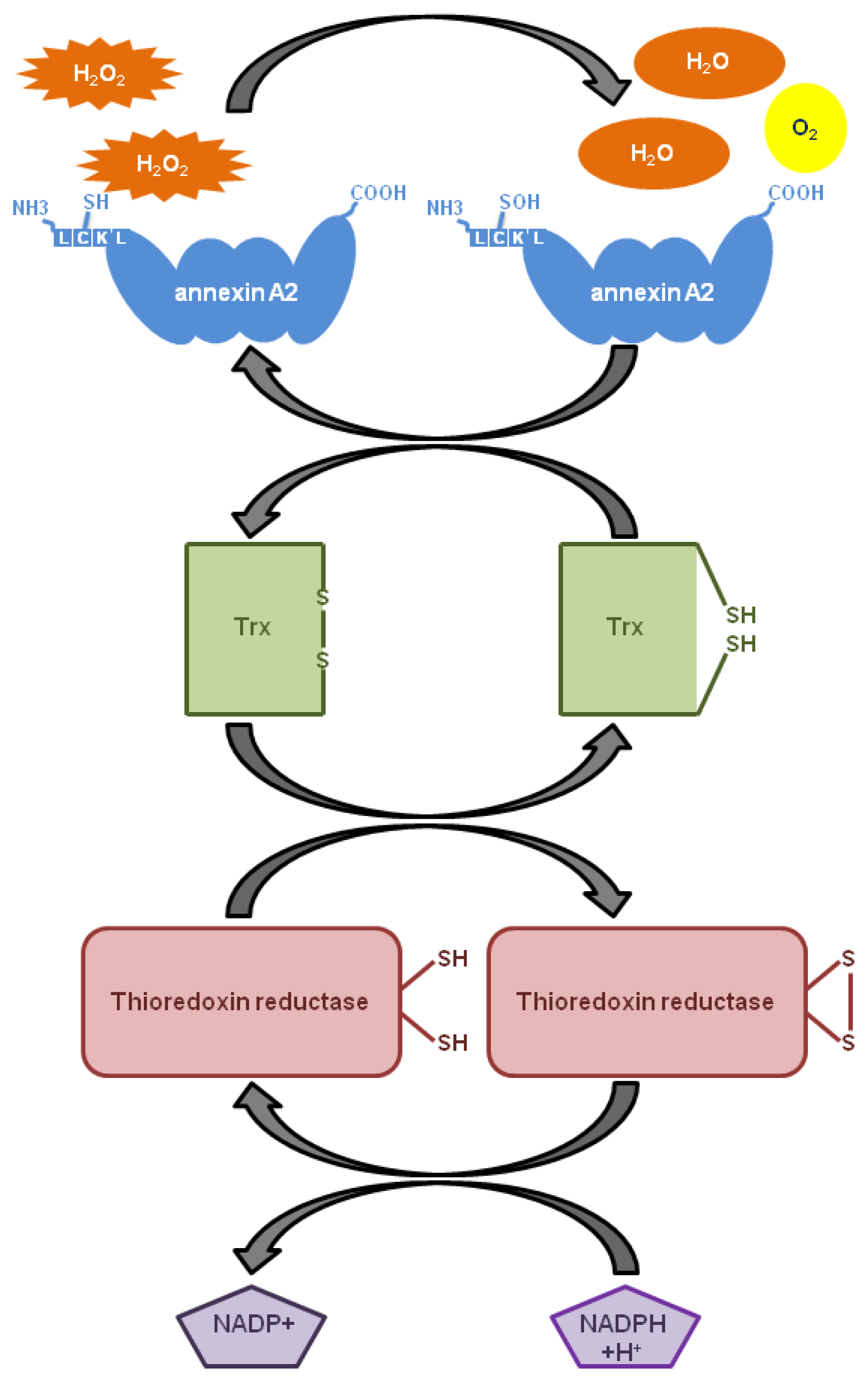
Hydrogen peroxide (H2O2) is an important second messenger in cellular signal transduction. H2O2-dependent signalling regulates many cellular processes, such as proliferation, differentiation, migration and apoptosis. Nevertheless, H2O2 is an oxidant and a major contributor to DNA damage, protein oxidation and lipid peroxidation, which can ultimately result in cell death and/or tumourigenesis. For this reason, cells have developed complex antioxidant systems to scavenge ROS. Recently, our laboratory identified the protein, annexin A2, as a novel cellular redox regulatory protein. Annexin A2 possesses a reactive cysteine residue (Cys-8) that is readily oxidized by H2O2 and subsequently reduced by the thioredoxin system, thereby enabling annexin A2 to participate in multiple redox cycles. Thus, a single molecule of annexin A2 can inactivate several molecules of H2O2. In this report, we will review the studies detailing the reactivity of annexin A2 thiols and the importance of these reactive cysteine(s) in regulating annexin A2 structure and function. We will also focus on the recent reports that establish novel functions for annexin A2, namely as a protein reductase and as a cellular redox regulatory protein. We will further discuss the importance of annexin A2 redox regulatory function in disease, with a particular focus on tumour progression.
Keywords: redox; reactive oxygen species (ROS); annexin A2; tumourigenesis; hydrogen peroxide (H2O2); reactive cysteine; glutathionylation; thiolate anion redox; reactive oxygen species (ROS); annexin A2; tumourigenesis; hydrogen peroxide (H2O2); reactive cysteine; glutathionylation; thiolate anion