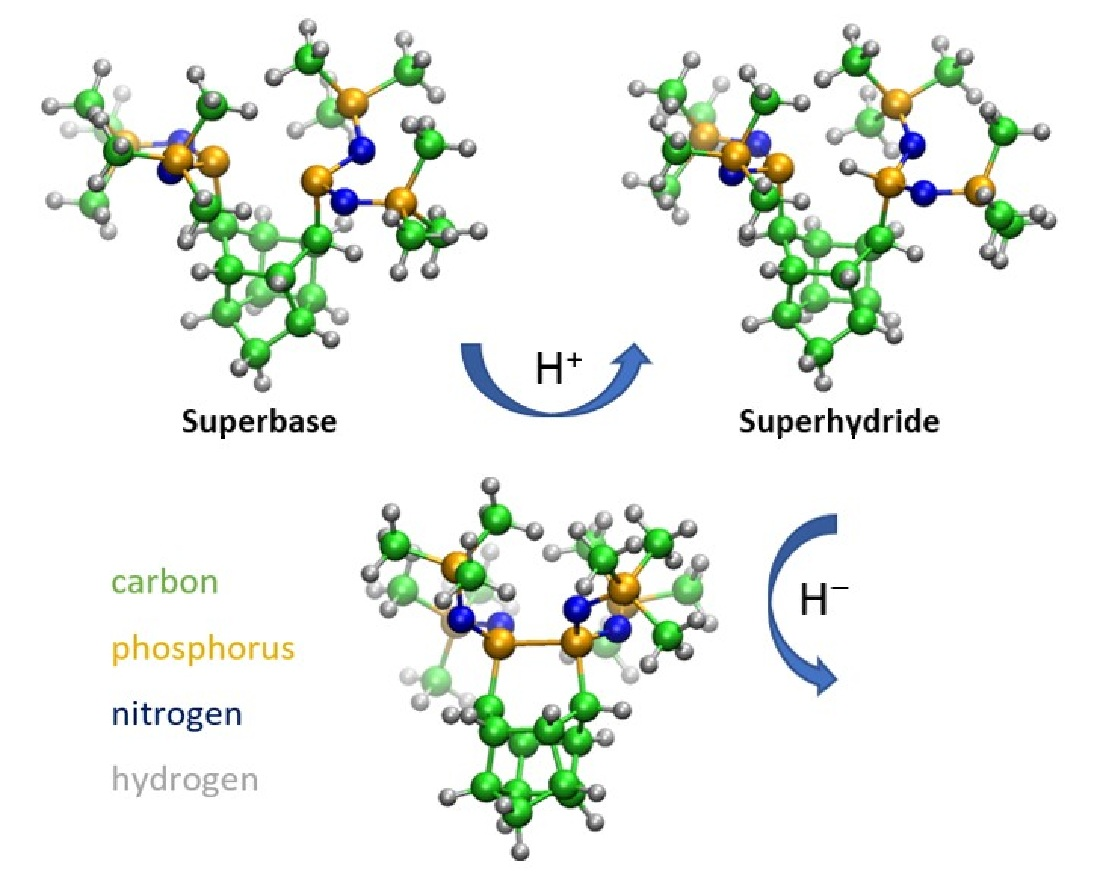
Bis(phosphazenyl)phosphines: From Superbases to Superhydrides †


Abstract
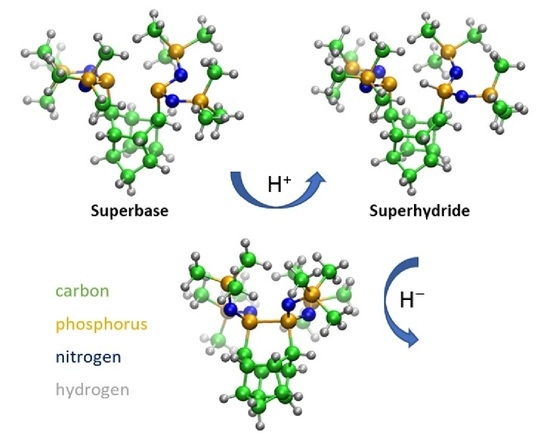
1. Introduction
2. Results and Discussion
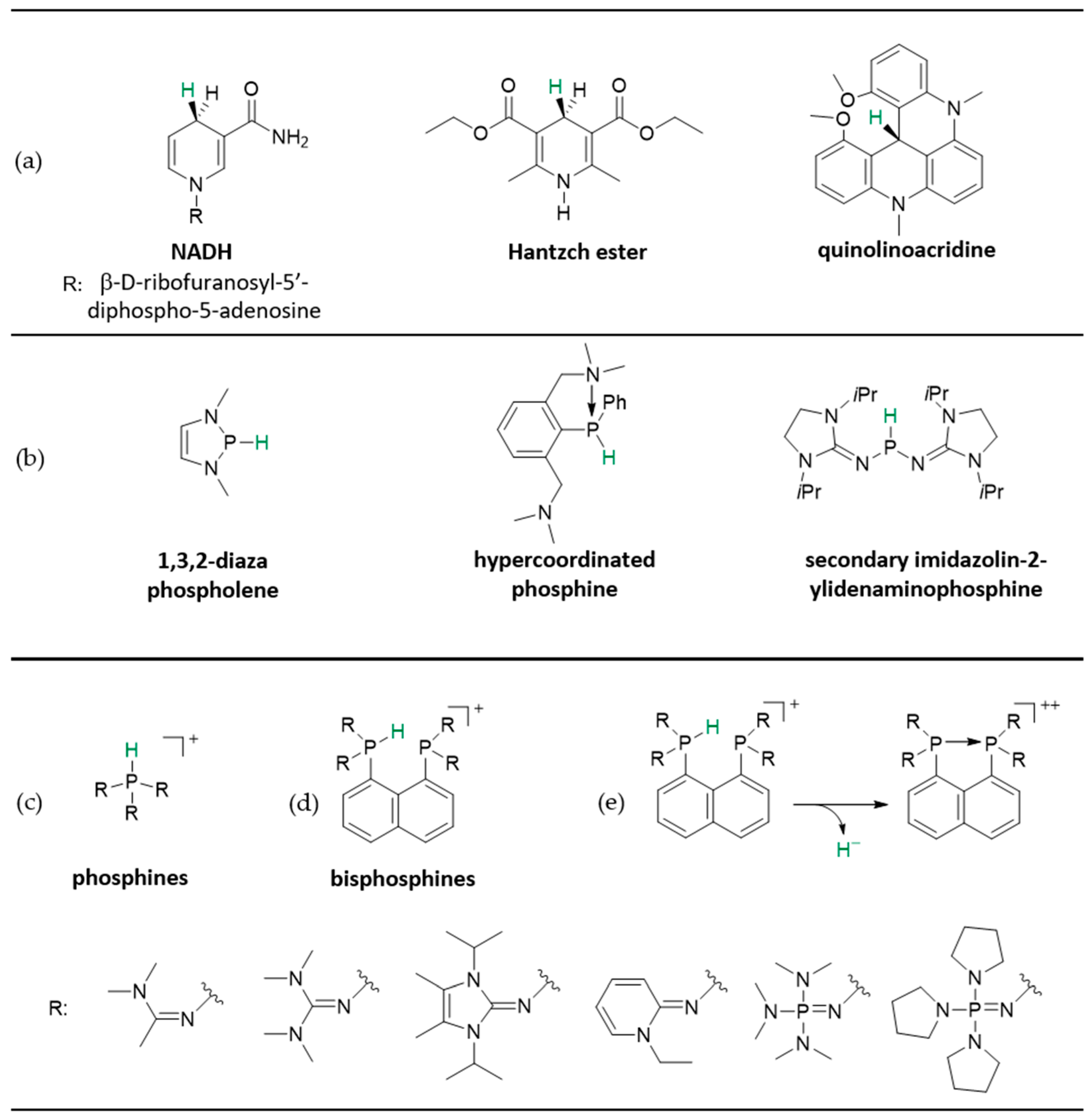
2.1. Superhydricity of Monoprotonated Bis(phosphazenyl)phosphines
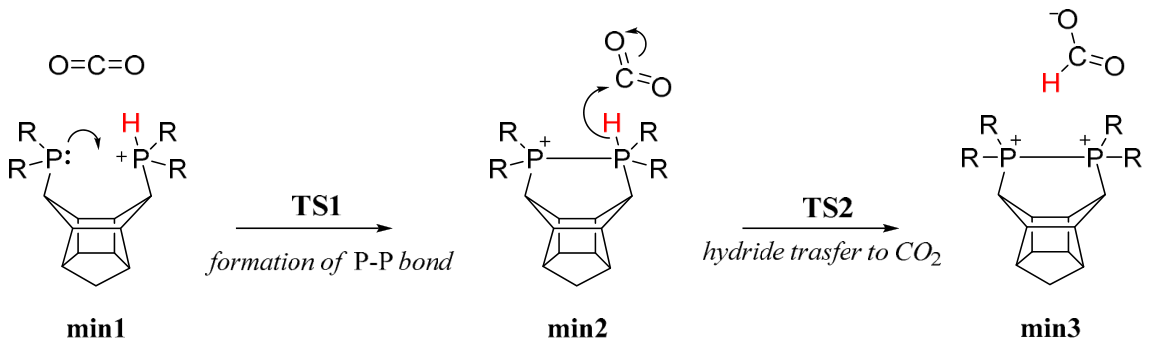
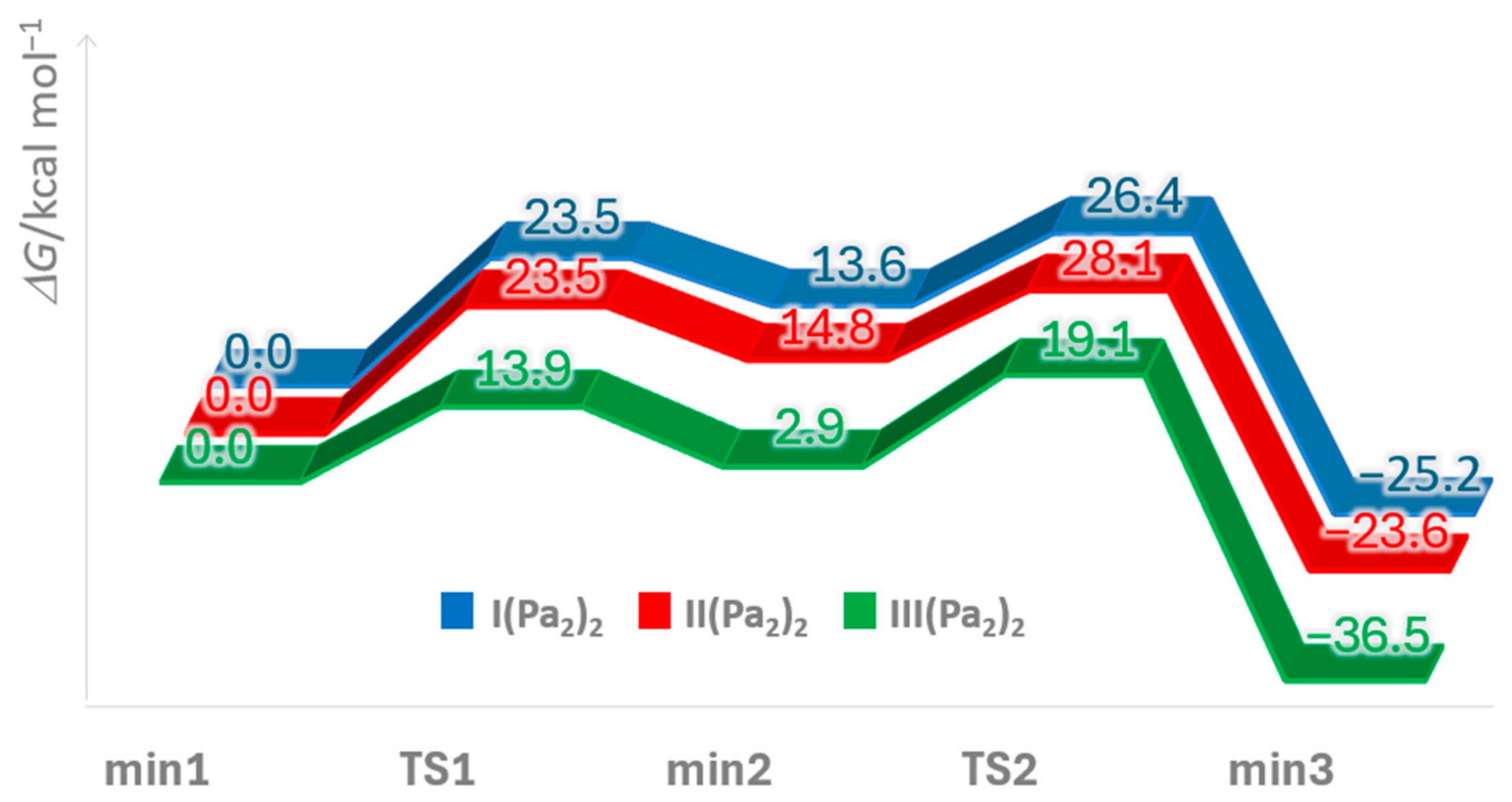
2.2. CO2 Reduction to Formate
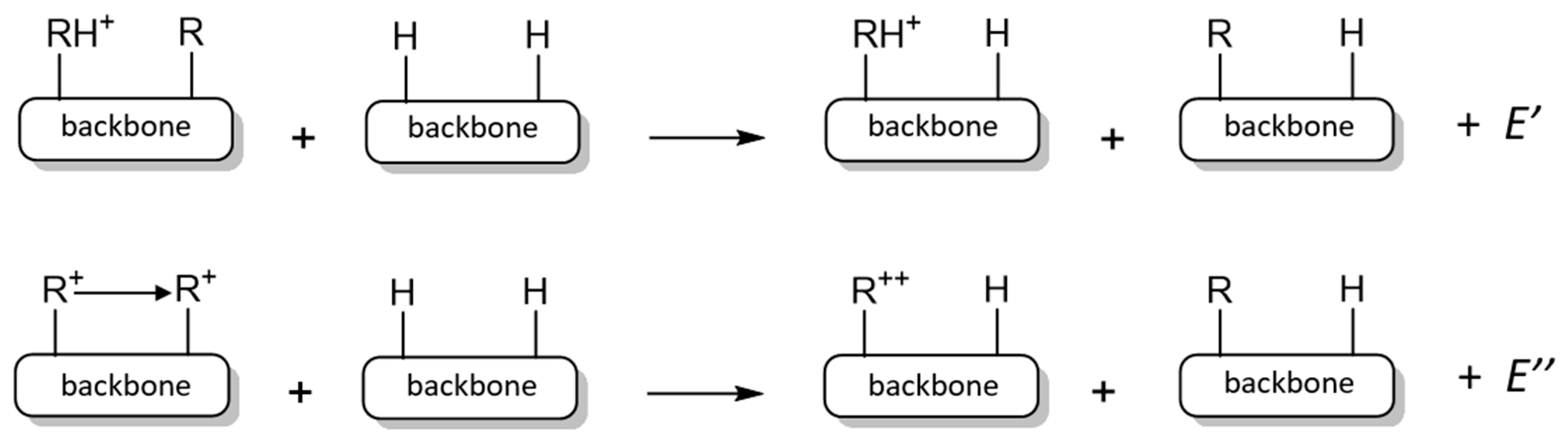
2.3. Superhydricity of Bis(phosphazenyl)phosphines
3. Materials and Methods
Computational Details
4. Conclusions
Supplementary Materials
Author Contributions
Funding
Institutional Review Board Statement
Informed Consent Statement
Data Availability Statement
Acknowledgments
Conflicts of Interest
References
- Wiedner, E.S.; Chambers, M.B.; Pitman, C.L.; Bullock, R.M.; Miller, A.J.M.; Appel, A.M. Thermodynamic hydricity of transition metal hydrides. Chem. Rev. 2016, 116, 8655–8692. [Google Scholar] [CrossRef] [Scilit] [PubMed]
- Brereton, K.R.; Smith, N.E.; Hazari, N.; Miller, A.J.M. Thermodynamic and kinetic hydricity of transition metal hydrides. Chem. Soc. Rev. 2020, 49, 7929–7948. [Google Scholar] [CrossRef] [Scilit]
- Zheng, C.; You, S.-L. Transfer hydrogenation with Hantzsch esters and related organic hydride donors. Chem. Soc. Rev. 2012, 41, 2498–2518. [Google Scholar] [CrossRef] [Scilit]
- Archipowa, N.; Kutta, R.J.; Heyes, D.J.; Scrutton, N.S. Stepwise hydride transfer in a biological system: Insights into the reaction mechanism of the light-dependent protochlorophyllide oxidoreductase. Angew. Chem. Int. Ed. 2018, 57, 2682–2686. [Google Scholar] [CrossRef] [Scilit] [PubMed]
- Yang, W.; Chernyshov, I.Y.; van Schendel, R.K.A.; Weber, M.; Müller, C.; Filonenko, G.A.; Pidko, E.A. Robust and efficient hydrogenation of carbonyl compounds catalysed by mixed donor Mn(I) pincer complexes. Nat. Commun. 2021, 12, 12. [Google Scholar] [CrossRef] [Scilit] [PubMed]
- de Vries, J.G.; Mršić, N. Organocatalytic asymmetric transfer hydrogenation of imines. Catal. Sci. Technol. 2011, 1, 727–735. [Google Scholar] [CrossRef] [Scilit]
- Ilic, S.; Gesiorski, J.L.; Weerasooriya, R.B.; Glusac, K.D. Biomimetic metal-free hydride donor catalysts for CO2 reduction. Acc. Chem. Res. 2022, 55, 844–856. [Google Scholar] [CrossRef] [Scilit]
- Pospech, J.; Fleischer, I.; Franke, R.; Buchholz, S.; Beller, M. Alternative metals for homogeneous catalyzed hydroformylation reactions. Angew. Chem. Int. Ed. 2013, 52, 2852–2872. [Google Scholar] [CrossRef] [Scilit]
- McGrady, G.S.; Guilera, G. The multifarious world of transition metal hydrides. Chem. Soc. Rev. 2003, 32, 383–392. [Google Scholar] [CrossRef] [Scilit]
- Paik, J.; Choe, J.H.; Padmanaban, S.; Seo, M.; Yoo, C.J.; Lee, H.B.; Lee, Y. Thermodynamic hydricity of a ruthenium CO2 hydrogenation catalyst supported by a rigid PNP pincer. JACS Au 2025, 5, 811–821. [Google Scholar] [CrossRef] [Scilit]
- Wang, Y.; Zhang, H.; Xie, S.; Sun, H.; Li, X.; Fenske, D. An air-stable N-heterocyclic [PSiP] pincer iron hydride complex: Synthesis and catalytic applications. Organometallics 2021, 40, 1234–1242. [Google Scholar]
- Eberhardt, N.A.; Guan, H. Nickel hydride complexes. Chem. Rev. 2016, 116, 8373–8426. [Google Scholar] [CrossRef] [Scilit]
- Malaza, S.S.P.; Makhubela, B.C.E. Direct and indirect CO2 hydrogenation catalyzed by Ir(III), Rh(III), Ru(II), and Os(II) half-sandwich complexes to generate formates and N,N-diethylformamide. J. CO2 Util. 2020, 39, 101149. [Google Scholar] [CrossRef] [Scilit]
- Siek, S.; Burks, D.B.; Gerlach, D.L.; Liang, G.; Tesh, J.M.; Thompson, C.R.; Qu, F.; Shankwitz, J.E.; Vasquez, R.M.; Chambers, N.; et al. Iridium and ruthenium complexes of N-heterocyclic carbene- and pyridinol-derived chelates as catalysts for aqueous carbon dioxide hydrogenation and formic acid dehydrogenation: The role of the alkali metal. Organometallics 2017, 36, 1091–1106. [Google Scholar] [CrossRef] [Scilit]
- Tawalbeh, M.; Javed, R.M.N.; Al Othman, A.; Almomani, F.; Ajith, S. Unlocking the potential of CO2 hydrogenation into valuable products using noble metal catalysts: A comprehensive review. Environ. Technol. Innov. 2023, 31, 103217. [Google Scholar] [CrossRef] [Scilit]
- Mayer, R.J.; Moran, J. Quantification of the hydride donor abilities of NADH, NADPH, and BH3CN− in water. Org. Biomol. Chem. 2023, 21, 85–88. [Google Scholar] [CrossRef] [Scilit]
- Golub, I.E.; Filippov, O.A.; Belkova, N.V.; Epstein, L.M.; Shubina, E.S. Hydride donating abilities of the tetracoordinated boron hydrides. J. Organomet. Chem. 2018, 865, 247–256. [Google Scholar] [CrossRef] [Scilit]
- Heiden, Z.M.; Lathem, A.P. Establishing the hydride donor abilities of main group hydrides. Organometallics 2015, 34, 1818–1827. [Google Scholar] [CrossRef] [Scilit]
- Herrera, R.P. Organocatalytic transfer hydrogenation and hydrosilylation reactions. Top. Curr. Chem. 2016, 374, 29. [Google Scholar] [CrossRef] [Scilit]
- Khan, N.; van Ingen, Y.; Boruah, T.; McLauchlan, A.; Wirth, T.; Melen, R.L. Advances in CO2 activation by frustrated Lewis pairs: From stoichiometric to catalytic reactions. Chem. Sci. 2023, 14, 13661–13695. [Google Scholar] [CrossRef] [Scilit] [PubMed]
- Karaghiosoff, K.; Majoral, J.-P.; Meriem, A.; Navech, J.; Schmidpeter, A. 1,3,2-Diazaphosphole derivatives from the reaction of PCln(NR2)3−n with diaminomaleonitrile. Tetrahedron Lett. 1983, 24, 2137–2140. [Google Scholar] [CrossRef] [Scilit]
- Burck, S.; Gudat, D.; Nieger, M.; Du Mont, W.W. P-hydrogen-substituted 1,3,2-diazaphospholenes: Molecular hydrides. J. Am. Chem. Soc. 2006, 128, 3946–3955. [Google Scholar] [CrossRef] [Scilit]
- Reed, J.H.; Klett, J.; Steven, C.; Cramer, N. Stay positive: Catalysis with 1,3,2-diazaphospholenes. Org. Chem. Front. 2020, 7, 3521–3529. [Google Scholar] [CrossRef] [Scilit]
- Gudat, D.; Haghverdi, A.; Nieger, M. Umpolung of P–H bonds. Angew. Chem. Int. Ed. 2000, 39, 3084–3086. [Google Scholar] [CrossRef]
- Carré, F.; Chuit, C.; Corriu, R.J.; Mehdi, A.; Reyé, C. N → P intramolecular stabilization of phosphenium ions and preparation of hypercoordinated phosphanes with unusual properties. J. Organomet. Chem. 1997, 529, 59−68. [Google Scholar] [CrossRef] [Scilit]
- Röthel, M.B.; Eder, T.; Brylak, F.; Seidl, M.; Löwe, P.; Dielmann, F. Secondary Phosphines Bearing N-Heterocyclic Imine Groups: Polarity Umpolung of Highly Electron-Rich P–H Bonds. Inorg. Chem. 2025, 64, 24134–24142. [Google Scholar] [CrossRef] [Scilit] [PubMed]
- Mehlmann, P.; Mück-Lichtenfeld, C.; Tan, T.T.Y.; Dielmann, F. Tris(imidazolin-2-ylidenamino)phosphine: A Crystalline Phosphorus(III) Superbase That Splits Carbon Dioxide. Chem. Eur. J. 2017, 23, 5929–5933. [Google Scholar] [CrossRef] [Scilit]
- Buß, F.; Röthel, M.B.; Werra, J.A.; Rotering, P.; Wilm, L.F.B.; Daniliuc, C.G.; Löwe, P.; Dielmann, F. Tris(tetramethylguanidinyl)phosphine: The Simplest Non-ionic Phosphorus Superbase and Strongly Donating Phosphine Ligand. Chem. Eur. J. 2021, 28, e202104021. [Google Scholar] [CrossRef] [Scilit]
- Rotering, P.; Wilm, L.F.B.; Werra, J.A.; Dielmann, F. Pyridinylidenaminophosphines: Facile Access to Highly Electron-Rich Phosphines. Chem. Eur. J. 2019, 26, 406–410. [Google Scholar] [CrossRef] [Scilit]
- Ullrich, S.; Kovačević, B.; Xie, X.; Sundermeyer, J. Phosphazenyl Phosphines: The Most Electron-Rich Uncharged Phosphorus Brønsted and Lewis Bases. Angew. Chem. Int. Ed. 2019, 58, 10335–10339. [Google Scholar] [CrossRef] [Scilit]
- Glasovac, Z.; Barić, D.; Despotović, I.; Kovačević, B. Phosphazenyl Phosphine Proton Sponges: Does the Proton-Chelating Effect Enhance Their Basicity? Int. J. Mol. Sci. 2025, 26, 5058. [Google Scholar] [CrossRef] [Scilit] [PubMed]
- Barić, D.; Damjanović, M.; Glasovac, Z.; Despotović, I.; Kovačević, B. Protonated Bisphosphines: A New Class of Powerful Hydride Donors Capable of CO2 Reduction. Chem. Commun. 2026, 62, 4833–4837. [Google Scholar] [CrossRef] [Scilit] [PubMed]
- Kögel, J.F.; Xie, X.; Baal, E.; Gesevičius, D.; Oelkers, B.; Kovačević, B.; Sundermeyer, J. Superbasic Alkyl-Substituted Bisphosphazene Proton Sponges: Synthesis, Structural Features, Thermodynamic and Kinetic Basicity, Nucleophilicity and Coordination Chemistry. Chem. Eur. J. 2014, 20, 7670–7685. [Google Scholar] [CrossRef] [Scilit]
- Saha, A.; Ganguly, B. Exploiting the (–C–H···C–) Interaction to Design Cage-Functionalized Organic Superbases and Hyperbases: A Computational Study. ACS Omega 2023, 8, 38546–38556. [Google Scholar] [CrossRef] [Scilit]
- Margetić, D.; Ishikawa, T.; Kumamoto, T. Exceptional Superbasicity of Bis(guanidine) Proton Sponges Imposed by the Bis(secododecahedrane) Molecular Scaffold: A Computational Study. Eur. J. Org. Chem. 2010, 2010, 6563–6572. [Google Scholar] [CrossRef] [Scilit]
- Vazdar, K.; Margetić, D.; Kovačević, B.; Sundermeyer, J.; Leito, I.; Jahn, U. Design of Novel Uncharged Organic Superbases: Merging Basicity and Functionality. Acc. Chem. Res. 2021, 54, 3108–3123. [Google Scholar] [CrossRef] [Scilit]
- Kögel, J.F.; Oelkers, B.; Kovačević, B.; Sundermeyer, J. A New Synthetic Pathway to the Second and Third Generation of Superbasic Bisphosphazene Proton Sponges: The Run for the Best Chelating Ligand for a Proton. J. Am. Chem. Soc. 2013, 135, 17768–17774. [Google Scholar] [CrossRef] [Scilit]
- Del Bene, J.E.; Elguero, J.; Alkorta, I. Probing P–H+–P Hydrogen Bonds: Structures, Binding Energies, and Spin–Spin Coupling Constants. J. Phys. Chem. A 2007, 111, 3416–3422. [Google Scholar] [CrossRef] [Scilit] [PubMed]
- Haav, K.; Saame, J.; Kutt, A.; Leito, I. Basicity of Phosphanes and Diphosphanes in Acetonitrile. Eur. J. Org. Chem. 2012, 2012, 2167–2172. [Google Scholar] [CrossRef] [Scilit]
- Barić, D.; Dragičević, I.; Kovačević, B. Design of Superbasic Guanidines: The Role of Multiple Intramolecular Hydrogen Bonds. J. Org. Chem. 2013, 78, 4075–4082. [Google Scholar] [CrossRef] [Scilit]
- Maksić, Z.; Kovačević, B.; Vianello, R. Advances in Determining the Absolute Proton Affinities of Neutral Organic Molecules in the Gas Phase and Their Interpretation: A Theoretical Account. Chem. Rev. 2012, 112, 5240–5270. [Google Scholar] [CrossRef] [Scilit]
- Raczyńska, E.D.; Gal, J.-F.; Maria, P.-C. Enhanced Basicity of Push–Pull Nitrogen Bases in the Gas Phase. Chem. Rev. 2016, 116, 13454–13511. [Google Scholar] [CrossRef] [Scilit]
- Despotović, I.; Kovačević, B.; Maksić, Z. Hyperstrong Neutral Organic Bases: Phosphazeno azacalix [3](2,6)pyridines. Org. Lett. 2007, 9, 4709–4712. [Google Scholar] [CrossRef] [Scilit]
- Frisch, M.J.; Trucks, G.W.; Schlegel, H.B.; Scuseria, G.E.; Robb, M.A.; Cheeseman, J.R.; Scalmani, G.; Barone, V.; Petersson, G.A.; Nakatsuji, H.; et al. Gaussian16 Revision A.03, 2016; Gaussian Inc.: Wallingford, CT, USA, 2016. [Google Scholar]
- Pracht, P.; Bohle, F.; Grimme, S. Automated exploration of the low-energy chemical space with fast quantum chemical methods. Phys. Chem. Chem. Phys. 2020, 22, 7169–7192. [Google Scholar] [CrossRef] [Scilit] [PubMed]
- Bannwarth, C.; Ehlert, S.; Grimme, S. GFN2-xTB—An Accurate and Broadly Parametrized Self-Consistent Tight-Binding Quantum Chemical Method with Multipole Electrostatics and Density-Dependent Dispersion Contributions. J. Chem. Theory Comput. 2019, 15, 1652–1671. [Google Scholar] [CrossRef] [Scilit] [PubMed]
- Chai, J.-D.; Head-Gordon, M. Long-range corrected hybrid density functionals with damped atom–atom dispersion corrections. Phys. Chem. Chem. Phys. 2008, 10, 6615–6620. [Google Scholar] [CrossRef] [Scilit]
- Chai, J.-D.; Head-Gordon, M. Systematic optimization of long-range corrected hybrid density functionals. J. Chem. Phys. 2008, 128, 084106. [Google Scholar] [CrossRef] [Scilit]
- Ditchfield, R.; Hehre, W.J.; Pople, J.A. Self-Consistent Molecular-Orbital Methods. IX. An Extended Gaussian-Type Basis for Molecular-Orbital Studies of Organic Molecules. J. Chem. Phys. 1971, 54, 724–728. [Google Scholar] [CrossRef] [Scilit]
- Cossi, M.; Rega, N.; Scalmani, G.; Barone, V. Energies, structures, and electronic properties of molecules in solution with the C-PCM solvation model. J. Comput. Chem. 2003, 24, 669. [Google Scholar] [CrossRef] [Scilit]
- Fifen, J.J.; Dhaouadi, Z.; Nsangou, M. Revision of the thermodynamics of the proton in gas phase. J. Phys. Chem. A 2014, 118, 11090–11097. [Google Scholar] [CrossRef] [Scilit]
- Sastre, S.; Casasnovas, R.; Muñoz, F.; Frau, J. Isodesmic reaction for accurate theoretical pKa calculations of amino acids and peptides. Phys. Chem. Chem. Phys. 2016, 18, 11202–11212. [Google Scholar] [CrossRef] [Scilit]



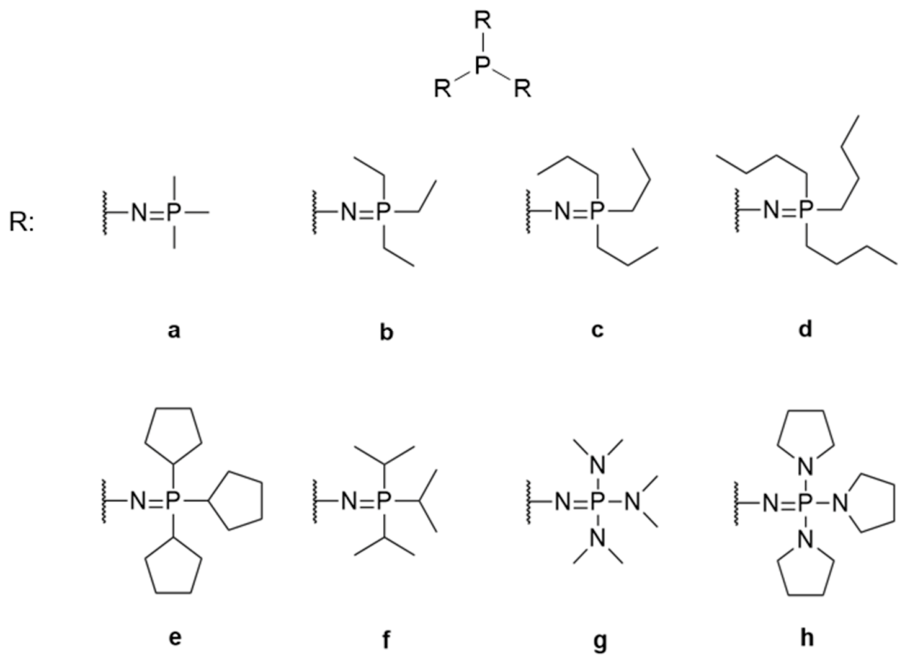
| PR3 R= | a | b | c | d | e | f | g | h |
|---|---|---|---|---|---|---|---|---|
| 77.4 | 78.6 | 77.9 | 77.1 | 77.3 | 75.1 | 76.8 | 73.0 |
| Backbone | Molecule | Molecule | ||
|---|---|---|---|---|
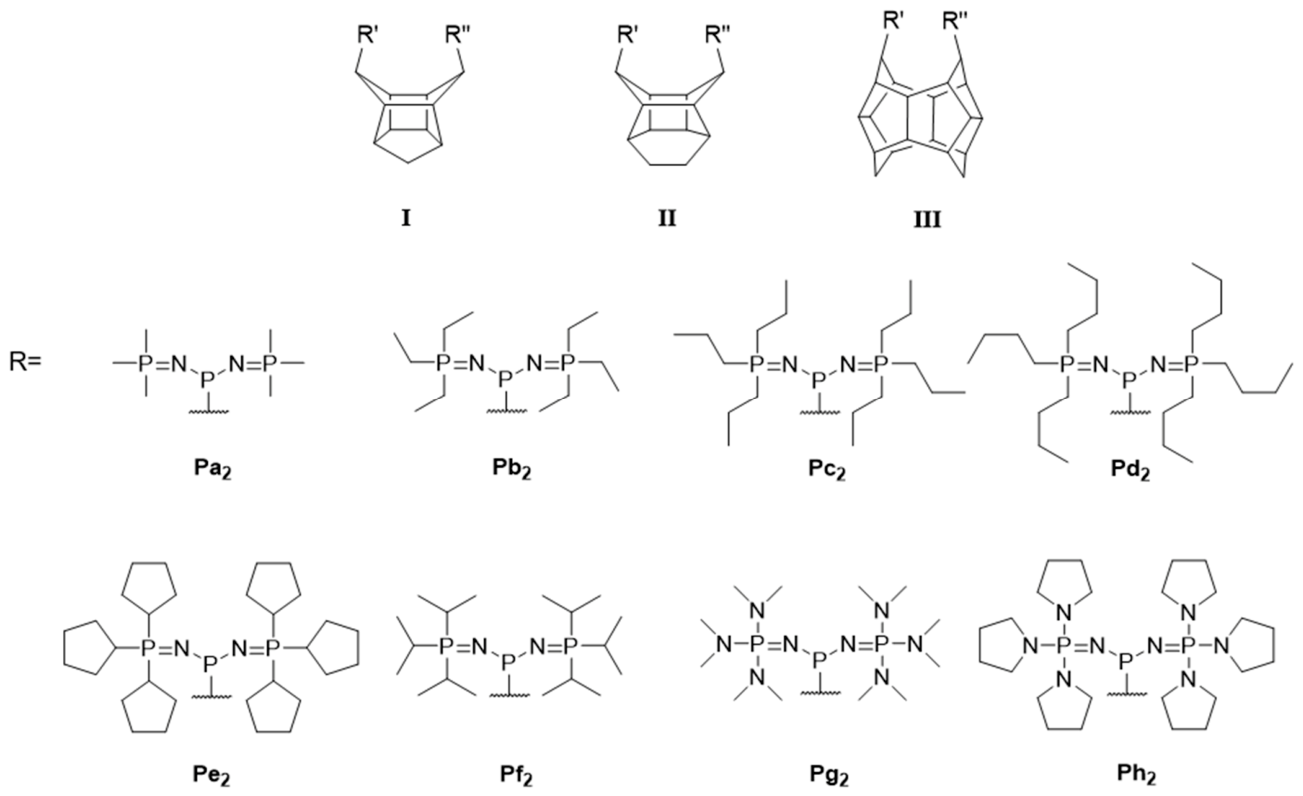
| I | R′ = R″ = Pa2 | 20.4 | R′ = H, R″= Pa2 | 88.7 |
| R′ = R″ = Pb2 | 14.9 | R′ = H, R″= Pb2 | 88.8 | |
| R′ = R″ = Pc2 | 14.2 | R′ = H, R″= Pc2 | 87.8 | |
| R′ = R″ = Pd2 | 12.6 | R′ = H, R″ = Pd2 | 86.5 | |
| R′ = R″ = Pe2 | 29.3 | R′ = H, R″ = Pe2 | 88.5 | |
| R′ = R″ = Pf2 | 25.9 | R′ = H, R″ = Pf2 | 88.5 | |
| R′ = R″ = Pg2 | 18.8 | R′ = H, R″ = Pg2 | 88.3 | |
| R′ = R″ = Ph2 | 13.9 | R′ = H, R″ = Ph2 | 88.0 | |
| II | R′ = R″ = Pa2 | 18.8 | R′ = H, R″ = Pa2 | 87.9 |
| R′ = R″ = Pb2 | 9.9 | R′ = H, R″ = Pb2 | 88.2 | |
| R′= R″ = Pc2 | 11.9 | R′ = H, R″ = Pc2 | 88.9 | |
| R′ = R″ = Pd2 | 10.0 | R′ = H, R″ = Pd2 | 87.8 | |
| R′ = R″ = Pe2 | 24.0 | R′ = H, R″ = Pe2 | 87.4 | |
| R′ = R″ = Pf2 | 25.1 | R′ = H, R″ = Pf2 | 87.1 | |
| R′ = R″ = Pg2 | 14.9 | R′ = H, R″ = Pg2 | 86.9 | |
| R′ = R″ = Ph2 | 12.3 | R′ = H, R″ = Ph2 | 85.7 | |
| III | R′ = R″ = Pa2 | 7.5 | R′ = H, R″ = Pa2 | 85.2 |
| R′ = R″ = Pb2 | 3.5 | R′ = H, R″ = Pb2 | 84.9 | |
| R′ = R″ = Pc2 | 7.5 | R′ = H, R″ = Pc2 | 86.2 | |
| R′ = R″ = Pd2 | 0.8 | R′ = H, R″ = Pd2 | 86.3 | |
| R′ = R″ = Pe2 | 17.7 | R′ = H, R″= Pe2 | 86.4 | |
| R′ = R″ = Pf2 | 16.8 | R′ = H, R″= Pf2 | 84.4 | |
| R′ = R″ = Pg2 | 7.9 | R′ = H, R″= Pg2 | 86.7 | |
| R′ = R″ = Ph2 | 0.9 | R′ = H, R″= Ph2 | 84.3 |
| Bisphosphine | E′ | E″ | ||||
|---|---|---|---|---|---|---|
| R′ = R″ | I | II | III | I | II | III |
| Pa2 | 1.1 | 1.7 | 8.9 | −67.3 | −67.3 | −68.6 |
| Pb2 | 4.5 | 7.5 | 11.6 | −69.4 | −70.9 | −69.7 |
| Pc2 | 4.1 | 5.2 | 7.8 | −69.5 | −71.8 | −70.9 |
| Pd2 | 0.5 | 2.2 | 6.2 | −73.4 | −71.5 | −79.1 |
| Pe2 | −6.2 | −2.3 | 8.1 | −65.3 | −65.7 | −60.6 |
| Pf2 | 3.3 | 1.5 | 9.9 | −59.3 | −60.5 | −57.6 |
| Pg2 | 2.3 | 3.3 | 8.2 | −67.2 | −68.7 | −70.5 |
| Ph2 | −1.5 | −1.2 | 11.1 | −75.7 | −74.6 | −72.3 |
| Backbone | Bisphosphine | Proton Affinity (PA) and Gas Basicity (GB) | pKBH+ Values | ||||
|---|---|---|---|---|---|---|---|
| R1=R2= | PA(1) | PA(2) | GB(1) | GB(2) | pKBH+(1) | pKBH+(2) | |
| I | Pa2 | 287.6 | 217.0 | 280.6 | 211.8 | 38.0 | 27.2 |
| Pb2 | 290.5 | 230.4 | 283.7 | 223.1 | 41.4 | 30.5 | |
| Pc2 | 279.6 | 232.4 | 273.2 | 226.4 | 41.1 | 32.2 | |
| Pd2 | 294.8 | 230.1 | 285.9 | 222.5 | 37.5 | 31.3 | |
| Pe2 | 300.9 | 236.4 | 293.2 | 228.9 | 47.1 | 31.4 | |
| Pf2 | 296.7 | 236.0 | 289.4 | 229.1 | 42.8 | 34.5 | |
| Pg2 | 293.2 | 230.1 | 285.4 | 223.9 | 41.8 | 30.8 | |
| Ph2 | 299.0 | 239.2 | 293.0 | 230.2 | 44.3 | 32.8 | |
| II | Pa2 | 287.5 | 217.0 | 280.8 | 211.6 | 38.4 | 25.8 |
| Pb2 | 286.2 | 233.5 | 279.7 | 226.2 | 41.0 | 32.5 | |
| Pc2 | 292.0 | 231.8 | 283.4 | 225.3 | 38.8 | 30.7 | |
| Pd2 | 288.5 | 234.7 | 281.5 | 226.1 | 41.5 | 30.1 | |
| Pe2 | 298.1 | 235.3 | 290.2 | 229.4 | 46.9 | 30.2 | |
| Pf2 | 296.8 | 233.9 | 288.4 | 227.6 | 44.8 | 33.4 | |
| Pg2 | 294.4 | 230.3 | 285.8 | 225.5 | 41.3 | 30.9 | |
| Ph2 | 300.9 | 231.7 | 291.7 | 233.2 | 42.6 | 30.9 | |
| III | Pa2 | 286.0 | 219.0 | 280.0 | 211.6 | 37.1 | 28.7 |
| Pb2 | 291.6 | 224.6 | 284.2 | 218.3 | 40.7 | 39.4 | |
| Pc2 | 291.0 | 229.2 | 286.3 | 220.9 | 40.7 | 28.7 | |
| Pd2 | 291.5 | 231.2 | 284.1 | 226.5 | 39.8 | 30.1 | |
| Pe2 | 298.4 | 237.5 | 290.2 | 230.4 | 44.9 | 31.5 | |
| Pf2 | 296.2 | 238.9 | 288.7 | 231.9 | 44.3 | 36.5 | |
| Pg2 | 297.2 | 232.2 | 290.3 | 226.0 | 40.6 | 32.5 | |
| Ph2 | 295.6 | 247.9 | 286.8 | 242.9 | 41.6 | 32.1 | |
Disclaimer/Publisher’s Note: The statements, opinions and data contained in all publications are solely those of the individual author(s) and contributor(s) and not of MDPI and/or the editor(s). MDPI and/or the editor(s) disclaim responsibility for any injury to people or property resulting from any ideas, methods, instructions or products referred to in the content. |
© 2026 by the authors. Licensee MDPI, Basel, Switzerland. This article is an open access article distributed under the terms and conditions of the Creative Commons Attribution (CC BY) license.
Share and Cite
Damjanović, M.; Kovačević, B. Bis(phosphazenyl)phosphines: From Superbases to Superhydrides. Molecules 2026, 31, 1535. https://doi.org/10.3390/molecules31091535
Damjanović M, Kovačević B. Bis(phosphazenyl)phosphines: From Superbases to Superhydrides. Molecules. 2026; 31(9):1535. https://doi.org/10.3390/molecules31091535
Chicago/Turabian StyleDamjanović, Mario, and Borislav Kovačević. 2026. "Bis(phosphazenyl)phosphines: From Superbases to Superhydrides" Molecules 31, no. 9: 1535. https://doi.org/10.3390/molecules31091535
APA StyleDamjanović, M., & Kovačević, B. (2026). Bis(phosphazenyl)phosphines: From Superbases to Superhydrides. Molecules, 31(9), 1535. https://doi.org/10.3390/molecules31091535