The Influence of Wood-Derived Compounds on the Quality of Alcoholic Beverages


Abstract
1. Introduction
2. Objectives
3. Methods
4. The Chemical Composition of the Wood Used to Make Barrels

| Wood Component, Decomposition Temperature | Structural Unit of a Chemical Compound | Main Thermal Decomposition Products | References |
|---|---|---|---|
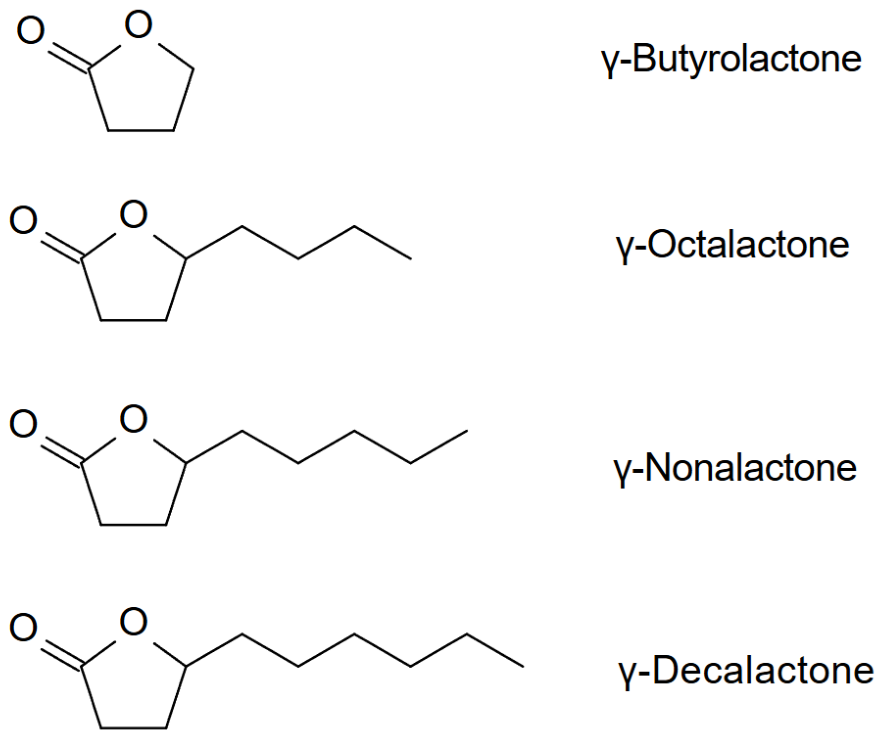
| Hemicelluloses 150–260 °C | sugars: glucose, xylose, mannose, galactose sugar acids: glucuronic and galacturonic acid | furfural, hydroxymethylfurfural, formic, acetic, and propionic acid, formaldehyde, acetaldehyde, hydroxyacetaldehyde, γ-butyrolactone, and other low molecular weight lactones | [23,24,32] |
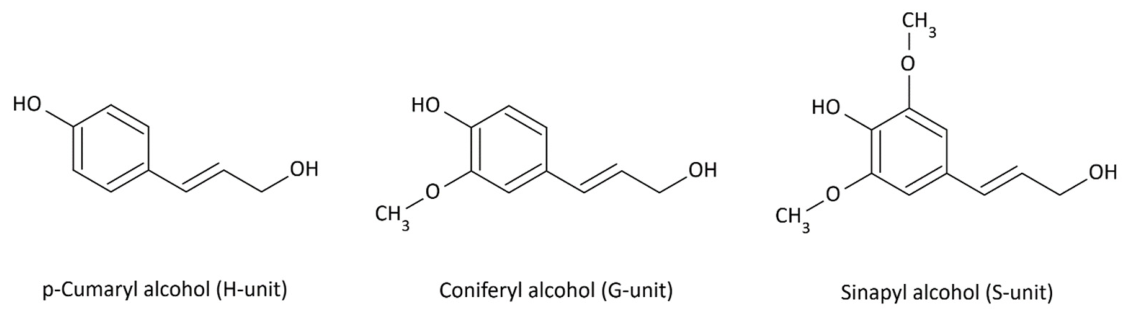
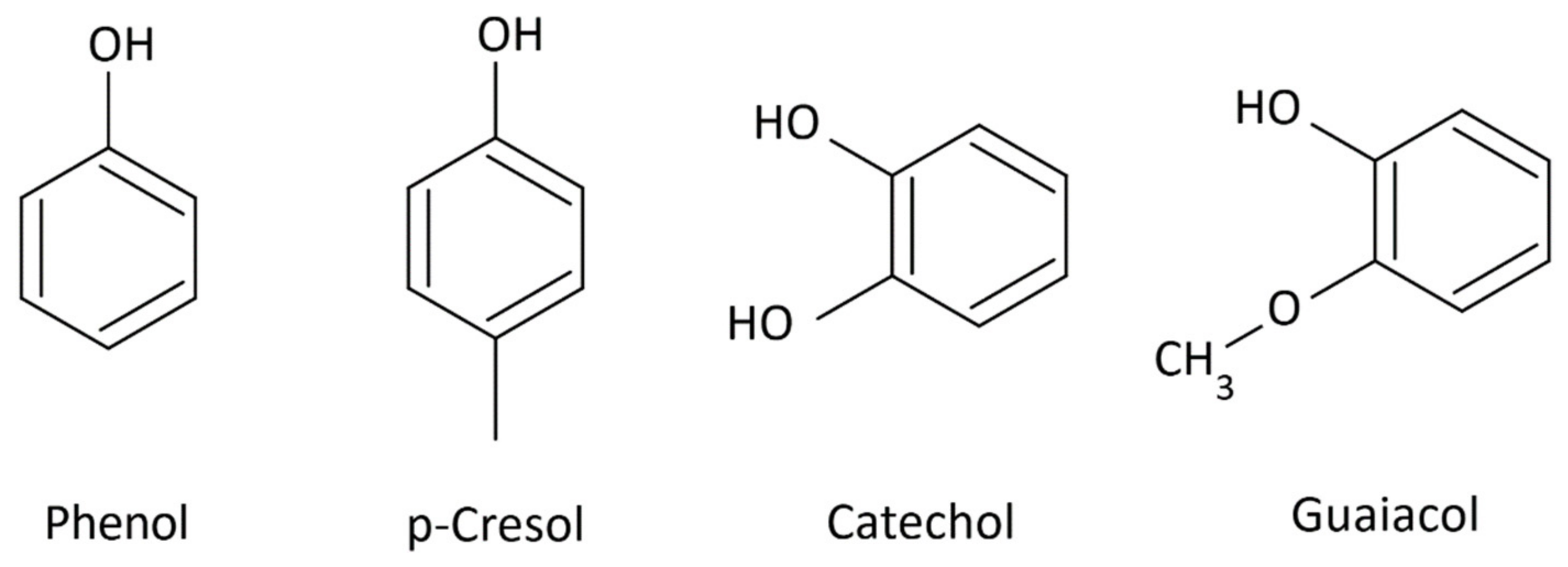
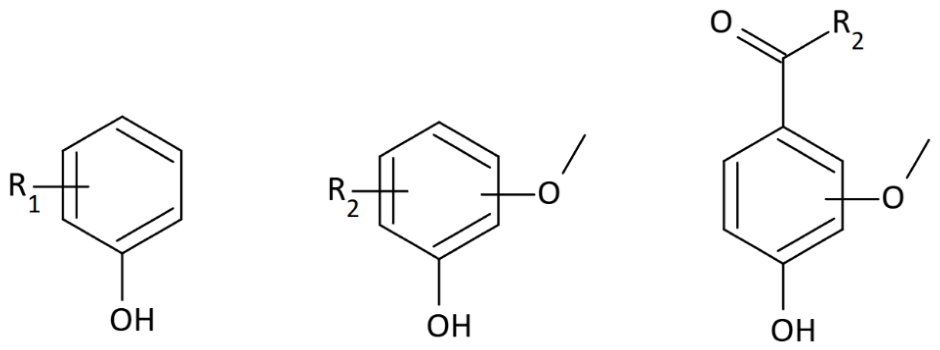
| Lignin 200–500 °C | p-coumaryl alcohol (H-unit) | phenol, methylphenols, alkylphenols, p-hydroxybenzaldehyde, p-hydroxybenzoic acid, p-hydroxyphenol | [29,30,31] |
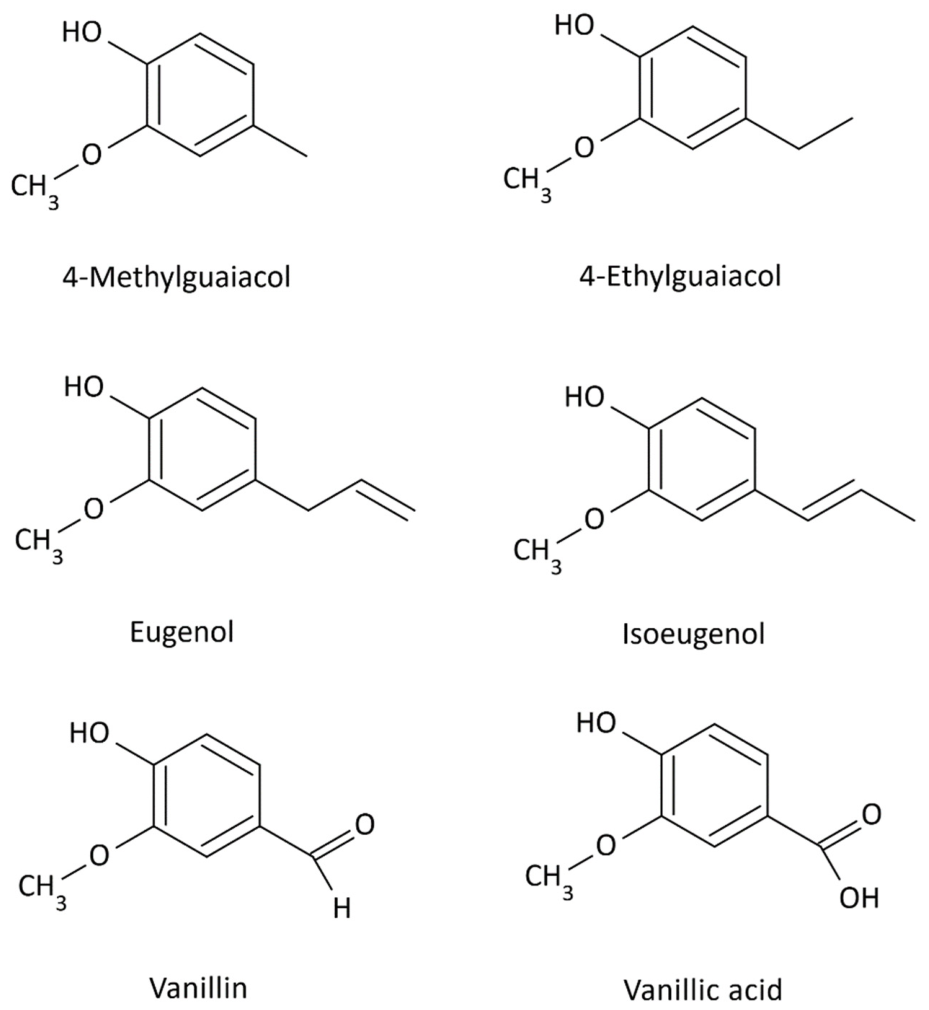
| coniferyl alcohol (G-unit) | guaiacol, methylguaiacol, ethyl guaiacol, vinyl guaiacol, vanillin, vanillic acid | ||
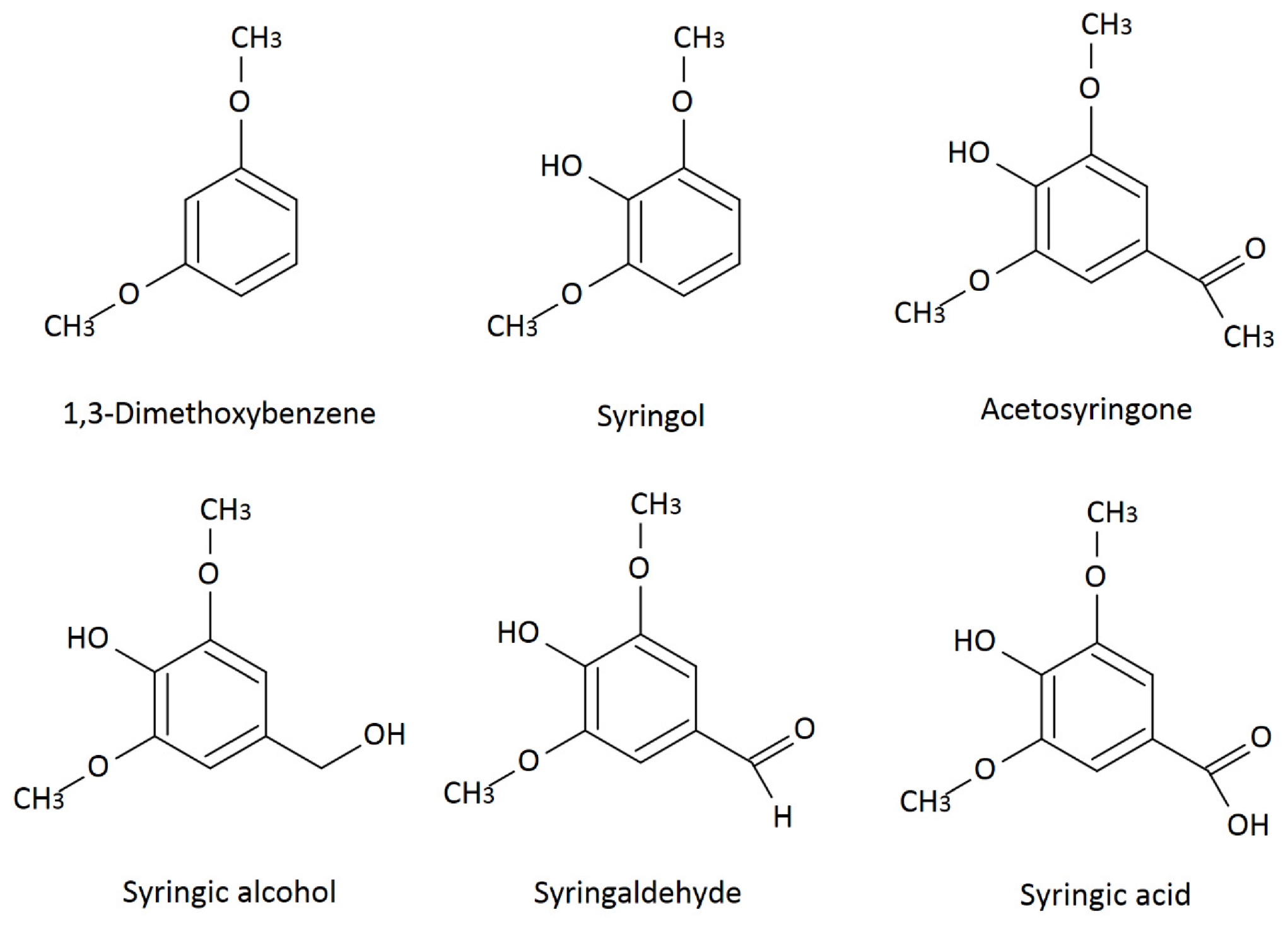
| sinapyl alcohol (S-unit) | syringol, methylsyringol, ethylsyringol, vinylsyringol, acetosyringone, propylsyringone, syringaldehyde, syringic acid | ||
| Cellulose 260–450 °C | glucose | aldehydes, furans, acids, α- pyranone, levoglucosenone, phenol, benzene, ethylbenzene, p-xylene, o-cresol, styrene | [27,33] |
| Sugars 180–450 °C | glucose, fructose, sucrose, xylose, arabinose, galactose | aldehydes, furans, maltol, acids | [11,33,34] |
| Polyphenols | ellagic and gallic acid derivatives | pyrogallol, catechol, resorcinol, phenol | [35,36,37,38,39,40] |
| Acids (lipids) | fatty acids | aldehydes and ketones, lactones, short-chain acids | [41,42,43,44,45,46,47] |
5. The Importance of Wood-Derived Compounds in the Production of Alcoholic Beverages
5.1. Wines
5.2. Beer
5.3. Spirits
5.3.1. Whisky (Or Whiskey)
5.3.2. Brandy
5.3.3. Cachaça
6. Conclusions
Author Contributions
Funding
Data Availability Statement
Conflicts of Interest
References
- Duval, C.J.; Sok, N.; Laroche, J.; Gourrat, K.; Prida, A.; Lequin, S.; Chassagne, D.; Gougeon, R.D. Dry vs Soaked Wood: Modulating the Volatile Extractible Fraction of Oak Wood by Heat Treatments. Food Chem. 2013, 138, 270–277. [Google Scholar] [CrossRef] [Scilit] [PubMed]
- Duval, C.J.; Gourrat, K.; Perre, P.; Prida, A.; Gougeon, R.D. A HS–SPME–GC–MS Analysis of IR Heated Wood: Impact of the Water Content on the Depth Profile of Oak Wood Aromas Extractability. Food Res. Int. 2013, 54, 277–284. [Google Scholar] [CrossRef] [Scilit]
- Del Alamo-Sanza, M.; Nevares, I. Oak Wine Barrel as an Active Vessel: A Critical Review of Past and Current Knowledge. Crit. Rev. Food Sci. Nutr. 2018, 58, 2711–2726. [Google Scholar] [CrossRef] [Scilit] [PubMed]
- Kainuma, G.; Mochizuki, A.; Watanabe-Saito, F.; Hisamoto, M.; Kusumoto, N.; de Revel, G.; Okuda, T. Understanding Wood Polysaccharide Depolymerization and Denaturation Under Different Toasting Conditions Through Analysis of Sugars Extracted from French Oak Chips. Beverages 2024, 10, 118. [Google Scholar] [CrossRef] [Scilit]
- Alañón, M.E.; Castro-Vázquez, L.; Díaz-Maroto, M.C.; Hermosín-Gutiérrez, I.; Gordon, M.H.; Pérez-Coello, M.S. Antioxidant Capacity and Phenolic Composition of Different Woods Used in Cooperage. Food Chem. 2011, 129, 1584–1590. [Google Scholar] [CrossRef] [Scilit]
- Slaghenaufi, D.; Marchand-Marion, S.; Richard, T.; Waffo-Teguo, P.; Bisson, J.; Monti, J.-P.; Merillon, J.-M.; de Revel, G. Centrifugal Partition Chromatography Applied to the Isolation of Oak Wood Aroma Precursors. Food Chem. 2013, 141, 2238–2245. [Google Scholar] [CrossRef] [Scilit]
- Courregelongue, M.; Shinkaruk, S.; Prida, A.; Darriet, P.; Pons, A. Identification and Distribution of New Impact Aldehydes in Toasted Oak Wood (Quercus petraea). J. Agric. Food Chem. 2022, 70, 11667–11677. [Google Scholar] [CrossRef] [Scilit]
- Híc, P.; Soural, I.; Balík, J.; Kulichová, J.; Vrchotová, N.; Triska, J. Antioxidant Capacities of Extracts in Relation to Toasting Oak and Acacia Wood. J. Food Nutr. Res. 2017, 56, 129–137. [Google Scholar]
- Chira, K.; Anguellu, L.; Da Costa, G.; Richard, T.; Pedrot, E.; Jourdes, M.; Teissedre, P.-L. New C-Glycosidic Ellagitannins Formed upon Oak Wood Toasting, Identification and Sensory Evaluation. Foods 2020, 9, 1477. [Google Scholar] [CrossRef] [Scilit]
- Guchu, E.; Díaz-Maroto, M.C.; Díaz-Maroto, I.J.; Vila-Lameiro, P.; Pérez-Coello, M.S. Influence of the Species and Geographical Location on Volatile Composition of Spanish Oak Wood (Quercus petraea Liebl. and Quercus robur L.). J. Agric. Food Chem. 2006, 54, 3062–3066. [Google Scholar] [CrossRef] [Scilit]
- Culleré, L.; Fernández de Simón, B.; Cadahía, E.; Ferreira, V.; Hernández-Orte, P.; Cacho, J. Characterization by Gas Chromatography-Olfactometry of the Most Odor-Active Compounds in Extracts Prepared from Acacia, Chestnut, Cherry, Ash and Oak Woods. LWT 2013, 53, 240–248. [Google Scholar] [CrossRef] [Scilit]
- Lu, H.; Cheng, B.; Lan, Y.; Duan, C.; He, F. Modifications in Aroma Characteristics of ‘Merlot’ Dry Red Wines Aged in American, French and Slovakian Oak Barrels with Different Toasting Degrees. Food Sci. Hum. Wellness 2024, 13, 381–391. [Google Scholar] [CrossRef] [Scilit]
- Le Floch, A.; Jourdes, M.; Teissedre, P.-L. Polysaccharides and Lignin from Oak Wood Used in Cooperage: Composition, Interest, Assays: A Review. Carbohydr. Res. 2015, 417, 94–102. [Google Scholar] [CrossRef] [Scilit] [PubMed]
- Gollihue, J.; Pook, V.G.; DeBolt, S. Sources of Variation in Bourbon Whiskey Barrels: A Review. J. Inst. Brew. 2021, 127, 210–223. [Google Scholar] [CrossRef] [Scilit]
- Horvath, A.L. Solubility of Structurally Complicated Materials: I. Wood. J. Phys. Chem. Ref. Data 2005, 35, 77–92. [Google Scholar] [CrossRef] [Scilit]
- Puech, J.-L. Extraction and Evolution of Lignin Products in Armagnac Matured in Oak. Am. J. Enol. Vitic. 1981, 32, 111–114. [Google Scholar] [CrossRef] [Scilit]
- Vivas, N.; Pianet, I.; Bourgeois, G.; Vitry, C.; Servens, C.; Glories, Y. Characterization of Heartwood Lignin Fractions from Quercus robur L. and Quercus petraea (Matt) Liebl., the Main Oak Species Used for Barrel Making. Am. J. Enol. Vitic. 1998, 49, 49–55. [Google Scholar] [CrossRef] [Scilit]
- Puech, J.-L. Characteristics of Oak Wood and Biochemical Aspects of Armagnac Aging. Am. J. Enol. Vitic. 1984, 35, 77–81. [Google Scholar] [CrossRef] [Scilit]
- Puech, J.-L. Extraction of Phenolic Compounds from Oak Wood in Model Solutions and Evolution of Aromatic Aldehydes in Wines Aged in Oak Barrels. Am. J. Enol. Vitic. 1987, 38, 236–238. [Google Scholar] [CrossRef] [Scilit]
- Poletto, M.; Zattera, A.J.; Santana, R.M.C. Structural Differences between Wood Species: Evidence from Chemical Composition, FTIR Spectroscopy, and Thermogravimetric Analysis. J. Appl. Polym. Sci. 2012, 126, E337–E344. [Google Scholar] [CrossRef] [Scilit]
- Sophonrat, N.; Wooldridge, M. Revisiting Biomass Compositions Determination Using Thermogravimetric Analysis and Independent Parallel Reaction Model. Thermochim. Acta 2024, 739, 179814. [Google Scholar] [CrossRef] [Scilit]
- Dahmen, N.; Wang, S.; Luo, Z. Pyrolysis of Biomass. Chem. Ing. Tech. 2017, 89, 1255–1256. [Google Scholar] [CrossRef] [Scilit]
- Zhou, X.; Li, W.; Mabon, R.; Broadbelt, L.J. A Critical Review on Hemicellulose Pyrolysis. Energy Technol. 2017, 5, 52–79. [Google Scholar] [CrossRef] [Scilit]
- Yaylayan, V.A.; Harty-Majors, S.; Ismail, A.A. Investigation of the Mechanism of Dissociation of Glycolaldehyde Dimer (2,5-Dihydroxy-1,4-Dioxane) by FTIR Spectroscopy. Carbohydr. Res. 1998, 309, 31–38. [Google Scholar] [CrossRef] [Scilit]
- Kubovský, I.; Kačíková, D.; Kačík, F. Structural Changes of Oak Wood Main Components Caused by Thermal Modification. Polymers 2020, 12, 485. [Google Scholar] [CrossRef] [Scilit]
- Yildiz, S.; Gümüşkaya, E. The Effects of Thermal Modification on Crystalline Structure of Cellulose in Soft and Hardwood. Build. Environ. 2007, 42, 62–67. [Google Scholar] [CrossRef] [Scilit]
- Wang, Q.; Song, H.; Pan, S.; Dong, N.; Wang, X.; Sun, S. Initial Pyrolysis Mechanism and Product Formation of Cellulose: An Experimental and Density Functional Theory (DFT) Study. Sci. Rep. 2020, 10, 3626. [Google Scholar] [CrossRef] [Scilit]
- Shen, Z.; Zhang, J.; Qi, C.; Mu, J. Wood Pyrolysis Modeling Based on the Pyrolysis Characteristics of Wood Extracted and Pseudo Components. Wood Sci. Technol. 2025, 59, 37. [Google Scholar] [CrossRef] [Scilit]
- Lu, X.; Gu, X. A Review on Lignin Pyrolysis: Pyrolytic Behavior, Mechanism, and Relevant Upgrading for Improving Process Efficiency. Biotechnol. Biofuels Bioprod. 2022, 15, 106. [Google Scholar] [CrossRef] [Scilit]
- Kawamoto, H. Lignin Pyrolysis Reactions. J. Wood Sci. 2017, 63, 117–132. [Google Scholar] [CrossRef] [Scilit]
- Lyu, G.; Wu, Q.; Li, T.; Jiang, W.; Ji, X.; Yang, G. Thermochemical Properties of Lignin Extracted from Willow by Deep Eutectic Solvents (DES). Cellulose 2019, 26, 8501–8511. [Google Scholar] [CrossRef] [Scilit]
- Moldoveanu, S. Chapter 9. Analytical Pyrolysis of Lignins. In Techniques and Instrumentation in Analytical Chemistry; Elsevier: Amsterdam, The Netherlands, 1998; Volume 20, pp. 327–351. [Google Scholar] [CrossRef] [Scilit]
- Chen, M.; Yu, H.; Wang, K.; Yao, B.; Zhang, D.; Cui, T.; Yue, Y.; Huo, W.; Ma, H.; Song, S.; et al. Study on the Thermal Decomposition Characteristics of Different Carbohydrates by TG-FTIR-GC/MS. Carbohydr. Res. 2025, 558, 109680. [Google Scholar] [CrossRef] [Scilit] [PubMed]
- Hale, M.D.; Mccafferty, K.; Larmie, E.; Newton, J.; Swan, J.S. The Influence of Oak Seasoning and Toasting Parameters on the Composition and Quality of Wine. Am. J. Enol. Vitic. 1999, 50, 495–502. [Google Scholar] [CrossRef] [Scilit]
- Cadahía, E.; Varea, S.; Muñoz, L.; Fernández De Simón, B.; García-Vallejo, M.C. Evolution of Ellagitannins in Spanish, French, and American Oak Woods during Natural Seasoning and Toasting. J. Agric. Food Chem. 2001, 49, 3677–3684. [Google Scholar] [CrossRef] [Scilit] [PubMed]
- Guillén, M.D.; Manzanos, M.J. Study of the Volatile Composition of an Aqueous Oak Smoke Preparation. Food Chem. 2002, 79, 283–292. [Google Scholar] [CrossRef] [Scilit]
- Glabasnia, A.; Hofmann, T. Identification and Sensory Evaluation of Dehydro- and Deoxy-Ellagitannins Formed upon Toasting of Oak Wood (Quercus alba L.). J. Agric. Food Chem. 2007, 55, 4109–4118. [Google Scholar] [CrossRef] [Scilit]
- Fujieda, M.; Tanaka, T.; Suwa, Y.; Koshimizu, S.; Kouno, I. Isolation and Structure of Whiskey Polyphenols Produced by Oxidation of Oak Wood Ellagitannins. J. Agric. Food Chem. 2008, 56, 7305–7310. [Google Scholar] [CrossRef] [Scilit]
- Fernández de Simón, B.; Sanz, M.; Cadahía, E.; Esteruelas, E.; Muñoz, A.M. Nontargeted GC–MS Approach for Volatile Profile of Toasting in Cherry, Chestnut, False Acacia, and Ash Wood. J. Mass Spectrom. 2014, 49, 353–370. [Google Scholar] [CrossRef] [Scilit]
- Abou Rjeily, M.; Cazier, F.; Gennequin, C.; Randrianalisoa, J.H. Detailed Analysis of Gas, Char and Bio-Oil Products of Oak Wood Pyrolysis at Different Operating Conditions. Waste Biomass Valor. 2023, 14, 325–343. [Google Scholar] [CrossRef] [Scilit]
- Jordão, A.M.; Ricardo-da-Silva, J.M.; Laureano, O.; Adams, A.; Demyttenaere, J.; Verhé, R.; De Kimpe, N. Volatile Composition Analysis by Solid-Phase Microextraction Applied to Oak Wood Used in Cooperage (Quercus pyrenaica and Quercus petraea): Effect of Botanical Species and Toasting Process. J. Wood Sci. 2006, 52, 514–521. [Google Scholar] [CrossRef] [Scilit]
- Díaz-Maroto, M.C.; Guchu, E.; Castro-Vázquez, L.; de Torres, C.; Pérez-Coello, M.S. Aroma-Active Compounds of American, French, Hungarian and Russian Oak Woods, Studied by GC–MS and GC–O. Flavour Fragr. J. 2008, 23, 93–98. [Google Scholar] [CrossRef] [Scilit]
- Poisson, L.; Schieberle, P. Characterization of the Most Odor-Active Compounds in an American Bourbon Whisky by Application of the Aroma Extract Dilution Analysis. J. Agric. Food Chem. 2008, 56, 5813–5819. [Google Scholar] [CrossRef] [Scilit] [PubMed]
- Jeon, H.; Park, J.-Y.; Lee, J.W.; Oh, C.-H.; Kim, J.-K.; Yoon, J. Fractional Composition Analysis for Upgrading of Fast Pyrolysis Bio-Oil Produced from Sawdust. Energies 2022, 15, 2054. [Google Scholar] [CrossRef] [Scilit]
- Martínez-Gil, A.M.; del Alamo-Sanza, M.; del Barrio-Galán, R.; Nevares, I. Alternative Woods in Oenology: Volatile Compounds Characterisation of Woods with Respect to Traditional Oak and Effect on Aroma in Wine, a Review. Appl. Sci. 2022, 12, 2101. [Google Scholar] [CrossRef] [Scilit]
- Santos, M.B.; Sillero, L.; Gatto, D.A.; Labidi, J. Bioactive Molecules in Wood Extractives: Methods of Extraction and Separation, a Review. Ind. Crops Prod. 2022, 186, 115231. [Google Scholar] [CrossRef] [Scilit]
- Miller, G.C.; Culley, N.; Barker, D.; Pilkington, L.I.; Deed, R.C. Impact of Oak on γ-Nonalactone Concentration During Fermentation and Maturation of Chardonnay Wines. Aust. J. Grape Wine Res. 2025, 2025, 2584122. [Google Scholar] [CrossRef] [Scilit]
- Cadahía, E.; Muñoz, L.; Fernández de Simón, B.; García-Vallejo, M.C. Changes in Low Molecular Weight Phenolic Compounds in Spanish, French, and American Oak Woods during Natural Seasoning and Toasting. J. Agric. Food Chem. 2001, 49, 1790–1798. [Google Scholar] [CrossRef] [Scilit]
- Sarni, F.; Moutounet, M.; Puech, J.-L.; Rabier, P. Effect of Heat Treatment of Oak Wood Extractable Compounds. Holzforschung 1990, 44, 461–466. [Google Scholar] [CrossRef] [Scilit]
- Ngo, T.-A.; Kim, J.; Kim, S.-S. Fast Pyrolysis of Spent Coffee Waste and Oak Wood Chips in a Micro-Tubular Reactor. Energy Sources Part A Recovery Util. Environ. Eff. 2015, 37, 1186–1194. [Google Scholar] [CrossRef] [Scilit]
- Alamo-Sanza, M.D.; Nevares, I.; Martínez-Gil, A.; Rubio-Bretón, P.; Garde-Cerdán, T. Impact of Long Bottle Aging (10 Years) on Volatile Composition of Red Wines Micro-Oxygenated with Oak Alternatives. LWT 2019, 101, 395–403. [Google Scholar] [CrossRef] [Scilit]
- Breniaux, M.; Renault, P.; Ghidossi, R. Impact of High-Power Ultrasound for Barrel Regeneration on the Extraction of Wood Volatile and Non-Volatile Compounds. Processes 2021, 9, 959. [Google Scholar] [CrossRef] [Scilit]
- Masson, E.; Baumes, R.; Le Guernevé, C.; Puech, J.-L. Identification of a Precursor of β-Methyl-γ-Octalactone in the Wood of Sessile Oak (Quercus petraea (Matt.) Liebl.). J. Agric. Food Chem. 2000, 48, 4306–4309. [Google Scholar] [CrossRef] [Scilit] [PubMed]
- Vichi, S.; Santini, C.; Natali, N.; Riponi, C.; López-Tamames, E.; Buxaderas, S. Volatile and Semi-Volatile Components of Oak Wood Chips Analysed by Accelerated Solvent Extraction (ASE) Coupled to Gas Chromatography-Mass Spectrometry (GC-MS). Food Chem. 2007, 102, 1260–1269. [Google Scholar] [CrossRef] [Scilit]
- Schep, L.J.; Knudsen, K.; Slaughter, R.J.; Vale, J.A.; Mégarbane, B. The Clinical Toxicology of Gamma-Hydroxybutyrate, Gamma-Butyrolactone and 1,4-Butanediol. Clin. Toxicol. 2012, 50, 458–470. [Google Scholar] [CrossRef] [Scilit]
- Marchoubeh, M.L.; Knight, H.; Horn, G.P. A Pyrolysis-Gas Chromatography/Mass Spectrometry Study of Volatile Compounds Produced by Wood-Based Materials. Fire Mater. 2024, 48, 542–550. [Google Scholar] [CrossRef] [Scilit]
- Godono, A.; Quattrocolo, A.; Caradonna, R.; Picciaiola, M.V.; Boffetta, P.; Seyyedsalehi, M.S. Occupational Benzene Exposure and Risk of Male Genital Cancers: A Systematic Review and Meta-Analysis. Am. J. Ind. Med. 2025, 68, 666–678. [Google Scholar] [CrossRef] [Scilit]
- Bährle, C.; Custodis, V.; Jeschke, G.; van Bokhoven, J.A.; Vogel, F. The Influence of Zeolites on Radical Formation During Lignin Pyrolysis. ChemSusChem 2016, 9, 2397–2403. [Google Scholar] [CrossRef] [Scilit]
- Kulik, T.; Nastasiienko, N.; Palianytsia, B.; Ilchenko, M.; Larsson, M. Catalytic Pyrolysis of Lignin Model Compound (Ferulic Acid) over Alumina: Surface Complexes, Kinetics, and Mechanisms. Catalysts 2021, 11, 1508. [Google Scholar] [CrossRef] [Scilit]
- Aurell, J.; Gullett, B.K.; Tabor, D.; Touati, A.; Oudejans, L. Semivolatile and Volatile Organic Compound Emissions from Wood-Fired Hydronic Heaters. Environ. Sci. Technol. 2012, 46, 7898–7904. [Google Scholar] [CrossRef] [Scilit]
- Skene, S.A.; Dewhurst, I.C.; Greenberg, M. Polychlorinated Dibenzo-p-Dioxins and Polychlorinated Dibenzofurans: The Risks to Human Health. A Review. Hum. Toxicol. 1989, 8, 173–203. [Google Scholar] [CrossRef] [Scilit]
- Zheng, L.; Zhang, X.; Gao, Z.; Zhong, C.; Qiu, D.; Yan, Q. The Association between Polychlorinated Dibenzo-p-Dioxin Exposure and Cancer Mortality in the General Population: A Cohort Study. Front. Public Health 2024, 12, 1354149. [Google Scholar] [CrossRef] [Scilit] [PubMed]
- Altarawneh, M.; Ali, L. Formation of Polycyclic Aromatic Hydrocarbons (PAHs) in Thermal Systems: A Comprehensive Mechanistic Review. Energy Fuels 2024, 38, 21735–21792. [Google Scholar] [CrossRef] [Scilit]
- dos Santos, R.R.; Vidotti Leal, L.D.; de Lourdes Cardeal, Z.; Menezes, H.C. Determination of Polycyclic Aromatic Hydrocarbons and Their Nitrated and Oxygenated Derivatives in Coffee Brews Using an Efficient Cold Fiber-Solid Phase Microextraction and Gas Chromatography Mass Spectrometry Method. J. Chromatogr. A 2019, 1584, 64–71. [Google Scholar] [CrossRef] [Scilit] [PubMed]
- Duedahl-Olesen, L.; Iversen, N.M.; Kelmo, C.; Jensen, L.K. Validation of QuEChERS for Screening of 4 Marker Polycyclic Aromatic Hydrocarbons in Fish and Malt. Food Control 2020, 108, 106434. [Google Scholar] [CrossRef] [Scilit]
- de Oliveira, J.B.; Menezes, H.C.; de Souza, P.P.; de Lourdes Cardeal, Z. Green Microextraction and GC × GC/MS Quantification of PAHs and Derivatives in Roasted/Smoked Spices and Dry Herbs: Implications for Food Safety. Food Chem. 2025, 495, 146655. [Google Scholar] [CrossRef] [Scilit]
- Berrigan, D.; Freedman, N.D. Invited Perspective: Polyaromatic Hydrocarbons in Alcohol—An Unappreciated Carcinogenic Mechanism? Env. Health Perspect 2024, 132, 011302. [Google Scholar] [CrossRef] [Scilit]
- Chinnici, F.; Natali, N.; Spinabelli, U.; Riponi, C. Presence of Polycyclic Aromatic Hydrocarbons in Woody Chips Used as Adjuvant in Wines, Vinegars and Distillates. LWT Food Sci. Technol. 2007, 40, 1587–1592. [Google Scholar] [CrossRef] [Scilit]
- Kleinjans, J.C.; Moonen, E.J.; Dallinga, J.W.; Albering, H.J.; van den Bogaard, A.E.; van Schooten, F.-J. Polycyclic Aromatic Hydrocarbons in Whiskies. Lancet 1996, 348, 1731. [Google Scholar] [CrossRef] [Scilit]
- Lavric, E.D.; Konnov, A.A.; Ruyck, J.D. Dioxin Levels in Wood Combustion—A Review. Biomass Bioenergy 2004, 26, 115–145. [Google Scholar] [CrossRef] [Scilit]
- Tame, N.W.; Dlugogorski, B.Z.; Kennedy, E.M. Conversion of Wood Pyrolysates to PCDD/F. Proc. Combust. Inst. 2009, 32, 665–671. [Google Scholar] [CrossRef] [Scilit]
- Addink, R.; Cnubben, P.A.J.P.; Olie, K. Formation of Polychlorinated Dibenzo-p-Dioxins/Dibenzofurans on Fly Ash from Precursors and Carbon Model Compounds. Carbon 1995, 33, 1463–1471. [Google Scholar] [CrossRef] [Scilit]
- Wilhelm, J.; Stieglitz, L.; Dinjus, E.; Will, R. Mechanistic Studies on the Role of PAHs and Related Compounds in PCDD/F Formation on Model Fly Ashes. Chemosphere 2001, 42, 797–802. [Google Scholar] [CrossRef] [Scilit] [PubMed]
- Balbo, S.; Meng, L.; Bliss, R.L.; Jensen, J.A.; Hatsukami, D.K.; Hecht, S.S. Kinetics of DNA Adduct Formation in the Oral Cavity after Drinking Alcohol. Cancer Epidemiol. Biomark. Prev. 2012, 21, 601–608. [Google Scholar] [CrossRef] [Scilit] [PubMed]
- Okaru, A.O.; Lachenmeier, D.W. Margin of Exposure Analyses and Overall Toxic Effects of Alcohol with Special Consideration of Carcinogenicity. Nutrients 2021, 13, 3785. [Google Scholar] [CrossRef] [Scilit] [PubMed]
- Salaspuro, V.; Salaspuro, M. Synergistic Effect of Alcohol Drinking and Smoking on in Vivo Acetaldehyde Concentration in Saliva. Int. J. Cancer 2004, 111, 480–483. [Google Scholar] [CrossRef] [Scilit]
- Martínez-Gil, A.; Cadahía, E.; de Simón, B.F.; Gutiérrez-Gamboa, G.; Nevares, I.; Álamo-Sanza, M. del Quercus Humboldtii (Colombian Oak): Characterisation of Wood Phenolic Composition with Respect to Traditional Oak Wood Used in Oenology. Ciência Téc. Vitiv. 2017, 32, 93–101. [Google Scholar] [CrossRef] [Scilit]
- Ghadiriasli, R.; Wagenstaller, M.; Buettner, A. Identification of Odorous Compounds in Oak Wood Using Odor Extract Dilution Analysis and Two-Dimensional Gas Chromatography-Mass Spectrometry/Olfactometry. Anal Bioanal Chem. 2018, 410, 6595–6607. [Google Scholar] [CrossRef] [Scilit]
- Carpena, M.; Pereira, A.G.; Prieto, M.A.; Simal-Gandara, J. Wine Aging Technology: Fundamental Role of Wood Barrels. Foods 2020, 9, 1160. [Google Scholar] [CrossRef] [Scilit]
- Cutzach, I.; Chatonnet, P.; Henry, R.; Dubourdieu, D. Identifying New Volatile Compounds in Toasted Oak. J. Agric. Food Chem. 1999, 47, 1663–1667. [Google Scholar] [CrossRef] [Scilit]
- López, R.; Aznar, M.; Cacho, J.; Ferreira, V. Determination of Minor and Trace Volatile Compounds in Wine by Solid-Phase Extraction and Gas Chromatography with Mass Spectrometric Detection. J. Chromatogr. A 2002, 966, 167–177. [Google Scholar] [CrossRef] [Scilit]
- Culleré, L.; Escudero, A.; Cacho, J.; Ferreira, V. Gas Chromatography−Olfactometry and Chemical Quantitative Study of the Aroma of Six Premium Quality Spanish Aged Red Wines. J. Agric. Food Chem. 2004, 52, 1653–1660. [Google Scholar] [CrossRef] [Scilit]
- Brown, R.C.; Sefton, M.A.; Taylor, D.K.; Elsey, G.M. An Odour Detection Threshold Determination of All Four Possible Stereoisomers of Oak Lactone in a White and a Red Wine. Aust. J. Grape Wine Res. 2006, 12, 115–118. [Google Scholar] [CrossRef] [Scilit]
- Rodríguez-Bencomo, J.J.; Ortega-Heras, M.; Pérez-Magariño, S.; González-Huerta, C. Volatile Compounds of Red Wines Macerated with Spanish, American, and French Oak Chips. J. Agric. Food Chem. 2009, 57, 6383–6391. [Google Scholar] [CrossRef] [Scilit] [PubMed]
- Caldeira, I.; Anjos, O.; Portal, V.; Belchior, A.P.; Canas, S. Sensory and Chemical Modifications of Wine-Brandy Aged with Chestnut and Oak Wood Fragments in Comparison to Wooden Barrels. Anal. Chim. Acta 2010, 660, 43–52. [Google Scholar] [CrossRef] [Scilit] [PubMed]
- Juan, F.S.; Cacho, J.; Ferreira, V.; Escudero, A. Aroma Chemical Composition of Red Wines from Different Price Categories and Its Relationship to Quality. J. Agric. Food Chem. 2012, 60, 5045–5056. [Google Scholar] [CrossRef] [Scilit] [PubMed]
- Pereira, V.; Cacho, J.; Marques, J.C. Volatile Profile of Madeira Wines Submitted to Traditional Accelerated Ageing. Food Chem. 2014, 162, 122–134. [Google Scholar] [CrossRef] [Scilit]
- Herrero, P.; Sáenz-Navajas, M.P.; Avizcuri, J.M.; Culleré, L.; Balda, P.; Antón, E.C.; Ferreira, V.; Escudero, A. Study of Chardonnay and Sauvignon Blanc Wines from D.O.Ca Rioja (Spain) Aged in Different French Oak Wood Barrels: Chemical and Aroma Quality Aspects. Food Res. Int. 2016, 89, 227–236. [Google Scholar] [CrossRef] [Scilit]
- Tarko, T.; Krankowski, F.; Duda-Chodak, A. The Impact of Compounds Extracted from Wood on the Quality of Alcoholic Beverages. Molecules 2023, 28, 620. [Google Scholar] [CrossRef] [Scilit]
- Ribéreau-Gayon, P.; Dubourdieu, D.; Donèche, B.; Lonvaud, A. Handbook of Enology: The Microbiology of Wine and Vinifications, 1st ed.; Wiley: Hoboken, NJ, USA, 2005; ISBN 978-0-470-01034-1. [Google Scholar]
- Ribéreau-Gayon, P.; Glories, Y.; Maujean, A.; Dubourdieu, D. Handbook of Enology, Volume 2: The Chemistry of Wine—Stabilization and Treatments; John Wiley & Sons: Hoboken, NJ, USA, 2006; ISBN 978-0-470-01038-9. [Google Scholar]
- Vine, R.P.; Harkness, E.M.; Linton, S.J. Winemaking: From Grape Growing to Marketplace; Springer Science & Business Media: Berlin/Heidelberg, Germany, 2012; ISBN 978-1-4615-0733-8. [Google Scholar]
- Kosseva, M.R.; Joshi, V.K.; Panesar, P.S. Science and Technology of Fruit Wine Production; Academic Press: Cambridge, MA, USA, 2016; ISBN 978-0-12-801034-1. [Google Scholar]
- Dumitriu (Gabur), G.-D.; Peinado, R.A.; Cotea, V.V.; López de Lerma, N. Volatilome Fingerprint of Red Wines Aged with Chips or Staves: Influence of the Aging Time and Toasting Degree. Food Chem. 2020, 310, 125801. [Google Scholar] [CrossRef] [Scilit]
- Jiang, B.; Xi, Z.; Luo, M.; Zhang, Z. Comparison on Aroma Compounds in Cabernet Sauvignon and Merlot Wines from Four Wine Grape-Growing Regions in China. Food Res. Int. 2013, 51, 482–489. [Google Scholar] [CrossRef] [Scilit]
- Roullier-Gall, C.; Boutegrabet, L.; Gougeon, R.D.; Schmitt-Kopplin, P. A Grape and Wine Chemodiversity Comparison of Different Appellations in Burgundy: Vintage vs Terroir Effects. Food Chem. 2014, 152, 100–107. [Google Scholar] [CrossRef] [Scilit]
- del Barrio Galán, R.; Bueno-Herrera, M.; de la Cuesta, P.L.; Pérez-Magariño, S. Volatile Composition of Spanish Red Wines: Effect of Origin and Aging Time. Eur. Food Res. Technol. 2022, 248, 1903–1916. [Google Scholar] [CrossRef] [Scilit]
- Styger, G.; Prior, B.; Bauer, F.F. Wine Flavor and Aroma. J. Ind. Microbiol. Biotechnol. 2011, 38, 1145. [Google Scholar] [CrossRef] [Scilit] [PubMed]
- Ebeler, S.E. Analytical Chemistry: Unlocking the Secrets of Wine Flavor. Food Rev. Int. 2001, 17, 45–64. [Google Scholar] [CrossRef] [Scilit]
- Gil, M.; Cabellos, J.M.; Arroyo, T.; Prodanov, M. Characterization of the Volatile Fraction of Young Wines from the Denomination of Origin “Vinos de Madrid” (Spain). Anal. Chim. Acta 2006, 563, 145–153. [Google Scholar] [CrossRef] [Scilit]
- Naranjo, A.; Martínez-Lapuente, L.; Ayestarán, B.; Guadalupe, Z.; Pérez, I.; Canals, C.; Adell, E. Aromatic and Sensory Characterization of Maturana Blanca Wines Made with Different Technologies. Beverages 2021, 7, 10. [Google Scholar] [CrossRef] [Scilit]
- Jordi, G.; Cabanillas, P.; Mena, A.; Pérez-Navarro, J.; Ramos, J.; Torner, A.; Fort, F.; Gómez-Alonso, S.; García-Romero, E.; Canals, J.M.; et al. Comparative Study of Volatile Substances and Ellagitannins Released into Wine by Quercus Pyrenaica, Quercus petraea and Quercus Alba Barrels. OENO One 2022, 56, 243–255. [Google Scholar] [CrossRef] [Scilit]
- Feng, Z.; Martínez-Lapuente, L.; Ayestarán, B.; Guadalupe, Z. Volatile and Sensory Characterization of Tempranillo Wines Aged in Quercus Alba Oak Barrels of Different Geographical Origins in USA. LWT 2023, 173, 114328. [Google Scholar] [CrossRef] [Scilit]
- Obreque-Slier, E.; Molina-Tejada, N.; Medel-Marabolí, M.; López-Solís, R. Diverse Phenolic Responses of Six Varietal Wines (Vitis vinifera L.) throughout Ageing in Contact with a Single Type of Oak Barrels. Int. J. Food Sci. Technol. 2023, 58, 2949–2961. [Google Scholar] [CrossRef] [Scilit]
- Correia, A.C.; Miljić, U.; Jordão, A.M. Storage of a White Wine with Different Untoasted Wood Species: Impact on the Chemical Composition and Sensory Characteristics. Eur. Food Res. Technol. 2023, 249, 2689–2703. [Google Scholar] [CrossRef] [Scilit]
- Fernández de Simón, B.; Martínez, J.; Sanz, M.; Cadahía, E.; Esteruelas, E.; Muñoz, A.M. Volatile Compounds and Sensorial Characterisation of Red Wine Aged in Cherry, Chestnut, False Acacia, Ash and Oak Wood Barrels. Food Chem. 2014, 147, 346–356. [Google Scholar] [CrossRef] [Scilit] [PubMed]
- Arfelli, G.; Sartini, E.; Corzani, C.; Fabiani, A.; Natali, N. Impact of Wooden Barrel Storage on the Volatile Composition and Sensorial Profile of Red Wine. Food Sci. Technol. Int. 2007, 13, 293–299. [Google Scholar] [CrossRef] [Scilit]
- Jarauta, I.; Cacho, J.; Ferreira, V. Concurrent Phenomena Contributing to the Formation of the Aroma of Wine during Aging in Oak Wood: An Analytical Study. J. Agric. Food Chem. 2005, 53, 4166–4177. [Google Scholar] [CrossRef] [Scilit] [PubMed]
- Cadahía, E.; Fernández de Simón, B.; Sanz, M.; Poveda, P.; Colio, J. Chemical and Chromatic Characteristics of Tempranillo, Cabernet Sauvignon and Merlot Wines from DO Navarra Aged in Spanish and French Oak Barrels. Food Chem. 2009, 115, 639–649. [Google Scholar] [CrossRef] [Scilit]
- Alañón, M.E.; Schumacher, R.; Castro-Vázquez, L.; Díaz-Maroto, I.J.; Díaz-Maroto, M.C.; Pérez-Coello, M.S. Enological Potential of Chestnut Wood for Aging Tempranillo Wines Part I: Volatile Compounds and Sensorial Properties. Food Res. Int. 2013, 51, 325–334. [Google Scholar] [CrossRef] [Scilit]
- Fernández de Simón, B.; Cadahía, E.; Sanz, M.; Poveda, P.; Perez-Magariño, S.; Ortega-Heras, M.; González-Huerta, C. Volatile Compounds and Sensorial Characterization of Wines from Four Spanish Denominations of Origin, Aged in Spanish Rebollo (Quercus pyrenaica Willd.) Oak Wood Barrels. J. Agric. Food Chem. 2008, 56, 9046–9055. [Google Scholar] [CrossRef] [Scilit]
- Garde-Cerdán, T.; Lorenzo, C.; Carot, J.M.; Esteve, M.D.; Climent, M.D.; Salinas, M.R. Effects of Composition, Storage Time, Geographic Origin and Oak Type on the Accumulation of Some Volatile Oak Compounds and Ethylphenols in Wines. Food Chem. 2010, 122, 1076–1082. [Google Scholar] [CrossRef] [Scilit]
- Bautista-Ortín, A.B.; Lencina, A.G.; Cano-López, M.; Pardo-Mínguez, F.; López-Roca, J.M.; Gómez-Plaza, E. The Use of Oak Chips during the Ageing of a Red Wine in Stainless Steel Tanks or Used Barrels: Effect of the Contact Time and Size of the Oak Chips on Aroma Compounds. Aust. J. Grape Wine Res. 2008, 14, 63–70. [Google Scholar] [CrossRef] [Scilit]
- Cerdán, T.G.; Goñi, D.T.; Azpilicueta, C.A. Changes in the Concentration of Volatile Oak Compounds and Esters in Red Wine Stored for 18 Months in Re-Used French Oak Barrels. Aust. J. Grape Wine Res. 2002, 8, 140–145. [Google Scholar] [CrossRef] [Scilit]
- Qian, X.; Jia, F.; Cai, J.; Shi, Y.; Duan, C.; Lan, Y. Characterization and Evolution of Volatile Compounds of Cabernet Sauvignon Wines from Two Different Clones during Oak Barrel Aging. Foods 2022, 11, 74. [Google Scholar] [CrossRef] [Scilit]
- Sroka, P.; Tarko, T.; Duda, A. The Impact of Furfural on the Quality of Meads. Molecules 2023, 29, 29. [Google Scholar] [CrossRef] [Scilit]
- Ortu, E.; Caboni, P. Levels of 5-Hydroxymethylfurfural, Furfural, 2-Furoic Acid in Sapa Syrup, Marsala Wine and Bakery Products. Int. J. Food Prop. 2018, 20, S2543–S2551. [Google Scholar] [CrossRef] [Scilit]
- Jiménez-Sánchez, M.; Durán-Guerrero, E.; Rodríguez-Dodero, M.C.; Barroso, C.G.; Castro, R. Use of Ultrasound at a Pilot Scale to Accelerate the Ageing of Sherry Vinegar. Ultrason. Sonochem. 2020, 69, 105244. [Google Scholar] [CrossRef] [Scilit] [PubMed]
- Navarro, M.; Kontoudakis, N.; Gómez-Alonso, S.; García-Romero, E.; Canals, J.M.; Hermosín-Gutíerrez, I.; Zamora, F. Influence of the Volatile Substances Released by Oak Barrels into a Cabernet Sauvignon Red Wine and a Discolored Macabeo White Wine on Sensory Appreciation by a Trained Panel. Eur. Food Res. Technol. 2018, 244, 245–258. [Google Scholar] [CrossRef] [Scilit]
- García-Moreno, M.V.; Sánchez-Guillén, M.M.; Delgado-González, M.J.; Durán-Guerrero, E.; Rodríguez-Dodero, M.C.; García-Barroso, C.; Guillén-Sánchez, D.A. Chemical Content and Sensory Changes of Oloroso Sherry Wine When Aged with Four Different Wood Types. LWT 2021, 140, 110706. [Google Scholar] [CrossRef] [Scilit]
- Chira, K.; Teissedre, P.-L. Extraction of Oak Volatiles and Ellagitannins Compounds and Sensory Profile of Wine Aged with French Winewoods Subjected to Different Toasting Methods: Behaviour during Storage. Food Chem. 2013, 140, 168–177. [Google Scholar] [CrossRef] [Scilit]
- Ligas, I.; Kotseridis, Y. Impact of French Oak Chip Maturation on the Volatile Composition and Sensory Profile of Agiorgitiko Wine. Beverages 2024, 10, 121. [Google Scholar] [CrossRef] [Scilit]
- Asproudi, A.; Barera, S.R.; Panero, L.M.; Cravero, M.C.; Bonello, F.; Mulinazzi, W.; Castagna, M.; Corpart, A.; Piano, F.; Petrozziello, M. Enhancing the Volatile Compounds and Sensory Profile of Nebbiolo Wines through Wood Formats Alternative to Traditional Barrels. Eur. Food Res. Technol. 2025, 251, 587–602. [Google Scholar] [CrossRef] [Scilit]
- Petrozziello, M.; Nardi, T.; Asproudi, A.; Cravero, M.C.; Bonello, F.; Petrozziello, M.; Nardi, T.; Asproudi, A.; Cravero, M.C.; Bonello, F. Chemistry and Technology of Wine Aging with Oak Chips. In Chemistry and Biochemistry of Winemaking, Wine Stabilization and Aging; IntechOpen: London, UK, 2020; ISBN 978-1-83962-576-3. [Google Scholar]
- Kyraleou, M.; Tzanakouli, E.; Kotseridis, Y.; Chira, K.; Ligas, I.; Kallithraka, S.; Teissedre, P.-L. Addition of Wood Chips in Red Wine during and after Alcoholic Fermentation: Differences in Color Parameters, Phenolic Content and Volatile Composition. OENO One 2016, 50, 1–25. [Google Scholar] [CrossRef] [Scilit]
- Laqui-Estaña, J.; López-Solís, R.; Peña-Neira, Á.; Medel-Marabolí, M.; Obreque-Slier, E. Wines in Contact with Oak Wood: The Impact of the Variety (Carménère and Cabernet Sauvignon), Format (Barrels, Chips and Staves), and Aging Time on the Phenolic Composition. J. Sci. Food Agric. 2019, 99, 436–448. [Google Scholar] [CrossRef] [Scilit]
- Călugăr, A.; Coldea, T.E.; Pop, C.R.; Pop, T.I.; Babeș, A.C.; Bunea, C.I.; Manolache, M.; Gal, E. Evaluation of Volatile Compounds during Ageing with Oak Chips and Oak Barrel of Muscat Ottonel Wine. Processes 2020, 8, 1000. [Google Scholar] [CrossRef] [Scilit]
- Stegăruș, D.I.; Călugăr, A.; Tanase, C.; Muscă, A.; Botoran, O.R.; Manolache, M.; Babeș, A.C.; Bunea, C.; Gál, E.; Bunea, A.; et al. Influence of Oak Chips and Oak Barrel Ageing on Volatile Profile in Chardonnay Wine of Romania. Appl. Sci. 2021, 11, 3691. [Google Scholar] [CrossRef] [Scilit]
- Gómez García-Carpintero, E.; Sánchez-Palomo, E.; González Viñas, M.A. Volatile Composition of Bobal Red Wines Subjected to Alcoholic/Malolactic Fermentation with Oak Chips. LWT Food Sci. Technol. 2014, 55, 586–594. [Google Scholar] [CrossRef] [Scilit]
- Rubio-Bretón, P.; Garde-Cerdán, T.; Martínez, J. Use of Oak Fragments during the Aging of Red Wines. Effect on the Phenolic, Aromatic, and Sensory Composition of Wines as a Function of the Contact Time with the Wood. Beverages 2018, 4, 102. [Google Scholar] [CrossRef] [Scilit]
- Martínez-Gil, A.M.; del Alamo-Sanza, M.; Gutiérrez-Gamboa, G.; Moreno-Simunovic, Y.; Nevares, I. Volatile Composition and Sensory Characteristics of Carménère Wines Macerating with Colombian (Quercus humboldtii) Oak Chips Compared to Wines Macerated with American (Q. Alba) and European (Q. Petraea) Oak Chips. Food Chem. 2018, 266, 90–100. [Google Scholar] [CrossRef] [Scilit] [PubMed]
- Sroka, P.; Tuszyński, T. Changes in Organic Acid Contents during Mead Wort Fermentation. Food Chem. 2007, 104, 1250–1257. [Google Scholar] [CrossRef] [Scilit]
- Valette, N.; Perrot, T.; Sormani, R.; Gelhaye, E.; Morel-Rouhier, M. Antifungal Activities of Wood Extractives. Fungal Biol. Rev. 2017, 31, 113–123. [Google Scholar] [CrossRef] [Scilit]
- Smailagić, A.; Ristivojević, P.; Dimkić, I.; Pavlović, T.; Dabić Zagorac, D.; Veljović, S.; Fotirić Akšić, M.; Meland, M.; Natić, M. Radical Scavenging and Antimicrobial Properties of Polyphenol Rich Waste Wood Extracts. Foods 2020, 9, 319. [Google Scholar] [CrossRef] [Scilit]
- Soares, C.E.V.F.; Bergmann, J.C.; de Almeida, J.R.M. Variable and Dose-Dependent Response of Saccharomyces and Non-Saccharomyces Yeasts toward Lignocellulosic Hydrolysate Inhibitors. Braz. J. Microbiol. 2021, 52, 575–586. [Google Scholar] [CrossRef] [Scilit]
- Todorov, S.D.; Alves, V.F.; Popov, I.; Weeks, R.; Pinto, U.M.; Petrov, N.; Ivanova, I.V.; Chikindas, M.L. Antimicrobial Compounds in Wine. Probiotics Antimicro. Prot. 2024, 16, 763–783. [Google Scholar] [CrossRef] [Scilit]
- Vinchira-Villarraga, D.; Dhaouadi, S.; Milenkovic, V.; Wei, J.; Grace, E.R.; Hinton, K.G.; Webster, A.J.; Vadillo-Dieguez, A.; Powell, S.E.; Korotania, N.; et al. Metabolic Profiling and Antibacterial Activity of Tree Wood Extracts Obtained under Variable Extraction Conditions. Metabolomics 2024, 21, 13. [Google Scholar] [CrossRef] [Scilit] [PubMed]
- Modig, T.; Lidén, G.; Taherzadeh, M.J. Inhibition Effects of Furfural on Alcohol Dehydrogenase, Aldehyde Dehydrogenase and Pyruvate Dehydrogenase. Biochem. J. 2002, 363, 769–776. [Google Scholar] [CrossRef] [PubMed]
- Liu, Z.L. Understanding the Tolerance of the Industrial Yeast Saccharomyces Cerevisiae against a Major Class of Toxic Aldehyde Compounds. Appl. Microbiol. Biotechnol. 2018, 102, 5369–5390. [Google Scholar] [CrossRef] [Scilit] [PubMed]
- Grbin, P.R.; Henschke, P.A. Mousy Off-Flavour Production in Grape Juice and Wine by Dekkera and Brettanomyces Yeasts. Aust. J. Grape Wine Res. 2000, 6, 255–262. [Google Scholar] [CrossRef] [Scilit]
- Snowdon, E.M.; Bowyer, M.C.; Grbin, P.R.; Bowyer, P.K. Mousy Off-Flavor: A Review. J. Agric. Food Chem. 2006, 54, 6465–6474. [Google Scholar] [CrossRef] [Scilit]
- Malfeito-Ferreira, M. Yeasts and Wine Off-Flavours: A Technological Perspective. Ann. Microbiol. 2011, 61, 95–102. [Google Scholar] [CrossRef] [Scilit]
- Puig, A.; Bertran, E.; Franquet, R.; García, J.; Mínguez, S. Brettanomyces Bruxellensis Prevalence in Wines Produced and Marketed in Spain. Ann. Microbiol. 2011, 61, 145–151. [Google Scholar] [CrossRef] [Scilit]
- Kheir, J.; Salameh, D.; Strehaiano, P.; Brandam, C.; Lteif, R. Impact of Volatile Phenols and Their Precursors on Wine Quality and Control Measures of Brettanomyces/Dekkera Yeasts. Eur. Food Res. Technol. 2013, 237, 655–671. [Google Scholar] [CrossRef] [Scilit]
- Steensels, J.; Daenen, L.; Malcorps, P.; Derdelinckx, G.; Verachtert, H.; Verstrepen, K.J. Brettanomyces Yeasts—From Spoilage Organisms to Valuable Contributors to Industrial Fermentations. Int. J. Food Microbiol. 2015, 206, 24–38. [Google Scholar] [CrossRef] [Scilit]
- Chandra, M.; Madeira, I.; Coutinho, A.-R.; Albergaria, H.; Malfeito-Ferreira, M. Growth and Volatile Phenol Production by Brettanomyces Bruxellensis in Different Grapevine Varieties during Fermentation and in Finished Wine. Eur. Food Res. Technol. 2016, 242, 487–494. [Google Scholar] [CrossRef] [Scilit]
- Oelofse, A.; Pretorius, I.S.; Du Toit, M. Significance of Brettanomyces and Dekkera during Winemaking: A Synoptic Review. South Afr. J. Enol. Vitic. 2016, 29, 128–144. [Google Scholar] [CrossRef] [Scilit]
- Mitina, I.; Grajdieru, C.; Sturza, R.; Mitin, V.; Rubtov, S.; Balanuta, A.; Behta, E.; Inci, F.; Hacıosmanoğlu, N.; Zgardan, D. The Brettanomyces Bruxellensis Contamination of Wines: A Case Study of Moldovan Micro-Winery. Beverages 2025, 11, 3. [Google Scholar] [CrossRef] [Scilit]
- Arfelli, G.; Sartini, E.; Corzani, C.; Fabiani, A. Chips, Lees, and Micro-Oxygenation: Influence on Some Flavors and Sensory Profile of a Bottled Red Sangiovese Wine. Eur. Food Res. Technol. 2011, 233, 1–10. [Google Scholar] [CrossRef] [Scilit]
- Lisanti, M.T.; Capuano, R.; Moio, L.; Gambuti, A. Wood Powders of Different Botanical Origin as an Alternative to Barrel Aging for Red Wine. Eur. Food Res. Technol. 2021, 247, 2309–2320. [Google Scholar] [CrossRef] [Scilit]
- Guzzon, R.; Nardin, T.; Micheletti, O.; Nicolini, G.; Larcher, R. Antimicrobial Activity of Ozone. Effectiveness against the Main Wine Spoilage Microorganisms and Evaluation of Impact on Simple Phenols in Wine. Aust. J. Grape Wine Res. 2013, 19, 180–188. [Google Scholar] [CrossRef] [Scilit]
- Wyler, P.; Angeloni, L.H.P.; Alcarde, A.R.; Da Cruz, S.H. Effect of Oak Wood on the Quality of Beer: Effect of Oak Wood on the Quality of Beer. J. Inst. Brew. 2015, 121, 62–69. [Google Scholar] [CrossRef] [Scilit]
- Aroh, K. Review: Beer Production. SSRN Electron. J. 2019. [Google Scholar] [CrossRef] [Scilit]
- Bossaert, S.; Winne, V.; Van Opstaele, F.; Buyse, J.; Verreth, C.; Herrera-Malaver, B.; Verstrepen, K.J.; De Rouck, G.; Crauwels, S.; Lievens, B. Impact of Wood Species on Microbial Community Composition, Beer Chemistry and Sensory Characteristics during Barrel-Ageing of Beer. Int. J. Food Sci. Technol. 2022, 57, 1122–1136. [Google Scholar] [CrossRef] [Scilit]
- Jung, R.; Karabín, M.; Jelínek, L.; Dostálek, P. Balance of Volatile Phenols Originating from Wood- and Peat-Smoked Malt during the Brewing Process. Eur. Food Res. Technol. 2023, 249, 33–45. [Google Scholar] [CrossRef] [Scilit]
- Goyal, A.; Shukla, G.; Mishra, S.; Mallik, S.; Singh, A.; Dubey, M. Beer Production by Fermentation Process: A Review. J. Microbiol. Biotechnol. Food Sci. 2023, 13, e9532. [Google Scholar] [CrossRef] [Scilit]
- Bossaert, S.; Winne, V.; Van Opstaele, F.; Buyse, J.; Verreth, C.; Herrera-Malaver, B.; Van Geel, M.; Verstrepen, K.J.; Crauwels, S.; De Rouck, G.; et al. Description of the Temporal Dynamics in Microbial Community Composition and Beer Chemistry in Sour Beer Production via Barrel Ageing of Finished Beers. Int. J. Food Microbiol. 2021, 339, 109030. [Google Scholar] [CrossRef] [Scilit]
- Coelho, E.; Magalhães, J.; Pereira, F.B.; Macieira, F.; Domingues, L.; Oliveira, J.M. Volatile Fingerprinting Differentiates Diverse-Aged Craft Beers. LWT 2019, 108, 129–136. [Google Scholar] [CrossRef] [Scilit]
- Sterckx, F.L.; Saison, D.; Delvaux, F.R. Wood Aging of Beer. Part I: Influence on Beer Flavor and Monophenol Concentrations. J. Am. Soc. Brew. Chem. 2012, 70, 55–61. [Google Scholar] [CrossRef] [Scilit]
- Sterckx, F.L.; Saison, D.; Delvaux, F.R. Wood Aging of Beer. Part II: Influence of Wood Aging Parameters on Monophenol Concentrations. Cerevisia 2013, 38, 53. [Google Scholar] [CrossRef] [Scilit]
- Guimarães, B.P.; Neves, L.E.P.; Guimarães, M.G.; Ghesti, G.F. Evaluation of Maturation Congeners in Beer Aged with Brazilian Woods. J. Brew. Distill. 2020, 9, 1–7. [Google Scholar] [CrossRef]
- Correia, A.C.; González-SanJosé, M.L.; Ortega-Heras, M.; Jordão, A.M. Preliminary Study of the Effect of Short Maceration with Cherry and Oak Wood Chips on the Volatile Composition of Different Craft Beers. Beverages 2023, 9, 79. [Google Scholar] [CrossRef] [Scilit]
- Machado, J.C., Jr.; Nicola, P.D.M.; Viegas, O.; Santos, M.C.; Faria, M.A.; Ferreira, I.M.P.L.V.O. Bioactive Properties and Phenolic Composition of Wood-Aged Beers: Influence of Oak Origin and the Use of Pale and Dark Malts. Foods 2023, 12, 1237. [Google Scholar] [CrossRef] [Scilit]
- Mendes, M.A. Wood aging in beer: Chemical, sensory, and technological perspectives—A critical review. Lumen Virtus São José Dos Pinhais 2026, 17, 1–19. [Google Scholar] [CrossRef] [Scilit]
- Bossaert, S.; Kocijan, T.; Winne, V.; Van Opstaele, F.; Schlich, J.; Herrera-Malaver, B.; Verstrepen, K.J.; De Rouck, G.; Lievens, B.; Crauwels, S. Development of a tractable model system to mimic wood-aging of beer on a lab scale. bioRxiv 2022. [Google Scholar] [CrossRef] [Scilit]
- Tsakiris, A.; Kallithraka, S.; Kourkoutas, Y. Grape Brandy Production, Composition and Sensory Evaluation. J. Sci. Food Agric. 2014, 94, 404–414. [Google Scholar] [CrossRef] [Scilit]
- Wanikawa, A. Flavors in Malt Whisky: A Review. J. Am. Soc. Brew. Chem. 2020, 78, 260–278. [Google Scholar] [CrossRef] [Scilit]
- Krstić, J.; Kostic-Stankovic, M.; Pecić, S. Traditional and Innovative Aging Technologies of Distilled Beverages: The Influence on the Quality and Consumer Preferences of Aged Spirit Drinks. J. Agric. Sci. 2021, 66, 209–230. [Google Scholar] [CrossRef] [Scilit]
- Black, K.; Walker, G. Yeast Fermentation for Production of Neutral Distilled Spirits. Appl. Sci. 2023, 13, 4927. [Google Scholar] [CrossRef] [Scilit]
- da Silva, V.P.; de Souza, J.B.; de Queiroz, A.L.M.; Ribeiro-Filho, N.; Bezerra, T.K.A. Cachaça Production: From Sugar Cane to Spirit. J. Inst. Brew. 2023, 129, 259–275. [Google Scholar] [CrossRef] [Scilit]
- Power, A.C.; Néill, C.N.; Geoghegan, S.; Currivan, S.; Deasy, M.; Cozzolino, D. A Brief History of Whiskey Adulteration and the Role of Spectroscopy Combined with Chemometrics in the Detection of Modern Whiskey Fraud. Beverages 2020, 6, 49. [Google Scholar] [CrossRef] [Scilit]
- Kyraleou, M.; Herb, D.; O’Reilly, G.; Conway, N.; Bryan, T.; Kilcawley, K.N. The Impact of Terroir on the Flavour of Single Malt Whisk(e)y New Make Spirit. Foods 2021, 10, 443. [Google Scholar] [CrossRef] [Scilit]
- Espitia-López, V.L.; Malpica-Sánchez, F.P.; Escalona-Buendía, H.B.; Verde-Calvo, J.R. Innovation and Development in Whisky Production Around the World. Beverages 2024, 10, 124. [Google Scholar] [CrossRef] [Scilit]
- Butrón-Benítez, D.; Valcárcel-Muñoz, M.J.; García-Moreno, M.V.; Rodríguez-Dodero, M.C.; Guillén-Sánchez, D.A. Chemical Characterization and Sensory Evaluation of Scottish Malt Spirit Aged in Sherry Casks®: Comparison Between Static and Dynamic Aging Systems. Molecules 2025, 30, 1378. [Google Scholar] [CrossRef] [Scilit]
- Piggott, J.R. Whisky, Whiskey and Bourbon: Composition and Analysis of Whisky. In Encyclopedia of Food and Health; Elsevier: Amsterdam, The Netherlands, 2016; pp. 514–518. ISBN 978-0-12-384953-3. [Google Scholar]
- Haug, H.; Grasskamp, A.T.; Singh, S.; Strube, A.; Sauerwald, T. Quick Insights into Whisky—Investigating Rapid and Efficient Methods for Sensory Evaluation and Chemical Analysis. Anal. Bioanal. Chem. 2023, 415, 6091–6106. [Google Scholar] [CrossRef] [Scilit]
- Luo, M.; Cui, D.; Li, J.; Zhou, P.; Duan, C.; Lan, Y.; Wu, G. Factors in Modulating the Potential Aromas of Oak Whisky Barrels: Origin, Toasting, and Charring. Foods 2023, 12, 4266. [Google Scholar] [CrossRef] [Scilit]
- Teo, H.; Hiura, T.; Pauley, M.; Hill, A.E.; Zhuang, S. Assessing the Feasibility of Using Small Pieces of Mizunara Oak as Inner Staves within Ex-Bourbon Casks for Whisky Maturation: An Opportunity for Sustainable Bioresource Management? J. Am. Soc. Brew. Chem. 2025, 83, 137–147. [Google Scholar] [CrossRef] [Scilit]
- Farrell, R.R.; Wellinger, M.; Gloess, A.N.; Nichols, D.S.; Breadmore, M.C.; Shellie, R.A.; Yeretzian, C. Real-Time Mass Spectrometry Monitoring of Oak Wood Toasting: Elucidating Aroma Development Relevant to Oak-Aged Wine Quality. Sci. Rep. 2015, 5, 17334. [Google Scholar] [CrossRef] [Scilit] [PubMed]
- Picard, M.; Nonier, M.-F.; Vivas, N.; Vivas, N. The Dynamic of Roasted Aroma Compounds Release from Oak Wood: Investigation of the Heating Barrel Process and Some Spirit Maturation Parameters. Wood Sci. Technol. 2021, 55, 1821–1839. [Google Scholar] [CrossRef] [Scilit]
- Roullier-Gall, C.; Signoret, J.; Coelho, C.; Hemmler, D.; Kajdan, M.; Lucio, M.; Schäfer, B.; Gougeon, R.D.; Schmitt-Kopplin, P. Influence of regionality and maturation time on the chemical fingerprint of whisky. Food Chem. 2020, 323, 126748. [Google Scholar] [CrossRef] [Scilit] [PubMed]
- Snakkers, G.; Boulesteix, J.-M.; Estréguil, S.; Gaschet, J.; Lablanquie, O.; Faure, A.; Cantagrel, R. Effect of Oak Wood Heating on Cognac Spirit Matured in New Barrel: A Pilot Study. OENO One 2003, 37, 243–255. [Google Scholar] [CrossRef] [Scilit]
- Caldeira, I.; Sousa, R.; Belchior, A.; Climaco, M. A Sensory and Chemical Approach to the Aroma of Wooden Aged Lourinhã Wine Brandy. Cienc. E Tec. Vitivinic. 2008, 23, 97–110. [Google Scholar]
- Eliseev, M.; Gribkova, I.; Kosareva, O.; Alexeyeva, O. Effect of Organic Compounds on Cognac Sensory Profile. Foods Raw Mater. 2021, 9, 244–253. [Google Scholar] [CrossRef] [Scilit]
- Gadrat, M.; Lavergne, J.; Emo, C.; Teissedre, P.-L.; Chira, K. Sensory Characterisation of Cognac Eaux-de-Vie Aged in Barrels Subjected to Different Toasting Processes. OENO One 2022, 56, 17–28. [Google Scholar] [CrossRef] [Scilit]
- Fiches, G.; Saint Eve, A.; Jourdren, S.; Déléris, I.; Brunerie, P.; Souchon, I. Temporality of Perception during the Consumption of French Grape Brandies with Different Aging Times in Relation with Aroma Compound Release. Flavour Fragr. J. 2016, 31, 31–40. [Google Scholar] [CrossRef] [Scilit]
- Cernîşev, S. Analysis of Lignin-Derived Phenolic Compounds and Their Transformations in Aged Wine Distillates. Food Control 2017, 73, 281–290. [Google Scholar] [CrossRef] [Scilit]
- Valcárcel-Muñoz, M.J.; Guerrero-Chanivet, M.; García-Moreno, M.V.; Rodríguez-Dodero, M.C.; Guillén-Sánchez, D.A. Comparative Evaluation of Brandy de Jerez Aged in American Oak Barrels with Different Times of Use. Foods 2021, 10, 288. [Google Scholar] [CrossRef] [Scilit]
- Caldeira, I.; Santos, R.; Ricardo-da-Silva, J.M.; Anjos, O.; Mira, H.; Belchior, A.P.; Canas, S. Kinetics of Odorant Compounds in Wine Brandies Aged in Different Systems. Food Chem. 2016, 211, 937–946. [Google Scholar] [CrossRef] [Scilit] [PubMed]
- Granja-Soares, J.; Roque, R.; Cabrita, M.J.; Anjos, O.; Belchior, A.P.; Caldeira, I.; Canas, S. Effect of Innovative Technology Using Staves and Micro-Oxygenation on the Odorant and Sensory Profile of Aged Wine Spirit. Food Chem. 2020, 333, 127450. [Google Scholar] [CrossRef] [Scilit] [PubMed]
- Yan, T.; Liu, Z.; Zhao, M.; Tang, X.; Tan, H.; Xu, Z.; Shen, Y.; Ho, C.-T. Chemical Characterization and Sensory Properties of Apple Brandies Aged with Different Toasted Oak Chips and Ultra-High-Pressure Treatments. Food Chem. 2024, 442, 138390. [Google Scholar] [CrossRef] [Scilit] [PubMed]
- Nhouchi, Z.; Lafleur, C.; Chalut, P.; Vallet, N.; Vivas, N.; Vivas, N.; Picard, M. Wood and Mint Aroma Interactions During Spirit Oak Cask Maturation: A Sensory Case Study. Flavour Fragr. J. 2024, 39, 384–395. [Google Scholar] [CrossRef] [Scilit]
- van Jaarsveld, F.P.; Hattingh, S.; Minnaar, P.; Blom, M. Rapid Induction of Ageing Character in Brandy Products—Part I. Effects of Extraction Media and Preparation Conditions. South Afr. J. Enol. Vitic. 2009, 30, 1–15. [Google Scholar] [CrossRef] [Scilit]
- Guerrero-Chanivet, M.; Valcárcel-Muñoz, M.J.; García-Moreno, M.V.; Guillén-Sánchez, D.A. Characterization of the Aromatic and Phenolic Profile of Five Different Wood Chips Used for Ageing Spirits and Wines. Foods 2020, 9, 1613. [Google Scholar] [CrossRef] [Scilit]
- García-Moreno, M.V.; Sánchez-Guillén, M.M.; Ruiz de Mier, M.; Delgado-González, M.J.; Rodríguez-Dodero, M.C.; García-Barroso, C.; Guillén-Sánchez, D.A. Use of Alternative Wood for the Ageing of Brandy de Jerez. Foods 2020, 9, 250. [Google Scholar] [CrossRef] [Scilit]
- de Sousa Fernandes, D.D.; de Almeida, V.E.; Fontes, M.M.; de Araújo, M.C.U.; Véras, G.; Diniz, P.H.G.D. Simultaneous identification of the wood types in aged cachaças and their adulterations with wood extracts using digital images and SPA-LDA. Food Chem. 2019, 273, 77–84. [Google Scholar] [CrossRef] [Scilit]
- Bortoletto, A.M.; Correa, A.C.; Alcarde, A.R. Aging practices influence chemical and sensory quality of cachaça. Food Res. Int. 2016, 86, 46–53. [Google Scholar] [CrossRef] [Scilit]
- Ratkovich, N.; Esser, C.; de Resende Machado, A.M.; Mendes, B.d.A.; Cardoso, M.d.G. The Spirit of Cachaça Production: An Umbrella Review of Processes, Flavour, Contaminants and Quality Improvement. Foods 2023, 12, 3325. [Google Scholar] [CrossRef] [Scilit]
- Bortoletto, A.M.; Alcarde, A.R. Aging marker profile in cachaça is influenced by toasted oak chips. J. Inst. Brew. 2015, 121, 114–119. [Google Scholar] [CrossRef] [Scilit]
- Santiago, W.D.; Cardoso, M.d.G.; Santiago, J.d.A.; Teizeira, M.L.; Barbosa, R.B.; Zacaroni, L.M.; de Sales, P.F.; Nelson, D.L. Physicochemical profile and determination of volatile compounds in cachaça stored in new oak (Quercus sp.), amburana (Amburana cearensis), jatoba (Hymenaeae carbouril), balsam (Myroxylon peruiferum) and peroba (Paratecoma peroba) casks by SPME-GC–MS. J. Inst. Brew. 2016, 122, 624–634. [Google Scholar] [CrossRef] [Scilit]
- Silvello, G.; Bortoletto, A.M.; de Castro, M.C.; Alcarde, A.R. New approach for barrel-aged distillates classification based on maturation level and machine learning: A study of cachaça. LWT Food Sci. Technol. 2021, 137, 110836. [Google Scholar] [CrossRef] [Scilit]


| Common Name | IUPAC Name | Olfactory Threshold | Aroma Notes |
|---|---|---|---|
| Volatile phenols | |||
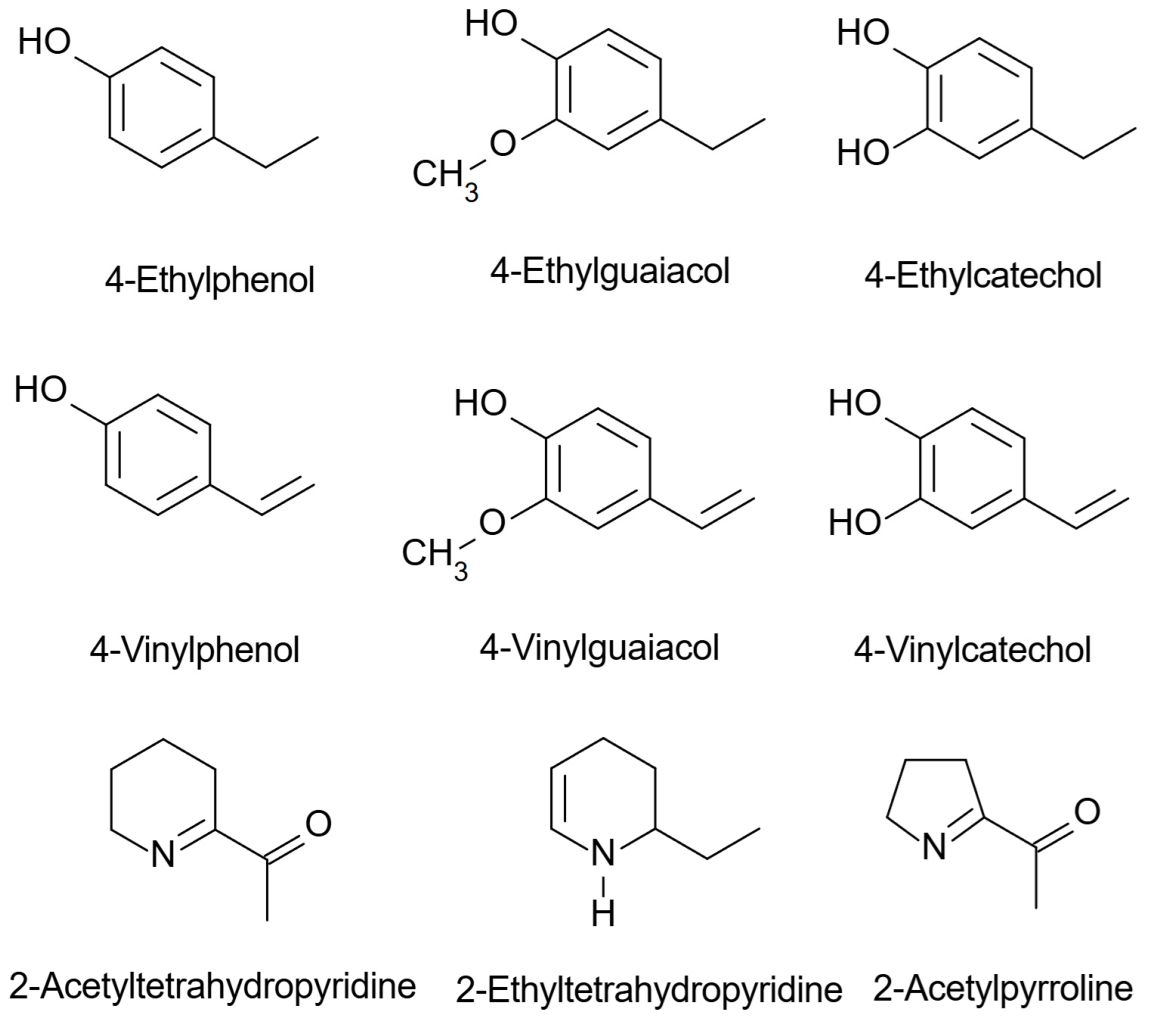
| 4-Ethylguaiacol | 4-ethyl-2-methoxyphenol | 47 µg/L | phenolic, smoked, leather |
| 4-Methylguaiacol | 4-methyl-2-methoxyphenol | 20 µg/L | spicy, phenolic, light green |
| 4-Vinylguaiacol | 4-vinyl-2-methoxyphenol | 40 µg/L | clove |
| Eugenol | 2-methoxy-4-(prop-2-enyl)phenol | 6 µg/L | clove, honey, spicy, cinnamon |
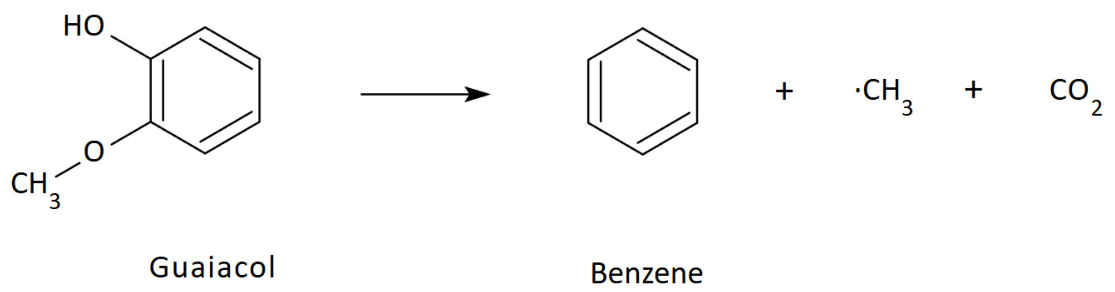
| Guaiacol | 2-methoxyphenol | 9.5 µg/L | smoke, sweet, medicine |
| Isoeugenol | 2-methoxy-4-propenylphenol | 6 µg/L | floral, clove, woody |
| Syringol | 2,6-dimethoxyphenol | 570 µg/L | smoke, burned, wood |
| Lactones | |||
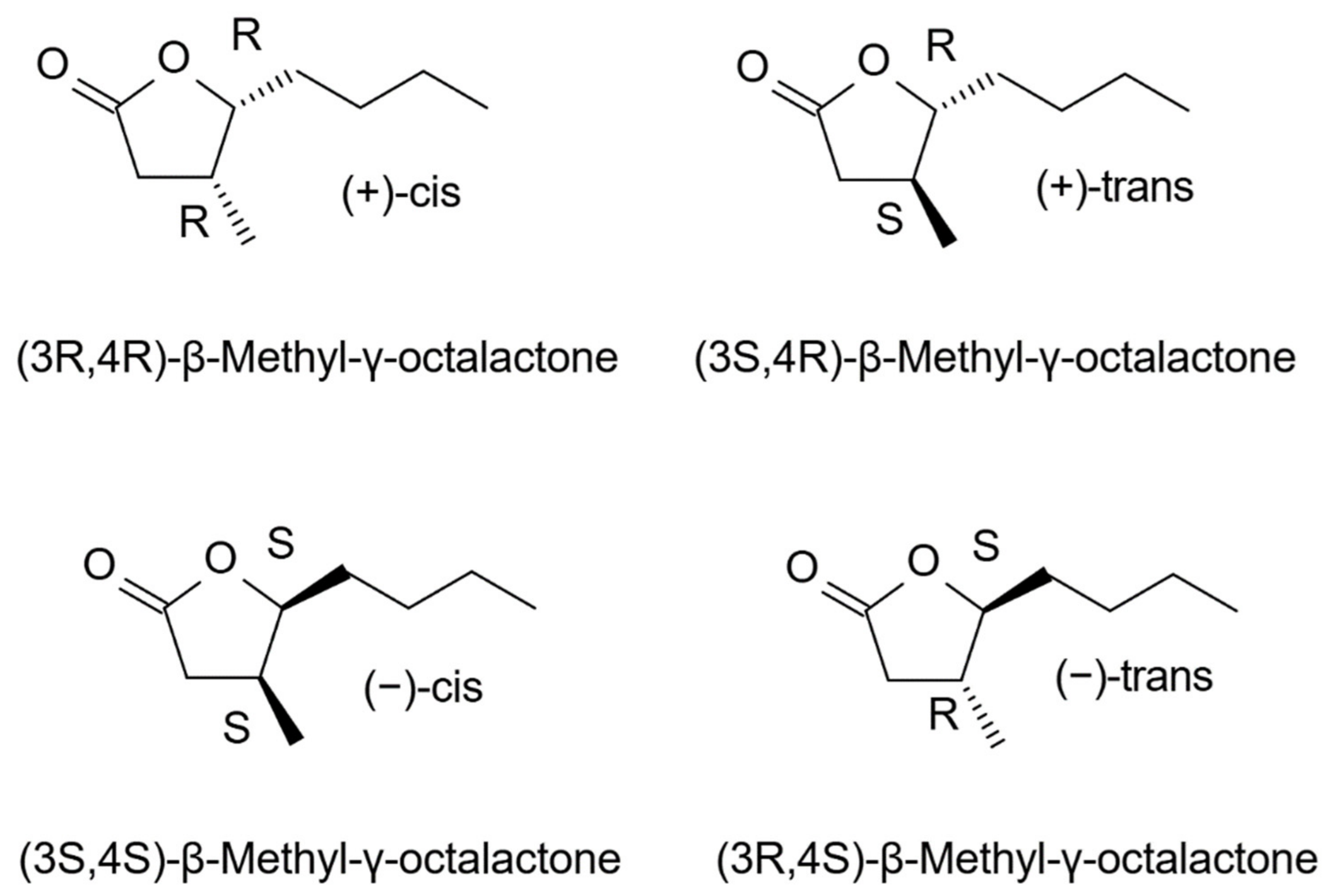
| cis-β-Methyl-γ-octalactone | (3S,4S)-5-butyl-4-methyldihydro-2-(3H)-furanone | 20–46 µg/L | coconut, woody, vanilla |
| trans-β-Methyl-γ-octalactone | (3S,4R)-5-butyl-4-methyldihydro-2-(3H)-furanone | 140–370 µg/L | coconut, woody, vanilla |
| Heterocyclic compounds | |||
| 5-Hydroxy-methylfurfural | 5-hydroxymethyl-2-furaldehyde | 100 mg/L | caramel |
| 5-Methylfurfural | 5-methyl-2-furancarboxaldehyde | 16 mg/L | almond, caramel, burnt, sugar |
| Furfural | furan-2-carbaldehyde | 15 mg/L | bread, almond, sweet |
| Maltol | 3-hydroxy-2-methyl-4H-pyran-4-one | 5 mg/L | honey, toasty, caramel |
| Phenolic aldehydes/Phenyl ketones | |||
| Acetovanillone | 1-(4-hydroxy-3-methoxyphenyl)ethanone | 1 mg/L | vanilla |
| Syringaldehyde | 4-hydroxy-3,5-dimethoxybenzaldehyde | 50 mg/L | vanilla |
| Vanillin | 4-hydroxy-3-methoxybenzaldehyde | 1 mg/L | vanilla |
| Wine Type (Maturation Time mth) Toasting Level * | Compounds Concentration (µg/L) | ||||||||||||||
|---|---|---|---|---|---|---|---|---|---|---|---|---|---|---|---|
| Furfural | 5-Methylfurfural | HMF | Maltol | trans-Whiskylactone | cis-Whiskylactone | Guaiacol | 4-Methylguaiacol | 4-Ethylguaiacol | 4-Vinylguaiacol | Eugenol | Syringol | Vanillin | Syringaldehyde | Acetovanillone | |
| French oak (Q. petraea) | |||||||||||||||
| Cabernet Sauvignon (12) M | 836 | 289 | 114 | 111 | 49.5 | 142 | 19.6 | 7.2 | na | na | 7.8 | 73.5 | 62 | 23.3 | 11.4 |
| Cabernet Sauvignon (12) L | 300.7 | 71.1 | na | 331.6 | 80.2 | 116.8 | 40.9 | 22.3 | 2.7 | 89.1 | 29.4 | 373.9 | 44.5 | 52.2 | 97.6 |
| Chardonnay (Spain) (12) M | 1966 | 105 | 2039 | na | 160 | 281 | 4.6 | 6.5 | na | 257 | 20 | na | 187 | 791 | 24 |
| Chardonnay (Spain) (12) L | 8995 | 885 | 6973 | na | 108 | 187 | 17 | 21 | na | 294 | 19 | na | 611 | 3177 | 46 |
| Mencía (12) M | 110 | 51.4 | 1229 | 92 | 245 | 611 | 27.2 | 24.2 | 31.5 | 73.5 | 22.7 | na | 289 | 743 | 102 |
| Merlot (12) M | 739 | 109 | 43.3 | 132 | 33.8 | 152 | 28.9 | 15.9 | na | na | 25.2 | 74.3 | 42.6 | 23 | 19.6 |
| Sangiovese (Italy) (12) M | na | na | na | na | na | 99.9 | 53 | na | 89.9 | 57.6 | 28.3 | na | 99.1 | na | na |
| Sauvignon blanc (Spain) (12) M | 13837 | 1111 | 13149 | na | 162 | 276 | 27 | 17 | na | 219 | 31 | na | 678 | 6467 | 47 |
| Sauvignon blanc (Spain) (12) L | 891 | 39 | 1444 | na | 180 | 353 | 9.3 | 5.8 | na | 249 | 30 | na | 173 | 850 | 28 |
| Somontano (Spain) Syrah (12) M | 39.8 | 842 | 703 | 142 | 99.4 | 577 | 43.8 | 31.5 | 24.2 | 20.8 | 101 | 178 | 408 | 1305 | 62.4 |
| Tempranillo (12) M | 155 | 46.7 | 44.6 | 150 | 25 | 154 | 28.1 | 9.8 | na | na | 32.7 | 72.5 | 48.4 | 9 | 22.3 |
| Tempranillo (12) M | 1378 | 869 | 986 | 114 | 305 | 529 | 36.3 | 25.6 | 5.6 | 409 | 35.7 | na | 466 | 1495 | 195 |
| Tempranillo (60%), Cabernet Sauvignon (20%), Garnacha (20%) (12) M | 771 | 135 | na | na | 73 | 79 | 8.8 | 0.06 | 87 | na | 20 | na | 89 | 312 | 114 |
| Tempranillo (63%), Cabernet Sauvignon (20%), Merlot (17%) (12) M | 127 | 439 | na | 119 | 412 | 629 | 11.8 | na | na | na | 91.8 | na | 216 | 60.5 | na |
| Spanish oak (Q. petraea) | |||||||||||||||
| Cabernet Sauvignon (12) M | 851 | 276 | 100 | 92.4 | 24 | 214 | 11.2 | 2.7 | na | na | 17.1 | 34.1 | 45.7 | 5.4 | 7.3 |
| Mencía (12) M | 190.5 | 70.8 | na | na | 98.9 | 199 | 14.4 | 5.8 | 7.6 | 9 | 9.5 | 27.6 | 29.5 | na | 22.5 |
| Mencía (12) M | 134 | 93.5 | 1704 | 111 | 222 | 1011 | 42.1 | 36.9 | 43.7 | 93.1 | 84.2 | na | 342 | 553 | 121 |
| Merlot (12) M | 55 | 119 | 51.7 | 105 | 36.3 | 322 | 14.5 | 2.7 | na | na | 20.5 | 37.6 | 43.6 | 3.4 | 11.4 |
| Tempranillo (12) M | 165 | 74.6 | 77.9 | 150 | 44.6 | 253 | 34.3 | 11.8 | na | na | 25 | 81.7 | 42.8 | 12.2 | 14.3 |
| Tempranillo (12) M | 3575 | 2477 | 3141 | 282 | 231 | 1096 | 76.1 | 21.9 | 5.3 | 315 | 116 | na | 574 | 1748 | 203 |
| American oak (Q. alba) | |||||||||||||||
| – (12) M | 5330 | 250 | na | na | 210 | 1370 | 120 | na | 450 | na | 100 | na | na | na | na |
| Mencía (12) M | 187 | 41.8 | 2094 | 197 | 236 | 1313 | 40.9 | 32.5 | 24.9 | 109 | 51.9 | na | 540 | 1378 | 153 |
| Monastrell (9) M | 739 | 435 | na | na | 80 | 1332 | na | na | 64 | na | na | na | 431 | na | na |
| Tempranillo (12) M | 1869 | 1543 | 1193 | 168 | 150 | 1083 | 41.5 | 21.9 | 5 | 242 | 63.3 | na | 482 | 1495 | 175 |
| Tempranillo (63%), Cabernet Sauvignon (20%), Merlot (17%) (12) M | 232 | 488 | na | 135 | 152 | 845 | 22.4 | na | na | na | 81.5 | na | 165 | 66.3 | na |
| Chestnut (Castanea sativa) | |||||||||||||||
| Sangiovese (Italy) (12) M | na | na | na | na | na | 43.6 | 54.3 | 79.5 | 37.7 | 36.3 | na | 20 | na | na | |
| Somontano (Spain) Syrah (12) M | 509 | 241 | 689 | 125 | 21.3 | 21.2 | 59.3 | 51.5 | 49.1 | 23.9 | 118 | 153 | 456 | 1189 | 92.4 |
| Tempranillo (6) N | 24.4 | 64.3 | 3.3 | 2.4 | na | na | 35.1 | 24.5 | 133.9 | 41.4 | 139.4 | 285.4 | 156.7 | na | 135.8 |
| Tempranillo (6) M | 28.5 | 184 | 6.2 | 3.3 | na | na | 35 | 29.8 | 123.5 | 37.7 | 162.1 | 242.1 | 260.7 | na | 155.1 |
| Cherry (Prunus cerasus L.) | |||||||||||||||
| Somontano (Spain) Syrah (12) M | 101 | 31.8 | 145 | 133 | nd | nd | 42.8 | 24.6 | 73.3 | 23.1 | 10.5 | 169 | 304 | 1877 | 75.1 |
| Acacia (Acacia Mill.) | |||||||||||||||
| Somontano (Spain) Syrah (12) M | 238 | 450 | 248 | 300 | nd | nd | 59.8 | 14.1 | 19.9 | 25.7 | 19.3 | 217 | 233 | 768 | 61.3 |
| Ash (Fraxinus excelsior L.) | |||||||||||||||
| Somontano (Spain) Syrah (12) M | 66.2 | 57.8 | 339 | 354 | nd | nd | 75.1 | 34.8 | 91.5 | 9.9 | 12.8 | 198 | 696 | 1090 | 111 |
| Compound | Control | Light Toast | Medium Toast | Heavy Toast | ||||
|---|---|---|---|---|---|---|---|---|
| 1 Month | 3 Months | 1 Month | 3 Months | 1 Month | 3 Months | 1 Month | 3 Months | |
| 5-Methylfurfural | 1.12 | 1.12 | 23.5 | 69.26 | 30.44 | 72.41 | 5.9 | 12.52 |
| cis-Whiskylactone | 3.52 | 3.24 | 43.5 | 104.8 | 13.19 | 23.93 | 5.83 | 7.98 |
| Eugenol + isoeugenol | 1.4 | 0.8 | 4.25 | 4.65 | 2.39 | 2.16 | 1.84 | 1.09 |
| Furfural | 84.25 | 67.9 | 132.4 | 339.2 | 478.57 | 682 | 104.9 | 129.95 |
| Guaiacol | 42.95 | 7.04 | 26.29 | 8.76 | 72.32 | 20.6 | 45.99 | 22.97 |
| Methylguaiacol | nd | nd | 3.13 | 3.72 | 8.33 | 11.41 | 6 | 8.61 |
| Syringaldehyde | 12.76 | 17.04 | 42.76 | 82.18 | 170.4 | 276.6 | 67.24 | 111.47 |
| Syringol | 133.46 | 37.75 | 94.35 | 49.55 | 265.47 | 110.8 | 174.4 | 144.03 |
| trans-Whiskylactone | 3.01 | 2.92 | 23.01 | 57.99 | 7.81 | 14.98 | 4.04 | 4.64 |
| Vanillin | 19.4 | 19.4 | 34.13 | 64.14 | 92.09 | 108.9 | 36.31 | 74.9 |
| Sample | Control | Amburana | Balsam | Cariniana | Chestnut | Oak |
|---|---|---|---|---|---|---|
| 5-Hydroxymethylfurfural | 1540 | 3170 | 2080 | 850 | 3130 | 2840 |
| Furfural | 1820 | 1980 | 2930 | 1180 | 4280 | 110 |
| Guaiacol | 10 | 180 | 30 | 180 | 210 | 140 |
| Syringaldehyde | 930 | 2760 | 2230 | 3040 | 2760 | 2920 |
| Vanillin | 170 | 2330 | 4520 | 3820 | 2140 | 1020 |
| Compound | Concentration [μg/L] |
|---|---|
| 4–Ethylguaiacol | 0.74–380 |
| 4–Methylguaiacol | 0.59–300 |
| 4–Vinylguaiacol | 9.77–5000 |
| 5–Methylfurfural | 6.88–3522 |
| Acetovanilone | 4.70–2405 |
| cis–Whisky lactone | 5.69–2916 |
| Furfural | 13.86–7098 |
| Eugenol | 0.98–500 |
| Guaiacol | 1.31–670 |
| HMF | 13.47–6895 |
| Syringaldehyde | 3.16–1620 |
| trans–Whisky lactone | 5.70–2916 |
| Vanillin | 13.93–7130 |
Disclaimer/Publisher’s Note: The statements, opinions and data contained in all publications are solely those of the individual author(s) and contributor(s) and not of MDPI and/or the editor(s). MDPI and/or the editor(s) disclaim responsibility for any injury to people or property resulting from any ideas, methods, instructions or products referred to in the content. |
© 2026 by the authors. Licensee MDPI, Basel, Switzerland. This article is an open access article distributed under the terms and conditions of the Creative Commons Attribution (CC BY) license.
Share and Cite
Sroka, P.; Tarko, T. The Influence of Wood-Derived Compounds on the Quality of Alcoholic Beverages. Molecules 2026, 31, 1408. https://doi.org/10.3390/molecules31091408
Sroka P, Tarko T. The Influence of Wood-Derived Compounds on the Quality of Alcoholic Beverages. Molecules. 2026; 31(9):1408. https://doi.org/10.3390/molecules31091408
Chicago/Turabian StyleSroka, Paweł, and Tomasz Tarko. 2026. "The Influence of Wood-Derived Compounds on the Quality of Alcoholic Beverages" Molecules 31, no. 9: 1408. https://doi.org/10.3390/molecules31091408
APA StyleSroka, P., & Tarko, T. (2026). The Influence of Wood-Derived Compounds on the Quality of Alcoholic Beverages. Molecules, 31(9), 1408. https://doi.org/10.3390/molecules31091408