1. Introduction
Methylation represents an important epigenetic modification of nucleic acids, involved in gene regulation [
1,
2]. Exposure to cigarette smoke or pathological conditions such as tumors and immunodeficiencies can result in abnormal nucleobase alkylation, compromising DNA stability and replication [
3,
4,
5,
6]. Methylated nucleobases can then be found in urine as an indicator of whole-body turnover and degradation of methylated RNA [
7,
8]. In addition, methylated nucleobases are seeing a rising importance concerning studies in mechanochemistry [
9,
10], and tested for their potential anticancer activity [
11,
12]. Moreover, solid-state investigations provide experimental insights that can be applied to biological systems. In fact, we noticed that despite significant efforts in understanding the solution and gas-phase behavior of methylated nucleobases [
13,
14,
15,
16,
17,
18], there is still a surprisingly high lack of solid-state studies. Crystal structures of
N-methylated nucleobases, with methylation on the rings, not on the functional groups (oxo and amino/imino) were solved only in the cases of 9-methylguanine (9mG), 9-methyladenine (9mA) and 3-methylguanine (3mG) sesquihydrate [
9,
19,
20]. However, in the case of 3mG sesquihydrate, no atomic coordinates were available. Crystal structures of pure guanine and adenine were instead solved relatively recently [
21,
22].
Studies are reporting a growing interest in the description of noncovalent interactions of nucleobases for their application in material sciences [
23,
24,
25], as well as their importance in stabilizing nucleic acids [
26,
27]. In fact, stacking between nucleobases is considered as one of the two factors that are mainly responsible for the stability of the DNA double helix, together with hydrogen bonding [
28,
29,
30]. Furthermore, stacking interactions are specifically inferred to play a pivotal role in governing the selectivity of enzymes for removing damaged nucleobases in DNA due to alkylation [
13] and the effect of post-transcriptional methylation in RNA [
14].
A model for describing electronic interactions in aromatic systems accounting for the charge distribution was first proposed in a pioneering study by Hunter and Sanders, 1990 [
31]. This model describes π-π stacking geometries in benzene rings as the result of the interplay between electrostatic effects and van der Waals (vdW) interactions. As a result of the balance between attraction and repulsion due to these interactions, aromatic rings can orient in different geometries, including parallel, parallel displaced, or T-shaped stacking, depending on the relative position between the aromatic rings and polarization effects on the π-systems. Schramm et al., 2025 [
32] explained how, in parallel displaced benzene dimers, vdW interactions control the lateral displacement, whereas electrostatic effects are responsible for minimizing the distances between the two interacting rings at parallel displaced geometries [
33]. Among π-π interactions, T-shaped stacking between nucleobases and aromatic amino acids can provide stability to many different enzymatic systems, including those involved in DNA transcription, replication, and repair [
34]. Moreover, other types of π- interactions can occur involving an aromatic ring and ions or functional groups, such as XH-π, cation-π, anion-π or lone pair-π [
35].
Simplistic experimental studies of π-π investigations on purine nucleobases are, to date, not fully explored. A study on pure 2-deoxyadenosine [
36] has revealed its crystal structure; however, no stacking interactions were identified at that time. However, considering the fact that the study of Hunter and Sanders provided new insights into the definition and importance of π-π interactions for biological molecules only a few years later in 1990, the revisiting of findings prior to this study might be suggested. We note that the 2-deoxyguanosine crystal structure remains unknown as of today. Similarly, in the case of RNA bases bonded with ribose, the adenosine crystal structure is solved [
37] while guanosine was not found in databases.
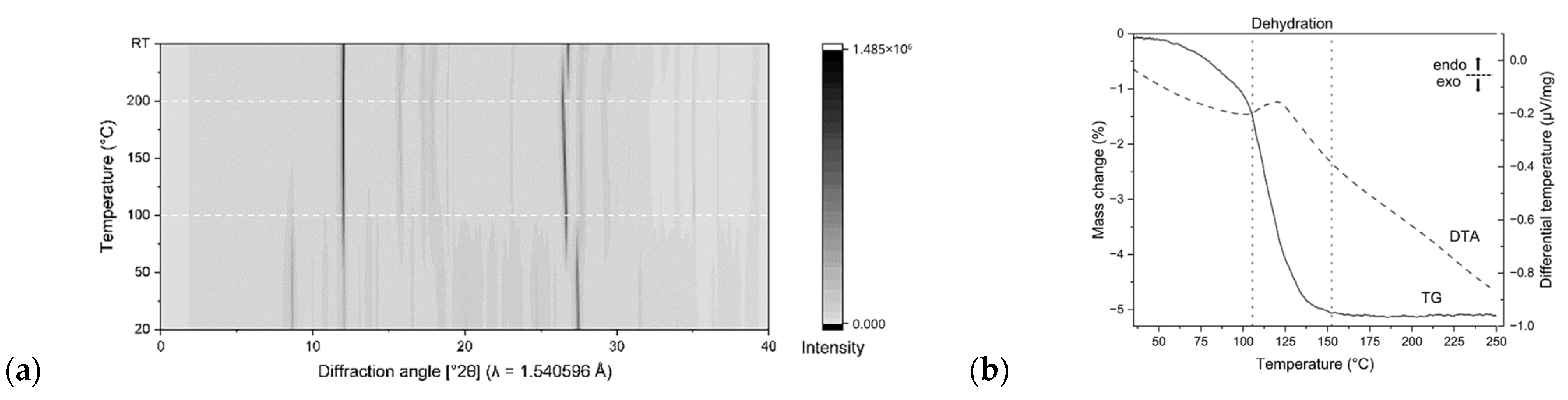
In the present study, we will report about the first solid-state experimental insights into 1-, 3- and 7-methylated adenines and guanines. The crystal structures were solved from synchrotron and laboratory X-ray powder diffraction (XRPD) data, and from single crystal X-ray diffraction (SC-XRD) data, where recrystallization to single crystals was required due to poor powder quality. Furthermore, in the case of 3-methyladenine and 3-methylguanine, crystal structures with molecular water, anhydrous crystal structures and polymorphism will be discussed following in situ high-temperature XRPD experiments. Packing motifs will be described according to H-bonding schemes. π-π stacking geometry parameters, particularly horizontal and vertical displacements, and relative orientations of stacked nucleobases will also be discussed, combining an overview of existing theoretical studies and existing crystallographic data on pure and N9-methylated guanines and adenines. The Hunter and Sanders equation will be used for modeling our experimental data, providing reasonable agreement with their predictions.
3. Discussion
The first objective of the present study was to determine the steric contribution of methylation in nucleobases in the solid state. Concerning
N-methylated guanines, a study by Bald et al., 2011 [
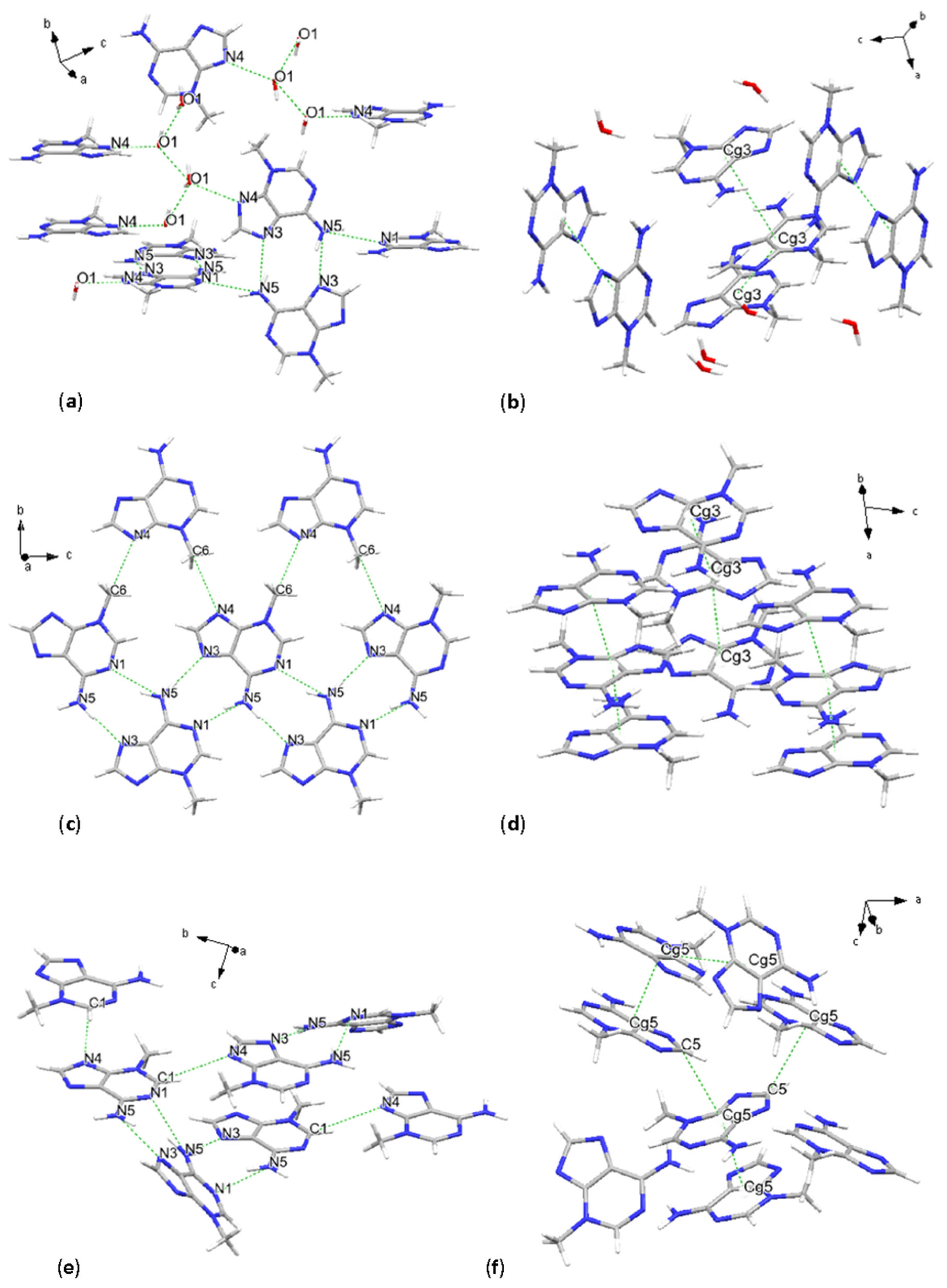
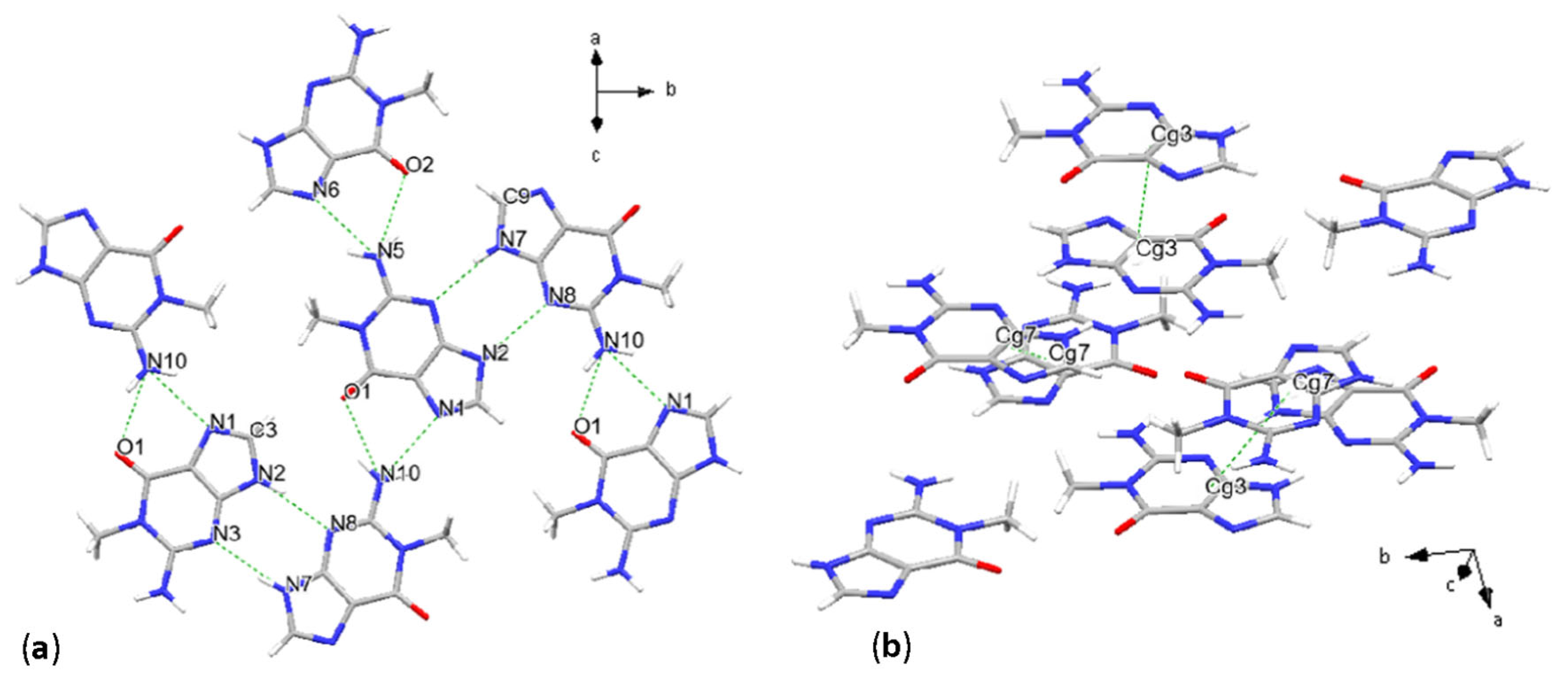
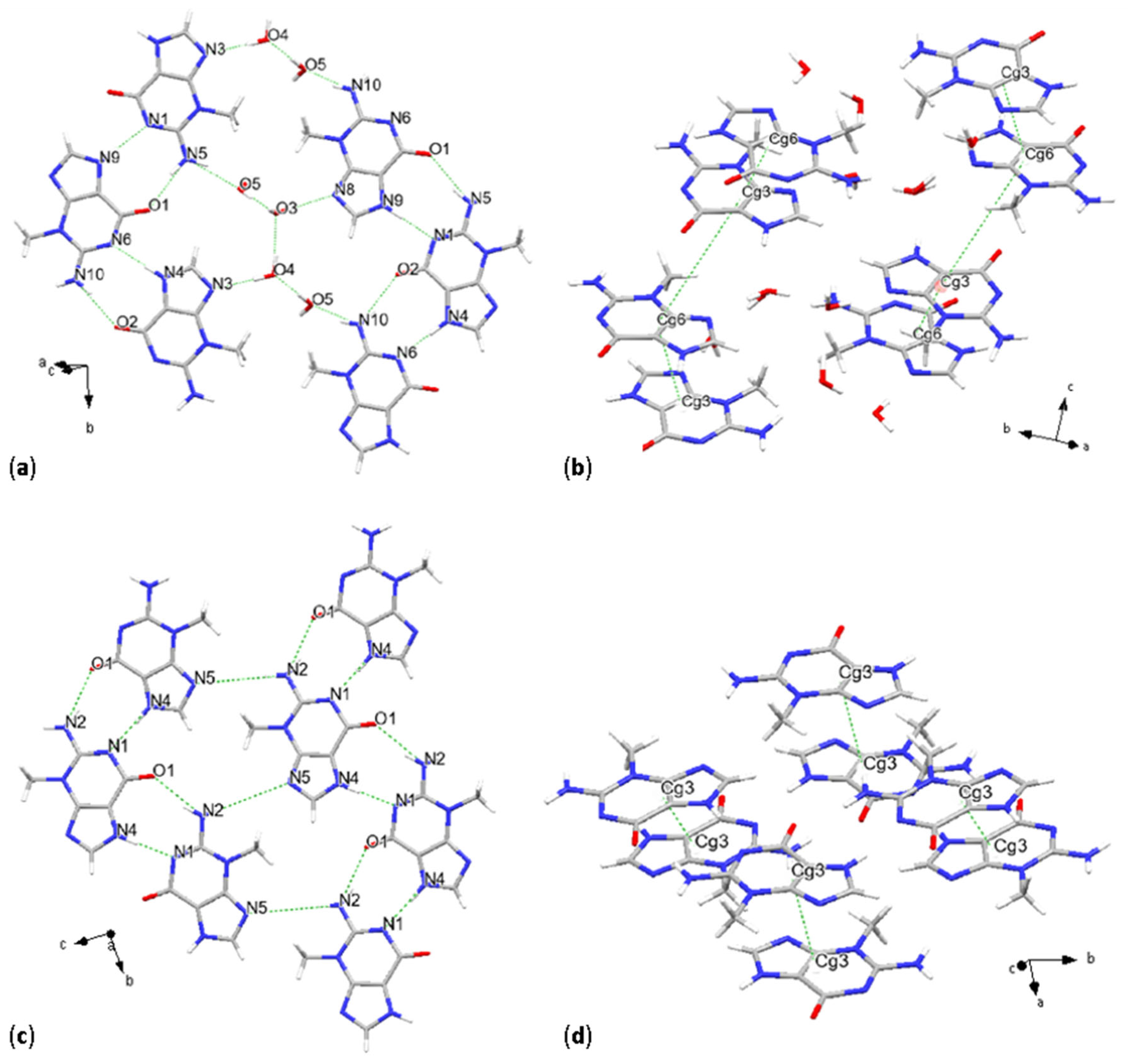
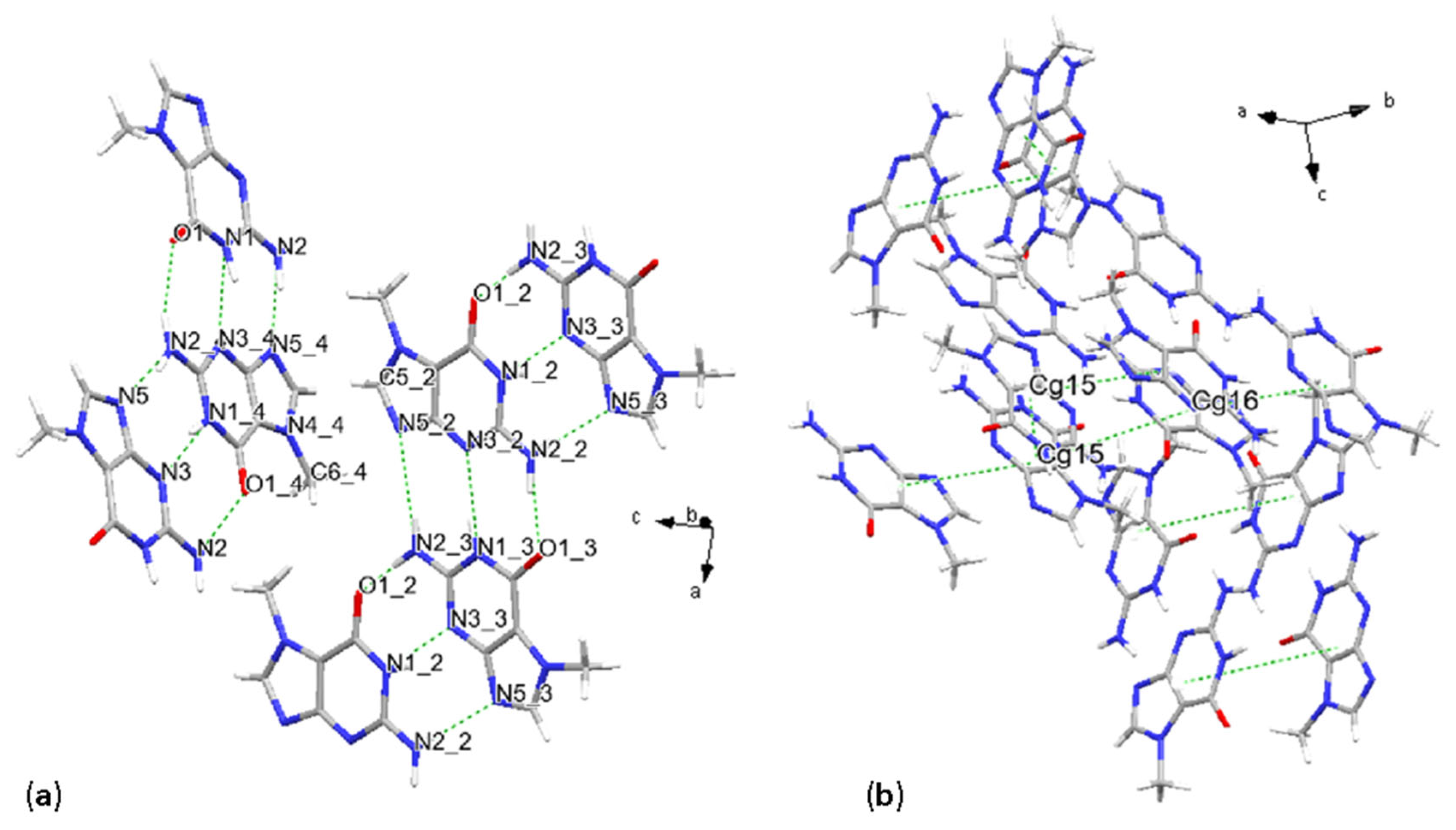
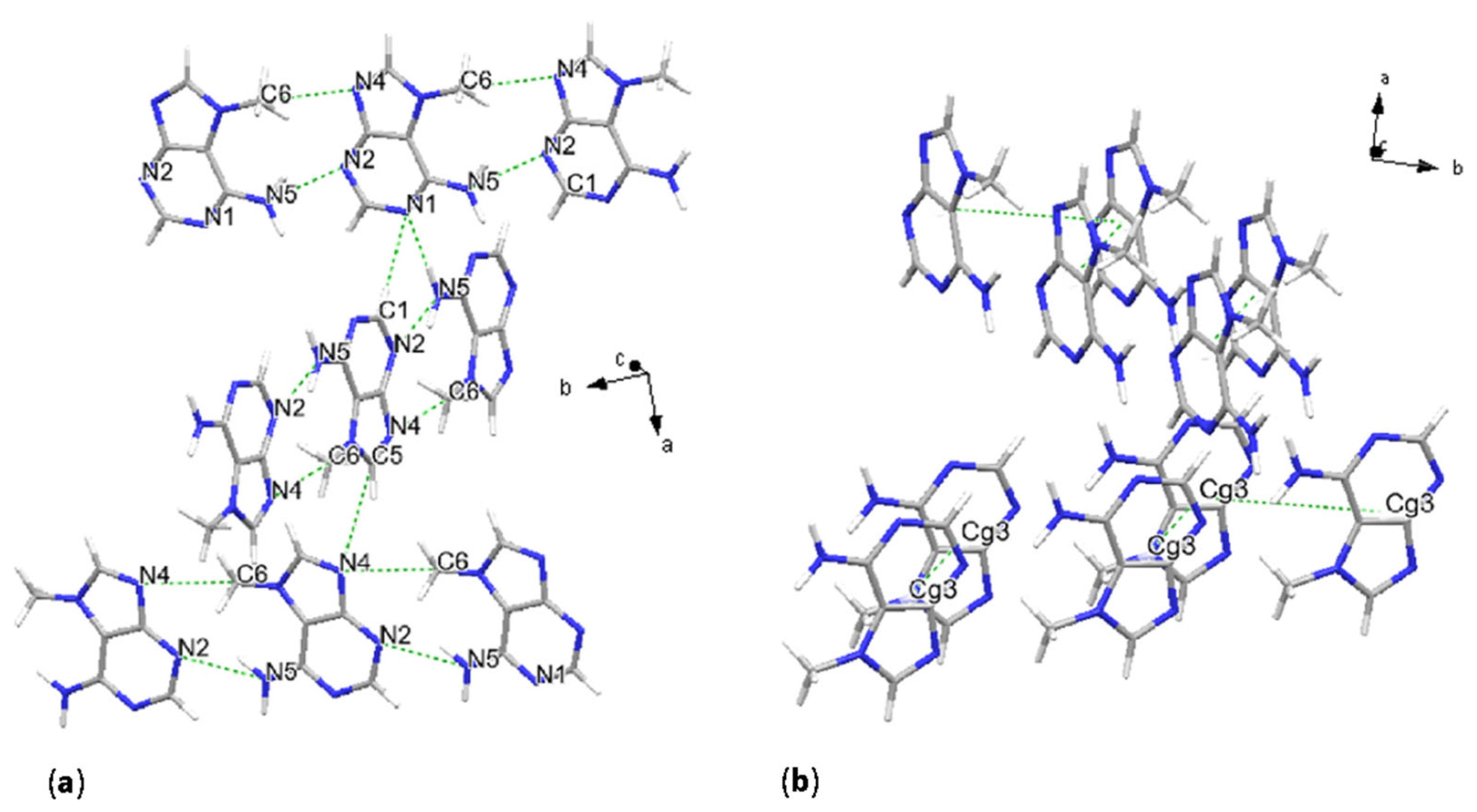
38] investigated the effect of methylation on intermolecular interactions between guanine molecules using scanning tunneling microscopy (STM) and density functional theory with empirical dispersion correction (DFT-D). This study was carried out on a graphite surface at the liquid–solid interface, with a focus on 2D motifs that were stabilized by hydrogen bonding. In the case of 1mG, molecules formed 2D windmills interacting with N9-H···N7, N2(amino)-H···N3 and N2(amino)-H···O hydrogen bonds. Instead, in the solid state, we observe ribbons with the following H-bond scheme, in IUPAC notation: N9-H···N3, N2(amino)-H···N7, and N2(amino)-H···O. Another DFT study conducted by Paragi et al., 2013 [
16] predicted the plausibility of 7mG clusters with and without stabilizing anions at solid–liquid and solid–gas interfaces. These authors proposed either ring clusters due to a cooperativity effect of H-bonding within rings, or ribbons. Our findings indicate that in the solid-state, clusters of 7mG can be observed as in the latter case. Nonetheless, precise modeling of this compound was compromised by the number of parameters in the refinement. For this reason, although the cluster and donor-acceptor geometries may be accurate, a comparison with the precise distances reported by Paragi et al., 2013 [
16] is not possible. Another finding from the previously mentioned study was a comparison of the clusters and H-bonding distances between their calculations and the crystal data of 7H-guanine reported by Guille and Clegg, 2006 [
21], finding agreement with their calculations of the ribbon geometries for 7mG and 7H-guanine. Our findings indicate that the bonding scheme N1-H1···N3, N2-H2···N9, and N2-H2···O6 is indeed present in both 7H-guanine after Guille and Clegg, 2006 [
21], and 7mG, confirming that in the solid state, this interaction geometry is maintained. However, we point out that in the solid state, whilst ribbon clusters in 7H-guanine form indefinitely extended planes that stack with parallel stacked π-π geometries, in 7mG, these ribbons form π-π stacked molecules forming chains along the
b and
a − b axial directions. This implies that packing is also defined by other intermolecular interactions, which consist of C-H···N or C-H···O hydrogen bonding among differently oriented chains, whereas stacking is not only defined by parallel displaced π-π interactions, but also by T-shaped π-π stacking. Concerning
N-methylated adenines, a comparison similar to that in Paragi et al., 2013 [
16] cannot be drawn for 7mA, since the crystallographic data for anhydrous adenine reported by Mahapatra et al., 2008 [
22] consists of 9H-adenine. However, comparing their findings with 9mA after Kistenmacher et al., 1977 [
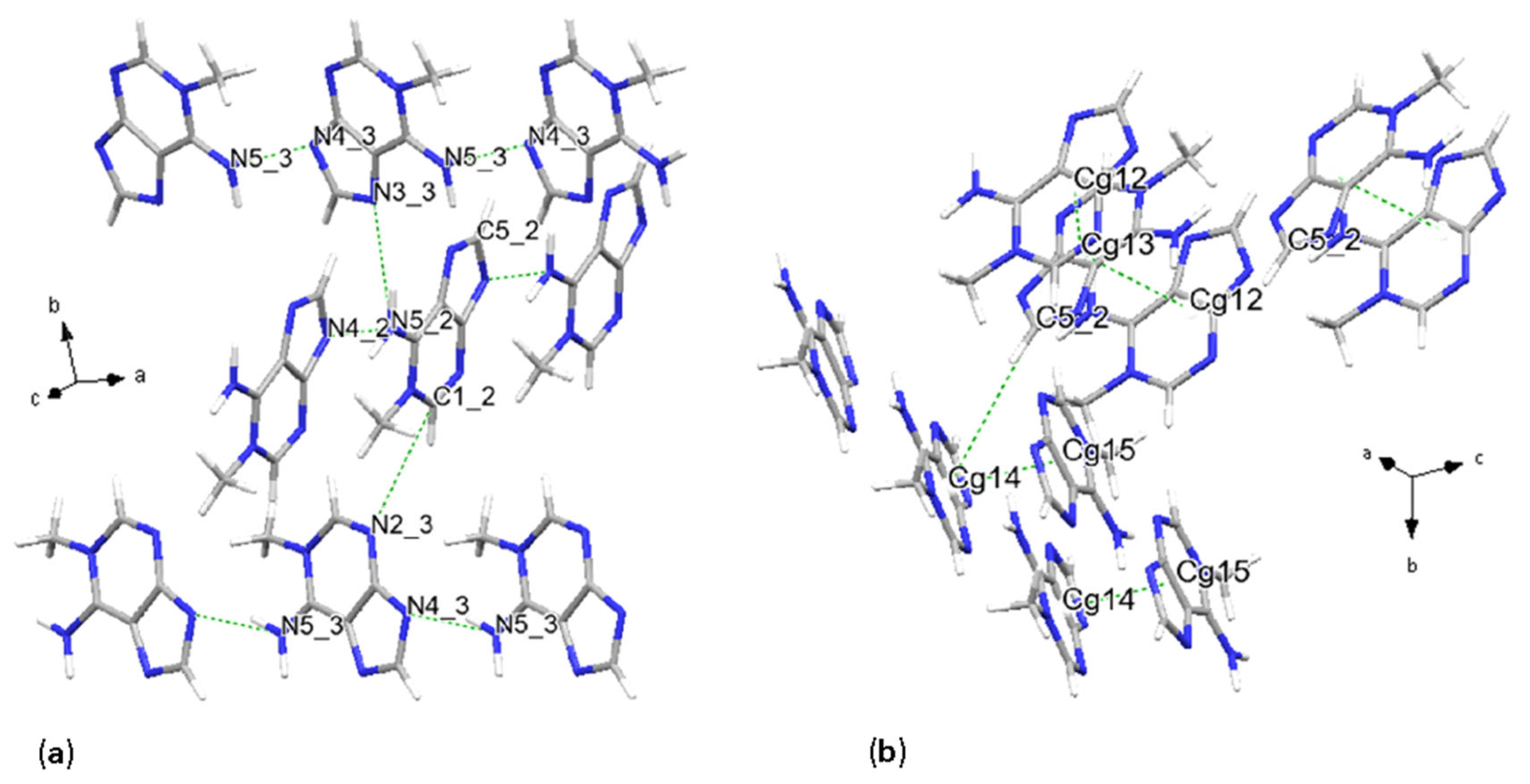
19], we notice that in this last case, the dipole–dipole interactions describe quartets, whereas for 9H-adenine one observes a ribbon pattern. Thus, we can say that for 7mG and 7H-guanine, and 9mA and 9H-adenine, the steric contribution of the methyl group implies new interactions forming among the molecules in the crystalline state, compared to the case of pure guanine and adenine and protonated at the same N site as the methyl group. These interactions consist of T-shaped π-π stacking interactions and C-H···N donor-acceptor bonds in the case of 7mG and C(methyl)-H···N3 bonds in 9mA.
Overall, our results show that packing in methylated nucleobases is represented by planarly configured stacked molecules, forming planes with stacking infinitely in a single crystallographic direction, as in the cases of 1mG, 3mG sesquihydrate and 3mA, or planar chains stacking along different directions in the case of 3mG, 7mG and 3mA monohydrate, reaching an angle between chains close to 90° in 1mA and 7mA. In the case of the 3mA polymorph, the α angle between one of the two types of parallel-displaced π-π stacked dimers has a value of 40.5°, consisting neither of planes nor of chains. It is worth mentioning that the 3mA polymorph represents the example of the highest symmetry among the studied compounds. The increase in symmetry from low-temperature 3mA is coherent with what is generally observed also for other crystal systems at higher temperatures, for minerals and as a general tendency for crystalline materials [
39,
40,
41]. Therefore, this polymorph might also differ when compared to trends of π-interactions.
Concerning the H-bonding motifs, besides 7mG and 1mG, ribbon configurations are also observed for 3mG sesquihydrate, 3mG and 3mA. On the other hand, 1mA, 3mA monohydrate and 7mA resulted in only two points of contact between coplanar molecules along the chains, whereas the amino group shares a proton with both the coplanar and the oriented second chain.
Other existing research has aimed at studying methylation effects on purine nucleobases regarding the interfacial structures of 1mA, 3mA, 7mA and 9mA on gold nanoparticles using surface-enhanced Raman scattering (SERS) [
18]. These findings indicated that the position of the methyl group on the purine ring of adenine led to distinct surface-binding schemes. DFT calculations predicted energetic stabilities in the gas phase as, in increasing order, 1mA, 3mA, 7mA and 9mA. The overall energetic stability of a system is determined by the combined effects of all interactions within it.
A second objective of the present study was to determine π-π stacking interaction geometries and abundances among the compounds studied. The study by Hunter and Sanders 1990 [
31] proposed an original model, which was validated by Wheeler, 2025 [
33], indicating that in the stacking of aromatic systems, the interplay between electrostatic and van der Waals (vdW) components influences the stacking geometries. In particular, the vdW contribution dominates at lower horizontal displacements, whereas electrostatic forces would be more relevant only at higher slippages. However, this last contribution is weaker than the vdW forces on the overall interaction energy.
This is summarized by the following formula, after Hunter and Sanders 1990 [
31] and Wheeler 2025 [
33].
where
R denotes the horizontal displacement at a fixed vertical separation. Notably, no vertical displacement is accounted for in the formula, since in the original model, this distance was kept fixed at a reference value, given the qualitative and conceptual original scope of the model.
The findings from Wheeler 2025 [
33] and Hunter and Sanders 1990 [
31], applicable both in solution and qualitatively in the solid-state, suggest that for nearly face-to-face π-stacked systems, dispersion forces (vdW) dominate. After a certain lateral displacement, depending on the system studied, at around 3 Å in the case of benzene parallel stacked dimers, this contribution to the interaction potential falls off in favor of electrostatic contributions.
These contributions also indicate that a face-to-face geometry is unfavorable unless relevant polarization effects are involved.
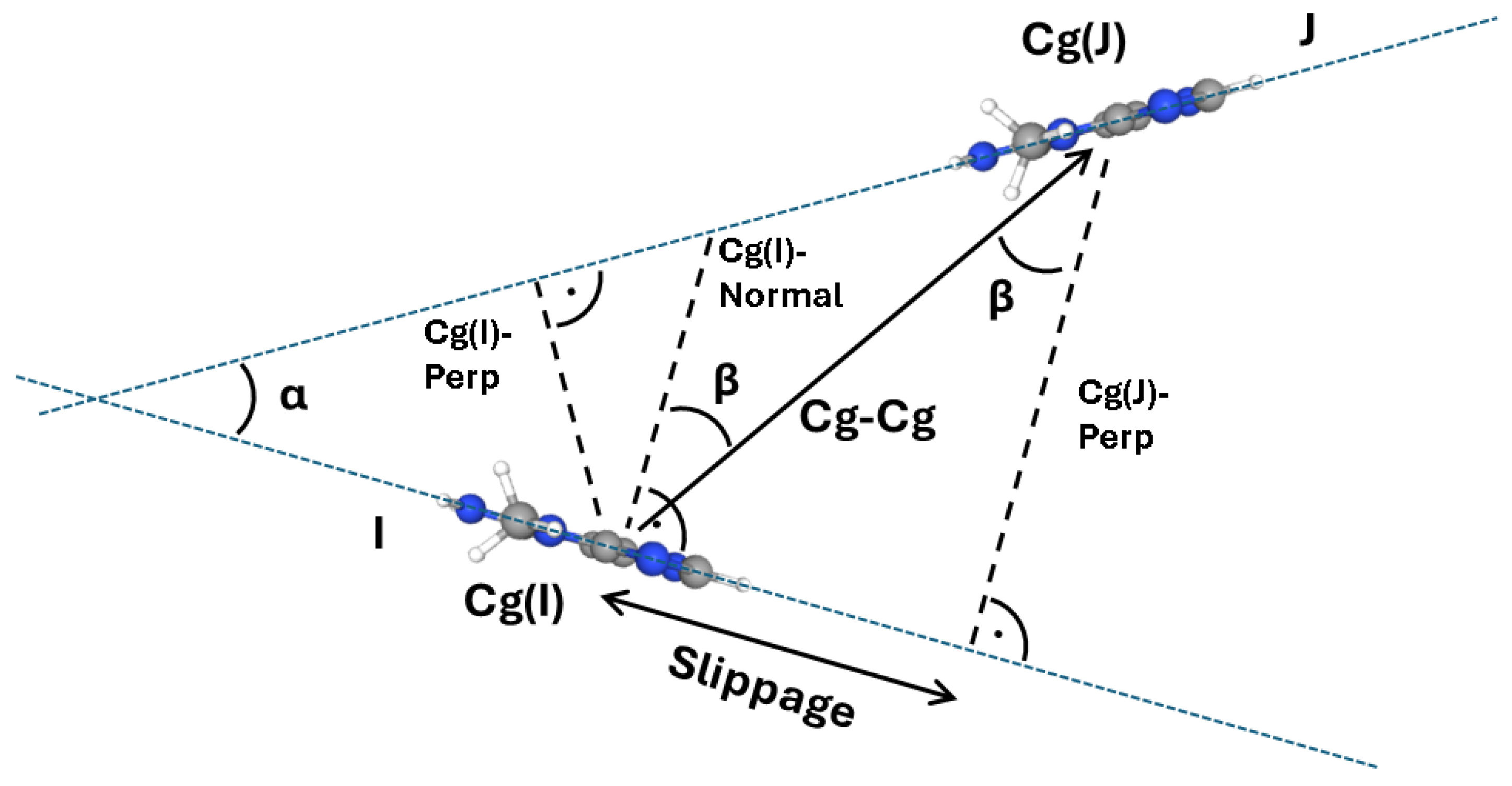
N-methylated adenine and guanines are polarized owing to the methyl, oxo and amino functional groups. This is another factor to consider when assessing ideal interaction geometries and energies. In the case of nearly face-to-face geometry, following Hunter and Sanders’ predictions, the functional groups are expected to be positioned in a trans configuration. This is indeed observed in 3mA, where the 9-membered centroids have a slippage of 0.667 Å and 1.137 Å. In this case, our findings are consistent with the original model proposed by Hunter and Sunders, in which the functional groups are positioned diametrically opposite. Also, in one of the molecules in 9mG from Stolar et al. 2020 [
9], one of the 9-membered centroid distances with the lowest slippage, 0.389 Å, has an inverted trans configuration. Another case in the present study is the 3mA polymorph, where the slippage of 0.147 Å of two 9-membered centroids is associated with direct stacking. Charges are expected to be balanced due to the rotation of around 22° between one another, and the trans positioning of functional groups.
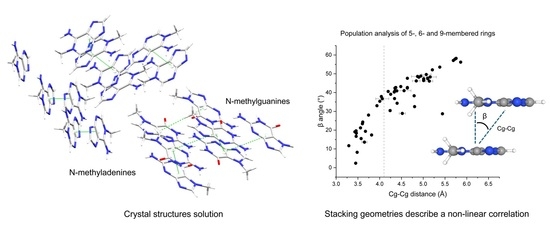
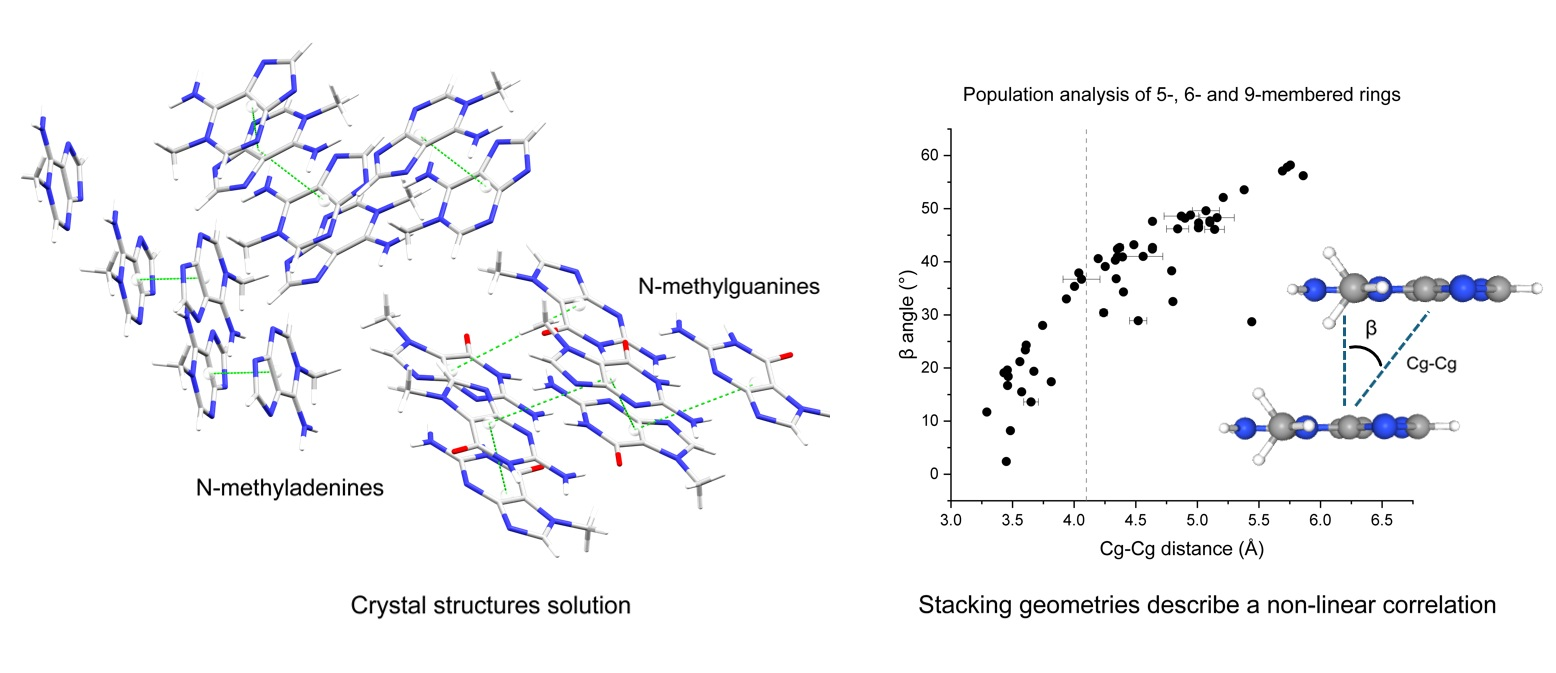
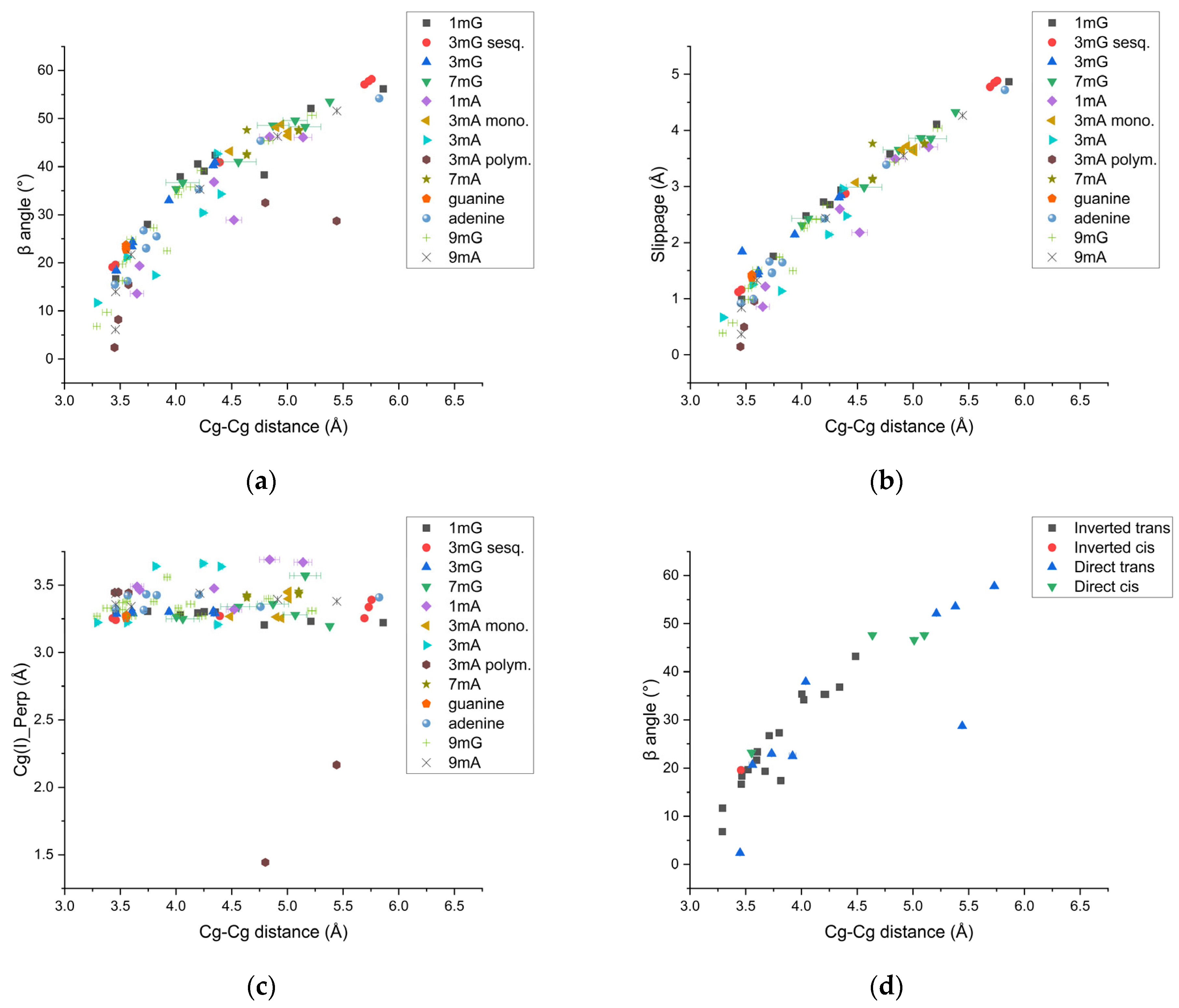
The plots in
Figure 8 were obtained after combining and comparing our results for 5-, 6- and 9-membered centroids with other already solved pure and
N-methylated nucleobases, namely 9mA [
19], 9mG [
9], 7H-guanine [
21] and 9H-adenine [
22]. All of them are characterized by a quasi-linear trend of the relationship between centroid-to-centroid distances and β angles or slippage (
Figure 8a,b). These plots allow a vertical distance (
x-axis) to be related to the horizontal displacement (
y-axis). For centroid distances relative to the interplanar distances, we did not observe a clear trend (
Figure 8c). The non-linearity in the previous two cases is here inferred to be consistent with the findings of Hunter and Sanders, 1990 [
31] and Wheeler, 2025 [
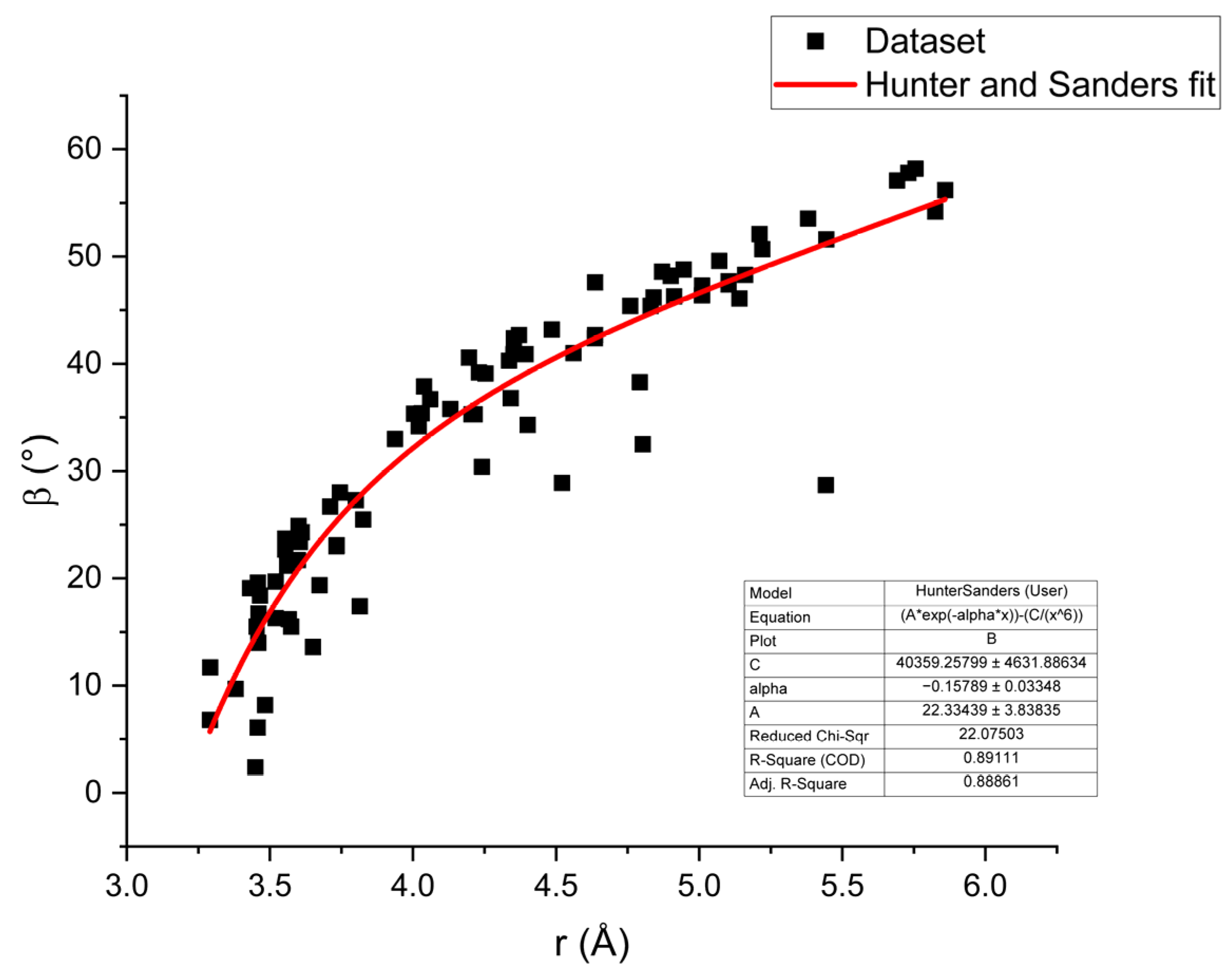
33]; specifically, the slight change in the slope is related to the change in contribution on the stacking interactions and geometries from vdW interactions to an electrostatic component, where at higher horizontal displacements (higher β), the interaction is dominated by the last one, which decreases linearly according to the formula. A fit of the data from all centroids from the compounds from the present study, together with 9mA, 9mG, 9H-adenine and 7H-guanine, is modeled according to the findings of Hunter and Sanders 1990 [
31].
Figure 9 shows the β angle plotted versus the Cg-Cg distance
r. Empirically, the observed trend of the data can be fitted utilizing the generalized van der Waals interaction term
from the Hunter–Sanders model for π-π interactions, where
A,
C and
α are standard parameters (see Hunter and Sanders, 1990 [
31]) and
r is here the Cg-Cg distance between two molecules. Please note that we assumed that the interaction term can be generalized, meaning that the summation over individual atoms i and j that interact with each other can be omitted and instead that the interaction between two molecules can be expressed by the same equation. Moreover, in order to justify the fit of this β angle versus Cg-Cg distance data, it must be further assumed that there exists a proportionality between the β angle and the van der Waals interaction term
. Under these two assumptions, the equation fits the data with reasonable agreement.
Based on existing research and our findings, we suggest that after a change in the electrostatic and vdW contributions between these stacked systems, the electrostatic contribution remains lower than the vdW contribution, leading to a change in the slope. In the case of the 3mA polymorph, one point in the plots of
Figure 8 and lies outside the trend. This is due to the fact, that the planes defined by couples of molecules can reach an angle of 40°, as mentioned in
Section 2. Consequently, the π-π interactions are weaker, whereas the C-H on the imidazole ring now forms an X-H··· π interaction. Other variations in trends relating to a pure vertical or horizontal component, the interplanar distance Cg(I)-Perp, and the slippage, and a vertical/horizontal component, given by the centroid-to-centroid distances, are also reported in
Figure 8b,c.
A recent study by Sierański, 2020 [
42], investigated the stacking interactions on purines with DFT calculations, reporting that interaction energies, among other parameters, depend on the centroid distances and the β angle. The energies have a minimum at distances of approximately 3.5 Å and an angular value between 0 and 50°, becoming more positive thereafter, consistent with the trend observed in
Figure 8a. Moreover, Sierański 2020 [
42] also conducted a population analysis on structures from the Cambridge Structural Database (CSD), finding that dimers in the solid state follow the same trend of abundances, with a peak at 4 Å and 30°, and 5 Å and 60° in the relation between centroid distances and β angles, which agrees with our findings.
The cis and trans notations, used here to describe the location of functional groups in stacked purine bases, were adopted from Jhunjhunwala et al. 2021 [
27]. This also highlights the importance of adding all the possible interactions among rings. Furthermore, cis and trans geometries also allow for a comparison with the Hunter and Sanders 1990 model [
31], indicating how protonation affects stacking geometries. Overall, the trans conformation is more frequently observed, because it is the most stable configuration according to steric repulsions accounted for in the model. In fact, where the cis configuration is observed, either the slippage is relevant (minimum represented by 1.4 Å in anhydrous guanine) or rotation angles > 0° are observed, as in the case of 3mG sesquihydrate. This can be observed in
Figure 8d, where the abundances of direct or inverted configurations and cis/trans geometries are plotted as a function of 9-centroids distances and β angle. It can be observed that the direct cis conformation tends to have a larger β angle, reflecting higher horizontal displacements. This agrees with the prediction by Hunter and Sanders 1990 [
31] of steric repulsion between functional groups, since the repulsion was not accounted for by the rotation angle gamma, which resulted in 0° after our findings. An exception to this is represented by 7H-guanine, with a β angle of around 20° and direct cis conformation; in this case, the rotation angle is also close to 0°.
A study by van Mourik et al., 2016 [
43], describes the stacking interactions between adenine and 2-aminopurine in the gas phase using DFT. Specifically, their calculations accounted for variations in stacking distances, slide (corresponding to slippage in the present study), tilt and twist angle (referred to as our rotation angle gamma). Importantly, they have treated the rotation angle, or twist angle, as a key variable in DNA.
In an idealized DNA helix, excluding the occurrences of bends and twists in the DNA strand, the authors reported an expected twist of 36°. These authors also noticed that in El Hassan et al., 1997 [
44], a comprehensive single-crystal XRD study on DNA oligomers was reported, showing a twist that varied from 10° up to 60°, slippage variations from −3 to 3 Å, and a tilt, which corresponds to the α angle in the present study, between −25 and +25°. However, findings from van Mourik et al., 2016 [
43], on paired adenine/adenine, 2-aminopurine/2-aminopurine and adenine/2-aminopurine show that all configurations have a twist angle of at least 60°, which is not observed in DNA, potentially indicating that the stacking configuration in DNA is not optimal in terms of pure base/base stacking.
In Kagra et al., 2021 [
14], the methylated adenine dimers tested have more stabilized stacking interactions than pure adenine dimers, but only when methylation does not add charge to the adenine system. For example, 1mA-1mA pair interactions decrease the stacking stability because the N1 site acts as a proton acceptor, reducing the charge of the system. Instead, if a methyl group is attached, we have introduced a charge to the system. However, when 1mA is paired with adenine, the stacking stability increases remarkably, even more than in adenine–adenine dimers. In the case of the methylation sites N2, N6 and N8, stacking increases compared to pure adenine pairs. As for methylguanine dimers, pure guanine has a proton in site N1 differently from adenine. Thus, methylation at the N1 site does not add any charge to the guanine system. Kagra et al., 2021 [
14], have observed the same behavior as for adenine dimers: charged (7mG) dimers do not exhibit attraction. Neutrals have slightly higher stacking energies, so they are more stable. Other findings from them indicate that for all dimers (pure and methylated), the stacking energy increases with rotation angle. Perfectly direct stacking with approximately 0° of rotation is energetically unfavorable. Also, Sierański, 2020 [
42], states that an optimal orientation is given by a 200 to 220° rotation, where in the mentioned study, this angle is referred to as the α angle.
The proposed chemical explanation for their findings is that, when charge modifications occur, electrostatic repulsions dominate. This is the case for 1mA dimers or 7mG dimers. In the case of methylation at other sites where the charge does not change, e.g., 1mG dimers, the stacking strength increases due to enhanced dispersion interactions originating from the methyl groups. In these cases, the charge distribution in nucleobases is taking place, considering that the nucleobase is attached to the ribose. In our results, methylation at site N7 also does not change the charge distribution.
Kagra et al., 2021 [
14], also state that stacking distances of 3 Å are not optimal for stabilization, whereas closer to a distance of 4 Å, the energies are optimized. In the solid state, we observe shorter interplanar distances (stacking distances reported in the mentioned study), whereas the centroids-to-centroid distances are generally longer. This is due to the interplay between the contributing forces as attributed by the model of Hunter and Sanders. In Rutledge et al. 2008 [
13], methylation increases stacking strength between the methylated purine nucleobase and an amino acid. This is in line with the findings from Kagra et al., 2021 [
14], where they have found that stacking between methylated and pure nucleobases is stronger.
Overall, our findings aim to describe the frequency of stacking geometry parameters in the crystal structures of methylated purine nucleobases. The entirety of π-π stacking interactions is of a parallel displaced or T-shaped type. Moreover, trends of these parameters can be modeled successfully with a modified and generalized Hunter and Sanders equation, providing a qualitative explanation of the observed geometries. We herein prove the applicability of this model for the present aromatic compounds as a function of horizontal and vertical displacements. Our considerations on cis and trans, and direct and inverse conformations are not directly applicable to DNA, because in that case, necessarily what we find is cis and direct stacking, oriented around 30° as summarized by van Mourik et al., 2016 [
43]. In RNA, the stacking interactions can be consecutive or non-consecutive depending on whether they occur on linear strands or bent strands of nucleic acid. In this latter case, it would consist of the inverse configuration (gamma angle of 180°) as compared to our study. Recently, Jhunjhunwala et al. 2021 [
27] studied the frequencies of stacking interaction geometries in RNA nucleobases. Their findings indicate that among purine-purine stacked dimers, the majority of the interactions are represented by upward (=direct in the present study) cis configurations, since these occur between two consecutive stacked bases in the helical part of RNA. Other findings from the aforementioned study suggested that trans configurations were less common; however, these can be observed in loops in rRNA structures. In crystal structures of methylated purine nucleobases alone, we can observe a higher frequency of inverse and trans configurations. The findings from Kagra, 2021 [
14], and from Sierański, 2020 [
42], suggest that a rotation of 180°, thus inverted configurations, are expected to be energetically optimal for methylated and pure stacked adenine or guanine dimers in the first study, and for purines in general in the case of the latter.
To the best of our knowledge, the present findings represent the first experimental insights into solid-state packing motifs and supramolecular interactions of 1-, 3- and 7-methylated purine nucleobases. Information on π-π interactions is systematically evaluated here, and also compared to 9-methylated and pure counterparts, providing reasonable agreement with the Hunter and Sanders model.




 ,
,