1. Introduction
Multidrug resistance (MDR)-related bacterial diseases are the most important public health issues of the 21st century. According to the annual report of the World Health Organization (WHO), it is estimated that by 2050, the mortality due to antibiotic resistance will reach up to 10 million, overtaking cancer as the major cause of death [
1,
2]. The effectiveness of traditional antibiotics is compromised due to the adaptability of microorganisms. Bacteria take advantage of mechanisms such as target change, biofilm formation, enzymatic degradation, and efflux pump activation; this compromises the effectiveness of traditional antibiotics despite nonstop pharmaceutical innovations [
3,
4]. Because of these evolved defense mechanisms in bacterial cells, standard pharmacological therapies are becoming less effective, especially when handling chronic and biofilm-associated conditions [
5].
The traditional medicine system has been largely replaced by alternative nanosystems through innovations in stability, absorption, solubility, and passive targeting mechanisms of micelles, liposomes, and nanoparticles [
6,
7]. However, these systems still depend on diffusion and are unable to effectively overcome the structural and biochemical barriers related to resistant ailments [
8]. Bacterial biofilms are dense extracellular matrices containing polysaccharides, nucleic acids, lipids, and proteins that decrease the absorption of antibiotics, decrease the metabolic activity of embedded bacteria, and generate microenvironments that guard infectious agents from the host defense system [
9,
10]. Accordingly, a significant therapeutic inconsistency persists between the functional limitations of traditional drug delivery systems and the complex physiological barriers inherent to the infection microenvironment [
11]. Nanorobots, in comparison to passive nanoparticles, are highly programmable, externally controllable, and dynamic, enabling them to interact with and target biological tissues in a specific way by self-propulsion and navigation mechanisms [
12,
13]. These nanorobots accomplish active localization, selective drug release, and microenvironmental sensing of biofilms with the combined help of nanotechnology, bioengineering, and materials science. Their active propulsion ability or reaction to external stimuli, like chemical, auditory, or magnetic fields, permits unprecedented spatiotemporal control over drug delivery, pathogen eradication, and biofilm disruption [
14,
15].
Despite encouraging experimental results, research in this field remains divided across different disciplines. Device engineering and distinct biomedical uses account for the majority of published research, with limited correspondence across these areas [
16]. Still, there are limitations to the transition from the conceptual framework to clinical implementation because of several significant barriers in their large-scale production, immunogenicity, biocompatibility, and energy sources [
17,
18]. Furthermore, their use in humans is limited because of the lack of ethical accuracy and uniform legal frameworks [
19].
From the perspective of multidrug-resistant infections, this review critically examines the transdisciplinary interface between nanorobotic design and biological translation, where the existing literature highlights the need for clinical readiness. The preclinical efficiencies of nanorobotic systems in target-specific antibacterial drug delivery and disruption of biofilms are critically evaluated by synthesizing evidence on the mechanisms, actuation strategies, and materials that underpin these systems and categorizing the translational and regulatory bottlenecks that restrict clinical applications, all based on research work published between 2020 and 2025. In conclusion, research suggests a strategic roadmap that combines adaptive navigation, artificial intelligence (AI), and standardized regulatory procedures to lead the development of clinically viable nanorobotic therapies for infection treatment [
20,
21,
22].
The objective of this review is to provide a critical synthesis and comprehensive analysis of recent developments in nanotechnology and their potential implementation against multidrug-resistant (MDR) microbial infections. In contrast to previous studies that mainly focus on material synthesis or isolated biomedical applications [
15,
16,
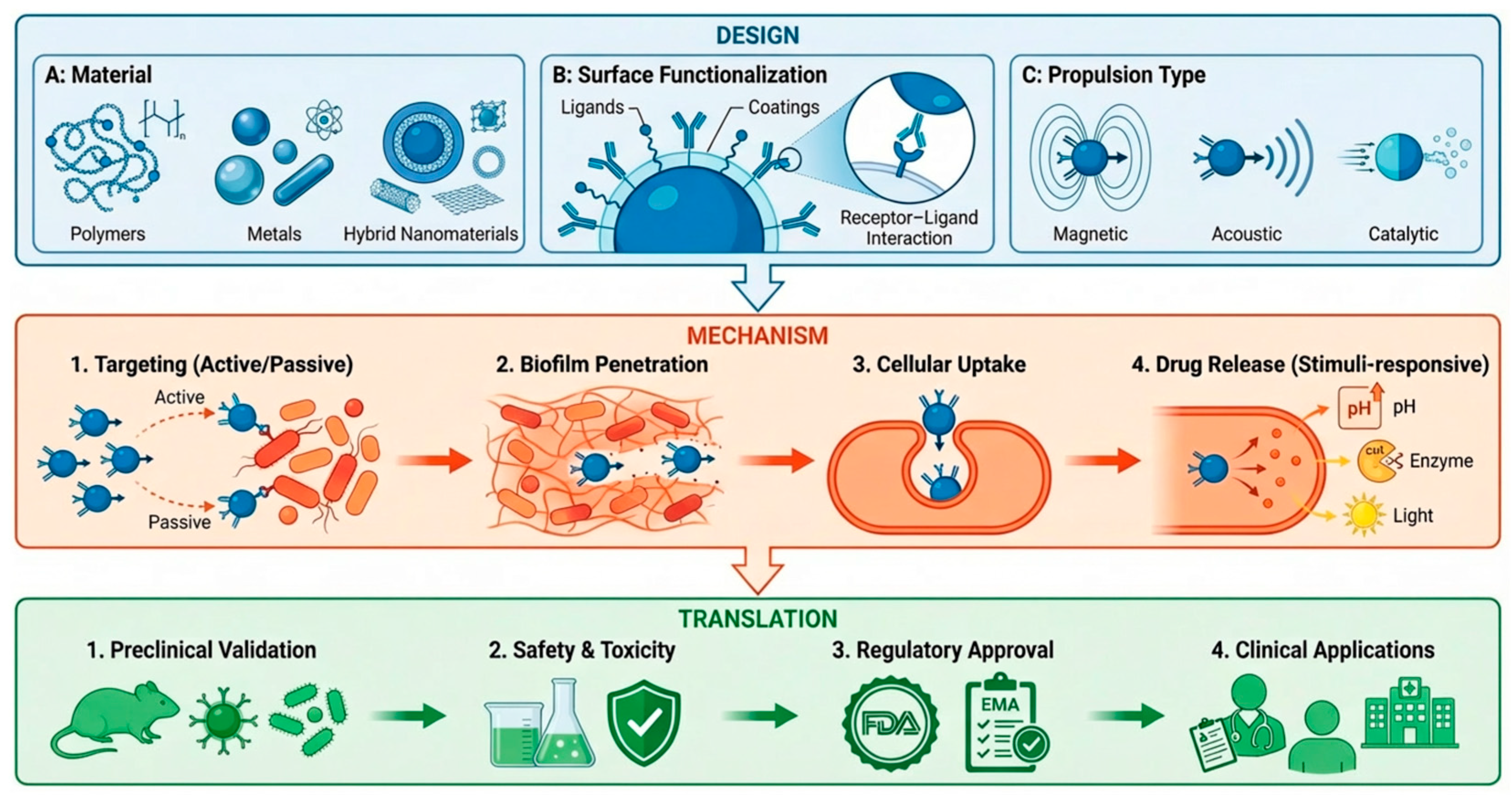
17], this work adopts a transdisciplinary approach. By combining principles of microbiology, materials science, and regulatory science, this study designs the evolving interface between nanorobotic design and clinical therapeutics. We propose a design–mechanism–translation framework for navigating the complex landscape, which acts as the structural foundation of this review, guiding the synthesis of the existing literature toward a more cohesive understanding of clinical readiness.
2. Scope of This Review
This review provides an analysis of studies on the design, functionalization, biomedical applications and manufacturing processes of nanorobotic systems, along with biofilm disruption and antimicrobial characteristics, that were published between the years 2020 and 2025. Particularly, this review focused on:
- (1)
Microrobots that are driven magnetically and proposed for biofilm disruption or targeted drug delivery.
- (2)
DNA origami nanorobotics and biohybrid nanotechnologies, specifically programmed for enzyme or drug delivery.
- (3)
Nanoswimmers that are designed with catalytic or chemical propulsion and applied in bacterial eradication and infection models.
- (4)
Hybrid nanocarrier systems that incorporate photothermal, photodynamic or sonodynamic antimicrobial processes.
Research studies that only focused on non-autonomous non-biomedical robotic systems, non-autonomous nanoparticles, targeted anti-cancer nanomedicine or non-infectious therapeutic areas were excluded from this review [
11].
3. Literature Search, Data Extraction and Synthesis
Both conceptual and experimental data were documented with the help of a narrative review methodology. Systematic literature searches were carried out with the help of the Google search engine, including Google Scholar, Web of Science, PubMed, Science Direct, and Scopus, with manual screening of reference lists from essential publications. Different logical operations and keywords were used to search the literature (microrobots, nanoswimmers, nanorobots, magnetic microbots, DNA origami, biohybrid robots, nanotechnology and antimicrobial, biofilm, resistance, infection, drug delivery and target sites).
This review includes only articles published in English that contain original experimental results, translational debates or design frameworks. Reviews, conference abstracts, and non-peer-reviewed publications were excluded unless they presented novel conceptual or regulatory insights [
10,
22,
23].
The collected articles, complete texts, abstracts, and titles were assessed for quality and applicability. Information about the type, structure, propulsion method and mode, target pathogen or model system, therapeutic payload, and outcome measurements of the nanorobot was extracted from the selected literature. The extracted data were synthesized to establish the following thematic categories:
Advances in design and mechanics (propulsion, control, and functionalization).
Biomedical uses, such as biofilm penetration, antibiotic delivery, and synergistic therapy.
Preclinical outcomes (effectiveness, cytotoxicity, and biocompatibility).
Manufacturing, immunogenicity and regulatory requirements are significant translational barriers. Instead of performing a meta-analysis, this study utilized a qualitative narrative strategy to compare different material systems and treatment approaches. This methodology aligns with established frameworks currently used in technology-driven biomedical reviews, which mainly emphasize mapping research trajectories; rather than quantifying aggregated outcomes, it mainly focuses on the identification of translational gaps [
20,
24,
25].
4. Nanorobotic Design—Methodological Rationale
This research methodology integrates studies from biology and engineering to explain how advances occur in nanorobot design and their implementation in clinical practices.
Additionally, this approach helps to identify significant challenges, such as immunological responses, biocompatibilities and regulatory aspects, that are often overlooked in technical research studies [
26,
27].
In the upcoming era, this methodology will demonstrate that the current research represents more than a mere compilation of available data; it clearly outlines what technical and scientific steps are needed to facilitate nanorobotic antimicrobial systems from laboratory experiments to real medical applications. This includes addressing key obstacles, such as scalability, biocompatibility, regulatory compliance, and clinical validation, to ensure successful integration into future therapeutic strategies.
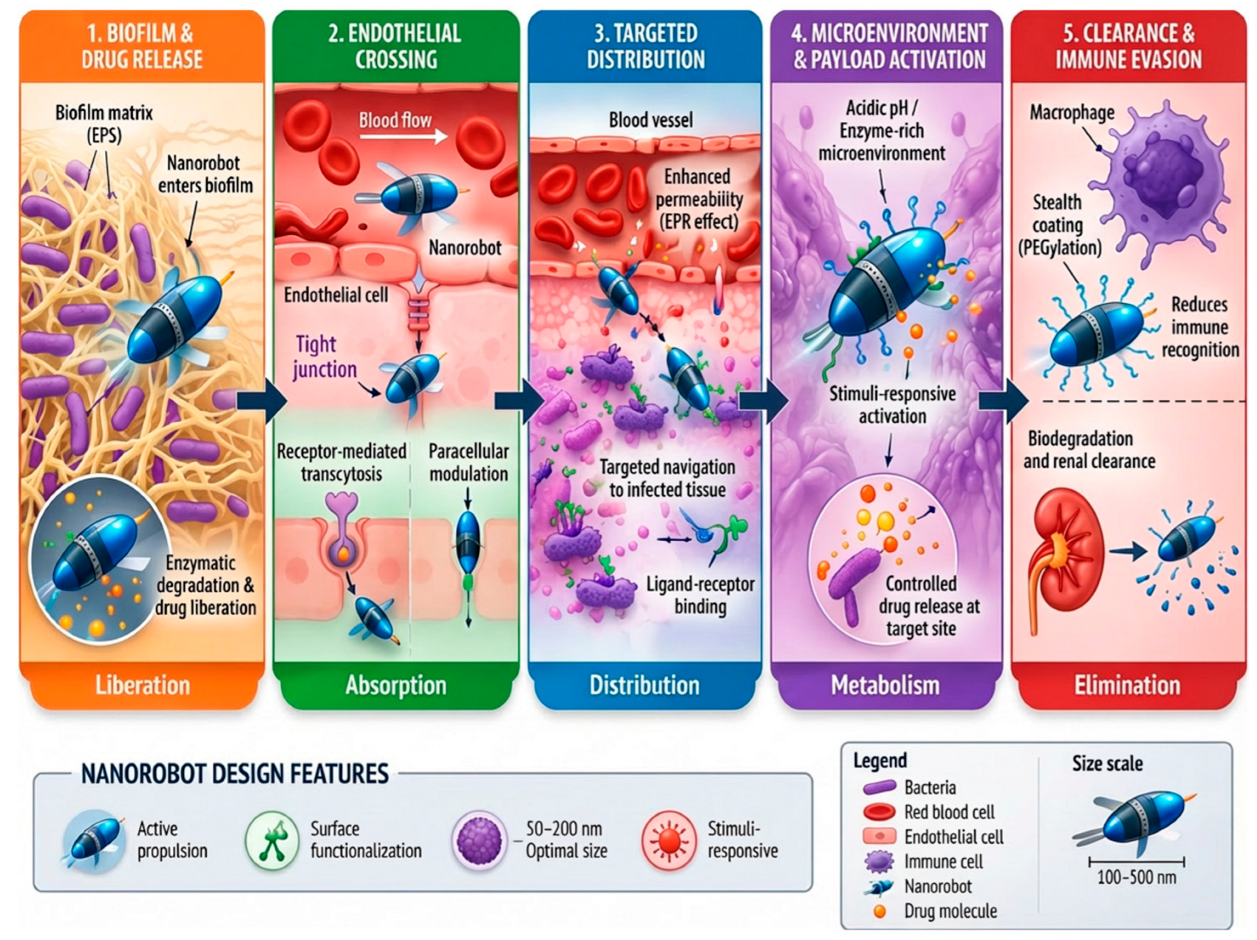
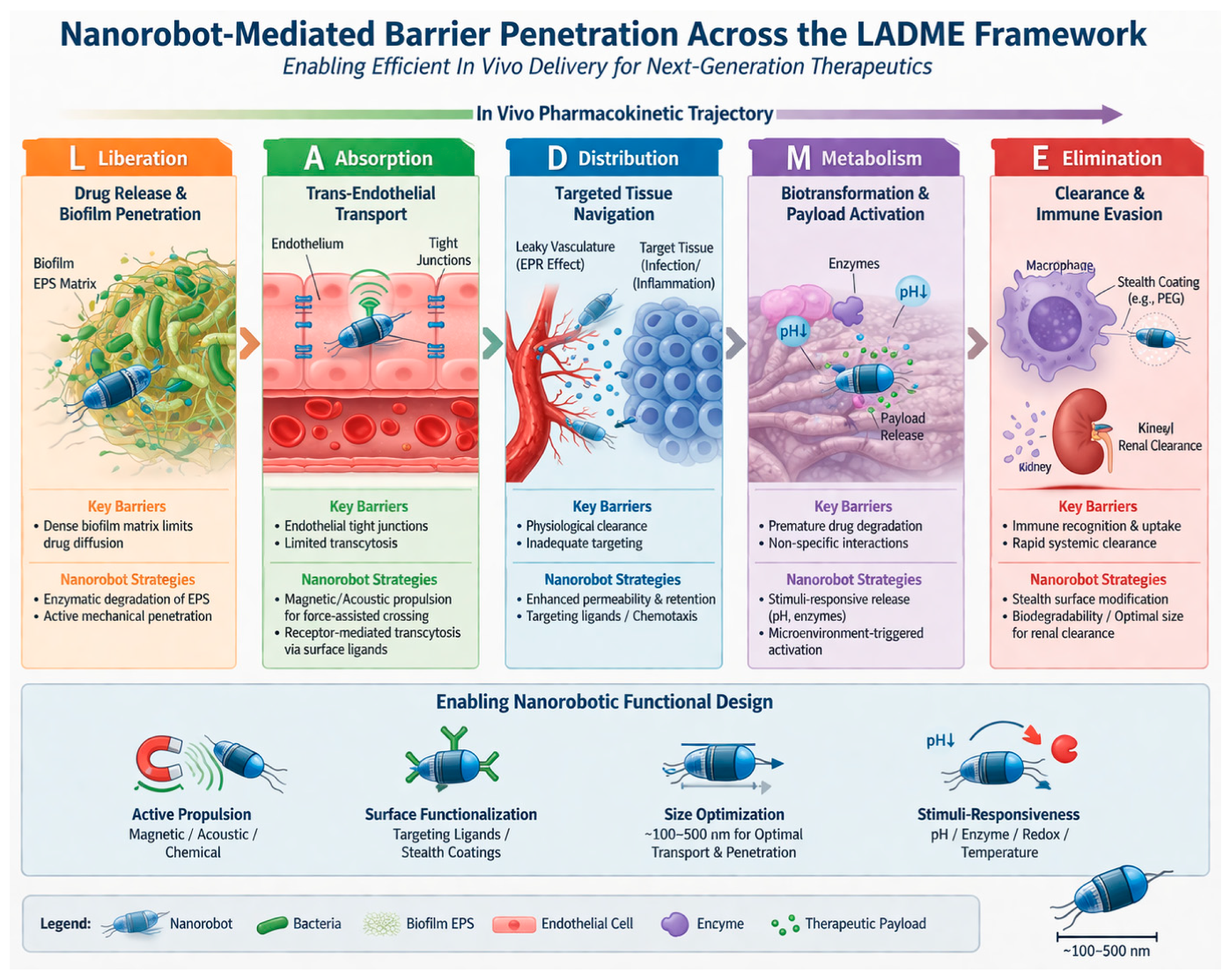
The design of nanorobots for biomedical uses can additionally be rationalized by integrating classical pharmacokinetic parameters, i.e., LADME (Liberation, Absorption, Distribution, Metabolism, and Excretion), which is mostly used in conventional drug discoveries [
28]. Regardless of their advanced and active nature, nanorobots still meet these basic biological principles to attain clinical success. The process of drug liberation in nanorobots is achieved by a controlled and stimuli-dependent responsive drug release process, permitting localized therapeutic action [
29]. Absorption is improved through active targeting mechanisms and the ability of nanorobots to penetrate deep into physiological barriers, such as cellular membranes and biofilms [
30]. The distribution of nanorobots can be governed by their physiochemical characteristics and is affected by directed propulsion systems, such as enzymatic, magnetic or acoustic control, which permit accurate navigation to infection sites [
31]. Metabolism is mainly influenced by material properties and composition and addressed through the application of biodegradable and bio-responsive moieties that undergo controlled degradation within biological environments, minimizing cytotoxicity and improving safety profiles [
32]. Lastly, excretion of nanorobots depends on size, surface properties, composition and biodegradability, with properly designed nanostructures facilitating clearance through renal and hepatic routes and minimizing long-term accumulation and associated toxicities [
33]. This LADME-guided methodology offers a systematic background for aligning nanorobotic design with conventional pharmacokinetic principles, thus improving their translational potential in antimicrobial therapy. The incorporation of LADME principles into nanorobotic design is shown in
Figure 1. As shown, each pharmacokinetic module is associated with specific functional landscapes of nanorobots to improve therapeutic efficacy and translational potential.
5. Design Principles and Mechanistic Innovations in Nanorobotics
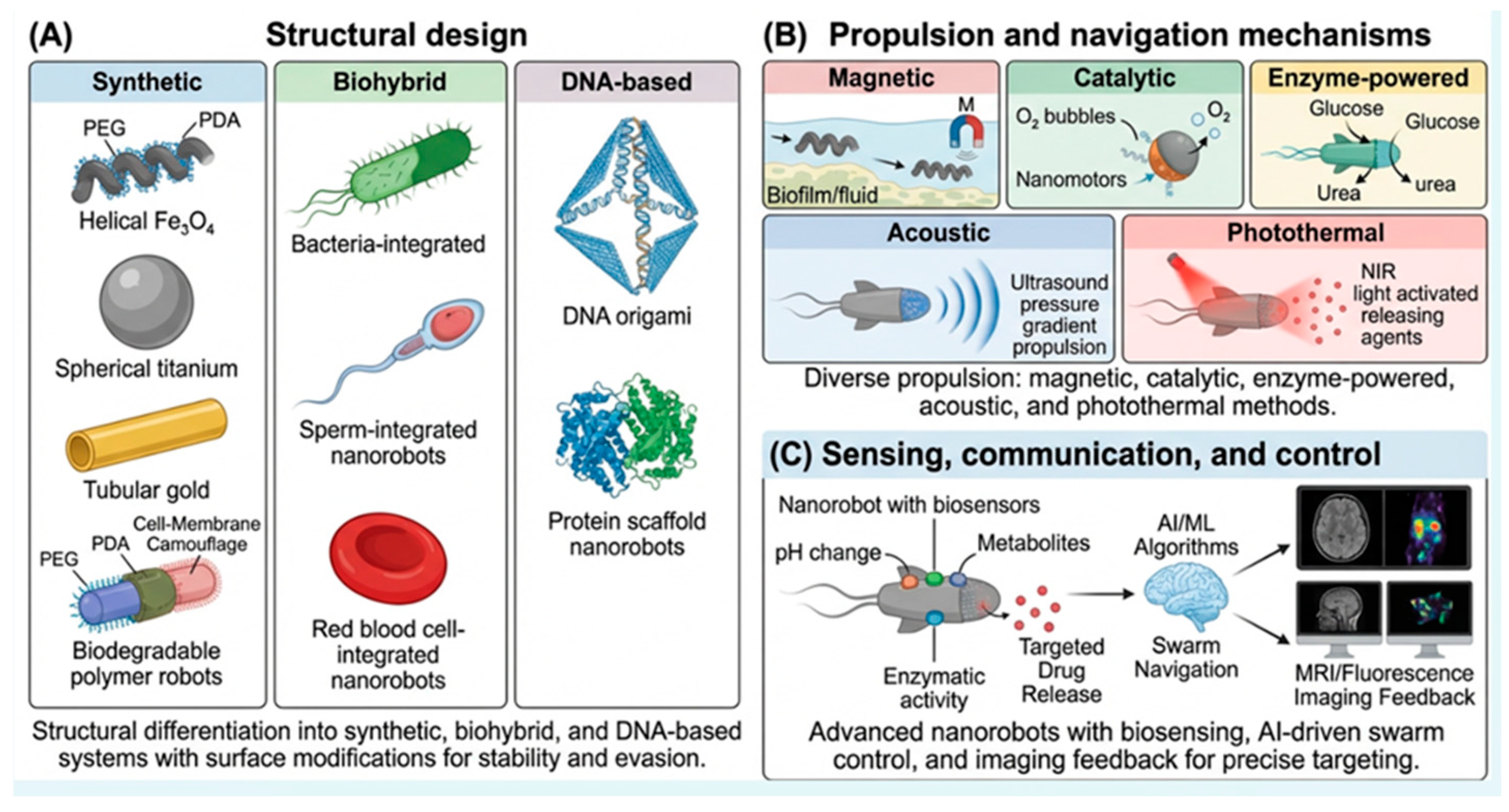
The development of biomedical nanorobotics resulted from the convergence of bioengineering, nanofabrication and material science. These nanorobots can execute very complex pharmacological tasks at cellular and subcellular levels either autonomously or under external supervision. These nanorobots can easily penetrate physiological membranes and biofilms and deliver their antibacterial content/drug with high precision and accuracy compared to conventional antibiotics [
15,
34,
35]. Diagrammatic presentations of nanorobotics strategies are shown in
Figure 2.
6. Structural and Functional Design Principles
The biological objective, medicinal payload, and desired propulsion technique of nanorobots largely determine their architectures. Nanorobots can be classified into three primary categories: synthetic, biohybrid, and biological systems [
12,
18].
Inorganic or polymeric materials, including magnetic iron oxide (Fe
3O
4), titanium (Ti), gold (Au), and naturally degradable polymers, are used to create synthetic nanorobots. Nanorobots are usually helical, spherical or tubular in shape, and their movement can be easily influenced and regulated by biological fluids [
36]. In contrast, biohybrid nanorobots are composed of both biological and synthetic components, for example, red blood cells, sperm cells, or bacteria, and for locomotion, they use their innate mobility and resemblance with other living microorganisms [
37]. Biohybrid nanorobots, which are usually based on DNA nanotechnology, utilize DNA origami frameworks or protein-based skeletons that self-assemble and respond directly to molecular triggers [
38,
39,
40].
Subsequently, biocompatibility influences how effectively an architecture evades the immune system, how long it remains inside the body, and how safely it is used for treatment; therefore, it is crucial for all structures. Various polymers are used as surface coating materials, for example, polyethylene glycol (PEG), polydopamine (PDA), and cell membrane camouflaging, which are used to mask different items and make them more stable and less likely to trigger the immune system of the body [
40]. In therapeutic settings, nanorobots can now be improved because of the addition of smart functional domains for drug loading, enzymatic degradation through programmed assembly processes and pH-responsive release mechanisms. Detailed structural and functional aspects of nanorobots are mentioned in
Table 1.
7. Propulsion and Navigation Mechanisms
Active nanorobots and passive nanocarriers are mechanistically well differentiated from each other by their modes of locomotion and propulsion. Various techniques are employed on micro- and nanoscales for propulsion, including acoustic, chemical, magnetic, catalytic and light-driven systems [
46,
47].
Since magnetically propelled nanorobots have minimal cellular toxicity, deep tissue penetration, and remote-control capabilities, they are specifically used in biomedical fields. Nanorobots are usually made up of supermagnetic or ferromagnetic materials, which convert oscillating or rotating magnetic fields into translational motion [
48]. Helical microbots, which are designed after bacterial flagella, can easily swim through dense fluids and spin, allowing for controlled passage across mucosal barriers and biofilms [
49]. Recent studies suggest that magnetic nanorobots carrying antibiotics or enzymes can simultaneously deliver therapeutic drugs and disrupt biofilm materials [
50].
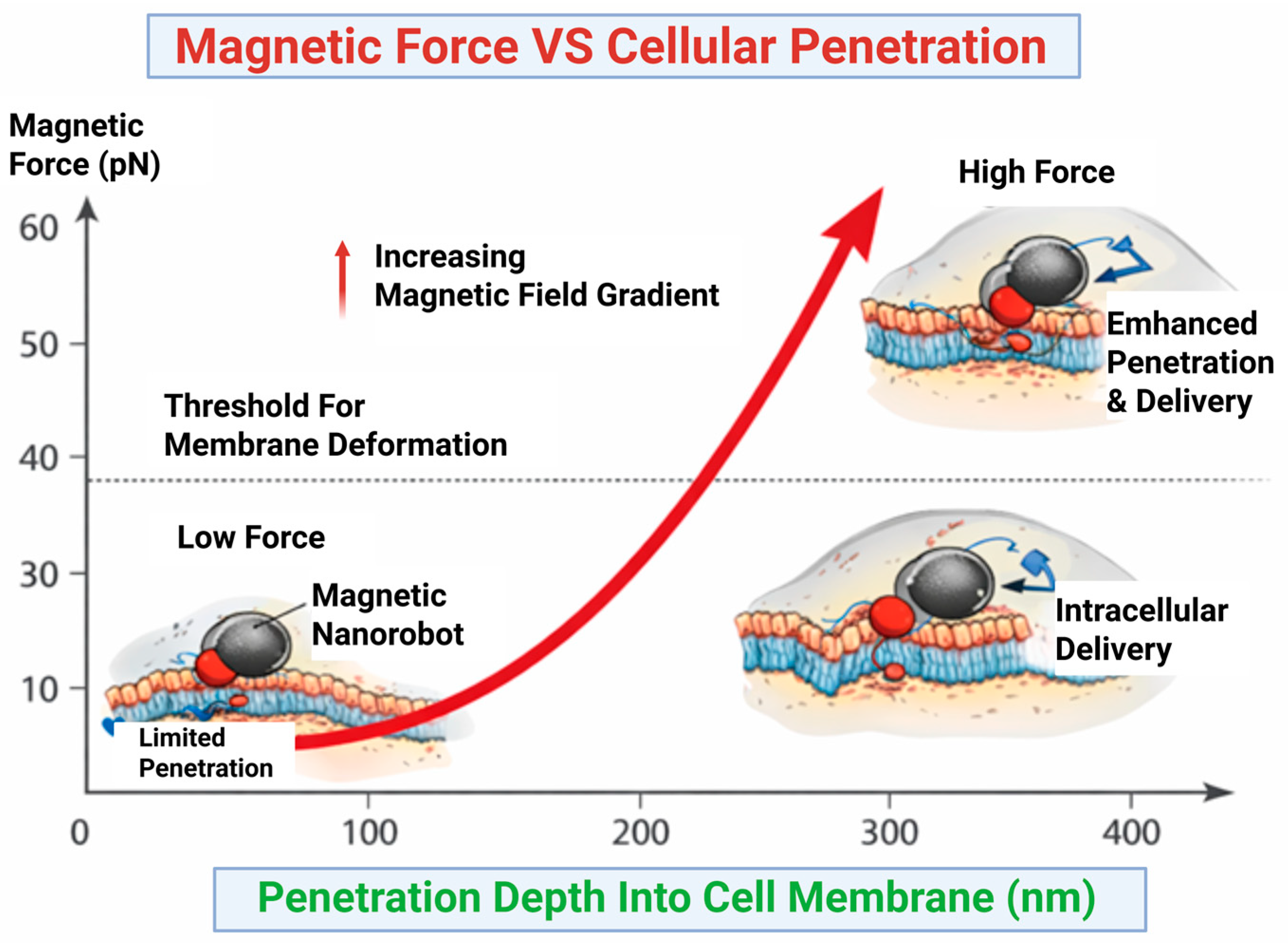
The effectiveness of magnetically propelled nanorobots is governed by the magnitude of the external magnetic force produced under an applied magnetic field. This force (F) can be estimated as directly proportional to the product of volume, magnetic susceptibility and gradient of the magnetic field (∇B), such that F ∝ Vχ∇B. Notably, it is the magnetic field gradient, rather than the field strength alone, that governs the capacity of nanocarriers to produce sufficient force for propulsion and tissue penetration [
51]. Quantitative studies have confirmed that increasing field gradients boosts propulsion efficacy and allows nanocarriers to apply mechanical forces capable of altering cellular membranes, thus facilitating uptake and intracellular delivery [
52]. It has been reported that optimized magnetic field conditions significantly enhance transmembrane transport efficacy, emphasizing the significance of correlating physical force generation with biological barriers. However, achieving satisfactorily high magnetic gradients in deep tissues remains a major challenge, predominantly under clinically acceptable conditions. Hence, the translation of magnetic nanorobotic systems needs careful optimization of field factors to balance effective force generation with safety and feasibility constraints [
51,
53].
Figure 3 illustrates the relationship between magnetic force and cellular membrane permeation in magnetically driven nanorobotic systems.
Catalytic and chemical nanorobots utilize chemical energy for propulsion, and with the help of redox reactions, this chemical energy is converted into mechanical work. On the surface of a catalyst, e.g., platinum (Pt) or manganese dioxide (MnO
2), the hydrogen peroxide (H
2O
2) molecule decomposes and creates oxygen bubbles, which help nanorobots move forward [
46]. Even though this system can attain high propulsion speeds, its reliance on toxic chemical propellants limits its clinical translation for in vivo application. In recent bioinspired techniques, enzymes are powered by biocompatible fuels like glucose or urea, achieving constant propulsion in physiological settings and thereby overcoming the limitations of cytotoxicity [
54].
Acoustic nanorobots utilize ultrasound energy to generate localized pressure gradients, enabling efficient movement through biological tissues with minimal energy dissipation. This method improves translational compatibility by facilitating simultaneous imaging and propulsion of nanorobots using clinical ultra-sonographic devices [
55].
Light-driven propulsion based on photothermal or photochemical conversion makes it possible to control space very precisely in clear areas. Gold nanorods and semiconducting nanoparticles absorb near-infrared (NIR) light, which creates localized heat gradients that either move the nanorobot or release antimicrobials [
56]. On the other hand, optical scattering in biological tissue makes it hard for them to work in deep tissue.
8. Comparative Analysis of Nanorobotic Systems for Multidrug Resistance Infections
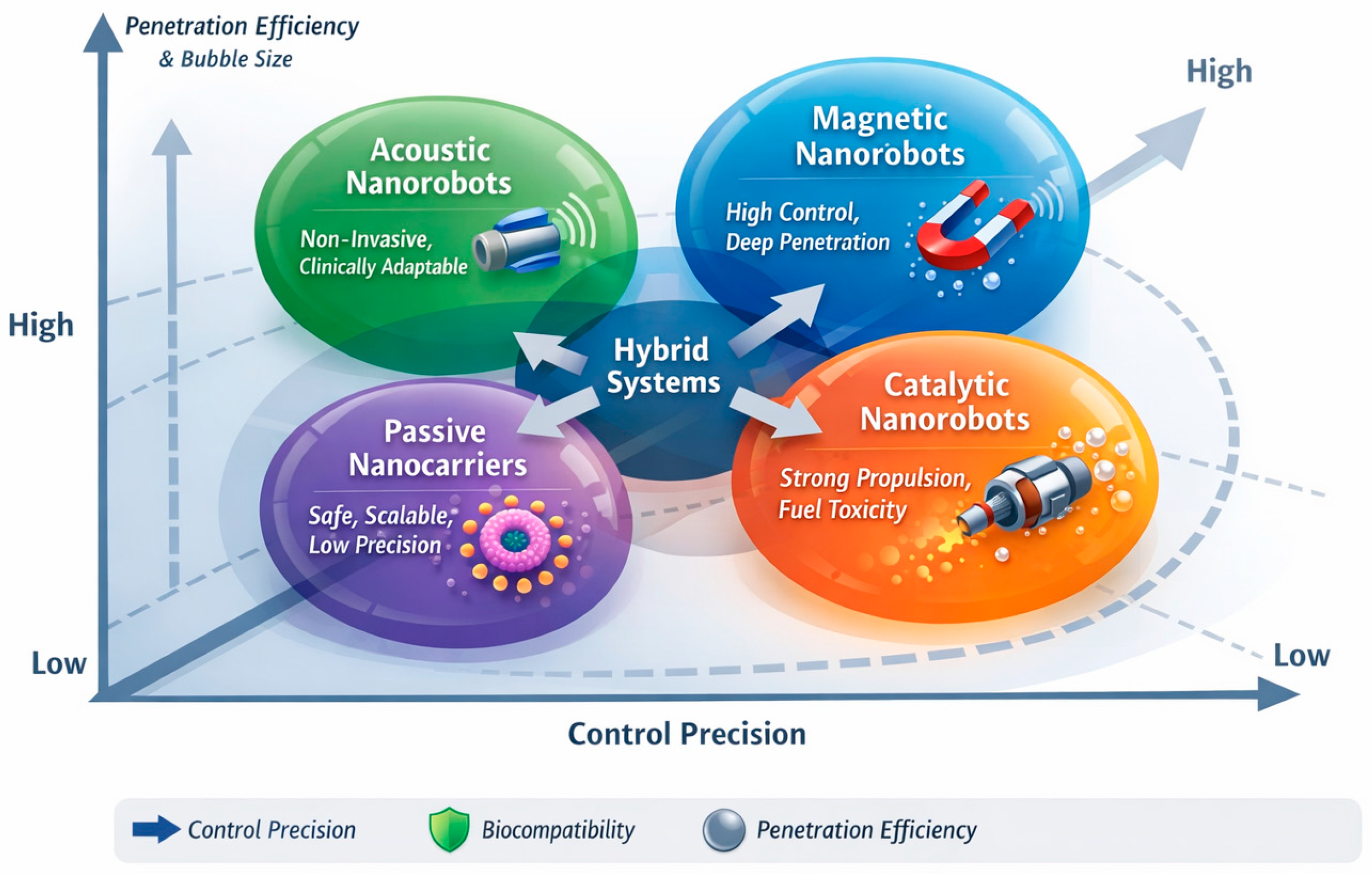
To clearly contextualize the therapeutic potential of nanorobotics in combating MDR infections, a comparative analysis of various propulsion mechanisms and delivery approaches is essential. The functional variations among major nanorobotic systems are summarized in
Table 2 and
Table 3 and
Figure 4, which highlight trade-offs between control accuracy, biocompatibility and penetration potential.
Magnetically operated nanorobots provide superior external controllability and enhance tissue penetration, making them feasible for targeted drug delivery in cases of deep lesions and infections. However, their reliance on magnetic field gradients and specific equipment restricts scalability and clinical translation [
18,
51]. On the other hand, catalytic nanorobots have autonomous propulsion and high biofilm penetration capacity; however, they are limited by toxicity concerns linked with chemical fuels like H
2O
2 [
57,
58].
Acoustic nanorobots offer a non-invasive alternative with high biocompatibility and clinical compliance due to the extensive applications of ultrasound technologies. Nevertheless, their relatively minimum propulsion limit and force spatial accuracy may restrict their effectiveness in dense biofilm milieu [
59]. Passive nanocarriers, which are highly safe and scalable, lack active targeting capacity and exhibit low penetration efficiency, especially in complex infection sites [
60,
61].
A critical view from this perspective shows that no single nanorobotic system is universally optimal; rather, therapeutic potential depends on aligning a system’s framework with a specific pathological condition, such as biofilm density, infection site and required penetration ability. This highlights the significance of evolving hybrid systems that integrate different propulsion mechanisms to overcome individual limitations and increase overall therapeutic potentials.
The comparative landscape of nanorobots against MDR infections demonstrates that magnetic nanorobots show high accuracy and great tissue penetration, yet they are constrained by external magnetic fields. Although catalytic nanosystems have high propulsion and biofilm penetration, they have limited biocompatibility because of their reliance on chemical fuels. Acoustic systems provide a non-invasive and biocompatible substitute with moderate propulsion efficiency, while passive nanocarriers demonstrate high biocompatibility and scalability but lack active targeting and penetration abilities.
9. Sensing, Communication, and Control
Functional intelligence, or perceiving and reacting to environmental signals, is a key component of next-generation nanorobotics in addition to mobility. Modification of nanorobots with biosensors results in the real-time detection of various biomarkers, such as bacterial metabolites, enzyme activity and pH, causing changes in various behaviors like alteration in locomotion or release of drug substances [
62].
Machine learning methodologies and artificial intelligence-based control algorithms have distinctly advanced the predictable navigation of nanorobotic swarms inside highly complex biological microenvironments [
63]. These computational algorithms lead to the optimization of navigational trajectories, suppressing nonspecific target interactions and enhancing therapeutic thresholds through a real-time feedback mechanism caused by imaging modalities like magnetic resonance imaging (MRI), fluorescence microscopy and tomography.
10. Mechanistic Innovations for Antimicrobial Therapy
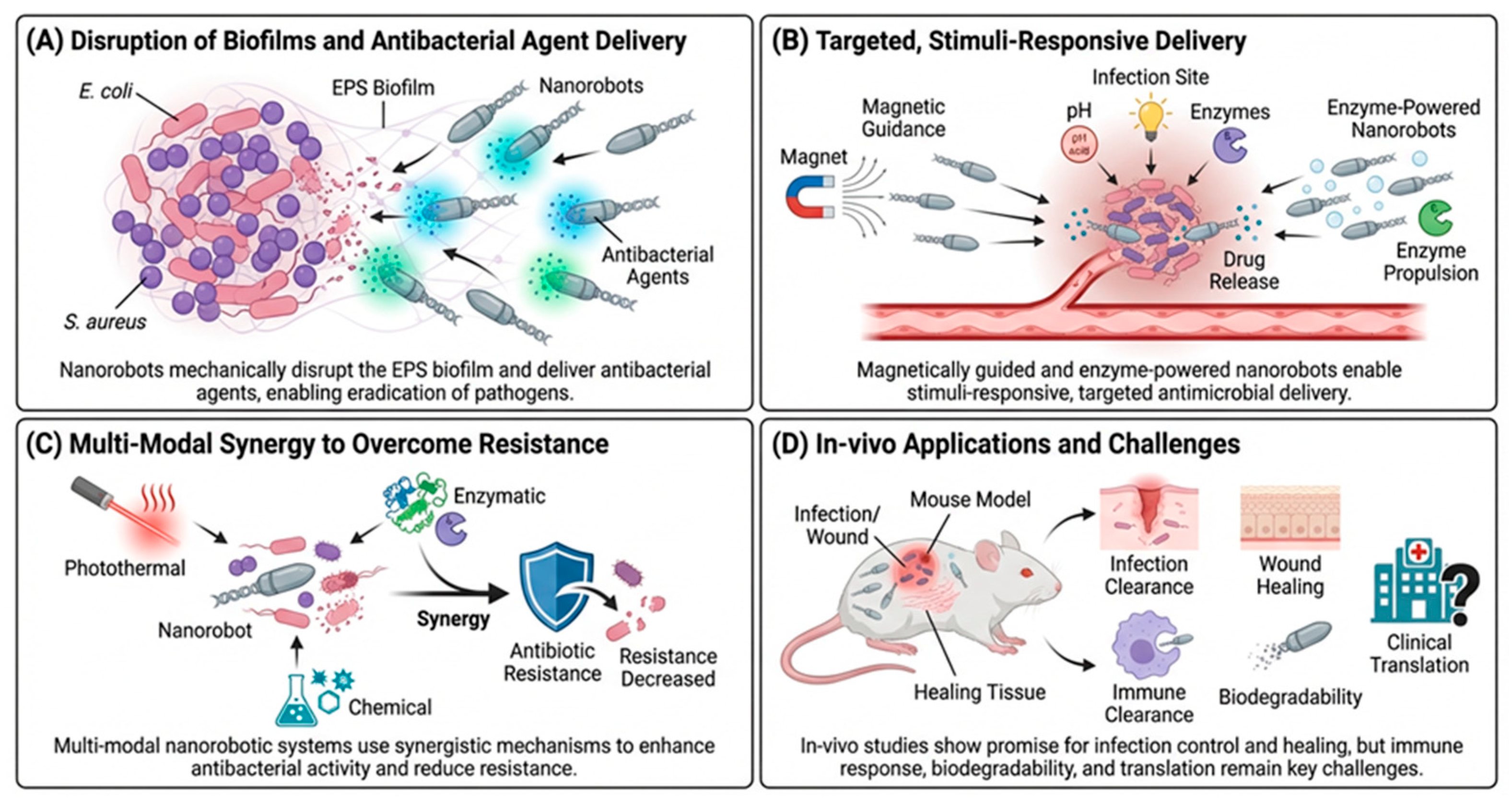
The utilization of proposed principles for the control of infections signifies one of the most critical innovations in the field of biomedical nanorobotics. To overcome multidrug resistance (MDR)-related challenges, nanorobots utilize three principal strategies, as shown in
Figure 5.
Mechanical biofilm disruption: Bacteria are exposed to antimicrobial chemicals, and biofilm matrices are broken up by rotational or oscillatory motion [
64].
Optimization of local drug delivery: Systemic exposure is reduced by permitting the direct delivery of enzymes or antibiotics to infected microenvironments [
22].
Multimodal synergistic effect: Combining physical disruption with chemical or photothermal bactericidal actions can increase killing power even against populations of bacteria that are latent [
19].
Magnetically driven Fe
3O
4-PDA nanorobots and DNA origami constructs equipped with lysozyme or antimicrobial peptides have the potential to remove up to 90–95% of biofilm mass in vitro when compared to traditional nanoparticle therapies [
16].
11. Overcoming Physiological Barriers
Overcoming various physiological barriers is the key challenge for nanomedicine, as such obstacles significantly impede the efficient delivery of therapeutic agents to a targeted site [
65]. Within the human body, nanorobots must navigate diverse biological interfaces, such as endothelial layers of vessels, cell membranes and organ-specific barriers, that strongly regulate molecular transport [
66]. Nanorobotic systems have unique advantages in addressing challenges because of their active propulsion mechanisms and tailorable physicochemical characteristics. For instance, externally directed nanorobotic systems, like magnetic, enzymatic or acoustic fields, can generate localized mechanical forces that increase their penetration through endothelial membranes [
67]. Furthermore, surface functionalization of nanorobots with special ligands allows for receptor-mediated endocytosis, facilitating targeted cellular uptake and enhancing tissue localization [
68].
Additionally, their nanoscale dimensions and specially engineered surface characteristics enable them to exploit properties such as enhanced permeability and retention effects, particularly in inflamed or infected regions [
69]. From the perspective of MDR infections, these systems have shown the ability to infiltrate dense biofilm structures, which are otherwise very resistant to conventional antimicrobial therapies [
70]. Regardless of all these promising capacities, challenges exist, such as immune system recognition, complexity of in vivo navigation and clearance problems; thus, overcoming physiological barriers requires an integrated landscape combining mechanical propulsion, adaptive material engineering, and biochemical targeting to achieve maximum therapeutic efficacy [
71].
Figure 6 illustrates how nanorobots navigate key physiological barriers through synchronized transport and targeting mechanisms, thereby highlighting the potential to improve delivery efficiency in vivo.
12. Design-to-Translation Considerations
Despite the quick advances in mechanics, nanorobots must be manufactured, scaled, and biocompatible for their transition from lab prototypes to clinical treatments. Additive manufacturing and 3D microprinting have made it possible to build microhelices and tubular robots repeatedly with nanoscale precision [
72]. Concurrent research is being done on hydrogel–metal composites and other hybrid materials for biodegradable designs that eliminate the potential for long-term retention in vivo [
73].
Biocompatibility remains a critical, yet evolving aspect of nanorobotic systems. Current advances in surface modification, including coating with polymers, utilization of biodegradable structural moieties and ligand conjugation, have enhanced biological compatibility while reducing cytotoxicity [
60]. These changes increase circulation stability and decrease nonspecific interactions with healthy tissues. Despite these modifications, several challenges remain. Nanorobots may still evoke immune system responses, causing rapid clearance or unintended inflammatory reactions [
60]. Furthermore, concerns related to long-term accumulation, potential cytotoxicity, and biodegradation of certain moieties, particularly in catalytic systems, remain significant barriers to clinical transition. Hence, biocompatibility should be considered a topic of ongoing progress rather than a fully resolved issue, demanding further evaluation through standardized preclinical and clinical investigations [
61,
74].
Nevertheless, there are still limitations like standardizing testing procedures, immunological tolerance, and ensuring steady propulsion under physiological conditions. In order to create nanorobots and consider these problems, a comprehensive framework that integrates computational design, regulatory harmonization, and advanced material innovation is needed [
75].
13. Translational Roadmap for Nanorobotic Systems in MDR Infections
The evolution of nanorobots from laboratory innovation to clinical utilization (
Figure 7) requires a structured elucidation across preclinical studies, regulatory feasibility and realistic clinical approaches. To increase the translational significance of this review, key elements, including preclinical benchmarks, regulatory pathways, and clinical entry points, are critically considered.
At the preclinical benchmark phase, four critical sites are highlighted. The first one is targeting efficiency, including accurate localization and incapacitating physiological barriers, mostly achieved through externally guided nanorobotic systems [
58]. The second is drug loading and release, emphasizing a stimuli-responsive system with precise release kinetics for targeted therapy [
76]. The third is toxicity thresholds, pointing out cytotoxicity and immunogenicity to ensure biosafety and biocompatibility [
77]. The fourth one is biofilm penetration and antimicrobial effect, suggesting that nanorobots can easily penetrate and eradicate biofilms, which serves as a key benchmark distinguishing them from conventional therapies [
78].
The clinical translation of nanorobotic systems is further evaluated by regulatory authorities such as the FDA/EMA. These regulatory framework considerations outline important translational requirements, such as combination product classification integrating device and drug functionality challenges [
79], safety and toxicity profiling held by long-term validation studies [
80,
81], and clinical trial design, emphasizing end points like infection elimination and biofilm eradication [
82].
Among the current technological limitations, the abrupt application of nanorobotic systems to combat systemic infections remains challenging. Therefore, identifying feasible initial clinical targets is crucial. At the clinical level, the therapeutic landscape encompasses several potential domains, such as localized infections, biofilm-associated diseases requiring targeting disruption and topical drug delivery approaches aimed at limiting systemic toxicity [
58,
83].
14. Biomedical Applications of Nanorobotics in Multidrug-Resistant Infections
Traditional antimicrobial therapy is limited by microorganisms through different resistance mechanisms, like biofilm formation, phenotypic persistence, horizontal gene transfer and hiding drug-binding sites, which explains the clinical burden of multidrug-resistant infections (MDRIs) [
84,
85]. Nanorobotic systems represent an emerging therapeutic potential transition from conventional passive nanocarriers to adaptive, intelligent nanotherapeutic platforms because they can actively navigate biological settings, mechanically break biofilm formations, and perform on-demand antimicrobial administration [
35]. This section critically examines the preclinical and experimental applications of nanorobots in the primary models of infectious diseases, as well as their relative advantages, translational challenges, and mechanistic effectiveness.
14.1. Disruption of Bacterial Biofilms
Highly organized bacterial populations known as biofilms are protected from host immunological reactions and antibiotic activity by an extracellular polymeric matrix that the bacteria manufacture on their own. More than 80% of chronic infections, such as wound infections, pneumonia, and device-associated sepsis, are linked to biofilms [
86]. The inability of conventional antibiotic treatments to adequately permeate this matrix commonly leads to prolonged infections and partial bacterial clearance.
Nanorobotic systems are remarkable because they can distribute antibacterial chemicals and physically clear biofilms. For instance, magnetically driven microrobots can increase the dispersion and effectiveness of antibiotics by employing oscillating magnetic fields to bore through biofilm layers [
36]. Fe
3O
4-polydopamine nanorobots coated with tannic acid outperformed passive nanoparticles in reducing biofilm biomass against
Escherichia coli and
Staphylococcus aureus by 95% [
73].
Similarly, biofilm eradication has been programmed using DNA origami nanorobots. DNA nanocages have been engineered to be activated by bacterial quorum-sensing molecules, which contain lysozyme, an enzyme capable of degrading bacterial cell walls. Eighty to ninety percent of MRSA biofilms and multidrug-resistant
E. coli were successfully destroyed by these nanorobots [
87]. These structures’ adaptability mitigates off-target effects, enabling precision-targeted recognition and payload release within the infected microenvironment.
14.2. Targeted Antimicrobial Delivery
Conventional nanocarriers passively aggregate at the site of infection by relying on the increased permeability and retention (EPR) effect, which is sometimes unreliable in tissues with little vascularization or variety [
6]. However, therapeutic medications can be delivered directly to infected microenvironments using nanorobots, which can travel under external magnetic or acoustic fields with spatiotemporal accuracy. Under various field strengths, magnetic nanorobots have demonstrated controlled release of antimicrobials. For example, hydrogel microrobots with antibiotic payloads were developed, which released their payloads upon encountering pH gradients typical of pathological tissues. These nanorobots also reduced biofilm regrowth in
S. epidermidis infection models by 90% [
88].
Another development is enzyme-powered nanomotors, which use endogenous substrates such as glucose or urea for both propulsion and concurrent therapeutic activation [
89]. In infected wound models, catalase-driven nanomotors functionalized with ciprofloxacin were used to rapidly destroy bacteria within 6 h compared to 24 h for free drug therapy [
90].
Moreover, hybrid nanorobots offer double advantages of chemical self-propulsion and directional control. They combine catalytic propulsion and magnetic navigation, allowing them to penetrate deeper into biofilms and tissue layers [
62,
91]. These systems are used in vitro to attack
Pseudomonas aeruginosa biofilms, practically performing a complete breakdown and showing bactericidal effects [
73].
14.3. Combination and Synergistic Therapies
Recent studies demonstrate that the most potent antibacterial effects come from multimodal approaches that combine photothermal, chemical, and mechanical mechanisms. For example, light-driven gold nanorobots, when mixed in bacterial cultures, caused localized hyperthermia upon exposure to near-IR radiation and, at the same time, they released antibiotics to completely accomplish biofilm eradication [
56].
Similarly, enzyme-loaded catalytic microrobots that co-deliver DNase and antibiotics enhance bacterial sensitivity and work in concert to degrade the extracellular polymeric substance (EPS) matrix. In polymicrobial models, the method produced a 70% decrease in total biofilm biomass [
92].
The risk of future resistance development is reduced by enhancing bactericidal effects and lowering antibiotic doses through these synergistic mechanisms. Notably, multi-model nanorobots are engineered to respond to environmental stimuli such as bacterial enzymes or oxidative stresses, enabling site-specific activation [
93].
14.4. In Vivo and Translational Models
The use of nanorobots in in vivo environments is still rare but rapidly evolving despite widespread in vitro success. Current studies on animal models have shown encouraging results in terms of infection clearance, wound healing and improved survival. Similarly, it has been reported that magnetically guided nanorobots decrease bacterial burden and inflammation in animal models of chronic wound infection without causing any marked injury.
Biohybrid nanorobots have shown great potential for stimulating natural propulsion by utilizing living cells or microorganisms as their propulsion energy. It has been reported that bacteria-driven microrobots with antibiotic nanoparticles may independently target hypoxic infection sites, utilizing bacterial chemotaxis to navigate across complex tissue environments [
37].
The transition from preclinical to clinical application remains hindered by several critical challenges, including immunological clearance, biodegradability, and long-term biodistribution [
66,
94]. Furthermore, the absence of standardized infection models for evaluating nanorobotic efficacy limits the comparability of results across different studies [
95]. To address these challenges, interdisciplinary collaboration is essential for the development of standardized benchmark models, ethical frameworks, and Good Laboratory Practice (GLP) protocols specific to nanorobotics.
14.5. Comparative Advantages of Nanorobots over Conventional Nanomedicine
Nanorobots have several mechanistic and therapeutic advantages over passive nanocarriers:
Physical rupture of biofilms, which increases bacterial exposure and antimicrobial penetration.
Controllable, on-demand medication delivery that enables therapeutic modification in real time.
The potential for theragnostic (therapy + diagnosis) applications through interaction with diagnostic modalities.
Overcoming diffusional constraints through active navigation across viscous biofilm matrices.
Less systemic toxicity because medication release mostly takes place at infection sites [
7,
25].
For instance, while liposomal and polymeric nanoparticles typically exhibit penetration depths of less than 20 µm, magnetically operated nanorobots can exceed 100 µm, resulting in much higher rates of bacterial reduction in mature biofilms [
72]. The comparative analysis in
Table 4 reveals that active nanocarriers show active propulsion, bioactive-triggered drug release, biofilm disruption and navigation, while their biosafety requires further evaluation and has limited manufacturing scalability. On the other hand, conventional nanocarriers have passive mobility, well-established biosafety protocols, diffusion and pH-triggered drug release, and high manufacturing scalability but limited biofilm penetration. These results suggest that nanorobotics could revolutionize the therapeutic management of chronic infections by replacing empirical antibiotic treatments with highly customized, precision-based therapies.
14.6. Future Prospects and Current Limitations
Although nanorobotics represents a revolutionary advancement in infection control, the practical application of this technology remains in its early stages. Large-scale repeatability, in vivo navigation accuracy, the standardization of propulsion mechanisms, and long-term biosafety are currently the primary constraints [
26]. Moreover, regulatory challenges pertaining to active nanosystems, which are classified as drugs, devices, and biological products, continue to impede clinical approval [
96].
To fully utilize the potential of nanorobots in the fight against multidrug-resistant ailments, future research must focus on a few crucial areas. Currently, the first and most urgent need is the development of biodegradable, nontoxic propulsion mechanisms that offer biocompatibility and safety in clinical settings. Second, to achieve precise navigation and targeted therapeutic action inside complex biological milieus, AI-guided control systems and real-time imaging technologies must be integrated. Third, to validate the reproducibility, efficiency, and long-term safety of nanorobotic interventions, reliable infection and safety models must be established. Finally, in addition to these, the development of hybrid regulatory frameworks is needed to address the unique features of active nanotherapeutics, which usually blur the conventional boundaries between drugs, medical devices, and biological products. As synergistic collaborations among nanotechnology, microbiology and robotics grow, it is anticipated that nanorobots will progress from laboratory prototypes to promising therapeutic strategies under active investigation for precise antimicrobial treatments, leading to a new era in the treatment of multidrug-resistant ailments.
15. Translational Barriers and Regulatory Challenges in Clinical Nanorobotics
The clinical implementations of nanorobots remain limited despite substantial preclinical advancements due to a complex array of biological, technological and regulatory complications. None have progressed to either clinical trials or human use despite the fact that many in vitro and in vivo animalstudies have demonstrated robust antimicrobial efficacy. This translational bottleneck highlights the multidisciplinary character of nanorobots, which lies at the nexus of materials science, engineering, and medicine fields that have conventionally worked under different developmental and regulatory models.
15.1. Biocompatibility and Biosafety Concerns
Biocompatibility is one of the major challenges in nanorobotics for treating diseases; these challenges arise from complex interactions with various biological systems, including immune system recognition, protein corona formation, and clearance dynamics [
97]. Furthermore, nanorobots that contain inorganic materials, such as metals like titanium, iron and nickel, face various problems such as long-term tissue accumulation, cytotoxic ion release and oxidative stress [
46]. On the other hand, in various physiological environments, hydrogel- or polymeric-based nanorobots, which are becoming more biocompatible, may break too easily and encounter structural variability [
73].
In order to address these challenges, scientists have explored biodegradable hybrid materials that combine metal cores with bio-resorbable polymers or biomimetic coverings such as extracellular vesicles and erythrocyte membranes [
98]. Such surface activation can enhance the duration of circulation, increase the targeting capability of infection sites and reduce immune system activation. The current literature still lacks a comprehensive toxicological profile that includes long-term biodistribution, acute and chronic effects, and reproductive toxicity [
99].
On the other hand, nanorobots operated by fuel raise extra safety concerns; for example, nanorobots that are propelled by chemicals or utilize reactive fuels, such as hydrogen peroxide, may generate destructive by-products, which make them unsafe for systemic applications [
100]. However, switching to magnetically driven nanorobots or enzymatically propelled nanorobots is one of the biggest successes, although evolution towards clinical applications needs strict and more detailed pharmacokinetic and pharmacodynamic investigations [
54].
15.2. Immunogenicity and Host Interaction
The human defense system poses a significant threat to the functionality and durability of nanorobots. The therapeutic efficacy of these nanorobots may be compromised by their rapid sequestration in the spleen and hepatocytes, following recognition by the reticuloendothelial system [
101]. Moreover, hypersensitivity reactions may be triggered by inflammatory cascades, cytokine release, and complement activation [
102].
Recent technological innovations adopt cell membrane coating techniques, which wrap nanorobots with a natural cellular membrane, similar to macrophages or platelet membranes, thereby providing immune system escape and pathogen-targeting abilities [
103]. These biohybrid advancements bridge the gap between biological and artificial systems, allowing “stealth” nanorobots to function in complex physiological environments; however, this same bio-integration complicates monitoring, classification and long-term biosafety evaluation [
104].
15.3. Manufacturing and Scalability Constraints
There are numerous manufacturing-related production limitations with nanorobots/Specifically, traditional means of nanofabrication, such as electrochemical synthesis, lithography and template-assisted deposition, are highly laborious, offer low yields and are challenging to scale for clinical-grade production [
49]. Additionally, multifunctional nanorobots that incorporate drug loading, sensing, and propulsion processes are gradually becoming more varied and complex.
New technologies bring developments in the accuracy and reproducibility of nanorobot structures and enhanced microfluidic templating, assembly and three-dimensional (3D) nonprinting [
25]. For instance, high-throughput 3D printing of magnetic microhelices with near-atomic precision was demonstrated, allowing for the mass production of standardized microrobots for treatment purposes [
72]. However, it remains technically and economically challenging to ensure sterility, batch uniformity, and traceability at the nanoscale level; consequently, many of these developments fall short of Good Manufacturing Practice (GMP) standards [
105].
The absence of International Organization for Standardization (ISO) compliant testing agendas and established quality-control procedures for active nanosystems is a substantial drawback. Reproducibility and cross-laboratory justification are challenging due to the lack of globally recognized standards, which delays regulatory approval [
106].
15.4. Regulatory and Ethical Complexities
The regulatory ambiguity surrounding nanorobotic therapy is likely the most significant translational obstacle. There are currently no clear classifications for “active nanomedical devices” that combine mechanical and pharmacological capabilities of regulatory bodies like the European Medicines Agency (EMA) and the Food and Drug Administration (FDA). Therefore, nanorobots often belong to one of three groups: biological products, drug–device combinations, or medical devices [
107,
108].
15.5. Translational Pathway and Clinical Integration
In order to bridge the gap between experimental discovery and clinical implementations, a system-level translational approach is required that takes safety, regulatory compliance, and production aspects into consideration. This process can be facilitated by a suggested three-phase model:
Preclinical Standardization: Generating dose–response relationship profiles distinctive to active nanosystems, toxicity benchmarks, and authenticated infection models.
Integrated Regulatory Framework: Working together, academia, industry, and regulatory bodies launch classification standards and approval measures for nanorobotic treatments.
Clinical Translation: Restricted, biodegradable systems are given importance in phase I/II human clinical trials to assess safety and efficacy in a clear infectious disease model.
Through the synergy of artificial intelligence-driven modeling and digital twin simulations, manufacturers can design nanorobot–host interactions prior to in vivo experiments, thereby improving risk assessment and prognostic performance [
25,
109].
Meanwhile, cross-sector cooperation involving scientists, physicians, microbiologists, and legislators is essential to establish an environment where nanorobots can progress from experimental prototypes into clinically controlled therapeutic settings [
19].
16. Future Directions and Strategic Roadmap
Nanorobots have emerged as a prominent field for the treatment of infectious diseases due to the synergy between nanotechnology robotics and biomedical research. To ensure their emergence from conceptual experimental innovation to clinical practice, a careful multi-faced strategy is required that coordinates scientific discovery with technological scalability, ethical oversight and biosafety assurance. Whether nanorobots develop into therapeutically useful antibacterial agents or stay a laboratory curiosity will be determined over the course of the next ten years. Some of the reported disadvantages in specific areas, along with research directions, are represented in
Table 5.
16.1. Material Innovation and Biodegradable Design
The development of biocompatible and biodegradable nanorobotic platforms that can operate and be cleared safely in vivo is a top strategic priority. Transient therapeutic activity without long-term residue can be achieved by combining bioinspired propulsion systems with naturally generated materials such as silk fibroin, chitosan, and collagen [
110]. Environmentally safe and physiologically resorbable nanorobots are being made possible by developments in transient electronics and biodegradable magnetic composites [
111].
Newly developed self-assembling nanorobots that are powered by hydrophobic contacts or molecular recognition may further simplify production while guaranteeing exact control over shape and functionality [
112]. In the meantime, AI-guided material design platforms are accelerating the prediction of the optimal degradation kinetics, toxicity profiles, and nanorobot–tissue interactions [
25].
In order to reduce the trial-and-error cycle in material discovery, future research should focus on closed-loop material optimization, merging computational design, automated synthesis, and real-time biological feedback [
113].
16.2. Integration of Artificial Intelligence and Real-Time Navigation
The integration of machine learning (ML) and artificial intelligence (AI) into nanorobotic control and navigation systems represents the second pillar of progress. AI may be utilized to optimize propulsion settings, forecast infection site microenvironments, and dynamically modify nanorobot trajectories in response to physiological feedback [
114,
115].
To simulate nanorobot–host interactions and forecast negative consequences prior to clinical testing, digital twin frameworks—virtual reproductions of biological systems—are becoming increasingly popular [
109]. By accelerating the development of secure and effective delivery algorithms, these technologies may improve accuracy while reducing the need for trial and error.
Furthermore, integrating AI-assisted magnetic field programming with real-time imaging modalities (such as photoacoustic tomography and magnetic particle imaging) could enable closed-loop navigation systems, transforming nanorobots into intelligent, self-correcting therapeutic agents [
58].
16.3. Biohybrid and Immunomodulatory Nanorobots
The development of biohybrid nanorobots offers unparalleled possibilities for adaptive infection control by fusing artificial components with biomimetic structures or living cells. Integrating immune cells, bacteria, or extracellular vesicles as functional components enables self-propulsion, environmental detection, and pathogen-specific targeting [
116].
In the future, in addition to administering medications, nanorobots may be able to directly transport immunomodulatory compounds into infection microenvironments or enhance phagocytic clearance to actively alter immune responses [
26]. Combining antibacterial administration with immunologically reprogrammable, dual-function nanorobots has the ability to completely cure chronic infections.
However, these systems demand comprehensive monitoring strategies during early development as they raise concerns regarding ethical consent, biosafety, and controllability [
96].
16.4. Regulatory Harmonization and Risk–Benefit Frameworks
Innovations in global regulatory frameworks must keep pace with technological advancements. The lack of international standards for nanorobots is one of the key problems in their clinical translation [
108]. To consider the twin mechanical and pharmacological nature of active nanosystems, risk–benefit development methods specific to these systems should be merged into future frameworks [
27].
A proposed Global Nanorobotic Regulatory Alliance (GNRA) might bring together EMA, FDA, WHO, and International Organization for Standardization (ISO) partners to create:
Differentiation between autonomous and externally operated nanorobots through tiered safety testing procedures.
Standardized reporting formats for long-term biosafety, toxicity, and clearance.
Adaptive ethical review procedures that take patient consent, data privacy, and autonomy into account.
When legislation is implemented, open-access registries for clinical data from nanorobotics should be set up to promote transparency, reproducibility, and post-market monitoring [
117].
16.5. Clinical Translation Pathways and Multidisciplinary Collaboration
Nanorobotics must use successive clinical translation frameworks to get from laboratory research to bedside applications. Research should concentrate on localized infections, such as implant-associated infections, osteomyelitis, and wound biofilms, where systemic risk is reduced through regulated distribution and direct access [
117].
To guide this translation, networks of regulatory scientists, physicians, engineers, and microbiologists must collaborate. National or regional Nanorobotic Translational Consortia (NTC) may be formed to provide a shared infrastructure for clinical prototyping, imaging, and safety testing in order to expedite the bench-to-bedside development process [
72].
Integration with ongoing antimicrobial stewardship initiatives will ensure that nanorobotic treatments support responsible and long-term therapeutic use by enhancing, rather than replacing traditional antibiotics [
7].
16.6. Ethical, Environmental, and Societal Dimensions
The ethical and environmental implications of using nanorobots in biomedicine must be considered. Unprecedented concerns are raised by the confinement, retrieval, and ecological impact of self-propelled autonomous nanosystems [
58]. “Nanoethics-by-design,” which integrates ethical considerations into early engineering stages, as opposed to post hoc regulation, is a necessary component of bioethical governance [
118].
Public approval will be determined by the transparent disclosure of the risk-to-benefit ratio. Technological developments alone will not be sufficient for long-term success; global collaboration, multidisciplinary oversight, and participatory ethics will also be needed to preserve public trust [
64].
16.7. Vision: The Nanorobotic Therapeutic Ecosystem
In 2035, programmable nanorobots will operate with high accuracy inside the physiological systems of the human body and will be digitally connected, powered by artificial intelligence, and ethically regulated, which forms the conceptual basis for nanorobotic therapies. These systems will connect with other nanomedical systems through biocompatible communication networks to autonomously diagnose, treat, and monitor ailments [
25,
119].
Conclusively, infection therapies will shift from reactive intervention to proactive, adaptive infection control due to the integration of robotics, molecular medicine and data science.
17. Conclusions and Prospects
Nanorobots bring a paradigm revolution to the field of therapeutic monitoring of multidrug-resistant ailments, bridging active biomedical engineering with nanomedicine. In comparison to traditional drug carriers, nanorobots provide higher therapeutic precision due to their tailored antimicrobial delivery, biofilm eradication capabilities, and self-propelling power. However, their therapeutic efficacy is compromised primarily particularly by challenges in biocompatibility, scalable manufacturing, immune system evasion and the limitations of standardized regulatory frameworks. To address these multifaceted issues, it is necessary to integrate research that bridges material innovation, translational biology and computational design.
In the future, manufacturing smart, biodegradable and ethically regulated nanosystems that can safely perform their roles within the human physiological environment will pave the way for developing clinical nanorobots. Achieving this goal will depend mainly on adaptive navigation, artificial intelligence (AI), and the incorporation of biohybrid designs. Nanorobots have the capacity to redefine the limits of existing medicine by transforming infection therapy from a reactive practice into a precise, adaptable, and preventive discipline through multidisciplinary collaboration and coordinated global standards.
Nanorobotics represents a promising strategy under active investigation; however, it is still an evolving approach for combating MDR infections. Although substantial advances have been made in mechanistic and design frameworks, significant challenges persist in scalability, clinical translation, and biocompatibility. Future studies should emphasize standardized evaluation frameworks, interdisciplinary collaboration, and regulatory alliances to facilitate the translation from experimental disciplines to clinically viable therapies.
Author Contributions
All authors participated in this study. A.A.K.K. and S.U.R. planned the manuscript. U.S., S.U.R. and S.U. conducted the literature survey and drafted the manuscript. A.U., S.M.B. and A.A.K.K. revised, reviewed and edited the manuscript. All authors have read and agreed to the published version of the manuscript.
Funding
This research received no external funding.
Institutional Review Board Statement
Not applicable.
Informed Consent Statement
Not applicable.
Data Availability Statement
Supporting data for this manuscript were sourced via systematic searches of Web of Science, Google Scholar, PubMed, and Scopus.
Acknowledgments
Figure layouts were initially drafted using Figure Lab and subsequently finalized and refined through BioRender. ChatGPT (GPT-4o and GPT-4.5) was used for English language editing and grammatical refinements. All scientific content, interpretations, and the final presentation were developed, verified, and approved by the authors, who assume full responsibility for the integrity of the manuscript and figures.
Conflicts of Interest
All authors declare no conflicts of interest.
References
- Fuller, W.L.; Hamzat, O.T.; Aboderin, A.O.; Gahimbare, L.; Kapona, O.; Yahaya, A.A.; Kasambara, W.; Nikiema, J.-B.; Ilboudo, D.W.; Mpundu, M.M. National action plan on antimicrobial resistance: An evaluation of implementation in the World Health Organization Africa region. J. Public Health Afr. 2022, 13, 2000. [Google Scholar] [CrossRef]
- Zulfkar, Q.; Humaira, A.; Mohd, A.D.; Afshana, Q. The growing threat of antibiotic resistance: Mechanisms, causes, consequences, and solutions. Int. J. Cogn. Neurosci. Psychol. 2025, 3, 28–36. [Google Scholar]
- Ventola, C.L. The antibiotic resistance crisis: Part 1: Causes and threats. Pharm. Ther. 2015, 40, 277. [Google Scholar]
- Blair, J.M.; Webber, M.A.; Baylay, A.J.; Ogbolu, D.O.; Piddock, L.J. Molecular mechanisms of antibiotic resistance. Nat. Rev. Microbiol. 2015, 13, 42–51. [Google Scholar] [CrossRef]
- O’Neill, J. Tackling Drug-Resistant Infections Globally: Final Report and Recommendations; HM Government: London, UK, 2016. [Google Scholar]
- Mitragotri, S.; Burke, P.A.; Langer, R. Overcoming the challenges in administering biopharmaceuticals: Formulation and delivery strategies. Nat. Rev. Drug Discov. 2014, 13, 655–672. [Google Scholar] [CrossRef]
- Peer, D.; Karp, J.M.; Hong, S.; Farokhzad, O.C.; Margalit, R.; Langer, R. Nanocarriers as an emerging platform for cancer therapy. In Nano-Enabled Medical Applications; Jenny Stanford Publishing: New Delhi, India, 2020; pp. 61–91. [Google Scholar]
- Antil, M.; Gupta, V. Nanorobots in Medicine: Advancing Healthcare through Molecular Engineering: A Comprehensive Review. Igmin Res. 2024, 2, 938–949. [Google Scholar]
- Flemming, H.; Wingender, J. The biofilm matrix. Nat. Rev. Microbiol. 2010, 8, 623–633. [Google Scholar] [CrossRef] [PubMed]
- Sharma, D.; Misba, L.; Khan, A.U. Antibiotics versus biofilm: An emerging battleground in microbial communities. Antimicrob. Resist. Infect. Control 2019, 8, 76. [Google Scholar] [CrossRef] [PubMed]
- Vallet-Regí, M.; González, B.; Izquierdo-Barba, I. Nanomaterials as promising alternative in the infection treatment. Int. J. Mol. Sci. 2019, 20, 3806. [Google Scholar] [CrossRef]
- Medina-Sánchez, M.; Schwarz, L.; Meyer, A.K.; Hebenstreit, F.; Schmidt, O.G. Cellular cargo delivery: Toward assisted fertilization by sperm-carrying micromotors. Nano Lett. 2016, 16, 555–561. [Google Scholar] [CrossRef]
- Zhu, B.; Salehi, A.; Xu, L.; Yuan, W.; Yu, T. Multi-Module Micro/Nanorobots for Biomedical and Environmental Remediation Applications. Adv. Intell. Syst. 2025, 7, 2400779. [Google Scholar] [CrossRef]
- Zhang, L.; Petit, T.; Peyer, K.E.; Nelson, B.J. Targeted cargo delivery using a rotating nickel nanowire. Nanomed. Nanotechnol. Biol. Med. 2012, 8, 1074–1080. [Google Scholar] [CrossRef]
- Mela, I.; Vallejo-Ramirez, P.P.; Makarchuk, S.; Christie, G.; Bailey, D.; Henderson, R.M.; Sugiyama, H.; Endo, M.; Kaminski, C.F. DNA nanostructures for targeted antimicrobial delivery. Angew. Chem. 2020, 132, 12798–12802. [Google Scholar] [CrossRef]
- Bhuyan, T.; Simon, A.T.; Maity, S.; Singh, A.K.; Ghosh, S.S.; Bandyopadhyay, D. Magnetotactic T-budbots to kill-n-clean biofilms. ACS Appl. Mater. Interfaces 2020, 12, 43352–43364. [Google Scholar] [CrossRef] [PubMed]
- Afonin, K.A.; Dobrovolskaia, M.A.; Church, G.; Bathe, M. Opportunities, barriers, and a strategy for overcoming translational challenges to therapeutic nucleic acid nanotechnology. In Therapeutic RNA Nanotechnology; Jenny Stanford Publishing: New Delhi, India, 2021; pp. 605–623. [Google Scholar]
- Li, J.; Esteban-Fernández de Ávila, B.; Gao, W.; Zhang, L.; Wang, J. Micro/nanorobots for biomedicine: Delivery, surgery, sensing, and detoxification. Sci. Robot. 2017, 2, eaam6431. [Google Scholar] [CrossRef]
- Gulyaeva, P.S. Medical nanorobots in the focus of law. J. Digit. Technol. Law 2023, 1, 89–122. [Google Scholar] [CrossRef]
- Khan, H.; Jan, Z.; Ullah, I.; Alwabli, A.; Alharbi, F.; Habib, S.; Islam, M.; Shin, B.-J.; Lee, M.Y.; Koo, J. A deep dive into AI integration and advanced nanobiosensor technologies for enhanced bacterial infection monitoring. Nanotechnol. Rev. 2024, 13, 20240056. [Google Scholar] [CrossRef]
- Desai, N.; Rana, D.; Patel, M.; Bajwa, N.; Prasad, R.; Vora, L.K. Nanoparticle Therapeutics in Clinical Perspective: Classification, Marketed Products, and Regulatory Landscape. Small 2025, 21, 2502315. [Google Scholar] [CrossRef] [PubMed]
- Chen, X.; Li, Y.; Wang, C.; Chen, Z.; Xu, Z.; Xia, F.; Yan, Y.; Gao, M. Micro/nanorobots in antimicrobial therapy: Addressing challenges of antibiotic resistance. Mater. Today Bio 2025, 32, 101936. [Google Scholar] [CrossRef]
- Singh, A.V.; Ansari, M.H.D.; Laux, P.; Luch, A. Micro-nanorobots: Important considerations when developing novel drug delivery platforms. Expert Opin. Drug Deliv. 2019, 16, 1259–1275. [Google Scholar] [CrossRef]
- Giri, G.; Maddahi, Y.; Zareinia, K. A brief review on challenges in design and development of nanorobots for medical applications. Appl. Sci. 2021, 11, 10385. [Google Scholar] [CrossRef]
- Dong, H.; Lin, J.; Tao, Y.; Jia, Y.; Sun, L.; Li, W.J.; Sun, H. AI-enhanced biomedical micro/nanorobots in microfluidics. Lab A Chip 2024, 24, 1419–1440. [Google Scholar] [CrossRef]
- Wang, Z.; Klingner, A.; Magdanz, V.; Misra, S.; Khalil, I.S. Soft Bio-Microrobots: Toward Biomedical Applications. Adv. Intell. Syst. 2024, 6, 2300093. [Google Scholar] [CrossRef]
- Anklam, E.; Bahl, M.I.; Ball, R.; Beger, R.D.; Cohen, J.; Fitzpatrick, S.; Girard, P.; Halamoda-Kenzaoui, B.; Hinton, D.; Hirose, A. Emerging technologies and their impact on regulatory science. Exp. Biol. Med. 2022, 247, 1–75. [Google Scholar] [CrossRef] [PubMed]
- Iftekhar, K.; Sajid, K.; Shabbir, M.; Khan, M. ADME of nanoprecision medicines: Understanding the pharmacokinetics and pharmacodynamics of nanoprecision medicines. In Nanotheranostics and Precision Oncology; Elsevier: Amsterdam, The Netherlands, 2026; pp. 535–558. [Google Scholar]
- Mura, S.; Nicolas, J.; Couvreur, P. Stimuli-responsive nanocarriers for drug delivery. Nat. Mater. 2013, 12, 991–1003. [Google Scholar] [CrossRef]
- Mao, M.; Wu, Y.; He, Q. Breaking through physiological barriers: Nanorobotic strategies for active drug delivery. Bioconjugate Chem. 2024, 36, 1–14. [Google Scholar] [CrossRef]
- Yu, N.; Yang, J.; Ni, Z.; Cai, Y.; Jurado-Sánchez, B.; Dong, R. The Next Frontier: Micro/Nanorobots Operating Inside the Living Body. SmartBot 2026, 2, e70030. [Google Scholar] [CrossRef]
- Alexis, F.; Pridgen, E.; Molnar, L.K.; Farokhzad, O.C. Factors affecting the clearance and biodistribution of polymeric nanoparticles. Mol. Pharm. 2008, 5, 505–515. [Google Scholar] [CrossRef] [PubMed]
- Longmire, M.; Choyke, P.L.; Kobayashi, H. Clearance properties of nano-sized particles and molecules as imaging agents: Considerations and caveats. Nanomedicine 2008, 3, 703–717. [Google Scholar] [CrossRef] [PubMed]
- Ju, X.; Chen, C.; Oral, C.M.; Sevim, S.; Golestanian, R.; Sun, M.; Bouzari, N.; Lin, X.; Urso, M.; Nam, J.S. Technology Roadmap of Micro/Nanorobots. ACS Nano 2025, 19, 24174–24334. [Google Scholar] [CrossRef]
- Sitti, M.; Ceylan, H.; Hu, W.; Giltinan, J.; Turan, M.; Yim, S.; Diller, E. Biomedical applications of untethered mobile milli/microrobots. Proc. IEEE 2015, 103, 205–224. [Google Scholar] [CrossRef]
- Peyer, K.E.; Zhang, L.; Nelson, B.J. Bio-inspired magnetic swimming microrobots for biomedical applications. Nanoscale 2013, 5, 1259–1272. [Google Scholar] [CrossRef]
- Martel, S. Bacterial microsystems and microrobots. Biomed. Microdevices 2012, 14, 1033–1045. [Google Scholar] [CrossRef] [PubMed]
- Rothemund, P.W. Folding DNA to create nanoscale shapes and patterns. Nature 2006, 440, 297–302. [Google Scholar] [CrossRef]
- Su, H.-J.; Castro, C.E.; Marras, A.E.; Hudoba, M. Design and fabrication of DNA origami mechanisms and machines. In Advances in Reconfigurable Mechanisms and Robots I.; Springer: Berlin/Heidelberg, Germany, 2012; pp. 487–500. [Google Scholar]
- Shibata, T.; Fujita, Y.; Ohno, H.; Suzuki, Y.; Hayashi, K.; Komatsu, K.R.; Kawasaki, S.; Hidaka, K.; Yonehara, S.; Sugiyama, H. Protein-driven RNA nanostructured devices that function in vitro and control mammalian cell fate. Nat. Commun. 2017, 8, 540. [Google Scholar] [CrossRef]
- Si, L.; Zhang, S.; Guo, H.; Luo, W.; Feng, Y.; Du, X.; Mou, F.; Ma, H.; Guan, J. Swarming Magnetic Fe3O4@Polydopamine-Tannic Acid Nanorobots: Integrating Antibiotic-Free Superficial Photothermal and Deep Chemical Strategies for Targeted Bacterial Elimination. Research 2024, 7, 0438. [Google Scholar] [CrossRef] [PubMed]
- Manoharan, D.; Wang, L.C.; Chen, Y.C.; Li, W.P.; Yeh, C.S. Catalytic nanoparticles in biomedical applications: Exploiting advanced nanozymes for therapeutics and diagnostics. Adv. Healthc. Mater. 2024, 13, 2400746. [Google Scholar] [CrossRef] [PubMed]
- Loscrí, V.; Vegni, A.M. An acoustic communication technique of nanorobot swarms for nanomedicine applications. IEEE Trans. Nanobioscience 2015, 14, 598–607. [Google Scholar] [CrossRef]
- Zhan, P.; Peil, A.; Jiang, Q.; Wang, D.; Mousavi, S.; Xiong, Q.; Shen, Q.; Shang, Y.; Ding, B.; Lin, C. Recent advances in DNA origami-engineered nanomaterials and applications. Chem. Rev. 2023, 123, 3976–4050. [Google Scholar] [CrossRef]
- Li, J.; Dekanovsky, L.; Khezri, B.; Wu, B.; Zhou, H.; Sofer, Z. Biohybrid micro-and nanorobots for intelligent drug delivery. Cyborg Bionic Syst. 2022, 2022, 9824057. [Google Scholar] [CrossRef]
- Cianchetti, M.; Laschi, C.; Menciassi, A.; Dario, P. Biomedical applications of soft robotics. Nat. Rev. Mater. 2018, 3, 143–153. [Google Scholar] [CrossRef]
- Wu, Z.; Chen, Y.; Mukasa, D.; Pak, O.S.; Gao, W. Medical micro/nanorobots in complex media. Chem. Soc. Rev. 2020, 49, 8088–8112. [Google Scholar] [CrossRef] [PubMed]
- Qiu, F.; Nelson, B.J. Magnetic helical micro-and nanorobots: Toward their biomedical applications. Engineering 2015, 1, 021–026. [Google Scholar] [CrossRef]
- Lin, J.; Cong, Q.; Zhang, D. Magnetic microrobots for in vivo cargo delivery: A review. Micromachines 2024, 15, 664. [Google Scholar] [CrossRef]
- Yan, X.; Zhou, Q.; Yu, J.; Xu, T.; Deng, Y.; Tang, T.; Feng, Q.; Bian, L.; Zhang, Y.; Ferreira, A. Magnetite nanostructured porous hollow helical microswimmers for targeted delivery. Adv. Funct. Mater. 2015, 25, 5333–5342. [Google Scholar] [CrossRef]
- Mehrafrooz, B.; Pedram, M.Z.; Ghafar-Zadeh, E. An improved method for magnetic nanocarrier drug delivery across the cell membrane. Sensors 2018, 18, 381. [Google Scholar] [CrossRef]
- Pedram, M.Z.; Shamloo, A.; Ghafar-Zadeh, E.; Alasty, A. Dynamic analysis of magnetic nanoparticles crossing cell membrane. J. Magn. Magn. Mater. 2017, 429, 372–378. [Google Scholar] [CrossRef]
- Nelson, B.J.; Kaliakatsos, I.K.; Abbott, J.J. Microrobots for minimally invasive medicine. Annu. Rev. Biomed. Eng. 2010, 12, 55–85. [Google Scholar] [CrossRef]
- Arqué, X.; Patino, T.; Sánchez, S. Enzyme-powered micro-and nano-motors: Key parameters for an application-oriented design. Chem. Sci. 2022, 13, 9128–9146. [Google Scholar] [CrossRef]
- Li, J.; Mayorga-Martinez, C.C.; Ohl, C.D.; Pumera, M. Ultrasonically propelled micro-and nanorobots. Adv. Funct. Mater. 2022, 32, 2102265. [Google Scholar] [CrossRef]
- Cheng, Q.; Lu, X.; Tai, Y.; Luo, T.; Yang, R. Light-driven microrobots for targeted drug delivery. ACS Biomater. Sci. Eng. 2024, 10, 5562–5594. [Google Scholar] [CrossRef]
- Meng, X.; Tang, Y.; Li, Q. Micro-and nanomotors in biomedical applications. Responsive Mater. 2025, 3, e20250021. [Google Scholar] [CrossRef]
- Gao, W.; Wang, J. The environmental impact of micro/nanomachines: A review. Acs Nano 2014, 8, 3170–3180. [Google Scholar] [CrossRef] [PubMed]
- Ahmed, D.; Ozcelik, A.; Bojanala, N.; Nama, N.; Upadhyay, A.; Chen, Y.; Hanna-Rose, W.; Huang, T.J. Rotational manipulation of single cells and organisms using acoustic waves. Nat. Commun. 2016, 7, 11085. [Google Scholar] [CrossRef] [PubMed]
- Blanco, E.; Shen, H.; Ferrari, M. Principles of nanoparticle design for overcoming biological barriers to drug delivery. Nat. Biotechnol. 2015, 33, 941–951. [Google Scholar] [CrossRef]
- Shi, J.; Kantoff, P.W.; Wooster, R.; Farokhzad, O.C. Cancer nanomedicine: Progress, challenges and opportunities. Nat. Rev. Cancer 2017, 17, 20–37. [Google Scholar] [CrossRef]
- Niazi, M.; Alizadeh, E.; Zarebkohan, A.; Seidi, K.; Ayoubi-Joshaghani, M.H.; Azizi, M.; Dadashi, H.; Mahmudi, H.; Javaheri, T.; Jaymand, M. Advanced bioresponsive multitasking hydrogels in the new era of biomedicine. Adv. Funct. Mater. 2021, 31, 2104123. [Google Scholar] [CrossRef]
- Sharma, P.K.; Chen, C.Y. AI-Integrated Micro/Nanorobots for Biomedical Applications: Recent Advances in Design, Fabrication, and Functions. Biosensors 2025, 15, 793. [Google Scholar] [CrossRef]
- Guix, M.; Mayorga-Martinez, C.C.; Merkoçi, A. Nano/micromotors in (bio) chemical science applications. Chemical Rev. 2014, 114, 6285–6322. [Google Scholar] [CrossRef]
- Thomas, O.S.; Weber, W. Overcoming physiological barriers to nanoparticle delivery—Are we there yet? Front. Bioeng. Biotechnol. 2019, 7, 415. [Google Scholar]
- Ressnerova, A.; Heger, Z.; Pumera, M. Translational nanorobotics breaking through biological membranes. Chem. Soc. Rev. 2025, 54, 1924–1956. [Google Scholar] [CrossRef]
- Chen, Y.; Jiang, C.; Zhang, C.; He, W.; Hou, C. Antibacterial Micro/Nanorobots: Innovations, Challenges, and Future Perspectives in Combatting Infection. Nano Sel. 2026, 7, e70084. [Google Scholar] [CrossRef]
- Subbiah, R.; Veerapandian, M.; Yun, K.S. Nanoparticles: Functionalization and multifunctional applications in biomedical sciences. Curr. Med. Chem. 2010, 17, 4559–4577. [Google Scholar] [CrossRef]
- Liu, Y.; Wen, X.; Tan, Y.; Zeng, R.; Zhang, Y.; Lin, T.; Gong, L.; Luo, Z. Advanced nanotherapeutics for combating ocular infections: Rational design, antimicrobial mechanisms, and therapeutic breakthroughs. BMEMat 2026, e70082. [Google Scholar] [CrossRef]
- Makabenta, J.M.; Nabawy, A.; Li, C.H.; Schmidt-Malan, S.; Patel, R.; Rotello, V.M. Nanomaterial-based therapeutics for antibiotic-resistant bacterial infections. Nat. Rev. Microbiol. 2021, 19, 23–36. [Google Scholar] [CrossRef] [PubMed]
- Chen, A.; Gong, Y.; Wu, S.; Du, Y.; Liu, Z.; Jiang, Y.; Li, J.; Miao, Y.-B. Navigating a challenging path: Precision disease treatment with tailored oral nano-armor-probiotics. J. Nanobiotechnol. 2025, 23, 72. [Google Scholar] [CrossRef]
- Wei, K.; Tang, C.; Ma, H.; Fang, X.; Yang, R. 3D-printed microrobots for biomedical applications. Biomater. Sci. 2024, 12, 4301–4334. [Google Scholar] [CrossRef]
- Zhang, Z.; Wang, L.; Chan, T.K.; Chen, Z.; Ip, M.; Chan, P.K.; Sung, J.J.; Zhang, L. Micro-/Nanorobots in antimicrobial applications: Recent progress, challenges, and opportunities. Adv. Healthc. Mater. 2022, 11, 2101991. [Google Scholar] [CrossRef] [PubMed]
- Wang, J. Nanomachines: Fundamentals and Applications; John Wiley & Sons: Hoboken, NJ, USA, 2013. [Google Scholar]
- Chohan, D.P.; Dey, B.; Tarkunde, A.; Vyas, V.; De Sarkar, S.; Sundara, B.K. Advancing Autonomous Nanomedicine: Bridging the Gap from Concept to Potential Clinical Studies. J. Clust. Sci. 2024, 35, 2607–2635. [Google Scholar] [CrossRef]
- Qiao, Y.; Wan, J.; Zhou, L.; Ma, W.; Yang, Y.; Luo, W.; Yu, Z.; Wang, H. Stimuli-responsive nanotherapeutics for precision drug delivery and cancer therapy. Wiley Interdiscip. Rev. Nanomed. Nanobiotechnol. 2019, 11, e1527. [Google Scholar] [CrossRef] [PubMed]
- Datta, D.; Colaco, V.; Nison, M.; Bandi, S.P.; Dhas, N.; Pai, V.R.; Halagali, P.; Tippavajhala, V.K.; Singh, S.; Vora, L.K. Smart microdevices for biomedical drug delivery: Endogenous stimuli as the key to safer therapeutics. RSC Adv. 2026, 16, 14878–14935. [Google Scholar] [CrossRef]
- Sahli, C.; Moya, S.E.; Lomas, J.S.; Gravier-Pelletier, C.; Briandet, R.; Hémadi, M. Recent advances in nanotechnology for eradicating bacterial biofilm. Theranostics 2022, 12, 2383. [Google Scholar] [CrossRef]
- Đorđević, S.; Gonzalez, M.M.; Conejos-Sánchez, I.; Carreira, B.; Pozzi, S.; Acúrcio, R.C.; Satchi-Fainaro, R.; Florindo, H.F.; Vicent, M.J. Current hurdles to the translation of nanomedicines from bench to the clinic. Drug Deliv. Transl. Res. 2022, 12, 500–525. [Google Scholar] [CrossRef]
- Gaur, N.; Sharma, N.; Dahiya, A.; Yadav, P.; Ojha, H.; Goyal, R.K.; Sharma, R.K. Toxicity and regulatory concerns for nanoformulations in medicine. In The ELSI Handbook of Nanotechnology: Risk, Safety, ELSI and Commercialization; Wiley: Hoboken, NJ, USA, 2020; pp. 333–357. [Google Scholar]
- Saifi, M.A.; Khan, W.; Godugu, C. Cytotoxicity of nanomaterials: Using nanotoxicology to address the safety concerns of nanoparticles. Pharm. Nanotechnol. 2018, 6, 3–16. [Google Scholar] [CrossRef] [PubMed]
- Tran, H.H.; Watkins, A.; Oh, M.J.; Babeer, A.; Schaer, T.P.; Steager, E.; Koo, H. Targeting biofilm infections in humans using small scale robotics. Trends Biotechnol. 2024, 42, 479–495. [Google Scholar] [CrossRef] [PubMed]
- Yan, X.; Zhou, Q.; Vincent, M.; Deng, Y.; Yu, J.; Xu, J.; Xu, T.; Tang, T.; Bian, L.; Wang, Y.-X.J. Multifunctional biohybrid magnetite microrobots for imaging-guided therapy. Sci. Robot. 2017, 2, eaaq1155. [Google Scholar] [CrossRef]
- Michaelis, C.; Grohmann, E. Horizontal gene transfer of antibiotic resistance genes in biofilms. Antibiotics 2023, 12, 328. [Google Scholar] [CrossRef] [PubMed]
- Wright, G.D. Molecular mechanisms of antibiotic resistance. Chem. Commun. 2011, 47, 4055–4061. [Google Scholar] [CrossRef] [PubMed]
- Hall-Stoodley, L.; Costerton, J.W.; Stoodley, P. Bacterial biofilms: From the natural environment to infectious diseases. Nat. Rev. Microbiol. 2004, 2, 95–108. [Google Scholar] [CrossRef]
- Jiang, Q.; Liu, S.; Liu, J.; Wang, Z.G.; Ding, B. Rationally designed DNA-origami nanomaterials for drug delivery in vivo. Adv. Mater. 2019, 31, 1804785. [Google Scholar] [CrossRef]
- Li, H.; Go, G.; Ko, S.Y.; Park, J.-O.; Park, S. Magnetic actuated pH-responsive hydrogel-based soft micro-robot for targeted drug delivery. Smart Mater. Struct. 2016, 25, 027001. [Google Scholar] [CrossRef]
- Sanchez, S.; Pumera, M. Nanorobots: The ultimate wireless self-propelled sensing and actuating devices. Chem.–Asian J. 2009, 4, 1402–1410. [Google Scholar] [CrossRef]
- Liu, X.-Y.; Li, R.-F.; Jia, J.; Yu, Z.-L. Antibacterial micro/nanomotors: Current research progress, challenges, and opportunities. Theranostics 2024, 14, 1029. [Google Scholar] [CrossRef]
- Zhou, H.; Mayorga-Martinez, C.C.; Pané, S.; Zhang, L.; Pumera, M. Magnetically driven micro and nanorobots. Chem. Rev. 2021, 121, 4999–5041. [Google Scholar] [CrossRef]
- Chen, Y.; Jia, M.; Fan, H.; Duan, J.; Fu, J. Advances in Architectural Design, Propulsion Mechanisms, and Applications of Asymmetric Nanomotors. Nanomaterials 2025, 15, 1333. [Google Scholar] [CrossRef]
- Zeng, J.; Guo, Z.; Wang, Y.; Qin, Z.; Ma, Y.; Jiang, H.; Weizmann, Y.; Wang, X. Intelligent bio-assembly imaging-guided platform for real-time bacteria sterilizing and infectious therapy. Nano Res. 2022, 15, 4164–4174. [Google Scholar] [CrossRef]
- Halamoda-Kenzaoui, B.; Baconnier, S.; Bastogne, T.; Bazile, D.; Boisseau, P.; Borchard, G.; Borgos, S.E.; Calzolai, L.; Cederbrant, K.; Di Felice, G.; et al. Bridging communities in the field of nanomedicine. Regul. Toxicol. Pharmacol. RTP 2019, 106, 187–196. [Google Scholar] [CrossRef]
- Rana, M.N.; Saifullah, M.; Saeid, A.; Kamal, M.M.; Gao, X.; Gao, X. Protein-based micro-and nano-transporters for gut microbiota modulators: Advances in delivery strategies and gut health benefits. Front. Bioeng. Biotechnol. 2025, 13, 1706245. [Google Scholar] [CrossRef] [PubMed]
- Rodríguez-Gómez, F.D.; Monferrer, D.; Penon, O.; Rivera-Gil, P. Regulatory pathways and guidelines for nanotechnology-enabled health products: A comparative review of EU and US frameworks. Front. Med. 2025, 12, 1544393. [Google Scholar] [CrossRef] [PubMed]
- Monopoli, M.P.; Aberg, C.; Salvati, A.; Dawson, K.A. Biomolecular coronas provide the biological identity of nanosized materials. In Nano-Enabled Medical Applications; Jenny Stanford Publishing: New Delhi, India, 2020; pp. 205–229. [Google Scholar]
- Guan, X.; Xing, S.; Liu, Y. Engineered cell membrane-camouflaged nanomaterials for biomedical applications. Nanomaterials 2024, 14, 413. [Google Scholar] [CrossRef] [PubMed]
- Louro, H.; Silva, M.J. Nanotoxicology in Safety Assessment of Nanomaterials; Springer: Berlin/Heidelberg, Germany, 2022; Volume 1357. [Google Scholar]
- James, J.J.; Sandhya, K. Integration of biosensors and drug delivery systems for biomedical applications. In Applied Artificial Intelligence; CRC Press: Boca Raton, FL, USA, 2023; pp. 353–372. [Google Scholar]
- Ma, J.; Pan, Q.; Mahto, S.; Ramanathan, R.; Shaikh, A.; Kumar, V.; Tan, C.; Mahato, R.I. Pharmacokinetics and biodistribution of polymeric nanoparticles loaded with a small molecule drug in mice with alcoholic liver disease. Mol. Pharm. 2025, 22, 5473–5484. [Google Scholar] [CrossRef]
- Digiacomo, L.; Pozzi, D.; Palchetti, S.; Zingoni, A.; Caracciolo, G. Impact of the protein corona on nanomaterial immune response and targeting ability. Wiley Interdiscip. Rev. Nanomed. Nanobiotechnology 2020, 12, e1615. [Google Scholar] [CrossRef]
- Yang, F.; Kong, Z.; Ji, Q.; Li, S.; Sun, J.; He, Z.; Zhang, S.; Luo, C. Platelet-inspired nanotherapeutics for biomedical applications. ACS Mater. Lett. 2023, 5, 429–449. [Google Scholar] [CrossRef]
- Regazzoni, L.; Totter, E.; Menghini, S.; Oberhuber, I.; Li, F.; Forbrigger, C.; Poc, P.; Wang, X.; Schirmer, C.; Wagner, P. Engineering bacterial-based biohybrid microrobots for magnetic torque-driven control. Cell Rep. Phys. Sci. 2025, 6, 102909. [Google Scholar] [CrossRef]
- Soto, F.; Wang, J.; Ahmed, R.; Demirci, U. Medical micro/nanorobots in precision medicine. Adv. Sci. 2020, 7, 2002203. [Google Scholar] [CrossRef] [PubMed]
- Committee, E.S. Guidance on risk assessment of nanomaterials to be applied in the food and feed chain: Human and animal health. EFSA J. 2021, 19, e06768. [Google Scholar] [CrossRef] [PubMed]
- Malik, R.; Patil, S. Nanotechnology: Regulatory outlook on nanomaterials and nanomedicines in United States, Europe and India. Appl. Clin. Res. Clin. Trials Regul. Aff. 2020, 7, 225–236. [Google Scholar] [CrossRef]
- Halamoda-Kenzaoui, B.; Vandebriel, R.; Howarth, A.; Siccardi, M.; David, C.; Liptrott, N.; Santin, M.; Borgos, S.; Bremer-Hoffmann, S.; Caputo, F. Methodological needs in the quality and safety characterisation of nanotechnology-based health products: Priorities for method development and standardisation. J. Control. Release 2021, 336, 192–206. [Google Scholar] [CrossRef] [PubMed]
- Deshmukh, S.S.; Yadav, K.S. Next-gen cancer therapy: The convergence of artificial intelligence, nanotechnology, and digital twin. Next Nanotechnol. 2025, 8, 100286. [Google Scholar] [CrossRef]
- Ye, Y.; Tian, H.; Jiang, J.; Huang, W.; Zhang, R.; Li, H.; Liu, L.; Gao, J.; Tan, H.; Liu, M. Magnetically actuated biodegradable nanorobots for active immunotherapy. Adv. Sci. 2023, 10, 2300540. [Google Scholar] [CrossRef]
- Li, M.; Xi, N.; Wang, Y.; Liu, L. Progress in nanorobotics for advancing biomedicine. IEEE Trans. Biomed. Eng. 2020, 68, 130–147. [Google Scholar] [CrossRef]
- Wei, F.; Zhong, T.; Zhan, Z.; Yao, L. Self-assembled Micro-nanorobots: From Assembly Mechanisms to Applications. ChemNanoMat 2021, 7, 238–252. [Google Scholar] [CrossRef]
- Liu, S.; Jiang, X.; Guan, Y.; Wan, M.; Mao, C. Design Fundamentals of Nanorobots for In Vivo Applications. Small Methods 2025, 9, e01633. [Google Scholar] [CrossRef] [PubMed]
- Biswas, M. AI-Powered nanorobots: A mini review on innovations in healthcare. J. Artif. Intell 2024, 1, 1–4. [Google Scholar] [CrossRef]
- Shaikh, Z.P. Artificial Intelligence and Machine Learning-Assisted Internet of Medical Things: Approaches Drug Discovery. In Convergence of Internet of Medical Things (IoMT) and Generative AI; IGI Global: Hershey, PA, USA, 2025; pp. 361–384. [Google Scholar]
- Mayorga-Martinez, C.C.; Zhang, L.; Pumera, M. Chemical multiscale robotics for bacterial biofilm treatment. Chem. Soc. Rev. 2024, 53, 2284–2299. [Google Scholar] [CrossRef] [PubMed]
- Grunwald, A. Nanotechnology-A new field of ethical inquiry? In The Ethics of Nanotechnology, Geoengineering, and Clean Energy; Routledge: London, UK, 2020; pp. 17–31. [Google Scholar]
- Souto, E.B.; Dias-Ferreira, J.; Shegokar, R.; Durazzo, A.; Santini, A. Ethical issues in research and development of nanoparticles. In Drug Delivery Aspects; Elsevier: Amsterdam, The Netherlands, 2020; pp. 157–168. [Google Scholar]
- Zhang, H.; Tang, J.; Cao, H.; Wang, C.; Shen, C.; Liu, J. Review of the applications of micro/nanorobots in biomedicine. ACS Appl. Nano Mater. 2024, 7, 17151–17192. [Google Scholar] [CrossRef]
Figure 1.
LADME-based design–mechanism–translation framework for antimicrobial nanorobots in MDR therapy. (1) Biofilm and drug release: chemical or mechanical penetration of the extracellular polymeric substance matrix. (2) Endothelial crossing: extravasation via active and passive processes of nanorobots across vascular barriers. (3) Targeted distribution: systemic transportation and localized accumulation of nanocarriers at the infection site. (4) Microenvironment and payload activation: release of antimicrobial agents (e.g., pH-responsive or enzyme-activated) within the specific biochemical conditions of the infection. (5) Clearance and immune evasion: approaches utilized to bypass opsonization and renal/hepatic clearance.
Figure 1.
LADME-based design–mechanism–translation framework for antimicrobial nanorobots in MDR therapy. (1) Biofilm and drug release: chemical or mechanical penetration of the extracellular polymeric substance matrix. (2) Endothelial crossing: extravasation via active and passive processes of nanorobots across vascular barriers. (3) Targeted distribution: systemic transportation and localized accumulation of nanocarriers at the infection site. (4) Microenvironment and payload activation: release of antimicrobial agents (e.g., pH-responsive or enzyme-activated) within the specific biochemical conditions of the infection. (5) Clearance and immune evasion: approaches utilized to bypass opsonization and renal/hepatic clearance.
Figure 2.
Hierarchical framework for nanorobotics strategies for combating bacterial infections and biofilms. (A) Structural design: showing the fabrication of synthetic (polymeric/metallic), biohybrid (cell-integrated), and DNA-based designs tailored for biocompatibility. (B) Propulsion and navigation mechanisms: specifying the principles of physical and chemical motion, comprising magnetic field gradients, catalytic fuel conversion, and enzyme-based bio-propulsion. (C) Sensing, communication, and control: demonstrating the joined intelligence essential for autonomous navigation, quorum-sensing detection, and external feedback loops.
Figure 2.
Hierarchical framework for nanorobotics strategies for combating bacterial infections and biofilms. (A) Structural design: showing the fabrication of synthetic (polymeric/metallic), biohybrid (cell-integrated), and DNA-based designs tailored for biocompatibility. (B) Propulsion and navigation mechanisms: specifying the principles of physical and chemical motion, comprising magnetic field gradients, catalytic fuel conversion, and enzyme-based bio-propulsion. (C) Sensing, communication, and control: demonstrating the joined intelligence essential for autonomous navigation, quorum-sensing detection, and external feedback loops.
Figure 3.
Magnetic force and cellular membrane penetration in magnetically driven nanorobots. Increasing magnetic field gradients increases force generation, enabling membrane deformation and improved penetration depth. A threshold force is required to overcome membrane resistance and achieve intracellular delivery. This highlights the importance of optimizing magnetic parameters for effective nanorobotic transport.
Figure 3.
Magnetic force and cellular membrane penetration in magnetically driven nanorobots. Increasing magnetic field gradients increases force generation, enabling membrane deformation and improved penetration depth. A threshold force is required to overcome membrane resistance and achieve intracellular delivery. This highlights the importance of optimizing magnetic parameters for effective nanorobotic transport.
Figure 4.
Comparative functional landscape for nanorobot systems against MDR infections. The schematic illustrates four key classes, including acoustic nanorobots (that are non-invasive and clinically versatile with moderate-to-high penetration efficiency), magnetic nanorobots (that can be highly controlled and have high penetration efficiency into tissues), catalytic nanorobots (that are highly propulsive and that may be toxic to the body), and passive nanocarriers (that are highly biocompatible). The axes show the level of control (horizontal) and penetration efficiency (vertical) based on bubble size, indicating trade-offs between various nanorobotic methods.
Figure 4.
Comparative functional landscape for nanorobot systems against MDR infections. The schematic illustrates four key classes, including acoustic nanorobots (that are non-invasive and clinically versatile with moderate-to-high penetration efficiency), magnetic nanorobots (that can be highly controlled and have high penetration efficiency into tissues), catalytic nanorobots (that are highly propulsive and that may be toxic to the body), and passive nanocarriers (that are highly biocompatible). The axes show the level of control (horizontal) and penetration efficiency (vertical) based on bubble size, indicating trade-offs between various nanorobotic methods.
Figure 5.
Nanorobot-enabled strategies for biofilm disruption, targeted antimicrobial delivery, and infection control. (A) Penetration of the extracellular polymeric substance matrix and delivery of the antimicrobial agent to a localized site. (B) Activation of payloads in response to different endogenous or exogenous stimuli. (C) Integrated effect of mechanical disruption and synergistic drug combinations to bypass bacterial efflux pumps. (D) Transition from laboratory models to systemic circulation.
Figure 5.
Nanorobot-enabled strategies for biofilm disruption, targeted antimicrobial delivery, and infection control. (A) Penetration of the extracellular polymeric substance matrix and delivery of the antimicrobial agent to a localized site. (B) Activation of payloads in response to different endogenous or exogenous stimuli. (C) Integrated effect of mechanical disruption and synergistic drug combinations to bypass bacterial efflux pumps. (D) Transition from laboratory models to systemic circulation.
Figure 6.
Schematic representation of nanorobot-mediated penetration through physiological barriers across sequential stages, such as biofilm disruption, endothelial crossing, targeted tissue distribution, and stimuli-responsive payload activation.
Figure 6.
Schematic representation of nanorobot-mediated penetration through physiological barriers across sequential stages, such as biofilm disruption, endothelial crossing, targeted tissue distribution, and stimuli-responsive payload activation.
Figure 7.
Nanorobot design–mechanism–translation framework for combating MDR infections. The nanorobotic design framework includes material selections such as polymers, hybrid systems and metals, surface functionalization, like coating and ligands, and propulsion mechanisms, like acoustic, catalytic and magnetic. These parameters regulate mechanistic behaviors such as active or passive targeting, biofilm eradication, cellular penetration and stimuli-responsive drug release triggered by environmental stimuli like enzymes, pH, or external fields. The transition stage includes preclinical validation, safety and toxicity assessments, regulatory approval and clinical applications.
Figure 7.
Nanorobot design–mechanism–translation framework for combating MDR infections. The nanorobotic design framework includes material selections such as polymers, hybrid systems and metals, surface functionalization, like coating and ligands, and propulsion mechanisms, like acoustic, catalytic and magnetic. These parameters regulate mechanistic behaviors such as active or passive targeting, biofilm eradication, cellular penetration and stimuli-responsive drug release triggered by environmental stimuli like enzymes, pH, or external fields. The transition stage includes preclinical validation, safety and toxicity assessments, regulatory approval and clinical applications.
Table 1.
Structural and functional design principles of nanorobots.
Table 1.
Structural and functional design principles of nanorobots.
| Nanorobot Type | Propulsion Mechanism | Typical Material | Actuation Control | Biocompatibility | References |
|---|
| Magnetic microbots | External magnetic field | Fe3O4, NiTi alloy | Remote, precise | Moderate | [41] |
| Catalytic nanoswimmers | Chemical (H2O2, urea) | Pt, Au | Autonomous | Low (H2O2 toxicity) | [42] |
| Acoustic nanorobots | Ultrasound field | Gold–polymer composites | Remote, deep tissue | High | [43] |
| DNA origami robots | Programmable folding | DNA nanostructures | Enzyme trigger | Excellent | [44] |
| Biohybrid robots | Bacteria/cell-driven | Living cell membrane | Chemotactic | Variable | [45] |
Table 2.
Comparative analysis of nanorobotic systems for MDR infections.
Table 2.
Comparative analysis of nanorobotic systems for MDR infections.
| Feature | Magnetic Nanorobots | Catalytic Nanorobots | Acoustic Nanorobots | Passive Nanocarriers |
|---|
| Propulsion Mechanism | External magnetic field | Chemical reactions (e.g., H2O2) | Ultrasound waves | Diffusion/physiological gradients |
| Control Precision | High (external control) | Moderate (self-propelled) | Moderate | Low |
| Penetration Ability | High (deep tissue) | High (localized propulsion) | Moderate | Low |
| Biocompatibility | Good (depends on coating) | Limited (fuel toxicity concerns) | High (non-invasive) | High |
| Energy Requirement | External | Internal (chemical fuel) | External | None |
| Clinical Feasibility | Moderate (equipment-dependent) | Low (toxicity issues) | High (clinically adaptable) | Very high |
| Advantages | Precise targeting, deep penetration | Autonomous movement | Non-invasive, safe | Simple, scalable |
| Limitations | Equipment constraints | Toxic fuels, instability | Lower force generation | Poor targeting |
| Best Use Case | Deep infections, targeted therapy | Biofilm disruption | Localized therapy | General drug delivery |
Table 3.
Comparative analysis of nanorobotic systems, their major limitations and uses.
Table 3.
Comparative analysis of nanorobotic systems, their major limitations and uses.
| System Type | Propulsion Mechanism | Key Advantages | Major Limitations | Best Clinical Use | References |
|---|
| Magnetic | External magnetic field | High-precision targeting; deep tissue penetration | Requires strong magnetic gradients; equipment dependency | Implant infections; deep tissue targeting | [18,51] |
| Catalytic | Chemical reactions (e.g., H2O2) | Autonomous motion; strong biofilm penetration | Fuel toxicity; poor biocompatibility | Biofilm disruption (localized use) | [57,58] |
| Acoustic | Ultrasound-driven | Non-invasive; clinically adaptable; safe | Lower propulsion force; reduced precision | Localized infections | [59] |
| Passive | Diffusion-based | High safety; scalable; simple | Poor targeting; limited penetration | Systemic delivery | [60] |
Table 4.
Comparative analysis of nanorobots over conventional nanomedicine and their clinical relevance.
Table 4.
Comparative analysis of nanorobots over conventional nanomedicine and their clinical relevance.
| Parameter | Conventional Nanocarriers | Active Nanorobots | Clinical Relevance |
|---|
| Mobility | Passive (Brownian motion, EPR effect) | Active propulsion (magnetic, chemical, acoustic) | Enables targeting deep biofilms/infection sites |
| Biosafety | Generally established | Requires further evaluation | Toxicity studies ongoing |
| Regulatory Framework | Existing for nanomedicine | Under development | Expected within next 5–10 years |
| Drug Release | Diffusion or pH-triggered | On-demand, externally or biomarker-triggered | Controlled spatiotemporal release |
| Biofilm Penetration | Limited | Mechanical disruption and navigation | Effective against dense MDR biofilms |
| Manufacturing Scalability | High | Limited, improving with 3D microprinting | Gradually increasing feasibility |
Table 5.
Present drawbacks, research directions and clinical research plan.
Table 5.
Present drawbacks, research directions and clinical research plan.
| Key Areas | Present Drawbacks | Research Direction/Proposed Plan |
|---|
| Biocompatibility | Metallic toxicity | Use of polymeric and biodegradable materials |
| Fuel Source | Chemical fuels toxic in vivo | Transition to magnetic, acoustic, or light propulsion |
| Scalability | Low-yield fabrication | Adoption of nano-/micro-3D printing for reproducible mass production |
| Navigation and Imaging | Poor visualization in vivo | Integration with MRI or ultrasound tracking |
| Regulation | Undefined safety standards | Early engagement with FDA/EMA for hybrid device–drug frameworks |
| Biofilm-Targeting Efficiency | Variable penetration and mechanical force | AI-guided swarm control and field optimization |
| Disclaimer/Publisher’s Note: The statements, opinions and data contained in all publications are solely those of the individual author(s) and contributor(s) and not of MDPI and/or the editor(s). MDPI and/or the editor(s) disclaim responsibility for any injury to people or property resulting from any ideas, methods, instructions or products referred to in the content. |





 ,
,