Environmentally Friendly Synthesis of Polysubstituted Pyrroles in Ionic Liquid via Gold-Catalyzed Propargylic Substitution/Hydration/Amination/Cycloisomerization Sequence


Abstract
1. Introduction
2. Results and Discussion
3. Materials and Methods
3.1. General Information
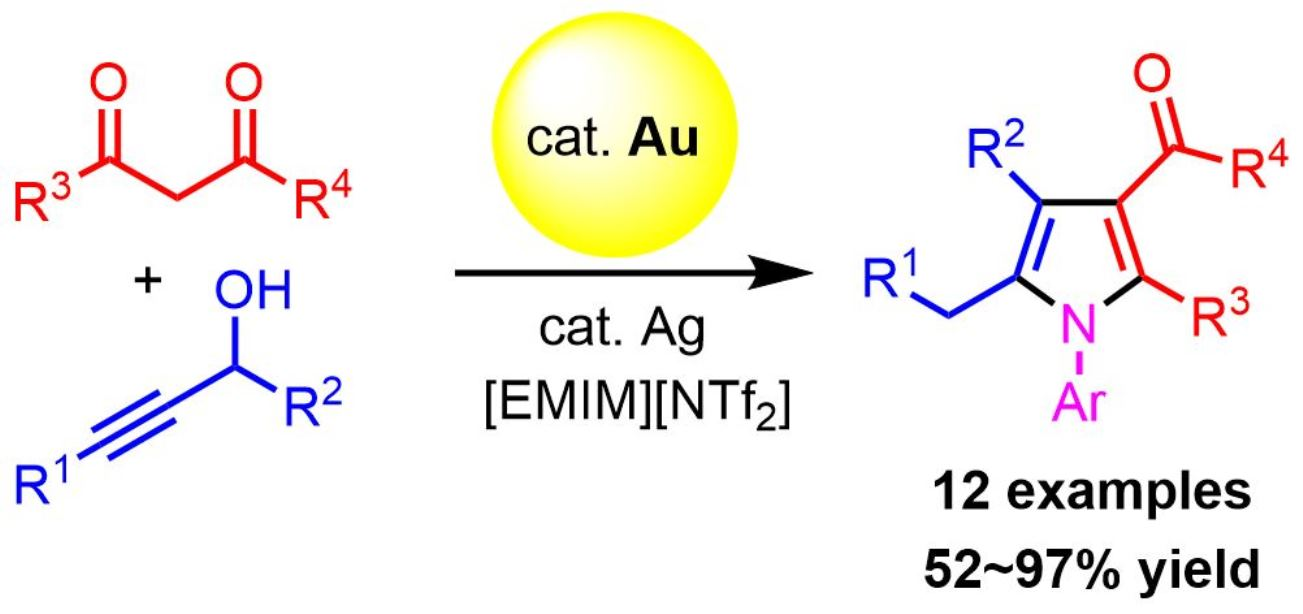
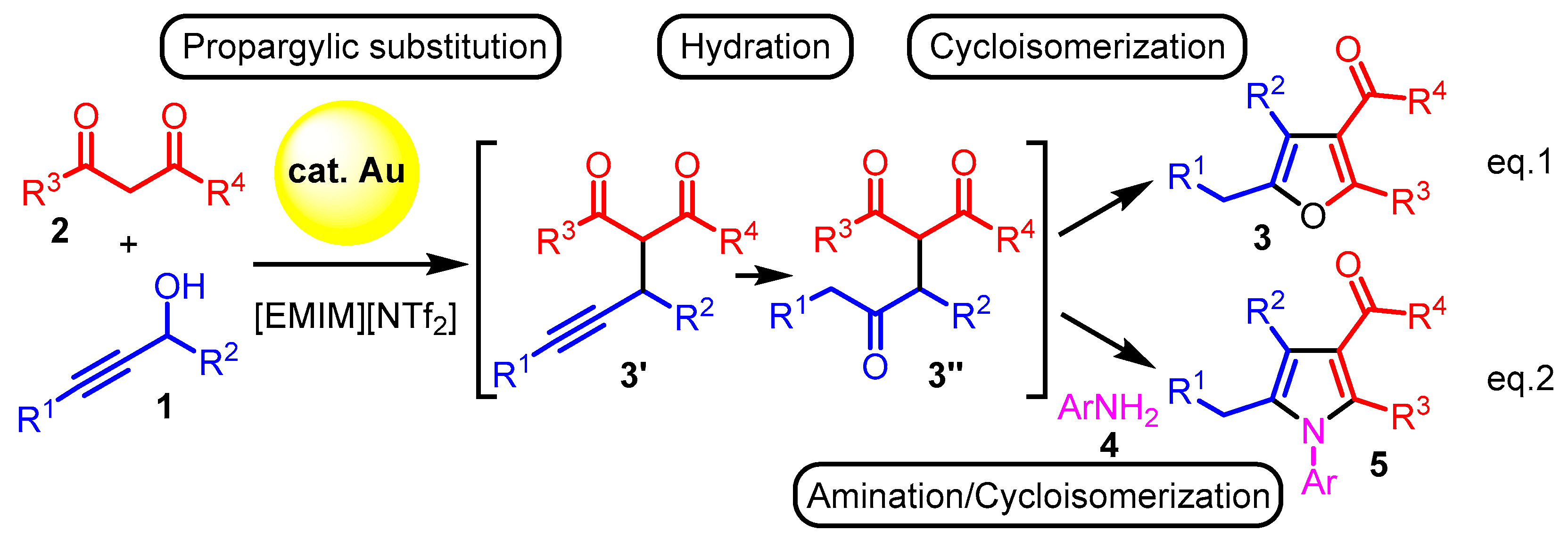
3.2. General Procedure of Gold(III)-Catalyzed Propargylic Substitution/Hydration/Amination/Cycloisomerization for the Synthesis of Polysubstituted Pyrroles 5 from Propargylic Alcohols 1
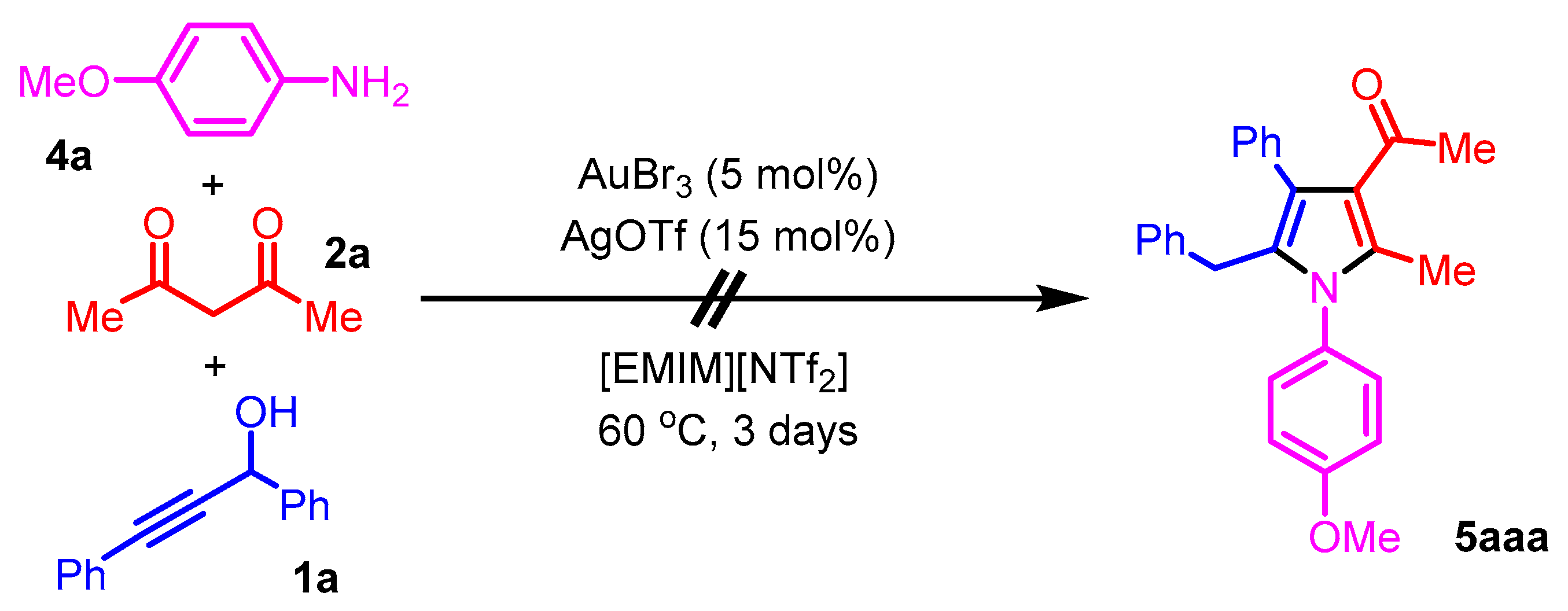
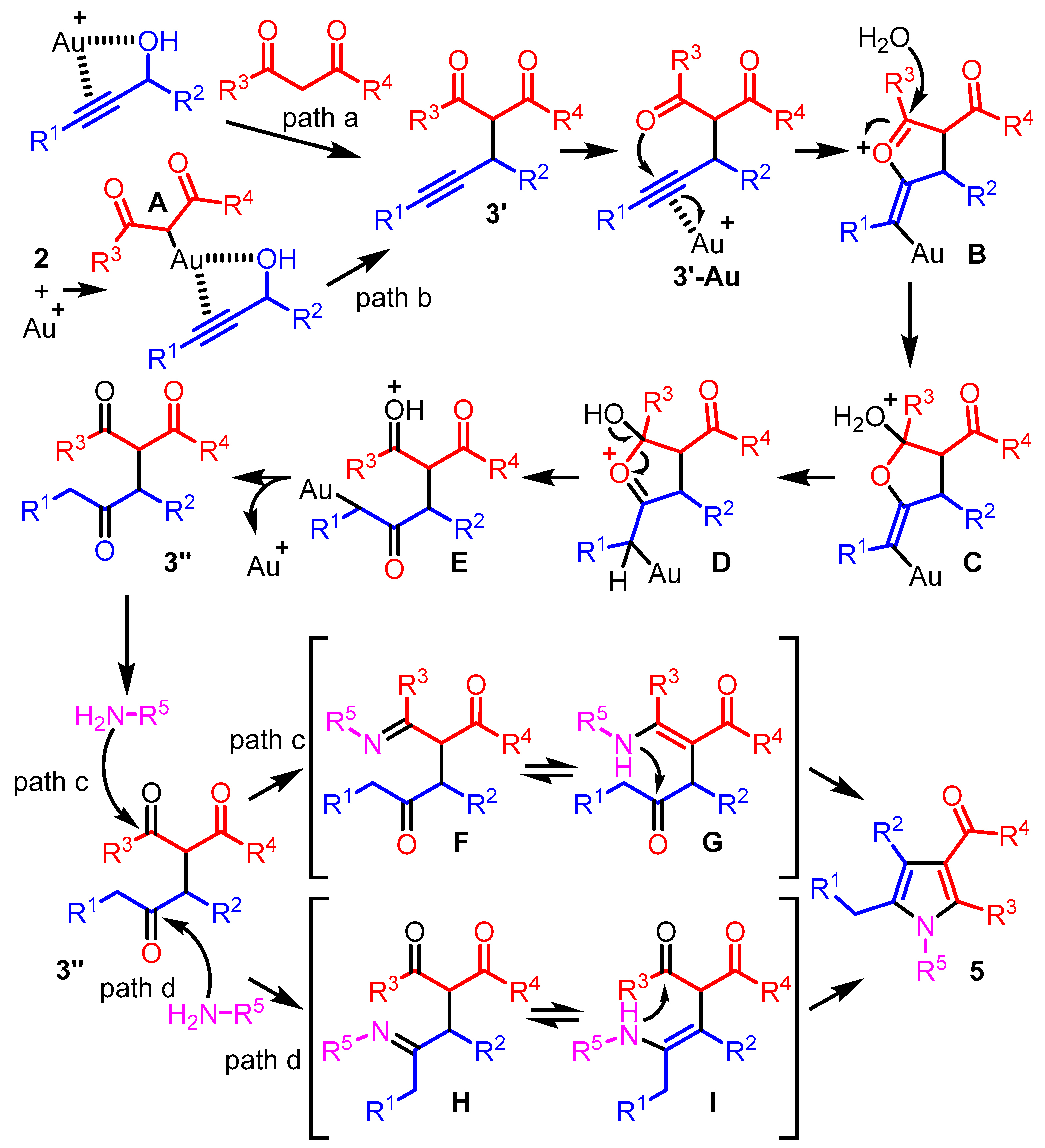
- 1-[5-Benzyl-1-(4-methoxyphenyl)-2-methyl-4-phenyl-1H-pyrrol-3-yl]ethan-1-one (5aaa): Propargylic alcohol 1a (31 mg, 0.15 mmol, acetylacetone (2a) (15 mg, 0.15 mmol), p-methoxyaniline (4a) (36 mg, 0.29 mmol), AuBr3 (3.3 mg, 0.007 mmol, 5 mol%) and AgOTf (5.8 mg, 0.022 mmol, 15 mol%) in [EMIM][NTf2] (1 mL) furnished pyrrole 5aaa (54 mg, yield = 93%) as a colorless solid; Mp 153.0–153.6 °C; IR (ATR) 3027, 2923, 1649, 1605, 1511, 1249 cm–1; 1H NMR (400 MHz, CDCl3) δ 7.38 (4H, d, J = 4.5 Hz), 7.33–7.28 (1H, m), 7.06–7.02 (3H, m), 6.85–6.77 (4H, m), 6.65–6.62 (2H, m), 3.81 (3H, s), 3.64 (2H, s), 2.24 (3H, s), 1.95 (3H, s); 13C NMR (100 MHz, CDCl3) δ 197.4, 159.4, 139.6, 136.7, 136.2, 130.6, 129.8, 129.7, 129.4, 128.3, 128.0, 127.9, 126.8, 125.7, 123.5, 121.6, 114.1, 55.5, 31.0, 30.7, 12.9; HRMS (EI) m/z calcd for C27H25NO2 [M]+ 395.1885, found 395.1887.
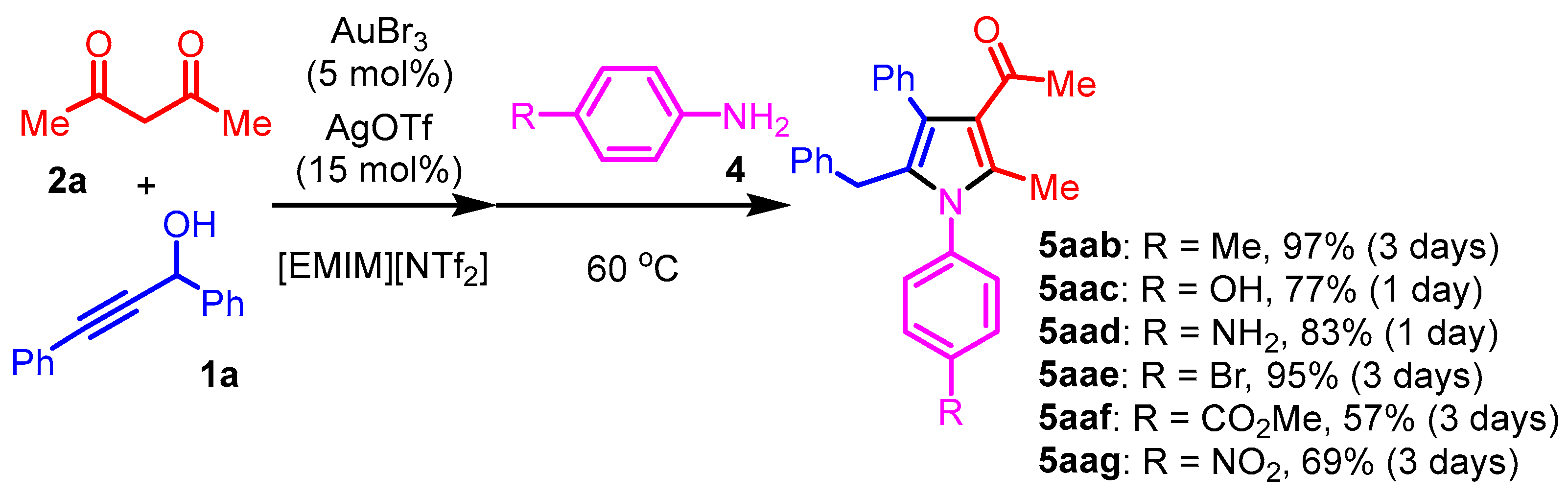
- 1-[5-Benzyl-2-methyl-4-phenyl-1-(p-tolyl)-1H-pyrrol-3-yl]ethan-1-one (5aab): Propargylic alcohol 1a (35 mg, 0.16 mmol), acetylacetone (2a) (16 mg, 0.16 mmol), p-toluidine (4b) (34 mg, 0.31 mmol), AuBr3 (3.4 mg, 0.008 mmol, 5 mol%) and AgOTf (6.1 mg, 0.024 mmol, 15 mol%) in [EMIM][NTf2] (1 mL) furnished pyrrole 5aab (62 mg, yield = 97%) as a colorless solid as a white solid; Mp 134.3–134.9 °C; IR (ATR) 3029, 2923, 1650,1515,1410 cm–1; 1H-NMR (400 MHz, CDCl3) δ 7.37–7.28 (5H, m), 7.09 (2H, d, J = 8.0 Hz), 7.04–7.01 (3H, m), 6.81 (2H, d, J = 8.0 Hz), 6.64–6.61 (2H, m), 3.65 (2H, s), 2.36 (3H, s), 2.24 (3H, s), 1.95 (3H, s); 13C-NMR (100 MHz, CDCl3) δ 197.5, 139.7, 138.5, 136.8, 136.1, 134.6, 130.7, 129.6, 129.5, 128.4, 128.2, 128.1, 127.9, 126.9, 125.8, 123.7, 121.8, 31.1, 30.8, 21.2, 13.0; HRMS (EI) m/z calcd for C27H25NO [M]+ 379.1936, found 379.1937.
- 1-[5-Benzyl-1-(4-hydroxyphenyl)-2-methyl-4-phenyl-1H-pyrrol-3-yl]ethan-1-one (5aac): Propargylic alcohol 1a (30 mg, 0.14 mmol), acetylacetone (2a) (15 mg, 0.14 mmol), 4-aminophenol (4c) (32 mg, 0.29 mmol), AuBr3 (3.2 mg, 0.007 mmol, 5 mol%) and AgOTf (5.6 mg, 0.022 mmol, 15 mol%) in [EMIM][NTf2] (1 mL) furnished pyrrole 5aac (42 mg, yield = 77%) as a colorless oil; IR (ATR) 3210, 2923, 2854, 1625, 1602, 1516, 1454 cm–1; 1H NMR (400 MHz, CDCl3) δ 7.38 (4H, d, J = 4.3 Hz), 7.34–7.28 (1H, m), 7.07–7.01 (3H, m), 6.75 (4H, s), 6.65–6.61 (2H, m), 3.64 (2H, s), 2.25 (3H, s), 1.97 (3H, s); 13C NMR (100 MHz, CDCl3) δ 198.1, 156.3, 139.5, 136.9, 136.6, 130.6, 130.0, 129.5, 129.3, 128.4, 128.0, 127.9, 126.9, 125.7, 123.6, 121.3, 115.7, 30.9, 30.7, 13.1; HRMS (EI) m/z calcd for C26H23NO2 [M]+ 381.1729, found 381.1725.
- 1-[1-(4-Aminophenyl)-5-benzyl-2-methyl-4-phenyl-1H-pyrrol-3-yl]ethan-1-one (5aad): Propargylic alcohol 1a (30 mg, 0.14 mmol), acetylacetone (2a) (15 mg, 0.14 mmol), 1,4-phenylenediamine (4d) (32 mg, 0.29 mmol), AuBr3 (3.3 mg, 0.007 mmol, 5 mol%) and AgOTf (5.7 mg, 0.022 mmol, 15 mol%) in [EMIM][NTf2] (1 mL) furnished pyrrole 5aad (46 mg, yield = 83%) as a colorless oil; IR (ATR) 3462, 3358, 3225, 3027, 2923, 1636, 1603, 1511, 1411 cm–1; 1H-NMR (300 MHz, CDCl3) δ 7.37–7.36 (4H, d, J = 4.4 Hz), 7.32–7.27 (1H, m), 7.07–7.02 (3H, m), 6.69 (2H, d, J = 8.8 Hz), 6.66 (2H, dd, J = 8.0, 2.8 Hz), 6.58 (2H, d, J = 8.8 Hz), 3.65 (2H, s), 2.24 (3H, s), 1.94 (3H, s); 13C-NMR (75 MHz, CDCl3) δ 197.3, 139.8, 136.9, 136.4, 130.6, 130.0, 129.2, 128.3, 128.1, 127.9, 126.8, 125.7, 123.4, 121.5, 115.2, 31.0, 30.7, 13.0 (several signals overlapped); HRMS (EI) m/z calcd for C26H24N2O [M]+ 380.1889, found 380.1877.
- 1-[5-Benzyl-1-(4-bromophenyl)-2-methyl-4-phenyl-1H-pyrrol-3-yl]ethan-1-one (5aae): Propargylic alcohol 1a (30 mg, 0.14 mmol), acetylacetone (2a) (15 mg, 0.14 mmol), 4-bromoaniline (4e) (50 mg, 0.29 mmol), AuBr3 (3.2 mg, 0.007 mmol, 5 mol%) and AgOTf (5.9 mg, 0.022 mmol, 15 mol%) in [EMIM][NTf2] (1 mL) furnished pyrrole 5aae (37 mg, yield = 95%) as a colorless oil; IR (ATR) 3060, 3029, 2923, 1650, 1603, 1511, 1491, 1408 cm−1; 1H-NMR (300 MHz, CDCl3) δ 7.42–7.38 (6H, m), 7.38–7.30 (1H, m), 7.30–7.06 (3H, m), 6.78 (2H, dd, J = 8.4, 2.0 Hz), 6.65–6.62 (2H, m), 3.64 (2H, s), 2.23 (3H, s), 1.94 (3H, s); 13C-NMR (75 MHz, CDCl3) δ 197.3, 139.2, 136.3, 136.2, 135.7, 132.2, 130.5, 130.0, 129.3, 128.4, 128.1, 128.0, 127.0, 125.9, 124.0, 122.6, 122.0, 31.0, 30.7, 12.9; HRMS (EI) m/z calcd for C26H22BrNO [M]+ 443.0885, found 443.0881.
- Methyl 4-(3-acetyl-5-benzyl-2-methyl-4-phenyl-1H-pyrrol-1-yl)benzoate (5aaf): Propargylic alcohol 1a (30 mg, 0.14 mmol), acetylacetone (2a) (14 mg, 0.14 mmol), methyl 4-aminobenzoate (4f) (43 mg, 0.28 mmol), AuBr3 (3.1 mg, 0.007 mmol, 5 mol%) and AgOTf (5.5 mg, 0.021 mmol, 15 mol%) in [EMIM][NTf2] (1 mL) furnished pyrrole 5aaf (34 mg, yield = 57%) as a colorless oil; IR (ATR) 3027, 2950, 1723, 1652, 1603, 1509, 1435, 1407 cm−1; 1H NMR (400 MHz, CDCl3) δ 7.97 (2H, dd, J = 8.4, 2.0 Hz), 7.34–7.39 (4H, m), 7.34–7.31 (1H, m), 7.03–6.99 (5H, m), 6.60–6.57 (2H, m), 3.94 (3H, s), 3.67 (2H, s), 2.24 (3H, s), 1.95 (3H, s); 13C NMR (100 MHz, CDCl3) δ 197.4, 166.2, 141.3, 139.0, 136.3, 135.6, 130.5, 130.4, 130.2, 129.2, 128.5, 128.4, 128.0, 127.9, 127.1, 125.9, 124.3, 122.2, 52.4, 31.0, 30.7, 12.9; HRMS (EI) m/z calcd for C28H25O3N [M]+ 423.1834, found 423.1825.
- 1-(5-Benzyl-2-methyl-1-(4-nitrophenyl)-4-phenyl-1H-pyrrol-3-yl)ethan-1-one (5aag): Propargylic alcohol 1a (35 mg, 0.17 mmol), acetylacetone (2a) (17 mg, 0.17 mmol), 4-nitroaniline (4g) (46 mg, 0.33 mmol), AuBr3 (3.6 mg, 0.008 mmol, 5 mol%) and AgOTf (6.4 mg, 0.025 mmol, 15 mol%) in [EMIM][NTf2] (1 mL) furnished pyrrole 5aag (47 mg, yield = 69%) as a colorless oil; IR (ATR) 3029, 2992, 1717, 1651, 1597, 1559, 1527, 1496, 1455, 1406 cm−1; 1H NMR (400 MHz, CDCl3) δ 8.15 (2H, dd, J = 8.4, 2.0 Hz), 7.42–7.38 (4H, m), 7.36–7.32 (1H, m), 7.10 (2H, dd, J = 8.4, 2.0 Hz), 7.05–7.02 (3H, m), 6.61–6.59 (2H, m), 3.68 (2H, s), 2.25 (3H, s), 1.96 (3H, s); 13C NMR (100 MHz, CDCl3) δ 197.3, 147.3, 143.0, 138.7, 135.9, 135.3, 130.4, 129.4, 129.0, 128.5, 128.2, 127.8, 127.3, 126.2, 124.8, 124.3, 122.6, 31.0, 30.7, 12.9; HRMS (EI) m/z calcd for C26H22 N2O3 [M]+ 410.1630, found 410.1628.
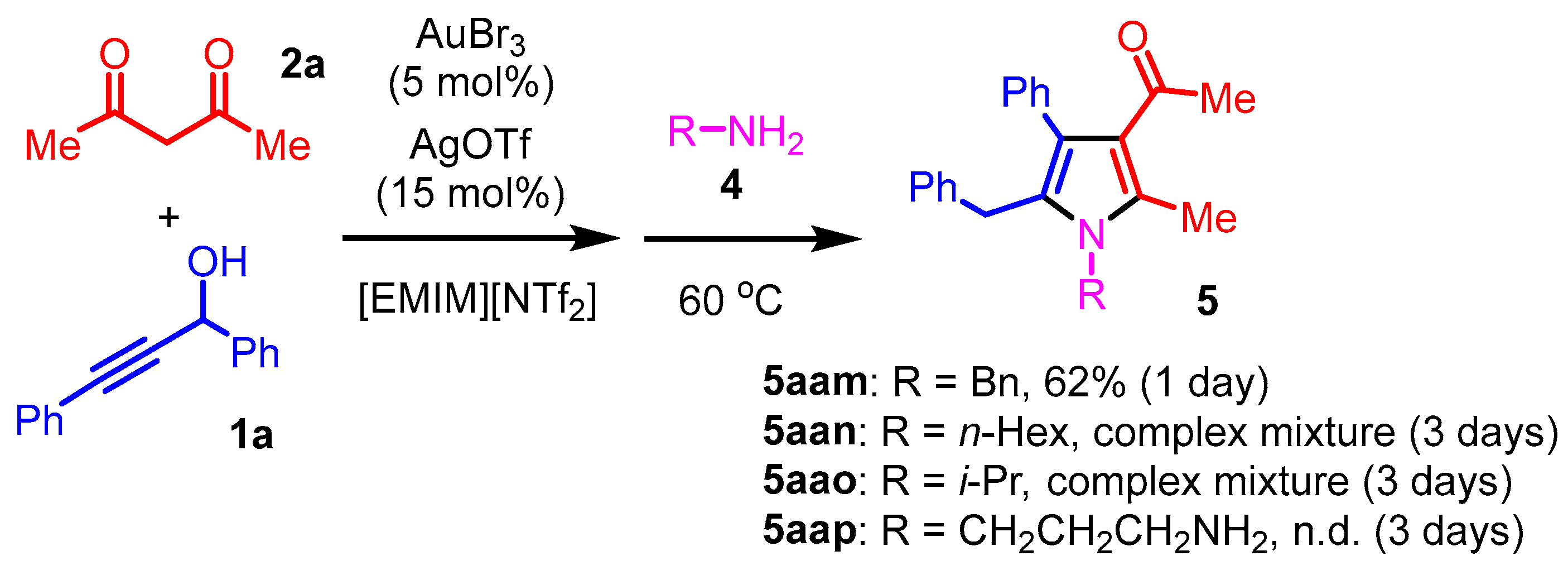
- 1-(1,5-Dibenzyl-2-methyl-4-phenyl-1H-pyrrol-3-yl)ethan-1-one (5aam): Propargylic alcohol 1a (29 mg, 0.14 mmol), acetylacetone (2a) (14 mg, 0.14 mmol), benzylamine (4m) (29 mg, 0.27 mmol), AuBr3 (3.0 mg, 0.007 mmol, 5 mol%) and AgOTf (5.3 mg, 0.021 mmol, 15 mol%) in [EMIM][NTf2] (1 mL) furnished pyrrole 5aam (32 mg, yield = 62%) as a colorless oil; IR (ATR) 3029, 2920, 1647, 1603, 1514, 1494, 1454, 1407 cm−1; 1H-NMR (300 MHz, CDCl3) δ 7.35–7.21 (10H, m), 7.07 (1H, d, J = 7.2 Hz), 6.99 (2H, d, J = 7.2 Hz), 6.85 (2H, d, J = 7.2 Hz), 4.86 (2H, s), 3.72 (2H, s), 2.46 (3H, s), 1.94 (3H, s); 13C-NMR (75 MHz, CDCl3) δ 197.4, 139.3, 136.9, 136.8, 135.3, 130.5, 128.9, 128.6, 128.3, 127.9, 127.8, 127.4, 126.9, 126.3, 125.6, 124.5, 121.8, 31.1, 30.3, 11.8 (one signal overlapped); HRMS (EI) m/z calcd for C27H25NO [M]+ 379.1936, found 379.1945.
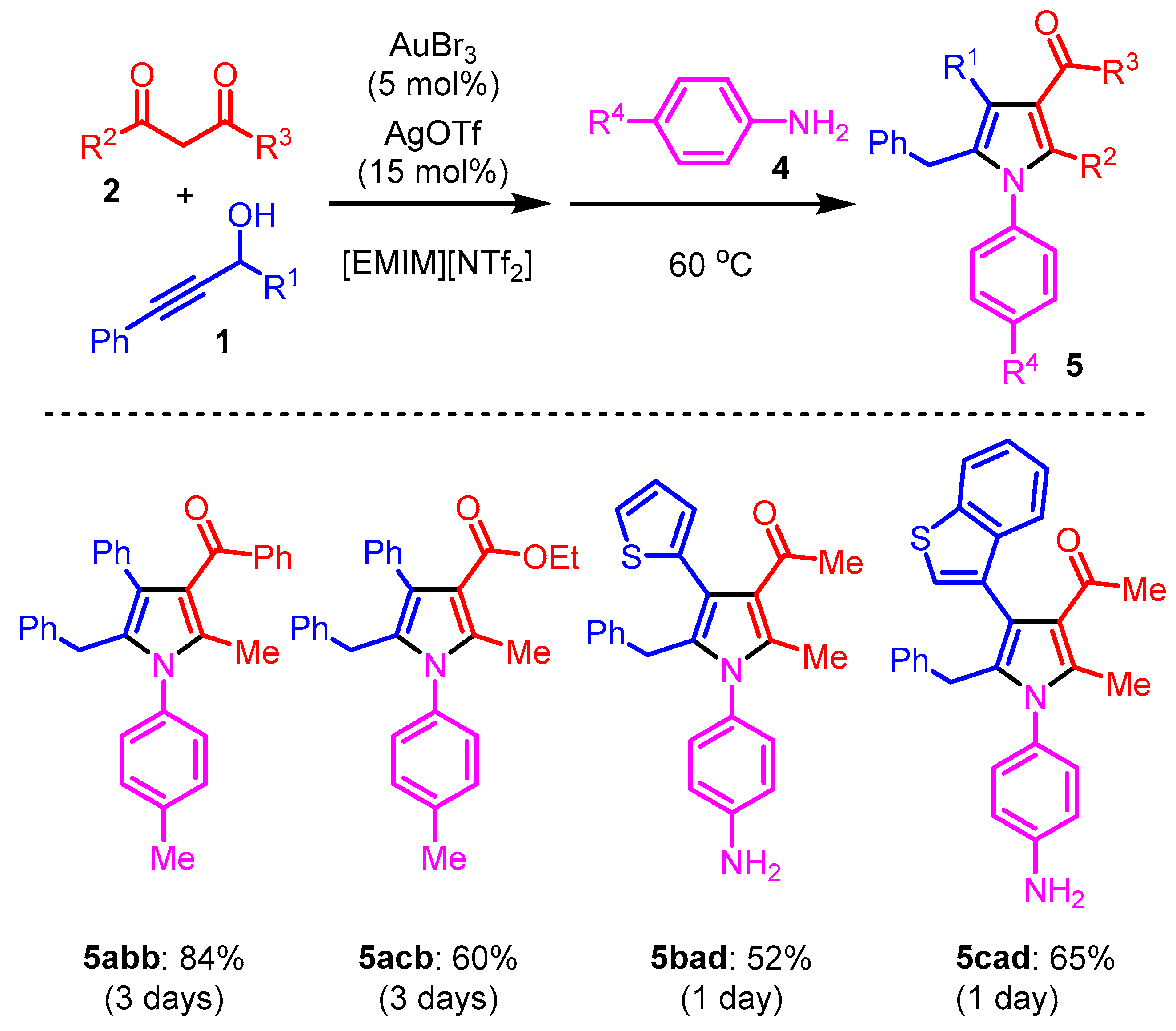
- (5-Benzyl-2-methyl-4-phenyl-1-(p-tolyl)-1H-pyrrol-3-yl)(phenyl)methanone (5abb): Propargylic alcohol 1a (31 mg, 0.15 mmol), 1-phenyl-1,3-butanedione (2b) (24 mg, 0.15 mmol), p-toluidine (4b) (32 mg, 0.30 mmol), AuBr3 (3.3 mg, 0.007 mmol, 5 mol%) and AgOTf (5.8 mg, 0.022 mmol, 15 mol%) in [EMIM][NTf2] (1 mL) furnished pyrrole 5abb (55 mg, yield = 84%) as a white solid; Mp 146.0–146.5 °C; IR (ATR) 3027, 2920, 1633, 1599, 1578, 1515, 1447, 1408 cm−1; 1H NMR (400 MHz, CDCl3) δ 7.69–7.67 (2H, m), 7.28–7.23 (2H, m), 7.17–7.10 (5H, m), 7.10–7.02 (6H, m), 6.79 (2H, dt, J = 2.5, 2.5 Hz), 6.64–6.62 (2H, m), 3.64 (2H, s), 2.23 (3H, s), 1.94 (3H, s); 13C-NMR (100 MHz, CDCl3) δ 197.4, 166.2, 141.3, 139.0, 136.3, 135.6, 130.5, 130.4, 130.2, 129.2, 128.5, 128.4, 128.0, 127.9, 127.1, 125.9, 124.3, 122.2, 52.4, 31.0, 30.7, 12.9 (several signals overlapped); HRMS (EI) m/z calcd for C32H27NO [M]+ 441.2093, found 441.2082.
- Ethyl 5-benzyl-2-methyl-4-phenyl-1-(p-tolyl)-1H-pyrrole-3-carboxylate (5acb): Propargylic alcohol 1a (32 mg, 0.15 mmol), ethyl acetoacetate (2c) (20 mg, 0.15 mmol), p-toluidine (4b) (33 mg, 0.30 mmol), AuBr3 (3.4 mg, 0.008 mmol, 5 mol%) and AgOTf (6.0 mg, 0.023 mmol, 15 mol%) in [EMIM][NTf2] (1 mL) furnished pyrrole 5acb (37 mg, yield = 60%) as a colorless oil; IR (ATR) 3030, 2979, 2925, 1693, 1603, 1516, 1494, 1454, 1415 cm−1; 1H NMR (400 MHz, CDCl3) δ 7.37–7.29 (4H, m), 7.26–7.22 (1H, m), 7.08 (2H, d, J = 8.0), 7.05–7.01 (3H, m), 6.80 (2H, dt, J = 8.3, 2.1 Hz), 6.66–6.64 (2H, m), 4.09 (2H, q, J = 7.2 Hz), 3.68 (2H, s), 2.36 (3H, s), 2.27 (3H, s), 1.02 (3H, t, J = 7.1 Hz); 13C NMR (100 MHz, CDCl3) δ 166.0, 139.8, 138.3, 136.6, 136.4, 134.7, 130.4, 129.5, 129.4, 128.2, 128.1, 127.8, 127.5, 126.1, 125.6, 124.0, 111.0, 59.2, 30.7, 21.2, 13.9, 12.5; HRMS (EI) m/z calcd for C28H27NO2 [M]+ 409.2042, found 409.2046.
- 1-[1-(4-Aminophenyl)-5-benzyl-2-methyl-4-(thiophen-2-yl)-1H-pyrrol-3-yl]ethan-1-one] (5bad): Propargylic alcohol 1b (33 mg, 0.15 mmol), acetylacetone (2a) (16 mg, 0.15 mmol), 1,3-phenylenediamine (4d) (34 mg, 0.31 mmol), AuBr3 (3.4 mg, 0.008 mmol, 5 mol%) and AgOTf (6.0 mg, 0.023 mmol, 15 mol%) in [EMIM][NTf2] (1 mL) furnished pyrrole 5bad (31 mg, yield = 52%) as a colorless oil; IR (ATR) 3366, 2923, 2854, 1717, 1685, 1647, 1559, 1541, 1518, 1457, 1411 cm−1; 1H-NMR (300 MHz, CDCl3) δ 7.36–7.27 (5H, m), 7.08–7.02 (3H, m), 6.69 (2H, d, J = 8.8 Hz), 6.66 (2H, dd, J = 8.0, 2.8 Hz), 6.58 (2H, d, J = 8.8 Hz), 3.78 (2H, br s), 3.65 (2H, s), 2.24 (3H, s), 1.94 (3H, s); 13C-NMR (75 MHz, CDCl3) δ 197.3, 139.8, 136.9, 136.4, 130.6, 129.8, 129.8, 129.2, 128.3, 128.1, 127.9, 126.8, 125.7, 123.4, 121.5, 115.2, 31.0, 30.7, 13.0 (overlapped); HRMS (EI) m/z calcd for C24H22N2OS [M]+ 386.1453, found 386.1447.
- 1-{1-[4-Aminophenyl]-4-[benzo(b)thiophen-3-yl]-5-benzyl-2-methyl-1H-pyrrol-3-yl}ethan-1-one (5cad): Propargylic alcohol 1c (42 mg, 0.16 mmol), acetylacetone (2a) (16 mg, 0.16 mmol), 1,3-phenylenediamine (4d) (34 mg, 0.32 mmol), AuBr3 (3.4 mg, 0.008 mmol, 5 mol%) and AgOTf (6.1 mg, 0.024 mmol, 15 mol%) in [EMIM][NTf2] (1 mL) furnished pyrrole 5cad (40 mg, yield = 65%) as a colorless oil; IR (ATR) 3363, 2923, 2854, 1710, 1629, 1515, 1455, 1411 cm−1; 1H NMR (400 MHz, CDCl3) δ 7.90–7.86 (1H, m), 7.68–7.64 (1H, m), 7.38–7.34 (2H, m), 7.32 (1H, s), 7.03–6.99 (3H, m), 6.76 (2H, dd, J = 8.4, 2.4 Hz) 6.65–6.60 (3H, m), 6.57 (1H, ddd, J = 8.2, 8.1, 2.6 Hz), 3.83 (2H, br s), 3.67 (1H, d, J = 16.0 Hz), 3.55 (1H, d, J = 16.0 Hz), 2.31 (3H, s), 1.83 (3H, s); 13C NMR (100 MHz, CDCl3) δ 196.9, 146.6, 140.3, 139.8, 139.5, 137.2, 132.3, 131.4, 129.2, 129.1, 128.1, 127.9, 127.6, 125.7, 124.6, 124.4, 123.3, 122.7, 121.6, 115.7, 115.0, 31.1, 29.8, 13.2; HRMS (EI) m/z calcd for C28H24N2OS [M]+ 436.1609, found 436.1603.
3.3. Procedure of Gold(III)-Catalyzed Reaction from Hydrated Propargylic Substitution Product 3″aa and Aniline 4a
4. Conclusions
Supplementary Materials
Author Contributions
Funding
Institutional Review Board Statement
Informed Consent Statement
Data Availability Statement
Conflicts of Interest
References
- Nicolaou, K.C.; Tamsyn Montagnon, T.; Snyder, S.A. Tandem Reactions, Cascade Sequences, and Biomimetic Strategies in Total Synthesis. Chem. Commun. 2003, 34, 551–564. [Google Scholar] [CrossRef]
- Lv, P.; Huang, K.; Xie, L.; Xu, X. Palladium-Catalyzed Tandem Reaction to Construct Benzo[c]phenanthridine: Application to the Total Synthesis of Benzo[c]phenanthridine Alkaloids. Org. Biomol. Chem. 2011, 9, 3133–3135. [Google Scholar] [CrossRef]
- Wang, Z.; Song, Z.; Huang, J.; Yang, Z. Total Synthesis of Penicibilaenes Enabled by a Tandem Double Conia-ene Type Reaction. J. Am. Chem. Soc. 2024, 146, 4363−4368. [Google Scholar] [CrossRef]
- Millán, A.; Smith, J.R.; Chen, J.L.-Y.; Aggarwal, V.A. Tandem Allylboration–Prins Reaction for the Rapid Construction of Substituted Tetrahydropyrans: Application to the Total Synthesis of (–)-Clavosolide A. Angew. Chem. Int. Ed. 2016, 55, 2498–2502. [Google Scholar] [CrossRef]
- Sears, J.E.; Barker, T.J.; Boger, D.L. Total Synthesis of (−)-Vindoline and (+)-4-epi-Vindoline Based on a 1,3,4-Oxadiazole Tandem Intramolecular [4+2]/[3+2] Cycloaddition Cascade Initiated by an Allene Dienophile. Org. Lett. 2015, 17, 5460−5463. [Google Scholar] [CrossRef]
- Sugimoto, K.; Matsuya, Y. Recent Applications of Gold-Catalyzed Cascade Reactions in Total Synthesis of Natural Product. Tetrahedron Lett. 2017, 58, 4420–4426. [Google Scholar] [CrossRef]
- Kar, S.; Sanderson, K.; Roy, K.; Benfenati, E.; Leszczynski, J. Green Chemistry in the Synthesis of Pharmaceuticals. Chem. Rev. 2022, 122, 3637–3710. [Google Scholar] [CrossRef] [PubMed]
- Mishra, M.; Sharma, M.; Dubey, R.; Kumari, P.; Ranjan, V.; Pandey, J. Green Synthesis Interventions of Pharmaceutical Industries for Sustainable Development. Curr. Res. Green Sustain. Chem. 2021, 4, 100174. [Google Scholar] [CrossRef]
- Sheldon, R.A. Green Solvents for Sustainable Organic Synthesis: State of the Art. Green Chem. 2005, 7, 267–278. [Google Scholar] [CrossRef]
- Anastas, P.; Eghbali, N. Green Chemistry: Principles and Practice. Chem. Soc. Rev. 2010, 39, 301–312. [Google Scholar] [CrossRef]
- Lipshutz, B.H.; Ghorai, S. Transitioning Organic Synthesis from Organic Solvents to water. What’s your E Factor? Green Chem. 2014, 16, 3660–3679. [Google Scholar] [CrossRef] [PubMed]
- Lipshutz, B.H.; Gallou, F.; Hand, S. Evolution of Solvents in Organic Chemistry. ACS Sustain. Chem. Eng. 2016, 4, 5838–5849. [Google Scholar] [CrossRef]
- Minkler, S.R.K.; Lipshutz, B.H.; Krause, N. Gold Catalysis in Micellar Systems. Angew. Chem. Int. Ed. 2011, 50, 7820–7823. [Google Scholar] [CrossRef] [PubMed]
- Minkler, S.R.K.; Isley, N.A.; Lippincott, D.J.; Krause, N. Leveraging the Micellar Effect: Gold-Catalyzed Dehydrative Cyclizations in Water at Room Temperature. Org. Lett. 2014, 16, 724–726. [Google Scholar] [CrossRef]
- Lempke, L.; Ernst, A.; Kahl, F.; Weberskirch, R.; Krause, N. Sustainable Micellar Gold Catalysis – Poly(2-oxazolines) as Versatile Amphiphiles. Adv. Synth. Catal. 2016, 358, 1491–1499. [Google Scholar] [CrossRef]
- Ballmann, M.; Ruer, P.C.; Hofnagel, O.; Hiller, W.; Krause, N. Recyclable Polyethylene Glycol Ubiquinol Succinate-Bound N-Heterocyclic Carbene–Gold(I) Complexes: Sustainable Micellar Catalysis in Water. ACS Sustain. Chem. Eng. 2022, 10, 7288−7298. [Google Scholar] [CrossRef]
- Morita, N.; Chiaki, H.; Tanaka, K., III; Hashimoto, Y.; Tamura, O.; Krause, N. Sustainable Chemical Synthesis of 2,3-Dihydrobenzofurans/1,2,3-Trisubstituted Indanes in Water by Using a Permethylated β-Cyclodextrin-Tagged N-Heterocyclic Carbene-Gold Catalyst. Synlett 2023, 34, 1425–1432. [Google Scholar] [CrossRef]
- Petersen, H.; Ballmann, M.; Krause, N.; Weberskirch, R. Gold(I) NHC Catalysts Immobilized to Amphiphilic Block Copolymers: A Versatile Approach to Micellar Gold Catalysis in Water. ChemCatChem 2022, 14, e202200727. [Google Scholar] [CrossRef]
- Hallet, J.P.; Welton, T. Room-Temperature Ionic Liquids: Solvents for Synthesis and Catalysts. 2. Chem. Rev. 2011, 111, 3508–3576. [Google Scholar] [CrossRef]
- Imperato, G.; König, B.; Chiappe, C. Ionic Green Solvents from Renewable Resources. Eur. J. Org. Chem. 2007, 2007, 1049–1058. [Google Scholar] [CrossRef]
- Liu, X.; Pan, Z.; Shu, X.; Duan, X.; Liang, Y. Bu4N[AuCl4]-Catalyzed Synthesis of Highly Substituted Furans from 2-(1-Alkynyl)-2-alken-1-ones in Ionic Liquid: An Air-Stable and Recyclable Catalytic System. Synlett 2006, 12, 1962–1964. [Google Scholar] [CrossRef]
- Aksɩn, Ö.; Krause, N. Gold-Catalyzed Synthesis of 2,5-Dihydrofurans in Ionic Liquids. Adv. Synth. Catal. 2008, 350, 1106–1112. [Google Scholar] [CrossRef]
- Ambrogio, I.; Arcadi, A.; Cacchi, S.; Fabrizi, G.; Marinelli, F. Gold-Catalyzed Synthesis of 2-Substituted, 2,3-Disubstituted and 1,2,3-Trisubstituted Indoles in [bmim]BF4. Synlett 2007, 11, 1775–1779. [Google Scholar] [CrossRef]
- Corma, A.; Domínguez, I.; Ródenas, T.; Sabater, M.J. Stabilization and Recovery of Gold Catalysts in the Cyclopropanation of Alkenes within Ionic Liquid. J. Catal. 2008, 259, 26–35. [Google Scholar] [CrossRef]
- Neaţu, F.; Pârvulescu, V.I.; Michelet, V.; Gênet, J.-P.; Goguet, A.; Hardacre, C. Gold Imidazolium-based Ionic Liquids, Efficient Catalysts for Cycloisomerization of γ-Acetylenic Carboxylic Acids. New J. Chem. 2009, 33, 102–106. [Google Scholar] [CrossRef]
- Moreau, X.; Hours, A.; Fensterbank, L.; Goddard, J.-P.; Malacria, M.; Thorimbert, S. Use of Ionic Liquids in the Platinum- and Gold-Catalyzed Cycloisomerization of Enyne Systems. J. Organomet. Chem. 2009, 694, 561–565. [Google Scholar] [CrossRef]
- Cui, D.-M.; Ke, Y.-N.; Zhuang, D.-W.; Wang, Q.; Zhang, C. Gold-Catalyzed Hydrative Cyclization of 1,6-Diynes in Ionic Liquid Media. Tetrahedron Lett. 2010, 51, 980–982. [Google Scholar] [CrossRef]
- Lempke, L.; Fischer, T.; Bell, J.; Kraus, W.; Rurack, K.; Krause, N. Gold-Catalyzed Allene Cycloisomerization for Pyrrole Synthesis: Towards Highly Fluorinated BODIPY Dyes. Org. Biomol. Chem. 2015, 13, 3787–3791. [Google Scholar] [CrossRef]
- Lempke, L.; Sak, H.; Kubicki, M.; Krause, N. Gold-Catalyzed Cycloisomerization of Trifluoromethylated Allenols: Sustainability and Mechanistic Studies. Org. Chem. Front. 2016, 3, 1514–1519. [Google Scholar] [CrossRef]
- Baron, M.; Biffis, A. Gold(I) Complexes in Ionic Liquids: An Efficient Catalytic System for the C-H Functionalization of Arenes and Heteroarenes under Mild Conditions. Eur. J. Org. Chem. 2019, 2019, 3687–3693. [Google Scholar] [CrossRef]
- Morita, N.; Mashiko, R.; Hakuta, D.; Eguchi, D.; Hashimoto, Y.; Okamoto, I.; Tamura, O. Gold-Catalyzed Dimeric Cyclization of Isoeugenol and Related 1-Phenylpropenes in Ionic Liquid: Environmentally Friendly and Stereoselective Synthesis of 1,2,3-Trisubstituted 2,3-Dihydro-1H-Indanes. Synthesis 2016, 48, 1927–1933. [Google Scholar] [CrossRef]
- Morita, N.; Chiaki, H.; Ikeda, K.; Tanaka, K., III; Hashimoto, Y.; Tamura, O. Gold-Catalyzed Formal (3+2) Cycloaddition in an Ionic Liquid: Environmentally Friendly and Stereoselective Synthesis of Polysubstituted Indanes from Benzylic Alcohols and 1-Phenylpropenes. Synlett 2023, 34, 1068–1074. [Google Scholar] [CrossRef]
- Morita, N.; Ikeda, K.; Chiaki, H.; Araki, R.; Tanaka, K., III; Hashimoto, Y.; Tamura, O. Gold-Catalyzed Formal [3+2] Cycloaddition of p-Quinones and 1-Phenylpropenes in an Ionic Liquid: Environmentally Friendly and Stereoselective Synthesis of 2,3-Benzofuran Neolignans. Heterocycles 2021, 103, 714–722. [Google Scholar]
- Chiaki, H.; Hashimoto, Y.; Morita, N. Gold-Catalyzed Propargylic Substitution Followed by Cycloisomerization in Ionic Liquid: Environmentally Friendly Synthesis of Polysubstituted Furans from Propargylic Alcohols and 1,3-Dicarbonyl Compounds. Molecules 2024, 29, 5441. [Google Scholar] [CrossRef]
- Estévez, V.; Villacampa, M.; Menéndez, J.C. Recent Advances in the Synthesis of Pyrroles by Multicomponent Reactions. Chem. Soc. Rev. 2014, 43, 4633–4657. [Google Scholar] [CrossRef]
- Ma, Z.; Ma, Z.; Zhang, D. Synthesis of Multi-Substituted Pyrrole Derivatives Through [3+2] Cycloaddition with Tosylmethyl Isocyanides (TosMICs) and Electron-Deficient Compounds. Molecules 2018, 23, 2666. [Google Scholar] [CrossRef]
- Cadierno, V.; Gimeno, J.; Nebra, N. One-Pot Three-Component Catalytic Synthesis of Fully Substituted Pyrroles from Readily Available Propargylic Alcohols, 1,3-Dicarbonyl Compounds and Primary Amines. Chem. Eur. J. 2007, 13, 9973–9981. [Google Scholar] [CrossRef]
- Liu, X.-T.; Huang, L.; Zheng, F.-J.; Zhan, Z.-P. Indium(III) Chloride-Catalyzed Propargylation/Amination/Cycloisomerization Tandem Reaction: One-Pot Synthesis of Highly Substituted Pyrroles from Propargylic Alcohols, 1,3-Dicarbonyl Compounds and Primary Amines. Adv. Synth. Catal. 2008, 350, 2778–2788. [Google Scholar] [CrossRef]
- Gujarathi, S.; Liu, X.; Song, L.; Hendrickson, H.; Zheng, G. A Mild and Efficient AgSbF6-Catalyzed Synthesis of Substituted Pyrroles through a Sequential Propargylation/Amination/Cycloisomerization Reaction. Tetrahedron 2014, 70, 5267–5273. [Google Scholar] [CrossRef] [PubMed]
- Chatterjee, P.N.; Roy, S. Alkylation of 1,3-Dicarbonyl Compounds with Benzylic and Propargylic Alcohols using Ire–Sn Bimetallic Catalyst: Synthesis of Fully Decorated Furans and Pyrroles. Tetrahedron 2011, 67, 4569–4577. [Google Scholar] [CrossRef]
- Komiya, S.; Kochi, J.K. Reversible Linkage Isomerisms of β-Diketonato Ligands. Oxygen-Bonded Carbon-Bonded Structure in Gold(III) Acetylacetoneate Complexes Induced by Phosphines. J. Am. Chem. Soc. 1977, 99, 3695–3704. [Google Scholar] [CrossRef]
- Zharkova, G.I.; Baidina, I.A.; Igumenov, I.K. X-Ray Diffraction Study of Volatile Complexes of Dimethylgold(III) Derived from Symmetrical β-Diketones. J. Struc. Chem. 2006, 47, 1117–1126. [Google Scholar] [CrossRef]
- Murakami, M.; Inouye, M.; Suginome, M.; Ito, Y. Reactions of (Triphenylphosphine)gold(I) Enolates and Homoenolates. Bull. Chem. Soc. Jpn. 1988, 61, 3649–3652. [Google Scholar] [CrossRef]
- Yao, X.; Li, C.-J. Highly Efficient Addition of Activated Methylene Compounds to Alkenes Catalyzed by Gold and Silver. J. Am. Chem. Soc. 2004, 126, 6884–6885. [Google Scholar] [CrossRef] [PubMed]
- Nguyen, R.-V.; Yao, X.-Q.; Bohle, D.B.; Li, C.-J. Gold- and Silver-Catalyzed Highly Regioselective Addition of Active Methylenes to Dienes, Triene, and Cyclic Enol Ethers. Org. Lett. 2005, 7, 673–675. [Google Scholar] [CrossRef]
- Zhou, C.-Y.; Che, C.-M. Highly Efficient Au(I)-Catalyzed Intramolecular Addition of β-Ketoamide to Unactivated Akenes. J. Am. Chem. Soc. 2007, 129, 5828–5829. [Google Scholar] [CrossRef]
- Dénès, F.; Pérez-Luna, A.; Chemla, F. Addition of Metal Enolate Derivatives to Unactivated Carbon-Carbon Multiple Bonds. Chem. Rev. 2010, 110, 2366–2447. [Google Scholar] [CrossRef] [PubMed]
- Kuo, P.-L.; Chen, C.-C. Generation of Gold Thread from Au(III) and Triethylamine. Langmuir 2006, 22, 7902–7906. [Google Scholar] [CrossRef]
- Dai, X.; Tan, Y.; Xu, J. Formation of Gold Nanoparticles in the Presence of o-Anisidine and the Dependence of the Structure of Poly(o-anisidine) on Synthetic Conditions. Langmuir 2004, 20, 295–298. [Google Scholar] [CrossRef]




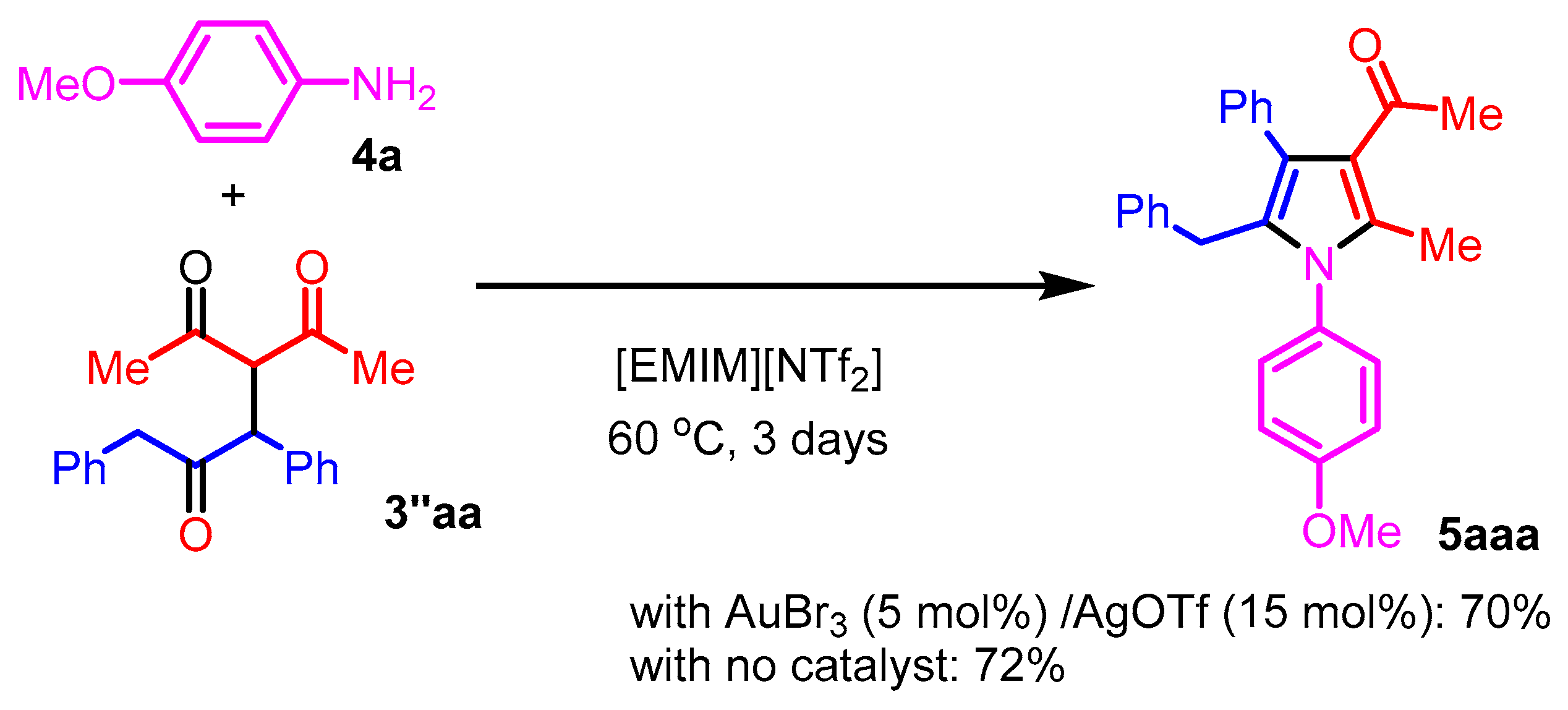


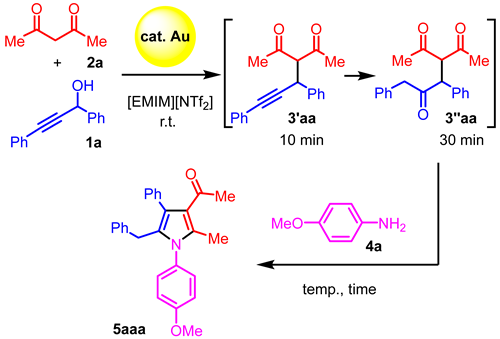 | ||||
| Entry | Cat. Au | Temp. | Time | 5aaa Yield |
| 1 | AuCl (5) | 100 °C | 1 day | Trace |
| 2 | AuBr3 (5) | 100 °C | 1 day | No reaction |
| 3 | AuCl (5)/AgOTf (5) | 100 °C | 1 day | 53% |
| 4 | AuBr3 (5)/AgOTf (15) | 100 °C | 1 day | 72% |
| 5 | AuBr3 (5)/AgOTf (15) | 60 °C | 3 days | 93% |
| 6 | AuBr3 (2.5)/AgOTf (7.5) | 100 °C | 1 day | 26% |
| 7 | AgOTf (15 mol%) | 60 °C | 3 days | trace |
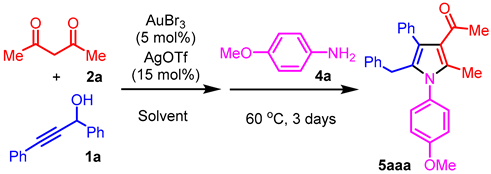 | ||
| Entry | Solvent | 5aaa Yield |
| 1 | [EMIM][NTf2] | 93% |
| 2 | [EMIM][OTf] | n.d. |
| 3 | [EMIM][HSO4] | n.d. |
| 4 | [EMIM][MeSO4] | n.d. |
| 5 | [EMIM][Me2PO4] | No reaction |
| 6 | [EMIM][CH3CO2] | No reaction |
| 7 | toluene | n.d. |
| 8 | ClCH2CH2Cl | 28% |
| 9 | THF | No reaction |
 | ||
| Entry | Solvent | 5aaa Yield |
| 1 | [EMIM][NTf2] | 93% |
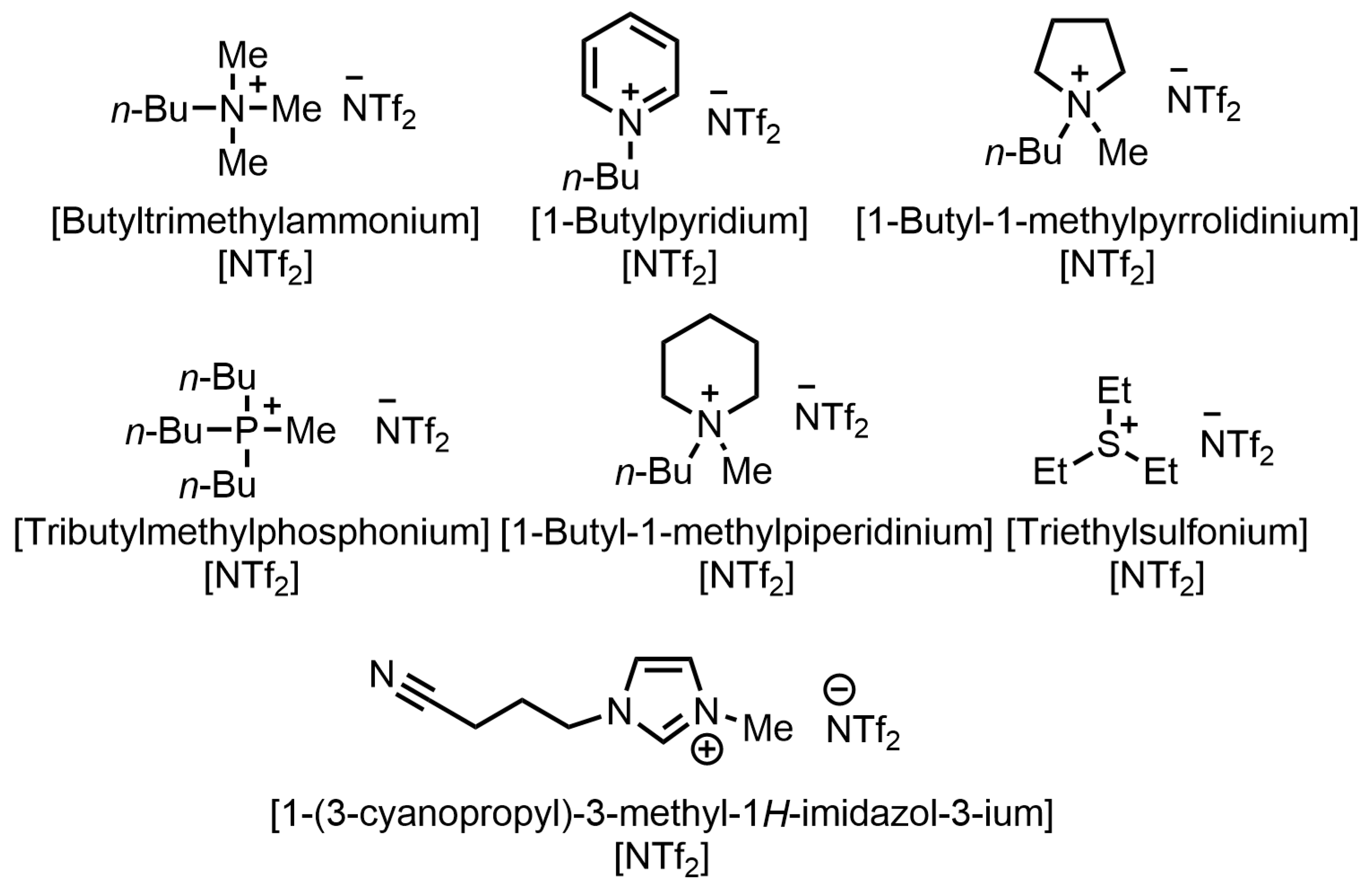
| 2 | [Butyltrimethylammonium][NTf2] | 80% |
| 3 | [1-Butylpyridium][NTf2] | 84% |
| 4 | [1-Butyl-1-methylpyrrolidinium][NTf2] | 80% |
| 5 | [Tributylmethylphosphonium][NTf2] | 86% |
| 6 | [1-Butyl-1-methylpiperidinium][NTf2] | 67% |
| 7 | [Triethylsulfonium][NTf2] | n.d. |
| 8 | [1-(3-Cyanopropyl)-3-methyl-1H-imidazol-3-ium] [NTf2] | n.d. |
Disclaimer/Publisher’s Note: The statements, opinions and data contained in all publications are solely those of the individual author(s) and contributor(s) and not of MDPI and/or the editor(s). MDPI and/or the editor(s) disclaim responsibility for any injury to people or property resulting from any ideas, methods, instructions or products referred to in the content. |
© 2026 by the authors. Licensee MDPI, Basel, Switzerland. This article is an open access article distributed under the terms and conditions of the Creative Commons Attribution (CC BY) license.
Share and Cite
Chiaki, H.; Umezawa, Y.; Hashimoto, Y.; Morita, N. Environmentally Friendly Synthesis of Polysubstituted Pyrroles in Ionic Liquid via Gold-Catalyzed Propargylic Substitution/Hydration/Amination/Cycloisomerization Sequence. Molecules 2026, 31, 1203. https://doi.org/10.3390/molecules31071203
Chiaki H, Umezawa Y, Hashimoto Y, Morita N. Environmentally Friendly Synthesis of Polysubstituted Pyrroles in Ionic Liquid via Gold-Catalyzed Propargylic Substitution/Hydration/Amination/Cycloisomerization Sequence. Molecules. 2026; 31(7):1203. https://doi.org/10.3390/molecules31071203
Chicago/Turabian StyleChiaki, Hitomi, Yukinori Umezawa, Yoshimitsu Hashimoto, and Nobuyoshi Morita. 2026. "Environmentally Friendly Synthesis of Polysubstituted Pyrroles in Ionic Liquid via Gold-Catalyzed Propargylic Substitution/Hydration/Amination/Cycloisomerization Sequence" Molecules 31, no. 7: 1203. https://doi.org/10.3390/molecules31071203
APA StyleChiaki, H., Umezawa, Y., Hashimoto, Y., & Morita, N. (2026). Environmentally Friendly Synthesis of Polysubstituted Pyrroles in Ionic Liquid via Gold-Catalyzed Propargylic Substitution/Hydration/Amination/Cycloisomerization Sequence. Molecules, 31(7), 1203. https://doi.org/10.3390/molecules31071203