In Vitro Antimicrobial Potential of Medicinal Plant Extracts and Their Combinations Against Mastitis-Causing Bacteria in Dairy Cows

 , , , , , and
Abstract
1. Introduction
2. Results
2.1. Phytochemical Composition and Antioxidant Activity of Plant Extracts
2.2. Antimicrobial Data
3. Discussion
4. Materials and Methods
4.1. Plant Materials
4.2. Extraction
4.3. Formulations
4.4. Spectrophotometric Quantification of Phenolic Compounds
4.5. UPLC–PDA–MS Profiling of Individual Phenolic Compounds
4.6. Antioxidant Activity
4.7. Microorganisms, Nutrient Media, and Cultivation Conditions
4.8. Antimicrobial Activity
4.9. Statistical Analysis
5. Conclusions
Supplementary Materials
Author Contributions
Funding
Institutional Review Board Statement
Informed Consent Statement
Data Availability Statement
Acknowledgments
Conflicts of Interest
References
- Rasmussen, P.; Barkema, H.W.; Osei, P.P.; Taylor, J.; Shaw, A.P.; Conrady, B.; Chaters, G.; Muñoz, V.; Hall, D.C.; Apenteng, O.O.; et al. Global losses due to dairy cattle diseases: A comorbidity-adjusted economic analysis. J. Dairy Sci. 2024, 107, 6945–6970. [Google Scholar] [CrossRef]
- Nielsen, C.; Ostergaard, S.; Emanuelson, U.; Andersson, H.; Berglund, B.; Strandberg, E. Economic consequences of mastitis and withdrawal of milk with high somatic cell count in Swedish dairy herds. Animal 2010, 4, 1758–1770. [Google Scholar] [CrossRef] [PubMed]
- Duse, A.; Persson-Waller, K.; Pedersen, K. Microbial Aetiology, Antibiotic Susceptibility and Pathogen-Specific Risk Factors for Udder Pathogens from Clinical Mastitis in Dairy Cows. Animals 2021, 11, 2113. [Google Scholar] [CrossRef] [PubMed]
- Hébert, A.; Sayasith, K.; Sénéchal, S.; Dubreuil, P.; Lagacé, J. Demonstration of intracellular Staphylococcus aureus in bovine mastitis alveolar cells and macrophages isolated from naturally infected cow milk. FEMS Microbiol. Lett. 2000, 193, 57–62. [Google Scholar] [CrossRef] [PubMed]
- Moradi, A.; Bidarian, B.; Mohammadian, F.; Akbarian, F.; Kalateh Rahmani, H.; Tashakkori, N.; Khoramian, B. Trends in Antimicrobial Resistance of Major Mastitis-Causing Pathogens: A Nine-Year Study. Vet. Med. Sci. 2025, 11, e70417. [Google Scholar] [CrossRef]
- Chantziaras, I.; Boyen, F.; Callens, B.; Dewulf, J. Correlation between veterinary antimicrobial use and antimicrobial resistance in food-producing animals: A report on seven countries. J. Antimicrob. Chemother. 2014, 69, 827–834. [Google Scholar] [CrossRef]
- Chen, R.A.; Wu, W.K.; Panyod, S.; Liu, P.Y.; Chuang, H.L.; Chen, Y.H.; Lyu, Q.; Hsu, H.C.; Lin, T.L.; Shen, T.D.; et al. Dietary Exposure to Antibiotic Residues Facilitates Metabolic Disorder by Altering the Gut Microbiota and Bile Acid Composition. mSystems 2022, 7, e0017222. [Google Scholar] [CrossRef]
- Liu, Y.; Wu, Y.; Wu, J.; Li, X.; Yu, L.; Xie, K.; Zhang, M.; Ren, L.; Ji, Y.; Li, Y. Exposure to Veterinary Antibiotics via Food Chain Disrupts Gut Microbiota and Drives Increased Escherichia coli Virulence and Drug Resistance in Young Adults. Pathogens 2022, 11, 1062. [Google Scholar] [CrossRef]
- Piñeiro, S.A.; Cerniglia, C.E. Antimicrobial drug residues in animal-derived foods: Potential impact on the human intestinal microbiome. J. Vet. Pharmacol. Ther. 2021, 44, 215–222. [Google Scholar] [CrossRef]
- Costa, L.V.; Gebara, C.; Zacaroni, O.D.; Freitas, N.E.; Silva, A.N.; Prado, C.S.; Nunes, I.A.; Cavicchioli, V.Q.; Duarte, F.O.; Lage, M.E.; et al. Antibiotic Residues in Raw Cow’s Milk: A Systematic Review of the Last Decade. Foods 2024, 13, 3758. [Google Scholar] [CrossRef]
- Meklati, F.R.; Panara, A.; Hadef, A.; Meribai, A.; Ben-Mahdi, M.H.; Dasenaki, M.E.; Thomaidis, N.S. Comparative Assessment of Antibiotic Residues Using Liquid Chromatography Coupled with Tandem Mass Spectrometry (LC-MS/MS) and a Rapid Screening Test in Raw Milk Collected from the North-Central Algerian Dairies. Toxics 2022, 10, 19. [Google Scholar] [CrossRef]
- Rware, H.; Monica, K.K.; Idah, M.; Fernadis, M.; Davis, I.; Buke, W.; Solveig, D.; Daniel, K.; Duncan, C.; Morten, B.; et al. Examining antibiotic use in Kenya: Farmers’ knowledge and practices in addressing antibiotic resistance. CAB Agric. Biosci. 2024, 5, 21. [Google Scholar] [CrossRef]
- Fan, X.; Qadeer, A.; Asiri, M.; Alzahrani, F.M.; Alzahrani, K.J.; Alsharif, K.F.; Khan, M.Z.; Jiang, X. Traditional Chinese Medicine and Plant-Derived Bioactive Compounds as Sustainable Alternatives to Antibiotics in Bovine Mastitis: A Review. Front. Vet. Sci. 2025, 12, 1642647. [Google Scholar] [CrossRef] [PubMed]
- Lopes, T.S.; Fontoura, P.S.; Oliveira, A.; Rizzo, F.A.; Silveira, S.; Streck, A.F. Use of plant extracts and essential oils in the control of bovine mastitis. Res. Vet. Sci. 2020, 131, 186–193. [Google Scholar] [CrossRef] [PubMed]
- Kovačević, Z.; Radinović, M.; Čabarkapa, I.; Kladar, N.; Božin, B. Natural Agents against Bovine Mastitis Pathogens. Antibiotics 2021, 10, 205. [Google Scholar] [CrossRef]
- Rani, S.; Verma, S.; Singh, H.; Ram, C. Antibacterial activity and mechanism of essential oils in combination with medium-chain fatty acids against predominant bovine mastitis pathogens. Lett. Appl. Microbiol. 2022, 74, 959–969. [Google Scholar] [CrossRef]
- Tomanić, D.; Božić, D.D.; Kladar, N.; Samardžija, M.; Apić, J.; Baljak, J.; Kovačević, Z. Clinical Evidence on Expansion of Essential Oil-Based Formulation’s Pharmacological Activity in Bovine Mastitis Treatment: Antifungal Potential as Added Value. Antibiotics 2024, 13, 575. [Google Scholar] [CrossRef]
- Pașca, C.; Mărghitaș, L.A.; Dezmirean, D.S.; Matei, I.A.; Bonta, V.; Pașca, I.; Chirilă, F.; Cîmpean, A.; Iosif Fiț, N. Efficacy of Natural Formulations in Bovine Mastitis Pathology: Alternative Solution to Antibiotic Treatment. J. Vet. Res. 2020, 64, 523–529. [Google Scholar] [CrossRef]
- do Nascimento, G.M.; Rodrigues, R.A.; Brugnera, H.C.; Barbosa, J.C.; Favaron, F.R., Jr.; Rossi, G.A.M.; de Bragança, C.R.S.; Schocken-Iturrino, R.P.; de Ávila, F.A.; Cardozo, M.V. Antimicrobial Activity of Teat Antiseptic Formulations Based on Plant Extracts for Controlling Bovine Mastitis: In Vitro and In Vivo Evaluation. Vet. Sci. 2025, 12, 293. [Google Scholar] [CrossRef]
- Silva, C.; Vidal, C.S.; Filho, S.M.A.; Agatão, I.M.; Berbert, L.C.; Salles, J.B.; Cardoso, A.M.; Kuster, R.M.; Victório, C.P.; Assis, M.C. Rapid Bactericidal Activity of Punica granatum L. Peel Extract: A Natural Alternative for Mastitis Prevention in Dairy Cattle. Molecules 2025, 30, 2387. [Google Scholar] [CrossRef]
- Debruyn, E.; Ghumman, N.Z.; Peng, J.; Tiwari, H.K.; Gogoi-Tiwari, J. Alternative approaches for bovine mastitis treatment: A critical review of emerging strategies, their effectiveness and limitations. Res. Vet. Sci. 2025, 185, 105557. [Google Scholar] [CrossRef]
- Silva, D.M.; Costa, P.A.D.; Ribon, A.O.B.; Purgato, G.A.; Gaspar, D.M.; Diaz, M.A.N. Plant Extracts Display Synergism with Different Classes of Antibiotics. An. Acad. Bras. Cienc. 2019, 91, e20180117. [Google Scholar] [CrossRef]
- Sultanayeva, L.; Zamaratskaia, G.; Balji, Y. Tannins and flavonoids as feed additives in the diet of ruminants to improve performance and quality of the derived products: A review. Bulg. J. Agric. Sci. 2023, 29, 522–530. [Google Scholar]
- Belew, A.A.; Gebre, S.H. Comparative assessment of phenolic and flavonoid contents and antioxidant activities in methanol extracts of spices from Jigjiga market, Ethiopia. Pharmacol. Res. Nat. Prod. 2025, 6, 100168. [Google Scholar] [CrossRef]
- Atak, M.; Yılmaz Kutlu, E.; Çavuş, D.; Çomoğlu, M. Handmade green tea: Antioxidant content and activity. Appl. Food Res. 2024, 4, 100626. [Google Scholar] [CrossRef]
- Shrivastava, A.K.; Keshari, M.; Neupane, M.; Chaudhary, S.; Dhakal, P.K.; Shrestha, L.; Palikhey, A.; Yadav, C.K.; Lamichhane, G.; Shekh, M.U.; et al. Evaluation of Antioxidant and Anti-Inflammatory Activities, and Metabolite Profiling of Selected Medicinal Plants of Nepal. J. Trop. Med. 2023, 2023, 6641018. [Google Scholar] [CrossRef]
- de Jesus, G.S.; Silva Trentin, D.; Barros, T.F.; Ferreira, A.M.T.; de Barros, B.C.; de Oliveira Figueiredo, P.; Garcez, F.R.; dos Santos, É.L.; Micheletti, A.C.; Yoshida, N.C. Medicinal plant Miconia albicans synergizes with ampicillin and ciprofloxacin against multi-drug resistant Acinetobacter baumannii and Staphylococcus aureus. BMC Complement. Med. Ther. 2023, 23, 374. [Google Scholar] [CrossRef]
- Hanci, H.; Igan, H. Antimicrobial synergistic effects of apigenin, (-)-epigallocatechin-3-gallate, myricetin and luteolin in combination with some antibiotics. Ann. Agric. Environ. Med. 2023, 30, 61–64. [Google Scholar] [CrossRef]
- Ispiryan, A.; Atkociuniene, V.; Makstutiene, N.; Sarkinas, A.; Salaseviciene, A.; Urbonaviciene, D.; Viskelis, J.; Pakeltiene, R.; Raudone, L. Correlation between Antimicrobial Activity Values and Total Phenolic Content/Antioxidant Activity in Rubus idaeus L. Plants 2024, 13, 504. [Google Scholar] [CrossRef]
- Zhang, Z.; Cao, M.; Shang, Z.; Xu, J.; Chen, X.; Zhu, Z.; Wang, W.; Wei, X.; Zhou, X.; Zhang, J. Research Progress on the Antibacterial Activity of Natural Flavonoids. Antibiotics 2025, 14, 334. [Google Scholar] [CrossRef]
- Okińczyc, P.; Widelski, J.; Nowak, K.; Radwan, S.; Włodarczyk, M.; Kuś, P.M.; Susniak, K.; Korona-Głowniak, I. Phytochemical Profiles and Antimicrobial Activity of Selected populus spp. Bud. Extracts. Mol. 2024, 29, 437. [Google Scholar] [CrossRef] [PubMed]
- Stanciauskaite, M.; Marksa, M.; Liaudanskas, M.; Ivanauskas, L.; Ivaskiene, M.; Ramanauskiene, K. Extracts of Poplar Buds (Populus balsamifera L., Populus nigra L.) and Lithuanian Propolis: Comparison of Their Composition and Biological Activities. Plants 2021, 10, 828. [Google Scholar] [CrossRef] [PubMed]
- Afanyibo, Y.; Anani, K.; Esseh, K.; Sadji, Y.; Idoh, K.; Koudouvo, K.; Agbonon, A.; Améyapoh, Y.; Tozo, K.; Gbeassor, M. Antimicrobial activities of Syzygium aromaticum (L.) Merr. & L.M. Perry (Myrtaceae) fruit extracts on six standard microorganisms and their clinical counterpart. Open Access Libr. J. 2018, 5, e4951. [Google Scholar] [CrossRef]
- Teles, A.M.; Silva-Silva, J.V.; Fernandes, J.M.P.; Abreu-Silva, A.L.; Calabrese, K.D.S.; Mendes Filho, N.E.; Mouchrek, A.N.; Almeida-Souza, F. GC-MS Characterization of Antibacterial, Antioxidant, and Antitrypanosomal Activity of Syzygium aromaticum Essential Oil and Eugenol. Evid. Based Complement. Altern. Med. 2021, 2021, 6663255. [Google Scholar] [CrossRef]
- Carbone, K.; Gervasi, F. An Updated Review of the Genus Humulus: A Valuable Source of Bioactive Compounds for Health and Disease Prevention. Plants 2022, 11, 3434. [Google Scholar] [CrossRef]
- Zhang, G.; Zhang, N.; Yang, A.; Huang, J.; Ren, X.; Xian, M.; Zou, H. Hop bitter acids: Resources, biosynthesis, and applications. Appl. Microbiol. Biotechnol. 2021, 105, 4343–4356. [Google Scholar] [CrossRef]
- Han, N.; Zhao, F.; Li, Y.; Xiong, W.; Wan, P.; Zeng, Z. Xanthohumol restores the susceptibility of Escherichia coli to colistin. One Health Adv. 2025, 3, 32. [Google Scholar] [CrossRef]
- Wang, X.-D.; Bai, J.-L.; Ma, Z.-J.; Fan, J.; Kong, W.-B.; Wang, J.-L.; Zhang, J.; Liang, J.-Y. Analysis of chemical composition, antibacterial activity, antioxidant properties, and cytotoxicity of essential oils from four plant fruits. Microb. Pathog. 2025, 209, 108133. [Google Scholar] [CrossRef]
- Tariq, S.; Wani, S.; Rasool, W.; Shafi, K.; Bhat, M.A.; Prabhakar, A.; Shalla, A.H.; Rather, M.A. A comprehensive review of the antibacterial, antifungal and antiviral potential of essential oils and their chemical constituents against drug-resistant microbial pathogens. Microb. Pathog. 2019, 134, 103580. [Google Scholar] [CrossRef]
- Kovačević, Z.; Tomanić, D.; Čabarkapa, I.; Šarić, L.; Stanojević, J.; Bijelić, K.; Galić, I.; Ružić, Z.; Erdeljan, M.; Kladar, N. Chemical Composition, Antimicrobial Activity, and Withdrawal Period of Essential Oil-Based Pharmaceutical Formulation in Bovine Mastitis Treatment. Int. J. Environ. Res. Public Health 2022, 19, 16643. [Google Scholar] [CrossRef]
- Royal Botanic Gardens, Kew. Plants of the World Online. Available online: https://powo.science.kew.org/ (accessed on 18 March 2026).
- State Pharmacopoeia of the Republic of Kazakhstan; Zhibek Zholy Publishing House: Almaty, Kazakhstan, 2008–2014; Volume 3.
- General Monograph (FS.2.5.0046.15 Humuli lupuli fructus; FS.0.0.0000 Syzygium aromaticum (L.) Merr. & L.M. Perry; FS.2.5.0042.15 Populus balsamifera L.—Poplar buds). In State Pharmacopoeia of the Russian Federation, 13th ed.; Ministry of Health of the Russian Federation: Moscow, Russia, 2015; Volume 3.
- TR CU 021/2011; On Food Safety. Eurasian Economic Union: Moscow, Russia, 2011.
- TR CU 022/2011; On the Labelling of Food Products. Eurasian Economic Union: Moscow, Russia, 2011.
- Pavlov, N.V. Flora Kazakhstana; Nauka: Alma-Ata, Kazakhstan, 1956–1966; Volume 1–9. (In Russian) [Google Scholar]
- Pylkkänen, R.; Werner, D.; Bishoyi, A.; Weil, D.; Scoppola, E.; Wagermaier, W.; Safeer, A.; Bahri, S.; Baldus, M.; Paananen, A.; et al. The complex structure of Fomes fomentarius represents an architectural design for high-performance ultralightweight materials. Sci. Adv. 2023, 9, eade5417. [Google Scholar] [CrossRef] [PubMed]
- European Directorate for the Quality of Medicines & HealthCare (EDQM). European Pharmacopoeia, 11th ed.; Council of Europe: Strasbourg, France, 2022; Section 2.8.16, Dry residue of extracts. [Google Scholar]
- Singleton, V.L.; Rossi, J.A., Jr. Colorimetry of Total Phenolics with Phosphomolybdic–Phosphotungstic Acid Reagents. Am. J. Enol. Vitic. 1965, 16, 144–158. [Google Scholar] [CrossRef]
- Abashidze, N.; Djafaridze, I.; Vanidze, M.; Khakhutaishvili, M.; Kharadze, M.; Kartsivadze, I.; Davitadze, R.; Kalandia, A. Physicochemical Characterization and Antioxidant Activity of Jara Honey Produced in Western Georgia. Appl. Sci. 2024, 14, 6874. [Google Scholar] [CrossRef]
- Datuashvili, L.; Vanidze, M.; Japaridze, I.; Surmanidze, N.; Kartsivadze, I.; Davitadze, R.; Kalandia, A. Chemical Composition Analysis of Sea Buckthorn (Hippophae) in Georgia and Development of Innovative Valorization Technologies. Food Sci. Nutr. 2025, 13, e70507. [Google Scholar] [CrossRef]
- Putkaradze, J.; Vanidze, M.; Ghoghoberidze, S.; Davitadze, R.; Kalandia, A. Traditional and Innovative Processing of Georgian Myrobalan Plum (P. cerasifera Ehrh): Effects on Phytochemical. Content. Food Sci. Nutr. 2026, 14, e71458. [Google Scholar] [CrossRef]
- Brand-Williams, W.; Cuvelier, M.E.; Berset, C. Use of a free radical method to evaluate antioxidant activity. LWT Food Sci. Technol. 1995, 28, 25–30. [Google Scholar] [CrossRef]



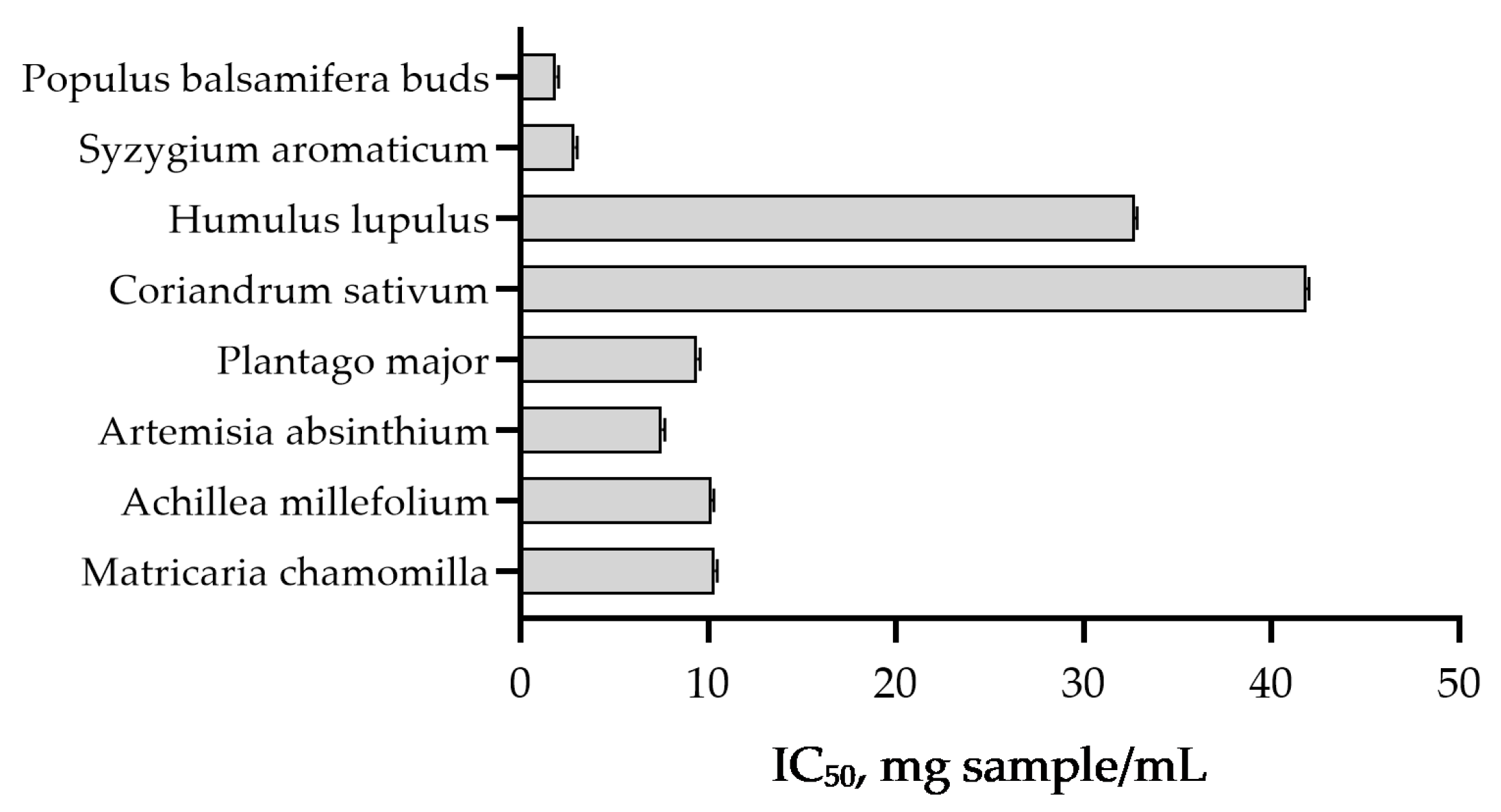
| Extract | Total Phenolic Compounds, mg GAE g−1 Extract | Phenolic Acids, mg CAE g−1 Extract | Flavonoids, mg QE g−1 Extract | Catechins, mg CE g−1 Extract |
|---|---|---|---|---|
| Balsam poplar buds (Populus balsamifera) | 43.0 ± 0.2 a | 12.6 ± 0.1 a | 34.5 ± 0.2 a | 0.9 ± 0.01 b |
| Clove (Syzygium aromaticum) | 31.8 ± 0.2 b | 3.5 ± 0.1 b | 22.8 ± 0.2 b | 0.3 ± 0.01 c |
| Wormwood (Artemisia absinthium) | 12.1 ± 0.2 c | 2.2 ± 0.1 c | 7.9 ± 0.2 d | <0.0001 e |
| Broadleaf Plantain (Plantago major) | 11.7 ± 0.2 c | 2.5 ± 0.1 c | 8.5 ± 0.2 c | 1.0 ± 0.01 a |
| Yarrow (Achillea millefolium) | 7.2 ± 0.2 d | 2.2 ± 0.1 c | 5.1 ± 0.2 e | <0.0001 e |
| Hops (Humulus lupulus) | 4.0 ± 0.2 e | 1.6 ± 0.1 d | 2.2 ± 0.2 f | <0.0001 e |
| Polypore (Fomes fomentarius, ex Populus) | 2.9 ± 0.2 f | 0.5 ± 0.1 f | 1.5 ± 0.2 g | 0.1 ± 0.01 d |
| Coriander (Coriandrum sativum) | 2.5 ± 0.2 f | 1.3 ± 0.1 de | 1.2 ± 0.2 g | <0.0001 e |
| Milk Thistle (Silybum marianum) | 3.7 ± 0.2 e | 1.1 ± 0.1 e | 2.5 ± 0.2 f | 0.1 ± 0.01 d |
| Chamomile (Matricaria chamomilla) | 7.3 ± 0.2 d | 2.5 ± 0.1 c | 4.7 ± 0.2 e | <0.0001 e |
| Effect of extract, p-value | <0.001 | <0.001 | <0.001 | <0.001 |
| Variable | Candida Field | Candida ATCC | E. coli Field | E. coli ATCC | Total Field | S. aureus ATCC | Total Phenolics | Phenolic Acids | Flavonoids | Catechins |
|---|---|---|---|---|---|---|---|---|---|---|
| IC50 | 0.079 | 0.160 | 0.310 | 0.048 | −0.257 | 0.193 | −0.410 | −0.361 | −0.383 | −0.283 |
| Candida field | 0.848 ** | −0.612 | 0.283 | 0.365 | 0.731 * | 0.638 * | 0.478 | 0.629 | 0.396 | |
| Candida ATCC | −0.460 | 0.235 | 0.475 | 0.674 * | 0.701 * | 0.584 | 0.718 * | 0.343 | ||
| E. coli field | 0.367 | −0.297 | −0.727 * | −0.574 | −0.668 * | −0.615 | −0.604 | |||
| E. coli ATCC | −0.030 | −0.111 | 0.117 | −0.318 | 0.048 | −0.364 | ||||
| Total field | 0.516 | 0.718 * | 0.573 | 0.743 * | 0.833 ** | |||||
| S. aureus ATCC | 0.572 | 0.525 | 0.614 | 0.711 * | ||||||
| Total phenolics | 0.883 ** | 0.994 ** | 0.630 | |||||||
| Phenolic acids | 0.901 ** | 0.628 | ||||||||
| Flavonoids | 0.663 * |
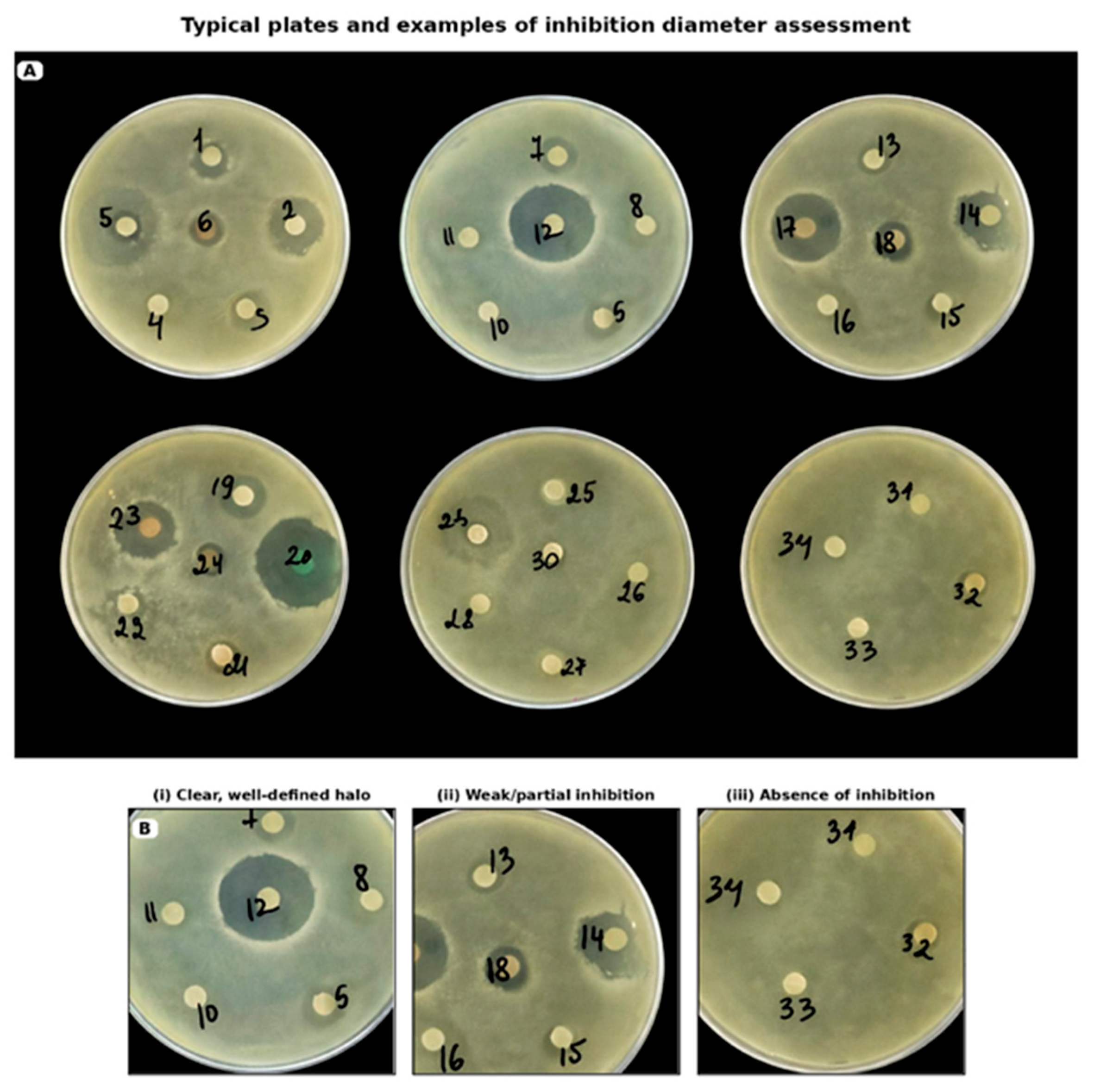
| Extract | Concentration (mg DW/mL) | Candida Field | Candida ATCC | E.coli Field | E.coli ATCC | Total Field | S.aureus ATCC |
|---|---|---|---|---|---|---|---|
| Populus balsamifera buds | 68 | 15.1 ± 2.9 | 18.1 ± 2.9 | 4.7 ± 2.9 | 6.7 ± 2.9 | 13.8 ± 2.9 | 19.1 ± 2.9 |
| Syzygium aromaticum | 128 | 12.5 ± 2.9 | 14.5 ± 2.9 | 13.5 ± 2.9 | 17.5 ± 2.9 | 13.7 ± 2.9 | 13.5 ± 2.9 |
| Humulus lupulus | 43 | 18.2 ± 2.9 | 17.6 ± 2.9 | 9.0 ± 2.9 | 13.2 ± 2.9 | 8.2 ± 2.9 | 18.4 ± 2.9 |
| Silybum marianum | 46 | 9.6 ± 2.9 | 7.7 ± 2.9 | 10.8 ± 2.9 | 8.3 ± 2.9 | 13.4 ± 2.9 | 19.0 ± 2.9 |
| Coriandrum sativum | 33 | 5.2 ± 2.9 | 10.8 ± 2.9 | 17.1 ± 2.9 | 10.7 ± 2.9 | 10.8 ± 2.9 | 12.7 ± 2.9 |
| Plantago major | 63 | 8.1 ± 2.9 | 3.6 ± 2.9 | 13.8 ± 2.9 | 11.6 ± 2.9 | 8.7 ± 2.9 | 9.1 ± 2.9 |
| Fomes fomentarius | 24 | 9.2 ± 2.9 | 7.8 ± 2.9 | 12.4 ± 2.9 | 9.8 ± 2.9 | 11.1 ± 2.9 | 10.1 ± 2.9 |
| Artemisia absinthium | 7 | 3.2 ± 2.9 | 8.1 ± 2.9 | 13.6 ± 2.9 | 9.3 ± 2.9 | 9.4 ± 2.9 | 8.9 ± 2.9 |
| Achillea millefolium | 5 | 2.3 ± 2.9 | 0.0 ± 2.9 | 10.1 ± 2.9 | 9.2 ± 2.9 | 8.9 ± 2.9 | 12.7 ± 2.9 |
| Matricaria chamomilla | 49 | 2.9 ± 2.9 | 2.0 ± 2.9 | 15.6 ± 2.9 | 10.2 ± 2.9 | 9.0 ± 2.9 | 6.5 ± 2.9 |
| F1 | 3.2 ± 2.9 | 5.6 ± 2.9 | 5.1 ± 2.9 | 4.0 ± 2.9 | 7.6 ± 2.9 | 9.4 ± 2.9 | |
| F2 | 12.6 ± 2.9 | 17.2 ± 2.9 | 14.8 ± 2.9 | 15.4 ± 2.9 | 0.0 ± 2.9 | 15.4 ± 2.9 | |
| CP1 | 4.6 ± 2.9 | 14.9 ± 2.9 | 11.0 ± 2.9 | 7.4 ± 2.9 | 6.2 ± 2.9 | 15.8 ± 2.9 | |
| CP2 | 8.9 ± 2.9 | 28.8 ± 2.9 | 11.1 ± 2.9 | 6.8 ± 2.9 | 6.4 ± 2.9 | 10.5 ± 2.9 | |
| Ethanol control (%) | 70 | 0.0 ± 2.9 | 0.0 ± 2.9 | 0.0 ± 2.9 | 0.0 ± 2.9 | 0.0 ± 2.9 | 0.0 ± 2.9 |
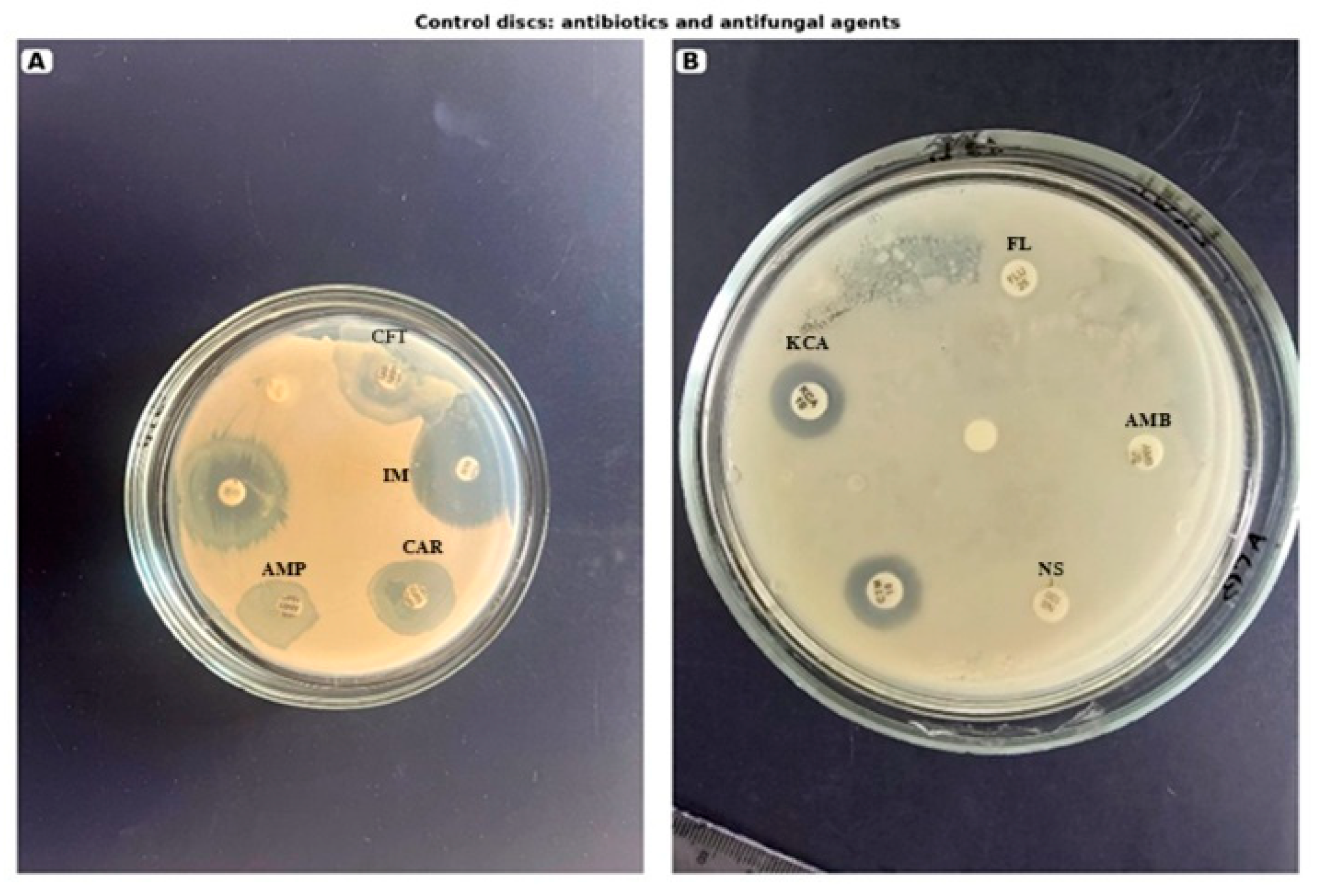
| Ampicillinum (mg/mL) | 2.5 | - | - | - | - | 14.5 ± 2.9 | - |
| Carbenicillin (mg/mL) | 10 | - | - | 10.5 ± 2.9 | - | - | - |
| Cefalotin (mg/mL) | 5 | - | - | - | - | 0.0 ± 2.9 | - |
| Imipenem (mg/mL) | 10 | - | - | 11.6 ± 2.9 | - | - | - |
| Ketoconazole (mg/mL) | 2 | 8.9 ± 2.9 | - | - | - | - | - |
| Fluconazole (mg/mL) | 1.5 | 0.0 ± 2.9 | 0.0 ± 2.9 | - | - | - | - |
| Nystatin (IU/mL) | 2.5 | 0.0 ± 2.9 | 0.0 ± 2.9 | - | - | - | - |
| Species (with Authority) | Family | Plant Part Used | Collection Site/Origin | Coordinates | Pharmacopoeia Data/Origin | POWO Link (All Accessed on 18 March 2026) |
|---|---|---|---|---|---|---|
| Coriandrum sativum L. | Apiaceae | Seeds | Uzbekistan | * | SP RK, т. II | https://powo.science.kew.org/taxon/urn:lsid:ipni.org:names:840760-1 |
| Matricaria chamomilla L. | Asteraceae | Flowers | Akmola region, Kazakhstan | 51.246724, 71.769323 | SP RK, т. II. c. 704–705. | https://powo.science.kew.org/taxon/urn:lsid:ipni.org:names:154715-2 |
| Plantago major L. | Plantaginaceae | Leaves | Akmola region, Kazakhstan | 51°18′29.7′′N 70°42′23.6′′E | SP RK, т. III | https://powo.science.kew.org/taxon/urn:lsid:ipni.org:names:77227281-1 |
| Silybum marianum (L.) Gaertn. | Asteraceae | Seeds | Akmola region, Kazakhstan | 46.100284, 80.642703 | SP RK, т. II. | https://powo.science.kew.org/taxon/urn:lsid:ipni.org:names:249211-1 |
| Populus balsamifera L. | Salicaceae | Buds | Akmola region, Kazakhstan | 51.291016, 70.682656 | SP RF, 13th ed.; Vol. III. FS.2.5.0042.15. | https://powo.science.kew.org/taxon/urn:lsid:ipni.org:names:776600-1 |
| Achillea millefolium L. | Asteraceae | Aerial parts | Akmola region, Kazakhstan | 43.254748, 77.189459 | SP RK, т. II | https://powo.science.kew.org/taxon/urn:lsid:ipni.org:names:2294-2 |
| Artemisia absinthium L. | Asteraceae | Aerial parts | Akmola region, Kazakhstan | 51.310994, 70.654803 | SP RK, т. II | https://powo.science.kew.org/taxon/urn:lsid:ipni.org:names:300106-2 |
| Syzygium aromaticum (L.) Merr. & L.M.Perry | Myrtaceae | Flower buds | Commercial botanical material | ** | SP RF, 13th ed.; Vol. III. FS.0.0.0000 | https://powo.science.kew.org/taxon/urn:lsid:ipni.org:names:601421-1 |
| Humulus lupulus L. | Cannabaceae | Cones | Akmola region, Kazakhstan | 51.294751, 70.746605 | SP RF, 13th ed.; Vol. III. FS.2.5.0046.15 | https://powo.science.kew.org/taxon/urn:lsid:ipni.org:names:303502-2 |
| Species (with Authority) | Family | Plant Part Used | Collection Site/Origin | Coordinates | Pharmacopoeia Data/Origin | MYCOBANK Link (Accessed on 18 March 2026) |
|---|---|---|---|---|---|---|
| Fomes fomentarius (L.) Fr. | Polyporaceae | Basidiocarp (fruiting body) | Akmola region, Kazakhstan | 52.04587, 71.174895 | MycoBank, fungal taxonomic database | https://www.mycobank.org/page/Name%20details%20page/10408?utm_source=chatgpt.com |
| Formulation | Plant Extracts (Mass Fraction, %) | Total Extract Fraction (%) | Other Ingredients (% w/w) | Water (% w/w) | Glycerin (% w/w) | Xanthan Gum (% w/w) |
|---|---|---|---|---|---|---|
| F1 | Humulus lupulus (7.07), Artemisia absinthium (6.06), Calendula officinalis (6.06), Plantago major (6.06), Populus balsamifera buds (5.05), Achillea millefolium (4.04) | 34.34 | – | 55.35 | 10.10 | 0.2 |
| F2 | Coriandrum sativum (4.0), Syzygium aromaticum (4.0), Fomes fomentarius (4.0), Populus balsamifera buds (3.0), Matricaria chamomilla (3.0) | 18.0 | Flax oil (10.0), Beeswax (1.0) | 60.0 | 10.0 | 1.0 |
Disclaimer/Publisher’s Note: The statements, opinions and data contained in all publications are solely those of the individual author(s) and contributor(s) and not of MDPI and/or the editor(s). MDPI and/or the editor(s) disclaim responsibility for any injury to people or property resulting from any ideas, methods, instructions or products referred to in the content. |
© 2026 by the authors. Licensee MDPI, Basel, Switzerland. This article is an open access article distributed under the terms and conditions of the Creative Commons Attribution (CC BY) license.
Share and Cite
Balji, Y.; Sultanayeva, L.; Mustafina, R.; Alyonova, M.; Kalandia, A.; Djafaridze, I.; Zamaratskaia, G. In Vitro Antimicrobial Potential of Medicinal Plant Extracts and Their Combinations Against Mastitis-Causing Bacteria in Dairy Cows. Molecules 2026, 31, 1089. https://doi.org/10.3390/molecules31071089
Balji Y, Sultanayeva L, Mustafina R, Alyonova M, Kalandia A, Djafaridze I, Zamaratskaia G. In Vitro Antimicrobial Potential of Medicinal Plant Extracts and Their Combinations Against Mastitis-Causing Bacteria in Dairy Cows. Molecules. 2026; 31(7):1089. https://doi.org/10.3390/molecules31071089
Chicago/Turabian StyleBalji, Yuriy, Leila Sultanayeva, Raikhan Mustafina, Meruyert Alyonova, Aleko Kalandia, Indira Djafaridze, and Galia Zamaratskaia. 2026. "In Vitro Antimicrobial Potential of Medicinal Plant Extracts and Their Combinations Against Mastitis-Causing Bacteria in Dairy Cows" Molecules 31, no. 7: 1089. https://doi.org/10.3390/molecules31071089
APA StyleBalji, Y., Sultanayeva, L., Mustafina, R., Alyonova, M., Kalandia, A., Djafaridze, I., & Zamaratskaia, G. (2026). In Vitro Antimicrobial Potential of Medicinal Plant Extracts and Their Combinations Against Mastitis-Causing Bacteria in Dairy Cows. Molecules, 31(7), 1089. https://doi.org/10.3390/molecules31071089