Pecan (Carya illinoinensis) Shells as a Source of Antioxidants: Implications for Oxidative Stress-Driven Pathologies

 ,
,  and
and 
Abstract
1. Introduction
2. Literature Search Methodology
3. Results
3.1. Keywords Clustering
3.2. Pecan Nutshell as a Source of Phenolic Compounds
3.2.1. Antioxidant Capacity of Pecan Nutshell
3.2.2. Antioxidant Mechanisms of Action of Pecan Shell
- Direct free-radical quenching: Ethanolic or aqueous PNS extracts from 20 cultivars show DPPH· and ABTS·+ inhibition up to ~3600 µmol Trolox g−1, values that track linearly with total phenolic content (150–490 mg GAE g−1) and confirm a primary hydrogen-atom/electron-donating capacity [33].
- Metal chelation: Sub-critical-water extracts obtained at 80 °C display the highest ferric-reducing antioxidant power (FRAP) among industrial shell streams, reflecting multiple ortho-dihydroxyl and galloyl sites able to sequester Fe3+/Cu2+ and curb Fenton chemistry [28].
- Recycling of endogenous defenses: In vivo, 5% (w/v) PNS aqueous extract given ad libitum prevents cyclophosphamide-induced spikes in testicular lipid peroxidation while restoring catalase and glutathione levels and normalizing superoxide-dismutase activity, indicating up-regulation or preservation of the cellular enzymatic antioxidant network [40].
- Possible redox-signalling modulation: High-molecular proanthocyanidins in hydro-alcoholic PNS fractions have been docked in silico to Keap1 cysteine pockets; although direct Nrf2 read-outs are pending, the pattern suggests other tannin-rich botanicals known to trigger phase-II genes. Collectively, these converging mechanisms—radical scavenging, metal sequestration, enzyme rebalancing and putative Nrf2 activation—explain why PNS extracts consistently protect biological membranes, DNA and proteins in diverse oxidative paradigms while maintaining a favorable safety margin (rodent NOAEL ≥ 1 g/kg/day) [36]. Harnessing these actions through green extraction and tannin-enrichment technologies points to pecan shell as an inexpensive, circular-economy source of antioxidant ingredients for food, cosmetic and possibly therapeutic applications.
3.3. Therapeutic Potential of Pecan Nutshell Extracts Against Endothelial Dysfunction
3.4. Potential of Pecan Nutshell Against Hyperglycemia
3.5. Potential of Pecan Nutshell Against Neurodegenerative Disorders
3.5.1. Antioxidant Activity in Neurological Contexts
3.5.2. Neuroprotective Mechanisms Beyond Antioxidant Activity
3.6. Potential of Pecan Nutshell Against Cancer
4. Perspective & Limitations
4.1. Perspective & Future Direction
- Green extraction has become mainstream: ball-milling combined with deep-eutectic solvents or water/ethanol systems now recover > 160 mg gallic-acid-equivalents g−1 dry shell while eliminating petrochemical solvents [74]. However, standardization across laboratories remains inconsistent, with extraction temperature, time, solvent-to-solid ratio, and particle size varying widely between studies, complicating reproducibility and comparison of bioactivity data.
- PNS extracts consistently exhibit nanomolar-to-micromolar EC50 values in DPPH and ABTS assays and retain their antioxidant activity after incorporation into complex matrices, such as electrospun PAN fibers for skin-care applications, where radical scavenging reaches 60–80% and is accompanied by antimicrobial effects [20]. However, this strong in vitro antioxidant performance does not necessarily translate to in vivo efficacy, as evidenced by the absence of vascular effects following administration of whole-shell powder despite its antioxidant content (Section 3.3), underscoring bioavailability as a critical limiting factor.
- First bio-efficacy signals have moved beyond in vitro chemistry: phenolic-rich water extracts trigger apoptosis in HT-29 colon-cancer cells (IC50 ≈ 50 µg/mL) [72], while lignin-rich fractions protect edible oils and margarines from oxidative rancidity as effectively as BHT. However, as detailed in Section 3.6, only one cancer type (breast, via EAT model) has in vivo validation, and no disease-specific models (transgenic Alzheimer’s, 6-OHDA Parkinson’s, orthotopic tumors) have been tested. The gap between in vitro promise and in vivo/clinical reality remains substantial.
- Material-science approaches (silver-nanoparticle hybrids, zein microcapsules) are creating multi-functional carriers that couple antioxidant, antibacterial and controlled-release properties, broadening the application palette to foods, cosmetics and biomedical devices. These delivery systems may address the poor oral bioavailability of high-molecular-weight tannins, though comparative pharmacokinetic studies (nano encapsulated vs. free extracts) measuring plasma and tissue concentrations are not yet published.
4.2. Current Limitations and Research Gaps
5. Conclusions
Author Contributions
Funding
Institutional Review Board Statement
Informed Consent Statement
Data Availability Statement
Conflicts of Interest
References
- Lackner, M.; Besharati, M. Agricultural Waste: Challenges and Solutions, a Review. Waste 2025, 3, 18. [Google Scholar] [CrossRef]
- Koul, B.; Yakoob, M.; Shah, M.P. Agricultural waste management strategies for environmental sustainability. Env. Res. 2022, 206, 112285. [Google Scholar] [CrossRef] [PubMed]
- Garcia-Larez, F.L.; Esquer, J.; Guzmán, H.; Zepeda-Quintana, D.S.; Moreno-Vásquez, M.J.; Rodríguez-Félix, F.; Del-Toro Sánchez, C.L.; López-Corona Sánchez, B.E.; Tapia-Hernández, J.A. Effect of Ultrasound-Assisted Extraction (UAE) parameters on the recovery of polyphenols from pecan nutshell waste biomass and its antioxidant activity. Biomass Conv. Bioref. 2024, 18, 10977–10995. [Google Scholar] [CrossRef]
- Ingallina, C.; Spano, M.; Prencipe, S.A.; Vinci, G.; Di Sotto, A.; Ambroselli, D.; Vergine, V.; Crestoni, M.E.; Di Meo, C.; Zoratto, N.; et al. Enhancing Human Health Through Nutrient and Bioactive Compound Recovery from Agri-Food By-Products: A Decade of Progress. Nutrients 2025, 20, 2528. [Google Scholar] [CrossRef] [PubMed]
- Food and Agriculture Organization of the United Nations (FAO). Food Loss and Waste and the Right to Adequate Food: Making the Connection; FAO: Rome, Italy, 2018; p. 48. [Google Scholar]
- Gemar, G.; Soler, I.P.; Sánchez-Teba, E.M. Waste management: Valorization is the way. Foods 2021, 10, 2373. [Google Scholar] [CrossRef]
- Guasch-Ferré, M.; Li, J.; Hu, F.B.; Salas-Salvadó, J.; Tobias, D.K. Effects of walnut consumption on blood lipids and other cardiovascular disease risk factors: An updated meta-analysis and systematic review of controlled trials. Am. J. Clin. Nutr. 2018, 108, 174–187. [Google Scholar] [CrossRef]
- Khalili, L.; A-Elgadir, T.M.E.; Mallick, A.K.; El Enshasy, H.A.; Sayyed, R.Z. Nuts as a part of dietary strategy to improve metabolic biomarkers: A narrative review. Front. Nutr. 2022, 9, 881843. [Google Scholar] [CrossRef]
- Rajaram, S.; Damasceno, N.R.T.; Braga, R.A.M.; Martinez, R.; Kris-Etherton, P.; Sala-Vila, A. Effect of nuts on markers of inflammation and oxidative stress: A narrative review. Nutrients 2023, 18, 1099. [Google Scholar] [CrossRef]
- Alasalvar, C.; Huang, G.; Bolling, B.W.; Jantip, P.A.; Pegg, R.B.; Wong, X.K.; Chang, S.K.; Pelvan, E.; de Camargo, A.C.; Mandalari, G.; et al. Upcycling commercial nut byproducts for food, nutraceutical, and pharmaceutical applications: A comprehensive review. Food Chem. 2025, 467, 142222. [Google Scholar] [CrossRef]
- Balmé, F. Plantas Medicinais; Ed. Hemus Ltda: São Paulo, Brazil, 1982; p. 241. [Google Scholar]
- Santoso, I.; Suprayogi, S.; Sulianto, A.A.; Widyastuti, E.; Choirun, A.U.; Lestari, K.; A’yuniah, S.; Kusumaningtyas, O.W. Exploring antioxidant potential of agricultural by-products: A systematic review. F1000Research 2024, 16, 1008. [Google Scholar] [CrossRef]
- Müller, L.G.; Pase, C.S.; Reckziegel, P.; Barcelos, R.C.; Boufleur, N.; Prado, A.C.P.; Fett, R.; Block, J.M.; Pavanato, M.A.; Bauermann, L.F.; et al. Hepatoprotective effects of pecan nut shells on ethanol-induced liver damage. Exp. Toxicol. Pathol. 2013, 68, 165–171. [Google Scholar] [CrossRef]
- Rahaman, M.M.; Hossain, R.; Herrera-Bravo, J.; Islam, M.T.; Atolani, O.; Adeyemi, O.S. Natural antioxidants from some fruits, seeds, foods, natural products, and associated health benefits: An update. Food Sci. Nutr. 2023, 11, 1657–1670. [Google Scholar] [CrossRef]
- Hilbig, J.; Alves, V.R.; Müller, C.M.; Micke, G.A.; Vitali, L.; Pedrosa, R.C.; Block, J.M. Ultrasonic-assisted extraction combined with sample preparation and analysis using LC-ESI-MS/MS allowed the identification of 24 new phenolic compounds in pecan nut shell [Carya illinoinensis (Wangenh.) C. Koch] extracts. Food Res. Int. 2018, 106, 549–557. [Google Scholar] [CrossRef]
- Del C Reyes-Vázquez, N.; de la Rosa, L.A.; Morales-Landa, J.L.; García-Fajardo, J.A.; García-Cruz, M.Á. Phytochemical Content and Potential Health Applications of Pecan [Carya illinoinensis (Wangenh) K. Koch] Nutshell. Curr. Top. Med. Chem. 2022, 25, 150–167. [Google Scholar] [CrossRef]
- Soto-Díaz, O.; Lobato-Peralta, D.R.; Ayala-Cortés, A.; Villafán-Vidales, H.I.; Gamboa-Sanchez, S.A.; Collins-Martínez, V.H.; Román-Aguirre, M.; González-García, G.; Cuentas-Gallegos, A.K.; Ramos-Sánchez, V.H. Solar-driven synthesis of CaS-decorated activated carbon from pecan nutshell agro-industrial waste to assemble green, stable, and electro-activated supercapacitors. Chem. Eng. J. 2025, 507, 160743. [Google Scholar] [CrossRef]
- Agustin-Salazar, S.; Cerruti, P.; Medina-Juárez, L.Á.; Scarinzi, G.; Malinconico, M.; Soto-Valdez, H.; Gamez-Meza, N. Lignin and holocellulose from pecan nutshell as reinforcing fillers in poly (lactic acid) biocomposites. Int. J. Biol. Macromol. 2018, 115, 727–736. [Google Scholar] [CrossRef] [PubMed]
- Kureck, I.; Policarpi, P.B.; Toaldo, I.M.; Maciel, M.V.O.B.; Bordignon-Luiz, M.T.; Barreto, P.L.M.; Block, J.M. Chemical Characterization and Release of Polyphenols from Pecan Nut Shell [Carya illinoinensis (Wangenh) C. Koch] in Zein Microparticles for Bioactive Applications. Plant Foods Hum. Nutr. 2018, 72, 137–145. [Google Scholar] [CrossRef]
- García-García, M.; Jaime-Ferrer, J.S.; Medrano-Lango, F.N.; Quintana-Rodríguez, E.; Campos-García, T.; Rodríguez-Sevilla, E.; Orona-Tamayo, D. Electrospun Membranes Loaded with Melanin Derived from Pecan Nutshell (Carya illinoinensis) Residues for Skin-Care Applications. Membranes 2025, 18, 44. [Google Scholar] [CrossRef] [PubMed]
- Porto, L.C.; da Silva, J.; Ferraz, A.B.; Ethur, E.M.; Porto, C.D.; Marroni, N.P.; Picada, J.N. The Antidiabetic and Antihypercholesterolemic Effects of an Aqueous Extract from Pecan Shells in Wistar Rats. Plant Foods Hum. Nutr. 2015, 67, 414–419. [Google Scholar] [CrossRef] [PubMed]
- Xu, Y.; Luo, Y.; Weng, Z.; Xu, H.; Zhang, W.; Li, Q. Microenvironment-responsive metal-phenolic nanozyme release platform with antibacterial, ROS scavenging, and osteogenesis for periodontitis. ACS Nano 2023, 17, 18732–18746. [Google Scholar] [CrossRef]
- Zhang, J.; Hu, J.; Sang, W.; Wang, J.; Yan, Q. Peroxynitrite (ONOO−) redox signaling molecule-responsive polymersomes. ACS Macro Lett. 2016, 5, 919–924. [Google Scholar] [CrossRef] [PubMed]
- Rizzo, A.M.; Berselli, P.; Zava, S.; Montorfano, G.; Negroni, M.; Corsetto, P.; Berra, B. Endogenous antioxidants and radical scavengers. In Bio-Farms for Nutraceuticals (Advances in Experimental Medicine and Biology); Giardi, M.T., Rea, G., Berra, B., Eds.; Springer: Boston, MA, USA, 2010; Volume 698, pp. 52–67. [Google Scholar]
- do Prado, A.C.P.; Aragão, A.M.; Fett, R.; Block, J.M. Antioxidant properties of pecan nut [Carya illinoinensis (Wangenh.) C. Koch] shell infusion. Grasas Aceites 2009, 59, 330–335. [Google Scholar] [CrossRef]
- Sorriento, D.; De Luca, N.; Trimarco, B.; Iaccarino, G. The antioxidant therapy: New insights in the treatment of hypertension. Front. Physiol. 2018, 9, 258. [Google Scholar] [CrossRef]
- John, J.A.; Shahidi, F. Phenolic compounds and antioxidant activity of Brazil nut (Bertholletia excelsa). J. Funct. Foods 2010, 2, 196–209. [Google Scholar] [CrossRef]
- Dunford, N.T.; Gümüş, Z.P.; Sevimli Gur, C. Chemical composition and antioxidant properties of pecan shell water extracts. Antioxidants 2022, 11, 1127. [Google Scholar] [CrossRef] [PubMed]
- Huang, C.Y.; Riskowski, G.L.; Chang, J.; Lin, C.H.; Lai, J.T.; Chang, A.C. Pecan shell by-products Phenolic compound contents and antimicrobial properties. AIMS Agric. Food 2020, 5, 218–232. [Google Scholar]
- Pinheiro do Prado, A.C.; Manion, B.A.; Seetharaman, K.; Deschamps, F.C.; Barrera Arellano, D.; Block, J.M. Relationship between antioxidant properties and chemical composition of the oil and the shell of pecan nuts [Carya illinoinensis (Wangenh.) C. Koch]. Ind. Crops Prod. 2013, 44, 64–73. [Google Scholar] [CrossRef]
- Karuna, K.; Kraśniewska, K.; Gniewosz, M.; Prinyawiwatkul, W.; Fontenot, K.; Adhikari, A. Antimicrobial screening of pecan shell extract and efficacy of pecan shell extract–pullulan coating against Listeria monocytogenes, Salmonella enterica, and Staphylococcus aureus on blueberries. Heliyon 2024, 10, e29610. [Google Scholar] [CrossRef]
- Yemmireddy, V.K.; Cason, C.; Moreira, J.; Adhikari, A. Effect of pecan variety and the method of extraction on the antimicrobial activity of pecan shell extracts against different foodborne pathogens and their efficacy on food matrices. Food Control 2020, 112, 107098. [Google Scholar] [CrossRef]
- Cason, C.; Yemmireddy, V.K.; Moreira, J.; Adhikari, A. Antioxidant Properties of Pecan Shell Bioactive Components of Different Cultivars and Extraction Methods. Foods 2021, 10, 713. [Google Scholar] [CrossRef]
- Flores-Estrada, R.A.; Gámez-Meza, N.; Medina-Juárez, L.A.; Castillón-Campaña, L.G.; Molina-Domínguez, C.C.; Rascón-Valenzuela, L.A.; García-Galaz, A. Chemical composition, antioxidant, antimicrobial and antiproliferative activities of wastes from pecan nut [Carya illinoinensis (Wagenh) K. Koch]. Waste Biomass Valorization 2020, 11, 3419–3432. [Google Scholar] [CrossRef]
- Bottari, N.B.; Soare Lopes, L.Q.; Pizzuti, K.; dos Santos Alves, C.F.; Saldanha Corrêa, M.; Perger Bolzan, L.; Zago, A.; de Almeida Vaucher, R.; Boligon, A.A.; Giongo, J.L.; et al. Antimicrobial activity and phytochemical characterization of Carya illinoensis. Microb. Pathog. 2017, 104, 190–205. [Google Scholar] [CrossRef] [PubMed]
- Benvegnú, D.; Barcelos, R.C.; Boufleur, N.; Reckziegel, P.; Pase, C.S.; Müller, L.G.; Martins, N.M.; Vareli, C.; Bürger, M.E. Protective effects of a by-product of the pecan nut industry (Carya illinoensis) on the toxicity induced by cyclophosphamide in rats Carya illinoensis protects against cyclophosphamide-induced toxicity. J. Environ. Pathol. Toxicol. Oncol. 2010, 30, 185–197. [Google Scholar] [CrossRef] [PubMed]
- Ribas, L.E.; Gasser, F.B.; Baravalle, M.E.; Renna, M.S.; Perello, A.; Savino, G.H.; Ortega, H.H.; Van de Velde, F.; Hein, G.J. Cytotoxic, antioxidants, and cytoprotective properties of polyphenol-enriched extracts from pecan nutshells in MDA-MB-231 breast cancer cells. Cell Biochem. Funct. 2023, 40, 1442–1450. [Google Scholar] [CrossRef]
- Cardona Jimenez, M.E.; Gabilondo, J.; Bodoira, R.M.; Agudelo Laverde, L.M.; Santagapita, P.R. Extraction of bioactive compounds from pecan nutshell: An added-value and low-cost alternative for an industrial waste. Food Chem. 2024, 453, 139596. [Google Scholar] [CrossRef]
- Villarreal-Lozoya, J.E.; Lombardini, L.; Cisneros-Zevallos, L. Phytochemical constituents and antioxidant capacity of different pecan (Carya illinoinensis) cultivars. Food Chem. 2007, 102, 1241–1249. [Google Scholar] [CrossRef]
- Benvegnu, D.M.; Barcelos, R.C.; Roversi, K.; Boufleur, N.; Pase, C.S.; Trevizol, F.; Segat, H.J.; Dias, V.T.; Dolci, G.S.; Antoniazzi, C.T.; et al. Aqueous extract of pecan nut shell (Carya illinoensis [Wangenh.] K. Koch) exerts protection against oxidative damage induced by cyclophosphamide in rat testis. J. Environ. Pathol. Toxicol. Oncol. 2013, 33, 329–341. [Google Scholar] [CrossRef] [PubMed]
- Schulz, E.; Gori, T.; Münzel, T. Oxidative stress and endothelial dysfunction in hypertension. Hypertens. Res. 2011, 15, 665–673. [Google Scholar] [CrossRef]
- Higashi, Y.; Maruhashi, T.; Noma, K.; Kihara, Y. Oxidative stress and endothelial dysfunction: Clinical evidence and therapeutic implications. Trends Cardiovasc. Med. 2013, 14, 165–169. [Google Scholar] [CrossRef] [PubMed]
- Shaito, A.; Aramouni, K.; Assaf, R.; Parenti, A.; Orekhov, A.; Yazbi, A.E.; Pintus, G.; Eid, A.H. Oxidative Stress-Induced endothelial dysfunction in cardiovascular diseases. Front. Biosci. 2022, 27, 105. [Google Scholar] [CrossRef]
- Higashi, Y. Roles of Oxidative stress and inflammation in Vascular Endothelial Dysfunction-Related Disease. Antioxidants 2022, 11, 1958. [Google Scholar] [CrossRef]
- Cai, H.; Harrison, D.G. Endothelial dysfunction in cardiovascular diseases: The role of oxidant stress. Circ. Res. 2000, 87, 840–844. [Google Scholar] [CrossRef]
- Chaudhary, P.; Pandey, A.; Azad, C.S.; Tia, N.; Singh, M.; Gambhir, I.S. Association of oxidative stress and endothelial dysfunction in hypertension. Anal. Biochem. 2019, 590, 113535. [Google Scholar] [CrossRef]
- Jin, S.; Kang, P.M. A Systematic Review on Advances in Management of Oxidative Stress-Associated Cardiovascular Diseases. Antioxidants 2024, 16, 923. [Google Scholar] [CrossRef]
- Reckziegel, P.; Boufleur, N.; Barcelos, R.C.S.; Benvegnú, D.M.; Pase, C.S.; Muller, L.G.; Teixeira, A.M.; Zanella, R.; Prado, A.C.; Fett, R.; et al. Oxidative stress and anxiety-like symptoms related to withdrawal of passive cigarette smoke in mice: Beneficial effects of pecan nut shells extract, a by-product of the nut industry. Ecotoxicol. Environ. Saf. 2011, 73, 1770–1778. [Google Scholar] [CrossRef]
- Hilbig, J.; Policarpi, P.B.; Grinevicius, V.M.A.S.; Mota, N.S.R.S.; Toaldo, I.M.; Luiz, M.T.B.; Pedrosa, R.C.; Block, J.M. Aqueous extract from pecan nut [Carya illinoinensis (Wangenh) C. Koch] shell show activity against breast cancer cell line MCF-7 and Ehrlich ascites tumor in Balb-C mice. J. Ethnopharmacol. 2018, 211, 256–266. [Google Scholar] [CrossRef] [PubMed]
- Dolan, L.; Matulka, R.; Worn, J.; Nizio, J. Safety studies conducted on pecan shell fiber, a food ingredient produced from ground pecan shells. Toxicol. Rep. 2016, 3, 87–97. [Google Scholar] [CrossRef] [PubMed][Green Version]
- Porto, L.C.S.; da Silva, J.; Ferraz, A.D.B.F.; Corrêa, D.S.; dos Santos, M.S.; Porto, C.D.L.; Picada, J.N. Evaluation of acute and subacute toxicity and mutagenic activity of the aqueous extract of pecan shells [Carya illinoinensis (Wangenh.) K. Koch]. Food Chem. Toxicol. 2013, 58, 579–585. [Google Scholar] [CrossRef] [PubMed]
- Araki, E.; Nishikawa, T. Oxidative stress: A cause and therapeutic target of diabetic complications. J. Diabetes Investig. 2010, 1, 90–96. [Google Scholar] [CrossRef] [PubMed]
- Fiorentino, T.; Prioletta, A.; Zuo, P.; Folli, F. Hyperglycemia-induced Oxidative Stress and its Role in Diabetes Mellitus Related Cardiovascular Diseases. Curr. Pharm. Des. 2013, 22, 5695–5703. [Google Scholar] [CrossRef] [PubMed]
- González, P.; Lozano, P.; Ros, G.; Solano, F. Hyperglycemia and oxidative stress: An integral, updated and critical overview of their metabolic interconnections. Int. J. Mol. Sci. 2023, 14, 9352. [Google Scholar] [CrossRef]
- Porto, L.C.S.; Da Silva, J.; Sousa, K.; Ambrozio, M.L.; De Almeida, A.; Santos, C.E.I.D.; Dias, J.F.; Allgayer, M.C.; Santos, M.S.D.; Pereira, P.; et al. Evaluation of Toxicological Effects of an Aqueous Extract of Shells from the Pecan Nut Carya illinoinensis (Wangenh.) K. Koch and the Possible Association with Its Inorganic Constituents and Major Phenolic Compounds. Evid.-Based Complement. Altern. Med. 2016, 2016, 4647830. [Google Scholar] [CrossRef]
- Sun, X.; Ye, H.; Liu, J.; Wu, L.; Lin, D.; Yu, Y.; Gao, F. Assessment of anti-diabetic activity of peanut shell polyphenol extracts. J. Zhejiang Univ.-Sci. B 2018, 22, 764–775. [Google Scholar] [CrossRef] [PubMed]
- Dugger, B.N.; Dickson, D.W. Pathology of Neurodegenerative Diseases. Cold Spring Harb. Perspect. Biol. 2017, 9, a028035. [Google Scholar] [CrossRef]
- Temple, S. Advancing cell therapy for neurodegenerative diseases. Cell Stem Cell 2023, 31, 512–529. [Google Scholar] [CrossRef]
- Pathak, N.; Vimal, S.K.; Tandon, I.; Agrawal, L.; Hongyi, C.; Bhattacharyya, S. Neurodegenerative Disorders of Alzheimer, Parkinsonism, Amyotrophic Lateral Sclerosis and Multiple Sclerosis: An Early Diagnostic Approach for Precision Treatment. Metab. Brain Dis. 2022, 36, 67–104. [Google Scholar] [CrossRef] [PubMed]
- Guo, C.; Sun, L.; Chen, X.; Zhang, D. Oxidative stress, mitochondrial damage and neurodegenerative diseases. Neural Regen. Res. 2013, 8, 2003–2014. [Google Scholar] [CrossRef] [PubMed]
- Dash, U.; Bhol, N.; Swain, S.; Samal, R.; Nayak, P.; Raina, V.; Panda, S.; Kerry, R.; Duttaroy, A.; Jena, A. Oxidative stress and inflammation in the pathogenesis of neurological disorders: Mechanisms and implications. Acta Pharm. Sin. B 2024, 18, 15–34. [Google Scholar] [CrossRef]
- Singh, A.; Kukreti, R.; Saso, L.; Kukreti, S. Oxidative stress: A key modulator in neurodegenerative diseases. Molecules 2019, 14, 1583. [Google Scholar] [CrossRef]
- Zhao, Y.; Liu, B.; Xu, L.; Yu, S.; Fu, J.; Wang, J.; Yan, X.; Su, J. ROS-induced mtDNA release: The emerging messenger for communication between neurons and innate immune cells during neurodegenerative disorder progression. Antioxidants 2021, 10, 1917. [Google Scholar] [CrossRef]
- Vazquez-Flores, A.A.; Martinez-Gonzalez, A.I.; Alvarez-Parrilla, E.; Díaz-Sánchez, Á.G.; de la Rosa, L.A.; González-Aguilar, G.A.; Aguilar, C.N. Proanthocyanidins with a Low Degree of Polymerization are Good Inhibitors of Digestive Enzymes Because of their Ability to form Specific Interactions: A Hypothesis. J. Food Sci. 2018, 83, 2895–2902. [Google Scholar] [CrossRef] [PubMed]
- Tong, X.; Tang, R.; Xiao, M.; Xu, J.; Wang, W.; Zhang, B.; Liu, J.; Yu, X.; Shi, S. Targeting cell death pathways for cancer therapy: Recent developments in necroptosis, pyroptosis, ferroptosis, and cuproptosis research. J. Hematol. Oncol. 2022, 15, 174. [Google Scholar] [CrossRef]
- NavaneethaKrishnan, S.; Rosales, J.L.; Lee, K.Y. ROS-mediated cancer cell killing through dietary phytochemicals. Oxid. Med. Cell. Longev. 2019, 2019, 9051542. [Google Scholar] [CrossRef]
- Wang, Y.; Qi, H.; Liu, Y.; Duan, C.; Liu, X.; Xia, T.; Chen, D.; Piao, H.L.; Liu, H.X. The double-edged roles of ROS in cancer prevention and therapy. Theranostics 2021, 11, 4839–4857. [Google Scholar] [CrossRef]
- Dai, J.; Mumper, R.J. Plant phenolics: Extraction, analysis and their antioxidant and anticancer properties. Molecules 2010, 18, 7313–7352. [Google Scholar] [CrossRef] [PubMed]
- De La Rosa, L.A.; Vazquez-Flores, A.A.; Alvarez-Parrilla, E.; Rodrigo-García, J.; Medina-Campos, O.N.; Ávila-Nava, A.; González-Reyes, S.; Pedraza-Chaverri, J. Content of major classes of polyphenolic compounds, antioxidant, antiproliferative, and cell protective activity of pecan crude extracts and their fractions. J. Funct. Foods 2014, 7, 219–228. [Google Scholar] [CrossRef]
- Khan, H.; Ullah, H.; Castilho, P.C.; Gomila, A.S.; D’Onofrio, G.; Filosa, R.; Wang, F.; Nabavi, S.M.; Daglia, M.; Silva, A.S.; et al. Targeting NF-κB signaling pathway in cancer by dietary polyphenols. Crit. Rev. Food Sci. Nutr. 2020, 59, 2790–2800. [Google Scholar] [CrossRef]
- Ribas, L.E.; Baravalle, M.E.; Gasser, F.B.; Renna, M.S.; Addona, S.; Ortega, H.H.; Savino, G.H.; Van de Velde, F.; Hein, G.J. Extraction of phenolic compounds from the shells of pecan nuts with cytotoxic activity through apoptosis against the colon cancer cell line HT-29. J. Food Sci. 2021, 86, 5409–5423. [Google Scholar] [CrossRef] [PubMed]
- Gur, C.S.; Dunford, N.T.; Gumus, Z.P. Cytotoxicity of subcritical water extracts obtained from byproducts generated at commercial pecan shelling operations on cancer cells. Bioresour. Bioprocess. 2023, 10, 47. [Google Scholar] [CrossRef]
- Argenziano, R.; Moccia, F.; Esposito, R.; D’Errico, G.; Panzella, L.; Napolitano, A. Recovery of Lignins with Potent Antioxidant Properties from Shells of Edible Nuts by a Green Ball Milling/Deep Eutectic Solvent (DES)-Based Protocol. Antioxidants 2022, 11, 1860. [Google Scholar] [CrossRef] [PubMed]
- Miller, A.A.; Verghese, M.; Boateng, J.; Shackelford, L.; Walker, L.T. Feeding almonds and pecans reduced development of azoxymethane-induced precancerous lesions. Int. J. Cancer Res. 2010, 6, 234–242. [Google Scholar] [CrossRef]
- Chung, K.T.; Wong, T.Y.; Wei, C.I.; Huang, Y.W.; Lin, Y. Tannins and Human Health: A Review. Crit. Rev. Food Sci. Nutr. 1998, 37, 421–464. [Google Scholar] [CrossRef] [PubMed]
- Piskin, E.; Cianciosi, D.; Gulec, S.; Tomas, M.; Capanoglu, E. Iron Absorption: Factors, Limitations, and Improvement Methods. ACS Omega 2022, 7, 20441–20456. [Google Scholar] [CrossRef]
- Camarda, L.; Budriesi, R.; Corazza, I.; Frosini, M.; Marzetti, C.; Mattioli, L.B. Antioxidant and Health-Related Effects of Tannins: From Agri-Food By-Products to Human and Animal Health. Antioxidants 2026, 18, 104. [Google Scholar] [CrossRef]
- Gurley, B.J.; Fifer, E.K.; Gardner, Z. Pharmacokinetic Herb–Drug Interactions (Part 2): Drug Interactions Involving Popular Botanical Dietary Supplements and Their Clinical Relevance. Planta Med. 2012, 78, 1490–1514. [Google Scholar] [CrossRef]
- Breiteneder, H.; Radauer, C. A Classification of Plant Food Allergens. J. Allergy Clin. Immunol. 2004, 113, 821–830. [Google Scholar] [CrossRef]
- Nachshon, L.; Goldberg, M.; Levy, M.; Epstein-Rigbi, N.; Koren, Y.; Elizur, A. Clinical Significance of Pecan Allergy. J. Allergy Clin. Immunol. 2025, 155, AB34. [Google Scholar] [CrossRef]
- Galati, G.; O’Brien, P.J. Potential Toxicity of Flavonoids and Other Dietary Phenolics: Significance for Their Chemopreventive and Anticancer Properties. Free Radic. Biol. Med. 2004, 36, 287–303. [Google Scholar] [CrossRef]
- Procházková, D.; Boušová, I.; Wilhelmová, N. Antioxidant and Prooxidant Properties of Flavonoids. Fitoterapia 2011, 82, 513–523. [Google Scholar] [CrossRef] [PubMed]
- European Food Safety Authority (EFSA). Scientific Opinion on the Risk for Public Health Related to the Presence of Heavy Metals in Food. EFSA J. 2010, 8, 1570. [Google Scholar] [CrossRef]
- Mattson, M.P. Hormesis Defined. Ageing Res. Rev. 2008, 7, 1–7. [Google Scholar] [CrossRef] [PubMed]



| Compound Class | Specific Compounds Identified | Quantification Method | References |
|---|---|---|---|
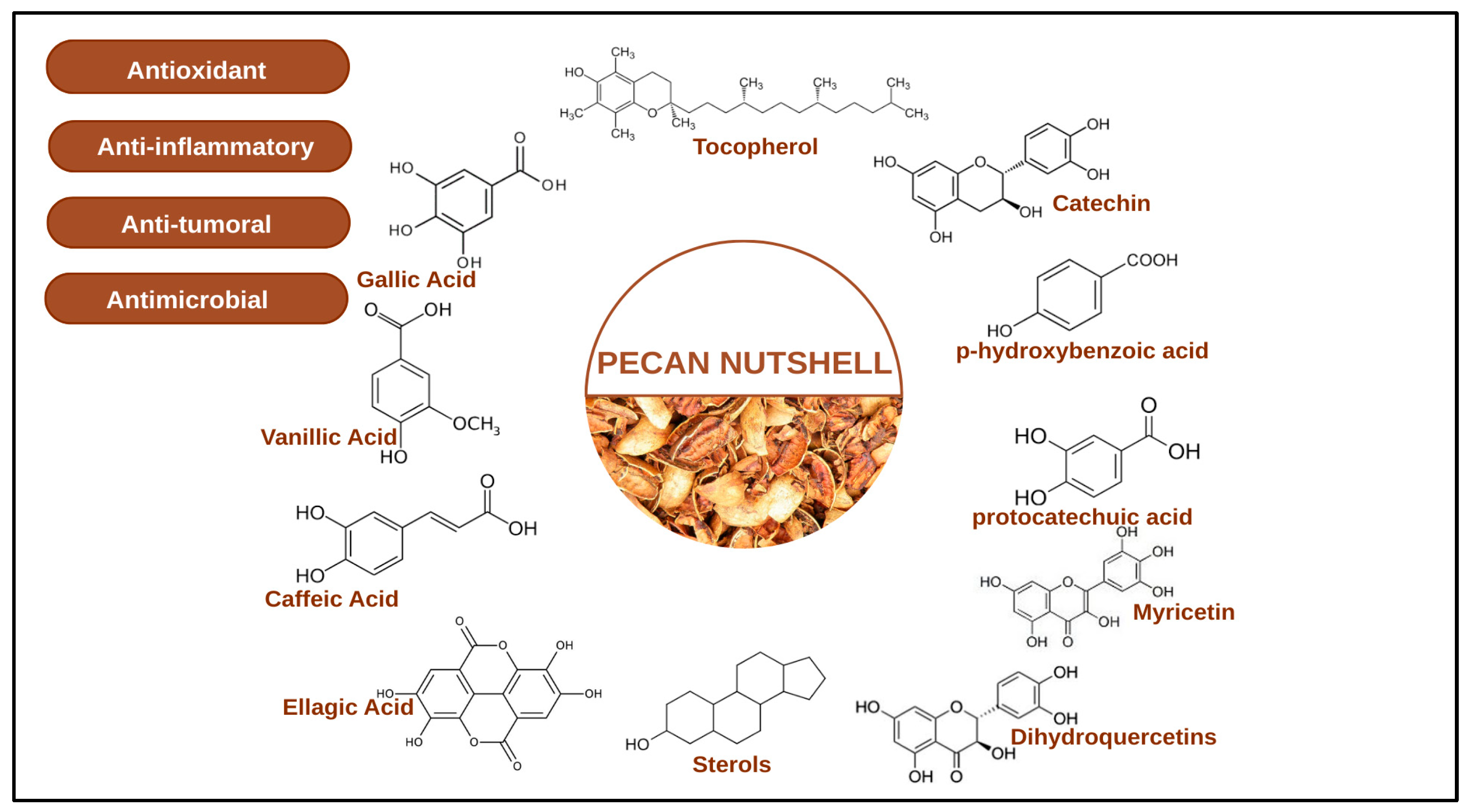
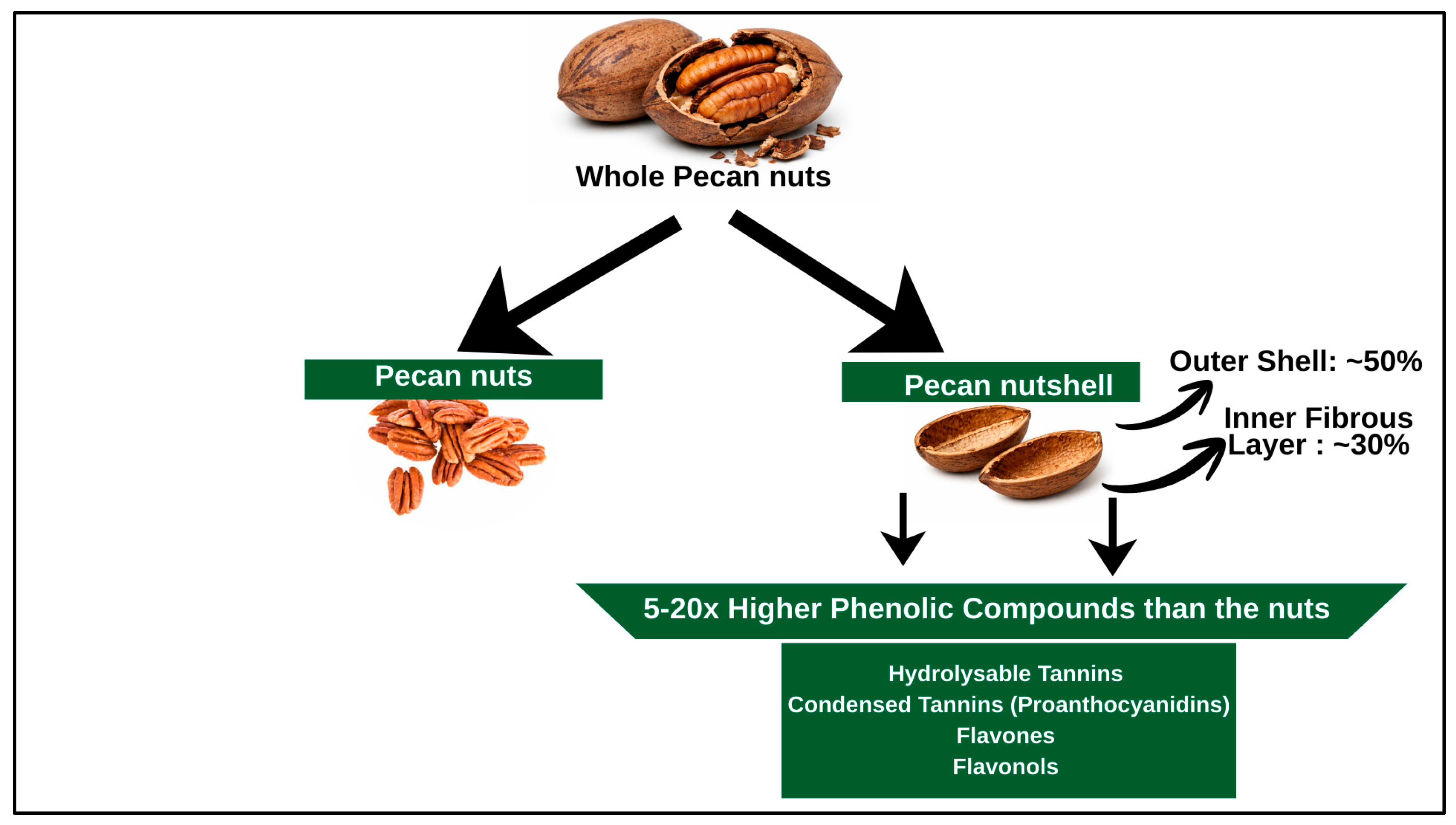
| Hydrolysable Tannins | Ellagic acid derivatives, Ellagitannins, Gallic acid | Detected as prominent compounds via HPLC-ESI-MS/MS. Absolute μg/g quantification for individual compounds is not yet reported in the searched literature; their presence is confirmed by chromatographic peak areas and contributes to the total phenolic content (TPC) measured in GAE. | [37,38] |
| Condensed Tannins (Proanthocyanidins) | Proanthocyanidin dimers (A- and B-type), Trimer of (Epi)catechin–(Epi)catechin–(Epi)gallocatechin | Confirmed as a major fraction, with a reported concentration of 189 mg CE/g in an optimized extract. The presence of oligomers underscores the high degree of polymerization. | [38] |
| Flavones and flavonols | Myricetin, Dihydroquercetins | Identified as part of the broader flavonoid profile. Total flavonoid content has been quantified at 90 mg CE/g. | [38] |
| Flavan-3-ols | Catechin, Epicatechin, Gallocatechin | Serve as the monomeric building blocks for the abundant condensed tannins. Targeted quantification via MRM on LC-MS is feasible, with typical LOD/LOQ in the sub-µg/mL range. | [38] |
| Extract/Fraction | Experimental Model | Dose | Observed Effect | Study Quality | References |
|---|---|---|---|---|---|
| Condensed-Tannin–Enriched Fraction (70% proanthocyanidins) | Swiss mice in a cigarette smoke withdrawal model | 50 mg/kg/day (oral) | Normalized elevated plasma ICAM-1 and VCAM-1 levels (decreased by 27% and 24% vs. smoke-withdrawn controls); Restored eNOS protein expression in the thoracic aorta to 92% of air-control levels. | Positive controls included; dose–response limited | [48] |
| Aqueous Total-Phenolic Extract | Balb/C mice with Ehrlich ascites tumor (EAT) | 100–200 mg/kg/day (oral) | Reduced vascular permeability by 38% in the peritoneum; Decreased tumor-associated micro-vessel density by 31%. | Cancer model; not cardiovascular disease-specific | [49] |
| Whole-Shell Powder (55% insoluble fiber, 3% phenolics) | Sprague-Dawley rats in a 13-week dietary study | 5%, 10%, and 15% in diet (approx. 3.3, 6.7, and 10 g/kg/day) | No treatment-related changes in the histology of the aorta or cardiac vessels; No effect on systolic blood pressure. | OECD-compliant toxicity study; well-controlled | [50] |
| Condensed-Tannin–Enriched Fraction | Wistar rats in a 28-day oral toxicity study (OECD 407) | 300, 1000, and 2000 mg/kg/day (oral) | No changes in serum ICAM-1 or VCAM-1 at any dose. Established a NOAEL of ≥2 g/kg/day. | Regulatory toxicity study; comprehensive organ pathology | [51] |
| Aqueous Shell Extract | Wistar rats with cyclophosphamide (CP)-induced oxidative stress | 400 mg/kg/day (oral) for 10 days | Increased heart catalase (CAT) activity by 32% vs. CP control; Significantly decreased cardiac TBARS (lipid peroxidation) and plasma protein carbonyls; Restored circulating vitamin-C levels. | Oxidative stress model; mechanistic markers measured | [15] |
| Extract/Fraction | Cancer Model | Dose/Conc. | Observed Effect (vs. Control) | References |
|---|---|---|---|---|
| Subcritical-water extract (“Native”, “Pawnee”) | Cervical, lung, skin, breast, colon, prostate cell panels | IC50 15–60 µg/mL | >70% viability loss in tumor cells; non-cytotoxic to Vero cells; some extracts > doxorubicin potency | [73] |
| SPE-C18 phenolic-enriched extract (PCEE) | MDA-MB-231 & CHO-K1 cells | IC50 26 µg/mL (MDA); 56 µg/mL (CHO) | G2/M arrest; ↓ ROS in doxorubicin-stressed cells (cytoprotection) | [35] |
| Optimised alkaline aqueous extracts (“Mahan”, “Marameck) | HT-29 colon cancer cells | IC50 50–138 µg/mL | Apoptosis confirmed by Annexin-V/PI; caspase-3 activation | [72] |
| Crude aqueous shell extract | MCF-7 cells & Ehrlich ascites tumor in mice | 100 µg/mL (in vitro); 100–200 mg/kg/day (in vivo) | 46% in vitro apoptosis; ↓ tumor volume; 67% ↑ survival; Bax ↑/Bcl-XL ↓ | [50] |
Disclaimer/Publisher’s Note: The statements, opinions and data contained in all publications are solely those of the individual author(s) and contributor(s) and not of MDPI and/or the editor(s). MDPI and/or the editor(s) disclaim responsibility for any injury to people or property resulting from any ideas, methods, instructions or products referred to in the content. |
© 2026 by the authors. Licensee MDPI, Basel, Switzerland. This article is an open access article distributed under the terms and conditions of the Creative Commons Attribution (CC BY) license.
Share and Cite
Ezeanolue, I.R.; George, J.; Ohioze, P.A.; Oyeniyi, O.O.; Elechi, J.O.G.; Loizzo, M.R.; Plastina, P. Pecan (Carya illinoinensis) Shells as a Source of Antioxidants: Implications for Oxidative Stress-Driven Pathologies. Molecules 2026, 31, 993. https://doi.org/10.3390/molecules31060993
Ezeanolue IR, George J, Ohioze PA, Oyeniyi OO, Elechi JOG, Loizzo MR, Plastina P. Pecan (Carya illinoinensis) Shells as a Source of Antioxidants: Implications for Oxidative Stress-Driven Pathologies. Molecules. 2026; 31(6):993. https://doi.org/10.3390/molecules31060993
Chicago/Turabian StyleEzeanolue, Ifeoma Roseline, Judith George, Precious Aimalohi Ohioze, Oluwapelumi Oloyede Oyeniyi, Jasper Okoro Godwin Elechi, Monica Rosa Loizzo, and Pierluigi Plastina. 2026. "Pecan (Carya illinoinensis) Shells as a Source of Antioxidants: Implications for Oxidative Stress-Driven Pathologies" Molecules 31, no. 6: 993. https://doi.org/10.3390/molecules31060993
APA StyleEzeanolue, I. R., George, J., Ohioze, P. A., Oyeniyi, O. O., Elechi, J. O. G., Loizzo, M. R., & Plastina, P. (2026). Pecan (Carya illinoinensis) Shells as a Source of Antioxidants: Implications for Oxidative Stress-Driven Pathologies. Molecules, 31(6), 993. https://doi.org/10.3390/molecules31060993