Biodegradable Poly(lactic acid)-Based Blends as Intrinsic Self-Healing Matrices for Multifunctional and Eco-Sustainable Composites


 , ,
, ,  and
and 
Abstract
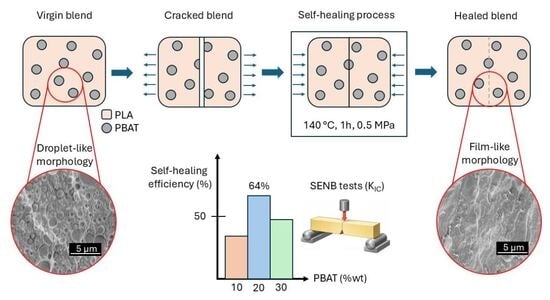
1. Introduction
2. Results and Discussion
2.1. Rheological Measurements
2.2. Chemical and Microstructural Characterization
2.3. Thermal Characterization
2.4. Mechanical Characterization
2.5. Self-Healing Evaluation
3. Materials and Methods
3.1. Materials
3.2. Sample Preparation
3.3. Experimental Techniques
3.3.1. Rheological Properties
3.3.2. Chemical and Microstructural Properties
3.3.3. Thermal Properties
3.3.4. Mechanical Properties
3.3.5. Evaluation of Self-Healing Efficiency
4. Conclusions
Author Contributions
Funding
Institutional Review Board Statement
Informed Consent Statement
Data Availability Statement
Conflicts of Interest
References
- Tang, J.; Zhou, Z.; Chen, H.; Wang, S.; Gutiérrez, A.; Zhang, C.; Deng, J. Laminate design, optimization, and testing of an innovative carbon fiber-reinforced composite sandwich panel for high-speed train. Polym. Compos. 2021, 42, 5811–5829. [Google Scholar] [CrossRef]
- Kausar, A.; Ahmad, I.; Rakha, S.; Eisa, M.; Diallo, A. State-of-the-art of sandwich composite structures: Manufacturing—To—High performance applications. J. Compos. Sci. 2023, 7, 102. [Google Scholar] [CrossRef]
- Simonini, L.; Sorze, A.; Maddalena, L.; Carosio, F.; Dorigato, A. Mechanical reprocessing of polyurethane and phenolic foams to increase the sustainability of thermal insulation materials. Polym. Test. 2024, 138, 108539–108553. [Google Scholar] [CrossRef]
- Celiński, M.; Sałasińska, K.; Mizera, K.; Kozikowski, P. Fire behavior of sandwich panels with different cores. In Advances in the Toxicity of Construction and Building Materials; Woodhead Publishing: Cambridge, UK, 2022; Volume 1, pp. 137–170. [Google Scholar]
- Huang, S.; Wang, B.; Yan, L. Interphase and Interfacial Properties of Composite Materials. In Composite Materials: Manufacturing, Properties and Applications; Low, I.-M., Dong, Y., Eds.; Elsevier: Amsterdam, The Netherlands, 2021; pp. 151–177. [Google Scholar]
- Romanowic, P.; Muc, A. Estimation of Notched Composite Plates Fatigue Life Using Residual Strength Model Calibrated by Step-Wise Tests. Materials 2018, 11, 2180. [Google Scholar] [CrossRef] [PubMed]
- Simonini, L.; Mahmood, H.; Dorigato, A.; Alessandro, P. Development of a self-healing interphases for structural composites. In Proceedings of the 23rd International Conference on Composite Materials, ICCM 2023, Belfast, Northern Ireland, 30 July–4 August 2023. [Google Scholar]
- Mahmood, H.; Simonini, L.; Dorigato, A.; Pegoretti, A. Graphene Deposition on Glass Fibers by Triboelectrification. Appl. Sci. 2021, 11, 3123. [Google Scholar] [CrossRef]
- Simonini, L.; Mahmood, H.; Dorigato, A.; Pegoretti, A. Evaluation of self-healing capability of a polycaprolactone interphase in epoxy/glass composites. Compos. Part A 2023, 169, 107539–107548. [Google Scholar] [CrossRef]
- Simonini, L.; Kakkonen, M.; Dsouza, R.; Kanerva, M.; Mahmood, H.; Dorigato, A.; Pegoretti, A. Tailoring the interfacial properties of glass fiber-epoxy microcomposites through the development of a self-healing poly (ϵ-caprolactone) coating. Compos. Sci. Technol. 2025, 261, 110991–111007. [Google Scholar] [CrossRef]
- Sun, Y.; Simonini, L.; Xing, C.; Mishnaevsky, L., Jr. Self-healing interfaces in fiber reinforced polymers: Computational modeling. Compos. Sci. Technol. 2025, 270, 111269–111282. [Google Scholar] [CrossRef]
- Simonini, L.; Canale, R.; Mahmood, H.; Dorigato, A.; Pegoretti, A. Multifunctional epoxy/carbon composites with a fully reparable interface. Polym. Compos. 2024, 45, 2558–2568. [Google Scholar] [CrossRef]
- Simonini, L.; Dorigato, A. Surface Modification of Wood Fibers with Citric Acid as a Sustainable Approach to Developing Novel Polycaprolactone-Based Composites for Packaging Applications. J. Compos. Sci. 2025, 9, 274. [Google Scholar] [CrossRef]
- Mahmood, H.; Dorigato, A.; Pegoretti, A. Healable Carbon Fiber-Reinforced Epoxy/Cyclic Olefin Copolymer Composites. Materials 2020, 13, 2165. [Google Scholar] [CrossRef]
- Zovi, R.C.; Mahmood, H.; Dorigato, A.; Fredi, G.; Pegoretti, A. Cyclic Olefin Copolymer Interleaves for Thermally Mendable Carbon/Epoxy Laminates. Molecules 2020, 25, 5347. [Google Scholar] [CrossRef] [PubMed]
- Cohades, A.; Branfoot, C.; Rae, S.; Bond, I.; Michaud, V. Progress in Self-Healing Fiber-Reinforced Polymer Composites. Adv. Mater. Interfaces 2018, 5, 1870084. [Google Scholar] [CrossRef]
- Jones, A.R.; Blaiszik, B.J.; White, S.R.; Sottos, N.R. Full recovery of fiber/matrix interfacial bond strength using a microencapsulated solvent-based healing system. Compos. Sci. Technol. 2013, 79, 1–7. [Google Scholar] [CrossRef]
- Norris, C.J.; Meadway, G.J.; O’Sullivan, M.J.; Bond, I.P.; Trask, R.S. Self-healing fibre reinforced composites via a bioinspired vasculature. Adv. Funct. Mater. 2011, 21, 3624–3633. [Google Scholar] [CrossRef]
- Ghazali, H.; Ye, L.; Amir, A.N. Microencapsulated healing agents for an elevated-temperature cured epoxy: Influence of viscosity on healing efficiency. Polym. Polym. Compos. 2021, 29, 1317–1327. [Google Scholar] [CrossRef]
- Zhang, W.; Duchet, J.; Gerard, J.F. Self-healable interfaces based on thermo-reversible Diels–Alder reactions in carbon fiber reinforced composites. J. Colloid Interface Sci. 2014, 430, 61–68. [Google Scholar] [CrossRef]
- Zhang, H.; Lamnawar, K.; Maazouz, A. Rheological modeling of the diffusion process and the interphase of symmetrical bilayers based on PVDF and PMMA with varying molecular weights. Rheol. Acta 2012, 51, 691–711. [Google Scholar] [CrossRef]
- Wu, D.Y.; Sam Meure, S.; Solomon, D. Self-healing polymeric materials: A review of recent developments. Prog. Polym. Sci. 2008, 33, 479–522. [Google Scholar] [CrossRef]
- Islam, S.; Bhat, G. Progress and challenges in self-healing composite materials. Mater. Adv. 2012, 2, 1896–1926. [Google Scholar] [CrossRef]
- Cohades, A.; Manfredi, E.; Plummer, C.J.G.; Michaud, V. Thermal mending in immiscible poly(ε-caprolactone)/epoxy blends. Eur. Polym. J. 2016, 81, 114–128. [Google Scholar] [CrossRef]
- Karger-Kocsis, J. Self-healing properties of epoxy resins with poly(ε-caprolactone) healing agent. Polym. Bull. 2016, 73, 3081–3093. [Google Scholar] [CrossRef]
- Perin, D.; Dorigato, A.; Pegoretti, A. Thermoplastic self-healing polymer blends for structural composites: Development of polyamide 6 and cyclic olefinic copolymer blends. J. Appl. Polym. Sci. 2023, 140, 53751–53768. [Google Scholar] [CrossRef]
- Perin, D.; Odorizzi, G.; Dorigato, A.; Pegoretti, A. Development of polyamide 6 (PA6)/polycaprolactone (PCL) thermoplastic self-healing polymer blends for multifunctional structural composites. Appl. Sci. 2022, 12, 12357. [Google Scholar] [CrossRef]
- Xu, X.; Fan, P.; Ren, J.; Cheng, Y.; Ren, J.; Zhao, J.; Song, R. Self-healing thermoplastic polyurethane (TPU)/polycaprolactone (PCL)/multi-wall carbon nanotubes (MWCNTs) blend as shape-memory composites. Compos. Sci. Technol. 2018, 168, 255–262. [Google Scholar] [CrossRef]
- Endres, H.-J.; Siebert-Raths, A. Engineering Biopolymers Markets, Manufacturing, Properties and Applications; Hanser Publishers: Munich, Germany, 2011. [Google Scholar]
- Ali Kandemir, A.; Pozegic, T.R.; Hamerton, I.; Eichhorn, S.J.; Longana, M.L. Characterisation of Natural Fibres for Sustainable Discontinuous Fibre Composite Materials. Materials 2020, 13, 2129. [Google Scholar] [CrossRef]
- Pozo Morales, A.; Güemes, A.; Fernandez-Lopez, A.; Carcelen Valero, V.; De La Rosa Llano, S. Bamboo–polylactic acid (PLA) composite material for structural applications. Materials 2017, 10, 1286. [Google Scholar] [CrossRef]
- Yeo, J.C.C.; Lin, T.T.; Koh, J.J.; Low, L.W.; Tan, B.H.; Li, Z.; He, C. Insights into the nucleation and crystallization analysis of PHB-rubber toughened PLA biocomposites. Compos. Commun. 2021, 27, 100894–100900. [Google Scholar] [CrossRef]
- Murariu, M.; Dubois, P. PLA composites: From production to properties. Adv. Drug Deliv. Rev. 2016, 107, 17–46. [Google Scholar] [CrossRef]
- Qian, S.; Sheng, K. PLA toughened by bamboo cellulose nanowhiskers: Role of silane compatibilization on the PLA bionanocomposite properties. Compos. Sci. Technol. 2017, 148, 59–69. [Google Scholar] [CrossRef]
- Qian, K.; Qian, X.; Chen, Y.; Zhou, M. Poly (lactic acid)–thermoplastic poly (ether) urethane composites synergistically reinforced and toughened with short carbon fibers for three-dimensional printing. Appl. Polym. Sci. 2018, 135, 46483. [Google Scholar] [CrossRef]
- Aliotta, L.; Cinelli, P.; Coltelli, M.B.; Lazzeri, A. Rigid filler toughening in PLA-Calcium Carbonate composites: Effect of particle surface treatment and matrix plasticization. Eur. Polym. J. 2019, 113, 78–88. [Google Scholar] [CrossRef]
- Gigante, V.; Canesi, I.; Cinelli, P.; Coltelli, M.B.; Lazzeri, A. Rubber Toughening of Polylactic Acid (PLA) with Poly(butylene adipate-co-terephthalate) (PBAT): Mechanical Properties, Fracture Mechanics and Analysis of Ductile-to-Brittle Behavior while Varying Temperature and Test Speed. Eur. Polym. J. 2019, 115, 125–137. [Google Scholar] [CrossRef]
- Hassan, E.A.M.; Yang, L.; Elagib, T.H.H.; Ge, D.; Lv, X.; Zhou, J.; Yu, M.; Zhu, S. Synergistic effect of hydrogen bonding and π-π stacking in interface of CF/PEEK composites. Compos. Part B 2019, 171, 70–77. [Google Scholar] [CrossRef]
- Moldovan, A.; Sarosi, I.; Cuc, S.; Prodan, D.; Taut, A.C.; Petean, I.; Man, S.C. Development and characterization of PLA food packaging composite. J. Therm. Anal. Calorim. 2025, 150, 2469–2481. [Google Scholar] [CrossRef]
- Bergström, J.S.; Danika, H. An overview of mechanical properties and material modeling of polylactide (PLA) for medical applications. Ann. Biomed. Eng. 2016, 44, 330–340. [Google Scholar] [CrossRef]
- Simonini, L.; Mahmood, H.; Dorigato, A.; Pegoretti, A. Tailoring the physical properties of poly (lactic acid) through the addition of thermoplastic polyurethane and functionalized short carbon fibers. Polym. Compos. 2023, 44, 4719–4733. [Google Scholar] [CrossRef]
- Mohammadi, M.; Heuzey, M.C.; Carreau, P.J.; Taguet, A. Morphological and rheological properties of PLA, PBAT, and PLA/PBAT blend nanocomposites containing CNCs. Nanomaterials 2021, 11, 857. [Google Scholar] [CrossRef] [PubMed]
- Xiang, S.; Feng, L.; Bian, X.; Li, G.; Chen, X. Evaluation of PLA content in PLA/PBAT blends using TGA. Polym. Test. 2020, 81, 106211–106234. [Google Scholar] [CrossRef]
- Simonini, L.; Rigotti, D.; Pidapa, J.; Pegoretti, A. Poly (butylene adipate-co-terephthalate) as a new healing agent for epoxy/basalt composites. Compos. Part A 2025, 196, 109010–109019. [Google Scholar] [CrossRef]
- Bianchi, M.; Dorigato, A.; Morreale, M.; Pegoretti, A. Evaluation of the physical and shape memory properties of fully biodegradable poly (lactic acid)(PLA)/poly (butylene adipate terephthalate)(PBAT) blends. Polymers 2023, 15, 881. [Google Scholar] [CrossRef] [PubMed]
- Standau, T.; Nofar, M.; Dörr, D.; Ruckdäschel, H.; Altstädt, V. A review on multifunctional epoxy-based Joncryl® ADR chain extended thermoplastics. Polym. Rev. 2022, 62, 296–350. [Google Scholar] [CrossRef]
- Zakizadeh, M.; Jalali-Aarani, A.; Garmabi, H. Experimental Investigation and Molecular Dynamic Simulation of In-Situ Compatibilization of Biodegradable PLA/PBAT Blend as a Shape Memory Material. J. Polym. Environ. 2025, 33, 4713–4728. [Google Scholar] [CrossRef]
- Akdevelioğlu, Y.; Begum Alanalp, M.; Siyahcan, F.; Randall, J.; Gehrung, M.; Durmus, A.; Nofar, M. Joncryl chain extender reactivity with polylactide: Effect of d-lactide content, Joncryl type, and processing temperature. J. Rheol. 2024, 68, 247–262. [Google Scholar] [CrossRef]
- Liu, Y.; Gall, K.; Dunn, M.L.; McCluskey, P. Thermomechanical recovery couplings of shape memory polymers in flexure. Smart Mater. Struct. 2003, 12, 947–961. [Google Scholar] [CrossRef]
- Li, K.; Peng, J.; Turng, L.; Huang, H.X. Dynamic rheological behavior and morphology of polylactide/poly (butylenes adipate-co-terephthalate) blends with various composition ratios. Adv. Polym. Technol. 2011, 30, 150–157. [Google Scholar] [CrossRef]
- Ackermann, A.C.; Carosella, S.; Rettenmayr, M.; Fox, B.L.; Middendorf, P. Rheology, dispersion, and cure kinetics of epoxy filled with amine-and non-functionalized reduced graphene oxide for composite manufacturing. J. Appl. Polym. Sci. 2022, 139, 51664–51679. [Google Scholar] [CrossRef]
- Grigora, M.E.; Terzopoulou, Z.; Tsongas, K.; Klonos, P.; Kalafatakis, N.; Bikiaris, D.N.; Tzetzis, D. Influence of reactive chain extension on the properties of 3d printed poly (Lactic acid) constructs. Polymers 2021, 13, 1381. [Google Scholar] [CrossRef]
- Siriprom, W.; Sangwaranatee, N.; Chantarasunthon, K.; Teanchai, K.; Chamchoi, N. Characterization and analyzation of the poly (L-lactic acid)(PLA) films. Mater. Today Proc. 2018, 5, 14803–14806. [Google Scholar] [CrossRef]
- Zhang, X.; Bian, H.; Meng, X.; Yuan, J.; Ding, J.; Li, W.; Guo, B. Synthesis of Poly (butylene adipate-co-terephthalate) with Branched Monomer for Biodegradable Copolyesters with Enhanced Processability and Rheological Properties. ACS Omega 2025, 10, 14258–14270. [Google Scholar] [CrossRef]
- Kanwal, A.; Zhang, M.; Sharaf, F.; Li, C. Enzymatic degradation of poly (butylene adipate co-terephthalate)(PBAT) copolymer using lipase B from Candida antarctica (CALB) and effect of PBAT on plant growth. Polym. Bull. 2022, 79, 9059–9073. [Google Scholar] [CrossRef]
- Mungok, R.M.; Handge, U.A. Compatibilization of poly (lactic acid)/poly (3-hydroxybutyrate-co-hydroxyvalerate) blends using multifunctional epoxy-based chain extender. Polym. Eng. Sci. 2025, 65, 3687–3703. [Google Scholar] [CrossRef]
- Altınbay, A.; Özsaltık, C.; Jahani, D.; Nofar, M. Reactivity of Joncryl chain extender in PLA/PBAT blends: Effects of processing temperature and PBAT aging on blend performance. Int. J. Biol. Macromol. 2025, 303, 140703–140720. [Google Scholar] [CrossRef] [PubMed]
- Heidari, M.; Garmabi, H. Design, Modeling, and Optimization of PLA/PBAT Using Response Surface Method: Rheology and Comprehensive Characterization for 3D Printing Applications. Mater. Today Commun. 2025, 50, 114164–114180. [Google Scholar] [CrossRef]
- Simmons, H.; Twary, P.; Colwell, J.E.; Kontopoulou, M. Improvements in the crystallinity and mechanical properties of PLA by nucleation and annealing. Polym. Degrad. Stab. 2019, 166, 248–257. [Google Scholar] [CrossRef]
- Bo, L.; Guan, T.; Wu, G.; Ye, F.; Weng, Y. Biodegradation Behavior of Degradable Mulch with Poly (Butylene Adipate-co-Terephthalate) (PBAT) and Poly (Butylene Succinate) (PBS) in Simulation Marine Environment. Polymers 2022, 14, 1515–1527. [Google Scholar]
- Chen, R.Y.; Jin, B.H.; Han, L.; Zhang, Z.H.; Fang, S.M. Preparation and performance of super toughened and high heat-resistant biodegradable PLA/PBAT blends. Mater. Lett. 2024, 361, 136171–136187. [Google Scholar] [CrossRef]
- Wang, L.; Wang, Y.N.; Huang, Z.G.; Weng, Y.X. Heat resistance, crystallization behavior, and mechanical properties of polylactide/nucleating agent composites. Mater. Des. 2015, 66, 7–15. [Google Scholar] [CrossRef]
- Park, S.D.; Todo, M.; Arakawa, K. Effect of annealing on the fracture toughness of poly (lactic acid). J. Mater. Sci. 2004, 39, 1113–1116. [Google Scholar] [CrossRef]
- Li, T.Q.; Zhang, M.Q.; Zhang, K.; Zeng, H.M. The dependence of the fracture toughness of thermoplastic composite laminates on interfacial interaction. Compos. Sci. Technol. 2000, 60, 465–476. [Google Scholar] [CrossRef]
- Su, S.; Duhme, M.; Kopitzky, R. Uncompatibilized PBAT/PLA blends: Manufacturability, miscibility and properties. Materials 2020, 13, 4897. [Google Scholar] [CrossRef]
- Nakayama, D.; Wu, F.; Mohanty, A.K.; Hirai, S.; Misra, M. Biodegradable composites developed from PBAT/PLA binary blends and silk powder: Compatibilization and performance evaluation. ACS Omega 2018, 3, 12412–12421. [Google Scholar] [CrossRef]
- ISO 527-1; Plastics—Determination of tensile properties—Part 1: General principles. International Organization for Standardization: Geneva, Switzerland, 2019.
- ASTM D1525-25; Standard Test Method for Vicat Softening Temperature of Plastics. ASTM International: West Conshohocken, PA, USA, 2025.
- ASTM D5045-14; Standard Test Methods for Plane-Strain Fracture Toughness and Strain Energy Release Rate of Plastic Materials. ASTM International: West Conshohocken, PA, USA, 2022.
- ISO 17281; Plastics—Determination of fracture toughness (GIC and KIC) at moderately high loading rates (1 m/s). International Organization for Standardization: Geneva, Switzerland, 2018.


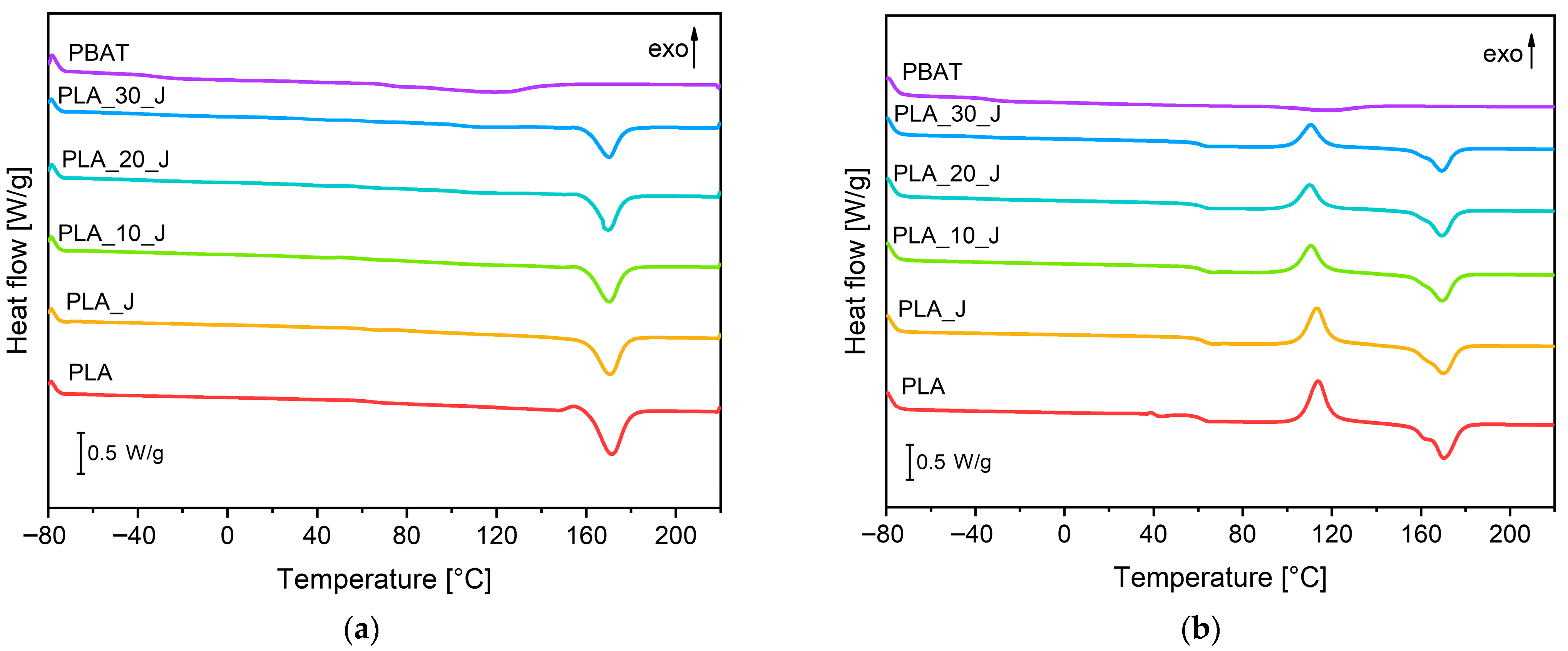



| Samples | Tg,PLA (°C) | Tg,PBAT (°C) | Tcc,PLA (°C) | Tm,PLA (°C) | Tm,PBAT (°C) | ∆Hcc,PLA (J/g) | ∆Hm,PLA (J/g) | ∆Hm,PBAT (J/g) | χPLA (%) | χPBAT (%) |
|---|---|---|---|---|---|---|---|---|---|---|
| First heating scan | ||||||||||
| PLA | 64.4 | - | - | 171.5 | - | - | 36.1 | - | 39.0 | - |
| PLA_J | 63.7 | - | - | 170.6 | - | - | 37.6 | - | 40.0 | - |
| PLA_10_J | 63.2 | - | - | 170.4 | - | - | 28.8 | - | 34.0 | - |
| PLA_20_J | 62.7 | - | - | 169.8 | - | - | 26.2 | - | 35.0 | - |
| PLA_30_J | 62.3 | −36.7 | - | 170.1 | - | - | 23.0 | - | 35.0 | - |
| PBAT | - | −34.3 | - | - | 118.2 | - | - | 31.2 | - | 27.0 |
| Second heating scan | ||||||||||
| PLA | 61.8 | - | 113.8 | 170.2 | - | 37.9 | 38.1 | - | ≈0.0 | - |
| PLA_J | 61.9 | - | 113.4 | 170.0 | - | 32.6 | 32.8 | - | ≈0.0 | - |
| PLA_10_J | 61.4 | - | 110.6 | 169.5 | - | 28.1 | 28.1 | - | ≈0.0 | - |
| PLA_20_J | 60.6 | - | 110.1 | 169.3 | - | 24.5 | 24.5 | - | ≈0.0 | - |
| PLA_30_J | 60.4 | −36.3 | 110.6 | 169.2 | - | 21.2 | 21.9 | - | ≈0.0 | - |
| PBAT | - | −34.0 | - | - | 118.3 | - | - | 10.5 | - | 9.0 |
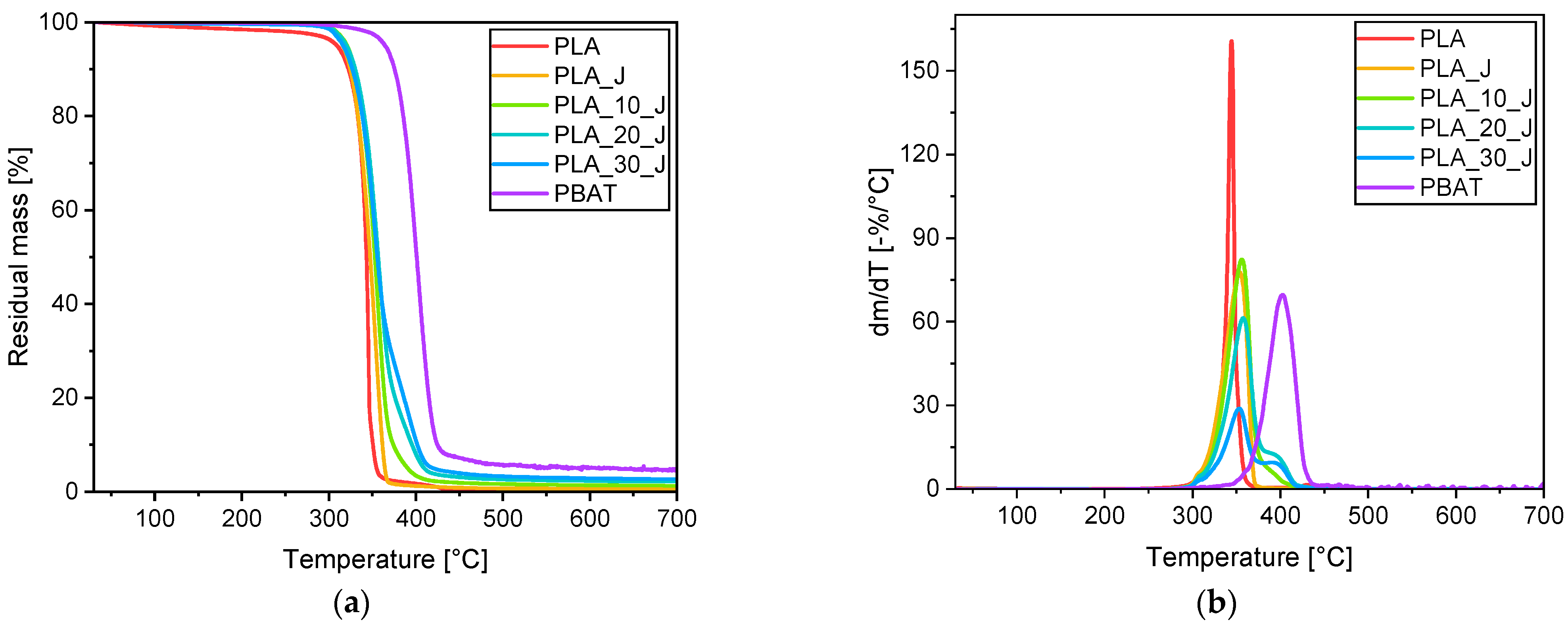
| Samples | T5% (°C) | Td,PLA (°C) | Td,PBAT (°C) | m700 (%) |
|---|---|---|---|---|
| PLA | 310 | 345 | - | 0.0 |
| PLA_J | 314 | 347 | - | 0.6 |
| PLA_10_J | 320 | 356 | 390 | 1.3 |
| PLA_20_J | 320 | 359 | 393 | 2.2 |
| PLA_30_J | 318 | 354 | 393 | 2.7 |
| PBAT | 364 | - | 404 | 4.6 |
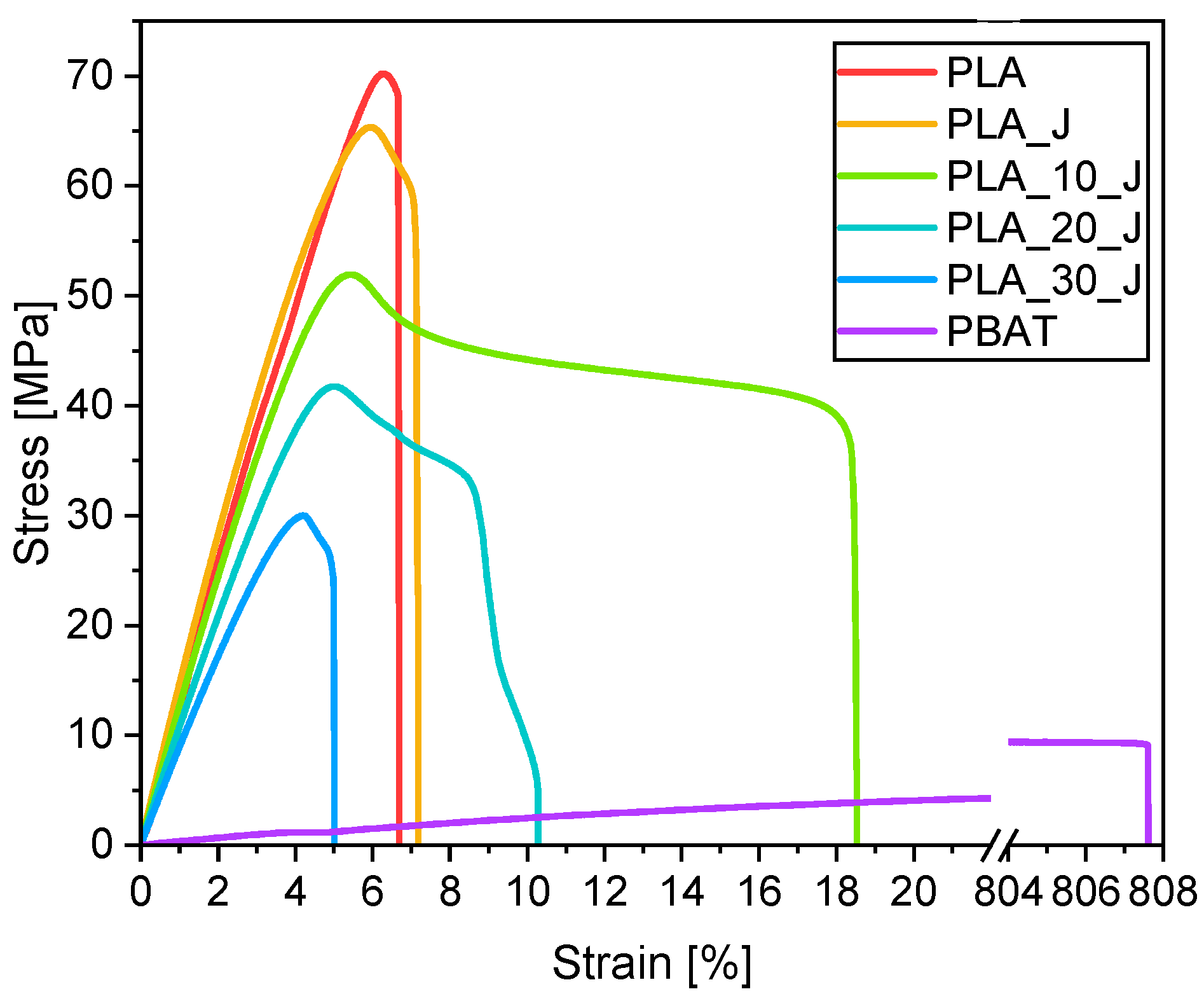
| Samples | E (GPa) | UTS (MPa) | ϵb (%) | VST (°C) |
|---|---|---|---|---|
| PLA | 3.4 ± 0.2 a | 69.4 ± 2.9 a | 6.5 ± 0.6 a | 155.4 ± 3.3 a |
| PLA_J | 3.5 ± 0.5 a | 65.0 ± 0.7 a | 7.0 ± 0.9 a | 151.7 ± 1.4 a |
| PLA_10_J | 3.4 ± 0.6 a | 52.3 ± 0.9 b | 17.9 ± 2.4 b | 148.6 ± 2.4 a |
| PLA_20_J | 2.5 ± 0.1 b | 41.0 ± 0.5 c | 12.6 ± 4.5 c | 142.6 ± 2.5 a |
| PLA_30_J | 1.9 ± 0.1 c | 31.1 ± 0.9 d | 4.8 ± 0.4 a | 131.7 ± 12.1 b |
| PBAT | 0.1 ± 0.1 d | 9.8 ± 0.3 e | 896.1 ± 89.3 d | 75.9 ± 6.6 c |
| Quasi-Static Mode | Quasi-Static Mode | ||
|---|---|---|---|
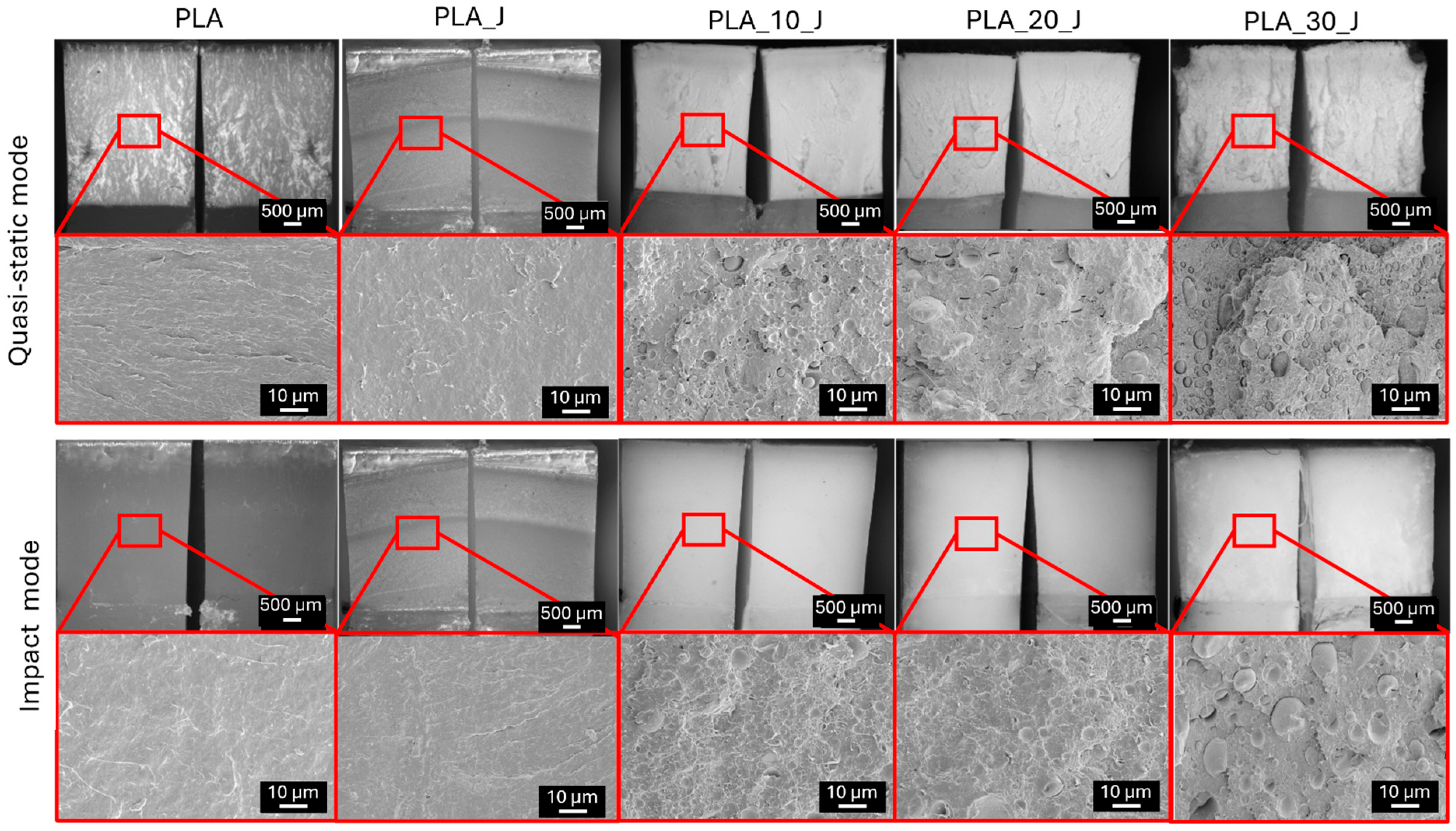
| Samples | KIC ) | GIC (kJ/m2) | KIC ) |
| PLA | 3.95 ± 0.33 a | 8.15 ± 0.79 a | 3.95 ± 0.33 a |
| PLA_J | 3.19 ± 0.12 b | 4.76 ± 0.46 b | 3.19 ± 0.12 b |
| PLA_10_J | 2.98 ± 0.12 b | 7.84 ± 1.06 a | 2.98 ± 0.12 b |
| PLA_20_J | 2.93 ± 0.42 b | 9.99 ± 1.72 a | 2.93 ± 0.42 b |
| PLA_30_J | 2.35 ± 0.13 c | 8.69 ± 0.51 a | 2.35 ± 0.13 c |
| Quasi-Static Mode | Impact Mode | |||
|---|---|---|---|---|
| Samples | KIC,H ) | HE (%) | KIC,H ) | HE (%) |
| PLA | - | - | - | - |
| PLA_J | - | - | - | - |
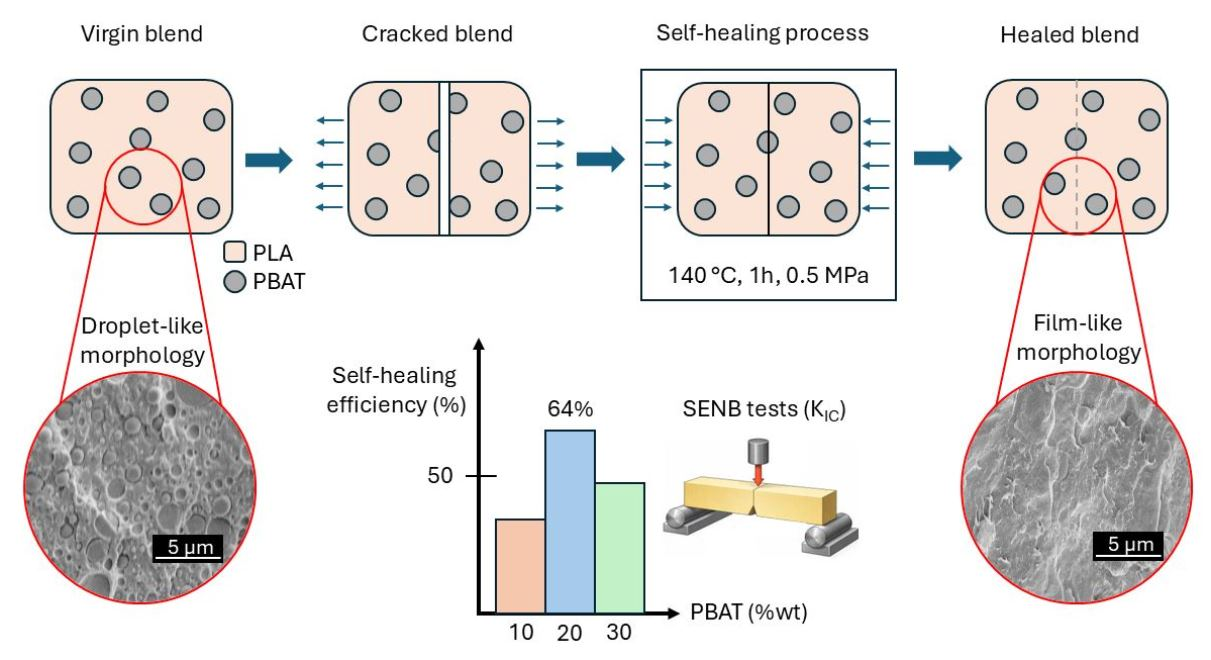
| PLA_10_J | - | - | 1.27 ± 0.43 | 36.1 ± 7.1 |
| PLA_20_J | 0.14 ± 0.07 | 4.7 ± 1.7 | 1.89 ± 0.55 | 63.7 ± 10.0 |
| PLA_30_J | 0.22 ± 0.08 | 9.8 ± 3.6 | 1.38 ± 0.31 | 49.5 ± 10.4 |
| Samples | PLA (%wt) | PBAT (%wt) | J (phr *) |
|---|---|---|---|
| PLA | 100 | - | - |
| PLA_J | 100 | - | 0.5 |
| PLA_10_J | 90 | 10 | 0.5 |
| PLA_20_J | 80 | 20 | 0.5 |
| PLA_30_J | 70 | 30 | 0.5 |
| PBAT | - | 100 | - |
Disclaimer/Publisher’s Note: The statements, opinions and data contained in all publications are solely those of the individual author(s) and contributor(s) and not of MDPI and/or the editor(s). MDPI and/or the editor(s) disclaim responsibility for any injury to people or property resulting from any ideas, methods, instructions or products referred to in the content. |
© 2026 by the authors. Licensee MDPI, Basel, Switzerland. This article is an open access article distributed under the terms and conditions of the Creative Commons Attribution (CC BY) license.
Share and Cite
Savioli, I.; Simonini, L.; Rigotti, D.; Pegoretti, A.; Dorigato, A. Biodegradable Poly(lactic acid)-Based Blends as Intrinsic Self-Healing Matrices for Multifunctional and Eco-Sustainable Composites. Molecules 2026, 31, 921. https://doi.org/10.3390/molecules31060921
Savioli I, Simonini L, Rigotti D, Pegoretti A, Dorigato A. Biodegradable Poly(lactic acid)-Based Blends as Intrinsic Self-Healing Matrices for Multifunctional and Eco-Sustainable Composites. Molecules. 2026; 31(6):921. https://doi.org/10.3390/molecules31060921
Chicago/Turabian StyleSavioli, Isacco, Laura Simonini, Daniele Rigotti, Alessandro Pegoretti, and Andrea Dorigato. 2026. "Biodegradable Poly(lactic acid)-Based Blends as Intrinsic Self-Healing Matrices for Multifunctional and Eco-Sustainable Composites" Molecules 31, no. 6: 921. https://doi.org/10.3390/molecules31060921
APA StyleSavioli, I., Simonini, L., Rigotti, D., Pegoretti, A., & Dorigato, A. (2026). Biodegradable Poly(lactic acid)-Based Blends as Intrinsic Self-Healing Matrices for Multifunctional and Eco-Sustainable Composites. Molecules, 31(6), 921. https://doi.org/10.3390/molecules31060921