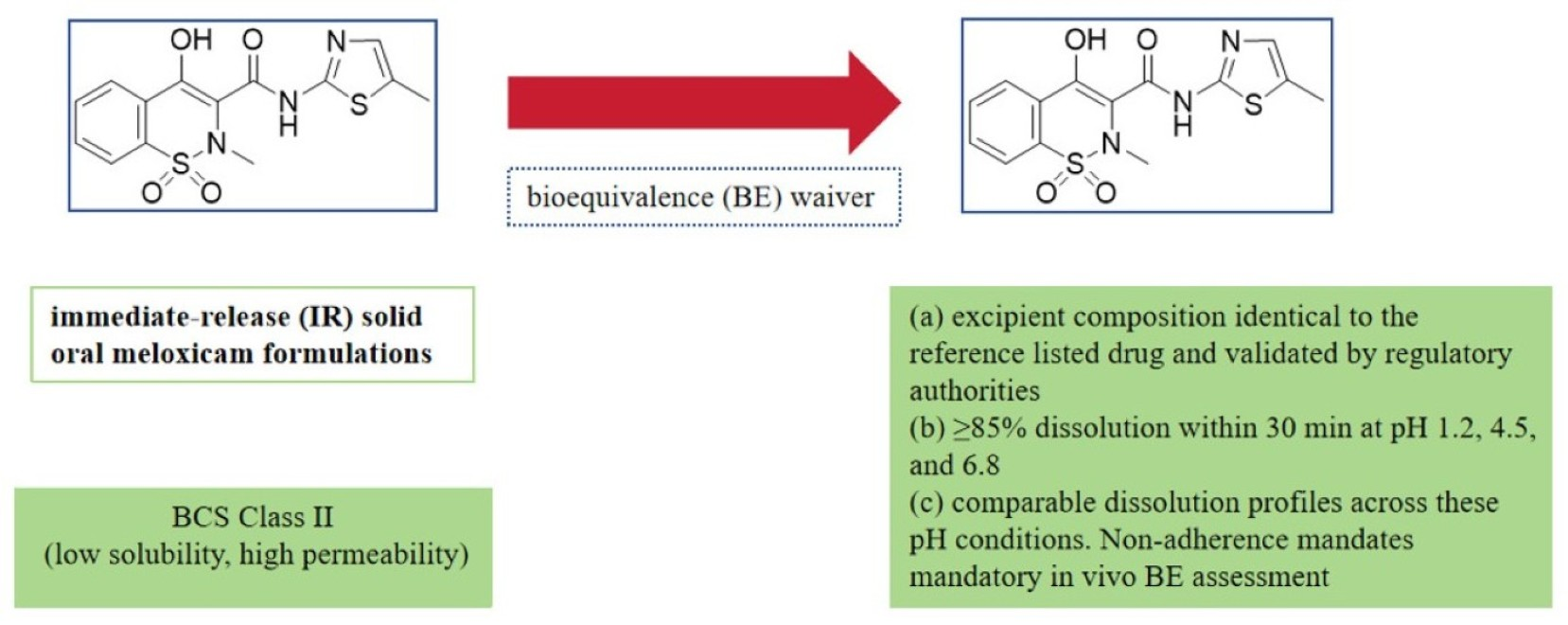
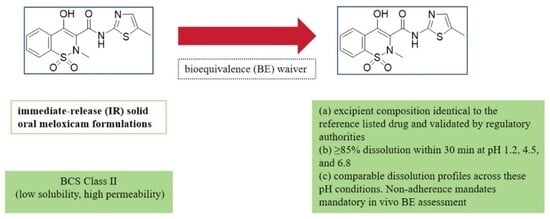
Biowaiver Monographs for Immediate-Release Solid Oral Dosage Forms: Meloxicam

Abstract
1. Introduction
2. Discussion
2.1. Solubility
2.2. Absorption and Permeability
2.3. BCS Classification
2.4. Surrogate Techniques for In Vivo Bioequivalence Testing
2.5. Risks with Respect to Excipient and Manufacturing Variations
2.6. Patient’s Risks Associated with Bioinequivalence
3. Methods
3.1. General Characteristics
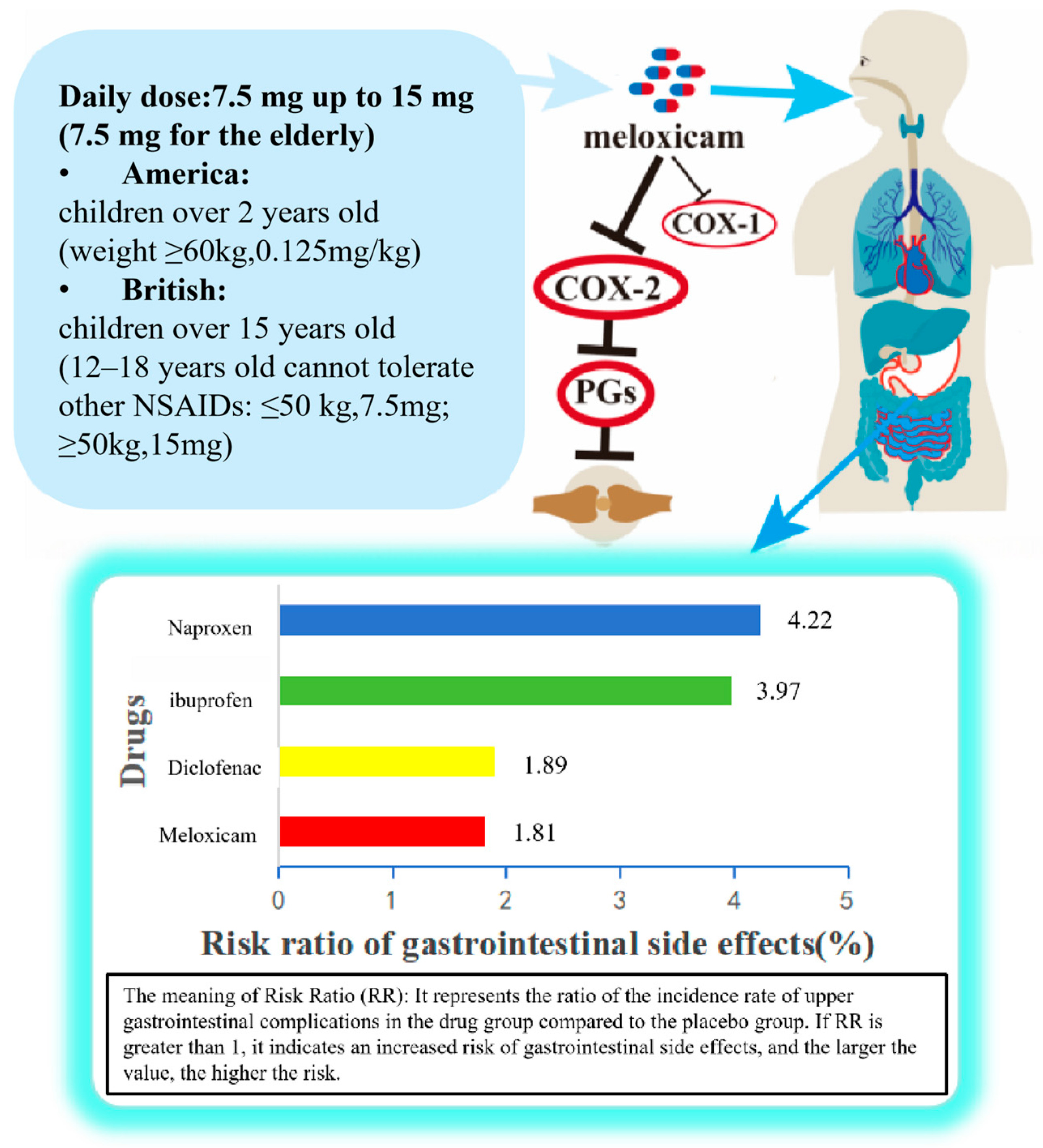
Therapeutic Indication, Dose, Therapeutic Index, and Toxicity
3.2. Physicochemical Properties
3.2.1. Stereoisomers, Salts, and Polymorphs
3.2.2. Solubility
3.2.3. Partition Coefficient and pKa
3.2.4. Stability in Various pH Media
3.3. Pharmacokinetic Properties
3.3.1. Absorption and Bioavailability
3.3.2. Permeability

| Method | Value | Acceptance Criterion | Permeability (Low/High) | Ref |
|---|---|---|---|---|
| Caco-2 | PappAB = 54.7 × 10⁻⁶ cm/s | [26] | ||
| Pcaco2 = 19.5 ± 6.2 × 10⁻⁶ cm/s Paccelerated(AP → BL) = 39.5 × 10⁻⁶ cm/s | [94,96] | |||
| P(A to B) 7.5 mg = 17.6 ± 1.3 × 106 cm/s | P(A to B) > 1.57 ± 0.25 × 106 cm/s | High | [25] | |
| P(A to B) 15 mg = 13.8 ± 1.3 × 106 cm/s | ||||
| P(B to A) 7.5 mg = 15.1 ± 0.6 × 106 cm/s | ||||
| P(B to A) 15 mg = 15.3 ± 0.9 × 106 cm/s |
3.3.3. Distribution
3.3.4. Metabolism and Excretion
3.4. Dosage Form Performance
3.4.1. Bioequivalence
| Subjects (Females; Males) | Study Design | Drug Product (Manufacturer) | Dose (mg) | AUC (μg·h/mL) | Cmax (μg/mL) | Criteria and Result | 90% CI (AUC0–∞/AUC0–∞/Cₘₐₓ) | Ref |
|---|---|---|---|---|---|---|---|---|
| 4 healthy volunteers (0:4) | single dose, two-period, crossover | Mobic® (Boehringer Ingelheim, Singapore) | 15 | 53.53 | 1.81 | noncompartmental analysis, Cmax, AUC | AUC0–∞: 90.1–101.8%; Cmax: 87.5–99.3% | [17] |
| EXT-SD (±SE) | 77.81 | 2.43 | ||||||
| FUS-SD (±SE) | 41.87 | 1.33 | ||||||
| 24 healthy volunteers (0:24) | open, randomized, two-period cross-over, single dose | (Melcam®, DEVA Holding A.Ş. Istanbul, Turkey; batch no. 4010178) | 15 | 34.4990 | 1.1469 | ANOVA, Cmax, AUC0–∞ 90% CI between 0.8 and 1.25 Bioequivalent | AUC0–∞: 90.1–105.3%; Cmax: 88.6–102.1% | [101] |
| (batch no. 351558N) | 33.7843 | 1.0648 | ||||||
| 18 healthy volunteers (0:18) | open, single dose, crossover, two period | Melfax® (AGP, Karachi, Pakistan) | 15 | 28.367 | 1.023 | t-test, Cmax, AUC Bioequivalent | AUC0–t: 91.5–101.2%; Cmax: 89.3–100.7% | [102] |
| Xobix® (Hilton Pharma, Karachi, Pakistan) | 28.667 | 1.051 | ||||||
| 24 healthy volunteers (15:9) | open-label, ran- domized, two-period, two-sequence, single dose, crossover | Reference: Meloxicam standard reference substance (batch 629/2453) | 15 | 35.66701 | 1.30326 | Cmax, tmax, t1/2, AUD and AUC | / | [103] |
| Test: Meloxicam 15 mg produced by LaborMed Pharma (Bucharest, Romania), batch 0903001462 | 37.31091 | 1.34541 | ||||||
| 12 healthy volunteers (0:12) | single dose, randomized, two treatment, two periods crossover | Reference formulation (a local pharmaceutical company) | 30 | 51.04 (AUC0–t) | 1.48 | ANOVA, Cmax, AUC(0–t) 90% CIbetween 0.8 and 1.25 Bioequivalent | AUC0–∞: 92.8–104.6%; Cmax: 90.2–103.8% | [104] |
| Test formulation (the innovator product) | 47.12 (AUC0–t) | 1.34 | ||||||
| 24 healthy volunteers (9:15) | single-site, single-dose, randomized, open, 2-period, 2-sequence, crossover | Mobic | 15 | 55.901 (Fasting) | 1.854 | Cmax, AUC 90% CI between 0.8 and 1.25 bioequivalence in both the fasting and fed states | Fasting AUC: 92.32–102.23%; Fed AUC: 91.98–102.01%; Fasting Cmax: 89.85–101.96%; Fed Cmax: 88.75–100.52% | [105] |
| 48.147 (Fed) | 1.893 | |||||||
| Aomei | 59.042 (Fasting) | 1.939 | ||||||
| 48.545 (Fed) | 1.864 | |||||||
| 4 healthy volunteers (0:4) | single dose, two-treatment, two period, randomized, crossover | conventional commercially available immediate release tablet (IR) | 15 | 37.830 | 1.242 | ANOVA, 90% CI between 0.8 and 1.25 Bioequivalent | AUC0–t: 89.6–101.5%; Cmax: 88.1–99.8% | [106] |
| the selected optimum ODT formulation (F12) | 40.189 | 1.589 | ||||||
| 4 healthy volunteers (0:4) | 9 healthy male Beagle dogs (10–15 kg), Single-dose, three-way crossover design | Mobic®(Boehringer Ingelheim) | 7.5 | 117,074.89 ± 15,964.42 | 3194.86 ± 528.86 | Bioequivalence Reference Criteria | / | [107] |
| Meloxicam Tablets (Ningxia Kangya, Yinchuan, China) | 7.5 | 116,343.80 ± 19,435.36 | 3136.15 ± 418.94 | Meets bioequivalence | AUC0–∞: 90.5–108.5%; AUC0–∞: 90.1–110.1%; Cmax: 91.5–106.2% | |||
| HeChang® Meloxicam Tablets (Ningxia Kangya) | 7.5 | 114,092.57 ± 17,078.34 | 3081.30 ± 624.38 | Meets bioequivalence | AUC0–∞: 88.9–106.6%; AUC0–∞: 90.4–110.5%; Cmax: 88.9–103.2% |
3.4.2. Effect of Excipients and Manufacturing Variations
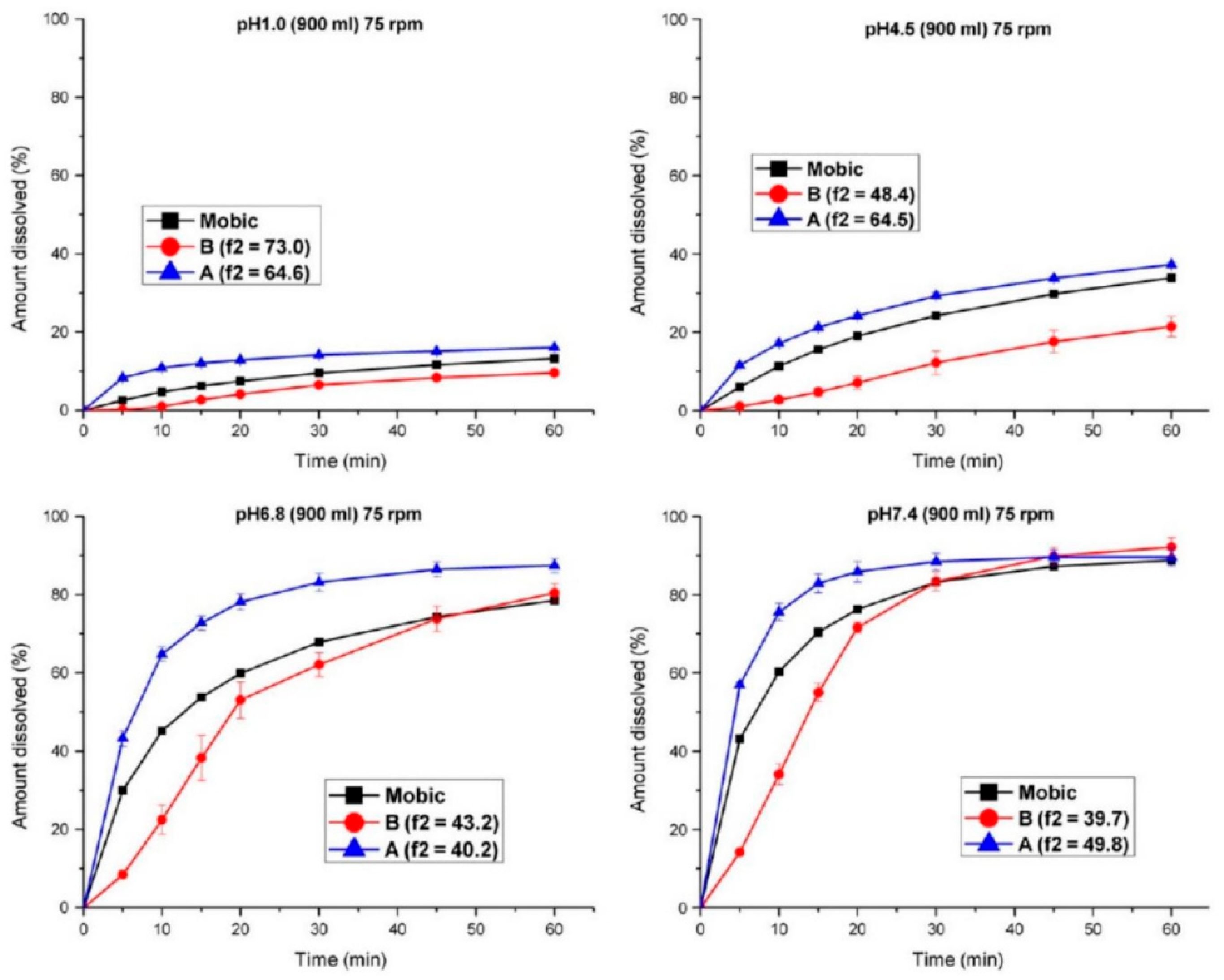
3.4.3. Dissolution
4. Conclusions
5. Simple Summary
Author Contributions
Funding
Institutional Review Board Statement
Informed Consent Statement
Data Availability Statement
Conflicts of Interest
References
- Rao, P.; Knaus, E.E. Evolution of nonsteroidal anti-inflammatory drugs (NSAIDs): Cyclooxygenase (COX) inhibition and beyond. J. Pharm. Pharm. Sci. 2008, 11, 81s–110s. [Google Scholar] [CrossRef]
- Del Tacca, M.; Colucci, R.; Fornai, M.; Blandizzi, C. Efficacy and Tolerability of Meloxicam, a COX-2 Preferential Nonsteroidal Anti-Inflammatory Drug. Clin. Drug Investig. 2002, 22, 799–818. [Google Scholar] [CrossRef]
- Engelhardt, G. Pharmacology of meloxicam, a new non-steroidal anti-inflammatory drug with an improved safety profile through preferential inhibition of COX-2. Br. J. Rheumatol. 1996, 35, 4–12. [Google Scholar] [CrossRef]
- FDA Meloxicam official. FDA Information, Side Effects and Uses; U.S. Food and Drug Administration (FDA): Silver Spring, MD, USA, 2021. [Google Scholar]
- Schattenkirchner, M. Meloxicam: A selective COX-2 inhibitor non-steroidal anti-inflammatory drug. Expert. Opin. Investig. Drugs 1997, 6, 321–334. [Google Scholar] [CrossRef] [PubMed]
- WHO. WHO Model List of Essential Medicines–23rd List (2023); WHO: Geneva, Switzerland, 2023. [Google Scholar]
- Jin, W.; Wang, Q.; Jin, C.; Xue, M.; Pan, L.; Zeng, Y.; Zhang, Y.; Li, F.; Zhong, C.C.; Lu, Y.; et al. Spatiotemporal distributions and regional disparities of rheumatoid arthritis in 953 global to local locations, 1980-2040, with deep learning-empowered forecasts and evaluation of interventional policies’ benefits. Ann. Rheum. Dis. 2025, 84, 1104–1116. [Google Scholar] [CrossRef] [PubMed]
- Almutairi, K.; Nossent, J.; Preen, D.; Keen, H.; Inderjeeth, C. The global prevalence of rheumatoid arthritis: A meta-analysis based on a systematic review. Rheumatol. Int. 2021, 41, 863–877. [Google Scholar] [CrossRef] [PubMed]
- Shavlovskaya, O.A.; Bokova, I.A.; Shavlovskiy, N.I. Meloxicam clinical effects. Zh. Nevrol. Psikhiatr. Im. S S Korsakova 2022, 122, 36–42. [Google Scholar] [CrossRef]
- Macasoi, C.; Meltzer, V.; Stanculescu, I.; Romanitan, C.; Pincu, E. Binary Mixtures of Meloxicam and L-Tartaric Acid for Oral Bioavailability Modulation of Pharmaceutical Dosage Forms. J. Funct. Biomater. 2024, 15, 104. [Google Scholar] [CrossRef]
- WHO. WHO Guideline on Biopharmaceutics Classification System-Based Biowaivers (Annex 7); WHO: Geneva, Switzerland, 2024; pp. 279–304. [Google Scholar]
- International Cruise Food & Hotel Suppliers. Biopharmaceutics Classification System-Based Biowaivers (M9), Final version ed.; International Cruise Food & Hotel Suppliers: Hialeah, FL, USA, 2019. [Google Scholar]
- Food and Drug Administration. M13A Bioequivalence for Immediate-Release Solid Oral Dosage Forms; Guidance for Industry; Food and Drug Administration: Silver Spring, MD, USA, 2024. [Google Scholar]
- Committee for Medicinal Products for Human Use. Guideline on the Investigation of Bioequivalence; European Medicines Agency: London, UK, 2010. [Google Scholar]
- Niharika, A. Enhancement of solubility and dissolution rate of Meloxicam by solid dispersions in superdisintegrants. Res. J. Pharm. Biol. Chem. Sci. 2010, 1, 655–671. [Google Scholar]
- Patel, K.R.; Patel, P.R.; Barot, H.P. Formulation and optimization of fast dissolving tablets of meloxicam by lyophilisation method. Res. J. Pharm. Biol. Chem. Sci. 2011, 2, 827–840. [Google Scholar]
- Taha, N.F.; Emam, M.F.; Emara, L.H. A novel combination of Soluplus(®)/Poloxamer for Meloxicam solid dispersions via hot melt extrusion for rapid onset of action. Part 2: Comparative bioavailability and IVIVC. Drug Dev. Ind. Pharm. 2020, 46, 1362–1372. [Google Scholar] [CrossRef]
- Jin, C.; Zhao, C.; Shen, D.; Dong, W.; Liu, H.; He, Z. Evaluating bioequivalence of meloxicam tablets: Is in-vitro dissolution test overdiscriminating? J. Pharm. Pharmacol. 2018, 70, 250–258. [Google Scholar] [CrossRef]
- Bartos, C.; Jójárt-Laczkovich, O.; Katona, G.; Budai-Szűcs, M.; Ambrus, R.; Bocsik, A.; Gróf, I.; Deli, M.A.; Szabó-Révész, P. Optimization of a combined wet milling process in order to produce poly(vinyl alcohol) stabilized nanosuspension. Drug Des. Dev. Ther. 2018, 12, 1567–1580. [Google Scholar] [CrossRef]
- Tsume, Y.; Mudie, D.M.; Langguth, P.; Amidon, G.E.; Amidon, G.L. The Biopharmaceutics Classification System: Subclasses for in vivo predictive dissolution (IPD) methodology and IVIVC. Eur. J. Pharm. Sci. 2014, 57, 152–163. [Google Scholar] [CrossRef]
- Türck, D.; Roth, W.; Busch, U. A review of the clinical pharmacokinetics of meloxicam. Br. J. Rheumatol. 1996, 35, 13–16. [Google Scholar] [CrossRef] [PubMed]
- Datapharm Communications Ltd. Available online: https://www.datapharm.com/ (accessed on 5 December 2025).
- Wu, C.Y.; Benet, L.Z. Predicting drug disposition via application of BCS: Transport/absorption/ elimination interplay and development of a biopharmaceutics drug disposition classification system. Pharm. Res. 2005, 22, 11–23. [Google Scholar] [CrossRef] [PubMed]
- Benet, L.Z.; Amidon, G.L.; Barends, D.M.; Lennernäs, H.; Polli, J.E.; Shah, V.P.; Stavchansky, S.A.; Yu, L.X. The use of BDDCS in classifying the permeability of marketed drugs. Pharm. Res. 2008, 25, 483–488. [Google Scholar] [CrossRef]
- Yazdanian, M.; Briggs, K.; Jankovsky, C.; Hawi, A. The “high solubility” definition of the current FDA Guidance on Biopharmaceutical Classification System may be too strict for acidic drugs. Pharm. Res. 2004, 21, 293–299. [Google Scholar] [CrossRef] [PubMed]
- Dehghan, M.H.; Jafar, M. Improving Dissolution of Meloxicam Using Solid Dispersions. Iran. J. Pharm. Res. 2006, 5, 231–238. [Google Scholar]
- Pavlović, N.; Goločorbin-Kon, S.; Ðanić, M.; Stanimirov, B.; Al-Salami, H.; Stankov, K.; Mikov, M. Bile Acids and Their Derivatives as Potential Modifiers of Drug Release and Pharmacokinetic Profiles. Front. Pharmacol. 2018, 9, 1283. [Google Scholar] [CrossRef]
- U.S. Food and Drug Administration. Dissolution Methods Database; U.S. Food and Drug Administration: Silver Spring, MD, USA, 2025. Available online: https://www.accessdata.fda.gov/scripts/cder/dissolution/index.cfm (accessed on 11 March 2026).
- Anishetty, R.; Singh, S.K.; Garg, V.; Yadav, A.K.; Gulati, M.; Kumar, B.; Pandey, K.; Narang, R.; Mittal, A. Discriminatory potential of biphasic medium over compendial and biorelevant medium for assessment of dissolution behavior of tablets containing meloxicam nanoparticles. Asian J. Pharm. Clin. Res. 2016, 9, 253–264. [Google Scholar]
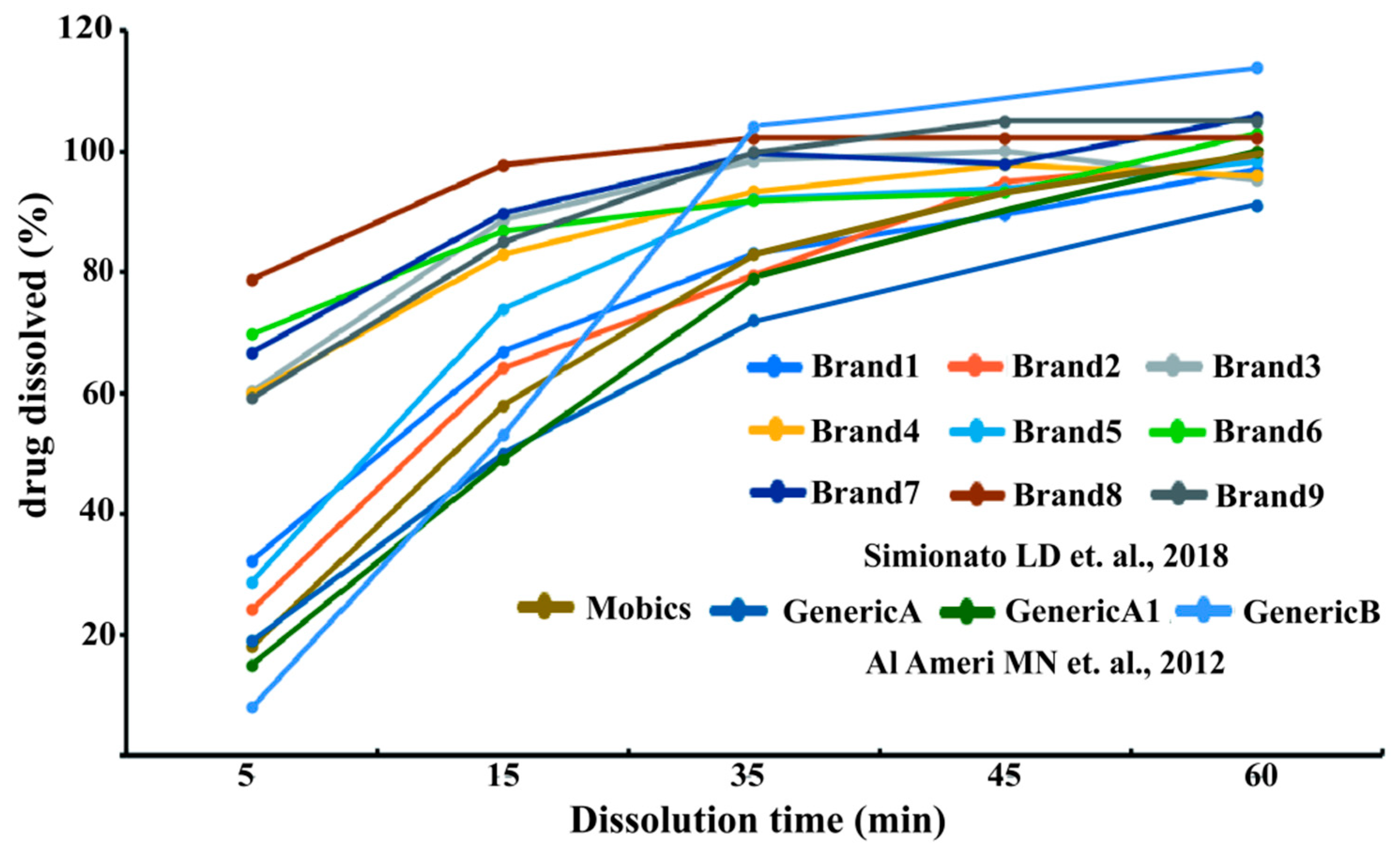
- Simionato, L.D.; Petrone, L.; Baldut, M.; Bonafede, S.L.; Segall, A.I. Comparison between the dissolution profiles of nine meloxicam tablet brands commercially available in Buenos Aires, Argentina. Saudi Pharm. J. 2018, 26, 578–584. [Google Scholar] [CrossRef] [PubMed]
- Al Ameri, M.N.; Nayuni, N.; Anil Kumar, K.G.; Perrett, D.; Tucker, A.; Johnston, A. The differences between the branded and generic medicines using solid dosage forms: In-vitro dissolution testing. Results Pharma Sci. 2012, 2, 1–8. [Google Scholar] [CrossRef]
- Patera, J.; Němečková, P.; Zámostný, P. Dissolution Kinetics of Meloxicam Formulations Co-Milled with Sodium Lauryl Sulfate. Pharmaceutics 2022, 14, 2173. [Google Scholar] [CrossRef] [PubMed]
- Singh, G.; Lanes, S.; Triadafilopoulos, G. Risk of serious upper gastrointestinal and cardiovascular thromboembolic complications with meloxicam. Am. J. Med. 2004, 117, 100–106. [Google Scholar] [CrossRef]
- Draksiene, G.; Venclovaite, B.; Pudziuvelyte, L.; Ivanauskas, L.; Marksa, M.; Bernatoniene, J. Natural Polymer Chitosan as Super Disintegrant in Fast Orally Disintegrating Meloxicam Tablets: Formulation and Evaluation. Pharmaceutics 2021, 13, 879. [Google Scholar] [CrossRef]
- Nagai, N.; Ogata, F.; Otake, H.; Kawasaki, N. Oral Administration System Based on Meloxicam Nanocrystals: Decreased Dose Due to High Bioavailability Attenuates Risk of Gastrointestinal Side Effects. Pharmaceutics 2020, 12, 313. [Google Scholar] [CrossRef]
- Ochi, M.; Kawachi, T.; Toita, E.; Hashimoto, I.; Yuminoki, K.; Onoue, S.; Hashimoto, N. Development of nanocrystal formulation of meloxicam with improved dissolution and pharmacokinetic behaviors. Int. J. Pharm. 2014, 474, 151–156. [Google Scholar] [CrossRef]
- Shoormeij, Z.; Taheri, A.; Homayouni, A. Preparation and physicochemical characterization of meloxicam orally fast disintegration tablet using its solid dispersion. Braz. J. Pharm. Sci. 2017, 53, e00176. [Google Scholar] [CrossRef]
- Haser, A.; Cao, T.; Lubach, J.W.; Zhang, F. In Situ Salt Formation during Melt Extrusion for Improved Chemical Stability and Dissolution Performance of a Meloxicam-Copovidone Amorphous Solid Dispersion. Mol. Pharm. 2018, 15, 1226–1237. [Google Scholar] [CrossRef]
- Jacon Freitas, J.T.; Santos Viana, O.M.M.; Bonfilio, R.; Doriguetto, A.C.; de Araújo, M.B. Analysis of polymorphic contamination in meloxicam raw materials and its effects on the physicochemical quality of drug product. Eur. J. Pharm. Sci. 2017, 109, 347–358. [Google Scholar] [CrossRef]
- Induri, M.; Mantripragada, B.R.; Yejella, R.P.; Kunda, P.R.; Nannapaneni, D.T.; Boddu, R. Dissolution studies and quantification of meloxicam in tablet dosage form by spectrophotometry. Pak. J. Pharm. Sci. 2012, 25, 283–287. [Google Scholar]
- Hussaini, A.; Solorio, D.; Young, C. Pharmacokinetic properties of low-dose SoluMatrix meloxicam in healthy adults. Clin. Rheumatol. 2016, 35, 1099–1104. [Google Scholar] [CrossRef]
- Raikwar, S. Effect of Food on Pharmacokinetics of Meloxicam. Int. J. Sci. Invent. Today (IJSIT) 2013, 2, 235–253. [Google Scholar]
- Jadach, B.; Froelich, A.; Tatarek, A.; Osmałek, T. An overview of the methods used to increase the dissolution rate of meloxicam for oral administration. J. Drug Deliv. Sci. Technol. 2024, 97, 105836. [Google Scholar] [CrossRef]
- Saelim, N.; Suksawaeng, K.; Chupan, J.; Techatanawat, I. Biopharmaceutics classification system (BCS)-based biowaiver for immediate release solid oral dosage forms of moxifloxacin hydrochloride (Moxiflox GPO) manufactured by the Government Pharmaceutical Organization (GPO). Asian J. Pharm. Sci. 2016, 11, 235–236. [Google Scholar] [CrossRef]
- Dhake, P.R.; Kumbhar, S.T.; Gaikwad, V.L. Biowaiver based on biopharmaceutics classification system: Considerations and requirements. Pharm. Sci. Adv. 2024, 2, 100020. [Google Scholar] [CrossRef] [PubMed]
- Chiou, A.H.-J.; Yeh, M.-K.; Chen, C.-Y.; Wang, D.-P. Micronization of meloxicam using a supercritical fluids process. J. Supercrit. Fluids 2007, 42, 120–128. [Google Scholar] [CrossRef]
- Khalil, N.Y.; Aldosari, K.F. Meloxicam. Profiles Drug Subst. Excip. Relat. Methodol. 2020, 45, 159–197. [Google Scholar] [CrossRef]
- da Silveira, L.M.; Fiorot, A.B.; Xavier, T.P.; Yoshida, M.I.; de Oliveira, M.A. Drug-excipient compatibility assessment of solid formulations containing meloxicam. Eur. J. Pharm. Sci. 2018, 112, 146–151. [Google Scholar] [CrossRef]
- ICH. ICH Specifications: Test Procedures and Acceptance Criteria for New Drug Substances and New Drug Products: Chemical Substances (Q6A), Final version ed.; ICH: Geneva, Switzerland, 1999. [Google Scholar]
- Taha, N.F.; Mahmoud, K.M.; Soliman, A.A.F.; Emara, L.H. Anti-inflammatory and cytoprotective potentials of Meloxicam solid dispersions prepared by different techniques on lipopolysaccharide-stimulated RAW 264.7 macrophages. J. Drug Deliv. Sci. Technol. 2021, 63, 102507. [Google Scholar] [CrossRef]
- Distel, M.; Mueller, C.; Bluhmki, E.; Fries, J. Safety of meloxicam: A global analysis of clinical trials. Br. J. Rheumatol. 1996, 35, 68–77. [Google Scholar] [CrossRef]
- Laut, S.; Poapolathep, S.; Khidkhan, K.; Klangkaew, N.; Phaochoosak, N.; Wongwaipairoj, T.; Giorgi, M.; Marin, P.; Escudero, E.; Poapolathep, A. Pharmacokinetic evaluation of meloxicam following intravenous and intramuscular administration in Crocodylus siamensis, a freshwater crocodile. Vet. J. 2025, 311, 106342. [Google Scholar] [CrossRef]
- FDA. Mobic® (Meloxicam) Oral Suspension: Prescribing Information; U.S. Food and Drug Administration (FDA): Silver Spring, MD, USA, 2008. [Google Scholar]
- WHO. The Selection and Use of Essential Medicines, 2025; Model List of Essential Medicines, 24th List; WHO: Geneva, Switzerland, 2025. [Google Scholar] [CrossRef]
- U.S. Department of Health and Human Services. Approved Drug Products with Therapeutic Equivalence Evaluations, 45th ed.; Food and Drug Administration: Silver Spring, MD, USA, 2025. [Google Scholar]
- Apotex Inc. PrAPO-MELOXICAM Product Monograph: Meloxicam Tablets 7.5 mg and 15.0 mg, Apotex Standard ed.; Apotex Inc.: Toronto, ON, Canada, 2015; pp. 1–44. [Google Scholar]
- García Rodríguez, L.A.; Barreales Tolosa, L. Risk of upper gastrointestinal complications among users of traditional NSAIDs and COXIBs in the general population. Gastroenterology 2007, 132, 498–506. [Google Scholar] [CrossRef]
- McGettigan, P.; Henry, D. Cardiovascular risk with non-steroidal anti-inflammatory drugs: Systematic review of population-based controlled observational studies. PLoS Med. 2011, 8, e1001098. [Google Scholar] [CrossRef]
- Argoff, C.E. Recent developments in the treatment of osteoarthritis with NSAIDs. Curr. Med. Res. Opin. 2011, 27, 1315–1327. [Google Scholar] [CrossRef]
- Degner, F.; Sigmund, R.; Zeidler, H. Efficacy and tolerability of meloxicam in an observational, controlled cohort study in patients with rheumatic disease. Clin. Ther. 2000, 22, 400–410. [Google Scholar] [CrossRef]
- Prouse, P.J.; Bevis, P.J.; Bluhmki, E.; Distel, M. Evaluation of the safety, tolerability, and efficacy of meloxicam tablets in patients with osteoarthritis. Clin. Ther. 1996, 18, 429–439. [Google Scholar] [CrossRef] [PubMed]
- Hawkey, C.; Kahan, A.; Steinbrück, K.; Alegre, C.; Baumelou, E.; Begaud, B.; Dequeker, J.; Isomaki, H.; Littlejohn, G.; Mau, J.; et al. Gastrointestinal tolerability of meloxicam compared to diclofenac in osteoarthritis patients. International MELISSA Study Group. Br. J. Rheumatol. 1998, 37, 937–945. [Google Scholar] [CrossRef]
- Dequeker, J.; Hawkey, C.; Kahan, A.; Alegre, C.; Baumelou, E.; Begaud, B.; Dequeker, J.; Isomaki, H.; Littlejohn, G.; Mau, J.; et al. Improvement in gastrointestinal tolerability of the selective cyclooxygenase (COX)-2 inhibitor, meloxicam, compared with piroxicam: Results of the SELECT trial. Br. J. Rheumatol. 1998, 37, 946–951. [Google Scholar] [CrossRef]
- Wright, E.M.; Wright, L.; Cox, S.; Schwartz, H. Pharmacokinetic profile of a single intramuscular or oral dose of meloxicam in red kangaroos (Osphranter rufus). Am. J. Vet. Res. 2025, 86, ajvr.24.10.0326. [Google Scholar] [CrossRef] [PubMed]
- Zhang, Z.; Tell, L.A.; Lin, Z. Comparisons of PK-Sim and R program for physiologically based pharmacokinetic model development for broiler chickens and laying hens: Meloxicam as a case study. Toxicol. Sci. 2025, 205, 28–41. [Google Scholar] [CrossRef] [PubMed]
- US Department of Health and Human Services FDA, Center for Drug Evaluation and Research. Title 21-Food and Drugs, Part 320-Bioavailability and Bioequivalence Requirements; U.S. Government Publishing Office: Washington, DC, USA, 2022. [Google Scholar]
- Coxib and Traditional NSAID Trialists’ (CNT) Collaboration; Bhala, N.; Emberson, J.; Merhi, A.; Abramson, S.; Arber, N.; A Baron, J.; Bombardier, C.; Cannon, C.; E Farkouh, M.; et al. Vascular and upper gastrointestinal effects of non-steroidal anti-inflammatory drugs: Meta-analyses of individual participant data from randomised trials. Lancet 2013, 382, 769–779. [Google Scholar] [CrossRef]
- Coppi, L.; Sanmarti, M.B.; Clavo, M.C. Crystalline Forms of Meloxicam and Processes for Their Preparation and Interconversion. U.S. Patent 6,967,248, 9 December 2002. [Google Scholar]
- Luger, P.; Daneck, K.; Engel, W.; Trummlitz, G.; Wagner, K. Structure and physicochemical properties of meloxicam, a new NSAID. Eur. J. Pharm. Sci. 1996, 4, 175–187. [Google Scholar] [CrossRef]
- Mezei, T.; Simig, G.; Molnar, E.; Lukacs, G.; Porcs-Makkay, M.; Volk, B.; Hofmanne Fekete, V.; Nagy, K.; Mesterhazy, N.; Krasznai, G.; et al. Process for Preparation of High-Purity Meloxicam and Meloxicam Potassium Salt. U.S. Patent 8,097,616, 16 December 2005. [Google Scholar]
- Allen, F.H. The Cambridge Structural Database: A quarter of a million crystal structures and rising. Acta Crystallogr. B 2002, 58, 380–388. [Google Scholar] [CrossRef]
- Romani, L.F.A.; Yoshida, M.I.; Gomes, E.C.L.; Machado, R.R.; Rodrigues, F.F.; Coelho, M.M.; Oliveira, M.A.; Freitas-Marques, M.B.; Gil, R.A.S.; Mussel, W.N. Physicochemical characterization, the Hirshfeld surface, and biological evaluation of two meloxicam compounding pharmacy samples. J. Pharm. Anal. 2018, 8, 103–108. [Google Scholar] [CrossRef]
- Cysewski, P. Intermolecular interaction as a direct measure of water solubility advantage of meloxicam cocrystalized with carboxylic acids. J. Mol. Model. 2018, 24, 112. [Google Scholar] [CrossRef] [PubMed]
- Weyna, D.R.; Cheney, M.L.; Shan, N.; Hanna, M.; Zaworotko, M.J.; Sava, V.; Song, S.; Sanchez-Ramos, J.R. Improving solubility and pharmacokinetics of meloxicam via multiple-component crystal formation. Mol. Pharm. 2012, 9, 2094–2102. [Google Scholar] [CrossRef]
- British Pharmacopoeia Commission. British Pharmacopoeia 2020, Volume II, Meloxicam. Vol BP 2020; Her Majesty’s Stationery Office: London, UK, 2020. [Google Scholar]
- European Directorate for the Quality of Medicines & HealthCare. European Pharmacopoeia 10.0. Vol Ph.Eur. 10.0; Council of Europe: Strasbourg, France, 2020. [Google Scholar]
- National Center for Biotechnology Information. PubChem Compound Summary for CID 54677470, Meloxicam. Available online: https://pubchem.ncbi.nlm.nih.gov/compound/Meloxicam (accessed on 11 March 2026).
- Aejaz, A.; Jafar, M.; Dehghan, M.; Adil Shareef, S. Meloxicam-PVP-SLS ternary dispersion systems: In-vitro and in-vivo evaluation. Int. J. Pharm. Pharm. Sci. 2010, 2, 182–190. [Google Scholar]
- Shafique, S.; Mughal, U.; Dayo, A.; Mustapha, O.; Saleem, H.; Naeem, S.; Ahmed, S. Optimization, Fabrication and Characterization of Novel Meloxicam-Loaded Surface Attached Solid Dispersions to Ameliorate its Aqueous Solubility and Dissolution Employing Spray-Drying Technique. Pak. J. Med. Health Sci. 2023, 17, 717–720. [Google Scholar] [CrossRef]
- Sieger, P.; Cui, Y.; Scheuerer, S. pH-dependent solubility and permeability profiles: A useful tool for prediction of oral bioavailability. Eur. J. Pharm. Sci. 2017, 105, 82–90. [Google Scholar] [CrossRef]
- Seedher, N.; Bhatia, S. Solubility enhancement of Cox-2 inhibitors using various solvent systems. AAPS PharmSciTech 2003, 4, E33. [Google Scholar] [CrossRef]
- Bandarkar, F.S.; Vavia, P.R. An optimized commercially feasible milling technique for molecular encapsulation of meloxicam in β-cyclodextrin. Drug Dev. Ind. Pharm. 2011, 37, 1318–1328. [Google Scholar] [CrossRef]
- Ghorab, M.M.; Abdel-Salam, H.M.; El-Sayad, M.A.; Mekhel, M.M. Tablet formulation containing meloxicam and beta-cyclodextrin: Mechanical characterization and bioavailability evaluation. AAPS PharmSciTech 2004, 5, e59. [Google Scholar] [CrossRef]
- Naidu, N.B.; Chowdary, K.P.; Murthy, K.V.; Satyanarayana, V.; Hayman, A.R.; Becket, G. Physicochemical characterization and dissolution properties of meloxicam-cyclodextrin binary systems. J. Pharm. Biomed. Anal. 2004, 35, 75–86. [Google Scholar] [CrossRef]
- Snor, W.; Liedl, E.; Weiss-Greiler, P.; Viernstein, H.; Wolschann, P. Density functional calculations on meloxicam-beta-cyclodextrin inclusion complexes. Int. J. Pharm. 2009, 381, 146–152. [Google Scholar] [CrossRef] [PubMed]
- Delgado, D.R.; Holguín, A.R.; Almanza, O.A.; Martínez, F.; Marcus, Y. Solubility and preferential solvation of meloxicam in ethanol+water mixtures. Fluid Ph. Equilib. 2011, 305, 88–95. [Google Scholar] [CrossRef]
- Cheney, M.L.; Weyna, D.R.; Shan, N.; Hanna, M.; Wojtas, L.; Zaworotko, M.J. Supramolecular Architectures of Meloxicam Carboxylic Acid Cocrystals, a Crystal Engineering Case Study. Cryst. Growth Des. 2010, 10, 4401–4413. [Google Scholar] [CrossRef]
- Kasim, N.A.; Whitehouse, M.; Ramachandran, C.; Bermejo, M.; Lennernäs, H.; Hussain, A.S.; Junginger, H.E.; Stavchansky, S.A.; Midha, K.K.; Shah, V.P.; et al. Molecular properties of WHO essential drugs and provisional biopharmaceutical classification. Mol. Pharm. 2004, 1, 85–96. [Google Scholar] [CrossRef]
- Hansch, C.; Leo, A.; Mekapati, S.B.; Kurup, A. QSAR and ADME. Bioorg. Med. Chem. 2004, 12, 3391–3400. [Google Scholar] [CrossRef] [PubMed]
- Borbás, E.; Sinkó, B.; Tsinman, O.; Tsinman, K.; Kiserdei, É.; Démuth, B.; Balogh, A.; Bodák, B.; Domokos, A.; Dargó, G.; et al. Investigation and Mathematical Description of the Real Driving Force of Passive Transport of Drug Molecules from Supersaturated Solutions. Mol. Pharm. 2016, 13, 3816–3826. [Google Scholar] [CrossRef]
- Li, S.; Kou, L.; Qin, Y.; Tsinman, K.; Kiserdei, É.; Démuth, B.; Balogh, A.; Bodák, B.; Domokos, A.; Dargó, G.; et al. A ternary system of meloxicam with matching hydrophilic polymer and cyclodextrin for improved stability in liquid preprations. RSC Adv. 2024, 14, 21260–21268. [Google Scholar] [CrossRef]
- Navarro-Ruíz, E.; Álvarez-Álvarez, C.; Peña, M.; Torrado-Salmerón, C.; Dahma, Z.; de la Torre-Iglesias, P.M. Multiparticulate Systems of Meloxicam for Colonic Administration in Cancer or Autoimmune Diseases. Pharmaceutics 2022, 14, 1504. [Google Scholar] [CrossRef]
- Busch, U.; Schmid, J.; Heinzel, G.; Schmaus, H.; Baierl, J.; Huber, C.; Roth, W. Pharmacokinetics of meloxicam in animals and the relevance to humans. Drug Metab. Dispos. 1998, 26, 576–584. [Google Scholar]
- Davies, N.M.; Skjodt, N.M. Clinical pharmacokinetics of meloxicam. A cyclo-oxygenase-2 preferential nonsteroidal anti-inflammatory drug. Clin. Pharmacokinet. 1999, 36, 115–126. [Google Scholar] [CrossRef]
- Yazdanian, M.; Glynn, S.L.; Wright, J.L.; Hawi, A. Correlating partitioning and caco-2 cell permeability of structurally diverse small molecular weight compounds. Pharm. Res. 1998, 15, 1490–1494. [Google Scholar] [CrossRef]
- Liang, E.; Chessic, K.; Yazdanian, M. Evaluation of an accelerated Caco-2 cell permeability model. J. Pharm. Sci. 2000, 89, 336–345. [Google Scholar] [CrossRef]
- Schmid, J.; Busch, U.; Trummlitz, G.; Prox, A.; Kaschke, S.; Wachsmuth, H. Meloxicam: Metabolic profile and biotransformation products in the rat. Xenobiotica 1995, 25, 1219–1236. [Google Scholar] [CrossRef] [PubMed]
- Türck, D.; Busch, U.; Heinzel, G.; Narjes, H. Clinical pharmacokinetics of meloxicam. Arzneimittelforschung 1997, 47, 253–258. [Google Scholar]
- Schmid, J.; Busch, U.; Heinzel, G.; Bozler, G.; Kaschke, S.; Kummer, M. Pharmacokinetics and metabolic pattern after intravenous infusion and oral administration to healthy subjects. Drug Metab. Dispos. 1995, 23, 1206–1213. [Google Scholar] [CrossRef] [PubMed]
- Chesné, C.; Guyomard, C.; Guillouzo, A.; Schmid, J.; Ludwig, E.; Sauter, T. Metabolism of Meloxicam in human liver involves cytochromes P4502C9 and 3A4. Xenobiotica 1998, 28, 1–13. [Google Scholar] [CrossRef]
- Gschwend, M.H.; Erenmemişoğlu, A.; Martin, W.; Tamur, U.; Kanzik, I.; Hincal, A.A. Pharmacokinetic and bioequivalence study of meloxicam tablets in healthy male subjects. Arzneimittelforschung 2007, 57, 264–268. [Google Scholar] [CrossRef]
- Ahmad, M.; Murtaza, G.; Akhtar, N.; Siddique, F.; Khan, S.A. Bioequivalence study of two brands of meloxicam tablets in healthy human Pakistani male subjects. Acta Pol. Pharm. 2011, 68, 115–119. [Google Scholar]
- Medvedovici, A.; Albu, F.; Georgita, C.; Mircioiu, C.; David, V. A non-extracting procedure for the determination of meloxicam in plasma samples by HPLC-diode array detection. Arzneimittelforschung 2005, 55, 326–331. [Google Scholar] [CrossRef]
- Hasan, S.M.; Shoaib, M.H.; Hassan, F.; Rehman, I.U. Bioequivalence studies of two brands of meloxicam tablets in healthy Pakistani volunteers. Pak. J. Pharm. Sci. 2009, 22, 199–204. [Google Scholar]
- Yu, J.; Wang, Y.; Wu, Y.; Lin, S.; Hao, R.; Fang, L.; Zhu, J.; Zhao, D.; Tong, S.; Si, Y.; et al. Pharmacokinetics of Meloxicam Tablets in Healthy Chinese Adults in the Fasting and Fed States: A Single-Site, Single-Dose, Randomized, Open, 2-Period, 2-Sequence, Crossover Bioequivalence Study. Clin. Pharmacol. Drug Dev. 2022, 11, 71–79. [Google Scholar] [CrossRef]
- Aboelwafa, A.A.; Fahmy, R.H. A pilot human pharmacokinetic study and influence of formulation factors on orodispersible tablet incorporating meloxicam solid dispersion using factorial design. Pharm. Dev. Technol. 2012, 17, 1–14. [Google Scholar] [CrossRef]
- Burke Michael, H. Meloxicam Tablet Formulations and Their Preparation. GB Patent 2,455,875, 18 December 2008. [Google Scholar]
- Sipos, B.; Bella, Z.; Gróf, I.; Veszelka, S.; Deli, M.A.; Szűcs, K.F.; Sztojkov-Ivanov, A.; Ducza, E.; Gáspár, R.; Kecskeméti, G.; et al. Soluplus® promotes efficient transport of meloxicam to the central nervous system via nasal administration. Int. J. Pharm. 2023, 632, 122594. [Google Scholar] [CrossRef] [PubMed]
- Bartos, C.; Ambrus, R.; Katona, G.; Sovány, T.; Gáspár, R.; Márki, Á.; Ducza, E.; Ivanov, A.; Tömösi, F.; Janáky, T.; et al. Transformation of Meloxicam Containing Nanosuspension into Surfactant-Free Solid Compositions to Increase the Product Stability and Drug Bioavailability for Rapid Analgesia. Drug Des. Dev. Ther. 2019, 13, 4007–4020. [Google Scholar] [CrossRef] [PubMed]
- Helmy, S.A.; El Bedaiwy, H.M. Effect of the formulation on the bioequivalence of meloxicam: Tablet and suspension. Drug Res. 2013, 63, 331–337. [Google Scholar] [CrossRef] [PubMed]
- Park, J.S.; Kim, S.; Lee, J.; Choi, J.C.; Kim, Y.; Park, C.W.; Lee, S. Preliminary bioequivalence of an oral integrating film formulation containing meloxicam with a suspension formulation in beagle dogs. J. Vet. Pharmacol. Ther. 2021, 44, 342–348. [Google Scholar] [CrossRef]
- Wewers, M.; Finke, J.H.; Czyz, S.; Van Eerdenbrugh, B.; John, E.; Büch, G.; Juhnke, M.; Bunjes, H.; Kwade, A. Evaluation of the Formulation Parameter-Dependent Redispersibility of API Nanoparticles from Fluid Bed Granules. Pharmaceutics 2022, 14, 1688. [Google Scholar] [CrossRef]
- U.S. Pharmacopeial Convention. United States Pharmacopeia (Spanish Version); U.S. Pharmacopeial Convention: Rockville MD, USA, 2015; pp. 4640–4642. [Google Scholar]
- European Directorate for the Quality of Medicines & HealthCare. European Pharmacopoeia, 7th ed.; Council of Europe: Strasbourg, France, 2011. [Google Scholar]
- Bhattachar, S.N.; Deschenes, L.A.; Wesley, J.A. Solubility: It’s not just for physical chemists. Drug Discov. Today 2006, 11, 1012–1018. [Google Scholar] [CrossRef] [PubMed]
- Antonio, M.; Carneiro, R.L.; Maggio, R.M. Unveiling meloxicam monohydrate process of dehydration by an at-line vibrational multi-spectroscopy approach. J. Pharm. Biomed. Anal. 2021, 202, 114164. [Google Scholar] [CrossRef] [PubMed]
- Tsume, Y.; Langguth, P.; Garcia-Arieta, A.; Amidon, G.L. In silico prediction of drug dissolution and absorption with variation in intestinal pH for BCS class II weak acid drugs: Ibuprofen and ketoprofen. Biopharm. Drug Dispos. 2012, 33, 366–377. [Google Scholar] [CrossRef]
- Zafar, F.; Khan, S.; Ali, H.; Shah, S.N.; Bushra, R.; Naqvi, G.R.; Maroof, K.; Khan, M.A.; Nisa, Z.U. Biowaiver studies of newly optimized meloxicam tablets. Pak. J. Pharm. Sci. 2018, 31, 1469–1474. [Google Scholar]
- Zhao, J.; Zhang, J.-S. Study on the solubilization of meloxicam in meglumine aqueous solution. J.-China Pharm. Univ. 2003, 34, 423–425. [Google Scholar]




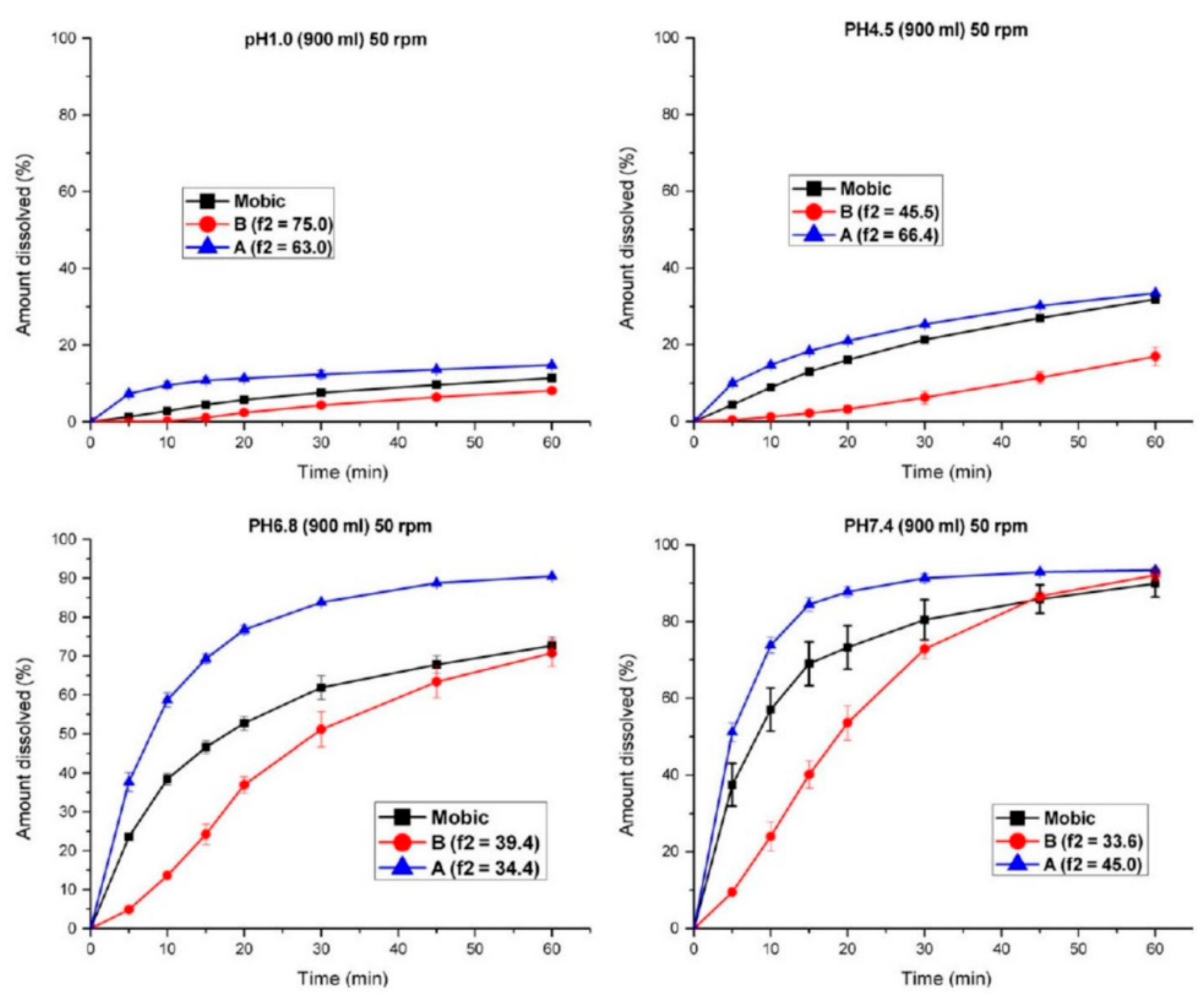
| Acidity (pH) | Dose Strength (mg) | Solubility Cs (mg/mL) | D0 |
|---|---|---|---|
| 1.0 | 7.5 | 1.139 × 10⁻³ | 26.55 |
| 4.5 | 7.5 | 4.459 × 10⁻³ | 6.74 |
| 6.8 | 7.5 | 0.24 | 0.13 |
| 7.4 | 7.5 | 0.95 | 0.03 |
Disclaimer/Publisher’s Note: The statements, opinions and data contained in all publications are solely those of the individual author(s) and contributor(s) and not of MDPI and/or the editor(s). MDPI and/or the editor(s) disclaim responsibility for any injury to people or property resulting from any ideas, methods, instructions or products referred to in the content. |
© 2026 by the authors. Licensee MDPI, Basel, Switzerland. This article is an open access article distributed under the terms and conditions of the Creative Commons Attribution (CC BY) license.
Share and Cite
Guan, A.; Bei, X.; Jin, C.; Xie, J.; Guo, J.; Li, X. Biowaiver Monographs for Immediate-Release Solid Oral Dosage Forms: Meloxicam. Molecules 2026, 31, 1020. https://doi.org/10.3390/molecules31061020
Guan A, Bei X, Jin C, Xie J, Guo J, Li X. Biowaiver Monographs for Immediate-Release Solid Oral Dosage Forms: Meloxicam. Molecules. 2026; 31(6):1020. https://doi.org/10.3390/molecules31061020
Chicago/Turabian StyleGuan, Aixin, Xueqiao Bei, Chan Jin, Jing Xie, Jianpeng Guo, and Xiaoting Li. 2026. "Biowaiver Monographs for Immediate-Release Solid Oral Dosage Forms: Meloxicam" Molecules 31, no. 6: 1020. https://doi.org/10.3390/molecules31061020
APA StyleGuan, A., Bei, X., Jin, C., Xie, J., Guo, J., & Li, X. (2026). Biowaiver Monographs for Immediate-Release Solid Oral Dosage Forms: Meloxicam. Molecules, 31(6), 1020. https://doi.org/10.3390/molecules31061020