A Scoping Review of the Challenges and Future Perspectives in the Use of Alpha-Emitters for Metastatic Ovarian Cancer

 ,
,  , and
, and
Abstract
1. Introduction
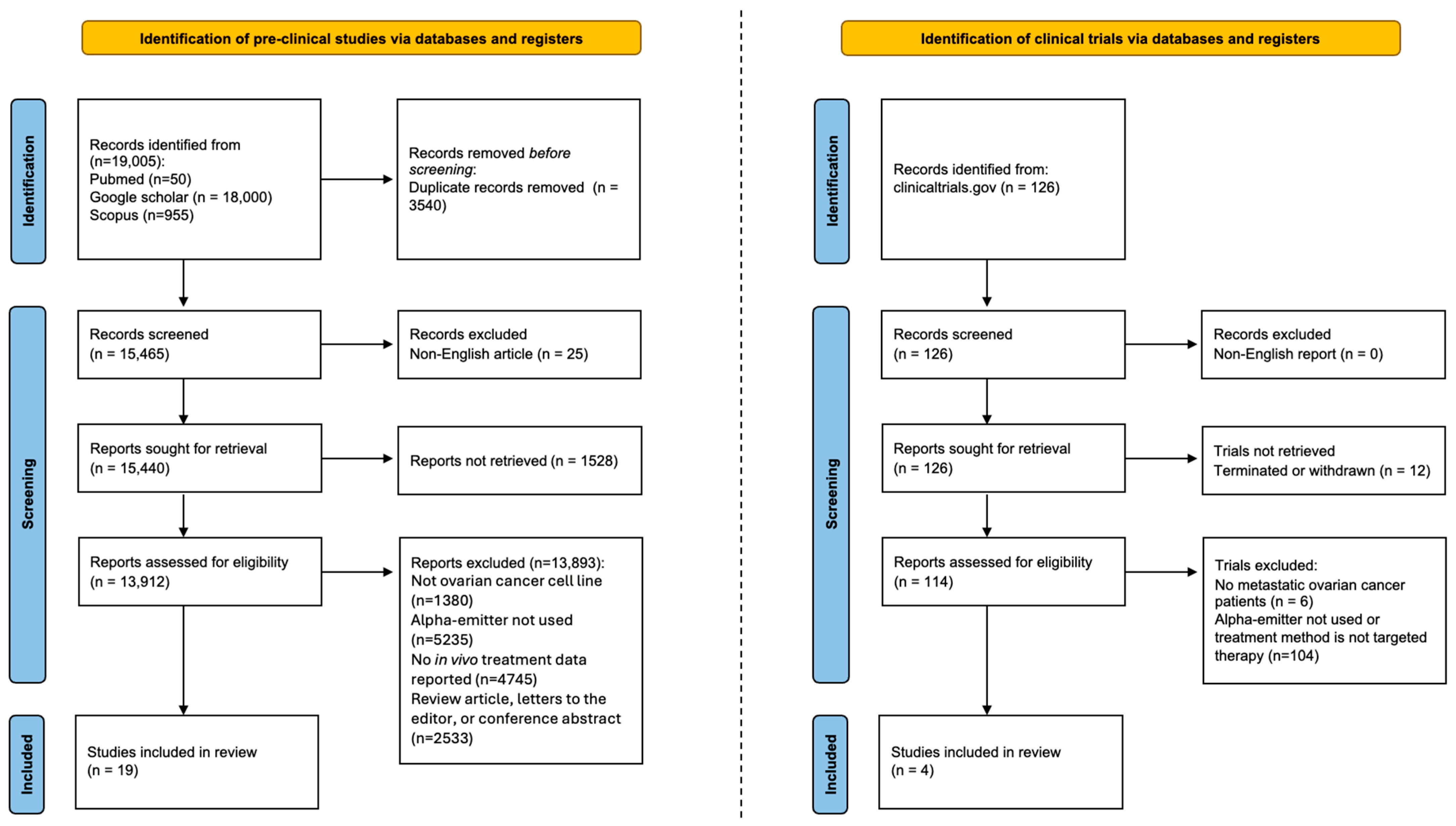
2. Methods
3. Biological and Physical Basis of Targeted Alpha-Particle Therapy for Metastatic Ovarian Cancer
3.1. Pathophysiology and Current Standard of Care for Ovarian Cancer
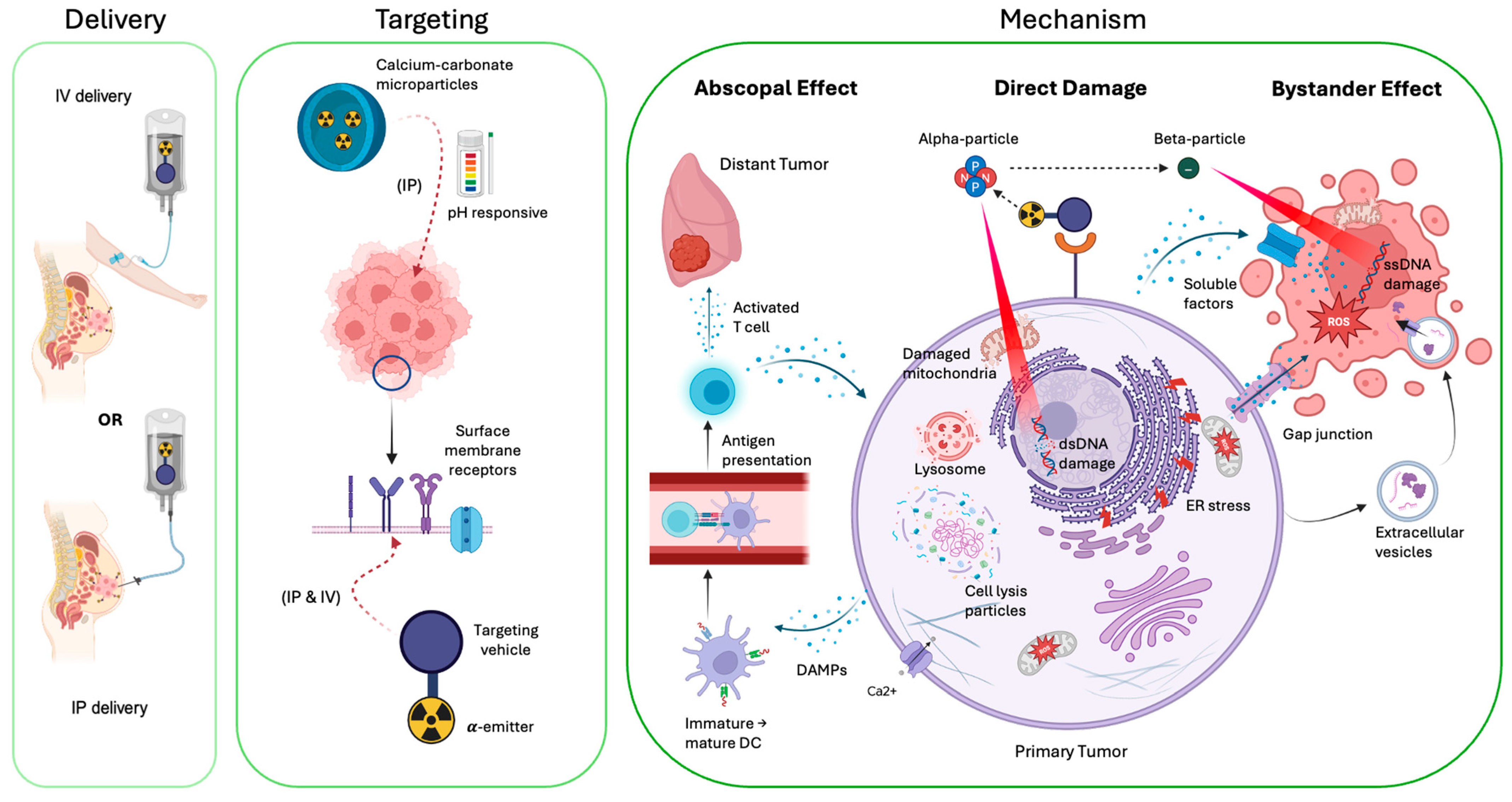
3.2. Rationale of Targeted Alpha-Particle Therapy for Ovarian Cancer Treatment
4. Pre-Clinical Evidence of TAT in OC

| Target | Vector | Alpha-Emitter | Model | Route | Dose/Timing | Reported Toxicity | Primary Treatment Outcome |
|---|---|---|---|---|---|---|---|
| FR-α | MOv18 [94] | 211At | Female nude mice, IP inoculation with OVCAR-3; therapy delivered either when the disease was microscopic or when macroscopic with ascites. | IP | Microscopic disease cohort: single ~450–555 kBq. Macroscopic/ascites cohort: single ~377–389 kBq. Controls: untreated | No specific toxicity or treatment-related deaths were reported in the microscopic disease and advanced-disease/ascites cohort. | Microscopic disease: median survival 213 days with 211At-MOv18 vs. 138 days in untreated controls; tumor-free fraction (TFF) = 33% of treated mice at 7 months. Macroscopic/ascites disease: ~377–389 kBq delayed ascites formation (palliative). |
| Farletuzumab [95] | 211At | Nude mice bearing IP-disseminated OVCAR-3 ovarian cancer. | IP | Single IP injection: ~170 kBq/mL. Controls: 211At rituximab (unspecific) ~170 kBq/mL, unlabeled farletuzumab, and PBS. | Thyroid uptake was observed when no blocking agent was used. | TFF at endpoint: 211At-farletuzumab ~91%, PBS 12%, unlabeled farletuzumab 9%, and unspecific 211At-rituximab 14%; 6–10× higher anti-tumor effect for 211At-farletuzumab compared with controls. | |
| MOv18 [96] | 211At | Female Balb/c nu/nu nude mice inoculation with OVCAR-3 cell IP. Therapy was initiated 2 weeks post-inoculation (microscopic disease stage). | IP | Single IP injection: ~300–400 kBq per mouse (2 weeks after tumor inoculation). Controls: PBS, unlabeled MOv18, or 211At-unspecific mAb (C242). | No obvious side effects reported at therapeutic dosing (~300–400 kBq); WBC depression was insignificant. | TFF: IP 211At-MOv18 at ~400 kBq 93%, IP-unlabeled MOv18 10%, non-specific control 25%, and PBS 0%; all surviving animals were free from macroscopic tumors; durable complete responses in ~1/3 of mice at 7 months; ascites prevented in almost all treated animals. | |
| MUC1 | C595 [97] | 213Bi | Nude mice bearing OVCAR-3 ovarian cancer cells as an intraperitoneal ascites model. | IP | Single IP injection: 355, 710, or 1065 MBq/kg (9 days post-inoculation). Controls: not specified in the dosing/timing cell. | Minimal toxicity observed, no leukocyte depression at 90 days, mild renal tubular changes/mild radiation nephropathy at 1065 MBq/kg. | Single 355 MBq/kg IP prolonged survival by ~25 days vs. control in the ascites model. |
| CD138 | B-B4 [98] | 213Bi | Nu/nu nude mice, inoculated IP with SHIN-3-Luc cells. Therapy was administered 3 days post-inoculation to mimic post-operative minimal residual disease. | Single IP injection: 7.4 MBq or 11.1 MBq (3 days post-inoculation). Controls: HIPEC (oxaliplatin 5 mg/kg, 42 °C, 90 min) and HIPEC + alpha-RIT. | Transient, mild hematologic effects with insignificant decreases in WBC and platelets; no acute blood toxicity at 7.4–11.1 MBq 213; transient weight loss recovered by day 7. | Median survival: control 68 d; HIPEC 37.5 d; HIPEC + α-RIT 75.5 d; 213Bi-B-B4 7.4 MBq > 90 d (7/11 alive at 90 d); 213Bi-B-B4 11.1 MBq > 90 d (5/7 alive); ascites and tumor burden markedly reduced in α-RIT groups compared with controls/HIPEC. | |
| B7-H3 (CD276) | 376.96 [99] | 212Pb 212Bi | ES-2 (ascites) IP xenografts (athymic mice), A2780cp20 (nodular) IP xenografts (athymic mice). | IP | Single IP injection: 0.17, 0.35, 0.51 MBq for ES-2 (day 4 tumors) and 0.35, 0.53, 0.70 MBq ± weekly carboplatin 50 mg/kg (carboplatin given 1 day before 212Pb-376.96) for A2780cp20 (day 10 tumors). Controls: 212Pb-F3-C25 and untreated. | Transient weight loss recovered by 2–4 weeks; no blood/organ pathology. | Treated groups with 212Pb-376.96 (alone or with carboplatin) survived 2–3× longer than those treated with 212Pb-F3-C25 or untreated controls. |
| HER2 | 2Rs15d single-domain antibody fragment [100] | 213Bi | Female athymic nude mice, SKOV-3 IP (luciferase+). | IV | Study 1 (fractionated I.V. injection on days 7.8. and 24): 1.01 ± 0.05 MBq × 3 or 2.12 ± 0.11 MBq × 3; vehicle control. Study 2 (fractions on days 7, 9, 11): 1.03 ± 0.03 MBq × 3 or 0.5 ± 0.08 MBq × 3; same two regimens + trastuzumab (loading 7.5 mg/kg, then 3.5 mg/kg maintenance); trastuzumab alone; vehicle. | Dose-limiting renal toxicity (≥2 MBq) caused kidney histopathology (tubular dilatation/degeneration/necrosis and medullary interstitial fibrosis + mononuclear infiltrates); >20% weight loss in high-dose and repeat-dose groups; spleen hemosiderin in red pulp with increasing activity. | Study 1: 1 MBq × 3 median survival 68 d vs. 56 d control; 2 MBq × 3 not significantly better than control. Study 2: 0.5 MBq × 3 mean overall survival 80 d vs. control 53 d, 1 MBq × 3 median 67 d vs. 53 d control, 1 MBq × 3 + trastuzumab median 145 d vs. 109 d trastuzumab alone, and 0.5 MBq × 3 + trastuzumab median 140.5 d (increased 28% vs. trastuzumab alone). BLI showed delayed tumor growth in all treated groups. |
| Pre-targeted. 1: Bispecific antibody (anti-HER2). 2: 225Ac-Proteus-DOTA [101] | 225Ac | Female athymic nude mice, injected IP with SKOV3-luc cells. | IP | One or two cycles of PRIT; 5 mg/kg bsAb (day 0) per cycle → 24 h later 37 kBq 225Ac-Proteus-DOTA (day 1). Day 15 repeat for the 2nd cycle group. Control: irrelevant bispecific antibody and radiohapten. | Well tolerated, no significant weight loss, minimal-mild renal tubular changes, and hematology within reference limits. | 2-cycle PRIT group: 85% (17/20) alive at day 133 vs. 37% (10/27) in control; 15/15 PRIT-treated mice had no viable carcinoma. | |
| NaPi2b (SLC34A2) | MX35 F(ab′)2 [102] | 211At | Female nude mice, IP inoculated with OVCAR-3 human ovarian cancer cells. | IP | Single IP injection: 25, 50, 100, 200 kBq (4 weeks post-inoculation). Non-specific control: 100 kBq 211At-rituximab F(ab’)2. | Toxicity not directly assessed/reported, toxic limit discussed only in reference to prior myelotoxicity studies. | TFF at 4 weeks: 25 kBq achieved 25%, 50 kBq 22%, 100 kBq 50%, 200 kBq 61%. |
| MX35 F(ab′)2 [103] | 211At | Female nude BALB/c nu/nu mice; IP injected OVCAR-3 cells. Therapy was given 3 weeks post-inoculation. | IP | Single IP treatment: ~400, 800, or 1200 kBq; therapy was given 3 weeks post-inoculation. Controls: unlabeled MX35, PBS, ~400 kBq 211At -MOv18. | Well-tolerated; treated mice had lower body weights than controls at 2 months. | 211At-MX35 (all dose groups combined): 3/25 ascites, 0/25 macroscopic tumors, 8/25 microscopic tumor growth. 211At-MOv18 (~400 kBq): 0/10 ascites; 0/10 macroscopic tumors; 3/10 microscopic tumor growth. Controls (unlabeled MX35 or PBS): 18/18 ascites, 6/9 macroscopic tumors, all had microscopic tumor growth. | |
| MX35 F(ab′)2 [104] | 211At | 5-week-old nude mice inoculated intraperitoneally with OVCAR-3 cells; groups treated at different tumor ages to span micro- to larger clusters. | IP | Single IP dose ~400 kBq 211At-MX35 F(ab’)2 (specific) delivered 1, 3, 4, 5, or 7 weeks after tumor cell inoculation. Controls: ~400 kBq 211At-rituximab F(ab’)2 (non-specific) and unlabeled rituximab. | Toxicity not directly assessed/reported; potential renal toxicity warrants further study. | TFF by treatment timing: 211At-MX35: 95%, 68%, 58%, 47%, 26% when treated at 1, 3, 4, 5, 7 weeks; 211At -rituximab (non-specific): 100%, 80%, 20%, 20%, 0% at 1, 3, 4, 5, 7 weeks. | |
| MX35 F(ab′)2 [105] | 213Bi and 211At | Female BALB/c nu/nu nude mice, 6–8 weeks old. IP inoculation OVCAR-3 cells. Therapy given at 2 or 4 weeks post-inoculation. | IP | 2 weeks post-inoculation: 0.35–0.54 MBq 211At -MX35 or 2.55–2.95 MBq Bi-213-MX35. 4 weeks post-inoculation: 0.42 MBq 211At-MX35 or 2.51–3.08 MBq Bi-213-MX35. Controls: untreated control. | Transient hematologic toxicity with decreased WBC at day 5 (~10% for 213Bi-MX35; ~45% for 211At-MX35) and recovery to baseline by day 14; no weight loss. | TFF: 211At-MX35 90% and 213Bi-MX35 60%; efficacy fell for larger/older tumors (TFF 0.25 at 4 weeks). | |
| MX35 F(ab′)2 [106] | 211At | Female Balb/c nu/nu nude mice inoculated IP with OVCAR-3 cells. Therapy given 4 weeks post-inoculation. | IP | 400 kBq 211At-MX35 F(ab’)2 per injection delivered once or weekly up to 6 times. Controls: unlabeled MX35 F(ab’)2. | No hematological or organ toxicity; controls weighed more due to ascites. | TFF (no macro-/micro-tumor and no ascites): 0.17, 0.11, 0.39, 0.44, 0.44, 0.67 for 1, 2, 3, 4, 5, 6 weekly injections; ascites fell from 15/18 (one dose) to 0/18 (5–6 doses); unlabeled control TFF = 0. | |
| MX35 F(ab′)2 [107] | 211At | BALB/c nu/nu nude mice IP-inoculated intraperitoneally with OVCAR-3 cells at age 5 weeks. Tumors allowed to grow for 4 weeks before treatment began. | IP | Single dosing: 50, 400, 800 kBq. Fractionated dosing (day 1, 4, 8): 3 × 17, 3 × 133, 3 × 267 kBq. Control: untreated control. | Hematologic toxicity (myelotoxicity/leukopenia) observed; fractionated regimen reduced myelotoxicity vs. single dose and delayed WBC nadir. | TFF: 50 kBq 17%, 3 × 17 kBq 22%, 400 kBq 39%, 3 × 133 kBq 28%, 800 kBq 56%, 3 × 267 kBq 41%, unlabeled MX35 F(ab’)2 controls 0% (high rates of macroscopic tumors, microscopic disease, and ascites). | |
| Pre-targeted. 1: avidin-MX35. 2: 211At biotinylated, succinylated poly-L-lysine [108] | 211At | Female BALB/c nu/nu nude mice; OVCAR-3 cells IP-inoculated. Necropsy/response assessment occurred 8 weeks after therapy. | IP | PRIT 1 (lower activity): avidin-MX35 (25 µg) → 24 h → 211At-B-PLsuc 1.0 MBq/0.4 µg (0.75 mL PBS). PRIT 2 (higher activity): avidin-MX35 (25 µg) → 24 h → 211At-B-PLsuc 1.5 MBq/0.6 µg (0.75 mL PBS). RIT: 211At-MX35 0.9 MBq/4 µg (0.75 mL PBS). Controls: PBS. | Acute, reversible myelotoxicity with significant WBC and platelet suppression at day 5 and recovery by ~day 21. | TFF (no ascites, no macro-/microscopic tumors): PRIT 1 35%, PRIT 2 45%, RIT 0.9 MBq 45%, and control 0%. Ascites at necropsy: RIT 40%, PRIT 1 15%, PRIT 2 0%. Tumors > 1 mm: PRIT 1 and RIT 40%, PRIT 2 15%. | |
| TAG-72 | CC49 [111] | 225Ac | Female athymic nude mice with subcutaneous OVCAR-3 xenografts (~100 mm3 at therapy start). | IP | Single-dose cohorts: 1.85, 3.7, or 7.4 kBq per mouse. Fractionated regimen: 1.85 kBq initial dose + 0.74 kBq weekly × 5 (total 5.55 kBq). Controls: vehicle, unlabeled huCC49, or 225Ac-IgG. | Dose-dependent weight loss < 20%; fractionated was better tolerated than a single 7.4 kBq dose (less weight loss, reduced acute toxicity); targeted 7.4 kBq had better tolerability than untargeted. | Single-dose efficacy (7.4 kBq): tumor regression in most mice; median survival > 120 days vs. ~30–40 d in controls. Fractionated regimen: 5.55 kBq split dosing extended survival to ~100 d vs. ~30 d controls. |
| MUC16 | AR9.6 [112] | 225Ac | Female athymic nude (Nu/Nu) mice subcutaneous OVCAR3 xenografts; initial injection of 10 × 106 cells, followed by 5 × 10⁶ cells one week later; tumors allowed to reach ~200–600 mm3 before treatment. | IV | RIT: single-dose 0.037 MBq PRIT: AR9.6-TCO followed by 0.148 MBq 72 h later. Controls: saline; IgG RIT control: 0.037 MBq, single dose; IgG PRIT control: IgG-TCO followed by 0.148 MBq AR9.6 72 h later. | Transient hematologic toxicity (WBC/RBC/platelets recovered by 2–4 weeks); early weight loss (~5–10% with recovery by day 14), with 1 PRIT mouse euthanized for >20% loss); mild-moderate renal tubulonephropathy; moderate ovarian cortical atrophy/follicular loss. | Median survival: AR9.6 RIT ~80 days, AR9.6 PRIT ~80 days, IgG~60 days, and saline controls ~25 days; complete tumor responses without recurrence in surviving mice from both treatment groups. |
| PTK7 | chOI-1 [114] | 212Pb | Female BALB/cOlaHsd-Foxn1nu/nu nude mice, 6–8 weeks old, IP xenograft model A2780 cells. Treatment initiated at day 18 post-inoculation. | IP | Single IP injection: 458 kBq 212Pb-TCMC-chOI-1 (~50 MBq/mg) on day 18 post-tumor inoculation. Controls: free 212Pb (470 kBq), unlabeled chOI-1 (10 µg), and vehicle formulation buffer. | Mild transient weight loss stabilized by day 5; no comprehensive toxicity assessment performed (no hematology/organ pathology). | Median survival: 42 days for 212Pb-TCMC-chOI-1 and 22–25.5 days for all control groups; reduced abdominal distension and tumor burden compared with controls. |
| mOI-1 [115] | 212Pb | Female athymic nude mice IP xenograft model: SKOV-3-luc cells. Treatment was initiated 3 days post-inoculation to model early peritoneal disease. | IP and IV | Single IP injection: 180 kBq and 405 kBq 212Pb-TCMC-chOI-1 (3 days post-inoculation). Controls: saline, unlabeled chOI-1, 212Pb-TCMC-hIgG (211 or 384 kBq). | Toxicity not comprehensively assessed; need blood counts and histopathology in future studies. | TFF: 180 kBq 212Pb-TCMC-chOI-1 100%. 405 kBq 212Pb-TCMC-chOI-1 87.5% (7/8), 212Pb-TCMC-hIgG controls 25%, non-radioactive controls 0%. TFF = total IP tumor weight ≤ 0.020 g at endpoint. |
5. Clinical Evidence of TAT in OC
5.1. 211At-MX35 F(ab’)2 Targeting NaPi2b
5.2. 212Pb-TCMC-Trastuzumab Targeting HER2
5.3. Radspherin® (224Ra Calcium Carbonate Microparticles)
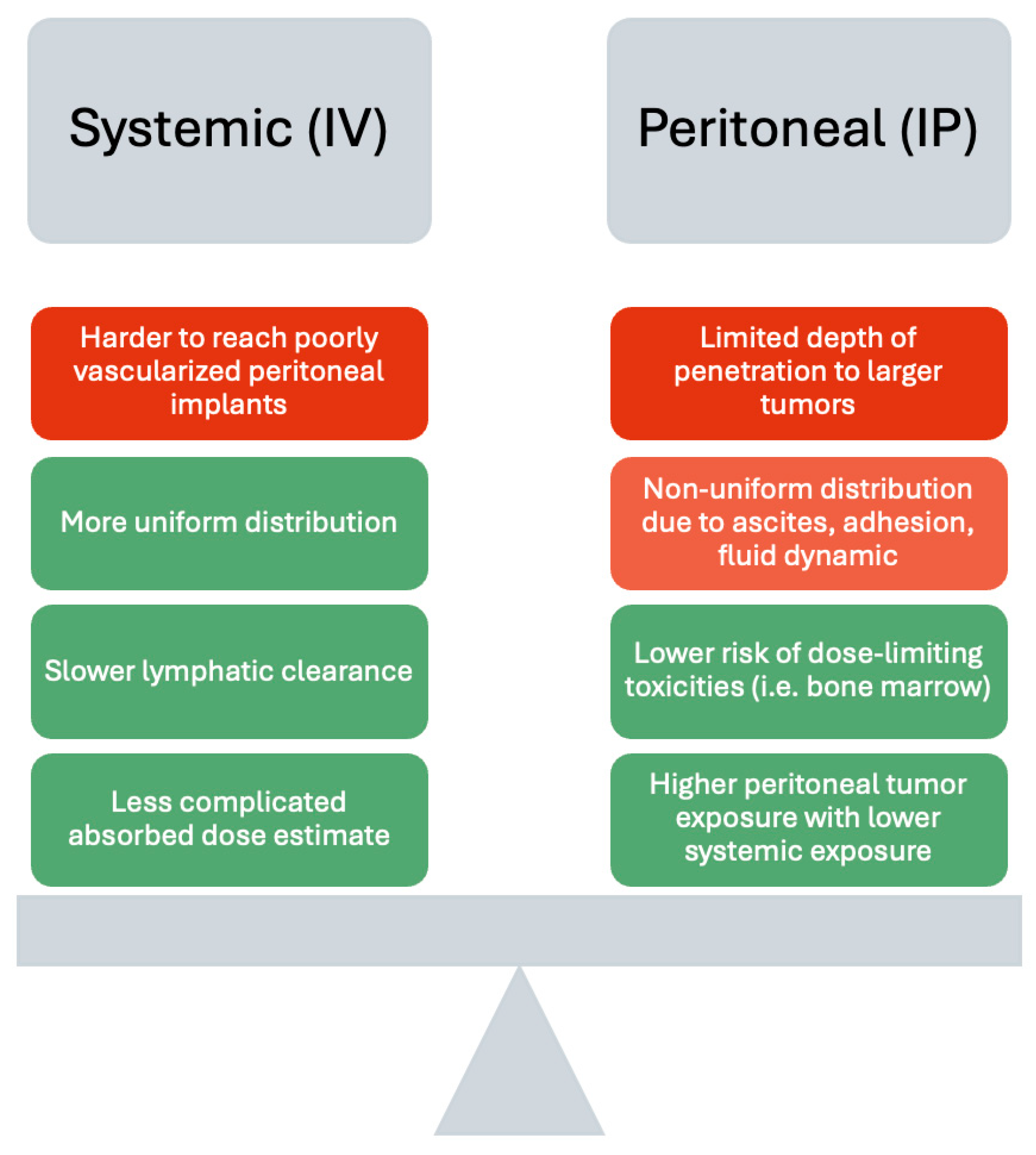
6. Challenges
7. Future Perspectives and Opportunities
8. Conclusions
Supplementary Materials
Author Contributions
Funding
Institutional Review Board Statement
Informed Consent Statement
Data Availability Statement
Acknowledgments
Conflicts of Interest
Abbreviations
| OC | Ovarian cancer |
| TAT | Targeted alpha-particle therapy |
| dsDNA | Double-stranded DNA |
| RIT | Radioimmunotherapy |
| HIPEC | Hyperthermic intraperitoneal chemotherapy |
| LET | Linear energy transfer |
| FIGO | International Federation of Gynecology and Obstetrics |
| IP | Intraperitoneal |
| IV | Intravenous |
| TFF | Tumor-free fraction |
| IC | Initial activity concentration |
| mCRPC | Metastatic castration-resistant prostate cancer |
References
- Zhu, B.; Gu, H.; Mao, Z.; Beeraka, N.M.; Zhao, X.; Anand, M.P.; Zheng, Y.; Zhao, R.; Li, S.; Manogaran, P.; et al. Global Burden of Gynaecological Cancers in 2022 and Projections to 2050. J. Glob. Health 2024, 14, 04155. [Google Scholar] [CrossRef]
- Matulonis, U.A.; Sood, A.K.; Fallowfield, L.; Howitt, B.E.; Sehouli, J.; Karlan, B.Y. Ovarian Cancer. Nat. Rev. Dis. Primers 2016, 2, 16061. [Google Scholar] [CrossRef]
- Hong, M.K.; Ding, D.C. Early Diagnosis of Ovarian Cancer: A Comprehensive Review of the Advances, Challenges, and Future Directions. Diagnostics 2025, 15, 406. [Google Scholar] [CrossRef] [PubMed]
- Mei, S.; Chen, X.; Wang, K.; Chen, Y. Tumor Microenvironment in Ovarian Cancer Peritoneal Metastasis. Cancer Cell Int. 2023, 23, 11. [Google Scholar] [CrossRef]
- He, T.; Li, H.; Zhang, Z. Differences of Survival Benefits Brought by Various Treatments in Ovarian Cancer Patients with Different Tumor Stages. J. Ovarian Res. 2023, 16, 92. [Google Scholar] [CrossRef] [PubMed]
- Alizadeh, H.; Akbarabadi, P.; Dadfar, A.; Tareh, M.R.; Soltani, B. A Comprehensive Overview of Ovarian Cancer Stem Cells: Correlation with High Recurrence Rate, Underlying Mechanisms, and Therapeutic Opportunities. Mol. Cancer 2025, 24, 135. [Google Scholar] [CrossRef]
- Marchetti, C.; De Felice, F.; Romito, A.; Iacobelli, V.; Sassu, C.M.; Corrado, G.; Ricci, C.; Scambia, G.; Fagotti, A. Chemotherapy Resistance in Epithelial Ovarian Cancer: Mechanisms and Emerging Treatments. Semin. Cancer Biol. 2021, 77, 144–166. [Google Scholar] [CrossRef]
- Elledge, C.R.; LaVigne, A.W.; Bhatia, R.K.; Viswanathan, A.N. Aiming for 100% Local Control in Locally Advanced Cervical Cancer: The Role of Complex Brachytherapy Applicators and Intraprocedural Imaging. Semin. Radiat. Oncol. 2020, 30, 300–310. [Google Scholar] [CrossRef] [PubMed]
- Rütten, H.; Verhoef, C.; van Weelden, W.J.; Smits, A.; Dhanis, J.; Ottevanger, N.; Pijnenborg, J.M.A. Recurrent Endometrial Cancer: Local and Systemic Treatment Options. Cancers 2021, 13, 6275. [Google Scholar] [CrossRef]
- Rondon, A.; Rouanet, J.; Degoul, F. Radioimmunotherapy in Oncology: Overview of the Last Decade Clinical Trials. Cancers 2021, 13, 5570. [Google Scholar] [CrossRef]
- Mondello, P.; Cuzzocrea, S.; Navarra, M.; Mian, M. 90 Y-Ibritumomab Tiuxetan: A Nearly Forgotten Opportunity. Oncotarget 2015, 7, 7597–7609. [Google Scholar] [CrossRef] [PubMed]
- Cheung, M.C.; Maceachern, J.A.; Haynes, A.E.; Meyer, R.M.; Imrie, K. Practice Guideline Series: 131I-Tositumomab in Lymphoma. Curr. Oncol. 2009, 16, 32–47. [Google Scholar] [CrossRef][Green Version]
- Klampatsa, A. Overcoming Efficiency Limitations of CAR-T Cell Therapy in Antigen-Heterogeneous Solid Tumors. Expert Opin. Biol. Ther. 2024, 24, 879–881. [Google Scholar] [CrossRef]
- Chen, N.; Li, X.; Chintala, N.K.; Tano, Z.E.; Adusumilli, P.S. Driving CARs on the Uneven Road of Antigen Heterogeneity in Solid Tumors. Curr. Opin. Immunol. 2018, 51, 103–110. [Google Scholar] [CrossRef]
- Gillies, R.J.; Schornack, P.A.; Secomb, T.W.; Raghunand, N. Causes and Effects of Heterogeneous Perfusion in Tumors. Neoplasia 1999, 1, 197–207. [Google Scholar] [CrossRef]
- Lu, G.; Fakurnejad, S.; Martin, B.A.; van den Berg, N.S.; van Keulen, S.; Nishio, N.; Zhu, A.J.; Chirita, S.U.; Zhou, Q.; Gao, R.W.; et al. Predicting Therapeutic Antibody Delivery into Human Head and Neck Cancers. Clin. Cancer Res. 2020, 26, 2582–2594. [Google Scholar] [CrossRef]
- Minchinton, A.I.; Tannock, I.F. Drug Penetration in Solid Tumours. Nat. Rev. Cancer 2006, 6, 583–592. [Google Scholar] [CrossRef] [PubMed]
- Salih, S.; Alkatheeri, A.; Alomaim, W.; Elliyanti, A. Radiopharmaceutical Treatments for Cancer Therapy, Radionuclides Characteristics, Applications, and Challenges. Molecules 2022, 27, 5231. [Google Scholar] [CrossRef]
- Ferrier, M.G.; Radchenko, V. An Appendix of Radionuclides Used in Targeted Alpha Therapy. J. Med. Imaging Radiat. Sci. 2019, 50, S58–S65. [Google Scholar] [CrossRef]
- Yeong, C.H.; Cheng, M.H.; Ng, K.H. Therapeutic Radionuclides in Nuclear Medicine: Current and Future Prospects. J. Zhejiang Univ. Sci. B 2014, 15, 845–863. [Google Scholar] [CrossRef] [PubMed]
- Kassis, A.I.; Adelstein, S.J. Radiobiologic Principles in Radionuclide Therapy. J. Nucl. Med. 2005, 46, 4S–12S. [Google Scholar] [PubMed]
- Bertolet, A.; Ramos-Méndez, J.; Paganetti, H.; Schuemann, J. The Relation between Microdosimetry and Induction of Direct Damage to DNA by Alpha Particles. Phys. Med. Biol. 2021, 66, 155016. [Google Scholar] [CrossRef]
- Bannik, K.; Madas, B.; Jarzombek, M.; Sutter, A.; Siemeister, G.; Mumberg, D.; Zitzmann-Kolbe, S. Radiobiological Effects of the Alpha Emitter Ra-223 on Tumor Cells. Sci. Rep. 2019, 9, 18489. [Google Scholar] [CrossRef] [PubMed]
- Shore, N.D. Radium-223 Dichloride for Metastatic Castration-Resistant Prostate Cancer: The Urologist’s Perspective. Urology 2015, 85, 717–724. [Google Scholar] [CrossRef]
- Nawar, M.F.; Selim, A.A.; Essa, B.M.; El-Daoushy, A.F.; Swidan, M.M.; Chambers, C.G.; Al Qahtani, M.H.; Smith, C.J.; Sakr, T.M. Actinium-225/Bismuth-213 as Potential Leaders for Targeted Alpha Therapy: Current Supply, Application Barriers, and Future Prospects. Cancers 2025, 17, 3055. [Google Scholar] [CrossRef]
- Bidkar, A.P.; Zerefa, L.; Yadav, S.; VanBrocklin, H.F.; Flavell, R.R. Actinium-225 Targeted Alpha Particle Therapy for Prostate Cancer. Theranostics 2024, 14, 2969–2992. [Google Scholar] [CrossRef] [PubMed]
- Strosberg, J.R.; Naqvi, S.; Cohn, A.L.; Delpassand, E.S.; Wagner, V.J.; Tworowska, I.; Torgue, J.; Woloski, R.; Manuel, A.; Maluccio, M.A.; et al. Safety, Tolerability and Efficacy of 212 Pb-DOTAMTATE as a Targeted Alpha Therapy for Subjects with Unresectable or Metastatic Somatostatin Receptor-Expressing Gastroenteropancreatic Neuroendocrine Tumors (SSTR+ GEP-NETs): A Phase 2 Study. J. Clin. Oncol. 2025, 42, 4020. [Google Scholar] [CrossRef]
- Bergeron, D.E.; Collins, S.M.; Pibida, L.; Cessna, J.T.; Fitzgerald, R.; Zimmerman, B.E.; Ivanov, P.; Keightley, J.D.; Napoli, E. Ra-224 Activity, Half-Life, and 241 KeV Gamma Ray Absolute Emission Intensity: A NIST-NPL Bilateral Comparison. Appl. Radiat. Isot. 2021, 170, 109572. [Google Scholar] [CrossRef]
- Pommé, S.; Marouli, M.; Suliman, G.; Dikmen, H.; Van Ammel, R.; Jobbágy, V.; Dirican, A.; Stroh, H.; Paepen, J.; Bruchertseifer, F.; et al. Measurement of the 225Ac Half-Life. Appl. Radiat. Isot. 2012, 70, 2608–2614. [Google Scholar] [CrossRef]
- Azure, M.T.; Archer, R.D.; Sastry, K.S.R.; Rao, D.V.; Howell, R.W. Biological Effect of Lead-212 Localized in the Nucleus of Mammalian Cells: Role of Recoil Energy in the Radiotoxicity of Internal Alpha-Particle Emitters 1. Radiat. Res. 1994, 140, 276. [Google Scholar] [CrossRef]
- Feng, Y.; Zalutsky, M.R. Production, Purification and Availability of 211At: Near Term Steps towards Global Access. Nucl. Med. Biol. 2021, 100–101, 12–23. [Google Scholar] [CrossRef]
- El-Ghobashy, A.; Ind, T.; Persson, J.; Magrina, J.F. Textbook of Gynecologic Robotic Surgery; Springer: Berlin/Heidelberg, Germany, 2018. [Google Scholar]
- Han, X.; Wen, H.; Ju, X.; Chen, X.; Ke, G.; Zhou, Y.; Li, J.; Xia, L.; Tang, J.; Liang, S.; et al. Predictive Factors of Para-Aortic Lymph Nodes Metastasis in Cervical Cancer Patients: A Retrospective Analysis Based on 723 Para-Aortic Lymphadenectomy Cases. Oncotarget 2017, 8, 51840–51847. [Google Scholar] [CrossRef]
- Alhilli, M.M.; Mariani, A. The Role of Para-Aortic Lymphadenectomy in Endometrial Cancer. Int. J. Clin. Oncol. 2013, 18, 193–199. [Google Scholar] [CrossRef]
- Clark, R.; Krishnan, V.; Schoof, M.; Rodriguez, I.; Theriault, B.; Chekmareva, M.; Rinker-Schaeffer, C. Milky Spots Promote Ovarian Cancer Metastatic Colonization of Peritoneal Adipose in Experimental Models. Am. J. Pathol. 2013, 183, 576–591. [Google Scholar] [CrossRef]
- Tajaldini, M.; Saeedi, M.; Amiriani, T.; Amiriani, A.H.; Sedighi, S.; Zadeh, F.M.; Dehghan, M.; Jahanshahi, M.; Ghandian, M.Z.; Khalili, P.; et al. Cancer-Associated Fibroblasts (CAFs) and Tumor-Associated Macrophages (TAMs); Where Do They Stand in Tumorigenesis and How They Can Change the Face of Cancer Therapy? Eur. J. Pharmacol. 2022, 928, 175087. [Google Scholar] [CrossRef] [PubMed]
- Ramos, C.; Gerakopoulos, V.; Oehler, R. Metastasis-Associated Fibroblasts in Peritoneal Surface Malignancies. Br. J. Cancer 2024, 131, 407–419. [Google Scholar] [CrossRef]
- Li, J.; Guo, T. Role of Peritoneal Mesothelial Cells in the Progression of Peritoneal Metastases. Cancers 2022, 14, 2856. [Google Scholar] [CrossRef] [PubMed]
- Thapa, B.V.; Banerjee, M.; Glimm, T.; Saini, D.K.; Bhat, R. The Senescent Mesothelial Matrix Accentuates Colonization by Ovarian Cancer Cells. Cell. Mol. Life Sci. 2024, 81, 2. [Google Scholar] [CrossRef]
- Ahmed, N.; Stenvers, K.L. Getting to Know Ovarian Cancer Ascites: Opportunities for Targeted Therapy-Based Translational Research. Front. Oncol. 2013, 3, 256. [Google Scholar] [CrossRef] [PubMed]
- Lele, S. Ovarian Cancer; Lele, S., Ed.; Exon Publications: Brisbane, Australia, 2022. [Google Scholar]
- Boo, K.H.; Lee, G.; Song, M. Malignant Ascites in Ovarian Cancer: New Advances and Translational Opportunities. Transl. Oncol. 2025, 62, 102568. [Google Scholar] [CrossRef]
- Chandra, A.; Pius, C.; Nabeel, M.; Nair, M.; Vishwanatha, J.K.; Ahmad, S.; Basha, R. Ovarian Cancer: Current Status and Strategies for Improving Therapeutic Outcomes. Cancer Med. 2019, 8, 7018–7031. [Google Scholar] [CrossRef]
- Meinhold-Heerlein, I.; Fotopoulou, C.; Harter, P.; Kurzeder, C.; Mustea, A.; Wimberger, P.; Hauptmann, S.; Sehouli, J. Statement by the Kommission Ovar of the AGO: The New FIGO and WHO Classifications of Ovarian, Fallopian Tube and Primary Peritoneal Cancer. Geburtshilfe Frauenheilkd 2015, 75, 1021–1027. [Google Scholar] [CrossRef] [PubMed]
- Heublein, S.; Baum, J.; Jaeger, A.; Grimm-Glang, D.; Olthoff, J.; Braicu, E.I.; Nieto, O.A.; Hassdenteufel, K.; Schmalfeldt, B.; Hanker, L.; et al. Current Treatment Practices and Prognostic Factors in Early-Stage Ovarian Cancer—An Analysis of the NOGGO/JAGO. Cancers 2023, 15, 2038. [Google Scholar] [CrossRef]
- Dumas, L.; Ring, A.; Butler, J.; Kalsi, T.; Harari, D.; Banerjee, S. Improving Outcomes for Older Women with Gynaecological Malignancies. Cancer Treat. Rev. 2016, 50, 99–108. [Google Scholar] [CrossRef]
- Lawrie, T.A.; Winter-Roach, B.A.; Heus, P.; Kitchener, H.C. Adjuvant (Post-Surgery) Chemotherapy for Early Stage Epithelial Ovarian Cancer. Cochrane Database Syst. Rev. 2015, 2015, CD004706. [Google Scholar] [CrossRef] [PubMed]
- Collinson, F.; Qian, W.; Fossati, R.; Lissoni, A.; Williams, C.; Parmar, M.; Ledermann, J.; Colombo, N.; Swart, A. Optimal Treatment of Early-Stage Ovarian Cancer. Ann. Oncol. 2014, 25, 1165–1171. [Google Scholar] [CrossRef] [PubMed]
- Gaillard, S.; Lacchetti, C.; Armstrong, D.K.; Cliby, W.A.; Edelson, M.I.; Garcia, A.A.; Ghebre, R.G.; Gressel, G.M.; Lesnock, J.L.; Meyer, L.A.; et al. Neoadjuvant Chemotherapy for Newly Diagnosed, Advanced Ovarian Cancer: ASCO Guideline Update. J. Clin. Oncol. 2025, 43, 868–891. [Google Scholar] [CrossRef]
- Garzon, S.; Laganà, A.S.; Casarin, J.; Raffaelli, R.; Cromi, A.; Franchi, M.; Barra, F.; Alkatout, I.; Ferrero, S.; Ghezzi, F. Secondary and Tertiary Ovarian Cancer Recurrence: What Is the Best Management? Gland Surg. 2020, 9, 1118–1129. [Google Scholar] [CrossRef]
- Salani, R.; Backes, F.J.; Fung, M.F.K.; Holschneider, C.H.; Parker, L.P.; Bristow, R.E.; Goff, B.A. Posttreatment Surveillance and Diagnosis of Recurrence in Women with Gynecologic Malignancies: Society of Gynecologic Oncologists Recommendations. Am. J. Obstet. Gynecol. 2011, 204, 466–478. [Google Scholar] [CrossRef]
- Levy, K.; Natarajan, S.; Wang, J.; Chow, S.; Eggold, J.T.; Loo, P.E.; Manjappa, R.; Melemenidis, S.; Lartey, F.M.; Schüler, E.; et al. Abdominal FLASH Irradiation Reduces Radiation-Induced Gastrointestinal Toxicity for the Treatment of Ovarian Cancer in Mice. Sci. Rep. 2020, 10, 21600. [Google Scholar] [CrossRef]
- Sharifi, M.; Cho, W.C.; Ansariesfahani, A.; Tarharoudi, R.; Malekisarvar, H.; Sari, S.; Bloukh, S.H.; Edis, Z.; Amin, M.; Gleghorn, J.P.; et al. An Updated Review on EPR-Based Solid Tumor Targeting Nanocarriers for Cancer Treatment. Cancers 2022, 14, 2868. [Google Scholar] [CrossRef]
- Huang, D.; Sun, L.; Huang, L.; Chen, Y. Nanodrug Delivery Systems Modulate Tumor Vessels to Increase the Enhanced Permeability and Retention Effect. J. Pers. Med. 2021, 11, 124. [Google Scholar] [CrossRef]
- Wu, J. The Enhanced Permeability and Retention (Epr) Effect: The Significance of the Concept and Methods to Enhance Its Application. J. Pers. Med. 2021, 11, 771. [Google Scholar] [CrossRef]
- Zhang, Y.; Cui, Q.; Xu, M.; Liu, D.; Yao, S.; Chen, M. Current Advances in PD-1/PD-L1 Blockade in Recurrent Epithelial Ovarian Cancer. Front. Immunol. 2022, 13, 901772. [Google Scholar] [CrossRef]
- Chen, K.; Wang, J.; Yang, M.; Deng, S.; Sun, L. Immunotherapy in Recurrent Ovarian Cancer. Biomedicines 2025, 13, 168. [Google Scholar] [CrossRef]
- Wang, L.; Wang, X.; Zhu, X.; Zhong, L.; Jiang, Q.; Wang, Y.; Tang, Q.; Li, Q.; Zhang, C.; Wang, H.; et al. Drug Resistance in Ovarian Cancer: From Mechanism to Clinical Trial. Mol. Cancer 2024, 23, 66. [Google Scholar] [CrossRef]
- Elyashiv, O.; Aleohin, N.; Migdan, Z.; Leytes, S.; Peled, O.; Tal, O.; Levy, T. The Poor Prognosis of Acquired Secondary Platinum Resistance in Ovarian Cancer Patients. Cancers 2024, 16, 641. [Google Scholar] [CrossRef] [PubMed]
- Pokhriyal, R.; Hariprasad, R.; Kumar, L.; Hariprasad, G. Chemotherapy Resistance in Advanced Ovarian Cancer Patients. Biomark. Cancer 2019, 11, 1–19. [Google Scholar] [CrossRef] [PubMed]
- Veneziani, A.C.; Gonzalez-Ochoa, E.; Alqaisi, H.; Madariaga, A.; Bhat, G.; Rouzbahman, M.; Sneha, S.; Oza, A.M. Heterogeneity and Treatment Landscape of Ovarian Carcinoma. Nat. Rev. Clin. Oncol. 2023, 20, 820–842. [Google Scholar] [CrossRef] [PubMed]
- Blagden, S.P. Harnessing Pandemonium: The Clinical Implications of Tumor Heterogeneity in Ovarian Cancer. Front. Oncol. 2015, 5, 149. [Google Scholar] [CrossRef]
- Kumar, S.; Acharya, S.; Karthikeyan, M.; Biswas, P.; Kumari, S. Limitations and Potential of Immunotherapy in Ovarian Cancer. Front. Immunol. 2023, 14, 1292166. [Google Scholar] [CrossRef]
- Azaïs, H.; Vignion-Dewalle, A.S.; Carrier, M.; Augustin, J.; Da Maïa, E.; Penel, A.; Belghiti, J.; Nikpayam, M.; Gonthier, C.; Ziane, L.; et al. Microscopic Peritoneal Residual Disease after Complete Macroscopic Cytoreductive Surgery for Advanced High Grade Serous Ovarian Cancer. J. Clin. Med. 2021, 10, 41. [Google Scholar] [CrossRef] [PubMed]
- Tafreshi, N.K.; Doligalski, M.L.; Tichacek, C.J.; Pandya, D.N.; Budzevich, M.M.; El-Haddad, G.; Khushalani, N.I.; Moros, E.G.; McLaughlin, M.L.; Wadas, T.J.; et al. Development of Targeted Alpha Particle Therapy for Solid Tumors. Molecules 2019, 24, 4314. [Google Scholar] [CrossRef]
- Aghevlian, S.; Boyle, A.J.; Reilly, R.M. Radioimmunotherapy of Cancer with High Linear Energy Transfer (LET) Radiation Delivered by Radionuclides Emitting α-Particles or Auger Electrons. Adv. Drug Deliv. Rev. 2017, 109, 102–118. [Google Scholar] [CrossRef]
- Dekempeneer, Y.; Keyaerts, M.; Krasniqi, A.; Puttemans, J.; Muyldermans, S.; Lahoutte, T.; D’huyvetter, M.; Devoogdt, N. Targeted Alpha Therapy Using Short-Lived Alpha-Particles and the Promise of Nanobodies as Targeting Vehicle. Expert Opin. Biol. Ther. 2016, 16, 1035–1047. [Google Scholar] [CrossRef]
- Staudacher, A.H.; Liapis, V.; Brown, M.P. Therapeutic Targeting of Tumor Hypoxia and Necrosis with Antibody α-Radioconjugates. Antib. Ther. 2018, 1, 75–83. [Google Scholar] [CrossRef]
- Ahenkorah, S.; Cassells, I.; Deroose, C.M.; Cardinaels, T.; Burgoyne, A.R.; Bormans, G.; Ooms, M.; Cleeren, F. Bismuth-213 for Targeted Radionuclide Therapy: From Atom to Bedside. Pharmaceutics 2021, 13, 599. [Google Scholar] [CrossRef]
- Song, Z.; Zhang, J.; Qin, S.; Luan, X.; Zhang, H.; Yang, M.; Jin, Y.; Yang, G.; Yu, F. Targeted Alpha Therapy: A Comprehensive Analysis of the Biological Effects from “Local-Regional-Systemic” Dimensions. Eur. J. Nucl. Med. Mol. Imaging 2025, 53, 30–47. [Google Scholar] [CrossRef] [PubMed]
- Cruz-Nova, P.; Trujillo-Nolasco, M.; Aranda-Lara, L.; Ferro-Flores, G.; Ocampo-García, B. Radiobiological Effect of Alpha Particles. The Scientific Basis of Targeted Alpha-Particle Therapy. Nucl. Med. Biol. 2025, 146–147, 109044. [Google Scholar] [CrossRef] [PubMed]
- Klammer, H.; Mladenov, E.; Li, F.; Iliakis, G. Bystander Effects as Manifestation of Intercellular Communication of DNA Damage and of the Cellular Oxidative Status. Cancer Lett. 2015, 356, 58–71. [Google Scholar] [CrossRef]
- Autsavapromporn, N.; De Toledo, S.M.; Little, J.B.; Jay-Gerin, J.P.; Harris, A.L.; Azzam, E.I. The Role of Gap Junction Communication and Oxidative Stress in the Propagation of Toxic Effects among High-Dose α-Particle-Irradiated Human Cells. Radiat. Res. 2011, 175, 347–357. [Google Scholar] [CrossRef]
- Gaillard, S.; Pusset, D.; De Toledo, S.M.; Fromm, M.; Azzam, E.I. Propagation Distance of the α-Particle-Induced Bystander Effect: The Role of Nuclear Traversal and Gap Junction Communication. Radiat. Res. 2009, 171, 513–520. [Google Scholar] [CrossRef]
- Restier-Verlet, J.; Joubert, A.; Ferlazzo, M.L.; Granzotto, A.; Sonzogni, L.; Al-Choboq, J.; El Nachef, L.; Le Reun, E.; Bourguignon, M.; Foray, N. X-Rays-Induced Bystander Effect Consists in the Formation of DNA Breaks in a Calcium-Dependent Manner: Influence of the Experimental Procedure and the Individual Factor. Biomolecules 2023, 13, 542. [Google Scholar] [CrossRef] [PubMed]
- Burdak-Rothkamm, S.; Short, S.C.; Folkard, M.; Rothkamm, K.; Prise, K.M. ATR-Dependent Radiation-Induced ΓH2AX Foci in Bystander Primary Human Astrocytes and Glioma Cells. Oncogene 2007, 26, 993–1002. [Google Scholar] [CrossRef] [PubMed]
- Li, J.; He, M.; Shen, B.; Yuan, D.; Shao, C. Alpha Particle-Induced Bystander Effect Is Mediated by ROS via a P53-Dependent SCO2 Pathway in Hepatoma Cells. Int. J. Radiat. Biol. 2013, 89, 1028–1034. [Google Scholar] [CrossRef]
- Smolarz, M.; Skoczylas, Ł.; Gawin, M.; Krzyżowska, M.; Pietrowska, M.; Widłak, P. Radiation-Induced Bystander Effect Mediated by Exosomes Involves the Replication Stress in Recipient Cells. Int. J. Mol. Sci. 2022, 23, 4169. [Google Scholar] [CrossRef]
- Yang, M.; Wang, L.; Qin, S.; Dai, X.; Li, J.; An, L.; Song, L.; Gao, J.; Han, Z.; Yu, F. Role of Damaged Mitochondrial Transfer in Alpha-Particle Generator 212Pb Radiation-Induced Bystander Effect. Theranostics 2024, 14, 6768–6782. [Google Scholar] [CrossRef]
- Tang, H.; Cai, L.; He, X.; Niu, Z.; Huang, H.; Hu, W.; Bian, H.; Huang, H. Radiation-Induced Bystander Effect and Its Clinical Implications. Front. Oncol. 2023, 13, 1124412. [Google Scholar] [CrossRef]
- Boyd, M.; Ross, S.C.; Dorrens, J.; Fullerton, N.E.; Tan, K.W.; Zalutsky, M.R.; Mairs, R.J. Radiation-Induced Biologic Bystander Effect Elicited In Vitro by Targeted Radiopharmaceuticals Labeled with a-, b-, and Auger Electron-Emitting Radionuclides. J. Nucl. Med. 2006, 47, 1007–1015. [Google Scholar]
- Gorin, J.B.; Ménager, J.; Gouard, S.; Maurel, C.; Guilloux, Y.; Faivre-Chauvet, A.; Morgenstern, A.; Bruchertseiferf, F.; Chérel, M.; Davodeau, F.; et al. Antitumor Immunity Induced after α Irradiation. Neoplasia 2014, 16, 319–328. [Google Scholar] [CrossRef] [PubMed]
- Spiotto, M.; Fu, Y.-X.; Weichselbaum, R.R. The Intersection of Radiotherapy and Immunotherapy: Mechanisms and Clinical Implications. Sci. Immunol. 2016, 1, eaag1266. [Google Scholar] [CrossRef]
- Hazout, S.; Zwahlen, D.; Oehler, C.; Champion, A.; Benzaquen, D.; Taussky, D. Exploring the Therapeutic Potential of Localized Alpha Irradiation for Cancer: From DNA Damage to Immune Activation. BJR|Open 2025, 7, tzaf030. [Google Scholar] [CrossRef]
- Ferreira, C.A.; Potluri, H.K.; Massey, C.; Grudzinski, J.J.; Carston, A.; Clemons, N.; Thickens, A.; Rosenkrans, Z.; Choi, C.; Pinchuk, A.; et al. Profound Immunomodulatory Effects of Ac-225-NM600 Drive Enhanced Anti-Tumor Response in Prostate Cancer. bioRxiv 2022. [Google Scholar] [CrossRef]
- Reits, E.A.; Hodge, J.W.; Herberts, C.A.; Groothuis, T.A.; Chakraborty, M.; Wansley, E.K.; Camphausen, K.; Luiten, R.M.; De Ru, A.H.; Neijssen, J.; et al. Radiation Modulates the Peptide Repertoire, Enhances MHC Class I Expression, and Induces Successful Antitumor Immunotherapy. J. Exp. Med. 2006, 203, 1259–1271. [Google Scholar] [CrossRef]
- Demirci, E.; Selçuk, N.A.; Beydağı, G.; Ocak, M.; Toklu, T.; Akçay, K.; Kabasakal, L. Initial Findings on the Use of [225Ac]Ac-DOTATATE Therapy as a Theranostic Application in Patients with Neuroendocrine Tumors. Mol. Imaging Radionucl. Ther. 2023, 32, 226–232. [Google Scholar] [CrossRef]
- Tombal, B.; Choudhury, A.; Saad, F.; Gallardo, E.; Soares, A.; Loriot, Y.; McDermott, R.; Rodriguez-Vida, A.; Velho, P.I.; Nolè, F.; et al. Enzalutamide plus Radium-223 in Metastatic Castration-Resistant Prostate Cancer: Results of the EORTC 1333/PEACE-3 Trial. Ann. Oncol. 2025, 36, 1058–1067. [Google Scholar] [CrossRef]
- Parker, C.; Nilsson, S.; Heinrich, D.; Helle, S.I.; O’Sullivan, J.M.; Fosså, S.D.; Chodacki, A.; Wiechno, P.; Logue, J.; Seke, M.; et al. Alpha Emitter Radium-223 and Survival in Metastatic Prostate Cancer. N. Engl. J. Med. 2013, 369, 213–223. [Google Scholar] [CrossRef]
- Smith, M.; Parker, C.; Saad, F.; Miller, K.; Tombal, B.; Ng, Q.S.; Boegemann, M.; Matveev, V.; Piulats, J.M.; Zucca, L.E.; et al. Addition of Radium-223 to Abiraterone Acetate and Prednisone or Prednisolone in Patients with Castration-Resistant Prostate Cancer and Bone Metastases (ERA 223): A Randomised, Double-Blind, Placebo-Controlled, Phase 3 Trial. Lancet Oncol. 2019, 20, 408–419. [Google Scholar] [CrossRef] [PubMed]
- Yadav, M.P.; Ballal, S.; Sahoo, R.K.; Tripathi, M.; Seth, A.; Bal, C. Efficacy and Safety of 225Ac-PSMA-617 Targeted Alpha Therapy in Metastatic Castration-Resistant Prostate Cancer Patients. Theranostics 2020, 10, 9364–9377. [Google Scholar] [CrossRef] [PubMed]
- Jurcic, J.G. Targeted Alpha-Particle Therapy for Hematologic Malignancies. Semin. Nucl. Med. 2020, 50, 152–161. [Google Scholar] [CrossRef]
- Jang, A.; Kendi, A.T.; Johnson, G.B.; Halfdanarson, T.R.; Sartor, O. Targeted Alpha-Particle Therapy: A Review of Current Trials. Int. J. Mol. Sci. 2023, 24, 11626. [Google Scholar] [CrossRef]
- Andersson, H.; Lindegren, S.; Bäck, T.; Jacobsson, L.; Leser, G.; Horvath, G. The Curative and Palliative Potential of the Monoclonal Antibody MOv18 Labelled with 211At in Nude Mice with Intraperitoneally Growing Ovarian Cancer Xenografts: A Long-Term Study. Acta Oncol. 2000, 39, 741–745. [Google Scholar] [CrossRef]
- Palm, S.; Bäck, T.; Aneheim, E.; Hallqvist, A.; Hultborn, R.; Jacobsson, L.; Jensen, H.; Lindegren, S.; Albertsson, P. Evaluation of Therapeutic Efficacy of 211At-Labeled Farletuzumab in an Intraperitoneal Mouse Model of Disseminated Ovarian Cancer. Transl. Oncol. 2021, 14, 100873. [Google Scholar] [CrossRef]
- Andersson, H.; Elgqvist, J.; Horvath, G.; Hultborn, R.; Jacobsson, L.; Jensen, H.; Karlsson, B.; Lindegren, S.; Palm, S. Astatine-211-Labeled Antibodies for Treatment of Disseminated Ovarian Cancer: An Overview of Results in an Ovarian Tumor Model. Clin. Cancer Res. 2003, 9, 3914s–3921s. [Google Scholar]
- Song, E.Y.; Qu, C.F.; Rizvi, S.M.A.; Raja, C.; Beretov, J.; Morgenstern, A.; Apostolidis, C.; Bruchertseifer, F.; Perkins, A.; Allen, B.J. Bismuth-213 Radioimmunotherapy with C595 Anti-MUC1 Monoclonal Antibody in an Ovarian Cancer Ascites Model. Cancer Biol. Ther. 2008, 7, 76–80. [Google Scholar] [CrossRef]
- Derrien, A.; Gouard, S.; Maurel, C.; Gaugler, M.H.; Bruchertseifer, F.; Morgenstern, A.; Faivre-Chauvet, A.; Classe, J.M.; Chérel, M. Therapeutic Efficacy of Alpha-RIT Using a 213Bi-Anti-HCD138 Antibody in a Mouse Model of Ovarian Peritoneal Carcinomatosis. Front. Med. 2015, 2, 88. [Google Scholar] [CrossRef] [PubMed]
- Kasten, B.B.; Arend, R.C.; Katre, A.A.; Kim, H.; Fan, J.; Ferrone, S.; Zinn, K.R.; Buchsbaum, D.J. B7-H3-Targeted 212Pb Radioimmunotherapy of Ovarian Cancer in Preclinical Models. Nucl. Med. Biol. 2017, 47, 23–30. [Google Scholar] [CrossRef] [PubMed]
- Dekempeneer, Y.; Caveliers, V.; Ooms, M.; Maertens, D.; Gysemans, M.; Lahoutte, T.; Xavier, C.; Lecocq, Q.; Maes, K.; Covens, P.; et al. Therapeutic Efficacy of 213Bi-Labeled SdAbs in a Preclinical Model of Ovarian Cancer. Mol. Pharm. 2020, 17, 3553–3566. [Google Scholar] [CrossRef]
- Chung, S.K.; Vargas, D.B.; Chandler, C.S.; Katugampola, S.; Veach, D.R.; McDevitt, M.R.; Seo, S.H.; Vaughn, B.A.; Rinne, S.S.; Punzalan, B.; et al. Efficacy of HER2-Targeted Intraperitoneal 225Ac a-Pretargeted Radioimmunotherapy for Small-Volume Ovarian Peritoneal Carcinomatosis. J. Nucl. Med. 2023, 64, 1439–1445. [Google Scholar] [CrossRef] [PubMed]
- Elgqvist, J.; Andersson, H.; Bernhardt, P.; Bäck, T.; Claesson, I.; Hultborn, R.; Jensen, H.; Johansson, B.R.; Lindegren, S.; Olsson, M.; et al. Administered Activity and Metastatic Cure Probability during Radioimmunotherapy of Ovarian Cancer in Nude Mice with 211At-MX35 F(Ab′)2. Int. J. Radiat. Oncol. Biol. Phys. 2006, 66, 1228–1237. [Google Scholar] [CrossRef]
- Elgqvist, J.; Andersson, H.; Bäck, T.; Hultborn, R.; Jensen, H.; Karlsson, B.; Lindegren, S.; Palm, S.; Warnhammar, E.; Jacobsson, L. Therapeutic Efficacy and Tumor Dose Estimations in Radioimmunotherapy of Intraperitoneally Growing OVCAR-3 Cells in Nude Mice with 211 At-Labeled Monoclonal Antibody MX35. J. Nucl. Med. 2005, 46, 1907–1915. [Google Scholar] [PubMed]
- Elgqvist, J.; Andersson, H.; Bäck, T.; Claesson, I.; Hultborn, R.; Jensen, H.; Johansson, B.R.; Lindegren, S.; Olsson, M.; Palm, S.; et al. A-Radioimmunotherapy of Intraperitoneally Growing OVCAR-3 Tumors of Variable Dimensions: Outcome Related to Measured Tumor Size and Mean Absorbed Dose. J. Nucl. Med. 2006, 47, 1342–1350. [Google Scholar]
- Gustafsson, A.M.E.; Bäck, T.; Elgqvist, J.; Jacobsson, L.; Hultborn, R.; Albertsson, P.; Morgenstern, A.; Bruchertseifer, F.; Jensen, H.; Lindegren, S. Comparison of Therapeutic Efficacy and Biodistribution of 213Bi- and 211At-Labeled Monoclonal Antibody MX35 in an Ovarian Cancer Model. Nucl. Med. Biol. 2012, 39, 15–22. [Google Scholar] [CrossRef]
- Elgqvist, J.; Andersson, H.; Jensen, H.; Kahu, H.; Lindegren, S.; Warnhammar, E.; Hultborn, R. Repeated Intraperitoneal -Radioimmunotherapy of Ovarian Cancer in Mice. J. Oncol. 2010, 2010, 394913. [Google Scholar] [CrossRef][Green Version]
- Elgqvist, J.; Andersson, H.; Bäck, T.; Claesson, I.; Hultborn, R.; Jensen, H.; Lindegren, S.; Olsson, M.; Palm, S.; Warnhammar, E.; et al. Fractionated Radioimmunotherapy of Intraperitoneally Growing Ovarian Cancer in Nude Mice with 211At-MX35 F(Ab′)2: Therapeutic Efficacy and Myelotoxicity. Nucl. Med. Biol. 2006, 33, 1065–1072. [Google Scholar] [CrossRef]
- Frost, S.H.L.; Bäck, T.; Chouin, N.; Hultborn, R.; Jacobsson, L.; Elgqvist, J.; Jensen, H.; Albertsson, P.; Lindegren, S. Comparison of 211At-PRIT and 211At-RIT of Ovarian Microtumors in a Nude Mouse Model. Cancer Biother. Radiopharm. 2013, 28, 108–114. [Google Scholar] [CrossRef]
- Kujawski, M.; Aniogo, E.; Wong, P.; Hui, S.; Ghimire, H.; Poku, E.K.; Yazaki, P.J.; Wong, J.Y.C.; Shively, J.E. Combination Image-Guided and Antibody-Targeted α-Therapy Before Targeted Immunotherapy for Treatment of Solid Tumors. J. Nucl. Med. 2025, 66, 1605–1611. [Google Scholar] [CrossRef]
- Chauhan, S.C.; Vinayek, N.; Maher, D.M.; Bell, M.C.; Dunham, K.A.; Koch, M.D.; Lio, Y.; Jaggi, M. Combined Staining of TAG-72, MUC1, and CA125 Improves Labeling Sensitivity in Ovarian Cancer: Antigens for Multi-Targeted Antibody-Guided Therapy. J. Histochem. Cytochem. 2007, 55, 867–875. [Google Scholar] [CrossRef]
- Minnix, M.; Li, L.; Yazaki, P.J.; Miller, A.D.; Chea, J.; Poku, E.; Liu, A.; Wong, J.Y.C.; Rockne, R.C.; Colcher, D.; et al. TAG-72-Targeted α-Radionuclide Therapy of Ovarian Cancer Using 225Ac-Labeled DOTAylated-HuCC49 Antibody. J. Nucl. Med. 2021, 62, 55–61. [Google Scholar] [CrossRef] [PubMed]
- Mack, K.N.; Bauer, D.; Carter, L.M.; Carrasco, S.E.; Atmane, M.I.; Viray, T.D.; Brooks, C.L.; Hollingsworth, M.A.; Radhakrishnan, P.; Lewis, J.S. Pretargeted Alpha Therapy in MUC16-Positive High-Grade Serous Ovarian Cancer. Nucl. Med. Biol. 2025, 140–141, 108976. [Google Scholar] [CrossRef] [PubMed]
- Mack, K.N.; Samuels, Z.V.; Carter, L.M.; Viray, T.D.; Mandleywala, K.; Brooks, C.L.; Hollingsworth, M.A.; Radhakrishnan, P.; Lewis, J.S. Interrogating the Theranostic Capacity of a MUC16-Targeted Antibody for Ovarian Cancer. J. Nucl. Med. 2024, 65, 580–585. [Google Scholar] [CrossRef]
- Lindland, K.; Westrøm, S.; Dragovic, S.M.; Li, R.G.; Malenge, M.M.; Ho, B.; Juzeniene, A.; Bønsdorff, T.B. Preclinical Evaluation of PTK7-Targeted Radionuclide Therapy. Mol. Cancer Ther. 2025, 24, 1415–1427. [Google Scholar] [CrossRef]
- Berckmans, Y.; Wouters, R.; Raskovic-Lovre, Z.; Van Mechelen, S.; Lindland, K.; Bønsdorff, T.; Coosemans, A.; Cleeren, F. Targeted Alpha Therapy of Ovarian Cancer With212Pb-Labeled Anti-PTK7 Antibody: On-Site212Pb Production and Preclinical Insights. Nucl. Med. Biol. 2025, 150–151, 109570. [Google Scholar] [CrossRef]
- Mattes, M.J.; Look, K.; Furukawa, K.; Pierce, V.; Old, L.; Lewis, J.; Lloyd, K. Mouse Monoclonal Antibodies to Human Differentiation Antigens Expressed on the Surface of Ovarian Carcinoma Cells. Cancer Res. 1987, 47, 6741–6750. [Google Scholar]
- Hallqvist, A.; Bergmark, K.; Bäck, T.; Andersson, H.; Dahm-Kähler, P.; Johansson, M.; Lindegren, S.; Jensen, H.; Jacobsson, L.; Hultborn, R.; et al. Intraperitoneal α-Emitting Radioimmunotherapy with 211AT in Relapsed Ovarian Cancer: Long-Term Follow-up with Individual Absorbed Dose Estimations. J. Nucl. Med. 2019, 60, 1073–1079. [Google Scholar] [CrossRef]
- Harutyunyan, L.; Manvelyan, E.; Karapetyan, N.; Bardakhchyan, S.; Jilavyan, A.; Tamamyan, G.; Avagyan, A.; Safaryan, L.; Zohrabyan, D.; Movsisyan, N.; et al. A Survival Analysis of Patients with Recurrent Epithelial Ovarian Cancer Based on Relapse Type: A Multi-Institutional Retrospective Study in Armenia. Curr. Oncol. 2024, 31, 1323–1334. [Google Scholar] [CrossRef] [PubMed]
- Andersson, H.; Cederkrantz, E.; Bäck, T.; Divgi, C.; Elgqvist, J.; Himmelman, J.; Horvath, G.; Jacobsson, L.; Jensen, H.; Lindegren, S.; et al. Intraperitoneal α-Particle Radioimmunotherapy of Ovarian Cancer Patients: Pharmacokinetics and Dosimetry of 211At-MX35 F(Ab′)2—A Phase I Study. J. Nucl. Med. 2009, 50, 1153–1160. [Google Scholar] [CrossRef]
- Cederkrantz, E.; Andersson, H.; Bernhardt, P.; Bäck, T.; Hultborn, R.; Jacobsson, L.; Jensen, H.; Lindegren, S.; Ljungberg, M.; Magnander, T.; et al. Absorbed Doses and Risk Estimates of 211At-MX35 F(Ab’)2 in Intraperitoneal Therapy of Ovarian Cancer Patients. Int. J. Radiat. Oncol. Biol. Phys. 2015, 93, 569–576. [Google Scholar] [CrossRef] [PubMed]
- Metebi, A.; Kauffman, N.; Xu, L.; Singh, S.K.; Nayback, C.; Fan, J.; Johnson, N.; Diemer, J.; Grimm, T.; Zamiara, M.; et al. Pb-214/Bi-214-TCMC-Trastuzumab Inhibited Growth of Ovarian Cancer in Preclinical Mouse Models. Front. Chem. 2023, 11, 1322773. [Google Scholar] [CrossRef] [PubMed]
- Meredith, R.; Torgue, J.; Shen, S.; Fisher, D.R.; Banaga, E.; Bunch, P.; Morgan, D.; Fan, J.; Straughn, J.M. Dose Escalation and Dosimetry of First-in-Human α Radioimmunotherapy with 212Pb-TCMC-Trastuzumab. J. Nucl. Med. 2014, 55, 1636–1642. [Google Scholar] [CrossRef]
- Meredith, R.F.; Torgue, J.; Azure, M.T.; Shen, S.; Saddekni, S.; Banaga, E.; Carlise, R.; Bunch, P.; Yoder, D.; Alvarez, R. Pharmacokinetics and Imaging of 212Pb-TCMC-Trastuzumab after Intraperitoneal Administration in Ovarian Cancer Patients. Cancer Biother. Radiopharm. 2014, 29, 12–17. [Google Scholar] [CrossRef]
- Meredith, R.F.; Torgue, J.J.; Rozgaja, T.A.; Banaga, E.P.; Bunch, P.W.; Alvarez, R.D.; Straughn, J.M.; Dobelbower, M.C.; Lowy, A.M. Safety and Outcome Measures of First-in-Human Intraperitoneal α Radioimmunotherapy with 212 Pb-TCMC-Trastuzumab. Am. J. Clin. Oncol. 2018, 41, 716–721. [Google Scholar] [CrossRef]
- Trushina, D.B.; Borodina, T.N.; Belyakov, S.; Antipina, M.N. Calcium Carbonate Vaterite Particles for Drug Delivery: Advances and Challenges. Mater. Today Adv. 2022, 14, 100214. [Google Scholar] [CrossRef]
- Wang, Y.; Van Nieuwenhuysen, E.; Skeie-Jensen, T.; Van Gorp, T.; Aksnes, A.-K.; Myren, K.; Vergote, I. First Experience with Intra-Abdominal 224Radium-Labelled Microparticles (Radspherin) After Cytoreductive Surgery for Peritoneal Metastasis in Recurrent Epithelial Ovarian Cancer (Phase 1 Study). Int. J. Gynecol. Cancer 2023, 33, A27–A28. [Google Scholar]
- Larsen, S.G.; Graf, W.; Larsen, R.H.; Revheim, M.E.; Mariathasan, A.M.; Sørensen, O.; Spasojevic, M.; Rashid, G.; Lundstrøm, N.; Gjertsen, T.J.; et al. ONCOInvent Report: 4th Quarter 2024; John Wiley and Sons Inc.: Hoboken, NJ, USA, 2024; Volume 130. [Google Scholar]
- Coleman, R.L.; Spirtos, N.M.; Enserro, D.; Herzog, T.J.; Sabbatini, P.; Armstrong, D.K.; Kim, J.-W.; Park, S.-Y.; Kim, B.-G.; Nam, J.-H.; et al. Secondary Surgical Cytoreduction for Recurrent Ovarian Cancer. N. Engl. J. Med. 2019, 381, 1929–1939. [Google Scholar] [CrossRef] [PubMed]
- Harter, P.; Sehouli, J.; Vergote, I.; Ferron, G.; Reuss, A.; Meier, W.; Greggi, S.; Mosgaard, B.J.; Selle, F.; Guyon, F.; et al. Randomized Trial of Cytoreductive Surgery for Relapsed Ovarian Cancer. N. Engl. J. Med. 2021, 385, 2123–2131. [Google Scholar] [CrossRef] [PubMed]
- Shi, T.; Zhu, J.; Feng, Y.; Tu, D.; Zhang, Y.; Zhang, P.; Jia, H.; Huang, X.; Cai, Y.; Yin, S.; et al. Secondary Cytoreduction Followed by Chemotherapy versus Chemotherapy Alone in Platinum-Sensitive Relapsed Ovarian Cancer (SOC-1): A Multicentre, Open-Label, Randomised, Phase 3 Trial. Lancet Oncol. 2021, 22, 439–449. [Google Scholar] [CrossRef] [PubMed]
- Balan, D.; Kampan, N.C.; Plebanski, M.; Aziz, N.H.A. Unlocking Ovarian Cancer Heterogeneity: Advancing Immunotherapy through Single-Cell Transcriptomics. Front. Oncol. 2024, 14, 1388663. [Google Scholar] [CrossRef]
- MacDonald, W.J.; Purcell, C.; Pinho-Schwermann, M.; Stubbs, N.M.; Srinivasan, P.R.; El-Deiry, W.S. Heterogeneity in Cancer. Cancers 2025, 17, 441. [Google Scholar] [CrossRef]
- Sharifi, M.N.; Shi, Y.; Chrostek, M.R.; Callahan, S.C.; Shang, T.; Berg, T.J.; Helzer, K.T.; Bootsma, M.L.; Sjöström, M.; Josefsson, A.; et al. Clinical Cell-Surface Targets in Metastatic and Primary Solid Cancers. JCI Insight 2024, 9, e183674. [Google Scholar] [CrossRef]
- Jiang, T.; Cheng, R.; Pan, Y.; Zhang, H.; He, Y.; Su, C.; Ren, S.; Zhou, C. Heterogeneity of Neoantigen Landscape between Primary Lesions and Their Matched Metastases in Lung Cancer. Transl. Lung Cancer Res. 2020, 9, 246–256. [Google Scholar] [CrossRef] [PubMed]
- Welch, W.R.; Niloff, J.M.; Anderson, D.; Battaile, A.; Emery, S.; Knapp, R.C.; Bast, R.C. Antigenic Heterogeneity in Human Ovarian Cancer. Gynecol. Oncol. 1990, 38, 12–16. [Google Scholar] [CrossRef]
- Poty, S.; Francesconi, L.C.; McDevitt, M.R.; Morris, M.J.; Lewis, J.S. α-Emitters for Radiotherapy: From Basic Radiochemistry to Clinical Studies—Part 1. J. Nucl. Med. 2018, 59, 878–884. [Google Scholar] [CrossRef]
- Matsumura, Y. Barriers to Antibody Therapy in Solid Tumors, and Their Solutions. Cancer Sci. 2021, 112, 2939–2947. [Google Scholar] [CrossRef]
- Cruz, E.; Kayser, V. Monoclonal Antibody Therapy of Solid Tumors: Clinical Limitations and Novel Strategies to Enhance Treatment Efficacy. Biologics 2019, 13, 33–51. [Google Scholar] [CrossRef]
- Flessner, M.F. Pharmacokinetic Problems in Peritoneal Drug Administration: An Update after 20 Years. Pleura Peritoneum 2016, 1, 183–191. [Google Scholar] [CrossRef] [PubMed]
- Monk, B.J.; Berman, M.L.; Montz, F.J. Current Development Adhesions after Extensive Gynecologic Surgery: Clinical Significance, Etiology, and Prevention. Am. J. Obstret. Gynecol. 1994, 170, 1396–1403. [Google Scholar] [CrossRef]
- Mcbride, W.H.; Mason, K.A.; Davis, C.; Withers, H.R.; Smathers, J.B. Adhesion Formation in Experimental Chronic Radiation Enteropathy. Int. J. Radiat. Oncol. 1989, 16, 737–743. [Google Scholar] [CrossRef]
- Perelló-Trias, M.T.; Serrano-Muñoz, A.J.; Rodríguez-Fernández, A.; Segura-Sampedro, J.J.; Ramis, J.M.; Monjo, M. Intraperitoneal Drug Delivery Systems for Peritoneal Carcinomatosis: Bridging the Gap between Research and Clinical Implementation. J. Control. Release 2024, 373, 70–92. [Google Scholar] [CrossRef]
- Parungo, C.P.; Soybel, D.I.; Colson, Y.L.; Kim, S.-W.; Ohnishi, S.; De Grand, A.M.; Laurence, R.G.; Soltesz, E.G.; Chen, F.Y.; Cohn, L.H.; et al. Lymphatic Drainage of the Peritoneal Space: A Pattern Dependent on Bowel Lymphatics. Ann. Surg. Oncol. 2006, 14, 286–298. [Google Scholar] [CrossRef] [PubMed]
- Jony, M.J.H.; Ranjbar, S.; Prajapati, R.; Eslami, S.M.; Zhen, Z.; Darji, M.; Zhu, X.; Lu, X. Physiological Considerations and Delivery Strategies for Targeting Tumors Through Intraperitoneal Delivery. Pharm. Res. 2025, 42, 2353–2368. [Google Scholar] [CrossRef]
- Parghane, R.V.; Basu, S. Toxicity Manifestations Encountered in Peptide Receptor Radionuclide Therapy Setting. J. Neuroendocrinol. 2025, 37, e13464. [Google Scholar] [CrossRef]
- Shea, A.G.; Idrissou, M.B.; Torres, A.I.; Chen, T.; Hernandez, R.; Morris, Z.S.; Sodji, Q.H. Immunological Effects of Radiopharmaceutical Therapy. Front. Nucl. Med. 2024, 4, 1331364. [Google Scholar] [CrossRef] [PubMed]
- Guja, K.E.; Wu, J.; Agordzo, H.L.; Kwofie, J.; Samaan, D.; Nadel, H.R.; Grady, E.; Shah, J. Adverse Events in Targeted Radionuclide Therapy. Radiographics 2025, 45, e240143. [Google Scholar] [CrossRef]
- Huang, C.Y.; Guatelli, S.; Oborn, B.M.; Allen, B.J. Microdosimetry for Targeted Alpha Therapy of Cancer. Comput. Math. Methods Med. 2012, 2012, 153212. [Google Scholar] [CrossRef]
- Ree, S.M.; Greenwood, H.; Young, J.D.; Roberts, R.; Livens, F.R.; Heath, S.L.; Sosabowski, J.K. Selection of Radionuclide(s) for Targeted Alpha Therapy Based on Their Nuclear Decay Properties. Nucl. Med. Commun. 2024, 45, 465–473. [Google Scholar] [CrossRef] [PubMed]
- Sharma, R.; Mukherjee, A.; Jagasia, P.; Singh, S.K. Assessing the Radiation-Induced Bystander Effect in Radionuclide Therapy Using Targeted Radiopharmaceuticals. EJNMMI Radiopharm. Chem. 2025, 10, 83. [Google Scholar] [CrossRef] [PubMed]
- Mairs, R.J.; Fullerton, N.E.; Zalutsky, M.R.; Boyd, M. Targeted Radiotherapy: Microgray Doses and the Bystander Effect. Dose-Response 2007, 5, 204–213. [Google Scholar] [CrossRef]
- Akhunzianov, A.A.; Rozhina, E.V.; Filina, Y.V.; Rizvanov, A.A.; Miftakhova, R.R. Resistance to Radiotherapy in Cancer. Diseases 2025, 13, 22. [Google Scholar] [CrossRef]
- Ortiz-Cuaran, S.; Leonce, C. Mechanisms of Adaptive Resistance to Targeted Therapy in RET-Aberrant Cancers. Clin. Cancer Res. 2025, 31, 958–959. [Google Scholar] [CrossRef]
- Gong, X.; Zhou, Y.; Deng, Y. Targeting DNA Damage Response-Mediated Resistance in Non-Small Cell Lung Cancer: From Mechanistic Insights to Drug Development. Curr. Oncol. 2025, 32, 367. [Google Scholar] [CrossRef] [PubMed]
- Pazarentzos, E.; Bivona, T.G. Adaptive Stress Signaling in Targeted Cancer Therapy Resistance. Oncogene 2015, 34, 5599–5606. [Google Scholar] [CrossRef]
- Al-Ibraheem, A.; Brink, A.; Lee, S.T.; De Los Reyes, A.; Paez, D.; Craviolatti, P.S.; Llamas-Olier, A.; Giammarile, F.; Abdlkadir, A.S.; Estrada-Lobato, E.; et al. Implementation of Radiotheranostics: Challenges, Barriers, and IAEA-Driven Strategies for Sustainable Access. Semin. Nucl. Med. 2025, 55, 1032–1044. [Google Scholar] [CrossRef]
- Brink, A.; Cerci, J.J.; Giammarile, F.; Yurystovskyi, D.; Korde, A.; Estrada-Lobato, E.; Mikhail-Lette, M.; Pellet, O.; Macapinlac, H.A.; Paez, D. Global Challenges in the Provision of Theranostic Services the International Atomic Energy Agency (IAEA) Perspective. World J. Nucl. Med. 2025, 24, 238–243. [Google Scholar] [CrossRef]
- Tosato, M.; Favaretto, C.; Kleynhans, J.; Burgoyne, A.R.; Gestin, J.F.; van der Meulen, N.P.; Jalilian, A.; Köster, U.; Asti, M.; Radchenko, V. Alpha Atlas: Mapping Global Production of α-Emitting Radionuclides for Targeted Alpha Therapy. Nucl. Med. Biol. 2025, 142–143, 108990. [Google Scholar] [CrossRef]
- Lindegren, S.; Jensen, H.; Van de Maele, H.; Mikolajczak, R.; Rabarijaona, H.; Aneheim, E. Solving the Limited Availability of Astatine-211 from a European Perspective: From Production to the End User. EJNMMI Radiopharm. Chem. 2026, 11, 15. [Google Scholar] [CrossRef]
- Morgenstern, A.; Apostolidis, C.; Bruchertseifer, F. Supply and Clinical Application of Actinium-225 and Bismuth-213. Semin. Nucl. Med. 2020, 50, 119–123. [Google Scholar] [CrossRef]
- Jumapili, N.A.; Zivalj, M.; Barthelmess, R.M.; Raes, G.; De Groof, T.W.M.; Devoogdt, N.; Stijlemans, B.; Vincke, C.; Van Ginderachter, J.A. A Few Good Reasons to Use Nanobodies for Cancer Treatment. Eur. J. Immunol. 2023, 53, e2250024. [Google Scholar] [CrossRef] [PubMed]
- Nessler, I.; Khera, E.; Vance, S.; Kopp, A.; Qiu, Q.; Keating, T.A.; Abu-Yousif, A.O.; Sandal, T.; Legg, J.; Thompson, L.; et al. Increased Tumor Penetration of Single-Domain Antibody-Drug Conjugates Improves in Vivo Efficacy in Prostate Cancer Models. Cancer Res. 2020, 80, 1268–1278. [Google Scholar] [CrossRef]
- Zhang, Q.; Zhang, N.; Xiao, H.; Wang, C.; He, L. Small Antibodies with Big Applications: Nanobody-Based Cancer Diagnostics and Therapeutics. Cancers 2023, 15, 5639. [Google Scholar] [CrossRef] [PubMed]
- Götzke, H.; Kilisch, M.; Martínez-Carranza, M.; Sograte-Idrissi, S.; Rajavel, A.; Schlichthaerle, T.; Engels, N.; Jungmann, R.; Stenmark, P.; Opazo, F.; et al. The ALFA-Tag Is a Highly Versatile Tool for Nanobody-Based Bioscience Applications. Nat. Commun. 2019, 10, 4403. [Google Scholar] [CrossRef]
- Vadevoo, S.M.P.; Gurung, S.; Lee, H.S.; Gunassekaran, G.R.; Lee, S.M.; Yoon, J.W.; Lee, Y.K.; Lee, B. Peptides as Multifunctional Players in Cancer Therapy. Exp. Mol. Med. 2023, 55, 1099–1109. [Google Scholar] [CrossRef] [PubMed]
- Wang, M.; Liu, J.; Xia, M.; Yin, L.; Zhang, L.; Liu, X.; Cheng, Y. Peptide-Drug Conjugates: A New Paradigm for Targeted Cancer Therapy. Eur. J. Med. Chem. 2024, 265, 116119. [Google Scholar] [CrossRef]
- Oh, P.; Li, Y.; Yu, J.; Durr, E.; Krasinska, K.M.; Carver, L.A.; Testa, J.E.; Schnitzer, J.E. Subtractive Proteomic Mapping of the Endothelial Surface in Lung and Solid Tumours for Tissue-Specific Therapy. Nature 2004, 429, 629–635. [Google Scholar] [CrossRef]
- Xu, L.; Metebi, A.; Singh, S.; Erder, E.; Kauffman, N.; Nayback, C.; Schnitzer, J.; Zinn, K. Development of Immune-Competent Mouse Models of Ovarian Cancer for Targeted Radiation Therapy in Combination with Immunotherapy. J. Nucl. Med. 2024, 65, 242186. [Google Scholar]
- Han, L.; Wang, K.; Jiang, Z.; Guo, X.; Yu, J. Recent Development in Bispecific Antibody Immunotherapy for Hematological Malignancies. Crit. Rev. Oncol./Hematol. 2025, 212, 104752. [Google Scholar] [CrossRef]
- Tapia-Galisteo, A.; Compte, M.; Álvarez-Vallina, L.; Sanz, L. When Three Is Not a Crowd: Trispecific Antibodies for Enhanced Cancer Immunotherapy. Theranostics 2023, 13, 1028–1041. [Google Scholar] [CrossRef] [PubMed]
- Park, J.A.; Cheung, N.K.V. Overcoming Tumor Heterogeneity by Ex Vivo Arming of T Cells Using Multiple Bispecific Antibodies. J. Immunother. Cancer 2022, 10, e003771. [Google Scholar] [CrossRef]
- Lan, H.R.; Chen, M.; Yao, S.Y.; Chen, J.X.; Jin, K.T. Bispecific Antibodies Revolutionizing Breast Cancer Treatment: A Comprehensive Overview. Front. Immunol. 2023, 14, 1266450. [Google Scholar] [CrossRef]
- Sun, J.; Huang, X.; Qin, Y.; Fang, X.; Chen, M.; Lin, H.; Guan, J.; Huang, J.; Liu, T.; Wang, B.; et al. LBL-033, a Novel Bispecific Antibody Targeting MUC16 and CD3, for the Treatment of Tumors over-Expressing MUC16. Cancer Res. 2023, 83, 2965. [Google Scholar] [CrossRef]
- Van Nieuwenhuysen, E.; Bouberhan, S.; Papadimitriou, K.; Arend, R.C.; Lee, J.-Y.; Eilish O’cearbhaill, R.; O’malley, D.M.; You, B.; Gonzalez Martin, A.; Michels, J.; et al. A Phase 1/2 Study of Ubamatamab (REGN4018), a MUC163CD3 Bispecific Anti-Body, Administered Alone or in Combination with Cemiplimab (Anti-PD-1) in Patients with Recurrent Ovarian Cancer or MUC16+ Endometrial Cancer. J. Clin. Oncol. 2024, 42, 16. [Google Scholar] [CrossRef]
- Zhou, X.; Dong, L.; Shen, L. Hydroxypyridinones as a Very Promising Platform for Targeted Diagnostic and Therapeutic Radiopharmaceuticals. Molecules 2021, 26, 6997. [Google Scholar] [CrossRef]
- Pilgrim, C.D.; Grimes, T.S.; Smith, C.; Heathman, C.R.; Mathew, J.; Jansone-Popova, S.; Roy, S.; Ray, D.; Bryantsev, V.S.; Zalupski, P.R. Tuning Aminopolycarboxylate Chelators for Efficient Complexation of Trivalent Actinides. Sci. Rep. 2023, 13, 17855. [Google Scholar] [CrossRef]
- Yang, H.; Wilson, J.J.; Orvig, C.; Li, Y.; Wilbur, D.S.; Ramogida, C.F.; Radchenko, V.; Schaffer, P. Harnessing α-Emitting Radionuclides for Therapy: Radiolabeling Method Review. J. Nucl. Med. 2022, 63, 5–13. [Google Scholar] [CrossRef]
- Geszke-Moritz, M.; Moritz, M. Biodegradable Polymeric Nanoparticle-Based Drug Delivery Systems: Comprehensive Overview, Perspectives and Challenges. Polymers 2024, 16, 2536. [Google Scholar] [CrossRef] [PubMed]
- Trujillo-Nolasco, M.; Morales-Avila, E.; Cruz-Nova, P.; Katti, K.V.; Ocampo-García, B. Nanoradiopharmaceuticals Based on Alpha Emitters: Recent Developments for Medical Applications. Pharmaceutics 2021, 13, 1123. [Google Scholar] [CrossRef] [PubMed]
- Karlsson, J.; Vaughan, H.J.; Green, J.J. Biodegradable Polymeric Nanoparticles for Therapeutic Cancer Treatments HHS Public Access. Annu. Rev. Chem. Biomol. Eng. 2018, 9, 105–127. [Google Scholar] [CrossRef]
- Linciano, S.; Vigolo, E.; Rosato, A.; Kumada, Y.; Angelini, A. Albumin-Based Strategies to Effectively Prolong the Circulation Half-Life of Small Immunomodulatory Payloads in Cancer Therapy. Curr. Opin. Biotechnol. 2024, 90, 103218. [Google Scholar] [CrossRef]
- Hoogenboezem, E.N.; Duvall, C.L. Harnessing Albumin as a Carrier for Cancer Therapies. Adv. Drug Deliv. Rev. 2018, 130, 73–89. [Google Scholar] [CrossRef] [PubMed]
- Kozempel, J.; Mokhodoeva, O.; Vlk, M. Progress in Targeted Alpha-Particle Therapy. What We Learned about Recoils Release from in Vivo Generators. Molecules 2018, 23, 581. [Google Scholar] [CrossRef]
- Alkandari, A.M.; Alsayed, Y.M.; El-Hanbaly, A.M. Enhanced Efficacy of Radiopharmaceuticals When Using Technetium-99m-Labeled Liposomal Agents: Synthesis and Pharmacokinetic Properties. Biomedicines 2022, 10, 2994. [Google Scholar] [CrossRef]
- Rahiman, N. Updates and Current States on Liposomal Vehicles for Tumor Targeting: Precision Therapy in the Spotlight. Cancer Nanotechnol. 2025, 16, 12. [Google Scholar] [CrossRef]
- Alkandari, A.M.; Alsayed, Y.M.; El-hanbaly, A.M. Radiopharmaceutical Encapsulated Liposomes as a Novel Radiotracer Imaging and Drug Delivery Protocol. Curr. Radiopharm. 2022, 16, 133–139. [Google Scholar] [CrossRef]
- Behera, J.; Laha, S.S.; Dasgupta, D.; Goswami, S.; Mukherjee, S.; Jaiswar, A.; Modak, P.; Banerjee, M.; Ramachandran, R.V.; Morozov, K.I.; et al. Stable and Highly Steerable Magnetic Nanorobots Demonstrate Therapeutical Functionality in Crowded Biological Media. ACS Nano 2025, 19, 17785–17795. [Google Scholar] [CrossRef]
- Wang, Z.; Wang, C.; Ji, Y.; Yang, M.; Li, C.; Li, M.; Yang, J.; Tang, H.; Luo, X.; Hao, H.; et al. Magnetically Driven Bionic Nanorobots Enhance Chemotherapeutic Efficacy and the Tumor Immune Response via Precise Targeting. Innovation 2025, 6, 100777. [Google Scholar] [CrossRef] [PubMed]
- Fan, S.; Liu, Q.; Dong, J.; Ai, X.; Li, J.; Huang, W.; Sun, T. In Situ Forming an Injectable Hyaluronic Acid Hydrogel for Drug Delivery and Synergistic Tumor Therapy. Heliyon 2024, 10, e32135. [Google Scholar] [CrossRef]
- Thambi, T.; Li, Y.; Lee, D.S. Injectable Hydrogels for Sustained Release of Therapeutic Agents. J. Control. Release 2017, 267, 57–66. [Google Scholar] [CrossRef]
- Peppelenbosch, A.; Van Kuijk, W.H.M.; Bouvy, N.D.; Van Der Sande, F.M.; Tordoir, J.H.M. Peritoneal Dialysis Catheter Placement Technique and Complications. NDT Plus 2008, 1, iv23–iv28. [Google Scholar] [CrossRef]
- Khan, S.F.; Rosner, M.H. Optimizing Peritoneal Dialysis Catheter Placement. Front. Nephrol. 2023, 3, 1056574. [Google Scholar] [CrossRef]
- Mass, A.C.L.; Runge, R.; Wetzig, K.; Huebinger, L.; Brogsitter, C.; Kotzerke, J. Enhancing Effects of Olaparib by Alpha- and Beta-Emitting Radionuclides, X-Rays, and Ultraviolet A Light in Combination with Ortho-IodoHoechst in a Prostate Cancer Cell Model. Pharmaceuticals 2024, 17, 1450. [Google Scholar] [CrossRef]
- Makvandi, M.; Lee, H.; Puentes, L.N.; Reilly, S.W.; Rathi, K.S.; Weng, C.C.; Chan, H.S.; Hou, C.; Raman, P.; Martinez, D.; et al. Targeting PARP-1 with Alpha-Particles Is Potently Cytotoxic to Human Neuroblastoma in Preclinical Models. Mol. Cancer Ther. 2019, 18, 1195–1204. [Google Scholar] [CrossRef]
- Sun, C.; Chu, A.; Song, R.; Liu, S.; Chai, T.; Wang, X.; Liu, Z. PARP Inhibitors Combined with Radiotherapy: Are We Ready? Front. Pharmacol. 2023, 14, 1234973. [Google Scholar] [CrossRef]
- Olivares-Urbano, M.A.; Griñán-Lisón, C.; Marchal, J.A.; Núñez, M.I. CSC Radioresistance: A Therapeutic Challenge to Improve Radiotherapy Effectiveness in Cancer. Cells 2020, 9, 1651. [Google Scholar] [CrossRef] [PubMed]
- Lin, X.; Kong, D.; Chen, Z.S. Editorial: Chemo-Radiation-Resistance in Cancer Therapy. Front. Pharmacol. 2022, 13, 904063. [Google Scholar] [CrossRef] [PubMed]
- Del Mare, S.; Nishri, Y.; Shai, A.; Efrati, M.; Deutsch, L.; Den, R.B.; Kelson, I.; Keisari, Y.; Domankevich, V. Diffusing Alpha-Emitters Radiation Therapy Promotes a Proimmunogenic Tumor Microenvironment and Synergizes with Programmed Cell Death Protein 1 Blockade. Int. J. Radiat. Oncol. Biol. Phys. 2023, 115, 707–718. [Google Scholar] [CrossRef]
- Chen, C.; Liu, Y.; Cui, B. Effect of Radiotherapy on T Cell and PD-1/PD-L1 Blocking Therapy in Tumor Microenvironment. Hum. Vaccines Immunother. 2021, 17, 1555–1567. [Google Scholar] [CrossRef]
- Li, M.; Liu, D.; Lee, D.; Cheng, Y.; Baumhover, N.J.; Marks, B.M.; Sagastume, E.A.; Ballas, Z.K.; Johnson, F.L.; Morris, Z.S.; et al. Targeted Alpha-Particle Radiotherapy and Immune Checkpoint Inhibitors Induces Cooperative Inhibition on Tumor Growth of Malignant Melanoma. Cancers 2021, 13, 3676. [Google Scholar] [CrossRef]
- Kordbacheh, T.; Honeychurch, J.; Blackhall, F.; Faivre-Finn, C.; Illidge, T. Radiotherapy and Anti-PD-1/PD-L1 Combinations in Lung Cancer: Building Better Translational Research Platforms. Ann. Oncol. 2018, 29, 301–310. [Google Scholar] [CrossRef]
- Zheng, W.; Ling, S.; Cao, Y.; Shao, C.; Sun, X. Combined Use of NK Cells and Radiotherapy in the Treatment of Solid Tumors. Front. Immunol. 2023, 14, 1306534. [Google Scholar] [CrossRef] [PubMed]
- He, J.; Yan, Y.; Zhang, J.; Wei, Z.; Li, H.; Xing, L. Synergistic Treatment Strategy: Combining CAR-NK Cell Therapy and Radiotherapy to Combat Solid Tumors. Front. Immunol. 2023, 14, 1298683. [Google Scholar] [CrossRef]
- Garcia-Prada, C.D.; Carmes, L.; Atis, S.; Parach, A.; Bertolet, A.; Jarlier, M.; Poty, S.; Garcia, D.S.; Shin, W.G.; Du Manoir, S.; et al. Gadolinium-Based Nanoparticles Sensitize Ovarian Peritoneal Carcinomatosis to Targeted Radionuclide Therapy. J. Nucl. Med. 2023, 64, 1956–1964. [Google Scholar] [CrossRef]
- Bobba, K.N.; Bidkar, A.P.; Meher, N.; Fong, C.; Wadhwa, A.; Dhrona, S.; Sorlin, A.; Bidlingmaier, S.; Shuere, B.; He, J.; et al. Evaluation of 134Ce/134La as a PET Imaging Theranostic Pair for 225Ac a-Radiotherapeutics. J. Nucl. Med. 2023, 64, 1076–1082. [Google Scholar] [CrossRef]
- Ramonaheng, K.; Qebetu, M.; Banda, K.; Goorhoo, P.; Legodi, K.; Mdanda, S.; Sibiya, S.; Mzizi, Y.; Ndlovu, H.; Kabunda, J.; et al. Advances in Dosimetry and Imaging for 203Pb and 212Pb Radiotheranostics. Semin. Nucl. Med. 2025, 55, 1011–1031. [Google Scholar] [CrossRef]
- Barca, C.; Griessinger, C.M.; Faust, A.; Depke, D.; Essler, M.; Windhorst, A.D.; Devoogdt, N.; Brindle, K.M.; Schäfers, M.; Zinnhardt, B.; et al. Expanding Theranostic Radiopharmaceuticals for Tumor Diagnosis and Therapy. Pharmaceuticals 2022, 15, 13. [Google Scholar] [CrossRef]
- Chang, M.C.; Chiang, P.F.; Kuo, Y.J.; Peng, C.L.; Chen, I.C.; Huang, C.Y.; Chen, C.A.; Chiang, Y.C. Develop Companion Radiopharmaceutical YKL40 Antibodies as Potential Theranostic Agents for Epithelial Ovarian Cancer. Biomed. Pharmacother. 2022, 155, 113668. [Google Scholar] [CrossRef] [PubMed]
- Wood, J.L.; Ghosh, S.; Houston, Z.H.; Fletcher, N.L.; Humphries, J.; Mardon, K.; Akhter, D.T.; Tieu, W.; Ivashkevich, A.; Wheatcroft, M.P.; et al. A First-in-Class Dual-Chelator Theranostic Agent Designed for Use with Imaging-Therapy Radiometal Pairs of Different Elements. Chem. Sci. 2024, 15, 11748–11760. [Google Scholar] [CrossRef] [PubMed]
- de Gooyer, J.M.; Elekonawo, F.M.K.; Bremers, A.J.A.; Boerman, O.C.; Aarntzen, E.H.J.G.; de Reuver, P.R.; Nagtegaal, I.D.; Rijpkema, M.; de Wilt, J.H.W. Multimodal CEA-Targeted Fluorescence and Radioguided Cytoreductive Surgery for Peritoneal Metastases of Colorectal Origin. Nat. Commun. 2022, 13, 2621. [Google Scholar] [CrossRef]
- Gustafsson, J.; Taprogge, J. Future Trends for Patient-Specific Dosimetry Methodology in Molecular Radiotherapy. Phys. Medica 2023, 115, 103165. [Google Scholar] [CrossRef]
- Akhavanallaf, A.; Shiri, I.; Arabi, H.; Zaidi, H. Whole-Body Voxel-Based Internal Dosimetry Using Deep Learning. Eur. J. Nucl. Med. 2020, 48, 670–682. [Google Scholar] [CrossRef]
- Gupta, A.; Lee, M.S.; Kim, J.H.; Lee, D.S.; Lee, J.S. Preclinical Voxel-Based Dosimetry in Theranostics: A Review. Nucl. Med. Mol. Imaging 2020, 54, 86–97. [Google Scholar] [CrossRef] [PubMed]
- Sarrut, D.; Etxebeste, A.; Muñoz, E.; Krah, N.; Létang, J.M. Artificial Intelligence for Monte Carlo Simulation in Medical Physics. Front. Phys. 2021, 9, 738112. [Google Scholar] [CrossRef]
- West, V.; Ezra, E.M.; Nguyen, M.; Ray, T.; Morse, P.; Andrulewicz, J.; Durden, L.; Harker, A.; Mallak, N.; Mittra, E.; et al. Framing Theranostic Protocols: Development, Implementation, and Insights from Clinical Practice. J. Nucl. Med. Technol. 2025, 53, 13S–26S. [Google Scholar] [CrossRef] [PubMed]
- Hungerford, M.; Lamerton, P. Establishing Radiopharmaceutical Centers of Excellence. J. Nucl. Med. Technol. 2025, 53, 27S–37S. [Google Scholar] [CrossRef] [PubMed]
- Dash, A.; Farahati, J.; Giammarile, F.; Jalilian, A. Cyclotron Produced Radionuclides: Emerging Positron Emitters for Medical Applications: 64Cu and 124I Production, Quality Control and Clinical Applications of Radiosynovectomy Agents; International Atomic Energy Agency: Vienna, Austria, 2021. [Google Scholar]
- Pasqual, E.M.; Bertozzi, S.; Londero, A.P.; Brandolin, D.; Mariuzzi, L.; De Pellegrin, A.; Bacchetti, S.; Zoratti, L.; Petri, R.; Della Bianca, C.; et al. Microscopic Peritoneal Carcinomatosis in Gastric Cancer: Prevalence, Prognosis and Predictive Factors. Oncol. Lett. 2018, 15, 710–716. [Google Scholar] [CrossRef] [PubMed]
- Klaver, Y.L.B.; Lemmens, V.E.P.P.; Nienhuijs, S.W.; Luyer, M.D.P.; de Hingh, I.H.J.T. Peritoneal Carcinomatosis of Colorectal Origin: Incidence, Prognosis and Treatment Options. World J. Gastroenterol. 2012, 18, 5489–5494. [Google Scholar] [CrossRef]


| Alpha-Emitter | Half-Life | Range (μm) | Emissions per Decay | Max Energy (MeV) |
|---|---|---|---|---|
| 224Ra [28] | 3.6 d | 50–80 | 4 alpha | 5.79 |
| 225Ac [29] | 9.92 d | 50–90 | 4 alpha, 2 beta- | 5.83 |
| 212Pb * [30] | 10.64 h | 600 | 1 alpha, 2 beta- | 8.375 |
| 211At [31] | 7.21 h | 55–80 | 1 alpha, 1 EC | 5.982 |
| 212Bi [30] | 60.6 min | 40–100 | 1 alpha, 1 beta- | 6.090 |
| 213Bi [29] | 45.6 min | 40–100 | 1 alpha, 2 beta- | 5.869 |
| Agent (Target) | Alpha-Emitter | Route | Phase /Status | ID | Patient Population | Dosing Schema | Reported Toxicity/Primary Outcomes |
|---|---|---|---|---|---|---|---|
| MX35 F(ab’)2 (NaPi2b/SLC34A2) | 211At | I.P. | Phase I completed, long-term follow-up | NCT04461457 | Ovarian cancer patients in clinical remission, with microscopic residual | Escalating doses in the 20–215 MBq/L range | Toxicity was limited to transient, low-grade procedural symptoms; hematologic, renal, and late radiation-induced toxicities were not observed |
| Trastuzumab (HER2) | 212Pb | I.P. | Phase I completed | NCT01384253 | Patients with HER2+ ovarian and other peritoneal carcinomatosis | Escalating doses up to 27 MBq/m2 | Minimal toxicity across the initial dose cohorts and no late toxicity observed in most patients with >1 year follow-up |
| Radspherin CaCO3 microparticles | 224Ra | I.P. | Phase 1/2a completed; phase 2 randomized ongoing | NCT03732768;NCT06504147 | Ovarian cancer patients undergoing cytoreductive surgery ± HIPEC with residual microscopic peritoneal disease | Escalating doses at 1–2-4–7 MBq not reported for ongoing trials | No dose-limiting toxicities across the 1–2–4–7 MBq dose levels, with one serious adverse event related to administration. The ongoing trial is intended to track safety/toxicity (adverse events) alongside efficacy |
Disclaimer/Publisher’s Note: The statements, opinions and data contained in all publications are solely those of the individual author(s) and contributor(s) and not of MDPI and/or the editor(s). MDPI and/or the editor(s) disclaim responsibility for any injury to people or property resulting from any ideas, methods, instructions or products referred to in the content. |
© 2026 by the authors. Licensee MDPI, Basel, Switzerland. This article is an open access article distributed under the terms and conditions of the Creative Commons Attribution (CC BY) license.
Share and Cite
Xu, L.L.; Singh, S.K.; Gaspar, N.; Fan, J.; Viglianti, B.L.; Zinn, K.R. A Scoping Review of the Challenges and Future Perspectives in the Use of Alpha-Emitters for Metastatic Ovarian Cancer. Molecules 2026, 31, 1019. https://doi.org/10.3390/molecules31061019
Xu LL, Singh SK, Gaspar N, Fan J, Viglianti BL, Zinn KR. A Scoping Review of the Challenges and Future Perspectives in the Use of Alpha-Emitters for Metastatic Ovarian Cancer. Molecules. 2026; 31(6):1019. https://doi.org/10.3390/molecules31061019
Chicago/Turabian StyleXu, Lu Lucy, Satyendra Kumar Singh, Nelli Gaspar, Jinda Fan, Benjamin L. Viglianti, and Kurt R. Zinn. 2026. "A Scoping Review of the Challenges and Future Perspectives in the Use of Alpha-Emitters for Metastatic Ovarian Cancer" Molecules 31, no. 6: 1019. https://doi.org/10.3390/molecules31061019
APA StyleXu, L. L., Singh, S. K., Gaspar, N., Fan, J., Viglianti, B. L., & Zinn, K. R. (2026). A Scoping Review of the Challenges and Future Perspectives in the Use of Alpha-Emitters for Metastatic Ovarian Cancer. Molecules, 31(6), 1019. https://doi.org/10.3390/molecules31061019