Insights into the Design of MYC-Targeting Proteolysis Targeting Chimeras (PROTACs)

 , , , , and
Abstract
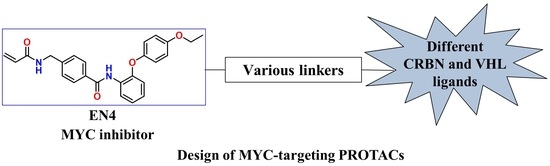
1. Introduction
2. Results and Discussion
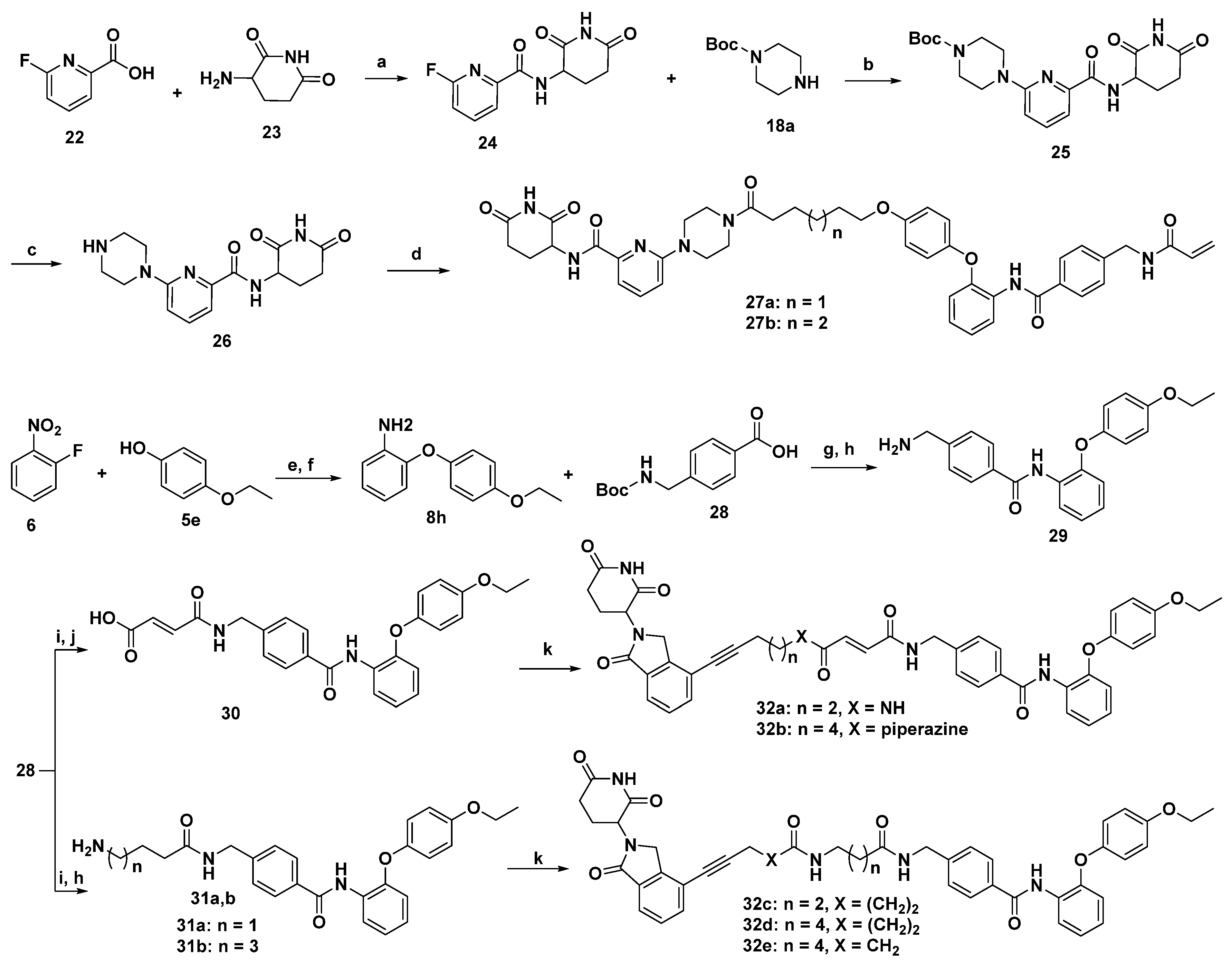
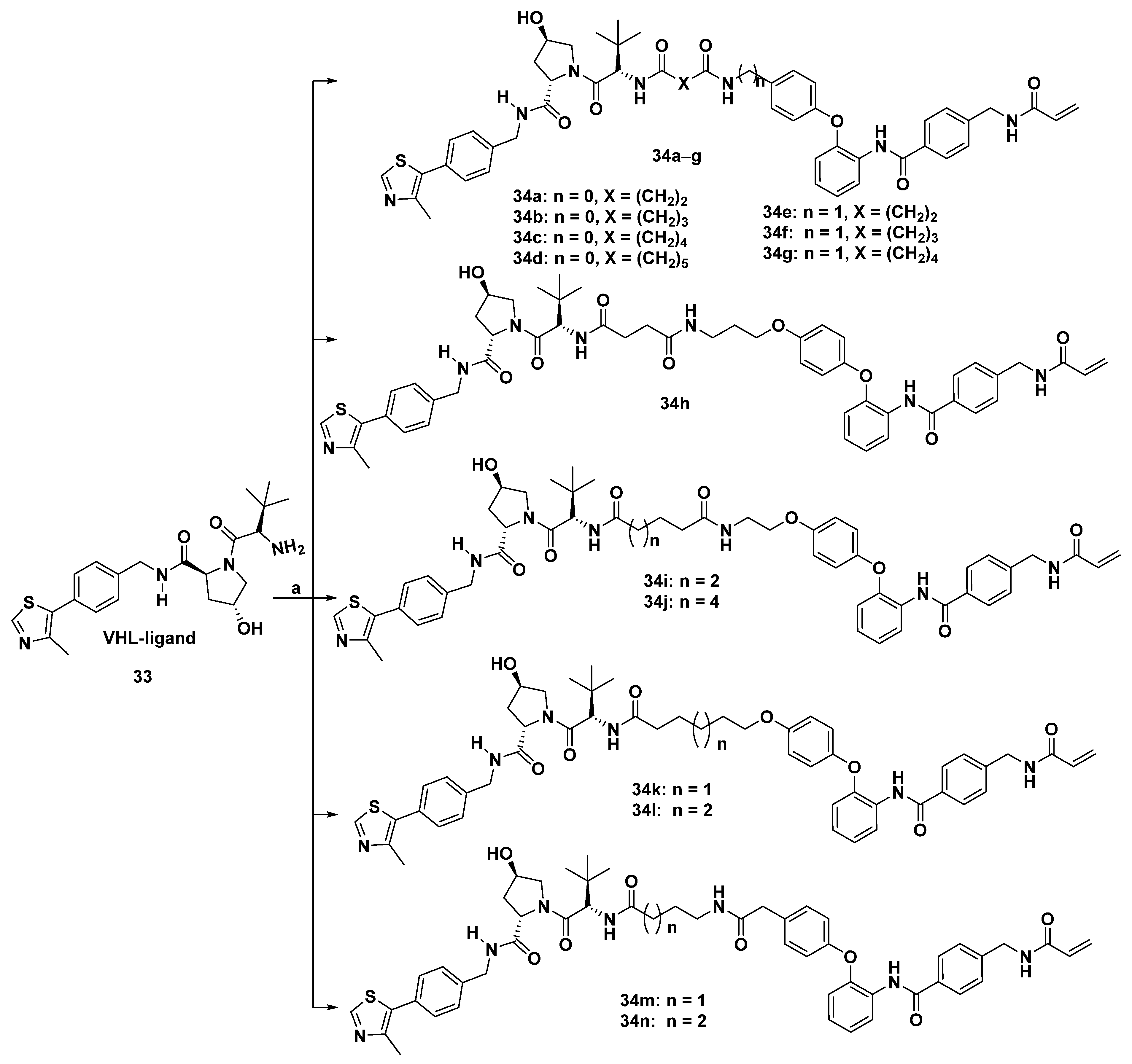
2.1. Chemistry
2.2. Non-Enzymatic Stability Testing
2.3. Microsomal Stability Testing
2.4. Biological Testing
3. Materials and Methods
3.1. General
3.2. General Synthetic Methods
3.2.1. Method I: Amide Coupling
3.2.2. Method II: Ester Hydrolysis
3.2.3. Method III: Reaction of Phenols with 2-Fluoronitrobenzene
3.2.4. Method IV: Reduction of Nitro to Amine Derivatives
3.2.5. Method V: Boc Deprotection
3.2.6. Method VI: Sonogashira Coupling
3.2.7. Method VII: Hydrogenation
3.2.8. Method VIII: Alkylation Reaction
3.3. Characterization Data of Key Intermediates and Final Compounds
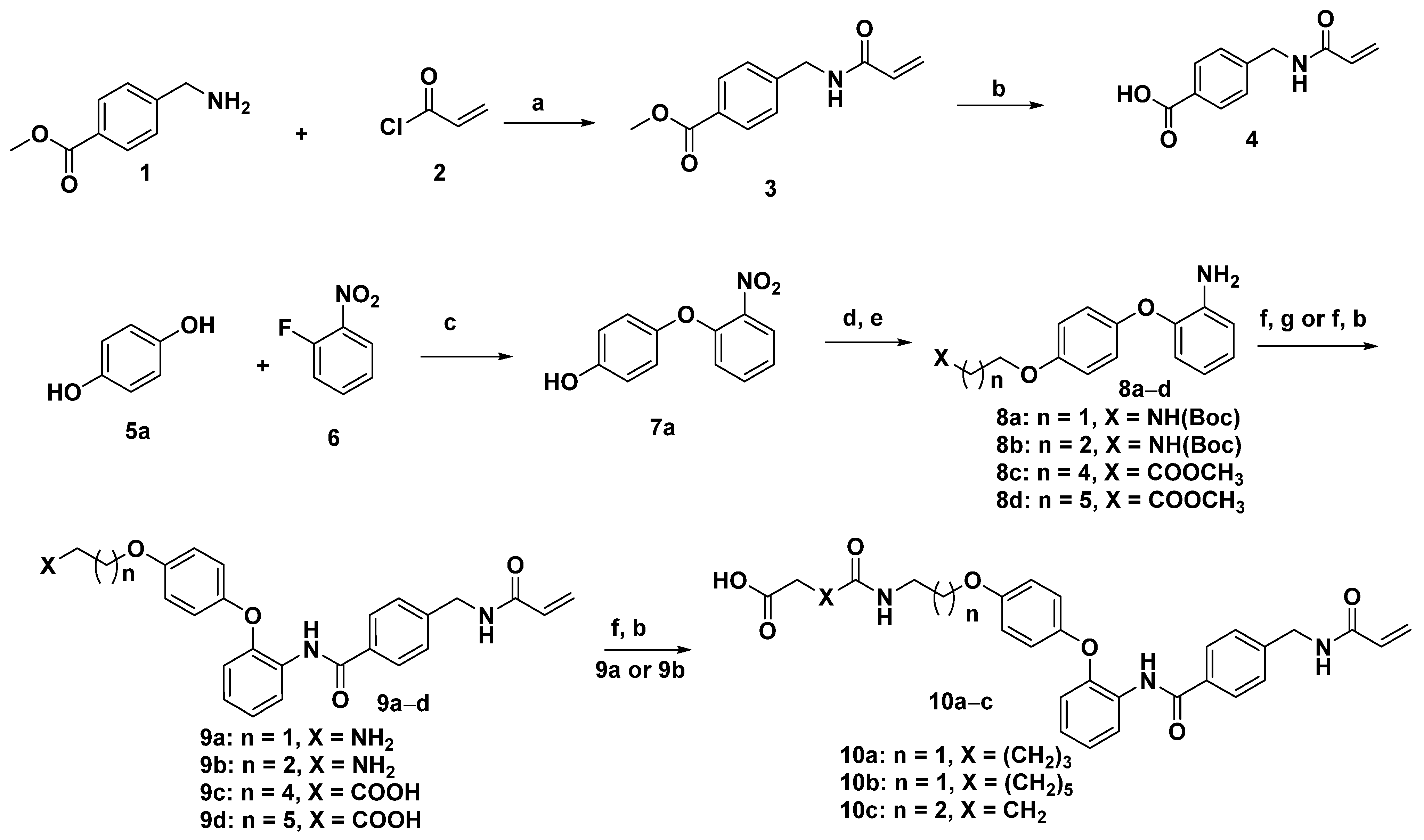
3.3.1. Synthesis and Characterization of Intermediates 3 and 4
- Methyl 4-(acrylamidomethyl)benzoate (3). 1H NMR (400 MHz, DMSO-d6) δ 8.67 (t, J = 5.5 Hz, 1H), 7.91 (d, J = 8.3 Hz, 2H), 7.38 (d, J = 8.4 Hz, 2H), 6.28 (dd, J = 17.1, 10.1 Hz, 1H), 6.12 (dd, J = 17.1, 2.2 Hz, 1H), 5.62 (dd, J = 10.1, 2.2 Hz, 1H), 4.41 (d, J = 6.0 Hz, 2H), 3.82 (s, 3H).
- 4-(Acrylamidomethyl)benzoic acid (4). 1H NMR (400 MHz, DMSO-d6) δ 12.80 (s, 1H), 8.65 (t, J = 5.8 Hz, 1H), 7.88 (d, J = 8.3 Hz, 2H), 7.35 (d, J = 8.5 Hz, 2H), 6.27 (dd, J = 17.1, 10.1 Hz, 1H), 6.12 (dd, J = 17.1, 2.2 Hz, 1H), 5.62 (dd, J = 10.1, 2.2 Hz, 1H), 4.40 (d, J = 6.0 Hz, 2H).
3.3.2. Synthesis and Characterization of Intermediates 7a–d
- 4-(2-Nitrophenoxy)phenol (7a). 1H NMR (400 MHz, DMSO-d6) δ 9.47 (s, 1H), 7.97 (dd, J = 8.1, 1.6 Hz, 1H), 7.63–7.55 (m, 1H), 7.27–7.18 (m, 1H), 6.98–6.90 (m, 3H), 6.84–6.75 (m, 2H).
- tert-Butyl (4-(2-nitrophenoxy)phenyl)carbamate (7b). 1H NMR (400 MHz, DMSO-d6) δ 9.38 (s, 1H), 7.99 (d, J = 8.1 Hz, 1H), 7.66–7.56 (m, 1H), 7.48 (d, J = 8.5 Hz, 2H), 7.30–7.23 (m, 1H), 7.00 (d, J = 8.7 Hz, 3H), 1.45 (s, 9H).
- tert-Butyl (4-(2-nitrophenoxy)benzyl)carbamate (7c). 1H NMR (400 MHz, DMSO-d6) δ 8.03 (dd, J = 8.2, 1.6 Hz, 1H), 7.69–7.62 (m, 1H), 7.42–7.30 (m, 2H), 7.27 (d, J = 8.6 Hz, 2H), 7.08 (dd, J = 8.4, 0.9 Hz, 1H), 7.01 (d, J = 8.6 Hz, 2H), 4.11 (d, J = 6.1 Hz, 2H), 1.38 (s, 9H).
- Methyl 2-(4-(2-nitrophenoxy)phenyl)acetate (7d). 1H NMR (400 MHz, DMSO-d6) δ 8.04 (dd, J = 8.1, 1.5 Hz, 1H), 7.72–7.63 (m, 1H), 7.39–7.26 (m, 3H), 7.12 (d, J = 7.6 Hz, 1H), 7.01 (d, J = 8.5 Hz, 2H), 3.67 (s, 2H), 3.61 (s, 3H).
3.3.3. Synthesis and Characterization of Intermediates 8a–d
- tert-Butyl (2-(4-(2-aminophenoxy)phenoxy)ethyl)carbamate (8a). 1H NMR (400 MHz, DMSO-d6) δ 6.95 (t, J = 5.2 Hz, 1H), 6.86 (q, J = 9.3 Hz, 5H), 6.76 (dd, J = 7.9, 1.7 Hz, 1H), 6.65 (dd, J = 7.9, 1.3 Hz, 1H), 6.52–6.44 (m, 1H), 4.84 (s, 2H), 3.89 (t, J = 5.9 Hz, 2H), 3.25 (dd, J = 5.8, 5.8 Hz, 2H), 1.36 (s, 9H).
- tert-Butyl (3-(4-(2-aminophenoxy)phenoxy)propyl)carbamate (8b). 1H NMR (400 MHz, DMSO-d6) δ 6.90–6.80 (m, 6H), 6.76 (dd, J = 7.9, 1.6 Hz, 1H), 6.65 (dd, J = 7.9, 1.1 Hz, 1H), 6.51–6.45 (m, 1H), 4.84 (s, 2H), 3.90 (t, J = 6.3 Hz, 2H), 3.06 (dd, J = 6.7, 6.7 Hz, 2H), 1.85–1.73 (m, 2H), 1.36 (s, 9H).
- Methyl 6-(4-(2-aminophenoxy)phenoxy)hexanoate (8c). 1H NMR (400 MHz, DMSO-d6) δ 6.90–6.80 (m, 5H), 6.75 (dd, J = 7.9, 1.6 Hz, 1H), 6.65 (dd, J = 8.0, 1.3 Hz, 1H), 6.53–6.43 (m, 1H), 4.84 (s, 2H), 3.88 (t, J = 6.5 Hz, 2H), 3.56 (s, 3H), 2.31 (t, J = 7.4 Hz, 2H), 1.72–1.63 (m, 2H), 1.62–1.50 (m, 2H), 1.45–1.32 (m, 2H).
- Methyl 7-(4-(2-aminophenoxy)phenoxy)heptanoate (8d). 1H NMR (400 MHz, DMSO-d6) δ 6.93–6.79 (m, 5H), 6.75 (dd, J = 7.9, 1.6 Hz, 1H), 6.65 (dd, J = 7.9, 1.2 Hz, 1H), 6.52–6.44 (m, 1H), 4.84 (s, 2H), 3.88 (t, J = 6.4 Hz, 2H), 3.56 (s, 3H), 2.28 (t, J = 7.4 Hz, 2H), 1.72–1.60 (m, 2H), 1.58–1.47 (m, 2H), 1.43–1.22 (m, 4H).
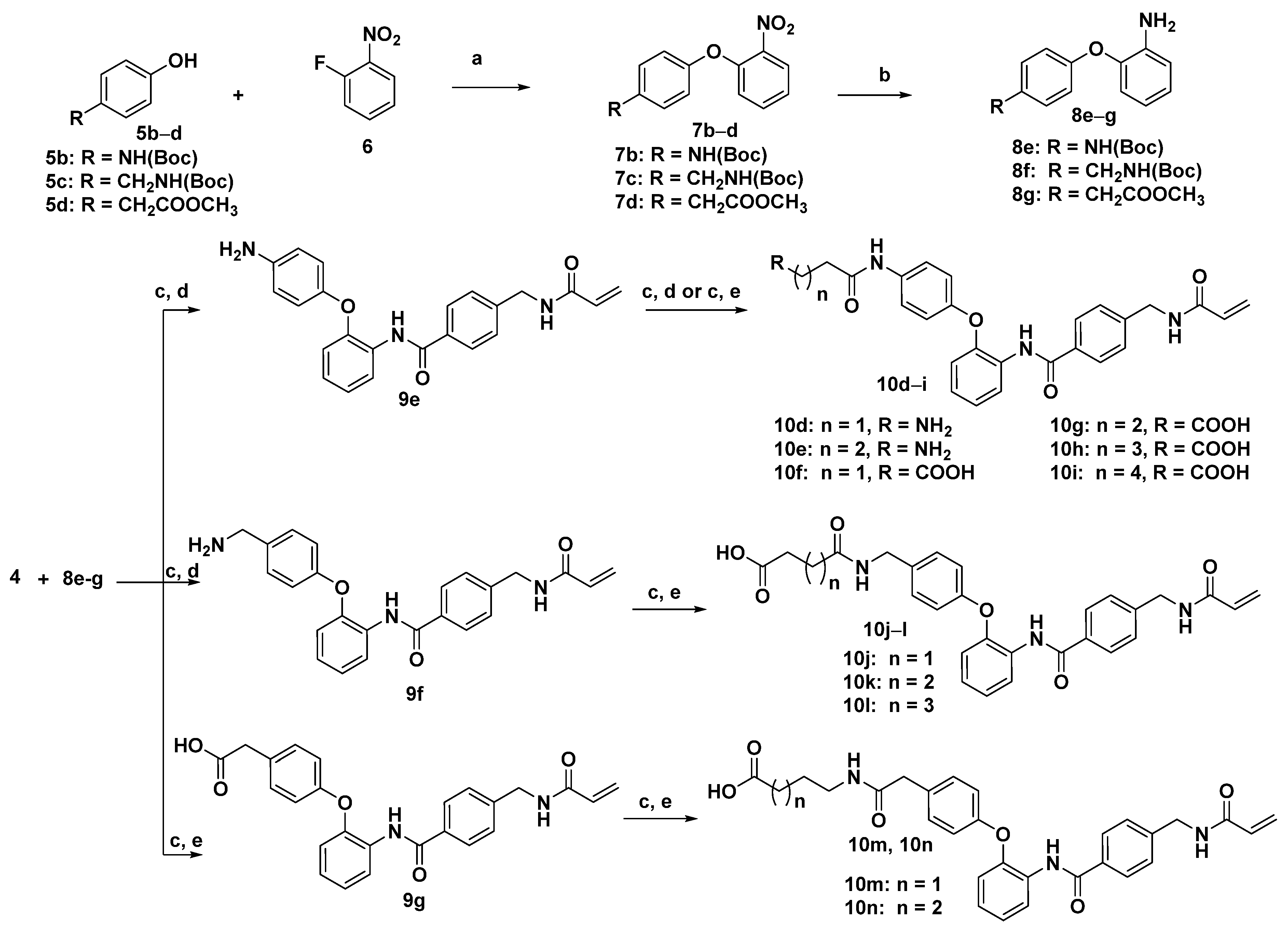
3.3.4. Synthesis and Characterization of Intermediates 8e–g
- tert-Butyl (4-(2-aminophenoxy)phenyl)carbamate (8e). 1H NMR (400 MHz, DMSO-d6) δ 9.21 (s, 1H), 7.38 (d, J = 8.6 Hz, 2H), 6.89–6.73 (m, 4H), 6.67 (dd, J = 8.0, 1.4 Hz, 1H), 6.54–6.45 (m, 1H), 4.83 (s, 2H), 1.45 (s, 9H).
- tert-Butyl (4-(2-aminophenoxy)benzyl)carbamate (8f). 1H NMR (400 MHz, DMSO-d6) δ 7.29 (t, J = 5.9 Hz, 1H), 7.16 (d, J = 8.5 Hz, 2H), 6.92–6.85 (m, 1H), 6.82 (d, J = 8.5 Hz, 2H), 6.78 (dd, J = 7.9, 1.6 Hz, 1H), 6.72 (dd, J = 7.8, 1.4 Hz, 1H), 6.56–6.47 (m, 1H), 4.82 (s, 2H), 4.05 (d, J = 6.6 Hz, 2H), 1.36 (s, 9H).
- Methyl 2-(4-(2-aminophenoxy)phenyl)acetate (8g). 1H NMR (400 MHz, DMSO-d6) δ 7.18 (d, J = 8.6 Hz, 2H), 6.93–6.87 (m, 1H), 6.86–6.73 (m, 4H), 6.57–6.48 (m, 1H), 4.86 (s, 2H), 3.60 (s, 2H), 3.59 (s, 3H).
3.3.5. Synthesis and Characterization of Intermediates 8h
- 2-(4-Ethoxyphenoxy)aniline (8h). 1H NMR (400 MHz, DMSO-d6) δ 6.91–6.80 (m, 5H), 6.76 (dd, J = 7.9, 1.6 Hz, 1H), 6.65 (dd, J = 7.9, 1.4 Hz, 1H), 6.53–6.44 (m, 1H), 4.84 (s, 2H), 3.95 (q, J = 7.0 Hz, 2H), 1.28 (t, J = 7.0 Hz, 3H).
3.3.6. Synthesis and Characterization of Intermediates 9a–g
- 4-(Acrylamidomethyl)-N-(2-(4-(2-aminoethoxy)phenoxy)phenyl)benzamide (9a). 1H NMR (400 MHz, DMSO-d6) δ 9.72 (s, 1H), 8.68 (t, J = 6.0 Hz, 1H), 8.00 (s, 3H), 7.81 (d, J = 8.3 Hz, 2H), 7.73 (dd, J = 7.6, 2.1 Hz, 1H), 7.34 (d, J = 8.2 Hz, 2H), 7.21–7.08 (m, 2H), 7.02–6.92 (m, 4H), 6.85 (dd, J = 7.8, 1.7 Hz, 1H), 6.28 (dd, J = 17.1, 10.1 Hz, 1H), 6.11 (dd, J = 17.1, 2.2 Hz, 1H), 5.62 (dd, J = 10.1, 2.2 Hz, 1H), 4.39 (d, J = 6.0 Hz, 2H), 4.09 (t, J = 5.1 Hz, 2H), 3.21–3.12 (m, 2H).
- 4-(Acrylamidomethyl)-N-(2-(4-(3-aminopropoxy)phenoxy)phenyl)benzamide (9b). 1H NMR (400 MHz, DMSO-d6) δ 9.71 (s, 1H), 8.68 (t, J = 6.0 Hz, 1H), 7.82 (d, J = 8.2 Hz, 5H), 7.73 (dd, J = 7.8, 1.9 Hz, 1H), 7.34 (d, J = 8.2 Hz, 2H), 7.20–7.07 (m, 2H), 7.03–6.87 (m, 4H), 6.83 (dd, J = 7.7, 1.7 Hz, 1H), 6.28 (dd, J = 17.1, 10.1 Hz, 1H), 6.11 (dd, J = 17.1, 2.2 Hz, 1H), 5.62 (dd, J = 10.1, 2.2 Hz, 1H), 4.39 (d, J = 6.0 Hz, 2H), 3.99 (t, J = 6.0 Hz, 2H), 2.99–2.90 (m, 2H), 2.02–1.91 (m, 2H).
- 6-(4-(2-(4-(Acrylamidomethyl)benzamido)phenoxy)phenoxy)hexanoic acid (9c). 1H NMR (400 MHz, DMSO-d6) δ 11.96 (br, 1H), 9.68 (s, 1H), 8.64 (t, J = 5.9 Hz, 1H), 7.85–7.79 (m, 2H), 7.74 (dd, J = 7.5, 2.0 Hz, 1H), 7.39–7.29 (m, 2H), 7.20–7.06 (m, 2H), 6.97–6.87 (m, 4H), 6.83 (dd, J = 7.8, 1.7 Hz, 1H), 6.27 (dd, J = 17.1, 10.1 Hz, 1H), 6.12 (dd, J = 17.1, 2.2 Hz, 1H), 5.61 (dd, J = 10.1, 2.2 Hz, 1H), 4.39 (d, J = 6.0 Hz, 2H), 3.89 (t, J = 6.4 Hz, 2H), 2.21 (t, J = 7.3 Hz, 2H), 1.75–1.61 (m, 2H), 1.60–1.48 (m, 2H), 1.45–1.32 (m, 2H).
- 7-(4-(2-(4-(Acrylamidomethyl)benzamido)phenoxy)phenoxy)heptanoic acid (9d). 1H NMR (400 MHz, DMSO-d6) δ 11.98 (br, 1H), 9.67 (s, 1H), 8.64 (t, J = 5.8 Hz, 1H), 7.81 (d, J = 8.2 Hz, 2H), 7.74 (dd, J = 7.6, 2.0 Hz, 1H), 7.34 (d, J = 8.2 Hz, 2H), 7.19–7.06 (m, 2H), 6.98–6.87 (m, 4H), 6.83 (dd, J = 7.8, 1.7 Hz, 1H), 6.27 (dd, J = 17.1, 10.1 Hz, 1H), 6.11 (dd, J = 17.1, 2.2 Hz, 1H), 5.61 (dd, J = 10.1, 2.2 Hz, 1H), 4.39 (d, J = 6.0 Hz, 2H), 3.89 (t, J = 6.4 Hz, 2H), 2.18 (t, J = 7.3 Hz, 2H), 1.71–1.60 (m, 2H), 1.55–1.45 (m, 2H), 1.43–1.25 (m, 4H).
- 4-(Acrylamidomethyl)-N-(2-(4-aminophenoxy)phenyl)benzamide (9e). 1H NMR (400 MHz, DMSO-d6) δ 9.76 (s, 1H), 8.66 (t, J = 5.9 Hz, 1H), 7.78–7.67 (m, 3H), 7.31 (d, J = 8.1 Hz, 2H), 7.27–7.09 (m, 4H), 7.04–6.94 (m, 3H), 6.27 (dd, J = 17.1, 10.1 Hz, 1H), 6.11 (dd, J = 17.1, 2.0 Hz, 1H), 5.62 (dd, J = 10.1, 2.1 Hz, 1H), 4.37 (d, J = 6.0 Hz, 2H).
- 4-(Acrylamidomethyl)-N-(2-(4-(aminomethyl)phenoxy)phenyl)benzamide (9f). 1H NMR (400 MHz, DMSO-d6) δ 9.78 (s, 1H), 8.67 (t, J = 6.0 Hz, 1H), 8.11 (s, 3H), 7.80–7.68 (m, 3H), 7.39 (d, J = 8.7 Hz, 2H), 7.31 (d, J = 8.4 Hz, 2H), 7.26–7.18 (m, 2H), 7.03–6.93 (m, 3H), 6.27 (dd, J = 17.1, 10.1 Hz, 1H), 6.11 (dd, J = 17.1, 2.2 Hz, 1H), 5.62 (dd, J = 10.1, 2.2 Hz, 1H), 4.37 (d, J = 6.0 Hz, 2H), 3.96 (q, J = 5.5 Hz, 2H).
- 2-(4-(2-(4-(Acrylamidomethyl)benzamido)phenoxy)phenyl)acetic acid (9g). 1H NMR (400 MHz, DMSO-d6) δ 12.25 (s, 1H), 9.71 (s, 1H), 8.63 (t, J = 5.9 Hz, 1H), 7.79–7.70 (m, 3H), 7.32 (d, J = 8.2 Hz, 2H), 7.25–7.12 (m, 4H), 6.99–6.88 (m, 3H), 6.27 (dd, J = 17.1, 10.1 Hz, 1H), 6.11 (dd, J = 17.1, 2.2 Hz, 1H), 5.61 (dd, J = 10.1, 2.2 Hz, 1H), 4.38 (d, J = 6.0 Hz, 2H), 3.50 (s, 2H).
3.3.7. Synthesis and Characterization of Intermediates 10a–n
- 6-((2-(4-(2-(4-(Acrylamidomethyl)benzamido)phenoxy)phenoxy)ethyl)amino)-6-oxohexanoic acid (10a). 1H NMR (400 MHz, DMSO-d6) δ 11.94 (br, 1H), 9.68 (s, 1H), 8.64 (t, J = 5.9 Hz, 1H), 8.00 (t, J = 5.4 Hz, 1H), 7.81 (d, J = 8.0 Hz, 2H), 7.77–7.70 (m, 1H), 7.34 (d, J = 8.0 Hz, 2H), 7.20–7.07 (m, 2H), 6.98–6.89 (m, 4H), 6.86–6.80 (m, 1H), 6.27 (dd, J = 17.1, 10.1 Hz, 1H), 6.11 (dd, J = 17.1, 2.1 Hz, 1H), 5.61 (dd, J = 10.1, 2.1 Hz, 1H), 4.39 (d, J = 6.0 Hz, 2H), 3.91 (t, J = 5.6 Hz, 2H), 3.41–3.34 (m, 2H), 2.17 (t, J = 6.6 Hz, 2H), 2.07 (t, J = 6.7 Hz, 2H), 1.54–1.38 (m, 4H).
- 8-((2-(4-(2-(4-(Acrylamidomethyl)benzamido)phenoxy)phenoxy)ethyl)amino)-8-oxooctanoic acid (10b). 1H NMR (400 MHz, DMSO-d6) δ 11.93 (s, 1H), 9.68 (s, 1H), 8.64 (t, J = 6.0 Hz, 1H), 7.98 (t, J = 5.5 Hz, 1H), 7.81 (d, J = 8.3 Hz, 2H), 7.74 (dd, J = 7.6, 2.0 Hz, 1H), 7.34 (d, J = 8.2 Hz, 2H), 7.19–7.06 (m, 2H), 6.99–6.87 (m, 4H), 6.83 (dd, J = 7.7, 1.8 Hz, 1H), 6.27 (dd, J = 17.1, 10.1 Hz, 1H), 6.11 (dd, J = 17.1, 2.2 Hz, 1H), 5.61 (dd, J = 10.1, 2.2 Hz, 1H), 4.39 (d, J = 6.0 Hz, 2H), 3.91 (t, J = 5.7 Hz, 2H), 3.36 (dd, J = 5.7, 5.7 Hz, 2H), 2.15 (t, J = 7.3 Hz, 2H), 2.05 (t, J = 7.4 Hz, 2H), 1.52–1.38 (m, 4H), 1.29–1.15 (m, 4H).
- 4-((3-(4-(2-(4-(Acrylamidomethyl)benzamido)phenoxy)phenoxy)propyl)amino)-4-oxobutanoic acid (10c). 1H NMR (400 MHz, DMSO-d6) δ 12.03 (s, 1H), 9.68 (s, 1H), 8.65 (t, J = 5.9 Hz, 1H), 7.89 (t, J = 5.4 Hz, 1H), 7.82 (d, J = 8.2 Hz, 2H), 7.74 (dd, J = 7.6, 1.6 Hz, 1H), 7.34 (d, J = 8.2 Hz, 2H), 7.19–7.06 (m, 2H), 6.98–6.87 (m, 4H), 6.83 (dd, J = 7.9, 1.4 Hz, 1H), 6.27 (dd, J = 17.1, 10.1 Hz, 1H), 6.11 (dd, J = 17.1, 2.1 Hz, 1H), 5.61 (dd, J = 10.1, 2.1 Hz, 1H), 4.39 (d, J = 6.0 Hz, 2H), 3.91 (t, J = 6.3 Hz, 2H), 3.16 (dd, J = 6.3, 6.3 Hz, 2H), 2.40 (t, J = 6.9 Hz, 2H), 2.28 (t, J = 6.9 Hz, 2H), 1.85–1.74 (m, 2H).
- 4-(Acrylamidomethyl)-N-(2-(4-(3-aminopropanamido)phenoxy)phenyl)benzamide (10d). 1H NMR (400 MHz, DMSO-d6) δ 10.15 (s, 1H), 9.72 (s, 1H), 8.68 (t, J = 6.0 Hz, 1H), 7.89–7.70 (m, 5H), 7.54 (d, J = 9.0 Hz, 2H), 7.33 (d, J = 8.3 Hz, 2H), 7.23–7.10 (m, 2H), 6.99–6.88 (m, 3H), 6.28 (dd, J = 17.1, 10.1 Hz, 1H), 6.11 (dd, J = 17.1, 2.2 Hz, 1H), 5.61 (dd, J = 10.1, 2.2 Hz, 1H), 4.38 (d, J = 6.0 Hz, 2H), 3.12–3.02 (m, 2H), 2.67 (t, J = 6.8 Hz, 2H).
- 4-(Acrylamidomethyl)-N-(2-(4-(4-aminobutanamido)phenoxy)phenyl)benzamide (10e). 1H NMR (400 MHz, DMSO-d6) δ 9.97 (s, 1H), 9.71 (s, 1H), 8.67 (t, J = 6.0 Hz, 1H), 7.89–7.70 (m, 6H), 7.54 (d, J = 9.0 Hz, 2H), 7.33 (d, J = 8.3 Hz, 2H), 7.22–7.10 (m, 2H), 6.99–6.87 (m, 3H), 6.28 (dd, J = 17.1, 10.1 Hz, 1H), 6.11 (dd, J = 17.1, 2.2 Hz, 1H), 5.61 (dd, J = 10.1, 2.2 Hz, 1H), 4.38 (d, J = 6.0 Hz, 2H), 2.89–2.77 (m, 2H), 2.38 (t, J = 7.2 Hz, 2H), 1.89–1.77 (m, 2H).
- 4-((4-(2-(4-(Acrylamidomethyl)benzamido)phenoxy)phenyl)amino)-4-oxobutanoic acid (10f). 1H NMR (400 MHz, DMSO-d6) δ 12.08 (s, 1H), 9.91 (s, 1H), 9.70 (s, 1H), 8.63 (t, J = 6.0 Hz, 1H), 7.80 (d, J = 8.3 Hz, 2H), 7.74 (dd, J = 7.5, 2.1 Hz, 1H), 7.53 (d, J = 9.0 Hz, 2H), 7.33 (d, J = 8.3 Hz, 2H), 7.21–7.09 (m, 2H), 6.97–6.86 (m, 3H), 6.27 (dd, J = 17.1, 10.1 Hz, 1H), 6.11 (dd, J = 17.1, 2.2 Hz, 1H), 5.61 (dd, J = 10.1, 2.2 Hz, 1H), 4.38 (d, J = 6.0 Hz, 2H), 2.53–2.49 (m, 4H).
- 5-((4-(2-(4-(Acrylamidomethyl)benzamido)phenoxy)phenyl)amino)-5-oxopentanoic acid (10g). 1H NMR (400 MHz, DMSO-d6) δ 12.04 (s, 1H), 9.85 (s, 1H), 9.70 (s, 1H), 8.63 (t, J = 5.9 Hz, 1H), 7.79 (d, J = 8.3 Hz, 2H), 7.74 (dd, J = 7.5, 2.0 Hz, 1H), 7.54 (d, J = 9.0 Hz, 2H), 7.33 (d, J = 8.3 Hz, 2H), 7.22–7.09 (m, 2H), 6.97–6.86 (m, 3H), 6.27 (dd, J = 17.1, 10.1 Hz, 1H), 6.11 (dd, J = 17.1, 2.2 Hz, 1H), 5.61 (dd, J = 10.1, 2.2 Hz, 1H), 4.38 (d, J = 6.0 Hz, 2H), 2.30 (t, J = 7.4 Hz, 2H), 2.25 (t, J = 7.3 Hz, 2H), 1.84–1.72 (m, 2H).
- 6-((4-(2-(4-(Acrylamidomethyl)benzamido)phenoxy)phenyl)amino)-6-oxohexanoic acid (10h). 1H NMR (400 MHz, DMSO-d6) δ 12.00 (s, 1H), 9.83 (s, 1H), 9.69 (s, 1H), 8.63 (t, J = 5.9 Hz, 1H), 7.80 (d, J = 8.3 Hz, 2H), 7.74 (dd, J = 7.5, 2.0 Hz, 1H), 7.54 (d, J = 9.0 Hz, 2H), 7.33 (d, J = 8.3 Hz, 2H), 7.21–7.09 (m, 2H), 6.97–6.86 (m, 3H), 6.27 (dd, J = 17.1, 10.1 Hz, 1H), 6.11 (dd, J = 17.1, 2.2 Hz, 1H), 5.61 (dd, J = 10.1, 2.2 Hz, 1H), 4.38 (d, J = 6.0 Hz, 2H), 2.30–2.18 (m, 4H), 1.63–1.44 (m, 4H).
- 7-((4-(2-(4-(Acrylamidomethyl)benzamido)phenoxy)phenyl)amino)-7-oxoheptanoic acid (10i). 1H NMR (400 MHz, DMSO-d6) δ 11.96 (s, 1H), 9.81 (s, 1H), 9.70 (s, 1H), 8.63 (t, J = 5.8 Hz, 1H), 7.83–7.71 (m, 3H), 7.54 (d, J = 8.9 Hz, 2H), 7.33 (d, J = 8.1 Hz, 2H), 7.22–7.09 (m, 2H), 6.99–6.84 (m, 3H), 6.27 (dd, J = 17.1, 10.1 Hz, 1H), 6.11 (dd, J = 17.1, 2.1 Hz, 1H), 5.61 (dd, J = 10.1, 2.1 Hz, 1H), 4.39 (d, J = 5.9 Hz, 2H), 2.25 (t, J = 7.4 Hz, 2H), 2.19 (t, J = 7.4 Hz, 2H), 1.62–1.44 (m, 4H), 1.32–1.22 (m, 2H).
- 4-((4-(2-(4-(Acrylamidomethyl)benzamido)phenoxy)benzyl)amino)-4-oxobutanoic acid (10j). 1H NMR (400 MHz, DMSO-d6) δ 12.06 (s, 1H), 9.71 (s, 1H), 8.64 (t, J = 6.0 Hz, 1H), 8.30 (t, J = 6.0 Hz, 1H), 7.81–7.69 (m, 3H), 7.32 (d, J = 8.3 Hz, 2H), 7.24–7.12 (m, 4H), 6.98–6.87 (m, 3H), 6.27 (dd, J = 17.1, 10.1 Hz, 1H), 6.11 (dd, J = 17.1, 2.2 Hz, 1H), 5.61 (dd, J = 10.1, 2.2 Hz, 1H), 4.38 (d, J = 6.0 Hz, 2H), 4.19 (d, J = 5.9 Hz, 2H), 2.46–2.31 (m, 4H).
- 5-((4-(2-(4-(Acrylamidomethyl)benzamido)phenoxy)benzyl)amino)-5-oxopentanoic acid (10k). 1H NMR (400 MHz, DMSO-d6) δ 12.00 (s, 1H), 9.71 (s, 1H), 8.63 (t, J = 5.9 Hz, 1H), 8.26 (t, J = 5.9 Hz, 1H), 7.81–7.69 (m, 3H), 7.32 (d, J = 8.4 Hz, 2H), 7.23–7.12 (m, 4H), 6.96–6.87 (m, 3H), 6.27 (dd, J = 17.1, 10.1 Hz, 1H), 6.11 (dd, J = 17.1, 2.2 Hz, 1H), 5.61 (dd, J = 10.1, 2.2 Hz, 1H), 4.38 (d, J = 6.0 Hz, 2H), 4.18 (d, J = 5.9 Hz, 2H), 2.19 (t, J = 7.4 Hz, 2H), 2.13 (t, J = 7.4 Hz, 2H), 1.77–1.65 (m, 2H).
- 6-((4-(2-(4-(Acrylamidomethyl)benzamido)phenoxy)benzyl)amino)-6-oxohexanoic acid (10l). 1H NMR (400 MHz, DMSO-d6) δ 11.97 (s, 1H), 9.71 (s, 1H), 8.63 (t, J = 6.0 Hz, 1H), 8.24 (t, J = 5.9 Hz, 1H), 7.81–7.70 (m, 3H), 7.32 (d, J = 8.2 Hz, 2H), 7.23–7.12 (m, 4H), 6.97–6.87 (m, 3H), 6.27 (dd, J = 17.1, 10.1 Hz, 1H), 6.11 (dd, J = 17.1, 2.2 Hz, 1H), 5.61 (dd, J = 10.1, 2.2 Hz, 1H), 4.38 (d, J = 6.0 Hz, 2H), 4.19 (d, J = 5.9 Hz, 2H), 2.18 (t, J = 7.0 Hz, 2H), 2.10 (t, J = 7.0 Hz, 2H), 1.57–1.40 (m, 4H).
- 4-(2-(4-(2-(4-(Acrylamidomethyl)benzamido)phenoxy)phenyl)acetamido)butanoic acid (10m). 1H NMR (400 MHz, DMSO-d6) δ 12.06 (s, 1H), 9.70 (s, 1H), 8.63 (t, J = 5.9 Hz, 1H), 7.99 (t, J = 5.5 Hz, 1H), 7.80–7.70 (m, 3H), 7.32 (d, J = 8.2 Hz, 2H), 7.24–7.11 (m, 4H), 6.98–6.86 (m, 3H), 6.27 (dd, J = 17.1, 10.1 Hz, 1H), 6.11 (dd, J = 17.1, 2.2 Hz, 1H), 5.61 (dd, J = 10.1, 2.2 Hz, 1H), 4.38 (d, J = 6.0 Hz, 2H), 3.32 (s, 2H), 3.02 (dd, J = 6.8, 6.8 Hz, 2H), 2.18 (t, J = 7.4 Hz, 2H), 1.65–1.53 (m, 2H).
- 5-(2-(4-(2-(4-(Acrylamidomethyl)benzamido)phenoxy)phenyl)acetamido)pentanoic acid (10n). 1H NMR (400 MHz, DMSO-d6) δ 12.02 (br, 1H), 9.70 (s, 1H), 8.63 (t, J = 5.9 Hz, 1H), 7.96 (t, J = 5.5 Hz, 1H), 7.81–7.70 (m, 3H), 7.32 (d, J = 8.2 Hz, 2H), 7.24–7.11 (m, 4H), 6.98–6.86 (m, 3H), 6.27 (dd, J = 17.1, 10.1 Hz, 1H), 6.11 (dd, J = 17.1, 2.2 Hz, 1H), 5.61 (dd, J = 10.1, 2.2 Hz, 1H), 4.38 (d, J = 6.0 Hz, 2H), 3.32 (s, 2H), 3.01 (dd, J = 6.6, 6.6 Hz, 2H), 2.17 (t, J = 7.2 Hz, 2H), 1.52–1.32 (m, 4H).
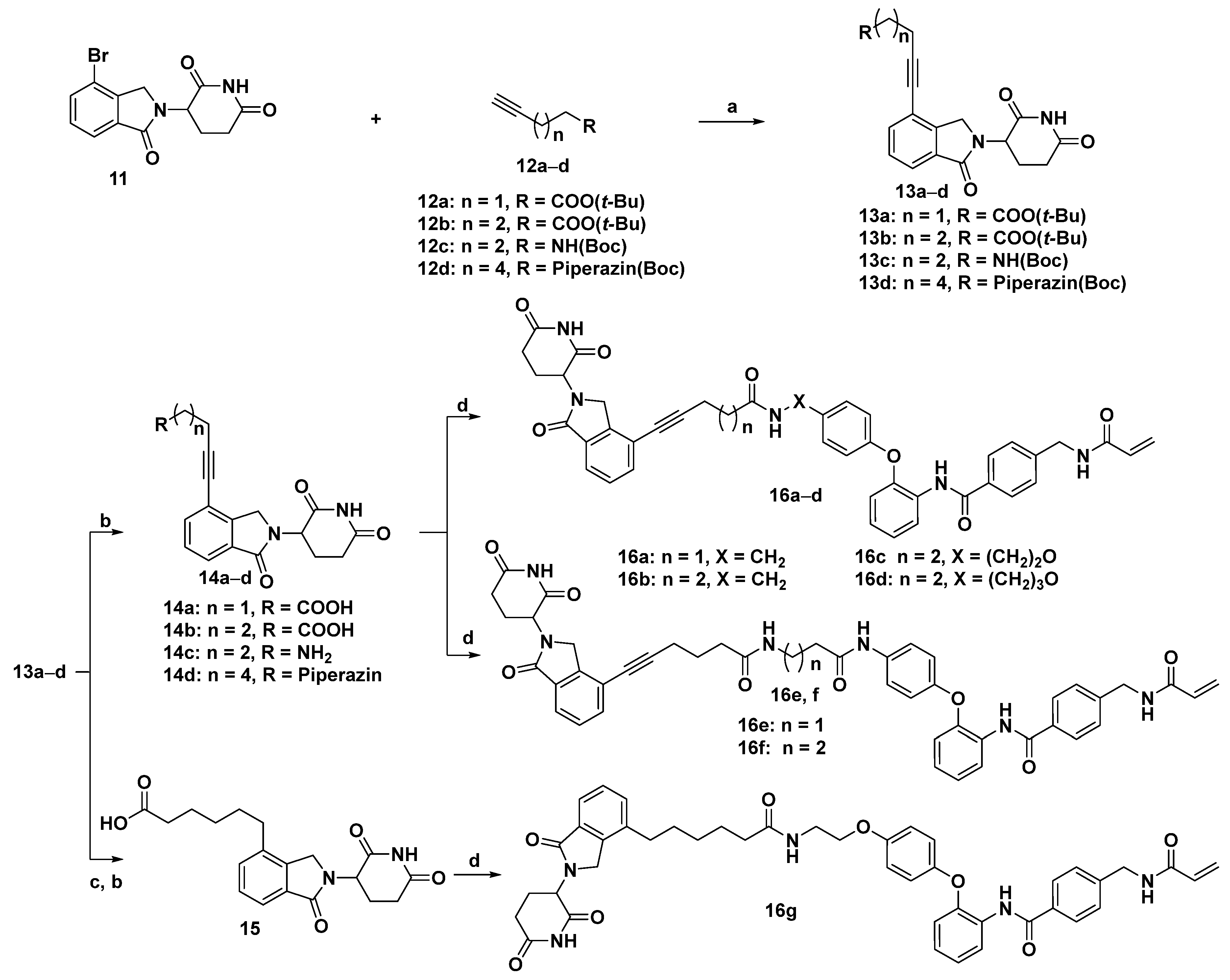
3.3.8. Synthesis and Characterization of Intermediates 14a–d
- 5-(2-(2,6-Dioxopiperidin-3-yl)-1-oxoisoindolin-4-yl)pent-4-ynoic acid (14a). 1H NMR (400 MHz, DMSO-d6) δ 12.36 (s, 1H), 10.98 (s, 1H), 7.73–7.66 (m, 1H), 7.60 (dd, J = 7.6, 0.8 Hz, 1H), 7.50 (t, J = 7.6 Hz, 1H), 5.13 (dd, J = 13.3, 5.1 Hz, 1H), 4.41 (d, J = 17.8 Hz, 1H), 4.26 (d, J = 17.8 Hz, 1H), 2.98–2.84 (m, 1H), 2.71–2.51 (m, 5H), 2.46–2.37 (m, 1H), 2.06–1.95 (m, 1H).
- 6-(2-(2,6-Dioxopiperidin-3-yl)-1-oxoisoindolin-4-yl)hex-5-ynoic acid (14b). 1H NMR (400 MHz, DMSO-d6) δ 12.14 (br, 1H), 10.96 (s, 1H), 7.69 (dd, J = 7.6, 0.8 Hz, 1H), 7.63 (dd, J = 7.6, 0.9 Hz, 1H), 7.50 (t, J = 7.6 Hz, 1H), 5.12 (dd, J = 13.3, 5.1 Hz, 1H), 4.44 (d, J = 17.7 Hz, 1H), 4.30 (d, J = 17.7 Hz, 1H), 2.96–2.83 (m, 1H), 2.66–2.49 (m, 3H), 2.46–2.27 (m, 3H), 2.05–1.94 (m, 1H), 1.85–1.69 (m, 2H).
- 3-(4-(5-Aminopent-1-yn-1-yl)-1-oxoisoindolin-2-yl)piperidine-2,6-dione (14c). 1H NMR (400 MHz, DMSO-d6) δ 10.98 (s, 1H), 7.88 (br, 3H), 7.71 (d, J = 7.5 Hz, 1H), 7.63 (d, J = 7.6 Hz, 1H), 7.51 (t, J = 7.6 Hz, 1H), 5.13 (dd, J = 13.3, 5.0 Hz, 1H), 4.45 (d, J = 17.7 Hz, 1H), 4.29 (d, J = 17.7 Hz, 1H), 2.99–2.83 (m, 3H), 2.58 (t, J = 7.0 Hz, 3H), 2.45–2.34 (m, 1H), 2.05–1.96 (m, 1H), 1.90–1.76 (m, 2H).
- 3-(1-Oxo-4-(7-(piperazin-1-yl)hept-1-yn-1-yl)isoindolin-2-yl)piperidine-2,6-dione (14d). 1H NMR (400 MHz, DMSO-d6) δ 10.96 (s, 1H), 9.29 (s, 2H), 7.69 (dd, J = 7.5, 1.1 Hz, 1H), 7.60 (dd, J = 7.6, 1.1 Hz, 1H), 7.49 (t, J = 7.6 Hz, 1H), 5.12 (dd, J = 13.3, 5.1 Hz, 1H), 4.42 (d, J = 17.7 Hz, 1H), 4.28 (d, J = 17.7 Hz, 1H), 3.52–3.27 (m, 8H), 3.12–3.01 (m, 2H), 2.96–2.78 (m, 1H), 2.62–2.49 (m, 1H), 2.45–2.24 (m, 3H), 2.05–1.94 (m, 1H), 1.70–1.53 (m, 4H), 1.50–1.39 (m, 2H).
3.3.9. Synthesis and Characterization of Intermediate 15
- 6-(2-(2,6-Dioxopiperidin-3-yl)-1-oxoisoindolin-4-yl)hexanoic acid (15). 1H NMR (400 MHz, DMSO-d6) δ 11.95 (s, 1H), 10.96 (s, 1H), 7.58–7.50 (m, 1H), 7.48–7.39 (m, 2H), 5.11 (dd, J = 13.3, 5.1 Hz, 1H), 4.44 (d, J = 17.2 Hz, 1H), 4.29 (d, J = 17.1 Hz, 1H), 2.97–2.83 (m, 1H), 2.67–2.54 (m, 3H), 2.45–2.34 (m, 1H), 2.18 (t, J = 7.3 Hz, 2H), 2.05–1.94 (m, 1H), 1.65–1.47 (m, 4H), 1.37–1.25 (m, 2H).
3.3.10. Synthesis and Characterization of Intermediates 29, 30, 31a and 31b
- (4-((2-(4-Ethoxyphenoxy)phenyl)carbamoyl)phenyl)methanaminium chloride (29). 1H NMR (400 MHz, DMSO-d6) δ 9.82 (s, 1H), 8.61 (s, 3H), 7.88 (d, J = 8.3 Hz, 2H), 7.70 (dd, J = 7.7, 1.9 Hz, 1H), 7.58 (d, J = 8.3 Hz, 2H), 7.20–7.06 (m, 2H), 6.98–6.79 (m, 5H), 4.09–4.00 (m, 2H), 3.94 (q, J = 7.0 Hz, 2H), 1.27 (t, J = 7.0 Hz, 3H).
- (E)-4-((4-((2-(4-Ethoxyphenoxy)phenyl)carbamoyl)benzyl)amino)-4-oxobut-2-enoic acid (30). 1H NMR (400 MHz, DMSO-d6) δ 12.86 (s, 1H), 9.68 (s, 1H), 9.02 (t, J = 5.9 Hz, 1H), 7.80 (d, J = 8.3 Hz, 2H), 7.73 (dd, J = 7.7, 1.8 Hz, 1H), 7.34 (d, J = 8.3 Hz, 2H), 7.18–7.05 (m, 2H), 7.01–6.78 (m, 6H), 6.54 (d, J = 15.5 Hz, 1H), 4.42 (d, J = 5.9 Hz, 2H), 3.94 (q, J = 7.0 Hz, 2H), 1.27 (t, J = 7.0 Hz, 3H).
- 4-((4-((2-(4-Ethoxyphenoxy)phenyl)carbamoyl)benzyl)amino)-4-oxobutan-1-aminium chloride (31a). 1H NMR (400 MHz, DMSO-d6) δ 9.70 (s, 1H), 8.58 (t, J = 5.9 Hz, 1H), 8.02 (br, 3H), 7.81 (d, J = 8.2 Hz, 2H), 7.72 (dd, J = 7.7, 1.8 Hz, 1H), 7.32 (d, J = 8.2 Hz, 2H), 7.17–7.05 (m, 2H), 6.99–6.84 (m, 4H), 6.81 (dd, J = 7.9, 1.5 Hz, 1H), 4.29 (d, J = 5.9 Hz, 2H), 3.94 (q, J = 6.9 Hz, 2H), 2.69 (d, J = 43.1 Hz, 2H), 2.26 (t, J = 7.2 Hz, 2H), 1.88–1.70 (m, 2H), 1.27 (t, J = 7.0 Hz, 3H).
- 6-((4-((2-(4-Ethoxyphenoxy)phenyl)carbamoyl)benzyl)amino)-6-oxohexan-1-aminium chloride (31b). 1H NMR (400 MHz, DMSO-d6) δ 9.69 (s, 1H), 8.43 (t, J = 5.9 Hz, 1H), 7.95 (br, 3H), 7.80 (d, J = 8.2 Hz, 2H), 7.72 (dd, J = 7.7, 1.7 Hz, 1H), 7.30 (d, J = 8.2 Hz, 2H), 7.16–7.05 (m, 2H), 6.97–6.84 (m, 4H), 6.81 (dd, J = 7.9, 1.5 Hz, 1H), 4.28 (d, J = 5.9 Hz, 2H), 3.94 (q, J = 6.9 Hz, 2H), 2.78–2.63 (m, 2H), 2.14 (t, J = 7.4 Hz, 2H), 1.60–1.43 (m, 4H), 1.36–1.19 (m, 5H).
3.3.11. Synthesis and Characterization of the Final PROTACs
- 4-(Acrylamidomethyl)-N-(2-(4-((5-(2-(2,6-dioxopiperidin-3-yl)-1-oxoisoindolin-4-yl) pent-4-ynamido)methyl)phenoxy)phenyl)benzamide (16a). 1H NMR (400 MHz, DMSO-d6) δ 10.99 (s, 1H), 9.68 (s, 1H), 8.63 (t, J = 6.0 Hz, 1H), 8.44 (t, J = 5.9 Hz, 1H), 7.80–7.70 (m, 3H), 7.66 (dd, J = 7.5, 0.8 Hz, 1H), 7.54 (dd, J = 7.6, 0.9 Hz, 1H), 7.45 (t, J = 7.6 Hz, 1H), 7.32 (d, J = 8.3 Hz, 2H), 7.23–7.13 (m, 4H), 6.90–6.85 (m, 1H), 6.82 (d, J = 8.6 Hz, 2H), 6.27 (dd, J = 17.1, 10.1 Hz, 1H), 6.11 (dd, J = 17.1, 2.2 Hz, 1H), 5.61 (dd, J = 10.1, 2.2 Hz, 1H), 5.13 (dd, J = 13.3, 5.1 Hz, 1H), 4.42–4.31 (m, 3H), 4.29–4.19 (m, 3H), 2.95–2.84 (m, 1H), 2.70 (t, J = 7.1 Hz, 2H), 2.61–2.52 (m, 1H), 2.47–2.34 (m, 3H), 2.01–1.88 (m, 1H). 13C NMR (101 MHz, DMSO-d6) δ 173.27, 171.39, 170.71, 168.08, 165.56, 165.14, 155.93, 149.93, 144.31, 143.54, 134.78, 134.31, 133.36, 132.34, 131.96, 129.91, 129.03, 128.97, 128.10, 127.58, 126.86, 126.76, 126.02, 124.11, 123.14, 119.56, 119.04, 118.30, 95.98, 76.96, 51.99, 47.29, 42.33, 41.88, 34.86, 31.62, 22.86, 15.99. HRMS (ESI, positive): calcd. for C42H38N5O7 [M + H]+: m/z = 724.2766; found: 724.2765. HPLC tR = 11.90 min (purity 98.8%).
- 4-(Acrylamidomethyl)-N-(2-(4-((6-(2-(2,6-dioxopiperidin-3-yl)-1-oxoisoindolin-4-yl)hex-5-ynamido)methyl)phenoxy)phenyl)benzamide (16b). 1H NMR (400 MHz, DMSO-d6) δ 10.96 (s, 1H), 9.70 (s, 1H), 8.63 (t, J = 6.0 Hz, 1H), 8.31 (t, J = 5.9 Hz, 1H), 7.78–7.73 (m, 3H), 7.69 (dd, J = 7.6, 0.8 Hz, 1H), 7.62 (dd, J = 7.6, 0.9 Hz, 1H), 7.49 (t, J = 7.6 Hz, 1H), 7.32 (d, J = 8.3 Hz, 2H), 7.21–7.16 (m, 4H), 6.91 (d, J = 8.5 Hz, 3H), 6.26 (dd, J = 17.1, 10.1 Hz, 1H), 6.11 (dd, J = 17.1, 2.2 Hz, 1H), 5.61 (dd, J = 10.1, 2.2 Hz, 1H), 5.11 (dd, J = 13.3, 5.1 Hz, 1H), 4.44 (d, J = 17.7 Hz, 1H), 4.38 (d, J = 6.0 Hz, 2H), 4.30 (d, J = 17.8 Hz, 1H), 4.20 (d, J = 5.9 Hz, 2H), 2.93–2.84 (m, 1H), 2.58–2.50 (m, 3H), 2.45–2.37 (m, 1H), 2.29 (t, J = 7.3 Hz, 2H), 2.03–1.92 (m, 1H), 1.84–1.77 (m, 2H). 13C NMR (101 MHz, DMSO-d6) δ 173.26, 171.82, 171.37, 168.09, 165.57, 165.13, 155.92, 150.03, 144.23, 143.54, 135.00, 134.55, 133.36, 132.41, 131.96, 129.91, 129.13, 128.98, 128.10, 127.57, 126.87, 126.75, 126.01, 124.08, 123.07, 119.53, 119.21, 118.43, 96.20, 77.14, 52.09, 47.45, 42.32, 41.87, 34.61, 31.64, 24.75, 22.78, 18.92. HRMS (ESI, positive): calcd. for C43H40N5O7 [M + H]+: m/z = 738.2922; found: 738.2919. HPLC tR = 12.55 min (purity 99.7%).
- 4-(Acrylamidomethyl)-N-(2-(4-(2-(6-(2-(2,6-dioxopiperidin-3-yl)-1-oxoisoindolin-4-yl) hex-5-ynamido)ethoxy)phenoxy)phenyl)benzamide (16c). 1H NMR (400 MHz, DMSO-d6) δ 10.96 (s, 1H), 9.68 (s, 1H), 8.64 (t, J = 5.6 Hz, 1H), 8.08 (t, J = 5.0 Hz, 1H), 7.81 (d, J = 7.9 Hz, 2H), 7.74 (d, J = 6.8 Hz, 1H), 7.68 (d, J = 7.5 Hz, 1H), 7.62 (d, J = 7.5 Hz, 1H), 7.49 (t, J = 7.6 Hz, 1H), 7.34 (d, J = 7.8 Hz, 2H), 7.21–7.08 (m, 2H), 6.93 (q, J = 9.1 Hz, 4H), 6.82 (d, J = 7.5 Hz, 1H), 6.27 (dd, J = 17.0, 10.1 Hz, 1H), 6.11 (dd, J = 17.1, 1.2 Hz, 1H), 5.61 (dd, J = 10.1, 1.2 Hz, 1H), 5.11 (dd, J = 13.2, 4.7 Hz, 1H), 4.48–4.36 (m, 3H), 4.30 (d, J = 17.7 Hz, 1H), 3.92 (t, J = 5.3 Hz, 2H), 3.44–3.34 (m, 2H), 2.97–2.80 (m, 1H), 2.61–2.51 (m, 1H), 2.46–2.35 (m, 3H), 2.26 (t, J = 7.2 Hz, 2H), 2.04–1.94 (m, 1H), 1.84–1.73 (m, 2H). 13C NMR (101 MHz, DMSO-d6) δ 173.26, 172.23, 171.38, 168.09, 165.53, 165.13, 155.03, 150.97, 150.33, 144.22, 143.56, 134.55, 133.41, 132.41, 131.97, 129.26, 128.97, 128.11, 127.59, 126.59, 126.01, 123.37, 123.06, 120.47, 119.21, 118.28, 116.08, 96.24, 77.09, 67.25, 52.10, 47.45, 42.32, 38.66, 34.58, 31.64, 24.74, 22.79, 18.90. HRMS (ESI, positive): calcd. for C44H42N5O8 [M + H]+: m/z = 768.3028; found: 768.3032. HPLC tR = 12.72 min (purity 99.8%).
- 4-(Acrylamidomethyl)-N-(2-(4-(3-(6-(2-(2,6-dioxopiperidin-3-yl)-1-oxoisoindolin-4-yl) hex-5-ynamido)propoxy)phenoxy)phenyl)benzamide (16d). 1H NMR (400 MHz, DMSO-d6) δ 10.97 (s, 1H), 9.68 (s, 1H), 8.64 (t, J = 6.0 Hz, 1H), 7.91 (t, J = 5.5 Hz, 1H), 7.82 (d, J = 8.3 Hz, 2H), 7.74 (dd, J = 7.6, 1.9 Hz, 1H), 7.68 (dd, J = 7.5, 0.6 Hz, 1H), 7.62 (dd, J = 7.6, 0.7 Hz, 1H), 7.49 (t, J = 7.6 Hz, 1H), 7.34 (d, J = 8.3 Hz, 2H), 7.18–7.06 (m, 2H), 6.92 (dd, J = 23.3, 9.2 Hz, 4H), 6.82 (dd, J = 7.8, 1.7 Hz, 1H), 6.27 (dd, J = 17.1, 10.1 Hz, 1H), 6.11 (dd, J = 17.1, 2.2 Hz, 1H), 5.61 (dd, J = 10.1, 2.2 Hz, 1H), 5.12 (dd, J = 13.3, 5.1 Hz, 1H), 4.45 (d, J = 17.7 Hz, 1H), 4.39 (d, J = 6.0 Hz, 2H), 4.30 (d, J = 17.7 Hz, 1H), 3.91 (t, J = 6.2 Hz, 2H), 3.22–3.13 (m, 2H), 2.95–2.83 (m, 1H), 2.61–2.52 (m, 1H), 2.48–2.36 (m, 3H), 2.24 (t, J = 7.3 Hz, 2H), 2.06–1.94 (m, 1H), 1.85–1.70 (m, 4H). 13C NMR (101 MHz, DMSO-d6) δ 173.26, 171.85, 171.38, 168.09, 165.52, 165.14, 155.20, 151.01, 150.15, 144.22, 143.56, 134.54, 133.42, 132.41, 131.97, 129.23, 128.98, 128.11, 127.59, 126.57, 126.00, 123.32, 123.07, 120.48, 119.22, 118.21, 115.97, 96.23, 77.10, 66.11, 52.10, 47.44, 42.32, 35.94, 34.67, 31.64, 29.39, 24.76, 22.79, 18.91. HRMS (ESI, positive): calcd. for C45H44N5O8 [M + H]+: m/z = 782.3184; found: 782.3184. HPLC tR = 12.97 min (purity 97.6%).
- 4-(Acrylamidomethyl)-N-(2-(4-(3-(6-(2-(2,6-dioxopiperidin-3-yl)-1-oxoisoindolin-4-yl) hex-5-ynamido)propanamido)phenoxy)phenyl)benzamide (16e). 1H NMR (400 MHz, DMSO-d6) δ 10.96 (s, 1H), 9.88 (s, 1H), 9.69 (s, 1H), 8.63 (t, J = 5.9 Hz, 1H), 7.95 (t, J = 5.5 Hz, 1H), 7.80 (d, J = 8.2 Hz, 2H), 7.76–7.70 (m, 1H), 7.68 (d, J = 7.7 Hz, 1H), 7.61 (d, J = 7.6 Hz, 1H), 7.58–7.45 (m, 3H), 7.33 (d, J = 8.2 Hz, 2H), 7.21–7.09 (m, 2H), 6.97–6.83 (m, 3H), 6.27 (dd, J = 17.1, 10.1 Hz, 1H), 6.11 (dd, J = 17.1, 2.2 Hz, 1H), 5.61 (dd, J = 10.1, 2.2 Hz, 1H), 5.11 (dd, J = 13.3, 5.1 Hz, 1H), 4.48–4.36 (m, 3H), 4.30 (d, J = 17.7 Hz, 1H), 3.35–3.30 (m, 2H), 2.95–2.83 (m, 1H), 2.64–2.49 (m, 3H), 2.47–2.38 (m, 3H), 2.22 (t, J = 7.3 Hz, 2H), 2.04–1.93 (m, 1H), 1.83–1.70 (m, 2H). 13C NMR (101 MHz, DMSO-d6) δ 173.27, 171.98, 171.39, 169.63, 168.09, 165.53, 165.13, 152.23, 150.44, 144.21, 143.55, 135.35, 134.55, 133.39, 132.40, 131.97, 130.03, 129.55, 129.01, 128.96, 128.11, 127.59, 126.75, 126.68, 126.00, 123.72, 123.05, 121.04, 119.21, 119.14, 118.88, 96.25, 77.05, 52.11, 47.45, 42.32, 36.79, 35.56, 34.62, 31.64, 24.84, 22.79, 18.87. HRMS (ESI, positive): calcd. for C45H42N6NaO8 [M + Na]+: m/z = 817.2962; found: 817.2969. HPLC tR = 12.22 min (purity 97.1%).
- 4-(Acrylamidomethyl)-N-(2-(4-(4-(6-(2-(2,6-dioxopiperidin-3-yl)-1-oxoisoindolin-4-yl) hex-5-ynamido)butanamido)phenoxy)phenyl)benzamide (16f). 1H NMR (400 MHz, DMSO-d6) δ 10.96 (s, 1H), 9.84 (s, 1H), 9.69 (s, 1H), 8.63 (s, 1H), 7.91–7.44 (m, 9H), 7.32 (d, J = 7.9 Hz, 2H), 7.21–7.08 (m, 2H), 7.01–6.79 (m, 3H), 6.26 (dd, J = 16.9, 10.0 Hz, 1H), 6.11 (d, J = 16.5 Hz, 1H), 5.61 (d, J = 10.2 Hz, 1H), 5.11 (dd, J = 12.9, 5.9 Hz, 1H), 4.54–4.17 (m, 4H), 3.06 (dd, J = 11.2, 6.5 Hz, 2H), 2.92–2.82 (m, 1H), 2.68–2.52 (m, 3H), 2.45–2.38 (m, 2H), 2.30–2.17 (m, 3H), 2.03–1.93 (m, 1H), 1.84–1.60 (m, 4H). 13C NMR (101 MHz, DMSO-d6) δ 173.26, 171.80, 171.38, 171.02, 168.08, 165.53, 165.12, 152.15, 150.46, 144.23, 143.54, 135.46, 134.55, 133.40, 133.12, 132.41, 131.97, 130.03, 129.53, 129.00, 128.10, 127.58, 126.72, 125.99, 123.69, 123.06, 120.96, 119.19, 118.85, 96.25, 77.09, 52.10, 47.45, 42.32, 38.56, 34.72, 34.20, 31.63, 25.69, 24.80, 22.78, 18.94. HRMS (ESI, positive): calcd. for C46H45N6O8 [M + H]+: m/z = 809.3293; found: 809.3300. HPLC tR = 9.33 min (purity 95%).
- 4-(Acrylamidomethyl)-N-(2-(4-((6-(2-(2,6-dioxopiperidin-3-yl)-1-oxoisoindolin-4-yl)hexanamido)methyl)phenoxy)phenyl)benzamide (16g). 1H NMR (400 MHz, DMSO-d6) δ 10.96 (s, 1H), 9.70 (s, 1H), 8.63 (t, J = 5.7 Hz, 1H), 8.21 (t, J = 5.6 Hz, 1H), 7.75 (dd, J = 12.9, 5.5 Hz, 3H), 7.59–7.50 (m, 1H), 7.42 (d, J = 4.2 Hz, 2H), 7.32 (d, J = 8.1 Hz, 2H), 7.21–7.13 (m, 4H), 6.91 (d, J = 8.6 Hz, 3H), 6.27 (dd, J = 17.1, 10.1 Hz, 1H), 6.11 (dd, J = 17.1, 2.0 Hz, 1H), 5.61 (dd, J = 10.1, 2.0 Hz, 1H), 5.11 (dd, J = 13.1, 5.3 Hz, 1H), 4.44 (d, J = 17.1 Hz, 1H), 4.38 (d, J = 5.8 Hz, 2H), 4.28 (d, J = 17.2 Hz, 1H), 4.18 (d, J = 5.5 Hz, 2H), 2.97–2.81 (m, 1H), 2.65–2.50 (m, 3H), 2.45–2.34 (m, 1H), 2.23–2.05 (m, 2H), 2.03–1.91 (m, 1H), 1.75–1.51 (m, 4H), 1.33–1.20 (m, 2H). 13C NMR (101 MHz, DMSO-d6) δ 173.30, 172.41, 171.47, 168.80, 165.57, 165.13, 155.89, 150.04, 143.53, 140.93, 137.90, 135.13, 133.37, 131.97, 129.91, 129.11, 128.67, 128.10, 127.57, 126.87, 126.75, 126.00, 124.08, 121.02, 119.51, 118.43, 52.01, 46.68, 42.32, 41.81, 35.69, 31.64, 31.57, 29.43, 28.99, 25.48, 22.94. HRMS (ESI, positive): calcd. for C43H44N5O7 [M + H]+: m/z = 742.3235; found: 742.3229. HPLC tR = 12.45 min (purity 99.3%).
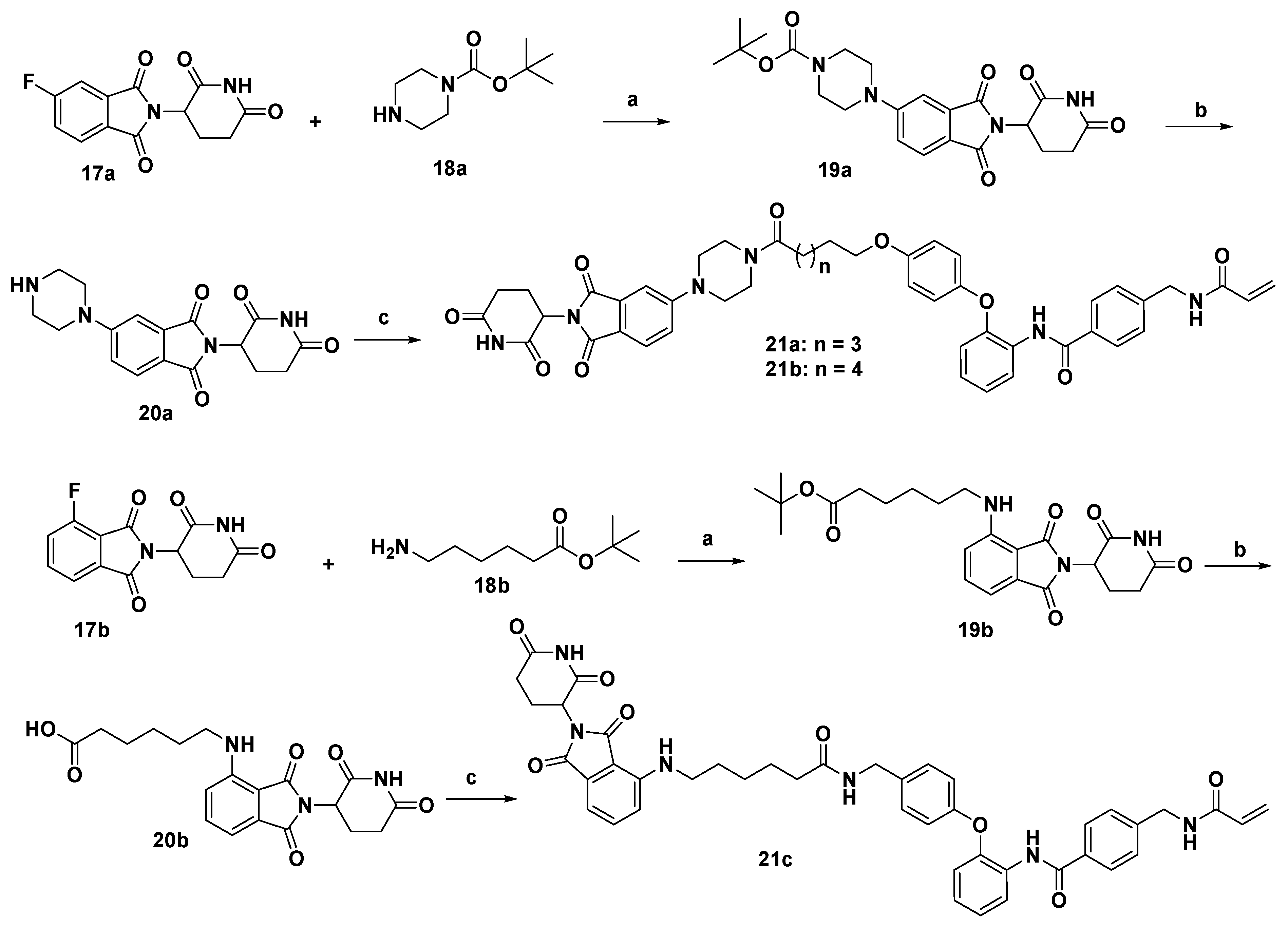
- 4-(Acrylamidomethyl)-N-(2-(4-((6-(4-(2-(2,6-dioxopiperidin-3-yl)-1,3-dioxoisoindolin-5-yl)piperazin-1-yl)-6-oxohexyl)oxy)phenoxy)phenyl)benzamide (21a). 1H NMR (400 MHz, DMSO-d6) δ 11.06 (s, 1H), 9.67 (s, 1H), 8.64 (t, J = 5.9 Hz, 1H), 7.81 (d, J = 8.2 Hz, 2H), 7.77–7.65 (m, 2H), 7.31 (dd, J = 20.5, 5.2 Hz, 3H), 7.24–7.07 (m, 3H), 6.98–6.79 (m, 5H), 6.27 (dd, J = 17.1, 10.1 Hz, 1H), 6.11 (dd, J = 17.1, 2.2 Hz, 1H), 5.61 (dd, J = 10.1, 2.2 Hz, 1H), 5.06 (dd, J = 12.9, 5.4 Hz, 1H), 4.39 (d, J = 6.0 Hz, 2H), 3.90 (t, J = 6.4 Hz, 2H), 3.67–3.38 (m, 8H), 2.93–2.80 (m, 1H), 2.62–2.50 (m, 2H), 2.36 (t, J = 7.2 Hz, 2H), 2.05–1.95 (m, 1H), 1.76–1.64 (m, 2H), 1.63–1.49 (m, 2H), 1.48–1.35 (m, 2H). 13C NMR (101 MHz, DMSO-d6) δ 173.23, 171.25, 170.50, 167.95, 167.40, 165.52, 165.13, 155.32, 155.30, 150.97, 150.08, 143.56, 134.29, 133.43, 131.98, 129.24, 128.11, 127.59, 126.56, 126.52, 126.00, 125.35, 123.32, 120.44, 118.91, 118.26, 118.18, 115.94, 108.35, 68.26, 49.25, 47.25, 46.99, 44.52, 42.32, 32.60, 31.44, 29.03, 25.79, 24.88, 22.63. HRMS (ESI, positive): calcd. for C46H47N6O9 [M + H]+: m/z = 827.3399; found: 827.3403. HPLC tR = 13.44 min (purity 96.1%).
- 4-(Acrylamidomethyl)-N-(2-(4-((7-(4-(2-(2,6-dioxopiperidin-3-yl)-1,3-dioxoisoindolin-5-yl)piperazin-1-yl)-7-oxoheptyl)oxy)phenoxy)phenyl)benzamide (21b). 1H NMR (400 MHz, DMSO-d6) δ 11.05 (s, 1H), 9.67 (s, 1H), 8.64 (t, J = 5.9 Hz, 1H), 7.81 (d, J = 8.2 Hz, 2H), 7.74 (dd, J = 7.6, 1.8 Hz, 1H), 7.68 (d, J = 8.5 Hz, 1H), 7.33 (d, J = 8.5 Hz, 3H), 7.21 (dd, J = 8.6, 2.1 Hz, 1H), 7.17–7.07 (m, 2H), 6.92 (dd, J = 19.7, 9.2 Hz, 4H), 6.83 (dd, J = 7.8, 1.6 Hz, 1H), 6.27 (dd, J = 17.1, 10.1 Hz, 1H), 6.11 (dd, J = 17.1, 2.2 Hz, 1H), 5.61 (dd, J = 10.1, 2.2 Hz, 1H), 5.06 (dd, J = 12.9, 5.4 Hz, 1H), 4.39 (d, J = 6.0 Hz, 2H), 3.89 (t, J = 6.4 Hz, 2H), 3.59 (s, 4H), 3.46 (dd, J = 22.1, 0.6 Hz, 4H), 2.93–2.81 (m, 1H), 2.62–2.51 (m, 2H), 2.34 (t, J = 7.4 Hz, 2H), 2.05–1.95 (m, 1H), 1.71–1.62 (m, 2H), 1.56–1.47 (m, 2H), 1.44–1.29 (m, 4H). 13C NMR (101 MHz, DMSO-d6) δ 173.20, 171.30, 170.48, 167.95, 167.40, 165.52, 165.13, 155.32, 155.30, 150.97, 150.07, 143.55, 134.29, 133.43, 131.97, 129.24, 128.11, 127.58, 126.57, 126.53, 125.99, 125.35, 123.32, 120.44, 118.91, 118.26, 118.18, 115.94, 108.34, 68.25, 49.24, 47.26, 46.99, 44.53, 42.32, 32.59, 31.43, 29.07, 28.96, 25.82, 25.07, 22.63. HRMS (ESI, positive): calcd. for C47H49N6O9 [M + H]+: m/z = 841.3556; found: 841.3556. HPLC tR = 13.85 min (purity 98.3%).
- 4-(Acrylamidomethyl)-N-(2-(4-((6-((2-(2,6-dioxopiperidin-3-yl)-1,3-dioxoisoindolin-4- yl)amino)hexanamido)methyl)phenoxy) phenyl)benzamide (21c). 1H NMR (400 MHz, DMSO-d6) δ 11.06 (s, 1H), 9.70 (s, 1H), 8.63 (t, J = 5.8 Hz, 1H), 8.23 (t, J = 5.8 Hz, 1H), 7.78–7.73 (m, 3H), 7.58–7.49 (m, 1H), 7.32 (d, J = 8.1 Hz, 2H), 7.20–7.15 (m, 4H), 7.05 (d, J = 8.6 Hz, 1H), 6.99 (d, J = 7.0 Hz, 1H), 6.92 (d, J = 8.4 Hz, 3H), 6.50 (t, J = 5.7 Hz, 1H), 6.27 (dd, J = 17.1, 10.1 Hz, 1H), 6.11 (dd, J = 17.1, 2.1 Hz, 1H), 5.61 (dd, J = 10.1, 2.1 Hz, 1H), 5.03 (dd, J = 12.8, 5.2 Hz, 1H), 4.38 (d, J = 5.9 Hz, 2H), 4.18 (d, J = 5.8 Hz, 2H), 3.28–3.22 (m, 2H), 2.91–2.81 (m, 1H), 2.59–2.52 (m, 2H), 2.11 (t, J = 7.3 Hz, 2H), 2.05–1.97 (m, 1H), 1.60–1.48 (m, 4H), 1.37–1.24 (m, 2H). 13C NMR (101 MHz, DMSO-d6) δ 173.22, 172.38, 170.51, 169.38, 167.73, 165.56, 165.12, 155.89, 150.03, 146.90, 143.53, 136.70, 135.13, 133.37, 132.63, 131.97, 129.90, 129.12, 128.10, 127.58, 126.84, 126.73, 126.00, 124.06, 119.49, 118.44, 117.61, 110.82, 109.46, 48.99, 42.32, 42.20, 41.82, 35.70, 31.43, 28.92, 26.43, 25.46, 22.60. HRMS (ESI, positive): calcd. for C43H43N6O8 [M + H]+: m/z = 771.3137; found: 771.3136. HPLC tR = 12.92 min (purity 99.2%).
- 6-(4-(6-(4-(2-(4-(Acrylamidomethyl)benzamido)phenoxy)phenoxy)hexanoyl)piperazin-1-yl)-N-(2,6-dioxopiperidin-3-yl)picolinamide (27a). 1H NMR (400 MHz, DMSO-d6) δ 10.86 (s, 1H), 9.67 (s, 1H), 8.76 (d, J = 8.4 Hz, 1H), 8.64 (t, J = 5.9 Hz, 1H), 7.81 (d, J = 8.3 Hz, 2H), 7.77–7.66 (m, 2H), 7.33 (dd, J = 7.6, 5.4 Hz, 3H), 7.18–7.07 (m, 2H), 7.03 (d, J = 8.6 Hz, 1H), 6.97–6.86 (m, 4H), 6.83 (dd, J = 7.8, 1.7 Hz, 1H), 6.27 (dd, J = 17.1, 10.1 Hz, 1H), 6.11 (dd, J = 17.1, 2.2 Hz, 1H), 5.61 (dd, J = 10.1, 2.2 Hz, 1H), 4.79–4.67 (m, 1H), 4.39 (d, J = 6.0 Hz, 2H), 3.90 (t, J = 6.4 Hz, 2H), 3.70–3.48 (m, 8H), 2.83–2.72 (m, 1H), 2.52 (dd, J = 5.0, 1.4 Hz, 1H), 2.37 (t, J = 7.3 Hz, 2H), 2.25–2.15 (m, 1H), 2.02–1.93 (m, 1H), 1.75–1.64 (m, 2H), 1.61–1.50 (m, 2H), 1.47–1.37 (m, 2H). 13C NMR (101 MHz, DMSO-d6) δ 173.44, 172.68, 171.20, 165.52, 165.13, 164.58, 158.04, 155.32, 151.00, 150.08, 147.90, 143.55, 139.30, 133.43, 131.97, 129.23, 128.11, 127.58, 126.58, 126.56, 126.00, 123.31, 120.45, 118.25, 115.94, 111.80, 110.81, 68.26, 49.88, 45.15, 44.97, 44.77, 42.32, 32.65, 31.46, 29.04, 25.81, 24.97, 24.49. HRMS (ESI, positive): calcd. for C44H48N7O8 [M + H]+: m/z = 802.3559; found: 802.3561. HPLC tR = 13.40 min (purity 97.8%).
- 6-(4-(7-(4-(2-(4-(Acrylamidomethyl)benzamido)phenoxy)phenoxy)heptanoyl)piperazin-1-yl)-N-(2,6-dioxopiperidin-3-yl)picolinamide (27b). 1H NMR (400 MHz, DMSO-d6) δ 10.87 (s, 1H), 9.68 (s, 1H), 8.77 (d, J = 8.4 Hz, 1H), 8.64 (t, J = 5.9 Hz, 1H), 7.81 (d, J = 8.2 Hz, 2H), 7.77–7.67 (m, 2H), 7.39–7.28 (m, 3H), 7.18–7.06 (m, 2H), 7.03 (d, J = 8.6 Hz, 1H), 6.98–6.77 (m, 5H), 6.27 (dd, J = 17.1, 10.1 Hz, 1H), 6.12 (dd, J = 17.1, 2.2 Hz, 1H), 5.61 (dd, J = 10.1, 2.2 Hz, 1H), 4.78–4.68 (m, 1H), 4.39 (d, J = 6.0 Hz, 2H), 3.89 (t, J = 6.4 Hz, 2H), 3.71–3.49 (m, 8H), 2.85–2.73 (m, 1H), 2.53 (d, J = 3.7 Hz, 1H), 2.35 (t, J = 7.4 Hz, 2H), 2.29–2.16 (m, 1H), 2.02–1.93 (m, 1H), 1.72–1.61 (m, 2H), 1.58–1.47 (m, 2H), 1.44–1.30 (m, 4H). 13C NMR (101 MHz, DMSO-d6) δ 173.44, 172.68, 171.26, 165.53, 165.14, 164.59, 158.03, 155.33, 150.99, 150.07, 147.91, 143.56, 139.29, 133.43, 131.97, 129.23, 128.11, 127.59, 126.57, 126.53, 126.00, 123.31, 120.45, 118.24, 115.94, 111.80, 110.80, 68.26, 49.89, 45.15, 44.98, 44.76, 42.33, 41.08, 32.66, 31.46, 29.08, 29.00, 25.84, 25.17, 24.50. HRMS (ESI, positive): calcd. for C45H50N7O8 [M + H]+: m/z = 816.3715; found: 816.3722. HPLC tR = 13.83 min (purity 98.1%).
- N1-(5-(2-(2,6-Dioxopiperidin-3-yl)-1-oxoisoindolin-4-yl)pent-4-yn-1-yl)-N4-(4-((2-(4-ethoxyphenoxy)phenyl)carbamoyl)benzyl)fumaramide (32a). 1H NMR (400 MHz, DMSO-d6) δ 10.96 (s, 1H), 9.68 (s, 1H), 8.89 (t, J = 5.9 Hz, 1H), 8.47 (t, J = 5.6 Hz, 1H), 7.81 (d, J = 8.3 Hz, 2H), 7.76–7.66 (m, 2H), 7.63–7.59 (m, 1H), 7.49 (t, J = 7.6 Hz, 1H), 7.34 (d, J = 8.3 Hz, 2H), 7.18–7.07 (m, 2H), 6.98–6.78 (m, 7H), 5.12 (dd, J = 13.3, 5.1 Hz, 1H), 4.46 (d, J = 17.9 Hz, 1H), 4.41 (d, J = 5.9 Hz, 2H), 4.31 (d, J = 17.8 Hz, 1H), 3.94 (q, J = 7.0 Hz, 2H), 3.27 (d, J = 7.7 Hz, 2H), 2.96–2.83 (m, 1H), 2.62–2.49 (m, 3H), 2.46–2.40 (m, 1H), 2.04–1.93 (m, 1H), 1.78–1.67 (m, 2H), 1.26 (t, J = 7.0 Hz, 3H). 13C NMR (101 MHz, DMSO-d6) δ 173.33, 171.40, 168.09, 165.50, 164.31, 164.13, 155.14, 151.00, 150.05, 144.34, 143.19, 134.40, 133.52, 133.46, 132.67, 132.40, 129.20, 129.00, 128.13, 127.51, 126.58, 123.31, 123.09, 120.43, 119.14, 118.24, 115.89, 96.04, 77.12, 63.82, 52.06, 47.44, 42.49, 38.35, 31.63, 28.35, 22.79, 16.89, 15.09. HRMS (ESI, positive): calcd. for C44H42N5O8 [M + H]+: m/z = 768.3028; found: 768.3027. HPLC tR = 14.55 min (purity 98.7%).
- (E)-4-((4-(4-(7-(2-(2,6-Dioxopiperidin-3-yl)-1-oxoisoindolin-4-yl)hept-6-yn-1-yl)pipera-zin-1-yl)-4-oxobut-2-enamido)methyl)-N-(2-(4-ethoxyphenoxy)phenyl)benzamide (32b). 1H NMR (400 MHz, DMSO-d6) δ 10.96 (s, 1H), 9.67 (s, 1H), 8.94 (t, J = 5.8 Hz, 1H), 7.80 (d, J = 8.2 Hz, 2H), 7.73 (dd, J = 7.6, 1.6 Hz, 1H), 7.67 (d, J = 7.4 Hz, 1H), 7.60 (d, J = 7.4 Hz, 1H), 7.48 (t, J = 7.6 Hz, 1H), 7.34 (d, J = 8.2 Hz, 2H), 7.26 (d, J = 15.1 Hz, 1H), 7.17–7.06 (m, 2H), 6.99–6.77 (m, 6H), 5.12 (dd, J = 13.3, 5.0 Hz, 1H), 4.50–4.35 (m, 3H), 4.28 (d, J = 17.6 Hz, 1H), 3.94 (q, J = 6.9 Hz, 2H), 3.50 (s, 4H), 2.95–2.81 (m, 1H), 2.61–2.52 (m, 1H), 2.46–2.21 (m, 9H), 2.03–1.94 (m, 1H), 1.62–1.51 (m, 2H), 1.51–1.35 (m, 4H), 1.26 (t, J = 6.9 Hz, 3H). 13C NMR (101 MHz, DMSO-d6) δ 173.24, 171.39, 168.08, 165.48, 164.28, 163.57, 155.13, 150.98, 150.05, 144.14, 143.16, 134.67, 134.46, 133.49, 132.39, 129.80, 129.21, 129.01, 128.13, 127.58, 126.57, 126.54, 123.30, 123.01, 120.43, 119.28, 118.23, 115.88, 96.77, 76.86, 63.81, 57.92, 53.59, 52.79, 52.06, 47.37, 45.82, 42.51, 42.04, 31.63, 28.39, 26.62, 26.09, 22.84, 19.17, 15.09. HRMS (ESI, positive): calcd. for C50H53N6O8 [M + H]+: m/z = 865.3919; found: 865.3931. HPLC tR = 14.13 min (purity 99.6%).
- 4-((4-(6-(2-(2,6-Dioxopiperidin-3-yl)-1-oxoisoindolin-4-yl)hex-5-ynamido)butanamido)methyl)-N-(2-(4-ethoxyphenoxy)phenyl)benzamide (32c). 1H NMR (400 MHz, DMSO-d6) δ 10.95 (s, 1H), 9.65 (s, 1H), 8.35 (t, J = 5.9 Hz, 1H), 7.85–7.76 (m, 3H), 7.73 (dd, J = 7.6, 1.9 Hz, 1H), 7.68 (d, J = 7.5 Hz, 1H), 7.65–7.58 (m, 1H), 7.48 (t, J = 7.6 Hz, 1H), 7.31 (d, J = 8.3 Hz, 2H), 7.17–7.06 (m, 2H), 6.97–6.85 (m, 4H), 6.82 (dd, J = 7.9, 1.6 Hz, 1H), 5.10 (dd, J = 13.3, 5.1 Hz, 1H), 4.44 (d, J = 17.7 Hz, 1H), 4.35–4.22 (m, 3H), 3.94 (q, J = 7.0 Hz, 2H), 3.02 (dd, J = 12.9, 6.8 Hz, 2H), 2.95–2.81 (m, 1H), 2.61–2.52 (m, 1H), 2.46–2.37 (m, 3H), 2.21 (t, J = 7.4 Hz, 2H), 2.13 (t, J = 7.5 Hz, 2H), 2.03–1.93 (m, 1H), 1.84–1.71 (m, 2H), 1.69–1.57 (m, 2H), 1.27 (t, J = 7.0 Hz, 3H). 13C NMR (101 MHz, DMSO-d6) δ 173.26, 172.33, 171.76, 171.37, 168.09, 165.53, 155.15, 150.98, 150.04, 144.22, 143.95, 134.54, 133.27, 132.40, 129.21, 128.97, 128.04, 127.41, 126.55, 126.50, 123.29, 123.05, 120.46, 119.21, 118.19, 115.89, 96.24, 77.08, 63.82, 52.10, 47.45, 42.19, 38.64, 34.70, 33.28, 31.63, 25.90, 24.79, 22.78, 18.92, 15.09. HRMS (ESI, positive): calcd. for C45H46N5O8 [M + H]+: m/z = 784.3341; found: 784.3342. HPLC tR = 14.31 min (purity 98.1%).
- 4-((6-(6-(2-(2,6-Dioxopiperidin-3-yl)-1-oxoisoindolin-4-yl)hex-5-ynamido)hexanamido)methyl)-N-(2-(4-ethoxyphenoxy)phenyl)benzamide (32d). 1H NMR (400 MHz, DMSO-d6) δ 10.96 (s, 1H), 9.65 (s, 1H), 8.32 (t, J = 5.9 Hz, 1H), 7.83–7.72 (m, 4H), 7.70–7.66 (m, 1H), 7.61 (dd, J = 7.6, 0.8 Hz, 1H), 7.48 (t, J = 7.6 Hz, 1H), 7.30 (d, J = 8.3 Hz, 2H), 7.16–7.06 (m, 2H), 6.97–6.85 (m, 4H), 6.82 (dd, J = 7.9, 1.7 Hz, 1H), 5.11 (dd, J = 13.3, 5.1 Hz, 1H), 4.44 (d, J = 17.7 Hz, 1H), 4.35–4.22 (m, 3H), 3.94 (q, J = 7.0 Hz, 2H), 3.00 (dd, J = 12.8, 6.8 Hz, 2H), 2.94–2.81 (m, 1H), 2.63–2.50 (m, 1H), 2.46–2.35 (m, 3H), 2.24–2.15 (m, 2H), 2.11 (t, J = 7.4 Hz, 2H), 2.02–1.93 (m, 1H), 1.82–1.71 (m, 2H), 1.54–1.44 (m, 2H), 1.41–1.31 (m, 2H), 1.27 (t, J = 7.0 Hz, 3H), 1.23–1.16 (m, 2H). 13C NMR (101 MHz, DMSO-d6) δ 173.24, 172.59, 171.61, 171.37, 168.09, 165.53, 155.15, 150.96, 150.04, 144.21, 144.04, 134.53, 133.26, 132.40, 129.22, 128.96, 128.03, 127.38, 126.53, 126.49, 123.28, 123.05, 120.46, 119.22, 118.19, 115.88, 96.25, 77.06, 63.81, 52.09, 47.43, 42.15, 38.79, 35.71, 34.71, 31.64, 29.38, 26.58, 25.44, 24.83, 22.79, 18.92, 15.09. HRMS (ESI, positive): calcd. for C47H50N5O8 [M + H]+: m/z = 812.3654; found: 812.3653. HPLC tR = 14.45 min (purity 98.7%).
- 4-((6-(5-(2-(2,6-Dioxopiperidin-3-yl)-1-oxoisoindolin-4-yl)pent-4-ynamido)hexanamido)methyl)-N-(2-(4-ethoxyphenoxy)phenyl)benzamide (32e). 1H NMR (400 MHz, DMSO-d6) δ 10.98 (s, 1H), 9.65 (s, 1H), 8.30 (t, J = 5.9 Hz, 1H), 7.89 (t, J = 5.5 Hz, 1H), 7.80 (d, J = 8.3 Hz, 2H), 7.74 (dd, J = 7.7, 1.9 Hz, 1H), 7.68 (dd, J = 7.5, 0.8 Hz, 1H), 7.57 (dd, J = 7.6, 0.9 Hz, 1H), 7.48 (t, J = 7.6 Hz, 1H), 7.30 (d, J = 8.3 Hz, 2H), 7.17–7.05 (m, 2H), 6.98–6.85 (m, 4H), 6.82 (dd, J = 7.9, 1.6 Hz, 1H), 5.13 (dd, J = 13.3, 5.1 Hz, 1H), 4.39 (d, J = 17.8 Hz, 1H), 4.34–4.19 (m, 3H), 3.94 (q, J = 7.0 Hz, 2H), 3.02 (dd, J = 13.0, 6.6 Hz, 2H), 2.96–2.83 (m, 1H), 2.65 (t, J = 7.2 Hz, 2H), 2.62–2.53 (m, 1H), 2.44–2.31 (m, 3H), 2.08 (t, J = 7.4 Hz, 2H), 2.04–1.95 (m, 1H), 1.52–1.42 (m, 2H), 1.41–1.32 (m, 2H), 1.27 (t, J = 7.0 Hz, 3H), 1.23–1.17 (m, 2H). 13C NMR (101 MHz, DMSO-d6) δ 173.24, 172.58, 171.39, 170.42, 168.08, 165.53, 155.15, 150.97, 150.04, 144.27, 144.03, 134.31, 133.26, 132.35, 129.22, 129.00, 128.03, 127.39, 126.54, 126.50, 123.28, 123.11, 120.46, 119.11, 118.19, 115.88, 96.04, 76.82, 63.81, 51.98, 47.27, 42.15, 38.89, 35.68, 34.86, 31.62, 29.40, 26.55, 25.40, 22.89, 15.95, 15.09. HRMS (ESI, positive): calcd. for C46H47N5NaO8 [M + Na]+: m/z = 820.3322; found: 820.3316. HPLC tR = 14.23 min (purity 99.2%).
- N1-(4-(2-(4-(Acrylamidomethyl)benzamido)phenoxy)phenyl)-N4-((S)-1-((2S,4R)-4-hydroxy-2-((4-(4-methylthiazol-5-yl)benzyl)carbamoyl)pyrrolidin-1-yl)-3,3-dimethyl-1-oxobutan-2-yl)succinamide (34a). 1H NMR (400 MHz, DMSO-d6) δ 9.89 (s, 1H), 9.70 (s, 1H), 8.96 (s, 1H), 8.64 (t, J = 6.0 Hz, 1H), 8.54 (t, J = 6.0 Hz, 1H), 7.92 (d, J = 9.3 Hz, 1H), 7.80 (d, J = 8.3 Hz, 2H), 7.74 (dd, J = 7.5, 2.1 Hz, 1H), 7.53 (d, J = 9.0 Hz, 2H), 7.44–7.29 (m, 6H), 7.20–7.10 (m, 2H), 6.93 (d, J = 9.1 Hz, 2H), 6.89 (dd, J = 7.7, 1.8 Hz, 1H), 6.27 (dd, J = 17.1, 10.1 Hz, 1H), 6.11 (dd, J = 17.1, 2.2 Hz, 1H), 5.61 (dd, J = 10.1, 2.2 Hz, 1H), 5.10 (d, J = 3.4 Hz, 1H), 4.53 (d, J = 9.4 Hz, 1H), 4.46–4.29 (m, 5H), 4.20 (dd, J = 15.9, 5.5 Hz, 1H), 3.69–3.57 (m, 2H), 2.64–2.50 (m, 4H), 2.43 (s, 3H), 2.06–1.97 (m, 1H), 1.93–1.83 (m, 1H), 0.92 (s, 9H). 13C NMR (101 MHz, DMSO-d6) δ 172.36, 171.59, 170.65, 170.01, 165.54, 165.12, 152.05, 151.86, 150.48, 148.16, 143.53, 139.94, 135.56, 133.41, 131.98, 131.60, 130.09, 129.52, 129.08, 128.11, 127.87, 127.60, 126.69, 125.99, 123.66, 120.85, 119.23, 118.79, 69.33, 59.16, 56.91, 56.78, 42.33, 42.11, 38.38, 35.81, 32.25, 30.58, 26.81, 16.39. HRMS (ESI, positive): calcd. for C49H54N7O8S [M + H]+: m/z = 900.3749; found: 900.3752. HPLC tR = 13.22 min (purity 99.4%).
- N1-(4-(2-(4-(Acrylamidomethyl)benzamido)phenoxy)phenyl)-N5-((S)-1-((2S,4R)-4-hydroxy-2-((4-(4-methylthiazol-5-yl)benzyl)carbamoyl)pyrrolidin-1-yl)-3,3-dimethyl-1-oxobutan-2-yl)glutarimide (34b). 1H NMR (400 MHz, DMSO-d6) δ 9.83 (s, 1H), 9.70 (s, 1H), 8.96 (s, 1H), 8.64 (t, J = 5.9 Hz, 1H), 8.53 (t, J = 6.0 Hz, 1H), 7.88 (d, J = 9.3 Hz, 1H), 7.80 (d, J = 8.2 Hz, 2H), 7.74 (dd, J = 7.5, 2.0 Hz, 1H), 7.54 (d, J = 9.0 Hz, 2H), 7.43–7.30 (m, 6H), 7.19–7.10 (m, 2H), 6.96–6.85 (m, 3H), 6.27 (dd, J = 17.1, 10.1 Hz, 1H), 6.11 (dd, J = 17.1, 2.2 Hz, 1H), 5.61 (dd, J = 10.1, 2.2 Hz, 1H), 5.12 (d, J = 3.3 Hz, 1H), 4.52 (d, J = 9.3 Hz, 1H), 4.46–4.29 (m, 5H), 4.20 (dd, J = 15.7, 5.4 Hz, 1H), 3.70–3.60 (m, 2H), 2.42 (s, 3H), 2.32–2.15 (m, 4H), 2.06–1.97 (m, 1H), 1.94–1.84 (m, 1H), 1.82–1.71 (m, 2H), 0.92 (s, 9H). 13C NMR (101 MHz, DMSO-d6) δ 172.36, 172.12, 171.06, 170.14, 165.53, 165.12, 152.13, 151.86, 150.48, 148.16, 143.54, 139.94, 135.51, 133.40, 131.98, 129.54, 129.07, 128.11, 127.87, 127.59, 126.72, 126.67, 125.99, 123.68, 121.00, 119.17, 118.84, 69.33, 59.15, 56.88, 56.79, 42.32, 42.10, 38.39, 36.24, 35.63, 34.68, 26.85, 21.93, 16.38. HRMS (ESI, positive): calcd. for C50H55N7NaO8S [M + Na]+: m/z = 936.3731; found: 936.3743. HPLC tR = 13.32 min (purity 98.7%).
- N1-(4-(2-(4-(Acrylamidomethyl)benzamido)phenoxy)phenyl)-N6-((S)-1-((2S,4R)-4-hydroxy-2-((4-(4-methylthiazol-5-yl)benzyl)carbamoyl)pyrrolidin-1-yl)-3,3-dimethyl-1-oxobutan-2-yl)adipamide (34c). 1H NMR (400 MHz, DMSO-d6) δ 9.82 (s, 1H), 9.70 (s, 1H), 8.96 (s, 1H), 8.64 (t, J = 5.9 Hz, 1H), 8.53 (t, J = 6.0 Hz, 1H), 7.82 (dd, J = 13.9, 8.8 Hz, 3H), 7.74 (dd, J = 7.4, 2.0 Hz, 1H), 7.54 (d, J = 9.0 Hz, 2H), 7.43–7.29 (m, 6H), 7.19–7.09 (m, 2H), 6.96–6.86 (m, 3H), 6.27 (dd, J = 17.1, 10.1 Hz, 1H), 6.11 (dd, J = 17.1, 2.2 Hz, 1H), 5.61 (dd, J = 10.1, 2.2 Hz, 1H), 5.10 (d, J = 3.6 Hz, 1H), 4.53 (d, J = 9.4 Hz, 1H), 4.47–4.30 (m, 5H), 4.20 (dd, J = 15.9, 5.3 Hz, 1H), 3.70–3.58 (m, 2H), 2.43 (s, 3H), 2.31–2.10 (m, 4H), 2.07–1.97 (m, 1H), 1.95–1.84 (m, 1H), 1.61–1.44 (m, 4H), 0.92 (s, 9H). 13C NMR (101 MHz, DMSO-d6) δ 172.36, 171.31, 170.15, 165.54, 165.13, 152.12, 151.85, 150.48, 148.15, 143.53, 139.93, 135.51, 133.41, 131.98, 131.60, 130.09, 129.53, 129.07, 128.11, 127.86, 127.60, 126.70, 125.99, 123.67, 120.97, 119.21, 118.83, 69.32, 59.14, 56.79, 42.33, 42.11, 38.39, 36.60, 35.65, 35.19, 26.84, 25.63, 25.39, 16.39. HRMS (ESI, positive): calcd. for C51H57N7NaO8S [M + Na]+: m/z = 950.3887; found: 950.3877. HPLC tR = 13.38 min (purity 98.1%).
- N1-(4-(2-(4-(Acrylamidomethyl)benzamido)phenoxy)phenyl)-N7-((S)-1-((2S,4R)-4-hydroxy-2-((4-(4-methylthiazol-5-yl)benzyl)carbamoyl)pyrrolidin-1-yl)-3,3-dimethyl-1-oxobutan-2-yl)heptanediamide (34d). 1H NMR (400 MHz, DMSO-d6) δ 9.81 (s, 1H), 9.69 (s, 1H), 8.96 (s, 1H), 8.63 (t, J = 6.0 Hz, 1H), 8.53 (t, J = 6.0 Hz, 1H), 7.84–7.77 (m, 3H), 7.74 (dd, J = 7.5, 2.1 Hz, 1H), 7.54 (d, J = 9.0 Hz, 2H), 7.44–7.29 (m, 6H), 7.19–7.10 (m, 2H), 6.95–6.86 (m, 3H), 6.27 (dd, J = 17.1, 10.1 Hz, 1H), 6.11 (dd, J = 17.1, 2.2 Hz, 1H), 5.61 (dd, J = 10.1, 2.2 Hz, 1H), 5.10 (d, J = 3.6 Hz, 1H), 4.52 (d, J = 9.4 Hz, 1H), 4.46–4.30 (m, 5H), 4.20 (dd, J = 15.8, 5.5 Hz, 1H), 3.69–3.58 (m, 2H), 2.42 (s, 3H), 2.28–2.08 (m, 4H), 2.05–1.97 (m, 1H), 1.93–1.85 (m, 1H), 1.59–1.44 (m, 4H), 1.31– 1.19 (m, 2H), 0.91 (s, 9H). 13C NMR (101 MHz, DMSO-d6) δ 172.46, 172.37, 171.37, 170.15, 165.54, 165.12, 152.09, 151.86, 150.50, 148.15, 143.54, 139.93, 135.57, 133.41, 131.97, 131.60, 130.08, 129.52, 129.07, 128.11, 127.87, 127.59, 126.70, 126.65, 125.99, 123.66, 120.94, 119.21, 118.80, 69.32, 59.14, 56.75, 42.32, 42.11, 38.40, 36.67, 35.64, 35.25, 28.81, 26.83, 25.69, 25.37, 16.39. HRMS (ESI, positive): calcd. for C52H59N7NaO8S [M + Na]+: m/z = 964.4044; found: 964.4049. HPLC tR = 10.03 min (purity 97.7%).
- N1-(4-(2-(4-(Acrylamidomethyl)benzamido)phenoxy)benzyl)-N4-((S)-1-((2S,4R)-4-hydroxy-2-((4-(4-methylthiazol-5-yl)benzyl)carbamoyl)pyrrolidin-1-yl)-3,3-dimethyl-1-oxobutan-2-yl)succinamide (34e). 1H NMR (400 MHz, DMSO-d6) δ 9.71 (s, 1H), 8.96 (s, 1H), 8.63 (t, J = 5.9 Hz, 1H), 8.53 (t, J = 6.0 Hz, 1H), 8.27 (t, J = 5.9 Hz, 1H), 7.88 (d, J = 9.3 Hz, 1H), 7.80–7.70 (m, 3H), 7.38 (dd, J = 8.5, 8.4 Hz, 4H), 7.32 (d, J = 8.3 Hz, 2H), 7.23–7.12 (m, 4H), 6.95–6.88 (m, 3H), 6.27 (dd, J = 17.1, 10.1 Hz, 1H), 6.11 (dd, J = 17.1, 2.2 Hz, 1H), 5.61 (dd, J = 10.1, 2.2 Hz, 1H), 5.09 (d, J = 3.5 Hz, 1H), 4.51 (d, J = 9.3 Hz, 1H), 4.45–4.29 (m, 5H), 4.25–4.15 (m, 3H), 3.68–3.56 (m, 2H), 2.56–2.50 (m, 1H), 2.43 (s, 3H), 2.41–2.28 (m, 3H), 2.06–1.97 (m, 1H), 1.93–1.82 (m, 1H), 0.91 (s, 9H). 13C NMR (101 MHz, DMSO-d6) δ 172.36, 171.81, 171.69, 170.02, 165.57, 165.13, 155.88, 151.86, 150.07, 148.16, 143.54, 139.93, 134.99, 133.37, 131.97, 131.60, 130.09, 129.89, 129.08, 128.11, 127.88, 127.58, 126.84, 126.74, 126.01, 124.05, 119.48, 118.44, 69.33, 59.15, 56.89, 56.74, 42.33, 42.11, 41.88, 38.37, 35.76, 31.39, 30.98, 26.80, 16.38. HRMS (ESI, positive): calcd. for C50H55N7NaO8S [M + Na]+: m/z = 936.3731; found: 936.3743. HPLC tR = 13.26 min (purity 96.9%).
- N1-(4-(2-(4-(Acrylamidomethyl)benzamido)phenoxy)benzyl)-N5-((S)-1-((2S,4R)-4-hydroxy-2-((4-(4-methylthiazol-5-yl)benzyl)carbamoyl)pyrrolidin-1-yl)-3,3-dimethyl-1-oxobutan-2-yl)glutarimide (34f). 1H NMR (400 MHz, DMSO-d6) δ 9.70 (s, 1H), 8.96 (s, 1H), 8.63 (t, J = 5.9 Hz, 1H), 8.53 (t, J = 6.0 Hz, 1H), 8.23 (t, J = 5.9 Hz, 1H), 7.85 (d, J = 9.3 Hz, 1H), 7.78–7.73 (m, 3H), 7.41–7.31 (m, 6H), 7.20–7.16 (m, 4H), 6.91 (d, J = 8.4 Hz, 3H), 6.26 (dd, J = 17.1, 10.1 Hz, 1H), 6.11 (dd, J = 17.1, 2.1 Hz, 1H), 5.61 (dd, J = 10.1, 2.1 Hz, 1H), 5.10 (d, J = 3.6 Hz, 1H), 4.51 (d, J = 9.3 Hz, 1H), 4.46–4.28 (m, 5H), 4.25–4.14 (m, 3H), 3.68–3.61 (m, 2H), 2.42 (s, 3H), 2.27–2.08 (m, 4H), 2.05–1.98 (m, 1H), 1.92–1.83 (m, 1H), 1.77–1.64 (m, 2H), 0.91 (s, 9H). 13C NMR (101 MHz, DMSO-d6) δ 172.36, 172.16, 172.15, 170.14, 165.57, 165.13, 155.88, 151.86, 150.04, 148.15, 143.53, 139.93, 135.08, 133.37, 131.96, 131.60, 130.08, 129.89, 129.11, 129.08, 128.10, 127.86, 127.57, 126.84, 126.74, 126.01, 124.05, 119.50, 118.45, 69.32, 59.14, 56.84, 42.32, 42.10, 41.84, 38.38, 35.62, 35.32, 34.84, 26.84, 22.20, 16.38. HRMS (ESI, positive): calcd. for C51H58N7O8S [M + H]+: m/z = 928.4062; found: 928.4061. HPLC tR = 13.38 min (purity 99.7%).
- N1-(4-(2-(4-(Acrylamidomethyl)benzamido)phenoxy)benzyl)-N6-((S)-1-((2S,4R)-4-hydroxy-2-((4-(4-methylthiazol-5-yl)benzyl)carbamoyl)pyrrolidin-1-yl)-3,3-dimethyl-1-oxobutan-2-yl)adipamide (34g). 1H NMR (400 MHz, DMSO-d6) δ 9.71 (s, 1H), 8.96 (s, 1H), 8.65 (t, J = 6.0 Hz, 1H), 8.53 (t, J = 6.0 Hz, 1H), 8.22 (t, J = 5.9 Hz, 1H), 7.83–7.72 (m, 4H), 7.41–7.31 (m, 6H), 7.22–7.12 (m, 4H), 6.91 (d, J = 8.6 Hz, 3H), 6.27 (dd, J = 17.1, 10.1 Hz, 1H), 6.11 (dd, J = 17.1, 2.2 Hz, 1H), 5.61 (dd, J = 10.1, 2.2 Hz, 1H), 5.11 (d, J = 3.6 Hz, 1H), 4.52 (d, J = 9.4 Hz, 1H), 4.45–4.30 (m, 5H), 4.26–4.14 (m, 3H), 3.68–3.59 (m, 2H), 2.43 (s, 3H), 2.29–2.19 (m, 1H), 2.13–1.96 (m, 4H), 1.94–1.84 (m, 1H), 1.52–1.41 (m, 4H), 0.91 (s, 9H). 13C NMR (101 MHz, DMSO-d6) δ 172.39, 172.37, 170.14, 165.57, 165.13, 155.89, 151.85, 150.02, 148.15, 143.53, 139.94, 135.10, 133.37, 131.97, 131.60, 130.08, 129.91, 129.07, 128.10, 127.86, 127.58, 126.83, 126.73, 125.99, 125.34, 124.06, 119.51, 118.43, 69.32, 59.14, 56.75, 42.33, 42.11, 41.81, 38.39, 35.65, 35.17, 34.82, 30.87, 26.83, 25.66, 25.51, 16.39. HRMS (ESI, positive): calcd. for C52H60N7O8S [M + H]+: m/z = 942.4219; found: 942.4220. HPLC tR = 13.44 min (purity 97.8%).
- N1-(3-(4-(2-(4-(Acrylamidomethyl)benzamido)phenoxy)phenoxy)propyl)-N4-((S)-1-((2S,4R)-4-hydroxy-2-((4-(4-methylthiazol-5-yl)benzyl)carbamoyl)pyrrolidin-1-yl)-3,3-dimethyl-1-oxobutan-2-yl)succinamide (34h). 1H NMR (400 MHz, DMSO-d6) δ 9.68 (s, 1H), 8.96 (s, 1H), 8.65 (t, J = 5.9 Hz, 1H), 8.53 (t, J = 5.9 Hz, 1H), 7.91–7.78 (m, 4H), 7.74 (d, J = 7.6 Hz, 1H), 7.46–7.28 (m, 6H), 7.19–7.04 (m, 2H), 6.93 (dd, J = 20.9, 9.1 Hz, 4H), 6.82 (d, J = 7.7 Hz, 1H), 6.27 (dd, J = 17.1, 10.1 Hz, 1H), 6.11 (dd, J = 17.1, 2.0 Hz, 1H), 5.61 (dd, J = 10.1, 2.0 Hz, 1H), 5.10 (s, 1H), 4.50 (d, J = 9.3 Hz, 1H), 4.46–4.27 (m, 5H), 4.21 (dd, J = 15.9, 5.3 Hz, 1H), 3.92 (t, J = 6.1 Hz, 2H), 3.71–3.55 (m, 2H), 3.24–3.06 (m, 2H), 2.43 (s, 3H), 2.39–2.20 (m, 4H), 2.06–1.96 (m, 1H), 1.94–1.84 (m, 1H), 1.83–1.74 (m, 2H), 0.91 (s, 9H). 13C NMR (101 MHz, DMSO-d6) δ 172.35, 171.84, 171.71, 170.02, 165.53, 165.14, 155.23, 151.85, 151.03, 150.13, 148.16, 143.56, 139.93, 133.42, 131.97, 131.60, 130.09, 129.22, 129.08, 128.11, 127.87, 127.59, 126.57, 126.55, 126.00, 123.30, 120.49, 118.18, 116.00, 69.33, 66.11, 59.15, 56.86, 56.73, 42.32, 42.11, 38.38, 35.98, 35.76, 31.46, 31.03, 29.36, 26.79, 16.38. HRMS (ESI, positive): calcd. for C52H59N7NaO9S [M + Na]+: m/z = 980.3993; found: 980.3984. HPLC tR = 13.66 min (purity 98.6%).
- N1-(2-(4-(2-(4-(Acrylamidomethyl)benzamido)phenoxy)phenoxy)ethyl)-N6-((S)-1-((2S,4R)-4-hydroxy-2-((4-(4-methylthiazol-5-yl)benzyl)carbamoyl)pyrrolidin-1-yl)-3,3-dimethyl-1-oxobutan-2-yl)adipamide (34i). 1H NMR (400 MHz, DMSO-d6) δ 9.68 (s, 1H), 8.96 (s, 1H), 8.64 (t, J = 6.0 Hz, 1H), 8.53 (t, J = 6.0 Hz, 1H), 7.98 (t, J = 5.4 Hz, 1H), 7.81 (d, J = 8.2 Hz, 3H), 7.74 (dd, J = 7.6, 1.8 Hz, 1H), 7.43–7.31 (m, 6H), 7.18–7.07 (m, 2H), 6.99–6.88 (m, 4H), 6.83 (dd, J = 7.8, 1.7 Hz, 1H), 6.27 (dd, J = 17.1, 10.1 Hz, 1H), 6.11 (dd, J = 17.1, 2.2 Hz, 1H), 5.61 (dd, J = 10.1, 2.2 Hz, 1H), 5.10 (d, J = 3.6 Hz, 1H), 4.52 (d, J = 9.4 Hz, 1H), 4.45–4.36 (m, 4H), 4.36–4.30 (m, 1H), 4.20 (dd, J = 16.0, 5.4 Hz, 1H), 3.91 (t, J = 5.7 Hz, 2H), 3.67–3.57 (m, 2H), 3.37 (dd, J = 11.4, 5.8 Hz, 2H), 2.42 (s, 3H), 2.27–2.19 (m, 1H), 2.13–1.98 (m, 4H), 1.93–1.84 (m, 1H), 1.50–1.38 (m, 4H), 0.91 (s, 9H). 13C NMR (101 MHz, DMSO-d6) δ 172.78, 172.36, 170.14, 165.52, 165.13, 155.04, 151.86, 150.98, 150.31, 148.15, 143.55, 139.94, 133.41, 131.97, 131.59, 130.08, 129.25, 129.07, 128.11, 127.86, 127.59, 126.58, 126.00, 123.35, 120.47, 118.25, 116.09, 69.31, 67.26, 59.13, 56.75, 42.32, 42.10, 38.58, 38.39, 35.64, 35.50, 35.13, 26.83, 25.57, 25.40, 16.38. HRMS (ESI, positive): calcd. for C53H62N7O9S [M + H]+: m/z = 972.4324; found: 972.4322. HPLC tR = 13.57 min (purity 98.8%).
- N1-(2-(4-(2-(4-(Acrylamidomethyl)benzamido)phenoxy)phenoxy)ethyl)-N8-((S)-1-((2S,4R)-4-hydroxy-2-((4-(4-methylthiazol-5-yl)benzyl)carbamoyl)pyrrolidin-1-yl)-3,3-dimethyl-1-oxobutan-2-yl)octanediamide (34j). 1H NMR (400 MHz, DMSO-d6) δ 9.68 (s, 1H), 8.96 (s, 1H), 8.65 (t, J = 6.0 Hz, 1H), 8.53 (t, J = 6.0 Hz, 1H), 7.97 (t, J = 5.5 Hz, 1H), 7.80 (dd, J = 10.3, 5.1 Hz, 3H), 7.74 (dd, J = 7.6, 1.9 Hz, 1H), 7.43–7.29 (m, 6H), 7.17–7.07 (m, 2H), 6.97–6.87 (m, 4H), 6.83 (dd, J = 7.8, 1.7 Hz, 1H), 6.27 (dd, J = 17.1, 10.1 Hz, 1H), 6.11 (dd, J = 17.1, 2.2 Hz, 1H), 5.61 (dd, J = 10.1, 2.2 Hz, 1H), 5.10 (d, J = 2.8 Hz, 1H), 4.52 (d, J = 9.4 Hz, 1H), 4.46–4.26 (m, 5H), 4.20 (dd, J = 15.8, 5.4 Hz, 1H), 3.91 (t, J = 5.7 Hz, 2H), 3.69–3.58 (m, 2H), 3.36 (dd, J = 11.2, 5.6 Hz, 2H), 2.42 (s, 3H), 2.27–2.16 (m, 1H), 2.12–1.95 (m, 4H), 1.93–1.83 (m, 1H), 1.50–1.38 (m, 4H), 1.27–1.16 (m, 4H), 0.91 (s, 9H). 13C NMR (101 MHz, DMSO-d6) δ 172.91, 172.51, 172.37, 170.16, 165.52, 165.14, 155.05, 151.85, 150.96, 150.30, 148.15, 143.55, 139.93, 133.42, 131.97, 131.60, 130.08, 129.26, 129.07, 128.11, 127.86, 127.58, 127.36, 126.57, 125.99, 123.35, 120.46, 118.26, 116.07, 69.31, 68.79, 67.25, 59.13, 58.29, 56.78, 56.73, 42.32, 42.11, 38.59, 38.39, 35.76, 35.64, 35.32, 28.91, 28.89, 26.83, 25.78, 25.61, 16.38. HRMS (ESI, positive): calcd. for C55H66N7O9S [M + H]+: m/z = 1000.4637; found: 1000.4638. HPLC tR = 13.85 min (purity 98.2%).
- (2S,4R)-1-((S)-2-(6-(4-(2-(4-(Acrylamidomethyl)benzamido)phenoxy)phenoxy)hexan-amido)-3,3-dimethylbutanoyl)-4-hydroxy-N-(4-(4-methylthiazol-5-yl)benzyl)pyrrolidine-2-carboxamide (34k). 1H NMR (400 MHz, DMSO-d6) δ 9.68 (s, 1H), 8.96 (s, 1H), 8.64 (t, J = 6.0 Hz, 1H), 8.52 (t, J = 6.0 Hz, 1H), 7.87–7.78 (m, 3H), 7.74 (dd, J = 7.6, 1.9 Hz, 1H), 7.43–7.30 (m, 6H), 7.17–7.07 (m, 2H), 6.96–6.86 (m, 4H), 6.83 (dd, J = 7.8, 1.7 Hz, 1H), 6.27 (dd, J = 17.1, 10.1 Hz, 1H), 6.12 (dd, J = 17.1, 2.2 Hz, 1H), 5.61 (dd, J = 10.1, 2.2 Hz, 1H), 5.10 (d, J = 3.6 Hz, 1H), 4.53 (d, J = 9.4 Hz, 1H), 4.46–4.29 (m, 5H), 4.20 (dd, J = 15.9, 5.5 Hz, 1H), 3.88 (t, J = 6.5 Hz, 2H), 3.70–3.59 (m, 2H), 2.42 (s, 3H), 2.32–2.22 (m, 1H), 2.18–2.09 (m, 1H), 2.06–1.98 (m, 1H), 1.94–1.85 (m, 1H), 1.71–1.62 (m, 2H), 1.57–1.46 (m, 2H), 1.41–1.31 (m, 2H), 0.92 (s, 9H). 13C NMR (101 MHz, DMSO-d6) δ 172.45, 172.37, 170.15, 165.53, 165.13, 155.34, 151.85, 151.03, 150.03, 148.15, 143.55, 139.94, 133.43, 131.97, 131.60, 130.08, 129.21, 129.07, 128.11, 128.02, 127.87, 127.59, 126.56, 126.52, 126.00, 123.28, 120.49, 118.18, 115.92, 69.31, 68.78, 68.21, 59.14, 56.76, 42.32, 42.10, 38.40, 35.65, 35.25, 28.90, 26.84, 25.64, 16.38. HRMS (ESI, positive): calcd. for C51H59N6O8S [M + H]+: m/z = 915.4110; found: 915.4114. HPLC tR = 14.46 min (purity 99%).
- (2S,4R)-1-((S)-2-(7-(4-(2-(4-(Acrylamidomethyl)benzamido)phenoxy)phenoxy)-heptanamido)-3,3-dimethylbutanoyl)-4-hydroxy-N-(4-(4-methylthiazol-5-yl)benzyl)pyrrolidine-2-carboxamide (34l). 1H NMR (400 MHz, DMSO-d6) δ 9.68 (s, 1H), 8.96 (s, 1H), 8.64 (t, J = 6.0 Hz, 1H), 8.53 (t, J = 6.0 Hz, 1H), 7.81 (d, J = 8.2 Hz, 3H), 7.74 (dd, J = 7.6, 1.9 Hz, 1H), 7.43–7.30 (m, 6H), 7.18–7.05 (m, 2H), 6.91 (dd, J = 21.1, 9.2 Hz, 4H), 6.83 (dd, J = 7.9, 1.6 Hz, 1H), 6.27 (dd, J = 17.1, 10.1 Hz, 1H), 6.11 (dd, J = 17.1, 2.2 Hz, 1H), 5.61 (dd, J = 10.1, 2.2 Hz, 1H), 5.10 (s, 1H), 4.53 (d, J = 9.4 Hz, 1H), 4.46–4.29 (m, 5H), 4.20 (dd, J = 15.8, 5.5 Hz, 1H), 3.88 (t, J = 6.4 Hz, 2H), 3.68–3.59 (m, 2H), 2.42 (s, 3H), 2.31–2.20 (m, 1H), 2.16–2.06 (m, 1H), 2.06–1.96 (m, 1H), 1.94–1.84 (m, 1H), 1.70–1.60 (m, 2H), 1.55–1.43 (m, 2H), 1.42–1.33 (m, 2H), 1.33–1.23 (m, 2H), 0.92 (s, 9H). 13C NMR (101 MHz, DMSO-d6) δ 172.50, 172.37, 170.15, 165.52, 165.13, 155.34, 151.85, 151.02, 150.04, 148.15, 143.55, 139.94, 133.43, 131.98, 131.60, 130.08, 129.21, 129.07, 128.11, 127.86, 127.59, 126.56, 126.52, 125.99, 123.28, 120.48, 118.19, 115.93, 69.31, 68.25, 59.13, 56.78, 56.73, 42.32, 42.10, 38.40, 35.64, 35.27, 29.06, 28.85, 26.83, 25.82, 25.69, 16.38. HRMS (ESI, positive): calcd. for C52H60N6NaO8S [M + Na]+: m/z = 951.4091; found: 951.4091. HPLC tR = 14.73 min (purity 97.3%).
- (2S,4R)-1-((S)-2-(4-(2-(4-(2-(4-(Acrylamidomethyl)benzamido)phenoxy)phenyl)-acetamido)butanamido)-3,3-dimethylbutanoyl)-4-hydroxy-N-(4-(4-methylthiazol-5-yl)benzyl)pyrrolidine-2-carboxamide (34m). 1H NMR (400 MHz, DMSO-d6) δ 9.69 (s, 1H), 8.96 (s, 1H), 8.63 (t, J = 5.9 Hz, 1H), 8.53 (t, J = 6.0 Hz, 1H), 7.97 (t, J = 5.4 Hz, 1H), 7.86 (d, J = 9.3 Hz, 1H), 7.79–7.71 (m, 3H), 7.38 (dd, J = 8.5, 8.5 Hz, 4H), 7.32 (d, J = 8.3 Hz, 2H), 7.23–7.12 (m, 4H), 6.96–6.86 (m, 3H), 6.27 (dd, J = 17.1, 10.1 Hz, 1H), 6.11 (dd, J = 17.1, 2.2 Hz, 1H), 5.61 (dd, J = 10.1, 2.2 Hz, 1H), 5.10 (d, J = 3.6 Hz, 1H), 4.52 (d, J = 9.3 Hz, 1H), 4.46–4.29 (m, 5H), 4.20 (dd, J = 16.0, 5.5 Hz, 1H), 3.69–3.59 (m, 2H), 3.33 (s, 2H), 3.00 (dd, J = 13.5, 6.8 Hz, 2H), 2.42 (s, 3H), 2.29–2.19 (m, 1H), 2.17–2.07 (m, 1H), 2.05–1.97 (m, 1H), 1.93–1.84 (m, 1H), 1.64–1.54 (m, 2H), 0.92 (s, 9H). 13C NMR (101 MHz, DMSO-d6) δ 172.36, 172.15, 170.43, 170.10, 165.59, 165.13, 155.63, 151.86, 150.01, 148.16, 143.49, 139.93, 133.41, 131.97, 131.88, 131.60, 130.72, 130.09, 129.88, 129.08, 128.10, 127.87, 127.59, 126.75, 126.71, 126.00, 124.00, 119.50, 118.38, 69.32, 59.14, 56.84, 42.33, 42.11, 41.99, 38.85, 38.39, 35.68, 32.95, 26.83, 26.10, 16.38. HRMS (ESI, positive): calcd. for C51H58N7O8S [M + H]+: m/z = 928.4062; found: 928.4080. HPLC tR = 13.25 min (purity 97.8%).
- (2S,4R)-1-((S)-2-(5-(2-(4-(2-(4-(Acrylamidomethyl)benzamido)phenoxy)phenyl)-acetamido)pentanamido)-3,3-dimethylbutanoyl)-4-hydroxy-N-(4-(4-methylthiazol-5-yl)benzyl)pyrrolidine-2-carboxamide (34n). 1H NMR (400 MHz, DMSO-d6) δ 9.69 (s, 1H), 8.96 (s, 1H), 8.63 (t, J = 5.9 Hz, 1H), 8.53 (t, J = 6.0 Hz, 1H), 7.95 (t, J = 5.5 Hz, 1H), 7.81 (d, J = 9.3 Hz, 1H), 7.75 (dd, J = 9.6, 5.3 Hz, 3H), 7.38 (dd, J = 8.4, 8.4 Hz, 4H), 7.32 (d, J = 8.3 Hz, 2H), 7.22–7.10 (m, 4H), 6.97–6.85 (m, 3H), 6.27 (dd, J = 17.1, 10.1 Hz, 1H), 6.11 (dd, J = 17.1, 2.2 Hz, 1H), 5.61 (dd, J = 10.1, 2.2 Hz, 1H), 5.10 (d, J = 3.6 Hz, 1H), 4.52 (d, J = 9.4 Hz, 1H), 4.46–4.29 (m, 5H), 4.20 (dd, J = 15.8, 5.4 Hz, 1H), 3.69–3.58 (m, 2H), 3.32 (s, 2H), 3.00 (dd, J = 12.6, 6.6 Hz, 2H), 2.43 (s, 3H), 2.28–2.19 (m, 1H), 2.15–2.06 (m, 1H), 2.05–1.97 (m, 1H), 1.93–1.84 (m, 1H), 1.50–1.41 (m, 2H), 1.39–1.32 (m, 2H), 0.91 (s, 9H). 13C NMR (101 MHz, DMSO-d6) δ 172.37, 170.34, 170.13, 165.59, 165.12, 155.60, 151.86, 150.02, 148.15, 143.49, 139.94, 133.42, 131.97, 131.60, 130.69, 130.09, 129.88, 129.07, 128.10, 127.86, 127.59, 126.74, 126.70, 125.99, 124.00, 119.48, 118.37, 69.32, 59.14, 56.75, 42.33, 42.11, 41.99, 38.88, 38.40, 35.65, 35.01, 29.24, 26.83, 23.43, 16.39. HRMS (ESI, positive): calcd. for C52H60N7O8S [M + H]+: m/z = 942.4219; found: 942.4227. HPLC tR = 13.32 min (purity 97.9%).
3.4. Experimental for Stability Testing
3.5. Experimental Procedure for Cellular Testing
3.6. Western Blot Analysis
4. Conclusions
Supplementary Materials
Author Contributions
Funding
Institutional Review Board Statement
Informed Consent Statement
Data Availability Statement
Conflicts of Interest
References
- Blackwood, E.M.; Eisenman, R.N. Max: A Helix-Loop-Helix Zipper Protein That Forms a Sequence-Specific DNA-Binding Complex with Myc. Science 1991, 251, 1211–1217. [Google Scholar] [CrossRef]
- Carroll, P.A.; Freie, B.W.; Mathsyaraja, H.; Eisenman, R.N. The MYC transcription factor network: Balancing metabolism, proliferation and oncogenesis. Front. Med. 2018, 12, 412–425. [Google Scholar] [CrossRef]
- Duffy, M.J.; O’Grady, S.; Tang, M.; Crown, J. MYC as a target for cancer treatment. Cancer Treat. Rev. 2021, 94, 102154. [Google Scholar] [CrossRef] [PubMed]
- Kalkat, M.; De Melo, J.; Hickman, K.A.; Lourenco, C.; Redel, C.; Resetca, D.; Tamachi, A.; Tu, W.B.; Penn, L.Z. MYC Deregulation in Primary Human Cancers. Genes 2017, 8, 151. [Google Scholar] [CrossRef] [PubMed]
- Gabay, M.; Li, Y.; Felsher, D.W. MYC activation is a hallmark of cancer initiation and maintenance. Cold Spring Harb. Perspect. Med. 2014, 4, a014241. [Google Scholar] [CrossRef]
- Dang, C.V. MYC on the Path to Cancer. Cell 2012, 149, 22–35. [Google Scholar] [CrossRef]
- Chen, H.; Liu, H.; Qing, G. Targeting oncogenic Myc as a strategy for cancer treatment. Signal Transduct. Target. Ther. 2018, 3, 5. [Google Scholar] [CrossRef] [PubMed]
- Hart, J.R.; Garner, A.L.; Yu, J.; Ito, Y.; Sun, M.; Ueno, L.; Rhee, J.-K.; Baksh, M.M.; Stefan, E.; Hartl, M.; et al. Inhibitor of MYC identified in a Kröhnke pyridine library. Proc. Natl. Acad. Sci. USA 2014, 111, 12556–12561. [Google Scholar] [CrossRef]
- Castell, A.; Yan, Q.; Fawkner, K.; Hydbring, P.; Zhang, F.; Verschut, V.; Franco, M.; Zakaria, S.M.; Bazzar, W.; Goodwin, J.; et al. A selective high affinity MYC-binding compound inhibits MYC:MAX interaction and MYC-dependent tumor cell proliferation. Sci. Rep. 2018, 8, 10064. [Google Scholar] [CrossRef]
- Han, H.; Jain, A.D.; Truica, M.I.; Izquierdo-Ferrer, J.; Anker, J.F.; Lysy, B.; Sagar, V.; Luan, Y.; Chalmers, Z.R.; Unno, K.; et al. Small-Molecule MYC Inhibitors Suppress Tumor Growth and Enhance Immunotherapy. Cancer Cell 2019, 36, 483–497.e15. [Google Scholar] [CrossRef]
- Boike, L.; Cioffi, A.G.; Majewski, F.C.; Co, J.; Henning, N.J.; Jones, M.D.; Liu, G.; McKenna, J.M.; Tallarico, J.A.; Schirle, M.; et al. Discovery of a Functional Covalent Ligand Targeting an Intrinsically Disordered Cysteine within MYC. Cell Chem. Biol. 2021, 28, 4–13.e17. [Google Scholar] [CrossRef]
- Hanzl, A.; Winter, G.E. Targeted protein degradation: Current and future challenges. Curr. Opin. Chem. Biol. 2020, 56, 35–41. [Google Scholar] [CrossRef]
- Wang, Y.-W.; Lan, L.; Wang, M.; Zhang, J.-Y.; Gao, Y.-H.; Shi, L.; Sun, L.-P. PROTACS: A technology with a gold rush-like atmosphere. Eur. J. Med. Chem. 2023, 247, 115037. [Google Scholar] [CrossRef]
- Lier, S.; Sellmer, A.; Orben, F.; Heinzlmeir, S.; Krauß, L.; Schneeweis, C.; Hassan, Z.; Schneider, C.; Patricia Gloria Schäfer, A.; Pongratz, H.; et al. A novel Cereblon E3 ligase modulator with antitumor activity in gastrointestinal cancer. Bioorg. Chem. 2022, 119, 105505. [Google Scholar] [CrossRef]
- Siokatas, C.; Lampropoulou, A.; Smina, A.; Soupsana, K.; Kontostathi, M.; Karra, A.-V.; Karampelas, T.; Politou, A.S.; Christoforidis, S.; Tamvakopoulos, C.; et al. Developing MYC Degraders Bearing the Von Hippel–Lindau Ligand to Target the “Undruggable” MYC. ACS Pharmacol. Transl. Sci. 2024, 7, 3955–3968. [Google Scholar] [CrossRef]
- Boyd, S.R.; Chamakuri, S.; Trostle, A.J.; Chen, H.; Liu, Z.; Jian, A.; Wang, J.; Malovannaya, A.; Young, D.W. MYC-Targeting PROTACs Lead to Bimodal Degradation and N-Terminal Truncation. ACS Chem. Biol. 2025, 20, 896–906. [Google Scholar] [CrossRef]
- Rosen, H.T.; Li, K.; Stieger, C.E.; Li, E.L.; Currier, B.; Brittain, S.M.; Garcia, F.J.; Beard, D.C.; Jones, M.D.; Haenni-Holzinger, S.; et al. Sulfinyl Aziridines as Stereoselective Covalent Destabilizing Degraders of the Oncogenic Transcription Factor MYC. Angew. Chem. Int. Ed. 2025, 64, e202508518. [Google Scholar] [CrossRef] [PubMed]
- Koyama, H.; Miller, D.J.; Boueres, J.K.; Desai, R.C.; Jones, A.B.; Berger, J.P.; MacNaul, K.L.; Kelly, L.J.; Doebber, T.W.; Wu, M.S.; et al. (2R)-2-Ethylchromane-2-carboxylic Acids: Discovery of Novel PPARα/γ Dual Agonists as Antihyperglycemic and Hypolipidemic Agents. J. Med. Chem. 2004, 47, 3255–3263. [Google Scholar] [CrossRef] [PubMed]
- Li, Y.; Yang, J.; Aguilar, A.; McEachern, D.; Przybranowski, S.; Liu, L.; Yang, C.-Y.; Wang, M.; Han, X.; Wang, S. Discovery of MD-224 as a First-in-Class, Highly Potent, and Efficacious Proteolysis Targeting Chimera Murine Double Minute 2 Degrader Capable of Achieving Complete and Durable Tumor Regression. J. Med. Chem. 2019, 62, 448–466. [Google Scholar] [CrossRef] [PubMed]
- Alfayomy, A.M.; Ashry, R.; Kansy, A.G.; Sarnow, A.-C.; Erdmann, F.; Schmidt, M.; Krämer, O.H.; Sippl, W. Design, synthesis, and biological characterization of proteolysis targeting chimera (PROTACs) for the ataxia telangiectasia and RAD3-related (ATR) kinase. Eur. J. Med. Chem. 2024, 267, 116167. [Google Scholar] [CrossRef]
- Robbins, D.W.; Noviski, M.A.; Tan, Y.S.; Konst, Z.A.; Kelly, A.; Auger, P.; Brathaban, N.; Cass, R.; Chan, M.L.; Cherala, G.; et al. Discovery and Preclinical Pharmacology of NX-2127, an Orally Bioavailable Degrader of Bruton’s Tyrosine Kinase with Immunomodulatory Activity for the Treatment of Patients with B Cell Malignancies. J. Med. Chem. 2024, 67, 2321–2336. [Google Scholar] [CrossRef] [PubMed]
- Zhang, J.; Che, J.; Luo, X.; Wu, M.; Kan, W.; Jin, Y.; Wang, H.; Pang, A.; Li, C.; Huang, W. Structural feature analyzation strategies toward discovery of orally bioavailable PROTACs of Bruton’s tyrosine kinase for the treatment of lymphoma. J. Med. Chem. 2022, 65, 9096–9125. [Google Scholar] [CrossRef]
- Zhao, C.; Zhang, J.; Zhou, H.; Setroikromo, R.; Poelarends, G.J.; Dekker, F.J. Exploration of Hydrazide-Based HDAC8 PROTACs for the Treatment of Hematological Malignancies and Solid Tumors. J. Med. Chem. 2024, 67, 14016–14039. [Google Scholar] [CrossRef]
- Han, X.; Wang, C.; Qin, C.; Xiang, W.; Fernandez-Salas, E.; Yang, C.-Y.; Wang, M.; Zhao, L.; Xu, T.; Chinnaswamy, K. Discovery of ARD-69 as a highly potent proteolysis targeting chimera (PROTAC) degrader of androgen receptor (AR) for the treatment of prostate cancer. J. Med. Chem. 2019, 62, 941–964. [Google Scholar] [CrossRef] [PubMed]
- Min, J.; Mayasundari, A.; Keramatnia, F.; Jonchere, B.; Yang, S.W.; Jarusiewicz, J.; Actis, M.; Das, S.; Young, B.; Slavish, J. Phenyl-Glutarimides: Alternative Cereblon Binders for the Design of PROTACs. Angew. Chem. Int. Ed. 2021, 60, 26663–26670. [Google Scholar]
- Hualong, M.; Liu, J.; Yin, T.; Cao, X.; Su, Z.; Zhao, D.-G.; Ma, Y.-Y. Discovery of a Selective and Orally Bioavailable RET Degrader with Effectiveness in Various Mutations. J. Med. Chem. 2025, 68, 2657–2679. [Google Scholar] [CrossRef] [PubMed]



 | |||||
| Cmpd. ID | CRBN Ligand | Linker | % Inhibition @20 μM PANC-1 | % Inhibition @50 μM HEK293T | EC50 μM HCT-116 |
| 16a (Abd11) |  |  | n.i. | n.t. | n.i. |
| 16b (Abd1) |  |  | n.i. | 13 ± 3 | n.i. |
| 16c (Abd9) |  | 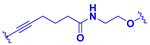 | n.i. | n.t. | n.i. |
| 16d (Abd12) |  |  | n.i. | n.t. | n.i. |
| 16e (Abd44) |  |  | n.i. | n.t. | n.i. |
| 16f (Abd48) |  | 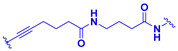 | 20 ± 2 | 14 ± 1 | n.i. |
| 16g (Abd8) |  |  | 12 ± 1 | 11 ± 1 | n.i. |
| 21a (Abd42) |  |  | 6 ± 1 | 43 ± 1 | n.i. |
| 21b (Abd25) |  |  | n.i. | n.t. | n.i. |
| 21c (Abd3) |  |  | n.i. | 18 ± 2 | n.i. |
| 27a (Abd41) |  |  | n.i. | n.t. | 40.2 ± 2.0 |
| 27b (Abd40) |  |  | n.i. | n.t. | n.i. |
| 32a (Abd63) |  |  | n.i. | n.t. | n.i. |
| 32b (Abd66) |  |  | 6 ± 1 | n.t. | n.i. |
| 32c (Abd59) |  |  | 9 ± 1 | 16 ± 1 | n.i. |
| 32d (Abd62) |  |  | 14 ± 1 | 43 ± 2 | n.i. |
| 32e (Abd61) |  |  | 8 ± 1 | n.t. | n.i. |
 | |||||
| Cmpd. ID | Linker | % Cytotox PANC-1 @20 μM | % Cytotox HEK293T @25 μM @50 μM | EC50 μM HEK293T | EC50 μM HCT-116 |
| 34a (Abd19) |  | n.i. | n.t. | n.i. | |
| 34b (Abd20) |  | n.i. | n.t. | 58.0 ± 7.3 | |
| 34c (Abd21) |  | n.i. | n.t. | 52.7 ± 6.9 | |
| 34d (Abd22) |  | n.i. | n.t. | n.i. | |
| 34e (Abd18) |  | n.i. | 12 ± 1 38 ± 3 | 90.0 ± 5.0 | >100 |
| 34f (Abd2) |  | 17 ± 2 | 33 ± 3 63 ± 6 | 37.3 ± 2.5 | 39.7 ± 1.2 |
| 34g (Abd5) | 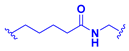 | 13 ± 2 | 18 ± 2 43 ± 4 | 61.6 ± 5.1 | 63.0 ± 8.1 |
| 34h (Abd17) |  | 8 ± 1 | 13 ± 1 44 ± 2 | >50 | >100 |
| 34i (Abd7) |  | n.i. | n.t. | n.i. | |
| 34j (Abd14) |  | n.i. | n.t. | n.i. | |
| 34k (Abd43) |  | n.i. | n.t. | n.i. | |
| 34l (Abd13) |  | 6 ± 1 | 37 ± 3 55 ± 6 | >50 | >100 |
| 34m (Abd23) |  | n.i. | n.t. | 50.3 ± 2.8 | |
| 34n (Abd24) |  | n.i. | n.t. | 52.6 ± 17.6 | |
| EN4 | 6.0 ± 0.4 | 11.3 ± 0.6 | >25 | ||
| KL4-219A | 1.57 ± 0.11 | 0.99 ± 0.04 | 0.82 ± 0.032 | ||
| 0 min—cpd. Remaining % | 10 min—cpd. Remaining % | 20 min—cpd. Remaining % | 30 min—cpd. Remaining % | 60 min—cpd. Remaining % | 120 min—cpd. Remaining % | |
|---|---|---|---|---|---|---|
| 34f | 100 | 46.0 ± 1.8 | 26.4 ± 0.6 | 17.1 ± 1.1 | 3.9 ± 0.2 | 1.1 ± 0.1 |
| 34g | 100 | 49.9 ± 1.1 | 23.6 ± 0.1 | 15.9 ± 1.1 | 4.1 ± 0.2 | 1.4 ± 0.1 |
| 34l | 100 | 38.3 ± 1.7 | 33.8 ± 1.1 | 25.6 ± 0.1 | 7.5 ± 0.1 | 2.6 ± 0.1 |
| 34h | 100 | 21.0 ± 0.6 | 13.8 ± 0.5 | 8.7 ± 0.3 | 3.7 ± 0.2 | 2.6 ± 0.1 |
| 34e | 100 | 44.0 ± 3.3 | 27.9 ± 0.4 | 17.4 ± 0.2 | 5.3 ± 0.2 | 1.8 ± 0. |
| 16f | 100 | 21.7 ± 0.2 | 13.8 ± 0.5 | 8.1 ± 0.2 | 2.9 ± 0.1 | 0.8 ± 0.0 |
| 27a | 100 | 18.7 ± 0.3 | 15.2 ± 0.1 | 14.1 ± 0.4 | 11.0 ± 0.4 | 9.1 ± 0.3 |
| 32c | 100 | 63.9 ± 0.9 | 36.6 ± 2.7 | 38.7 ± 0.1 | 24.0 ± 0.5 | 12.4 ± 0.1 |
| 32d | 100 | 56.6 ± 0.1 | 52.5 ± 0.2 | 43.9 ± 1.4 | 19.5 ± 0.3 | 7.1 ± 0.1 |
| KL4-219A | 100 | 50.0 ± 3.1 | 24.6 ± 0.4 | 13.6 ± 0.4 | 2.6 ± 0.2 | 0.6 ± 0.1 |
| EN4 | 100 | 52.4 ± 2.3 | 16.1 ± 0.4 | 14.7 ± 0.3 | 15.9 ± 0.2 | 15.1 ± 0.7 |
Disclaimer/Publisher’s Note: The statements, opinions and data contained in all publications are solely those of the individual author(s) and contributor(s) and not of MDPI and/or the editor(s). MDPI and/or the editor(s) disclaim responsibility for any injury to people or property resulting from any ideas, methods, instructions or products referred to in the content. |
© 2026 by the authors. Licensee MDPI, Basel, Switzerland. This article is an open access article distributed under the terms and conditions of the Creative Commons Attribution (CC BY) license.
Share and Cite
Alfayomy, A.M.; Hagemann, S.; Schmidt, M.; Fouad, A.; El-Zahabi, M.A.; Hüttelmaier, S.; Sippl, W. Insights into the Design of MYC-Targeting Proteolysis Targeting Chimeras (PROTACs). Molecules 2026, 31, 1011. https://doi.org/10.3390/molecules31061011
Alfayomy AM, Hagemann S, Schmidt M, Fouad A, El-Zahabi MA, Hüttelmaier S, Sippl W. Insights into the Design of MYC-Targeting Proteolysis Targeting Chimeras (PROTACs). Molecules. 2026; 31(6):1011. https://doi.org/10.3390/molecules31061011
Chicago/Turabian StyleAlfayomy, Abdallah M., Sven Hagemann, Matthias Schmidt, Ali Fouad, Mohamed Ayman El-Zahabi, Stefan Hüttelmaier, and Wolfgang Sippl. 2026. "Insights into the Design of MYC-Targeting Proteolysis Targeting Chimeras (PROTACs)" Molecules 31, no. 6: 1011. https://doi.org/10.3390/molecules31061011
APA StyleAlfayomy, A. M., Hagemann, S., Schmidt, M., Fouad, A., El-Zahabi, M. A., Hüttelmaier, S., & Sippl, W. (2026). Insights into the Design of MYC-Targeting Proteolysis Targeting Chimeras (PROTACs). Molecules, 31(6), 1011. https://doi.org/10.3390/molecules31061011