Article

Hydrothermal Conversion of Wastewater Treatment Sands into Dual-Phase FAU/LTA Zeolite: Structural Insights and Performance in Methylene Blue Adsorption

1
Department of Chemistry, Universidad Técnica Particular de Loja, Loja 110107, Ecuador
2
Escuela de Ingeniería Química, Universidad Técnica Particular de Loja, Loja 110107, Ecuador
3
Department of Chemical Engineering, Polytechnic University of Catalonia–BarcelonaTech (UPC), 08019 Barcelona, Spain
4
Barcelona Research Center in Multiscale Science and Engineering (CCEM), Universitat Politècnica de Catalunya-BarcelonaTech (UPC), Av. Eduard Maristany, 16, 08019 Barcelona, Spain
*
Author to whom correspondence should be addressed.
Molecules 2026, 31(3), 437; https://doi.org/10.3390/molecules31030437
Submission received: 2 December 2025 / Revised: 10 January 2026 / Accepted: 23 January 2026 / Published: 27 January 2026
(This article belongs to the Special Issue Design, Synthesis, and Application of Zeolite Materials)

Abstract

This study presents a sustainable valorization strategy for wastewater treatment plant (WWTP) residual sands through their hydrothermal conversion into a dual-phase FAU/LTA zeolite and evaluates its adsorption performance toward methylene blue (MB) as a model cationic contaminant. The synthesized material (ZEO-RS) exhibited a low Si/Al ratio (~1.7), well-developed FAU supercages with minor LTA domains, and high structural integrity, as confirmed by XRD, FTIR, XRF, SEM and PZC analyses. ZEO-RS demonstrated rapid adsorption kinetics, reaching approximately 92% of equilibrium uptake within 30 min and following a pseudo-second-order kinetic model (k2= 2.73 g·mg−1·h−1). Equilibrium data were best described by the Langmuir isotherm, yielding a maximum adsorption capacity of 34.2 mg·g−1 at 20 °C, with favorable separation factors (0 < rL < 1), while Freundlich fitting indicated moderate surface heterogeneity. Thermodynamic analysis revealed that MB adsorption is spontaneous (ΔG° = −11.98 to −12.56 kJ·mol−1), mildly endothermic (ΔH° = +5.26 kJ·mol−1), and entropy-driven (ΔS° = +0.059 kJ·mol−1·K−1). FTIR evidence, combined with pH-dependent behavior, indicates that adsorption proceeds via synergistic electrostatic attraction, pore confinement within FAU domains, and partial ion-exchange interactions. Desorption efficiencies conducted under mild acidic, neutral, and alkaline conditions resulted in low MB release (1–8%), indicating strong dye retention and high framework stability. Overall, the results demonstrate that WWTP residual sands are an effective and scalable low-cost precursor for producing zeolitic adsorbents, supporting their potential application in sustainable water purification and circular-economy-based wastewater treatment strategies.

1. Introduction

The rapid expansion of urbanization and industrial activities has intensified the demand for efficient wastewater treatment systems to safeguard public health and prevent environmental degradation [1,2,3,4]. Wastewater treatment plants (WWTPs) play a crucial role in this process; however, they generate large volumes of solid by-products, mainly sewage sludge and residual sands [5,6]. While sludge has been partially valorized through energy recovery, composting, or incorporation into construction materials, residual sands remain largely underutilized [7,8,9]. Their uncontrolled disposal in landfills or aquatic environments can lead to heavy metal leaching, particulate matter release, and secondary pollution, resulting in soil contamination and ecological disturbance. Nonetheless, given their high silica and alumina contents, these sands constitute a promising secondary raw material that can be transformed into high-value products such as construction aggregates, filtration media, catalytic supports, or zeolitic adsorbents, thereby supporting a circular economy approach to waste management [6,10].
Residual sands, often regarded as inert waste, are rich in SiO2 and Al2O3, making them excellent feedstocks for zeolite synthesis [11,12]. Traditionally, zeolites have been synthesized using high-purity chemical reagents (e.g., sodium silicate and aluminum hydroxide), which ensure controlled crystallinity but increase production costs and environmental impact [13,14]. As an alternative, natural and industrial by-products such as kaolin, fly ash, volcanic tuffs, and mining residues have been explored as low-cost sources of silicon and aluminum [15,16,17,18,19]. Although these raw materials reduce chemical consumption and waste generation, they often exhibit heterogeneous composition, lower purity, and variable Si/Al ratios, which may affect crystallization behavior and structural uniformity [20,21]. In this context, WWTP residual sands emerge as an untapped, compositionally stable, and locally available source for zeolite production. Their valorization not only mitigates the environmental burden associated with disposal but also enables the development of sustainable zeolitic materials with functional properties suitable for environmental remediation applications such as adsorption, ion exchange, and catalysis [22,23,24,25].
Among the various environmental applications of zeolitic materials, their use as adsorbents for organic dyes has been extensively documented due to their structural versatility, abundance of active sites, and excellent chemical and thermal stability [26,27,28,29,30]. Dyes, particularly those released by the textile, paper, and leather industries, represent one of the most persistent and hazardous classes of pollutants, characterized by high chromaticity, molecular complexity, and resistance to biodegradation [31,32,33]. Conventional treatment methods, such as coagulation–flocculation, chemical oxidation, and biological degradation, are often insufficient for complete dye removal, as they generate secondary sludge or exhibit limited selectivity toward recalcitrant molecules [34,35,36]. In this context, zeolite-based adsorption emerges as a promising alternative owing to its efficiency, regenerability, and operational simplicity [29,37]. However, zeolites synthesized from waste-derived precursors, while economically and environmentally advantageous, may display variations in purity, Si/Al ratio, and surface properties that influence adsorption capacity and reproducibility. According, the development of tailored zeolites with controlled composition and morphology from unconventional precursors, such as wastewater treatment residual sands, represents a critical step toward achieving high-efficiency, selective adsorption processes capable of addressing the current limitations of conventional dye removal technologies [38,39,40,41].
Methylene blue (MB) is a cationic thiazine dye widely used in the textile, paper, and pharmaceutical industries and is recognized for its high water solubility, intense chromaticity, and chemical stability [42,43,44]. These properties allow MB to persist in treated effluents [31,45], and when discharged into aquatic ecosystems, it can impede light penetration, reduce photosynthetic activity, and exert toxic, mutagenic, and neurotoxic effects on aquatic organisms and humans [46,47]. Its recalcitrant nature and strong interactions with organic and inorganic matter make MB an ideal model contaminant for evaluating the performance of emerging adsorbent materials [45,48,49]. Zeolites have been widely explored for MB removal owing to their negatively charged aluminosilicate frameworks, high cation-exchange capacity, and well-defined microporous structure, which promote electrostatic attraction and molecular sieving effects [50,51,52]. Various zeolitic frameworks, including clinoptilolite, mordenite, LTA, and FAU-type zeolites, have demonstrated significant adsorption capacities toward cationic dyes [53,54,55,56].
Among these materials, FAU-type zeolites (e.g., FAU-X and FAU-Y) are particularly attractive due to their three-dimensional pore system composed of large supercages (≈13 Å) interconnected by 12-membered oxygen rings, which enable the diffusion of relatively large dye molecules such as MB [57,58,59]. Their low Si/Al ratio further enhances the density of negative charge sites, promoting strong electrostatic interactions with cationic species [60,61]. Likewise, LTA-type zeolites, characterized by cubic morphology and 8-membered ring apertures (≈4.1 Å), exhibit high selectivity for small cations and dyes under optimized conditions [52,62]. Although their smaller pore openings compared to FAU-type structures limit the diffusion of bulky molecules, their surface charge, hydrophilicity, and tunable crystallite size can be engineered to improve adsorption performance [63,64,65]. The coexistence of FAU and LTA phases within a single material therefore offers a synergistic combination of large-pore and small-pore adsorption domains, facilitating the removal of cationic dyes with different molecular dimensions [41,66,67,68].
The novelty of this work lies in the conversion of wastewater treatment plant (WWTP) residual sands, an abundant yet underexplored waste stream, into dual-phase zeolitic materials (FAU–LTA) with tunable textural and adsorption properties. In contrast to conventional syntheses that rely on high-purity chemical reagents such as sodium silicate or aluminum hydroxide, or on industrial by-products such as fly ash and metakaolin, this study demonstrates a cost-effective and environmentally benign alternative that uses WWTP sands as the sole source of silicon and aluminum. These residual sands provide a stable and compositionally balanced precursor, eliminating the need for additional reagents and substantially reducing both material and energy consumption during synthesis. This approach represents a novel route that integrates waste valorization, green chemistry, and functional material design within a single framework [69,70]. By transforming an often-neglected waste into a high-performance zeolitic adsorbent, this strategy not only reduces the environmental impacts associated with disposal but also expands the portfolio of viable secondary raw materials for zeolite production [41,52]. Moreover, the successful synthesis of FAU–LTA structures from WWTP sands highlights their potential as sustainable substitutes for conventional, high-cost feedstocks, paving the way toward scalable and resource-efficient production of advanced zeolitic materials.
Therefore, this study aims to develop and characterize zeolitic materials derived from wastewater treatment plant (WWTP) residual sands through an optimized hydrothermal synthesis route. Specifically, the objectives are to: (i) evaluate the chemical and structural transformation of the sands into dual-phase zeolites (FAU–LTA); (ii) determine their physicochemical properties through XRF, XRD, FTIR, and PZC analyses; and (iii) assess their adsorption performance toward methylene blue (MB) as a model cationic pollutant. By integrating material design with environmental functionality, this work proposes an innovative valorization pathway for an underutilized waste stream while advancing the sustainable synthesis of zeolites from unconventional precursors. The outcomes of this research are expected to strengthen the scientific understanding of waste-derived zeolitic systems and to support the long-term development of scalable, low-cost adsorbents for water purification and circular resource management. Methylene blue was selected as a model contaminant because it is a well-established probe molecule for evaluating the adsorption performance of low-silica zeolites toward cationic species. Given the intrinsic negative framework charge and high cation-exchange capacity of FAU- and LTA-type zeolites, the evaluation of MB adsorption provides a representative and mechanistically relevant assessment of the material’s adsorption behavior toward cationic pollutants.

2. Results and Discussion

2.1. Physicochemical Characterization of Synthesized Zeolite

2.1.1. Chemical Composition

The pretreated sands were primarily composed of SiO2 (68.2%) and Al2O3 (13.4%), along with minor fractions of CaO, Fe2O3, and K2O, as summarized in Table 1. After hydrothermal synthesis, the SiO2 content decreased to 41.4%, while Al2O3 increased to 24.1%, resulting in a SiO2/Al2O3 molar ratio of 1.7. This compositional shift reflects the partial dissolution of silicate phases and the incorporation of additional aluminum from sodium aluminate, promoting the crystallization of a low-silica zeolite framework. Zeolitic materials with SiO2/Al2O3 molar ratios in the range of 1.5–2.0 correspond to low-silica frameworks such as Na-A (LTA), Na-X (FAU), and P1-type zeolites, which exhibit a high density of framework negative charges and strong cation-exchange capacity [71]. Similar compositions have been widely reported for materials synthesized from aluminosilicate-rich residues, including coal fly ash, kaolin, and volcanic tuffs, where the aluminum enrichment promotes the formation of zeolitic structures with enhanced hydrophilicity and electrostatic affinity toward cationic pollutants [17,72,73]. For instance, Pérez-Botella et al. (2022) demonstrated that zeolites with Si/Al ratios below 2 exhibit enhanced ion-exchange performance due to the larger proportion of AlO4 units [74], while Kordala (2024) and Li et al. (2023) reported the preferential crystallization of FAU- and LTA-type zeolites under comparable compositional conditions from waste-derived aluminosilicates [61,71]. Similarly, studies on zeolite synthesis from industrial wastes have shown that such Si/Al ratios favor the formation of highly reactive, Al-rich frameworks [38]. Therefore, the SiO2/Al2O3 ratio of 1.7 obtained in this study aligns well with the compositional domain of low-silica zeolites, confirming that the synthesis condition promoted aluminum incorporation and the crystallization of a cation-selective aluminosilicate network. Such low-silica compositions typically yield structures with stronger electrostatic interactions, greater hydrophilicity, and a higher density of accessible active sites than high-silica zeolites, which are more hydrophobic and exhibit lower cation affinity [74]. These results confirm that the applied synthesis conditions effectively facilitated the formation of a zeolite framework suitable for adsorption and ion-exchange applications [61].

2.1.2. XRD Analysis

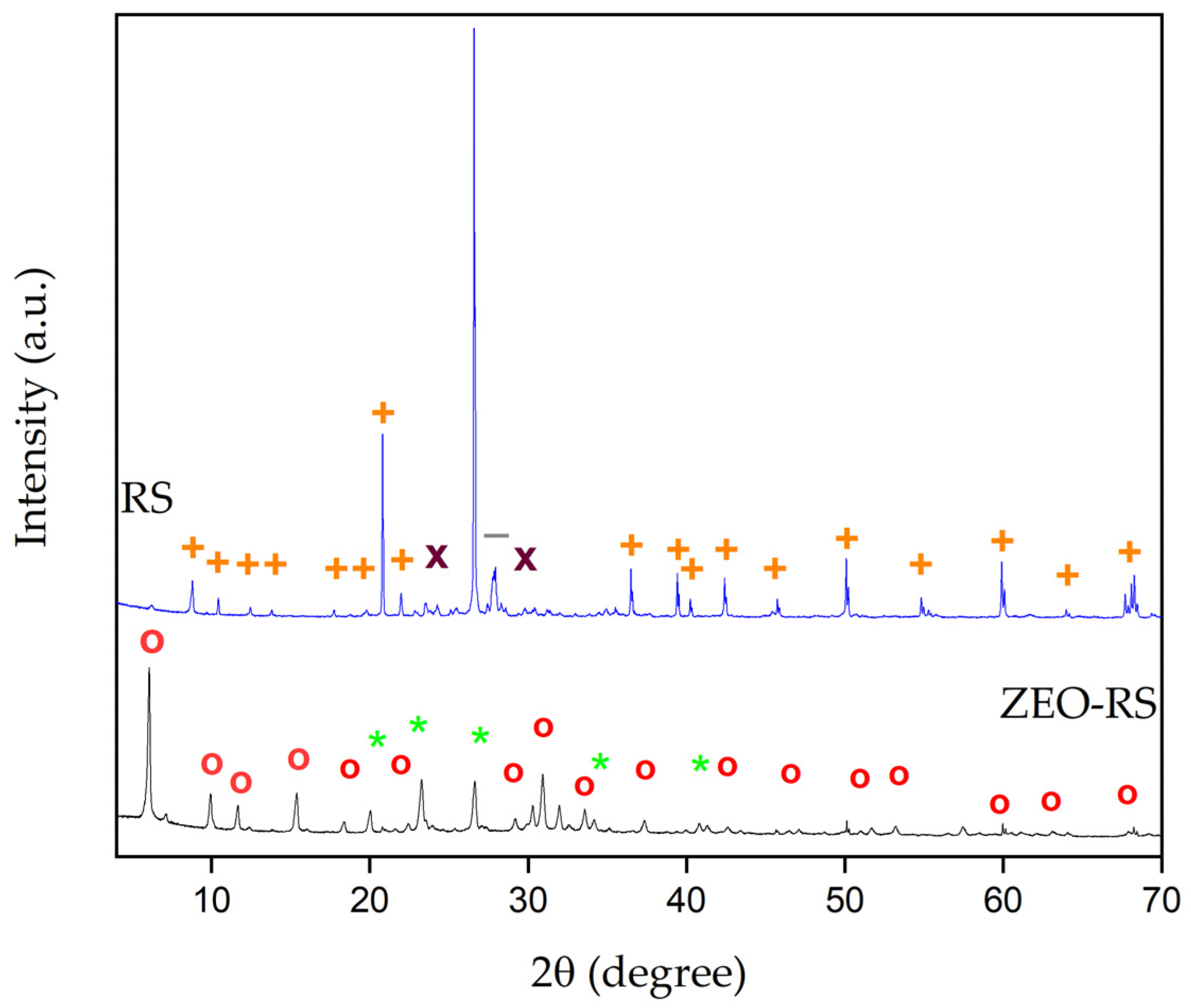
The X-ray diffraction (XRD) patterns of the residual sand (RS) and the synthesized zeolite (ZEO-RS) are presented in Figure 1. The diffraction peaks of RS were indexed by comparison with reference database codes from the Crystallography Open Database (COD) [75], confirming quartz (COD 1501650) as the dominant crystalline phase. Quartz was identified as a monoclinic structure (space group P 1 21/c 1) with unit cell parameters a = 1.86 Å, b = 14.09 Å, c = 13.47 Å. Characteristic reflections were observed at 2θ ≈ 8.8°, 9.7°, 10.4°, 12.5°, 13.8°, 17.7°, 18.8°, 20.8°, 22.8°, 25.5°, 37.7°, 39.4°, 40.2°, 42.4°, 45.4°, 49.2°, 54.8°, 60.7°, 64.7°, and 68.3°. Additional reflections correspond to muscovite (COD 11000014), a trigonal aluminosilicate (P 31 1 2, a = b = 5.20 Å, c = 29.97 Å), with characteristic reflections at 2θ ≈ 24.1° and 28.06°, and anorthite (COD 9016764), a triclinic feldspar-type phase (P–1, a = 8.18 Å, b = 8.77 Å, c = 9.44 Å), with characteristic reflection at 2θ ≈ 27.9°. These results confirm the heterogeneous aluminosilicate nature of the precursor material, with the residual sand consisting primarily of well-crystallized silicate and aluminosilicate minerals, in agreement with its high SiO2 and Al2O3 contents determined by XRF. Such mineral phases are typical of sand-based residues from wastewater treatment plants and exhibit high crystallinity and structural stability, which limit their direct reactivity under alkaline conditions.
After hydrothermal treatment, the ZEO-RS diffraction pattern showed a complete transformation of the crystalline profile, with the disappearance of quartz reflections and the emergence of new, well-defined peaks characteristic of zeolitic structures. The appearance of these peaks at low 2θ angles (6–35°) indicates the formation of a highly ordered aluminosilicate framework, confirming the successful conversion of the inert precursor into a crystalline zeolite. The observed crystallographic features suggest the coexistence of multiple aluminosilicate domains, reflecting a competitive crystallization process influenced by the SiO2/Al2O3 ratio (≈1.7) and synthesis alkalinity. Comparison with reference patterns from the Database of Zeolite Structures of the International Zeolite Association (IZA) revealed that the materials consist predominantly of Faujasite (FAU-X) with a minor contribution from Linde Type-A (LTA) [76], both exhibiting cubic symmetry (Fd–3 m and Pm–3 m, respectively; a = b = c = 24.36 Å). FAU was identified by characteristic diffraction peaks at 2θ ≈ 6.1°, 10.1°, 12.3°, 16°, 17.5°, 23.3°, 29.2°, 32.5°, 34.1°, 42.6°, 47.1°, 51.1°, 54.6°, 60.5°, 63.2°, and 67.9°. In contrast, weak reflections corresponding to LTA were observed at 2θ ≈ 21.3°, 23.5°, 26.6°, 33.2°, and 40.8°, indicating the coexistence of both zeolitic frameworks. Quantitative phase analysis performed using HighScore Plus 5.3. indicated that the zeolitic product consists of approximately 98 wt% FAU and 2 wt% LTA, confirming the predominance of the faujasite framework. This phase composition is consistent with previous studies showing that hydrothermal synthesis under moderate alkalinity and low Si/Al ratios (≈1.5–2.0) favors FAU crystallization as the thermodynamically dominant phase, with LTA forming as a minor metastable phase [77,78]. Dual-phase FAU/LTA systems are commonly reported for zeolites derived from natural or residual silicates, where competitive crystallization and dissolution–reprecipitation mechanism governs phase evolution [70,79,80]. These XRD results confirm that the hydrothermal treatment of WWTP sands leads to a well-crystallized zeolite framework, representing a complete structural reorganization from quartz- and feldspar-based phases to FAU/LTA zeolitic lattices. The high crystallinity and absence of unreacted phases highlight the efficiency of the synthesis process and indicate excellent structural ordering [81].

2.1.3. FTIR Analysis

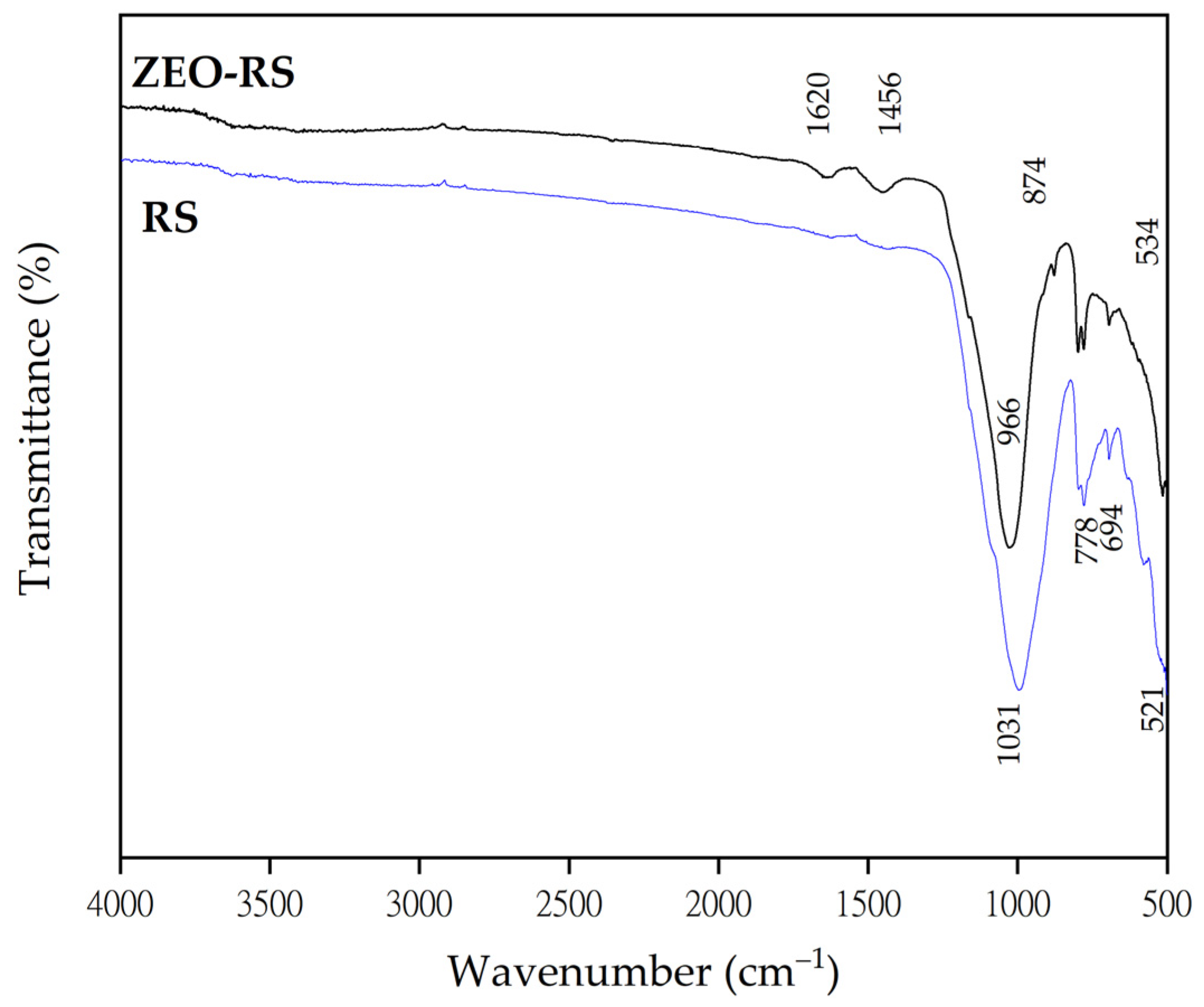
The FTIR spectra of the residual sand (RS) and the synthesized zeolite (ZEO-RS) are compared in Figure 2. The RS spectrum exhibits a dominant asymmetric stretching band at approximately 1031 cm−1, typically attributed to Si–O–Si and Si–O–Al linkages in crystalline silicates such as quartz and feldspars, and characteristics of aluminosilicate networks present raw sand matrices [82,83]. A secondary band observed at around 521 cm−1 further confirms the presence of Si–O–Al bending vibrations, consistent with previously reported FTIR characterizations of aluminosilicate minerals [84].
In contrast, the FTIR spectrum of the synthesized material (ZEO-RS) shows significant modifications relative to the precursor, notably the appearance and shifting of absorption bands at approximately 966 cm−1, ~874 cm−1 and ~534 cm−1, together with weaker bands at around 1456 cm−1 and ~1620 cm−1. The shift in the main asymmetric Si–O–T stretching band toward lower wavenumbers (~966 cm−1) is indicative of increased aluminum incorporation and framework rearrangement, in agreement with systematic studies correlating the Si/Al ratio with this vibrational frequency in zeolitic materials [20,85].
The band near ~874 cm−1 and the bending vibration at approximately 534 cm−1 correspond to T–O (T = Si or Al) vibrations in tetrahedral units and to ring deformations typical of zeolitic frameworks rather than unmodified silicate minerals. For LTA-type zeolites, bands in the range of 500–800 cm−1 are characteristic of symmetric stretching vibrations of four-membered rings, as well as vibrations associated with double six-membered ring (D6R) units [85,86]. Similarly, in LTA and FAU-X zeolites, characteristic bands are commonly reported near ~1007 cm−1 and ~547 cm−1. The broad absorption region between approximately 3000 and 3500 cm−1 indicates the presence of surface hydroxyl groups and adsorbed water, which is typical of hydrated zeolites with open framework structures [20,85].
The weak bands at around 1620 cm−1 and 1456 cm−1 are attributed to the H–O–H bending modes of confined water molecules and to bending vibrations of residual hydroxyl groups, respectively [85,87]. Their presence further supports the formation of a zeolitic framework and confirms the successful transformation of the precursor material into a hydrated aluminosilicate structure.

2.1.4. SEM Analysis

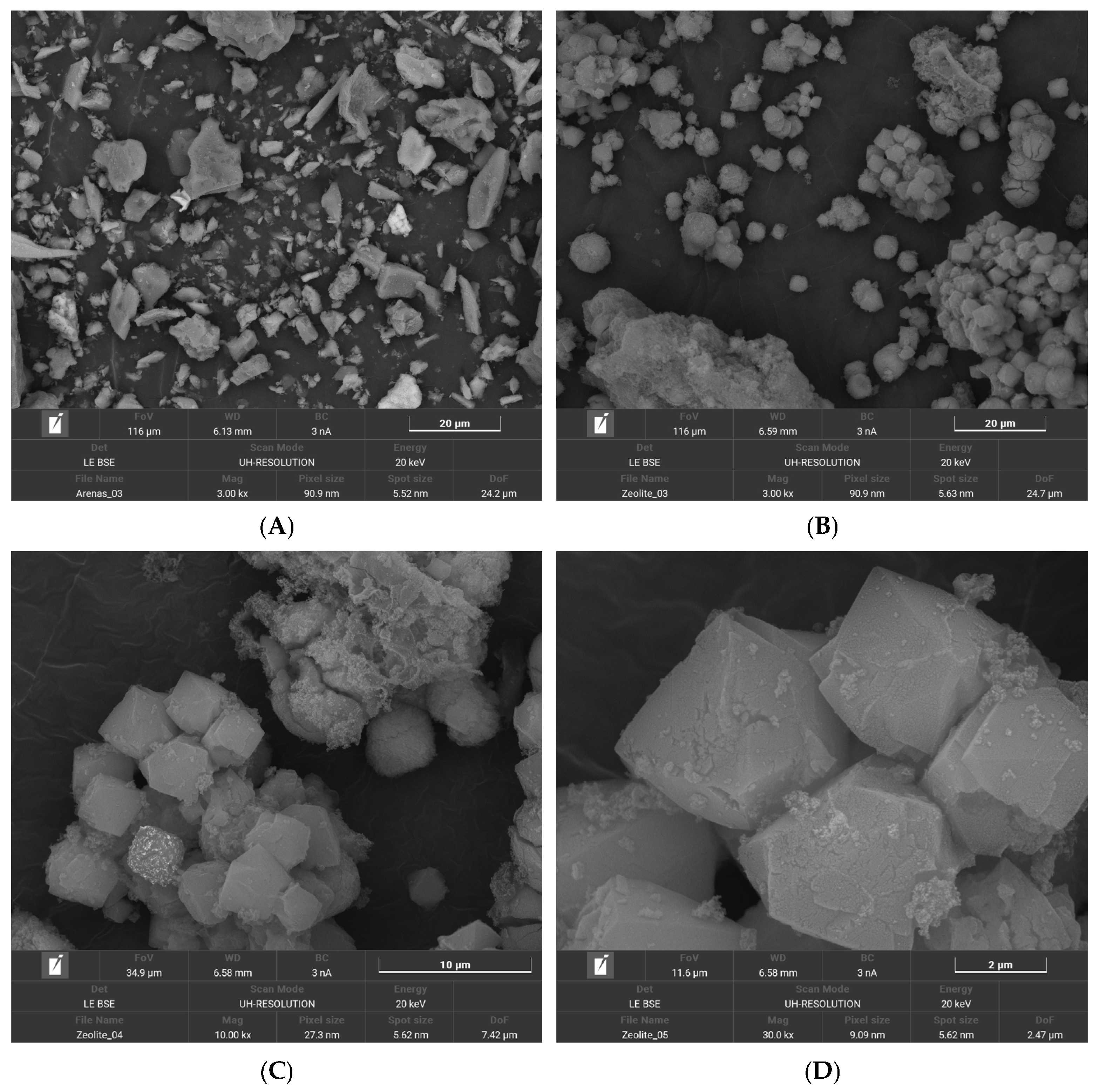
The morphological features of the residual sand (RS) and the synthesized zeolite (ZEO-RS) are shown in Figure 3. The SEM image of the raw material (RS) reveals heterogeneous, irregularly shaped particles with angular edges and compact, nonporous surfaces (Figure 3A). This morphology is characteristic of inert silicate mineral aggregates composed mainly of quartz, feldspar, and aluminosilicate fragments [88], consistent with residues commonly found in wastewater treatment plants (WWTPs). The dense texture indicates a low specific surface area and limited number of accessible active sites, a behavior similarly reported for untreated aluminosilicate residues such as fly ash prior to alkaline activation [89].
After hydrothermal synthesis, a marked morphological transformation is observed in the ZEO-RS sample (Figure 3B,C,D). The SEM images reveal aggregates of well-defined particles corresponding to zeolitic frameworks of the FAU and LTA types, in agreement with the XRD results [20,69,80]. The faujasite-type crystals appear as large, polyhedral and faceted aggregates with relatively smooth surfaces and particle sizes ranging from 1 to 3 µm, often forming intergrown clusters [82]. This morphology is characteristic of faujasite-type zeolites crystallized under moderate alkalinity and Si/Al ratios near 1.5–2.0, as previously reported for faujasites synthesized from aluminosilicate wastes, which exhibit similar octahedral or polyhedral shapes [15,69]. The presence of these well-faceted grains suggests a highly ordered crystallization process, consistent with the strong crystallinity observed by XRD and the low Si/Al ratio obtained from XRF analysis (≈1.7). In comparison, faujasite-Y zeolites (FAU-Y), typically synthesized at higher Si/Al ratios (2.5–3.0) and under more silica-rich or highly alkaline conditions, tend to exhibit smaller, less uniform crystallites with rougher surfaces and a greater tendency to form spherical or irregular aggregates [19]. Therefore, the predominance of large, faceted polyhedral particles in ZEO-RS is indicative of a low-silica faujasite-X structure (FAU-X), in agreement with the compositional and spectroscopic evidence.
The LTA crystals are distinguished by their well-defined cubic morphology with sharp edges and relatively uniform particle sizes ranging from approximately 0.5 to 2 µm. These cubic particles frequently appear densely packed or partially intergrown with faujasitic domains, suggesting simultaneous nucleation and competitive growth of both zeolitic structures during the hydrothermal synthesis process [78,79,80]. This morphology is consistent with typical LTA crystal structures, which are commonly obtained under high-alkalinity and low Si/Al ratio conditions (≈ 1.0–1.5) [78,90].
The Si/Al ratio determined for ZEO-RS (≈ 1.7) falls close to this compositional domain, supporting the coexistence of LTA and FAU phases as low-silica zeolitic domains. The agreement between chemical composition and crystal morphology reinforces the interpretation that both structures are present in the synthesized material. Overall, SEM observations confirm that hydrothermal treatment effectively transformed the compact, inert sand particles into well-crystallized zeolitic materials with distinct morphological domains reflecting the FAU/LTA dual-phase structure. The coexistence of both cubic LTA and polyhedral FAU-X crystals supports a competitive crystallization pathway typical of low-silica zeolites derived from natural or waste-based aluminosilicates under alkaline hydrothermal conditions [69,70,78]. Similar dual-phase morphologies have been reported for zeolites synthesized from a variety of raw materials, where FAU is often the dominant phase and LTA appears as a secondary phase [78]. In some cases, the initial nucleation of LTA followed by intercrystalline transformation into FAU has also been documented [80].

2.2. Adsorption Performance Evaluation

2.2.1. Effect of pH on Adsorption Efficiency

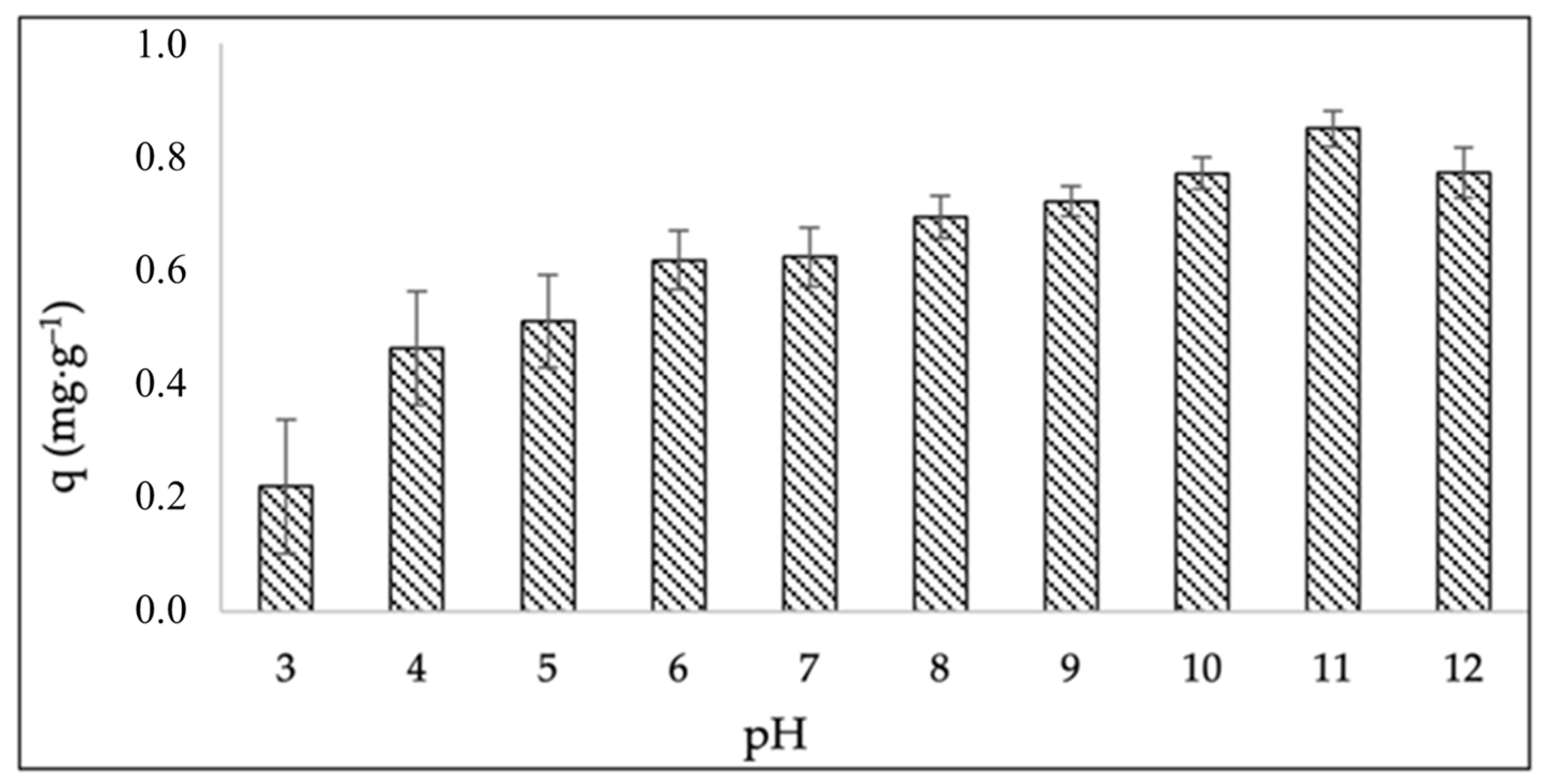
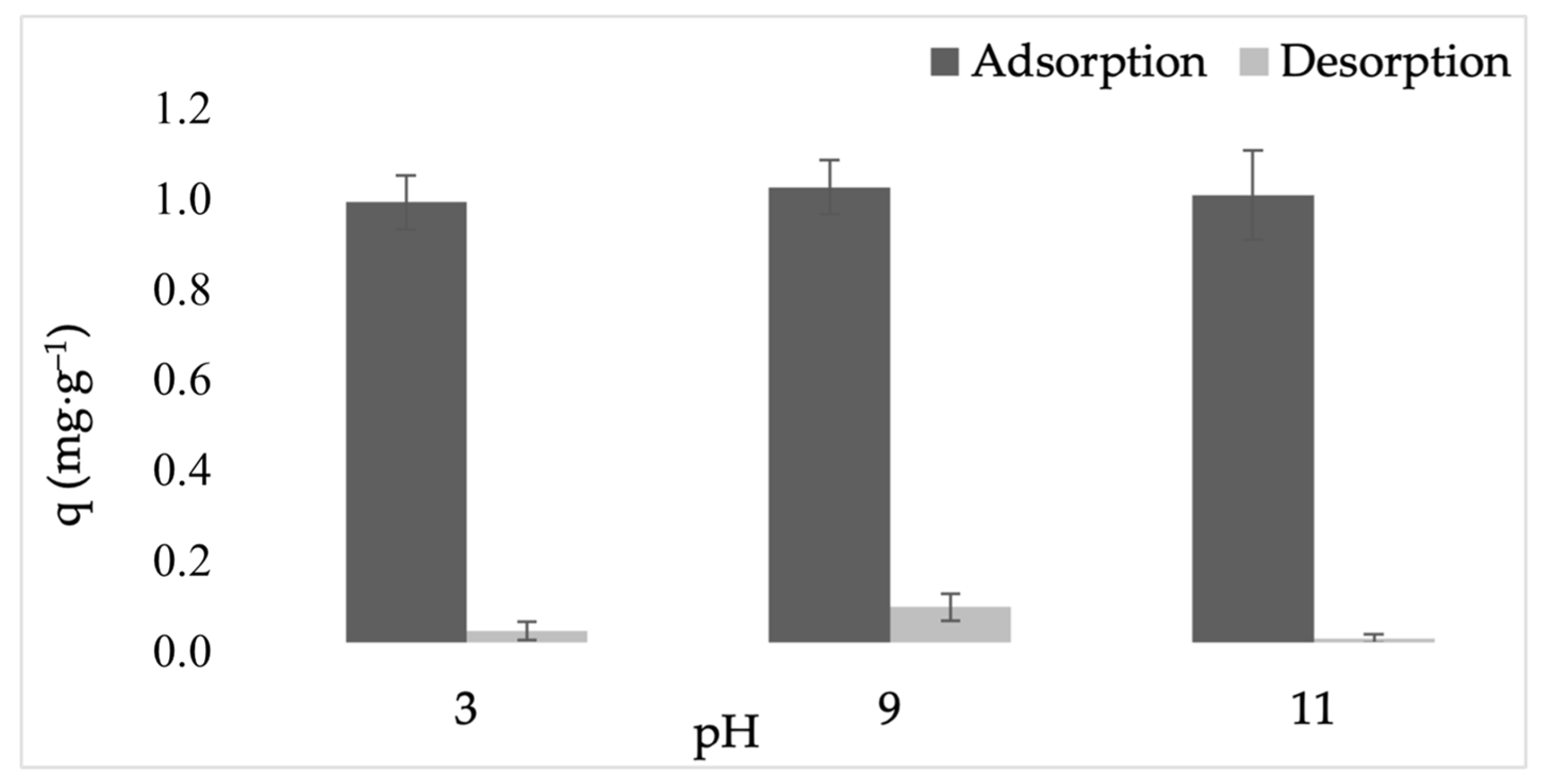
The adsorption of methylene blue (MB), a cationic thiazine dye, onto the synthesized zeolite (ZEO-RS) was strongly influenced by the pH, as shown in Figure 4. The point of zero charge (PZC) of ZEO-RS was determined to be 10.6 ± 0.2, indicating that the zeolite surface is positively charged at pH values below 10.6 and becomes negatively charged at pH values above this threshold. This shift in surface charge governs the electrostatic interactions between MB+ ions and the adsorbent’s active sites.
Comparable PZC values have been reported for low-silica, aluminum-rich zeolites such as FAU-X and LTA types, typically ranging between 9.5 and 11.0 [91,92], reflecting their strong basic character and high density of framework aluminum [93]. Therefore, the PZC obtained for ZEO-RS confirms its low-silica nature and the predominance of basic surface sites. This characteristic enhances electrostatic attraction between the negatively charged zeolite surface (pH > 10.6) and cationic MB species, thereby improving adsorption efficiency under alkaline conditions [52]. The pH-dependent adsorption study revealed a progressive increase in MB uptake with increasing pH, reaching maximum adsorption at pH 11.
At acidic to near-neutral pH values (pH 3–7), the adsorption capacity was relatively low because the surface of ZEO-RS remained positively charged, resulting in electrostatic repulsion between protonated zeolitic sites and MB+ molecules. In addition, under acidic conditions, H+ ions compete with MB+ species for available adsorption sites, further inhibiting dye uptake. Similar trends have been reported for cationic dye adsorption onto zeolitic and aluminosilicate materials with high PZC values [52]. These results confirm that electrostatic interactions play a major role in the adsorption of MB onto ZEO-RS, primarily governed by the protonation–deprotonation equilibrium of surface functional groups. These results confirm that electrostatic interactions play a major role in the adsorption of MB onto ZEO-RS, primarily governed by the protonation–deprotonation equilibrium of surface hydroxyl groups [55]. However, the noticeable adsorption observed at acidic pH values (pH < PZC), where electrostatic repulsion between positively charged ZEO-RS surfaces and MB+ would be expected, indicates that additional mechanisms may be involved [52]. As the pH increased toward alkaline conditions (pH > 8), the adsorption efficiency increased significantly. In this region, deprotonation of surface hydroxyl groups (≡Si–OH and ≡Al–OH) generates negatively charged sites (≡Si–O and ≡Al–O), enhancing electrostatic attraction with MB+ ions. Maximum removal occurred near pH 10–11, where the surface charge of ZEO-RS is predominantly negative, facilitating strong dye–surface interaction through Coulombic forces [52]. Similar pH-dependent behavior has been reported for various zeolitic structures targeting MB removal [55]. Overall, electrostatic attraction is the dominant mechanism at alkaline pH values (pH > PZC); however, the adsorption behavior across the entire pH range suggests the contribution of additional interaction pathways. This highlights the structural versatility and complex surface chemistry of the synthesized zeolite, enabling effective MB uptake under varying pH conditions [53,54]. Despite the higher adsorption efficiency observed at alkaline conditions, pH 7 was selected for subsequent kinetic and equilibrium experiments to better represent environmentally relevant conditions and ensure practical applicability in wastewater treatment scenarios.

2.2.2. Adsorption Kinetics

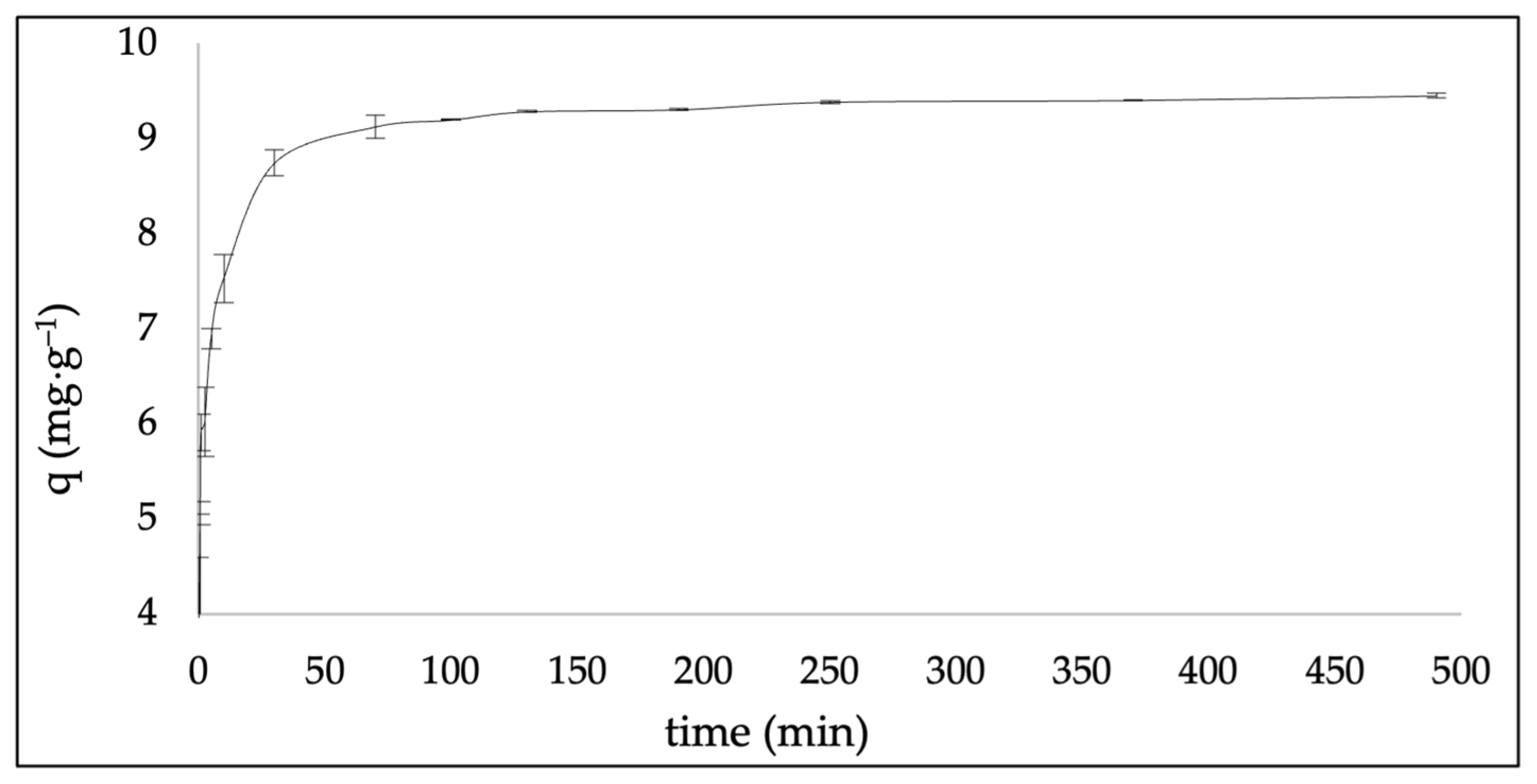
The adsorption kinetics of methylene blue (MB) onto the synthesized zeolite (ZEO-RS) are presented in Figure 5. Although the adsorption experiments were conducted for a total contact time of 24 h, the kinetic profile in Figure 5 is shown up to 8 h, as the adsorption capacity remained practically constant beyond this time and no significant variation was observed between 8 h and 24 h. The adsorption capacity (qₜ) increased rapidly during the first 30 min, reaching approximately 92% of the total uptake, and gradually approached equilibrium after about 120 min. This rapid initial uptake suggests that the early stage of adsorption is dominated by electrostatic attraction between the negatively charged zeolitic surface and cationic MB+ molecules. Comparable rapid adsorption stages have been previously reported for zeolites synthesized from industrial residues [52,94].
Beyond 120 min, the adsorption curve reached a plateau, indicating equilibrium, with a maximum capacity of approximately 9.8 mg·g−1. At this stage, most readily accessible active sites, including external exchange positions and micropore entrances, were occupied, and mass transfer resistance became the dominant limiting factor. As the number of available sites decreases, dye molecules require longer diffusion times to access deeper regions of the internal pore system. This transition from surface-controlled to diffusion-controlled kinetics is characteristic of low-silica zeolites, where a high density of exchangeable cations promotes rapid initial binding followed by a slower, diffusion-driven approach to equilibrium [51,95]. Similar equilibrium plateaus and diffusion-limited behavior have been widely reported for MB adsorption on zeolitic materials derived from industrial residues [52].
The kinetic parameters summarized in Table 2 indicate that MB adsorption onto ZEO-RS follows a pseudo-second-order kinetic model, as evidenced by the higher correlation coefficient (R2 = 0.99) compared to the pseudo-first-order model (R2 = 0.85). This suggests that the adsorption rate is governed predominantly by chemisorption process involving electron sharing or exchange between MB molecules and zeolitic active sites. This interpretation is consistent with the pH-dependent adsorption behavior (Figure 4), which indicates that non-electrostatic interactions contribute to MB uptake even under conditions where electrostatic repulsion may be expected.
The equilibrium adsorption capacity predicted by the pseudo-second-order model (Qₑ = 9.52 mg·g−1) closely matches experimental value, further confirming the suitability of this model. The relatively high-rate constant (K2 = 2.73 g·mg−1·h−1) reflects rapid interaction between MB molecules and reactive surface sites, consistent with adsorption mechanisms commonly reported for cationic dyes on aluminosilicate frameworks [50]. These mechanisms include ion-exchange with charge-compensating cations; Lewis acid–base interactions involving framework aluminum sites, hydrogen bonding with surface hydroxyl groups, and strong dye–surface associations within microporous regions [54,55].
Additional insights into the rate-controlling steps were obtained from the intraparticle-diffusion, film-diffusion and particle-diffusion models (Table 2). The multi-linear intraparticle-diffusion plot revealed three distinct regions: (i) an initial stage with a high diffusion constant (k1 = 9.37 g·mg−1·h−1), corresponding to rapid transport across the external surface and macropores; (ii) an intermediate stage with a lower diffusion constant (k2= 0.71 g·mg−1·h−1), associated with diffusion into microporous domains; and (iii) a final stage with the smallest diffusion constant (k3 =0.05 g·mg−1·h−1), corresponding to equilibrium and diffusion into the least accessible sites. This multistep diffusion behavior agrees with kinetic patterns reported for MB adsorption on NaX and LTA-type zeolites, where external-film transfer and intraparticle diffusion occur concurrently [52].
Film-diffusion and particle-diffusion models also confirmed the contribution of both external and internal mass-transfer resistances. The apparent film-diffusion coefficient (Df = 2.5 × 10⁷ m2·h−1; R2 = 0.83) and the effective particle-diffusion coefficient (Dp = 2.5 × 10¹⁰ m2·h−1; R2 = 0.86) indicate that hydrodynamic boundary-layer transport and intraparticle diffusion jointly influence the overall kinetic process, consistent with previous reports on MB adsorption by zeolitic frameworks [52,96].
These kinetic results can be interpreted considering the molecular dimensions of MB and the pore architecture of the dual-phase FAU/LTA framework in ZEO-RS. MB has an approximate molecular size 1.43 × 0.61 × 0.40 nm (14.3 × 6.1 × 4.0 Å). FAU-type zeolites possess large supercages (~13 Å) accessible through 12-membered-ring windows (~7.4 Å), allowing diffusion of elongated MB molecules in favorable orientation [57,97]. In contrast, LTA-type zeolites contain α-cages (~11.4 Å) connected by narrower 8-membered-ring windows (~4.1 Å), which are comparable to or smaller than the smallest cross-section of MB, significantly restricting its internal diffusion [52,98]. Computational and experimental studies on MB adsorption onto zeolite LTA are largely limited to external surfaces and pore mouths [96,99].
In the dual-phase ZEO-RS system, MB molecules are therefore preferentially accommodated within FAU supercages, while LTA domains contribute mainly through adsorption at external surfaces. The combination of a rapid initial uptake dominated by surface interactions and a slower diffusion-controlled uptake inside the FAU domains explains both the observed kinetic behavior and multistage intraparticle diffusion profile. Overall, these results indicate that MB adsorption onto ZEO-RS proceeds through a combination of surface chemisorption and pore-diffusion mechanisms, confirming the effectiveness of the synthesized zeolite as a low-cost, aluminum-rich adsorbent for the removal of cationic contaminants aqueous systems [100,101].

2.2.3. Isothermal and Thermodynamic Evaluation

The equilibrium adsorption data of methylene blue (MB) onto the synthesized zeolite (ZEO-RS) were fitted to both the Langmuir and Freundlich isotherm models (Table 3). The Freundlich model provides a stronger fit (R2 = 0.98) than the Langmuir model (R2 = 0.94–0.95), suggesting that adsorption occurs on a heterogeneous surface. The Freundlich parameter (n−1 = 0.80 and 0.87) further indicates moderate surface heterogeneity and adsorption behavior that deviates from ideal monolayer uptake.
The maximum adsorption capacity (qm) estimated from the Langmuir model ranged from 34.2 to 36.6 mg g−1 at 20–30 °C. The slight increase in qm with temperature suggests an endothermic adsorption process, commonly associated with enhanced diffusion and electrostatically driven uptake. This trend is consistent with reports indicating that MB adsorption on low-silica aluminosilicate frameworks is largely governed by electrostatic attraction between negatively charged zeolitic sites and cationic dye molecules [54,96]. Previous studies have shown that MB adsorption capacity generally follows the order LTA < FAU-X < FAU-Y, which is primarily attributed to differences in pore aperture size and accessibility. LTA zeolites, with narrower 8-ring windows, can restrict the penetration of bulky dye molecules [52,55], whereas FAU-type zeolites provide larger 12-membered-ring windows and supercages that enhance molecular diffusion and uptake [100,101,102]. Accordingly, the qm values obtained for ZEO-RS are consistent with those expected for FAU-dominant materials.
The Langmuir constants (kL = 7.7–8.2 × 10⁻³ L·g−1) and Freundlich constants (kF ≈ 0.31 mg·g−1) indicate moderate affinity, which supports efficient adsorption. Overall, these findings suggest that MB uptake is dominated physical interactions (electrostatic attraction and diffusion within microporous regions), with minor contributions from stronger interactions that may involve exchangeable framework sites.
Comparable adsorption capacities and mixed-model behavior have been reported for FAU-type zeolites, particularly when surface heterogeneity and multiphase compositions contribute to combined Langmuir–Freundlich characteristics [56,100]. Overall, the isotherm analysis confirms that ZEO-RS is an effective and sustainable adsorbent, exhibiting moderate adsorption capacity, good selectivity toward cationic dyes, and structural robustness associated with its FAU/LTA dual-phase framework. The favorability of MB adsorption on ZEO-RS was further assessed using the dimensionless Langmuir separation factor rL. The calculated rL values, derived from the Langmuir constant and the corresponding initial MB concentrations, ranged between 0.91 and 0.99 for all investigated temperatures (Table 3). These values fall within the range 0 < rL < 1, confirming that adsorption is favorable under the studied conditions. Because rL values approach unity, they reflect a moderately favorable affinity rather than strongly irreversible uptake. Nevertheless, the consistently favorable rL values across the evaluated temperatures support the applicability of the Langmuir model and confirm the practical suitability of the FAU/LTA zeolite for MB removal under realistic operating conditions.
The thermodynamic parameters obtained for MB adsorption onto ZEO-RS (Table 4) provide additional insight into the nature of the adsorbate–adsorbent interactions. The negative Gibbs free energy values (ΔG° = −11.98 to −12.56 kJ·mol−1) over 293–303 K confirm that adsorption is spontaneous and thermodynamically favorable [51]. The magnitude of ΔG°, which lies within the typical range associated with physisorption (0 to −20 kJ·mol−1), indicates that MB uptake is predominantly governed by weak and reversible interactions rather than strong chemisorption (often reported as >−80 kJ·mol−1). In combination with the kinetic and isotherm analyses, these results support adsorption dominated by physisorption, with possible secondary contributions from stronger site-specific interactions.
The positive enthalpy change (ΔH° = +5.26 kJ·mol−1) indicates an endothermic process, consistent with slightly improved adsorption at higher temperatures due to increased molecular mobility and enhanced diffusivity within zeolitic micropores. Such low positive enthalpy values are commonly associated with electrostatic and ion–dipole interactions and contrast with the higher ΔH° values (>80 kJ mol−1) typically attributed to chemisorption [51]. This further supports a physisorption-dominated process, coexisting with weak chemical interactions. Similar endothermic behavior has been reported for MB adsorption on FAU- and LTA-type zeolites, where temperature primarily enhances diffusion and interaction with hydrophilic pore surfaces [94,103].
The positive entropy change (ΔS° = 0.059 kJ·mol−1·K−1) reflects increased disorder at the solid–liquid interface during adsorption, as MB molecules transfer from the aqueous phase into the zeolitic environment [52,103]. Overall, the combination of spontaneous ΔG°, mildly endothermic ΔH°, and positive ΔS° indicates that MB adsorption onto ZEO-RS proceeds through an entropy-assisted, physisorption-dominated mechanism, supported by electrostatic attraction, pore confinement, and ion-dipole interactions [51,52,103]. These thermodynamic results are consistent with the isotherm and kinetic analyses and confirm the stability and effectiveness of ZEO-RS for removing cationic dyes from aqueous media.

2.2.4. Regeneration and Reusability

The desorption experiments were performed using aqueous acidic, neutral, and alkaline media deliberately selected to represent mild and environmentally benign conditions, thereby providing a conservative assessment of desorption behavior. Weak acidic and weak alkaline solutions were employed to evaluate pH-driven desorption mechanisms and to assess the stability of adsorbed methylene blue (MB) under different chemical environments, while avoiding aggressive treatments. The regeneration performance of ZEO-RS was evaluated through desorption assays conducted after dye adsorption at neutral conditions (pH 7). As shown in Figure 6, MB desorption remained very low across all tested pH values, with release percentages of ~3% at pH 3, ~8% at pH 9, and only ~1% at pH 11. These results indicate that MB is strongly retained within the FAU/LTA zeolitic microstructure and that the dye–surface interactions are not readily reversible under either acidic or alkaline conditions, consistent with the previous reports on MB adsorption by zeolites [52]. The use of mild aqueous solutions was motivated by the well-documented sensitivity of low-silica zeolites to strong acidic or highly alkaline environments, which can induce dealumination, framework degradation, or loss of crystallinity. A neutral aqueous solution was included as a reference condition to evaluate MB release in the absence of pH-driven desorption forces. Although previous studies have reported that saline electrolytes (e.g., NaCl), and organic solvents may enhance the desorption of cationic dyes, the use of such eluents may increase environmental burdens, operational complexity, and/or the risk of framework alteration. Therefore, these approaches were not investigated in the present work.
At pH 3, protonation of surface hydroxyl groups (≡Si–OH2+ and ≡Al–OH2+) generates a positively charged environment that suppresses dye release. Although electrostatic repulsion between the protonated surface and MB+ could theoretically promote desorption, the low release (~3%) suggests that a substantial fraction of MB remains confined within the micropores and/or associated with internal cavities and exchange sites. This behavior is characteristic of aluminum-rich, low-silica zeolites, where MB retention involves combined contributions from ion-exchange, van der Waals forces, and hydrogen bonding, which are not easily disrupted under acidic conditions [95,101].
At pH 9, the highest desorption (~8%) was observed. This moderate release can be attributed to partial deprotonation of ≡Si–OH and ≡Al–OH groups, which can weaken electrostatic interactions and facilitate the displacement of MB molecules located at external surfaces or near pore entrances. Nevertheless, MB accommodated within FAU supercages appears to remain strongly confined, consistent with previous reports describing limited reversibility of MB adsorption on FAU-X zeolites under mildly alkaline conditions [102].
At pH 11, desorption decreased sharply to ~1%, despite the highly negative surface charge expected under strongly alkaline conditions. This minimal release suggests that, after adsorption at neutral pH, MB penetrates into FAU supercages and/or occupies internal cation-exchange sites where steric confinement and site-specific interactions dominate. Under strong alkaline conditions, electrostatic stabilization between ≡Si–O/≡Al–O sites and MB+ may further promote dye retention within the pore network, as reported for FAU- and LTA-type zeolites where steric restrictions and framework hydrophilicity limit reversibility [52,99,101].
Overall, the regeneration results indicate that MB adsorption on ZEO-RS is highly stable. Dye molecules are strongly retained through a combination of physical (pore confinement, ion–dipole interactions) and chemical contributions (ion-exchange) [99]. Although partial desorption was observed at pH 9, the overall low reversibility suggests that ZEO-RS is more suitable for single-use or limited-cycle adsorption applications, particularly where dye leaching must be minimized. This conclusion aligns with previous reports of limited MB desorption from FAU-type zeolites and supports the structural robustness and strong dye affinity of the synthesized material [52].
The low desorption across all tested pH conditions has important operational implications. In full-scale wastewater treatment systems, adsorbents with limited regeneration efficiency often function as quasi-single-use materials, especially when the adsorbed species exhibit strong affinity for internal zeolitic cavities, as is the case for MB within FAU/LTA frameworks. While this behavior ensures excellent stability and negligible dye leaching, it may increase long-term operational cost due to more frequent adsorbent replacement. However, low-cost zeolites produced from industrial residues, such as ZEO-RS, may remain economically attractive even when regeneration is limited, particularly in scenarios where contaminant immobilization, process simplicity, and high removal efficiency are prioritized [95]. Accordingly, ZEO-RS may be especially relevant for decentralized treatment units, polishing stages, or systems in which spent adsorbents can be safely valorized (e.g., incorporation into construction materials) or managed through controlled disposal strategies [104].
In this study, distilled water was selected as the desorbing medium due to its neutral free of interfering ions, and widely applied in standardized regeneration protocols for cationic dyes on zeolitic materials [52]. This approach provides a conservative evaluation of intrinsic reversibility by allowing desorption driven primarily by weak physical interactions, without contributions from competing ions or complexing agents. The negligible MB release observed confirms the strong affinity between MB molecules and internal FAU/LTA sites. Given the limited regeneration achieved under these conditions, future work should investigate more effective yet framework-compatible eluents, such as saline electrolytes, dilute acids or bases, or suitable organic solvents, that may enhance competitive ion exchange or weaken dye–surface interactions.
From a process-design perspective, it should be emphasized that the regeneration study was intentionally restricted to pH-controlled aqueous media to evaluate desorption under mild and environmentally compatible conditions. The effectiveness of alternative regeneration strategies involving high ionic strength, strong acids or bases, oxidizing agents, or thermal treatments was not assessed in this work and remains outside its scope.
Consequently, the low desorption efficiencies reported here should be interpreted not as a limitation of adsorption itself, but as an operational characteristic of ZEO-RS. This behavior indicates that the material is better suited for applications in which adsorbent replacement or final immobilization is preferred over repeated regeneration cycles, and where process simplicity, contaminant stability, and low-cost feedstock utilization outweigh the need for multi-cycle reuse.

2.2.5. Literature Comparison of Methylene Blue Adsorption on Zeolitic Materials

To contextualize the methylene blue (MB) adsorption performance of the synthesized FAU/LTA zeolite, a comparative analysis was conducted using data reported in the literature. This comparison includes LTA-type, FAU-type (faujasite X) zeolites, and other related zeolitic materials synthesized from both waste-derived precursors and conventional raw materials.
Table 5 summarizes reported MB adsorption capacities together with BET surface areas and precursor origins; all values were strictly extracted from peer-reviewed studies. Given the diversity of experimental conditions across the literature, such as differences in initial MB concentration, solution pH, adsorbent dosage, and contact time, this comparison is intended as qualitative benchmarking rather than direct quantitative ranking. As shown in Table 5, the adsorption capacity obtained in the present study falls within the range reported for LTA- and FAU-type zeolites derived from various aluminosilicate sources, including industrial residues such as fly ash, mining tailings, and waste glass. Overall, these results indicate that the FAU/LTA material exhibits adsorption performance comparable to that reported for several single-phase zeolitic systems.
It is also noteworthy that adsorption performance is not governed solely by BET surface area or phase purity. Literature data indicate that framework topology, charge density, and accessibility of adsorption sites can significantly influence MB uptake. Reports specifically addressing MB adsorption on FAU-type zeolites, particularly faujasite X, remain relatively limited compared with other zeolite families, as highlighted in previous studies [105]. In this context, the performance achieved by the FAU/LTA zeolite further supports the relevance of waste-derived zeolitic materials synthesized through simple and sustainable routes.
Beyond adsorption capacity, the practical relevance of the proposed material is further supported by using wastewater treatment plant residual sands as a low-cost and readily available precursor, the simplicity of the synthesis process, and the absence of costly post-synthesis modification steps. These aspects collectively support the potential applicability of the FAU/LTA zeolite for environmentally relevant adsorption processes.
Table 5. Comparison of reported methylene blue adsorption capacities for zeolitic materials synthesized from waste-derived and conventional precursors.
Waste PrecursorZeolitic Material (Phase)BET Surface Area (m2·g−1)MB Adsorption Capacity
(mg·g−1)
Reference
Mining tailingsLTA zeolite 4830[41]
Mining tailingsLiOH-modified LTA zeolite (ZA-Li+)5243
Pure reagentsNaX zeolite37524[100]
Waste glass fiberZeolite-like mesoporous material (analcime-type)166132[106]
Fly ashZeolite1320.7[107]
KaolinZeolite–X71462[105]
Phosphogypsum Flotation TailingsZeolite A44.232[108]
Rice hush ask (RHA) Zeolite NaY 164.449[95]
ClaysLTA (MZ)-77[66]
LTA (ABZ)-76
FAU Y (ANF)-79
KaolinNaA625196[109]
Waste coal post-combustion fly ash (Raw CFA)Pure nanozeolite X (nFAZX)770345[110]
Commercial zeolite X (CZX)763250
Huadian oil shale ash NaX zeolite36750[111]
Molybdenum tailingsFaujasite-Na zeolite47845[112]
Wastewater treatment plan residual sandsZEO–RS5134.2–36.6
(20–30 °C)
This study
From a practical and economic perspective, the FAU/LTA zeolite developed in this study presents several advantages over conventional adsorbents. The use of wastewater treatment plant residual sands as the aluminosilicate precursor significantly reduces raw material costs while simultaneously contributing to waste valorization and circular economy strategies. Unlike conventional zeolite syntheses based on high-purity reagents, the proposed approach relies on an abundant and locally available waste stream, which is particularly advantageous for large-scale implementation.
In addition, the hydrothermal synthesis route employed does not require organic structure-directing agents, complex purification steps, or post-synthesis functionalization, which are commonly associated with increased production costs. When combined with the competitive adsorption performance observed for methylene blue removal, these features suggest that the FAU/LTA zeolite offers a favorable balance between performance and cost. While a full techno-economic assessment is beyond the scope of this study, a qualitative comparison with conventional adsorbents highlights the potential feasibility of scaling up this material for practical wastewater treatment applications.

2.2.6. Proposed Adsorption Mechanism

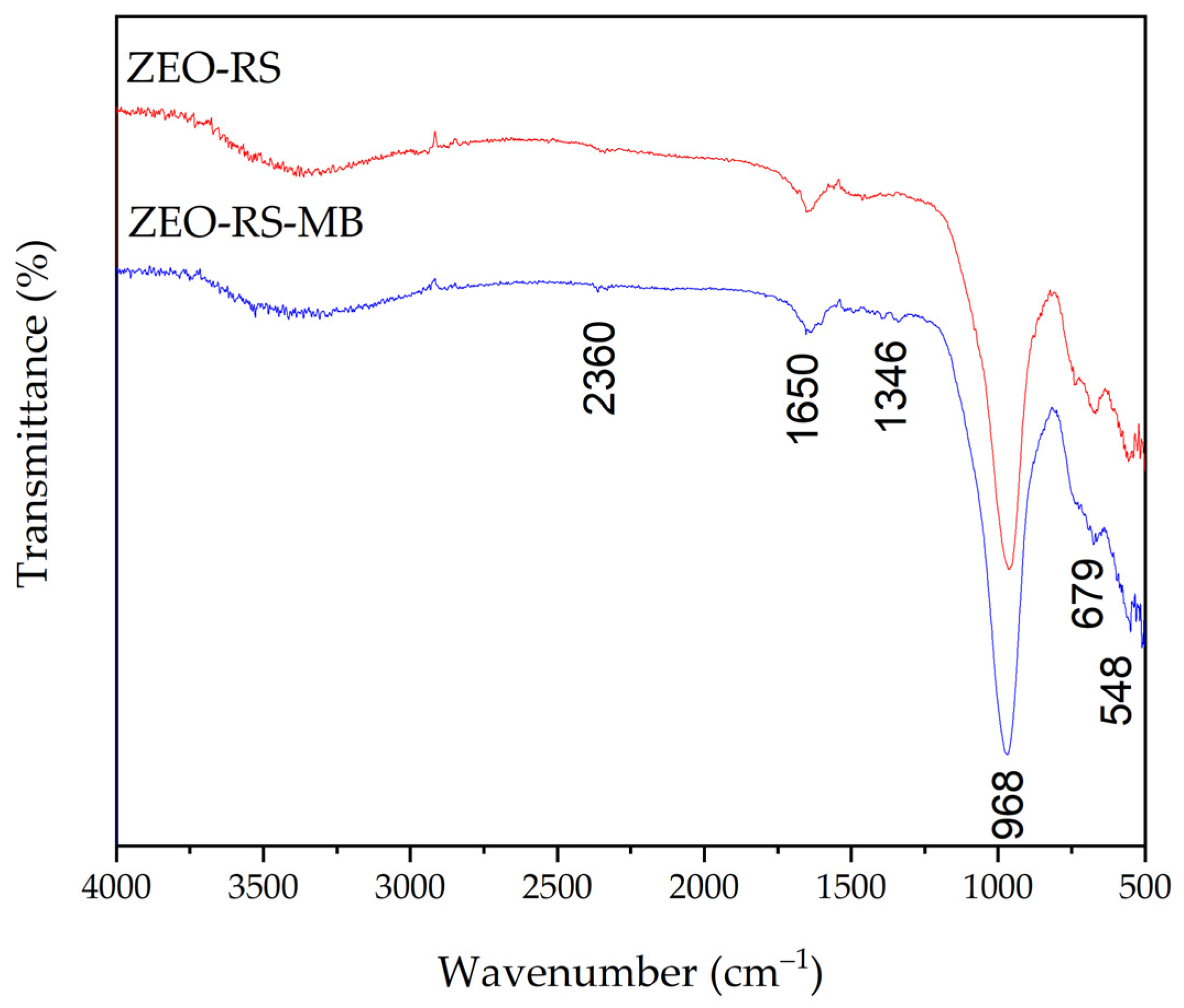
The adsorption mechanism of methylene blue (MB) on the dual-phase FAU/LTA zeolite was interpreted based exclusively on the experimental evidence obtained in this study. FTIR analysis comparing the pristine zeolite (ZEO-RS) and the MB-loaded material (ZEO-RS-MB) confirms that the zeolitic framework remains structurally intact after adsorption, as evidenced by the persistence of characteristic T–O–T framework vibrations (Figure 7) [52,103]. The pronounced decrease and broadening of the O–H stretching region (3000–3600 cm−1) after MB adsorption indicate the involvement of surface silanol and aluminol groups in the adsorption process. These spectral changes, together with the strong pH dependence of MB uptake, support the contribution of electrostatic attraction between negatively charged framework sites and cationic MB species [95,96]. The enhancement of the band at ~1620 cm−1 is attributed to changes in the environment of coordinated water molecules within the zeolite structure, which may occur upon MB incorporation into the internal cavities. This observation supports the contribution of pore confinement effects, particularly within FAU supercages, to the overall adsorption process [101,113]. In contrast, steric restrictions in LTA domains are consistent with limited MB penetration to external surfaces and pore mouths [66,100]. In addition, the appearance and intensification of bands in the 1450–1600 cm−1 region, corresponding to aromatic C=C and C–N vibrations, confirm the presence of MB within the zeolitic framework and its retention through non-covalent interactions [52,95]. Minor shifts in the T–O–T asymmetric stretching region (960–980 cm−1) suggest interactions between MB+ and framework Al–O sites [114,115]. Although direct identification of exchanged cations is limited by the absence of sodium detection in the XRF dataset, compositional changes observed after adsorption, including the reduction in K+ (0.1 ± 0.0%) and Mg2+ (2 ± 0.0%), the constant Ca2+ content (2 ± 0.0%) and the appearance of Fe3+ (1.42 ± 0.0%), are consistent with partial ion exchange phenomena commonly reported for cationic dye adsorption on low-silica zeolites [51,52,99,103]. Based on the combined experimental evidence from FTIR analysis, elemental composition, pH-dependent behavior, and adsorption performance trends, MB adsorption on ZEO-RS can be described as a process dominated by electrostatic attraction, pore confinement, and partial ion exchange. These mechanisms adequately explain the high adsorption efficiency and the limited reversibility observed during regeneration experiments, without invoking additional interaction pathways not directly supported by the available data [113,114,116,117].

3. Materials and Methods

3.1. Collection and Pretreatment of Residual Sands

Residual sands were collected from the coarse grit chamber of the municipal wastewater treatment plant (WWTP) of Loja, Ecuador. The material was air-dried and subsequently calcined at 500 °C for 3 h to remove organic matter. The calcined material was then ground using a vibratory disc mill and sieved to obtain a particle size below 75 µm. This fraction was used for zeolite synthesis and physicochemical characterization.

3.2. Zeolite Synthesis Procedure

The zeolite was synthesized using pretreated residual sands as the main Si/Al source and sodium aluminate (NaAlO2) as an additional aluminum precursor. Although only the final synthesis conditions are reported in this work, the development of the FAU/LTA zeolitic material involved an extensive experimental optimization process. Multiple synthesis trials were conducted by varying alkalinity, aging time, and hydrothermal treatment conditions until the desired crystalline phases and reproducible structural properties were achieved. The reported synthesis protocol corresponds to the optimized conditions that consistently yielded the target FAU-dominant dual-phase material. The synthesis mixture was formulated to maintain the following molar ratios of (SiO2/Al2O3) = 2, (Na2O/SiO2) = 2, and (H2O/Na2O) = 100. For every 2 g of residual sand, 3.24 g of NaOH, 81.08 g of H2O, and 0.81 g of NaAlO2 were employed. The procedure followed an adaptation of the method reported by Campoverde et al. (2023) [41]. Sodium aluminate and sodium hydroxide solutions were prepared separately and subsequently combined under continuous stirring at room temperature. The residual sand was gradually added to the alkaline mixture and stirred for 45 min. The resulting slurry was calcined at 800 °C for 5 h using a programmed temperature ramp. After cooling, the solid was rehydrated with 40 mL of deionized water and aged for 30 h at room temperature. The aged mixture was then subjected to hydrothermal treatment at 90 °C for 17 h in a sealed vessel. After synthesis, the material was vacuum-filtered and repeatedly washed with distilled water until the filtrate reached neutral pH. The zeolitic adsorbent (ZEO-RS) was synthesized in multiple independent batches following the same protocol. Prior to physicochemical characterization and adsorption/desorption experiments, the batches were homogenized to ensure material representativeness and minimize batch-to-batch variability. This procedure ensured that the reported results reflect the intrinsic behavior of the synthesized material rather than isolated synthesis events. Finally, the solid was dried at 90–105 °C for 1–2 h, labeled, and stored for further characterization.

3.3. Material Characterization Techniques

The chemical composition of the raw residual sand and the synthesized zeolite was determined by X-ray fluorescence (XRF) using a Bruker S1 Titan 800 handheld analyzer (Bruker, Billerica, MA, USA). Crystalline phases were identified by X-ray diffraction (XRD) using a Bruker D8 Advance A25 diffractometer (Bruker, Karlsruhe, Germany) equipped with Cu Kα radiation (λ = 0.1542 nm), operated at 40 kV and 40 mA, and scanning in the 2θ range of 4–90°. Morphology and surface texture of the materials were examined by scanning electron microscopy (SEM) using a Tescan Mira 3 field-emission microscope (Tescan, Brno, Czech Republic). Functional groups were analyzed by Fourier-transform infrared spectroscopy (FTIR) using a Jasco FT/IR-4100 spectrometer (Easton, MD, USA) in the range of 4000–550 cm−1. The point of zero charge (PZC) was determined using the salt addition method with NaCl solutions (0.01 and 0.05 M) over a pH range of 3–12 to evaluate the surface charge behavior of both the raw and synthesized materials. The specific surface area was measured by the nitrogen adsorption method using an automatic adsorption analyzer (Micrometrics Chemisorb 2720, Norcross, GA, USA), employing the single-point method under Ne:He gas flow ratio of 35:65%.

3.4. Adsorption and Desorption Experiments

The adsorption performance of methylene blue (MB) on the synthesized zeolite was evaluated under varying pH, contact time, initial dye concentration, and temperature. All experiments were conducted in batch mode using 25 mL of MB solution per test under the conditions summarized in Table 6. The selection of initial MB concentrations for the adsorption assays was based on preliminary exploratory experiments conducted prior to the systematic studies. These tests were performed to identify concentration ranges that allowed clear evaluation of the targeted adsorption phenomena without interference from early saturation or mass-transfer limitation. For kinetic and equilibrium adsorption experiments, the solution pH was adjusted and maintained at pH 7. This value was selected to represent environmentally relevant conditions commonly encountered in natural waters and treated wastewater effluents. Operating under neutral pH minimizes the need for chemical adjustment and allows a realistic assessment of adsorption performance under practical application scenarios.
All adsorption and desorption experiments were conducted in triplicate, and the reported values correspond to the arithmetic mean of three independent measurements. Experimental variability was evaluated using standard deviation, which is reported where applicable.
In the above equations qt, qe and qm (mg·g−1) represent the adsorption capacities at time t, at equilibrium, and the maximum adsorption capacity, respectively; c0, ct and ce (mg·L−1) correspond to the initial, time-dependt and equilibrium MB concentrations. The parameters k1 (h−1), k2 (g·mg−1·h−1) and kt (mg·g−1·h−1/2) are the pseudo-first-order,pseudo-second-order and intraparticle diffusion rate constants, respectively. A (mg·g−1) represents the boundary-layer thickness constant. Df and Dp denote the liquid film diffusion and particle diffusion coefficients. cs (mg·L−1) and cz (mg·kg−1) correspond to MB concentrations in solution and in the adsorbent. The parameter r is the average particle radius (3.7 × 10⁻⁵ m for < 200 mesh), and h is the film-layer thickness (1 × 10⁻⁵ m for a poorly stirred solution). kL and kF (L·mg−1) are the Langmuir and Freundlich constants, respectively, and rL represents the favourability of the adsorption process. ΔG°, ΔH° and ΔS° (kJ·mol−1) correspond to Gibbs free energy, enthalpy and entropy changes derived from the van’t Hoff Equation. kc is a dimensionless equilibrium constant, Mw is the molecular weight of adsorbate (g·mol−1), R is the universal gas constant (8.314 J mol−1·K−1), and T is the absolute temperature (K).

4. Conclusions

This study demonstrates the successful hydrothermal transformation of wastewater treatment plant (WWTP) residual sands into a dual-phase FAU/LTA zeolitic material with well-defined structural and adsorption properties. The proposed synthesis strategy effectively valorized an abundant and underutilized waste stream, yielding a highly crystalline, low-silica aluminosilicate framework (Si/Al ≈1.7) composed predominantly of FAU domains with minor LTA contributions. This dual-phase architecture provides a high density of negatively charged sites, pronounced hydrophilicity, and significant cation-exchange capacity, which are essential attributes for the efficient removal of cationic pollutants.
Comprehensive physicochemical characterization (XRF, XRD, FTIR, SEM, and PZC) confirmed the complete structural transformation of the inert sand precursor into a stable FAU/LTA zeolitic framework. Adsorption experiments demonstrated a strong affinity of the synthesized zeolite toward methylene blue (MB), governed by a cooperative mechanism involving electrostatic attraction, hydrogen bonding, van der Waals interactions, and pore confinement, with minor contributions from chemisorptive processes such as ion exchange and Lewis acid–base interactions. Kinetic analyses revealed rapid MB uptake, initially controlled by surface interactions and subsequently limited by intraparticle diffusion within FAU supercages. Isotherm modeling using Langmuir and Freundlich equations confirmed moderately favorable and heterogeneous adsorption behavior. Thermodynamic parameters (ΔG° < 0, ΔH° = 5.26 kJ·mol−1, ΔS° > 0) indicated that MB adsorption is spontaneous, mildly endothermic, and predominantly entropy-driven, consistent with a physisorption-dominated process reinforced by weak chemical interactions.
Regeneration assays conducted under mild acidic, neutral and alkaline aqueous conditions revealed limited MB desorption (1–8%), indicating strong dye retention driven by steric confinement and ion-exchange stabilization within the FAU/LTA framework. Although this limits regeneration by simple pH adjustment, it ensures excellent structural stability and negligible dye leaching, which are advantageous for polishing treatments, decentralized systems, or single-use adsorption applications where environmental safety and operational simplicity are prioritized. The low regeneration efficiency does not compromise the practical relevance of the material, particularly considering its low-cost origin. Future work will explore alternative regeneration strategies, such as saline solutions or other environmentally compatible eluents, to enhance desorption while preserving framework integrity.
Overall, this work introduces a sustainable and scalable route for converting WWTP residual sands into high-performance zeolitic adsorbents. Beyond demonstrating the feasibility of using residual sands as a silicon–aluminum source, the study advances the field of waste-derived zeolites by showing that FAU/LTA dual-phase materials can deliver competitive adsorption performance, strong contaminant affinity, and remarkable structural robustness. The use of an abundant, low-cost precursor combined with a relatively simple hydrothermal synthesis process supports the potential cost-effectiveness and scalability of the proposed material. These findings highlight the promise of residual sand–based zeolites as viable candidates for sustainable wastewater purification and circular resource management applications.

Author Contributions

Conceptualization, D.G. and J.L.C.; methodology, D.G.; software, D.G. and M.J.J.; validation, D.G. and J.L.C.; formal analysis, D.G.; investigation, M.J.J.; resources, D.G.; data curation, M.J.J. and D.G.; writing—original draft preparation, D.G. and M.J.J.; writing—review and editing, D.G. and J.L.C.; visualization, D.G.; supervision, D.G.; project administration, D.G.; funding acquisition, D.G. All authors have read and agreed to the published version of the manuscript.

Funding

This research was funded by Universidad Tecnica Particular de Loja and is part of María de Maeztu Unit of Excellence Programme CEX2023-001300-M/funded by MICIU/AEI/10.13039/501100011033 and it was supported by Upcycling project (PID2023-147160OB-C21) financed by the Spanish Research Agency (AEI). Finally, J.L. Cortina also received through the “ICREA Academia” recognition for excellence in research funded by the Generalitat de Catalunya.

Institutional Review Board Statement

Not applicable.

Informed Consent Statement

Not applicable.

Data Availability Statement

The original contributions presented in this study are included in the article. Further inquiries can be directed to the corresponding author.

Conflicts of Interest

The authors declare no conflicts of interest.

References

  1. Nishat, A.; Yusuf, M.; Qadir, A.; Ezaier, Y.; Vambol, V.; Ijaz Khan, M.; Ben Moussa, S.; Kamyab, H.; Sehgal, S.S.; Prakash, C.; et al. Wastewater Treatment: A Short Assessment on Available Techniques. Alex. Eng. J. 2023, 76, 505–516. [Google Scholar] [CrossRef]
  2. Pan, Y.; Teng, T.; Wang, S.; Wang, T. Impact and Mechanism of Urbanization on Urban Green Development in the Yangtze River Economic Belt. Ecol. Indic. 2024, 158, 111612. [Google Scholar] [CrossRef]
  3. Muga, H.E.; Mihelcic, J.R. Sustainability of Wastewater Treatment Technologies. J. Env. Manag. 2008, 88, 437–447. [Google Scholar] [CrossRef]
  4. Jain, H. From Pollution to Progress: Groundbreaking Advances in Clean Technology Unveiled. Innov. Green Dev. 2024, 3, 100143. [Google Scholar] [CrossRef]
  5. Borges, N.B.; Campos, J.R.; Pablos, J.M. Characterization of Residual Sand Removed from the Grit Chambers of a Wastewater Treatment Plant and Its Use as Fine Aggregate in the Preparation of Non-Structural Concrete. Water Pract. Technol. 2015, 10, 164–171. [Google Scholar] [CrossRef]
  6. Czop, M.; Zajusz-Zubek, E.; Łaźniewska-Piekarczyk, B. Use of Sands from Wastewater Treatment Plants as a Substitute for Natural Aggregate in the Context of a Circular Economy. Sustainability 2025, 17, 5471. [Google Scholar] [CrossRef]
  7. Górka, J.; Poproch, D.; Cimochowicz-Rybicka, M.; Łuszczek, B. Characteristics of Sand Recovered from the Municipal Wastewater Treatment Plant. Gospod. Surowcami Miner. Miner. Resour. Manag. 2023, 39, 109–123. [Google Scholar] [CrossRef]
  8. Silva, E.N.; Cantillo-Castrillon, M.; Dantas, T.M.; Mesquita, Y.M.; Maia, D.A.S.; Bastos-Neto, M.; Barcellos, W.M.; Azevedo, D.C.S. Siloxane Adsorption by Porous Silica Synthesized from Residual Sand of Wastewater Treatment. J. Environ. Chem. Eng. 2021, 9, 104805. [Google Scholar] [CrossRef]
  9. Nguyen, M.D.; Thomas, M.; Surapaneni, A.; Moon, E.M.; Milne, N.A. Beneficial Reuse of Water Treatment Sludge in the Context of Circular Economy. Environ. Technol. Innov. 2022, 28, 102651. [Google Scholar] [CrossRef]
  10. Ahmad, T.; Ahmad, K.; Alam, M. Characterization of Water Treatment Plant’s Sludge and Its Safe Disposal Options. Procedia Environ. Sci. 2016, 35, 950–955. [Google Scholar] [CrossRef]
  11. Hartmann, A.; Petrov, V.; Buhl, J.-C.; Rübner, K.; Lindemann, M.; Prinz, C.; Zimathies, A. Zeolite Synthesis under Insertion of Silica Rich Filtration Residues from Industrial Wastewater Reconditioning. Adv. Chem. Eng. Sci. 2014, 04, 120–134. [Google Scholar] [CrossRef]
  12. Xie, W.; Ma, H.; Cao, C.; Wang, Y.; Qiao, Y.; Teng, J.; Li, N.; Yue, C. Sea Sand as a Silica Source to Hydrothermally Synthesize Analcime. Materials 2025, 18, 2818. [Google Scholar] [CrossRef] [PubMed]
  13. Kühl, G. Source Materials for Zeolite Synthesis. In Verified Syntheses of Zeolitic Materials; Elsevier: Amsterdam, The Netherlands, 2001; pp. 19–20. [Google Scholar] [CrossRef]
  14. Round, C.I.; Hill, S.J.; Latham, K.; Williams, C.D. The Crystal Morphology of Zeolite A. The Effects of the Source of the Reagents. Microporous Mater. 1997, 11, 213–225. [Google Scholar] [CrossRef]
  15. Yoldi, M.; Fuentes-Ordoñez, E.G.; Korili, S.A.; Gil, A. Zeolite Synthesis from Industrial Wastes. Microporous Mesoporous Mater. 2019, 287, 183–191. [Google Scholar] [CrossRef]
  16. Lin, S.; Jiang, X.; Zhao, Y.; Yan, J. Zeolite Greenly Synthesized from Fly Ash and Its Resource Utilization: A Review. Sci. Total Environ. 2022, 851, 158182. [Google Scholar] [CrossRef]
  17. Khaleque, A.; Alam, M.; Hoque, M.; Mondal, S.; Bin Haider, J.; Xu, B.; Johir, M.; Karmakar, A.K.; Zhou, J.; Ahmed, M.B.; et al. Zeolite Synthesis from Low-Cost Materials and Environmental Applications: A Review. Environ. Adv. 2020, 2, 100019. [Google Scholar] [CrossRef]
  18. Vogrin, J.; Santini, T.; Peng, H.; Zhao, L.; Vaughan, J. Synthesis of Zeolites Using Kaolin in Concentrated Sodium Hydroxide-Aluminate Solutions. Appl. Clay Sci. 2023, 244, 107106. [Google Scholar] [CrossRef]
  19. Marschall, M.S.; Seifert, M.; Hauck, M.; Busse, O.; Weigand, J.J. Zeolite Synthesis Using Recycled Silicon and Aluminum Components from Spent FCC Catalysts. Waste Manag. 2025, 202, 114817. [Google Scholar] [CrossRef]
  20. de Longe, C.; da Silva, A.; Câmara, A.B.F.; Bieseki, L.; de Carvalho, L.S.; Pergher, S.B.C.; de Mello, M.I.S. Synthesis of LTA Zeolite from Beach Sand: A Solution for CO2 Capture. Coatings 2025, 15, 334. [Google Scholar] [CrossRef]
  21. Rozhkovskaya, A.; Rajapakse, J.; Millar, G.J. Optimisation of Zeolite LTA Synthesis from Alum Sludge and the Influence of the Sludge Source. J. Environ. Sci. 2021, 99, 130–142. [Google Scholar] [CrossRef]
  22. Kumari, S.; Chowdhry, J.; Kumar, M.; Chandra Garg, M. Zeolites in Wastewater Treatment: A Comprehensive Review on Scientometric Analysis, Adsorption Mechanisms, and Future Prospects. Environ. Res. 2024, 260, 119782. [Google Scholar] [CrossRef] [PubMed]
  23. Mancinelli, M.; Martucci, A. Exploring the Potential of Zeolites for Sustainable Environmental Applications. Sustain. Chem. 2025, 6, 9. [Google Scholar] [CrossRef]
  24. Hart, A.; Wood, J. Methodological Review of Zeolite Synthesis from Industrial Waste and Natural Clays and the Fabrication of Hierarchical Pore Structures. Next Mater. 2025, 9, 101113. [Google Scholar] [CrossRef]
  25. Wawrzkiewicz, M.; Wołowicz, A.; Vogelsang, C.; Umar, M. Municipal Solid Waste Fly Ash-Derived Zeolites as Adsorbents for the Recovery of Nutrients and Heavy Metals—A Review. Water 2023, 15, 3817. [Google Scholar] [CrossRef]
  26. Tufail, M.K.; Ifrahim, M.; Rashid, M.; Ul Haq, I.; Asghar, R.; Uthappa, U.T.; Selvaraj, M.; Kurkuri, M. Chemistry of Zeolites and Zeolite Based Composite Membranes as a Cutting-Edge Candidate for Removal of Organic Dyes & Heavy Metal Ions: Progress and Future Directions. Sep. Purif. Technol. 2025, 354, 128739. [Google Scholar] [CrossRef]
  27. Zhang, Y.; Zhang, Z.; Han, H.; Zhang, M.; Wang, H.; Song, H.; Chen, Y. Effective Removal of Organic Dyes Using the Ultrasonic-Assisted Hydrothermal Synthesis of NaP Zeolite Doping Cu or Fe in Fenton-like Oxidation Systems. Sep. Purif. Technol. 2022, 299, 121767. [Google Scholar] [CrossRef]
  28. Dehmani, Y.; Ba Mohammed, B.; Oukhrib, R.; Dehbi, A.; Lamhasni, T.; Brahmi, Y.; El-Kordy, A.; Franco, D.S.P.; Georgin, J.; Lima, E.C.; et al. Adsorption of Various Inorganic and Organic Pollutants by Natural and Synthetic Zeolites: A Critical Review. Arab. J. Chem. 2024, 17, 105474. [Google Scholar] [CrossRef]
  29. Gadore, V.; Mishra, S.R.; Yadav, N.; Yadav, G.; Ahmaruzzaman, M. Advances in Zeolite-Based Materials for Dye Removal: Current Trends and Future Prospects. Inorg. Chem. Commun. 2024, 166, 112606. [Google Scholar] [CrossRef]
  30. Liaquat, I.; Munir, R.; Abbasi, N.A.; Sadia, B.; Muneer, A.; Younas, F.; Sardar, M.F.; Zahid, M.; Noreen, S. Exploring Zeolite-Based Composites in Adsorption and Photocatalysis for Toxic Wastewater Treatment: Preparation, Mechanisms, and Future Perspectives. Environ. Pollut. 2024, 349, 123922. [Google Scholar] [CrossRef]
  31. Al-Tohamy, R.; Ali, S.S.; Li, F.; Okasha, K.M.; Mahmoud, Y.A.G.; Elsamahy, T.; Jiao, H.; Fu, Y.; Sun, J. A Critical Review on the Treatment of Dye-Containing Wastewater: Ecotoxicological and Health Concerns of Textile Dyes and Possible Remediation Approaches for Environmental Safety. Ecotoxicol. Environ. Saf. 2022, 231, 113160. [Google Scholar] [CrossRef]
  32. Periyasamy, A.P. A Review of Bioremediation of Textile Dye Containing Wastewater. Clean. Water 2025, 4, 100092. [Google Scholar] [CrossRef]
  33. Dutta, S.; Adhikary, S.; Bhattacharya, S.; Roy, D.; Chatterjee, S.; Chakraborty, A.; Banerjee, D.; Ganguly, A.; Nanda, S.; Rajak, P. Contamination of Textile Dyes in Aquatic Environment: Adverse Impacts on Aquatic Ecosystem and Human Health, and Its Management Using Bioremediation. J. Environ. Manag. 2024, 353, 120103. [Google Scholar] [CrossRef] [PubMed]
  34. Verma, A.K.; Dash, R.R.; Bhunia, P. A Review on Chemical Coagulation/Flocculation Technologies for Removal of Colour from Textile Wastewaters. J. Environ. Manag. 2012, 93, 154–168. [Google Scholar] [CrossRef] [PubMed]
  35. Kusumlata; Ambade, B.; Kumar, A.; Gautam, S. Sustainable Solutions: Reviewing the Future of Textile Dye Contaminant Removal with Emerging Biological Treatments. Limnol. Rev. 2024, 24, 126–149. [Google Scholar] [CrossRef]
  36. Ikram, M.; Naeem, M.; Zahoor, M.; Hanafiah, M.M.; Oyekanmi, A.A.; Ullah, R.; Farraj, D.A.A.; Elshikh, M.S.; Zekker, I.; Gulfam, N. Biological Degradation of the Azo Dye Basic Orange 2 by Escherichia Coli: A Sustainable and Ecofriendly Approach for the Treatment of Textile Wastewater. Water 2022, 14, 2063. [Google Scholar] [CrossRef]
  37. Popaliya, M.; Mishra, A. Modified Zeolite as an Adsorbent for Dyes, Drugs, and Heavy Metal Removal: A Review. Int. J. Environ. Sci. Technol. 2023, 20, 12919–12936. [Google Scholar] [CrossRef]
  38. Eren, S.; Türk, F.N.; Arslanoğlu, H. Synthesis of Zeolite from Industrial Wastes: A Review on Characterization and Heavy Metal and Dye Removal. Environ. Sci. Pollut. Res. 2024, 31, 41791–41823. [Google Scholar] [CrossRef]
  39. Mallapur, V.P.; Oubagaranadin, J.U.K. A Brief Review on the Synthesis of Zeolites from Hazardous Wastes. Trans. Indian Ceram. Soc. 2017, 76, 1–13. [Google Scholar] [CrossRef]
  40. Cao, C.; Xuan, W.; Yan, S.; Wang, Q. Zeolites Synthesized from Industrial and Agricultural Solid Waste and Their Applications: A Review. J. Environ. Chem. Eng. 2023, 11, 110898. [Google Scholar] [CrossRef]
  41. Campoverde, J.; Guaya, D. From Waste to Added-Value Product: Synthesis of Highly Crystalline LTA Zeolite from Ore Mining Tailings. Nanomaterials 2023, 13, 1295. [Google Scholar] [CrossRef]
  42. Rorissa, G.L.; Tesema, E.A.; Reddy, R.P.; Hunde, A.R.; Beyena, S.Y.; Biru, M.A.; Mekonnen, D.T.; Adnualem, T.L. Removal of Methylene Blue Dye from Textile Industry Wastewater Using Green Synthesized Teff Straw Assisted ZnO Nanoparticle. Sci. Rep. 2025, 15, 26230. [Google Scholar] [CrossRef] [PubMed]
  43. Al-Asadi, S.T.; Mussa, Z.H.; Al-Qaim, F.F.; Kamyab, H.; Al-Saedi, H.F.S.; Deyab, I.F.; Kadhim, N.J. A Comprehensive Review of Methylene Blue Dye Adsorption on Activated Carbon from Edible Fruit Seeds: A Case Study on Kinetics and Adsorption Models. Carbon Trends 2025, 20, 100507. [Google Scholar] [CrossRef]
  44. Khan, I.; Saeed, K.; Zekker, I.; Zhang, B.; Hendi, A.H.; Ahmad, A.; Ahmad, S.; Zada, N.; Ahmad, H.; Shah, L.A.; et al. Review on Methylene Blue: Its Properties, Uses, Toxicity and Photodegradation. Water 2022, 14, 242. [Google Scholar] [CrossRef]
  45. Oladoye, P.O.; Ajiboye, T.O.; Omotola, E.O.; Oyewola, O.J. Methylene Blue Dye: Toxicity and Potential Elimination Technology from Wastewater. Results Eng. 2022, 16, 100678. [Google Scholar] [CrossRef]
  46. Liang, P.; Yang, W.; Peng, H.; Zhao, S. Efficient Degradation of Methylene Blue in Industrial Wastewater and High Cycling Stability of Nano ZnO. Molecules 2024, 29, 5584. [Google Scholar] [CrossRef]
  47. Fito, J.; Abewaa, M.; Mengistu, A.; Angassa, K.; Ambaye, A.D.; Moyo, W.; Nkambule, T. Adsorption of Methylene Blue from Textile Industrial Wastewater Using Activated Carbon Developed from Rumex Abyssinicus Plant. Sci. Rep. 2023, 13, 5427. [Google Scholar] [CrossRef]
  48. Dimbo, D.; Abewaa, M.; Adino, E.; Mengistu, A.; Takele, T.; Oro, A.; Rangaraju, M. Methylene Blue Adsorption from Aqueous Solution Using Activated Carbon of Spathodea Campanulata. Results Eng. 2024, 21, 101910. [Google Scholar] [CrossRef]
  49. Oyarce, E.; Cantero-López, P.; Roa, K.; Boulett, A.; Yáñez, O.; Santander, P.; Pizarro, G.d.C.; Sánchez, J. Removal of Highly Concentrated Methylene Blue Dye by Cellulose Nanofiber Biocomposites. Int. J. Biol. Macromol. 2023, 238, 124045. [Google Scholar] [CrossRef]
  50. Bahmanzadegan, F.; Ghaemi, A. A Comprehensive Review on Novel Zeolite-Based Adsorbents for Environmental Pollutant. J. Hazard. Mater. Adv. 2025, 17, 100617. [Google Scholar] [CrossRef]
  51. Tubon-Usca, G.; Centeno, C.; Pomasqui, S.; Beneduci, A.; Arias, F.A. Enhanced Adsorption of Methylene Blue in Wastewater Using Natural Zeolite Impregnated with Graphene Oxide. Appl. Sci. 2025, 15, 2824. [Google Scholar] [CrossRef]
  52. Guaya, D.; Debut, A.; Campoverde, J. A Novel Approach to Waste Recycling and Dye Removal: Lithium-Functionalized Nanoparticle Zeolites. Molecules 2024, 29, 4643. [Google Scholar] [CrossRef]
  53. Dosa, M.; Grifasi, N.; Galletti, C.; Fino, D.; Piumetti, M. Natural Zeolite Clinoptilolite Application in Wastewater Treatment: Methylene Blue, Zinc and Cadmium Abatement Tests and Kinetic Studies. Materials 2022, 15, 8191. [Google Scholar] [CrossRef]
  54. Sohrabnezhad, S.; Pourahmad, A. Comparison Absorption of New Methylene Blue Dye in Zeolite and Nanocrystal Zeolite. Desalination 2010, 256, 84–89. [Google Scholar] [CrossRef]
  55. Belachew, N.; Hinsene, H. Preparation of Zeolite 4A for Adsorptive Removal of Methylene Blue: Optimization, Kinetics, Isotherm, and Mechanism Study. Silicon 2021, 14, 1629–1641. [Google Scholar] [CrossRef]
  56. Zarbaliyev, B.; Israfilov, N.; Feyziyeva, S.; Lutzweiler, G.; Guliyeva, N.; Louis, B. Role of Cation Nature in FAU Zeolite in Both Liquid-Phase and Gas-Phase Adsorption. Catalysts 2025, 15, 734. [Google Scholar] [CrossRef]
  57. Afreen, G.; Upadhyayula, S. Mechanistic Insights into Upgrading of Biomass-Derived Phenolic Compounds: Comparative Study of the Impact of Lewis Acidity in Zn Loaded FAU Zeolite on Reaction Mechanism. Chem. Eng. J. 2019, 377, 120236. [Google Scholar] [CrossRef]
  58. Nuno Almeida, J.; Song, L.; Askarli, S.; Chung, S.H.; Ruiz-Martínez, J. Zeolite–Water Chemistry: Characterization Methods to Unveil Zeolite Structure. Chem. Methods 2025, 5, e202400076. [Google Scholar] [CrossRef]
  59. Chen, L.; Xu, B.; Wang, S.; Ren, S.; Yang, F.; Zhang, W.; Lan, Y.; Chen, C.; Li, J.; Su, Y. Advancements in Synthesis Strategies and Environmental Application of FAU-Type Zeolite: Bibliometric-Driven Review. Green Energy Environ. 2025. [Google Scholar] [CrossRef]
  60. Daems, I.; Leflaive, P.; Méthivier, A.; Baron, G.V.; Denayer, J.F.M. Influence of Si: Al-Ratio of Faujasites on the Adsorption of Alkanes, Alkenes and Aromatics. Microporous Mesoporous Mater. 2006, 96, 149–156. [Google Scholar] [CrossRef]
  61. Li, J.; Gao, M.; Yan, W.; Yu, J. Regulation of the Si/Al Ratios and Al Distributions of Zeolites and Their Impact on Properties. Chem. Sci. 2023, 14, 1935–1959. [Google Scholar] [CrossRef]
  62. Al-Sultani, S.H.; Al-Shathr, A.; Al-Zaidi, B.Y. Aromatics Alkylated with Olefins Utilizing Zeolites as Heterogeneous Catalysts: A Review. Reactions 2024, 5, 900–927. [Google Scholar] [CrossRef]
  63. Beving, D.E.; O’Neill, C.R.; Yan, Y. Hydrophilic and Antimicrobial Low-Silica-Zeolite LTA and High-Silica-Zeolite MFI Hybrid Coatings on Aluminum Alloys. Microporous Mesoporous Mater. 2008, 108, 77–85. [Google Scholar] [CrossRef]
  64. Antúnez-García, J.; Galván, D.H.; Petranovskii, V.; Murrieta-Rico, F.N.; Yocupicio-Gaxiola, R.I.; Shelyapina, M.G.; Fuentes-Moyado, S. The Effect of Chemical Composition on the Properties of LTA Zeolite: A Theoretical Study. Comput. Mater. Sci. 2021, 196, 110557. [Google Scholar] [CrossRef]
  65. Wenten, I.G.; Dharmawijaya, P.T.; Aryanti, P.T.P.; Mukti, R.R.; Khoiruddin, K. LTA Zeolite Membranes: Current Progress and Challenges in Pervaporation. RSC Adv. 2017, 7, 29520–29539. [Google Scholar] [CrossRef]
  66. Von-Kiti, E.; Oduro, W.O.; Animpong, M.A.; Ampomah-Benefo, K.; Boafo-Mensah, G.; Kwakye-Awuah, B.; Williams, C.D. Evidence of Electronic Influence in the Adsorption of Cationic and Zwitterionic Dyes on Zeolites. Heliyon 2023, 9, e20049. [Google Scholar] [CrossRef]
  67. Tatlier, M.; Atalay-Oral, C.; Bayrak, A.; Maraş, T.; Erdem, A. Impact of Ion Exchange on Zeolite Hydrophilicity/Hydrophobicity Monitored by Water Capacity Using Thermal Analysis. Thermochim. Acta 2022, 713, 179240. [Google Scholar] [CrossRef]
  68. Boudjema, L.; Assaf, M.; Salles, F.; Gassin, P.M.; Martin-Gassin, G.; Zajac, J. Renewing Interest in Zeolites as Adsorbents for Capture of Cationic Dyes from Aqueous and Ethanolic Solutions: A Simulation-Based Insight into the Efficiency of Dye Adsorption in View of Wastewater Treatment and Valorization of Post-Sorption Materials. Molecules 2024, 29, 2952. [Google Scholar] [CrossRef]
  69. Sayehi, M.; Garbarino, G.; Delahay, G.; Busca, G.; Tounsi, H. Synthesis of High Value-Added Na–P1 and Na-FAU Zeolites Using Waste Glass from Fluorescent Tubes and Aluminum Scraps. Mater. Chem. Phys. 2020, 248, 122903. [Google Scholar] [CrossRef]
  70. Prasertsab, A.; Leangsiri, W.; Salakhum, S.; Yomthong, K.; Ittisanronnachai, S.; Watcharasing, S.; Kiattikomol, P.; Wattanakit, C. Transformation of Production Sand Waste to FAU and LTA Zeolites for Selective Moisture Adsorption and Ethanol Conversion. Top. Catal. 2023, 66, 1631–1648. [Google Scholar] [CrossRef]
  71. Kordala, N.; Wyszkowski, M. Zeolite Properties, Methods of Synthesis, and Selected Applications. Molecules 2024, 29, 1069. [Google Scholar] [CrossRef]
  72. Pereira, P.M.; Ferreira, B.F.; Oliveira, N.P.; Nassar, E.J.; Ciuffi, K.J.; Vicente, M.A.; Trujillano, R.; Rives, V.; Gil, A.; Korili, S.; et al. Synthesis of Zeolite A from Metakaolin and Its Application in the Adsorption of Cationic Dyes. Appl. Sci. 2018, 8, 608. [Google Scholar] [CrossRef]
  73. Verrecchia, G.; Cafiero, L.; de Caprariis, B.; Dell’Era, A.; Pettiti, I.; Tuffi, R.; Scarsella, M. Study of the Parameters of Zeolites Synthesis from Coal Fly Ash in Order to Optimize Their CO2 Adsorption. Fuel 2020, 276, 118041. [Google Scholar] [CrossRef]
  74. Pérez-Botella, E.; Valencia, S.; Rey, F. Zeolites in Adsorption Processes: State of the Art and Future Prospects. Chem. Rev. 2022, 122, 17647–17695. [Google Scholar] [CrossRef] [PubMed]
  75. Vaitkus, A.; Merkys, A.; Gražulis, S. Validation of the Crystallography Open Database Using the Crystallographic Information Framework. J. Appl. Crystallogr. 2021, 54, 661–672. [Google Scholar] [CrossRef] [PubMed]
  76. International Zeolite Association Database of Zeolites Structure. Available online: https://www.iza-structure.org/databases/ (accessed on 28 April 2022).
  77. Novembre, D.; di Sabatino, B.; Gimeno, D.; Pace, C. Synthesis and Characterization of Na-X, Na-A and Na-P Zeolites and Hydroxysodalite from Metakaolinite. Clay Min. 2011, 46, 339–354. [Google Scholar] [CrossRef]
  78. Kunecki, P.; Panek, R.; Wdowin, M.; Franus, W. Synthesis of Faujasite (FAU) and Tschernichite (LTA) Type Zeolites as a Potential Direction of the Development of Lime Class C Fly Ash. Int. J. Min. Process 2017, 166, 69–78. [Google Scholar] [CrossRef]
  79. Fan, W.; Shirato, S.; Gao, F.; Ogura, M.; Okubo, T. Phase Selection of FAU and LTA Zeolites by Controlling Synthesis Parameters. Microporous Mesoporous Mater. 2006, 89, 227–234. [Google Scholar] [CrossRef]
  80. Oleksiak, M.D.; Soltis, J.A.; Conato, M.T.; Penn, R.L.; Rimer, J.D. Nucleation of FAU and LTA Zeolites from Heterogeneous Aluminosilicate Precursors. Chem. Mater. 2016, 28, 4906–4916. [Google Scholar] [CrossRef]
  81. Marhoon, A.A.; Hasbullah, S.A.; Asikin-Mijan, N.; Mokhtar, W.N.A.W. Hydrothermal Synthesis of High-Purity Zeolite X from Coal Fly Ash for Heavy Metal Removal: Kinetic and Isotherm Analysis. Adv. Powder Technol. 2023, 34, 104242. [Google Scholar] [CrossRef]
  82. Sathish, V.; Chandrasekaran, A.; Hamideen, M.S.; Isinkaye, M.O. Impact of Industrial Activities on Physicochemical Properties, Mineralogical, and Elemental Composition in Sediments of Puliyanthangal Lake, Ranipet, India. Sci. Rep. 2025, 15, 20973. [Google Scholar] [CrossRef]
  83. Volkov, D.S.; Rogova, O.B.; Proskurnin, M.A. Organic Matter and Mineral Composition of Silicate Soils: FTIR Comparison Study by Photoacoustic, Diffuse Reflectance, and Attenuated Total Reflection Modalities. Agronomy 2021, 11, 1879. [Google Scholar] [CrossRef]
  84. Sivakumar, S.; Ravisankar, R.; Raghu, Y.; Chandrasekaran, A.; Chandramohan, J. FTIR Spectroscopic Studies on Coastal Sediment Samples from Cuddalore District, Tamilnadu, India. Indian J. Adv. Chem. Sci. 2012, 1, 40–46. [Google Scholar]
  85. Król, M.; Barczyk, K.; Mozgawa, W. FT-IR Studies of Zeolites from Different Structural Groups. Chemik 2011, 65, 667–674. [Google Scholar]
  86. Moneim, M.A.; Ahmed, E.A. Synthesis of Faujasite from Egyptian Clays: Characterizations and Removal of Heavy Metals. Geomaterials 2015, 05, 68–76. [Google Scholar] [CrossRef]
  87. Ma, B.; Lothenbach, B. Synthesis, Characterization, and Thermodynamic Study of Selected Na-Based Zeolites. Cem. Concr. Res. 2020, 135, 106111. [Google Scholar] [CrossRef]
  88. López, M.; Baeza-Brotons, F.; López, I.; Tenza-Abril, A.J.; Aragonés, L. Mineralogy and Morphology of Sand: Key Parameters in the Durability for Its Use in Artificial Beach Nourishment. Sci. Total Environ. 2018, 639, 186–194. [Google Scholar] [CrossRef]
  89. Parra-Huertas, R.A.; Calderón-Carvajal, C.O.; Gómez-Cuaspud, J.A.; Vera-López, E. Synthesis and Characterization of Faujasite-Na from Fly Ash by the Fusion-Hydrothermal Method. Bol. Soc. Esp. Cerám. Vidr. 2023, 62, 527–542. [Google Scholar] [CrossRef]
  90. Zhen, S.; Seff, K. Structures of Organic Sorption Complexes of Zeolites. Microporous Mesoporous Mater. 2000, 39, 1–18. [Google Scholar] [CrossRef]
  91. Mokrzycki, J.; Franus, W.; Panek, R.; Sobczyk, M.; Rusiniak, P.; Szerement, J.; Jarosz, R.; Marcińska-Mazur, L.; Bajda, T.; Mierzwa-Hersztek, M. Zeolite Composite Materials from Fly Ash: An Assessment of Physicochemical and Adsorption Properties. Materials 2023, 16, 2142. [Google Scholar] [CrossRef]
  92. Mokrzycki, J.; Fedyna, M.; Marzec, M.; Szerement, J.; Panek, R.; Klimek, A.; Bajda, T.; Mierzwa-Hersztek, M. Copper Ion-Exchanged Zeolite X from Fly Ash as an Efficient Adsorbent of Phosphate Ions from Aqueous Solutions. J. Environ. Chem. Eng. 2022, 10, 108567. [Google Scholar] [CrossRef]
  93. Busca, G. Acidity and Basicity of Zeolites: A Fundamental Approach. Microporous Mesoporous Mater. 2017, 254, 3–16. [Google Scholar] [CrossRef]
  94. Sapawe, N.; Jalil, A.A.; Triwahyono, S.; Shah, M.I.A.; Jusoh, R.; Salleh, N.F.M.; Hameed, B.H.; Karim, A.H. Cost-Effective Microwave Rapid Synthesis of Zeolite NaA for Removal of Methylene Blue. Chem. Eng. J. 2013, 229, 388–398. [Google Scholar] [CrossRef]
  95. Le, T.P.; Luong, H.V.T.; Nguyen, H.N.; Pham, T.K.T.; Trinh Le, T.L.; Tran, T.B.Q.; Ngo, T.N.M. Insight into Adsorption-Desorption of Methylene Blue in Water Using Zeolite NaY: Kinetic, Isotherm and Thermodynamic Approaches. Results Surf. Interfaces 2024, 16, 100281. [Google Scholar] [CrossRef]
  96. Radoor, S.; Karayil, J.; Jayakumar, A.; Lee, J.; Nandi, D.; Parameswaranpillai, J.; Pant, B.; Siengchin, S. Efficient Removal of Organic Dye from Aqueous Solution Using Hierarchical Zeolite-Based Biomembrane: Isotherm, Kinetics, Thermodynamics and Recycling Studies. Catalysts 2022, 12, 886. [Google Scholar] [CrossRef]
  97. Cao, C.Y.; Wang, M.; Song, Z.G.; Zhao, S.; Wan, X. Adsorption of Methylene Blue onto Al-Pillared Montmorillonite. Desalination Water Treat. 2021, 227, 384–390. [Google Scholar] [CrossRef]
  98. Dali Youcef, L.; López-Galindo, A.; Verdugo-Escamilla, C.; Belaroui, L.S. Synthesis and Characterization of Zeolite LTA by Hydrothermal Transformation of a Natural Algerian Palygorskite. Appl. Clay Sci. 2020, 193, 105690. [Google Scholar] [CrossRef]
  99. Khnifira, M.; El Hamidi, S.; Sadiq, M.; Şimşek, S.; Kaya, S.; Barka, N.; Abdennouri, M. Adsorption Mechanisms Investigation of Methylene Blue on the (0 0 1) Zeolite 4A Surface in Aqueous Medium by Computational Approach and Molecular Dynamics. Appl. Surf. Sci. 2022, 572, 151381. [Google Scholar] [CrossRef]
  100. Hadda Aya, H.; Djamel, N.; Samira, A.; Otero, M.; Ali Khan, M. Optimizing Methylene Blue Adsorption Conditions on Hydrothermally Synthesized NaX Zeolite through a Full Two-Level Factorial Design. RSC Adv. 2024, 14, 23816–23827. [Google Scholar] [CrossRef]
  101. Zhang, Y.; Wang, Z.; Zhang, Z.; Wu, L.; Fan, Y.; Sun, Z. Synthesis, Characterization and Adsorption Behaviors of Faujasite-Type Zeolites towards Methylene Blue. IOP Conf. Ser. Mater. Sci. Eng. 2019, 592, 012017. [Google Scholar] [CrossRef]
  102. Ahmed, E.S.A.; Al-Sagheer, N.A.; Razek, T.A.; El-Gendy, A.S.; Hashem, F.S. Synthesis of Faujasite-Na-Type Zeolite from Partial de-Aluminated Metakaolin for Removal of Methylene Blue from Contaminated Water. Chem. Pap. 2025, 79, 2505–2515. [Google Scholar] [CrossRef]
  103. Rusew, R.; Lazarova, H.; Angelova, M.; Petkova-Yankova, N.; Nikolova, R.; Valtchev, V. Exploring the Adsorptive Properties of an Embryonic Zeolite toward Methylene Blue. Mater. Adv. 2025, 6, 7942–7957. [Google Scholar] [CrossRef]
  104. Rial, J.B.; Ferreira, M.L. Potential Applications of Spent Adsorbents and Catalysts: Re-Valorization of Waste. Sci. Total Environ. 2022, 823, 153370. [Google Scholar] [CrossRef] [PubMed]
  105. Mulushewa, Z.; Dinbore, W.T.; Ayele, Y. Removal of Methylene Blue from Textile Waste Water Using Kaolin and Zeolite-x Synthesized from Ethiopian Kaolin. Environ. Anal. Health Toxicol. 2021, 36. [Google Scholar] [CrossRef]
  106. Tsai, C.K.; Horng, J.J. Transformation of Glass Fiber Waste into Mesoporous Zeolite-like Nanomaterials with Efficient Adsorption of Methylene Blue. Sustainability 2021, 13, 6207. [Google Scholar] [CrossRef]
  107. Fungaro, D.A.; Bruno, M.; Grosche, L.C. Adsorption and Kinetic Studies of Methylene Blue on Zeolite Synthesized from Fly Ash. Desalination Water Treat. 2009, 2, 231–239. [Google Scholar] [CrossRef]
  108. Li, C.; Yang, J.; Liu, S.; Liu, N.; Zhang, L.; Ren, L. Adsorption of Methylene Blue (MB) Using Novel Synthesized Phosphogypsum Flotation Tailings-Derived Zeolite (PGTZ): Experimental and Modeling Approaches. Separations 2025, 12, 286. [Google Scholar] [CrossRef]
  109. Oydinov, M.; Dimetova, F.; Abdurakhmonov, E.; Rakhmatkarieva, F.; Ibragimov, A.; Guro, V.; Onn, C.W.; Abdurakhmonov, O.; Dissanayake, K.K.; Abass, K.S.; et al. Kaolin-Derived Zeolites: Synthesis, Characterization, and Adsorption Efficiency of Methylene Blue. Inorg. Chem. Commun. 2026, 184, 115921. [Google Scholar] [CrossRef]
  110. Sivalingam, S.; Kella, T.; Maharana, M.; Sen, S. Efficient Sono-Sorptive Elimination of Methylene Blue by Fly Ash-Derived Nano-Zeolite X: Process Optimization, Isotherm and Kinetic Studies. J. Clean. Prod. 2019, 208, 1241–1254. [Google Scholar] [CrossRef]
  111. Shi, L.; Wang, Q.; Zhao, X.; Che, Y.; Liu, H.; Zuo, W.; Zhang, Y. The Methyl Blue Adsorption Performance and Mechanism of NaX Zeolite Synthesized from Huadian Oil Shale Ash. J. Taiwan. Inst. Chem. Eng. 2023, 147, 104904. [Google Scholar] [CrossRef]
  112. Dou, K.; Song, Y.; Tao, M.; Liu, S.; Li, C.; Dong, Q.; Chen, J.; Xie, M.; Sun, Q. Faujasite Zeolite Synthesized by Alkali Fusion-Hydrothermal Method from Molybdenum Tailings for Methylene Blue Adsorption. Microporous Mesoporous Mater. 2026, 399, 113864. [Google Scholar] [CrossRef]
  113. Asamoah, E.N.; Liu, H.; Fan, X. Fixed-Bed Adsorption of Methylene Blue Using Granular NaX Zeolite/Attapulgite Composite: Efficiency, Mechanism and Reusability of Saturated G-NaX/A. Sep. Purif. Technol. 2025, 354, 128710. [Google Scholar] [CrossRef]
  114. Król, M.; Koleżyński, A.; Mozgawa, W. Vibrational Spectra of Zeolite Y as a Function of Ion Exchange. Molecules 2021, 26, 342. [Google Scholar] [CrossRef]
  115. Lemishka, M.; Dedecek, J.; Mlekodaj, K.; Sobalik, Z.; Sklenak, S.; Tabor, E. Speciation and Siting of Divalent Transition Metal Ions in Silicon-Rich Zeolites. An FTIR Study. Pure Appl. Chem. 2019, 91, 1723–1732. [Google Scholar] [CrossRef]
  116. Picón, D.; Vergara-Rubio, A.; Estevez-Areco, S.; Cerveny, S.; Goyanes, S. Adsorption of Methylene Blue and Tetracycline by Zeolites Immobilized on a PBAT Electrospun Membrane. Molecules 2023, 28, 81. [Google Scholar] [CrossRef]
  117. Khraisheh, M.A.M.; Al-Ghouti, M.A.; Allen, S.J.; Ahmad, M.N. Effect of OH and Silanol Groups in the Removal of Dyes from Aqueous Solution Using Diatomite. Water Res. 2005, 39, 922–932. [Google Scholar] [CrossRef]
Figure 1. XRD patterns of residual sand (RS) and synthesized zeolite (ZEO-RS). Quartz (+), Anorthite (X), Muscovite (), Faujasite (FAU, o) and Linde Type-A (LTA, *) zeolites.
Molecules 31 00437 g001
Figure 2. FTIR spectra of pretreated residual sand (RS) and synthesized zeolite (ZEO-RS).
Molecules 31 00437 g002
Figure 3. SEM micrographs of (A) pretreated residual sand (RS) and (B) synthesized zeolite (ZEO-RS), scale bar = 20 µm, magnification: ×3000; (C,D) ZEO-RS at scale bars of 10 µm (×10,000) and 2 µm (×30,000).
Molecules 31 00437 g003
Figure 4. Effect of pH on methylene blue (MB) adsorption efficiency on ZEO-RS.
Molecules 31 00437 g004
Figure 5. Adsorption kinetics of methylene blue (MB) onto ZEO-RS (data shown up to 8 h; adsorption equilibrium was experimentally confirmed for a total contact time of 24 h).
Molecules 31 00437 g005
Figure 6. Adsorption–desorption behavior of MB on ZEO-RS at different pH values.
Molecules 31 00437 g006
Figure 7. FTIR spectra of synthesized zeolite (ZEO-RS) and zeolite loaded with methylene blue (ZEO-RS-MB).
Molecules 31 00437 g007
Table 1. Elemental composition of residual sand (RS) and synthesized zeolite (ZEO-RS) determined by XRF.
Chemical CompoundRS (%)ZEO-RS (%)
Al2O313.4 ± 0.724.1 ± 0.6
SiO268.3 ± 0.841.4 ± 0.9
S0.3 ± 0.0<ql 1
K2O1.0 ± 0.00.2 ± 0.0
MgO<ql2.2 ± 0.0
CaO2.3 ± 0.02.2 ± 0.0
Fe2O31.8 ± 0.01.6 ± 0.0
TiO2<ql0.3 ± 0.0
MnO<ql0.1 ± 0.0
ZnO<ql0.2 ± 0.0
1 Below quantification limit (ql).
Table 2. Kinetic parameters for methylene blue adsorption onto ZEO-RS.
ModelParameterZEO-RS
Pseudo-first orderqe (mg·g−1)2.04
k1 (h−1)0.50
R20.85
Pseudo-second orderqe (mg·g−1)9.52
k2 (g·mg−1·h−1)2.73
R20.99
Intraparticle diffusionkt1 (g·mg−1·h−1)9.37
R20.92
kt2 (g·mg−1·h−1)0.71
R20.95
kt3 (g·mg−1·h−1)0.05
R20.97
Film diffusionDf (m2·h−1)2.5 × 10⁻⁷
R20.83
Particle diffusionDp (m2·h−1)2.5 × 10⁻¹⁰
R20.86
Experimental conditions: co MB: 20 mg·L−1; v: 25 mL; pH = 7; w: 0.05 g; T: 293.15 K.
Table 3. Langmuir and Freundlich isotherm parameters for MB adsorption onto ZEO-RS at different temperatures.
ModelParametersZEO-RS
T = 20 °CT = 25 °CT = 30 °C
Langmuirqm (mg·g−1)34.235.636.6
kL (L·g−1)7.7 × 10−37.9 × 10−38.2 × 10⁻³
rL0.91–0.990.91–0.990.91–0.99
R20.940.940.95
FreundlichkF (mg·g−1)0.310.310.31
n−10.870.870.8
R20.980.980.98
Table 4. Thermodynamic parameters of MB adsorption on ZEO-RS.
Tln kcR2ΔG°ΔS°ΔH°
(K)(kJ·mol−1)(kJ·mol−1 · K−1)(kJ·mol−1)
2934.910.99−11.980.0595.26
2984.94−12.25
3034.98−12.56
Table 6. Experimental conditions for adsorption and desorption tests.
TestMB Content
(mg·L−1)
pH RangeAdsorbent Dose (g)Temperature (°C)Contact TimeEquation
Effect of pH5 a3–120.125 ± 124 h q e = v   x   ( c 0 c e ) w (1)
Kinetic study20 b70.0525 ± 115 s–24 hPseudo-first order
ln ( q e q t ) = ln ( q e ) k 1 t (2)
Pseudo-second order
t q t = 1 k 2 q e 2 + t q e (3)
Intraparticle diffusion
q t = k t t 1 2 + A (4)
Film diffusion
ln 1 q t q e = D f c s h   r   c z t (5)
Particle diffusion
ln 1 q t q e 2 = 2 π 2 D p r 2 t (6)
Isotherm study1, 5, 10, 15, 20, 50, 100 and 200 70.120, 25, 3024 hLangmuir isotherm
c e q e = c e q m + 1 k L q m (7)
r L = 1 1 + K L c o (8)
Freundlich isotherm
log q e = log k F + 1 n log c e (9)
Van’t Hoff equation
ln k c = H 0 R × 1 T + S 0 R (10)
k c = k L × M w × 1000 × 1 (11)
Desorption study53, 9, 11 c0.125 ± 124 h
a Initial concentration (5 mg·L−1) was selected in order to sensitively assess the influence of surface charge and solution chemistry on adsorption efficiency, while avoiding early saturation effects that could mask pH-dependent trends. b Initial concentration (20 mg·L−1) was deliberately chosen for the kinetic experiments to ensure a sufficient concentration driving force throughout the adsorption process. Lower concentrations led to a rapid depletion of MB at early contact times, hindering reliable monitoring of adsorption kinetics and accurate fitting of kinetic models. c Experimental approach allows the assessment of regeneration potential while preserving the structural integrity of the FAU/LTA zeolite and maintaining environmentally compatible operating conditions.
Disclaimer/Publisher’s Note: The statements, opinions and data contained in all publications are solely those of the individual author(s) and contributor(s) and not of MDPI and/or the editor(s). MDPI and/or the editor(s) disclaim responsibility for any injury to people or property resulting from any ideas, methods, instructions or products referred to in the content.