Electronic Properties of Common Psychostimulants in Aqueous Environments



Abstract
1. Introduction
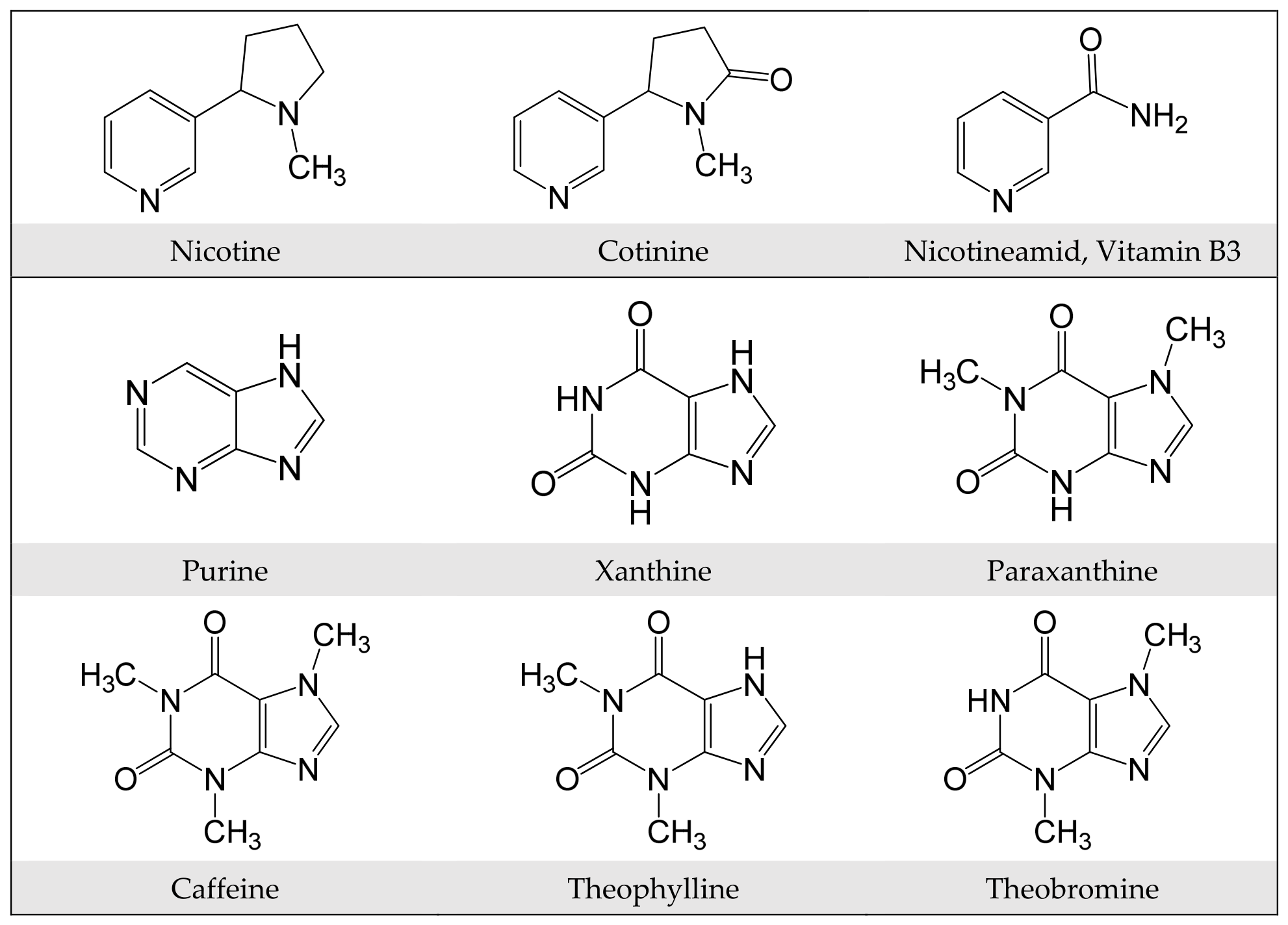
- Pyridine-type stimulants, including nicotine and cotinine;
- Purine-type stimulants, primarily including caffeine, xanthine, theophylline, and theobromine;
- Amphetamine-type stimulants (amphetamine, methamphetamine, ephedrine);
- Other stimulants, including, for example, cocaine, tetrahydrocannabinol (THC), and the hallucinogen lysergic acid diethylamide (LSD);
- Opiates, e.g., morphine, codeine, papaverine, and heroin.
2. Results
3. Discussion
4. Materials and Methods
5. Conclusions
Supplementary Materials
Author Contributions
Funding
Institutional Review Board Statement
Informed Consent Statement
Data Availability Statement
Acknowledgments
Conflicts of Interest
Abbreviations
| B3LYP | Becke, 3-parameter, Lee–Yang–Parr |
| CCDC | Cambridge Crystallographic Data Centre |
| CNS | Central Nervous System |
| DFT | Density Functional Theory |
| DLPNO-CCSD(T) | Domain-Based Local Pair Natural Orbital Coupled Cluster with Singles, Doubles, and Perturbative Triples |
| DNA | Deoxyribonucleic Acid |
| HAT | Hydrogen Atom Transfer mechanisms |
| HF | Hartree–Fock Orbitals |
| HMDB | Human Metabolome Database |
| HOMO | Highest Occupied Molecular Orbital |
| KS | Kohn–Sham orbitals |
| LSD | Lysergic acid diethylamide |
| LUMO | Lowest Unoccupied Molecular Orbital |
| PCET | Proton-Coupled Electron Transfer |
| RAF | Radical Adduct Formation |
| RNA | Ribonucleic Acid |
| ROS | Reactive Oxygen Species |
| SEPT | Sequential Electron-Proton Transfer |
| SET | Single Electron Transfer |
| THC | Tetrahydrocannabinol |
References
- Barlow, R.B.; Howard, J.A.K.; Johnson, O. Structures of nicotine monomethyl iodide and nicotine monohydrogen iodide. Acta Crystallogr. 1986, C42, 853–856. [Google Scholar] [CrossRef] [Scilit]
- Mercer, A.; Trotter, J. Crystal and molecular structure of 1,3,7-trimethyl-2,6-purinedione hydrochloride dihydrate (caffeine hydrochloride dihydrate). Acta Crystallogr. 1978, B34, 450–453. [Google Scholar] [CrossRef] [Scilit]
- Sutor, D.J. The structures of the pyrimidines and purines. VII. The crystal structure of caffeine. Acta Crystallogr. 1958, 11, 453–458. [Google Scholar] [CrossRef] [Scilit]
- Lehmann, C.W.; Stowasser, F. The Crystal Structure of Anhydrous β-Caffeine as Determined from X-ray Powder-Diffraction Data. Chem.-A Eur. J. 2007, 13, 2908–2911. [Google Scholar] [CrossRef] [Scilit] [PubMed]
- Ebisuzaki, Y.; Boyle, P.D.; Smith, J.A. Methylxanthines. I. Anhydrous Theophylline. Acta Crystallogr. 1997, C53, 777–779. [Google Scholar] [CrossRef] [Scilit]
- Ford, K.A.; Ebisuzaki, Y.; Boyle, P.D. Methylxanthines. II. Anhydrous Theobromine. Acta Crystallogr. 1998, C54, 1980–1983. [Google Scholar] [CrossRef] [Scilit]
- Koo, C.H.; Shin, H.S.; Oh, S.S. The Crystal and Molecular Structure of Theophylline Hydrochloride. J. Korean Chem. Soc. 1978, 22, 86–94. [Google Scholar]
- Camiruaga, A.; Usabiaga, I.; D’mello, V.C.; García, G.A.; Wategaonkar, S.; Fernández, J.A. Revisiting the spectroscopy of xanthine derivatives: Theobromine and theophylline. Phys. Chem. Chem. Phys. 2019, 21, 26430–26437. [Google Scholar] [CrossRef] [Scilit] [PubMed]
- Kim, D.; Kim, H.M.; Yang, K.Y.; Kim, S.K.; Kim, N.J. Molecular beam resonant two-photon ionization study of caffeine and its hydrated clusters. J. Chem. Phys. 2008, 128, 134310. [Google Scholar] [CrossRef] [Scilit] [PubMed]
- Kuhn, W.F.; Lilly-Leister, D.; Kao, J.; Lilly, A.C. Comparison of theoretical and experimental ionization potentials of nicotine and related molecules. J. Mol. Struct. 1989, 212, 37–44. [Google Scholar] [CrossRef] [Scilit]
- Sa’adeh, H.; Backler, F.; Wang, F.; Piccirillo, S.; Ciavardini, A.; Richter, R.; Coreno, M.; Prince, K.C. Experimental and Theoretical Soft X-ray Study of Nicotine and Related Compounds. J. Phys. Chem. A 2020, 124, 4025–4035. [Google Scholar] [CrossRef] [Scilit] [PubMed]
- León-Carmona, J.R.; Galano, A. Is Caffeine a Good Scavenger of Oxygenated Free Radicals? J. Phys. Chem. B 2011, 115, 4538–4546. [Google Scholar] [CrossRef] [Scilit] [PubMed]
- Lee, C.; Yang, W.; Parr, R.G. Development of the Colle-Salvetti correlation-energy formula into a functional of the electron density. Phys. Rev. B 1988, 37, 785–789. [Google Scholar] [CrossRef] [Scilit] [PubMed]
- Neese, F. Software update: The ORCA program system—Version 5.0. WIRES Comput. Mol. Sci. 2022, 12, e1606. [Google Scholar] [CrossRef] [Scilit]
- Neese, F. Software Update: The ORCA Program System—Version 6.0. WIREs Comput. Mol. Sci. 2025, 15, e70019. [Google Scholar] [CrossRef] [Scilit]
- Weigend, F.; Ahlrichs, R. Balanced Basis Sets of Split Valence, Triple Zeta Valence and Quadruple Zeta Valence Quality for H to Rn: Design and Assessment of Accuracy. Phys. Chem. Chem. Phys. 2005, 7, 3297–3305. [Google Scholar] [CrossRef] [Scilit] [PubMed]
- Weigend, F.; Kohn, A.; Hattig, C. Efficient use of the correlation consistent basis sets in resolution of the identity MP2 calculations. J. Chem. Phys. 2002, 116, 3175–3183. [Google Scholar] [CrossRef] [Scilit]
- Sen, K.D. Chemical hardness. In Structure and Bonding; Springer: Berlin/Heidelberg, Germany, 1993; Volume 80, 268p. [Google Scholar] [CrossRef] [Scilit]
- Pearson, R.G. Chemical Hardness; Wiley: Weinheim, Germany, 1997; 198p. [Google Scholar] [CrossRef] [Scilit]
- Parr, R.G.; Szentpaly, L.W.; Liu, S. Electrophilicity index. J. Am. Chem. Soc. 1999, 121, 1922–1924. [Google Scholar] [CrossRef] [Scilit]
- Neese, F.; Hansen, A.; Liakos, D.G. Efficient and accurate approximations to the local coupled cluster singles doubles method using a truncated pair natural orbital basis. J. Chem. Phys. 2009, 131, 064103. [Google Scholar] [CrossRef] [Scilit] [PubMed]
- Neese, F.; Wennmohs, F.; Hansen, A. Efficient and accurate local approximations to coupled-electron pair approaches: An attempt to revive the pair natural orbital method. J. Chem. Phys. 2009, 130, 114108. [Google Scholar] [CrossRef] [Scilit] [PubMed]
- Riplinger, C.; Neese, F. An efficient and near linear scaling pair natural orbital based local coupled cluster method. J. Chem. Phys. 2013, 138, 034106. [Google Scholar] [CrossRef] [Scilit] [PubMed]
- Riplinger, C.; Pinski, P.; Becker, U.; Valeev, E.F.; Neese, F. Sparse maps-A systematic infrastructure for reduced-scaling electronic structure methods. II. Linear scaling domain based pair natural orbital coupled cluster theory. J. Chem. Phys. 2016, 144, 024109. [Google Scholar] [CrossRef] [Scilit] [PubMed]
- Boča, R.; Štofko, J.; Rajnák, C. Electronic Properties of Small Psychotropic Substances in Water—Phenylamines. ACS Omega 2025, 10, 37383–37397. [Google Scholar] [CrossRef] [Scilit] [PubMed]
- Kendall, R.A.; Dunning, T.H., Jr.; Harrison, R.J. Electron affinities of the first-row atoms revisited. Systematic basis sets and wave functions. J. Chem. Phys. 1992, 96, 6796–6806. [Google Scholar] [CrossRef] [Scilit]
- Takano, Y.; Houk, K.N. Benchmarking the conductor-like polarizable continuum model (CPCM) for aqueous solvation free energies of neutral and ionic organic molecules. J. Chem. Theory. Comput. 2005, 1, 70–77. [Google Scholar] [CrossRef] [Scilit] [PubMed]
- Garcia-Rates, M.; Neese, F. Effect of the Solute Cavity on the Solvation Energy and its Derivatives within the Framework of the Gaussian Charge Scheme. J. Comput. Chem. 2020, 41, 922–939. [Google Scholar] [CrossRef] [Scilit] [PubMed]
- Garcia-Rates, M.; Becker, U.; Neese, F. Implicit solvation in domain based pair natural orbital coupled cluster (DLPNO-CCSD) theory. J. Comput. Chem. 2021, 42, 1959–1973. [Google Scholar] [CrossRef] [Scilit] [PubMed]
- Neese, F.; Wennmohs, F.; Becker, U.; Riplinger, C. The ORCA quantum chemistry program package. J. Chem. Phys. 2020, 152, 224108. [Google Scholar] [CrossRef] [Scilit] [PubMed]



| Nicotine | Cotinine | Caffeine | Theophylline | Theobromine | |
|---|---|---|---|---|---|
| IUPAC name | 3-[(2S)-1-methyl pyrrolidin-2-yl]pyridine | (5S)-1-methyl-5-(3-pyridyl) pyrrolidin-2-one | 1,3,7-trimethyl-3,7-dihydro-1H-purine-2,6-dione | 1,3-dimethyl-7H-purine-2,6-dione | 3,7-dimethyl-1H-purine-2,6-dione |
| Molecular formula | C10H14N2 | C10H12N2O | C8H10N4O2 | C7H8N4O2 | C7H8N4O2 |
| Molar mass | 162.23 | 176.21 | 194.19 | 180.17 | 180.17 |
| Rotatable bonds | 1 | 1 | 0 | 0 | 0 |
| Solubility in water a | 1 g/cm3 | 117 mg/cm3 | 2.17 g/cm3 | 7.36 mg/cm3 | 0.33 mg/cm3 |
| logP | 1.17 | 0.07 | −0.07 | −0.02 | −0.78 |
| Acidity pKa | 8.5 | 4.79 | 14 | 8.81 | 9.9 |
| Refractivity a/m3 mol−1 | 49.7 | 49.3 | 49.8 | 44.9 | 44.9 |
| Polarizability a/A3 | 18.6 | 18.6 | 18.9 | 16.9 | 16.8 |
| PubChem CID b | 89594 | 854019 | 2519 | 2153 | 5429 |
| DrugBank DB | 00184 | 00201 | 00277 | 01412 | |
| HMDB | 0001934 | 0001046 | 0001847 | 0001889 | 0002825 |
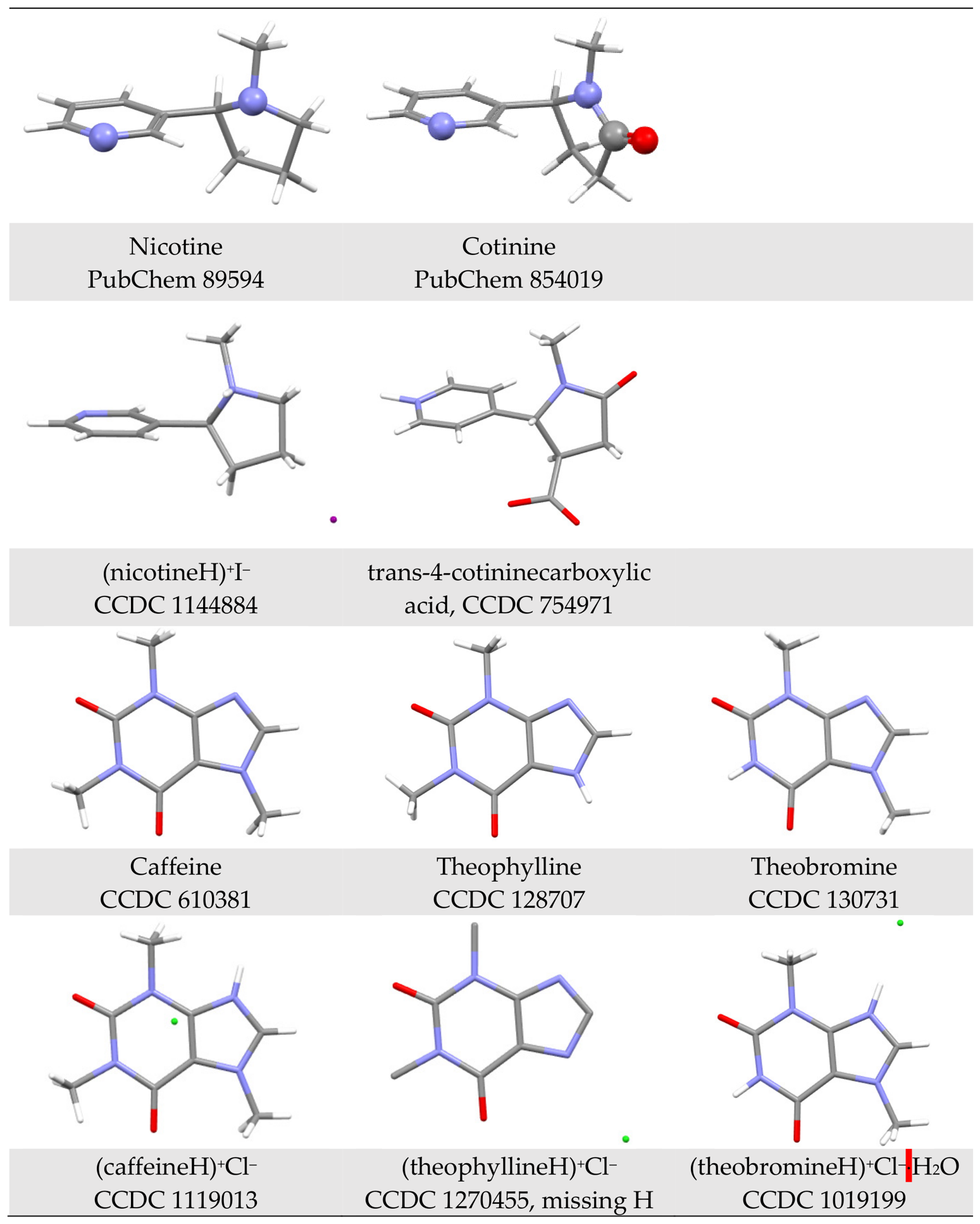
| CCDC | 610381 1119028 | 128707 | 130731 | ||
| ·HI, 1144884 | ·HCl, 1119013 | ·HCl, 1270455 | ·HCl, 1019199 |
| Molecule | p | –Q | α | S | V | Ezpe | SøTø | ν0 | |
|---|---|---|---|---|---|---|---|---|---|
| Canonical forms | |||||||||
| 1 | Nicotine_1 | 3.400 | 54.9 | 188.5 | 774 | 1427 | 141.4 | 29.9 | 33 |
| 1b | Nicotine_2 | 4.489 | 54.0 | 188.4 | 773 | 1431 | 141.4 | 29.8 | 31 |
| 2 | Cotinine_1 | 4.260 | 64.2 | 188.1 | 790 | 1468 | 130.0 | 30.9 | 41 |
| 2b | Cotinine_2 | 7.924 | 60.6 | 186.6 | 792 | 1480 | 130.0 | 31.0 | 28 |
| 3 | Caffeine | 5.621 | 60.2 | 187.0 | 782 | 1434 | 117.6 | 33.3 | 73 |
| 4 | Theophylline | 5.133 | 55.6 | 169.3 | 719 | 1313 | 100.4 | 30.5 | 79 |
| 5 | Theobromine | 6.452 | 56.7 | 169.9 | 732 | 1326 | 100.4 | 30.7 | 57 |
| Protonated forms | |||||||||
| 1+ | Nicotinium_1 | 10.28 | 44.2 | 173.5 | 779 | 1460 | 151.4 | 30.0 | 36 |
| 1b+ | Nicotinium_2 | 9.62 | 43.6 | 173.2 | 781 | 1450 | 151.4 | 30.1 | 26 |
| 2+ | Cotininium_1 | 17.52 | 43.4 | 178.6 | 795 | 1481 | 138.9 | 31.0 | 40 |
| 2b+ | Cotininium_2 | 14.63 | 45.7 | 176.3 | 797 | 1485 | 138.9 | 31.0 | 38 |
| 3+ | Caffeinium | 14.08 | 46.9 | 177.1 | 796 | 1480 | 126.1 | 32.9 | 58 |
| 4+ | Theophyllinium | 14.64 | 42.4 | 159.9 | 732 | 1333 | 108.9 | 30.6 | 69 |
| 5+ | Theobrominium | 13.88 | 44.7 | 159.9 | 737 | 1345 | 108.6 | 30.8 | 60 |
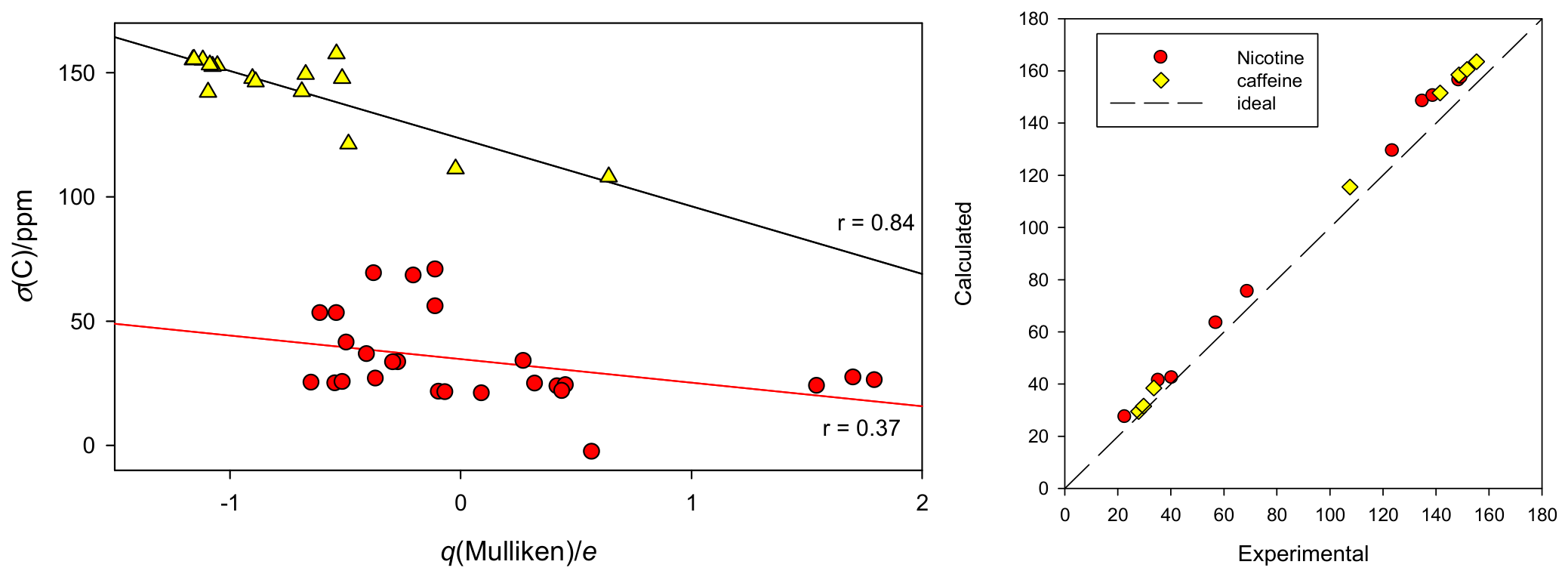
| Molecule | σ(H) | σ(C2ar) | σ(N2ar) | σ(C3al) or σ(C2al) | σ(N3al) | σ(O2) | |
|---|---|---|---|---|---|---|---|
| 1 | Nicotine_1 | 22–30 | 27, 28, 34, 36, 55 | −81 | 109, 142, 157, 121, 143 | 174 | |
| 2 | Cotinine_1 | 22–30 | 18, 23, 25, 52, 57 | −78 | 110, 154, 146, 150, -2(O) | 108 | −3 |
| 3 | Caffeine | 24–29 | 21, 24, 26, 33, 69 | 6, 71, 76, 112 | 146, 153, 155 | −8, 21 | |
| 4 | Theophylline | 22–29 | 21, 23, 27, 37, 70 | 2, 76, 87, 114 | 152, 155 | −5, 20 | |
| 5 | Theobromine | 24–29 | 22, 23, 24, 33, 68 | 5, 70, 80, 112 | 147, 152 | −1, 40 |
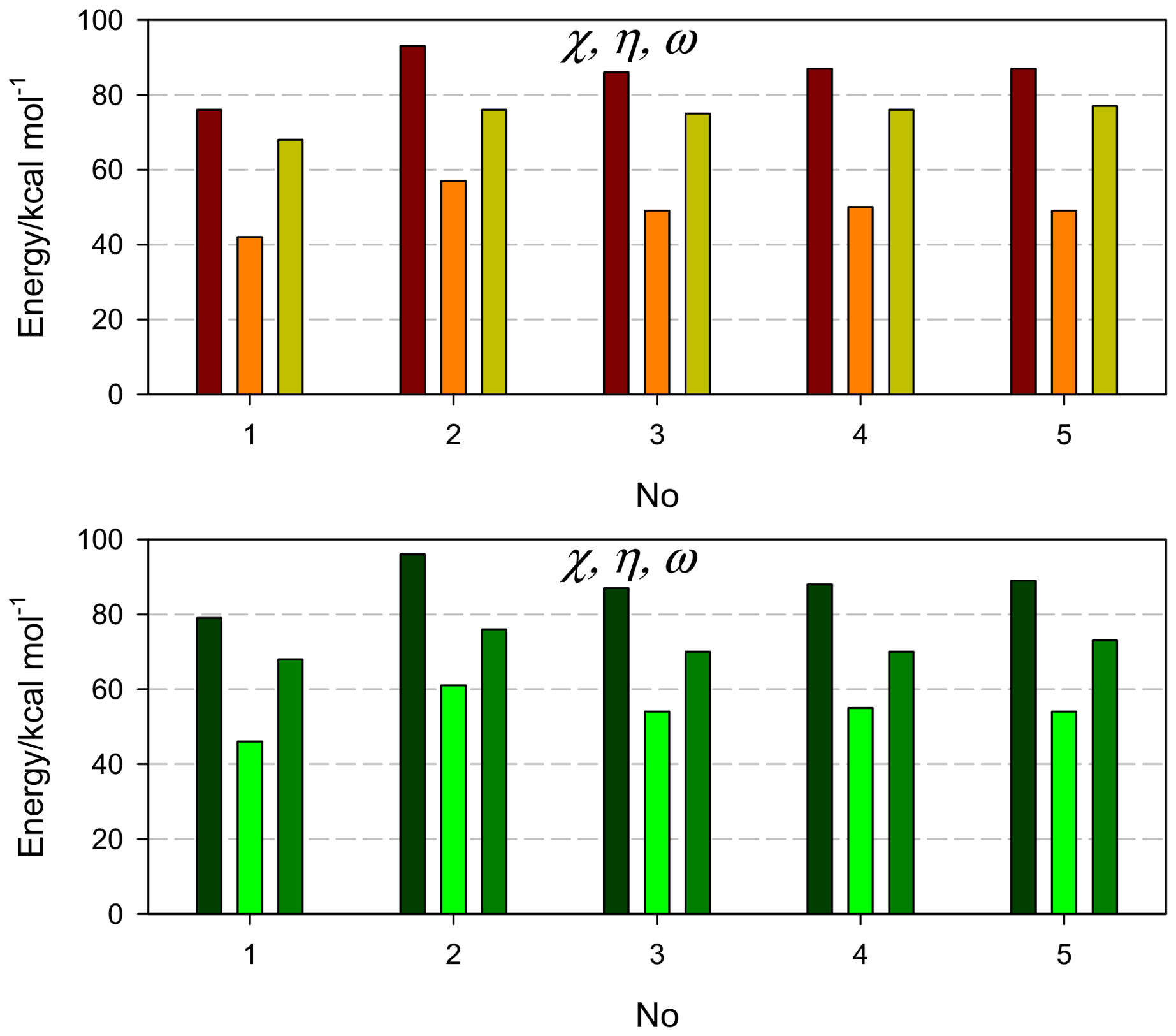
| B3LYP | HOMO | LUMO | Ei | Eeg | χ | η | ω | Eoxø/V | Eredø/V | |
|---|---|---|---|---|---|---|---|---|---|---|
| def2-TZVPD | KS | KS | ||||||||
| Canonical forms | ||||||||||
| 1 | Nicotine_1 | −140.2 | −23.5 | 117.8 | −33.5 | 76 | 42 | 68 | −5.06 | 1.62 |
| 1b | Nicotine_2 | −139.8 | −21.5 | 117.7 | −32.0 | 75 | 43 | 65 | −5.06 | 1.56 |
| 2 | Cotinine_1 | −158.9 | −25.6 | 150.2 | −36.1 | 93 | 57 | 76 | −6.42 | 1.73 |
| 2b | Cotinine_2 | −157.6 | −24.7 | 148.2 | −34.8 | 91 | 57 | 74 | −6.33 | 1.68 |
| 3 | Caffeine | −143.3 | −25.4 | 135.1 | −36.4 | 86 | 49 | 75 | −5.86 | 1.58 |
| 4 | Theophylline | −145.3 | −27.7 | 137.1 | −36.9 | 87 | 50 | 76 | −5.95 | 1.60 |
| 5 | Theobromine | −145.8 | −26.7 | 136.5 | −38.0 | 87 | 49 | 77 | −5.92 | 1.65 |
| Protonated forms | ||||||||||
| 1+ | Nicotinium_1 | −172.8 | −31.4 | 159.5 | −41.4 | 100 | 59 | 85 | −6.84 | 1.97 |
| 1b+ | Nicotinium_2 | −172.9 | −28.8 | 159.5 | −39.3 | 99 | 60 | 82 | −6.85 | 1.90 |
| 2+ | Cotininium_1 | −164.0 | −57.3 | 155.1 | −65.9 | 110 | 45 | 137 | −6.64 | 3.04 |
| 2b+ | Cotininium_2 | −164.3 | −58.0 | 154.2 | −65.9 | 110 | 44 | 137 | −6.60 | 3.04 |
| 3+ | Caffeinium | −162.5 | −42.4 | 155.5 | −55.4 | 105 | 50 | 111 | −6.72 | 2.56 |
| 4+ | Theophyllinium | −163.4 | −43.7 | 156.3 | −57.6 | 107 | 49 | 116 | −6.75 | 2.66 |
| 5+ | Theobrominium | −163.7 | −43.6 | 156.5 | −56.3 | 106 | 50 | 113 | −6.76 | 2.58 |
| DLPNO-CCSD(T) | ||||||||||
| aug-cc-pVTZ | HF | HF | Ei | Eeg | χ | η | ω | Eox*/V | Ered*/V | |
| Canonical forms | ||||||||||
| 1 | Nicotine_1 | −212.8 | 19.0 | 125.4 | −33.3 | 79 | 46 | 68 | −5.44 | 1.44 |
| 1b | Nicotine_2 | −211.3 | 19.0 | 125.3 | −31.8 | 79 | 47 | 66 | −5.43 | 1.38 |
| 2 | Cotinine_1 | −219.5 | 18.8 | 157.1 | −35.2 | 96 | 61 | 76 | −6.81 | 1.53 |
| 2b | Cotinine_2 | −214.9 | 18.5 | 156.4 | −34.6 | 96 | 61 | 75 | −6.78 | 1.50 |
| 3 | Caffeine | −219.4 | 18.8 | 141.1 | −32.7 | 87 | 54 | 70 | −6.12 | 1.42 |
| 4 | Theophylline | −201.4 | 18.3 | 143.0 | −33.5 | 88 | 55 | 70 | −6.20 | 1.45 |
| 5 | Theobromine | −201.4 | 18.7 | 142.3 | −35.0 | 89 | 54 | 73 | −6.17 | 1.52 |
| Protonated forms | ||||||||||
| 1+ | Nicotinium_1 | −222.9 | 17.6 | 166.1 | −40.6 | 103 | 63 | 85 | −7.20 | 1.76 |
| 1b+ | Nicotinium_2 | −222.4 | 17.5 | 165.9 | −38.4 | 102 | 64 | 82 | −7.19 | 1.67 |
| 2+ | Cotininium_1 | −244.2 | 16.6 | 161.6 | −65.5 | 114 | 48 | 134 | −7.01 | 2.84 |
| 2b+ | Cotininium_2 | −239.2 | 16.7 | 160.8 | −65.9 | 113 | 47 | 135 | −6.97 | 2.86 |
| 3+ | Caffeinium | −219.9 | 17.1 | 161.0 | −51.4 | 106 | 55 | 103 | −6.98 | 2.23 |
| 4+ | Theophyllinium | −221.0 | 16.8 | 161.8 | −34.5 | 98 | 64 | 76 | −7.02 | 1.50 |
| 5+ | Theobrominium | −221.5 | 17.1 | 162.2 | −52.3 | 107 | 55 | 105 | −7.03 | 2.27 |
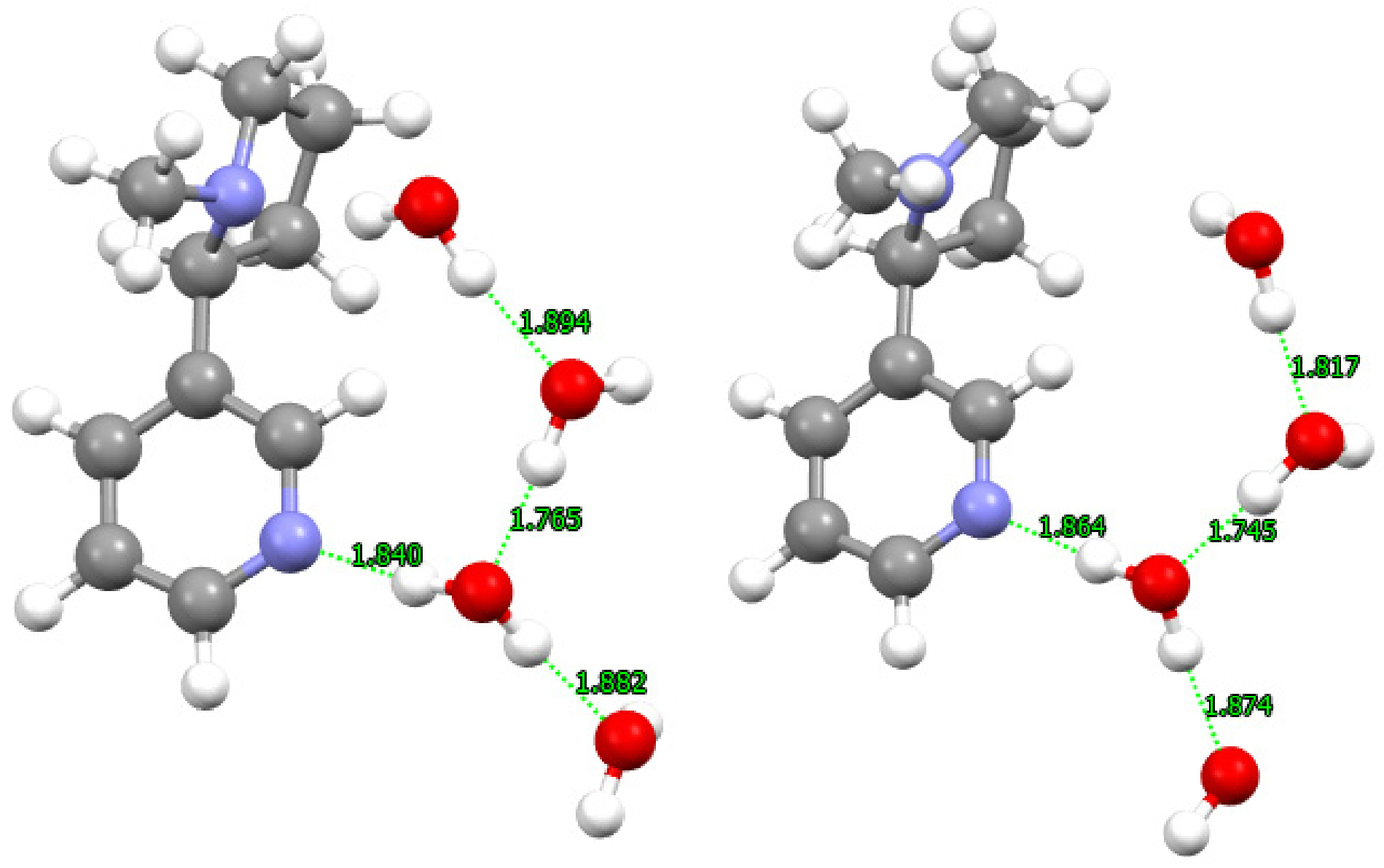
| Energy | Molecule, Nicotine | Aggregate, Nicotine·4H2O |
|---|---|---|
| Eiv | 136.2 | 145.2 |
| Eia | 117.7 | 120.7 |
| ΔGø | 116.6 | 118.4 |
Disclaimer/Publisher’s Note: The statements, opinions and data contained in all publications are solely those of the individual author(s) and contributor(s) and not of MDPI and/or the editor(s). MDPI and/or the editor(s) disclaim responsibility for any injury to people or property resulting from any ideas, methods, instructions or products referred to in the content. |
© 2026 by the authors. Licensee MDPI, Basel, Switzerland. This article is an open access article distributed under the terms and conditions of the Creative Commons Attribution (CC BY) license.
Share and Cite
Boča, R.; Vranovičová, B.; Štofko, J.; Rajnák, C. Electronic Properties of Common Psychostimulants in Aqueous Environments. Molecules 2026, 31, 3625. https://doi.org/10.3390/molecules31203625
Boča R, Vranovičová B, Štofko J, Rajnák C. Electronic Properties of Common Psychostimulants in Aqueous Environments. Molecules. 2026; 31(20):3625. https://doi.org/10.3390/molecules31203625
Chicago/Turabian StyleBoča, Roman, Beáta Vranovičová, Juraj Štofko, and Cyril Rajnák. 2026. "Electronic Properties of Common Psychostimulants in Aqueous Environments" Molecules 31, no. 20: 3625. https://doi.org/10.3390/molecules31203625
APA StyleBoča, R., Vranovičová, B., Štofko, J., & Rajnák, C. (2026). Electronic Properties of Common Psychostimulants in Aqueous Environments. Molecules, 31(20), 3625. https://doi.org/10.3390/molecules31203625