Abstract
Botryomeroterpenoids A (1) and B (2), two new andrastin-type meroterpenoids, along with two known analogues (3 and 4), were isolated from sponge-derived fungus Botryosporium sp. S5I2-1. Their structures were characterized by detailed spectroscopic analysis. Meanwhile, the absolute configurations of 1 and 2 were elucidated by comparing experimental and calculated ECD spectra. Compounds 1 and 2 were the first examples of andrastin-type meroterpenoids isolated from this genus, especially Compound 1 which represented the initial instance of 18-norandrastin-type meroterpenoids. Furthermore, the antibacterial activities of all compounds were also evaluated. However, the results indicated that these compounds showed no significant inhibitory activity against the tested bacteria with minimum inhibitory concentration (MIC) values of 32–64 μg/mL.
1. Introduction
Fungi generated from marine sponges are widely recognized as abundant sources of bioactive natural compounds, which are currently a valuable resource for drug discovery. Numerous secondary metabolites [1], mainly alkaloids [2], polyketides [3], terpenes [4] and sterols [5], etc., have been consistently isolated from marine sponge-derived fungus. A large proportion of these compounds display a wide range of biological activities [1], including antibacterial [6], cytotoxic [7], antiviral [8], etc. For example, 4-O-methylcandidusin A, which was isolated from marine sponge-derived fungus Aspergillus candidus OUCMDZ-1051, selectively inhibited the growth of the MDA-MB-468, BT474 and A431 cell lines with IC50 values of 1.84, 6.05, and 0.98 μmol/L, respectively, thereby indicating its potential as a lead compound for the discovery of novel drugs against these malignancies [9]. Another compound, amauromine, isolated from the sponge-derived fungus Auxarthron reticulatum, acted as an antagonist of the cannabinoid-like orphan receptor GPR18 (IC50 = 3.74 µM) and thus held promise as a lead structure for developing more potent and selective GPR18 antagonists [10]. Andrastin-type meroterpenoids, which are biosynthesized from 5-dimethylorsellinic acid (DMOA) and farnesyl diphosphate (FPP) via the mixed polyketide–terpenoid pathway, are defined by a 5-methyl-substituted ent-5α,14β-androstane scaffold corresponding to a 6,6,6,5-tetracarbocyclic framework. Except for a small portion of these compounds derived from the genus Aspergillus, more than seventy andrastin-type meroterpenoids have been identified and isolated from the genus Penicillium. Some of these compounds have shown several biological activities, including cytotoxic, anti-inflammatory, antifeedant, insecticidal, and antibacterial activity [11,12,13]. The fungus of genus Botryosporium belongs to the order Moniliales and the family Moniliaceae. This extensively dispersed genus of plant pathogenic fungus encompasses five identified species: B. hughesii, B. longibrachiatum var. longibrachiatum, B. longibrachiatum var. macrosporum, B. madrasense, and B. pulchrum. These fungi can infect various woody and herbaceous plants, with a higher prevalence in temperate and subtropical climatic regions [14,15,16,17]. Additionally, the morphological characteristics of the main taxonomic units of the genus Botryosporium have been studied [18,19]. Only B. pulchrum has been isolated from sponges, and this genus rarely occurs in marine habitats. Merely three secondary metabolites, all azaphilones, have been isolated from this genus in our research to date. These compounds exhibited potential anti-inflammatory activities in a CuSO4-induced transgenic zebrafish paradigm [20].
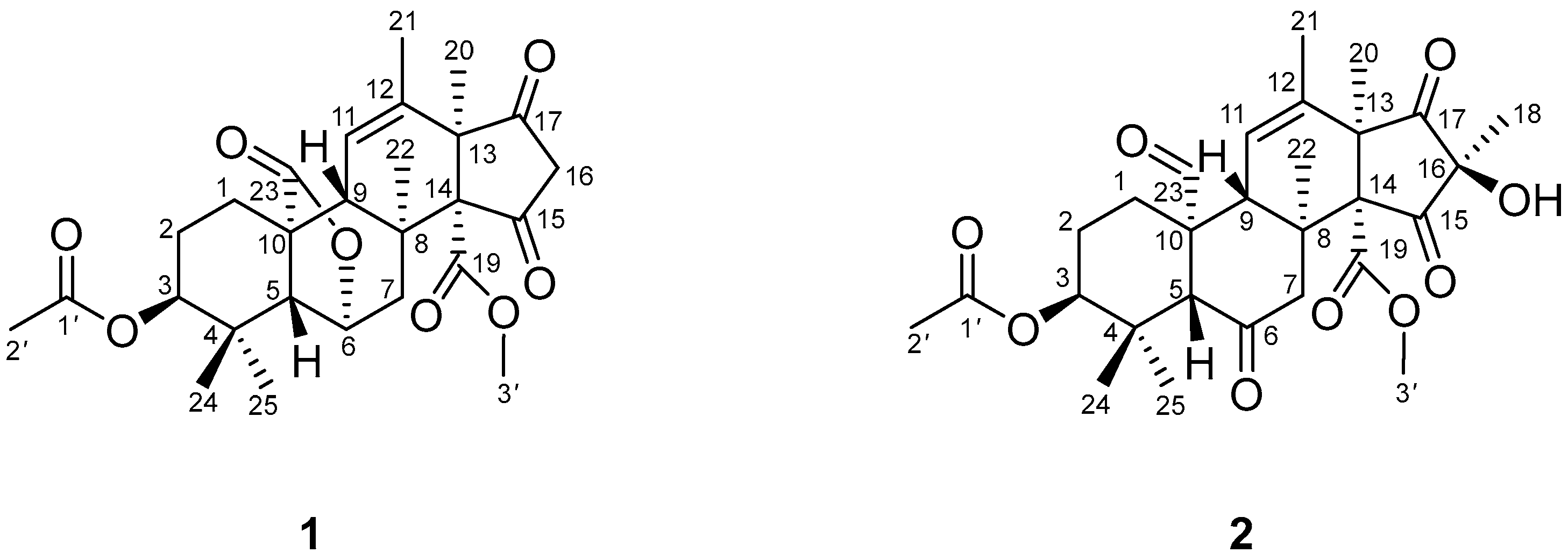
Structurally distinct secondary metabolites with biological activity from marine sponge-derived fungus are the focus of our ongoing investigations [21,22,23]. Thus, two new andrastin-type meroterpenoids, botryomeroterpenoids A (1) and B (2), along with two known ones (3 and 4), were isolated from marine sponge-derived fungus Botryosporium sp. S5I2-1 (Figure 1). Compounds 1 and 2 were the first examples of andrastin-type meroterpenoids isolated from this genus, especially Compound 1 which represented the initial instance of 18-norandrastin-type meroterpenoids.
Figure 1.
Chemical structures of 1 and 2.
Herein, the isolation, structural elucidation, and biological activities of these compounds are described.
2. Results and Discussion
Compound 1 was obtained as a yellow powder. The molecular formula of 1 was established as C27H34O8 from HR-ESI-MS (m/z 487.2331 [M + H]+, calcd for C27H35O8, 487.2326), indicating 11 degrees of unsaturation. The UV absorption maximum was at 202 nm. The IR bands indicated the presence of three carbonyl groups (1767, 1711, and 1619 cm−1). The 1H NMR (600 MHz, CD3OD) spectrum showed one olefinic proton [δH 5.59 (1H, br s)], four methines [δH 4.82 (1H, d, J = 4.4 Hz), 3.36 (1H, br s), 2.51 (1H, d, J = 4.4 Hz) and 2.07 (1H, s)], four methylenes [δH 3.35 (2H, s), 3.26 (1H, d, J = 10.5 Hz), 2.48 (1H, dd, J = 9.6, 4.4 Hz), 2.02 (2H, dd, J = 14.7, 5.8 Hz) and 1.72 (2H, dd, J = 14.9, 5.7 Hz)], and seven methyls [δH 3.59 (3H, s), 1.84 (3H, s), 1.60 (3H, s), 1.31 (3H, s), 1.24 (3H, s), 1.04 (3H, s) and 0.79 (3H, s)]. The 13C NMR (150 MHz, CD3OD) data revealed the presence of 27 carbons, including five carbonyl at δC 205.7, 193.2, 182.6, 172.5, and 166.5, a double-bond at δC 138.9 and 123.2, five quaternary carbons at δC 78.5, 71.2, 45.1, 43.3, and 36.2, four methines at δC 80.2, 74.4, 55.5, and 52.7, and four methylenes at δC 49.8, 38.2, 25.8, and 21.4, as well as seven methyls at δC 52.0, 26.9, 25.0, 24.3, 23.2, 20.5, and 17.8 (Table 1).
Table 1.
1H (600 MHz) and 13C NMR (150 MHz) spectroscopic data of 1 and 2 in CD3OD (J in Hz).
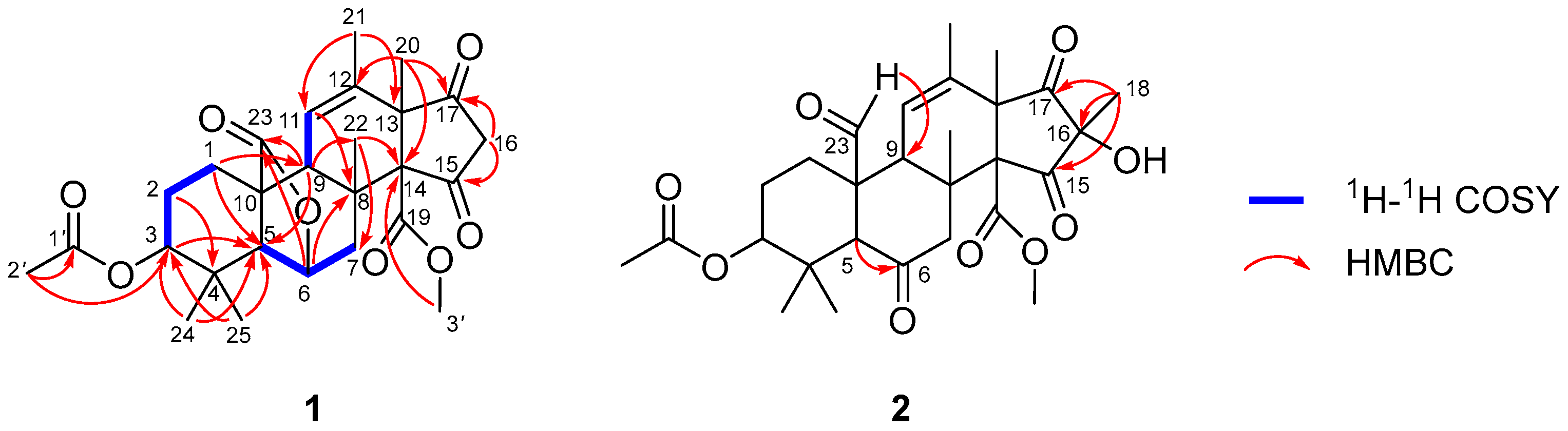
In the 1H-1H-COSY spectrum, three spin coupling systems were deduced as shown in Figure 2. Subsequently, based on the HMBC correlations from H-1 to C-5/C-9, from H-2 to C-4, from H-3 to C-5, from H-6 to C-8/C-23, from H-9 to C-5/C-23, from H-11 to C-8, from H-16 to C-15/C-17, from H-20 to C-12/C-14/C-17, from H-21 to C-11/C-13, from H-22 to C-7/C-14, the skeleton of pentacyclic meroterpenoid with 6/5/6/6/5 system was elucidated. According to the HMBC correlations between H-24/H-25 and C-3/C-5, the two methyl groups were linked to C-4. Meanwhile, the HMBC correlations between H-2′ and C-3/C-1′ implied that the acetoxyl was connected through C-3. Furthermore, the molecular formula information together with the obvious downfield chemical shifts in C-14, as well as the HMBC correlations from H-3′ to C-14, suggested that the methoxycarbonyl were attached at C-14. Hence, the planar structure of 1 was established, which was similar to that of the known Compound 3. The only difference was the absence of one hydroxyl and one methyl group at the C-16 position in 1 [24].
Figure 2.
1H-1H-COSY and key HMBC correlations of 1 and 2.
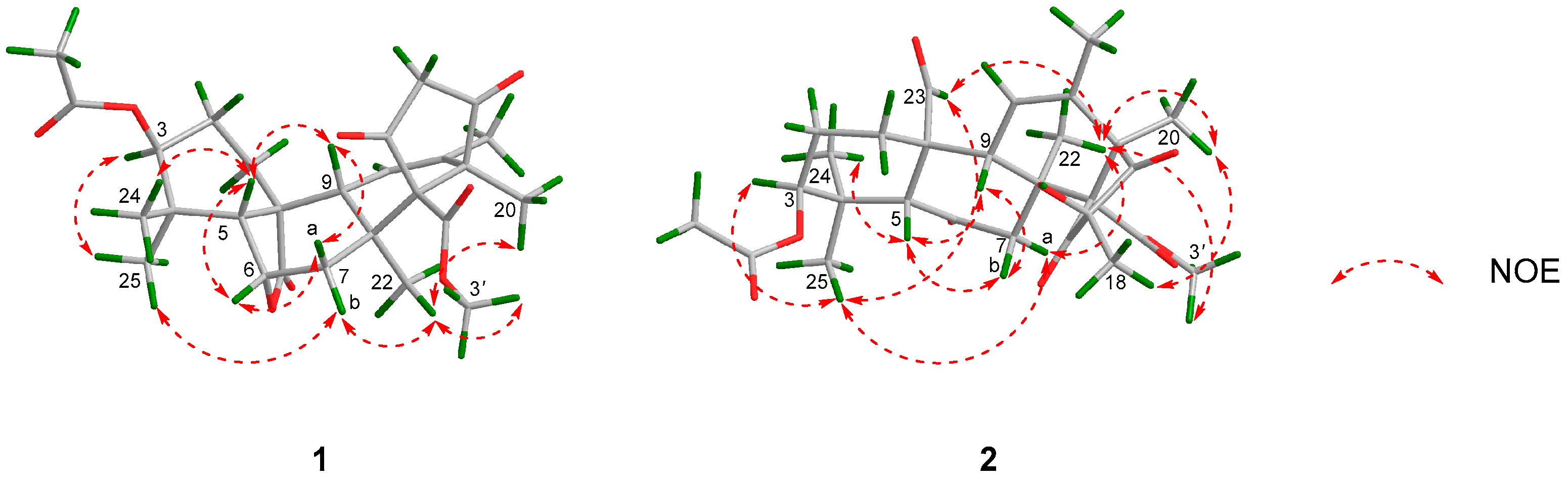
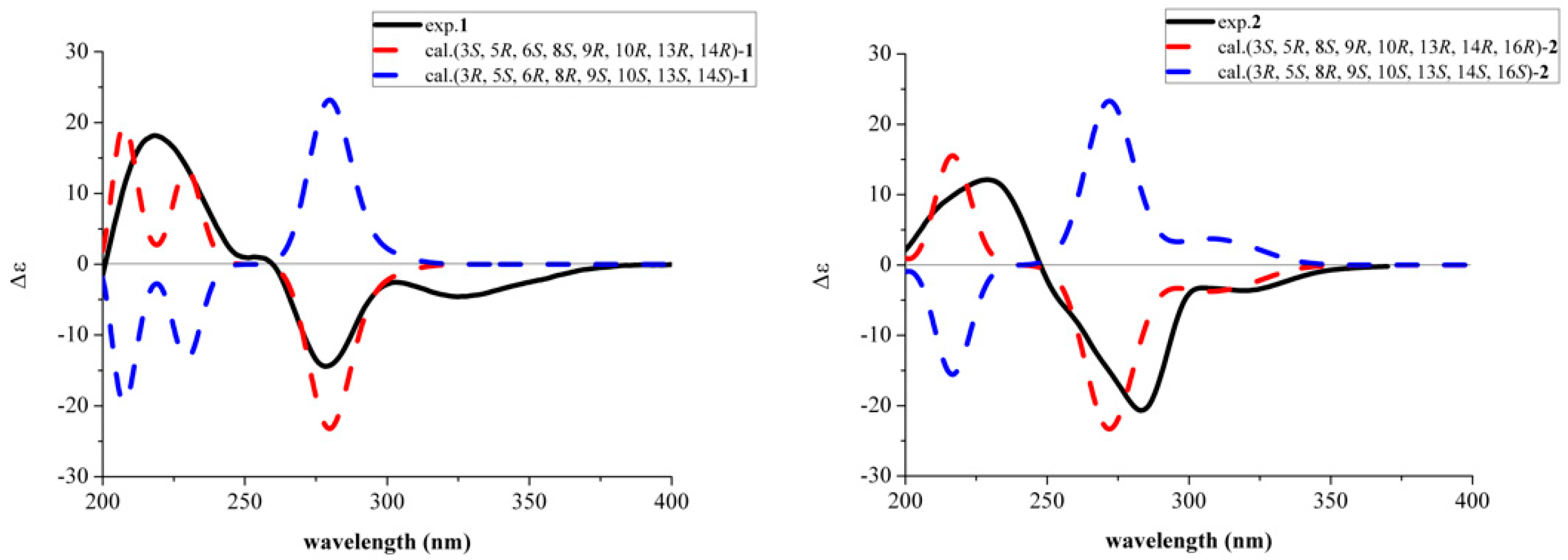
The relative configuration of 1 was determined by analysis of the NOESY spectrum. The correlations of H-5 and H-6/H-9/H-24, as well as H-7a and H-6/H-9, confirmed that these protons were cofacial, which were assigned as β-oriented. Accordingly, the NOE correlations between H-25 and H-3/H-7b together with H-22 and H-7b/H-20/H-3′ demonstrated that these protons were α-oriented (Figure 3). Hence, the relative configuration of 1 was completely established as 3S*, 5R*, 6S*, 8S*, 9R*, 10R*, 13R*, and 14R*. The absolute configuration of 1 was determined by the electronic circular dichroism (ECD) calculation. As a result, the calculated ECD spectrum of (3S, 5R, 6S, 8S, 9R, 10R, 13R, 14R)-1 matched well with the experimental one (Figure 4), which allowed the absolute configuration of 1 as 3S, 5R, 6S, 8S, 9R, 10R, 13R and 14R.
Figure 3.
Key NOE correlations of 1 and 2.
Figure 4.
Experimental and calculated ECD spectra of 1 and 2.
Compound 2 was obtained as a yellow powder. The molecular formula of 2 was established as C28H36O9 from HR-ESI-MS (m/z 539.2244 [M + Na]+, calcd for C28H36O9Na, 539.2252), indicating 11 degrees of unsaturation. The UV absorption maximum was at 203 nm. The IR bands indicated the presence of the carbonyl groups (1731 and 1603 cm−1). The 1D NMR data of 2 (Table 1) were very similar to those of 1, indicating that these two compounds might be the analogues. The differences between them were that 2 had one more carbonyl (δC 206.7), quaternary carbon (δC 72.8), and methyl [δH 1.31 (3H, s); δC 20.4] group, whereas the signals of a methine and a methylene had disappeared.
The HMBC correlations from H-18 to C-15/C-16/C-17 indicated that C-18 was attached to C-16. The HMBC correlation between H-23 to C-9 implied that the aldehyde group was connected to C-10. Meanwhile, the HMBC correlation from H-5 to C-6 confirmed the existence of a carbonyl group at C-6. The hydroxy group was assigned at C-16, which was determined by the obvious downfield chemical shifts in C-16 as well as the molecular formula information (Figure 2). The NOE correlations between H-5 and H-7b/H-9/H-24 showed that these protons were cofacial which were assigned as β-oriented. Therefore, the NOE correlations between H-25 and H-3/H-7a/H-23 as well as between H-22 and H-7a/H-20/H-23/H-3′ demonstrated that these protons were α-oriented (Figure 3). Hence, the relative configuration of 2 was completely established as 3S*, 5R*, 8S*, 9R*, 10R*, 13R*, 14R*, and 16R*. The absolute configuration of 2 was determined by the ECD calculation. As a result, the calculated ECD spectrum of (3S, 5R, 8S, 9R, 10R, 13R, 14R, 16R)-2 matched well with the experimental one (Figure 4), which allowed the absolute configuration of 2 as 3S, 5R, 8S, 9R, 10R, 13R, 14R, and 16R. In summary, Compounds 1 and 2 exhibited similar Cotton effects to those of the known compounds [13,24,25], whose absolute configurations were also determined by means of ECD calculations.
The two known compounds were identified as 16-epi-citreohybriddione (3) and citreohybriddione (4) [24], which were compared with the reported literature. Given that previous studies had reported the antibacterial activity of andrastin-type meroterpenoids [26], we aimed to further identify analogues with more potent antibacterial activity. Thus, the antibacterial activities of 1–4 were evaluated against Pseudomonas aeruginosa ATCC27853, Escherichia coli ATCC25922, Enterococcus faecalis ATCC29212, Staphylococcus aureus ATCC29213, Klebsiella pneumoniae ATCC700603, and Acinetobacter baumnnii ATCC19606. Unfortunately, the results indicated that these compounds showed no significant inhibitory activity against the tested bacteria with minimum inhibitory concentration (MIC) values of 32–64 μg/mL. Therefore, we will further enrich a larger number of this type of compounds and evaluate their multiple biological activities, such as antibacterial, cytotoxic, and anti-inflammatory activities, to discuss their structure–activity relationships.
3. Materials and Methods
3.1. General Experimental Procedures
The P-2000 Digital Polarimeter (JASCO International Co., Ltd., Hachioji, Japan) was applied to measure optical rotations. The Shimadzu UV-2600 Plus spectrometer (Shimadzu, Kyoto, Japan) and Nicolet iS 50 FT-IR (Thermo, Waltham, MA, USA) were utilized to collect the UV and IR spectra, respectively. HR-ESI-MS was assessed using the Agilent 6210 LC/MSD TOF mass spectrometer (Agilent, Palo Alto, CA, USA). NMR spectra were recorded on Bruker av 600 NMR spectrometers (Bruker, Fällanden, Switzerland). Structural assignments were made with additional information from the gNOESY, gCOSY, gHSQC, and gHMBC experiments. ECD spectrometer (JASCO International Co., Ltd., Hachioji, Tokyo, Japan) served to collect CD spectra. An Agilent 1200 series device (Agilent, Palo Alto, CA, USA) was used to perform semi-preparative HPLC [Rp-C18: 20 × 250 mm i.d, 10 µm (Cosmosil, Nacalai, Kyoto, Japan)]. Silica gel (300–400 mesh, Qingdao Haiyang Chemical Co., Qingdao, China) and Se-phadex LH-20 (GE Healthcare, Uppsala, Sweden) were the materials employed for column chromatography. Precoated silica gel plates (GF-254, Jiangyou Silica Gel Development, Inc., Yantai, China) were applied for thin-layer chromatography.
3.2. Fungal Material
The fungal strain S5I2-1 was obtained from marine sponge Gelliodes sp., which was gathered from the maritime region of Xuwen County, Zhanjiang City, China. It was identified as Botryosporium sp. based on sequencing of the ITS region (GenBank no. MH854672.1) with 99% similarity, which was deposited in the Department of Chemistry, College of Chemistry and Materials Science, Jinan University.
3.3. Fermentation, Extraction, and Isolation
The fungal strain Botryosporium sp. S5I2-1 was grown on solid medium I2 (glucose 1.6 g, yeast extract 1.6 g, malt extract 4.0 g, agar 6.0 g, sea salt 14.0 g and 400 mL distilled water) at 28 °C for a week. The mycelium was carefully excised from the Petri dish using an inoculation loop and transferred to 500 mL conical flask pre-filled with 100 mL of sterile liquid medium I2. To create the seed culture that was utilized to inoculate the rice medium, the liquid culture was incubated for three days at 180 rpm and 28 °C in a rotatory shaker (50 × 500 mL conical flask; 70 g of rice; 3 g of sea salt; 110 mL of distilled water in each flask). The fermentation was carried out at 28 °C under static condition for 50 days. Then the cultures were soaked and extracted with EtOAc for three times, which was concentrated in vacuo to gain a crude extract (9.0 g). Next, the extract was suspended in 90% MeOH-H2O and partitioned with cyclohexane to obtain MeOH-H2O fraction (MF, 2.3 g) and cyclohexane fraction (6.4 g).
The MF was separated into six fractions (Frs. 1–6) by an open ODS chromatographic column (CC), eluting with MeOH/H2O in gradient eluent (10:90~100:0). Gradient elution of Fr. 4 (624.8 mg) on silica gel column chromatography (CC) with dichloromethane/methanol (100:0 to 0:100) afforded six sub-fractions (Frs. 4.1–4.6). Four sub-fractions (Frs. 5.1–5.4) were isolated from Fr. 5 (407.7 mg) by silica gel CC using a dichloromethane/methanol gradient (100:0 to 0:100).
Semi-preparative HPLC with a mobile phase of MeOH/H2O (75:25, v/v) was applied to separate Fr. 4.3 (32.4 mg). Compounds 3 (1.5 mg, 2.5 mL/min, tR: 31.5 min) and 4 (1.2 mg, 2.5 mL/min, tR: 35.3 min) were afforded. Compound 1 (0.5 mg) was obtained from Fr. 4.4 (27.5 mg) through semi-preparative HPLC [MeOH/H2O (75:25, v/v), 2.5 mL/min, tR: 30.2 min]. Using semi-preparative HPLC [MeOH/H2O 75:25 (v/v), 2.5 mL/min, tR: 40.5 min], 2 (0.8 mg) was obtained from Fr. 5.2 (34.4 mg).
3.4. Antibacterial Activities
The broth microdilution method was used to evaluate antibacterial activity against a variety of bacterial strains, including Pseudomonas aeruginosa ATCC27853, Escherichia coli ATCC25922, Enterococcus faecalis ATCC29212, Staphylococcus aureus ATCC29213, Klebsiella pneumoniae ATCC700603, and Acinetobacter baumnnii ATCC19606. Ciprofloxacin (J&K Chemical Technology, Beijing, China) was utilized as a positive control in each experiment, which was carried out in triplicate.
3.5. ECD Calculations
The molecules of (3S, 5R, 6S, 8S, 9R, 10R, 13R, 14R)-1 and (3R, 5S, 6R, 8R, 9S, 10S, 13S, 14S)-1 (Figure S1) were converted into SMILES codes before their initial 3D structures were generated with CORINA version 3.4. Conformer databases were generated in CONFLEX version 7.0 using the MMFF94s force field, with an energy window for acceptable conformers (ewindow) of 5 kcal/mol above the ground state, a maximum number of conformations per molecule (maxconfs) of 100, and an RMSD cutoff (rmsd) of 0.5 Å. Then each acceptable conformer was optimized with the HF/6-31G(d) method in Gaussian09. Further optimization at the wB97XD/6-31G(d) level determined the dihedral angles. From this, two stable conformers were obtained for each molecule (Figure S2). The optimized conformer was used for the ECD calculation, which was performed with Gaussian09 (wB97XD/TZVP). The solvent effect was accounted by the polarizable-conductor calculation model (IEFPCM, methanol as the solvent). Comparisons of the experimental and calculated spectra were performed with the SpecDis software (version 1.71, University of Potsdam, Potsdam, Germany). This was also used to apply a UV shift to the ECD spectra, Gaussian broadening of the excitations, and Boltzmann weighting of the spectra (Table S1).
The molecules of (3S, 5R, 8S, 9R, 10R, 13R, 14R, 16R)-2 and (3R, 5S, 8R, 9S, 10S, 13S, 14S, 16S)-2 (Figure S3) were converted into SMILES codes before their initial 3D structures were generated with CORINA version 3.4. Conformer databases were generated in CONFLEX version 7.0 using the MMFF94s force field, with an energy window for acceptable conformers (ewindow) of 5 kcal/mol above the ground state, a maximum number of conformations per molecule (maxconfs) of 100, and an RMSD cutoff (rmsd) of 0.5 Å. Then each acceptable conformer was optimized with the HF/6-31G(d) method in Gaussian09. Further optimization at the wB97XD/6-31G(d) level determined the dihedral angles. From this, six stable conformers were obtained for each molecule (Figure S4). The optimized conformer was used for the ECD calculation, which was performed with Gaussian09 (wB97XD/TZVP). The solvent effect was accounted by the polarizable-conductor calculation model (IEFPCM, methanol as the solvent). Comparisons of the experimental and calculated spectra were performed with the SpecDis software (version 1.71, University of Potsdam, Potsdam, Germany). This was also used to apply a UV shift to the ECD spectra, Gaussian broadening of the excitations, and Boltzmann weighting of the spectra (Table S3).
4. Conclusions
In summary, botryomeroterpenoids A (1) and B (2), two new andrastin-type meroterpenoids, along with two known compounds (3 and 4), were isolated from sponge-derived fungus Botryosporium sp. S5I2-1. Compound 1 uniquely exemplified the first instance of 18-norandrastin-type meroterpenoids. Both of 1 and 2 were the first cases of andrastin-type meroterpenoids isolated from this genus. However, all the compounds showed no significant inhibitory activities against the tested bacteria.
Supplementary Materials
The following supporting information can be downloaded at https://www.mdpi.com/article/10.3390/molecules31020294/s1, compound characterization data; Figure S1. (3S, 5R, 6S, 8S, 9R, 10R, 13R, 14R)-1 and (3R, 5S, 6R, 8R, 9S, 10S, 13S, 14S)-1; Figure S2. Stable conformers of (3S*, 5R*, 6S*, 8S*, 9R*, 10R*, 13R*, 14R*)-1 at the wB97XD/6-31G(d) level in methanol; Figure S3. (3S, 5R, 8S, 9R, 10R, 13R, 14R, 16R)-2 and (3R, 5S, 8R, 9S, 10S, 13S, 14S, 16S)-2; Figure S4. Stable conformers of (3S*, 5R*, 8S*, 9R*, 10R*, 13R*, 14R*, 16R*)-2 at the wB97XD/6-31G(d) level in methanol; Figure S5. HRESIMS spectrum of 1; Figure S6. UV spectrum of 1 (MeOH); Figure S7. IR spectrum of 1 (MeOH); Figure S8. 1H NMR spectrum (600 MHz, CD3OD) of 1; Figure S9. 13C NMR spectrum (150 MHz, CD3OD) of 1; Figure S10. 1H-1H-COSY spectrum of 1; Figure S11. HSQC spectrum of 1; Figure S12. HMBC spectrum of 1; Figure S13. NOESY spectrum of 1; Figure S14. HRESIMS spectrum of 2; Figure S15. UV spectrum of 2 (MeOH); Figure S16. IR spectrum of 2 (MeOH); Figure S17. 1H NMR spectrum (600 MHz, CD3OD) of 2; Figure S18. 13C NMR spectrum (150 MHz, CD3OD) of 2; Figure S19. 1H-1H-COSY spectrum of 2; Figure S20. HSQC spectrum of 2; Figure S21. HMBC spectrum of 2; Figure S22. NOESY spectrum of 2; Table S1. The energies and Boltzmann distributions for stable conformers of (3S*, 5R*, 6S*, 8S*, 9R*, 10R*, 13R*, 14R*)-1; Table S2. Cartesian coordinates of all conformers of Compound 1; Table S3. The energies and Boltzmann distributions for stable conformers of (3S*, 5R*, 8S*, 9R*, 10R*, 13R*, 14R*, 16R*)-2; Table S4. Cartesian coordinates of all conformers of Compound 2.
Author Contributions
Conceptualization, B.-X.Z.; formal analysis, H.-X.L.; data curation, H.-X.L.; writing—original draft preparation, H.-X.L.; writing—review and editing, B.-X.Z.; investigation, H.-X.L. and W.-Y.G.; supervision, S.-H.X. and B.-X.Z.; project administration, B.-X.Z.; funding acquisition, S.-H.X. All authors have read and agreed to the published version of the manuscript.
Funding
This work was financially supported by the Department of Natural Resources of the Guangdong Province (GDNRC [2024] 28).
Institutional Review Board Statement
Not applicable.
Informed Consent Statement
Not applicable.
Data Availability Statement
All relevant data are available in the article and its Supplementary Materials.
Conflicts of Interest
The authors declare no conflicts of interest. The funders had no role in the design of the study.
References
- Zhang, B.; Zhang, T.; Xu, J.Z.; Lu, J.; Qiu, P.P.; Wang, T.T.; Ding, L.J. Marine sponge-sssociated fungi as potential novel bioactive natural product sources for drug discovery: A review. Mini-Rev. Med. Chem. 2020, 20, 1966–2010. [Google Scholar] [CrossRef]
- Sugiyama, Y.; Ito, Y.; Suzuki, M.; Hirota, A. Indole derivatives from a marine sponge-derived yeast as DPPH radical scavengers. J. Nat. Prod. 2009, 72, 2069–2071. [Google Scholar] [CrossRef]
- Song, F.; Ren, B.; Chen, C.; Yu, K.; Liu, X.; Zhang, Y.; Yang, N.; He, H.; Liu, X.; Dai, H.; et al. Three new sterigmatocystin analogues from marine-derived fungus Aspergillus versicolor MF359. Appl. Microbiol. Biot. 2014, 98, 3753–3758. [Google Scholar] [CrossRef]
- Ebada, S.S.; Schulz, B.; Wray, V.; Totzke, F.; Kubbutat, M.H.G.; Müller, W.E.G.; Hamacher, A.; Kassack, M.U.; Lin, W.; Proksch, P. Arthrinins A–D: Novel diterpenoids and further constituents from the sponge derived fungus Arthrinium sp. Bioorgan. Med. Chem. 2011, 19, 4644–4651. [Google Scholar] [CrossRef]
- Pang, X.; Lin, X.; Wang, J.; Liang, R.; Tian, Y.; Salendra, L.; Luo, X.; Zhou, X.; Yang, B.; Tu, Z.; et al. Three new highly oxygenated sterols and one new dihydroisocoumarin from the marine sponge-derived fungus Cladosporium sp. SCSIO41007. Steroids 2018, 129, 41–46. [Google Scholar] [CrossRef]
- Zheng, M.; Huang, Z.; Zheng, Y.; Tang, Y.; Wang, J.; Yang, S. Cotteslosin D, a new cyclopentapeptide from a sponge-derived fungus Aspergillus versicolour 2-18. Nat. Prod. Res. 2024, 1–6. [Google Scholar] [CrossRef]
- Lei, H.; Lei, J.; Zhou, X.; Hu, M.; Niu, H.; Song, C.; Chen, S.; Liu, Y.; Zhang, D. Cytotoxic polyketides from the marine sponge-derived fungus Pestalotiopsis heterocornis XWS03F09. Molecules 2019, 24, 2655. [Google Scholar] [CrossRef]
- Pang, X.; Yang, B.; Zhou, X.; Wang, J.; Yang, J.; Liu, Y. Two new isocoumarins isolated from the marine-sponge-derived fungus Setosphaeria sp. SCSIO41009. Chem. Biodivers. 2024, 21, e202302069. [Google Scholar] [CrossRef]
- Wang, D.; Qu, P.; Zhou, J.; Wang, Y.; Wang, L.; Zhu, W. p-Terphenyl alcohols from a marine sponge-derived fungus, Aspergillus candidus OUCMDZ-1051. Mar. Life Sci. Technol. 2020, 2, 262–267. [Google Scholar] [CrossRef]
- Nazir, M.; Harms, H.; Loef, I.; Kehraus, S.; El Maddah, F.; Arslan, I.; Rempel, V.; Müller, C.; König, G. GPR18 inhibiting amauromine and the novel triterpene glycoside auxarthonoside from the sponge-derived fungus Auxarthron reticulatum. Planta Med. 2015, 81, 1141–1145. [Google Scholar] [CrossRef]
- Chen, T.; Yang, W.C.; Li, T.B.; Yin, Y.H.; Liu, Y.F.; Wang, B.; She, Z.G. Hemiacetalmeroterpenoids A–C and Astellolide Q with antimicrobial activity from the marine-derived fungus Penicillium sp. N-5. Mar. Drugs 2022, 20, 514. [Google Scholar] [CrossRef] [PubMed]
- Yang, Y.N.; Han, X.; Jiang, C.; Chen, Y.; Tang, X.L.; Li, G.Q. Penisimplinoids A-K, highly oxygenated andrastin-type meroterpenoids with diverse activities from the marine-derived fungus Penicillium simplicissimum. Boorg. Chem. 2024, 153, 107897. [Google Scholar] [CrossRef]
- Ren, J.W.; Huo, R.Y.; Liu, G.R.; Liu, L. New Andrastin-Type Meroterpenoids from the Marine-Derived Fungus Penicillium sp. Mar. Drugs 2021, 19, 189. [Google Scholar]
- Tribe, H.T.; Weber, R.W.S. Dead basil stems—A possible ecological niche for the hoar-frost fungus Botryosporium longibrachiatum. Mycologist 2001, 15, 158–161. [Google Scholar] [CrossRef]
- Arunachalam, K.D.; Lakshmanan, M. Microbial uptake and accumulation of (14C carbofuran) 1,3-dihydro-2,2-dimethyl-7 benzofuranylmethyl carbamate in twenty fungal strains isolated by miniecosystem studies. Bull. Environ. Contam. Toxicol. 1988, 41, 127–134. [Google Scholar] [CrossRef]
- Sartory, A. New mold of the genus Botryosporium. Comptes Rendus Seances Soc. Biol. Ses Fil. 1916, 79, 516–517. [Google Scholar]
- Jensen, H.L. Cellulose-decomposing soil-fungus of an unusual character. Proc. Linn. Soc. N. S. Wales 1930, 55, 699–707. [Google Scholar]
- Zhang, T.Y.; Brycb, K. A reassessment of Botryosporium (Hyphomycetes). Acta Mycol. Sin. 1990, 9, 31–40. [Google Scholar]
- Park, J.H.; Park, M.J.; Han, K.S.; Shin, H.D. First report of black stem caused by Botryosporium longibrachiatum on Sweet Basil in Korea. Plant Dis. 2013, 97, 425. [Google Scholar] [CrossRef]
- Li, D.C.; Wei, M.W.; Yang, Z.Y.; Guo, Z.J.; Liao, X.J.; Xu, S.H.; Zhao, B.X. A new azaphilone from the marine sponge-associated fungus Botryosporium pulchrum. Chem. Biodivers. 2024, 22, e202402884. [Google Scholar] [CrossRef] [PubMed]
- Chen, Z.B.; Liang, H.X.; Guo, W.Y.; Li, D.C.; Liao, X.J.; Chen, G.D.; Xu, S.H.; Zhao, B.X. Sorbicitrinols A and B, two sorbicillinoids with unprecedented skeletons uncovered from sponge-derived fungus Penicillium sp. S4I4-3 by a molecular networking strategy. Org. Lett. 2025, 27, 3267–3272. [Google Scholar] [CrossRef] [PubMed]
- Wang, Y.; Lin, X.-P.; Ju, Z.-R.; Liao, X.-J.; Huang, X.-J.; Zhang, C.; Zhao, B.-X.; Xu, S.-H. Aspergchromones A and B, two new polyketides from the marine sponge-associated fungus Aspergillus sp. SCSIO XWS03F03. J. Asian Nat. Prod. Res. 2016, 19, 684–690. [Google Scholar] [CrossRef]
- Liang, Y.Q.; Liao, X.J.; Zhao, B.X.; Xu, S.H. (+)- and (−)-Spongiterpene, a pair of new valerenane sesquiterpene enantiomers from the marine sponge Spongia sp. Nat. Prod. Res. 2019, 35, 2178–2183. [Google Scholar]
- Xie, C.L.; Xia, J.M.; Lin, T.; Lin, Y.J.; Lin, Y.K.; Xia, M.L.; Chen, H.F.; Luo, Z.H.; Shao, Z.Z.; Yang, X.W. Andrastone A from the deep-sea-derived fungus Penicillium allii-sativi acts as an inducer of caspase and RXRα-dependent apoptosis. Front. Chem. 2019, 7, 692. [Google Scholar]
- Chang, J.L.; Ouyang, Q.X.; Peng, X.G.; Pei, J.; Zhang, L.L.; Gan, Y.T.; Ruan, H.L. Peniandrastins A–H: Andrastin-type meroterpenoids with immunosuppressive activity from a Penicillium sp. Boorg. Chem. 2023, 139, 106745. [Google Scholar] [CrossRef] [PubMed]
- Qin, Y.Y.; Huang, X.S.; Liu, X.B.; Mo, T.X.; Xu, Z.L.; Li, B.C.; Qin, X.Y.; Li, J.; Schäberle, T.F.; Yang, R.Y. Three new andrastin derivatives from the endophytic fungus Penicillium vulpinum. Nat. Prod. Res. 2022, 36, 3262–3270. [Google Scholar] [PubMed]
Disclaimer/Publisher’s Note: The statements, opinions and data contained in all publications are solely those of the individual author(s) and contributor(s) and not of MDPI and/or the editor(s). MDPI and/or the editor(s) disclaim responsibility for any injury to people or property resulting from any ideas, methods, instructions or products referred to in the content. |
© 2026 by the authors. Licensee MDPI, Basel, Switzerland. This article is an open access article distributed under the terms and conditions of the Creative Commons Attribution (CC BY) license.