Preferential Solvation of Zwitterionic Benzo-[f]-Quinolinium Ylids in Binary Solvent Mixtures: Spectral Study and Quantum Chemical Calculations


Abstract
1. Introduction
2. Results and Discussion
2.1. Solvatocromism in Binary Mixtures
2.2. General Analysis of the Preferential Solvation in Binary Mixtures
2.3. Preferential Solvation Analyzed Through the Bosch–Rosés Model
- (i)
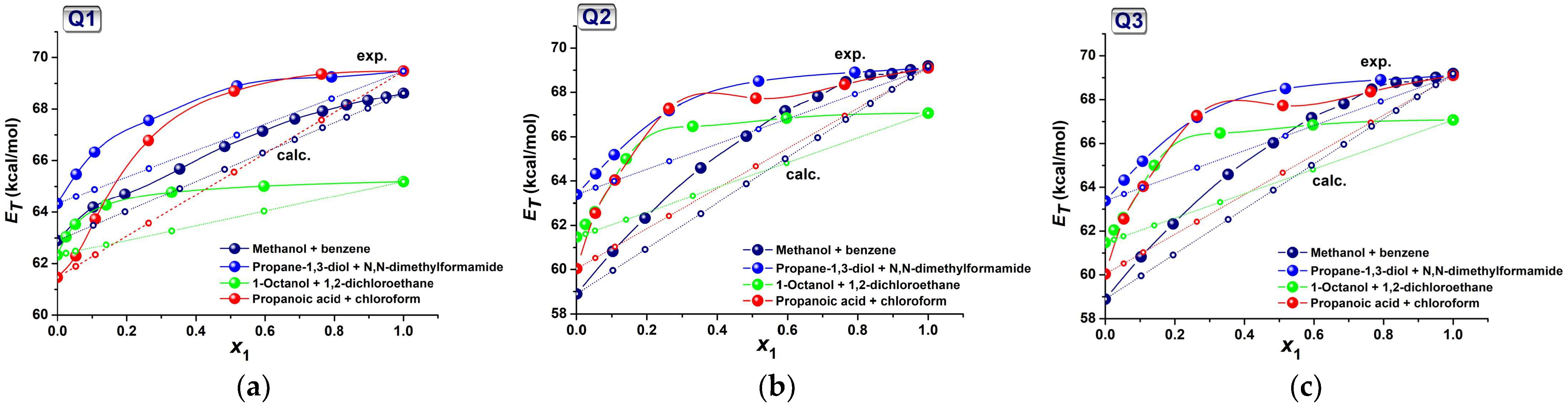
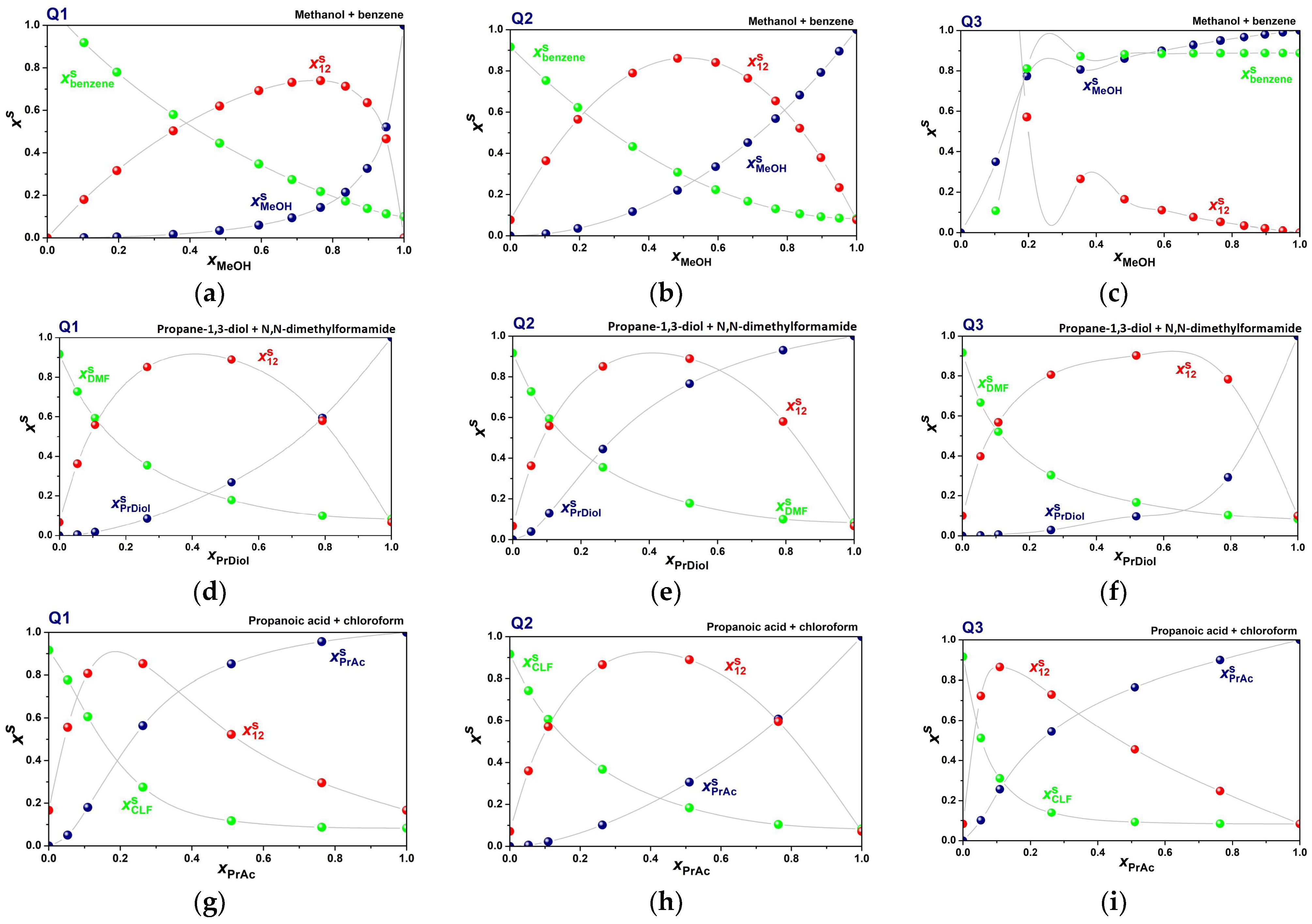
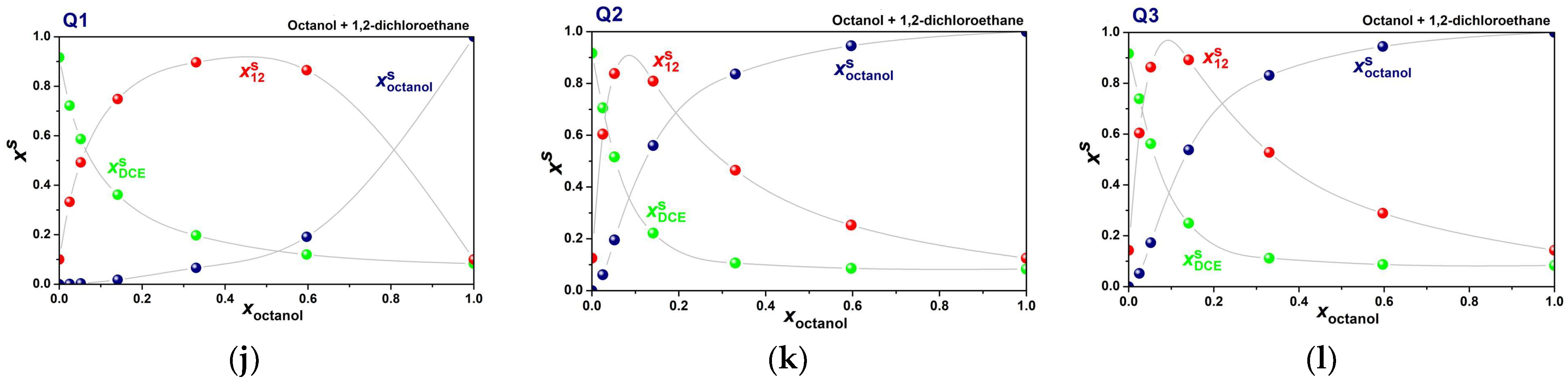
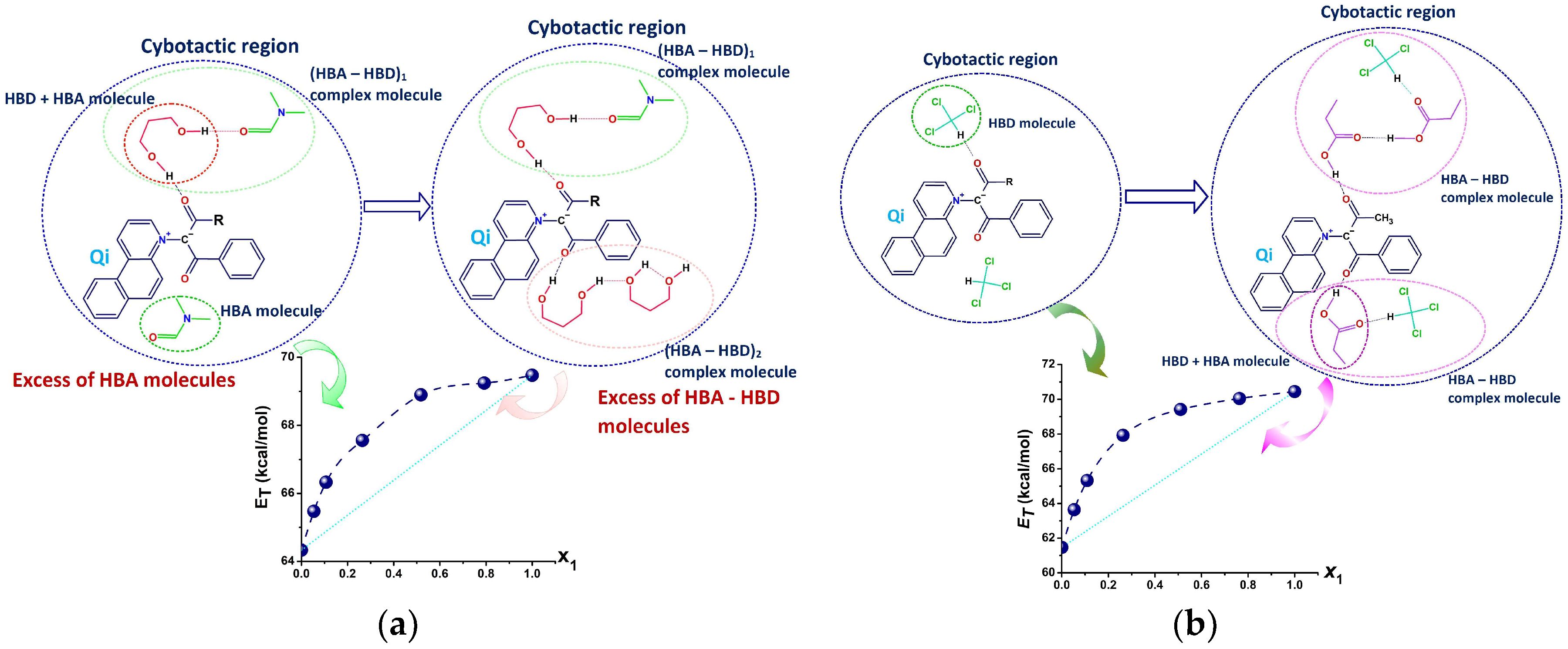
- The values of f2/1 are lower than for unity, except for the methanol + benzene mixture, meaning that Q1–Q3 are more solvated by the polar solvent S1; f2/1 is very small for 1-octanol + 1,2-dichloroethane, which shows the occupancy of the cybotactic region by the alkanol molecules.
- (ii)
- The values of f12/1 are higher than those of f2/1 for any mixture under study, which suggests that the solute molecules are preferentially solvated by the solvent intercomplex S12 in reference to the polar solvent S1; this effect is important for propane-1,3-diol + N,N-dimethylformamide mixtures and is irrelevant for the propionic acid + chloroform solution, confirming that propionic acid is the preferred solvent.
- (iii)
- The f12/2 parameter, measuring the tendency of Q1–Q3 to be solvated by the S12 complex rather than the aprotic solvent S2, is higher than unity, showing that S12 is preferred over the non-polar solvent.
- (iv)
- Within this context, the cybotactic region of Q1 was mainly composed of methanol–benzene, propane-1,3-diol–N,N-dimethylformamide mixtures, or 1-octanol–1,2-dichloroethane complexes; Q2 and Q3 show a lower preference for solvent complexes.
- (v)
- The values of f2/1 are only higher than 1 in the methanol + benzene mixture, which could be interpreted as a preference for benzene over methanol; however, for f12/1 > f2/1, the functional groups of Q1–Q3 can be selectively solvated by one of the two solvents; therefore, the solvation microsphere is not uniformly filled with solvent molecules, but they are selectively arranged around the HBA groups of the solute.
- (vi)
- For the combinations with alcohols, f2/1 decreases as the chain and the hydrophobicity of the alcohol increases; the lowest values are for 1-octanol + 1,2-dichloroethane, due to the very poor coordinating ability and high polarizability of 1,2-dichloroethane.
- (vii)
- The ET12 values are an intermediary between ET1 and ET2 for any mixture; for propanoic acid + chloroform, ET12 ≈ (ET1 + ET2)/2; and for the other three compositions, ET12 is closer to either ET1 or ET2, meaning that the intersolvent complex S12 is weak.
2.4. Solvation of Q1–Q3 Analyzed by Means of the Ternary Statistical Cell Model
2.5. Quantum Chemical Calculations
3. Materials and Methods
4. Conclusions
Supplementary Materials
Author Contributions
Funding
Institutional Review Board Statement
Informed Consent Statement
Data Availability Statement
Conflicts of Interest
References
- Reichardt, C. Solvents and Solvent Effects: An Introduction. Org. Process Res. Dev. 2007, 11, 105–113. [Google Scholar] [CrossRef]
- Machado, V.G.; Stock, R.I.; Reichardt, C. Pyridinium N-Phenolate Betaine Dyes. Chem. Rev. 2014, 114, 10429–10475. [Google Scholar] [CrossRef] [PubMed]
- Catalan, J.; de Paz, J.L.G.; Reichard, C. On the Molecular Structure and UV/vis Spectroscopic Properties of the Solvatochromic and Thermochromic Pyridinium-N-Phenolate Betaine Dye B30. J. Phys. Chem. A 2010, 114, 6226–6234. [Google Scholar] [CrossRef] [PubMed]
- Zacharlasse, K.A.; Phuc, N.V.; Koranklewicrz, B. Investigation of Micelles, Microemulsions, and Phospholipid Bilayers with the Pyrldinium N-Phenolbetaine ET(30), a Polarity Probe for Aqueous Interfaces. J. Phys. Chem. 1981, 85, 2676–2683. [Google Scholar] [CrossRef]
- Reichardt, C. Solvatochromic Dyes as Solvent Polarity Indicators. Chem. Rev. 1994, 94, 2319–2358. [Google Scholar] [CrossRef]
- Berthelot, M.; Jacques, P.; Achour, N.; Le Nouën, D.; Joyeux, C.; Chaumei, H. Synthesis and high negative solvatochromism of two new twisted pyridinium phenolate betaine dyes. J. Mol. Liq. 2022, 352, 118668. [Google Scholar] [CrossRef]
- Avadanei, M.I.; Avadanei, O.G.; Dorohoi, D.O. Solvatochromic and Computational Study of Three Benzo-[f]-Quinolinium Methylids with Photoinduced Charge Transfer. Molecules 2025, 30, 3162. [Google Scholar] [CrossRef]
- Platts, J.A.; Howard, S.T. C-H ••• C Hydrogen bonding involving ylides. J. Chem. Soc. Perkin Trans. 2 1997, 2241–2248. [Google Scholar] [CrossRef]
- Rozas, I.; Alkorta, I.; Elguero, J. Behavior of Ylides Containing N, O, and C Atoms as Hydrogen Bond Acceptors. J. Am. Chem. Soc. 2000, 122, 11154–11161. [Google Scholar] [CrossRef]
- Chatterjee, P.; Bagchi, S. Preferential Solvation in Mixed Binary Solvents by Ultraviolet-Visible Spectroscopy: N-Ethyl-4-cyanopyridinium Iodide in Alcohol-Acetone Mixtures. J. Chem. Soc. Faraday Trans. 1991, 87, 587–589. [Google Scholar] [CrossRef]
- Chatterjee, P.; Bagchi, S. Preferential Solvation of a Dipolar Solute in Mixed Binary Solvent. A Study by UV-Visible Spectroscopy. J. Phys. Chem. 1991, 95, 3311–3314. [Google Scholar] [CrossRef]
- Roses, M.; Rafols, C.; Ortega, J.; Bosch, E. Solute–solvent and solvent–solvent interactions in binary solvent mixtures. Part 1. A comparison of several preferential solvation models for describing ET(30) polarity of dipolar hydrogen bond acceptor-cosolvent mixtures. J. Chem. Soc. Perkin Trans. 2 1995, 1607–1615. [Google Scholar] [CrossRef]
- Rosés, M.; Buhvestov, U.; Ràfols, C.; Rived, F.; Bosch, E. Solute–solvent and solvent–solvent interactions in binary solvent mixtures. Part 6.† A quantitative measurement of the enhancement of the water structure in 2-methyl1,2-propanediol–water and 1,2-propanediol–water mixtures by solvatochromic indicators. J. Chem. Soc. Perkin Trans. 2 1997, 1341–1348. [Google Scholar] [CrossRef]
- Dorohoi, D.O.; Pop, V. Spectral shifts of the electronic absorption spectra of some cycloimmonium ylids in ternary solutions. An. Univ. Al. I. Cuza Iasi Sectia Ib Fizica 1987, 33, 78–85. [Google Scholar]
- Closca, V.; Puica-Melniciuc, N.; Closca, M.; Avadanei, M.I.; Dorohoi, D.O. Spectral study of (4′ phenyl)-1,2, triazol-1-ium-phenacylid (PTPhY) in ternary solutions. Ukr. J. Phys. 2018, 63, 592–599. [Google Scholar] [CrossRef]
- Dorohoi, D.O.; Avadanei, M.I.; Postolache, M. Characterization of the solvation spheres of some dipolar spectrally molecules in binary solvents. Optoelectron. Adv. Mater. Rapid Commun. 2008, 2, 511–515. [Google Scholar]
- Avădănei, M.I.; Gritco-Todirascu, A.; Dorohoi, D.O. Negative Solvatochromism of the Intramolecular Charge Transfer Band in Two Structurally Related Pyridazinium—Ylids. Symmetry 2024, 16, 1531. [Google Scholar] [CrossRef]
- Kamlet, M.J.; Abboud, J.I.; Taft, R.W. The solvatochromic comparison method 6. The π* scale of solvent polarities. J. Am. Chem. Soc. 1977, 99, 6027–6038. [Google Scholar] [CrossRef]
- Kamlet, M.J.; Abboud, J.L.M.; Abraham, M.H.; Taft, R.W. Linear solvation energy relationships. 23. A comprehensive collection of the solvatochromic parameters π*, α, and β, and some methods for simplifying the generalized solvatochromic equation. J. Org. Chem. 1983, 48, 2877–2887. [Google Scholar] [CrossRef]
- Dawber, J.G.; Ward, J.; Williams, R.A. A Study in Preferential Solvation using a Solvatochromic Pyridinium Betaine and its Relationship with Reaction Rates in Mixed Solvents. J. Chem. Soc. Faraday Trans. I 1988, 84, 713–727. [Google Scholar] [CrossRef]
- Adachi, Y.; Nakanishi, K. Monte Carlo study of the self-association of methanol in benzene. Mol. Simul. 1991, 6, 299–310. [Google Scholar] [CrossRef]
- Pribble, R.N.; Hagemeister, F.C.; Zwier, T.S. Resonant ion-dip infrared spectroscopy of benzene–(methanol)m clusters with m = 1 − 6. J. Chem. Phys. 1997, 106, 2145–2157. [Google Scholar] [CrossRef]
- Matisz, G.; Kelterer, A.-M.; Fabian, W.M.F.; Kunsagi-Mate, S. Coordination of Methanol Clusters to Benzene: A Computational Study. J. Phys. Chem. A 2011, 115, 10556–10564. [Google Scholar] [CrossRef] [PubMed]
- Suppan, P. Local Polarity of Solvent Mixtures in the Field of Electronically Excited Molecules and Exciplexes. J. Chem. Soc. Faraday Trans. 1 1987, 83, 495–509. [Google Scholar] [CrossRef]
- Lerf, C.; Suppan, P. Hydrogen Bonding and Dielectric Effects in Solvatochromic Shifts. J. Chem. Soc. Faraday Trans. 1992, 88, 963–969. [Google Scholar] [CrossRef]
- Borrmann, H.; Persson, I.; Sandström, M.; Stålhandske, C.M.V. The crystal and liquid structures of N,N-dimethylthioformamide and N,N-dimethylformamide showing a stronger hydrogen bonding effect for C–H… S than for C–H… O. J. Chem. Soc. Perkin Trans. 2 2000, 2, 393–402. [Google Scholar] [CrossRef]
- Melniciuc-Puica, N.; Avadanei, M.I.; Caprosu, M.; Dorohoi, D.O. Interaction energy in pairs of phthalazinium dibenzoyl methylid (PDBM)—Protic solvent molecules estimated in the limits of cell ternary solutions model, by spectral means. Spectrochim. Acta A 2012, 96, 271–277. [Google Scholar] [CrossRef]
- Babusca, D.; Morosanu, A.C.; Dorohoi, D.O. Spectral study of specific interactions between zwitterionic compounds and protic solvents. Spectrochim. Acta A 2017, 172, 58–64. [Google Scholar] [CrossRef]
- Yu, J.; Su, N.Q.; Yang, W. Describing Chemical Reactivity with Frontier Molecular Orbitalets. JACS Au 2022, 2, 1383–1394. [Google Scholar] [CrossRef]
- Zhan, C.-G.; Nichols, J.A.; Dixon, D.A. Ionization Potential, Electron Affinity, Electronegativity, Hardness, and Electron Excitation Energy: Molecular Properties from Density Functional Theory Orbital Energies. J. Phys. Chem. A 2003, 107, 4184–4195. [Google Scholar] [CrossRef]
- Pearson, R.G. The electronic chemical potential and chemical hardness. J. Mol. Struct. Theochem 1992, 255, 261–270. [Google Scholar] [CrossRef]
- Yoosefian, M.; Mola, A. Solvent effects on binding energy, stability order and hydrogen bonding of guanine–cytosine base pair. J. Mol. Liq. 2015, 209, 526–530. [Google Scholar] [CrossRef]
- Frisch, M.J.; Trucks, G.W.; Schlegel, H.B.; Scuseria, G.E.; Robb, M.A.; Cheeseman, J.R.; Scalmani, G.; Barone, V.; Mennucci, B.; Petersson, G.A.; et al. Gaussian 09, Revision, A.02; Gaussian, Inc.: Wallingford, CT, USA, 2009. [Google Scholar]
- Lee, C.; Yang, W.; Parr, R.G. Development of the Colic-Salvetti correlation-energy formula into a functional of the electron density. Phys. Rev. B 1988, 37, 785. [Google Scholar] [CrossRef]
- Pant, D.; Sitha, S. Roles of bridges on electronic, linear and nonlinear optical properties: A computational study on zwitterions with N-methyl pyridinium and p-dicyanomethanide phenylene. Comput. Theor. Chem. 2023, 1229, 114308. [Google Scholar] [CrossRef]
- Tomasi, J.; Cammi, R.; Mennucci, B.; Cappelli, C.; Corni, S. Molecular properties in solution described with a continuum solvation model. Phys. Chem. Chem. Phys. 2002, 4, 5697–5712. [Google Scholar] [CrossRef]
- Cances, E.; Mennucci, B.; Tomasi, J. A new integral equation formalism for the polarizable continuum model: Theoretical background and applications to isotropic and anisotropic dielectrics. J. Chem. Phys. 1997, 107, 3032–3041. [Google Scholar] [CrossRef]
- Bauernschmitt, R.; Ahlrichs, R. Treatment of electronic excitations within the adiabatic approximation of time dependent density functional theory. Chem. Phys. Lett. 1996, 256, 454–464. [Google Scholar] [CrossRef]
- Stratmann, R.E.; Scuseria, G.E.; Frisch, M.J. An efficient implementation of time-dependent density-functional theory for the calculation of excitation energies of large molecules. J. Chem. Phys. 1998, 109, 8218–8224. [Google Scholar] [CrossRef]





| Solvent | ε | n | α | β | π* | λ(Q1), cm−1 | λ(Q2), cm−1 | λ(Q3), cm−1 |
|---|---|---|---|---|---|---|---|---|
| Poor hydrogen bond acceptors and poor hydrogen bond donors | ||||||||
| Benzene | 2.27 | 1.5011 | 0 | 0.1 | 0.59 | 22,000 | 20,600 | 20,500 |
| 1,2-dichloroethane | 10.3 | 1.3729 | 0 | 0.1 | 0.81 | 21,800 | 21,500 | 21,160 |
| Poor hydrogen bond donor | ||||||||
| Chloroform | 4.81 | 1.4459 | 0.2 | 0.1 | 0.69 | 21,500 | 21,000 | 21,500 |
| Strong hydrogen bond acceptor and poor hydrogen bond donor | ||||||||
| N,N-dimethylformamide | 36.71 | 1.4305 | 0 | 0.69 | 0.88 | 22,500 | 22,170 | 22,000 |
| Strong hydrogen bond donors and strong hydrogen bond acceptors | ||||||||
| Propanoic acid | 3.1 | 1.386 | 1.12 | 0.45 | -- | 24,300 | 24,170 | 24,640 |
| Methanol | 32.62 | 1.3314 | 0.98 | 0.66 | 0.6 | 24,000 | 24,200 | 24,640 |
| 1-octanol | 10.3 | 1.429 | 0.77 | 0.81 | 0.4 | 22,800 | 23,460 | 23,000 |
| Propane-1,3-diol | 35 | 1.4398 | 0.76 | 0.84 | 0.48 | 24,300 | 24,170 | 24,640 |
| Compound | ET1 (kcal/mol) | ET2 (kcal/mol) | ET12 (kcal/mol) | f2/1 | f12/1 | f12/2 | RSS a | SD b |
|---|---|---|---|---|---|---|---|---|
| Methanol + benzene | ||||||||
| Q1 | 68.6 | 63.0 | 68.5 | 5.2 | 9.5 | 1.8 | 0.99 | 0.10 |
| Q2 | 69.2 | 58. 9 | 68.5 | 1.2 | 2.4 | 1.9 | 0.99 | 0.06 |
| Q3 | 58.6 | 70.4 | 70.5 | 0.6 | 3.9 | 6.1 | 0.99 | 0.13 |
| Propane-1,3-diol + N,N-dimethylformamide | ||||||||
| Q1 | 69.5 | 64.3 | 69.3 | 0.5 | 2.4 | 5.1 | 0.99 | 0.10 |
| Q2 | 69.1 | 63.3 | 67.1 | 0.1 | 0.2 | 3.7 | 0.99 | 0.03 |
| Q3 | 70.4 | 63.8 | 69.3 | 1.2 | 8.9 | 7.4 | 0.98 | 0.35 |
| Propionic acid + chloroform | ||||||||
| Q1 | 69.5 | 61.4 | 65.5 | 0.05 | 0.13 | 2.60 | 0.99 | 0.05 |
| Q2 | 68.8 | 60.0 | 64.3 | 0.15 | 0.16 | 1.06 | 0.96 | 0.74 |
| Q3 | 70.4 | 61.4 | 63.3 | 0.02 | 0.21 | 10.5 | 0.99 | 0.03 |
| 1-octanol + 1,2-dichloroethane | ||||||||
| Q1 | 65.2 | 62.3 | 65.1 | 0.50 | 5.92 | 11.84 | 1 | 0.008 |
| Q2 | 67.1 | 61.4 | 58.2 | 0.008 | 0.08 | 10 | 0.99 | 0.27 |
| Q3 | 65.8 | 60.5 | 61.5 | 0.01 | 0.08 | 8 | 1 | 0.02 |
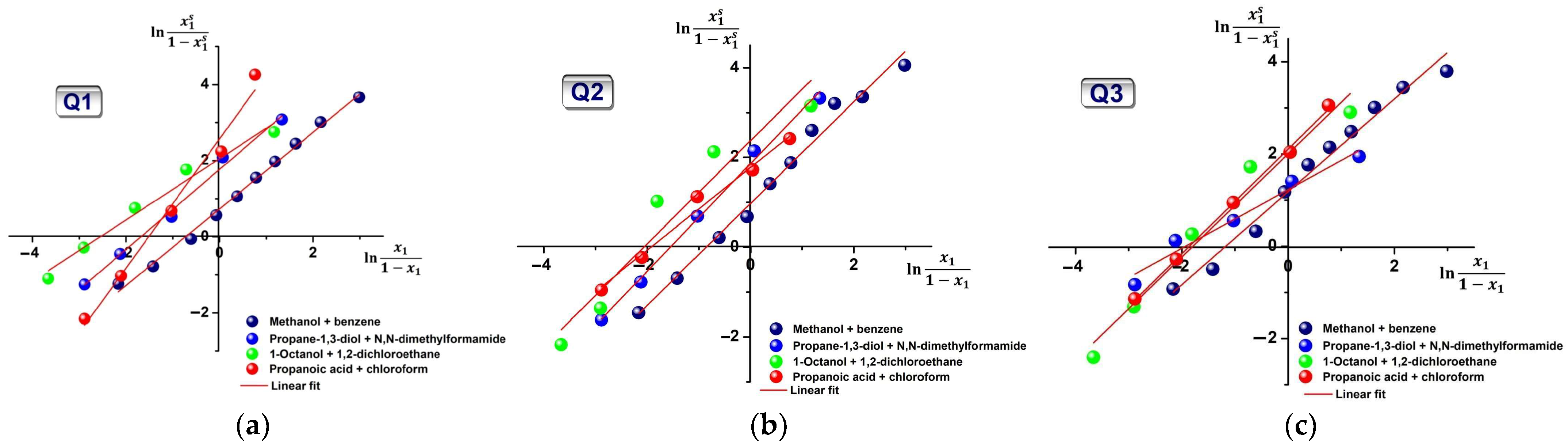
| Intercept | ω2 − ω1, × 1021 J | |
|---|---|---|
| MeOH_Benzene | ||
| Q1 | 0.73 | 3.00 |
| Q2 | 0.97 | 3.99 |
| Q3 | 1.18 | 4.85 |
| Propane-1,3-diol + DMF | ||
| Q1 | 1.76 | 7.26 |
| Q2 | 1.86 | 7.64 |
| Q3 | 1.22 | 5.04 |
| Propionic acid + chloroform | ||
| Q1 | 2.56 | 10.55 |
| Q2 | 1.77 | 7.29 |
| Q3 | 2.10 | 8.65 |
| 1-octanol + 1,2 dichloroethane | ||
| Q1 | 2.05 | 8.42 |
| Q2 | 2.37 | 9.74 |
| Q3 | 2.00 | 8.23 |
| Medium | Mulliken Charge (e) | IP | EA | χ | μ | η | ω | |
|---|---|---|---|---|---|---|---|---|
| N+ | C− | |||||||
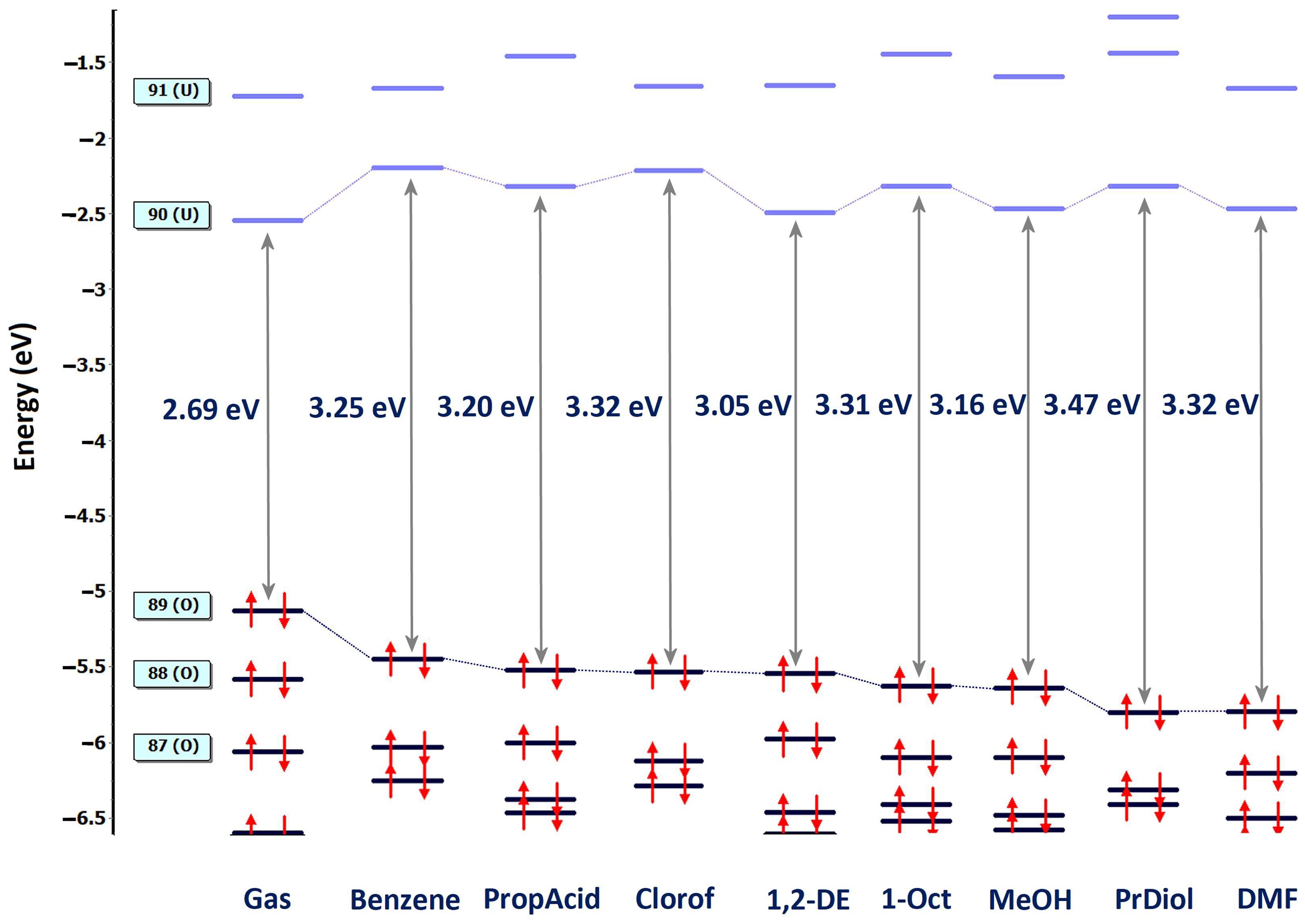
| Gas phase | 0.909 | −0.752 | 5.54 | 2.84 | 5.54 | −5.54 | 2.84 | 3.25 |
| Benzene | 0.9 | −0.782 | 5.45 | 2.19 | 5.45 | −5.45 | 2.19 | 2.24 |
| Propanoic acid | 0.885 | −0.777 | 5.53 | 2.34 | 5.53 | −5.53 | 2.33 | 2.42 |
| Chloroform | 0.835 | −0.770 | 5.54 | 2.21 | 5.54 | −5.54 | 2.21 | 2.25 |
| 1,2-dichloroethane | 0.839 | −0.775 | 5.55 | 2.50 | 5.55 | −5.55 | 2.50 | 2.66 |
| 1-octanol | 0.908 | −0.749 | 5.62 | 2.32 | 5.62 | −5.62 | 2.32 | 2.38 |
| Methanol | 0.831 | -0.767 | 5.64 | 2.47 | 5.64 | −5.64 | 2.47 | 2.59 |
| Propane-1,3-diol | 0.894 | −0.785 | 5.80 | 2.32 | 5.80 | −5.80 | 2.32 | 2.38 |
| N,N-dimethylformamide | 0.824 | −0.777 | 5.80 | 2.47 | 5.80 | −5.80 | 2.47 | 2.57 |
Disclaimer/Publisher’s Note: The statements, opinions and data contained in all publications are solely those of the individual author(s) and contributor(s) and not of MDPI and/or the editor(s). MDPI and/or the editor(s) disclaim responsibility for any injury to people or property resulting from any ideas, methods, instructions or products referred to in the content. |
© 2026 by the authors. Licensee MDPI, Basel, Switzerland. This article is an open access article distributed under the terms and conditions of the Creative Commons Attribution (CC BY) license.
Share and Cite
Avadanei, M.I.; Avadanei, O.G.; Dorohoi, D.O. Preferential Solvation of Zwitterionic Benzo-[f]-Quinolinium Ylids in Binary Solvent Mixtures: Spectral Study and Quantum Chemical Calculations. Molecules 2026, 31, 290. https://doi.org/10.3390/molecules31020290
Avadanei MI, Avadanei OG, Dorohoi DO. Preferential Solvation of Zwitterionic Benzo-[f]-Quinolinium Ylids in Binary Solvent Mixtures: Spectral Study and Quantum Chemical Calculations. Molecules. 2026; 31(2):290. https://doi.org/10.3390/molecules31020290
Chicago/Turabian StyleAvadanei, Mihaela Iuliana, Ovidiu Gabriel Avadanei, and Dana Ortansa Dorohoi. 2026. "Preferential Solvation of Zwitterionic Benzo-[f]-Quinolinium Ylids in Binary Solvent Mixtures: Spectral Study and Quantum Chemical Calculations" Molecules 31, no. 2: 290. https://doi.org/10.3390/molecules31020290
APA StyleAvadanei, M. I., Avadanei, O. G., & Dorohoi, D. O. (2026). Preferential Solvation of Zwitterionic Benzo-[f]-Quinolinium Ylids in Binary Solvent Mixtures: Spectral Study and Quantum Chemical Calculations. Molecules, 31(2), 290. https://doi.org/10.3390/molecules31020290