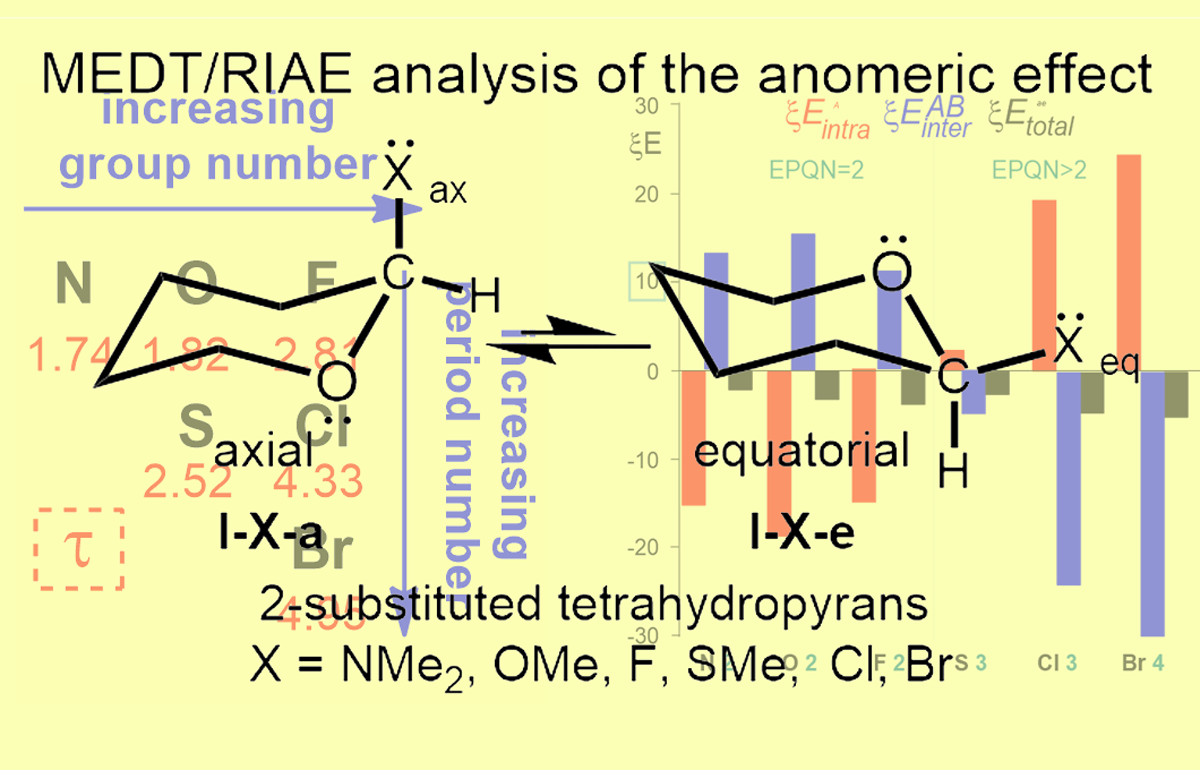
2.1. Energy Analysis of the Axial and Equatorial Conformations of Cyclic 2-Substituted THPs I–X
A reliable interpretation of the
anomeric effect requires first establishing the relative conformational energies, as any electronic behavior must ultimately account for the axial/equatorial stability differences. Therefore, the present study begins by establishing the energetic landscapes of both the cyclic THP and acyclic MM models, which provide the baseline that all geometric, charge, Electron Localization Function (ELF), and RIAE analyses should explain. Due to the great similarities between the axial/equatorial and 60-/180-DA stability gaps and geometrical parameters of both cyclic THP and acyclic MM models, the complete analysis of the acyclic MMs
II–
X is presented in
Sections S2–S4 of the Supplementary Materials.
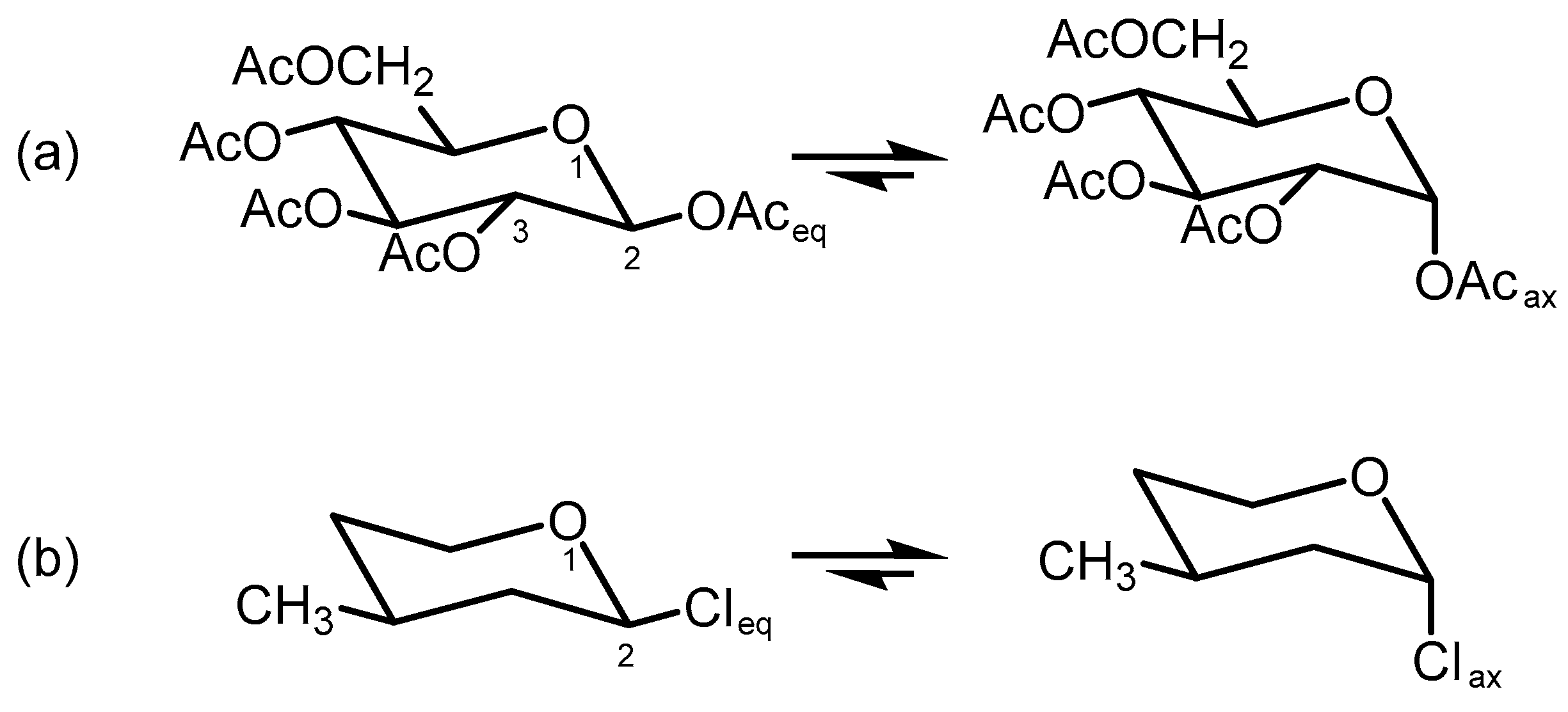
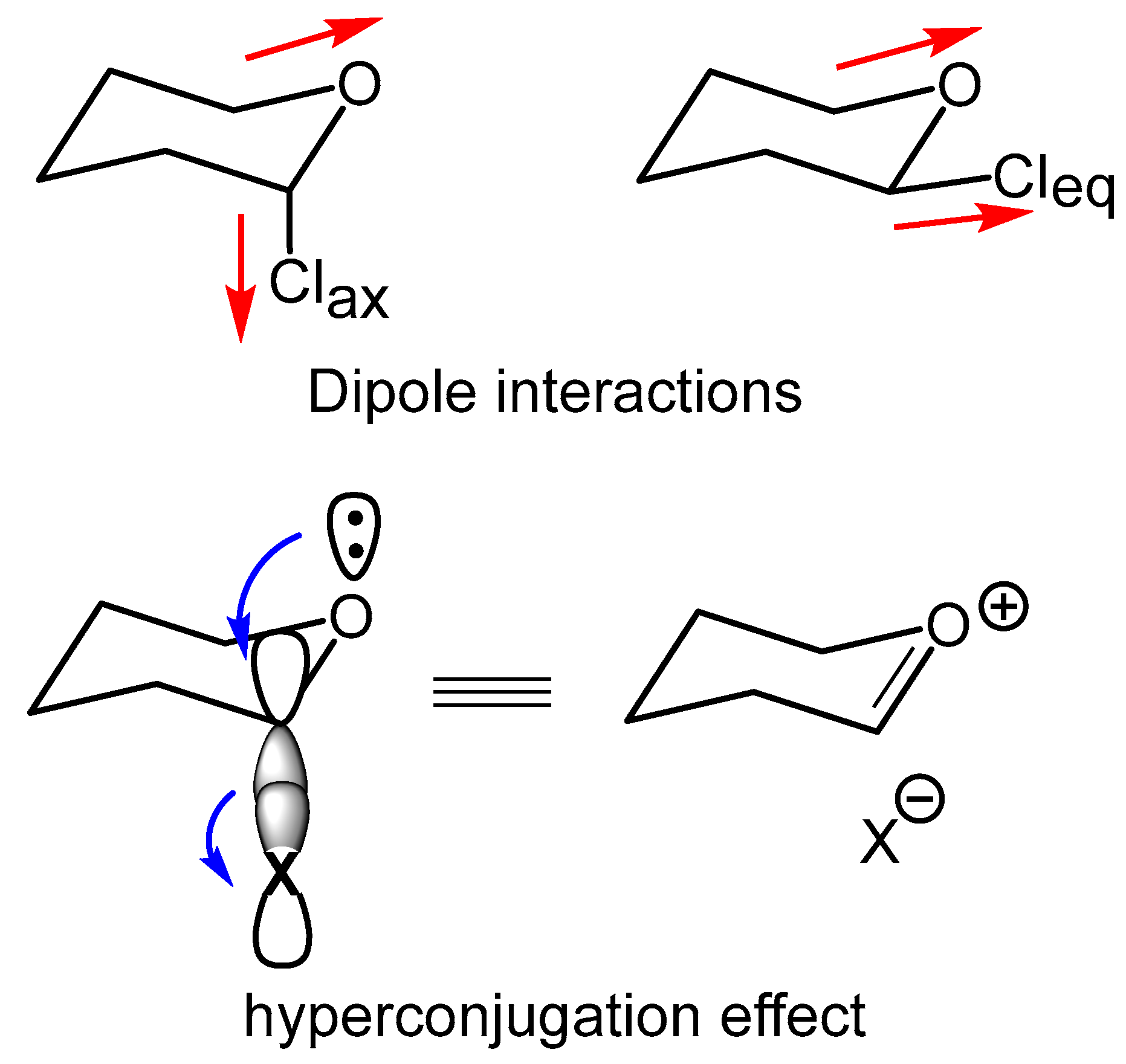
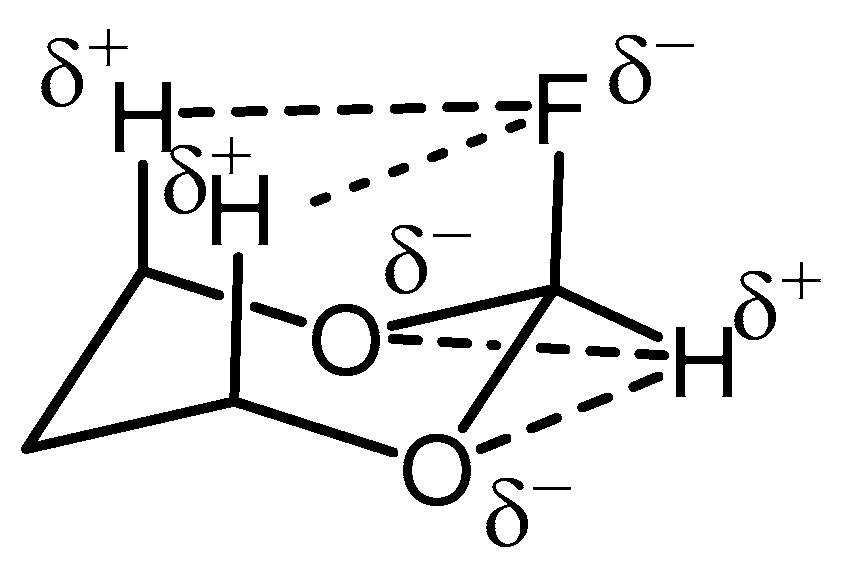
Importantly, the axial preference observed in 2-substituted Pyrs and THPs (
Scheme 1) does not arise exclusively from the
anomeric effect associated with the O–C–X motif, but also from additional interatomic electronic interactions involving the atoms belonging to the substituent and the atoms belonging to the cyclic framework. These interatomic electronic interactions can significantly influence the overall conformational stability. For this reason, the 2-substituted THPs
I–
X considered in this study were selected to minimize such additional interactions, providing a simplified framework in which the contribution of the O–C–X motif to the
anomeric effect can be more clearly evaluated.
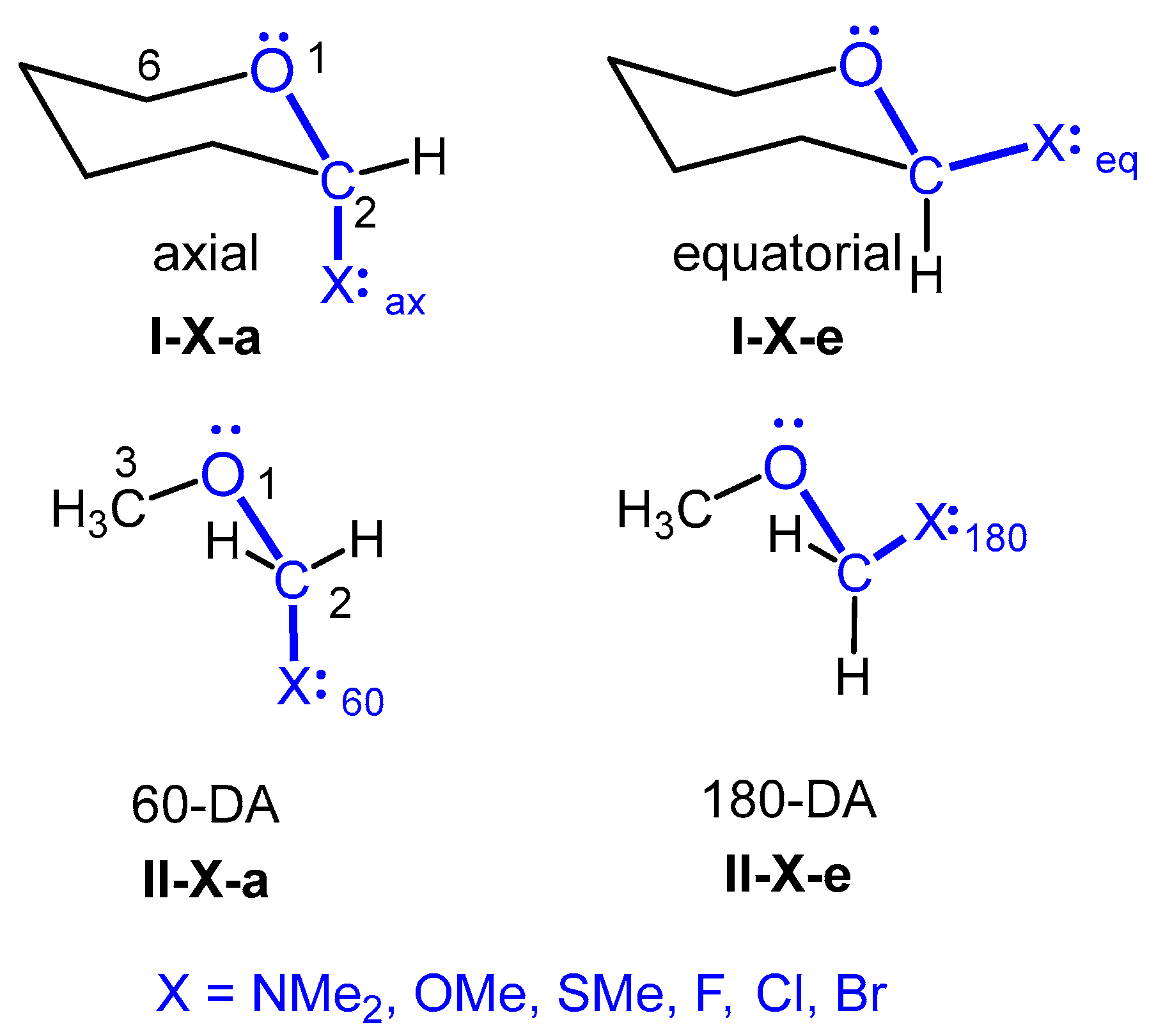
The axial and equatorial conformations of the six 2-substituted THPs
I–
X were optimized at the M06-2X/6-311G(d,p) level in the gas phase. The corresponding axial/equatorial relative energies, Δ
, are summarized in
Table 1, and the total energies of both conformations are provided in
Table S7 of the Supplementary Materials. For comparison, the 60- and 180-DA relative energies of the acyclic substituted MMs
II–
X (see Δ
in
Section S2 in the Supplementary Materials) are also included in
Table 1.
For the THP series, the axial conformers are consistently more stable than the equatorial ones, with stabilization energies ranging from 2.28 (
I–
S) to 4.94 (
I–
Br) kcal·mol
−1. For the halogen series (X = F, Cl, and Br), the axial stabilization increases in the order of 3.23 (F) < 4.26 (Cl) < 4.94 (Br) kcal·mol
−1. This trend parallels the progression of X element from the second to the fourth period. This trend is reproduced identically in cyclic
I–
X and acyclic MMs
II–
X (see
Section S2 of the Supplementary Materials), indicating that the electronic effects underlying the
anomeric effect are associated with the O–C–X motif rather than with cyclic constraints.
The axial preferences obtained at the M06-2X/6-311G(d,p) level were compared with those from B3LYP/6-311G(d,p) and M06-2X/6-311++G(d,p) levels to assess the sensitivity of the calculated conformational energies to the chosen computational levels. The corresponding comparative energy analysis is included in
Section S5 of the Supplementary Material.
Importantly, the axial preference observed in 2-substituted Pyrs and THPs (
Scheme 1) does not arise exclusively from the
anomeric effect associated with the O–C–X motif, but also from additional electronic interactions involving the atoms in the substituent and those in the cyclic framework. To minimize these secondary contributions, the present THP
I–
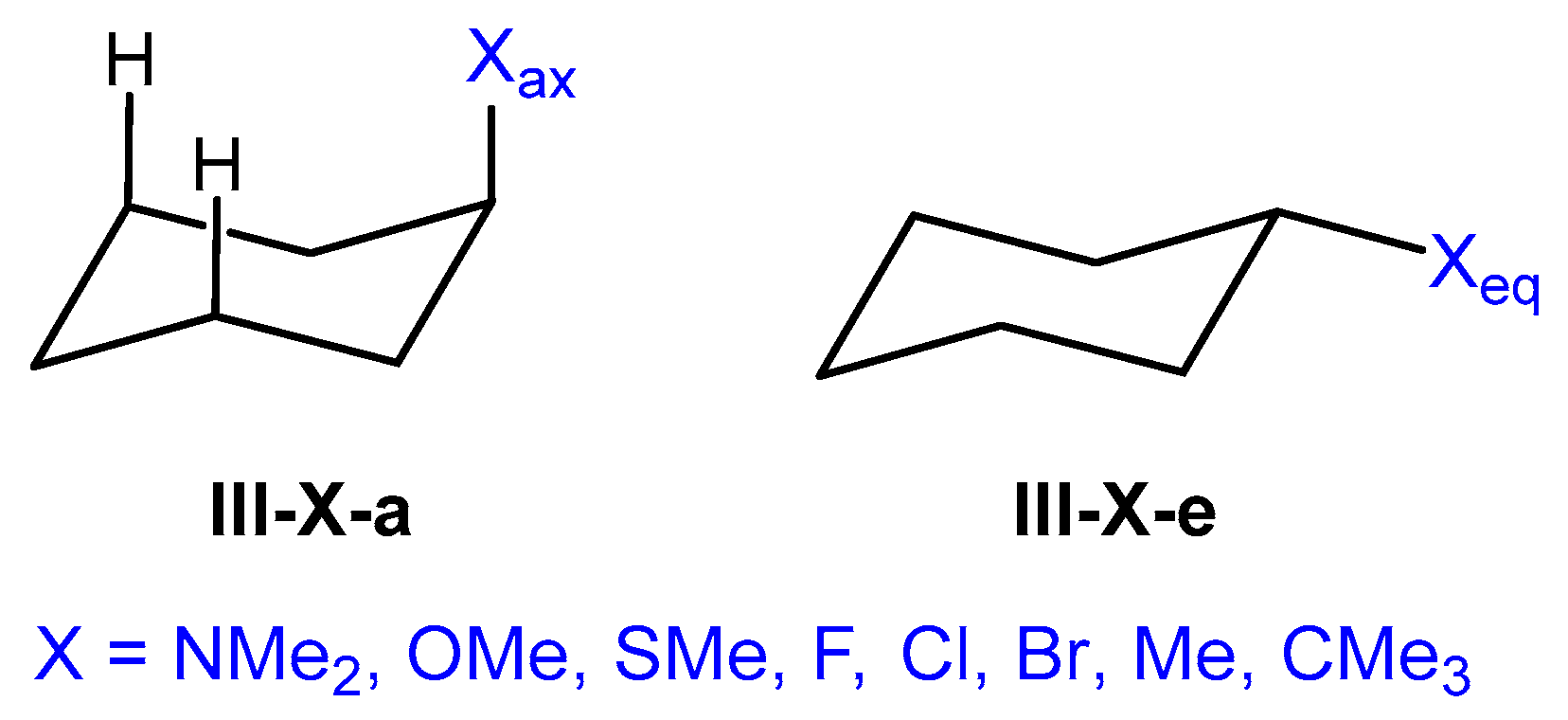
X series was selected as a simplified model system of 2-substituted Pyrs. Nevertheless, residual electronic effects unrelated to the O–C–X motif may still contribute to the conformational preferences. To assess these contributions, the axial and equatorial conformations of eight substituted cyclohexanes, Chs,
III–
X, which lack the O–C–X motif (see
Scheme 3), were also optimized. The corresponding relative energies Δ
are included in
Table 1, and total energies are reported in
Table S8 of the Supplementary Materials. The hydrocarbons, methylcyclohexane
III–
Me and tert-butylcyclohexane
III–
tBu, were also studied. Negative values of ΔE
e−a in
Table 1 indicate that the equatorial conformation is the most stable.
As expected, steric effects dominate in alkyl-substituted Chs: the axial conformations of methylcyclohexane
III–
Me–
a and tert-butylcyclohexane
III–
tBu are 1.50 and 4.55 kcal·mol
−1, respectively, higher in energy than the equatorial conformations. The conformational Gibbs free energies for Chs
III–
Me and
III–
tBu have been estimated at 1.8 and 4.7 kcal·mol
−1, respectively [
1], closer to the M06-2X/6-311G(d,p) gas-phase relative energies of the substituted alkyl. Steric 1,3-diaxial interactions between the axial methyl and tert-butyl groups and the two axial hydrogens have been proposed to account for these relative energies in hydrocarbon systems (see
III–
X–
a in
Scheme 3) [
1]. These unfavorable interactions are also present in the axial 2-methyl THP
I–
Me–
a, which is 2.42 kcal·mol
−1 higher in energy than the equatorial
I–
Me–
e (see
Table 1).
In contrast, the substituted Chs
III–
X exhibit X-atom-dependent electronic effects. For this series, the axial conformation of the N, O, and F heteroatoms
III–
X–
a is between 0.42 and 2.56 kcal·mol
−1 more stable than the equatorial conformation
III–
X–
e. For the S atom,
III–
S, the axial conformation is 0.24 kcal·mol
−1 less stable than the equatorial one, while for Cl and Br atoms,
III–
Cl and
III–
Br, both conformations have similar energies (see
Table 1). These results suggest that the X atom-dependent electronic interactions within the cyclohexane framework, which are also present in the 2-substituted THPs
I–
X, vary significantly with the nature of the X element. Notably, Chs
III–
O and
III–
S exhibit opposite conformational preferences, with the former favoring the axial conformation and the latter the equatorial one.
Consequently, the axial/equatorial energy differences observed for THPs
I–
X (see Δ
in
Table 1) reflect not only the so-called
anomeric effect associated with the electronic interaction at the O–C–X motif, but also additional electronic interactions, mainly between atoms belonging to the group attached to the anomeric C2 carbon and those of the cyclic hydrocarbon chain, which are also present in substituted Chs
III–
X.
The axial/equatorial energy differences observed between the THP
I–
X series, Δ
, and those observed in the Ch
III–
X series, Δ
, allow for an estimation of the
anomeric effect caused by the X atom of the O–C–X motif present in the THP series. The corresponding energy difference permits the definition of the anomérico τ index as:
i.e., the difference between the equatorial/axial relative energies of the C2-substituted THPs and the corresponding substituted Chs. The sign convention adopted here is
; therefore, positive values indicate an axial preference. The anomeric
index is defined as an operational, reference-based energy descriptor of the excess axial stabilization of THP
I–
X relative to the corresponding substituted cyclohexane Ch
III–
X. This comparison assumes that substituent-dependent interactions with the hydrocarbon framework that are present in both systems are transferable to the first order and are therefore partially canceled by the subtraction. Because replacing the ring oxygen of THP with a methylene group can also modify molecular geometry and polarization, this cancelation need not be exact. Accordingly, the
index should be regarded as an estimate of the conformational stabilization associated with the O–C–X motif rather than as a rigorous energy decomposition or a directly observable quantity. The resulting M06-2X/6-311G(d,p) τ values for the six 2-substituted THPs
I–
X are reported in
Table 1. The positive τ values in
Table 1 reflect a stabilizing
anomeric effect caused by the X atom, which favors the axial conformation.
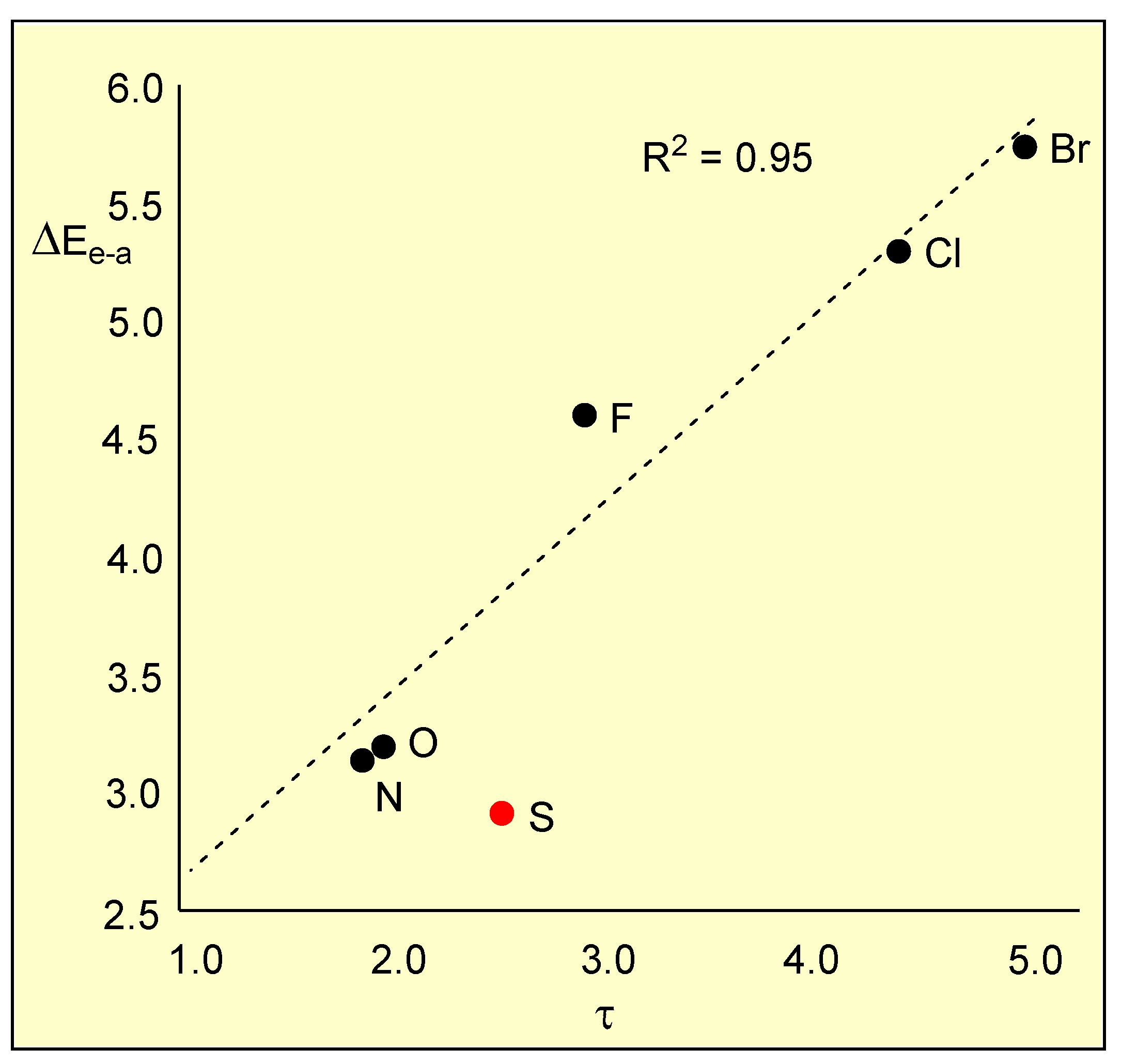
Figure 3 shows the relationship between the axial preference of the acyclic MMs
II–
X series, which minimizes interatomic electronic interactions not associated with the O–C–X motif present in THPs
I–
X, and the corresponding anomeric τ values obtained from Equation 1. MM
II–
S deviates markedly from the trend observed in the other systems (the red point in
Figure 3). Excluding MM
II–
S from an exploratory linear regression yields a strong correlation for the remaining five compounds (R
2 = 0.95, see
Figure 3). This result suggests that, with the notable exception of the sulfur derivative, the proposed τ index captures the variation in the conformational stabilization associated with the 60 DA arrangement of the O–C–X motif in the acyclic MM
II–
X series.
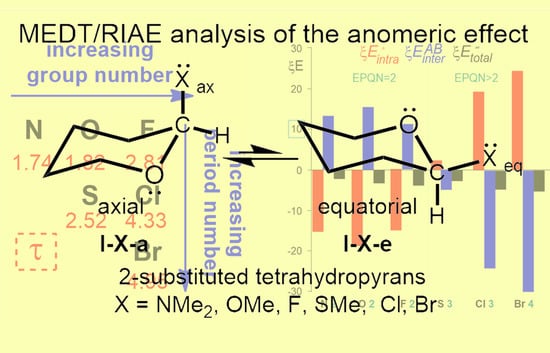
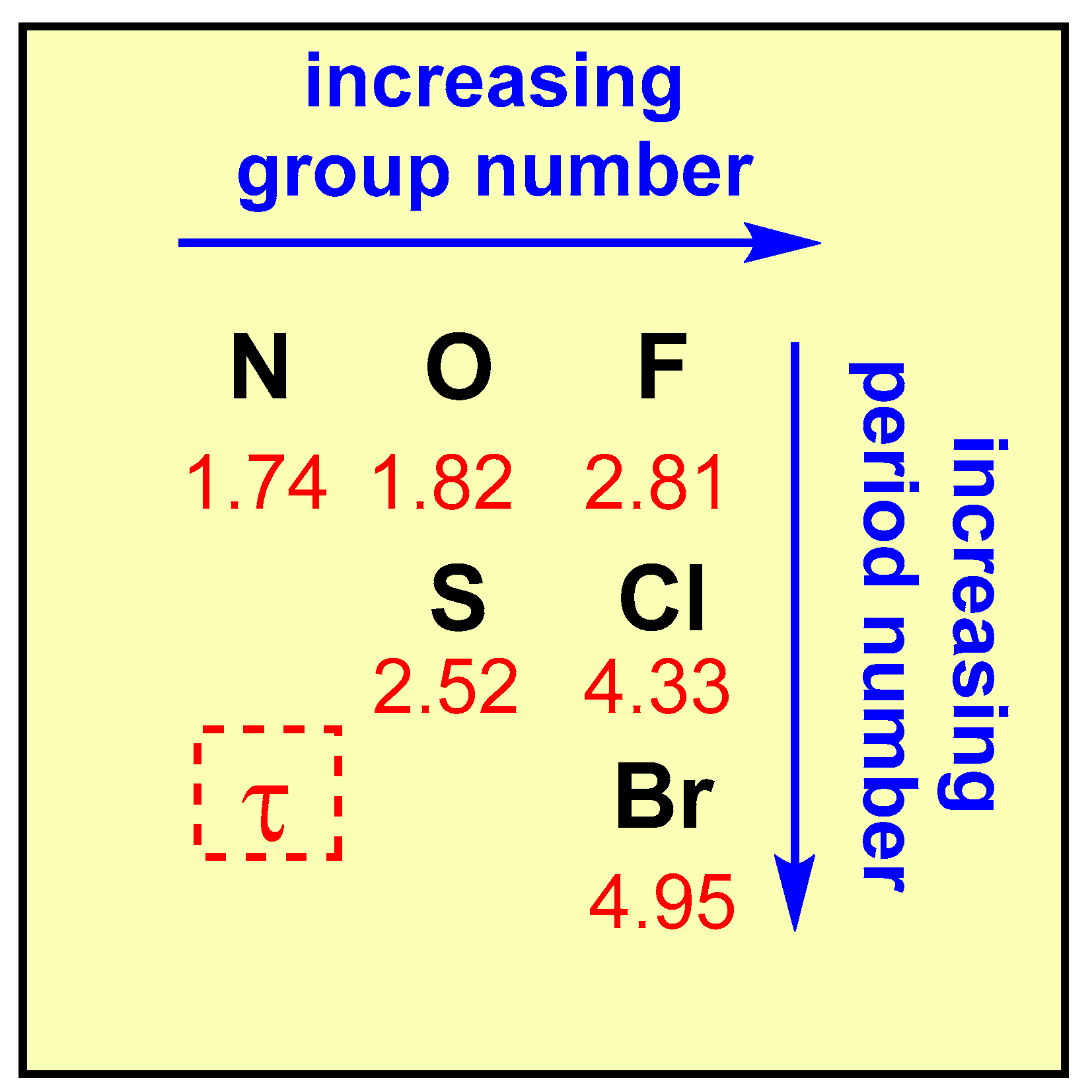
Figure 4 shows a schematic representation of the proposed anomeric τ indices computed at the M06-2X/6-311G(d,p) level for the 2-substituted THPs
I–
X arranged according to the group and period of the X atom in the periodic table. Analysis of the M06-2X/6-311G(d,p) τ values reveals three main trends: (i) the anomeric τ index increases in the order of 1.74 (N) < 1.82 (O) < 2.52 (S) < 2.81 (F) < 4.33 (Cl) < 4.95 (Br) kcal·mol
−1 (see
Figure 4), showing a systematic dependence on the nature of the X element; (ii) within the second-period series, τ increases in the order of 1.74 (N) < 1.82 (O) < 2.81 (F) kcal·mol
−1, paralleling the increase in Pauling electronegativity, χ = 3.04 (N) < 3.44 (O) < 3.98 (F); and (iii) within the halogen series τ increases in the order of 2.81 (F) < 4.33 (Cl) < 4.95 (Br) kcal·mol
−1, as X element progresses from the second to the fourth period, whereas electronegativity decreases in the opposite direction, χ = 3.98 (F) > 3.16 (Cl) > 2.96 (Br) [
1]. Note that this increase is also observed in the short series of the chalcogen group τ = 1.82 (O) < 2.52 (S). Thus, for the halogen derivatives, the increase in τ correlates with the X element period rather than with its electronegativity. The largest τ value, 4.95 kcal·mol
−1, is found for the bromine derivative
I–
Br–
a, whereas the smallest value, 1.74 kcal·mol
−1, is obtained for the nitrogen derivative
I–
N–
a.
Interestingly, the strong axial stabilization of the ether-substituted Ch
III–
O, Δ
= 2.56 kcal·mol
−1, accounts for the strong stabilization of THP
I–
O, Δ
= 4.38 kcal·mol
−1 (see
Table 1). Thus, except for THP
I–
O, where the intrinsic stabilization of the axial conformation exceeds the τ value of 1.82 kcal·mol
−1, the τ index makes a major contribution to axial stabilization in the remaining THPs, indicating that the anomeric contribution dominates other electronic interactions. For comparison, the corresponding 60-DA stabilization of MMs
II–
O is 3.19 kcal·mol
−1 (see
Table 1). Therefore, excluding the electronic interactions present in the cyclohexane framework of the Ch
III–
X series from those of the THP
I–
X series allows the anomeric τ index to be estimated. These values can be used as an approximate estimation of the
anomeric effect caused by the O–C–X motif present in 2-substituted Pyrs and THPs.
The calculated axial preferences show dependence on the computational method, leading to the calculation of corresponding
indices at the B3LYP/6-311G(d,p) level (see
Section S5 of the Supplementary Material). Although their numerical magnitude remains method-dependent, meaning that fine energetic differences should not be overinterpreted, both the B3LYP and M06-2X methods reproduce the general variation of
across the series and exhibit the same upward trend with increasing group and period numbers. An excellent linear correlation is found between the
values obtained with the M06-2X and B3LYP functionals, with R
2 = 1.00.
2.2. Solvent Effects and Thermodynamic Calculations for the Axial/Equatorial Stereoisomers of 2-Methoxy THP I–Oa
Solvent effects on the
anomeric effect were originally examined by Lemieux et al. [
28], who showed that the population of the axial conformer in 2-methoxy THP decreases as solvent polarity increases. To analyze this behavior, the axial/equatorial conformational equilibrium of 2-methoxy THP
I–
O was studied in a series of solvents with an increasing dielectric constant.
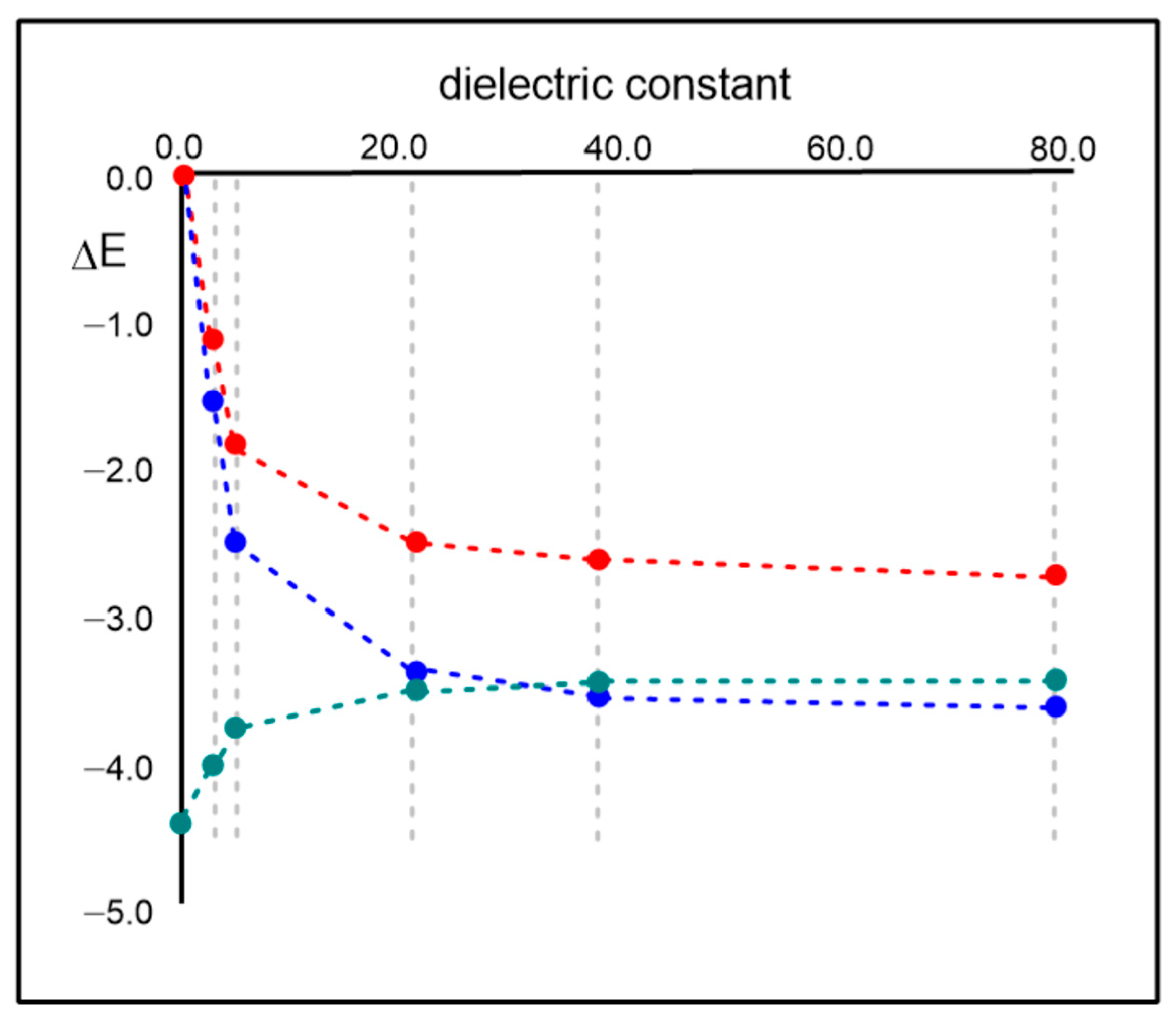
The M06-2X/6-311G(d,p) relative solvation energies of the axial (Δ
) and equatorial (Δ
) conformations of THP
I–
O, together with the corresponding axial-equatorial energy differences in the selected solvents Δ
are summarized in
Table 2 and represented in
Figure 5.
Three main observations arise from
Figure 5: (i) first, the equatorial conformer is increasingly stabilized relative to the axial one as the solvent dielectric constant increases. This behavior is consistent with the larger dipole moment of the equatorial stereoisomer, THP
I–
O–
e, relative to the axial one, THP
I–
O–
a, 2.13 and 0.35 Debye, respectively. (ii) Second, although both conformers are stabilized upon solvation, the magnitude of this stabilization becomes nearly constant for dielectric constants above ~20. (iii) Third, despite the preferential stabilization of the equatorial conformer, the axial–equatorial energy difference (Δ
) remains nearly unchanged at higher dielectric constants. This behavior suggests that the electronic interactions responsible for the
anomeric effect are only weakly modulated by solvation. These results indicate that, although polar solvents decrease the axial–equatorial energy difference through the greater solvation of the more polar and less stable equatorial conformation, the overall magnitude of the
anomeric effect remains only weakly affected by the solvent environment.
The axial/equatorial relationships of 2-substituted Pyrs or THPs (given in
Scheme 1) are experimentally determined by spectroscopic techniques such as NMR, which provide the composition of the stereoisomeric mixture. From these data, the Gibbs free energy differences between the axial/equatorial stereoisomers can be determined. To correlate the computed relative axial/equatorial electronic energies Δ
with the relative Gibbs free energies experimentally obtained, the thermodynamic calculations of the axial/equatorial equilibrium for 2-methoxy THP
I–
O in three selected solvents of increasing polarity were performed. The relative axial/equatorial electronic energies, enthalpies, and Gibbs free energies Δ
, Δ
, and Δ
in kcal·mol
−1, and entropies Δ
in cal·mol
−1·K
−1, computed in the corresponding solvent at room temperature, are given in
Table 3.
Two main conclusions can be obtained from
Table 3: (i) The relative axial/equatorial Gibbs free energies for the equilibrium of THP
I–
O are only 0.07 kcal·mol
−1 less than the relative electronic energies. This behavior is a consequence of two factors: (a) the variation between the relative electronic energies Δ
and enthalpies Δ
are less than 0.1 kcal·mol
−1; and (b) the variation in entropies between the axial and equatorial conformations is negligible (
< 0.28 cal·mol
−1·K
−1). (ii) The axial/equatorial relationships experimentally determined can be correlated with the inter- and intra-atomic electronic interactions present in the axial/equatorial stereoisomer, which include the so-called
anomeric effects.
2.3. Geometrical and Atomic Charge Analyses of Cyclic 2-Substituted THPs I–X
We next asked whether geometric parameters and the natural atomic charges of the O1–C2–X framework in the axial and equatorial conformations of cyclic 2-substituted THPs
I–
X correlate with the energetic trends observed in
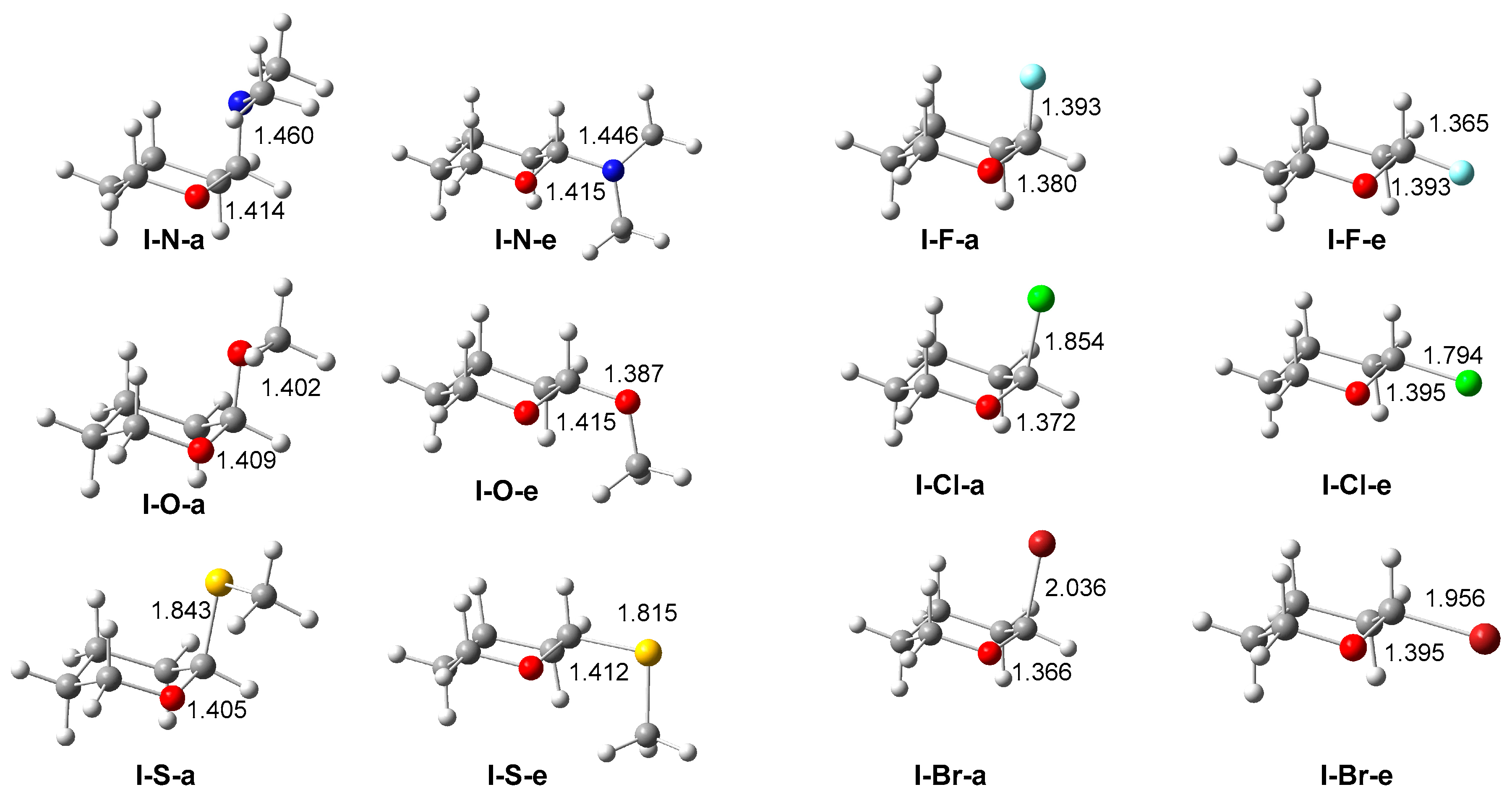
Section 2.1. The optimized geometries of substituted THPs
I–
X are given in
Figure 6. The differences in the O1–C2 and C2–X bond lengths between the two conformations, Δl
a−e, are summarized in
Table 4, while natural atomic charges of the O1–C2–X framework are reported in
Table 5. The corresponding parameters for the acyclic MMs
II–
X series are given in
Section S3 of the Supplementary Materials.
Analysis of the O1–C2 and C2–X bond-length differences (reported in
Table 4) reveals several systematic trends: (i) First, the O1–C2 bond is consistently shorter in the axial conformers, with values of Δl
a−e ranging from −0.001 to −0.029 Å, whereas the C2–X bond is elongated by 0.015–0.080 Å. The simultaneous O1–C2 contraction and C2–X elongation correspond to the structural pattern conventionally associated with anomeric stabilization. (ii) Second, within the second-period series, the magnitude of these structural changes generally increases in the order of N < O < F, although identical C2–X elongations are obtained for the N and O derivatives. (iii) Within the halogen series, both the O1–C2 contraction and C2–X elongation increase markedly in the order of F < Cl < Br. The sulfur derivative does not follow a simple period-dependent trend; its C2–S elongation is identical to that obtained for C2–F, whereas its O1–C2 contraction is intermediate between those of the O- and F-substituted derivatives. Thus, the observed structural changes depend on the identity of X and cannot be described solely in terms of its period. Finally, analogous O1–C2 contractions and C2–X elongations are obtained for the acyclic MMs
II–
X (
Section S3 of the Supplementary Materials). These structural variations broadly parallel the corresponding conformational energy trends, although they do not by themselves establish their electronic origin.
The analysis of the atomic charges obtained by natural population analysis [
29,
30] (NPA) for the three atoms in the O–C–X motif provides additional information on the electronic polarization of the O1–C2–X framework (
Table 5). The corresponding atomic charges for the 60- and 180-DA conformations of the substituted MMs
II–
X are given in
Section S3 of the Supplementary Materials. Several conclusions emerge from
Table 5: (i) First, the net charge of the O1 oxygen remains nearly constant (ca. −0.60 e) across both conformations and throughout the substituent series, indicating that this quantity is relatively insensitive to the conformational change. In contrast, larger substituent- and conformation-dependent variations are observed at C2 and the X atoms. (ii) Second, the positive charge at the anomeric C2 carbon is considerably larger for the derivatives containing second-period X elements (X = N, O, and F; 0.34–0.58 e) than for those containing third- and fourth-period X elements (X = S, Cl, and Br; 0.02–0.21 e). Within the second-period series, the positive charge at C2 increases in the order of N < O < F, paralleling the increase in the electronegativity of X. (iii) Third, the C2–X bond is more strongly polarized in the second-period derivatives, for which X bears a substantial negative charge (−0.39 to −0.61 e). By contrast, S bears a positive charge, whereas Cl and Br carry comparatively small negative charges. Finally, (iv) the axial–equatorial charge differences occur predominantly at C2 and X, and are larger for the S-, Cl-, and Br-substituted derivatives, particularly at X. Overall, the charge analysis results identify two distinct substituent-dependent polarization patterns: one for compounds containing second-period X elements and another for those containing third- and fourth-period X elements.
The calculations show that the net NPA charge at O1 oxygen changes only slightly between the axial and equatorial conformations of THPs
I–
X (approximately −0.61 e;
Table 5) and between the 60-DA and 180-DA conformations of MMs
II–
X (approximately −0.58 e;
Table S4 of the Supplementary Materials). This indicates that the conformational change produces only a small variation in the net NPA population assigned to O1.
Overall, the relative energies (
Table 1), bond-length variations (
Table 4), and atomic charge distributions at C2 and X (
Table 5) reveal substituent-dependent patterns that correlate with the period and electronegativity of X. Nevertheless, these geometrical and charge descriptors do not by themselves establish the physical origin of the conformational energy trends. The ELF and RIAE analyses presented below, therefore, provide complementary descriptions of the electron-density organization and of the distribution of the atomic energy contributions associated with anomeric stabilization.
2.4. ELF Topological Analyses of the 60- and 180-DA Conformations of MMs II–F and II–Cl
The topological analysis of ELF [
31] provides a quantitative description of the electron density distribution within a molecule [
32], offering direct insight into its electronic structure and reactivity. To examine the electron density changes between the axial/60-DA and equatorial/180-DA conformations of THPs
I–
X and MMs
II–
X, ELF analyses were performed for the 60- and 180-DA conformations of the acyclic MMs
II–
F and
II–
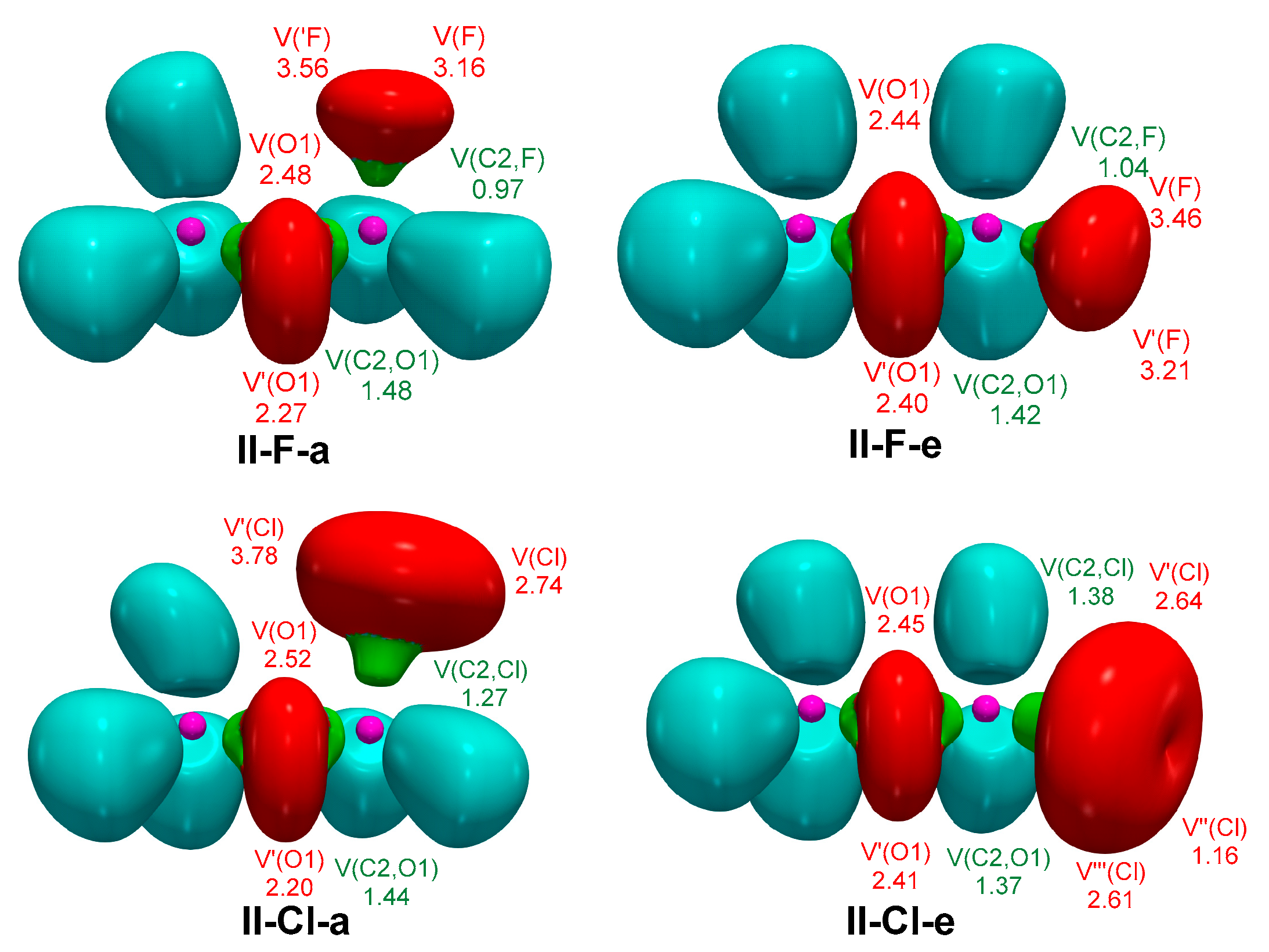
Cl. These compounds were selected as representative systems containing a second-period X element (F) and a third-period X element (Cl). The use of these acyclic models reduces the topological complexity associated with the cyclic THPs and facilitates comparison of the ELF basin populations directly associated with the O1–C2–X motif. The corresponding ELF valence basin distributions and the most relevant valence basin populations are depicted in
Figure 7.
In all four structures, the ELF topology consists of one V(C2,O1) disynaptic basin integrating less than 1.48 e, and one V(C2,X) disynaptic basin integrating less than 1.04 e for X = F or less than 1.38 e for X = Cl. These depopulated disynaptic basins correspond to the polarized C2–O1 and C2–X bonding regions. Each molecule also features two O1-centered monosynaptic basins, V(O1) and V′(O1), integrating less than 4.72 e in total, and two at II–F or two/three at the II–Cl monosynaptic V(X) basins, integrating a total of less than 6.67 e and 6.25 e, respectively. These highly populated V(X) monosynaptic basins represent the non-bonding electron density at the O, F, and Cl atoms, which is consistent with their higher electronegativity relative to the bonded C1 carbons.
ELF comparison of the two conformations of II–F and II–Cl reveals a similar pattern. In the more stable 60-DA conformer II–F–a, the C2–O1 single bond and the F non-bonding region are slightly more populated, whereas the C2–F single bond is slightly depopulated. In the favored 60-DA conformer II–Cl–a, the C2–O1 single bond and the O and Cl non-bonding regions show a small increase in population, while the C2–Cl single bond is slightly depopulated.
The depopulation of the V(C2,X) disynaptic basins in the 60-DA conformations accounts for the slightly longer C2–X distances observed in axial and 60-DA conformations. On the other hand, the slightly higher populations of the V(C2,O1) disynaptic basins at 60-DA conformations account for the shorter C2–O1 distances in axial and 60-DA conformations (see
Figure 6 and
Figure S1 of the Supplementary Materials).
Finally,
Figure 7 shows that the V(Cl) monosynaptic basins in
II–
Cl occupy a larger volume than the V(F) monosynaptic basins in
II–
F, consistent with Cl being a third-period element and F a second-period element.
2.5. RIAE Analysis of the 2-Substituted THPs I–X
In order to determine the electronic interactions at an atomic level responsible for the
anomeric effects, RIAE [
24,
25] analyses for the 2-substituted THPs
I–
X and substituted MMs
II–
X were performed. To our knowledge, stereoisomeric energy differences have not previously been examined using RIAE. In this approach, the relative ξ
intra-atomic and ξ
interatomic energies between the two conformations were computed and analyzed. The relative ξ
total energies obtained by summing the relative ξ
intra-atomic and ξ
interatomic energies represent the RIAE relative energies between the two stereoisomers. This approach enables the energetic origin of the axial/equatorial stability differences to be examined in terms of atomic contributions, providing a complementary perspective to the structural and electron-density analyses discussed above.
The RIAE analysis is organized in three parts: (i) the six 2-substituted THPs
I–
X, (ii) the corresponding MMs
II–
X, and (iii) methoxycyclohexane
III–
O and methylcyclohexane
III–
Me, as reference systems lacking the O–C–X motif. Due to the similarity of the RIAE of MMs
II–
X with that of THPs
I–
X, the former RIAE analysis is presented in
Section S4 of the Supplementary Materials.
2.5.1. RIAE Analysis of 2-Substituted THPs I–X
First, the RIAE analysis for the six 2-substituted THPs
I–
X was performed to identify—at the atomic energy level—the electronic factors responsible for the preferred axial conformation. Taking advantage of the topological atoms [
33], Popelier recently proposed an Interacting Quantum Fragment approach [
34], which allows grouping the IQA energy terms into chemically meaningful fragments ƒ(X) of the molecular system.
To examine the atomic energy contributions associated with the O–C–X motif, the atoms of THPs
I–
X, were grouped into two fragments: (a) the three atoms defining the O–C–X motif, and (b) the remaining hydrocarbon framework, denoted as CH. The M06-2X/6-311G(d,p) axial/equatorial relative ξ
intra-atomic, ξ
interatomic, and ξ
total energies for the OCX and CH frameworks of THPs
I–
X are given in
Table 6. The ξ
, which corresponds to the total axial/equatorial stabilization obtained by summing the contributions assigned to both fragments, represents the total axial–equatorial conformational energy differences recovered from the RIAE partition. Note that the relative ξ
and ξ
contributions are defined using the axial-minus-equatorial convention,
. Accordingly, negative values represent contributions favoring axial stabilization. Consequently, the ξ
values reported in
Table 6 follow the opposite sign convention to that used for the anomeric τ index in
Table 1, for which positive values indicate an excess axial stabilization.
Importantly, should not be equated with the anomeric τ index. The τ index is a reference-based conformational energy descriptor obtained by subtracting the axial–equatorial conformational preference of the substituted cyclohexane Ch III–X from that of the corresponding THP I–X by using the total molecular electronic energies of both systems. By contrast, is a within-THP atomic energy contribution obtained by summing the RIAE terms assigned to the O–C–X fragment for the axial–equatorial comparison of a single THP. Thus, τ estimates the excess axial stabilization of the THP relative to the external cyclohexane reference, whereas describes the contribution assigned by the RIAE partition to the O–C–X fragment within the THP itself. Consequently, τ and are complementary but distinct quantities; they are neither numerically equivalent nor expected to coincide.
As shown in
Table 6, the RIAE ξ
total energies reproduce the stability trends obtained from the full M06-2X/6-311G(d,p) gas-phase optimizations (see
Table 1). In all six THPs
I–
X, the O–C–X framework provides a stabilizing contribution to the axial conformation, whereas the remaining hydrocarbon framework contributes unfavorably and partially offsets this stabilization. Within the halogen series, the axial stabilization becomes progressively more favorable from F to Cl and Br, with values of −3.19, −4.70, and −5.31 kcal·mol
−1, respectively. The methoxy derivative
I–
O shows greater axial stabilization (−4.04 kcal·mol
−1) than the dimethylamino derivative
I–
N (−2.64 kcal·mol
−1), whereas
I–
S displays the weakest axial stabilization of the series (−2.26 kcal·mol
−1).
Decomposition of the O–C–X contribution further reveals a period-associated change in the dominant electronic term. For compounds containing second-period X elements (X = N, O, and F), the relative intra-atomic energies are strongly stabilizing, ranging from −17.04 to −11.12 kcal·mol−1, whereas the corresponding interatomic contributions are destabilizing. In contrast, for compounds containing third- and fourth-period X elements (X = S, Cl, and Br), the interatomic contributions become strongly stabilizing, ranging from −34.05 to −7.72 kcal·mol−1. Thus, the RIAE decomposition identifies two distinct energetic regimes: axial stabilization is dominated by intra-atomic terms for second-period X elements and by interatomic terms for third- and fourth-period X elements.
A detailed analysis of IQA
intra-atomic energies of the atoms contributing to the relative ξ
intra-atomic energies of
I–
N,
I–
O, and
I–
F (second-period X elements) indicates that the relative
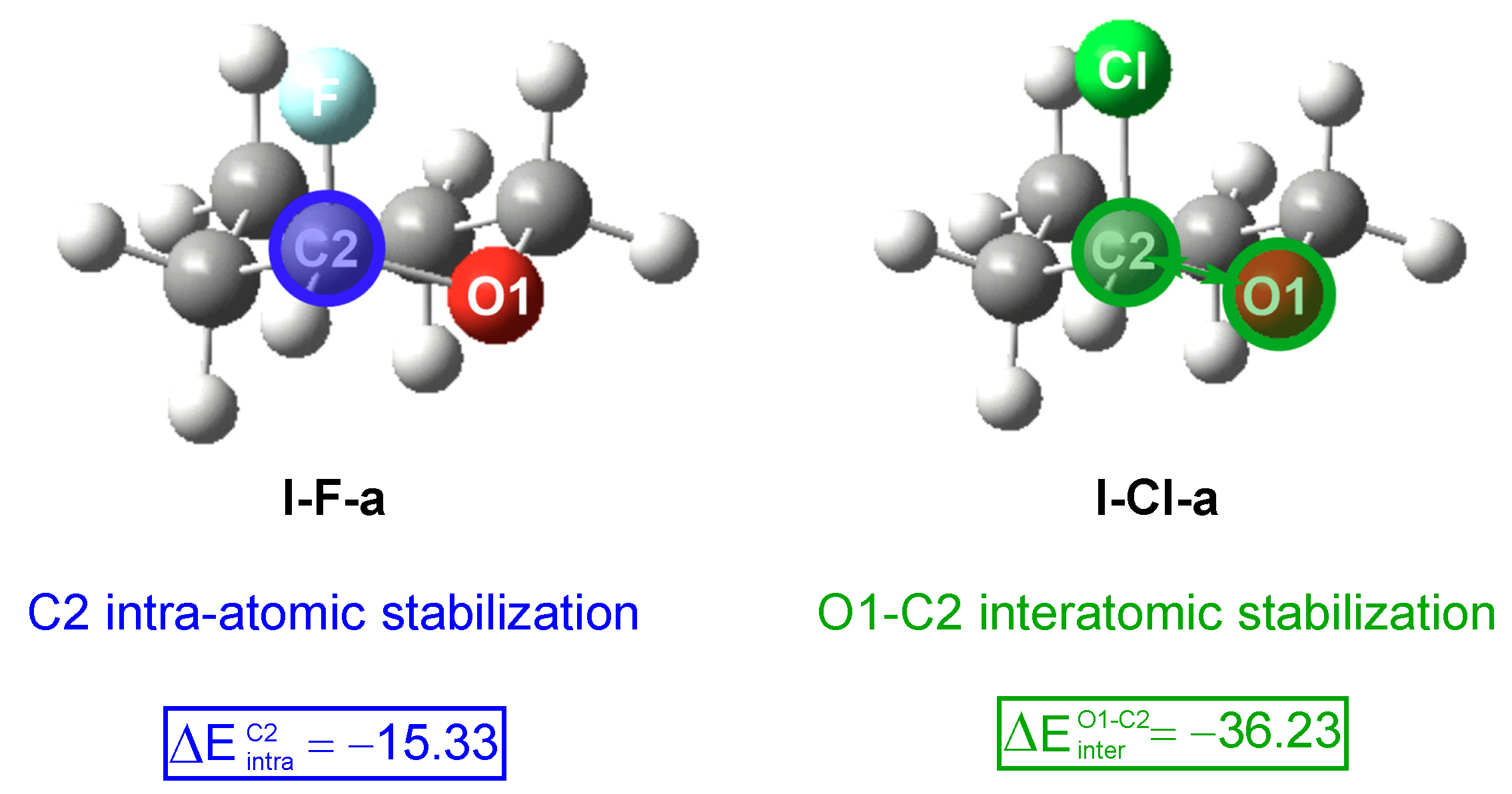
intra-atomic energies at the anomeric C2 carbon, −9.25, −13.76, and −15.33 kcal·mol
−1, respectively, are the dominant electronic factors at an atomic level for the axial stabilization of these THPs (see
Table 7 and
Table S11 of the Supplementary Materials). Note that this stabilization increases with the electronegativity of the X atom. Examination of the IQA components further reveals that the relatively favorable nuclei-electron contributions between the axial and equatorial conformations, −58.56 (
I–
N), −79.36 (
I–
O), and −70.37 (
I–
F) kcal·mol
−1, constitute the dominant contribution to this intra-atomic anomeric stabilization (see
Table 7). A comparable intra-atomic stabilization at the anomeric carbon was recently reported by Popelier for the fluorine derivative
I–
F using IQA and REG analyses [
21].
Conversely, for compounds containing third- and fourth-period X elements (X = S, Cl, and Br), analysis of the IQA
interatomic energies of the atoms contributing to ξ
interatomic energies of
I–
S–
a,
I–
Cl–
a, and
I–
Br–
a indicates that the
interatomic energies associated with O1 and C2 atoms are stabilizing. The corresponding O1 and C2 contributions, −2.47 and −2.36 (
I–
S–
a), −16.06 and −8.89 (
I–
Cl–
a), and −20.94 and −12.14 (
I–
Br–
a) kcal·mol
−1, drive axial stabilization (see
Table S11 of the Supplementary Materials). A further analysis of the IQA
terms shows that the
energies between O1 and C2, −12.45 (
I–
S–
a), −36.23 (
I–
Cl–
a), and −48.90 kcal·mol
−1 (
I–
Br–
a), constitute the most favorable axial electronic interactions in these sulfur and halogenated systems. This O1 and C2 interatomic stabilization agrees with the reduction of the O1–C2 distance in the more favorable
I–
X–
a compounds containing third- and fourth-period X elements.
The comparatively small ξ
and ξ
energy differences between the axial and equatorial conformations of
I–
S (
Table 6) may account for its pronounced deviation in
Figure 3, suggesting that additional intramolecular interactions contribute with magnitudes comparable to that associated with the
anomeric effect.
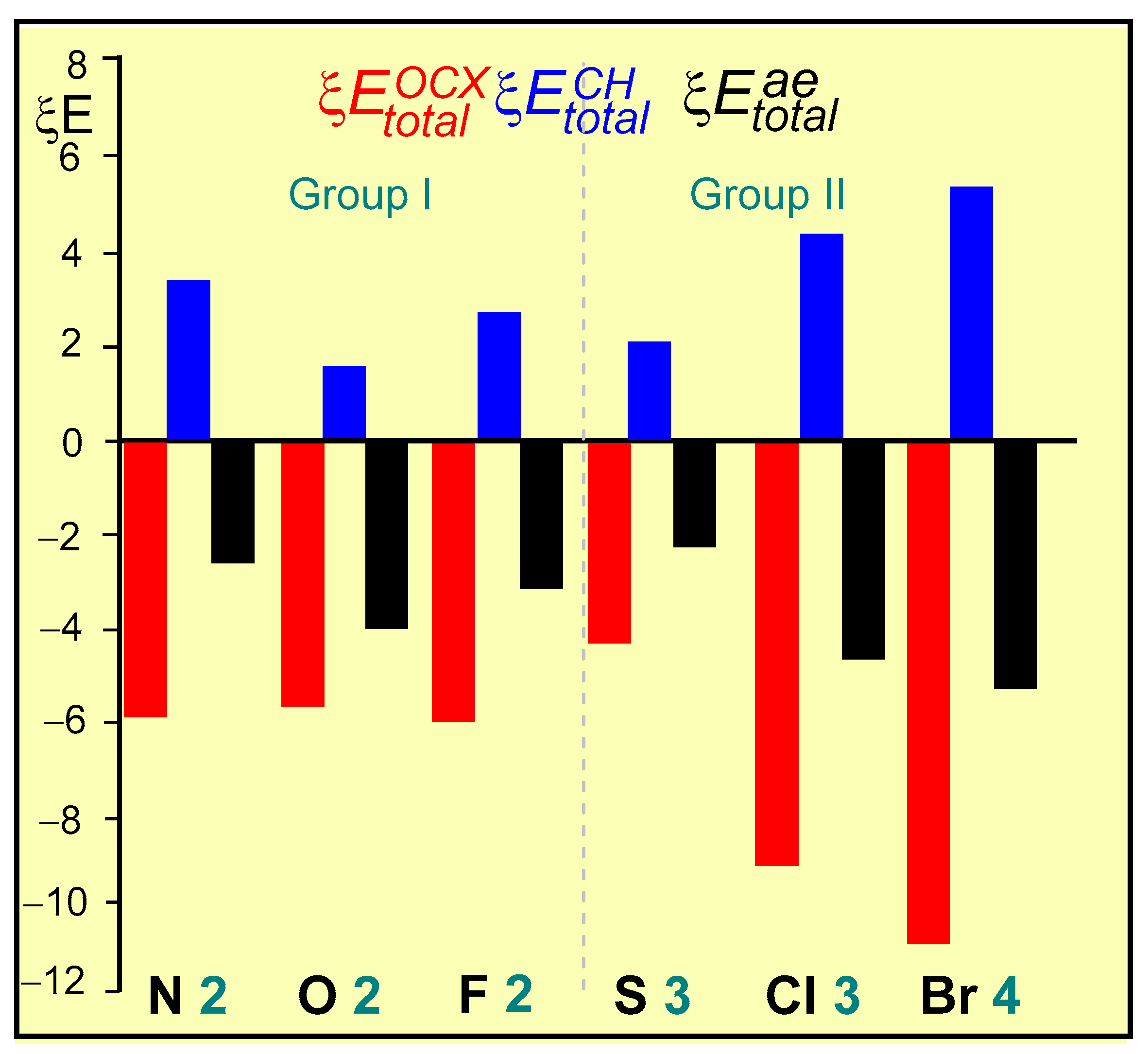
The RIAE analysis reveals a period-associated change in the distribution of the energy contributions responsible for the axial stabilization of THPs
I–
X. On this basis, the studied compounds can be classified into two groups: (i) Group I comprises THPs containing second-period X elements (X = N, O, and F), for which stabilization of the O–C–X framework is dominated by favorable intra-atomic contributions assigned to the anomeric C2 atom; and (ii) Group II comprises THPs containing third- and fourth-period X elements (X = S, Cl, and Br), for which the dominant stabilizing contribution is the interatomic interactions between the ether O1 oxygen and the anomeric C2 carbon. Thus, the RIAE decomposition identifies a shift in the dominant energy contribution from an intra-atomic C2 term in Group I to an interatomic O1–C2 term in Group II.
Figure 8 summarizes the C2 intra-atomic and O1–C2 interatomic electronic stabilizations for the axial preference of THPs containing second-period X elements (Group I), and for compounds containing third- and fourth-period X elements (Group II), respectively, which are responsible at the atomic-level for the
anomeric effect characterized in this RIAE study.
A comparison of the RIAE decomposition for the cyclic THPs
I–
X (
Table 6) with that obtained for the acyclic MMs
II–
X (
Table S4 of the Supplementary Materials) reveals the same qualitative period-associated pattern. Only MMs
II-N shows an exception as the RIAE
total energies, −3.20 kcal·mol
−1, arises from low stabilizing ξ
intra-atomic and ξ
interatomic energies, −1.75 and −1.45 kcal·mol
−1, respectively.
Analysis of the relative ξ intra-atomic and ξ interatomic energies contributing to the RIAE ξ total energies for the series of acyclic MMs II–X shows that, except for MMs II-N, the other five MMs present the same dependence on the period of the X atom as that observed for the cyclic THPs I-X series.
This agreement shows that the two patterns of RIAE contributions are reproduced in both cyclic and acyclic O–C–X frameworks. The smaller axial stabilization obtained for THPs
I–
X relative to the 60-DA stabilization of MMs
II–
X is associated with the unfavorable relative total-energy contribution assigned to the hydrocarbon CH framework of the cyclic systems, ξ
, which ranges from 1.57 to 5.39 kcal·mol
−1 (
Table 6). This positive contribution partially offsets the stabilization associated with the O–C–X framework in the THP series.
Finally, analysis of the relative axial/equatorial IQA
intra-atomic and
interatomic energies associated with the X element in the series of THPs
I–
X were analyzed (see
Table S11 of the Supplementary Materials). Except in the cases of
I–
N and
I–
O, where the relative
interatomic energies are stabilizing, the remaining systems show an axial intra-atomic stabilization at X, ranging from −3.05 (
I–
S) to −10.17 (
I–
Br) kcal·mol
−1. Note that, in the case of the Br atom, which experiences high
intra-atomic stabilization, this represents only ca. 25% of the
interatomic stabilization associated with the O1 and C2 atoms. These
intra-atomic stabilizations cannot be correlated with the atomic charges seen at the X atom, which differ between compounds containing second-period and third- or fourth-period X elements (see
Table 5). Note that at the THPs
I–
F and
I–
Cl, the halogen X atoms experience an axial
intra-atomic stabilization of ca. 5 kcal·mol
−1 despite having markedly different atomic charges of −0.42 and −0.16 e, respectively (see
Table 5). Consequently, while the stabilizations of the O1 and C2 atoms at an atomic level may be related to the X element period, those associated with the X atom, which have a minor contribution to the
anomeric effect, show less systematic behavior and have lower weight in the axial stabilization.
Figure 9 provides a graphical summary of the RIAE decomposition reported in
Table 6. It highlights the stabilizing contribution of the O–C–X framework to the axial conformations and the opposing destabilizing contribution of the remaining hydrocarbon framework. The figure also illustrates the progressive increase in axial stabilization along the halogen series F < Cl < Br. The detailed atomic origin of these trends is discussed above.
2.5.2. RIAE Analysis of Methoxycyclohexane III–O and Methylcyclohexane III–Me
Methoxycyclohexane Ch
III–
O, which lacks the O–C–X motif, displays a significant axial stabilization of −2.56 kcal·mol
−1, in contrast to the expected axial destabilization of methylcyclohexane
III–
Me, 1.50 kcal·mol
−1 (
Table 1). This intrinsic axial preference associated with the methoxy group also contributes in concert with the
anomeric effect, stabilizing the axial THP
I–
O and enhancing its overall axial stabilization to 4.38 kcal·mol
−1. The corresponding τ value for oxygen is 1.82 kcal·mol
−1 (
Table 1 and
Figure 4), indicating that both intrinsic substituent effects and the anomeric contribution participate in the stabilization of THP
I–
O.
To identify the electronic interactions underlying the axial stabilization of methoxycyclohexane
III–
O, a RIAE analysis was performed for Ch
III–
O and methylcyclohexane
III–
Me as reference systems. The M06-2X/6-311G(d,p) gas-phase relative intra-atomic, ξ
intra-atomic, ξ
interatomic, and ξ
total energy differences between the axial and equatorial conformations of Chs
III–
O and
III–
Me are given in
Table 8.
Analysis of the relative ξ
intra-atomic and ξ
interatomic energies responsible for the axial and equatorial stabilizations of Chs
III–
O and
III–
Me indicate that in both Chs, the ξ
intra-atomic energies are destabilizing, while the ξ
interatomic energies are stabilizing. However, in Ch
III–
O, the relative ξ
interatomic energies are stabilizing at −3.75 kcal·mol
−1, yielding an axial stabilization of −2.65 kcal·mol
−1; in Ch
III–
Me, the relative ξ
intra-atomic energies are more destabilizing at 4.13 kcal·mol
−1, yielding an axial destabilization of 1.46 kcal·mol
−1 (see
Table 8). A detailed analysis of the relative
interatomic energies of the atoms contributing to ξ
interatomic energies of Ch
III–
O–
a indicates that the
interatomic energies associated with the ether O oxygen, −8.88 kcal·mol
−1, drive axial stabilization.
Interestingly, the dominant energetic factors underlying axial stabilization in Ch III–O and THP I–O differ qualitatively. In Ch III–O, axial stabilization is dominated by favorable interatomic interactions associated with the ether O oxygen, whereas in THP I-O, this arises primarily from favorable intra-atomic contributions assigned to the anomeric C2 atom, consistent with the RIAE pattern identified for Group I compounds containing second-period X elements. This contrast shows that different distributions of atomic energy contributions can lead to axial stabilization in related systems and helps distinguish the contribution associated with the O–C–X motif from the other electronic contributions involved in overall stabilization.