Review

Hydrodynamic Cavitation in Juice Processing: Linking PME, PPO, and POD Responses to Physicochemical Stability and Quality Retention


Institute of BioEconomy, National Research Council of Italy, Via Madonna del Piano 10, 50019 Florence, Italy
Molecules 2026, 31(18), 3323; https://doi.org/10.3390/molecules31183323 (registering DOI)

Submission received: 20 August 2026 / Revised: 14 September 2026 / Accepted: 17 September 2026 / Published: 19 September 2026

Abstract

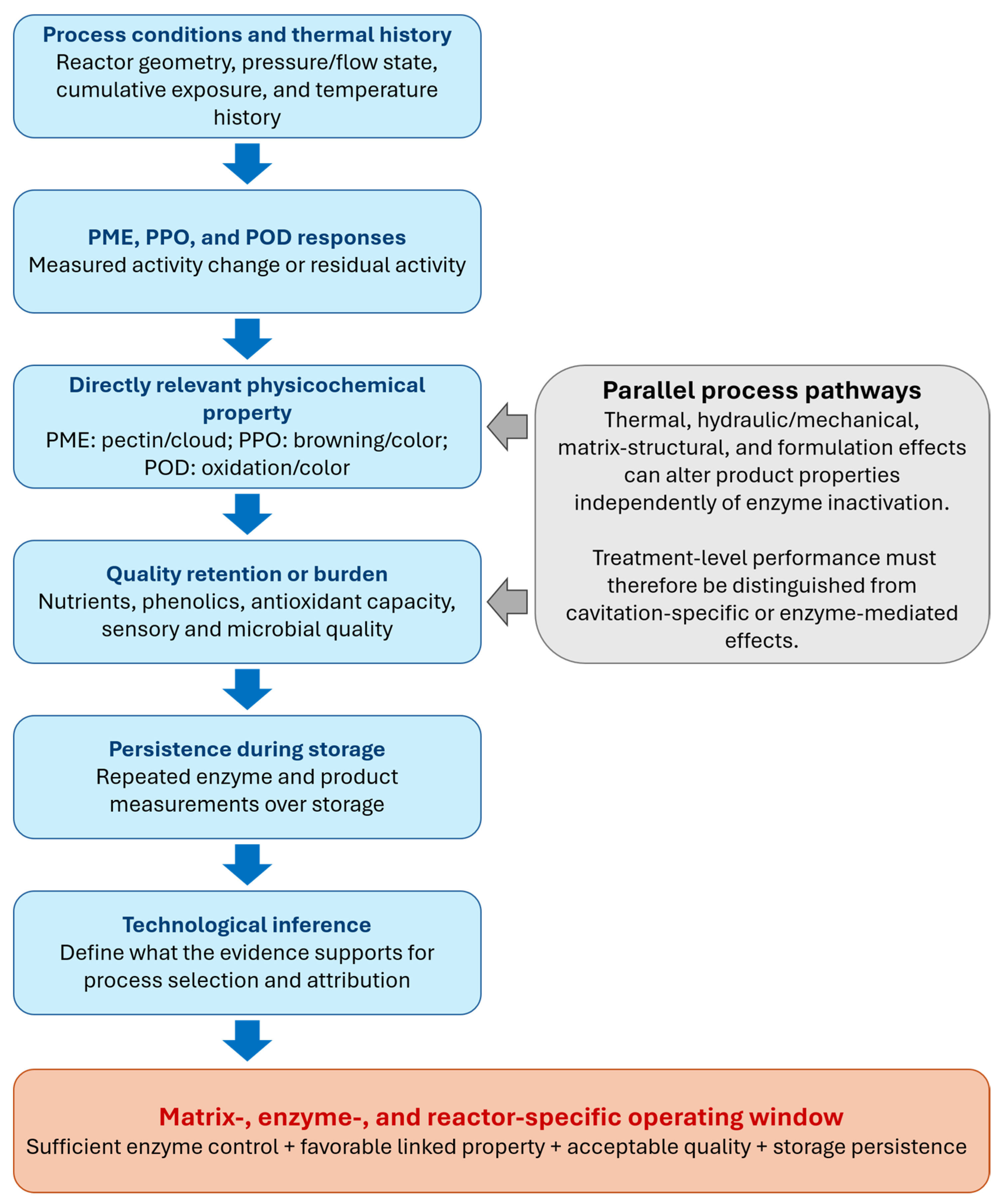
Hydrodynamic cavitation (HC) is increasingly investigated for juice processing, but changes in pectin methylesterase (PME), polyphenol oxidase (PPO), and peroxidase (POD) activity do not by themselves establish a technological benefit. Several mild or temperature-limited conditions left substantial residual activity, whereas stronger control was observed in thermally assisted, more severe, or hurdle-assisted treatments. Physical stability can nevertheless improve despite limited PME or PPO inactivation, consistent with concurrent particle-size reduction, pectin restructuring, rheological modification, and other matrix-level changes. Within-study quantitative comparisons showed that, in all six directly comparable enzyme-level contrasts, inactivation at the selected or experimentally validated condition was lower than the largest directly observed value for the same enzyme. In the three exact same-condition PPO storage trajectories, end-of-storage inactivation was lower than at day 0. Current evidence therefore supports treatment-level responses more strongly than cavitation-specific causality and does not justify a universal HC operating window. Technologically meaningful process development requires matrix-, enzyme-, and reactor-specific conditions that provide sufficient enzyme control for a defined product function, a favorable linked physicochemical response, acceptable quality retention, and persistence during storage, supported by adequate hydraulic and thermal characterization and controls matched to the causal claim.
Keywords: hydrodynamic cavitation; pectin methylesterase; polyphenol oxidase; peroxidase; juice processing; matrix specificity; enzyme–property linkage; physicochemical stability; quality retention; process attribution hydrodynamic cavitation; pectin methylesterase; polyphenol oxidase; peroxidase; juice processing; matrix specificity; enzyme–property linkage; physicochemical stability; quality retention; process attribution
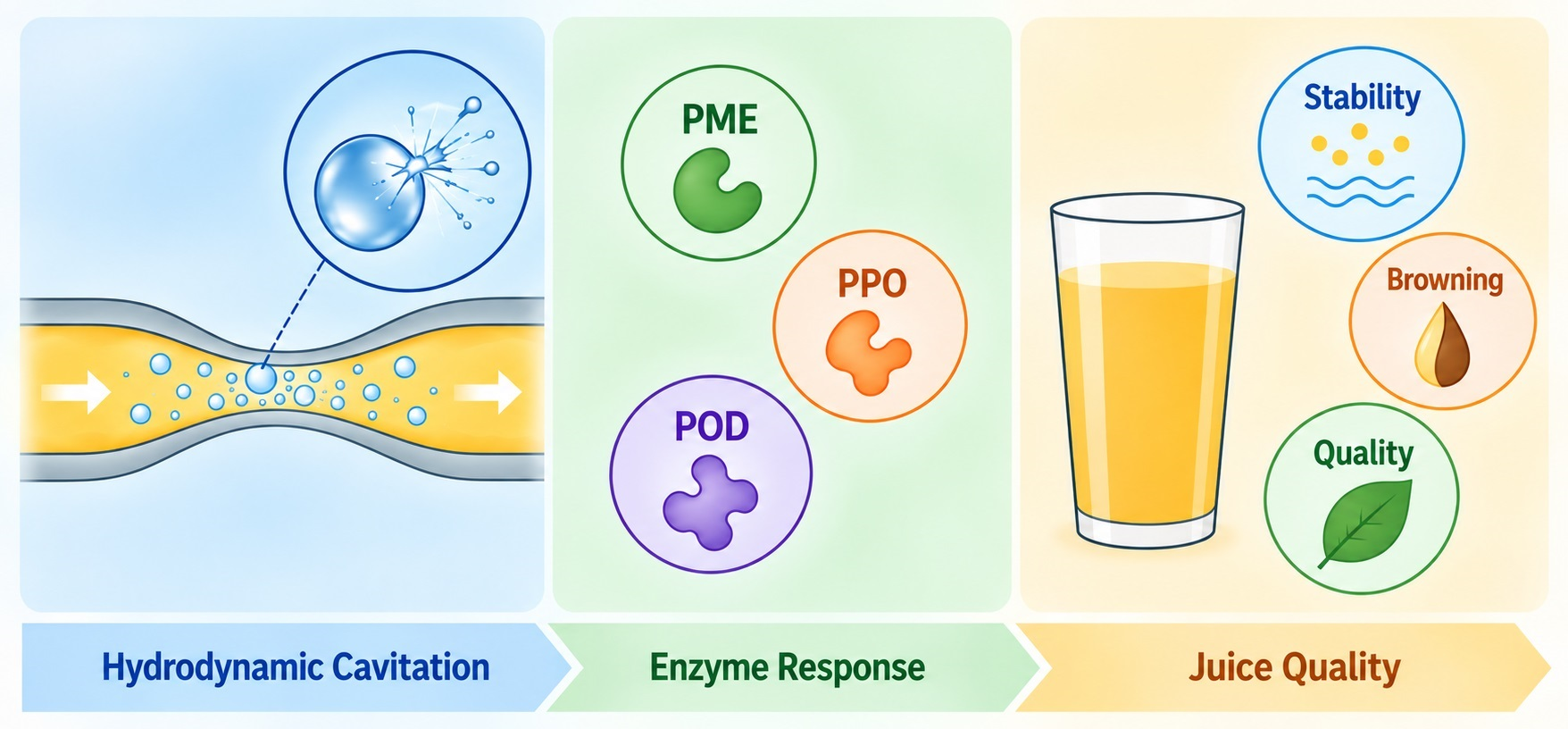
Graphical Abstract