Essential Oils of Lamiaceae Species as Promising Sources of Antimycobacterial Agents: Current Insights, Challenges, and Future Perspectives


Abstract
1. Introduction
2. Methodology
3. Mycobacterium tuberculosis and Microbial Resistance
4. Antimycobacterial Activity of Lamiaceae Essential Oils
4.1. Mechanisms Underlying the Antimycobacterial Activity of EOs
4.2. Interactions with Antimycobacterial Drugs
5. Limitations and Perspectives
6. Conclusions
Author Contributions
Funding
Institutional Review Board Statement
Informed Consent Statement
Data Availability Statement
Conflicts of Interest
References
- Jadhav, K.; Gautam, S.; Singh, A.K.; Verma, R.K.; Yadav, A.B. Conquering the tuberculosis Superbug: Innovative approaches for biofilm disruption and antibiotic resistance mitigation. J. Drug Deliv. Sci. Technol. 2025, 111, 107173. [Google Scholar] [CrossRef] [Scilit]
- WHO Global Tuberculosis Report 2025. Available online: https://www.who.int/teams/global-programme-on-tuberculosis-and-lung-health/tb-reports/global-tuberculosis-report-2025/tb-disease-burden/1-3-drug-resistant-tb (accessed on 29 May 2026).
- Walzl, G.; Goletti, D.; Zumla, A. The global epidemiology of tuberculosis: Burden, trends, and determinants. Cold Spring Harb. Perspect. Med. 2026, a041982. [Google Scholar] [CrossRef] [Scilit]
- Maleki, M.R. Genetic analysis of molecular mechanisms of drug resistance in Mycobacterium tuberculosis against four major first-line anti-tuberculosis drugs (Isoniazid, Rifampin, Ethambutol, and Pyrazinamide). Infect. Drug Resist. 2025, 18, 4901–4915. [Google Scholar] [CrossRef] [Scilit]
- Biswas, S.S.; Browne, R.B.; Borah, V.V.; Roy, J.D. In silico approach for phytocompound-based drug designing to fight efflux pump-mediated multidrug-resistant Mycobacterium tuberculosis. Appl. Biochem. Biotechnol. 2021, 193, 1757–1779. [Google Scholar] [CrossRef] [Scilit]
- Sieniawska, E. Recent research progress in the plant contribution to the management of tuberculosis. eFood 2024, 5, e157. [Google Scholar] [CrossRef] [Scilit]
- Niculescu, A.G.; Mük, G.R.; Avram, S.; Vlad, I.M.; Limban, C.; Nuta, D.; Grumezescu, A.M.; Chifiriuc, M.C. Novel strategies based on natural products and synthetic derivatives to overcome resistance in Mycobacterium tuberculosis. Eur. J. Med. Chem. 2024, 269, 116268. [Google Scholar] [CrossRef] [Scilit]
- Mongalo, N.I.; Raletsena, M.V. Antimycobacterial compounds isolated from medicinal plants: A South African comprehensive review. S. Afr. J. Bot. 2025, 181, 236–257. [Google Scholar] [CrossRef] [Scilit]
- Abdjul, D.B.; Budiyanto, F.; Wibowo, J.T.; Murniasih, T.; Rahmawati, S.I.; Indriani, D.W.; Putra, M.Y.; Bayu, A. Unlocking potent anti-tuberculosis natural products through structure-activity relationship analysis. Nat. Prod. Bioprospect. 2025, 15, 44. [Google Scholar] [CrossRef] [Scilit]
- Bindu, A. The lamiaceae family: A review of its medicinal properties and indispensable role in modern therapeutics. J. Med. Plants Stud. 2025, 13, 9–12. [Google Scholar]
- Chrysargyris, A. It runs in the family: The importance of the Lamiaceae family species. Agronomy 2024, 14, 1274. [Google Scholar] [CrossRef] [Scilit]
- Çalış, İ. A mini review on the chemodiversity of Lamiaceae plants that are native to Türkiye and Turkish Republic of Northern Cyprus. Rec. Nat. Prod. 2025, 19, 350–374. [Google Scholar] [CrossRef] [Scilit]
- Xu, Y.; Liang, B.; Kong, C.; Sun, Z. Traditional medicinal plants as a source of antituberculosis drugs: A system review. BioMed Res. Int. 2021, 2021, 9910365. [Google Scholar] [CrossRef] [Scilit]
- Caulfield, A.J.; Wengenack, N.L. Diagnosis of active tuberculosis disease: From microscopy to molecular techniques. J. Clin. Tuberc. Other Mycobact. Dis. 2016, 4, 33–43. [Google Scholar] [CrossRef] [Scilit]
- Whittaker, C. Barriers to Tuberculosis Drug Discovery: The Mycobacterial Cell Wall. Ph.D. Thesis, Faculty of Health Sciences, University of Cape Town, Cape Town, South Africa, 2023. [Google Scholar]
- Jacobo-Delgado, Y.M.; Rodríguez-Carlos, A.; Serrano, C.J.; Rivas-Santiago, B. Mycobacterium tuberculosis cell-wall and antimicrobial peptides: A mission impossible? Front. Immunol. 2023, 14, 1194923. [Google Scholar] [CrossRef] [Scilit]
- Gygli, S.M.; Borrell, S.; Trauner, A.; Gagneux, S. Antimicrobial resistance in Mycobacterium tuberculosis: Mechanistic and evolutionary perspectives. FEMS Microbiol. Rev. 2017, 41, 354–373. [Google Scholar] [CrossRef] [Scilit]
- Song, L.; Wu, X. Development of efflux pump inhibitors in antituberculosis therapy. Int. J. Antimicrob. Agents 2016, 47, 421–429. [Google Scholar] [CrossRef] [Scilit]
- Raj, R.; Tripathi, A.K.; Saranya, P.; Kaur, J.; Pal, R.S.; Singh, K.; Jain, D.; Chaitanya, M.V.N.L.; Kumar, S. A review of molecular investigations on traditional Chinese medicinal plant-based therapies in multidrug-resistant tuberculosis. Pharmacol. Res. Mod. Chin. Med. 2024, 13, 100521. [Google Scholar] [CrossRef] [Scilit]
- Zhang, S.; Cheng, J.; Tang, Y. Drug resistance mechanisms in Mycobacterium tuberculosis infection and challenges in vaccine development. Front. Pharmacol. 2026, 17, 1762214. [Google Scholar] [CrossRef] [Scilit]
- Målen, H.; De Souza, G.A.; Pathak, S.; Søfteland, T.; Wiker, H.G. Comparison of membrane proteins of Mycobacterium tuberculosis H37Rv and H37Ra strains. BMC Microbiol. 2011, 11, 18. [Google Scholar] [CrossRef] [Scilit]
- Mota, A.P.P.; Dantas, J.C.P.; Frota, C.C. Antimicrobial activity of essential oils from Lippia alba, Lippia sidoides, Cymbopogon citrates, Plectranthus amboinicus, and Cinnamomum zeylanicum against Mycobacterium tuberculosis. Ciênc. Rural 2018, 48, e20170697. [Google Scholar] [CrossRef] [Scilit]
- Fernandes, C.C.; de Andrade, P.M.; dos Santos, T.C.L.; Santiago, M.B.; Pagotti, M.C.; Miller Crotti, A.E.; Gomes Martins, C.H.; Magalhães Guidi, L.; Dantas Mayker Lazaro, M. In vitro evaluation of anticaries, antimycobacterial, antileishmanial and cytotoxic activities of essential oils from Eremanthus erythropappus and of α-bisabolol, their major sesquiterpene. Aust. J. Crop Sci. 2020, 14, 236–243. [Google Scholar] [CrossRef] [Scilit]
- Baldin, V.P.; Scodro, R.B.L.; Lopes-Ortiz, M.A.; de Almeida, A.L.; Gazim, Z.C.; Ferarrese, L.; Faiões, V.D.S.; Torres-Santos, E.C.; Pires, C.T.A.; Caleffi-Ferracioli, K.R.; et al. Anti-Mycobacterium tuberculosis activity of essential oil and 6,7-dehydroroyleanone isolated from leaves of Tetradenia riparia (Hochst.) Codd (Lamiaceae). Phytomedicine 2018, 47, 34–39. [Google Scholar] [CrossRef] [Scilit]
- Jiménez-Arellanes, M.A.; Gutiérrez-Rebolledo, G.A. Antimycobacterial susceptibility testing methods for natural products. Braz. J. Microbiol. 2013, 44, 341–355. [Google Scholar]
- Liu, Q.; Wang, D.; Martinez, L.; Lu, P.; Zhu, L.; Lu, W.; Wang, J. Mycobacterium tuberculosis Beijing genotype strains and unfavourable treatment outcomes: A systematic review and meta-analysis. Clin. Microbiol. Infect. 2020, 26, 180–188. [Google Scholar] [CrossRef] [Scilit]
- Szulczyk, D.; Woziński, M.; Koliński, M.; Kmiecik, S.; Głogowska, A.; Augustynowicz-Kopeć, E.; Dobrowolski, M.A.; Roszkowski, P.; Struga, M.; Ciura, K. Menthol- and thymol-based ciprofloxacin derivatives against Mycobacterium tuberculosis: In vitro activity, lipophilicity, and computational studies. Sci. Rep. 2023, 13, 16328. [Google Scholar] [CrossRef] [Scilit]
- Bueno-Sánchez, G.; Martínez-Morales, J.R.; Stashenko, E.E.; Ribón, W. Anti-tubercular activity of eleven aromatic and medicinal plants occurring in Colombia. Biomédica 2009, 29, 51–60. [Google Scholar]
- Dar, N.A.; Qadir, M.; Wani, S.A.; Shah, W.A. Chemical profile, antituberculosis, DSC, and molecular docking studies of Mentha longifolia essential oil. Nat. Prod. Res. 2025, 39, 4775–4781. [Google Scholar] [CrossRef] [Scilit]
- El Omari, K.; Hamze, M.; Alwan, S.; Osman, M.; Jama, C.; Chihib, N.E. In-vitro evaluation of the antibacterial activity of the essential oils of Micromeria barbata, Eucalyptus globulus and Juniperus excelsa against strains of Mycobacterium tuberculosis (including MDR), Mycobacterium kansasii and Mycobacterium gordonae. J. Infect. Public Health 2019, 12, 615–618. [Google Scholar] [CrossRef] [Scilit]
- Jayapal, V.; Raj, C.V.; Muthaiah, M.; Chadha, V.K.; Brammacharry, U.; Selvaraj, S.; Easow, J.M. In-vitro anti-Mycobacterium tuberculosis effect of essential oil of Ocimum sanctum L. (Tulsi/Basil) leaves. Indian J. Tuberc. 2021, 68, 470–473. [Google Scholar] [CrossRef] [Scilit]
- Elmaidomy, H.A.; Hassan, H.M.; Amin, E.; Mohamed, W.; Hetta, M.H. Premna odorata volatile oil as a new Mycobacterium tuberculosis growth inhibitor for the control of tuberculosis disease. Eur. J. Med. Plants 2017, 4, 1–11. [Google Scholar] [CrossRef] [Scilit]
- Bueno, J.; Escobar, P.; Martínez, J.R.; Leal, S.M.; Stashenko, E.E. Composition of three essential oils, and their mammalian cell toxicity and antimycobacterial activity against drug resistant-tuberculosis and nontuberculous mycobacteria strains. Nat. Prod. Commun. 2011, 6, 1743–1748. [Google Scholar] [CrossRef] [Scilit]
- Aşkun, T.; Başer, K.H.; Tümen, G.; Kürkçüoğlu, M. Characterization of essential oils of some Salvia species and their antimycobacterial activities. Turk. J. Biol. 2010, 34, 89–95. [Google Scholar] [CrossRef] [Scilit]
- Pourazar Dizaji, S.; Soleimani, N.; Afrugh, P.; Saedi, S. In vitro antibacterial activity of Thymus vulgaris essential oil against Mycobacterium tuberculosis. Infect. Epidemiol. Microbiol. 2018, 4, 47–51. [Google Scholar]
- Kazemian, H.; Heidari, H.; Yamchi, J.K.; Zandi, H.; Taji, A.; Yazdani, F.; Hamzehloo, G.; Ghanavati, R.; Rahdar, H.A.; Feizabadi, M.M. In vitro anti-mycobacterial activity of three medicinal plants of Lamiaceae family. Recent Pat. Anti-Infect. Drug Discov. 2018, 13, 240–245. [Google Scholar] [CrossRef] [Scilit]
- Kiliç, T. Analysis of essential oil composition of Thymbra spicata var. spicata: Antifungal, antibacterial and antimycobacterial activities. Z. Naturforsch. C J. Biosci. 2006, 61, 324–328. [Google Scholar] [CrossRef] [Scilit]
- Andrade-Ochoa, S.; Nevárez-Moorillón, G.V.; Sánchez-Torres, L.E.; Villanueva-García, M.; Sánchez-Ramírez, B.E.; Rodríguez-Valdez, L.M.; Rivera-Chavira, B.E. Quantitative structure-activity relationship of molecules constituent of different essential oils with antimycobacterial activity against Mycobacterium tuberculosis and Mycobacterium bovis. BMC Complement. Altern. Med. 2015, 15, 332. [Google Scholar] [CrossRef] [Scilit]
- Nakamura de Vasconcelos, S.S.; Caleffi-Ferracioli, K.R.; Hegeto, L.A.; Baldin, V.P.; Nakamura, C.V.; Stefanello, T.F.; Freitas Gauze, G.; Yamazaki, D.A.; Scodro, R.B.; Siqueira, V.L.; et al. Carvacrol activity & morphological changes in Mycobacterium tuberculosis. Future Microbiol. 2018, 13, 877–888. [Google Scholar] [CrossRef] [Scilit]
- Alokam, R.; Jeankumar, V.U.; Sridevi, J.P.; Matikonda, S.S.; Peddi, S.; Alvala, M.; Yogeeswari, P.; Sriram, D. Identification and structure-activity relationship study of carvacrol derivatives as Mycobacterium tuberculosis chorismate mutase inhibitors. J. Enzym. Inhib. Med. Chem. 2014, 29, 547–554. [Google Scholar] [CrossRef] [Scilit]
- Esquivel-Ferriño, P.C.; Clemente-Soto, A.F.; Ramírez-Cabriales, M.Y.; Garza González, E.; Álvarez, L.; del Rayo Camacho-Corona, M. Volatile constituents identified in hexane extract of Citrus sinensis peel and Anti-mycobacterial tuberculosis activity of some of its constituents. J. Mex. Chem. Soc. 2014, 58, 431–434. [Google Scholar]
- Rijo, P.; Simões, M.F.; Francisco, A.P.; Rojas, R.; Gilman, R.H.; Vaisberg, A.J.; Rodríguez, B.; Moiteiro, C. Antimycobacterial metabolites from Plectranthus: Royleanone derivatives against Mycobacterium tuberculosis strains. Chem. Biodivers. 2010, 7, 922–932. [Google Scholar] [CrossRef] [Scilit]
- 43. Vidya Raj, C.K.; Venugopal, J.; Muthaiah, M.; Kumar Chada, V.; Brammacharry, U.; Swappna, M.; Sangeetha, A.V.; Dhandapani, S.P.; Kareedhi, V.R.; Calivarathan, L.; et al. In-vitro anti-Mycobacterium tuberculosis effect of eugenol. Indian J. Tuberc. 2022, 69, 647–654. [Google Scholar] [CrossRef] [Scilit]
- Sawicki, R.; Sieniawska, E.; Swatko-Ossor, M.; Golus, J.; Ginalska, G. The frequently occurring components of essential oils beta elemene and R-limonene alter expression of dprE1 and clgR genes of Mycobacterium tuberculosis H37Ra. Food Chem. Toxicol. 2018, 112, 145–149. [Google Scholar] [CrossRef] [Scilit]
- Sieniawska, E.; Sawicki, R.; Swatko-Ossor, M.; Napiorkowska, A.; Przekora, A.; Ginalska, G.; Swatko-Ossor, M.; Augustynowicz-Kopec, E. The effect of combining natural terpenes and antituberculous agents against reference and clinical Mycobacterium tuberculosis strains. Molecules 2018, 23, 176. [Google Scholar] [CrossRef] [Scilit]
- Jiménez-Arellanes, A.; Martinez, R.; García-Rodríguéz, R.; León-Díaz, R.; Luna Herrera, J.; Molina-Salinas, G.; Said-Fernández, S. Thymus vulgaris as a potencial source of antituberculous compounds. Pharmacol. Line 2006, 3, 569–574. [Google Scholar]
- Paulos, B.; Bisrat, D.; Yeshak, M.Y.; Asres, K. Natural products with potent antimycobacterial activity (2000–2024): A review. Molecules 2025, 30, 3708. [Google Scholar] [CrossRef] [Scilit]
- Benkhaira, N.; Elbouzidi, A.; El Amine, O.; El Hachlafi, N.; Houssaini, M.I.; Koraichi, S.I.; Fikri-Benbrahim, K. Phytochemical characterization and antitubercular potential of three Moroccan essential oils: A combined experimental and in silico investigation. Sci. Afr. 2026, 31, e03218. [Google Scholar] [CrossRef] [Scilit]
- Henríquez, J.C.; Duarte, L.V.; Sierra, L.J.; Fernández-Alonso, J.L.; Martínez, J.R.; Stashenko, E.E. Chemical composition and in vitro antioxidant activity of Salvia aratocensis (Lamiaceae) essential iils and extracts. Molecules 2023, 28, 4062. [Google Scholar] [CrossRef] [Scilit]
- Sieniawska, E.; Swatko-Ossor, M.; Sawicki, R.; Skalicka-Woźniak, K.; Ginalska, G. Natural terpenes influence the activity of antibiotics against isolated Mycobacterium tuberculosis. Med. Princ. Pract. 2017, 26, 108–112. [Google Scholar] [CrossRef] [Scilit]
- Sieniawska, E.; Swatko-Ossor, M.; Sawicki, R.; Ginalska, G. Morphological changes in the overall Mycobacterium tuberculosis H37Ra cell shape and cytoplasm homogeneity due to Mutellina purpurea L. essential oil and its main constituents. Med. Princ. Pract. 2015, 24, 527–532. [Google Scholar] [CrossRef] [Scilit]
- Schneider, C.Z.; Parish, T.; Basso, L.A.; Santos, D.S. The two chorismate mutases from both Mycobacterium tuberculosis and Mycobacterium smegmatis: Biochemical analysis and limited regulation of promoter activity by aromatic amino acids. J. Bacteriol. 2008, 190, 122–134. [Google Scholar] [CrossRef] [Scilit]
- Miran, M.; Feizabadi, M.M.; Kazemian, H.; Kardan-Yamchi, J.; Monsef-Esfahani, H.R.; Ebrahimi, S.N. The activity of Levisticum officinale W.D.J. Koch essential oil against multidrug-resistant Mycobacterium tuberclosis. Iran. J. Microbiol. 2018, 10, 394–399. [Google Scholar]
- Siddique, K.R.; Parikesit, A.; Maladan, Y. Computational docking and virtual screening of Thymus vulgaris as potential inhibitors for multi-drug-resistant tuberculosis (MDR-TB) target proteins. Berk. Penelit. Hayati 2025, 31, 200–208. [Google Scholar]
- Kumar, G.; Mondal, P.; Kadam, A.; Dhamija, I.; Singh, R.P.; Nathiya, D.; Kumar, S. Combating multi-drug resistant Mycobacterium species by efflux pump inhibitors: Contemporary trends. BIO Integr. 2025, 6, 11. [Google Scholar] [CrossRef] [Scilit]
- Kanji, A.; Hasan, R.; Hasan, Z. Efflux pump as alternate mechanism for drug resistance in Mycobacterium tuberculosis. Indian J. Tuberc. 2019, 66, 20–25. [Google Scholar] [CrossRef] [Scilit]
- Ramón-García, S.; Martín, C.; Thompson, C.J.; Aínsa, J.A. Role of the Mycobacterium tuberculosis P55 efflux pump in intrinsic drug resistance, oxidative stress responses, and growth. Antimicrob. Agents Chemother. 2009, 53, 3675–3682. [Google Scholar] [CrossRef] [Scilit]
- Das, B.S.; Sarangi, A.; Pahuja, I.; Singh, V.; Ojha, S.; Giri, S.; Bhaskar, A.; Bhattacharya, D. Thymol as biofilm and efflux pump inhibitor: A dual-action approach to combat Mycobacterium tuberculosis. Cell Biochem. Funct. 2024, 42, e70030. [Google Scholar] [CrossRef] [Scilit]
- Liu, X.; Hu, J.; Wang, W.; Yang, H.; Tao, E.; Ma, Y.; Sha, S. Mycobacterial biofilm: Mechanisms, clinical problems, and treatments. Int. J. Mol. Sci. 2024, 25, 7771. [Google Scholar] [CrossRef] [Scilit]
- Muñoz-Egea, M.-C.; Akir, A.; Esteban, J. Mycobacterium biofilms. Biofilm 2023, 5, 100107. [Google Scholar] [CrossRef] [Scilit]
- Sarangi, A.; Singh, S.P.; Das, B.S.; Rajput, S.; Fatima, S.; Bhattacharya, D. Mycobacterial biofilms: A therapeutic target against bacterial persistence and generation of antibiotic resistance. Heliyon 2024, 10, e32003. [Google Scholar] [CrossRef] [Scilit]
- Perera, T.; Natarajan, S.B.; Kalusalingam, A.; Choudhury, S.; Ramachandran, K. Terpene-based phytochemicals as a novel strategy for biofilm disruption and enhanced wound healing. Trends Sci. 2026, 23, 12629. [Google Scholar] [CrossRef] [Scilit]
- Avoulou, F.L.; Edzimbi, M.G.C.; Del Florence Moni Ndedi, E.; Tamatcho Kweyang, B.P.; Nguele Toussaint, A.; Asakizi Nji, A.; Assam Assam, J.P.; Penlap Beng, V. Study of the antimycobacterial and anti-biofilm activity of the essential oils of Duguetia confinis [Engl & Diels (Chatrou)] and of Vetiveria zizanioides (L.). Acta Sci. Microbiol. 2025, 8, 39–47. [Google Scholar]
- Fathy, H.M.; Ahmed, M.N.; Goda, H.A.; Moselhy, M.A. Thyme essential oil potentials as a bactericidal and biofilm-preventive agent against prevalent bacterial pathogens. Sci. Rep. 2025, 15, 31644. [Google Scholar] [CrossRef] [Scilit]
- Deryabin, D.; Galadzhieva, A.; Kosyan, D.; Duskaev, G. Plant-derived inhibitors of AHL-mediated quorum sensing in bacteria: Modes of action. Int. J. Mol. Sci. 2019, 20, 5588. [Google Scholar] [CrossRef] [Scilit]
- Myszka, M.; Schmidt, M.T.; Majcher, M.; Juzwa, W.; Olkowicz, M.; Czaczyk, K. Inhibition of quorum sensing-related biofilm of Pseudomonas fluorescens KM121 by Thymus vulgare essential oil and its major bioactive compounds. Int. Biodeterior. Biodegrad. 2016, 114, 252–259. [Google Scholar] [CrossRef] [Scilit]
- Kumar, L.; Patel, S.K.S.; Kharga, K.; Kumar, R.; Kumar, P.; Pandohee, J.; Kulshresha, S.; Harjai, K.; Chhibber, S. Molecular mechanisms and applications of N-acyl homoserine lactone-mediated quorum sensing in bacteria. Molecules 2022, 27, 7584. [Google Scholar] [CrossRef] [Scilit]
- Mallery, C.P.; Paczkowski, J.E. Expanding the LuxR-type receptor functional repertoire: Protein-protein interactions in quorum sensing regulation. PLoS Pathog. 2026, 22, e1014091. [Google Scholar] [CrossRef] [Scilit]
- Mousavi-Sagharchi, S.M.A.; Rami, M.R.; Hasani, H.; Ghasemi, M.M.; Farahhal, M.; Hasani, A.H.; Seyyedian-Nikjeh, S.F.; Meskini, M.; Siadat, S.D. Assessment of the efficacy of plant-derived essential oils against Mycobacterium tuberculosis: A systematic review and meta-analysis. New Microbes New Infect. 2026, 69, 101699. [Google Scholar] [CrossRef] [Scilit]
- Mohammad, W.A.; Abbas, S.S.; Amin, E.; Hetta, M.H. Immunomodulatory effect of Premna odorata volatile oils in Mycobacterium tuberculosis by inhibiting TLR4/NF-κB pathway. J. Herbmed Pharmacol. 2019, 8, 1–7. [Google Scholar] [CrossRef] [Scilit]
- Sangamithira, S.P.; Sheik, A. Preventive efficacy of eugenol on isoniazid and rifampicin induced hepatoxic rats. Int. J. Curr. Res. 2016, 8, 28228–28231. [Google Scholar]
- Saha, P.; Rahman, F.I.; Hussain, F.; Rahman, S.M.A.; Rahman, M.M. Antimicrobial diterpenes: Recent development from natural sources. Front. Pharmacol. 2022, 12, 820312. [Google Scholar] [CrossRef] [Scilit]
- Trifan, A.; Luca, S.V.; Greige-Gerges, H.; Miron, A.; Gille, E.; Aprotosoaie, A.C. Recent advances in tackling microbial multidrug resistance with essential oils: Combinatorial and nano-based strategies. Crit. Rev. Microbiol. 2020, 46, 338–357. [Google Scholar] [CrossRef] [Scilit]
- Langeveld, W.T.; Veldhuizen, E.J.; Burt, S.A. Synergy between essential oil components and antibiotics: A review. Crit. Rev. Microbiol. 2014, 40, 76–94. [Google Scholar] [CrossRef] [Scilit]
- Grădinaru, A.C.; Trifan, A.; Şpac, A.; Brebu, M.; Miron, A.; Aprotosoaie, A.C. Antibacterial activity of traditional spices against lower respiratory tract pathogens: Combinatorial effects of Trachyspermum ammi essential oil with conventional antibiotics. Lett. Appl. Microbiol. 2018, 67, 449–457. [Google Scholar] [CrossRef] [Scilit]
- Ansari, M.A.; Shoaib, S.; Alomary, M.N.; Ather, H.; Ansari, S.M.A.; Hani, U.; Jamous, Y.F.; Alyahya, S.A.; Alharbi, J.N.; Imran, M.A.; et al. Deciphering the emerging role of phytocompounds: Implications in the management of drug-resistant tuberculosis and ATDs-induced hepatic damage. J. Infect. Public Health 2023, 16, 1443–1459. [Google Scholar] [CrossRef] [Scilit]
- Gumbo, T.; Louie, A.; Deziel, M.R.; Liu, W.; Parsons, L.M.; Salfinger, M.; Drusano, G.L. Concentration dependent Mycobacterium tuberculosis killing and prevention of resistance by rifampin. Antimicrob. Agents Chemother. 2007, 51, 3781–3788. [Google Scholar] [CrossRef] [Scilit]
- de Almeida, A.L.; Caleffi-Ferracioli, K.R.; Scodro, R.B.d.L.; Baldin, V.P.; Montaholi, D.C.; Spricigo, L.F.; Nakamura-Vasconcelos, S.S.; Hegeto, L.A.; Sampiron, E.G.; Costacurta, G.F.; et al. Eugenol and derivatives activity against Mycobacterium tuberculosis, nontuberculous mycobacteria and other bacteria. Future Microbiol. 2019, 14, 331–344. [Google Scholar] [CrossRef] [Scilit]
- Chinsembu, K.C. Tuberculosis and nature’s pharmacy of putative anti-tuberculosis agents. Acta Trop. 2016, 153, 46–56. [Google Scholar] [CrossRef] [Scilit]
- Cazzaniga, G.; Mori, M.; Chiarelli, L.R.; Gelain, A.; Meneghetti, F.; Villa, S. Natural products against key Mycobacterium tuberculosis enzymatic targets: Emerging opportunities for drug discovery. Eur. J. Med. Chem. 2021, 224, 113732. [Google Scholar] [CrossRef] [Scilit]



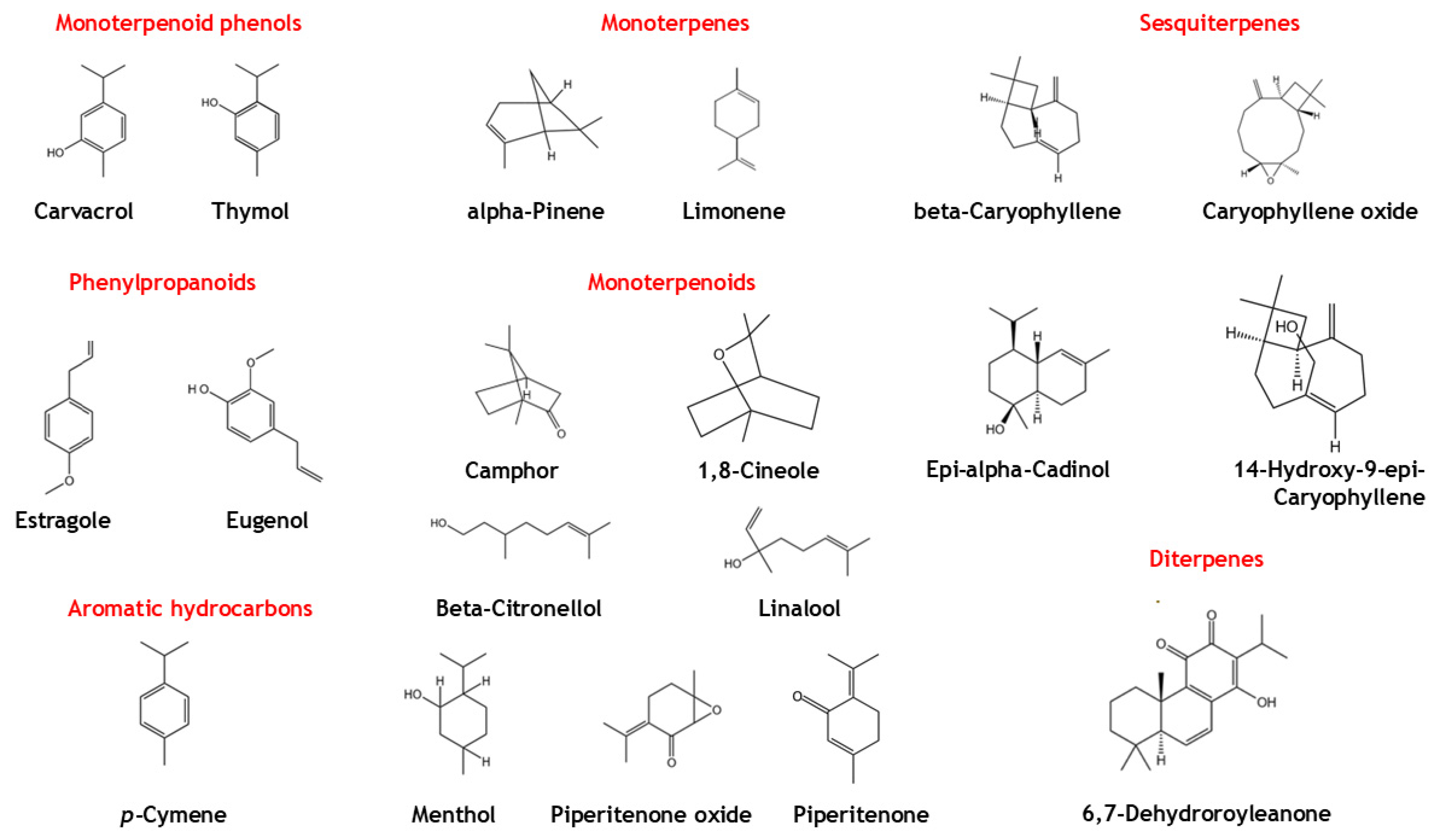
| EO | Main Compounds | MIC (μg/mL) | Experimental | Potential * | Ref. | ||
|---|---|---|---|---|---|---|---|
| H37Ra | H37Rv | Clinical Isolates | |||||
| Hyptis mutabilis syn. Cantinoua mutabilis, topical bushmint (Columbia) | fenchone (17.1%), 1,8-cineole (12.6%), β-caryophyllene (10.9%), bicyclogermacrene (8.7%) | - | 125 ± 0.01 | - | Colorimetric macrodilution | Good | [28] |
| Mentha longifolia, horse mint (India) | piperitenone oxide (45.9%), piperitone (17.5%), β-caryophyllene (10.2%), germacrene D (5%) | - | 0.8–1.6 | - | MABA | Highly active | [29] |
| Micromeria barbata (Lebanon) | unspecified | - | 1/1000 ** | 1/250 ** (MDR) | Broth microdilution | *** | [30] |
| Ocimum sanctum, holy basil, tulsi (India) | unspecified | - | 2.931 | 5.862 (S) 1.465–5.862 (MDR) | BD BACTEC MGIT | Highly active | [31] |
| Plectranthus amboinicus syn. Coleus amboinicus, Mexican mint (Brazil) | thymol (61.5%), β-pinene (11.2%), γ-terpinene (10.2%), caryophyllene (5.3%) | - | 351.6 ± 39.06 | - | REMA | Moderately active | [22] |
| Premna odorata (Egypt) | trans-caryophyllene (24.488–29.403%), β-phellandrene (11.701–22.930%), germacrene D (8.496–9.389%), Δ-cadinene (4.289–7.429%), α-humulene (3.529–7.016%), calamene (3.152–5.103%) | 100 μL/mL **** | - | - | MMA-ELISA | Good | [32] |
| Salvia aratocensis (Columbia) | epi-α-cadinol (20.1%), 1,10-di-epi-cubenol (14.2%), γ-cadinene (9.3%) | - | 62.5 | 49.6–99.2 (MDR) | Colorimetric macrodilution method | Highly active | [33] |
| Salvia aucheri subsp. aucheri, Turkish tea sage (Turkey) | 1,8-cineole (39.2%), camphor (20.7%) | 196 | - | - | MGIT fluorometric method | Good | [34] |
| Salvia tomentosa, balsamic sage (Turkey) | α-pinene (25.1%), camphor (14.9%), borneol (13.2%), 1,8-cineole (7%) | 196 | - | - | MGIT fluorometric method | Good | [34] |
| Satureja khuzestanica (Iran) | unspecified | - | 156 | 156 (MDR) | Broth microdilution | Good | [35] |
| Satureja rechingeri (Iran) | unspecified | - | 78 | 156 (MDR) | Broth microdilution | Highly active to Good | [35] |
| Tetradenia riparia, ginger bush (Brazil) | α-cadinol (13.81%), 14-hydroxy-9-epi-caryophyllene (12.70%), 6,7-dehydroroyleanone (12.51%) | - | 62.5 | 62.5 (S) 31.2–62.5 (MDR) | REMA | Highly active | [24] |
| Thymus vulgaris, common thyme (Iran) | unspecified | - | 0.5–40 | - | Unspecified | Highly active | [36] |
| Zataria multiflora, Shirazi thyme (Iran) | unspecified | - | 78 | 78 (MDR) | Broth microdilution | Highly active | [35] |
| Compound | Lamiaceae Plant Sources | MIC (μg/mL) | Experimental | Potential * | Ref. | ||
|---|---|---|---|---|---|---|---|
| H37Ra | H37Rv | Clinical Isolates | |||||
| Carvacrol | Origanum vulgare, Origanum dictamnus, Satureja hortensis, Satureja montana, Thymus vulgaris, Thymbra capitata | 64 | - | - | Broth microdilution | Good | [37] |
| - | 2.02 ± 0.88 | - | MABA | Highly active | [38] | ||
| - | 76 | 19–76 (MDR) | REMA | Weakly active to good | [39] | ||
| - | 6.249 | - | MABA | Highly active | [40] | ||
| (β)(trans)- Caryophyllene | Ocimum basilicum, Origanum vulgare, Melissa officinalis, Lavandula angustifolia, Rosmarinus officinalis, Salvia sp. | - | 100 | - | MABA | Weakly active | [38] |
| Caryophyllene oxide | Hyptis stricta, Melissa officinalis, Mentha piperita, Mentha longifolia, Salvia sp. | - | 200 | 100 (MDR) | MABA | Weakly active | [41] |
| (β)-Citronellol | Dracocephalum moldavica, Melissa officinalis, Plectranthus neochilus | - | 6.25 | - | MABA | Highly active | [38] |
| p-Cymene | Thymus vulgaris, Origanum vulgare, Ocimum gratissimum | - | 91.66 ± 14.43 | - | MABA | Weakly active | [38] |
| 6,7-Dehydroroyleanone | Tetradenia riparia | - | 31.2 | 31.2 | REMA | Good | [24] |
| >25 | ≤12.5 | Colorimetric MTT/ sulforhodamine B dye | Good to highly active | [42] | |||
| Estragole | Ocimum basilicum, Ocimum sp., Agastache rugosa | - | 20.83 ± 7.22 | - | MABA | Good | [38] |
| Eugenol | Ocimum sanctum, Ocimum gratissimum, Agastache rugosa, Agastache foeniculum | - | 25 | - | MABA | Good | [38] |
| - | 2.67 × 10³ | 2.67–10.68 × 10³ (S) 2.67–5.34 × 10³ (MDR) | BD BACTEC MGIT | Weakly active | [43] | ||
| - | 12.497 | - | MABA | Good | [40] | ||
| Limonene | Agastache urticifolia, Mentha sp., Dracocephalum sp., Rosmarinus sp. | 32 | - | - | Broth microdilution | Good | [44] |
| Linalool | Lavandula officinalis, Ocimum basilicum, Salvia sclarea | - | 33.33 ± 14.43 | - | MABA | Good | [38] |
| Menthol | Mentha piperita, Mentha arvensis | - | 41.66 ± 14.43 | - | MABA | Good | [38] |
| - | 24.987 | - | MABA | Good | [40] | ||
| Menthol-based ciprofloxacin derivatives | - | - | 0.5–1 | 8–16 (MDR) | Broth microdilution MABA | Highly active | [27] |
| α-Pinene | Rosmarinus officinalis, Salvia officinalis, Mentha piperita, Hyptis sp. | 128 | - | - | Broth microdilution | Weakly active | [37] |
| - | - | ≥512 | Serial dilution | Weakly active | [45] | ||
| Thymol | Thymus vulgaris, Thymus sp., Origanum sp., Satureja hortensis, Satureja montana | - | 0.78 ± 0.01 | - | MABA | Highly active | [38] |
| - | 50 | - | MABA | Good | [40] | ||
| Thymol and carvacrol | Thymus sp., Origanum sp. | - | - | 100 | MABA | Weakly active | [46] |
| Thymol-based ciprofloxacin derivatives | - | - | 0.5 | 16–32 (MDR) | Broth microdilution MABA | Highly active to good | [27] |
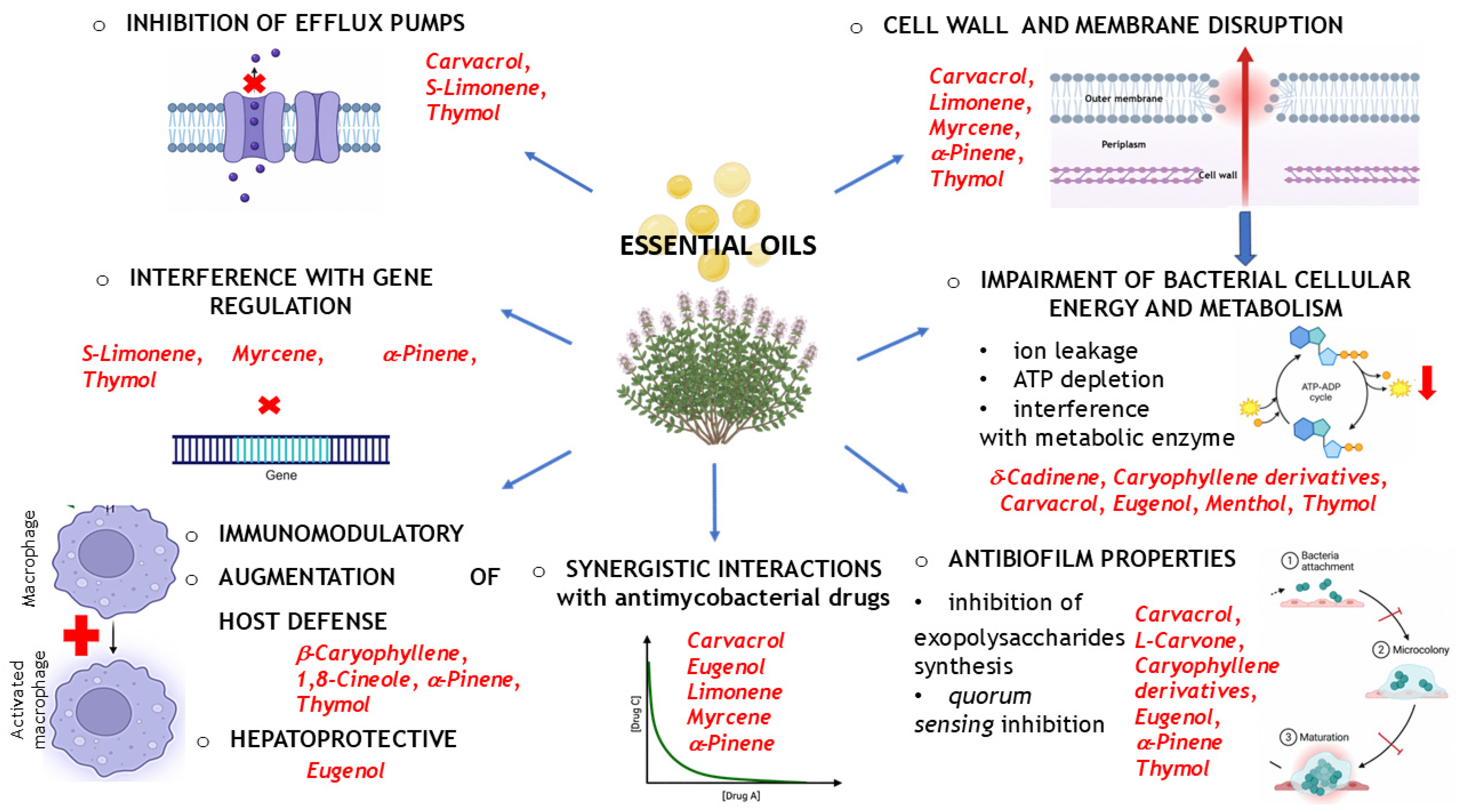
| Enzyme | Function | Compound | IC50/Activity | Ref. |
|---|---|---|---|---|
| Chorismate mutase (CM) | Aromatic amino acid biosynthesis; Modulation of cytokine response; Bacterial virulence | Carvacrol | 1.06 ± 0.4 μM | [40,52] |
| Thymol | 28.4 ± 2.4 μM | |||
| Menthol | 26.38 ± 2.1 μM | |||
| Eugenol | 28.58 ± 1.7 μM | |||
| Enoyl-acyl carrier protein reductase (InhA) | Biosynthesis of fatty acids and lipids of the cell envelope | Caryophyllene oxide, δ-cadinene | Higher affinities than triclosan, a standard inhibitor | [48] |
| α-Terpinyl acetate | Comparable affinity for enzyme inhibition as isoniazid | [53] | ||
| Mycobacterial proteasomal ATP-ase (Mpa) | Degradation of damaged/ unnecessary proteins; Bacterial survival during hostile conditions | Germacrene D, τ-cadinol, δ-cadinene | Higher affinities than oxathiazol-2-one, a standard inhibitor | [48] |
| Decaprenylphosphoryl-d-ribose oxidase (DprE1) | Cell wall synthesis | R-Limonene | Down-regulation of gene expression; Decrease gene transcript levels | [44] |
| clgR | Preservation of cell membrane integrity and tolerance to surface stress; Macrophage infection; Stress-sensing marker | R-limonene | Increases gene expression similar to the positive control (sodium dodecyl sulfate) | [44] |
| EmbA-EmbB-AcpM2 arabinosyltransferase complex (EmbA-EmbB) | Cell wall synthesis Biological target for ethambutol | Caryophyllene oxide, trans-caryophyllene | Inhibition of the enzyme and its MDR-mutant variant | [54] |
| Compound | Antimycobacterial Drug | Interaction | FICI | M. tuberculosis | Ref. |
|---|---|---|---|---|---|
| Carvacrol | Isoniazid | Additive | 0.75 | H37Rv | [39] |
| Rifampicin | Synergism | 0.25–0.40 | MDR | ||
| Ethambutol | Additive | 0.60 | MDR | ||
| Eugenol | Ethambutol | Additive | 0.62 | H37Rv | [78] |
| Rifampicin | Synergism | 0.25 | H37Rv | ||
| Rifampicin | Synergism | 0.132–0.5 | MDR | ||
| Isoniazid | Synergism | 0.26–0.43 | MDR | ||
| Ethambutol | Synergism | 0.31–0.5 | MDR | ||
| Pyrazinamide | Synergism | 0.31–0.37 | MDR | ||
| (R)-Limonene | Ethambutol | Synergism | 0.30 | H37Ra | [45] |
| Rifampicin | Synergism | 0.10 | H37Ra | ||
| (S)-Limonene | Ethambutol | Synergism | 0.10 | H37Ra | |
| Isoniazid | Additive | 0.60 | H37Ra | ||
| Rifampicin | Synergism | 0.10 | H37Ra | ||
| Myrcene | Ethambutol | Synergism | 0.20 | H37Ra | |
| Rifampicin | Synergism | 0.10 | H37Ra | ||
| α-Pinene | Rifampicin | Synergism | 0.10 | H37Ra |
Disclaimer/Publisher’s Note: The statements, opinions and data contained in all publications are solely those of the individual author(s) and contributor(s) and not of MDPI and/or the editor(s). MDPI and/or the editor(s) disclaim responsibility for any injury to people or property resulting from any ideas, methods, instructions or products referred to in the content. |
© 2026 by the authors. Licensee MDPI, Basel, Switzerland. This article is an open access article distributed under the terms and conditions of the Creative Commons Attribution (CC BY) license.
Share and Cite
Aprotosoaie, A.C.; Lipovanu, M.; Grădinaru, A.C.; Miron, A. Essential Oils of Lamiaceae Species as Promising Sources of Antimycobacterial Agents: Current Insights, Challenges, and Future Perspectives. Molecules 2026, 31, 3295. https://doi.org/10.3390/molecules31183295
Aprotosoaie AC, Lipovanu M, Grădinaru AC, Miron A. Essential Oils of Lamiaceae Species as Promising Sources of Antimycobacterial Agents: Current Insights, Challenges, and Future Perspectives. Molecules. 2026; 31(18):3295. https://doi.org/10.3390/molecules31183295
Chicago/Turabian StyleAprotosoaie, Ana Clara, Mihaela Lipovanu, Adina Catinca Grădinaru, and Anca Miron. 2026. "Essential Oils of Lamiaceae Species as Promising Sources of Antimycobacterial Agents: Current Insights, Challenges, and Future Perspectives" Molecules 31, no. 18: 3295. https://doi.org/10.3390/molecules31183295
APA StyleAprotosoaie, A. C., Lipovanu, M., Grădinaru, A. C., & Miron, A. (2026). Essential Oils of Lamiaceae Species as Promising Sources of Antimycobacterial Agents: Current Insights, Challenges, and Future Perspectives. Molecules, 31(18), 3295. https://doi.org/10.3390/molecules31183295