
Diterpenes with Abietane and Clerodane Skeletons from the Mexican Salvia Species as Potential Bioactive Compounds
 , , , , , , ,
  and
and
Abstract
1. Introduction
2. Materials and Methods
3. Results
3.1. Chemical Compounds Found and Isolated from Mexican Salvia Species
3.2. Diterpenoids
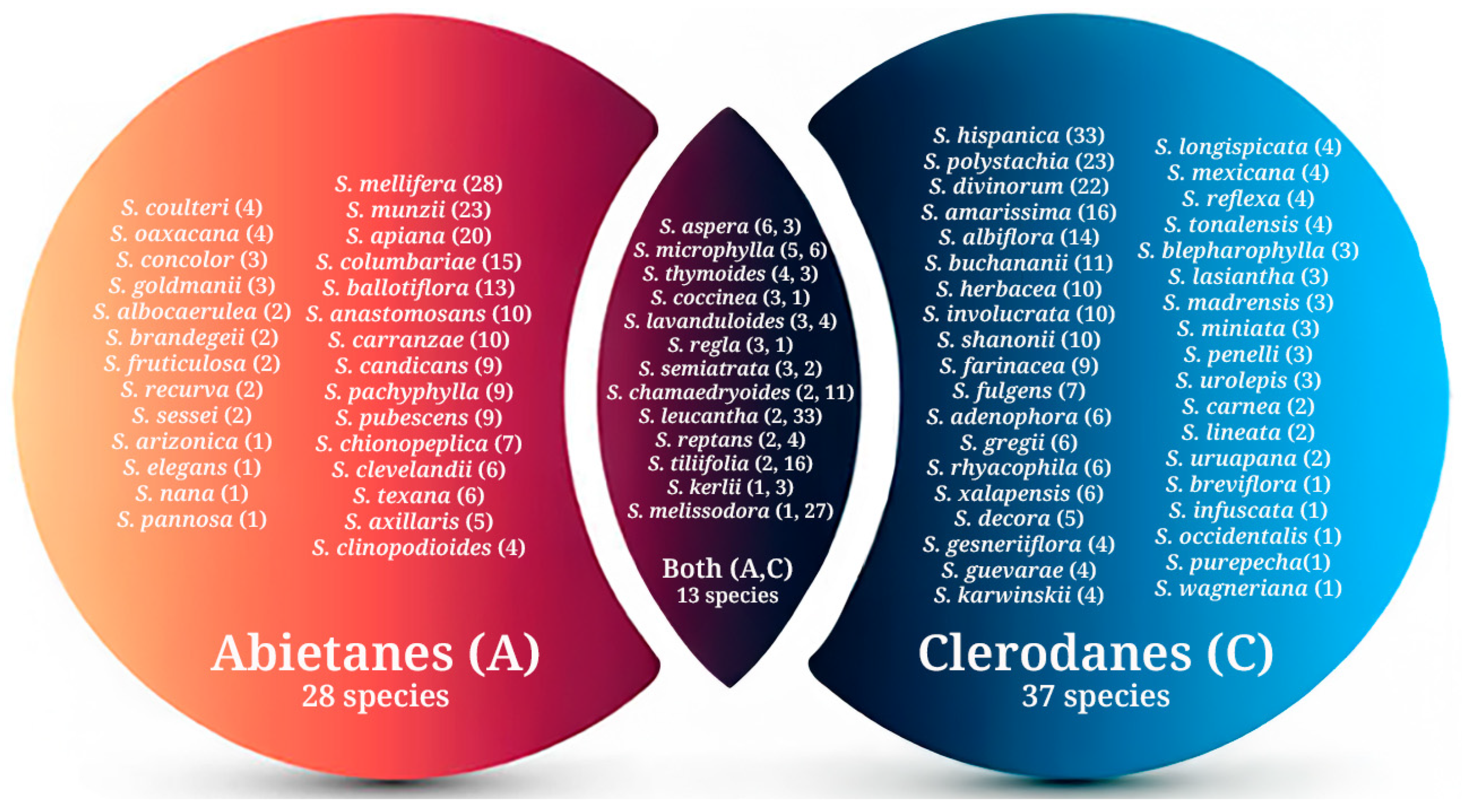
3.3. Abietanes and Clerodanes
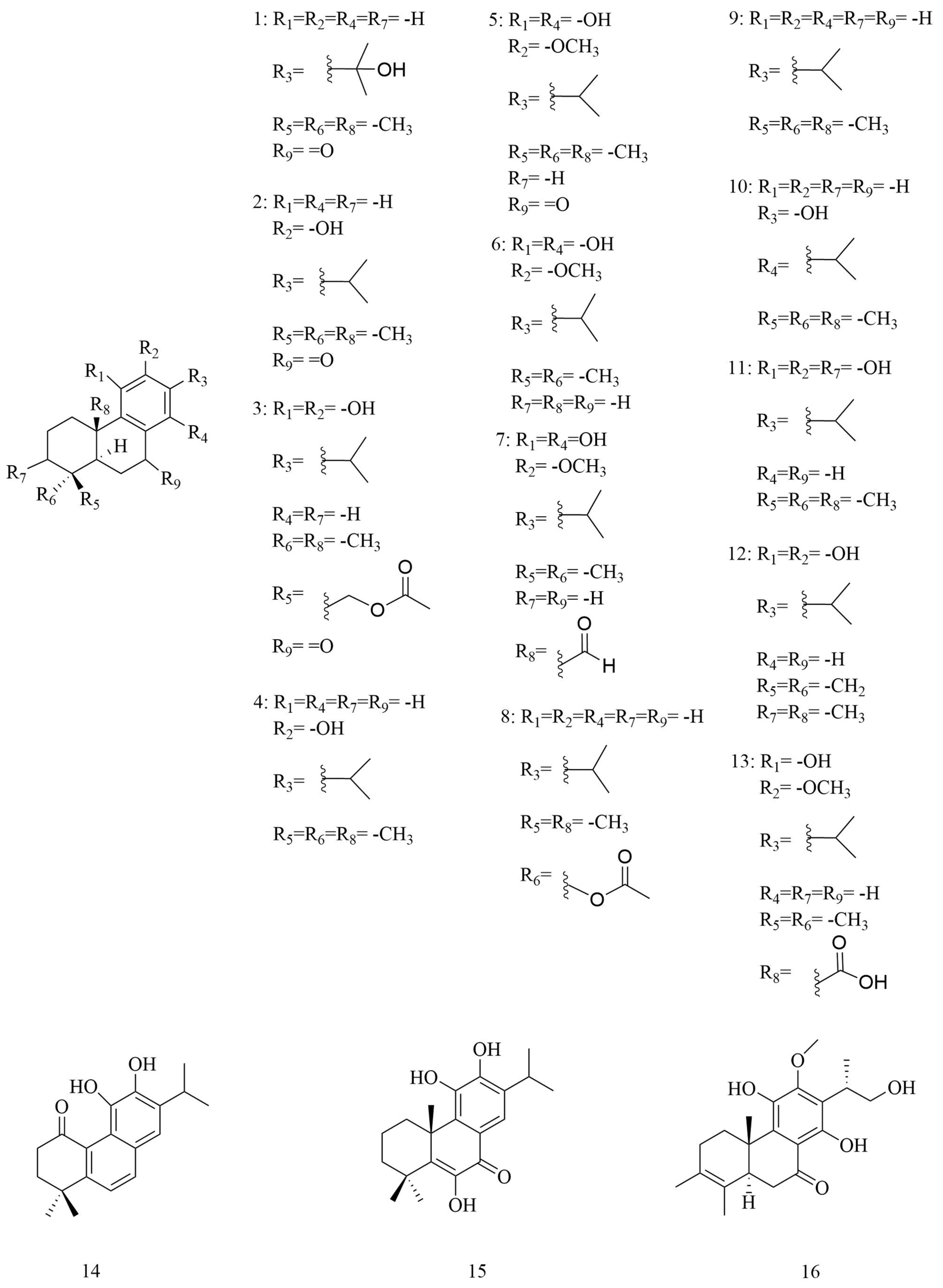
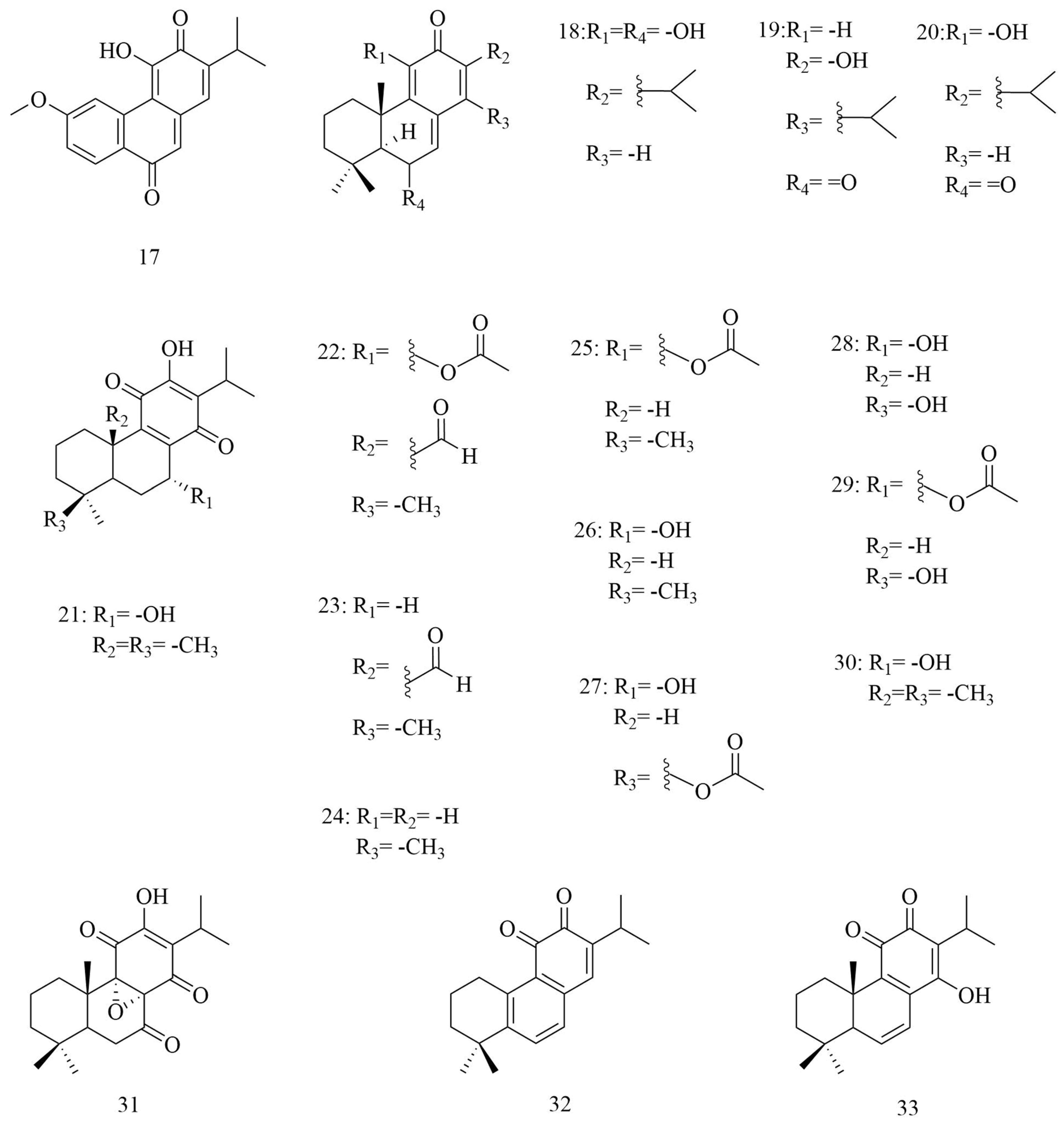
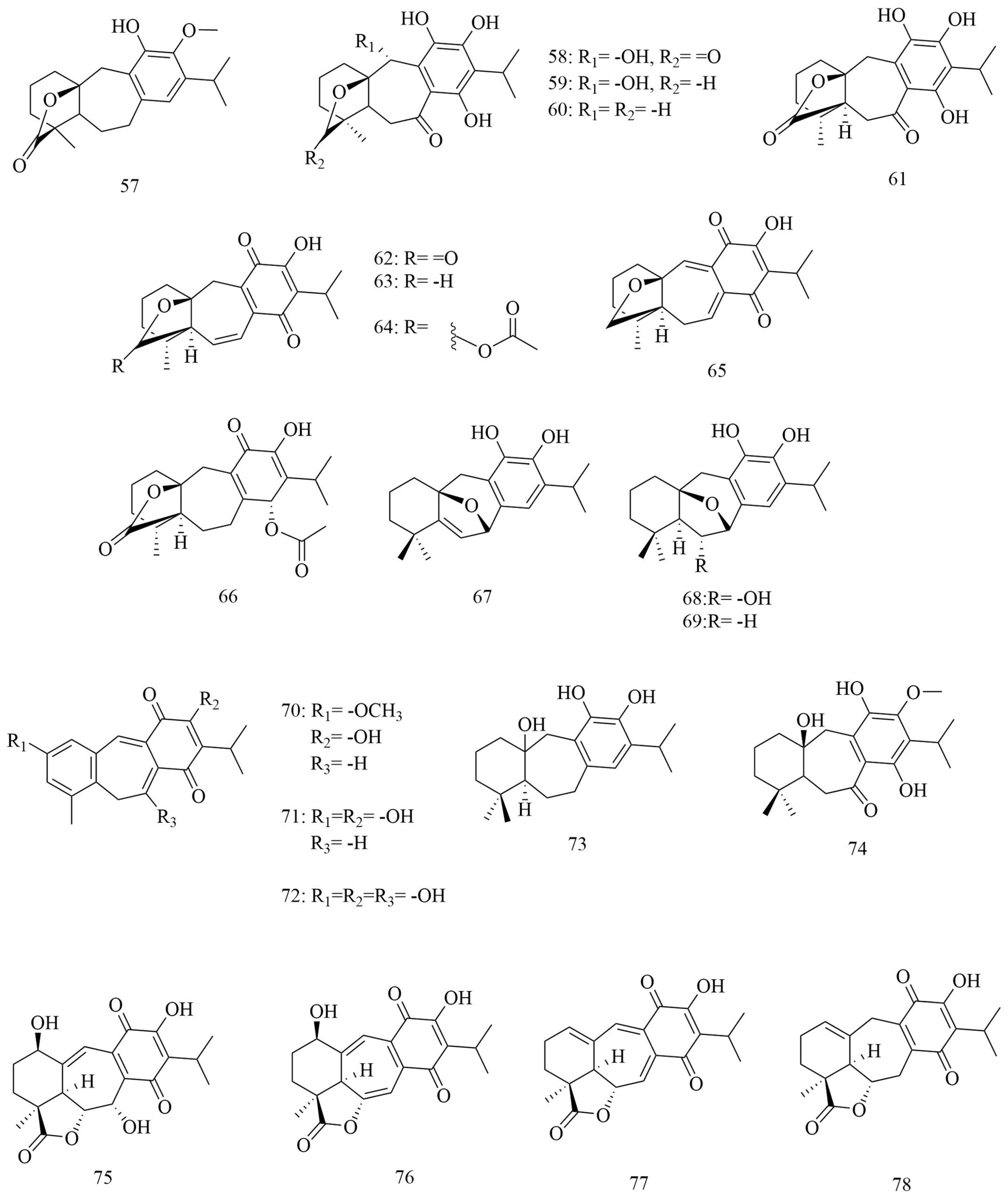
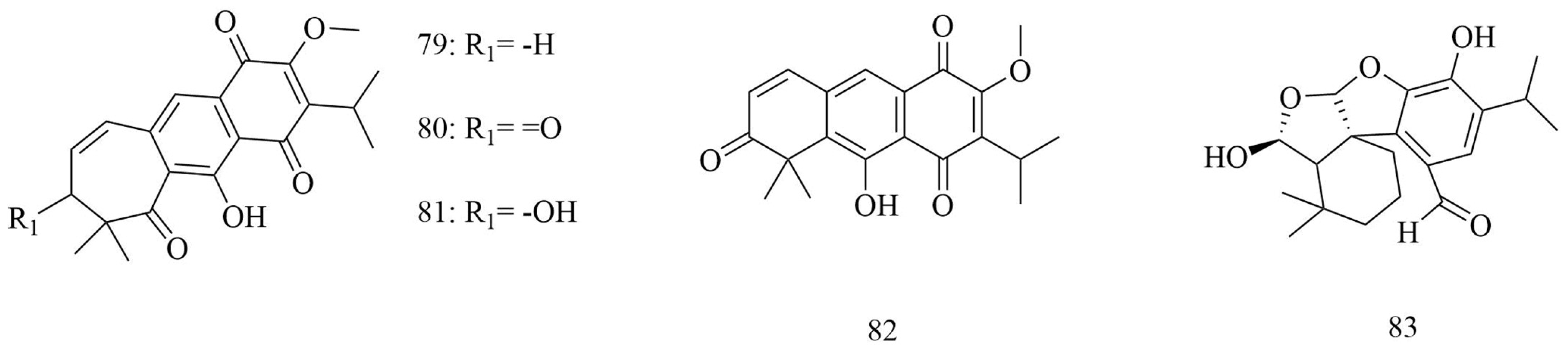
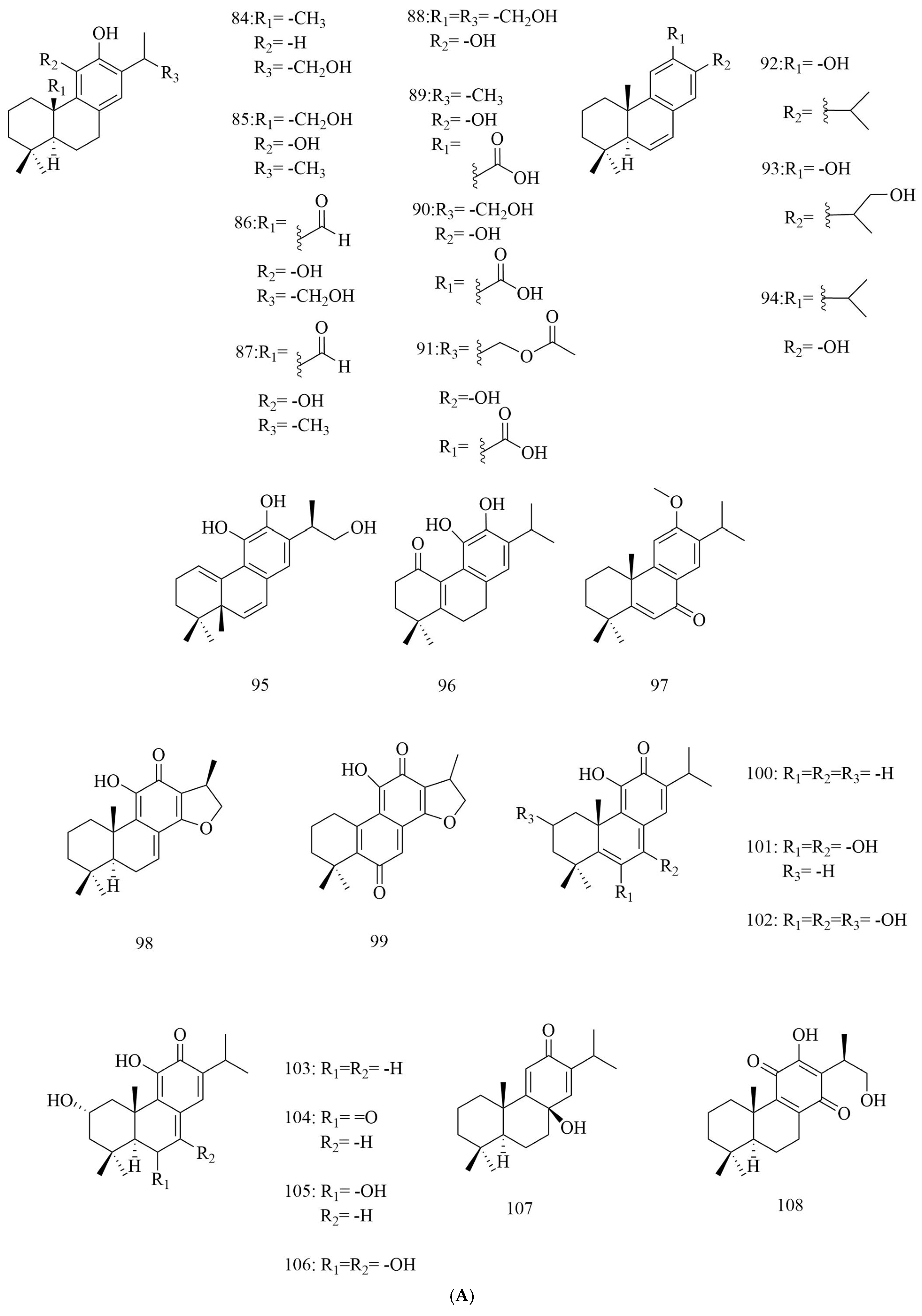
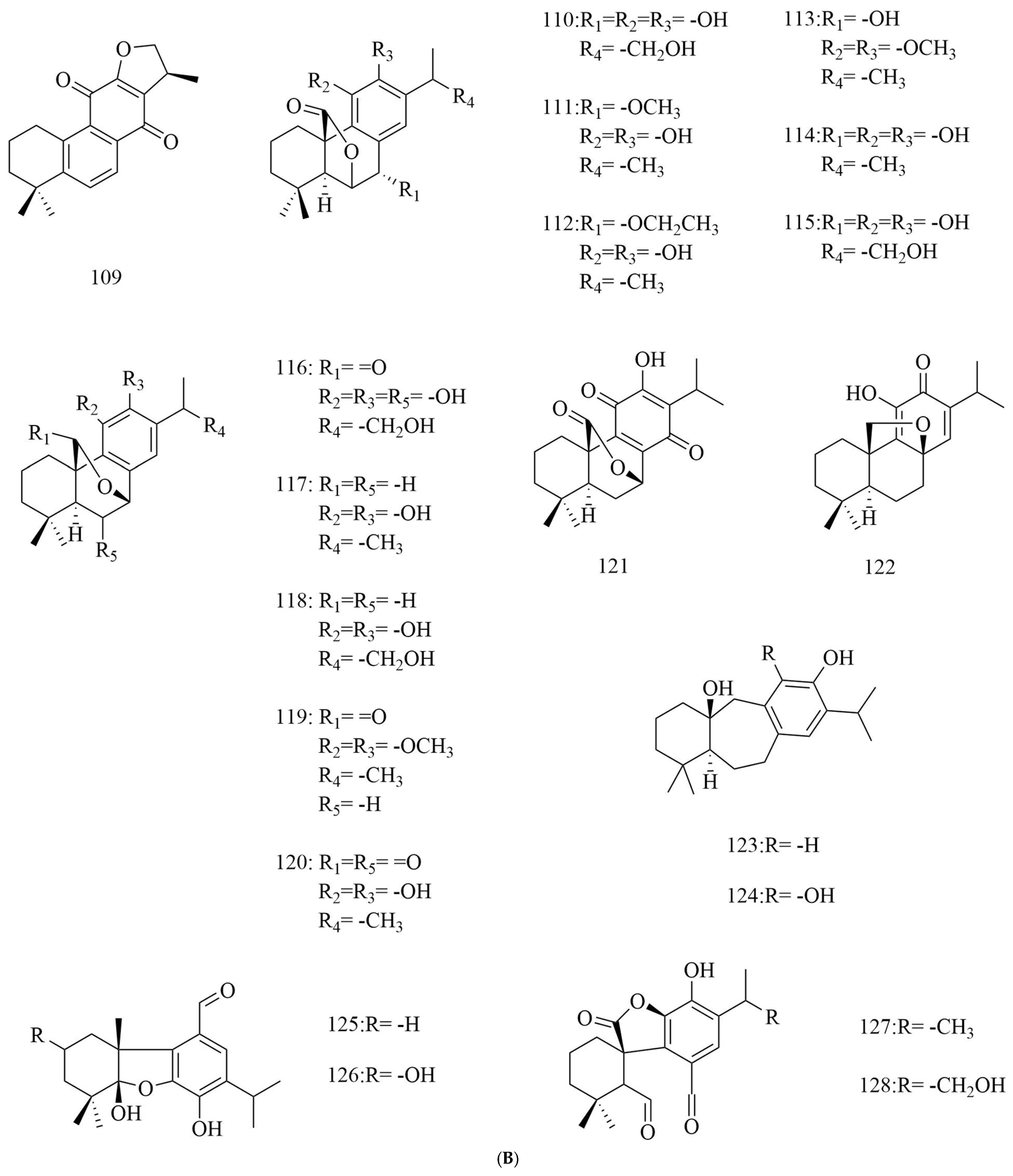
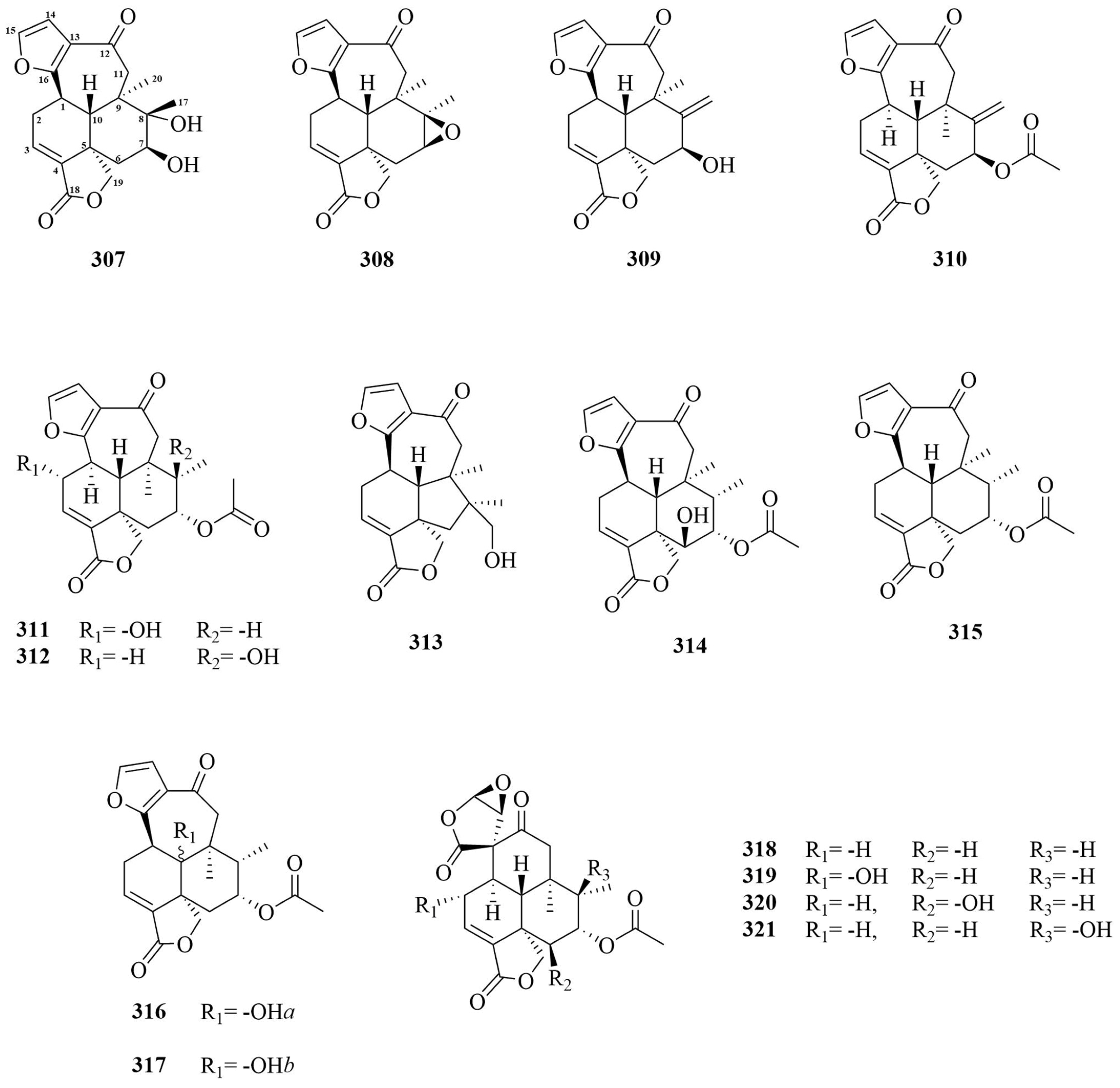
3.4. Abietane Diterpenes from Salvia Species
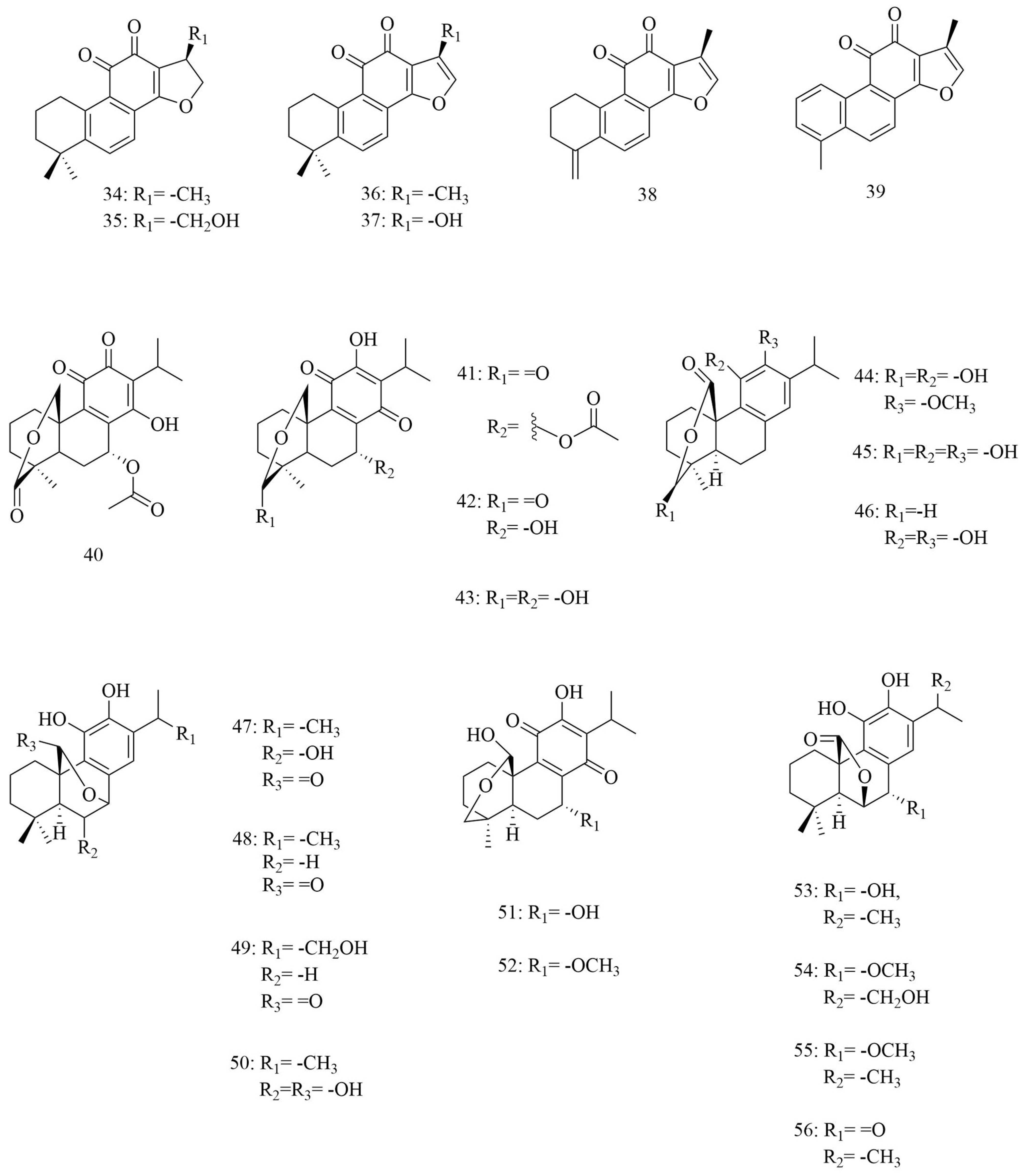
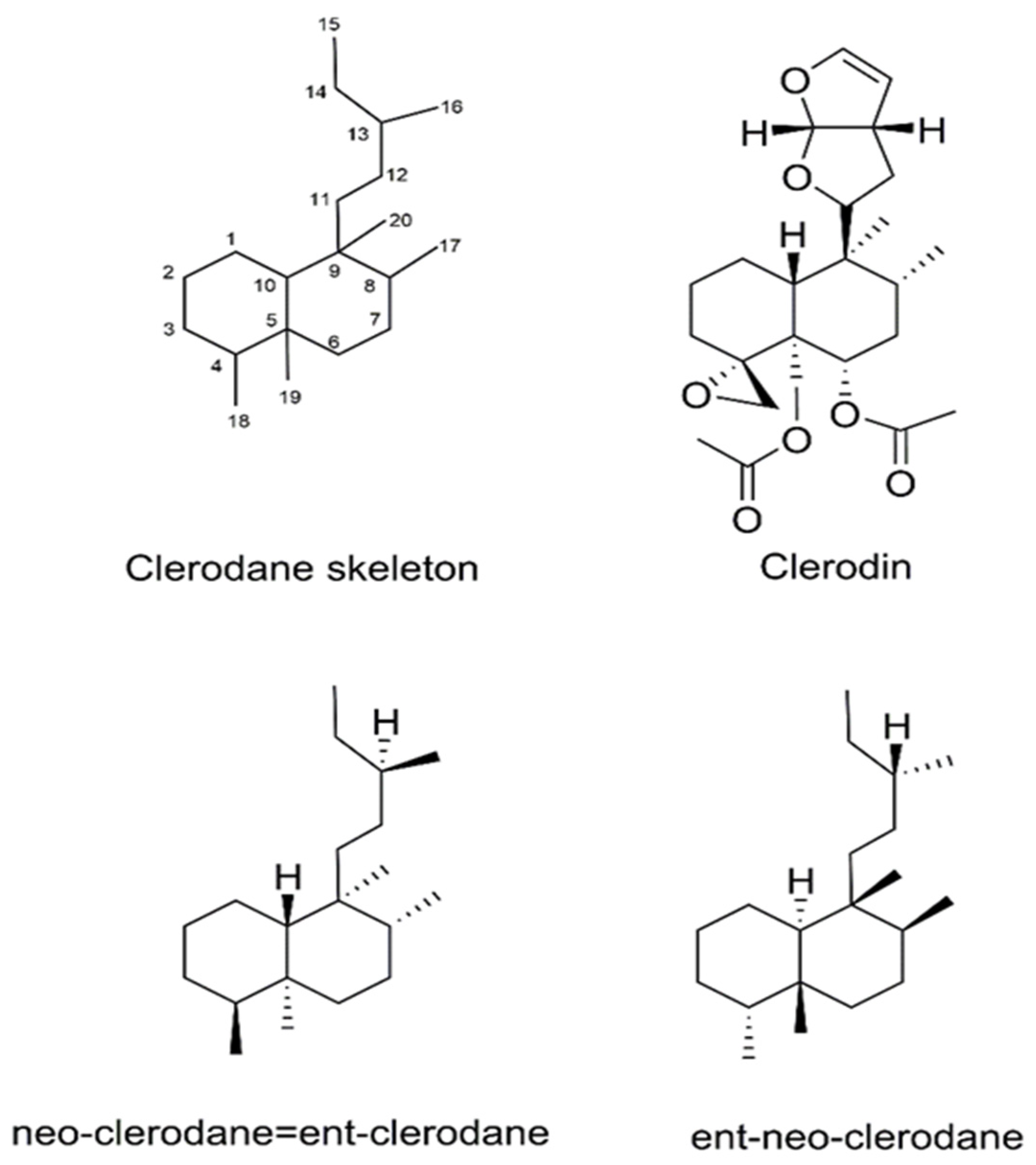
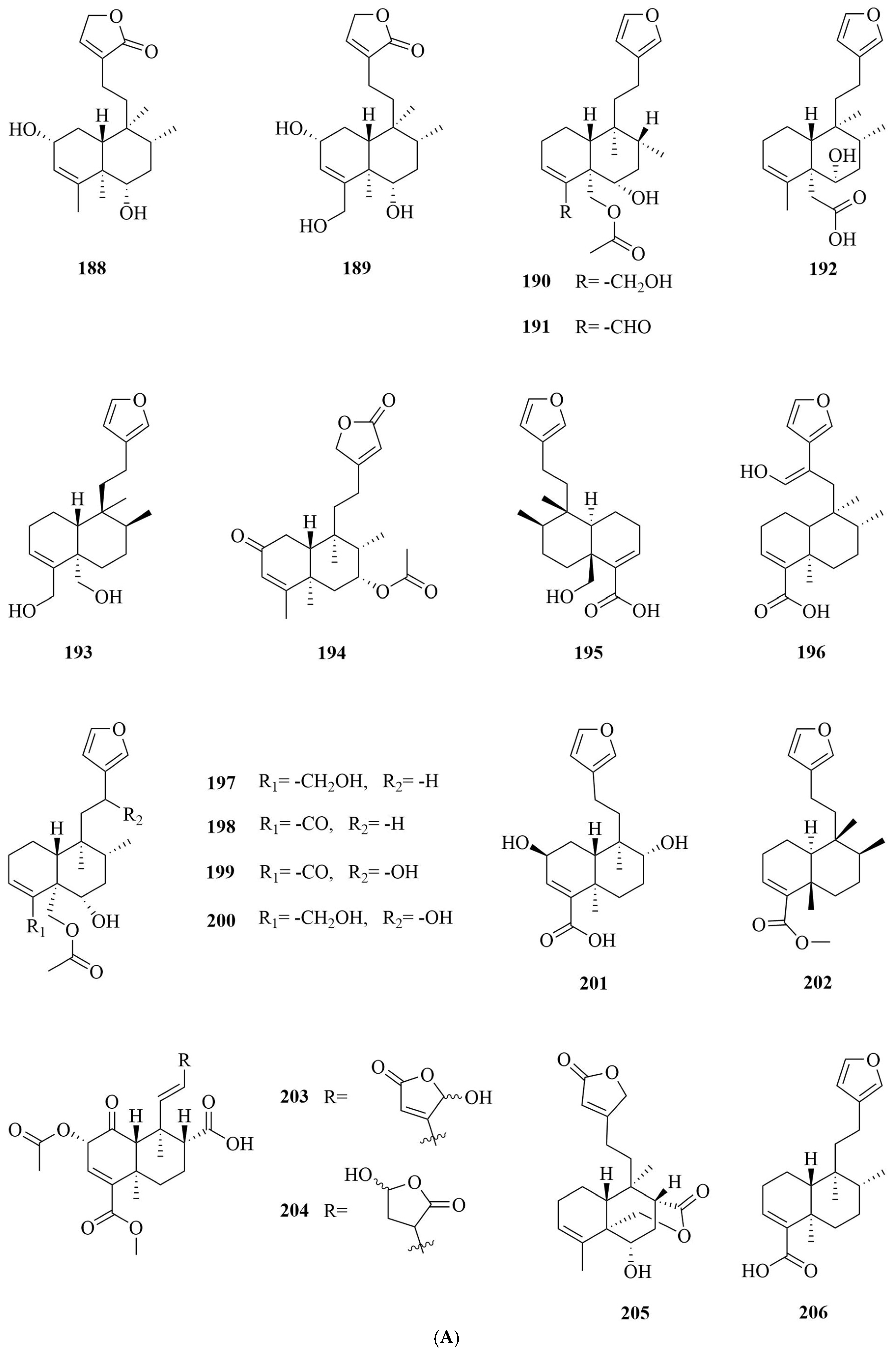
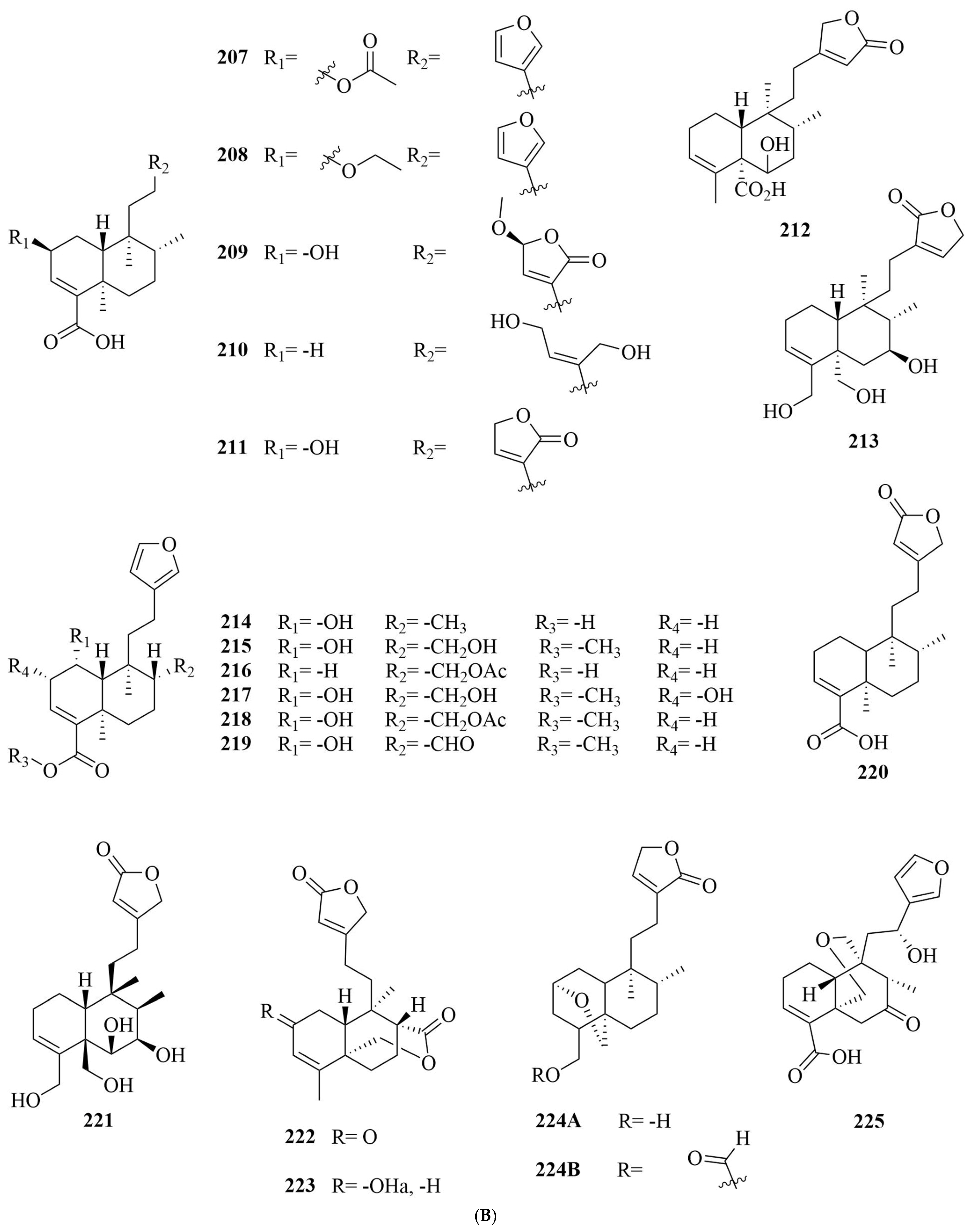
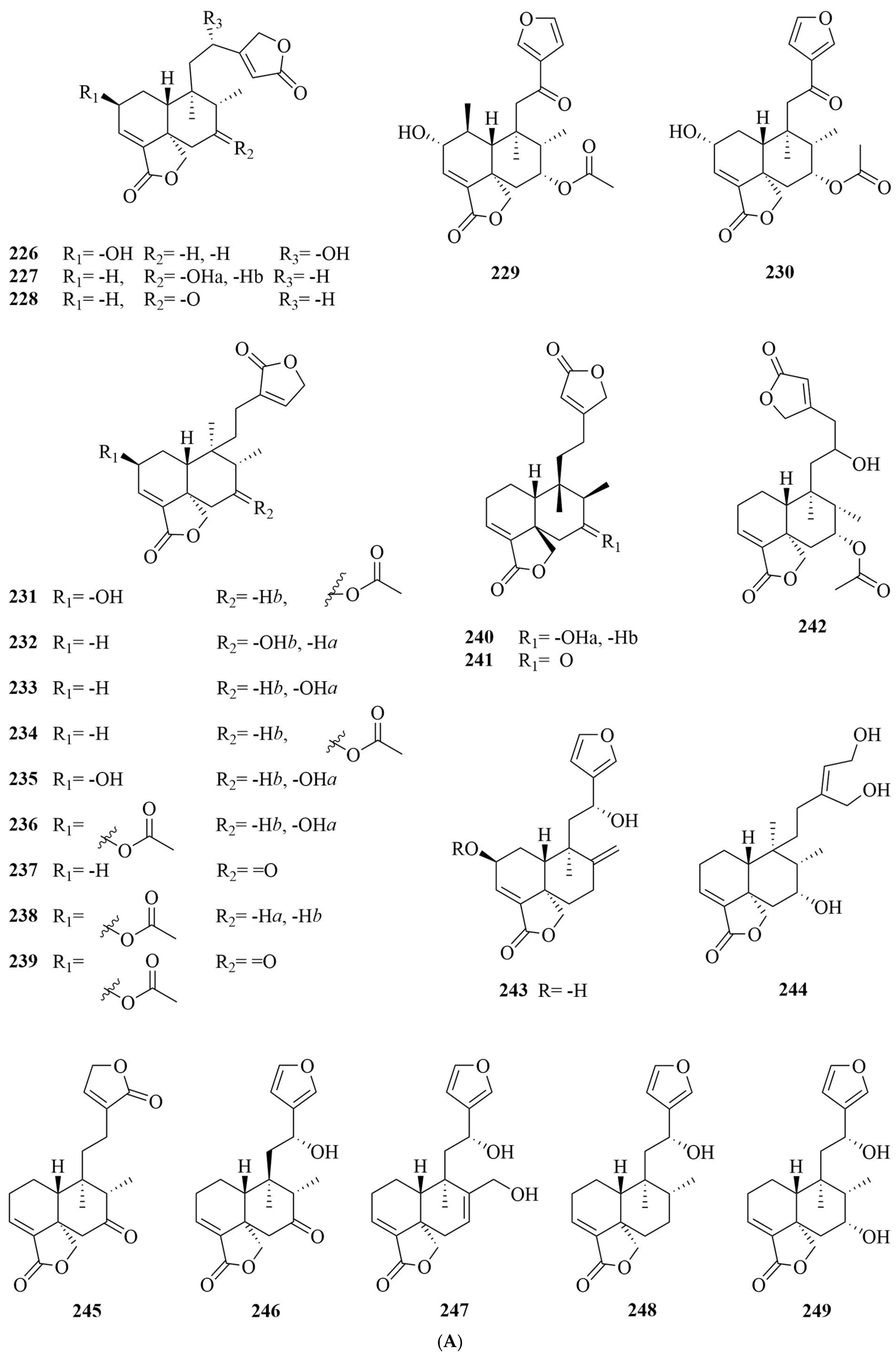
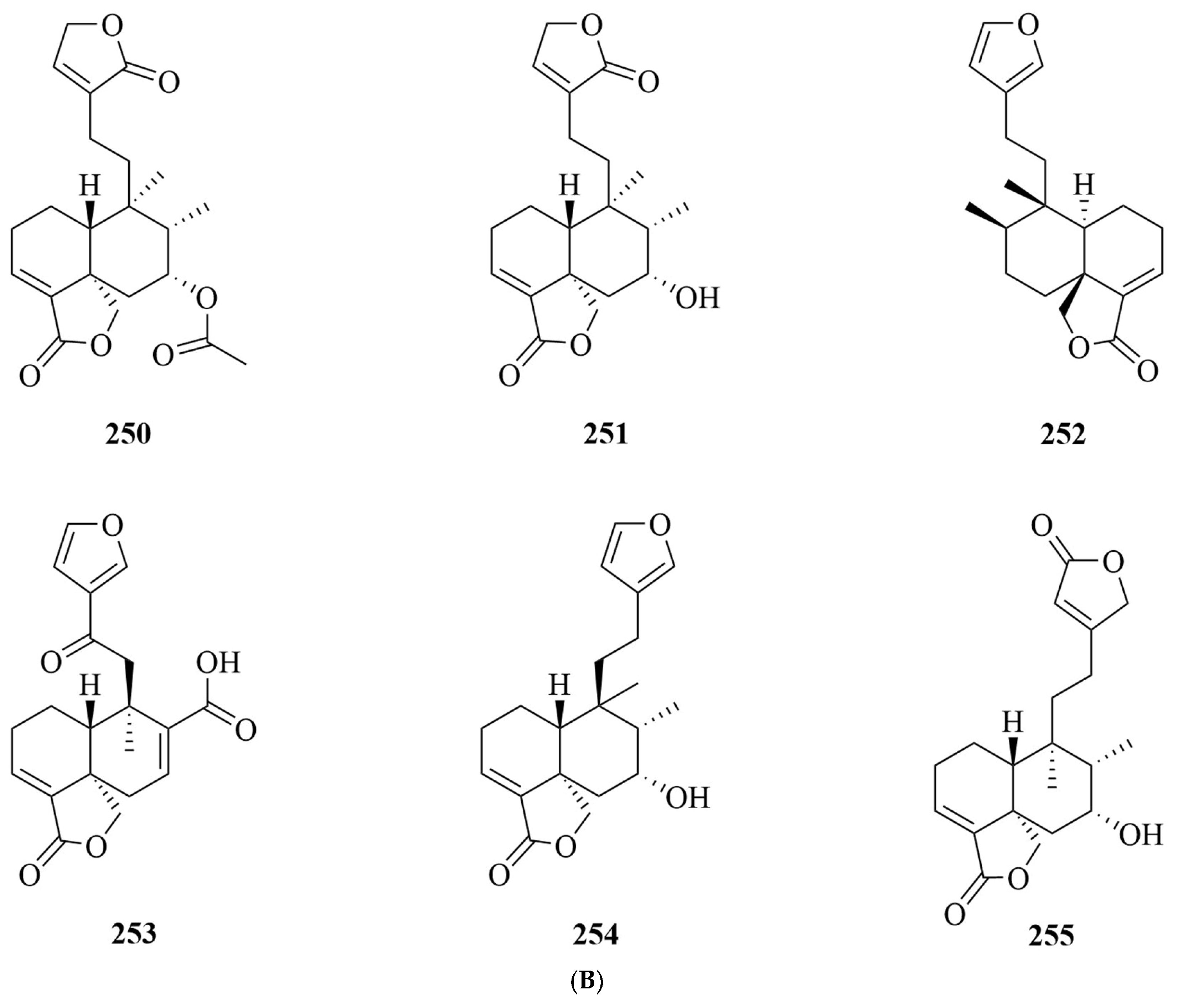
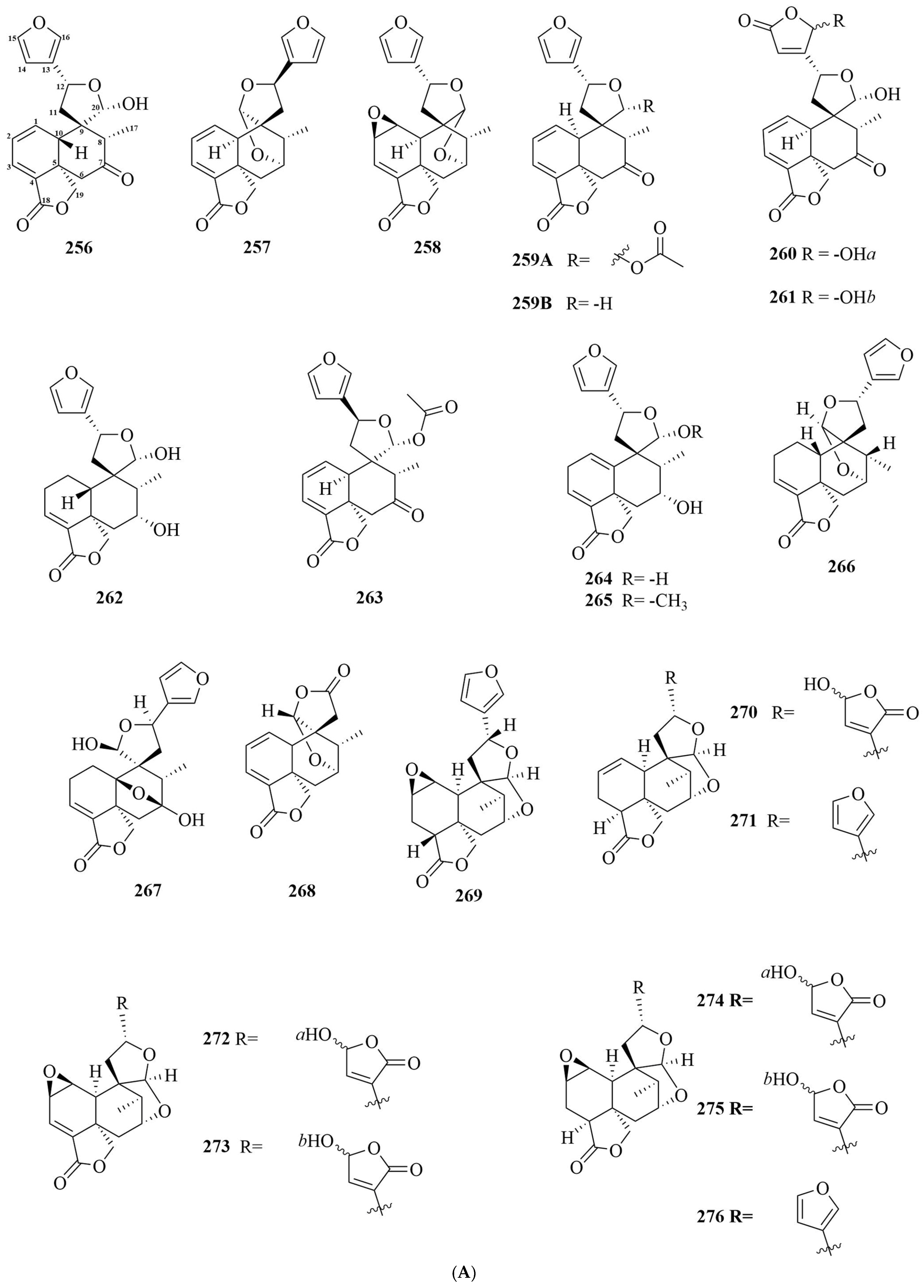
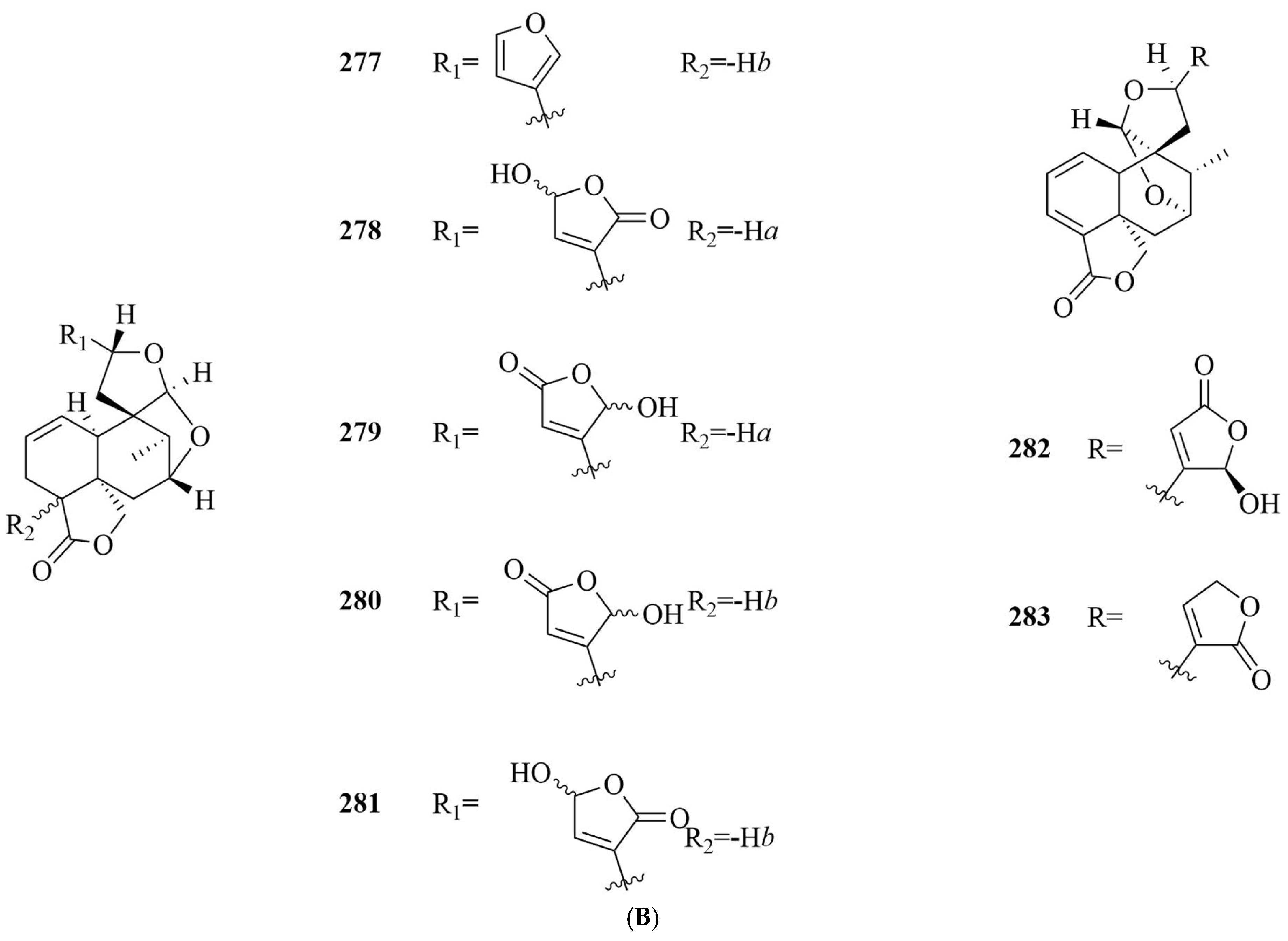
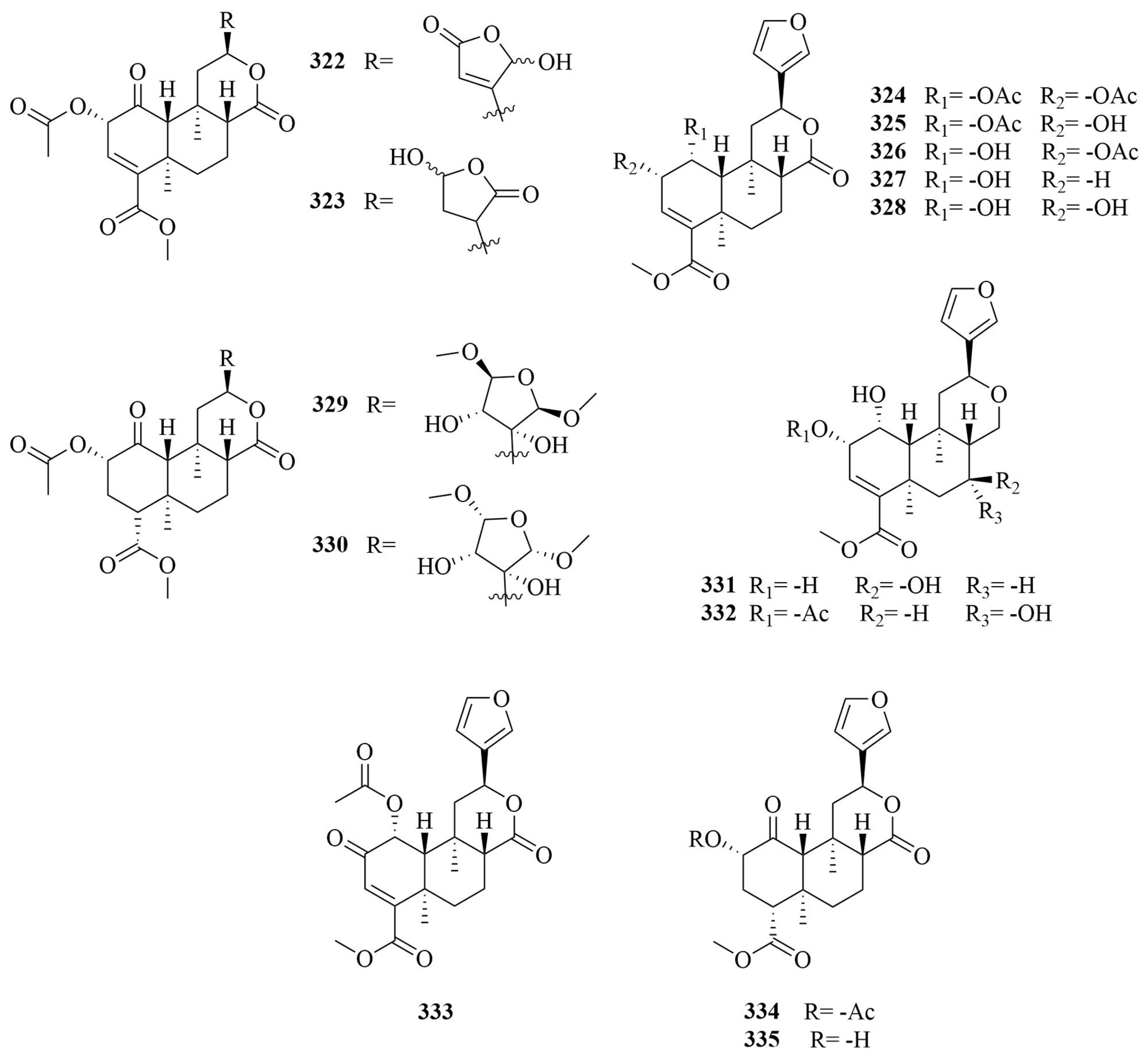
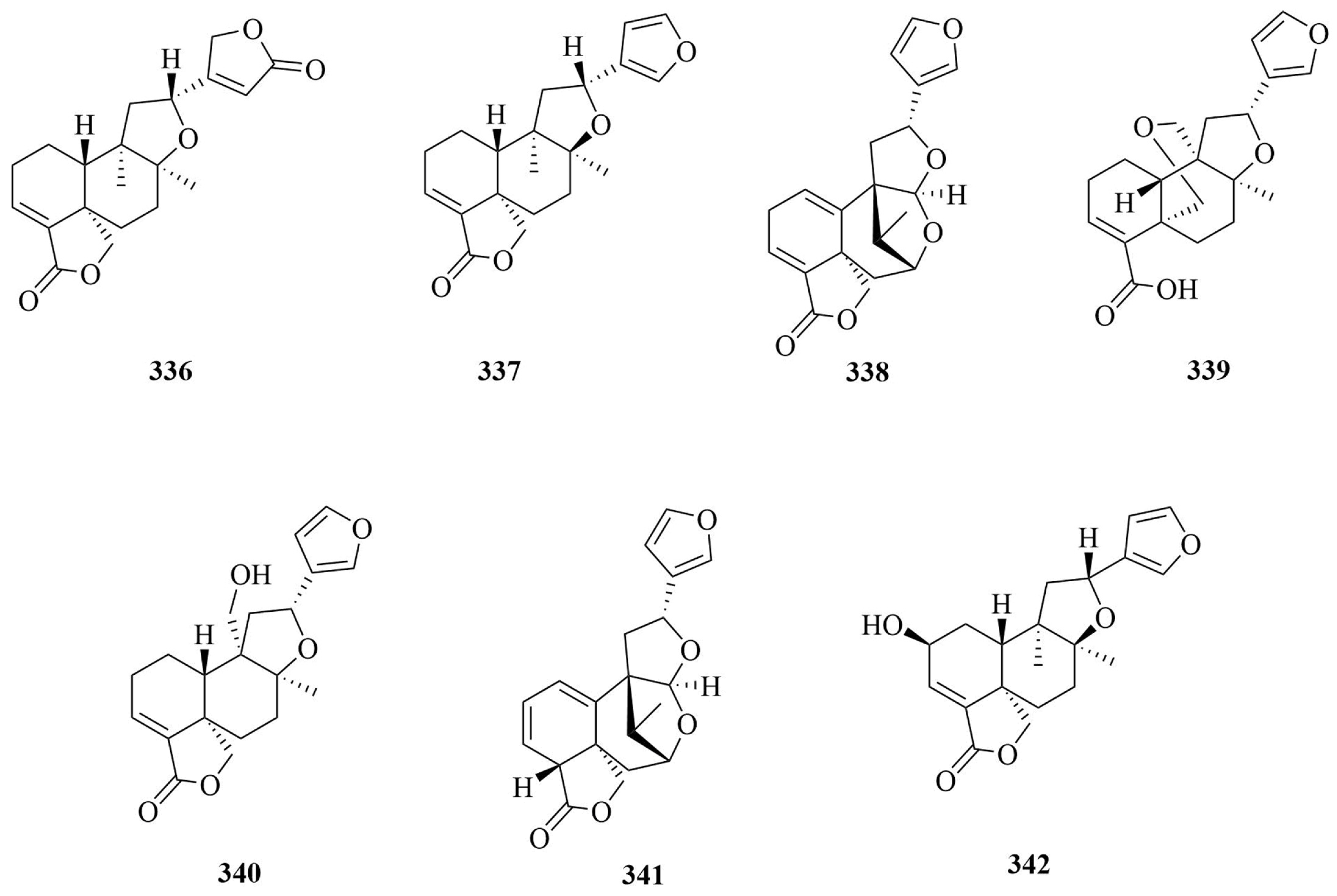
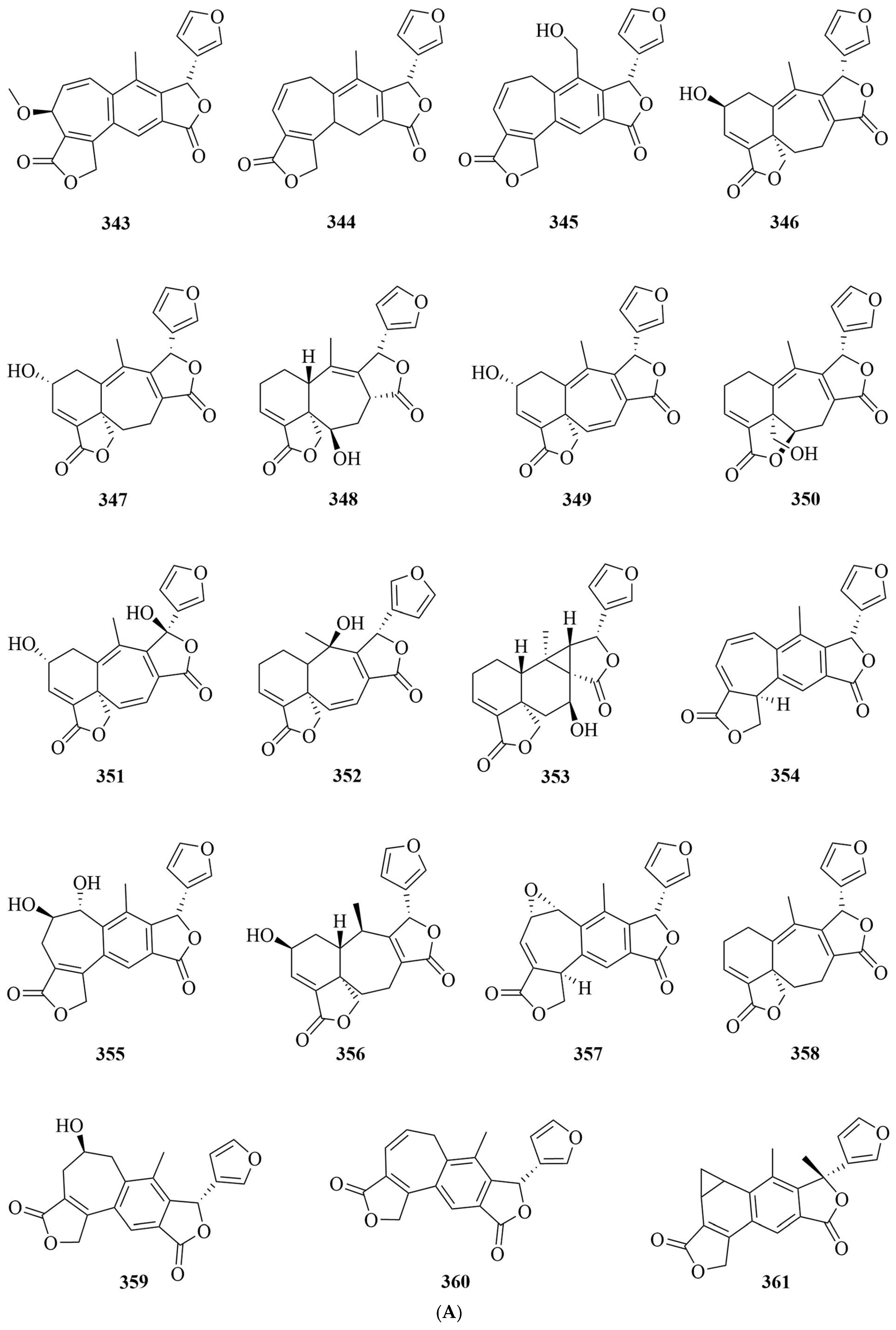
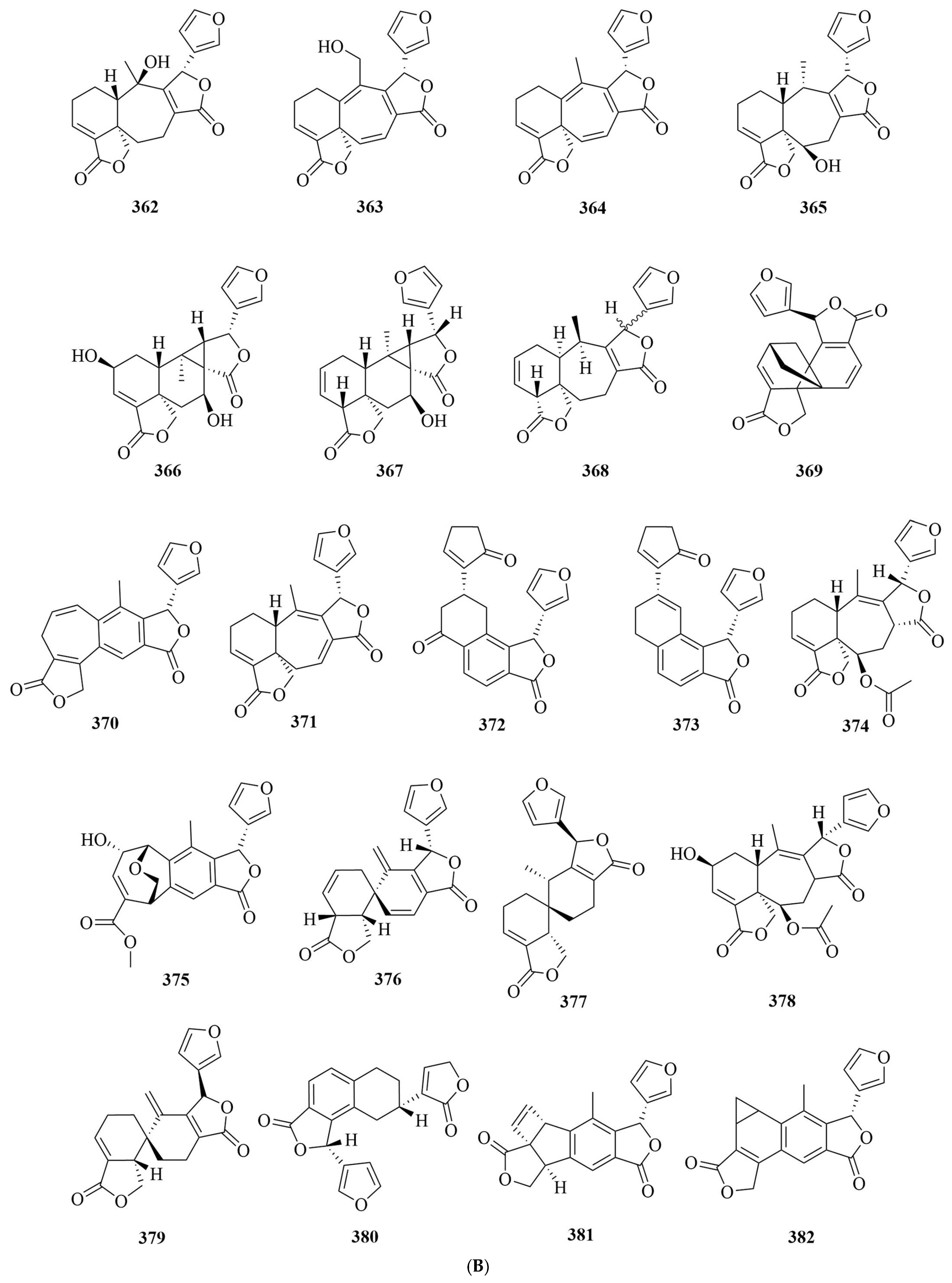
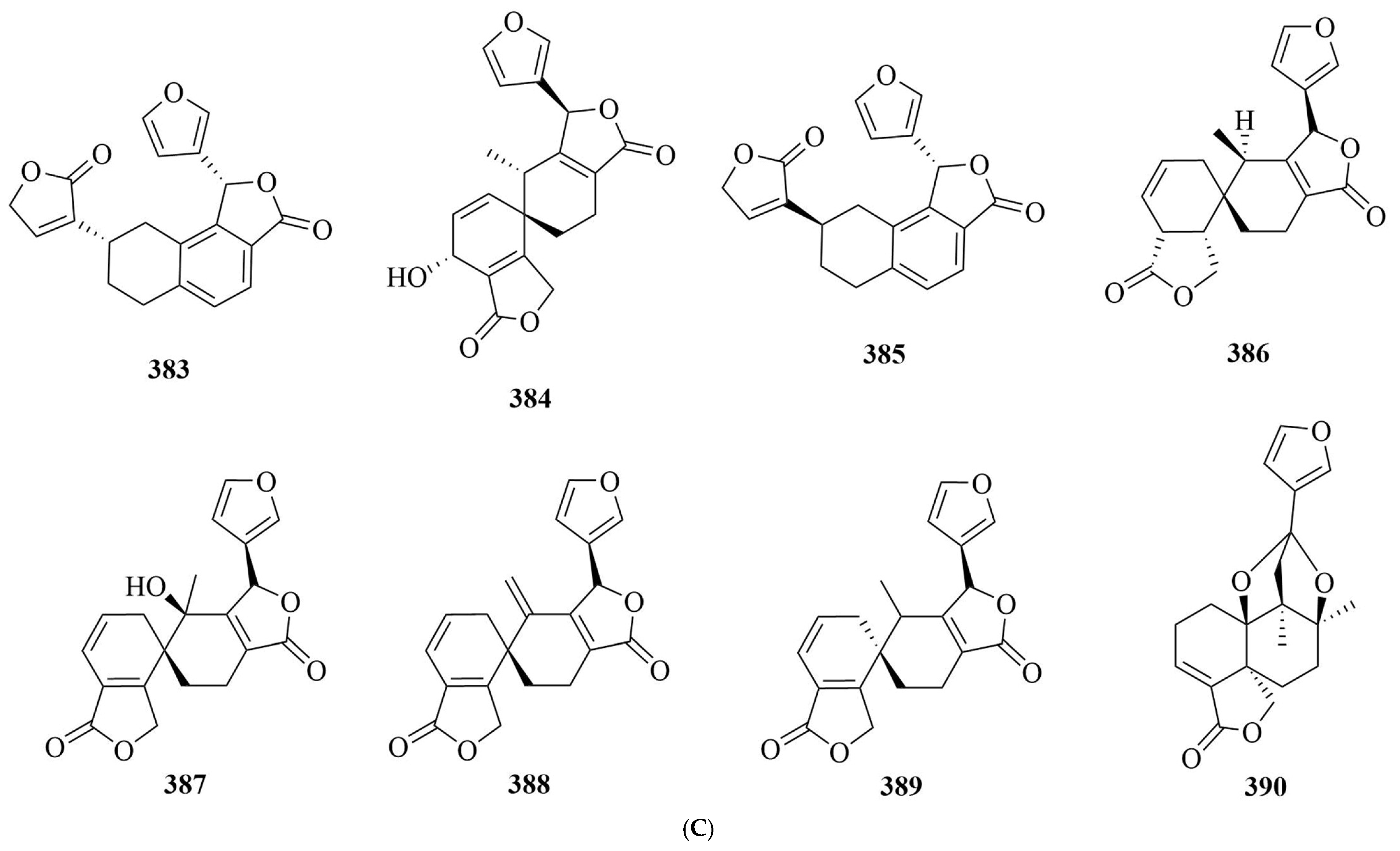
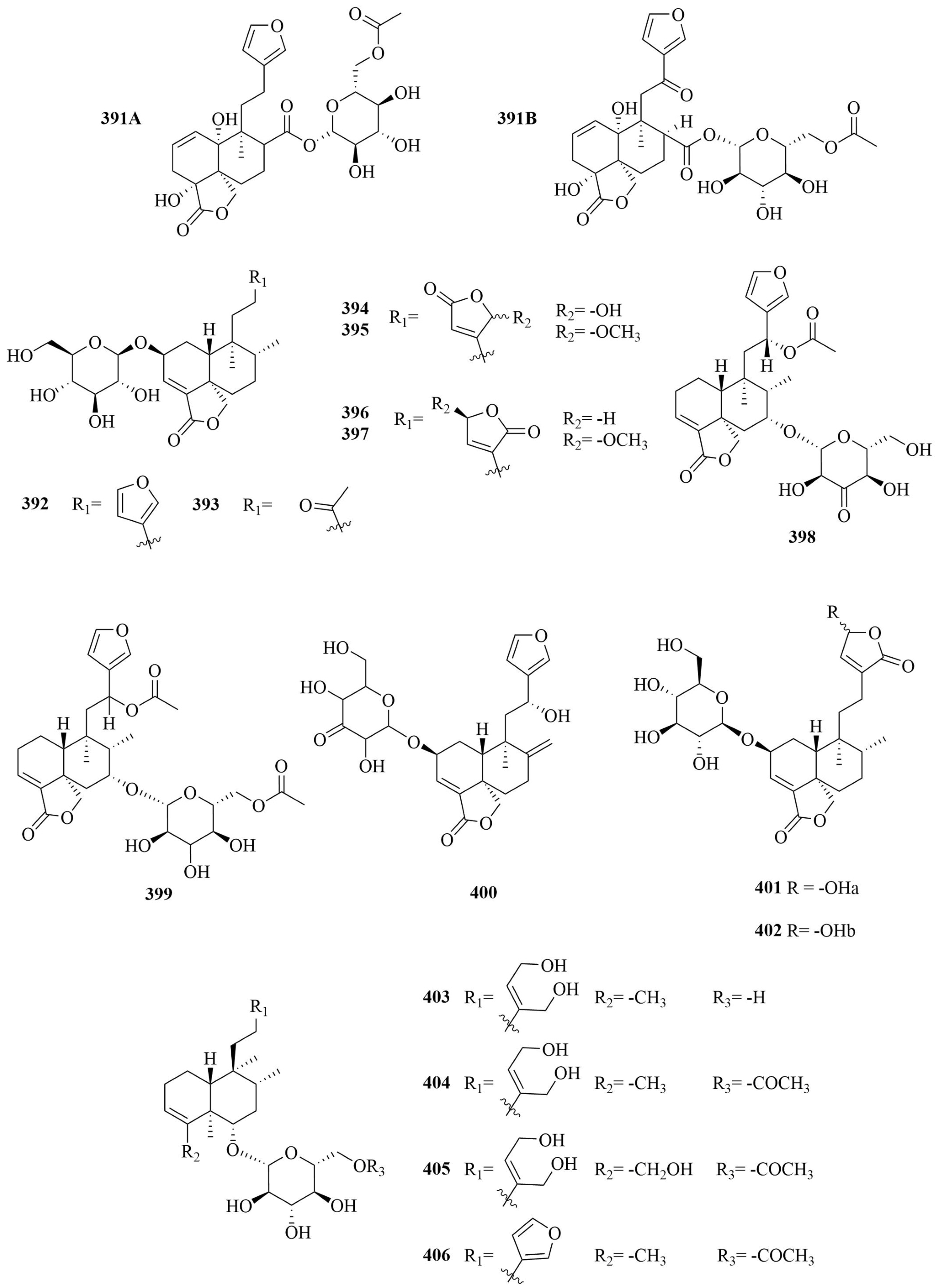
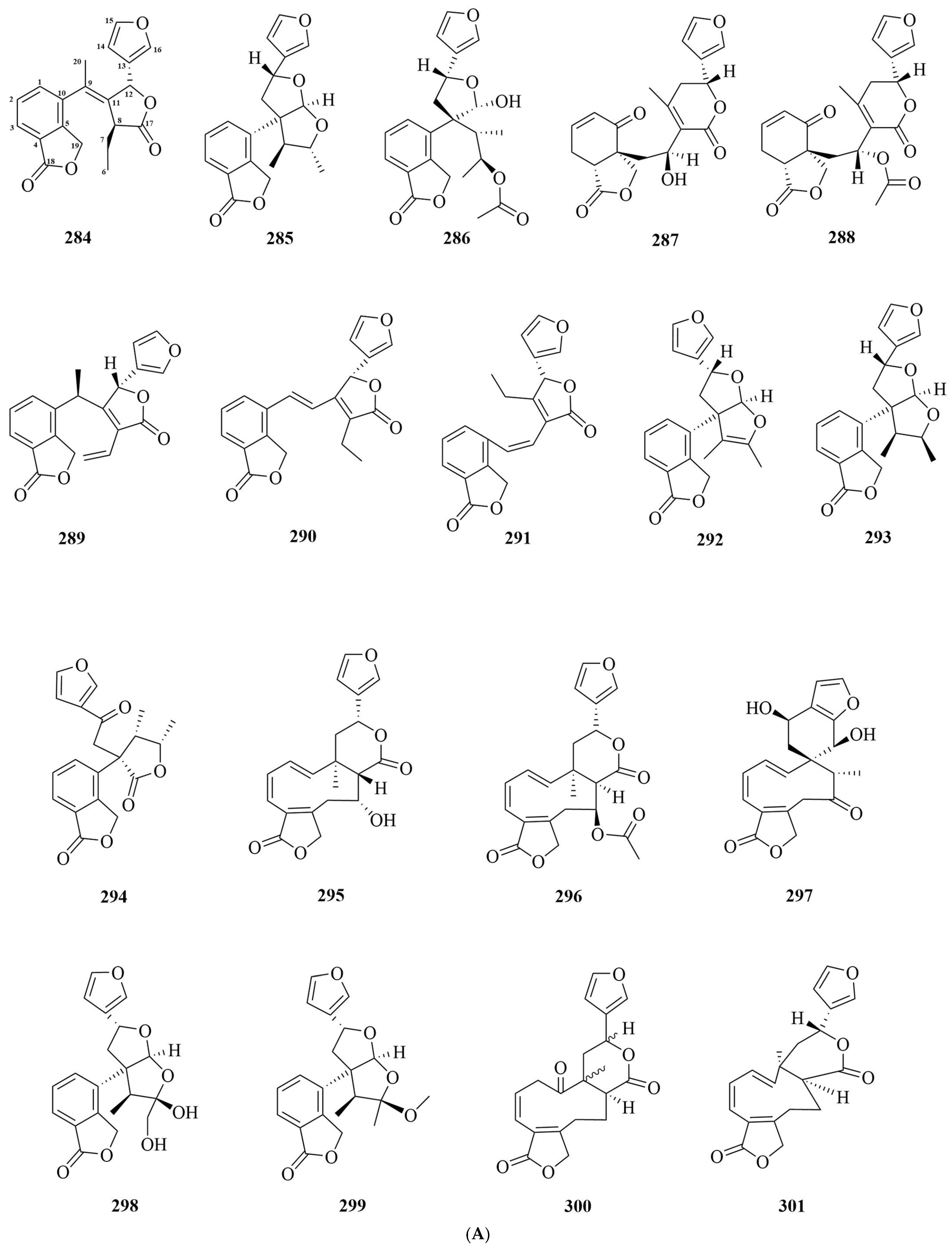
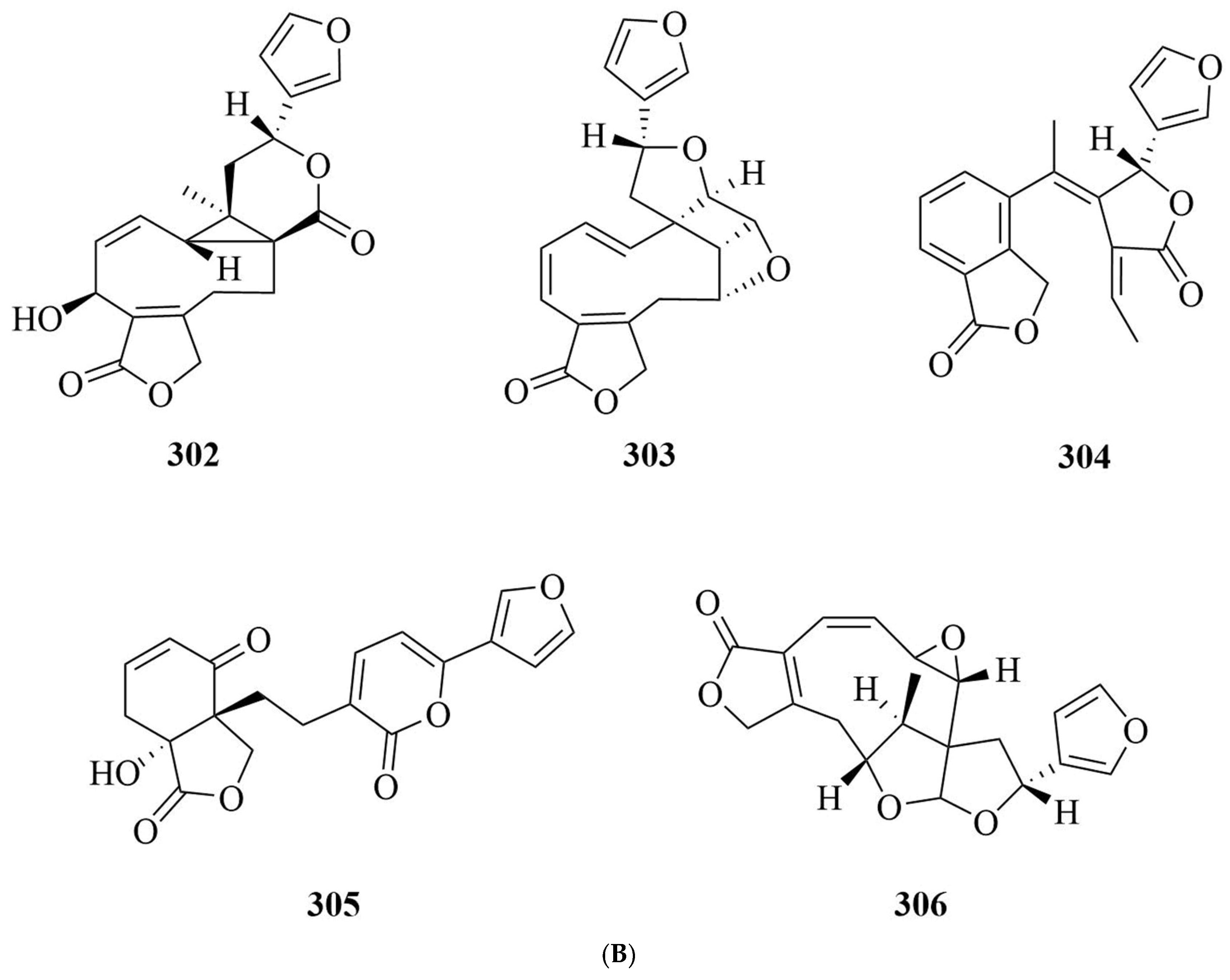
3.5. Clerodanes Diterpenes from Salvia Species
3.6. Biological Activities
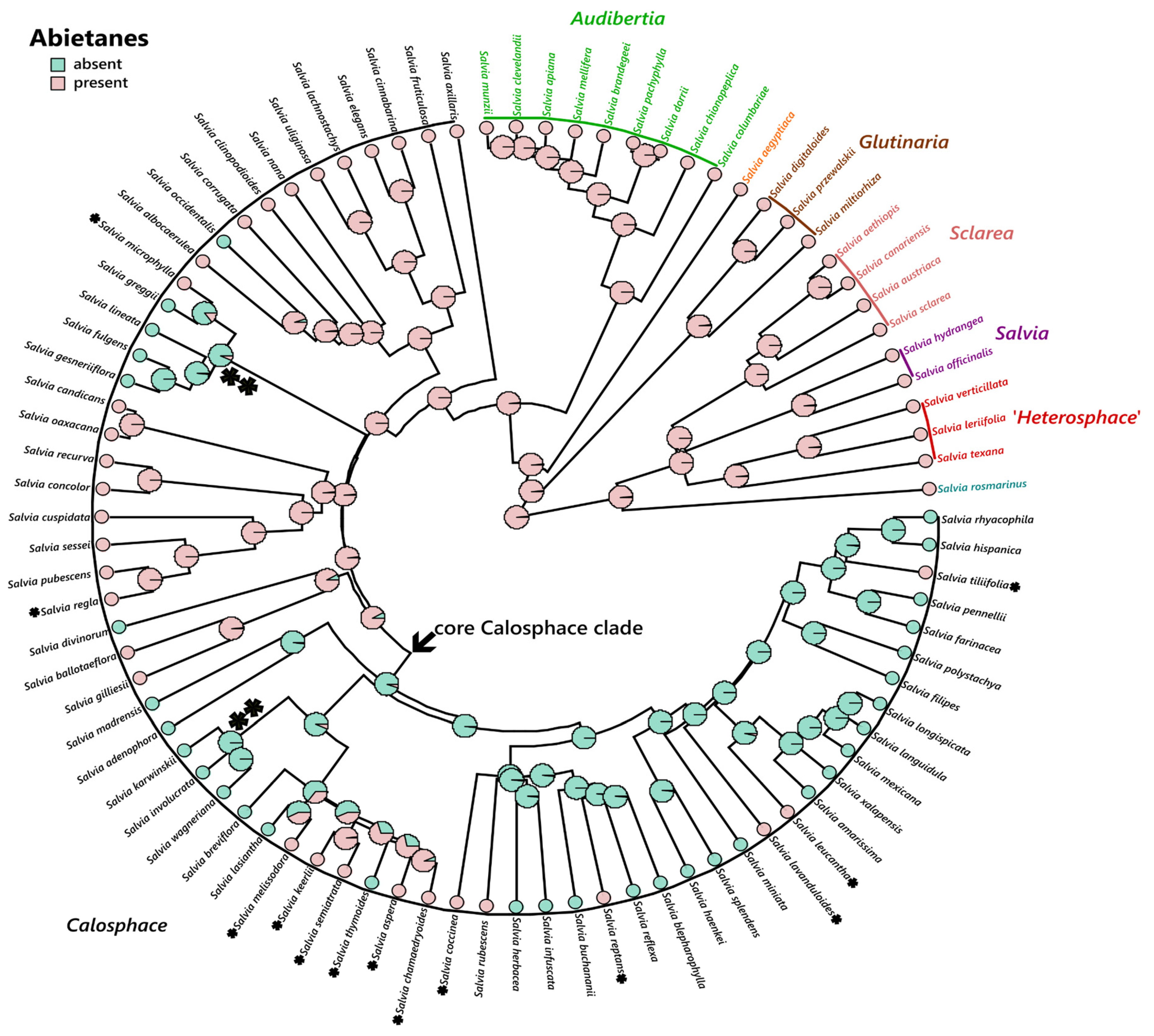
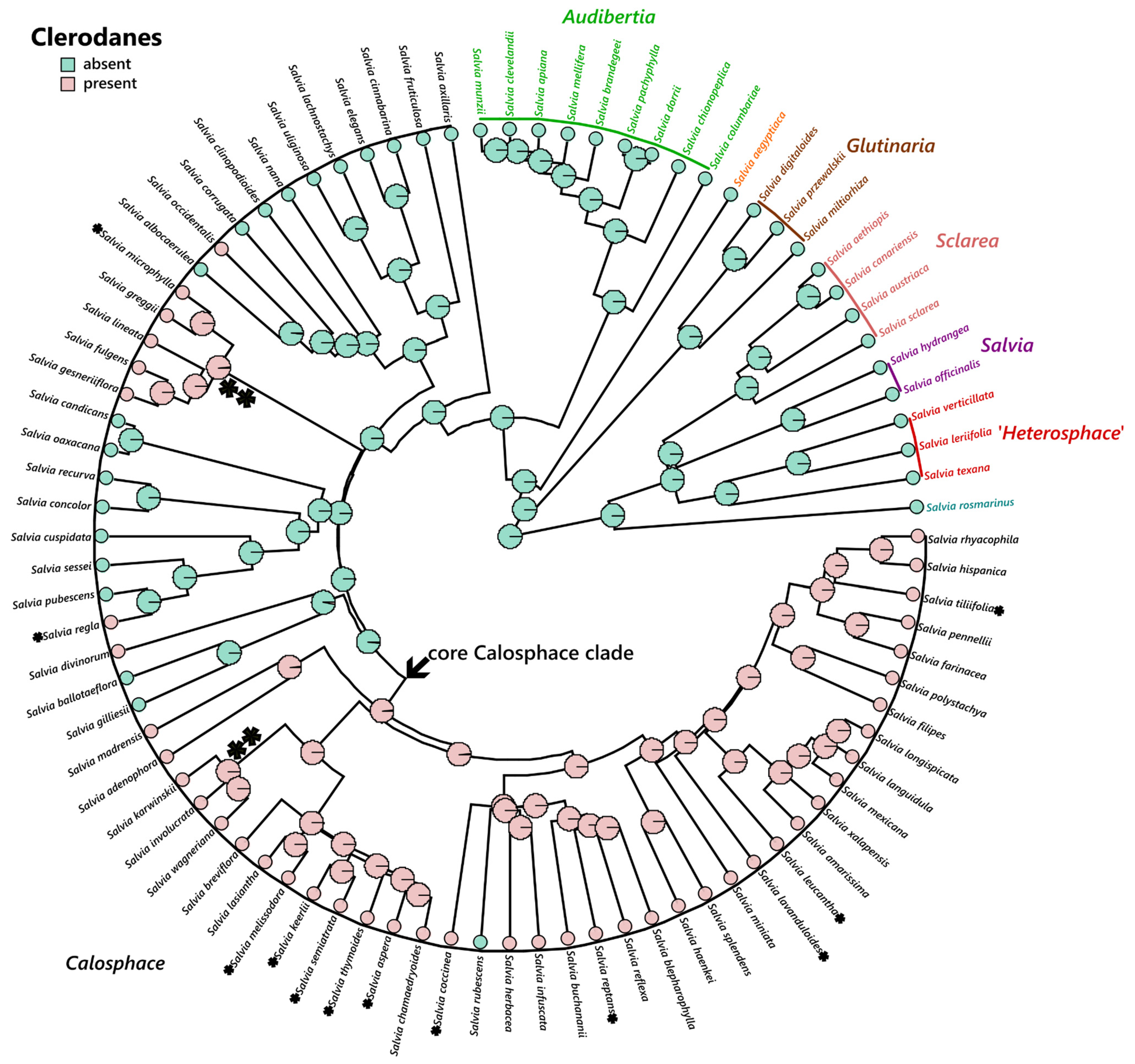
4. Evolution of Abietane- and Clerodane-Skeleton Diterpenes in Mexican Sages
Distribution in Salvia Subgenus Calosphace
5. Conclusions
Supplementary Materials
Author Contributions
Funding
Data Availability Statement
Acknowledgments
Conflicts of Interest
References
- Martínez-Gordillo, M.; Fragoso-Martínez, I.; García-Peña, M.D.R.; Montiel, O. Géneros de Lamiaceae de México, diversidad y endemismo. Rev. Mex. Biodiver. 2013, 84, 30–86. [Google Scholar] [CrossRef] [Scilit]
- Martínez-Gordillo, M.J.; Bedolla-García, B.; Cornejo-Tenorio, G.; Fragoso-Martínez, I.; García-Peña, M.d.R.; González-Gallegos, J.G.; Lara-Cabrera, S.I.; Zamudio, S. Lamiaceae de México. Bot. Sci. 2017, 95, 780–806. [Google Scholar] [CrossRef] [Scilit]
- Espejo, S.A.; Ramamoorthy, T.P. Revisión taxonómica de Salvia sección Sigmoideae (Lamiaceae). Acta Bot. Mex. 1993, 23, 65–102. [Google Scholar] [CrossRef] [Scilit]
- Ortiz-Mendoza, N.; Aguirre-Hernández, E.; Fragoso-Martínez, I.; González-Trujano, M.E.; Basurto-Peña, F.A.; Martínez-Gordillo, M.J. A review on the ethnopharmacology and Phytochemistry of the neotropical sages (Salvia Subgenus Calosphace; Lamiaceae) emphasizing Mexican species. Front. Pharmacol. 2022, 13, 867892. [Google Scholar] [CrossRef] [Scilit] [PubMed]
- Domínguez-Vázquez, G.; Castro-Ramírez, A. Usos medicinales de la familia Labiatae en Chiapas, México. Etnobiología 2002, 2, 19–31. [Google Scholar]
- Jenks, A.A.; Seung-Chul, K. Medicinal plant complexes of Salvia subgenus Calosphace: An ethnobotanical study of new world sages. J. Ethnopharmacol. 2013, 146, 214–224. [Google Scholar] [CrossRef] [Scilit] [PubMed]
- De la Cruz-Jiménez, L.; Guzmán-Lucio, M.; Viveros-Valdez, E. Traditional medicinal plants used for the treatment of gastrointestinal diseases in Chiapas, México. World Appl. Sci. J. 2014, 31, 508–515. [Google Scholar] [CrossRef] [Scilit]
- Casselman, I.; Nock, C.J.; Wohlmuth, H.; Weatherby, R.P.; Heinrich, M. From local to global-Fifty years of research on Salvia divinorum. J. Ethnopharmacol. 2014, 151, 768–783. [Google Scholar] [CrossRef] [Scilit] [PubMed]
- Rodríguez-Hahn, L.; Esquivel, B.; Cárdenas, J. Neo-clerodane dipertenoids from American Salvia species. Recent Adv. Phytochem. 1995, 29, 311–332. [Google Scholar] [CrossRef] [Scilit]
- Esquivel, B.; Bustos-Brito, C.; Sánchez-Castellanos, M.; Nieto-Camacho, A.; Ramírez-Apan, T.; Joseph-Nathan, P.; Quijano, L. Structure, absolute configuration, & antiproliferative activity of abietane & icetexane diterpenoids from Salvia ballotiflora. Molecules 2017, 22, 1690. [Google Scholar] [CrossRef] [Scilit] [PubMed]
- Esquivel, B. Rearranged clerodane and abietane derived diterpenoids from American Salvia species. Nat. Prod. Commun. 2008, 3, 989–1002. [Google Scholar] [CrossRef] [Scilit]
- Fragoso-Serrano, M.; Ortiz-Pastrana, N.; Luna-Cruz, N.; Toscano, R.A.; Alpuche-Solís, A.G.; Ortega, A.; Bautista, E. Amarisolide F, an acylated diterpenoid glucoside and related terpenoids from Salvia amarissima. J. Nat. Prod. 2019, 82, 631–635. [Google Scholar] [CrossRef] [Scilit] [PubMed]
- Fragoso-Martínez, I.; Martínez-Gordillo, M.; Salazar, G.A.; Sazatornil, F.; Jenks, A.A.; García Peña, M.R.; Barrera-Aveleida, G.; Benitez-Vieyra, S.; Magallón, S.; Cornejo-Tenorio, G.; et al. Phylogeny of the neotropical sages (Salvia subg. Calosphace; Lamiaceae) and insights into pollinator and area shifts. Plant Syst. Evol. 2018, 304, 43–55. [Google Scholar] [CrossRef] [Scilit]
- Lara-Cabrera, S.I.; Perez-Garcia, M.; Maya-Lastra, C.A.; Montero-Castro, J.C.; Godden, G.T.; Cibrian-Jaramillo, A.; Fisher, A.E.; Porter, J.M. Phylogenomics of Salvia L. subgenus Calosphace (Lamiaceae). Front. Plant Sci. 2021, 12, 725900. [Google Scholar] [CrossRef] [Scilit] [PubMed]
- Kriebel, R.; Drew, B.T.; Drummond, C.P.; González-Gallegos, J.G.; Celep, F.; Mahdjoub, M.M.; Rose, J.P.; Xiang, C.L.; Hu, G.X.; Walker, J.B.; et al. Tracking temporal shifts in area, biomes, and pollinators in the radiation of Salvia (sages) across continents: Leveraging anchored hybrid enrichment and targeted sequence data. Am. J. Bot. 2019, 106, 573–597. [Google Scholar] [CrossRef] [Scilit] [PubMed]
- Paradis, E.; Schliep, K. Ape 5.0: An environment for modern phylogenetics and evolutionary analyses in r. Bioinformatics 2019, 35, 526–528. [Google Scholar] [CrossRef] [Scilit] [PubMed]
- R Core Team. R: A Language and Environment for Statistical Computing; R foundation for Statistical Computing: Vienna, Austria, 2021; Available online: https://www.R-project.org/ (accessed on 15 March 2023).
- Revell, L.J. Phytools: An R package for phylogenetic comparative biology (and other things). Methods Ecol. Evol. 2012, 3, 217–223. [Google Scholar] [CrossRef] [Scilit]
- Wu, Y.B.; Ni, Z.Y.; Shi, Q.W.; Dong, M.; Kiyota, H.; Gu, Y.C.; Cong, B. Constituents from Salvia species and their biological activities. Chem. Rev. 2012, 112, 5967–6026. [Google Scholar] [CrossRef] [Scilit] [PubMed]
- Eksi, G.; Kurbanoglu, S.; Erdem, S.A. Analysis of diterpenes and diterpenoids. In Recent Advances in Natural Products Analysis; Elsevier: Amsterdam, The Netherlands, 2020; pp. 313–345. [Google Scholar]
- Esquivel, B.; Vallejo, A.; Gaviño, R.; Cárdenas, J.; Sánchez, A.A.; Ramamoorthy, T.P.; Rodriguez-Hahn, L. Clerodane diterpenoids from Salvia melissodora. Phytochemistry 1988, 27, 2903–2905. [Google Scholar] [CrossRef] [Scilit]
- Esquivel, B.; Hernandez, M.; Cardenas, J.; Ramamoorthy, T.P.; Rodriguez-Hanh, L. Further ent-clerodane diterpenoids from Salvia melissodora. Phytochemistry 1989, 28, 566. [Google Scholar] [CrossRef] [Scilit]
- Esquivel, B.; Domínguez, R.; Hernández-Ortega, S.; Toscano, R.A.; Rodríguez-Hanh, L. Salvigenane and isosalvipuberulan diterpenoids from Salvia leucantha. Tetrahedron 1994, 50, 11593–11600. [Google Scholar] [CrossRef] [Scilit]
- Esquivel, B.; Sánchez, A.A.; Vergara, F.; Matus, W.; Hernández-Ortega, S.; Ramírez-Apan, M.T. Abietane diterpenoids from the roots of some mexican Salvia species (Labiatae): Chemical diversity, phytogeographical significance, and cytotoxic activity. Chem. Biodivers. 2005, 2, 738–747. [Google Scholar] [CrossRef] [Scilit] [PubMed]
- Luis, J.G.; Quiñones, W.; Echeverri, F. Tilifolidione, a cycloheptanenapthoquinone-type diterpenoid of abietanic origin from the roots of Salvia tiliaefolia. Phytochemistry 1994, 36, 115–117. [Google Scholar] [CrossRef] [Scilit]
- Narukawa, Y.; Hatano, K.; Takeda, T. A novel diterpenoid with a rearranged neoclerodane skeleton from Salvia leucantha Cav. J. Nat. Med. 2006, 60, 206–209. [Google Scholar] [CrossRef] [Scilit] [PubMed]
- Aoyagi, Y.; Yamazaki, A.; Nakatsugawa, C.; Fukaya, H.; Takeya, K.; Kawauchi, S.; Izumi, H. Salvileucalin B, A novel diterpenoid with an unprecedented rearranged neoclerodane skeleton from Salvia leucantha Cav. Org. Lett. 2008, 10, 4429–4432. [Google Scholar] [CrossRef] [Scilit] [PubMed]
- Jiang, Y.J.; Su, J.; Shi, X.; Wu, X.-D.; Chen, X.-Q.; He, J.; Shao, L.-D.; Li, X.-N.; Peng, L.-Y.; Li, R.-T.; et al. neo-Clerodanes from the aerial parts of Salvia leucantha. Tetrahedron 2016, 72, 5507–5514. [Google Scholar] [CrossRef] [Scilit]
- Fan, M.; Bao, Y.; Zhang, Z.J.; Zhang, H.-B.; Zhao, Q.-S. New neo-clerodane diterpenoids with neurotrophic activity from the aerial parts of Salvia tiliifolia. Fitoterapia 2017, 123, 44–50. [Google Scholar] [CrossRef] [Scilit] [PubMed]
- Inderaja, B.M.; Pradhita, O.; Hanifah, R.; Manurung, R.; Abduh, M.Y. Factors affecting biomass growth and production of essential oil from leaf and flower of Salvia leucantha Cav. Essent. Oil-Bear. Plants 2018, 21, 1021–1029. [Google Scholar] [CrossRef] [Scilit]
- Fan, M.; Duan, B.Z.; Xia, C.L.; Wang, S. A new neo-clerodane diterpenoid from Salvia tiliifolia. Chin. Tradit. Herb. Drugs 2020, 51, 4610–4613. [Google Scholar]
- Li, L.W.; Qi, Y.Y.; Liu, S.X.; Wu, X.-D.; Zhao, Q.-S. Neo-clerodane and abietane diterpenoids with neurotrophic activities from the aerial parts of Salvia leucantha Cav. Fitoterapia 2018, 127, 367–374. [Google Scholar] [CrossRef] [Scilit] [PubMed]
- Li, R.; Morris-Natschke, S.L.; Lee, K.H. Clerodane diterpenes: Sources, structures, and biological activities. Nat. Prod. Rep. 2016, 33, 1166–1226. [Google Scholar] [CrossRef] [Scilit]
- Yang, J.-W.; Orihara, Y. Biosynthesis of abietane diterpenoids in cultured cells of Torreya nucifera var. radicans: Biosynthetic inequality of the FPP part and the terminal IPP. Tetrahedron 2002, 58, 1265–1270. [Google Scholar] [CrossRef] [Scilit]
- Kersten, P.J.; Kopper, B.J.; Raffa, K.F.; Illman, B.L. Rapid analysis of abietanes in conifers. J. Chem. Ecol. 2006, 32, 2679–2685. [Google Scholar] [CrossRef] [Scilit] [PubMed]
- Kang, J.; Quynh, L.T.; Oh, C.H. Recent advances in abietane/icetexane synthesis. Tetrahedron Lett. 2022, 108, 154133. [Google Scholar] [CrossRef] [Scilit]
- González, A.G.; Andrés, L.S.; Brito, I.; Rodríguez, M. Diterpenes from Salvia mellifera. Phytochemistry 1991, 30, 4067. [Google Scholar] [CrossRef] [Scilit]
- Luis, J.G.; Andrés, L.S. C-16 Hydroxylated abietane diterpenes from Salvia mellifera. Phytochemistry 1993, 33, 635–638. [Google Scholar] [CrossRef] [Scilit]
- Luis, J.G.; Grillo, T.A. Abietane diterpenes from Salvia munzii. Phytochemistry 1993, 34, 863–864. [Google Scholar] [CrossRef] [Scilit]
- Luis, J.G.; Andrés, L.S.; Perales, A. C-16 Hydroxylated abietane diterpenes from Salvia mellifera. Absolute configuration and biogenetic implications. Tetrahedron 1993, 49, 4993–4998. [Google Scholar] [CrossRef] [Scilit]
- Luis, J.G.; Quiñones, W.; Grillo, T.A.; Kishi, M.P. Diterpenes from the aerial part of Salvia columbariae. Phytochemistry 1994, 35, 1373–1374. [Google Scholar] [CrossRef] [Scilit]
- Luis, J.G.; Grillo, T.A.; Quirones, W.; Kishi, M.P. Columbaridione, a diterpenequinone from Salvia columbariae. Phytochemistry 1994, 36, 94. [Google Scholar] [CrossRef] [Scilit]
- Moujir, L.; Gutierrez-Navarro, A.M.; San Andres, L.; Luis, J.G. Bioactive diterpenoids isolated from Salvia mellifera. Phytochem. Res. 1996, 10, 172–174. [Google Scholar] [CrossRef] [Scilit]
- Adams, J.D.; Wall, M.; Garcia, C. Salvia columbariae contains tanshinones. Evid. Based Complement. Altern. Med. 2005, 2, 107–110. [Google Scholar] [CrossRef] [Scilit] [PubMed]
- Guerrero, I.C.; Andrés, L.S.; León, L.G.; Machín, R.P.; Padrón, J.M.; Luis, J.G.; Delgadillo, J. Abietane diterpenoids from Salvia pachyphylla and S. clevelandii with cytotoxic activity against human cancer cell lines. J. Nat. Prod. 2006, 69, 1803–1805. [Google Scholar] [CrossRef] [Scilit] [PubMed]
- Srivedavyasasri, R.; Hayes, T.; Ross, S.A. Phytochemical and biological evaluation of Salvia apiana. Nat. Prod. Res. 2017, 31, 2058–2061. [Google Scholar] [CrossRef] [Scilit] [PubMed]
- Watson, W.H.; Taira, Z.; Domínguez, J.A.; González, H.; Gutiérrez, M.; Aragón, R. Isolation and structure of two diterpene quinones from Salvia ballotaeflora Benth. (Labiatae). Tetrahedron Lett. 1976, 29, 2501–2502. [Google Scholar] [CrossRef] [Scilit]
- Galicia, M.A.; Esquivel, B.; Sanchez, A.A.; Cárdenas, J.; Ramamoorthy, T.P.; Rodríguez-Hanh, L. Abietane diterpenoids from Salvia pubescens. Phytochemistry 1988, 27, 217–219. [Google Scholar] [CrossRef] [Scilit]
- Sánchez, C.; Cárdenas, J.; Rodrlguez-Hahn, L.; Ramamoorthy, T.P. Abietane diterpenoids of Salvia anastomosans. Phytochemistry 1989, 28, 1681–1684. [Google Scholar] [CrossRef] [Scilit]
- Esquivel, B.; Calderon, J.S.; Flores, E.; Rosas Rivera, R. Abietane and icetexane diterpenoids from Salvia ballotaeflora and Salvia axillaris. Phytochemistry 1997, 46, 531–534. [Google Scholar] [CrossRef] [Scilit]
- Imanshahidi, M.; Hoseinzadeh, H. The pharmacological effects of Salvia species on the central nervous system. Phytother. Res. 2006, 20, 427–437. [Google Scholar] [CrossRef] [Scilit] [PubMed]
- Sharifi-Rad, M.; Ozcelik, B.; Altın, G.; Daşkaya-Dikmen, C.; Martorell, M.; Ramírez-Alarcón, K.; Alarcón-Zapata, P.; Morais-Braga, M.F.B.; Carneiro, J.N.P.; Alves Borges Leal, A.L.; et al. Salvia spp. plants: From farm to food applications and phytopharmacotherapy. Trends Food Sci. Technol. 2018, 80, 242–263. [Google Scholar] [CrossRef] [Scilit]
- Poulios, E.; Giaginis, C.; Vasios, G.K. Current state of the art on the antioxidant activity of Sage (Salvia spp.) and its bioactive components. Planta Med. 2020, 86, 224–238. [Google Scholar] [CrossRef] [Scilit] [PubMed]
- Küçük, S.; Soyer, P.; Tunalı, Y. Determination of antimicrobial and biological activities of Salvia sclarea L. (Lamiaceae) Extracts. J. Turk. Chem. Soc. A Chem. 2019, 6, 15–20. [Google Scholar] [CrossRef] [Scilit]
- Pereda-Miranda, R.; Hernández, L.; López, R. A novel antimicrobial abietane-type diterpene from Salvia albocaerulea. Lett. Planta Med. 1992, 58, 223. [Google Scholar] [CrossRef] [Scilit] [PubMed]
- González, A.G.; Aguiar, Z.E.; Grillo, T.A.; Luis, J.G. Diterpenes and diterpene quinones from the roots of Salvia apiana. Phytochemistry 1992, 31, 1691–1695. [Google Scholar] [CrossRef] [Scilit]
- Frontana, B.; Cárdenas, J.; Rodríguez-Hahn, L. Diterpenoids from Salvia coulteri. Phytochemistry 1994, 36, 739–741. [Google Scholar] [CrossRef] [Scilit]
- Esquivel, B.; Flores, M.; Hernandez-Ortega, S.; Toscano, R.A.; Ramamoorthy, T.P. Abietane and icetexane diterpenoids from the roots of Salvia aspera. Phytochemistry 1995, 39, 139–143. [Google Scholar] [CrossRef] [Scilit]
- Esquivel, B.; Calderon, J.S.; Flores, E.; Chavez, C.; Juarez, M. Abietane and icetexane diterpenoids from Salvia pubescens. Nat. Prod. Lett. 1997, 10, 87–93. [Google Scholar] [CrossRef] [Scilit]
- González, A.G.; Abad, T.; Jiménez, I.A.; Ravelo, A.G.; Aguiar, J.G.L.Z.; Andrés, L.S.; Plasencia, M.; Herrera, J.; Moujir, L. A first study of antibacterial activity of diterpenes isolated from some Salvia species (Lamiaceae). Biochem. Syst. Ecol. 1989, 17, 293–296. [Google Scholar] [CrossRef] [Scilit]
- Ruiz, A.C. Estudio fitoquímico de Salvia pannosa Fernald. Bachelor’s Thesis, UNAM, Mexico City, Mexico, 2017. [Google Scholar]
- Domínguez, X.A.; González, H.; Aragón, R.; Gutiérrez, M.; Marroquín, J.S.; Watson, W. Three new diterpene quinones from Salvia ballotaeflora. Planta Med. 1976, 30, 237–241. [Google Scholar] [CrossRef] [Scilit] [PubMed]
- Hernández, M.; Esquivel, B.; Cardenas, J.; Rodríguez-Hahn, L.; Ramamoorthy, T. Diterpenoid abietane quinones isolated from Salvia regla. Phytochemistry 1987, 26, 3297–3299. [Google Scholar] [CrossRef] [Scilit]
- Gaviño, R. Estudio fitoquímico de Salvia recurva. Master’s Thesis, UNAM, Mexico City, Mexico, 1994. [Google Scholar]
- Maldonado, E.; de los Angeles Flores, M.; Salazar, B.; Ortega, A. Abietane and neo-clerodane diterpenoids from Salvia lavanduloides. Phytochemistry 1994, 37, 1480–1482. [Google Scholar] [CrossRef] [Scilit]
- Martínez-Vázquez, M.; Miranda, P.; Valencia, N.A.; Torres, M.L.; Miranda, R.; Cárdenas, J.; Salmón, M. Antimicrobial diterpenes from Salvia reptans. Pharm. Biol. 1998, 36, 77–80. [Google Scholar] [CrossRef] [Scilit]
- Díaz-Fernández, M.; Salazar, M.I.; Joseph-Nathan, P.; Burgueño-Tapia, E. Configurational study of diastereoisomeric royleanone diterpenoids from Salvia concolor. Nat. Prod. Commun. 2019, 14, 1934578X19862650. [Google Scholar] [CrossRef] [Scilit]
- Esquivel, B.; Sanchez, A.A. Rearranged icetexane diterpenoids from the roots of Salvia thymoides (Labiatae). Nat. Prod. Res. 2005, 19, 413–417. [Google Scholar] [CrossRef] [Scilit] [PubMed]
- González, A.G.; Andrés, L.S.; Aguiar, Z.E.; Luis, J.G. Diterpenes from Salvia mellifera and their biogenetic significance. Phytochemistry 1992, 31, 1297–1305. [Google Scholar] [CrossRef] [Scilit]
- Amaro-Luis, M.J.; Ramon Herrera, J.; Luis, J.G. Abietane diterpenoids from Salvia chionopeplica. Phytochemistry 1998, 47, 895–897. [Google Scholar] [CrossRef] [Scilit]
- Takeoka, G.R.; Hobbs, C.; Park, B.S. Volatile constituents of the aerial parts of Salvia apiana Jepson. J. Essent. Oil Res. 2010, 22, 241–244. [Google Scholar] [CrossRef] [Scilit]
- Adams, J.D.; Tran, S.; Wong, V.; Fountaine, P.; Petrosyan, J. β-Sitosterol Lithospermate from Salvia columbariae. J. Nat. Prod. 2012, 5, 13–15. [Google Scholar] [CrossRef] [Scilit]
- Bisio, A.; De Mieri, M.; Milella, L.; Schito, A.M.; Parricchi, A.; Russo, D.; Alfei, S.; Lapillo, M.; Tuccinardi, T.; Hamburger, M.; et al. Antibacterial and hypoglycemic diterpenoids from Salvia chamaedryoides. J. Nat. Prod. 2017, 80, 503–514. [Google Scholar] [CrossRef] [Scilit] [PubMed]
- Almada-Taylor, G.; Díaz-Rubio, L.; Salazar-Aranda, R.; Waksman de Torres, N.; Uranga-Solis, C.; Delgadillo-Rodríguez, J.; Ramos, M.A.; Padrón, J.M.; Hernández-Martínez, R.; Córdova-Guerrero, I. Biological activities of extracts from aerial parts of Salvia pachyphylla Epling ex Munz. Plants 2018, 7, 105. [Google Scholar] [CrossRef] [Scilit] [PubMed]
- Ayoub, I.M.; George, M.Y.; Menze, E.T.; Mahmoud, M.; Botros, M.; Essam, M.; Ashmawy, I.; Shendi, P.; Hany, A.; Galal, M.; et al. Insights into the neuroprotective effects of Salvia officinalis L. and Salvia microphylla Kunth in the memory impairment rat model. Food Funct. 2022, 13, 2253–2268. [Google Scholar] [CrossRef] [Scilit] [PubMed]
- Sánchez, V.M.C. Estudio fitoquimico de mortonia diffusa. Bachelor’s Thesis, UNAM, Mexico City, Mexico, 1983. [Google Scholar]
- Cárdenas, J.; Rodríguez-Hahn, L. Abietane and icetexane diterpenoids from Salvia candicans. Phytochemistry 1995, 38, 199–204. [Google Scholar] [CrossRef] [Scilit]
- Pérez-Gutiérrez, S.; Zavala-Mendoza, D.; Hernández-Munive, A.; Mendoza-Martínez, Á.; Pérez-González, C.; Sánchez-Mendoza, E. Antidiarrheal activity of 19-deoxyicetexone isolated from Salvia ballotiflora benth in mice and rats. Molecules 2013, 18, 8895–8905. [Google Scholar] [CrossRef] [Scilit] [PubMed]
- Bustos-Brito, C.; Joseph-Nathan, P.; Burgueño-Tapia, E.; Martínez-Otero, D.; Nieto-Camacho, A.; Calzada, F.; Yépez-Mulia, L.; Esquivel, B.; Quijano, L. Structure and absolute configuration of abietane diterpenoids from Salvia clinopodioides: Antioxidant, antiprotozoal, and antipropulsive activities. J. Nat. Prod. 2019, 82, 1207–1216. [Google Scholar] [CrossRef] [Scilit] [PubMed]
- Bustos-Brito, C.; Torres-Medicis, J.P.; Bedolla-García, B.Y.; Zamudio, S.; Ramírez-Apan, T.; Macías-Rubalcava, M.L.; Quijano, L.; Esquivel, B. Structure, Absolute configuration, antiproliferative and phytotoxic activities of icetexane and abietane diterpenoids from Salvia carranzae and chemotaxonomic implications. Molecules 2024, 9, 1226. [Google Scholar] [CrossRef] [Scilit] [PubMed]
- González, A.G.; Andrés, L.S.; Ravelo, A.G.; Luis, J.G.; Bazzocchi, I.; West, J. Terpenoids from Salvia mellifera. Phytochemistry 1990, 29, 1691–1693. [Google Scholar] [CrossRef] [Scilit]
- Esquivel, B.; Tello, R.; Sánchez, A.A. Unsaturated diterpenoids with a novel carbocyclic skeleton from Salvia xalapensis. J. Nat. Prod. 2005, 68, 787–790. [Google Scholar] [CrossRef] [Scilit] [PubMed]
- Ortiz-Mendoza, N.; San Miguel-Chávez, R.; Martínez-Gordillo, M.J.; Basurto-Peña, F.A.; Palma-Tenango, M.; Aguirre-Hernández, E. Variation in terpenoid and flavonoid content in different samples of Salvia semiatrata collected from Oaxaca, Mexico, and its effects on antinociceptive activity. Metabolites 2023, 13, 866. [Google Scholar] [CrossRef] [Scilit] [PubMed]
- González, A.G.; Aguiar, Z.E.; Luis, J.G.; Ravelo, A.G.; Domínguez, X. Quinone methide diterpenoids from the roots of Salvia texana. Phytochemistry 1988, 27, 1777–1781. [Google Scholar] [CrossRef] [Scilit]
- Luis, J.G.; Lahlou, H.; Andros, L.S. Apiananes: C23 terpenoids with a new type of skeleton from Salvia apiana. Tetrahedron Lett. 1996, 37, 4213–4216. [Google Scholar] [CrossRef] [Scilit]
- Merritt, A.T.; Ley, S.V. Clerodane diterpenoids. Nat. Prod. Rep. 1992, 9, 243–287. [Google Scholar] [CrossRef] [Scilit] [PubMed]
- Bigham, A.K.; Munro, T.A.; Rizzacasa, M.A.; Robins-Browne, R.M. Divinatorins A-C, new neoclerodane diterpenoids from the controlled sage Salvia divinorum. J. Nat. Prod. 2003, 66, 1242–1244. [Google Scholar] [CrossRef] [Scilit] [PubMed]
- Fan, M.; Luo, D.; Peng, L.Y.; Wu, X.-D.; Ji, X.; Zhao, Q.-S. Rearranged neoclerodane diterpenoids from the aerial parts of Salvia hispanica L. Fitoterapia 2020, 146, 104672. [Google Scholar] [CrossRef] [Scilit] [PubMed]
- Fan, M.; Zhu, Y.; Zhang, Z.J.; Du, R.N.; Zhu, Q.F.; Wu, X.D.; Zhao, Q.S. Salvihispin A and its glycoside, two neo-clerodane diterpenoids with neurotrophic activities from Salvia hispanica L. Tetrahedron Lett. 2018, 59, 143–146. [Google Scholar] [CrossRef] [Scilit]
- Fan, M.; Luo, D.; Peng, L.Y.; Li, X.-N.; Wu, X.-D.; Ji, X.; Zhao, Q.-S. Neo-clerodane diterpenoids from aerial parts of Salvia hispanica L. and their cardioprotective effects. Phytochemistry 2019, 166, 112065. [Google Scholar] [CrossRef] [Scilit] [PubMed]
- Xu, G.; Peng, L.; Niu, X.; Zhao, Q.; Li, R.; Sun, H. Novel diterpenoids from Salvia dugesii. Helv. Chim. Acta 2004, 87, 949–955. [Google Scholar] [CrossRef] [Scilit]
- Ortega, A.; Bautista, E.; Maldonado, E. Polystachyne F, a 5,10-seco-Neoclerodane from Salvia polystachia. Chem. Pharm. Bull. 2006, 54, 1338–1339. [Google Scholar] [CrossRef] [Scilit] [PubMed]
- Bisio, A.; Schito, A.M.; Parricchi, A.; Mele, G.; Romussi, G.; Malafronte, N.; Oliva, P.; De Tommasi, N. Antibacterial activity of constituents from Salvia buchananii Hedge (Lamiaceae). Phytochem. Lett. 2015, 14, 170–177. [Google Scholar] [CrossRef] [Scilit]
- Xu, G.; Zhao, F.; Yang, X.-W.; Zhou, J.; Yang, L.-X.; Shen, X.-L.; Hu, Y.-J.; Zhao, Q.-S. neo-Clerodane diterpenoids from Salvia dugesii and their bioactive studies. Nat. Prod. Bioprospect. 2011, 1, 81–86. [Google Scholar] [CrossRef] [Scilit]
- Bautista, E.; Maldonado, E.; Ortega, A. Neo-clerodane diterpenes from Salvia herbacea. J. Nat. Prod. 2012, 75, 951–958. [Google Scholar] [CrossRef] [Scilit] [PubMed]
- Bautista, E.; Ortiz-Pastrana, N.; Pastor-Palacios, G.; Montoya-Contreras, A.; Toscano, R.A.; Morales-Jiménez, J.; Salazar-Olivo, L.A.; Ortega, A. Neo-Clerodane diterpenoids from Salvia polystachya stimulate the expression of extracellular matrix components in human dermal fibroblasts. J. Nat. Prod. 2017, 80, 3003–3009. [Google Scholar] [CrossRef] [Scilit] [PubMed]
- Bautista, E.; Toscano, A.; Calzada, F.; Díaz, E.; Yepez-Mulia, L.; Ortega, A. Hydroxyclerodanes from Salvia shannoni. J. Nat. Prod. 2013, 76, 1970–1975. [Google Scholar] [CrossRef] [Scilit] [PubMed]
- Calzada, F.; Bautista, E.; Barbosa, E.; Salazar-Olivo, L.A.; Alvidrez-Armendáriz, E.; Yepez-Mulia, L. Antiprotozoal activity of secondary metabolites from Salvia circinata. Rev. Bras. Farmacogn. 2020, 30, 593–596. [Google Scholar] [CrossRef] [Scilit]
- Salinas-Arellano, E.; Pérez-Vásquez, A.; Rivero-Cruz, I.; Torres-Colin, R.; González-Andrade, M.; Rangel-Grimaldo, M.; Mata, R. Flavonoids and terpenoids with PTP-1B inhibitory properties from the infusion of Salvia amarissima ortega. Molecules 2020, 25, 3530. [Google Scholar] [CrossRef] [Scilit] [PubMed]
- Maldonado, E.; Ortega, A. Polystachynes A-E, cis-neo-clerodane diterpenoids from Salvia polystachya. Phytochemistry 2000, 53, 103–109. [Google Scholar] [CrossRef] [Scilit] [PubMed]
- Bustos-Brito, C.; Pérez-Juanchi, D.; Rivera-Chávez, J.; Hernández-Herrera, A.D.; Bedolla-García, B.Y.; Zamudio, S.; Ramírez-Apan, T.; Quijano, L.; Esquivel, B. Clerodane and 5 10-seco-clerodane-type diterpenoids from Salvia involucrata. J. Mol. Struct. 2021, 1237, 130367. [Google Scholar] [CrossRef] [Scilit]
- Maldonado, E.; Galicia, L.; Chávez, M.I.; Hernández-Ortega, S. neo-clerodane diterpenoids and other constituents of Salvia filipes. J. Nat. Prod. 2016, 79, 2667–2673. [Google Scholar] [CrossRef] [Scilit] [PubMed]
- Rivera-Chávez, J.; Bustos-Brito, C.; Aguilar-Ramírez, E.; Martínez-Otero, D.; Rosales-Vázquez, L.D.; Dorazco-González, A.; Cano-Sánchez, P. Hydroxy- neo-Clerodanes and 5,10-seco-neo-Clerodanes from Salvia decora. J. Nat. Prod. 2020, 83, 2212–2220. [Google Scholar] [CrossRef] [Scilit] [PubMed]
- Ortega, A.; Ortiz-Pastrana, N.; Bedolla-García, B.Y.; Toscano, R.A.; Bautista, E. NMR analysis and crystal structure of hydroxyclerodanes from Mexican Salvia species. J. Mol. Struct. 2017, 1141, 157–162. [Google Scholar] [CrossRef] [Scilit]
- Kawahara, N.; Tamura, T.; Inoue, M.; Hosoe, T.; Kawai, K.-I.; Sekita, S.; Satake, M.; Goda, Y. Diterpenoid glucosides from Salvia greggii. Phytochemistry 2004, 65, 2577–2581. [Google Scholar] [CrossRef] [Scilit] [PubMed]
- Panter, K.E.; Stegelmeier, B.L.; Gardner, D.R.; Stonecipher, C.A.; Lee, S.T.; Kitchen, D.; Brackett, A.; Davis, C. Clinical, pathologic, and toxicologic characterization of Salvia reflexa (lance-leaf sage) poisoning in cattle fed contaminated hay. J. Vet. Diagn. Investig. 2021, 33, 538–547. [Google Scholar] [CrossRef] [Scilit] [PubMed]
- Guzmán, F.G. Estudio fitoquímico de Salvia carnea. Bachelor’s Thesis, UNAM, Mexico City, Mexico, 1997. [Google Scholar]
- Rodriguez-Hahn, L.; Garcia, A.; Esquivel, B.; Cardenas, J. Structure of kerlinic acid from Salvia keerlii. Chemical correlation with melisodoric acid. Can. J. Chem. 1987, 65, 2687–2690. [Google Scholar] [CrossRef] [Scilit]
- Sánchez, A.A.; Esquivel, B.; Pera, A.; Cárdenas, J.; Soriano-García, M.; Toscano, A.; Rodriguez-Hahn, L. Lasianthin, a neo-clerodane diterpenoid from Salvia lasiantha. Phytochemistry 1987, 26, 479–482. [Google Scholar] [CrossRef] [Scilit]
- Narukawa, Y.; Fukui, M.; Hatano, K.; Takeda, T. Four new diterpenoids from Salvia fulgens Cav. J. Nat. Med. 2006, 60, 58–63. [Google Scholar] [CrossRef] [Scilit]
- Cuevas, G.; Collera, O.; García, F.; Cárdenas, J.; Maldonado, E.; Ortega, A. Diterpenes from Salvia breviflora. Phytochemistry 1987, 26, 2019–2021. [Google Scholar] [CrossRef] [Scilit]
- Esquivel, B.; Cardenas, J.; Rodriguez-hahn, L.; Ramamoorthy, T.P. The diterpenoid constituents of Salvia fulgens and Salvia microphylla. J. Nat. Prod. 1987, 50, 738–740. [Google Scholar] [CrossRef] [Scilit]
- Ortega, A.; Cárdenas, J.; Gage, D.A.; Maldonado, E. Abietane and clerodane diterpenes from Salvia regla. Phytochemistry 1995, 39, 931–933. [Google Scholar] [CrossRef] [Scilit]
- Esquivel, B.; Méndez, A.; Ortega, A.; Soriano-García, M.; Toscano, A.; Rodríguez-Hahn, L. Neo-clerodane-type diterpenoids from Salvia keerlii. Phytochemistry 1985, 24, 1769–1772. [Google Scholar] [CrossRef] [Scilit]
- López, C.M.E. Aislamiento y determinación estructural de los metabolitos secundarios presentes en las hojas de Salvia longispicata. Bachelor’s Thesis, UNAM, Mexico City, Mexico, 2020. [Google Scholar]
- Bustos-Brito, C.; Montaño-Hernández, P.Y.; Salas-Huerta, O.; Ramírez-González, D.I.; Pérez-Juanchi, D.; Torres-Medicis, J.P.; Macías-Rubalcava, M.L.; Bedolla-García, B.Y.; Zamudio, S.; Quijano, L.; et al. Phytotoxic neo-clerodane and rearranged neo-clerodane type diterpenoids from Salvia albiflora. Tetrahedron 2025, 174, 134490. [Google Scholar] [CrossRef] [Scilit]
- Fan, M.; Wang, T.; Peng, L.Y.; Huang, J.; Wu, X.; Wang, H.; Zhao, Q. Neo-clerodane diterpenoids with hypoglycemic effects in vivo from the aerial parts of Salvia hispanica L. Chem. Biodivers. 2021, 18, e2100517. [Google Scholar] [CrossRef] [Scilit] [PubMed]
- Maldonado, E.; Ortega, A. Languidulane, clerodane and secoclerodane diterpenes from Salvia tonalensis. Phytochemistry 1997, 45, 1461–1467. [Google Scholar] [CrossRef] [Scilit]
- Ortega, A.; Maldonado, E. 7-epi-rhyacophiline, a 5,6-secoclerodane diterpene from Salvia rhyacophila. Phytochemistry 1993, 35, 1063–1064. [Google Scholar] [CrossRef] [Scilit]
- Guerrero, R.D. Aislamiento y elucidación estructural de los componentes terpénicos presentes en Salvia ballotiflora y Salvia gesneriflora. Masther’s Thesis, UNAM, Mexico City, Mexico, 2021. [Google Scholar]
- Li, S.W.; Fan, M. A new neo-clerodane diterpenoid from Salvia farinacea Benth. Yaoxue Xuebao 2024, 59, 1002–1004. [Google Scholar]
- Toscano, A.R.; Maldonado, E.; Ortega, A. Tonalensin, a 5,10-seco-neoclerodane diterpenoid. J. Chem. Crystallogr. 1996, 26, 239–242. [Google Scholar] [CrossRef] [Scilit]
- Aoyagi, Y.; Hitotsuyanagi, Y.; Nakazato, Y.; Yamazaki, A.; Kondo, H.; Ninomiya, A.; Tokuda, M.; Fukaya, H.; Yano, R.; Takeya, K.; et al. Five new highly oxidized neoclerodane diterpenes, salvileucalin E-I from Salvia leucantha. Heterocycles 2020, 100, 2061–2071. [Google Scholar] [CrossRef] [Scilit]
- Esquivel, B.; Esquivel, O.; Cardenas, J.; Sánchez, A.A.; Ramamoorthy, T.; Toscano, R.A.; Rodríguez-Hahn, L. Clerodane and seco-clerodane diterpenoids from Salvia reptans. Phytochemistry 1991, 34, 2335–2338. [Google Scholar] [CrossRef] [Scilit]
- González-Chávez, M.M.; Alonso-Castro, A.J.; Zapata-Morales, J.R.; Arana-Argáez, V.; Torres-Romero, J.C.; Medina-Rivera, Y.E.; Sánchez-Mendoza, E.; Pérez-Gutiérrez, S. Anti-inflammatory and antinociceptive effects of tilifodiolide, isolated from Salvia tiliifolia Vahl (Lamiaceae). Drug Dev. Res. 2018, 79, 165–172. [Google Scholar] [CrossRef] [Scilit] [PubMed]
- Paleo, G.E. Estudio fitoquímico de Salvia longispicata. Bachelor’s Thesis, UNAM, Mexico City, Mexico, 2004. [Google Scholar]
- Jaime-Vasconcelos, M.Á.; Frontana-Uribe, B.A.; Morales-Serna, J.A.; Salmón, M.; Cárdenas, J. Structure of salvioccidentalin, a diterpenoid with a rearranged neo-clerodane skeleton from Salvia occidentalis. Molecules 2011, 16, 9109–9115. [Google Scholar] [CrossRef] [Scilit] [PubMed]
- Aguilera, A.L. Phytochemistry Contribution of Salvia mexicana. Bachelor’s Thesis, UNAM, Mexico City, Mexico, 1994. [Google Scholar]
- Domínguez, R.M. Aislamiento y elucidación estructural de los componentes diterpenicas de Salvia leucantha, Cav. Bachelor’s Thesis, UNAM, Mexico City, Mexico, 1995. [Google Scholar]
- Bisio, A.; Fontana, N.; Romussi, G.; Ciarallo, G.; De Tommasi, N.; Pizza, C.; Mugnoli, A. Clerodane diterpenoids from Salvia blepharophylla. Phytochemistry 1999, 58, 1535–1540. [Google Scholar] [CrossRef] [Scilit]
- Bisio, A.; Damonte, G.; Fraternale, D.; Giacomelli, E.; Salis, A.; Romussi, G.; Cafaggi, S.; Ricci, D.; De Tommasi, N. Phytotoxic clerodane diterpenes from Salvia miniata Fernald (Lamiaceae). Phytochemistry 2011, 72, 265–275. [Google Scholar] [CrossRef] [Scilit] [PubMed]
- Tada, M.; Okuno, K.; Chiba, K.; Ohnishi, E.; Yoshii, T. Antiviral diterpenes from Salvia officinalis. Phytochemistry 1994, 35, 539–541. [Google Scholar] [CrossRef] [Scilit]
- Shrestha, S.; Song, Y.W.; Kim, H.; Lee, D.S.; Cho, S.K. Sageone, a diterpene from Rosmarinus officinalis, synergizes with cisplatin cytotoxicity in SNU-1 human gastric cancer cells. Phytomedicine 2016, 23, 1671–1679. [Google Scholar] [CrossRef] [Scilit] [PubMed]
- Dentali, S.J.; Hoffmann, J.J. 16-hydroxycarnosic acid, a diterpene from Salvia apiana. Phytochemistry 1990, 29, 993–994. [Google Scholar] [CrossRef] [Scilit]
- Agatonovic-Kustrin, S.; Wong, S.; Dolzhenko, A.V.; Gegechkori, V.; Ku, H.; Tan, W.K.; Morton, D.W. Effect directed analysis of bioactive compounds in leaf extracts from two Salvia species by High-performance thin-layer chromatography. J. Pharm. Biomed. Anal. 2023, 227, 115308. [Google Scholar] [CrossRef] [Scilit] [PubMed]
- Guo, R.; Li, L.; Su, J.; Li, S.; Duncan, S.E.; Liu, Z.; Fan, G. Pharmacological activity and mechanism of tanshinone IIA in related diseases. Drug Des. Devel Ther. 2020, 14, 4735–4748. [Google Scholar] [CrossRef] [Scilit] [PubMed]
- Ding, Z.; Deng, Y.; Luo, H.; Liu, C.; Yang, M.; Xue, H.; Chen, Z. Progress of tanshinone IIA against respiratory diseases: Therapeutic targets and potential mechanisms. Front. Pharmacol. 2025, 16, 1505672. [Google Scholar] [CrossRef] [Scilit] [PubMed]
- da Araújo, E.C.; Lima, M.A.; Montenegro, R.C.; Nogueira, M.; Costa-Lotufo, L.V.; Pessoa, C.; de Moraes, M.O.; Silveira, E.R. Cytotoxic abietane diterpenes from Hyptis martiusii Benth. Z. Naturforschung C J. Biosci. 2006, 61, 177–183. [Google Scholar] [CrossRef] [Scilit] [PubMed]
- Fronza, M.; Murillo, R.; Ślusarczyk, S.; Adams, M.; Hamburger, M.; Heinzmann, B.; Laufer, S.; Merfort, I. In vitro cytotoxic activity of abietane diterpenes from Peltodon longipes as well as Salvia miltiorrhiza and Salvia sahendica. Bioorg. Med. Chem. 2011, 19, 4876–4881. [Google Scholar] [CrossRef] [Scilit] [PubMed]
- Shakeri, A.; Farahmand, S.S.; Tayarani-Najaran, Z.; Emami, S.A.; Kúsz, N.; Hohmann, J.; Boozari, M.; Tavallaie, F.Z.; Asili, J. 4,5-Seco-5,10-friedo-abietane-type diterpenoids with anticancer activity from Salvia atropatana Bunge. Naunyn-Schmiedeberg’s Arch. Pharmacol. 2021, 394, 241–248. [Google Scholar] [CrossRef] [Scilit] [PubMed]
- Habtemariam, S. Anti-Inflammatory therapeutic mechanisms of natural products: Insight from rosemary diterpenes, carnosic acid and carnosol. Biomedicines 2023, 11, 545. [Google Scholar] [CrossRef] [Scilit] [PubMed]
- Liu, X.Y.; Wang, W.Z.; Yao, S.P.; Li, X.Y.; Han, R.M.; Zhang, D.; Zhao, Z.; Wang, Y.; Zhang, J.P. Antioxidation activity enhancement by intramolecular hydrogen bond and non-browning mechanism of active ingredients in rosemary: Carnosic acid and carnosol. J. Phys. Chem. B 2024, 128, 7627–7638. [Google Scholar] [CrossRef] [Scilit] [PubMed]
- Fang, Z.; Lu, M.; Huang, R.; Wang, G.; Yushanjiang, F.; Jiang, X.; Li, J. Carnosol prevents cardiac remodeling and ventricular arrhythmias in pressure overload-induced heart failure mice. Phytother. Res. 2024, 38, 3763–3781. [Google Scholar] [CrossRef] [Scilit] [PubMed]
- Li, C.; Yang, H.; Wu, Y.; Zhou, M.; Luo, H.; Yuan, P.; Shen, F. Carnosol alleviates cisplatin-induced acute kidney injury by regulating apoptosis and pyroptosis. Cell Biol. Int. 2025, 49, 101–117. [Google Scholar] [CrossRef] [Scilit] [PubMed]
- González, M.A.; Clark, J.; Connelly, M.; Rivas, F. Antimalarial activity of abietane ferruginol analogues possessing a phthalimide group. Bioorg. Med. Chem. Lett. 2014, 24, 5234–5237. [Google Scholar] [CrossRef] [Scilit] [PubMed]
- Kuźma, Ł.; Derda, M.; Hadaś, E.; Wysokińska, H. Abietane diterpenoids from Salvia sclarea transformed roots as growth inhibitors of pathogenic Acanthamoeba spp. Parasitol. Res. 2015, 114, 323–327. [Google Scholar] [CrossRef] [Scilit] [PubMed]
- Zolezzi, J.M.; Lindsay, C.B.; Serrano, F.G.; Ureta, R.C.; Theoduloz, C.; Schmeda-Hirschmann, G.; Inestrosa, N.C. Neuroprotective effects of ferruginol, jatrophone, and junicedric acid against amyloid-β injury in hippocampal neurons. J. Alzheimer’s Dis. 2018, 63, 705–723. [Google Scholar] [CrossRef] [Scilit] [PubMed]
- Topcu, G.; Altiner, E.N.; Gozcu, S.; Halfon, B.; Aydogmus, Z.; Pezzuto, J.M.; Zhou, B.N.; Kingston, D.G. Studies on di- and triterpenoids from Salvia staminea with cytotoxic activity. Planta Med. 2003, 69, 464–467. [Google Scholar] [CrossRef] [Scilit] [PubMed]
- Búfalo, J.; Cantrell, C.L.; Jacob, M.R.; Schrader, K.K.; Tekwani, B.L.; Kustova, T.S.; Ali, A.; Boaro, C.S. Antimicrobial and antileishmanial activities of diterpenoids isolated from the roots of Salvia deserta. Planta Med. 2016, 82, 131–137. [Google Scholar] [CrossRef] [Scilit] [PubMed]
- Jassbi, A.R.; Hadavand Mirzaei, H.; Firuzi, O.; Pirhadi, S.; Asadollahi, M.; Chandran, J.N.; Schneider, B. Cytotoxic abietane-type diterpenoids from roots of Salvia spinosa and their in Silico pharmacophore modeling. Nat. Prod. Res. 2022, 36, 3183–3188. [Google Scholar] [CrossRef] [Scilit] [PubMed]
- Máthé, I.; Hohmann, J.; Janicsák, G.; Nagy, G.; Dora, R. Chemical diversity of the biological active ingredients of Salvia officinalis and some closely related species. Acta Pharm. Hung. 2007, 77, 37–45. [Google Scholar] [PubMed]
- Darias, V.; Bravo, L.; Rabanal, R.; Sánchez-Mateo, C.; Martín-Herrera, D.A. Cytstatic and antibacterial activity of some compounds isolated from several Lamiaceae species from the Canary Islands. Planta Med. 1990, 56, 70–72. [Google Scholar] [CrossRef] [Scilit] [PubMed]
- Miura, K.; Kikuzaki, H.; Nakatani, N. Antioxidant activity of chemical components from sage (Salvia officinalis L.) and thyme (Thymus vulgaris L.) measured by the oil stability index method. J. Agric. Food Chem. 2002, 50, 1845–1851. [Google Scholar] [CrossRef] [Scilit] [PubMed]
- Bakhsh, T.; Abuzahrah, S.S.; Qahl, S.H.; Akela, M.A.; Rather, I.A. Sugiol masters apoptotic precision to halt gastric cancer cell proliferation. Pharmaceuticals 2023, 16, 1528. [Google Scholar] [CrossRef] [Scilit] [PubMed]
- Purgato, G.A.; Píccolo, M.S.; Moreira, M.A.S.; Pizziolo, V.R.; Diaz-Muñoz, G.; Rossi, C.C.; Dialz, M.A.N. Isolation and identification of antimicrobial multicyclic terpenoids from the medicinal plant Salvia officinalis and development of a formulation against clinical Staphylococcus aureus strains. Lett. Appl. Microbiol. 2024, 77, ovae077. [Google Scholar] [CrossRef] [Scilit] [PubMed]
- Giacomelli, E.; Bertrand, S.; Nievergelt, A.; Zwick, V.; Simoes-Pires, C.; Marcourt, L.; Rivara-Minten, E.; Cuendet, M.; Bisio, A.; Wolfender, J.-L. Cancer chemopreventive diterpenes from Salvia corrugata. Phytochemistry 2013, 96, 257–264. [Google Scholar] [CrossRef] [Scilit] [PubMed]
- Campos-Xolalpa, N.; Alonso-Castro, Á.J.; Ortíz-Sanchez, E.; Zapata-Morales, J.R.; González-Chávez, M.M.; Pérez, S. Anti-inflammatory and antitumor activities of the chloroform extract and anti-inflammatory effect of the three diterpenes isolated from Salvia ballotiflora Benth. BMC Complement. Med. Ther. 2021, 21, 17. [Google Scholar] [CrossRef] [Scilit] [PubMed]
- Hernández-Herrera, A.D.; Luna-Herrera, J.; del RocGonzz-Martz, M.; Prieto-Hinojosa, A.I.; Turcios-Esquivel, A.M.; Castillo-Maldonado, I.; SNM, D.G.; Ramz-Moreno, A.; Bustos-Brito, C.; Esquivel, B.; et al. Immunomodulatory activity of diterpenes over innate immunity and cytokine production in a human alveolar epithelial cell line infected with mycobacterium tuberculosis. Curr. Mol. Pharmacol. 2023, 16, 682–689. [Google Scholar] [CrossRef] [Scilit] [PubMed]
- Choudhary, M.I.; Hussain, A.; Ali, Z.; Adhikari, A.; Sattar, S.A.; Ayatollahi, S.A.; Al-Majid, A.M. Diterpenoids including a novel dimeric conjugate from Salvia leriaefolia. Planta Med. 2012, 78, 269–275. [Google Scholar] [CrossRef] [Scilit] [PubMed]
- Gómez-Rivera, A.; González-Cortazar, M.; Herrera-Ruíz, M.; Zamilpa, A.; Rodríguez-López, V. Sessein and isosessein with anti-inflammatory, antibacterial and antioxidant activity isolated from Salvia sessei Benth. J. Ethnopharmacol. 2018, 217, 212–219. [Google Scholar] [CrossRef] [Scilit] [PubMed]
- Bautista, E.; Fragoso-Serrano, M.; Ortiz-Pastrana, N.; Toscano, R.A.; Ortega, A. Structural elucidation and evaluation of multidrug-resistance modulatory capability of amarissinins A–C, diterpenes derived from Salvia amarissima. Fitoterapia 2016, 114, 1–6. [Google Scholar] [CrossRef] [Scilit] [PubMed]
- Gutiérrez-Román, A.S.; Trejo-Tapia, G.; González-Cortazar, M.; Jiménez-Ferrer, E.; Trejo-Espino, J.L.; Zamilpa, A.; Ble-González, E.A.; Camacho-Díaz, B.H.; Herrera-Ruiz, M. Anti-arthritic and anti-inflammatory effects of Baccharis conferta Kunth in a kaolin/carrageenan-induced monoarthritis model. J. Ethnopharmacol. 2022, 288, 114996. [Google Scholar] [CrossRef] [Scilit] [PubMed]
- Gutiérrez-Román, A.S.; Trejo-Tapia, G.; Herrera-Ruíz, M.; Nayeli, M.B.; Trejo-Espino, J.L.; Zamilpa, A.; Manasés, G.C. Effect of terpenoids and flavonoids isolated from Baccharis conferta Kunth on TPA-Induced ear edema in mice. Molecules 2020, 25, 1379. [Google Scholar] [CrossRef] [Scilit] [PubMed]
- Chen, J.; Wu, X.; Yu, R. Unraveling the therapeutic mechanism of saussurea involucrata against rheumatoid arthritis: A network pharmacology and molecular modeling-based investigation. Nutrients 2023, 15, 4294. [Google Scholar] [CrossRef] [Scilit] [PubMed]
- Flores-Bocanegra, L.; González-Andrade, M.; Bye, R.; Linares, E.; Mata, R. α-Glucosidase inhibitors from Salvia circinata. J. Nat. Prod. 2017, 80, 1584–1593. [Google Scholar] [CrossRef] [Scilit] [PubMed]
- Moreno-Pérez, G.F.; González-Trujano, M.E.; Hernandez-Leon, A.; Valle-Dorado, M.G.; Valdés-Cruz, A.; Alvarado-Vásquez, N.; Aguirre-Hernández, E.; Salgado-Ceballos, H.; Pellicer, F. Antihyperalgesic and antiallodynic effects of amarisolide A and Salvia amarissima ortega in experimental fibromyalgia-type pain. Metabolites 2022, 13, 59. [Google Scholar] [CrossRef] [Scilit] [PubMed]
- Moreno-Pérez, G.F.; González-Trujano, M.E.; Martínez-Gordillo, M.J.; Miguel-Chávez, R.S.; Basurto-Peña, F.A.; Dorazco-González, A.; Aguirre-Hernández, E. Amarisolide A and pedalitin as bioactive compounds in the antinociceptive effects of Salvia circinata (Lamiaceae). Bot. Sci. 2019, 97, 355–365. [Google Scholar] [CrossRef] [Scilit]
- Moreno-Pérez, F.; Alberto, H.L.; María Guadalupe, V.D.; Agustina, C.M.; Fernando, N.G.; Eva, A.H.; Hermelinda, S.C.; Eva, G.T.M. Neo-clerodane diterpenic influence in the antinociceptive and anti-inflammatory properties of Salvia circinnata Cav. J. Ethnopharmacol. 2021, 268, 113550. [Google Scholar] [CrossRef] [Scilit] [PubMed]
- Mendoza-Madrigal, R.; González-Trujano, M.E.; Onofre-Campos, D.; Moreno-Pérez, G.F.; Castellanos-Mijangos, J.G.; Martínez-Vargas, D. Electroencephalographic profile of Salvia amarissima Ortega and amarisolide A in the absence and presence of PTZ-induced seizures in mice. BioMed Pharmacother. 2024, 173, 116352. [Google Scholar] [CrossRef] [Scilit] [PubMed]
- Simmonds, M.S.J.; Blaney, W.M.; Esquivel, B.; Rodriguez-Hahn, L. Effect of clerodane-type diterpenoids isolated from Salvia spp. on the feeding behaviour of Spodoptera littoralis. Pestic. Sci. 1996, 47, 17–23. [Google Scholar] [CrossRef] [Scilit]
- Bozov, P.; Girova, T.; Prisadova, N.; Hristova, Y.; Gochev, V. Antimicrobial activity of neo-clerodane diterpenoids isolated from Lamiaceae species against pathogenic and food spoilage microorganisms. Nat. Prod. Commun. 2015, 10, 1797–1800. [Google Scholar] [CrossRef] [Scilit]
- Calzada, F.; Yepez-Mulia, L.; Tapia-Contreras, A.; Bautista, E.; Maldonado, E.; Ortega, A. Evaluation of the antiprotozoal activity of neo-clerodane type diterpenes from Salvia polystachya against Entamoeba histolytica and Giardia lamblia. Phytother. Res. 2010, 24, 662–665. [Google Scholar] [CrossRef] [Scilit] [PubMed]
- Calzada, F.; Bautista, E.; Yépez-Mulia, L.; García-Hernández, N.; Ortega, A. Antiamoebic and antigiardial activity of clerodane diterpenes from Mexican Salvia species used for the treatment of diarrhea. Phytother. Res. 2015, 29, 1600–1604. [Google Scholar] [CrossRef] [Scilit] [PubMed]
- Velázquez-Domínguez, J.A.; Hernández-Ramírez, V.I.; Calzada, F.; Varela-Rodríguez, L.; Pichardo-Hernández, D.L.; Bautista, E.; Herrera-Martínez, M.; Castellanos-Mijangos, R.D.; Matus-Meza, A.S.; Chávez-Munguía, B.; et al. Linearolactone and kaempferol disrupt the actin cytoskeleton in Entamoeba histolytica: Inhibition of amoebic liver abscess development. J. Nat. Prod. 2020, 83, 3671–3680. [Google Scholar] [CrossRef] [Scilit] [PubMed]
- Argüello-García, R.; Calzada, F.; Chávez-Munguía, B.; Matus-Meza, A.S.; Bautista, E.; Barbosa, E.; Velazquez, C.; Hernández-Caballero, M.E.; Ordoñez-Razo, R.M.; Velázquez-Domínguez, J.A. Linearolactone induces necrotic-like death in giardia intestinalis trophozoites: Prediction of a likely target. Pharmaceuticals 2022, 15, 809. [Google Scholar] [CrossRef] [Scilit] [PubMed]
- Varela-Rodríguez, L.; Calzada, F.; Velázquez-Domínguez, J.A.; Hernández-Ramírez, V.I.; Varela-Rodríguez, H.; Bautista, E.; Herrera-Martínez, M.; Pichardo-Hernández, D.L.; Castellanos-Mijangos, R.D.; Chávez-Munguía, B.; et al. Toxicological evaluation of kaempferol and linearolactone as treatments for amoebic liver abscess development in Mesocricetus auratus. Int. J. Mol. Sci. 2024, 25, 10633. [Google Scholar] [CrossRef] [Scilit] [PubMed]
- Alba-Betancourt, C.; Sánchez-Recillas, A.; Alonso-Castro, A.J.; Esquivel-Juárez, D.; Zapata-Morales, J.; Yáñez-Pérez, V.; Álvarez-Camacho, D.; Medina-Rivera, Y.E.; González-Chávez, M.M.; Gasca-Martínez, D.; et al. Antidiarrheal, vasorelaxant, and neuropharmacological actions of the diterpene tilifodiolide. Drug Dev. Res. 2019, 80, 981–991. [Google Scholar] [CrossRef] [Scilit] [PubMed]
- Ortiz-Mendoza, N.; Zavala-Ocampo, L.M.; Martínez-Gordillo, M.J.; González-Trujano, M.E.; Peña, F.A.B.; Rodríguez, I.J.B.; Chávez, J.A.R.; Dorazco-González, A.; Aguirre-Hernández, E. Antinociceptive and anxiolytic-like effects of a neo-clerodane diterpene from Salvia semiatrata aerial parts. Pharm. Biol. 2020, 58, 620–629. [Google Scholar] [CrossRef] [Scilit] [PubMed]
- Chen, C.; Xi, C.; Liang, X.; Ma, J.; Su, D.; Abel, T.; Liu, R. The role of κ opioid receptor in brain ischemia. Crit. Care Med. 2016, 44, e1219–e1225. [Google Scholar] [CrossRef] [Scilit] [PubMed]
- Paton, K.F.; Kumar, N.; Crowley, R.S.; Harper, J.L.; Prisinzano, T.E.; Kivell, B.M. The analgesic and anti-inflammatory effects of Salvinorin A analogue β-tetrahydropyran Salvinorin B in mice. Eur. J. Pain 2017, 21, 1039–1050. [Google Scholar] [CrossRef] [Scilit] [PubMed]
- van de Wetering, R.; Ewald, A.; Welsh, S.; Kornberger, L.; Williamson, S.E.; McElroy, B.D.; Butelman, E.R.; Prisinzano, T.E.; Kivell, B.M. The kappa opioid receptor agonist 16-bromo salvinorin a has anti-cocaine effects without significant effects on locomotion, food reward, learning and memory, or anxiety and depressive-like behaviors. Molecules 2023, 28, 4848. [Google Scholar] [CrossRef] [Scilit] [PubMed]
- Munné-Bosch, S.; Mueller, M.; Schwarz, K.; Alegre, L. Diterpenes and antioxidative protection in drought-stressed Salvia officinalis plants. J. Plant Physiol. 2004, 161, 1163–1171. [Google Scholar] [CrossRef] [Scilit]
- Serrano-Vega, R.; Pérez-González, C.; Alonso-Castro, Á.J.; Zapata-Morales, J.R.; Pérez-Gutiérrez, S. Anti-inflammatory and antinociceptive activities of Salvia keerlii. Pharmacogn. Mag. 2020, 16, 27–33. [Google Scholar] [CrossRef] [Scilit]
- Mathew, J.; Thoppil, J.E. Chemical composition and mosquito larvicidal activities of Salvia essential oils. Pharm. Biol. 2011, 49, 456–463. [Google Scholar] [CrossRef] [Scilit] [PubMed]
- Aydoğmuş, Z.; Yeşilyurt, V.; Topçu, G. Constituents of Salvia microphylla. Nat. Prod. Res. 2006, 20, 775–781. [Google Scholar] [CrossRef] [Scilit] [PubMed]
- Hernández, H.P.A. Estudio químico biodirigido de las raíces de Salvia candicans. Master’s Thesis, UNAM, Mexico City, Mexico, 2005. [Google Scholar]
- González, G.B. Estudio fitoquímico de Salvia oaxacana Fern. Bachelor’s Thesis, UNAM, Mexico City, Mexico, 1995. [Google Scholar]
- Rodríguez-Hahn, L.; Esquivel, B.; Sánchez, C.; Estebanes, L.; Cárdenas, J.; Soriano-García, M.; Toscano, R.; Ramamoorthy, T.P. Abietane type diterpenoids from Salvia fruticulosa. A revision of the structure of fruticulin B. Phytochemistry 1989, 28, 567–570. [Google Scholar] [CrossRef] [Scilit]
- Moreno, J.L.E. Aislamiento, determinación estructural y evaluación de la actividad biológica de metabolitos secundarios provenientes de Salvia axilliaris. Bachelor’s Thesis, UNAM, Mexico City, Mexico, 2019. [Google Scholar]
- Galindo-Hernández, O.; Córdova-Guerrero, I.; Díaz-Rubio, L.J.; Pulido-Capiz, Á.; Díaz-Villanueva, J.F.; Castañeda-Sánchez, C.Y.; Serafín-Higuera, N.; García-González, V. Protein translation associated to PERK arm is a new target for regulation of metainflammation: A connection with hepatocyte cholesterol. J. Cell. Biochem. 2019, 120, 4158–4171. [Google Scholar] [CrossRef] [Scilit] [PubMed]
- Huang, X.; Yang, B.J.; Hu, Z.B. Diterpenoid quinones from Salvia species. Acta Phytotax. Sin. 1981, 19, 421–433. [Google Scholar]
- Afonso, A.F.; Pereira, O.R.; Fernandes, Â.S.F.; Calhelha, R.C.; Silva, A.M.S.; Ferreira, I.C.F.R.; Cardoso, S.M. The health-benefits and phytochemical profile of Salvia apiana and Salvia farinacea var. Victoria Blue decoctions. Antioxidants 2019, 8, 241. [Google Scholar] [CrossRef] [Scilit] [PubMed]
- Luis, J.G.; Lahlou, E.H.; Andrés, L.S. Hassananes: C23 terpenoids with a new type of skeleton from Salvia apiana Jeps. Tetrahedron 1996, 52, 12309–12312. [Google Scholar] [CrossRef] [Scilit]
- González Martínez, U.; Martínez Porras, E.; Maldonado, E.; Nieto Camacho, A. Diterpenos tipo abietano aislados de Salvia microphylla y su actividad inhibitoria de acetilcolinesterasa. Rev. Latinoam. Quím. 2019, 47, 81. [Google Scholar]
- Sánchez, V.M.C. Estudio quimiotaxonómico de Salvia goldmanii y Salvia anastomosans. Master’s Thesis, UNAM, Mexico City, Mexico, 1987. [Google Scholar]
- Valant-Vetschera, K.M.; Roitman, J.N.; Wollenweber, E. Chemodiversity of exudate flavonoids in some members of the Lamiaceae. Biochem. Syst. Ecol. 2003, 31, 1279–1289. [Google Scholar] [CrossRef] [Scilit]
- Bautista, E.; Toscano, R.A.; Ortega, A. 5,10-seco-neo-Clerodanes and neo-Clerodanes from Salvia microphylla. J. Nat. Prod. 2014, 77, 1088–1092. [Google Scholar] [CrossRef] [Scilit] [PubMed]
- Ortega, A.; Maldonado, E.; Jankowski, C.K.; Van Calsteren, M.R.; Díaz, E. Structural elucidation of infuscatin, a diterpenoid from Salvia infuscata. Phytochem. Anal. 1994, 5, 302–304. [Google Scholar] [CrossRef] [Scilit]
- Esquivel, B.; Calderón, J.S.; Sánchez, A.A.; Zárate, M.; Sánchez, L. Neo-clerodane and languidulane diterpenoids from Salvia sousae and S. karwinskii. Phytochemistry 1997, 45, 781–783. [Google Scholar] [CrossRef] [Scilit]
- Fernandez de la Rosa, M.C. Estudio fitoquímico de Salvia rhyacophila. Bachelor’s Thesis, UNAM, Mexico City, Mexico, 1990. [Google Scholar]
- Savona, G.; Bruno, M.; Paternostro, M.; Marco, J.L.; Rodríguez, B. Salviacoccin, a neo-clerodane diterpenoid from Salvia coccinea. Phytochemistry 1982, 21, 2563–2566. [Google Scholar] [CrossRef] [Scilit]
- Bruno, M.; Savona, G.; Fernández-Gadea, F.; Rodríguez, B. Diterpenoids from Salvia greggii. Phytochemistry 1986, 25, 475–477. [Google Scholar] [CrossRef] [Scilit]
- Esquivel, B.; Cárdenas, J.; Ramamoorthy, T.P.; Rodríguez-Hahn, L. Clerodane diterpenoids of Salvia lineata. Phytochemistry 1986, 25, 2381–2384. [Google Scholar] [CrossRef] [Scilit]
- Mattia, C.A.; De Feo, V.; Quaranta, E.; Bisio, A.; Romussi, G.; Puliti, R. 1,10-Dehydrosalviarin. Acta Crystallogr. Sect. E Struct. Rep. Online 2006, 62, o559–o562. [Google Scholar] [CrossRef] [Scilit]
- Nieto, M.; Gallardo, O.; Rossomando, P.C.; Tonn, C.E. 8-Hydroxysalviarin and 7,8-didehydrorhyacophiline, two new diterpenes from Salvia reflexa. J. Nat. Prod. 1996, 59, 880–882. [Google Scholar] [CrossRef] [Scilit]
- Fernández, M.C.; Esquivel, B.; Cárdenas, J.; Sánchez, A.A.; Toscano, R.A.; Rodríguez-Hahn, L. Clerodane and aromatic seco-clerodane diterpenoids from Salvia rhyacophila. Tetrahedron 1991, 47, 7199–7208. [Google Scholar] [CrossRef] [Scilit]
- Torres Medicis, J.P. Aislamiento y elucidación estructural de los metabolitos secundarios de Salvia gesneriiflora y S. guevarae. Implicaciones quimiotaxonómicas. Master’s Thesis, UNAM, Mexico City, Mexico, 2021. [Google Scholar]
- Bisio, A.; Schito, A.M.; Ebrahimi, S.N.; Hamburger, M.; Mele, G.; Piatti, G.; Dal Piaz, F.; De Tommasi, N. Antibacterial compounds from Salvia adenophora Fernald (Lamiaceae). Phytochemistry 2015, 110, 120–132. [Google Scholar] [CrossRef] [Scilit] [PubMed]
- Rodríguez-Hahn, L.; Alvarado, G.; Cárdenas, J.; Esquivel, B.; Gaviño, R. Neo-clerodane diterpenoids from Salvia madrensis L. Phytochemistry 1994, 35, 447–450. [Google Scholar] [CrossRef] [Scilit]
- Manjarréz, R.; Frontana-Uribe, B.A.; Cárdenas, J. Estudio fitoquímico de Salvia uruapana. Rev. Soc. Quím. Méx. 2003, 47, 207–209. [Google Scholar]
- Esquivel, B.; Guerrero, F.; Toscano, R.A. Tri-nordammarane triterpenoids and neoclerodane diterpenoids from Salvia aspera (Labiatae). Nat. Prod. Lett. 2002, 16, 129–135. [Google Scholar] [CrossRef] [Scilit] [PubMed]
- Sánchez, A.A.; Esquivel, B.; Ramamoorthy, T.P.; Rodríguez-Hahn, L. Clerodane diterpenoids from Salvia urolepis. Phytochemistry 1995, 38, 171–174. [Google Scholar] [CrossRef] [Scilit]
- Eguren, L.; Fayos, J.; Perales, A.; Savona, G.; Rodríguez, B. Salvifarin, X-ray structure determination of a cis neo-clerodane diterpenoid from Salvia farinacea. Phytochemistry 1984, 23, 460–461. [Google Scholar] [CrossRef] [Scilit]
- Rojas-Morales, J.A.; Fragoso-Serrano, M.; Toscano, R.A.; Merlín-Lucas, V.; Alpuche-Solís, Á.G.; López-Revilla, R.; Pereda-Miranda, R.; Bautista, E. Amarissinin F and its 16-epimer, two neo-clerodane diterpenoids from Salvia amarissima containing a 5-hydroxy-furan-2(5H)-one with MDR modulatory activity in cancer cells. J. Mol. Struct. 2024, 1317, 139132. [Google Scholar] [CrossRef] [Scilit]
- Sepúlveda-Cuellar, L.; Cárdenas, J.; Toscano, R.A.; Rivera-Chávez, J.; Bautista, E.; Bedolla-García, B.Y.; Flores, J. neo-Clerodane and tiliifolane-type diterpenoids, and other constituents from Salvia pennellii. Tetrahedron Lett. 2023, 122, 154491. [Google Scholar] [CrossRef] [Scilit]
- Maldonado, E.; Cárdenas, J.; Salazar, B.; Toscano, R.A.; Ortega, A.; Jankowski, C.K.; Aumelas, A.; Van Calsteren, M.R. Salvianduline C, a 5,6-secoclerodane diterpenoid from Salvia lavanduloides. Phytochemistry 1992, 31, 217–220. [Google Scholar] [CrossRef] [Scilit]
- Ortega, A.; Cárdenas, J.; Toscano, A.; Maldonado, E.; Aumelas, A.; Van Calsteren, M.R.; Jankowski, C. Salviandulines A and B, two secoclerodane diterpenoids from Salvia lavanduloides. Phytochemistry 1991, 30, 3357–3360. [Google Scholar] [CrossRef] [Scilit]
- García-Nava, X.; Valdes, M.; Calzada, F.; Bautista, E.; Cortezano-Arellano, O.; de Loera, D.; Fragoso-Martínez, I.; Martínez-Gordillo, M. Chemical constituents of Salvia urica and their antihyperglycemic and antipropulsive effects. Bot. Sci. 2024, 102, 162–171. [Google Scholar] [CrossRef] [Scilit]
- Cárdenas, J.; Pavón, T.; Esquivel, B.; Toscano, A.; Rodríguez-Hahn, L. Salvilanguidulines, four new diterpenoids isolated from Salvia languidula with an unusual epoxy spiro γ-lactone. Tetrahedron Lett. 1992, 33, 581–584. [Google Scholar] [CrossRef] [Scilit]
- Aoyagi, Y.; Yamazaki, A.; Kato, R.; Tobe, F.; Fukaya, H.; Nishikawa, T.; Nakahashi, A.; Miura, N.; Monde, K.; Takeya, K. Salvileucalin C, a novel rearranged neoclerodane diterpene from Salvia leucantha. Tetrahedron Lett. 2011, 52, 1851–1853. [Google Scholar] [CrossRef] [Scilit]
- García-Nava, X.; Fragoso-Serrano, M.; Bautista, E.; de Loera, D.; Cortezano-Arellano, O.; Calzada, F.; Bedolla-García, B.Y. Amarisolide H and 15-epi-Amarisolide H, two diterpenoid glucosides from Salvia circinnata. Rev. Bras. Farmacogn. 2022, 32, 993–999. [Google Scholar] [CrossRef] [Scilit]

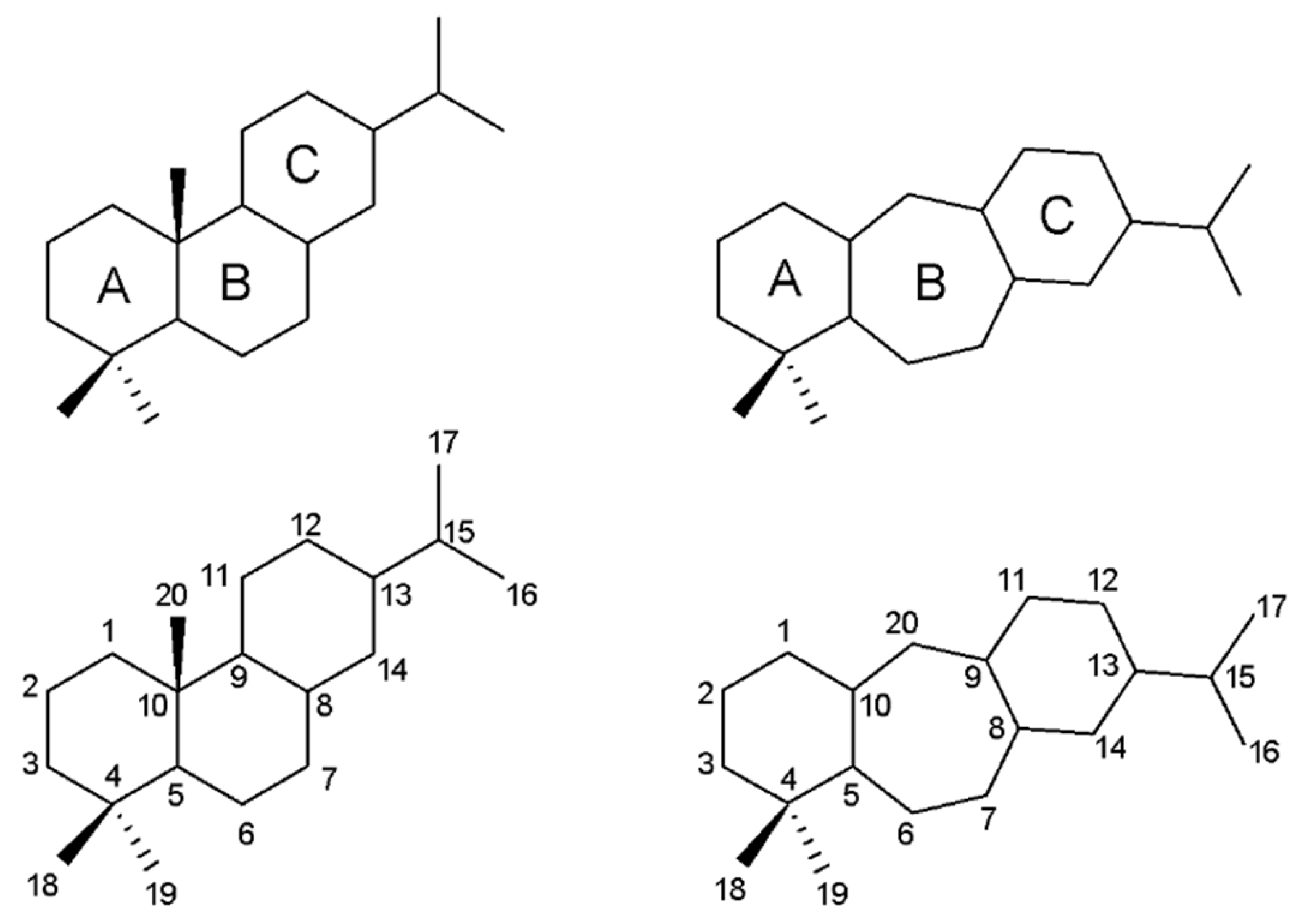


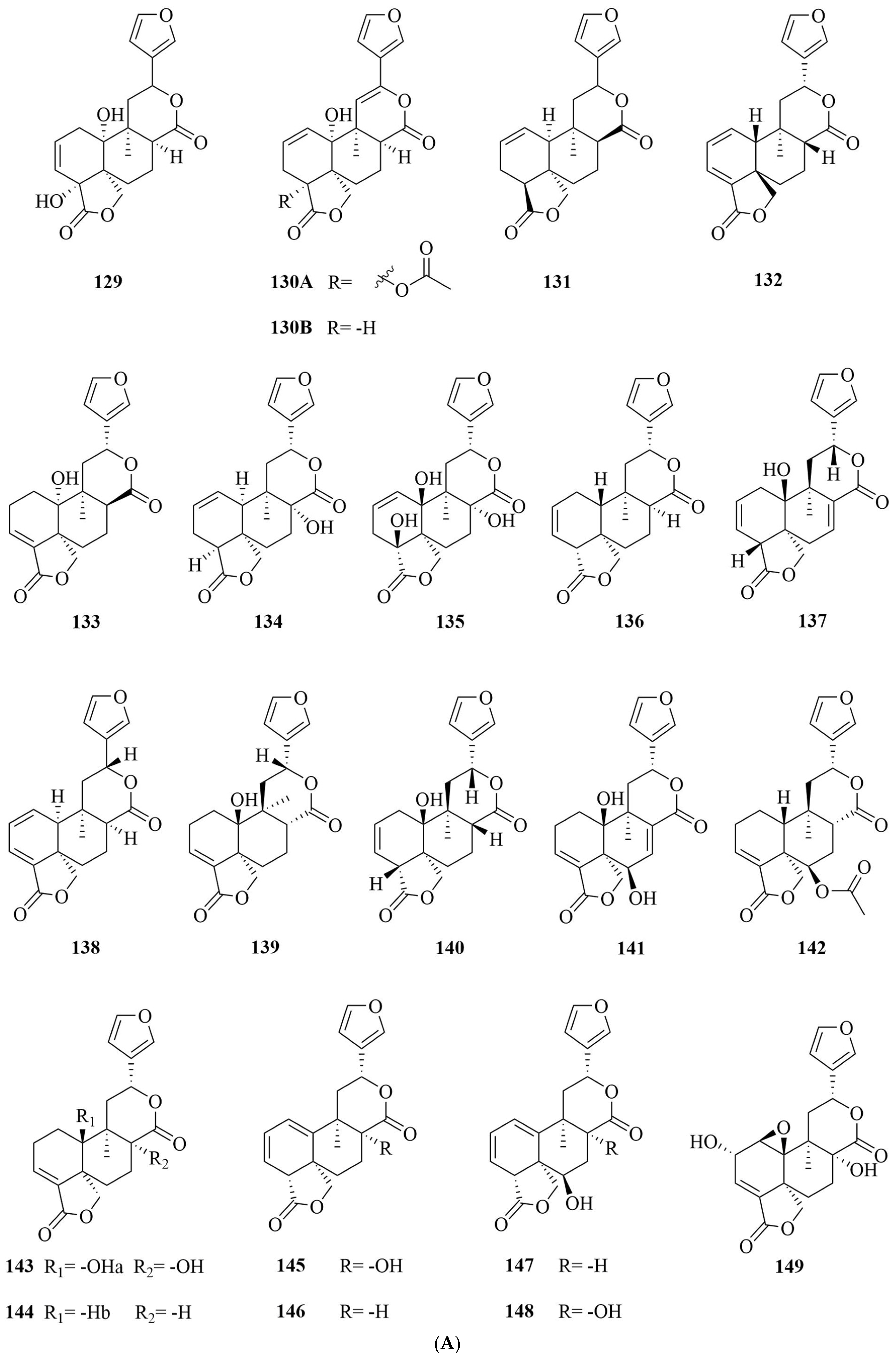
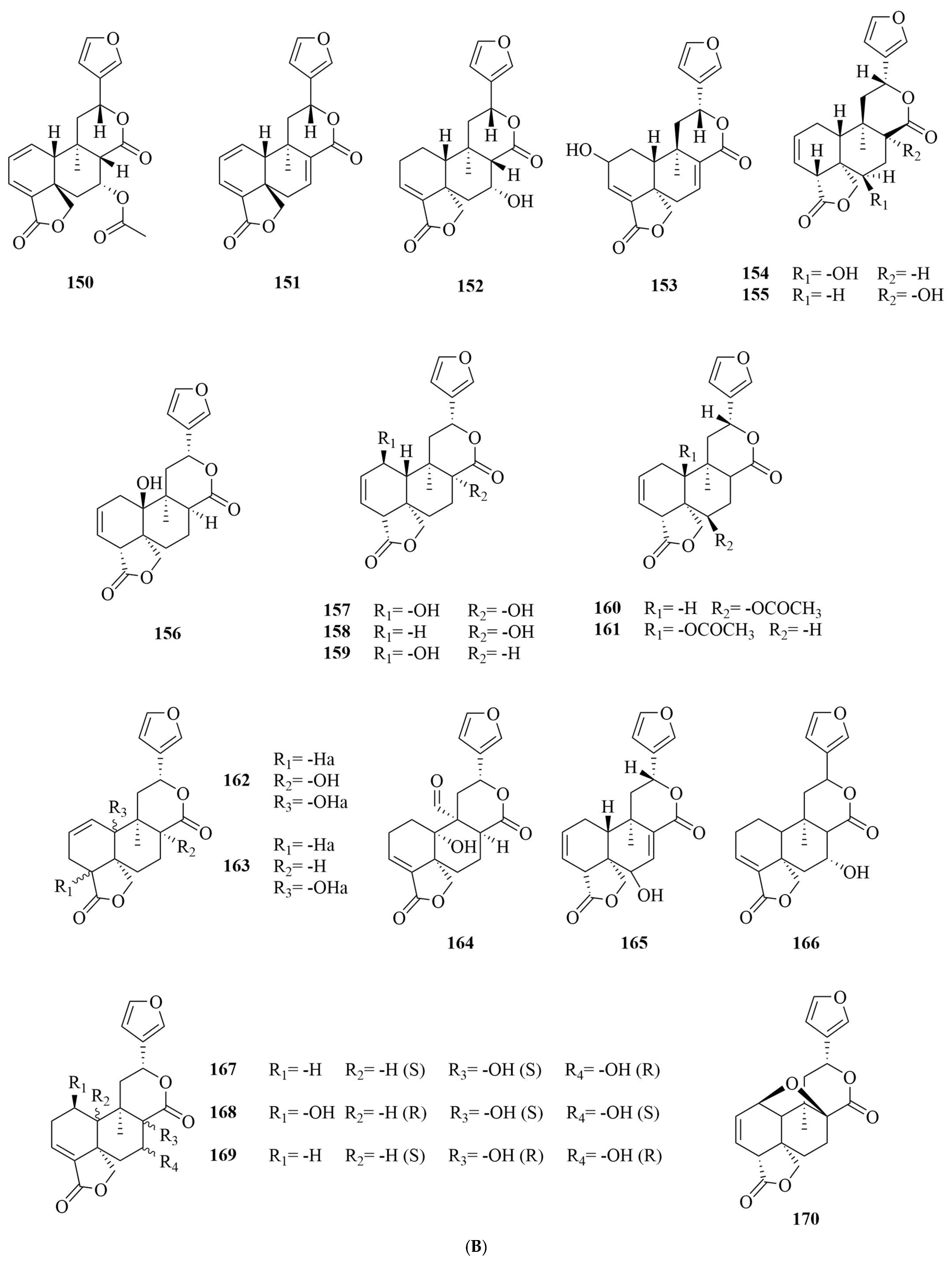
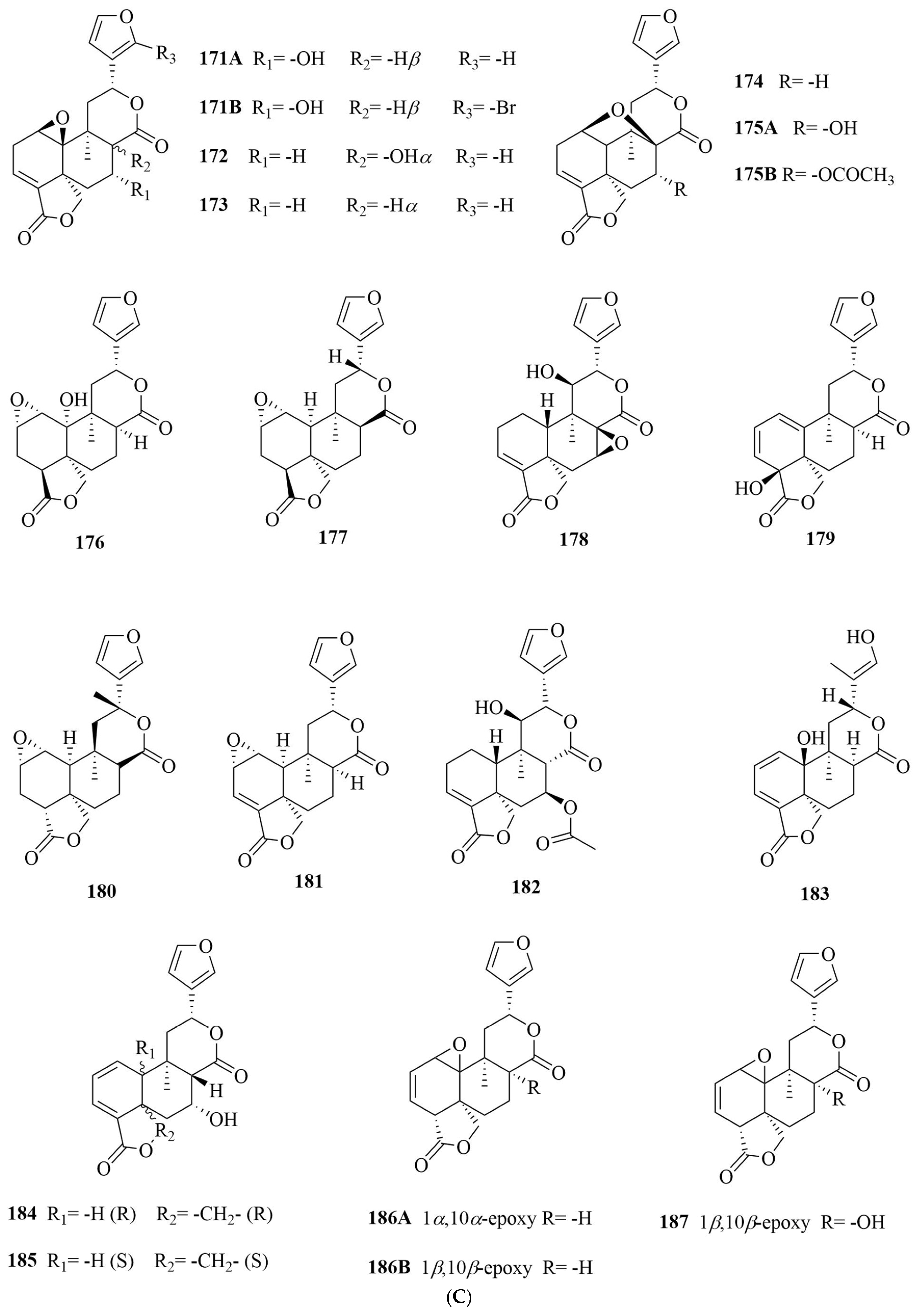





| Compound | Species | Biological Activity | Reference |
|---|---|---|---|
| Subgenus Audibertia | |||
| Sageone | S. apiana | Antiviral, cytotoxic, ligand μ-opioid affinity. | [46,132,133] |
| 16-hydroxycarnosic acid | S. apiana | Antibacterial and antifungal. | [134,135] |
| Tanshinone-IIA | S. brandegeei | Cytoprotective, anti-inflammatory, antioxidant, anticoagulant, antithrombotic, neuroprotective, against respiratory diseases. | [136,137] |
| 7α-acetoxyroyleanone | S. brandegeei | Cytotoxic and cytostatic. | [138,139,140] |
| Carnosol 16-hydroxycarnosol | S. clevelandii | Antiproliferative, cytotoxic, anti-inflammatory, antioxidant, cardioprotective, protective against kidney injury. | [45,141,142,143,144] |
| Ferruginol | S. mellifera | Antimicrobial, cytotoxic; antimalarial, anti-parasitic, neuroprotective. | [43,145,146,147] |
| Taxodione | S. mellifera | Cytotoxic; leishmanicidal, antimicrobial, antiprotozoal. | [146,148,149,150] |
| 7α-hydroxyroyleanone | S. mellifera | Antioxidant. | [151] |
| Subgenus Calosphace | |||
| 15-hydroxy-7-oxo-abieta-8,11,13-triene, sugiol, horminone, 8α, 9α-epoxy-7-ketoroyleanone, galdosol | S. albocaerulea, S. aspera, S. coulteri, S. oaxacana, S. anastomosans, S. concolor, S. lavanduloides, S. reptans, S. semiatrata, S. chamaedryoides, S. mellifera | Cytostatic, antiproliferative, antibacterial, and antioxidant. | [55,66,73,152,153,154,155] |
| Conacytone | S. anastomosans, S. ballotiflora, S. candicans, S. pubescens | Cancer quimiopreventive and anti-inflammatory. | [10,156] |
| Icetexone, 7,20-dihydroanastomosine | S. anastomosans, S. carranzae, S. ballotiflora, S. candicans, S. pubescens | Antioxidant, cytotoxic, antiproliferative, and immunomodulatory. | [10,80,157,158] |
| 19-deoxyicetexone | S. ballotiflora, S. carranzae | Antidiarrheal, antispasmodic, antioxidant, anti-inflammatory, and antitumoral. | [78,80,157] |
| 7α-acetoxy-6,7-dihydroicetexone | S. ballotiflora | Cytotoxic, anti-inflammatory, antiproliferative. | [10,80] |
| 6,7,11,14-tetrahydro-7-oxo-icetexone | S. ballotiflora | Antioxidant and antiproliferative. | [10,80] |
| Cariocal, anastomosine; tilifolidione, 19-deoxyisoicetexone | S. anastomosans, S. candicans, S. ballotiflora, S. semiatrata, S. thymoides, S. tiliifolia | Cytotoxic, antiproliferative, and immunomodulatory. | [10,24,157,158,159] |
| Sessein, isosessein | S. regla, S. sessei | Antioxidant, anti-inflammatory, and antibacterial. | [160] |
| Clinopodiolide A, B, and C. | S. clinopodioides | Antiparasitic, antioxidant, and antidiarrheal. | [79] |
| Leucansalvialin J and G | S. leucantha | Neurothropic. | [32] |
| Compound | Species | Biological Activity | Reference |
|---|---|---|---|
| Subgenus Calosphace | |||
| (5R, 8R, 9S, 10R)-15,16-diol-15,16-dihydro-hardwickiic acid; (2S, 5R, 8R, 9S, 10R)-2-β-hydroxy-16-oxo-15, 16-dihydro-hardwickiic acid; 7α, 12α-dihydroxyhautriwaic acid-19-lactone; ent-15,16-epoxy-10,6-dihydroxycleroda-3,7,13(16), 14-tetraene-17,12;18,19-diolide; ent-19-O-acetoxy-15,16-epoxy-3,13(16), 14-clerodatrien-6,8,12-triol; Splendidin C; (5S,7R,8S,9R,10S,12R)-7,8-dihydroxycleroda-3,13(16),14-triene-17,12;18,19-diolide; (7R,8S,9R,12R)-7-hydroxy-5,10-seco-neo-cleroda-1(10),2,4,13-(16),14-pentaene-17,12;18,19-diolide; (5R,7R,8S,9R,10R,12R)-7-hydroxycleroda-1,3,13(16),14-tetraene-17,12;18,19-diolide; (5S,7R,8R,9R,10S,12R)-7,8-dihydroxycleroda-3,13(16),14-triene-17,12;18,19-diolide; ent-19-O-acetoxy-15,16-epoxy-3,13(16), 14-clerodatrien-6,18-diol; Salvigresin D | S. adenophora, S. buchananii, S. chamaedryoides, S. fulgens, S. greggii, S. involucrata | Antibacterial. | [73,93,105] |
| Teotihuacanin, amarissinin A-C, amarisolide F, involucratin A, kingidiol, salvileucalin B | S. amarissima, S. involucrata, S. leucantha | Cytotoxic, multidrug-resistance modulators, antiarthritic, anti-inflammatory and antirheumatic. | [12,27,101,161,162,163,164] |
| Amarisolide A | S. amarissima | Antidiabetic, antinociceptive, anti-inflammatory, antihyperalgesic, antiallodynic, and anticonvulsant. | [4,165,166,167,168,169] |
| Semiatrin, salviarin, dugesin E, isosalvipuberulin, 1(10)-dehydrosalviarin, kerlinolide, 6β-hydroxysalviarin, 7α-hydroxy-ent-clerodan-3,13-dien-18,19: 16,15-diolide | S. aspera, S. semiatrata; S. buchananii, S. carnea, S. gregii, S. karwinskii, S. reflexa, S. rhyacophila, S. melissodora (Syn. S. dugesii), S. carnea, S. leucantha, S. tiliifolia, S. involucrata, S. herbacea, S. lineata, S. wagneriana, S. kerlii, S. reptans | Antimicrobial, antifeedant, and multidrug-resistance modulatory. | [94,170,171] |
| Sepulturin A, C, E, linearolactone, infuscatin, salvimicrophyllin D, microphyllandiolide, polystachyne E, Tehuanin D-F, H, 1α, 10α-epoxysalviarin | S. buchananii, S. decora, S. shannonii, S. polystachia (Syn. S. filipes), S. infuscata, S. microphylla, S. herbacea, S. lineata | Cytotoxic, antiparasitic, antiprotozoal, antiamoebic, antigiardial, anti-inflammatory, antibacterial, antifungal, and phytotoxic. | [95,96,97,172,173,174,175,176] |
| Tilifodiolide | S. chamaedryoides, S. melissodora (Syn. S. dugesii), S. leucantha, S. mexicana, S. tiliifolia | Antifeedant, antidiarrheal, vasorelaxant, anxiolytic, antidepressant, anti-inflammatory, and antinociceptive. | [128,170,177] |
| (1R,5S,7S,8S,9R,10R,12R)-1,7,8-trihydroxycleroda-3,13(16),14-triene-17,12;18,19-diolide | S. chamaedryoides | Antidiabetic and antibacterial. | [73] |
| 7β-acetoxysalvimicrophyllin A | S. decora | Antidiabetic and inhibitory activity of hPTP1B. | [103] |
| Dugesin B | S. melissodora (Syn. S. dugesii), S. leucantha, S. mexicana, S. tiliifolia | Acetyl cholinesterase-inhibitory. | [28] |
| Dugesin F | S. melissodora (Syn. S. dugesii), S. tiliifolia | Activity against influenza virus. | [94] |
| Salvifarinin B | S. farinacea | Effect on reducing hepatic steatosis. | [89] |
| Salvifaricin | S. hispanica | Hypoglycemic activity. | [117] |
| Salvifiline A | S. polystachia (Syn. S filipes) | Cytotoxic, colagen (COL1A1) transcription inducer. | [96,102] |
| Tehuanin G | S. herbacea, S. shannonii | Anti-inflammatory and antiparasitic. | [95,97] |
| Salvianduline E | S. melissodora (Syn. S. dugesii), S. hispanica, S. lavanduloides, S. leucantha, S. tiliifolia, | Antitrypanosomal. | [27] |
| Leucansalvialin G | S. leucantha | Neurotrophic. | [32] |
| Salvileucantholide | S. leucantha | Acetyl cholinesterase inhibitor. | [28] |
| polystachine G, 15-epi-polystachine G | S. polystachia (Syn. S filipes) | Cytotoxic, antibacterial, antifungal, and phytotoxic. | [96] |
| 15-epi-salvifiline A | S. polystachia (Syn. S filipes) | Collagen transcription inducer. | [96] |
| 7-keto-neoclerodan-3,13-dien-18,19:15,16-diolide | S. semiatrata | Antinociceptive and anxiolytic. | [178] |
| Salvinorin A | S. divinorum | Anxiolytic, antidepressant, antinociceptive, anti-inflammatory, neuroprotector and antiparasitic. | [8,173,179,180,181] |
Disclaimer/Publisher’s Note: The statements, opinions and data contained in all publications are solely those of the individual author(s) and contributor(s) and not of MDPI and/or the editor(s). MDPI and/or the editor(s) disclaim responsibility for any injury to people or property resulting from any ideas, methods, instructions or products referred to in the content. |
© 2026 by the authors. Licensee MDPI, Basel, Switzerland. This article is an open access article distributed under the terms and conditions of the Creative Commons Attribution (CC BY) license.
Share and Cite
Ortiz-Mendoza, N.; Bazany-Rodríguez, I.J.; Martínez-Gordillo, M.J.; Basurto-Peña, F.A.; Dorazco-González, A.; Fragoso-Martínez, I.; González-Trujano, M.E.; Martínez Ambriz, E.; Soto-Hernández, M.; Aguirre-Hernández, E. Diterpenes with Abietane and Clerodane Skeletons from the Mexican Salvia Species as Potential Bioactive Compounds. Molecules 2026, 31, 3287. https://doi.org/10.3390/molecules31183287
Ortiz-Mendoza N, Bazany-Rodríguez IJ, Martínez-Gordillo MJ, Basurto-Peña FA, Dorazco-González A, Fragoso-Martínez I, González-Trujano ME, Martínez Ambriz E, Soto-Hernández M, Aguirre-Hernández E. Diterpenes with Abietane and Clerodane Skeletons from the Mexican Salvia Species as Potential Bioactive Compounds. Molecules. 2026; 31(18):3287. https://doi.org/10.3390/molecules31183287
Chicago/Turabian StyleOrtiz-Mendoza, Nancy, Iván J. Bazany-Rodríguez, Martha J. Martínez-Gordillo, Francisco A. Basurto-Peña, Alejandro Dorazco-González, Itzi Fragoso-Martínez, María Eva González-Trujano, Emmanuel Martínez Ambriz, Marcos Soto-Hernández, and Eva Aguirre-Hernández. 2026. "Diterpenes with Abietane and Clerodane Skeletons from the Mexican Salvia Species as Potential Bioactive Compounds" Molecules 31, no. 18: 3287. https://doi.org/10.3390/molecules31183287
APA StyleOrtiz-Mendoza, N., Bazany-Rodríguez, I. J., Martínez-Gordillo, M. J., Basurto-Peña, F. A., Dorazco-González, A., Fragoso-Martínez, I., González-Trujano, M. E., Martínez Ambriz, E., Soto-Hernández, M., & Aguirre-Hernández, E. (2026). Diterpenes with Abietane and Clerodane Skeletons from the Mexican Salvia Species as Potential Bioactive Compounds. Molecules, 31(18), 3287. https://doi.org/10.3390/molecules31183287