Article

Nanoconfinement-Enhanced CO2 Retention in Fenamate-Loaded Silica Aerogels

by
Konstantin Belov
1,
Maria Ikim
2,
Varvara Demina
2,
Valentina Sobornova
1,
Maria Mochalova
3,
Natalia Menshutina
3,
Michael Kiselev
1,
Leonid Trakhtenberg
2,4 and
Ilya Khodov
1,2,*
1
G.A. Krestov Institute of Solution Chemistry of the Russian Academy of Sciences, Ivanovo 153045, Russia
2
N.N. Semenov Federal Research Center for Chemical Physics RAS, Moscow 119991, Russia
3
Department of Chemical and Pharmaceutical Engineering, D. Mendeleev University of Chemical Technology of Russia, Moscow 125047, Russia
4
Moscow Center for Advanced Studies, Moscow 123592, Russia
*
Author to whom correspondence should be addressed.
Molecules 2026, 31(18), 3248; https://doi.org/10.3390/molecules31183248
Submission received: 25 August 2026 / Revised: 10 September 2026 / Accepted: 12 September 2026 / Published: 14 September 2026

Abstract

The interaction between carbon dioxide and molecularly confined pharmaceutical compounds can result in CO2 retention that exceeds that achieved through conventional physical adsorption. This study investigates CO2 retention following sorption in hydrophilic and hydrophobic silica aerogels containing the fenamates mefenamic acid and flufenamic acid. The Thermal stability of the retained CO2 was characterized using temperature-programmed oxidation and temperature-programmed desorption measurements. Concurrently, single-point nitrogen adsorption measurements monitored relative changes in the apparent accessible surface area of the porous matrix. Untreated silica aerogels did not exhibit a significant CO2 desorption peak at elevated temperatures. In contrast, all composites containing fenamates exhibited an additional high-temperature desorption step beginning at approximately 225 °C, indicating enhanced CO2 retention after sorption once the external CO2 layer was removed. This characteristic persisted following preliminary thermal treatment, suggesting it is not solely attributable to residual volatile substances. Surface-area measurements indicated minimal changes in the original aerogels after the CO2 cycle, whereas composites with flufenamic acid demonstrated more pronounced alterations. Considering previous nuclear magnetic resonance, spectroscopic, and computational studies, these findings suggest a combined effect of nanoconfinement, surface-dependent interfacial phenomena, and specific interactions involving the fenamate-containing phase. Reversible chemical interactions may contribute to the observed retention, although the current measurements do not allow for quantitative separation of their effects from those of physical confinement.

1. Introduction

Fenamates, including mefenamic acid (MFA) and flufenamic acid (FFA), are conformationally flexible nonsteroidal anti-inflammatory drugs whose molecular and solid-state structures exhibit high sensitivity to their local environment [1,2,3,4,5]. This pronounced sensitivity renders fenamates effective molecular probes for examining how solvent interactions, spatial confinement, and intermolecular forces influence the relationship between molecular conformation and solid-state organization [1,2,6,7,8]. Supercritical carbon dioxide (scCO2) is particularly advantageous in this context because its solvent properties can be continuously adjusted by varying pressure and temperature, facilitating both molecular processing and crystallization control without reliance on conventional organic solvents [9,10,11]. Systematic investigations of the solubility of various fenamate derivatives in scCO2 have revealed a strong dependence on molecular structure and thermodynamic parameters [9,10,12].
In addition to influencing solubility, scCO2 can modify the molecular organization of fenamates [13,14]. Nuclear magnetic resonance (NMR) studies of MFA and FFA have demonstrated alterations in their conformational states within CO2-containing media, thereby linking the molecular environment to the formation and stability of distinct solid forms [13]. More broadly, the significance of spatial confinement has been established for FFA, where nanoconfinement alters the pathways of polymorphic transformation compared to the bulk material [3,15,16]. Collectively, these findings indicate that the structural behavior of fenamates is determined not only by their intrinsic molecular properties but also by the nanoscale environment in which they are situated.
Porous aerogels offer a highly versatile platform for environmental control due to their combination of high surface area, interconnected porosity, and chemically tunable internal surfaces [17,18,19]. The application of scCO2 for loading pharmaceutical compounds into aerogels has consequently received significant attention [20,21,22,23,24,25,26]. Nonsteroidal anti-inflammatory drugs such as nimesulide, ketoprofen, and diclofenac have been successfully incorporated into biopolymer aerogels using scCO2 [26]. Conversely, studies involving ibuprofen and ketoprofen in mesoporous silica have shown that drug loading is influenced by both solubility in scCO2 and interactions with the porous matrix [17,27,28,29]. Notably, the quantity of drug retained after depressurization does not necessarily reflect the equilibrium adsorbed amount, as precipitation during depressurization can substantially affect the measured loading [17].
In the case of fenamates, the porous matrix is increasingly regarded as an active component of the molecular environment rather than merely a passive carrier [30,31]. Incorporation of MFA into silica aerogels has been shown to alter their conformational equilibrium through interactions with the silica surface, while FFA-containing silica aerogels display modifications in both the drug’s molecular environment and the composite’s sorption properties [31,32,33,34]. Studies involving cellulose-based aerogels further indicate that the chemical composition of the matrix can dictate the localization and structural state of confined MFA and FFA. Collectively, these results establish a coupled fenamate–surface–CO2 system in which molecular confinement, surface interactions, and the CO2 environment must be considered as interdependent factors.
A significant consequence of this coupling has received relatively limited attention: the state and persistence of CO2 following removal of the external CO2 phase [35,36,37,38]. Most previous studies have focused on CO2 uptake, diffusion, and molecular localization while the porous material is in contact with CO2-containing media [39,40,41]. These measurements yield insights into the dynamic equilibrium established during exposure, but do not directly determine whether a portion of CO2 remains strongly retained after the external CO2 reservoir is removed. This distinction is especially relevant for fenamate-containing aerogels, as interactions with the organic component may generate CO2 states distinct from those present on pristine silica surfaces.
This question is further informed by recent molecular-level investigations of fenamate–CO2 interactions [31,42,43]. Previous work has demonstrated that MFA reacts with CO2 in scCO2 and, notably, that confinement within an aerogel can modify the preferred reaction pathway and decrease the temperature at which reaction products are detectable [42]. Similar studies of FFA have confirmed its chemical reactivity with CO2 and the formation of a distinct reaction product [43]. These findings indicate that molecular interactions within the confined fenamate phase may have implications extending beyond the reaction itself, potentially affecting the persistence of CO2 within the porous composite after removal of the external CO2 phase [9,44].
A key unresolved issue is whether the enhanced post-sorption retention observed in fenamate-containing aerogels results primarily from physical confinement of CO2, specific intermolecular interactions, chemical binding, or a combination of these mechanisms. Clarifying these contributions is important because CO2 localized within a confined nanoporous environment may display markedly different retention behavior compared to CO2 undergoing conventional reversible physisorption on a bare silica surface. This study therefore investigates the thermal persistence of retained CO2 by employing comparative TPO/TPD measurements of pristine and fenamate-containing aerogels to determine whether the incorporation of the fenamate phase introduces an additional CO2-retention mechanism.
The present study examines the post-sorption retention of CO2 in MFA- and FFA-containing silica aerogels using temperature-programmed oxidation/desorption (TPO/TPD) in conjunction with single-point Brunauer–Emmett–Teller (BET) measurements of specific surface area [45]. This methodology allows for assessment of the thermal persistence of retained CO2 as well as changes in the textural properties of the porous matrix [46,47,48]. Pristine hydrophilic and hydrophobic silica aerogels, despite possessing high specific surface areas, do not display a significant high-temperature CO2-release feature. In contrast, both fenamate-containing composites exhibit an additional high-temperature CO2-release process [47,49]. The persistence of this feature after calcination, along with the relatively minor changes in the textural characteristics of the pristine aerogels following the CO2 cycle, indicates that alterations in the silica pore structure alone cannot fully explain the observed CO2 retention.
These findings highlight a key characteristic of fenamate–aerogel systems: the incorporation of a molecular dopant can produce a population of CO2 species that remains strongly retained after removal of the external CO2 phase [38]. Together with analysis of prior NMR, spectroscopic, and computational evidence for specific fenamate–surface and fenamate–CO2 interactions, the current results support a model in which CO2 retention is governed by the combined effects of nanoconfinement, interfacial interactions, and specific interactions involving the fenamate-containing phase [50]. Therefore, the most relevant descriptor for these materials is not solely their CO2 uptake under pressure, but also the molecular state, thermal stability, and persistence of CO2 following removal of the external reservoir.

2. Results and Discussion

2.1. TPO/TPD Characterization of Pristine and Fenamate-Doped Silica Aerogels

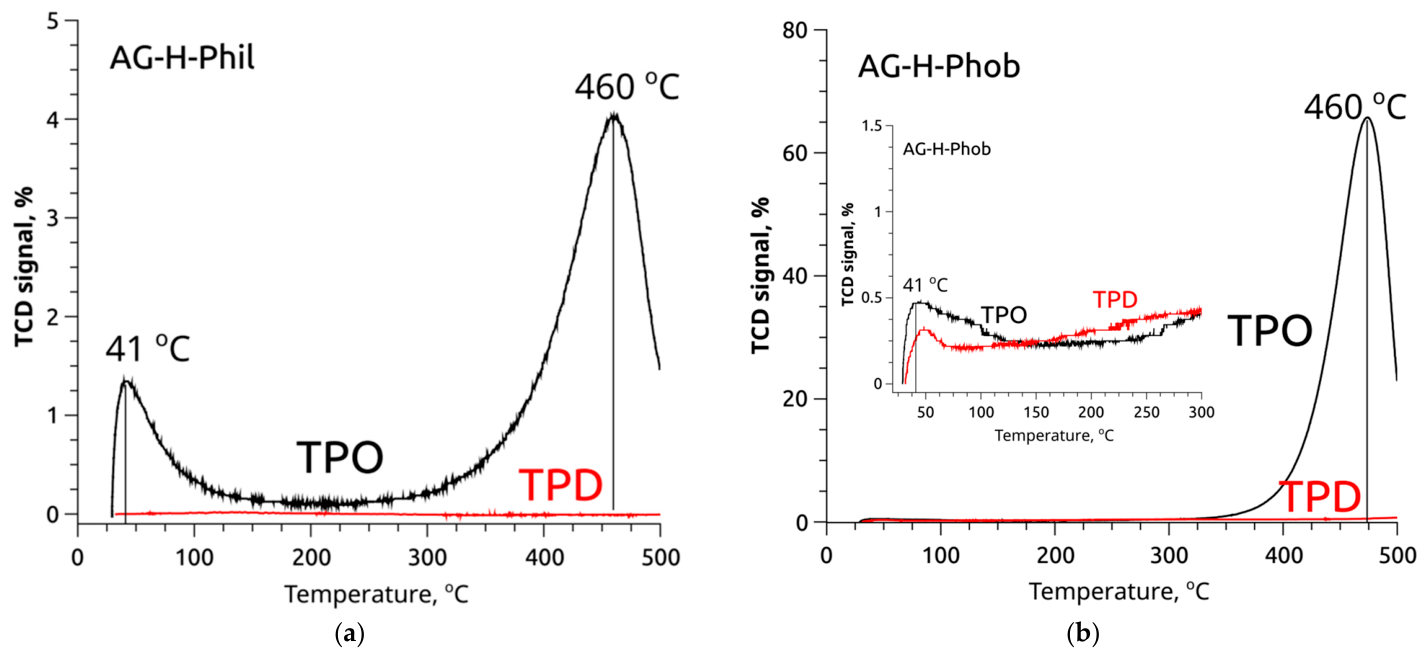
Initially, the TPO/TPD behavior of the hydrophilic (H-Phil) and hydrophobic (H-Phob) aerogel (AG)-based materials was compared (Figure 1). Establishing the baseline behavior of pristine, undoped materials is essential for interpreting the TPO and TPD profiles of the fenamate-loaded composites.
The AG-H-Phil sample exhibits a pronounced peak at approximately 41 °C; however, a signal in the same temperature region is also present for AG-H-Phob. In both materials, the TCD response appears immediately after the experiment commences. This low-temperature signal is most likely associated with the removal of physically adsorbed water, residual solvent from aerogel synthesis, and other volatile species within the pore structure. A high-temperature signal centered at approximately 460 °C is observed in both materials, but with markedly different intensities: for AG-H-Phob, the TCD response reaches approximately 66%, whereas for AG-H-Phil it is only about 4%. Previous IR spectroscopic studies have shown that hydrophobic silica aerogels are characterized predominantly by Si–CH3 groups at the pore surface, whereas hydrophilic materials contain Si–OH functionalities [51,52,53]. The pronounced high-temperature response of AG-H-Phob may therefore be attributed to the oxidation of surface CH3 groups and their conversion into more hydrophilic surface functionalities, as previously reported [54,55,56]. Neither material exhibits a pronounced TPD peak, indicating that the pristine aerogel matrices do not retain CO2 for extended periods under the applied flow-through conditions. These baseline observations provide a reference for assessing the behavior of the fenamate-doped composites, specifically mefenamic (MFA) and flufenamic (FFA) acid-based composites AG-H-Phil+MFA, AG-H-Phob+MFA, AG-H-Phil+FFA, and AG-H-Phob+FFA.
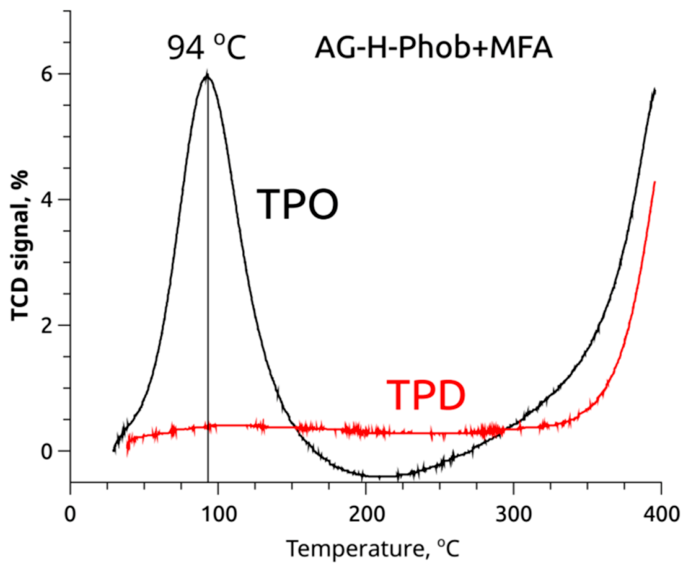
The initial composite investigated was AG-H-Phob+MFA (Figure 2). To identify characteristic patterns of CO2 interaction with both the composite matrix and the dopant, the upper temperature limit was reduced to 400 °C to minimize thermal degradation of mefenamic acid.
The first peak is shifted to a higher temperature, approximately 94 °C, and becomes more intense. This behavior may result from additional contributions of residual solvents, particularly isopropanol (Tb = 82.4 °C), used during sample preparation. Changes in the TCD response may also reflect partial removal of fenamate located near the external surface of the composite. At higher temperatures, the TPO profile exhibits a shoulder corresponding to the feature previously observed for the undoped matrices, but with substantially increased intensity. The most significant difference is observed in the TPD profile, where a relatively symmetric high-temperature signal appears, which was absent in pristine AG-H-Phob. This feature indicates that CO2 is retained in the composite structure considerably longer than in the pristine aerogel and suggests the presence of additional interactions between CO2 and the fenamate-containing structure.
This observation is consistent with previously reported NMR results for nanocrystalline cellulose aerogel-based composites exposed to supercritical CO2 [31]. In those systems, the correlation times (τc) of the composite materials (0.38 and 0.25 h) exceeded those of the corresponding pristine support matrices (0.15 h), indicating stronger retention of CO2 within the composite structure. The present TPD results provide complementary evidence for this behavior under flow-through conditions. While the NMR measurements were conducted in a cell with continuous scCO2 as the surrounding medium, TPD monitors the release of previously retained CO2 during a temperature ramp. The emergence of a high-temperature TPD signal indicates that the composite retains CO2 even after the external supply ceases.
These findings also clarify results reported in a previous study of silica-aerogel systems containing the same dopants [32]. In that work, substantially longer correlation times were obtained for the pristine silica matrices (1.2 h), whereas lower values were observed for the MFA- and FFA-containing composites (0.7 and 0.14 h, respectively). This behavior was interpreted in terms of the availability of sites or “vacancies” for CO2 localization within the pore structure. The combined results suggest that the different trends observed in the two experimental configurations are attributable to fundamentally different measurement conditions. Under continuous scCO2 exposure, the pristine silica aerogel provides numerous accessible sites for CO2 localization and can therefore exhibit relatively long correlation times. In contrast, once the external CO2 supply is removed, as in the flow-through TPD experiment, the pristine aerogel does not show significant long-term CO2 retention. The presence of the fenamate introduces additional interactions that allow a fraction of CO2 to remain associated with the composite structure during subsequent heating.
The fact that the pristine aerogels and those containing fenamates behave differently shows that the retention observed cannot be explained merely as conventional reversible physisorption on the silica surface. When the physically trapped CO2 in the pristine matrices is released under the flow-through TPD conditions, no sharp high-temperature desorption peak is obtained. By contrast, when MFA or FFA is incorporated, there appears an extra population of CO2 which stays bound to the composite down to much higher temperatures. This result is in agreement with there being stronger specific interactions between CO2 and the fenamate-containing phase.
It is also possible that a chemical effect is responsible for this retention. Earlier spectroscopic and computational studies have shown that both MFA and FFA are able to enter into chemical interactions with CO2 under the right conditions, and that spatial confinement can affect the formation and stability of the products thus obtained. It follows that the high-temperature feature seen in the present composites might be due at least in part to CO2 species that are chemically bound or otherwise strongly associated. However, this experiment does not offer a direct molecular identification of the retained species, and it cannot be ruled out that a contribution comes from strongly confined physisorbed CO2.
Therefore, silica aerogel without dopant is well suited for rapid CO2 uptake and prolonged CO2 localization under conditions resembling impregnation, when a continuous CO2 supply is maintained. Under flow-through TPO/TPD conditions, however, the retention mechanism is more complex, and the presence of the dopant becomes critical for maintaining CO2 within the material after the external CO2 supply is discontinued. This distinction reconciles the contrasting NMR and TPD observations and underscores the importance of experimental configuration when interpreting CO2 dynamics in porous materials.
A plausible explanation for the enhanced CO2 retention in fenamate-containing composites is the presence of chemical interactions between the dopant and CO2, indicating that chemisorption may significantly contribute to the observed effects. Such behavior was previously demonstrated for MFA in scCO2 and under confinement within a nanocrystalline-cellulose aerogel [42]. Using IR spectroscopy and quantum-chemical calculations, it was shown that the reaction between MFA and CO2 occurs in saturated scCO2 solution above approximately 190 °C. In contrast, confinement within the aerogel lowers the onset temperature to approximately 100 °C. Similar behavior was subsequently demonstrated for FFA [43]. In that case, the reaction in the bulk solution occurred at approximately 100 °C and around 200 bar, producing an amorphous reaction product that remained stable in air for an extended period.
These previous observations are particularly relevant to the present TPD results because they provide independent evidence that the fenamate molecules are capable of specific chemical interactions with CO2. The appearance of the high-temperature CO2 desorption feature in the present composites is therefore consistent with a contribution from chemical binding in addition to physical confinement and other intermolecular interactions. In this context, the higher temperature required for CO2 release may reflect the greater stability of the retained CO2-containing species compared with the weakly and reversibly localized CO2 observed in the pristine matrices.
However, the TPD experiment measures the thermal release of CO2 and does not directly identify the molecular structure of the retained species. The observed high-temperature feature should therefore not be assigned exclusively to chemisorption. Rather, the present results support a mechanistic model in which physical confinement, specific fenamate–CO2 interactions, and a possible reversible chemical component jointly contribute to the enhanced post-sorption CO2 retention.
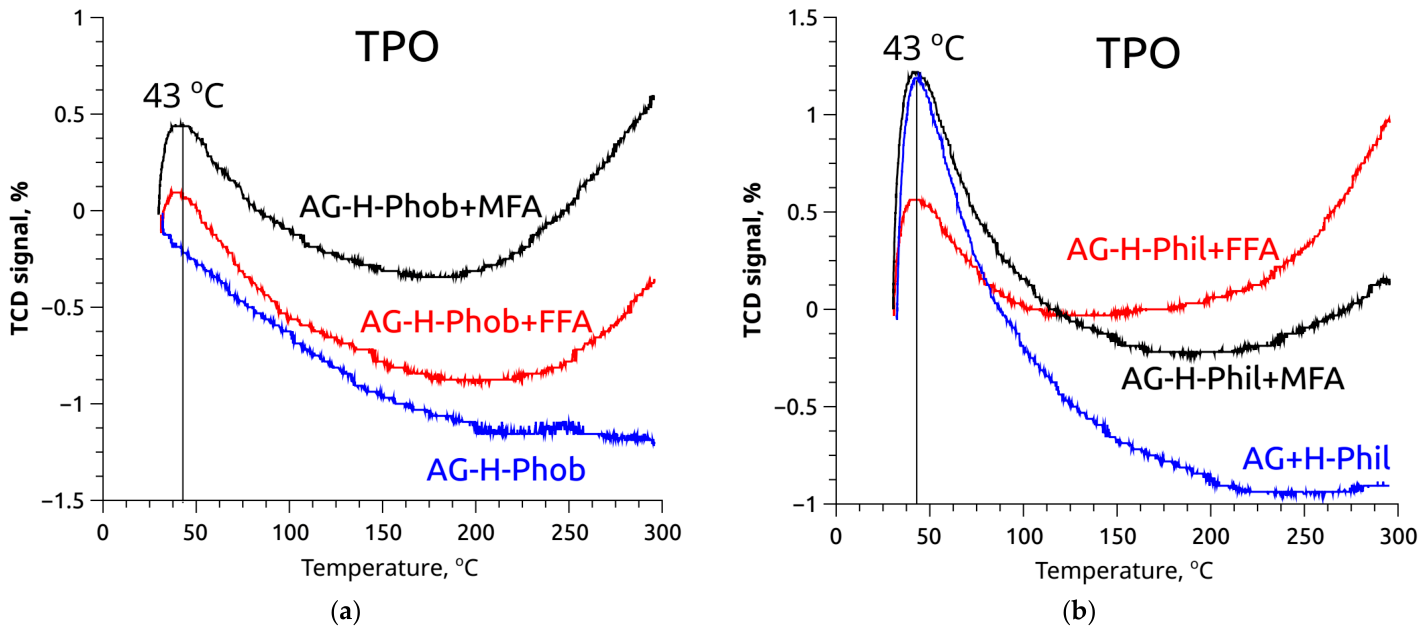
To further distinguish these effects from contributions arising from residual volatile species, the TPO/TPD measurements were repeated after preliminary calcination of the samples in flowing He at 130 °C for 30 min. This treatment was intended to minimize the contribution of residual solvents responsible for the low-temperature features observed in the initial measurements (Figure 3).
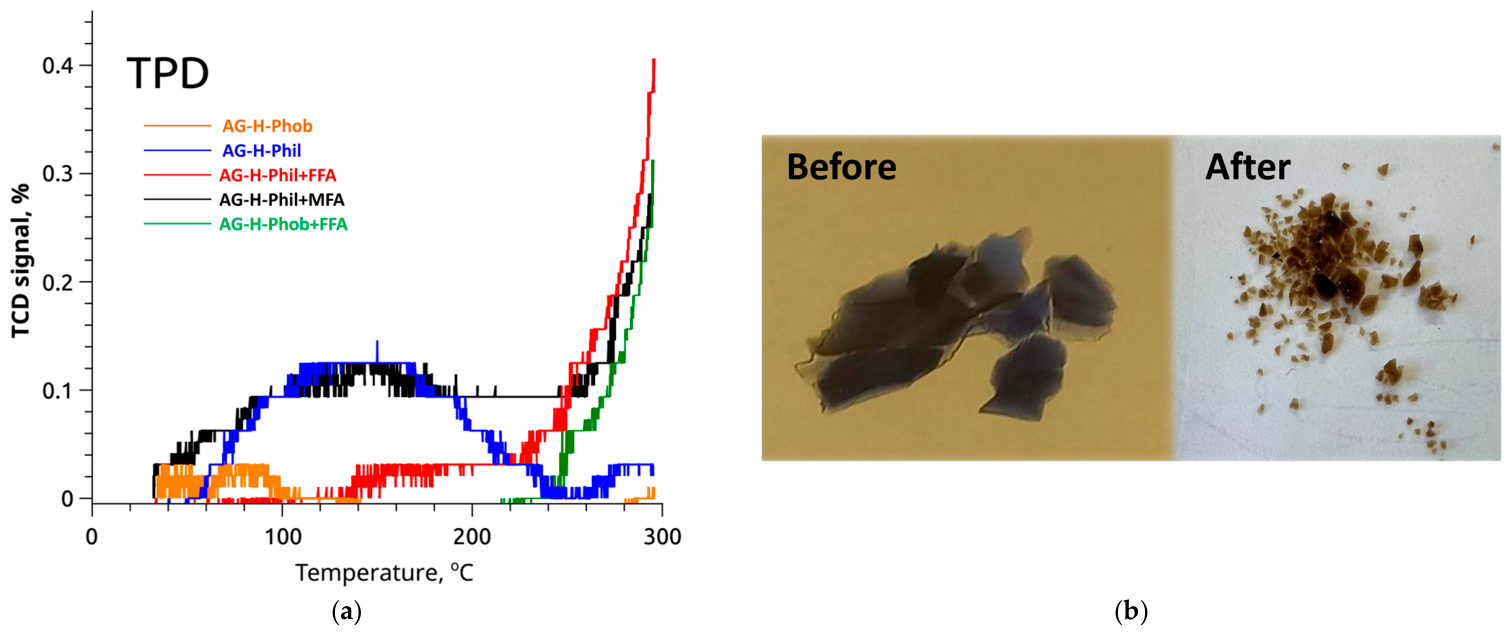
The resulting TPO profiles show similar behavior in both pristine aerogels and fenamate-containing composites. In all samples, the dominant changes in the TCD response occur above approximately 200 °C, irrespective of the support’s hydrophilic or hydrophobic character and of the dopant’s identity. Calcination completely removes the low-temperature feature previously observed for AG-H-Phob, supporting its assignment to volatile species. The corresponding signal remains in the composites, although with substantially reduced intensity. In contrast, the low-temperature response of AG-H-Phil persists after calcination, most likely because the hydrophilic sample partially re-adsorbed moisture from ambient air during transfer between experiments. The TPD profiles provide an even more pronounced distinction. All fenamate-containing composites exhibit an intense desorption signal beginning at approximately 225 °C, whereas the undoped aerogels do not show a comparable TPD response within the investigated temperature range (see Figure 4). Consequently, the calcined samples confirm the previously observed tendency: the fenamate-containing composites retain CO2 more efficiently than the pristine aerogels under flow-through conditions. This behavior may be consistent with chemical interactions analogous to those previously identified for MFA and FFA in scCO2 [42,43].
At the same time, interpretation of the TPO data requires caution because the temperature ranges associated with oxidation of the aerogel framework and oxidation/decomposition of the fenamate dopants partially overlap. Therefore, an increase in the TPO response cannot be directly assigned to a particular chemical transformation of the dopant. Nevertheless, the TPD behavior is less readily explained by this overlap, as pristine aerogels do not exhibit a corresponding high-temperature CO2 desorption feature. An additional qualitative indication of chemical transformation is the color change observed in AG-H-Phil+FFA after CO2 sorption. A comparable color change was previously observed during formation of the FFA–CO2 reaction product [43,57]. Although the color change cannot independently establish the formation of a reaction product within the aerogel, its coincidence with the enhanced high-temperature CO2 retention provides additional support for this interpretation. The primary objective of this study is to demonstrate and qualitatively characterize this previously unobserved phenomenon. Quantitative assessment of the contributions of physisorption and chemisorption, as well as clarification of the molecular mechanism governing the interaction of CO2 with the composite, will require further experimental and computational investigations. These aspects will be addressed in future research.
Therefore, the evidence for a chemical contribution should be evaluated cumulatively rather than relying solely on the TPD signal. The current TPD results demonstrate the presence of an additional thermally persistent CO2 population in the fenamate-containing composites. Furthermore, previously reported spectroscopic and computational studies independently confirm the chemical reactivity of fenamates toward CO2. Collectively, these findings support the hypothesis that chemical interactions contribute to enhanced retention; however, they do not permit quantitative separation of this contribution from that of physical confinement or other specific interactions.
Hydrophilic and hydrophobic silica surfaces generate distinct interfaces for the confined fenamate phase, which may influence its interaction with carbon dioxide. However, the observed high-temperature carbon dioxide retention in composites derived from both types of matrices indicates that surface hydrophilicity or hydrophobicity alone does not determine this effect. Instead, surface chemistry likely modulates the outcome in combination with nanoconfinement and the specific interactions between fenamate and carbon dioxide.

2.2. BET Analysis

We employed the dynamic single-point BET method [58,59], which provides a rapid means of estimating changes in specific surface area at key experimental stages (see Table 1). Measurements were conducted sequentially within a single experimental cycle: initially on untreated samples, subsequently after preliminary thermal treatment at 130 °C under helium flow, and finally following the temperature-programmed CO2 sorption and desorption experiments. Figure S1 displays all experimental data used to estimate the specific surface area values.
This section analyses and compares the estimated specific surface area values of the composite materials under investigation. While specific surface area is not a direct measure of sorption capacity, the estimated values obtained in this experiment may reflect differences in the CO2 sorption characteristics of these systems. Therefore, these values should instead be regarded as indicative trends in the evolution of specific surface area. The pristine AG-H-Phil and AG-H-Phob samples exhibit high specific surface areas of 980 and 1018 m2 g−1, respectively. Following calcination, these values increase to 1016 and 1129 m2 g−1, which can be attributed to the removal of residual solvent and other volatile species from the pore network. The resulting values are typical for silica aerogels [60,61,62,63]. Fenamate loading decreases the apparent specific surface area, consistent with partial occupation or blockage of the pore space by the dopant molecules. The largest decrease is observed for AG-H-Phil+FFA, for which the specific surface area decreases to 449 m2 g−1, i.e., by more than a factor of two relative to the pristine AG-H-Phil matrix. Calcination increases the specific surface area of the composite materials by approximately 20% on average, consistent with the removal of residual volatile species and/or weakly retained surface material.
Importantly, the CO2 sorption/desorption cycle produces only minor changes in the specific surface area of the pristine aerogels, with deviations of no more than approximately 2%. Such changes are within the expected experimental uncertainty and indicate that exposure to CO2 under the present conditions does not cause substantial irreversible restructuring of the silica pore network. This observation is consistent with the TPD data, which show that pristine silica aerogels do not retain a significant amount of CO2 under flow-through conditions after the external CO2 supply is removed.
The behavior of the fenamate-containing composites is markedly different. After the CO2 sorption/desorption cycle, the FFA-containing materials show an increase in specific surface area of approximately 11% for AG-H-Phil+FFA and 5% for AG-H-Phob+FFA. These changes are unlikely to be explained simply by CO2-induced modification of the silica framework, since the corresponding pristine aerogels exhibit only negligible changes. Instead, they may reflect changes in the dopant’s state during interaction with CO2, including the formation and subsequent transformation of a reaction product. Such an interpretation is consistent with the previously reported FFA–CO2 reaction, in which the formation of an amorphous product was demonstrated spectroscopically [43].
In contrast, the changes observed in the MFA-containing composites are minimal, not exceeding approximately 1%. This difference between MFA- and FFA-containing systems may be related to the different stability of their CO2 reaction products. The product formed upon reaction of CO2 with MFA is highly unstable in air; its formation can therefore be detected during the TPO/TPD experiment while CO2 is continuously supplied, whereas after removal of the CO2 atmosphere it undergoes transformation toward the more stable polymorphic form II of MFA [8]. The comparatively small change in BET surface area after the sorption/desorption cycle is therefore consistent with the transient nature of the MFA–CO2 product and its subsequent transformation after CO2 removal.
Taken together, the TPO/TPD and BET results provide an internally consistent picture of the role of the fenamate dopants. The negligible change in surface area of the pristine aerogels after the CO2 cycle, combined with the absence of a pronounced high-temperature TPD signal, indicates that the silica matrix alone does not provide substantial long-term CO2 retention under flow-through conditions. In contrast, the emergence of high-temperature CO2 desorption features in the fenamate-containing composites demonstrates that the dopants introduce additional CO2-retention sites or states. Because the overall pore structure is not substantially altered by the CO2 cycle, this enhanced retention cannot be attributed solely to textural changes in the silica matrix [48].
Current data indicate that the increased retention of CO2 following sorption cannot be attributed solely to changes in the accessible textural characteristics of the silica matrix. Instead, this effect is more plausibly explained by a combination of pore confinement and interactions with the fenamate-containing phase. Previous studies demonstrating the chemical reactivity of MFA and FFA toward CO2 further suggest that a chemical contribution may account for the retained CO2. However, the present single-point BET and TPO/TPD measurements do not allow for quantification of the relative contributions of these mechanisms.
Importantly, the present results also reconcile the apparently different CO2 dynamics previously observed by NMR. Under continuous scCO2 exposure, the pristine silica aerogel can provide numerous accessible sites for CO2 localization and consequently exhibit relatively long correlation times. Once the external CO2 supply is removed, however, most of this physically localized CO2 is rapidly released. Fenamate incorporation introduces an additional population of more strongly retained CO2 species, as evidenced in the present experiments by the high-temperature TPD signal. Thus, the combination of NMR and TPO/TPD suggests that CO2 mobility and CO2 retention are not equivalent parameters: a material may exhibit extensive transient CO2 localization under continuous exposure yet fail to retain it after removal of the CO2 reservoir. Fenamate-containing composites, in contrast, appear to combine rapid CO2 uptake with a fraction of more strongly retained CO2 species.
Overall, these results support the view that the silica aerogel should not be considered merely as an inert porous support. Rather, confinement within the aerogel can modify the local environment and behavior of the fenamate dopant, thereby affecting its interaction with CO2 and the stability of the resulting products. The TPO/TPD and BET measurements therefore complement the previously reported NMR, IR, and computational results and provide evidence that the enhanced CO2 retention observed in the composite materials is governed by mechanisms extending beyond simple physical adsorption.

3. Experimental

The study examined composite materials consisting of H-Phil and H-Phob silica AG as carrier matrices, which were loaded with active pharmaceutical ingredients (APIs), specifically MFA and FFA [25]. Aerogel samples were synthesized at the D. I. Mendeleev Russian University of Chemical Technology (Moscow, Russia). Commercially available API samples from Sigma-Aldrich (Darmstadt, Germany) (CAS: 530-78-9; 61-68-7) were utilized without further purification. Six material types were analyzed: non-sorbed carrier matrices (AG-H-Phil and AG-H-Phob) and the corresponding fenamate-based composites (AG-H-Phil+MFA, AG-H-Phob+MFA, AG-H-Phil+FFA, and AG-H-Phob+FFA).
Gel samples were synthesized using sol–gel technology. Tetraethoxysilane (TEOS) served as the precursor, isopropyl alcohol (C3H8O) as the organic solvent, a 0.01 M aqueous solution of hydrochloric acid (HCl) as the acid catalyst, and a 0.06 M aqueous ammonia (NH3) solution as the cross-linking agent. For sol preparation, TEOS, C3H8O, and HCl were combined at a molar ratio of 1:7:3.5, respectively, and stirred for 24 h. An aqueous ammonia solution was then added to initiate gelation at a TEOS:NH3 molar ratio of 1:2.7, and the mixture was transferred into pre-prepared 4 mL molds. Gelation was completed within 30 min. The gels remained in the molds for 24 h to enhance structural integrity.
During the solvent exchange step, samples were immersed in isopropyl alcohol at a volume four times greater than the gel volume. This process was repeated three times at 24 h intervals to remove excess water and unreacted hydroxyl groups from the gel pores. For hydrophobization, the gels were placed in an alcoholic solution containing 10 wt.% of a silicone-based hydrophobizing agent (GKZh) and maintained at 60 °C for 8 h.
The final stage of aerogel preparation involved supercritical drying, which removed the solvent from the material pores while preserving the porous structure [64]. Carbon dioxide (CO2) served as the supercritical fluid. Supercritical drying was conducted at 120 bar, 40 °C, and a CO2 flow rate of 40 mL/min.
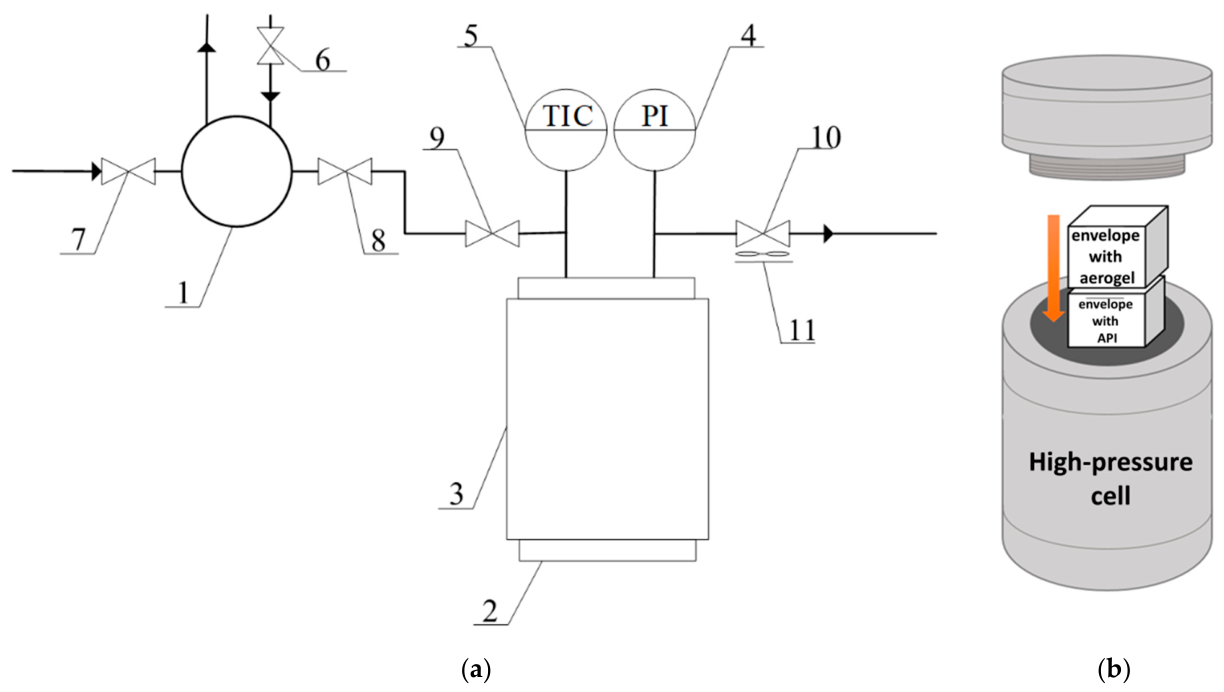
Composite materials were additionally prepared using supercritical fluid technology. Supercritical CO2 has previously been demonstrated to be an effective medium for loading pharmaceutical compounds into silica aerogels, with drug loading depending on the properties of both the API and the aerogel matrix [18,21,24,65]. In particular, silica aerogels have been successfully impregnated with mefenamic acid using supercritical CO2, and the loading was shown to depend strongly on the concentration of MFA in the supercritical phase [66]. Process parameters of 200 bar and 70 °C were selected based on literature data regarding the solubility of mefenamic and flufenamic acids in supercritical CO2 [10]. Supercritical adsorption of the APIs into the aerogels was performed using the experimental setup illustrated in Figure 5. The use of supercritical CO2 for API loading is particularly advantageous because it enables drug incorporation into the porous matrix while minimizing the use of conventional organic solvents [65].
Aerogel (0.2 g) and API (0.2 g) samples were placed in separate filter-paper envelopes. The API envelope was positioned at the bottom of the high-pressure cell, with the aerogel envelope placed above it (see Figure 5b). After sealing the high-pressure cell, valve 10 was closed, and carbon dioxide pre-cooled to 5 °C was introduced into the 65 mL high-pressure cell (2) containing the envelopes. The liquid pump (1) was used to increase system pressure, while the heating jacket (3) maintained the target process temperature. Pressure and temperature were monitored using the pressure gauge (4) and temperature controller with operator panel (5). Upon reaching the desired pressure and temperature, valve 9 was closed to seal the cell. The supercritical adsorption process was conducted for 24 h. After completion, the pressure was released at a controlled rate of 5 bar per minute.
The sorption and desorption of CO2 were investigated using temperature-programmed reaction analysis. This method measures the difference in thermal conductivity between a reference carrier gas stream and the gas stream passing through the reactor containing the sample. Changes in the gas mixture composition due to oxidation, adsorption, or desorption alter the thermal conductivity, which is detected as a thermal conductivity detector (TCD) signal (Altamira Instruments, Twin Lakes, WI, USA). Under constant experimental conditions, the signal intensity is directly proportional to changes in the concentrations of the gaseous components. TPO and TPD experiments for the composite materials were conducted using an automated chemisorption analyzer (Altamira AMI-400TPx (Altamira Instruments, Twin Lakes, WI, USA)). For TPO experiments, samples of AG and the composite materials were placed in a U-shaped quartz tube and heated to the specified temperature at a rate of 10 °C per minute in a flow of 10% CO2 in an inert helium atmosphere (flow rate: 30 mL/min).
TPD measurements were carried out under a flow of pure helium, with the heating rate and gas flow rate kept constant. Temperature-programmed desorption is widely used to characterize the interactions between adsorbed species and porous surfaces, as well as to assess the strength and distribution of adsorption sites [67,68].
We determined the specific surface area of the samples using the BET method under dynamic flow conditions on an AMI-400 automated analyzer (Altamira Instruments, Twin Lakes, WI, USA). Measurements employed a 30% N2/He mixture at a relative pressure (P/P0) of 0.3. This relative pressure was chosen as a representative condition for rapid single-point estimation of the BET surface area of the predominantly mesoporous aerogel materials [69].
We employed the single-point approach primarily to monitor relative changes in specific surface area during sequential experimental treatments, rather than to achieve comprehensive quantitative textural characterization. The principal advantage in this study was that surface area estimates could be obtained directly within the experimental sequence, enabling observation of changes associated with gas–solid interactions and subsequent treatments without removing the sample from the reactor. Therefore, the reported values should be regarded as comparative estimates of specific surface area and interpreted primarily in terms of their relative changes and trends.

4. Conclusions

The experimental results demonstrate that incorporation of MFA and FFA, collectively referred to as fenamates, into silica aerogels leads to increased CO2 retention following sorption under flow-through conditions. In contrast to plain hydrophilic and hydrophobic silica aerogels, fenamate-containing composites exhibit a distinct high-temperature CO2 desorption property, indicating the formation of CO2-retaining states not characteristic of the original silica matrices.
Results indicate that the increased CO2 retention cannot be explained by accessible area or by the hydrophilic or hydrophobic character of the silica matrix. Persistence of the high-temperature TPD peak after initial thermal treatment further suggests that the effect is not attributable to residual volatile substances. Additionally, single-point BET measurements provide further evidence that the observed retention does not result from significant irreversible alterations in the accessible surface area of the original aerogel matrices.
Together with previous NMR, spectroscopic, and computational data, these findings support a model that considers the combined effects of spatial confinement, matrix-fenamate interactions, and specific interactions between fenamates and CO2. A reversible chemical transformation of the fenamate-containing phase under confinement may explain the increased retention, consistent with previously reported reactivity of MFA and FFA toward CO2. However, the TPO/TPD measurements in this study are insufficient to quantify the relative contributions of physisorption, confinement, and chemisorption, or to identify a specific reaction product definitively.
The observed differences between MFA-containing and FFA-containing composites underscore the significance of the molecular dopant and its local chemical environment. Overall, these results highlight the potential of fenamate-functionalized silica aerogels as composite materials with tunable post-sorption CO2 retention properties and identify nanoconfinement as a key factor influencing interactions between the confined fenamate phase and CO2.

Supplementary Materials

The following supporting information can be downloaded at https://www.mdpi.com/article/10.3390/molecules31183248/s1. Figure S1: The N2 adsorption–desorption isotherms of AG-H-Phil (a), AG-H-Phob (b), AG-H-Phil+MFA (c), AG-H-Phob+MFA (d), AG-H-Phil+FFA (e), and AG-H-Phob+FFA (f), used for BET surface area analysis.

Author Contributions

Conceptualization, L.T. and I.K.; methodology, N.M. and M.I.; software, V.D. and M.I.; validation, V.D., V.S. and K.B.; formal analysis, K.B. and M.M.; investigation, M.M., M.I. and V.D.; resources, L.T. and M.K.; data curation, V.D., K.B. and M.I.; writing—original draft preparation, K.B., I.K., M.M., V.D. and M.I.; writing—review and editing, I.K. and L.T.; visualization, K.B., V.D. and V.S.; supervision, L.T., N.M. and I.K.; project administration, M.K.; funding acquisition, M.K. All authors have read and agreed to the published version of the manuscript.

Funding

This research was funded by the grant of the Russian Science Foundation (project no. 22-13-00257-Π).

Institutional Review Board Statement

Not applicable.

Informed Consent Statement

Not applicable.

Data Availability Statement

The original contributions presented in this study are included in the article and Supplementary Materials. Further inquiries can be directed to the corresponding author.

Conflicts of Interest

The authors declare no conflicts of interest.

References

  1. Surov, A.O.; Terekhova, I.V.; Bauer-Brandl, A.; Perlovich, G.L. Thermodynamic and Structural Aspects of Some Fenamate Molecular Crystals. Cryst. Growth Des. 2009, 9, 3265–3272. [Google Scholar] [CrossRef] [Scilit]
  2. Jabeen, S.; Dines, T.J.; Leharne, S.A.; Chowdhry, B.Z. Raman and IR Spectroscopic Studies of Fenamates—Conformational Differences in Polymorphs of Flufenamic Acid, Mefenamic Acid and Tolfenamic Acid. Spectrochim. Acta-Part A Mol. Biomol. Spectrosc. 2012, 96, 972–985. [Google Scholar] [CrossRef] [Scilit] [PubMed]
  3. Pang, Y.; Buanz, A.; Gaisford, S.; Magdysyuk, O.V.; Williams, G.R. Monitoring Polymorphic Phase Transitions in Flufenamic Acid Amorphous Solid Dispersions Using Hyphenated X-Ray Diffraction-Differential Scanning Calorimetry. Mol. Pharm. 2022, 19, 1477–1487. [Google Scholar] [CrossRef] [Scilit] [PubMed]
  4. Delaney, S.P.S.P.; Smith, T.M.T.M.; Korter, T.M. Conformational Origins of Polymorphism in Two Forms of Flufenamic Acid. J. Mol. Struct. 2014, 1078, 83–89. [Google Scholar] [CrossRef] [Scilit]
  5. López-Mejías, V.; Kampf, J.W.; Matzger, A.J.A.J.A.J. Nonamorphism in Flufenamic Acid and a New Record for a Polymorphic Compound with Solved Structures. J. Am. Chem. Soc. 2012, 134, 9872–9875. [Google Scholar] [CrossRef] [Scilit] [PubMed]
  6. Khodov, I.A.; Belov, K.V.; Krestyaninov, M.A.; Dyshin, A.A.; Kiselev, M.G.; Krestov, G.A. Investigation of the Spatial Structure of Flufenamic Acid in Supercritical Carbon Dioxide Media via 2D NOESY. Materials 2023, 16, 1524. [Google Scholar] [CrossRef] [Scilit] [PubMed]
  7. Shishkina, S.V.; Vaksler, Y.A.; Konovalova, I.S.; Dyakonenko, V.V.; Varchenko, V.V. Quantum Chemical Study on Mefenamic Acid Polymorphic Forms. ACS Omega 2022, 7, 17544–17554. [Google Scholar] [CrossRef] [Scilit] [PubMed]
  8. Oparin, R.D.; Vaksler, Y.A.; Krestyaninov, M.A.; Idrissi, A.; Shishkina, S.V.; Kiselev, M.G. Polymorphism and Conformations of Mefenamic Acid in Supercritical Carbon Dioxide. J. Supercrit. Fluids 2019, 152, 104547. [Google Scholar] [CrossRef] [Scilit]
  9. Tsai, C.C.; Lin, H.M.; Lee, M.J. Phase Equilibrium and Micronization for Flufenamic Acid with Supercritical Carbon Dioxide. J. Taiwan Inst. Chem. Eng. 2017, 72, 19–28. [Google Scholar] [CrossRef] [Scilit]
  10. Zeinolabedini Hezave, A.; Khademi, M.H.; Esmaeilzadeh, F. Measurement and Modeling of Mefenamic Acid Solubility in Supercritical Carbon Dioxide. Fluid Phase Equilib. 2012, 313, 140–147. [Google Scholar] [CrossRef] [Scilit]
  11. Vaksler, Y.A.; Benedis, D.; Dyshin, A.A.; Oparin, R.D.; Correia, N.T.; Capet, F.; Shishkina, S.V.; Kiselev, M.G.; Idrissi, A. Spectroscopic Characterization of Single Co-Crystal of Mefenamic Acid and Nicotinamide Using Supercritical CO2. J. Mol. Liq. 2021, 334, 116117. [Google Scholar] [CrossRef] [Scilit]
  12. Li, H.; Jia, D.; Zhu, Q.; Shen, B. Determination, Correlation and Prediction of the Solubilities of Niflumic Acid, Clofenamic Acid and Tolfenamic Acid in Supercritical CO2. Fluid Phase Equilib. 2015, 392, 95–103. [Google Scholar] [CrossRef] [Scilit]
  13. Belov, K.V.; Batista de Carvalho, L.A.E.; Dyshin, A.A.; Efimov, S.V.; Khodov, I.A. The Role of Hidden Conformers in Determination of Conformational Preferences of Mefenamic Acid by NOESY Spectroscopy. Pharmaceutics 2022, 14, 2276. [Google Scholar] [CrossRef] [Scilit] [PubMed]
  14. Oparin, R.D.; Krestyaninov, M.A.; Ivlev, D.V.; Kiselev, M.G. Molecular Mechanism of Conformational Crossover of Mefenamic Acid Molecules in ScCO2. Materials 2023, 16, 1403. [Google Scholar] [CrossRef] [Scilit] [PubMed]
  15. Zhang, K.; Fellah, N.; López-Mejías, V.; Ward, M.D. Polymorphic Phase Transformation Pathways under Nanoconfinement: Flufenamic Acid. Cryst. Growth Des. 2020, 20, 7098–7103. [Google Scholar] [CrossRef] [Scilit]
  16. Nartowski, K.P.; Malhotra, D.; Hawarden, L.E.; Sibik, J.; Iuga, D.; Zeitler, J.A.; Fábián, L.; Khimyak, Y.Z. 19F NMR Spectroscopy as a Highly Sensitive Method for the Direct Monitoring of Confined Crystallization within Nanoporous Materials. Angew. Chem. Int. Ed. 2016, 55, 8904–8908. [Google Scholar] [CrossRef] [Scilit] [PubMed]
  17. Yamamoto, K.; Ushiki, I. Impregnation of Non-Steroidal Anti-Inflammatory Drugs (Ibuprofen and Ketoprofen) onto Mesoporous Silica SBA-15 Using Supercritical CO2. J. CO2 Util. 2025, 92, 103022. [Google Scholar] [CrossRef] [Scilit]
  18. García-González, C.A.; Sosnik, A.; Kalmár, J.; De Marco, I.; Erkey, C.; Concheiro, A.; Alvarez-Lorenzo, C. Aerogels in Drug Delivery: From Design to Application. J. Control. Release 2021, 332, 40–63. [Google Scholar] [CrossRef] [Scilit] [PubMed]
  19. Payanda Konuk, O.; Alsuhile, A.A.A.M.; Yousefzadeh, H.; Ulker, Z.; Bozbag, S.E.; García-González, C.A.; Smirnova, I.; Erkey, C. The Effect of Synthesis Conditions and Process Parameters on Aerogel Properties. Front. Chem. 2023, 11, 1294520. [Google Scholar] [CrossRef] [Scilit] [PubMed]
  20. Asai, Y.; Ushiki, I. Evaluation of Drug Loading onto MCM-48 via Supercritical CO2 Deposition: Effects of Drug Type, Temperature, and Silica Structure. J. Supercrit. Fluids 2026, 229, 106824. [Google Scholar] [CrossRef] [Scilit]
  21. Singh, N.; Vinjamur, M.; Mukhopadhyay, M. Insights into Adsorptive Drug Loading on Silica Aerogels from Supercritical CO2. Langmuir 2022, 38, 13075–13083. [Google Scholar] [CrossRef] [Scilit] [PubMed]
  22. Gallo, M.; Serpella, L.; Leone, F.; Manna, L.; Banchero, M.; Ronchetti, S.; Onida, B. Piroxicam Loading onto Mesoporous Silicas by Supercritical CO2 Impregnation. Molecules 2021, 26, 2500. [Google Scholar] [CrossRef] [Scilit] [PubMed]
  23. Ulker, Z.; Erkey, C. An Advantageous Technique to Load Drugs into Aerogels: Gas Antisolvent Crystallization inside the Pores. J. Supercrit. Fluids 2017, 120, 310–319. [Google Scholar] [CrossRef] [Scilit]
  24. Singh, N.; Mukhopadhyay, M.; Vinjamur, M. Analysis of Modes of Drug Loading in Silica Aerogels from Supercritical CO2 Solutions. J. Supercrit. Fluids 2019, 152, 104553. [Google Scholar] [CrossRef] [Scilit]
  25. Smirnova, I.; Suttiruengwong, S.; Arlt, W. Feasibility Study of Hydrophilic and Hydrophobic Silica Aerogels as Drug Delivery Systems. J. Non-Cryst. Solids 2004, 350, 54–60. [Google Scholar] [CrossRef] [Scilit]
  26. Franco, P.; De Marco, I. Supercritical CO2 Adsorption of Non-Steroidal Anti-Inflammatory Drugs into Biopolymer Aerogels. J. CO2 Util. 2020, 36, 40–53. [Google Scholar] [CrossRef] [Scilit]
  27. Kamichoja, K.; Ushiki, I. Unveiling the Critical Role of Pressure in Supercritical CO2-Assisted Drug Impregnation into SBA-15 Mesoporous Silica. J. Chem. Eng. Jpn. 2026, 59, 2604404. [Google Scholar] [CrossRef] [Scilit]
  28. Caputo, G.; Scognamiglio, M.; De Marco, I. Nimesulide Adsorbed on Silica Aerogel Using Supercritical Carbon Dioxide. Chem. Eng. Res. Des. 2012, 90, 1082–1089. [Google Scholar] [CrossRef] [Scilit]
  29. Andersson, J.; Rosenholm, J.; Areva, S.; Lindén, M. Influences of Material Characteristics on Ibuprofen Drug Loading and Release Profiles from Ordered Micro- and Mesoporous Silica Matrices. Chem. Mater. 2004, 16, 4160–4167. [Google Scholar] [CrossRef] [Scilit]
  30. Khodov, I.A.; Sobornova, V.V.; Mulloyarova, V.V.; Belov, K.V.; Dyshin, A.A.; de Carvalho, L.B.; Tolstoy, P.M.; Kiselev, M.G.; Batista de Carvalho, L.A.E.; Tolstoy, P.M.; et al. Exploring the Conformational Equilibrium of Mefenamic Acid Released from Silica Aerogels via NMR Analysis. Int. J. Mol. Sci. 2023, 24, 6882. [Google Scholar] [CrossRef] [Scilit] [PubMed]
  31. Sobornova, V.V.; Mulloyarova, V.V.; Belov, K.V.; Dyshin, A.A.; Tolstoy, P.M.; Kiselev, M.G.; Khodov, I.A. Structural and Sorption Characteristics of Nanocellulose Aerogel-Based Composite Materials Doped with Mefenamic and Flufenamic Acids: Insights from Magic Angle Spinning and High-Pressure NMR Spectroscopy. J. Phys. Chem. Lett. 2025, 16, 6817–6824. [Google Scholar] [CrossRef] [Scilit] [PubMed]
  32. Sobornova, V.V.; Mulloyarova, V.V.; Belov, K.V.; Dyshin, A.A.; Tolstoy, P.M.; Kiselev, M.G.; Khodov, I.A. Structural and Sorption Characteristics of an Aerogel Composite Material Loaded with Flufenamic Acid: Insights from MAS NMR and High-Pressure NOESY Studies. Phys. Chem. Chem. Phys. 2024, 26, 27301–27313. [Google Scholar] [CrossRef] [Scilit] [PubMed]
  33. Fellah, N.; Dela Cruz, I.J.C.; Alamani, B.G.; Shtukenberg, A.G.; Pandit, A.V.; Ward, M.D.; Myerson, A.S. Crystallization Polymorphism under Nanoconfinement. Cryst. Growth Des. 2024, 24, 3527–3558. [Google Scholar] [CrossRef] [Scilit]
  34. Kéri, M.; Forgács, A.; Papp, V.; Bányai, I.; Veres, P.; Len, A.; Dudás, Z.; Fábián, I.; Kalmár, J. Gelatin Content Governs Hydration Induced Structural Changes in Silica-Gelatin Hybrid Aerogels—Implications in Drug Delivery. Acta Biomater. 2020, 105, 131–145. [Google Scholar] [CrossRef] [Scilit] [PubMed]
  35. Keshavarz, L.; Ghaani, M.R.; MacElroy, J.M.D.; English, N.J. A Comprehensive Review on the Application of Aerogels in CO2-Adsorption: Materials and Characterisation. Chem. Eng. J. 2021, 412, 128604. [Google Scholar] [CrossRef] [Scilit]
  36. Wilson, S.M.W.; Gabriel, V.A.; Tezel, F.H. Adsorption of Components from Air on Silica Aerogels. Microporous Mesoporous Mater. 2020, 305, 110297. [Google Scholar] [CrossRef] [Scilit]
  37. Ilkaeva, M.; Vieira, R.; Pereira, J.M.P.; Sardo, M.; Marin-Montesinos, I.; Mafra, L. Assessing Capture in Porous Sorbentsvia Solid-State NMR-Assisted Adsorption Techniques. J. Am. Chem. Soc. 2023, 145, 8764–8769. [Google Scholar] [CrossRef] [Scilit] [PubMed]
  38. Boukoussa, B.; Hakiki, A.; Bouazizi, N.; Beltrao-Nunes, A.P.; Launay, F.; Pailleret, A.; Pillier, F.; Bengueddach, A.; Hamacha, R.; Azzouz, A. Mesoporous Silica Supported Amine and Amine-Copper Complex for CO2 Adsorption: Detailed Reaction Mechanism of Hydrophilic Character and CO2 Retention. J. Mol. Struct. 2019, 1191, 175–182. [Google Scholar] [CrossRef] [Scilit]
  39. Vu, P.N.H.; Radlinski, A.P.; Blach, T.; Schweins, R.; Lemmel, H.; Daniels, J.; Regenauer-Lieb, K. Revealing Nanoscale Sorption Mechanisms of Gases in a Highly Porous Silica Aerogel. J. Appl. Crystallogr. 2024, 57, 1311–1322. [Google Scholar] [CrossRef] [Scilit] [PubMed]
  40. Fonseca, R.; Vieira, R.; Sardo, M.; Marin-Montesinos, I.; Mafra, L. Exploring Molecular Dynamics of Adsorbed CO2 Species in Amine-Modified Porous Silica by Solid-State NMR Relaxation. J. Phys. Chem. C 2022, 126, 12582–12591. [Google Scholar] [CrossRef] [Scilit] [PubMed]
  41. Tumurbaatar, O.; Lazarova, H.; Popova, M.; Mitova, V.; Shestakova, P.; Koseva, N. CO2 Adsorption on the N-and P-Modified Mesoporous Silicas. Nanomaterials 2022, 12, 1224. [Google Scholar] [CrossRef] [Scilit] [PubMed]
  42. Oparin, R.D.; Krestyaninov, M.A.; Ivlev, D.V.; Dyshin, A.A.; Kuz’mikov, M.S.; Kiselev, M.G. Reaction Mechanism between Carbon Dioxide and Mefenamic Acid in Saturated Solution and within the Confinement of a Nanocrystalline Cellulose Aerogel. J. Mol. Liq. 2025, 435, 128146. [Google Scholar] [CrossRef] [Scilit]
  43. Oparin, R.D.; Krestyaninov, M.A.; Khodov, I.A.; Dyshin, A.A.; Belov, K.V.; Mololina, A.A.; Kiselev, M.G. Mechanism of the Reaction between Flufenamic Acid and CO2 in Its Saturated Solution in Supercritical CO2. J. Mol. Liq. 2025, 438, 128703. [Google Scholar] [CrossRef] [Scilit]
  44. Sardo, M.; Morais, T.; Soares, M.; Vieira, R.; Ilkaeva, M.; Lourenço, M.A.O.; Marín-Montesinos, I.; Mafra, L. Unravelling the Structure of CO2 in Silica Adsorbents: An NMR and Computational Perspective. Chem. Commun. 2024, 60, 4015–4035. [Google Scholar] [CrossRef] [Scilit] [PubMed]
  45. Oliveira, R.J.; De Conto, J.F.; Oliveira, M.R.; Egues, S.M.S.; Borges, G.R.; Dariva, C.; Franceschi, E. CO2/CH4 Adsorption at High-Pressure Using Silica-APTES Aerogel as Adsorbent and near Infrared as a Monitoring Technique. J. CO2 Util. 2019, 32, 232–240. [Google Scholar] [CrossRef] [Scilit]
  46. Wang, X.; Song, C. Temperature-Programmed Desorption of CO2 from Polyethylenimine-Loaded SBA-15 as Molecular Basket Sorbents. Catal. Today 2012, 194, 44–52. [Google Scholar] [CrossRef] [Scilit]
  47. Kataoka, T.; Orita, Y.; Shimoyama, Y. Photo-Thermal CO2 Desorption from Amine-Modified Silica/Carbon Aerogel for Direct Air Capture. Chem. Eng. J. 2024, 482, 148710. [Google Scholar] [CrossRef] [Scilit]
  48. Gao, Y.; Zhang, J.; Tu, Y.; Wang, W.; Zhu, Z.; Xu, Z. Synthesis of Hierarchical Porous Silica Aerogel for CO2 Adsorption Using Decarbonized Coal Gasification Fine Slag. Microporous Mesoporous Mater. 2025, 382, 113399. [Google Scholar] [CrossRef] [Scilit]
  49. Ghomari, K.; Benhamou, A.; Hamacha, R.; Bengueddach, A.; Nousir, S.; Shiao, T.C.; Roy, R.; Azzouz, A. TPD and DSC Insights in the Basicity of MCM-48-like Silica and Modified Counterparts. Thermochim. Acta 2015, 600, 52–61. [Google Scholar] [CrossRef] [Scilit]
  50. Petrovic, B.; Gorbounov, M.; Masoudi Soltani, S. Influence of Surface Modification on Selective CO2 Adsorption: A Technical Review on Mechanisms and Methods. Microporous Mesoporous Mater. 2021, 312, 110751. [Google Scholar] [CrossRef] [Scilit]
  51. Sajedi, F.; Moghaddas, J. Synthetic Wastewater Treatment of Anticancer Agents Using Synthesized Hydrophilic Silica Aerogels. Sep. Sci. Technol. 2022, 57, 2041–2055. [Google Scholar] [CrossRef] [Scilit]
  52. Han, H.; Wei, W.; Jiang, Z.; Lu, J.; Zhu, J.; Xie, J. Removal of Cationic Dyes from Aqueous Solution by Adsorption onto Hydrophobic/Hydrophilic Silica Aerogel. Colloids Surf. A Physicochem. Eng. Asp. 2016, 509, 539–549. [Google Scholar] [CrossRef] [Scilit]
  53. Hu, W.; Li, M.; Chen, W.; Zhang, N.; Li, B.; Wang, M.; Zhao, Z. Preparation of Hydrophobic Silica Aerogel with Kaolin Dried at Ambient Pressure. Colloids Surf. A Physicochem. Eng. Asp. 2016, 501, 83–91. [Google Scholar] [CrossRef] [Scilit]
  54. Sarawade, P.B.; Kim, J.K.; Hilonga, A.; Quang, D.V.; Jeon, S.J.; Kim, H.T. Synthesis of Sodium Silicate-Based Hydrophilic Silica Aerogel Beads with Superior Properties: Effect of Heat-Treatment. J. Non-Cryst. Solids 2011, 357, 2156–2162. [Google Scholar] [CrossRef] [Scilit]
  55. He, S.; Huang, Y.; Chen, G.; Feng, M.; Dai, H.; Yuan, B.; Chen, X. Effect of Heat Treatment on Hydrophobic Silica Aerogel. J. Hazard. Mater. 2019, 362, 294–302. [Google Scholar] [CrossRef] [Scilit] [PubMed]
  56. Lun, Z.; Gong, L.; Zhang, Z.; Deng, Y.; Zhou, Y.; Pan, Y.; Cheng, X. Improvement of the Thermal Insulation Performance of Silica Aerogel by Proper Heat Treatment: Microporous Structures Changes and Pyrolysis Mechanism. Gels 2022, 8, 141. [Google Scholar] [CrossRef] [Scilit] [PubMed]
  57. Oparin, R.D.; Kalikin, N.N.; Dyshin, A.A.; Kiselev, M.G. Blocking of Chemical Reaction between Mefenamic Acid and Carbon Dioxide within Pores of Nanocrystalline Cellulose Aerogel. J. Supercrit. Fluids 2026, 235, 106998. [Google Scholar] [CrossRef] [Scilit]
  58. Dollimore, D.; Spooner, P.; Turner, A. The Bet Method of Analysis of Gas Adsorption Data and Its Relevance to the Calculation of Surface Areas. Surf. Technol. 1976, 4, 121–160. [Google Scholar] [CrossRef] [Scilit]
  59. Dollimore, D.; Spooner, P. Single Point Method for Evaluating the Specific Surface Area of a Solid from Nitrogen Adsorption Isotherms. J. Appl. Chem. Biotechnol. 1974, 24, 35–41. [Google Scholar] [CrossRef] [Scilit]
  60. Merzbacher, C.I.; Barker, J.G.; Swider, K.E.; Ryan, J.V.; Bernstein, R.A.; Rolison, D.R. Characterization of Multi-Phase Aerogels by Contrast-Matching SANS. J. Non-Cryst. Solids 1998, 225, 234–238. [Google Scholar] [CrossRef] [Scilit]
  61. Halim, Z.A.A.; Awang, N.; Ahmad, N.; Yajid, M.A.M. Effects of Silane Concentration on Hydrophobic Conversion of Rice Husk-Derived Silica Aerogels Prepared by Supercritical Drying. Biomass Convers. Biorefinery 2022, 14, 15811–15821. [Google Scholar] [CrossRef] [Scilit]
  62. Shan, J.; Shan, Y.; Zou, C.; Hong, Y.; Liu, J.; Guo, X. Cost-Effective Preparation of Hydrophobic and Thermal-Insulating Silica Aerogels. Nanomaterials 2024, 14, 119. [Google Scholar] [CrossRef] [Scilit] [PubMed]
  63. Sarawade, P.B.; Kim, J.K.; Kim, H.K.; Kim, H.T. High Specific Surface Area TEOS-Based Aerogels with Large Pore Volume Prepared at an Ambient Pressure. Appl. Surf. Sci. 2007, 254, 574–579. [Google Scholar] [CrossRef] [Scilit]
  64. Shafi, S.; Rasheed, T.; Naz, R.; Majeed, S.; Bilal, M. Supercritical CO2 Drying of Pure Silica Aerogels: Effect of Drying Time on Textural Properties of Nanoporous Silica Aerogels. J. Sol-Gel Sci. Technol. 2021, 98, 478–486. [Google Scholar] [CrossRef] [Scilit]
  65. Singh, N.; Vinjamur, M.; Mukhopadhyay, M. Influence of Drug Properties on Loadings and Release Kinetics of Drugs from Silica Aerogels Loaded in Supercritical CO2. J. Supercrit. Fluids 2022, 181, 105510. [Google Scholar] [CrossRef] [Scilit]
  66. Gurina, D.L.; Budkov, Y.A.; Kiselev, M.G. Molecular Aspects on Impregnation of Silica-Based Aerogels with Mefenamic Acid in Supercritical Carbon Dioxide. J. Mol. Liq. 2024, 415, 126358. [Google Scholar] [CrossRef] [Scilit]
  67. Zabirov, A.R.; Serebrennikov, D.V.; Filippova, N.A.; Sabirov, D.S.; Malunov, A.I.; Mescheryakova, E.S.; Zilberg, R.A.; Agliullin, M.R. Tuning the Structural, Acidic, and Catalytic Properties of SAPO-11 by Varying the SiO2/Al2O3 Ratio in a Boehmite-Based Reaction Gel. Gels 2025, 11, 989. [Google Scholar] [CrossRef] [Scilit] [PubMed]
  68. Rakić, V.; Damjanović, L. Temperature-Programmed Desorption (TPD) Methods. Springer Ser. Mater. Sci. 2013, 154, 131–174. [Google Scholar] [CrossRef] [Scilit]
  69. Lowell, S.; Shields, J.E. The Single Point BET Method. Powder Surf. Area Porosity 1984, 30–35. [Google Scholar] [CrossRef] [Scilit]
Figure 1. TPO (black) and TPD (red) curves for AG-H-Phil (a) and AG-H-Phob (b) recorded over the temperature range from 30 °C to 500 °C.
Molecules 31 03248 g001
Figure 2. TPO (black) and TPD (red) curves for AG-H-Phob+MFA recorded over the temperature range from 30 °C to 400 °C.
Molecules 31 03248 g002
Figure 3. TPO data recorded over the temperature range from 30 °C to 300 °C for hydrophobic (a) and hydrophilic (b) aerogels (blue line) and the corresponding composite materials doped with MFA (black line) and FFA (red line).
Molecules 31 03248 g003
Figure 4. (a) TPD data recorded over the temperature range from 30 °C to 300 °C for hydrophobic (orange line) and hydrophilic (blue line) aerogels and the corresponding composite materials: AG-H-Phil+FFA (red line), AG-H-Phil+MFA (black line), and AG-H-Phob+FFA (green line). (b) Photographs of the AG-H-Phil+FFA sample before and after the sorption process.
Molecules 31 03248 g004
Figure 5. (a)—Schematic diagram of the supercritical adsorption setup: 1—liquid membrane pump; 2—high-pressure cell; 3—heating jacket; 4—pressure indicator (PI); 5—temperature indicating controller (TIC) with operator panel; 6—pump cooling shut-off valve; 7, 8—pump shut-off valves; 9—high-pressure cell inlet valve; 10—high-pressure cell outlet valve; 11—heating element. (b)—Schematic diagram illustrating the arrangement of envelopes containing the aerogel and API within the high-pressure cell.
Molecules 31 03248 g005
Table 1. Estimated specific surface area values for the investigated samples determined using the single-point BET method.
Aerogel/Composite SampleInitial Sample, m2/gAfter Calcination, m2/gAfter CO2 Sorption/Desorption, m2/g
AG-H-Phil+FFA449574634
AG-H-Phil+MFA833981974
AG-H-Phob+MFA100710601068
AG-H-Phob+FFA688784823
AG-H-Phil98010161022
AG-H-Phob101811291107
Disclaimer/Publisher’s Note: The statements, opinions and data contained in all publications are solely those of the individual author(s) and contributor(s) and not of MDPI and/or the editor(s). MDPI and/or the editor(s) disclaim responsibility for any injury to people or property resulting from any ideas, methods, instructions or products referred to in the content.