Formation Energy Prediction and Feature Analysis of Lead-Free Double Perovskites Based on Deep Learning

Abstract
1. Introduction
2. Results and Discussion
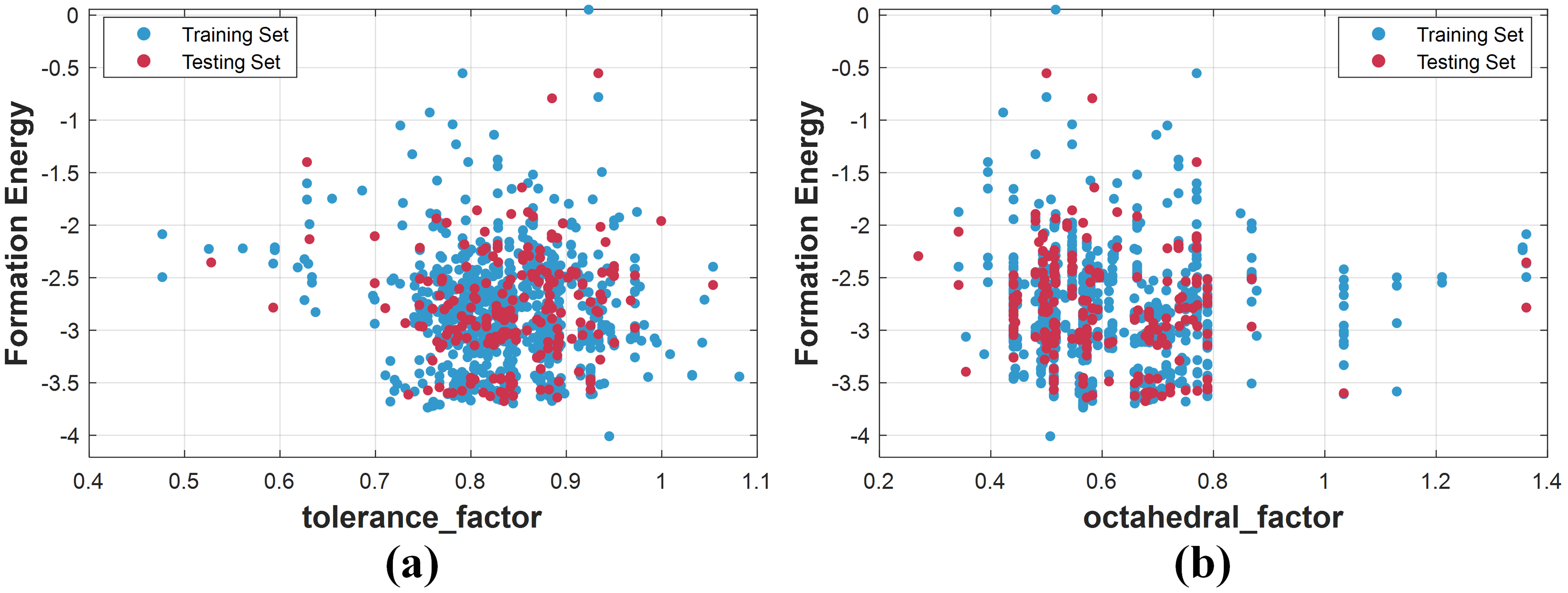
2.1. Feature Processing

| Parameter Category | Feature Names | Unit | Description | Ref. |
|---|---|---|---|---|
| Ionic structural radii | A/B1/B2/X_ionic_radius | Å | ionic radii at each site | Ref. [40] |
| A/B1/B2/X_van_der_waals_radius | Å | van der Waals radius | ||
| Electrochemical atomic features | A/B1/B2/X_electronegativity | None | electronegativities at four sites | Ref. [41] |
| A/B1/B2/X_electron_affinity | eV | electron affinities | ||
| A/B1/B2/X_first_ionization energy | eV | first ionization energies | ||
| A/B1/B2/X_second_ionization energy | eV | second ionization energies | ||
| A/B1/B2/X_third_ionization energy | eV | third ionization energies | ||
| Basic atomic intrinsic properties | A/B1/B2/X_atomic_mass | g/mol | atomic masses | Ref. [42] |
| A/B1/B2/X_atomic_number | None | atomic numbers | ||
| Thermophysical parameters | A/B1/B2/X_melting_point | K | elemental melting points | Ref. [43] |
| A/B1/B2/X_boiling_point | K | boiling points | ||
| A/B1/B2/X_thermal_conductivity | W·m−1·K−1 | elemental thermal conductivities | ||
| Geometric stability factors | tolerance_factor, octahedral_factor | None | tolerance and octahedral factors | Ref. [44] |
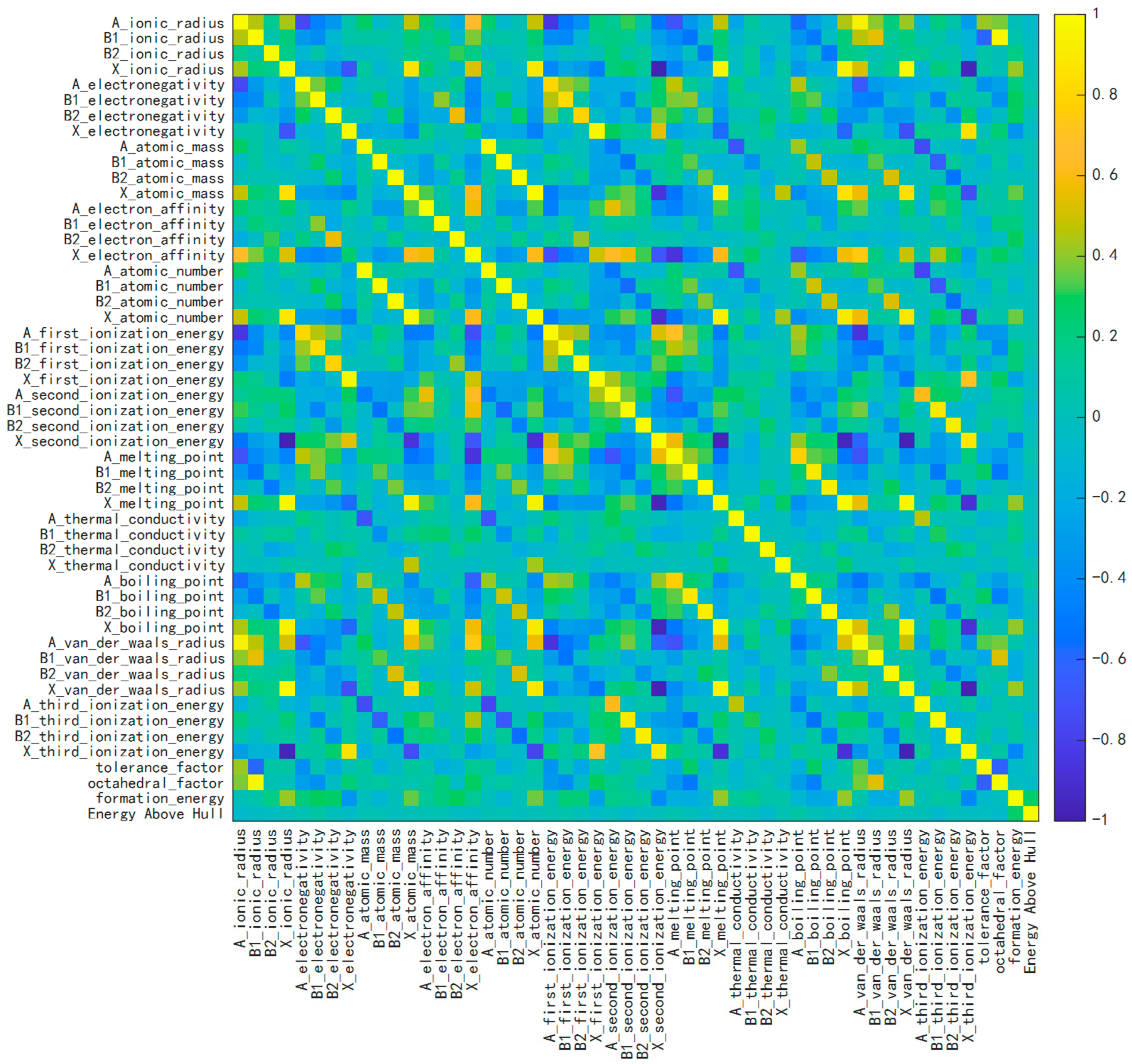
2.2. Feature Correlation Analysis
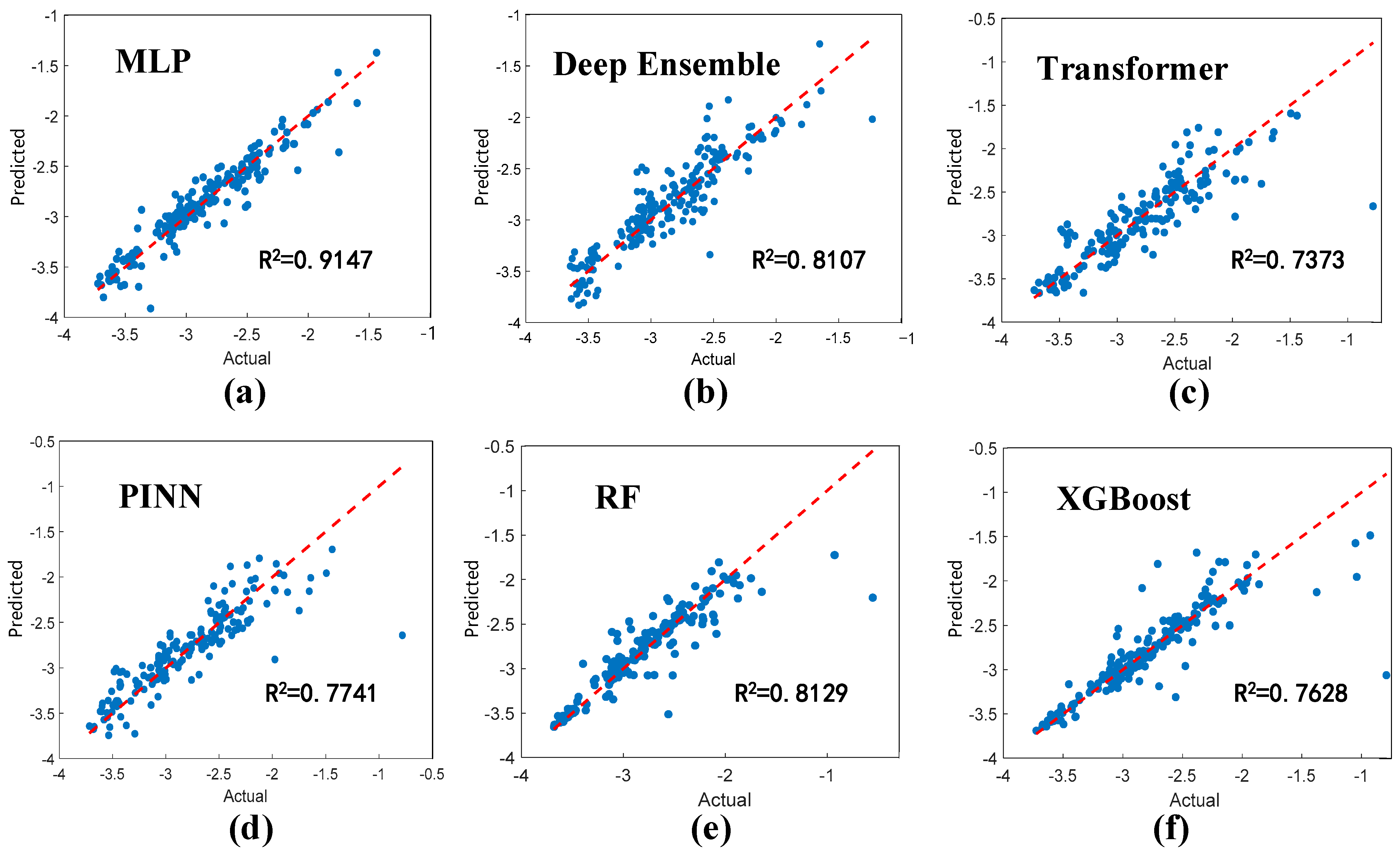
2.3. Model Prediction Results
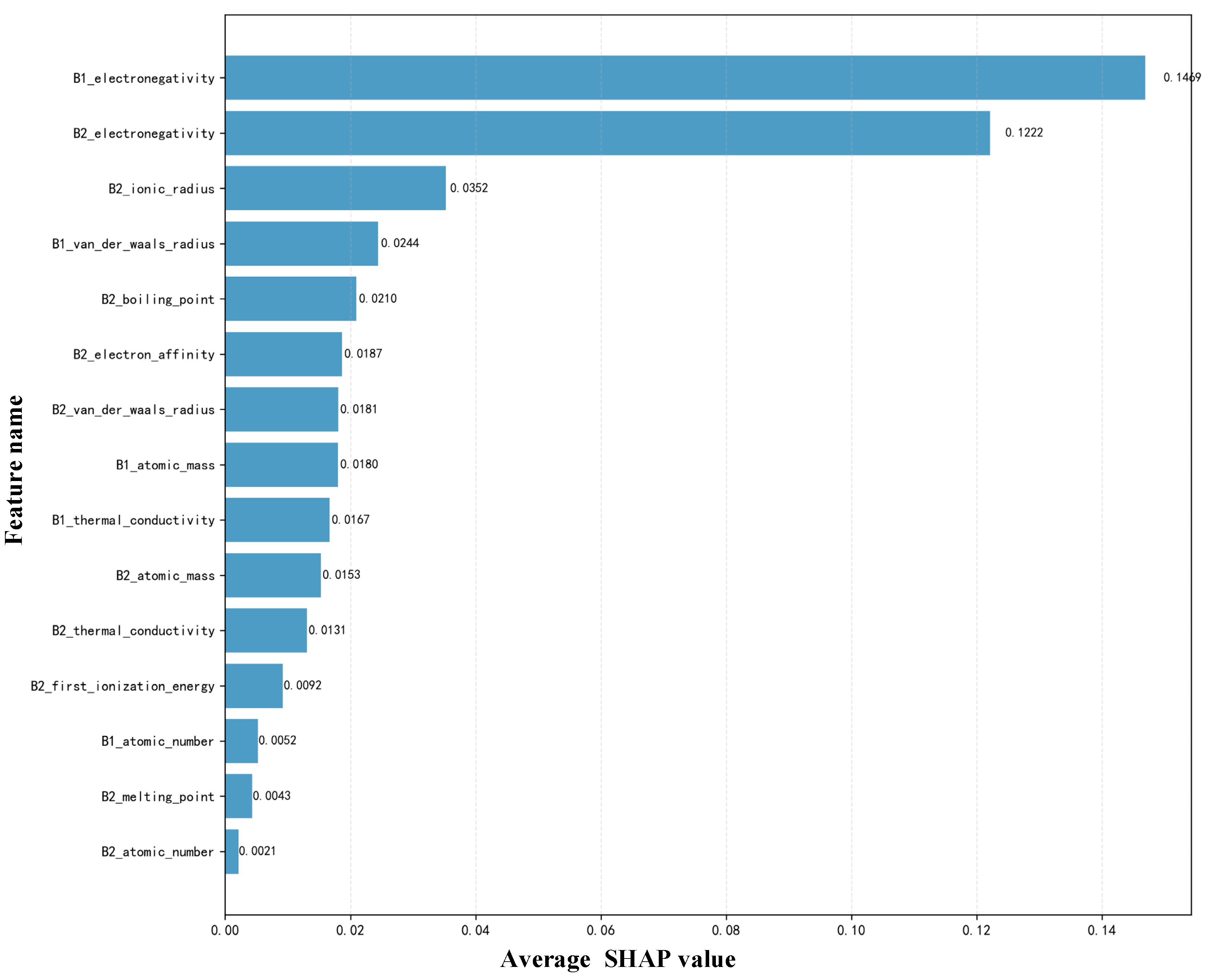
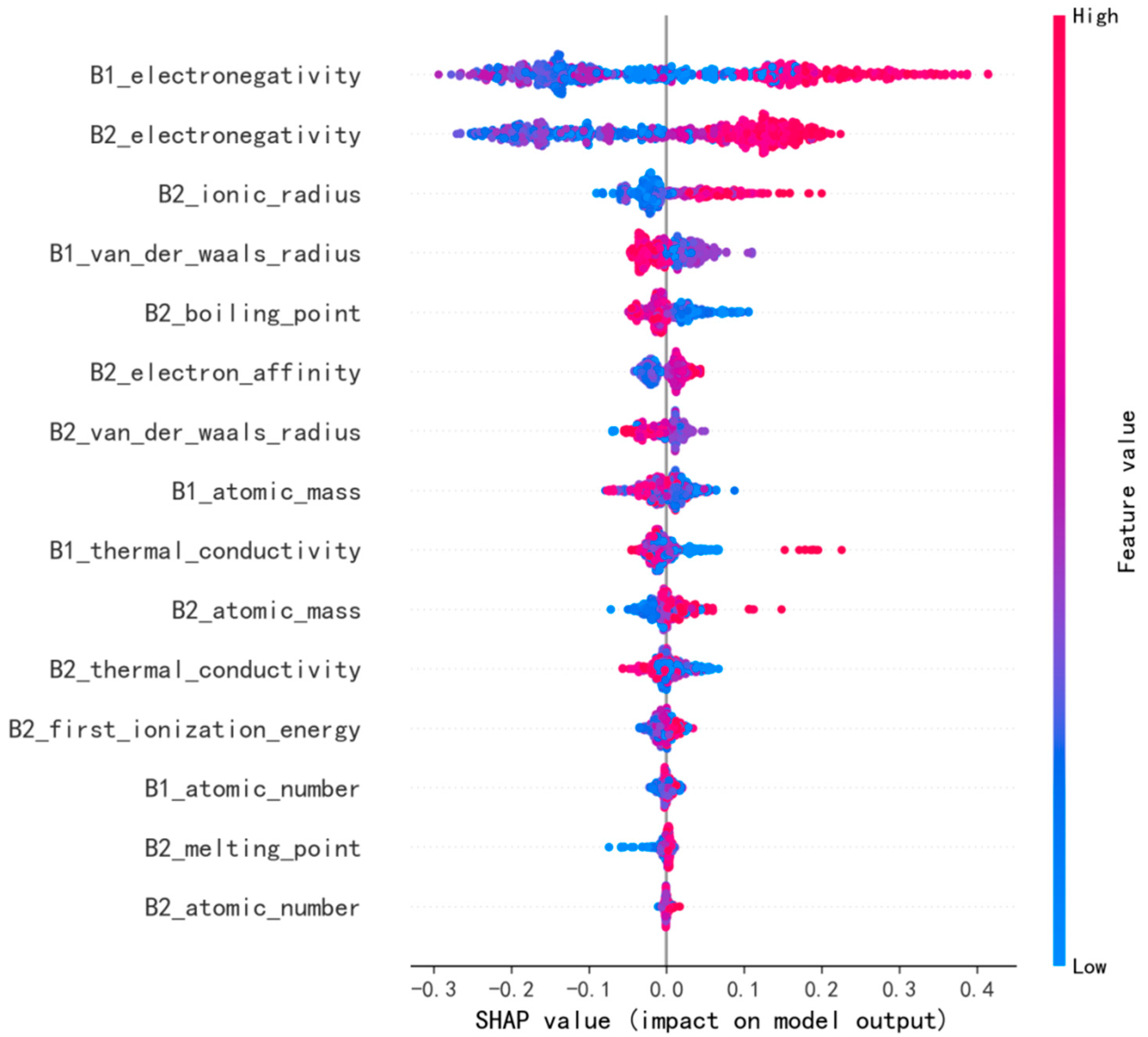
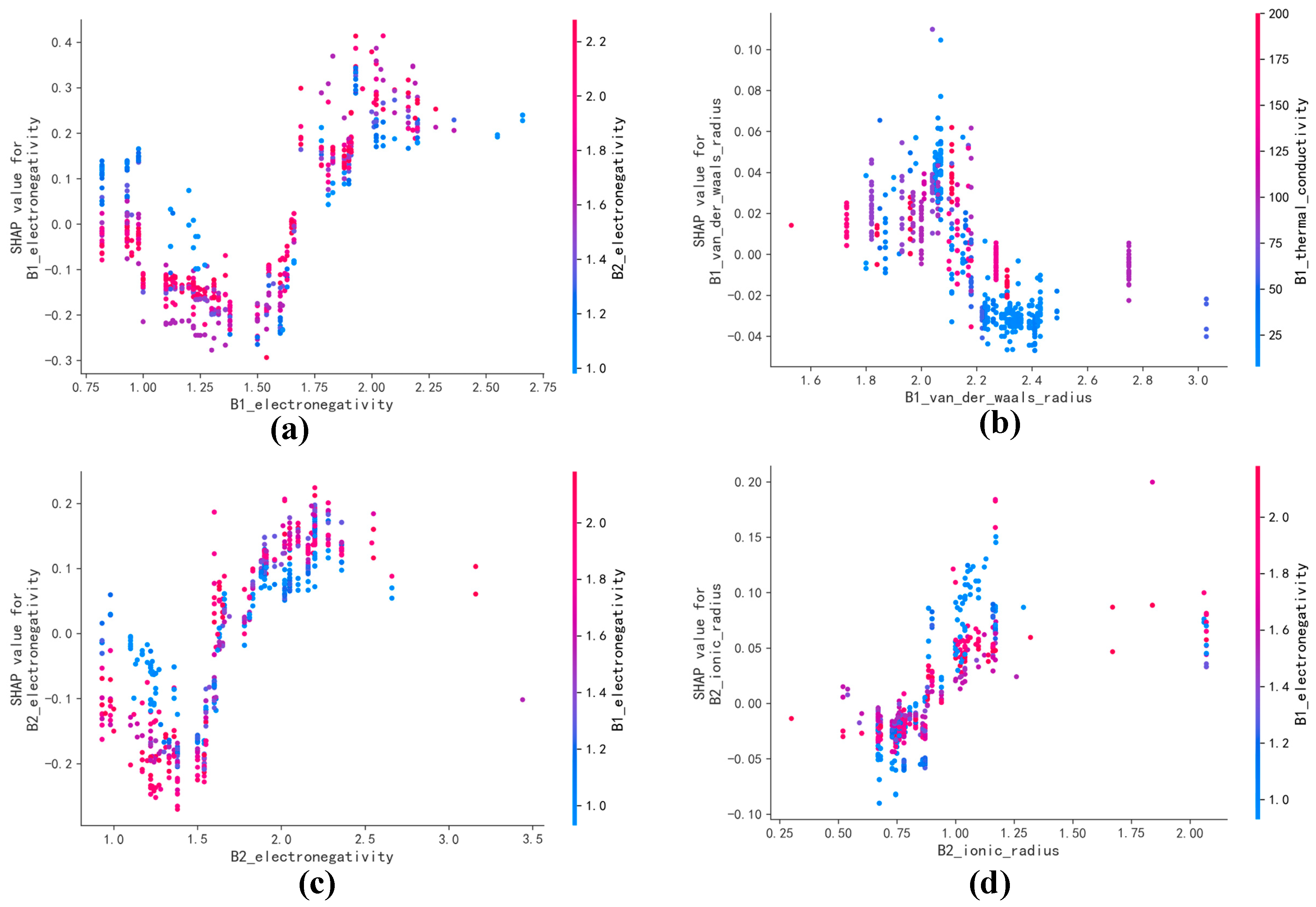
2.4. SHAP Interpretability of the Formation Energy Model
3. Data and Methods
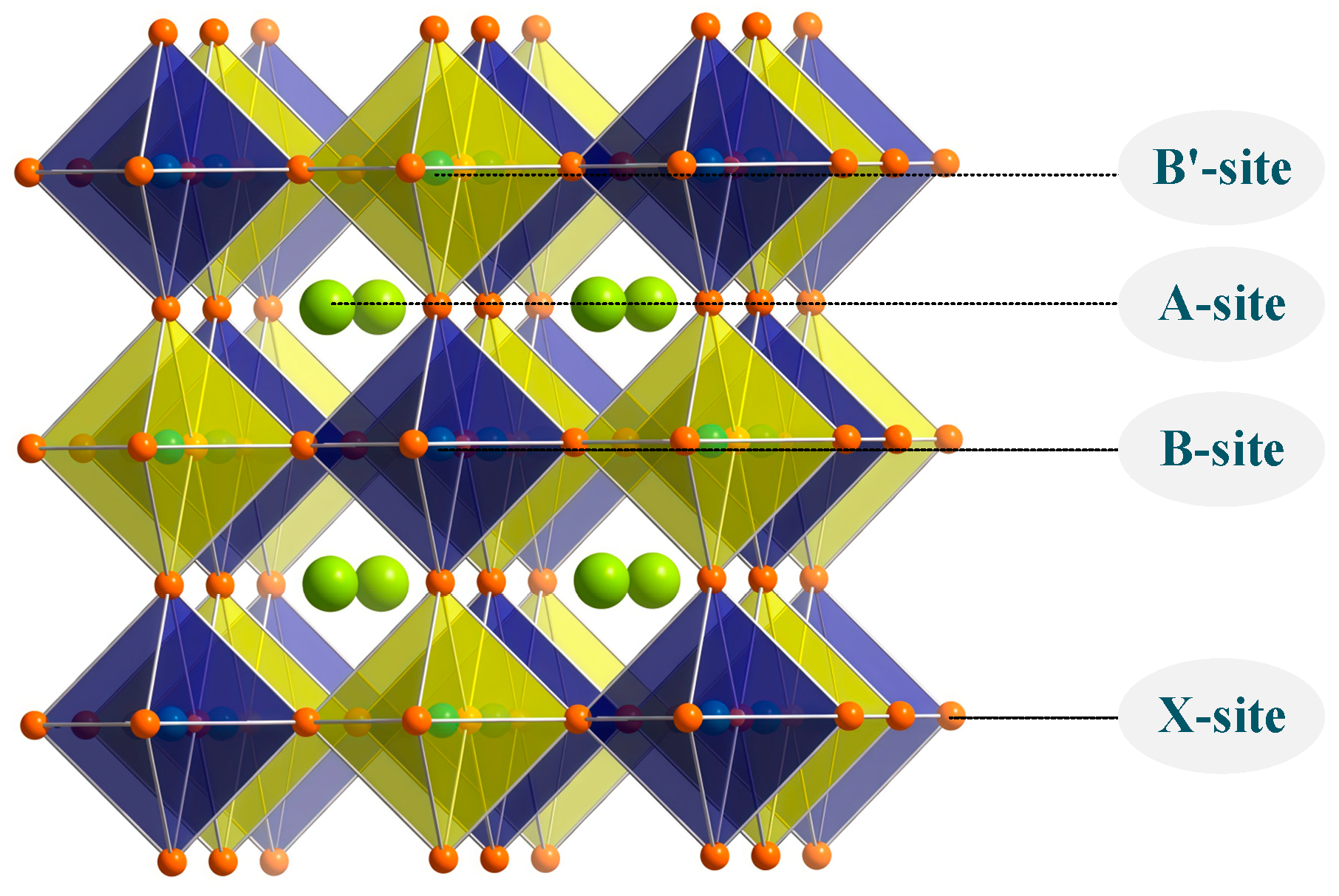
3.1. Dataset Preparation
3.1.1. Data Source
3.1.2. Dataset Splitting
3.2. Deep Learning Algorithms and Model Construction
3.2.1. MLP Algorithm
3.2.2. PINN Algorithm
3.2.3. Deep Ensemble Learning
3.2.4. Transformer Algorithm
3.3. Model Evaluation
4. Conclusions
Supplementary Materials
Author Contributions
Funding
Institutional Review Board Statement
Informed Consent Statement
Data Availability Statement
Conflicts of Interest
References
- Afroz, M.; Ratnesh, R.K.; Srivastava, S.; Singh, J. Perovskite solar cells: Progress, challenges, and future avenues to clean energy. Sol. Energy 2025, 287, 113205. [Google Scholar] [CrossRef] [Scilit]
- Chen, J.W.; Xiang, H.Y.; Wang, J.; Wang, R.; Li, Y.; Shan, Q.S.; Xu, X.B.; Dong, Y.H.; Wei, C.T.; Zeng, H.B. Perovskite White Light Emitting Diodes: Progress, Challenges, and Opportunities. ACS Nano 2021, 15, 17150–17174. [Google Scholar] [CrossRef] [Scilit] [PubMed]
- Green, M.A.; Ho-Baillie, A.; Snaith, H.J. The emergence of perovskite solar cells. Nat. Photonics 2014, 8, 506–514. [Google Scholar] [CrossRef] [Scilit]
- Prete, P.; Lovergine, N. High efficiency III–V nanowire solar cells: The road ahead. Nano Futures 2025, 9, 042502. [Google Scholar] [CrossRef] [Scilit]
- Chen, G.; Sun, G.; Ding, Y.J.; Prete, P.; Miccoli, I.; Lovergine, N.; Shtrikman, H.; Kung, P.; Livneh, T.; Spanier, J.E. Direct Measurement of Band Edge Discontinuity in Individual Core-Shell Nanowires by Photocurrent Spectroscopy. Nano Lett. 2013, 13, 4152–4157. [Google Scholar] [CrossRef] [Scilit] [PubMed]
- Usman, M. Nanowire design by deep learning for energy efficient photonic technologies. Nano Futures 2025, 9, 022502. [Google Scholar] [CrossRef] [Scilit]
- Igbari, F.; Wang, Z.-K.; Liao, L.-S. Progress of Lead-Free Halide Double Perovskites. Adv. Energy Mater. 2019, 9, 1803150. [Google Scholar] [CrossRef] [Scilit]
- Chen, J.F.; Luo, J.F.; Hou, E.L.; Song, P.Q.; Li, Y.Q.; Sun, C.; Feng, W.J.; Cheng, S.; Zhang, H.; Xie, L.Q.; et al. Efficient tin-based perovskite solar cells with trans-isomeric fulleropyrrolidine additives. Nat. Photonics 2024, 18, 464–470. [Google Scholar] [CrossRef] [Scilit]
- Kim, J.Y.; Lee, J.-W.; Jung, H.S.; Shin, H.; Park, N.-G. High-efficiency perovskite solar cells. Chem. Rev. 2020, 120, 7867–7918. [Google Scholar] [CrossRef] [Scilit] [PubMed]
- Wu, T.H.; Liu, X.; Luo, X.H.; Lin, X.S.; Cui, D.Y.; Wang, Y.B.; Segawa, H.; Zhang, Y.Q.; Han, L.Y. Lead-free tin perovskite solar cells. Joule 2021, 5, 863–886. [Google Scholar] [CrossRef] [Scilit]
- Noel, N.K.; Stranks, S.D.; Abate, A.; Wehrenfennig, C.; Guarnera, S.; Haghighirad, A.-A.; Sadhanala, A.; Eperon, G.E.; Pathak, S.K.; Johnston, M.B.; et al. Lead-free organic—Inorganic tin halide perovskites for photovoltaic applications. Energy Environ. Sci. 2014, 7, 3061–3068. [Google Scholar] [CrossRef] [Scilit]
- Yang, W.F.; Igbari, F.; Lou, Y.H.; Wang, Z.K.; Liao, L.S. Tin halide perovskites: Progress and challenges. Adv. Energy Mater. 2020, 10, 1902584. [Google Scholar] [CrossRef] [Scilit]
- Lei, H.W.; Hardy, D.; Gao, F. Lead-Free Double Perovskite Cs2AgBiBr6: Fundamentals, Applications, and Perspectives. Adv. Funct. Mater. 2021, 31, 2105898. [Google Scholar] [CrossRef] [Scilit]
- Gao, Z.Y.; Zhang, H.W.; Mao, G.Y.; Ren, J.N.; Chen, Z.H.; Wu, C.C.; Gates, I.D.; Yang, W.J.; Ding, X.L.; Yao, J.X. Screening for lead-free inorganic double perovskites with suitable band gaps and high stability using combined machine learning and DFT calculation. Appl. Surf. Sci. 2021, 568, 150916. [Google Scholar] [CrossRef] [Scilit]
- Tao, Q.L.; Xu, P.C.; Li, M.J.; Lu, W.C. Machine learning for perovskite materials design and discovery. npj Comput. Mater. 2021, 7, 23. [Google Scholar] [CrossRef] [Scilit]
- Fatima, S.K.; Alzard, R.H.; Amna, R.; Alzard, M.H.; Zheng, K.B.; Abdellah, M. Lead-free perovskites for next-generation applications: A comprehensive computational and data-driven review. Mater. Adv. 2025, 6, 7634–7661. [Google Scholar] [CrossRef] [Scilit]
- Li, Z.Z.; Xu, Q.C.; Sun, Q.D.; Hou, Z.F.; Yin, W.J. Thermodynamic stability landscape of halide double perovskites via high-throughput computing and machine learning. Adv. Funct. Mater. 2019, 29, 1807280. [Google Scholar] [CrossRef] [Scilit]
- Liang, G.Q.; Zhang, J. A machine learning model for screening thermodynamic stable lead-free halide double perovskites. Comput. Mater. Sci. 2022, 204, 111172. [Google Scholar] [CrossRef] [Scilit]
- Bartel, C.J.; Sutton, C.; Goldsmith, B.R.; Ouyang, R.; Musgrave, C.B.; Ghiringhelli, L.M.; Scheffler, M. New tolerance factor to predict the stability of perovskite oxides and halides. Sci. Adv. 2019, 5, eaav0693. [Google Scholar] [CrossRef] [Scilit] [PubMed]
- Chen, Y.Y.; Cao, S.; Bao, Y.; Song, K.K.; Qian, P.; Su, Y.J. Machine learning potential-assisted design of thermoelectric performance in anharmonic CsPbBr3 and CsPbI3. J. Mater. Chem. C 2026, 14, 8701–8714. [Google Scholar] [CrossRef] [Scilit]
- Wei, Y.; He, J.; Yang, C.; Yu, W.; Feng, J.; Liu, X.-J.; Chong, X. Accelerated Multi-Property Screening of Lead-Free Halide Double Perovskite via Transfer Learning. Adv. Funct. Mater. 2026, 36, e14377. [Google Scholar] [CrossRef] [Scilit]
- Stanley, J.C.; Mayr, F.; Gagliardi, A. Machine learning stability and bandgaps of lead-free perovskites for photovoltaics. Adv. Theory Simul. 2020, 3, 1900178. [Google Scholar] [CrossRef] [Scilit]
- Rodrigues, J.F., Jr.; Florea, L.; de Oliveira, M.C.F.; Diamond, D.; Oliveira, O.N., Jr. Big data and machine learning for materials science. Discov. Mater. 2021, 1, 12. [Google Scholar] [CrossRef] [Scilit] [PubMed]
- Liu, J.Y.; Su, X.Q.; Yang, L.S.; Ding, J.S.; Wang, J.; Ling, X.; Pan, Y.; Wang, Z.J.; Zhao, W.; Bu, Y. Comparation of Graph Neural Networks and Traditional Machine Learning for Property Prediction in All-Inorganic Perovskite Materials. Inorganics 2026, 14, 58. [Google Scholar] [CrossRef] [Scilit]
- Ghosh, S.; Chowdhury, J. Predicting band gaps of ABN3 perovskites: An account from machine learning and first-principle DFT studies. RSC Adv. 2024, 14, 6385–6397. [Google Scholar] [CrossRef] [Scilit] [PubMed]
- Ye, W.K.; Chen, C.; Wang, Z.B.; Chu, I.-H.; Ong, S.P. Deep neural networks for accurate predictions of crystal stability. Nat. Commun. 2018, 9, 3800. [Google Scholar] [CrossRef] [Scilit] [PubMed]
- Tian, R.C.; Calderon, A.D.; Fang, Q.R.; Liu, X.Y. Data-Driven Optimization and Mechanical Assessment of Perovskite Solar Cells via Stacking Ensemble and SHAP Interpretability. Materials 2025, 18, 4429. [Google Scholar] [CrossRef] [Scilit] [PubMed]
- Fang, X.; Chen, Z.X.; Ma, Q.; Wu, J.; Lin, J.; Li, J.W.; Li, W.H.; Liu, C.F.; Shen, H.T.; You, L.H. A2BB’X6/ABX3-type high-performance perovskites screening based on ensemble learning and high throughput screening. Sol. Energy 2023, 262, 111795. [Google Scholar] [CrossRef] [Scilit]
- Raissi, M.; Perdikaris, P.; Karniadakis, G.E. Physics-informed neural networks: A deep learning framework for solving forward and inverse problems involving nonlinear partial differential equations. J. Comput. Phys. 2019, 378, 686–707. [Google Scholar] [CrossRef] [Scilit]
- Hammad, R.; Mondal, S. Advancements in thermochemical predictions: A multi-output thermodynamics-informed neural network approach. J. Cheminform. 2025, 17, 95. [Google Scholar] [CrossRef] [Scilit]
- Madani, M.; Lacivita, V.; Shin, Y.W.; Tarakanova, A. Accelerating materials property prediction via a hybrid Transformer Graph framework that leverages four body interactions. npj Comput. Mater. 2025, 11, 15. [Google Scholar] [CrossRef] [Scilit] [PubMed]
- Jin, L.Z.J.; Du, Z.J.; Shu, L.; Cen, Y.; Xu, Y.F.; Mei, Y.F.; Zhang, H. Transformer-generated atomic embeddings to enhance prediction accuracy of crystal properties with machine learning. Nat. Commun. 2025, 16, 1210. [Google Scholar] [CrossRef] [Scilit] [PubMed]
- Wang, B.B.; Wang, J. Prediction of Bandgap and Key Feature Analysis of Lead-Free Double Perovskite Oxides Based on Deep Learning. Molecules 2026, 31, 1032. [Google Scholar] [CrossRef] [Scilit] [PubMed]
- Lu, S.; Zhou, Q.; Ouyang, Y.; Guo, Y.; Li, Q.; Wang, J. Accelerated discovery of stable lead-free hybrid organic-inorganic perovskites via machine learning. Nat. Commun. 2018, 9, 3405. [Google Scholar] [CrossRef] [Scilit] [PubMed]
- Jiang, X.; Yin, W.-J. High-throughput computational screening of oxide double perovskites for optoelectronic and photocatalysis applications. J. Energy Chem. 2021, 57, 351. [Google Scholar] [CrossRef] [Scilit]
- Wang, Y.D.; Sun, D.; Zhao, B.; Zhu, T.Y.; Liu, C.C.; Xu, Z.X.; Zhou, T.H.; Xu, C.M. Data-Driven Perovskite Design via High-Throughput Simulation and Machine Learning. Processes 2025, 13, 3049. [Google Scholar] [CrossRef] [Scilit]
- Li, J.; Cheng, K.; Wang, S.; Morstatter, F.; Trevino, R.P.; Tang, J.; Liu, H. Feature selection: A data perspective. ACM Comput. Surv. 2017, 50, 1–45. [Google Scholar] [CrossRef] [Scilit]
- Sinsomboonthong, S. Performance Comparison of New Adjusted Min-Max with Decimal Scaling and Statistical Column Normalization Methods for Artificial Neural Network Classification. Int. J. Math. Math. Sci. 2022, 1, 3584406. [Google Scholar] [CrossRef] [Scilit]
- Murph, A.C.; Strait, J.D.; Moran, K.R.; Hyman, J.D.; Stauffer, P.H. Visualisation and outlier detection for probability density function ensembles. Stat 2024, 13, e662. [Google Scholar] [CrossRef] [Scilit]
- Shannon, R.D. Revised effective ionic radii and systematic studies of interatomic distances in halides and chalcogenides. Acta Cryst. A 1976, 32, 751–767. [Google Scholar] [CrossRef] [Scilit]
- Lide, D.R. CRC Handbook of Chemistry and Physics: A Ready-Reference of Chemical and Physical Data, 85th ed. J. Am. Chem. Soc. 2005, 127, 4542. [Google Scholar] [CrossRef] [Scilit]
- Prohaska, T.; Irrgeher, J.; Benefield, J.; Bohlke, J.K.; Chesson, L. Standard atomic weights of the elements 2021 (IUPAC Technical Report). Pure Appl. Chem. 2022, 94, 573–600. [Google Scholar] [CrossRef] [Scilit]
- Haynes, W.M. CRC Handbook of Chemistry and Physics, 92nd ed.; CRC Press: Boca Raton, FL, USA, 2011. [Google Scholar] [CrossRef] [Scilit]
- Goldschmidt, V.M. Crystal structure and chemical constitution. Trans. Faraday Soc. 1929, 25, 253–283. [Google Scholar] [CrossRef] [Scilit]
- Topçuoğlu, H.; Evren, A.; Tuna, E.; Ustaoğlu, E. LAFS: A Fast, Differentiable Approach to Feature Selection Using Learnable Attention. Entropy 2026, 28, 20. [Google Scholar] [CrossRef] [Scilit] [PubMed]
- Kumari, A.; Shrivastava, A.; Adam, J. Machine learning-based modeling of double perovskites via multi-output prediction of bandgap and dielectric properties. Comput. Mater. Today 2026, 11, 100059. [Google Scholar] [CrossRef] [Scilit]
- Wang, J.; Wang, X.; Feng, S.; Miao, Z. Studying the Thermodynamic Phase Stability of Organic-Inorganic Hybrid Perovskites Using Machine Learning. Molecules 2024, 29, 2974. [Google Scholar] [CrossRef] [Scilit] [PubMed]
- Li, R.; Deng, Q.; Tian, D.; Zhu, D.; Lin, B. Predicting Perovskite Performance with Multiple Machine-Learning Algorithms. Crystals 2021, 11, 818. [Google Scholar] [CrossRef] [Scilit]
- Aydın, A.; Eryılmaz, Ü.K.; Alkan, O.B.; Kocagöz, P.; Ekinci, F.; Güzel, M.S. Hybrid graph—Machine learning framework for accurate and interpretable bandgap prediction. J. Chem. Inf. Model. 2026, 66, 3787–3802. [Google Scholar] [CrossRef] [Scilit] [PubMed]
- de la Asunción-Nadal, V.; Sprague, C.I.; Guijarro-Berdiñas, B.; Cappel, U.B.; García-Fernández, A. Machine learning for perovskite solar cells: A comprehensive review on opportunities and challenges for materials scientists. Energy Environ. Sci. Sol. 2025, 1, 927–957. [Google Scholar] [CrossRef] [Scilit]
- Li, G.; Wang, C.; Huang, J.; Huang, L.; Zhu, Y. Machine learning guided rapid discovery of narrow-bandgap inorganic halide perovskite materials. Appl. Phys. A 2024, 130, 93. [Google Scholar] [CrossRef] [Scilit]
- Lundberg, S.; Lee, S.-I. A Unified Approach to Interpreting Model Predictions. arXiv 2017. [Google Scholar] [CrossRef] [Scilit]
- Salih, A.M.; Raisi-Estabragh, Z.; Galazzo, I.B.; Radeva, P.; Petersen, S.E.; Lekadir, K.; Menegaz, G. A perspective on explainable artificial intelligence methods: SHAP and LIME. Adv. Intell. Syst. 2024, 7, 2400304. [Google Scholar] [CrossRef] [Scilit]
- Joeres, R.; Blumenthal, D.B.; Kalinina, O.V. Data splitting to avoid information leakage with DataSAIL. Nat. Commun. 2025, 16, 3337. [Google Scholar] [CrossRef] [Scilit] [PubMed]
- Guo, Z.; Lin, B. Machine learning stability and bandgap of lead-free halide double perovskite materials for perovskite solar cells. Sol. Energy 2021, 228, 689–699. [Google Scholar] [CrossRef] [Scilit]
- Gleaves, D.; Fu, N.; Dilanga Siriwardane, E.M.; Zhao, Y.; Hu, J. Materials synthesizability and stability prediction using a semi-supervised teacher-student dual neural network. Digit. Discov. 2023, 2, 377–391. [Google Scholar] [CrossRef] [Scilit]
- Heaton, J. Ian Goodfellow, Yoshua Bengio, and Aaron Courville: Deep learning. Genet. Program. Evolvable Mach. 2018, 19, 305–307. [Google Scholar] [CrossRef] [Scilit]
- Qi, X.; Wang, S.; Fang, C.; Jia, J.; Lin, L.; Yuan, T. Machine learning and SHAP value interpretation for predicting comorbidity of cardiovascular disease and cancer with dietary antioxidants. Redox Biol. 2025, 79, 103470. [Google Scholar] [CrossRef] [Scilit] [PubMed]
- Pun, G.P.P.; Yamakov, V.; Hickman, J.; Glaessgen, E.H.; Mishin, Y. Development of a general-purpose machine-learning interatomic potential for aluminum by the physically informed neural network method. Phys. Rev. Mater. 2020, 4, 113807. [Google Scholar] [CrossRef] [Scilit]
- Michaloglou, A.; Papadimitriou, I.; Gialampoukidis, I.; Vrochidis, S.; Kompatsiaris, I. Physics-informed neural networks in materials modeling and design: A review. Arch. Comput. Methods Eng. 2026, 33, 5223–5260. [Google Scholar] [CrossRef] [Scilit]
- Nasrabadi, N.M. Pattern Recognition and Machine Learning. J. Electron. Imaging 2007, 16, 049901. [Google Scholar] [CrossRef] [Scilit]
- Nocedal, J.; Wright, S.J. Numerical Optimization; Springer: Berlin/Heidelberg, Germany, 2006; Chapters 17–18. [Google Scholar] [CrossRef] [Scilit]
- Wayo, D.D.K. Ensembles of graph and physics-informed machine learning for scientific modeling in materials science: A review. Arch. Comput. Methods Eng. 2026, 33, 963–988. [Google Scholar] [CrossRef] [Scilit]
- Fan, Z.; Yu, Z.; Yang, K.; Chen, W.; Liu, X.; Li, G.; Yang, X.; Chen, C.L.P. Diverse models, united goal: A comprehensive survey of ensemble learning. CAAI Trans. Intell. Technol. 2025, 10, 959–982. [Google Scholar] [CrossRef] [Scilit]
- Lakshminarayanan, B.; Pritzel, A.; Blundell, C. Simple and Scalable Predictive Uncertainty Estimation using Deep Ensembles. arXiv 2017, arXiv:1612.01474. [Google Scholar] [CrossRef] [Scilit]
- Dietterich, T.G. Ensemble Methods in Machine Learning. Mult. Classif. Syst. 2000, 1857, 1–15. [Google Scholar] [CrossRef] [Scilit] [PubMed]
- Polikar, R. Ensemble based systems in decision making. IEEE Circuits Syst. Mag. 2006, 6, 21–45. [Google Scholar] [CrossRef] [Scilit]
- Cui, Y.; Chen, K.; Zhang, L.; Wang, H.; Bai, L.; Elliston, D.; Ren, W. Atomic positional embedding-based transformer model for predicting the density of states of crystalline materials. J. Phys. Chem. Lett. 2023, 14, 7924–7930. [Google Scholar] [CrossRef] [Scilit] [PubMed]
- Du, Z.; Jin, L.; Shu, L.; Cen, Y.; Xu, Y.; Mei, Y.; Zhang, H. CTGNN: Crystal transformer graph neural network for crystal material property prediction. arXiv 2024. [Google Scholar] [CrossRef] [Scilit]
- Zhang, L.; Wang, Z.; Wang, X.; Zhang, X.; Mao, Y.; Chen, K.; Wu, Y. Improving crystal material property prediction with multi-view geometric graph transformer. Nat. Commun. 2026, 17, 3248. [Google Scholar] [CrossRef] [Scilit] [PubMed]
- Vaswani, A.; Shazeer, N.; Parmar, N.; Uszkoreit, J.; Jones, L.; Gomez, A.N.; Kaiser, L.; Polosukhin, I. Attention Is All You Need. arXiv 2023. [Google Scholar] [CrossRef] [Scilit]
- Tao, K.; Li, J.; He, W.; Chen, A.; Han, Y.; Huang, F.; Huang, F.; Li, J. CGformer: Transformer-enhanced crystal graph network with global attention for material property prediction. Matter 2025, 8, 102380. [Google Scholar] [CrossRef] [Scilit]
- Yan, K.; Liu, Y.; Lin, Y.; Ji, S. Periodic Graph Transformers for Crystal Material Property Prediction. arXiv 2022, arXiv:2209.11807. [Google Scholar] [CrossRef] [Scilit]
- Riebesell, J.; Goodall, R.E.A.; Benner, P.; Chiang, Y.; Deng, B.; Ceder, G.; Asta, M.; Lee, A.A.; Jain, A.; Persson, K.A. A framework to evaluate machine learning crystal stability predictions. Nat. Mach. Intell. 2025, 7, 836–847. [Google Scholar] [CrossRef] [Scilit]
- Chicco, D.; Warrens, M.J.; Jurman, G. The coefficient of determination R-squared is more informative than SMAPE, MAE, MAPE, MSE and RMSE in regression analysis evaluation. PeerJ Comput. Sci. 2021, 7, e623. [Google Scholar] [CrossRef] [Scilit] [PubMed]
- Moeini, A.S.; Tehrani, F.S.; Sadigh, A.N. High-Accuracy Bandgap Prediction and Classification in Hybrid and Inorganic Halide Perovskites Using Advanced Machine Learning Techniques. Int. J. Energy Res. 2025, 2025, 1215175. [Google Scholar] [CrossRef] [Scilit]
- Fukasawa, R.; Asahi, T.; Taniguchi, T. Effectiveness and limitation of the performance prediction of perovskite solar cells by process informatics. Energy Adv. 2024, 3, 812–820. [Google Scholar] [CrossRef] [Scilit]


| Algorithm | Evaluation Indicators | |||
|---|---|---|---|---|
| MAE | MSE | RMSE | R2 | |
| Deep Ensemble | 0.1425 | 0.0387 | 0.1966 | 0.8107 |
| MLP | 0.0951 | 0.0189 | 0.1376 | 0.9147 |
| PINN | 0.1571 | 0.0598 | 0.2445 | 0.7741 |
| Transformer | 0.1787 | 0.0695 | 0.2636 | 0.7373 |
| RF | 0.1148 | 0.0444 | 0.2108 | 0.8129 |
| XGBoost | 0.1179 | 0.0616 | 0.2482 | 0.7628 |
| DPs Order Number | Functional Group | PBE Formation Energy (eV/atom) | Prediction Formation Energy (eV/atom) | Prediction Error (eV/atom) |
|---|---|---|---|---|
| 1 | La2MgMnO6 | −3.1847 | −3.3989 | −0.2142 |
| 2 | La2CrMnO6 | −3.0783 | −3.3495 | −0.2712 |
| 3 | La2CoNiO6 | −2.5702 | −2.6847 | −0.1145 |
| 4 | La2IrZnO6 | −2.6512 | −2.6269 | 0.0243 |
| 5 | La2NiZrO6 | −3.1419 | −3.1707 | −0.0288 |
| 6 | La2CuSnO6 | −2.7710 | −2.8490 | −0.0780 |
| 7 | Sm2CuTiO6 | −3.0428 | −2.9382 | 0.1045 |
| 8 | La2NaRuO6 | −2.7896 | −2.8085 | −0.0189 |
| 9 | La2CaTiO6 | −3.6790 | −3.8012 | −0.1222 |
| 10 | Pr2CoRuO6 | −2.4542 | −2.4926 | −0.0384 |
| 11 | La2CaZrO6 | −3.2924 | −3.9119 | −0.6194 |
| 12 | Gd2TiZnO6 | −3.3670 | −2.9318 | 0.4352 |
| 13 | Nd2IrNaO6 | −2.6187 | −2.6840 | −0.0653 |
| 14 | Cs2ErNaF6 | −3.6072 | −3.5001 | 0.1071 |
| 15 | Cs2CeNaF6 | −3.5164 | −3.4258 | 0.0907 |
| 16 | Rb2NaScF6 | −3.5758 | −3.5456 | 0.0302 |
| 17 | Rb2AgAlF6 | −3.0536 | −2.8969 | 0.1567 |
| 18 | Rb2NaYF6 | −3.5704 | −3.6245 | −0.0541 |
| 19 | Ba2DySbO6 | −3.0897 | −3.0898 | −0.0001 |
| 20 | Ba2ErTaO6 | −3.5980 | −3.5551 | 0.0429 |
Disclaimer/Publisher’s Note: The statements, opinions and data contained in all publications are solely those of the individual author(s) and contributor(s) and not of MDPI and/or the editor(s). MDPI and/or the editor(s) disclaim responsibility for any injury to people or property resulting from any ideas, methods, instructions or products referred to in the content. |
© 2026 by the authors. Licensee MDPI, Basel, Switzerland. This article is an open access article distributed under the terms and conditions of the Creative Commons Attribution (CC BY) license.
Share and Cite
Wang, B.; Wang, J. Formation Energy Prediction and Feature Analysis of Lead-Free Double Perovskites Based on Deep Learning. Molecules 2026, 31, 3175. https://doi.org/10.3390/molecules31183175
Wang B, Wang J. Formation Energy Prediction and Feature Analysis of Lead-Free Double Perovskites Based on Deep Learning. Molecules. 2026; 31(18):3175. https://doi.org/10.3390/molecules31183175
Chicago/Turabian StyleWang, Beibei, and Juan Wang. 2026. "Formation Energy Prediction and Feature Analysis of Lead-Free Double Perovskites Based on Deep Learning" Molecules 31, no. 18: 3175. https://doi.org/10.3390/molecules31183175
APA StyleWang, B., & Wang, J. (2026). Formation Energy Prediction and Feature Analysis of Lead-Free Double Perovskites Based on Deep Learning. Molecules, 31(18), 3175. https://doi.org/10.3390/molecules31183175