


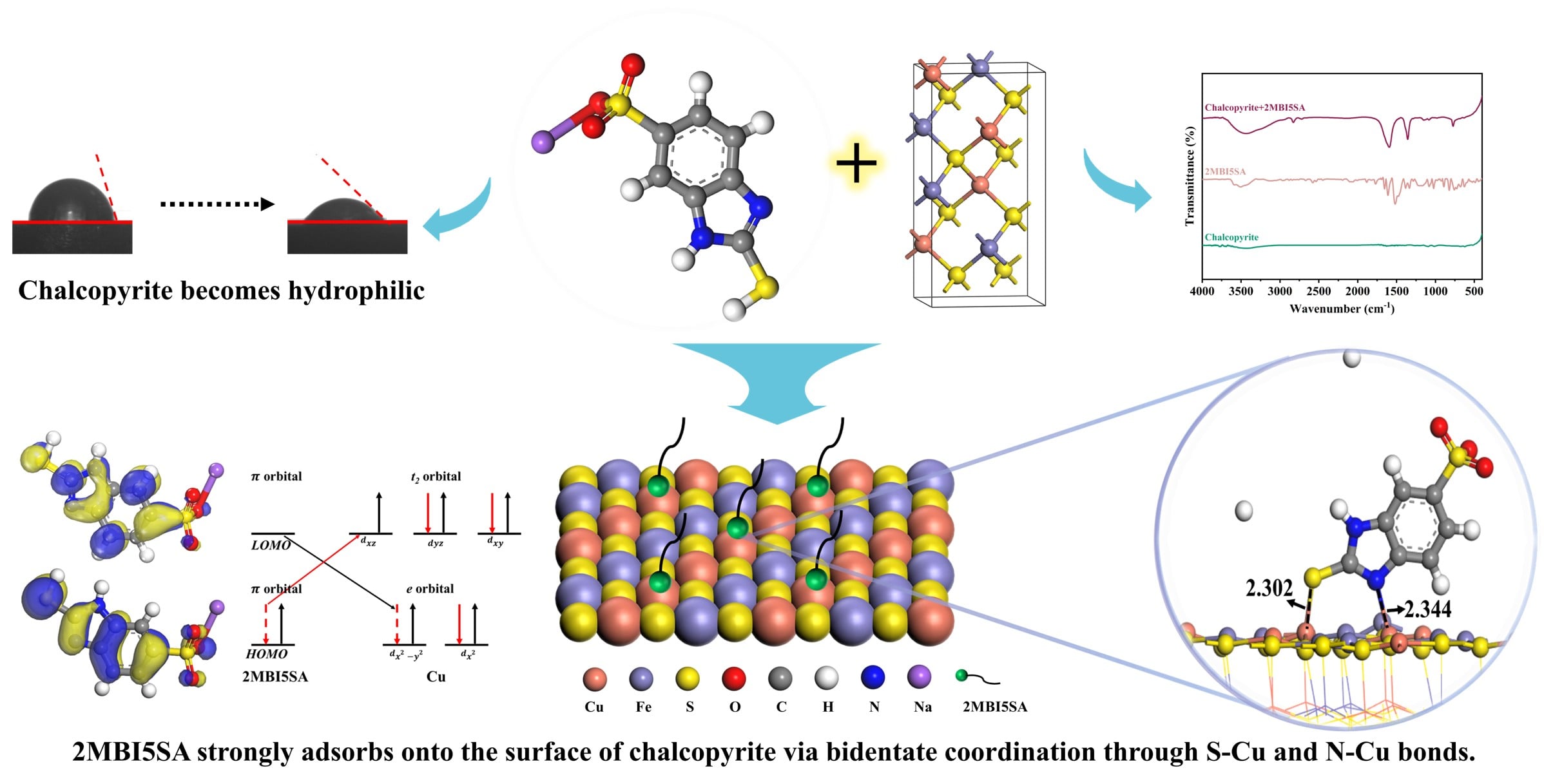
Study on the Depression Performance and Mechanism of the Novel Chalcopyrite Depressant 2-Mercapto-5-benzimidazole Sulfonate Dihydrate in the Flotation Separation of Cu-Mo Bulk Concentrate


Abstract
Share and Cite
Chen, J.; Zhang, X.; Liang, L.; Luo, A. Study on the Depression Performance and Mechanism of the Novel Chalcopyrite Depressant 2-Mercapto-5-benzimidazole Sulfonate Dihydrate in the Flotation Separation of Cu-Mo Bulk Concentrate. Molecules 2026, 31, 2383. https://doi.org/10.3390/molecules31132383
Chen J, Zhang X, Liang L, Luo A. Study on the Depression Performance and Mechanism of the Novel Chalcopyrite Depressant 2-Mercapto-5-benzimidazole Sulfonate Dihydrate in the Flotation Separation of Cu-Mo Bulk Concentrate. Molecules. 2026; 31(13):2383. https://doi.org/10.3390/molecules31132383
Chicago/Turabian StyleChen, Jianhua, Xufu Zhang, Lujing Liang, and Anruo Luo. 2026. "Study on the Depression Performance and Mechanism of the Novel Chalcopyrite Depressant 2-Mercapto-5-benzimidazole Sulfonate Dihydrate in the Flotation Separation of Cu-Mo Bulk Concentrate" Molecules 31, no. 13: 2383. https://doi.org/10.3390/molecules31132383
APA StyleChen, J., Zhang, X., Liang, L., & Luo, A. (2026). Study on the Depression Performance and Mechanism of the Novel Chalcopyrite Depressant 2-Mercapto-5-benzimidazole Sulfonate Dihydrate in the Flotation Separation of Cu-Mo Bulk Concentrate. Molecules, 31(13), 2383. https://doi.org/10.3390/molecules31132383
