Article

Cu/TiO2 Derived from Cu-Doped MIL-125 for Enhanced Photocatalytic CO2-to-CH4 Conversion

1
School of Environment and Architecture, University of Shanghai for Science and Technology, Shanghai 200093, China
2
Shanghai Noncarbon Energy Conversion and Utilization Institute, Shanghai 200240, China
3
College of Smart Energy, Shanghai Jiao Tong University, Shanghai 200240, China
4
Shanghai Institute of Optics and Fine Mechanics, Chinese Academy of Sciences, Shanghai 201800, China
*
Author to whom correspondence should be addressed.
Molecules 2026, 31(13), 2304; https://doi.org/10.3390/molecules31132304
Submission received: 31 May 2026 / Revised: 29 June 2026 / Accepted: 29 June 2026 / Published: 1 July 2026
(This article belongs to the Special Issue MOF-Based Catalysts for CO2 Capture and Conversion)

Abstract

Photocatalytic CO2 reduction into CH4 is a promising route for solar fuel production, but its efficiency is still limited by poor charge separation, insufficient CO2 activation, and sluggish multi-electron transfer kinetics. Herein, Cu-modified TiO2 (Cu/TiO2) was prepared by calcining a Cu-modified defective MIL-125(Ti) precursor, denoted as Cu-MIL-125, through a temperature-controlled calcination strategy. The effects of calcination temperature on the structural evolution, surface chemical states, interfacial charge transport, and CO2 photoreduction performance were examined. These results indicated that the Cu/TiO2 was successfully prepared, while the crystallinity, porous structure, and interfacial electronic properties of Cu/TiO2 were strongly dependent on the calcination temperature. Among the obtained samples, the Cu/TiO2 sample obtained by calcining Cu-MIL-125 at 450 °C (450 Cu/TiO2) exhibited the highest CH4 formation rate, reaching 15.90 μmol g−1 h−1, corresponding to an approximately 9.8-fold enhancement over TiO2 calcined from defective MIL-125(Ti) at 450 °C, together with a high CH4 selectivity of 93.05%. Control experiments and 13CO2 isotope-labeling tests confirmed that the detected carbon-containing products were generated from CO2 under photocatalytic conditions. In situ diffuse reflectance infrared Fourier transform spectroscopy measurements further revealed the formation of carbonate, bicarbonate and hydrogenated carbon-containing intermediates during the reaction. This work offers a practical route for constructing metal–organic framework-derived Cu/TiO2 photocatalysts for selective CH4 production from CO2.

1. Introduction

The continuous increase in atmospheric carbon dioxide (CO2) concentration, mainly originating from the extensive consumption of fossil fuels, has caused growing concerns regarding climate change and sustainable carbon utilization [1]. Solar-driven CO2 photoreduction offers a mild route for transforming CO2 into useful fuels and chemicals [2]. Among the possible products, carbon monoxide (CO) and methane (CH4) are particularly attractive because they connect CO2 utilization with renewable energy storage [3]. However, efficient CO2 photoreduction remains difficult because CO2 is highly stable, multi-electron transfer is kinetically slow, and photogenerated carriers tend to recombine rapidly [4]. In particular, the selective formation of CH4 is more challenging than CO generation because it involves an eight-electron reduction pathway and requires the stabilization of successive reaction intermediates [5,6]. Therefore, photocatalysts for CH4-selective CO2 reduction should combine effective charge separation, accessible active sites, and suitable surface reaction behavior. Meanwhile, reliable evaluation of heterogeneous photocatalytic CO2 reduction also requires clear reporting of experimental conditions, activity metrics, catalyst stability, data reproducibility, and mechanistic evidence [7].
Titanium dioxide (TiO2) is a representative semiconductor photocatalyst because of its chemical stability, low cost, low toxicity, and appropriate band-edge positions for CO2 reduction [8,9,10]. Nevertheless, pristine TiO2 is restricted by its wide band gap, weak visible-light utilization, limited CO2 adsorption/activation, and fast carrier recombination, which together lead to low activity and poor product selectivity [11,12]. Therefore, rational modification of TiO2 is required to simultaneously improve light utilization, charge separation, surface active-site exposure, and interfacial CO2 activation [13]. The photocatalytic behavior of TiO2 is strongly influenced by its crystal phase, crystallinity, defect structure, surface hydroxylation, and porosity, all of which are closely related to the preparation route and thermal treatment [14]. Among various modification strategies, constructing TiO2 from metal–organic framework (MOF) precursors offers an effective route to regulate the morphology and porosity of TiO2, thereby exposing more active sites and facilitating charge separation [15,16,17]. In addition, MOFs with designable pore structures can provide confined environments for accommodating metal species and promoting the adsorption and activation of reactant molecules [18]. Among Ti-based MOFs, Materials of Institut Lavoisier-125(Ti) (MIL-125(Ti)) is particularly attractive due to its Ti-oxo clusters and organic linkers, which provide a well-defined framework for subsequent structural transformation. After thermal conversion, MIL-125(Ti)-derived TiO2 can inherit part of the porous architecture and morphology of the MOF precursor, thereby increasing accessible surface area, exposing more surface sites, and facilitating CO2 adsorption and diffusion [15,19]. Nevertheless, the calcination temperature critically affects the MOF-to-TiO2 conversion, the crystallinity of TiO2, and the retention of porous structures [20,21]. Insufficient calcination may lead to incomplete framework decomposition and poor TiO2 crystallization, whereas excessive calcination can cause pore collapse, particle sintering, and loss of accessible active sites [22]. Although MOF-derived TiO2 can provide improved porosity and surface properties, electronic tuning is still needed to reduce charge recombination and promote selective CO2-to-CH4 conversion [9,23].
Introducing Cu species is a useful approach for adjusting the electronic structure and surface reaction behavior of TiO2-based photocatalysts [23]. The introduction of Cu species can facilitate interfacial electron transfer and suppress charge recombination by serving as electron-trapping or charge-transfer sites. Aguirre et al. reported Cu2O/TiO2 heterostructures for photocatalytic CO2 reduction, in which interfacial charge transfer promoted CO formation and TiO2 protected Cu2O from photocorrosion [24]. These studies indicate that Cu–TiO2 interfacial regulation is an effective strategy for CO2 photoreduction, whereas further exploration of precursor-derived Cu distribution and Cu–TiO2 interfacial interaction remains important for promoting CH4-selective CO2 reduction. In addition, Cu sites may strengthen CO2 adsorption/activation and adjust the interaction with reaction intermediates, which is beneficial for CH4 generation during photocatalytic CO2 reduction [25,26]. After calcination, Cu-modified MIL-125(Ti) can be converted into Cu-modified TiO2 (Cu/TiO2), while the chemical state, dispersion, and interfacial interaction of Cu species are highly dependent on the calcination temperature [15,22].
In this study, defective MIL-125(Ti) (MIL-125) was first synthesized, followed by the introduction of Cu to prepare Cu-modified defective MIL-125(Ti) (Cu-MIL-125). Cu/TiO2 was then prepared using Cu-MIL-125 as the precursor, with the properties of Cu/TiO2 finely tuned via the calcination temperature optimization. Different from conventional Cu/TiO2 modification strategies based on post-impregnation, deposition, or direct coupling with preformed copper oxides, this precursor-derived route allows Cu species to be introduced before thermal conversion, which is beneficial for regulating Cu dispersion and Cu/TiO2 interfacial interaction. The relationships between thermal transformation, interfacial electronic structure, and photocatalytic CO2 reduction performance were systematically investigated. Furthermore, in situ diffuse reflectance infrared Fourier transform spectroscopy (DRIFTS) and isotope-labeling experiments were performed to elucidate the reaction pathway and verify the carbon source of CH4. This study presents a strategy for constructing MOF-derived TiO2 photocatalysts for CO2 photoreduction, and demonstrates that the photocatalytic performance of Cu/TiO2 can be effectively optimized through the control of calcination conditions.

2. Results and Discussion

2.1. Structural Characterization of Cu/TiO2 Photocatalysts

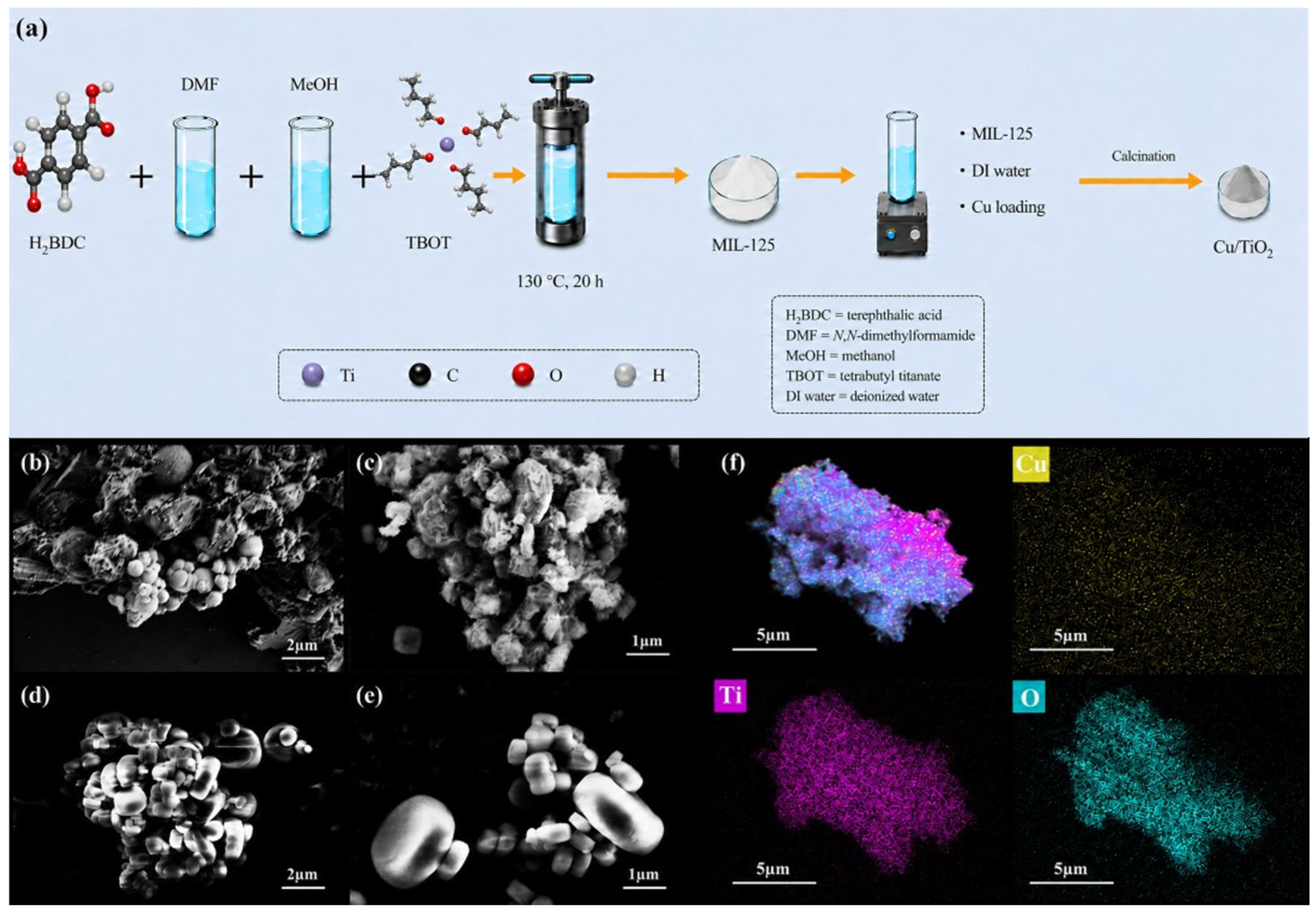
The synthesis process of Cu/TiO2 is illustrated in Figure 1a. The morphologies of MIL-125, Cu-MIL-125, and the derived 450 Cu/TiO2 samples were investigated by scanning electron microscopy (SEM). As shown in Figure 1b,c, after the introduction of Cu, Cu-MIL-125 retained a similar overall morphology to MIL-125, suggesting that Cu did not lead to obvious collapse of the precursor structure [23]. After calcination, the obtained 450 Cu/TiO2 consisted of irregular particles and displayed a disk-like aggregated morphology (Figure 1d,e), indicating the transformation of the MOF precursor into TiO2-based particles [27]. Energy-dispersive X-ray spectroscopy (EDS) mapping (Figure 1f) showed that Ti, O, and Cu were all detected in the 450 Cu/TiO2 sample, and their signals were observed in the selected region, which confirmed the successful introduction of Cu into the 450 Cu/TiO2. No obvious large Cu-rich aggregates were observed in the mapping images, indicating that Cu species were distributed without apparent microscale aggregation within the spatial resolution of SEM-EDS [28].
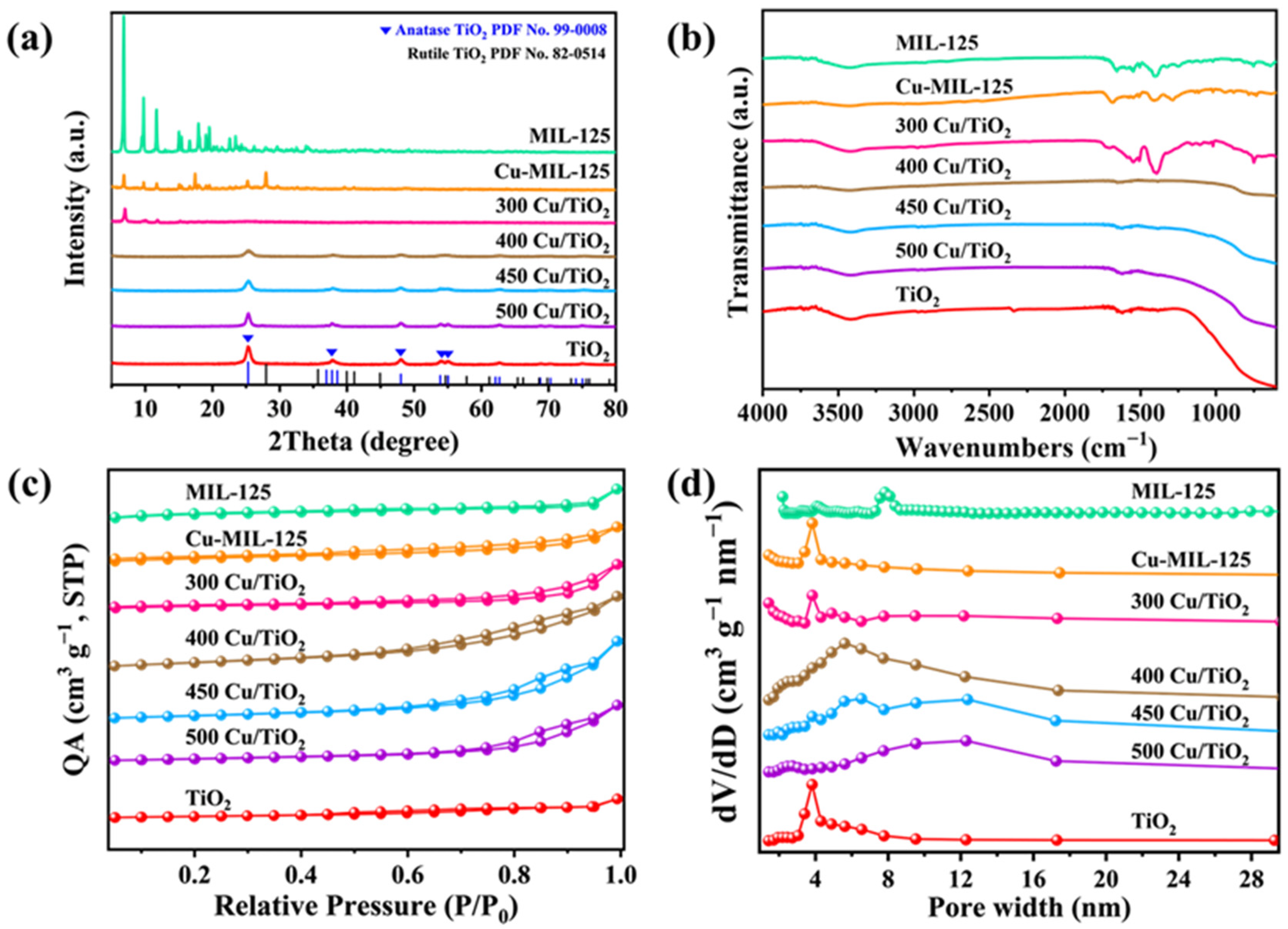
Figure 2a presents the X-ray diffraction (XRD) patterns of MIL-125, Cu-MIL-125, TiO2 (derived from MIL-125 at 450 °C) and Cu/TiO2 samples. MIL-125 and Cu-MIL-125 showed the typical diffraction features of the MIL-125(Ti) framework, suggesting the successful preparation of the MOF precursors [29,30]. After calcination, the characteristic diffraction peaks of the MIL-125(Ti) framework gradually disappeared, accompanied by the formation of TiO2-related diffraction features. The diffraction peaks of TiO2 and the calcined Cu/TiO2 samples located at 2θ = 25.3°, 37.8°, 48.0°, 53.9°, and 55.1° could be assigned to the (101), (004), (200), (105), and (211) planes of anatase TiO2, respectively, indicating the formation of anatase TiO2 after calcination [31]. At 300 °C, TiO2-related diffraction peaks of anatase TiO2 were still weak, indicating that the thermal conversion of the Cu-MIL-125-derived precursor was incomplete and that well-crystallized TiO2 had not yet formed. With increasing calcination temperature, the characteristic peaks of anatase TiO2 became more pronounced, suggesting the gradual crystallization of TiO2 during the MOF-derived thermal transformation. No obvious diffraction peaks assigned to crystalline Cu or CuOx species were detected, suggesting that Cu species were dispersed or present in a low-crystallinity form below the detection limit of XRD.
Fourier transform infrared spectroscopy (FT-IR) spectra were used to follow the changes in chemical bonds and functional groups during the thermal conversion process, as shown in Figure 2b. For MIL-125 and Cu-MIL-125, the bands near 1600 and 1400 cm−1 were associated with the stretching modes of carboxylate groups in terephthalate ligands, verifying the retained MIL-125(Ti) framework [32,33]. After calcination, these ligand-related bands gradually weakened with increasing temperature, suggesting the progressive decomposition and removal of organic ligands. Meanwhile, a broad band around 650 cm−1, corresponding to Ti-O-Ti stretching vibration [34], became more pronounced in the calcined samples, indicating the formation of TiO2-based structures. Combined with the results of XRD, the weakened organic-ligand signals and the enhancement of Ti-O-Ti vibration suggested the gradual conversion of Cu-MIL-125 into TiO2 with improved crystallinity at higher calcination temperatures.
The textural evolution of MIL-125, Cu-MIL-125, TiO2 and Cu/TiO2 samples was analyzed from N2 adsorption–desorption isotherms (Figure 2c,d). All the samples displayed type IV adsorption–desorption isotherms, suggesting mesoporous structures of these samples [27]. Correspondingly, the pore-size distribution curves in Figure 2d further confirmed the mesoporous features of these samples. MIL-125 exhibited a high Brunauer–Emmett–Teller (BET) surface area of 763.48 m2 g−1. After Cu incorporation, the value declined to 135.05 m2 g−1 (Table 1). For comparison, the TiO2 sample derived from MIL-125 at 450 °C without Cu introduction showed a BET surface area of 44.28 m2 g−1, a total pore volume of 0.11 cm3 g−1, and an average pore size of 10.07 nm. For the calcined Cu/TiO2 samples, a clear temperature-dependent textural evolution was observed: the BET surface area declined from 164.35 to 66.64 m2 g−1 as the calcination temperature increased from 300 to 500 °C, whereas the average pore size enlarged from 7.27 to 18.89 nm. This result suggested that higher calcination temperatures can increase the pore size of Cu/TiO2 [35,36]. These textural parameters suggest that Cu introduction and calcination temperature affected the porous structure of the MOF-derived TiO2-based samples, while the photocatalytic performance should be considered together with crystallinity, interfacial Cu regulation, and charge-transfer behavior.
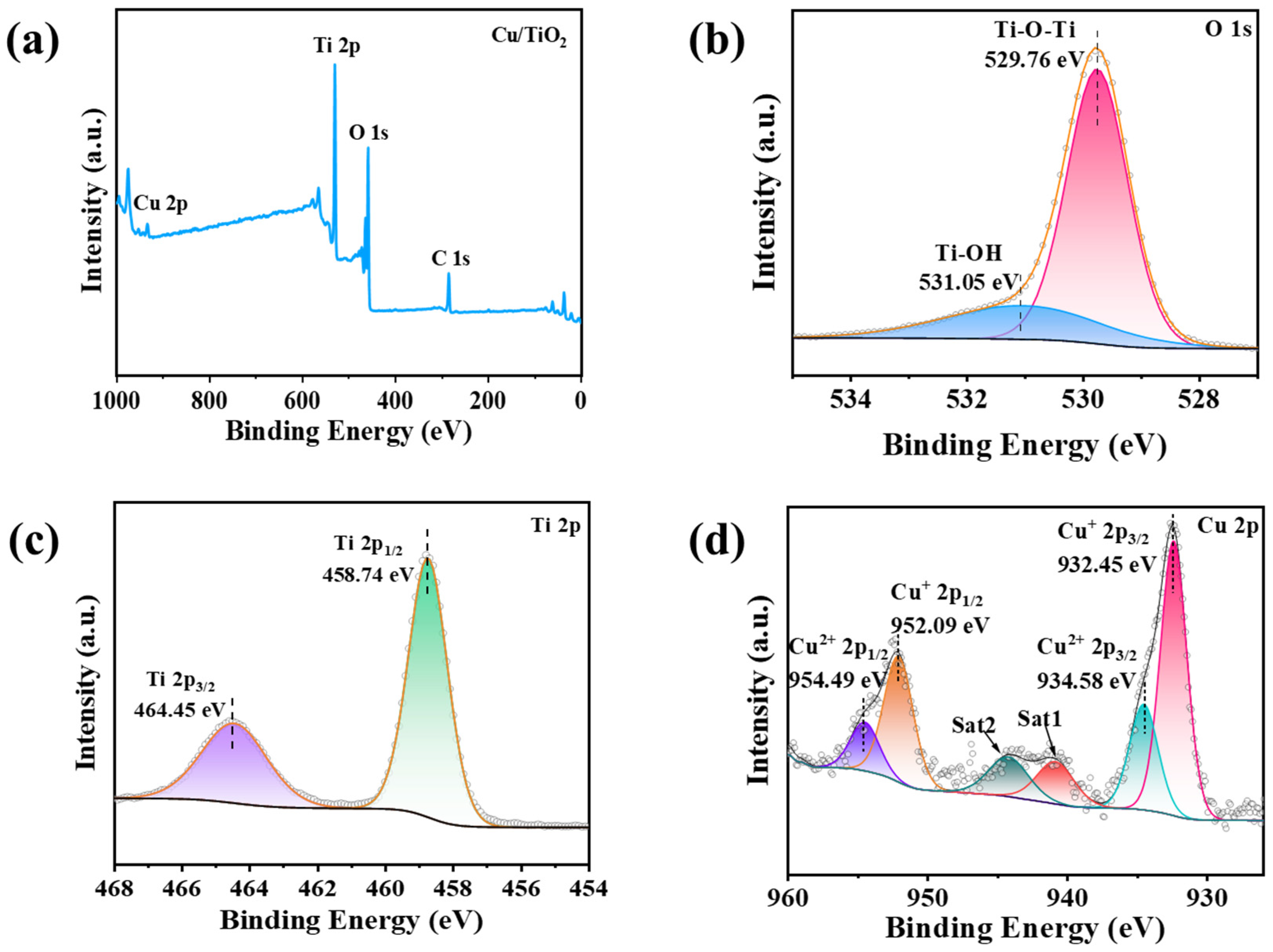
The surface chemical environment of 450 Cu/TiO2 was further probed by X-ray photoelectron spectroscopy (XPS), as shown in Figure 3. The survey spectrum (Figure 3a) showed the signals of C, O, Ti, and Cu, consistent with the elemental distribution observed from EDS mapping. In the Ti 2p spectrum (Figure 3c), two peaks located at 458.92 and 464.65 eV corresponded to Ti 2p3/2 and Ti 2p1/2 of Ti4+, respectively [37]. The O 1s spectrum was fitted with two components at 529.76 and 531.05 eV (Figure 3b), corresponding to lattice oxygen in the Ti-O-Ti and surface Ti-OH species, respectively [31]. For Cu 2p (Figure 3d), the peaks at 932.45 and 952.09 eV were attributed to Cu+ species [23], while those at 934.58 and 954.49 eV were assigned to Cu2+ species [31]. The satellite features further supported the presence of Cu2+ [37,38,39]. The Cu 2p XPS results indicate the coexistence of Cu+ and Cu2+ species on the surface of 450 Cu/TiO2, suggesting a mixed-valence Cu surface environment.

2.2. Photocatalytic CO2 Reduction Performance

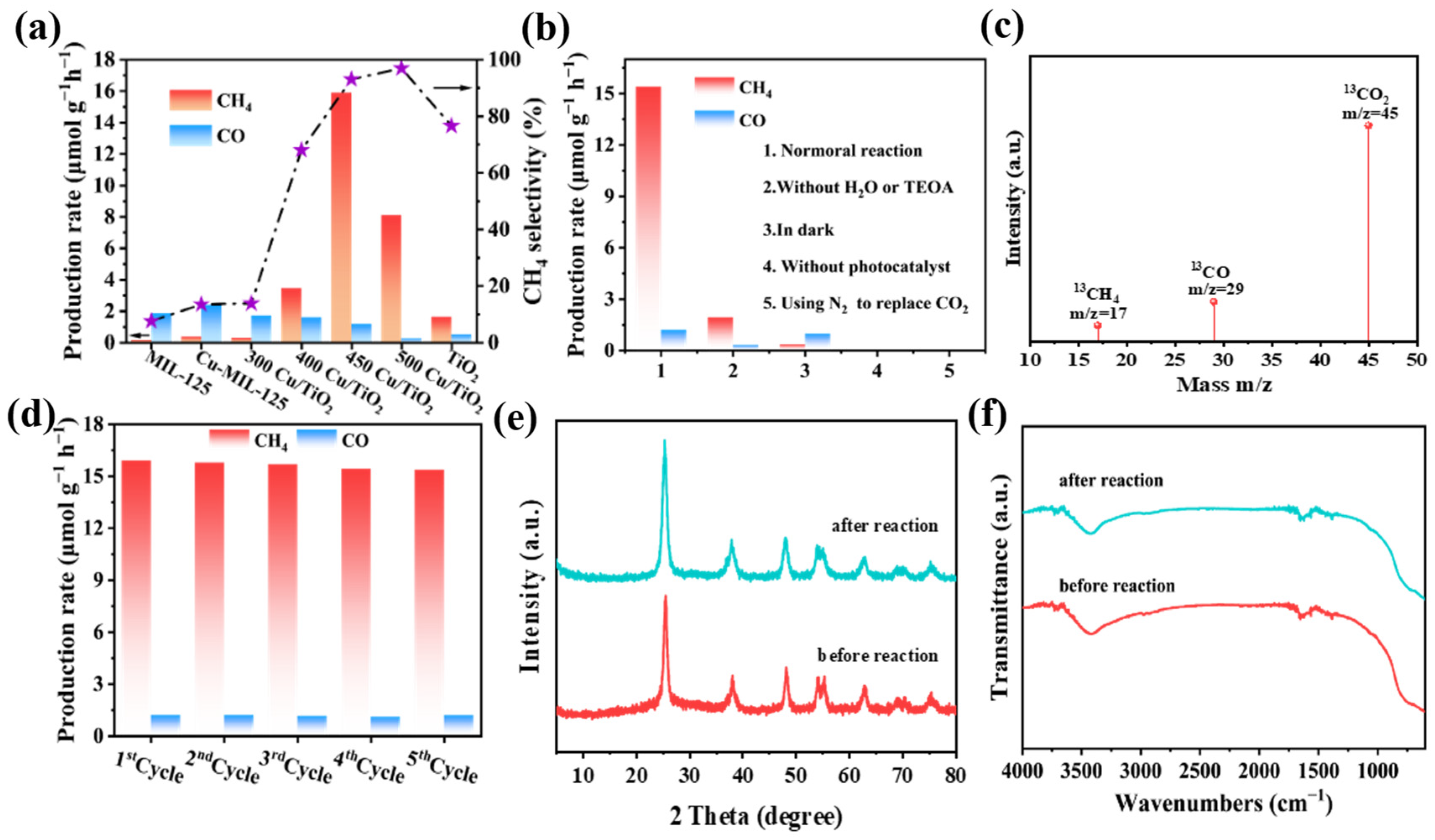
The CO2 photoreduction activity of different samples was compared by monitoring the formation of CH4 and CO. As shown in Figure 4a, pristine TiO2, MIL-125, and Cu-MIL-125 showed relatively low formation rates of CH4, indicating the limited ability to promote CH4 generation from CO2. By contrast, the Cu/TiO2 samples exhibited clearly enhanced photocatalytic activity, demonstrating that the calcined Cu/TiO2 exhibited excellent performance for the photocatalytic reduction of CO2 to CH4. For Cu/TiO2, the CH4 production rate increased markedly as the calcination temperature increased from 300 to 450 °C. Among them, 450 Cu/TiO2 exhibited the highest CH4 production rate of 15.90 μmol g−1 h−1, which was 106.0, 43.0, and 9.8 times those of MIL-125, Cu-MIL-125, and pristine TiO2, respectively. Meanwhile, 450 Cu/TiO2 maintained a high CH4 selectivity of 93.05%, suggesting that the optimized calcination temperature enhanced the overall CO2 reduction activity and promoted the selective formation of CH4. The superior performance of 450 Cu/TiO2 can be related to the appropriate structural evolution during calcination. Calcination at 450 °C may improve the crystallinity of anatase TiO2 and strengthen the interaction between Cu species and TiO2. These changes could improve the utilization of photogenerated charges and provide more accessible reaction sites for CO2 activation and subsequent multi-electron conversion toward CH4. When the calcination temperature was further increased to 500 °C, the CH4 selectivity increased slightly to 96.93%, whereas the CH4 formation rate decreased to 8.09 μmol g−1 h−1. This result may be related to the reduced specific surface area and possible changes in the porous structure and interfacial electronic properties at higher calcination temperature, indicating that the photocatalytic performance was governed by the combined effects of crystallinity, porosity, and Cu/TiO2 interfacial regulation rather than the specific surface area alone. Overall, the 450 Cu/TiO2 sample achieved a CH4 formation rate of 15.90 μmol g−1 h−1 with a CH4 selectivity of 93.05%, suggesting that the Cu-MIL-125-derived strategy is effective for promoting selective CO2-to-CH4 conversion. A comparison with representative TiO2-based photocatalysts reported for CO2-to-CH4 reduction is summarized in Table 2, further highlighting the relatively high CH4 formation rate of 450 Cu/TiO2.
Control experiments were performed to verify the essential factors during the photocatalytic CO2 reduction reaction (Figure 4b). In contrast, the formation of CH4 and CO was markedly suppressed in the absence of H2O, TEOA, light irradiation, photocatalyst, or CO2. These results confirmed that light irradiation, CO2, H2O and TEOA are indispensable for the photocatalytic CO2 reduction process. A 13CO2 isotope-labeling experiment was conducted to identify the carbon source of the products (Figure 4c). The signals assigned to 13CH4 and 13CO were observed at m/z = 17 and 29, respectively, confirming that the detected carbon-containing products originated from CO2 photoreduction rather than from residual carbon species or catalyst decomposition.
The stability of 450 Cu/TiO2 was evaluated by five consecutive cycling tests (Figure 4d). The CH4 and CO formation rates showed no obvious decrease after repeated cycles, suggesting a good photocatalytic stability of 450 Cu/TiO2. Moreover, the XRD patterns (Figure 4e) and FT-IR spectra (Figure 4f) of 450 Cu/TiO2 before and after the reaction showed no significant changes, further confirming its structural stability during the photocatalytic process.

2.3. Mechanism of Photocatalytic Activity Enhancement

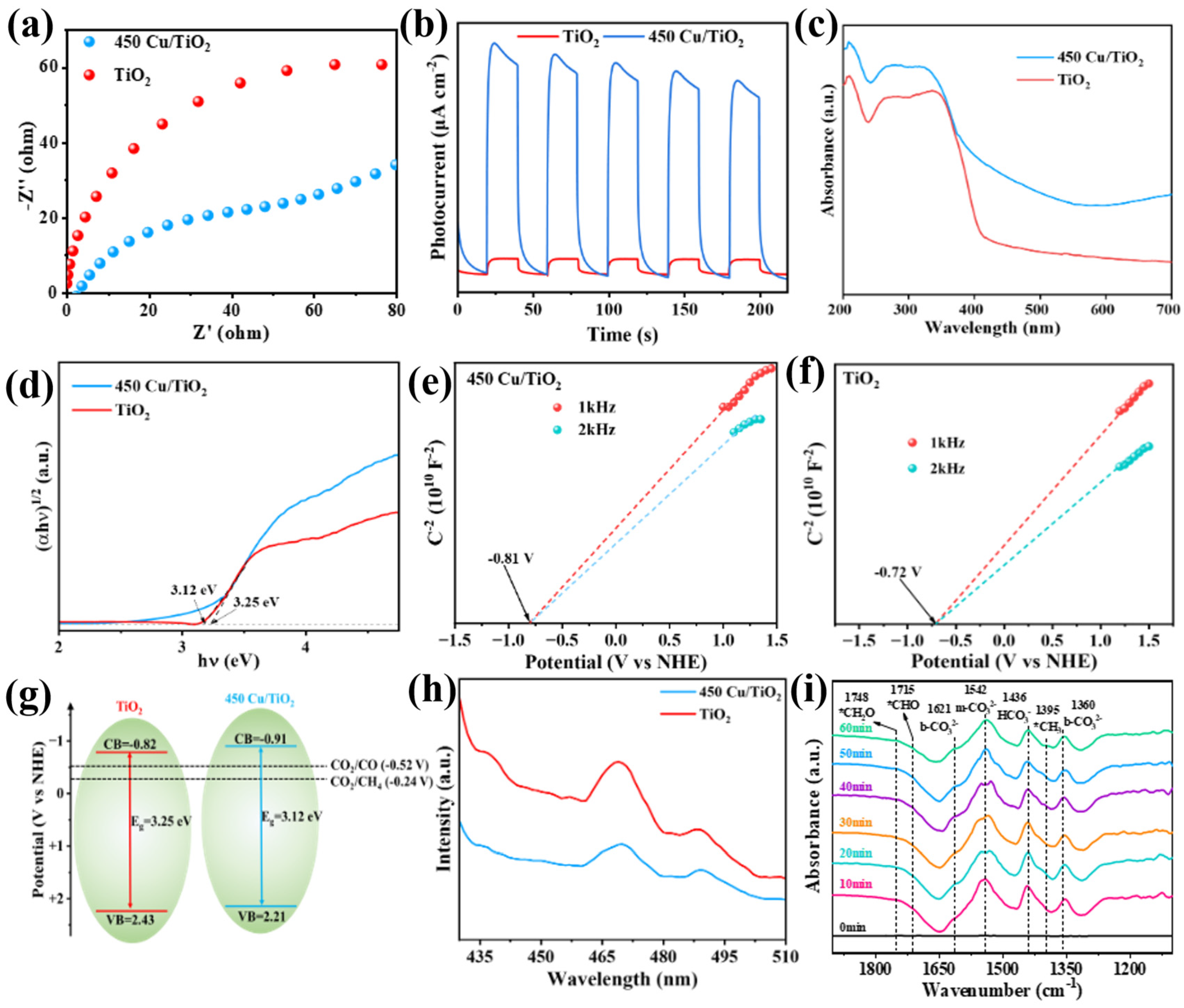
To gain insight into the factors responsible for the improved CO2 photoreduction activity, ultraviolet–visible diffuse reflectance spectroscopy (UV-vis DRS), Tauc plots, Mott–Schottky analysis, photoluminescence (PL) spectroscopy, transient photocurrent measurements, and electrochemical impedance spectroscopy (EIS) were employed to investigate the optical response, electronic band structure, and charge-carrier separation and transfer behaviors of the samples.
As shown in Figure 5a, 450 Cu/TiO2 exhibited much smaller arc radii than pristine TiO2, indicating improved interfacial charge transport after Cu modification, which was favorable for photocatalytic CO2 reduction [31].
Transient photocurrent measurements were conducted to compare the photoinduced charge-transport behavior of TiO2 and 450 Cu/TiO2. As shown in Figure 5b, 450 Cu/TiO2 exhibited higher photocurrent response than TiO2 under intermittent light irradiation. The stable and reproducible photocurrent response during repeated cycles further suggested the favorable photoelectrochemical stability of 450 Cu/TiO2. These results confirmed the improved charge separation and migration efficiency of 450 Cu/TiO2, which was beneficial for photocatalytic CO2 reduction.
UV-vis DRS, Tauc plots, and Mott–Schottky measurements were used to analyze the optical response and band positions of TiO2 and 450 Cu/TiO2. As shown in Figure 5c, pristine TiO2 showed an absorption edge around 400 nm in the near-UV region, corresponding to the wide-band-gap feature of anatase TiO2 [44]. Compared with TiO2, 450 Cu/TiO2 showed enhanced absorption in the visible-light region, indicating that the introduction of Cu species broadens the spectral response and improves the light-harvesting capability of TiO2 [23]. According to the corresponding Tauc plots (Figure 5d), the apparent optical band gaps of both TiO2 and 450 Cu/TiO2 were estimated to be 3.25 and 3.12 eV, respectively. The lower apparent optical band gap estimated for 450 Cu/TiO2 is consistent with its enhanced visible-light absorption after Cu introduction. Overall, these results indicated that Cu introduction modified the optical absorption behavior of TiO2, especially in the visible-light region.
Mott–Schottky measurements at 1 and 2 kHz were used to estimate the band-edge positions of TiO2 and 450 Cu/TiO2. As shown in Figure 5e,f, both TiO2 and 450 Cu/TiO2 displayed upward linear regions in the Mott–Schottky plots, indicating n-type behavior [45]. The flat-band potentials derived from the intercepts were −0.72 and −0.81 V versus the normal hydrogen electrode (NHE) for TiO2 and 450 Cu/TiO2, respectively. For n-type semiconductors, the conduction band edge is commonly approximated as 0.1 V more negative than the flat-band potential [46]. Accordingly, the conduction band positions were estimated as −0.82 V for TiO2 and −0.91 V for 450 Cu/TiO2 vs NHE. Using the Tauc-derived band gaps of 3.25 and 3.12 eV, the valence-band potentials (EVB) were obtained as 2.43 and 2.21 V vs NHE for TiO2 and 450 Cu/TiO2, respectively, based on EVB = ECB + Eg, where ECB and Eg represent the conduction-band potential and band gap, respectively. The more negative conduction band position of 450 Cu/TiO2 indicated a stronger reduction ability of photogenerated electrons, which was favorable for photocatalytic CO2 reduction [47]. Therefore, Cu modification may alter the estimated band structure of TiO2 and improve visible-light utilization, which could contribute to CO2 photoreduction together with the enhanced charge-separation behavior. PL spectra were recorded to compare the recombination behavior of photogenerated carriers (Figure 5h). The visible PL emission is mainly associated with radiative recombination through defect or surface-related states rather than direct band-to-band emission. The 450 Cu/TiO2 exhibited a much lower PL emission intensity than pristine TiO2, indicating reduced photogenerated carrier recombination. This result suggests that Cu modification and optimized calcination promoted charge separation in TiO2, which was consistent with previous reports that electronic-structure regulation can facilitate charge-transfer dynamics in MOF-based photocatalytic CO2 reduction systems [48].
In situ DRIFTS measurements were conducted to further investigate the reaction intermediates in the process of photocatalytic CO2 reduction over 450 Cu/TiO2 (Figure 5i). After CO2 and H2O adsorption in the dark, the sample was irradiated and the spectral changes were recorded as a function of irradiation time. The signals at 1542 cm−1 and 1621 cm−1 were attributed to monodentate carbonate (m-CO32−) and bidentate carbonate (b-CO32−), respectively, suggesting that CO2 was adsorbed and activated on the catalyst surface [49]. The peak at 1436 cm−1 corresponded to HCO3, and the intensity gradually decreased with irradiation time, while the carbonate-related bands remained relatively unchanged [50]. This suggested that HCO3 is a more reactive surface intermediate and may participate more readily in the subsequent reduction steps. In addition, the signals located at 1715 and 1748 cm−1 were associated with *CHO and *CH2O intermediates, respectively. Both of them are crucial hydrogenated intermediates for CH4 formation [50]. The peak at 1395 cm−1 related to the *CH3 further supported the progressive hydrogenation pathway from CO2-derived intermediates toward CH4 [51]. These DRIFTS results suggest a possible CO2-to-CH4 pathway involving initial CO2 adsorption and activation as carbonate/bicarbonate species, followed by stepwise hydrogenation through *CHO, *CH2O, and *CH3 intermediates toward CH4. This DRIFTS-supported pathway indicates that 450 Cu/TiO2 may promote CO2 activation and the formation of key hydrogenated intermediates, thereby contributing to its enhanced CH4 selectivity.
Combined with the EIS, photocurrent, UV-vis DRS, Mott–Schottky, and PL results, these observations indicated that the enhanced CO2-to-CH4 performance of 450 Cu/TiO2 is closely related to its calcination-regulated porous anatase structure, Cu-related interfacial electronic regulation, improved charge separation/transfer, and promoted CO2 activation.

3. Experimental Sections

3.1. Chemicals

Terephthalic acid (H2BDC, C8H6O4, ≥99.0%), N,N-dimethylformamide (DMF, C3H7NO, analytical reagent), absolute ethanol (C2H6O, analytical reagent), triethanolamine (TEOA, C6H15NO3, analytical reagent), methanol (CH3OH, analytical reagent), and copper(II) chloride dihydrate (CuCl2·2H2O, ≥99.0%) were supplied by Sinopharm Chemical Reagent Co., Ltd. (Shanghai, China). Tetrabutyl titanate (TBOT, C16H36O4Ti, analytical reagent) was obtained from Aladdin Chemical Reagent Co., Ltd. (Shanghai, China). All chemicals were directly used without additional purification.

3.2. Preparation of Photocatalyst

3.2.1. MIL-125

MIL-125 was prepared through a solvothermal route [30]. Briefly, H2BDC (3.00 g) was first dissolved in a mixed solvent containing 54.0 mL of DMF and 6.0 mL of methanol under stirring. TBOT (1.2 mL) was then introduced as the titanium source. After stirring for several minutes, the solution was then sealed in a Teflon-lined stainless-steel autoclave and heated at 130 °C for 20 h. The resulting precipitate was collected by centrifugation, washed alternately with DMF and methanol, and finally dried under vacuum at 80 °C for 12 h to obtain MIL-125.

3.2.2. Cu-MIL-125

Cu-MIL-125 was obtained by introducing Cu species into MIL-125 using a wet impregnation process [30]. In brief, 0.50 g of MIL-125 was dispersed in 40.0 mL of deionized water, followed by the addition of 9.96 mg of CuCl2·2H2O. The suspension was magnetically stirred for 3 h to allow sufficient contact between the precursor and Cu species. The product was then separated by centrifugation, rinsed with deionized water, and dried at 80 °C for 12 h.

3.2.3. Cu/TiO2

Cu/TiO2 was obtained by calcining Cu-MIL-125 as a precursor in air at different temperatures (300, 400, 450, and 500 °C) for 4 h. The resulting samples were denoted as 300 Cu/TiO2, 400 Cu/TiO2, 450 Cu/TiO2, and 500 Cu/TiO2, respectively.

3.3. Characterization

The structure, composition, optical response, and charge-transfer properties of the samples were examined using a series of characterization techniques. The crystalline phases were identified from XRD (D8 ADVANCE, Bruker AXS GmbH, Karlsruhe, Germany) patterns recorded with Cu Kα radiation. FT-IR spectra were collected using a Nicolet iS50 FT-IR spectrometer (Thermo Fisher Scientific, Waltham, MA, USA) to identify surface functional groups and bonding characteristics. Sample morphology and elemental distribution were observed by SEM equipped with EDS (GEMINI 300, Carl Zeiss Microscopy GmbH, Oberkochen, Germany). N2 adsorption–desorption isotherms were measured using an Autosorb iQ2 analyzer (Quantachrome Instruments, Boynton Beach, FL, USA), and the BET specific surface areas, total pore volumes, and average pore sizes were derived from the adsorption data. Surface elemental composition and chemical states were evaluated by XPS (ESCALAB Xi+, Thermo Fisher Scientific, Waltham, MA, USA). UV-vis DRS spectra were recorded using a UV-2600 spectrometer (Shimadzu Corporation, Kyoto, Japan) with BaSO4 as the reflectance standard, and the apparent optical band gaps were estimated from the corresponding Tauc plots. PL spectra were collected using a JEOL JEM-2010F instrument (JEOL Ltd., Tokyo, Japan) at room temperature under an excitation wavelength of 375 nm to evaluate the radiative recombination behavior of photogenerated carriers.
Transient photocurrent response, EIS, and Mott–Schottky measurements were carried out using a CHI660C electrochemical workstation (CH Instruments, Shanghai, China) in a three-electrode configuration under irradiation from a 300 W Xe lamp (CEL-HXF300, Beijing China Education Au-light Co., Ltd., Beijing, China). DRIFTS was employed to monitor the surface intermediates formed during photocatalytic CO2 reduction over powder 450 Cu/TiO2. The measurements were conducted using a Harrick in situ diffuse reflectance reaction cell (Harrick Scientific Products, Pleasantville, NY, USA) coupled with a Nicolet iS50 FT-IR spectrometer (Thermo Fisher Scientific, Waltham, MA, USA). Typically, 50 mg of catalyst is loaded into the reactor and exposed to a CO2/H2O mixed atmosphere for 30 min, followed by dark adsorption for 1 h. No TEOA was introduced during the DRIFTS measurements, which were used to probe surface CO2 adsorption, activation, and intermediate evolution under simplified in situ conditions. After background subtraction, spectra were recorded with 32 scans at a resolution of 4 cm−1. The sample was then irradiated with the same 300 W Xe lamp, and spectral changes were monitored at 10 min intervals.

3.4. Photocatalytic CO2 Reduction Experiments

The CO2 photoreduction activity was evaluated in a sealed batch reactor (CEL-HPR100T+, Beijing China Education Au-light Co., Ltd., Beijing, China) with a 150 mL Teflon liner under irradiation from the same 300 W Xe lamp. The reaction was carried out under continuous stirring, and no additional external heating was applied during irradiation. For each test, 10 mg of the catalyst was dispersed in a mixture of 1 mL TEOA and 4 mL deionized water. Before irradiation, the reactor was purged with high-purity CO2 (≥99.999%) for 30 min to remove residual air and ensure a CO2-saturated atmosphere. Before light irradiation, the suspension was kept in the dark for 1 h. During irradiation, the reaction mixture was continuously stirred, and gaseous products were sampled every 1 h for 5 h. The gaseous products were quantified by gas chromatography (GC2060-FID, Shanghai Ruimin Instrument Co., Ltd., Shanghai, China) with flame ionization and thermal conductivity detectors. In this study, the product analysis mainly focused on gaseous products, including CH4 and CO. To verify the origin of the carbon-containing products, 13CO2 isotope-labeling tests were performed, and the generated products were detected by gas chromatography–mass spectrometry (GC-MS, 7890A GC/5975C MS, Agilent Technologies, Santa Clara, CA, USA).

4. Conclusions

In summary, Cu/TiO2 photocatalysts were successfully prepared from Cu-MIL-125 through a temperature-controlled calcination strategy. Structural characterization confirmed that the Cu-MIL-125 precursor was gradually transformed into anatase Cu/TiO2, accompanied by the production of porous structures, and formation of surface Cu active sites. The calcination temperature played a crucial role in regulating the crystallinity and interfacial electronic structure of Cu/TiO2. Among the prepared samples, 450 Cu/TiO2 showed the best overall photocatalytic CO2 reduction performance, achieving a CH4 formation rate of 15.90 μmol g−1 h−1 and a CH4 selectivity of 93.05%. The improved activity was mainly attributed to the optimized anatase crystallinity, suitable porous structure, effective Cu active sites, enhanced light absorption, and promoted separation and transfer of photogenerated charge carriers. In addition, the unchanged XRD and FT-IR patterns after reaction further confirmed the catalyst maintained good stability during repeated cycling tests. Control experiments demonstrated that light irradiation, photocatalyst, CO2, H2O and TEOA were essential for the reaction. The 13CO2 isotope-labeling experiment verified that CH4 and CO originated from CO2 photoreduction, while in situ DRIFTS revealed the generation and evolution of surface intermediates during CO2 activation and hydrogenation. This study offers a practical route for developing MOF-derived Cu/TiO2 photocatalysts toward CH4-selective CO2 photoreduction and highlights calcination-temperature regulation as a key factor in optimizing MOF-derived photocatalysts.

Author Contributions

Methodology, S.H.; Validation, J.L.; Investigation, T.Z.; Data curation, Z.L.; Writing—original draft, H.C.; Writing—review & editing, N.L.; Supervision, X.Z. and Z.Z.; Funding acquisition, J.L. and N.L. All authors have read and agreed to the published version of the manuscript.

Funding

This research was funded by National Natural Science Foundation of China, grant numbers 42177405 and 12075152; the Innovation Program of Shanghai Municipal Education Commission, grant number 2021-03-147; And the Energy Science and Technology discipline under the Shanghai Class IV Peak Disciplinary Development Program.

Institutional Review Board Statement

Not applicable.

Informed Consent Statement

Not applicable.

Data Availability Statement

The data supporting the findings of this study are included in the accompanying minimal dataset submitted with this manuscript. Additional data are available from the corresponding author upon reasonable request.

Conflicts of Interest

The authors declare no conflict of interest.

References

  1. Yang, C.-Q.; Yan, X.; Su, P.; Zhang, X.-Q.; Chen, Q.; Ye, Z.-H.; Xiao, F.-X. Tailoring layered double hydroxides: Design principles and modification strategies for solar CO2 conversion. Coord. Chem. Rev. 2026, 550, 217396. [Google Scholar] [CrossRef]
  2. Li, X.; Yu, J.; Jaroniec, M.; Chen, X. Cocatalysts for Selective Photoreduction of CO2 into Solar Fuels. Chem. Rev. 2019, 119, 3962–4179. [Google Scholar] [CrossRef] [PubMed]
  3. Dong, H.; Zhang, Z.; Zhou, D.; Huang, S.; Lin, Z.; Zhang, X.; Zhang, Z.; Lei, J.; Liu, N. Progress of photothermal/thermal catalytic CO2 hydrogenation by metal-modified CeO2. Green Chem. 2026, 28, 3455–3485. [Google Scholar] [CrossRef]
  4. Wang, J.; Chen, F.; Liu, Q.; Huang, H. Intrinsic bimetallic cations regulating band centers and reactive sites for boosting CO2 photoreduction. J. Mater. Chem. A 2024, 12, 18358–18366. [Google Scholar] [CrossRef]
  5. Zhou, Y.; Ye, Q.; Shi, X.; Zhang, Q.; Song, Q.; Zhou, C.; Li, D.; Jiang, D. Ni3B as p-Block Element-Modulated Cocatalyst for Efficient Photocatalytic CO2 Reduction. Inorg. Chem. 2022, 61, 17268–17277. [Google Scholar] [CrossRef] [PubMed]
  6. Li, W.; Wang, Z.; Zhai, J.; Zhang, L.; Chong, R.; Zhou, Y.; Feng, C.; Wang, Y. Interfacial electron orchestration: Vacancy-engineered CQD/NiSV heterojunctions achieve near-perfect CO2-to-CH4 photocatalysis with selectivity approaching 100 %. J. Alloys Compd. 2025, 1038, 182558. [Google Scholar] [CrossRef]
  7. Hoque, M.A.; Guzman, M.I. Photocatalytic Activity: Experimental Features to Report in Heterogeneous Photocatalysis. Materials 2018, 11, 1990. [Google Scholar] [CrossRef] [PubMed]
  8. Thompson, W.A.; Sanchez Fernandez, E.; Maroto-Valer, M.M. Review and Analysis of CO2 Photoreduction Kinetics. ACS Sustain. Chem. Eng. 2020, 8, 4677–4692. [Google Scholar] [CrossRef]
  9. She, H.; Hua, R.; Zhao, J.; Xia, Y.; Wang, L.; Huang, J.; Wang, Q. Synergetic regulation of interfacial electronic structure of Cu, N co-doped carbon modified TiO2 for efficient photocatalytic CO2 reduction. Chem. Eng. J. 2024, 496, 153799. [Google Scholar] [CrossRef]
  10. Zhao, T.; Yang, F.; Cheng, G.; Zhang, W.; Xiong, J. Surface Hydroxyl Group Embedding and CuAg Alloy Anchoring Promotes Photocatalytic CO2 Reduction of Hollow TiO2 Nanostructures. Ind. Eng. Chem. Res. 2025, 64, 14077–14087. [Google Scholar] [CrossRef]
  11. Li, J.; Cao, C.; Zhang, X.; Dong, H.; Wang, M.; Zhang, L.; Xing, Z.; Yang, W. Tuning Oxygen Vacancies by Construction of a SiO2@TiO2 Core−Shell Composite Structure for Boosting Photocatalytic CO2 Reduction Towards CH4. Carbon Energy 2025, 7, e700. [Google Scholar] [CrossRef]
  12. Cheng, X.; Liu, X.; Xu, J.; Bi, Y.; Feng, C.; Meng, T.; Gao, S.; Li, H.; Dong, L.; Wang, C.; et al. Nitrogen vacancy-modulated Z-scheme CTF-based heterojunction for highly efficient and selective photocatalytic CO2 reduction. Nano Res. 2026, 19, 94908330. [Google Scholar] [CrossRef]
  13. Tran, D.P.H.; Pham, M.-T.; Bui, X.-T.; Wang, Y.-F.; You, S.-J. CeO2 as a photocatalytic material for CO2 conversion: A review. Sol. Energy 2022, 240, 443–466. [Google Scholar] [CrossRef]
  14. Podelinska, A.; Neilande, E.; Pankratova, V.; Serga, V.; Bandarenka, H.; Burko, A.; Piskunov, S.; Pankratov, V.A.; Sarakovskis, A.; Popov, A.I.; et al. Structural and Spectroscopic Characterization of TiO2 Nanocrystalline Materials Synthesized by Different Methods. Nanomaterials 2025, 15, 498. [Google Scholar] [CrossRef] [PubMed]
  15. Zhang, Q.; Chen, Y.; Yu, X.; Yin, Y.; Ru, Y.; Tian, G. In situ construction of Schottky junctions on MOF-derived defective TiO2 oval nanocages for enhanced photocatalytic CO2 reduction. J. Alloys Compd. 2024, 983, 173735. [Google Scholar] [CrossRef]
  16. Chen, J.; Zeng, Q.; Bao, S.; Wang, F.; Wang, C.; Li, K.; Mei, Y. Selective CO2-to-CO photocatalytic conversion over a TiO2@TPA hybrid synthesized via MOF hydrolysis. Sep. Purif. Technol. 2025, 379, 134981. [Google Scholar] [CrossRef]
  17. Kampouri, S.; Ireland, C.P.; Valizadeh, B.; Oveisi, E.; Schouwink, P.A.; Mensi, M.; Stylianou, K.C. Mixed-Phase MOF-Derived Titanium Dioxide for Photocatalytic Hydrogen Evolution: The Impact of the Templated Morphology. ACS Appl. Energy Mater. 2018, 1, 6541–6548. [Google Scholar] [CrossRef]
  18. Huang, W.; An, B.; Chen, Z.; Han, Y.; Chen, Y.; Li, J.; Han, X.; Xu, S.; Crawshaw, D.; Tillotson, E.; et al. Synthesis of Primary Amines via Reductive Amination of Aldehydes and Ketones Over a Ni-Doped MFM-300(Cr) Catalyst. Adv. Sci. 2025, 12, e08892. [Google Scholar] [CrossRef] [PubMed]
  19. Garvin, M.; Thompson, W.A.; Tan, J.Z.Y.; Kampouri, S.; Ireland, C.P.; Smit, B.; Brookfield, A.; Collison, D.; Negahdar, L.; Beale, A.M.; et al. Highly selective CO2 photoreduction to CO on MOF-derived TiO2. RSC Sustain. 2023, 1, 494–503. [Google Scholar] [CrossRef] [PubMed]
  20. Yang, X.; He, J.; Liu, J.; Zhang, S.; Song, X. A novel mixed crystal N-doped TiO2 derived from a surface engineered MIL-125(Ti) for enhancing the degradation of tetracycline hydrochloride under visible light. J. Alloys Compd. 2025, 1031, 180968. [Google Scholar] [CrossRef]
  21. Bakhadur, A.; Alem, H.; Carré, V.; Gries, T.; Balan, L.; Cantin, J.-L.; Medjahdi, G.; Orazov, Z.; Uralbekov, B.; Schneider, R. Porous nitrogen-doped TiO2/graphene oxide derived from H2N-MIL-125(Ti)/graphene oxide composites as highly efficient visible light active photocatalysts for the degradation of dyes and carbamazepine. Appl. Surf. Sci. 2025, 714, 164466. [Google Scholar] [CrossRef]
  22. Dan-Hardi, M.; Serre, C.; Frot, T.o.; Rozes, L.; Maurin, G.; Sanchez, C.m.; Férey, G.r. A New Photoactive Crystalline Highly Porous Titanium(IV) Dicarboxylate. J. Am. Chem. Soc. 2009, 131, 10857–10859. [Google Scholar] [CrossRef] [PubMed]
  23. Hua, R.; Zhao, J.; She, H.; Wang, L.; Huang, J.; Wang, Q. Valence-state engineering of Cu species on TiO2 surfaces for synergistic enhancement of photocatalytic CO2 reduction activity and products selectivity. Chem. Eng. J. 2025, 521, 166444. [Google Scholar] [CrossRef]
  24. Aguirre, M.E.; Zhou, R.; Eugene, A.J.; Guzman, M.I.; Grela, M.A. Cu2O/TiO2 heterostructures for CO2 reduction through a direct Z-scheme: Protecting Cu2O from photocorrosion. Appl. Catal. B Environ. 2017, 217, 485–493. [Google Scholar] [CrossRef]
  25. Wang, J.; Chang, W.; Wu, T.; Wang, L. Cu2O modified ultrathin TiO2 nanosheets optimizes *COOH formation energy for highly selective photocatalytic CO2-to-CH4 conversion. Nano Res. 2025, 18, 94908112. [Google Scholar] [CrossRef]
  26. Deng, X.; Liu, T. Reveal the role of (Cu0/Cu+) in CO2 reduction to methane on Cu-Cu2O heterojunction. Appl. Surf. Sci. 2026, 715, 164543. [Google Scholar] [CrossRef]
  27. Zhao, C.; Zhou, A.; Li, H.; Yu, J.; Xing, N.; Zhang, J.; Chen, D.; Li, J.R. Reversed Electron Transfer in Cu-TiO2@ZnIn2S4 for Boosting Photocatalytic CO2 Reduction. Adv. Funct. Mater. 2025, 36, e19072. [Google Scholar] [CrossRef]
  28. Belgamwar, R.; Verma, R.; Das, T.; Chakraborty, S.; Sarawade, P.; Polshettiwar, V. Defects Tune the Strong Metal-Support Interactions in Copper Supported on Defected Titanium Dioxide Catalysts for CO2 Reduction. J. Am. Chem. Soc. 2023, 145, 8634–8646. [Google Scholar] [CrossRef] [PubMed]
  29. Zhang, X.; Gao, B.; Rao, R.; Bi, F.; Li, C.; Yue, K.; Wang, Y.; Xu, J.; Feng, X.; Yang, Y. Defects materials of Institut Lavoisier-125(Ti) materials enhanced photocatalytic activity for toluene and chlorobenzene mixtures degradation: Mechanism study. J. Colloid Interface Sci. 2024, 660, 423–439. [Google Scholar] [CrossRef] [PubMed]
  30. Zhang, Y.; Zhao, J.; Wang, H.; Xiao, B.; Zhang, W.; Zhao, X.; Lv, T.; Thangamuthu, M.; Zhang, J.; Guo, Y.; et al. Single-atom Cu anchored catalysts for photocatalytic renewable H2 production with a quantum efficiency of 56%. Nat. Commun. 2022, 13, 58. [Google Scholar] [CrossRef] [PubMed]
  31. Li, D.; Li, Q.; Zhou, Y.; Zhang, Q.; Ye, Q.; Yang, R.; Jiang, D. Shaping and Doping Metal-Organic Framework-Derived TiO2 to Steer the Selectivity of Photocatalytic CO2 Reduction toward CH4. Inorg. Chem. 2024, 63, 15398–15408. [Google Scholar] [CrossRef] [PubMed]
  32. Daneshgar, H.; Bagherzadeh, M.; Sojdeh, S.; Rabiee, N. Optimizing sustainable pore design in MIL-125(Ti) for biomedicine using morphological tuning informed by Gaussian, Lorentzian, and Boltzmann fitting functions. Commun. Chem. 2025, 9, 38. [Google Scholar] [CrossRef] [PubMed]
  33. Babu, A.; Madathil, N.; Rajaboina, R.K.; Borkar, H.; Devarayapalli, K.C.; Mishra, Y.K.; Hajra, S.; Kim, H.J.; Khanapuram, U.K.; Lee, D.S. Functionalized MIL-125(Ti)-based high-performance triboelectric nanogenerators for hygiene monitoring. Mater. Adv. 2025, 6, 4725–4737. [Google Scholar] [CrossRef]
  34. Phongamwong, T.; Barrabés, N.; Donphai, W.; Witoon, T.; Rupprechter, G.; Chareonpanich, M. Chlorophyll-modified Au25(SR)18-functionalized TiO2 for photocatalytic degradation of rhodamine B. Appl. Catal. B Environ. 2023, 325, 122336. [Google Scholar] [CrossRef]
  35. Colón, G.; Maicu, M.; Hidalgo, M.C.; Navío, J.A. Cu-doped TiO2 systems with improved photocatalytic activity. Appl. Catal. B Environ. 2006, 67, 41–51. [Google Scholar] [CrossRef]
  36. Ji, Y.; Ma, H.; Shao, H.; Tao, Z.; Wang, W.; Miao, Y.; Xiao, S. Switching CO2 reduction selectivity in Cu-TiO2 catalysts: Role of Cu+ site location and oxygen vacancy concentration. Environ. Res. 2025, 276, 121501. [Google Scholar] [CrossRef] [PubMed]
  37. Kacica, C.T.; Biswas, P. Improved conductivity and ionic mobility in nanostructured thin films via aliovalent doping for ultra-high rate energy storage. Nanoscale Adv. 2020, 2, 2160–2169. [Google Scholar] [CrossRef] [PubMed]
  38. Yang, F.; Yang, R.; Yan, L.; Wu, J.; Liu, X.; Yang, L.; Zhong, M.; Luo, X.; Zhang, L. Enhancement of Titania Photoanode Performance by Sandwiching Copper between Two Titania Layers. Materials 2020, 13, 4326. [Google Scholar] [CrossRef] [PubMed]
  39. Belgamwar, R.; Singhvi, C.; Sharma, G.; Paidi, V.K.; Glatzel, P.; Yamazoe, S.; Sarawade, P.; Polshettiwar, V. Synthesis of synergistic catalysts: Integrating defects, SMSI, and plasmonic effects for enhanced photocatalytic CO2 reduction. Chem. Sci. 2025, 16, 9766–9784. [Google Scholar] [CrossRef] [PubMed]
  40. Xu, F.; Zhang, J.; Zhu, B.; Yu, J.; Xu, J. CuInS2 sensitized TiO2 hybrid nanofibers for improved photocatalytic CO2 reduction. Appl. Catal. B Environ. 2018, 230, 194–202. [Google Scholar] [CrossRef]
  41. Wu, K.; Dong, X.; Zhu, J.; Wu, P.; Liu, C.; Wang, Y.; Wu, J.; Hou, J.; Liu, Z.; Guo, X. Designing biomimetic porous celery: TiO2/ZnO nanocomposite for enhanced CO2 photoreduction. J. Mater. Sci. 2018, 53, 11595–11606. [Google Scholar] [CrossRef]
  42. Tahir, B.; Tahir, M.; Alraeesi, A.; Kumar, N. Photocatalytic Carbon Dioxide Reduction with Water to CO and CH4 over Bio-sludge Modified TiO2 Composite Chem. Eng. Trans. 2024, 113, 193–198. [Google Scholar] [CrossRef]
  43. Zhang, J.; Fu, J.; Chen, S.; Lv, J.; Dai, K. 1D carbon nanofibers@TiO2 core-shell nanocomposites with enhanced photocatalytic activity toward CO2 reduction. J. Alloys Compd. 2018, 746, 168–176. [Google Scholar] [CrossRef]
  44. Ren, W.; Ai, Z.; Jia, F.; Zhang, L.; Fan, X.; Zou, Z. Low temperature preparation and visible light photocatalytic activity of mesoporous carbon-doped crystalline TiO2. Appl. Catal. B Environ. 2007, 69, 138–144. [Google Scholar] [CrossRef]
  45. Han, W.; Shao, L.-H.; Sun, X.-J.; Liu, Y.-H.; Zhang, F.-M.; Wang, Y.; Dong, P.-Y.; Zhang, G.-L. Constructing Cu ion sites in MOF/COF heterostructure for noble-metal-free photoredox catalysis. Appl. Catal. B Environ. 2022, 317, 121710. [Google Scholar] [CrossRef]
  46. Cen, Q.; Xiao, W.; Liu, Y.; Wang, Q.; Nafady, A.; Ma, S. Fabrication of Fe-POMs as Visible-light-active Heterogeneous Photocatalyst. Chem. Res. Chin. Univ. 2020, 36, 1128–1135. [Google Scholar] [CrossRef]
  47. Li, B.H.; Zhang, K.H.; Wang, X.J.; Li, Y.P.; Liu, X.; Han, B.H.; Li, F.T. Construction synergetic adsorption and activation surface via confined Cu/Cu2O and Ag nanoparticles on TiO2 for effective conversion of CO2 to CH4. J. Colloid Interface Sci. 2024, 660, 961–973. [Google Scholar] [CrossRef] [PubMed]
  48. Zhang, Z.; Huang, W.; Dong, H.; Cui, H.; Zhou, D.; Lin, Z.; Hu, B.; Zhang, X.; Huang, S.; Tang, L.; et al. Self-Tuned Ligand-to-Metal–Metal Charge Transfer in Node-Engineered Al-Doped NH2-UiO-66 Boosts CO2 Photoreduction Activity. Adv. Funct. Mater. 2026, 36, e75148. [Google Scholar] [CrossRef]
  49. Bhattacharyya, K.; Nayak, C.; Bhattacharyya, D.; Roy, A.; Tyagi, A.K. High Selectivity toward Photoreduction of Carbon Dioxide to Methane over Copper-Doped Titania: Investigations Using Operando Techniques. Chem. Mater. 2025, 37, 3927–3949. [Google Scholar] [CrossRef]
  50. Zhang, Z.; Dong, H.; Zhou, D.; Tang, K.; Ma, Y.; Han, T.; Lei, J.; Huang, S.; Zhang, X.; Tang, L.; et al. Electron beam- induced defect engineering construction in MIL-68(In) for enhanced CO2 photoreduction: Unravelling organic framework defects. J. Colloid Interface Sci. 2026, 702, 138990. [Google Scholar] [CrossRef] [PubMed]
  51. Liu, L.; Zhao, C.; Miller, J.T.; Li, Y. Mechanistic Study of CO2 Photoreduction with H2O on Cu/TiO2 Nanocomposites by in Situ X-ray Absorption and Infrared Spectroscopies. J. Phys. Chem. C 2016, 121, 490–499. [Google Scholar] [CrossRef]
Figure 1. (a) Schematic illustration of the synthesis process of Cu/TiO2. SEM images of (b) MIL-125, (c) Cu-MIL-125, and (d,e) 450 Cu/TiO2. (f) EDS elemental mapping images of 450 Cu/TiO2.
Molecules 31 02304 g001
Figure 2. (a) XRD patterns, (b) FT-IR spectra, (c) N2 adsorption–desorption isotherms, and (d) pore-size distribution curves of the prepared samples.
Molecules 31 02304 g002
Figure 3. XPS spectra of 450 Cu/TiO2: (a) survey, (b) O 1s, (c) Ti 2p, and (d) Cu 2p.
Molecules 31 02304 g003
Figure 4. Photocatalytic CO2 reduction performance and stability evaluation. (a) Production rates of products and CH4 selectivity over different samples. (b) Control experiments under different reaction conditions. (c) Mass spectral signals of 13CH4 and 13CO obtained from the 13CO2 isotope-labeling test. (d) Cycling stability of 450 Cu/TiO2 for photocatalytic CO2 reduction. (e) XRD patterns and (f) FT-IR spectra of 450 Cu/TiO2 before and after the photocatalytic reaction.
Molecules 31 02304 g004
Figure 5. Charge-transfer behavior, optical properties, band structures, and surface-intermediate evolution of TiO2 and 450 Cu/TiO2: (a) EIS Nyquist plots, (b) transient photocurrent responses, (c) UV-vis diffuse reflectance spectra, (d) Tauc plots, Mott–Schottky plots of (e) TiO2 and (f) 450 Cu/TiO2, (g) estimated band structures of TiO2 and 450 Cu/TiO2 based on Mott–Schottky and Tauc analyses, (h) PL spectra, and (i) in situ DRIFTS spectra of CO2 photoreduction over 450 Cu/TiO2.
Molecules 31 02304 g005
Table 1. Physical parameters of materials obtained at different temperatures.
SamplesSBET (m2 g−1)Pore Volume (cm3 g−1)Pore Size (nm)
MIL-125763.480.522.74
Cu-MIL-125135.050.236.73
300 Cu/TiO2164.350.307.27
400 Cu/TiO2153.550.4210.85
450 Cu/TiO2104.030.4416.93
500 Cu/TiO266.640.3118.89
TiO244.280.1110.07
Table 2. Comparison of representative TiO2-based photocatalysts for photocatalytic CO2-to-CH4 reduction.
PhotocatalystReaction ConditionsCH4 Formation RateRef.
TiO2/CuInS2 hybrid nanofibersCO2 + H2O vapor, 350 W Xe lamp2.50 μmol g−1 h−1[40]
TiO2/ZnO nanocompositeCO2 + H2O, 300 W Xe lamp2.56 μmol g−1 h−1[41]
3% BS/TiO2CO2 + H2O2, continuous-flow photoreactor4.39 μmol g−1 h−1[42]
carbon nanofibers@TiO2CO2 + H2O, 350 W Xe lamp13.52 μmol g−1 h−1[43]
450 Cu/TiO2CO2 + H2O + TEOA 1, 300 W Xe lamp15.90 μmol g−1 h−1This work
1 TEOA = triethanolamine.
Disclaimer/Publisher’s Note: The statements, opinions and data contained in all publications are solely those of the individual author(s) and contributor(s) and not of MDPI and/or the editor(s). MDPI and/or the editor(s) disclaim responsibility for any injury to people or property resulting from any ideas, methods, instructions or products referred to in the content.