Article

Determination and Ecological Risk Assessment of Organophosphate Esters in Drinking and Environmental Waters by Automated Liquid–Liquid Extraction Coupled with GC-MS/MS


1
Institute of Marine and Fisheries, Zhejiang Ocean University, Zhoushan 316021, China
2
Key Laboratory of Sustainable Utilization of Technology Research for Fisheries Resources of Zhejiang Province, Zhejiang Marine Fisheries Research Institute, Zhoushan 316021, China
3
Marine Ecological and Environmental Monitoring Center of Zhejiang Province, Zhoushan 316021, China
*
Authors to whom correspondence should be addressed.
Molecules 2026, 31(12), 2131; https://doi.org/10.3390/molecules31122131
Submission received: 13 May 2026 / Revised: 10 June 2026 / Accepted: 15 June 2026 / Published: 17 June 2026
(This article belongs to the Special Issue Advanced Analytical Methods for Water Contaminant Detection)

Abstract

Organophosphate esters (OPEs) are ubiquitous in the global water environment and may pose potential risks to aquatic ecosystems and human health. Herein, we present a simple and efficient method for accurate quantification of nineteen OPEs in water based on automated liquid–liquid extraction (LLE) with dichloromethane and hexane, followed by gas chromatography–tandem mass spectrometry (GC-MS/MS) with isotope dilution calibration. This method demonstrated a negligible matrix effect, satisfactory recoveries (70–120%), and low limits of detection (0.46–2.32 ng/L). A total of 3, 9, 10, and 11 OPEs were detected in Wahaha pure water, tap water, river water, and seawater, respectively, with total OPE (∑OPE) concentration ranges of 8.23–18.5 ng/L, 159–218 ng/L, 202–623 ng/L, and 111–175 ng/L, respectively. Among the detected OPEs, tris(2-chloroethyl) phosphate (TCEP) and tris(1-chloro-2-propyl) phosphate (TCIPP) were the predominant compounds in four test water matrices. The risk quotient (RQ) results revealed that OPEs exhibited a low risk to algae, crustaceans and fish in the river water of Zhoushan and seawater of Sanmen Bay. Overall, the proposed method is sensitive and reliable for routine OPE analysis in drinking and environmental waters.

1. Introduction

Organophosphate esters (OPEs) are synthetic phosphate derivatives substituted with alkyl, halogenated alkyl, and aryl groups [1]. They have been widely used as flame retardants, plasticizers, and defoamers in agriculture, medicine, and industrial fields [2]. Due to restrictions on certain brominated flame retardants (hexabromocyclododecane and polybrominated diphenyl ethers (PBDEs)), OPEs have emerged as the predominant flame retardants in recent years [3]. However, studies have increasingly confirmed that numerous negative effects on health are associated with exposure to OPEs [4]. The United States, Canada, and the European Union have banned the use of tris(2-chloroethyl) phosphate (TCEP), tris(1,3-dichloro-2-propyl) phosphate (TDCPP), and tris(1-chloro-2-propyl) phosphate (TCIPP) in commercial products, whereas China listed TCEP and isopropylphenyl phosphate (IPPP) in its Priority Control Chemicals Inventory in 2020 [5]. OPEs are commonly incorporated into materials through physical mixing rather than chemical bonding and can thus be easily released into the environment through leaching, abrasion, and volatilization [6]. Ubiquitous OPEs in air, dust, soil, sediment, water, foodstuffs, organisms, and even human biological samples are globally well documented [4,7]. For instance, several studies have demonstrated that OPEs occur in various water bodies, including surface water, groundwater, drinking water, seawater, wastewater, and rainwater, at concentrations ranging from ng/L to μg/L [1,8,9,10,11]. Therefore, efficient and reliable analytical methods are urgently required to quantify OPEs in water environments and evaluate their potential health and ecological risks. Current analytical protocols for aqueous OPEs are mostly matrix-specific, and comprehensive methods covering both drinking water and environmental water (i.e., pure water, tap water, river water, seawater) are still lacking, which is a prominent research gap in this field.
Currently, the most commonly used methods for OPEs include gas chromatography [12,13], gas chromatography–mass spectrometry (GC-MS) [1,14,15,16], gas chromatography–tandem mass spectrometry (GC-MS/MS) [10,17,18,19,20,21,22,23,24], high-performance liquid chromatography–tandem mass spectrometry (HPLC-MS/MS) [2,6,11,25,26,27], ultra-performance liquid chromatography–tandem mass spectrometry (UPLC-MS/MS) [4,8,28,29,30,31,32,33,34,35,36], and ultrahigh-performance liquid chromatography–Q Exactive hybrid quadrupole-Orbitrap high-resolution mass spectrometry (UPLC-Q-Orbitrap HRMS) [37]. LC-MS/MS exhibited excellent sensitivity and specificity, demonstrating suitability for analyzing both volatile and non-volatile OPEs; however, this analytical technique suffered significant susceptibility to matrix effects [28]. When analyzing complex matrices, GC-MS/MS showed superior selectivity, sensitivity and accuracy relative to GC-MS [38], making it the method of choice for analyzing volatile OPEs. Nevertheless, these methods only involved limited OPEs, typically no more than 13 [1,12,15,18,19,20,21,25,29,31]. This lack of data might possibly originate from difficulties with OPE extraction from a complex matrix or limit of detection (LOD) incompatibility with environmental levels. Before instrumental analysis, trace OPEs in water samples require preconcentration, which can be achieved via methods such as liquid–liquid extraction (LLE) [14,17,21,22,29,37], solid-phase extraction (SPE) [1,4,10,11,18,19,20,24,26,27,30,31,32,33,34,35], dispersive solid-phase extraction (dSPE) [15], dispersive liquid–liquid microextraction (DLLME) [36], hollow-fiber liquid-phase microextraction (HF-LPME) [16], solid-phase microextraction (SPME) [13], headspace SPME [12], and magnetic solid-phase extraction (MSPE) [2,8]. Among them, dSPE features low cost and high throughput but weak enrichment capability. DLLME achieves efficient enrichment with low solvent consumption, while its performance is easily affected by emulsification and high salinity. HF-LPME has strong anti-interference ability yet low analysis efficiency. Solvent-free SPME is convenient for automation and field testing, but it suffers from low recoveries for weakly polar and low-volatility OPEs. MSPE enables rapid separation and selective extraction, but material agglomeration limits its practical use in complex water matrices. Normally, LLE and SPE were the most used techniques for OPE extraction from water environments due to their high sensitivity and robustness. However, SPE features tedious operations, low throughput and relatively high solvent usage. Plastic cartridges cause background contamination, while matrix effects, carryover and column clogging are also common issues [1]. In contrast, carryover and memory effects are largely absent in LLE, given that each sample is processed with a newly added solvent. Nevertheless, conventional LLE still has several inherent flaws. To address these issues, various modified and novel LLE methods have been developed to shorten extraction time, boost extraction efficiency and cut down organic solvent consumption.
The structural diversity of OPEs results in a wide range of chemical properties, ranging from very polar to highly hydrophobic. The goal of this study is to develop a simple and robust automated LLE coupled with stable isotope dilution GC-MS/MS for quantifying 19 OPEs (0.80 < log Kow < 9.49) in drinking and environmental water samples. Matrix effects were eliminated using nine isotope-labeled internal standards (ILISs). No plasticware was used throughout the automated LLE-GC-MS/MS procedure, which greatly reduces system blank contamination. The molecular structure and physicochemical properties of target OPEs are displayed in Supplementary Materials, Figure S1 and Table S1, including eight alkyl OPEs, four Cl-OPEs, and seven aryl OPEs. After optimization (e.g., extraction solvent) and validation, the proposed method was applied to detect OPEs in various real water samples including Wahaha pure water, tap water, river water from Zhoushan, and seawater from Sanmen Bay, East China. Then, the occurrence and ecological risks in the survey area were also discussed and assessed, providing scientific methods and a basis for the pollution control and risk management of organophosphorus flame retardant.

2. Results and Discussion

2.1. Optimization of Automated Liquid–Liquid Extraction

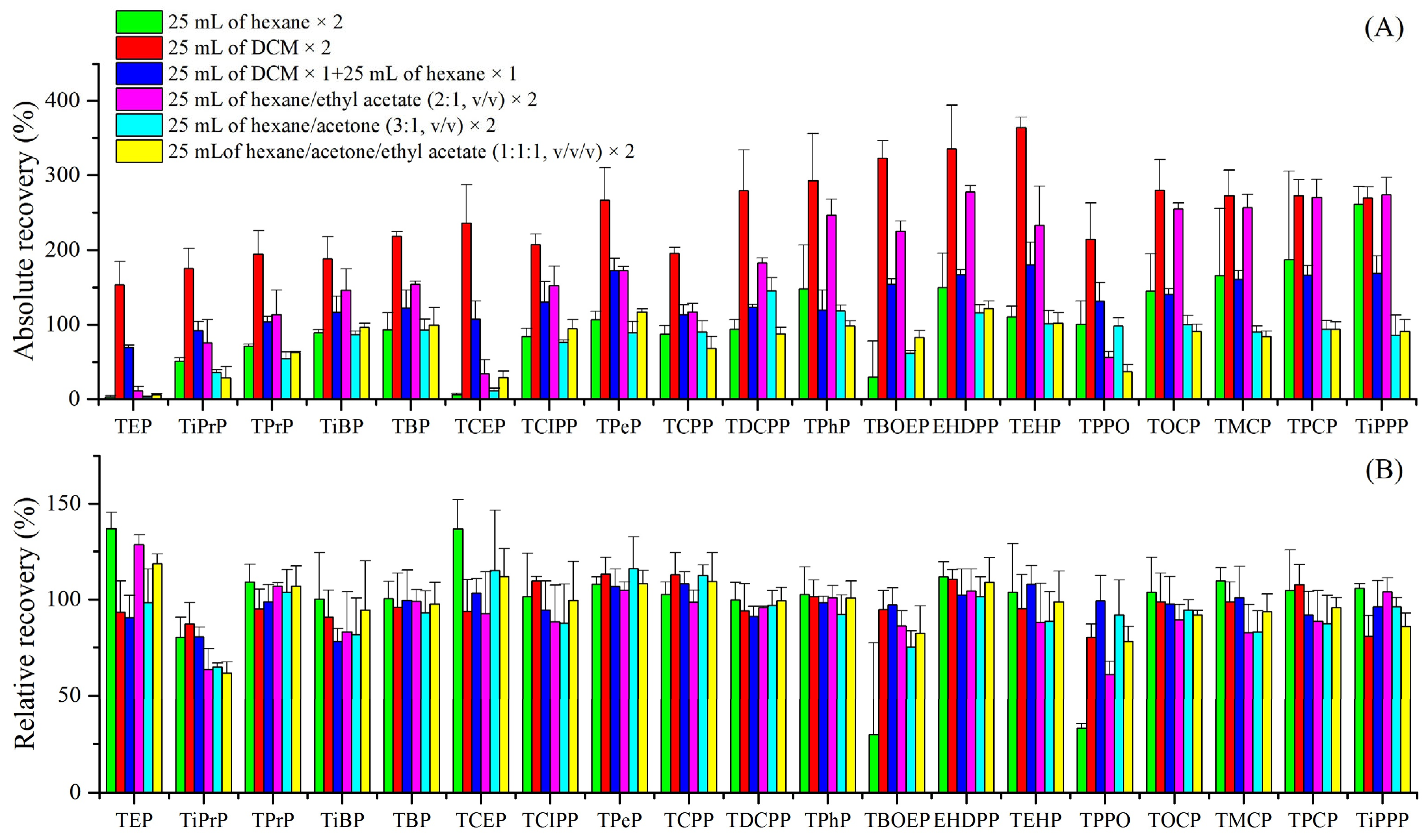
Previous studies have applied LLE for the extraction of OPEs in water [14,17,21,22,29,37]. To address the limitations of conventional manual LLE, which is both time- and labor-intensive, this study employs mechanical agitation for automated LLE, thereby enhancing experimental efficiency [39]. Considering the large differences in the polarities and volatilities of target analytes (logKOW ranging from 0.80 to 9.49, water solubility ranging from 2.59 × 10⁻⁵ to 5.0 × 10⁵ mg/L, vapor pressure ranging from 2.6 × 10⁻⁹ to 0.39 mm Hg, Table S1), extraction solvent selection is critical, and dichloromethane (DCM) was the most commonly used in previous work [14,17,21,22,29,37]. Six solvents were assessed for their efficiency in extracting spiked ultrapure water (spiked at 100 ng/L) by external standard method (absolute recovery). As shown in Figure 1A, DCM exhibited the highest extraction efficiencies for 19 OPEs, with absolute recoveries in the range of 154–364%, followed by DCM and hexane (69–180%). However, when the other four extraction solvents were utilized, the absolute recoveries of three to four OFEs were less than 60%. For instance, using hexane/acetone (3:1, v/v), the absolute recoveries of TEP, TiPrP, TPrP, and TCEP were 3%, 36%, 54%, and 11%, respectively. The high recoveries (154–364%) of DCM are mainly attributed to matrix enhancement from co-extracted substances. Furthermore, DCM also exhibits the highest extraction capacity for OPEs of different polarity with little analyte loss. Other extract solvents have low affinity for polar OPEs, leading to low recoveries.
The above recovery results indicated a severe matrix effect for OPE quantification in water using external standard calibration. As such, nine isotopically enriched OPEs were utilized for recovery estimation (relative recovery in this mode) using isotope-labeled internal standard (ILIS) calibration (which will be discussed in Section 2.2). As illustrated in Figure 1B, a water sample extracted with 25 mL of DCM twice, or once with 25 mL of DCM and once with another 25 mL of hexane, offered superior relative recoveries in the ranges of 80–113% (mean 98%) and 78–108% (mean 97%), respectively. This demonstrated that the ILISs with identical or similar molecular structures and physicochemical properties to the target OPEs were capable of correcting the matrix interference from extraction [20]. Nevertheless, the relative recoveries of one to four OPEs (namely TEP, TiPrP, TCEP, TBOEP, and TPPO) were less than 65% or more than 125% by using other four extraction solvents. Considering the recoveries and toxicity of both, DCM and hexane were each selected once as the extraction solvent for automated LLE.

2.2. Matrix Effect

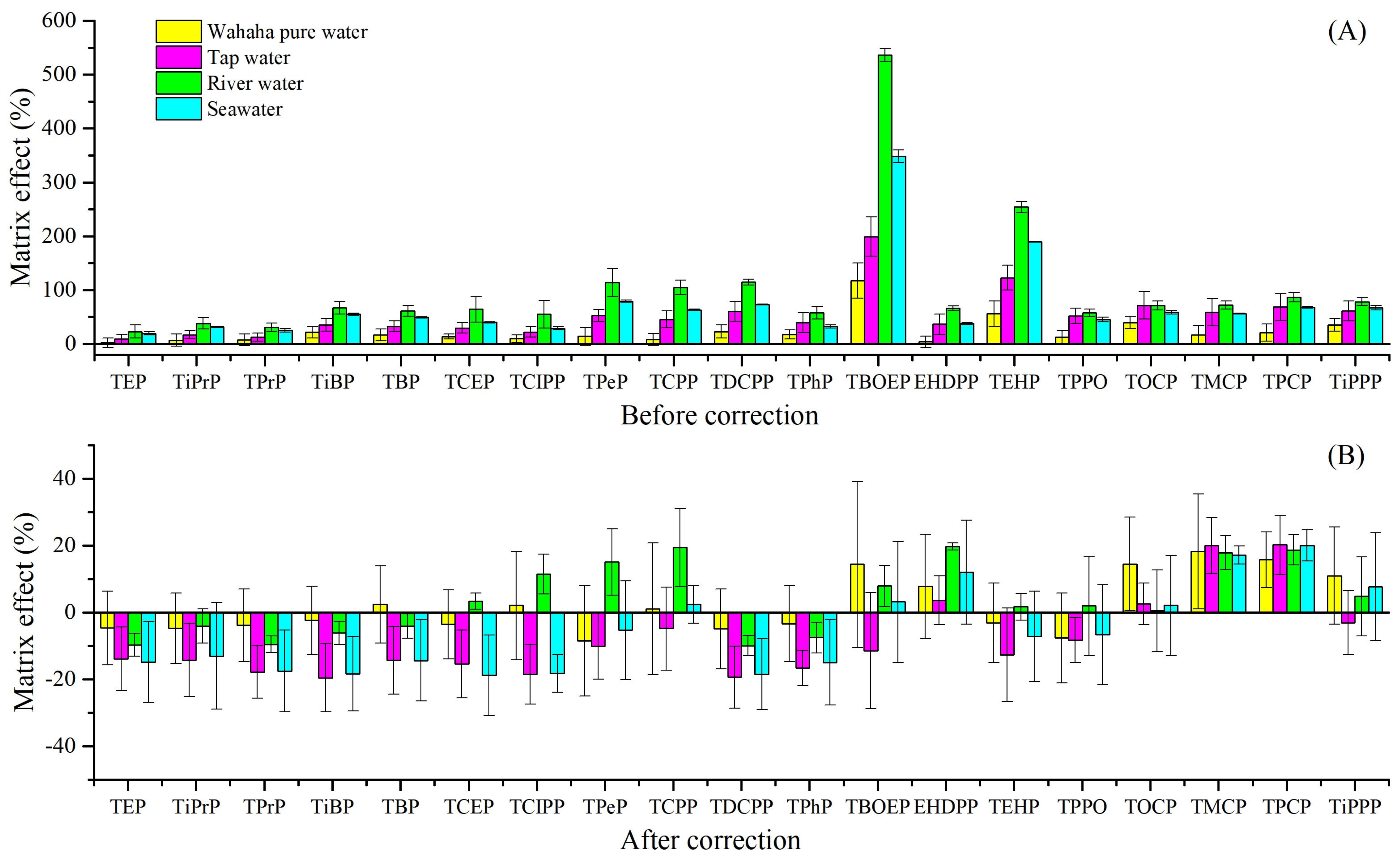
GC-MS/MS has become an essential analytical tool due to its exceptional sensitivity and selectivity. However, the unavoidable matrix effects (MEs), which may suppress or enhance analyte signals, frequently compromise quantification accuracy in GC-MS/MS analyses [40]. Matrix effects were calculated by comparing the peak areas of target OPEs in the matrix and in the standard solution according to the following equation, ME = ((Am − A0)/As − 1) × 100%, where Am and As are the peak areas of target OPEs in the spiked matrix and standard solution at the same concentration, respectively, while A0 is the background signal in the unspiked matrix [41]. The ME values were categorized into negligible (≤±20%), minor (>±20% and ≤±50%), and significant (>±50%) [42]. Figure 2A illustrates varying degrees of signal enhancement in Wahaha pure water (ME range 2–117%, mean 23%), tap water (9–199%, 54%), river water (23–536%, 103%), and seawater (20–349%, 72%). For instance, among the 19 OPEs in seawater, up to 10 OPEs suffered from major matrix effects (55–349%), while 8 OPEs suffered from minor matrix effects (25–49%), and only TEP suffered from negligible matrix effects (20%). Since ILIS is widely recommended to compensate for matrix effects and improve quantification accuracy [20], nine ILISs were employed for this purpose. After calibration with ILIS, the matrix effects became negligible (ME values within ±20%, Figure 2B). Therefore, the internal standard method is recommended for quantification of OPEs in water. It should be critically noted that matrix effects reached as high as 536% for TBOEP in river water before ILIS correction, which demonstrates that the GC-MS/MS instrumental system alone has weak inherent robustness and is extremely susceptible to signal enhancement interference induced by co-extracted impurities in water extracts. If quantified without internal standard calibration, severe overestimation would occur for all target OPEs.

2.3. Evaluation of the Method’s Performance

The linearity, limit of detection (LOD, S/N = 3), limit of quantitation (LOQ, S/N = 10), and precision of the developed automated LLE-GC-MS/MS method were validated under the optimum conditions. As displayed in Table 1, good linearity with correlation coefficients of 0.9905–0.9986 was achieved when the 19 target OPEs’ concentrations ranged from 5 to 1000 μg/L. The instrumental LODs and LOQs were in the ranges of 1.15–5.80 μg/L and 3.55–19.6 μg/L, respectively. By considering sample pretreatment, the method’s LODs and LOQs were in the ranges of 0.46–2.32 ng/L and 1.42–7.83 ng/L, respectively. Intra-day (n = 6) and inter-day (n = 6) precision at 100 ng/L show relative standard deviations (RSDs) below 20% and 18%, respectively, demonstrating good precision. A typical chromatogram of the 19 OPEs’ standard mixture solution is shown in Figure S2, and all target compounds achieved good chromatographic separation. Considering no available certified reference materials for OPEs in water matrices, the method’s accuracy was validated by spiked recovery experiments at four spike levels (20, 50, 100, and 400 ng/L) using four real water matrices. As listed in Table S2, the spike recoveries are in the ranges of 71–96% with 6.4–17.7% RSDs (Wahaha pure water), 70–95% with 6.5–18.0% RSDs (tap water), 70–87% with 5.8–16.9% RSDs (river water), and 70–120% with 1.2–17.7% RSDs (seawater), demonstrating satisfactory accuracy and acceptable precision.
In comparison with previous methods (Table 2), the proposed plastic-free automated LLE-GC-MS/MS method achieved satisfactory accuracy and precision and offered comparable method LODs to SPE-UPLC-MS/MS (LODs: 0.01–1.72 ng/L) [31], SPE-GC-MS/MS (0.03–0.25 ng/L) [19], automated LLE-GC-MS (0.68–2.96 ng/L) [21], and automated LLE-UPLC-MS/MS (0.06–1.57 ng/L) [29] but superior to those obtained with HS-SPME-GC-NPD (1.4–135.6 ng/L) [12], DIA-LC-MS/MS (1.5–30 ng/L) [25], dSPE-GC-MS (53–98 ng/L) [15], automated LLE-GC-MS (0.4–12 ng/L) [18], SPE-GC-MS/MS (0.3–24 ng/L) [20], and SPE-GC-MS (0.3–12.3 ng/L) [1]. In addition, the developed method has advantages including negligible background contamination, simplicity, rapidness, efficiency, low cost, matrix robustness, reduced organic solvents, and wide OPE coverage. Therefore, the developed method is reliable and practical for quantifying OPEs in environmental water samples.

2.4. Real Water Analysis

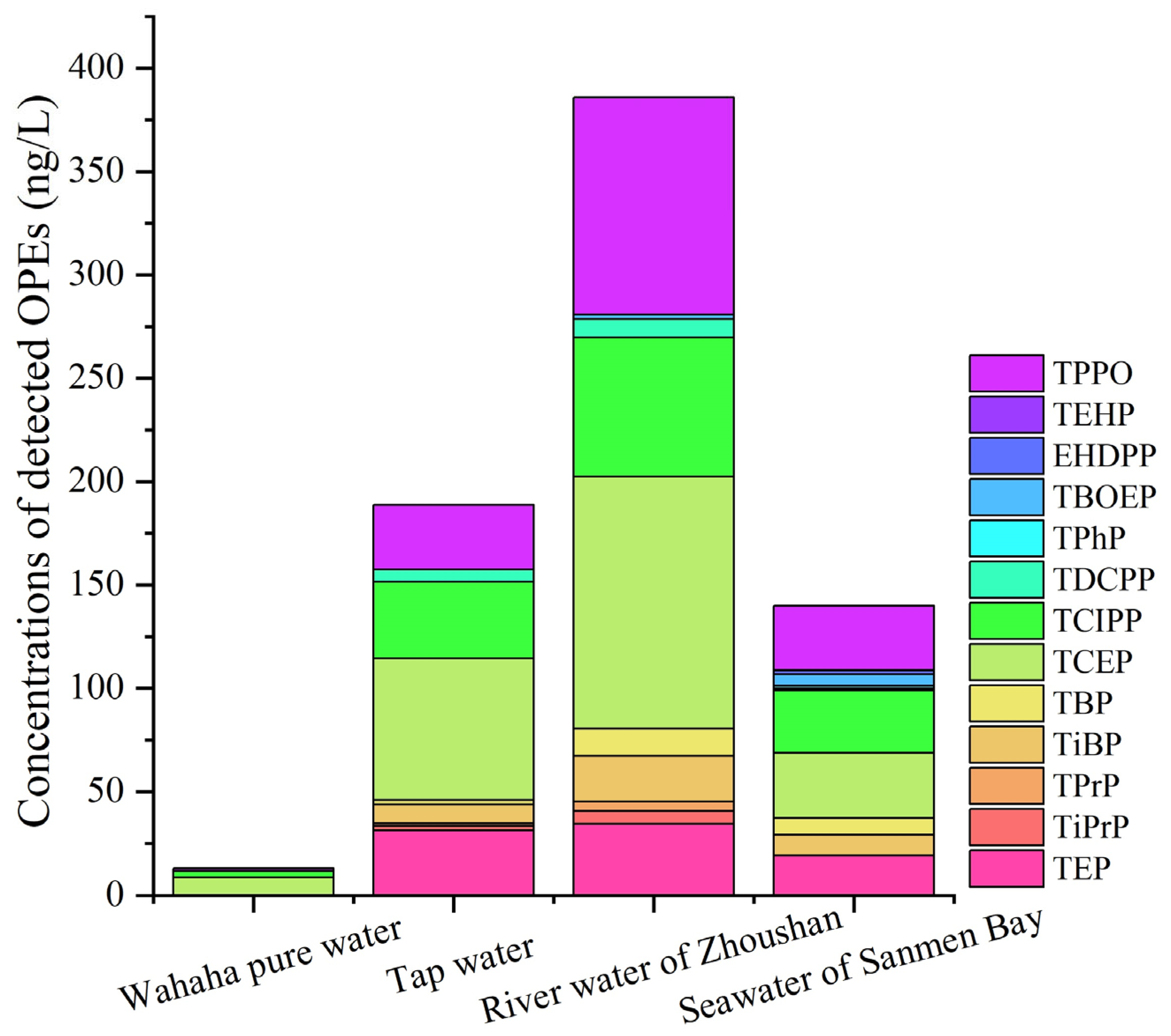
Twenty water samples representing four distinct water types were analyzed by the developed automated LLE-GC-MS/MS method to verify its applicability, with results shown in Supplementary Materials, Table S3 and Figure 3. A total of 3, 9, 10, and 11 OPEs were detected in Wahaha pure water, tap water, river water, and seawater, respectively, with total OPE (∑OPE) concentration ranges of 8.23–18.5 ng/L, 159–218 ng/L, 202–623 ng/L, and 111–175 ng/L, respectively. The mean concentration of ΣOPEs in river water (386 ng/L) was higher than those found in tap water (189 ng/L), seawater (140 ng/L), and Wahaha pure water (12.9 ng/L). Lower concentrations of OPEs found in seawater can be explained by the dilution effect [26]. In China, people commonly drink boiled tap water; however, the median ∑OPEs slightly increased from 192 ng/L to 212 ng/L after boiling [32]. The potential health risks associated with a high level of OPEs in tap water should be taken seriously. Installing home water filters is recommended to decrease the concentration of OPEs in tap water. On the other hand, although the concentrations of OPEs in Wahaha pure water were much lower than those in tap water, the bottle-sealing process or the use of recycled PET bottles may increase the risk of OPE contamination.
The detection frequencies of TPPO in Wahaha pure water, TBOEP in river water, and TDCPP, TPhP, TBOEP, EHDPP, and TEHP in seawater were 33.3%, 33.3%, and 12.5–50%, respectively, while those of other detected OPEs were all 100%. Regarding composition, Wahaha pure water was dominated by TCEP and TCIPP, tap water was dominated by TCEP, TCIPP, TPPO, and TEP, and river water and seawater were dominated by TCEP, TPPO, and TCIPP. The mass fraction of Cl-OPEs (TCEP and TCIPP) accounted for 44–91% of ∑OPEs in four water matrices, which is related to their extensive use in household products, high hydrophilicity, strong environmental persistence and difficult degradation [31]. This specific chemical pattern was compatible with the results found in bottled drinking water from South Korea [1], barreled water from Eastern China [32], tap water distributed in Wuhan, central China [33], surface water from the Eastern Route of the South-to-North Water Diversion Project, China [27], and seawater from the Changjiang Estuary to the adjacent East China Sea [19]. Furthermore, TPPO, which is widely used as an intermediate and catalyst in organic synthesis and pharmaceutical products [23], was also one of the most prevalent OPE congeners in seawater from Xiangshan Bay, East China Sea [10] and river water from Yarlung Tsangpo River and its main tributaries on the Tibetan Plateau [22]. Considering the extensive global usage of OPEs and their potential toxicity, it is of great significance for the systematic assessment of OPEs in various drinking and environmental waters.

2.5. Ecological Risk Assessment

There is growing scientific concern about the effects of OPEs on ecosystems due to their persistent release and potential toxicity. In this study, the risk quotient (RQ) was employed to assess the ecological risks posed by OPEs in the river water of Zhoushan and seawater of Sanmen Bay. The RQ is defined as the ratio of the measured environmental concentration to the predicted no-effect concentration (PNEC) [22]. The PNEC values were calculated by dividing the acute toxicity data by an assessment factor (AF) of 1000 [22]. The RQ values were categorized into low risk (RQ ≤ 0.1), medium risk (0.1 < RQ ≤ 1), and high risk (RQ > 1). The sum of each individual RQ value (ΣRQ) represents the combined contamination risk of the total OPEs [22].
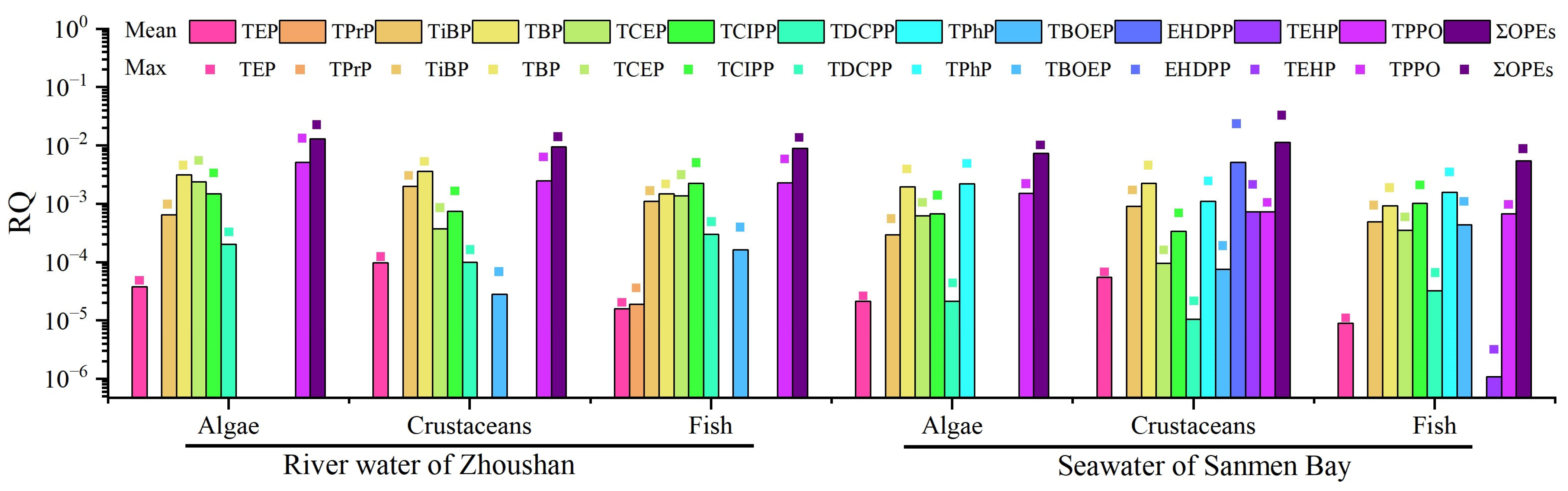
With the exception of TiPrP (which lacks toxicity data), the PNECs for the other 12 detected OPEs are provided in Supplementary Materials, Table S4, while the calculated RQ values for the trophic levels of the three representative organisms (algae, crustaceans, and fish) are illustrated in Figure 4. The results show that the RQs of TEP, TPrP, TiBP, TBP, TCEP, TCIPP, TDCPP, TBOEP, TPPO and ΣOPEs in river water, as well as TEP, TiBP, TBP, TCEP, TCIPP, TDCPP, TPhP, TBOEP, EHDPP, TEHP, TPPO and ΣOPEs in seawater, for all three trophic levels were far below 0.1, indicating that the detected OPEs in the surveyed area pose low risk to algae, crustaceans, and fish. These findings were in line with those found in environmental waters such as the Bohai Sea [24], Yellow Sea [37], Jiaozhou Bay [35], Beiyun and Yongding rivers [34], Taihu Lake and its inflowing rivers, and Beijing–Hangzhou Grand Canal [37]. However, the maximum RQs of several OPEs (i.e., TEP, TCEP, TPPO, EHDPP, TPhP) suggested moderate risks in surface water from Nansi Lake and Lunan Canal [27], Yarlung Tsangpo River and Lhasa River [22], and seawater from Xiangshan Bay [10]. Particularly, TEHP exhibited high risk in parts of the Pearl River Basin [43]. Therefore, the ecological risks of OPEs to aquatic organisms still deserve long-term attention.
Nevertheless, it is worth noting that the ecological risk assessment in this work is simplified, relying merely on an acute-toxicity deterministic RQ model with AF = 1000. This method ignores chronic risks and OPE mixture toxicity and may underestimate aquatic hazards; more rigorous approaches cover chronic toxicity, mixture toxicity, probabilistic risk assessment and species sensitivity distribution. Follow-up studies will gather comprehensive toxicological data to implement multi-dimensional advanced risk assessment.

3. Materials and Methods

3.1. Chemicals and Reagents

Nineteen standard OPEs (>98% purity), i.e., trimethyl phosphate (TEP), tri-isopropyl phosphate (TiPrP), tripropyl phosphate (TPrP), tri-isobutyl phosphate (TiBP), tributyl phosphate (TBP), tris(2-chloroethyl) phosphate (TCEP), tris(1-chloro-2-propyl) phosphate (TCIPP), tripentyl phosphate (TPeP), tris(3-chloropropyl) phosphate (TCPP), tris(1,3-dichloro-2-propyl) phosphate (TDCPP), triphenyl phosphate (TPhP), tris(2-butoxyethyl) phosphate (TBOEP), 2-ethylhexyl diphenyl phosphate (EHDPP), tris(2-ethylhexyl) phosphate (TEHP), triphenylphosphine oxide (TPPO), tri-o-cresyl phosphate (TOCP), tri-m-cresyl phosphate (TMCP), tri-p-cresyl phosphate (TPCP), and tris(2-isopropylphenyl) phosphate (TiPPP), were purchased from Alta Scientific (Tianjin, China). Their corresponding 9 ILISs, including TEP-D15, TPrP-D21, TBP-D27, TCEP-D12, TCIPP-D18, TDCPP-D15, TPhP-D15, TBOEP-D27, and TEHP-D51, were supplied by Alta Scientific (Tianjin, China). Stock standard solutions of 19 OPEs (1 mg/L) and 9 ILISs (1 mg/L) were prepared in isooctane and stored at −18 °C in the dark, remaining stable for three months. Daily calibration standard solutions were prepared by serial dilution of the stock solutions with isooctane.
Chromatographic-grade hexane, dichloromethane (DCM), ethyl acetate, acetone, and isooctane were obtained from Merck (Darmstadt, Germany), and anhydrous sodium sulfate was purchased from Sinopharm Chemical Reagent (Beijing, China). Ultrapure water (18.2 MΩ·cm, 25 °C) was prepared from Milli-Q Plus 185 (Millipore, Burlington, MA, USA).

3.2. Sampling and Preparation

A total of twenty-six water samples were collected in November and December of 2025. Three Wahaha pure water samples were purchased from local stores. Three tap water samples were collected from local families. Six river water samples were collected from an urban river in Zhoushan (R1–R6). Eight seawater samples were collected from Sanmen Bay (S1–S8), East China. The sampling locations for river water and seawater are shown in Figure S3. The collected water samples were stored at 0–4 °C and subjected to automated LLE as soon as possible, with the maximum storage period controlled within 7 days.

3.3. Automated Liquid–Liquid Extraction

Water samples were extracted with hexane and DCM. Briefly, 500 mL of water sample spiked with 50 ng of 9 ILISs was extracted with 25 mL of hexane and 25 mL of DCM by automated LLE for 10 min using an AG-LDZ-6 separating funnel oscillator (Shanghai Ou Ge Electronics Co. Ltd., Shanghai, China), respectively. After allowing for phase separation (5 min), the organic phases were successively decanted through anhydrous sodium sulfate and concentrated to dryness at 40 °C using a DryVap™ concentrator system (Horizon technology, Lake Forest, CA, USA). The residues were reconstituted in 200 μL of isooctane for GC-MS/MS analysis.

3.4. Instrumental Analysis

OPEs were analyzed on a 7890B/7000C Triple Quad GC-MS/MS in EI mode at 70 eV (Agilent Technologies, Santa Clara, CA, USA). In total, 1 μL was injected in splitless mode into a HP-5 MS capillary column (30 m × 0.25 mm × 0.25 μm) at an inlet temperature of 300 °C. Carrier gas was high-purity helium at a constant flow of 1 mL/min. The oven temperature was initially programmed at 40 °C for 2 min and then increased to 180 °C at 5 °C/min (held for 1 min), ramped up to 240 °C at 3 °C/min (held for 5 min), and finally increased to 310 °C at 10 °C/min (held for 5 min). The temperatures of the transfer line and ion source were maintained at 300 °C and 300 °C, respectively. Multiple reaction monitoring (MRM) mode was chosen for quantitation, and the retention time and MRM parameters for each compound are summarized in Table 3. A representative GC-EI-MS/MS (MRM) chromatogram is shown in Figure S2.

3.5. Quality Assurance and Quality Control

Given that OPEs are pervasive environmental contaminants, minimizing background contamination is essential for accurate quantification. Empirical evidence suggests that the predominant contamination sources originate from organic solvents and plasticware [1,30]. To minimize background contamination, plasticware was entirely avoided throughout the experiment. All labware was made of glass and underwent rigorous cleaning procedures prior to use: glassware was first soaked in 5% nitric acid overnight, rinsed thoroughly with ultrapure water, sequentially washed with acetone and dichloromethane, and finally baked at 450 °C. Anhydrous sodium sulfate was calcined at 550 °C for 2 h and then cooled in a desiccator before application. All pretreatment steps were completed in a clean fume hood to reduce interference from laboratory airborne OPE contaminants. To accurately quantify exogenous OPE contamination and the carryover effect, a set of solvent blanks (one in every ten samples), procedural blanks (one in every ten samples), field blanks (one in each batch sampling), and trip blanks (one in each batch sampling) was measured for each analytical batch to subtract the background values. Furthermore, for each batch of samples, ILISs for each sample, matrix spikes, and sample duplicates were analyzed for quality control. No target OPEs were detected above LOD in all blanks, indicating negligible background contamination and carryover during pretreatment and instrumental analysis.

4. Conclusions

A simple and rapid method based on plastic-free automated LLE-GC-MS/MS was developed and validated for simultaneous enrichment and quantification of 19 OPEs in drinking and environmental water samples. Thirteen OPEs were detected across four water matrices: Wahaha pure water, tap water, river water, and seawater. Notably, TCEP and TCIPP emerged as the predominant compounds among the detected OPEs, possibly reflecting extensive use of these OPEs in the study area. The ecological risk assessment based on acute toxicity data indicated that ΣOPEs posed a low risk to algae, crustaceans, and fish. However, these preliminary conclusions are derived from limited samples of drinking water and environmental water. To validate the generalizability of these findings, comprehensive sampling should be conducted across multiple sites and seasons throughout Zhejiang Province and other regions of China. Beyond these follow-up studies, this study may stimulate broader interest in applying multivariate statistical analyses for identifying OPE sources and discerning their composition. Additionally, it encourages in-depth exploration of their spatial heterogeneity, seasonal dynamics, and the driving forces associated with meteorological conditions and anthropogenic emissions. Furthermore, taking into account the high prevalence of OPEs both in drinking and environmental water samples, long-term exposure and bioaccumulation of these compounds in human and aquatic organisms should be further explored. In addition, although GC-MS/MS achieved effective quantification of target OPEs in the present work, high-resolution mass spectrometry (Orbitrap/QTOF) is suggested to cross-validate the analytical data and identify unknown OPE transformation products via accurate mass measurement. More attention should be paid to the environmental degradation and transformation behaviors of OPEs, and the ecological risks derived from their transformation byproducts deserve in-depth discussion in follow-up investigations.

Supplementary Materials

The following supporting information can be downloaded at: https://www.mdpi.com/article/10.3390/molecules31122131/s1. References [22,44,45,46] are cited in the Supplementary Materials.

Author Contributions

Conceptualization, H.H., Y.J. and Y.G.; methodology, G.W., H.H., Y.J. and Q.M.; software, Y.J.; validation, G.W. and Y.J.; formal analysis, G.W. and Y.J.; investigation, G.W. and Z.L.; resources, T.L., Z.L., Q.M. and Y.G.; data curation, G.W., H.H. and Y.J.; writing—original draft preparation, G.W. and H.H.; writing—review and editing, H.H. and Y.J.; visualization, H.H.; supervision, H.H.; project administration, H.H., Y.J. and Y.S.; funding acquisition, T.L. and Y.S. All authors have read and agreed to the published version of the manuscript.

Funding

This study was supported by the Environmental Protection Science Research and Achievement Promotion Project of Zhejiang Province (No. 2025HT0061).

Institutional Review Board Statement

Not applicable.

Informed Consent Statement

Not applicable.

Data Availability Statement

The original contributions presented in this study are included in the article and Supplementary Materials. Further inquiries can be directed to the corresponding authors.

Conflicts of Interest

The authors declare that they have no known competing financial interests or personal relationships that could have appeared to influence the work reported in this paper.

References

  1. Nguyen, M.K.; Ahn, J.; Han, T.G.; Tung, N.K.T.; Lee, J.Y.; Kang, J.S.; Kim, H.M. Determination of organophosphate flame retardants in bottled drinking water via solid-phase extraction and gas chromatography-mass spectrometry. J. Food Compos. Anal. 2025, 141, 107322. [Google Scholar] [CrossRef]
  2. Hu, X.; Feng, H.; Pang, L.; Wang, X.; Guo, L.; Wang, C.; Yuan, W.; Zhang, M. Magnetic solid-phase extraction of organophosphate esters from water sample based on MOF-derived hollow cactus-like carbon sheets. Microchim. Acta 2025, 192, 791. [Google Scholar] [CrossRef] [PubMed]
  3. Ai, S.; Chen, X.; Zhou, Y. Critical review on organophosphate esters in water environment: Occurrence, health hazards and removal technologies. Environ. Pollut. 2024, 343, 123218. [Google Scholar] [CrossRef] [PubMed]
  4. Hou, M.; Shi, Y.; Na, G.; Zhao, Z.; Cai, Y. Increased human exposure to organophosphate esters via ingestion of drinking water from water dispensers: Sources, influencing factors, and exposure assessment. Environ. Sci. Technol. Lett. 2021, 8, 884–889. [Google Scholar] [CrossRef]
  5. Gu, L.; Hu, B.; Fu, Y.; Zhou, W.; Li, X.; Huang, K.; Zhang, Q.; Fu, J.; Zhang, H.; Zhang, A.; et al. Occurrence and risk assessment of organophosphate esters in global aquatic products. Water Res. 2023, 240, 120083. [Google Scholar] [CrossRef] [PubMed]
  6. Wu, J.; Yao, S.; Wang, Y.; Fan, S.; Cui, X.; Chen, D.; Shi, Z. Fast determination of organophosphate esters and their metabolites in human matrices by a straightforward cold-induced strategy coupled with HPLC–MS/MS. Anal. Bioanal. Chem. 2024, 416, 6663–6677. [Google Scholar] [CrossRef] [PubMed]
  7. Stubbings, W.A.; Riddell, N.; Chittim, B.; Venier, M. Challenges in the analyses of organophosphate esters. Environ. Sci. Technol. Lett. 2017, 4, 292–297. [Google Scholar] [CrossRef]
  8. Xu, Q.; Yu, M.; Xie, C.; Chen, D.; Shi, S.; Wang, H.; Li, J.; Mei, S. A magnetic flower-like hollow vinyl-functionalized covalent organic framework nanocomposite for efficient enrichment of fifteen organophosphate tri-esters in environmental water samples. Anal. Chim. Acta 2025, 1372, 344457. [Google Scholar] [CrossRef] [PubMed]
  9. Bekele, T.G.; Zhao, H.; Yang, J.; Chegen, R.G.; Chen, J.; Mekonen, S.; Qadeer, A. A review of environmental occurrence, analysis, bioaccumulation, and toxicity of organophosphate esters. Environ. Sci. Pollut. Res. 2021, 28, 49507–49528. [Google Scholar] [CrossRef] [PubMed]
  10. Zhang, Z.M.; Dou, W.K.; Zhang, X.Q.; Sun, A.L.; Chen, J.; Shi, X.Z. Organophosphate esters in the mariculture ecosystem: Environmental occurrence and risk assessments. J. Hazard. Mater. 2022, 436, 129219. [Google Scholar] [CrossRef] [PubMed]
  11. Lao, J.Y.; Xu, S.; Zhang, K.; Lin, H.; Cao, Y.; Wu, R.; Tao, D.; Ruan, Y.; Leung, K.M.E.; Lam, P.K. New perspective to understand and prioritize the ecological impacts of organophosphate esters and transformation products in urban stormwater and sewage effluents. Environ. Sci. Technol. 2023, 57, 11656–11665. [Google Scholar] [CrossRef] [PubMed]
  12. Jin, T.; Cheng, J.; Cai, C.; Cheng, M.; Wu, S.; Zhou, H. Graphene oxide based sol-gel stainless steel fiber for the headspace solid-phase microextraction of organophosphate ester flame retardants in water samples. J. Chromatogr. A 2016, 1457, 1–6. [Google Scholar] [CrossRef] [PubMed]
  13. Pang, L.; Pang, R.; Ge, L.; Zheng, L.; Zhao, J.; Zhang, H. Trace determination of organophosphate esters in environmental water samples with an ionogel-based nanoconfined ionic liquid fiber coating for solid-phase microextraction with gas chromatography and flame photometric detection. J. Sep. Sci. 2016, 39, 4415–4421. [Google Scholar] [CrossRef] [PubMed]
  14. Nantaba, F.; Palm, W.U.; Wasswa, J.; Bouwman, H.; Kylin, H.; Kümmerer, K. Temporal dynamics and ecotoxicological risk assessment of personal care products, phthalate ester plasticizers, and organophosphorus flame retardants in water from Lake Victoria, Uganda. Chemosphere 2021, 262, 127716. [Google Scholar] [CrossRef] [PubMed]
  15. Felli, N.; Migneco, L.M.; Francolini, I.; Gentili, A.; Hernandez-Borges, J. Hypercrosslinked β-cyclodextrin polymer for the dispersive solid-phase extraction of organic pollutants from sea water and wastewater. Talanta 2025, 290, 127773. [Google Scholar] [CrossRef] [PubMed]
  16. Wang, X.; He, Y.; Lin, L.; Zeng, F.; Luan, T. Application of fully automatic hollow fiber liquid phase microextraction to assess the distribution of organophosphate esters in the Pearl River Estuaries. Sci. Total Environ. 2014, 470, 263–269. [Google Scholar] [CrossRef] [PubMed]
  17. Lee, S.; Cho, H.J.; Choi, W.; Moon, H.B. Organophosphate flame retardants (OPFRs) in water and sediment: Occurrence, distribution, and hotspots of contamination of Lake Shihwa, Korea. Mar. Pollut. Bull. 2018, 130, 105–112. [Google Scholar] [CrossRef] [PubMed]
  18. Liu, X.; Xiong, L.; Li, D.; Chen, C.; Cao, Q. Monitoring and exposure assessment of organophosphorus flame retardants in source and drinking water, Nanjing, China. Environ. Monit. Assess. 2019, 191, 119. [Google Scholar] [CrossRef] [PubMed]
  19. Wei, L.; Yang, Y.; Gao, H.; Wang, R.; Cao, F.; Huang, Q. Biogeochemical impact on the distribution variations of organophosphorus flame retardants in estuarine area and insight into climate change. J. Hazard. Mater. 2025, 491, 137993. [Google Scholar] [CrossRef] [PubMed]
  20. Teo, T.L.L.; McDonald, J.A.; Coleman, H.M.; Khan, S.J. Analysis of organophosphate flame retardants and plasticisers in water by isotope dilution gas chromatography–electron ionisation tandem mass spectrometry. Talanta 2015, 143, 114–120. [Google Scholar] [CrossRef] [PubMed]
  21. Lee, S.; Jeong, W.; Kannan, K.; Moon, H.B. Occurrence and exposure assessment of organophosphate flame retardants (OPFRs) through the consumption of drinking water in Korea. Water Res. 2016, 103, 182–188. [Google Scholar] [CrossRef] [PubMed]
  22. Zhong, M.Y.; Zhou, M.H.; Tang, J.H.; Ren, J.; Ma, R.X.; Li, X.L. Occurrence, spatial distributions, sources, and potential risks of organophosphate esters in Yarlung Tsangpo River and its main tributaries on the Tibetan Plateau. Environ. Pollut. 2025, 376, 126385. [Google Scholar] [CrossRef] [PubMed]
  23. Luo, Q.; Gu, L.; Wu, Z.; Shan, Y.; Wang, H.; Sun, L.N. Distribution, source apportionment and ecological risks of organophosphate esters in surface sediments from the Liao River, Northeast China. Chemosphere 2020, 250, 126297. [Google Scholar] [CrossRef] [PubMed]
  24. Qi, Y.; He, Z.; Yuan, J.; Ma, X.; Du, J.; Yao, Z.; Wang, W. Comprehensive evaluation of organophosphate ester contamination in surface water and sediment of the Bohai Sea, China. Mar. Pollut. Bull. 2021, 163, 112013. [Google Scholar] [CrossRef] [PubMed]
  25. Hao, C.; Helm, P.A.; Morse, D.; Reiner, E.J. Liquid chromatography-tandem mass spectrometry direct injection analysis of organophosphorus flame retardants in Ontario surface water and wastewater effluent. Chemosphere 2018, 191, 288–295. [Google Scholar] [CrossRef] [PubMed]
  26. Kim, U.J.; Kannan, K. Occurrence and distribution of organophosphate flame retardants/plasticizers in surface waters, tap water, and rainwater: Implications for human exposure. Environ. Sci. Technol. 2018, 52, 5625–5633. [Google Scholar] [CrossRef] [PubMed]
  27. Cao, Y.; Zhang, X.; Yan, Y.; Li, Q.; Shen, J. Spatiotemporal variations and risk assessment of organophosphate esters in surface waters of the Eastern Route of the South-to-North Water Diversion Project, China: A comprehensive survey for human health. Environ. Technol. Innov. 2025, 40, 104571. [Google Scholar] [CrossRef]
  28. Chu, S.G.; Letcher, R.J. Determination of organophosphate flame retardants and plasticizers in lipid-rich matrices using dispersive solid-phase extraction as a sample cleanup step and ultra-high performance liquid chromatography with atmospheric pressure chemical ionization mass spectrometry. Anal. Chim. Acta 2015, 885, 183–190. [Google Scholar] [CrossRef] [PubMed]
  29. Zhang, Q.; Li, J.; Lin, S.; Ying, Z.; Hu, S.; Wang, Y.; Mo, X. Organophosphate flame retardants in Hangzhou tap water system: Occurrence, distribution, and exposure risk assessment. Sci. Total Environ. 2022, 849, 157644. [Google Scholar] [CrossRef] [PubMed]
  30. Han, F.; Gao, Y.; Hu, F.; Yu, X.; Xie, H.; Li, H.; Zhao, Y.; Kimura, S.Y.; Zhang, Y.; Zubizarreta, M.E.; et al. Solid-phase extraction of seventeen alternative flame retardants in water as determined by ultra-high-performance liquid chromatography-tandem mass spectrometry. J. Chromatogr. A 2019, 1602, 64–73. [Google Scholar] [CrossRef] [PubMed]
  31. Qiao, Y.; Feng, W.; Feng, C.; Ren, B.; Li, Y.; Xue, J.; Liu, S.; Fan, W.; Ngien, S.K.; Duarte, I.M. Combining dissolved organic matter correlation and water quality parameters to unravel the fate of organophosphate esters in Uliastai Lake. Ecotox. Environ. Saf. 2025, 304, 119061. [Google Scholar] [CrossRef] [PubMed]
  32. Ding, J.; Shen, X.; Liu, W.; Covaci, A.; Yang, F. Occurrence and risk assessment of organophosphate esters in drinking water from Eastern China. Sci. Total Environ. 2015, 538, 959–965. [Google Scholar] [CrossRef] [PubMed]
  33. Huang, Q.; Mao, X.; Pan, F.; Hu, X.; He, Z.; Wang, Y.; Wan, Y. Organophosphate esters in source, finished, and tap water in Wuhan, China. Chemosphere 2023, 325, 138288. [Google Scholar] [CrossRef] [PubMed]
  34. Qiao, Y.; Feng, C.; Jin, X.; Yan, Z.; Feng, W.; Wang, Y.; Bai, Y. Concentration levels and ecological risk assessment of typical organophosphate esters in representative surface waters of a megacity. Environ. Res. 2024, 251, 118614. [Google Scholar] [CrossRef] [PubMed]
  35. Lin, J.; Zhang, L.; Zhang, M.; Zhang, H.; Guo, C.; Feng, S.; Xu, J. Distribution, sources, and ecological risk of organophosphate esters in the urbanized Jiaozhou Bay, East China. Environ. Sci. Pollut. Res. 2022, 29, 70167–70178. [Google Scholar] [CrossRef] [PubMed]
  36. Luo, H.; Xian, Y.; Guo, X.; Luo, D.; Wu, Y.; Lu, Y.; Yang, B. Dispersive liquid-liquid microextraction combined with ultrahigh performance liquid chromatography/tandem mass spectrometry for determination of organophosphate esters in aqueous samples. Sci. World J. 2014, 2014, 162465. [Google Scholar] [CrossRef] [PubMed]
  37. Huang, J.; Gao, Z.; Hu, G.; Su, G. Non-target screening and risk assessment of organophosphate esters (OPEs) in drinking water resource water, surface water, groundwater, and seawater. Environ. Int. 2022, 168, 107443. [Google Scholar] [CrossRef] [PubMed]
  38. Yang, Y.; Meng, Y.; Liu, S.; Wei, L.; Huang, Q. Insights into organophosphate esters (OPEs) in aquatic ecosystems: Occurrence, environmental behavior, and ecological risk. Crit. Rev. Environ. Sci. Technol. 2024, 54, 641–675. [Google Scholar]
  39. Sulej-Suchomska, A.M.; Polkowska, Ż.; Przyjazny, A.; Kokot, Z.J.; Namieśnik, J. Determination of fuel combustion product in airport runoff water samples using liquid–liquid extraction with gas chromatography–spectrometry. Int. J. Environ. Sci. Technol. 2016, 13, 1475–1488. [Google Scholar] [CrossRef]
  40. Dybowski, M.P. Enhancement of GC–MS signal for environmental pollutants via the transient matrix effect. J. Sep. Sci. 2025, 48, e70285. [Google Scholar] [CrossRef] [PubMed]
  41. Saraswati, M.; Naik, R.H.; Pallavi, M.S.; Bheemanna, M.; Paramasivam, M.; Kumar, P.; Poornima, G.; Ratnamma, P.; Sujay, H.; Naik, M.N.; et al. LC–MS/MS and GC–MS/MS quantification of pesticide residues in paddy grains and processed rice and dietary risk assessment. Microchem. J. 2025, 212, 113391. [Google Scholar] [CrossRef]
  42. Zhang, D.; Yang, X.; Zhu, L.; Yu, M.; Chen, M.; Wang, Q.; Jiang, Y.; Chen, H.; Chai, Y. Matrix effect evaluation and method validation of 181 pesticides in three types of tea using gas chromatography-tandem mass spectrometry. Food Anal. Methods 2025, 18, 2893–2908. [Google Scholar] [CrossRef]
  43. Han, Z.; He, J.; Chai, G.; Wan, X.; Jiang, T.; Cui, X.; Tong, Y.; Cui, X.; Cui, H. Organophosphate esters in surface water across China: Occurrence, distribution, driving factors and ecological risk. Environ. Res. 2025, 285, 122552. [Google Scholar] [CrossRef] [PubMed]
  44. Verbruggen, E.M.J.; Rila, J.P.; Traas, T.P.; Posthuma-Doodeman, C.J.A.M.; Posthumus, R. Environmental Risk Limits for Several Phosphate Esters, with Possible Application as Flame Retardant; RIVM Report 601501024; Rijksinstituut voor Volksgezondheid en Milieu, RIVM: Bilthoven, Netherlands, 2005. [Google Scholar]
  45. Du, Z.; Wang, G.; Gao, S.; Wang, Z. Aryl organophosphate flame retardants induced cardiotoxicity during zebrafish embryogenesis: By disturbing expression of the transcriptional regulators. Aquat. Toxicol. 2015, 161, 25–32. [Google Scholar] [CrossRef] [PubMed]
  46. Cristale, J.; García, V.; Barata, C.; Lacorte, S. Priority and emerging flame retardants in rivers: Occurrence in water and sediment, Daphnia magna toxicity and risk assessment. Environ. Int. 2013, 59, 232–243. [Google Scholar] [CrossRef] [PubMed]
Figure 1. Effect of extraction solvents on absolute recovery (A) and relative recovery (B) (n = 3).
Molecules 31 02131 g001
Figure 2. Matrix effects in four different water matrices before (A) and after (B) correction.
Molecules 31 02131 g002
Figure 3. Concentrations of detected OPEs in four types of water.
Molecules 31 02131 g003
Figure 4. RQ values of OPEs detected in aquatic organisms at different trophic levels.
Molecules 31 02131 g004
Table 1. Analytical characteristics of the proposed method.
AnalyteILISLinear Range (μg/L)r2Instrumental
LOD (μg/L)
Instrumental
LOQ (μg/L)
Method
LOD a (ng/L)
Method
LOQ b (ng/L)
Precision, RSD (%, n = 6)
Intra-DayInter-Day
TEPTEP-D155–10000.99841.304.050.521.6212.615.6
TiPrPTPrP-D215–10000.99761.153.550.461.425.615.1
TPrPTPrP-D215–10000.99721.634.880.651.958.311.6
TiBPTBP-D275–10000.99551.434.250.571.707.517.5
TBPTBP-D275–10000.99471.735.000.692.0013.817.4
TCEPTCEP-D125–10000.99713.2310.71.294.2812.014.6
TCIPPTCIPP-D185–10000.99792.537.631.013.0515.016.9
TPePTBP-D275–10000.99111.434.450.571.7816.611.3
TCPPTCIPP-D185–10000.99173.2810.61.314.266.810.8
TDCPPTDCPP-D155–10000.99313.5311.81.414.718.614.9
TPhPTPhP-D155–10000.99674.4314.91.775.969.611.8
TBOEPTBOEP-D275–10000.99515.8019.62.327.838.414.7
EHDPPTPhP-D155–10000.99862.889.501.153.8012.916.6
TEHPTEHP-D515–10000.99231.956.500.782.6015.510.9
TPPOTPhP-D155–10000.99184.3514.51.745.8017.819.9
TOCPTPhP-D155–10000.99414.3814.61.755.8212.215.1
TMCPTPhP-D155–10000.99054.7816.01.916.4215.015.1
TPCPTPhP-D155–10000.99094.5515.11.826.0516.812.5
TiPPPTPhP-D155–10000.99433.9313.01.575.2016.015.6
a Method LODs and b method LOQs are based on sample pretreatment (500 mL sample and 0.2 mL final volume).
Table 2. The comparison of the proposed method with other methods for OPE detection in water samples.
MethodN *Sample TypeSample Volume
(mL)
SorbentExtract or Elution or Disperser SolventExtraction Processing Time (min)Quantification MethodLOD (ng/L)Recovery (%)RSD (%)Ref.
HS-SPME-GC-NPD9River water, pond water, tap water10Graphene oxide-based sol–gel stainless-steel fiber/~40 minExternal standard method1.4–135.680–112<10[12]
DIA-LC-MS/MS12Drinking water, surface water, ground water and wastewater0.8///Isotope dilution (8 ILISs)1.5–3016–111<14[25]
dSPE-GC-MS2Seawater and wastewater50Hyper-crosslinked β-cyclodextrin polymer5 mL of cyclohexane~30 minExternal standard method57–14153–98≤13[15]
Automated SPE-GC-MS/MS13Source water, finished water, terminal tap water500Oasis HLB cartridge10 mL of ethyl acetate~40 minExternal standard method0.4–1232–131≤17[18]
SPE-GC-MS/MS13Seawater1000Oasis HLB CNW C18 tandem cartridges20 mL of DCM>200 minExternal standard method0.03–0.2579–123<54[19]
SPE-GC-MS/MS5Ultrapure water, tap water, seawater, surface water, secondary effluent and swimming pool water500Oasis HLB cartridge (500 mg, 6 mL)5 mL of methanol and 5 mL of methyl tert-butylether>130 minIsotope dilution (5 ILISs)0.3–2485–135<22[20]
SPE-GC-MS10Bottled drinking water500Oasis HLB cartridge (500 mg, 6 mL)18 mL of acetonitrile>100 minIsotope dilution (3 ILISs)0.3–12.371–97<14[1]
SPE UPLC-MS/MS12Lake water1000ENVI-18 solid-phase extraction column8 mL of acetonitrile: DCM (3:1, v:v)>343 minIsotope dilution (3 ILISs)0.01–1.7283–117/[31]
Automated LLE-GC-MS10Tap water, purified water, and bottled water600/60 mL of DCM twice~60 minExternal standard method0.68–2.9667–125<29[21]
Automated LLE-UPLC-MS/MS9Source water, before and after treatment plant water, and domestic tap water50/30 mL of DCM twice~60 minIsotope dilution (4 ILISs)0.06–1.5774–92<10[29]
automated LLE-GC-MS/MS19Wahaha pure water, tap water, river water, seawater500/25 mL of DCM and 25 mL of hexane~20 minIsotope dilution (9 ILISs)0.40–2.3270–120≤18Present work
* Number of OPEs evaluated.
Table 3. MRM parameters of OPEs.
AnalyteRetention Time (min)Precursor Ion (m/z) → Product Ion (m/z)Collision Energy (eV)
1TEP14.491155 → 99, 99 → 81 *7, 20
2TiPrP16.478125 → 99, 99 → 81 *13, 24
3TPrP21.583141 → 99, 99 → 81 *3, 21
4TiBP24.899155 → 99, 99 → 81 *3, 22
5TBP27.946155 → 99, 99 → 81 *3, 25
6TCEP30.452205 → 143, 143 → 117 *7, 10
7TCIPP31.328125 → 99, 99 → 81 *10, 22
8TPeP34.506169 → 99, 99 → 81 *3, 23
9TCPP38.923125 → 99, 99 → 81 *12, 20
10TDCPP45.096191 → 75, 99 → 81 *15, 23
11TPhP46.685326 → 215, 325 → 169 *33, 28
12TBOEP47.334153 → 125, 125 → 99 *5, 12
13EHDPP47.556251 → 77 *, 94 → 6523, 28
14TEHP48.821113 → 95, 99 → 81 *16, 23
15TPPO49.716201 → 77, 199 → 152 *23, 32
16TOCP51.409277 → 179 *, 165 → 11517, 45
17TMCP53.194368 → 165 *, 165 → 11522, 40
18TPCP56.043368 → 165 *, 165 → 16430, 35
19TiPPP57.200335 → 251, 118 → 91 *11, 25
TEP-D1514.235167 → 103, 103 → 83 *7, 20
TPrP-D2121.262199 → 103, 103 → 83 *4, 22
TBP-D2727.563167 → 103, 103 → 83 *4, 22
TCEP-D1230.217261 → 131, 148 → 120 *10, 10
TCIPP-D1830.988103 → 83 *, 131 → 10320, 12
TDCPP-D1544.689197 → 79, 103 → 83 *12, 22
TPhP-D1546.486341 → 243, 339 → 178 *16, 27
TBOEP-D2746.853126 → 100 *, 154 → 12612, 5
TEHP-D5147.962117 → 85, 103 → 83 *8, 22
* Quantitative ion.
Disclaimer/Publisher’s Note: The statements, opinions and data contained in all publications are solely those of the individual author(s) and contributor(s) and not of MDPI and/or the editor(s). MDPI and/or the editor(s) disclaim responsibility for any injury to people or property resulting from any ideas, methods, instructions or products referred to in the content.