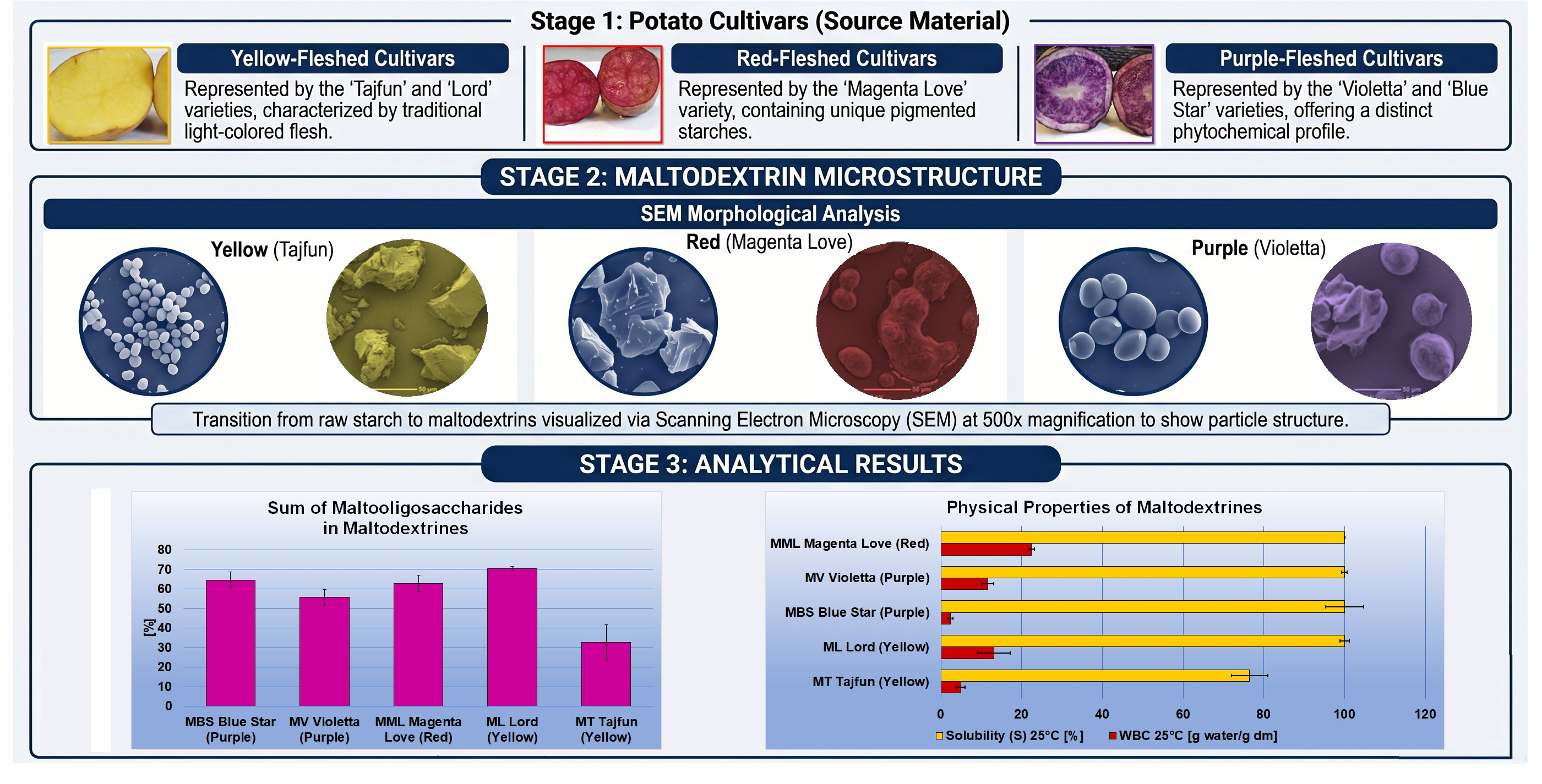

Comparative Physicochemical Characterization of Maltodextrins Derived from Starches of Red-, Purple-, and Light-Fleshed Potato Cultivars (Solanum tuberosum L.)


 , , , and
Abstract
1. Introduction
2. Results and Discussion
2.1. Dextrose Equivalent (DE) of Maltodextrins
2.2. Particle Size Distribution of Maltodextrins
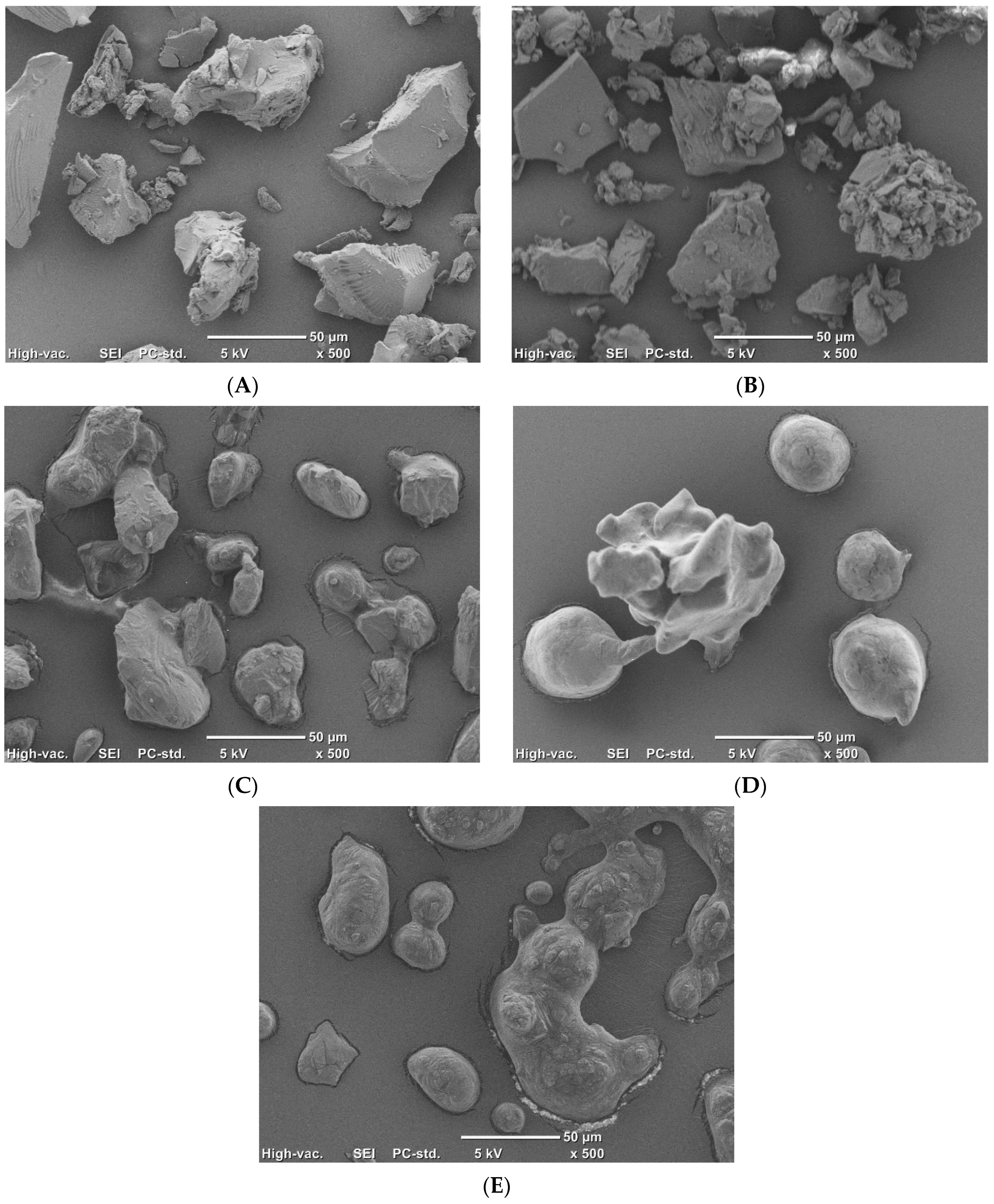
2.3. Scanning Electron Microscopy of Investigated Maltodextrins
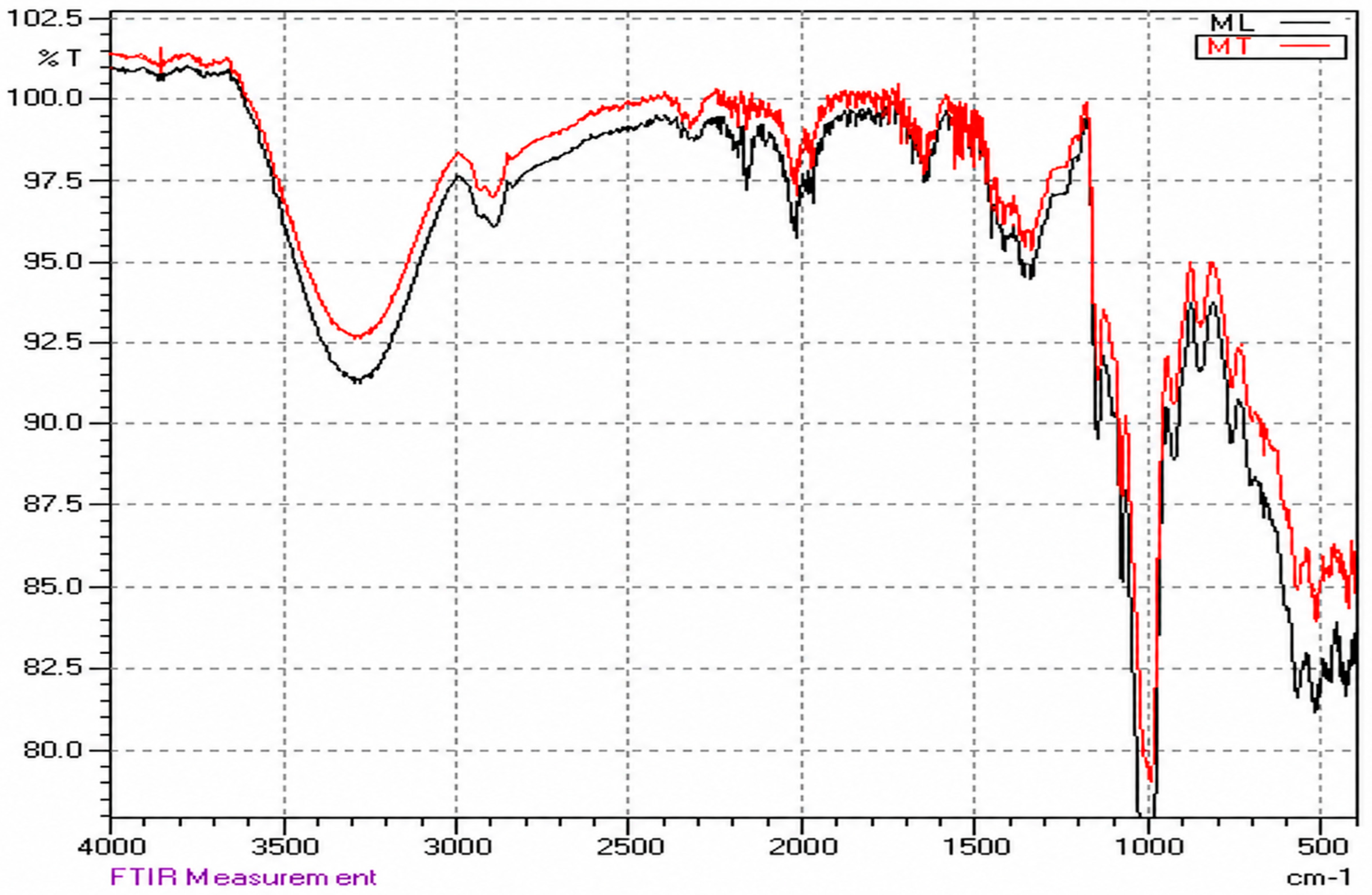
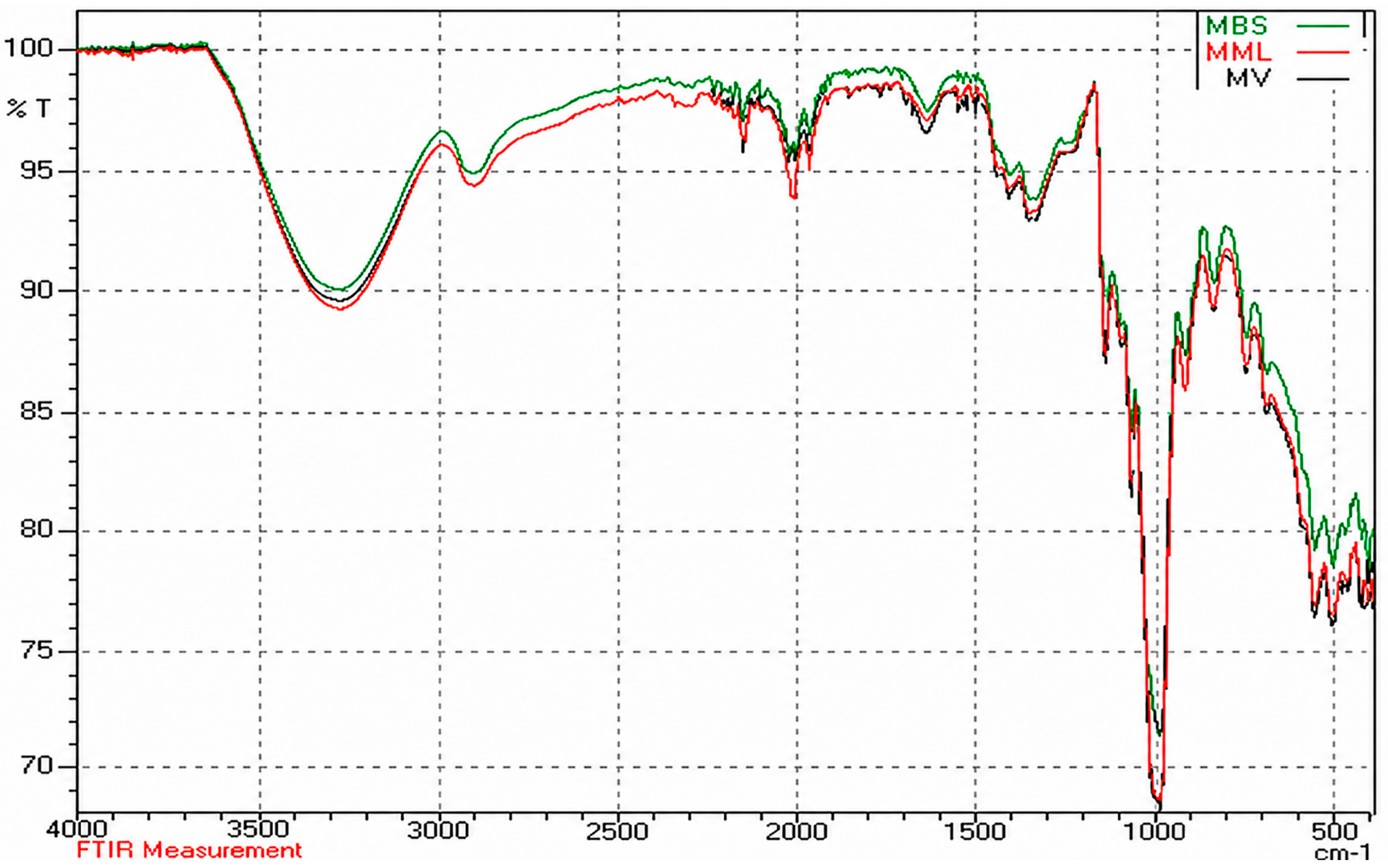
2.4. FT-IR Analysis of Maltodextrins
2.5. Non-Carbohydrate Components of Maltodextrin and the Profile of Maltooligosaccharides
2.6. Structural Parameters and Molecular Weights of Maltodextrins
2.7. Water-Binding Capacity (WBC) and Solubility (S) of Maltodextrins
2.8. Viscoelastic Properties of Maltodextrins
- -
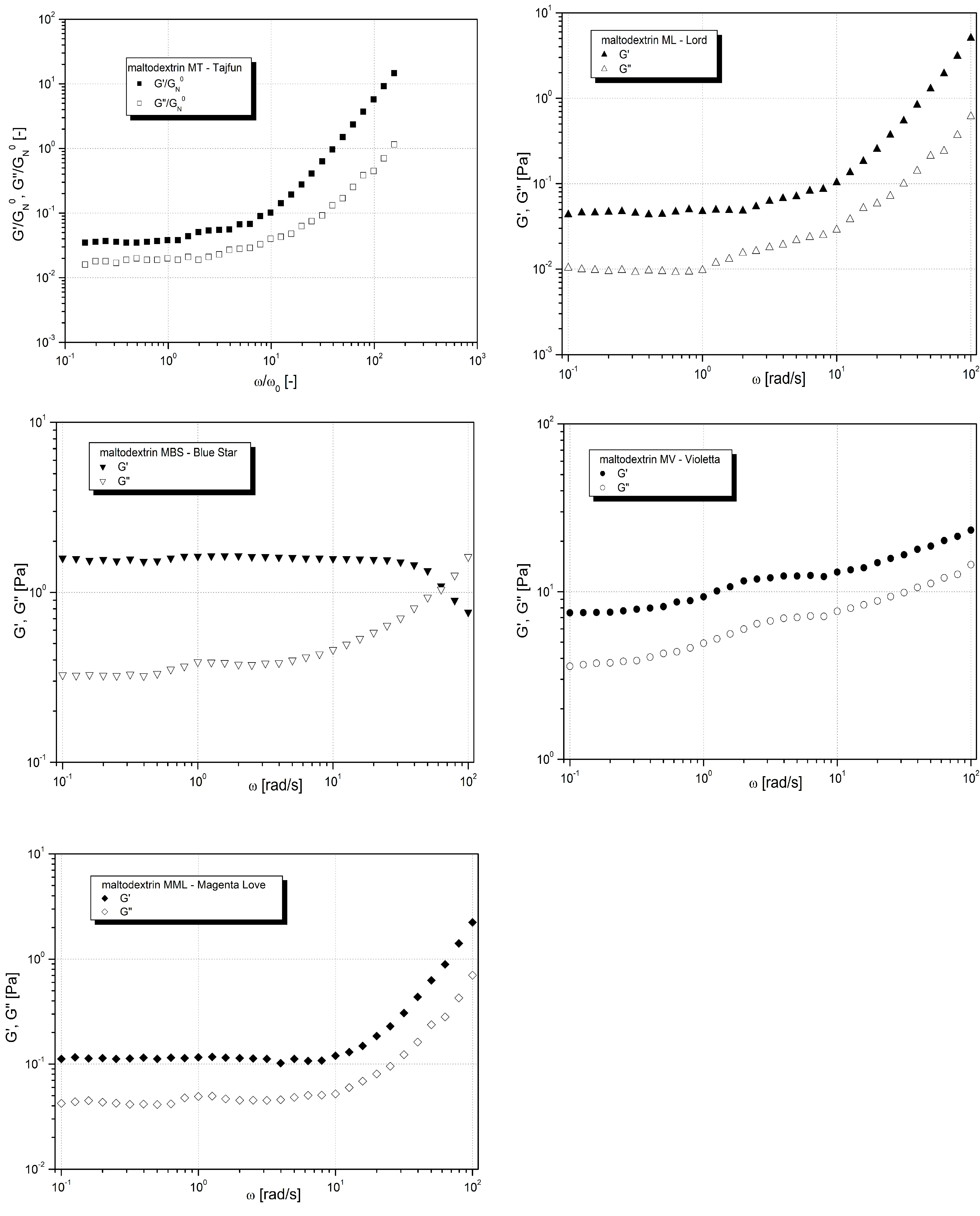
- The total network elasticity Ge of potato maltodextrins varies considerably, from very low values for maltodextrins isolated from yellow potato varieties Tajfun (MT) and Lord (ML) to high values for maltodextrins obtained from colored potatoes, i.e., red Magenta Love (MML) and purple Blue Star (MBS) and Violetta (MV). The difference between the lowest total network elasticity value for the Tajfun variety (Ge = 0.0194 Pa) and the highest value obtained for the Violetta variety (Ge = 7.480 Pa) is as much as 385 times.
- -
- The susceptibility in the equilibrium state of energy Je, and therefore the possibility of storing energy, is the highest for maltodextrin obtained from yellow potatoes of the Tajfun variety (MT).
- -
- The values of the plateau viscoelastic modulus GN0 are similarly varied as the values of the total network elasticity Ge. They show that the potato maltodextrin samples tested are media with a structure exhibiting behavior typical of viscoelastic quasi-solids. The GN0 modulus values indicate that the structure’s cross-linking is strongest for maltodextrin isolated from purple potatoes of the Violetta (MV) variety, and for this maltodextrin, aging processes occur more slowly over time.
- -
- The susceptibility of the structure to JN0 cross-linking reached the highest values for maltodextrins obtained from yellow potato varieties, i.e., the Tajfun (MT) variety and the Lord (ML) variety, at the level of 1.786 1/Pa and 1.815 1/Pa, respectively, which means that these maltodextrins have such network entanglements that suppress all types of long-range configurational rearrangements.
- -
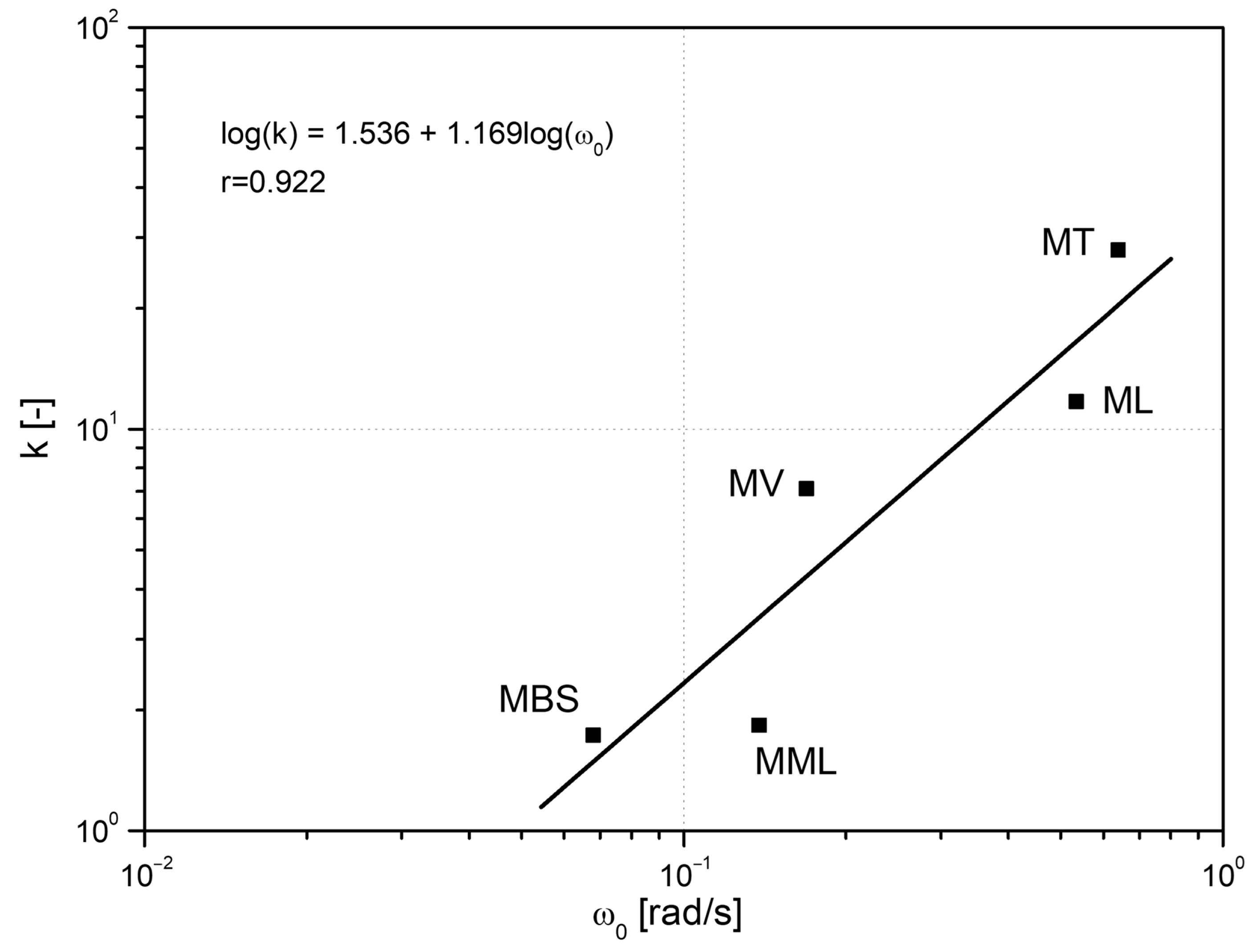
- The highest values of the network vibration damping coefficient k were achieved for maltodextrins isolated from yellow potato varieties, namely Tajfun (MT) and Lord (ML). In practice, this means that the network formed by these maltodextrins is resistant to external vibrations, and therefore media containing these maltodextrins will exhibit behavior typical of soft gels, while media containing maltodextrins from the Blue Star (MBS) and Magenta Love (MML) potato varieties will exhibit behavior typical of hard gels, with low values of the k coefficient.
- -
- The Newtonian viscosity under steady-state flow conditions h0 has the highest value for maltodextrin isolated from a purple potato variety, namely the Violetta (MV) variety, which means that the flow capacity of the set of elements enclosed by the minimum number of network nodes for this particular maltodextrin is the lowest. Interestingly, maltodextrin obtained from the second purple potato variety, Blue Star (MBS), had a h0 viscosity five times lower, so maltodextrin solutions from the Violetta variety will allow for obtaining media characterized by higher gel stiffness.
- -
- The cross-link density ω0 values of the tested maltodextrins indicate when the viscoelastic plateau region, i.e., the highly elastic state, ends. This state ends earliest for maltodextrin obtained from the purple Blue Star potato variety (MBS)—the lowest cross-link density value ω0 = 0.068 rad/s. This cross-link density value also indicates the distances between each node in the network being formed. In the case of maltodextrin from Blue Star potatoes, network nodes will appear every 0.068 rad/s, which in practice means that the network will be very densely woven. The opposite situation occurs in the case of two other potato varieties, namely maltodextrins isolated from yellow potato varieties, i.e., Tajfun (MT) and Lord (ML), for which the cross-linking density was 0.640 rad/s and 0.535 rad/s, respectively.
- -
- The width of the viscoelastic plateau L has the highest values, equal to 28.866 and 12.696, respectively, for maltodextrins obtained from yellow potato varieties, i.e., Tajfun (MT) and Lord (ML), suggesting greater polydispersity in relation to maltodextrins from other potato varieties.
- -
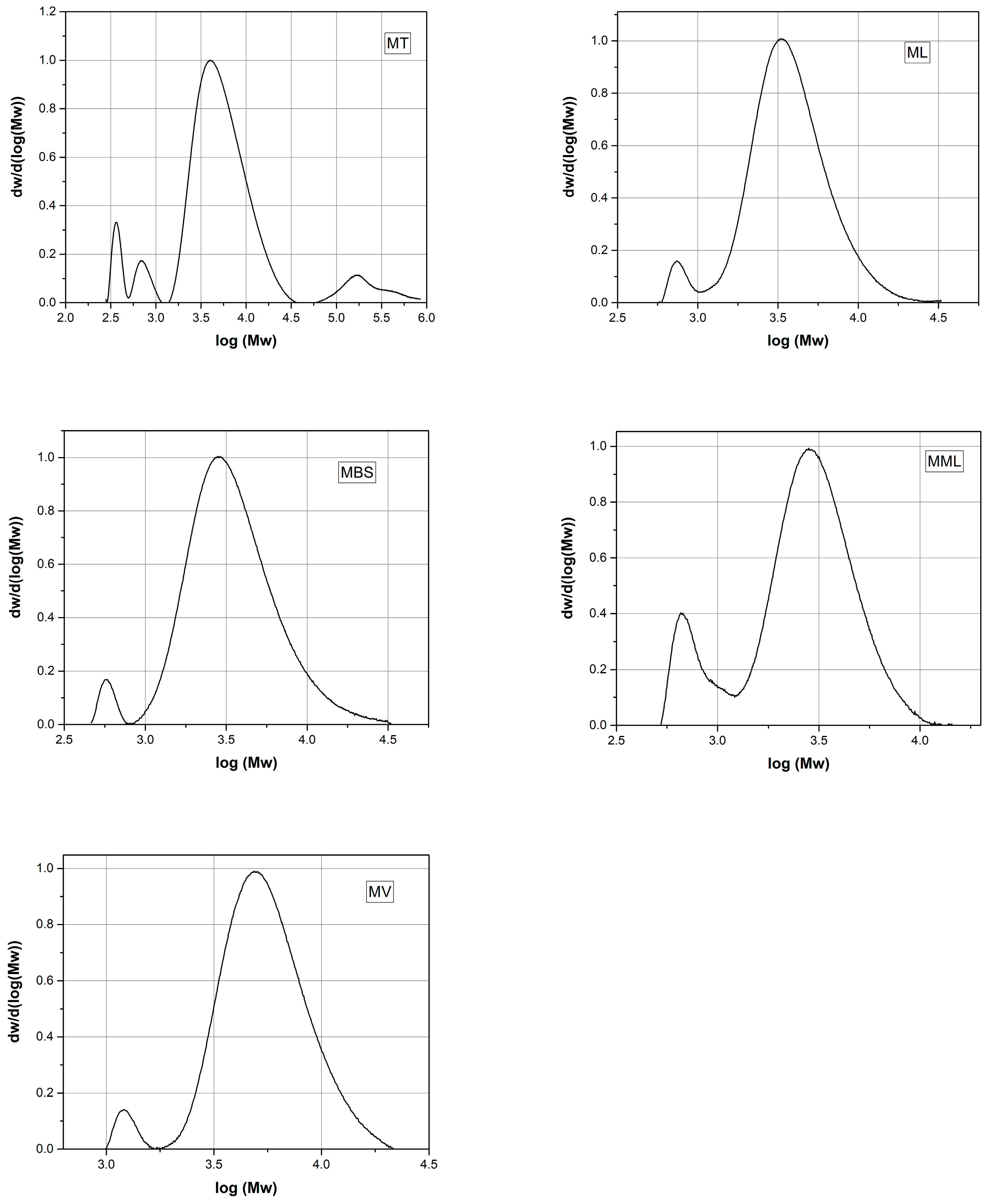
- The values of the average molecular weights for Me entanglement and Mc cross-linking do not have the same order of magnitude and confirm the different polydispersity of the tested maltodextrins.
- -
- The mesh size ζ is the largest for maltodextrins obtained from yellow potato varieties, i.e., Tajfun (MT) and Lord (ML), 199.663 nm and 200.744 nm, respectively, while it is 2 times smaller for maltodextrin from Blue Star (MBS) and Magenta Love (MML) potatoes, and almost 5 times smaller for maltodextrin from Violetta (MV) potatoes.
- -
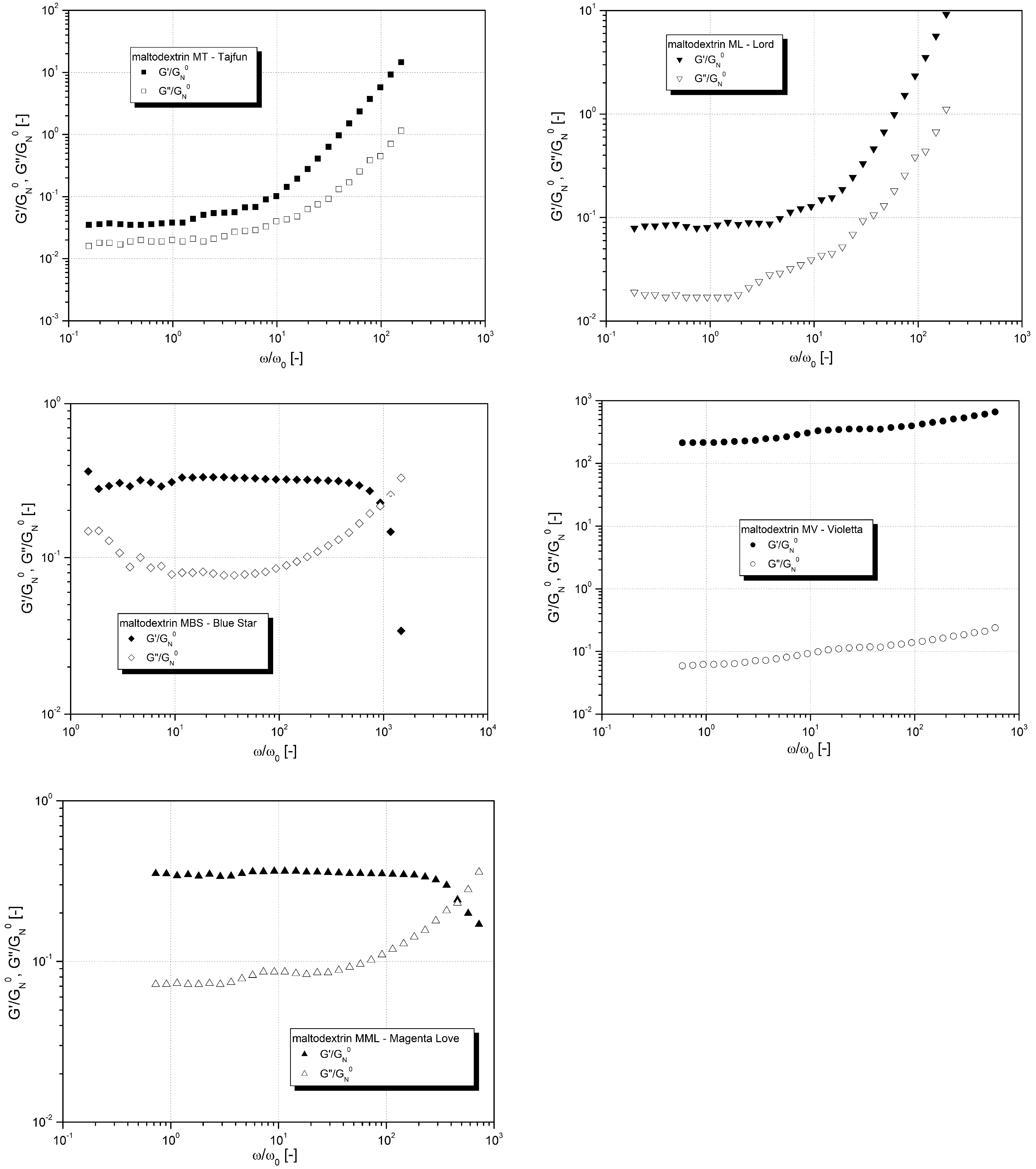
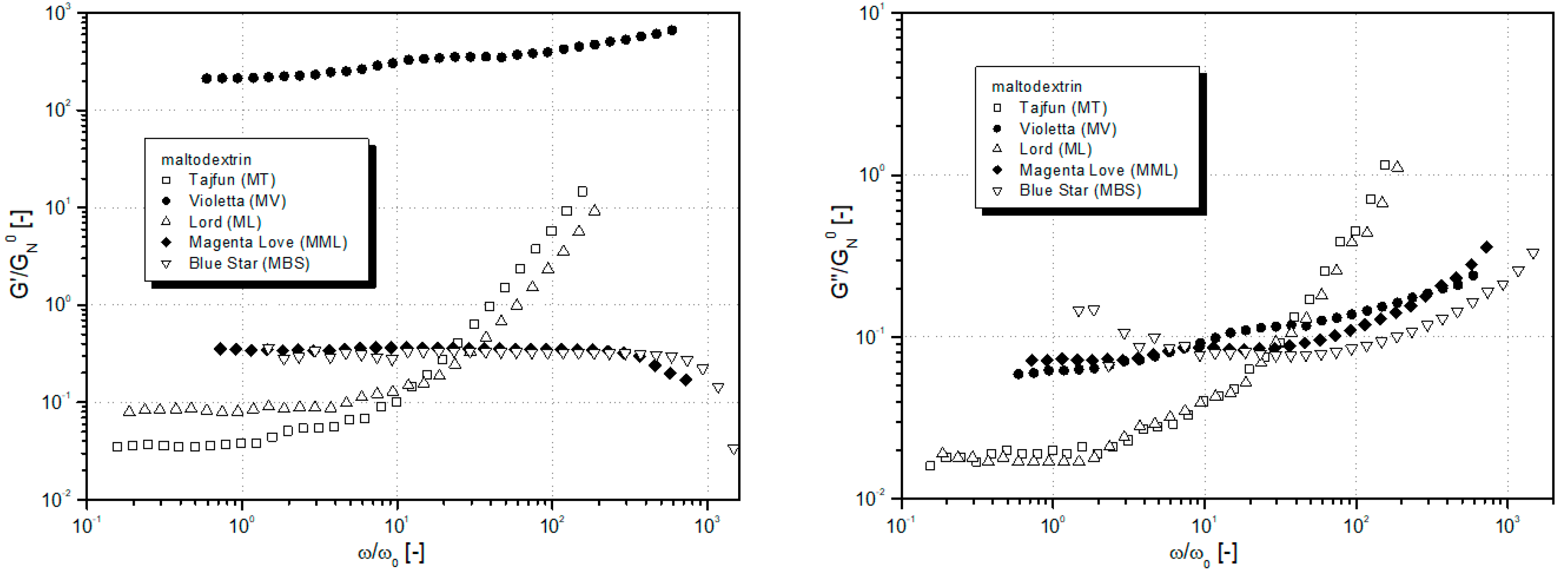
- The elastic elements shaping the internal structure of the yellow potato varieties Tajfun (MT) and Lord (ML) are very similar—there is a certain superposition of the reduced curves G′/GN0 = f(ω/ω0), which is also reflected in the values of the rheological parameters (see Table 8).
- -
- Practically complete superposition of the reduced curves G′/GN0 = f(ω/ω0) is observed for two potato varieties, each of which has a different flesh color, i.e., for maltodextrin obtained from the red potato variety Magenta Love (MML) and the purple potato variety Blue Star (MBS)—this means that the share of elastic elements shaping their internal structure is practically the same, with very similar values of the GN0 and Ge parameters (Table 8).
- -
- In the case of maltodextrin from the purple potato variety Violetta (MV), the elastic elements shaping its internal structure are definitely different from those of other potato varieties, explaining what is likely the highest value of the viscoelastic modulus of the plateau GN0 (Table 8).
- -
- Viscous elements illustrated in the form of reduced curves G″/GN0 = f(ω/ω0) show the similarity of these elements in shaping the internal structure of maltodextrins isolated from two yellow potato varieties Tajfun (MT) and Lord (ML): full superposition of reduced curves in the entire range of oscillation frequencies and similar values of viscosity η0 and cross-linking density ω0 (Table 8).
- -
- A very high similarity of the viscous elements in shaping the internal structure was observed for three maltodextrins with colored flesh, i.e., for red-fleshed potatoes of the Magenta Love (MML) variety and purple varieties Violetta (MV) and Blue Star (MBS). There is no complete superposition of the curves; these curves are similar to each other, as are the values of their rheological parameters (Table 8).

3. Materials and Methods
3.1. Materials
3.1.1. Characteristic of Potatoes
3.1.2. Isolating Starch
3.1.3. Production of Maltodextrins
3.2. Methods
3.2.1. Determination of the Dextrose Equivalent (DE)
3.2.2. Maltodextrin Particle Size Distribution and Polydispersity Index (PDI–SPAN)
- A value of less than 0.8 indicates a very narrow distribution, approaching monodispersity; values between 0.8 and 1.2 suggest a narrow distribution with very good uniformity;
- Values ranging from 1.2 to 2.0 are indicative of an average distribution, typical for most food products;
- Values between 2.0 and 3.0 denote a wide distribution, reflecting high heterogeneity; and values exceeding 3.0 represent a very wide distribution, which is generally considered unacceptable.
3.2.3. Scanning Electron Microscopy
3.2.4. Structure Analysis Using Fourier Transform Infrared Spectroscopy (FT-IR)
3.2.5. Content of Non-Polysaccharide Components
3.2.6. Maltooligosaccharides Content by HPLC
3.2.7. Analyses of Average Molecular Weights and Their Distributions
3.2.8. Determination of Water-Binding Capacity and Water Solubility
3.2.9. Determination of Maltodextrin Solubility and Water-Binding Capacity
3.2.10. Rheological Measurements
3.2.11. Measurement of Viscoelastic Properties
- -
- The equilibrium modulus, i.e., the modulus of elasticity in a steady state Ge, which is responsible for the total elasticity of the medium:
- -
- Viscoelastic plateau modulus GN0, responsible for cross-linking of the structure. Its high values also indicate the possibility of slowing down the aging effects of the medium over time; for polydisperse media, isolated samples of maltodextrins can be considered as such.
- -
- It is determined from the relationship:
- -
- Newtonian viscosity in conditions of steady flow η0 characterizing the flow capacity of a set of elements closed with a minimum number of nodes of the biopolymer network, capable of individual movement:
- -
- The equilibrium compliance Je, which is a measure of the energy stored during a steady state of the biopolymer under low-stress conditions:
- -
- Plateau compliance JN0, representing the strength with which the entanglements of the biopolymer network suppress all kinds of long-range configuration rearrangements:
- -
- Network vibration damping coefficient k, which indicates how resistant the created medium structure is to external vibrations:
- -
- Weighted average relaxation time τm equated with the longest relaxation time:
- -
- Numerically average relaxation time τ0 equated with the shortest relaxation time:
- -
- Cross-linking density of the structure ω0, defining at the same time the end of the viscoelastic area of the plateau:
- -
- Dimensionless width of the viscoelastic plateau L, combining fast and slow dissipation processes, determining the degree of biopolymer polydispersion:
- -
- Average molecular weight by entanglement Me, which is the average molecular weight between the topological bonds of the biopolymer network, resulting from the physical (mechanical) entanglement of long biopolymer chains:
- -
- Average molecular weight at Mc cross-linking, which is the average molecular weight of biopolymer chains between successive nodes of the network, which can be chemical cross-links, crystalline regions, and even polymer complexes:
- -
- Mesh size of the resulting network ξ, which is one of the characteristic linear dimensions of the created network of viscoelastic material:
3.2.12. Statistical Analysis
4. Conclusions
Supplementary Materials
Author Contributions
Funding
Institutional Review Board Statement
Informed Consent Statement
Data Availability Statement
Conflicts of Interest
References
- Pycia, K.; Juszczak, L.; Gałkowska, D.; Witczak, M.; Jaworska, G. Maltodextrins from chemically modified starches Part 2: Selected physicochemical properties. Carbohydr. Polym. 2016, 146, 301–309. [Google Scholar] [PubMed]
- Takeiti, C.Y.; Kieckbusch, T.G.; Collares-Queiroz, F.P. Morphological and Physicochemical Characterization of Commercial Maltodextrins with Different Degrees of Dextrose-Equivalent. Int. J. Food Prop. 2010, 13, 411–425. [Google Scholar] [CrossRef] [Scilit]
- Hu, W.; Zhang, W.; Zhang, Z.; Shen, S.; Lu, G.; Wu, W. Effect of Maltodextrin on the Physicochemical Properties and Cooking Performance of Sweet Potato Starch Noodles. Foods 2022, 11, 4082. [Google Scholar] [CrossRef] [Scilit] [PubMed]
- Sun, J.; Zhao, R.; Zeng, J.; Li, G.; Li, X. Characterization of Destrins with Different Dextrose Equivalents. Molecules 2010, 15, 5162–5173. [Google Scholar] [CrossRef] [Scilit] [PubMed]
- Yusraini, E.; Hariyadi, P.; Kusnandar, F. Preparation and partial characterization of low dextrose equivalent (DE) maltodextrin from banana starch produced by enzymatic hydrolysis. Starch/Stärke 2013, 65, 312–321. [Google Scholar]
- Li, G.; Wang, S.; Zhu, F. Physicochemical properties of quinoa starch. Carbohydr. Polym. 2016, 137, 328–338. [Google Scholar] [CrossRef] [Scilit] [PubMed]
- Saavedra-Leos, Z.; Leyva-Porras, C.; Araujo-Díaz, S.B.; Toxqui-Terán, A.; Borrás-Enríquez, A.J. Technological Application of Maltodextrins According to the Degree of Polymerization. Molecules 2015, 20, 21067–21081. [Google Scholar] [CrossRef] [Scilit] [PubMed]
- Du, Q.; Tang, J.; Xu, M.; Lyu, F.; Zhang, J.; Qiu, Y.; Liu, J.; Ding, Y. Whey protein and maltodextrin-stabilized oil-in-water emulsions: Effects of dextrose equivalent. Food Chem. 2021, 33, 128094. [Google Scholar] [CrossRef] [Scilit]
- Hofman, D.L.; van Buul, V.J.; Brouns, F.J.P.H. Nutrition, Health, and Regulatory Aspects of Digestible Maltodextrins. Crit. Rev. Food Sci. Nutr. 2016, 56, 2091–2100. [Google Scholar] [CrossRef] [Scilit] [PubMed]
- Udomrati, U.; Ikeda, S.; Gohtani, S. Rheological properties and stability of oil-in-water emulsions containing tapioca maltodextrin in the aqueous chase. J. Food Eng. 2013, 116, 170–175. [Google Scholar] [CrossRef] [Scilit]
- Wang, Y.J.; Wang, L. Structures and Properties of Commercial Maltodextrins from Corn, Potato, and Rice Starches. Starch/Stärke 2000, 52, 296–304. [Google Scholar] [CrossRef] [Scilit]
- Ozcelik, M.; Kulozik, U. The Role of Maltodextrin Concentration in Maintaining Storage Stability of Dried Fruit Foams Texturized Using Plant Protein-Polysaccharide Blends. Foods 2023, 12, 1673. [Google Scholar] [PubMed]
- Dokic, L.; Jakovljevic, J.; Dokic, P. Relation between viscous characteristic and dextrose equivalent of maltodextrins. Starch/Stärke 2004, 56, 520–525. [Google Scholar] [CrossRef] [Scilit]
- Pycia, K.; Juszczak, L.; Gałkowska, D. Effect of native potato starch maltodextrins on stability and rheological properties of albumin foams. Starch/Stärke 2015, 68, 611–620. [Google Scholar] [CrossRef] [Scilit]
- Lewandowicz, G.; Prochaska, K.; Grajek, W.; Krzyżaniak, W.; Majchrzak, A. Właściwości użytkowe maltodekstryn w układach emulsyjnych. Żywność. Nauka. Technol. Jakość 2005, 1, 35–47. [Google Scholar]
- Kedziora, P.; Le Thanh, J.; Lewandowicz, G.; Prochaska, K. An attempt toapplication of continuous recycle membrane reactor for hydrolysis of oxidizedderivatives of potato starch. J. Membr. Sci. 2006, 282, 14–20. [Google Scholar]
- Konował, E.; Lewandowicz, G.; Le Thanth-Blicharz, J.; Prochaska, K. Physicochemical characterisation of enzymatically hydrolysed derivatives ofacetylated starch. Carbohydr. Polym. 2012, 87, 1333–1341. [Google Scholar]
- Nurhadi, B.; Roos, Y.H.; Maidannyk, V. Physical properties of maltodextrin DE 10: Water sorption, water plasticization and enthalpy relaxation. J. Food Eng. 2016, 174, 68–74. [Google Scholar] [CrossRef] [Scilit]
- Carneiro, A.P.G.; Aguiar, A.L.L.; Silva, R.B.C.; Richter, R.; Sousa, P.H.M.; Silva, L.M.R.; Figueiredo, R.W. Acerola by-product as a renewable source of bioactive compounds: Arabic gum and maltodextrin nanocapsules. Food Sci. Technol. 2020, 40, 23–29. [Google Scholar] [CrossRef] [Scilit]
- Cid-Ortega, S.; Guerrero-Beltrá, J.A. Microencapsulation of Hibiscus sabdariffa (Roselle) Extracts by Spray Drying Using Maltodextrin and Gum Arabic as Carriers. J. Food Res. 2020, 9, 5. [Google Scholar] [CrossRef] [Scilit]
- Bernal-Millán, M.J.; Gutiérrez-Grijalva, M.; Contreras, E.; Muy, L.; Lopez-Martinez, D.; Heredia, B.J. Spray-Dried Microencapsulation of Oregano (Lippia graveolens) Polyphenols with Maltodextrin Enhances Their Stability during In Vitro Digestion. J. Chem. 2022, 2022, 8740141. [Google Scholar] [CrossRef] [Scilit]
- Valenzuela, C.; Aguilera, J.M. Effects of maltodextrin on hygroscopicity and crispness of apple leathers. J. Food Eng. 2015, 144, 1–9. [Google Scholar] [CrossRef] [Scilit]
- Gumul, D.; Areczuk, A.; Berski, W.; Juszczak, L.; Khachatryan, G. Selected Physicochemical Properties of Starch Isolated from Colored Potatoes (Solanum tuberosum L.) as Compared to Starch from Yellow Flesh Potatoes. Starch-Stärke 2022, 74, 2100158. [Google Scholar]
- Krystyjan, M.; Gumul, D.; Areczuk, A.; Khachatryan, G. Comparison of Physicochemical Parameters and Rheological Properties of Starch Isolated from Coloured Potatoes (Solanum tuberosum L.) and Yellow Potatoes. Food Hydrocoll. 2022, 131, 107829. [Google Scholar] [CrossRef] [Scilit]
- McPherson, A.E.; Seib, P.A. Preparation and properties of wheat and corn starch maltodextrins with a low dextrose equivalent. Cereal Chem. 1997, 74, 424–430. [Google Scholar] [CrossRef] [Scilit]
- Siemons, I.; Politiek, R.G.A.; Boom, R.M.; van der Sman, R.G.M.; Schutyser, M.A.I. Dextrose equivalence of maltodextrins determines particle morphology development during single sessile droplet drying. Food Res. Int. 2020, 131, 108988. [Google Scholar] [CrossRef] [Scilit] [PubMed]
- van Boven, A.P.; Siemons, I.; Kohls, R.; Schutyser, M.A.I. Analysis on particle morphology development during pilot-scale spray drying of maltodextrins. Dry. Technol. 2025, 43, 840–857. [Google Scholar] [CrossRef] [Scilit]
- Sritham, E.; Gunasekaran, S. bFTIR spectroscopic evaluation of sucrose-maltodextrin-sodium citrate bioglass. Food Hydrocoll. 2017, 70, 371–382. [Google Scholar]
- van Soest, J.J.G.; Tournois, H.; de Wit, D.; Vliegenthart, J.F.G. Short range structure in (partially) crystalline potato starch determined with ATR FTIR. Carbohydr. Res. 1995, 279, 201–214. [Google Scholar]
- Pozo, C.; Rodríguez Llamazares, S.; Bouza, R.; Barral, L.; Castaño, J.; Müller, N.; Restrepo, I. Study of the structural order of native starch granules using combined FTIR and XRD analysis. J. Polym. Res. 2018, 25, 266. [Google Scholar] [CrossRef] [Scilit]
- Avaltroni, F.; Bouquerand, P.E.; Normand, V. Maltodextrin Molecular Weight Distribution Influence on the Glass Transition Temperature and Viscosity in Aqueous Solutions. Carbohydr. Polym. 2004, 58, 323–334. [Google Scholar] [CrossRef] [Scilit]
- Tong, H.H.Y.; Wong, S.Y.S.; Law, M.W.L.; Chu, K.K.W.; Chow, A.H.L. Anti-Hygroscopic Effect of Dextrans in Herbal Formulations. Int. J. Pharm. 2008, 363, 99–105. [Google Scholar] [CrossRef] [Scilit] [PubMed]
- Chen, X.; Hou, Y.; Wang, Z.; Liao, A.; Pan, L.; Zhang, M.; Xue, Y.; Wang, J.; Liu, Y.; Huang, J. A Comparative Study of Resistant Dextrins and Resistant Maltodextrins from Different Tuber Crop Starches. Polymers 2023, 15, 4545. [Google Scholar] [CrossRef] [Scilit] [PubMed]
- Sun, Y.; Cheng, L.; Hong, Y.; Li, Z.; Li, C.; Ban, X.; Gu, Z. Preparation and characterization of cationic hyperbranched maltodextrins as potential carrier for siRNA encapsulation. Int. J. Biol. Macromol. 2023, 225, 786–794. [Google Scholar] [CrossRef] [Scilit] [PubMed]
- Leach, H.W. Gelatinization of Starch. In Starch Chemistry and Technology; Whistler, E.L., Paschall, E.F., Eds.; Academic Press: New York, NY, USA; London, UK, 1965; Volume 1. [Google Scholar]
- Ningtyas, D.W.; Tam, B.; Bhandari, B.; Prakash, S. Effect of different types and concentrations of fat on the physico-chemical properties of soy protein isolate gel. Food Hydrocoll. 2020, 111, 106226. [Google Scholar]
- Lorenzen, M.; van den Berg, F.W.J.; Lillevang, S.K.; Ahrné, L. The effect of milk fat content on microstructure and rheological properties of renet casein gel emulsions. Food Hydrocoll. 2024, 146, 109243. [Google Scholar] [CrossRef] [Scilit]
- Juszczak, L.; Gałkowska, D.; Witczak, T.; Fortuna, T. Effect of Maltodextrins on the Rheological Properties of Potato Starch Pastes and Gels. Int. J. Food Sci. 2013, 7, 869362. [Google Scholar] [CrossRef] [Scilit]
- Wischmann, B.; Ahmt, T.; Bandsholm, O.; Blennow, A.; Young, N.; Jeppesen, L.; Thomsen, L. Testing properties of potato starch from different scales of isolations—A ringtest. J. Food Eng. 2007, 79, 970–978. [Google Scholar] [CrossRef] [Scilit]
- Fortuna, T.; Sobolewska-Zielińska, J. Retrogradation od starches and maltodextrins of origin various. Acta Sci. Pol. Technol. Aliment. 2010, 9, 71–81. [Google Scholar]
- PN-78/A-74701:1978; Hydrolizaty Skrobiowe—Metody Badań. Polski Komitet Normalizacyjny: Warsaw, Poland, 1978.
- Rosicka-Kaczmarek, J.; Komisarczyk, A.; Nebesny, E. Heteropolysaccharide preparations from rye and wheat bran as sources of antioxidants. J. Cereal Sci. 2018, 81, 37–43. [Google Scholar] [CrossRef] [Scilit]
- AOAC International. Official Methods of Analysis of AOAC International, 21st ed.; AOAC International: Rockville, MD, USA, 2019. [Google Scholar]
- PN-ENISO3946:2000; Skrobia i Produkty Pochodne—Oznaczanie Całkowitej Zawartości Fosforu—Metoda Spektrofotometryczna. Polish Committee for Standardization: Warszawa, Poland, 2000.
- Lukasiewicz, M.; Kowalski, S. Low power microwave-assisted enzymatic esterification of starch. Starch/Stärke 2012, 64, 188–197. [Google Scholar]
- Ferry, J. Viscoelastic Properties of Polymers; Wiley: New York, NY, USA, 1980. [Google Scholar]
- Orczykowska, M.; Olejnik, T.P.; Rosicka-Kaczmarek, J.; Miśkiewicz, K.; Kowalska, G. Use of phenomenological rheology methods to analyze the viscoelastic properties of bee honeys. J. Food Process Eng. 2021, 44, e13637. [Google Scholar]
- Gumul, D.; Korus, J.; Orczykowska, M.; Rosicka-Kaczmarek, J.; Oracz, J.; Areczuk, A. Starch from Unripe Apples (Malus domestica Borkh) as an Alternative for Application in the Food Industry. Molecules 2024, 29, 1707. [Google Scholar] [CrossRef] [Scilit] [PubMed]



| Maltodextrins from Isolated Starch from Potatoes | DE, % | |
|---|---|---|
| The color of potato flesh | Variety of potatoes | |
| Yellow | Tajfun (MT) | 18 ± 0.0 d* |
| Lord (ML) | 16 ± 0.3 b | |
| Purple | Blue Star (MBS) | 17 ± 0.1 c |
| Violetta (MV) | 18 ± 0.0 d | |
| Red | Magenta Love (MML) | 15 ± 0.2 a |
| Maltodextrins from Isolated Starch with Potatoes | ≤30 | 30–70 | >70 | D10 | D50 | D90 | PDI (SPAN) | |
|---|---|---|---|---|---|---|---|---|
| The Color of Potato Flesh | Variety of Potatoes | |||||||
| Yellow | Tajfun | 75.55 ± 5.91 a* | 23.69 ± 5.00 d | 0.76 ± 0.88 b | 2.44 ± 0.29 a | 14.86 ± 2.59 bc | 44.78 ± 6.44 c | 2.86 ± 0.08 c |
| Lord | 90.84 ± 1.77 c | 9.16 ± 1.77 b | ND ** | 3.29 ± 0.17 b | 11.63 ± 0.65 ab | 29.49 ± 1.69 ab | 2.25 ± 0.01 bc | |
| Purple | Blue Star | 80.84 ± 3.81 b | 19.09 ± 3.74 c | 0.06 ± 0.00 a | 4.74 ± 0.36 c | 16.52 ± 1.29 c | 37.72 ± 3.17 bc | 2.00 ± 0.01 a |
| Violetta | 95.98 ± 0.75 d | 4.02 ± 0.75 a | ND | 3.17 ± 0.06 b | 10.54 ± 0.24 a | 24.55 ± 0.77 a | 2.03 ± 0.02 a | |
| Red | Magenta Love | 96.69 ± 0.56 d | 3.31 ± 0.56 a | ND | 3.19 ± 0.06 b | 10.27 ± 0.21 a | 23.74 ± 0.67 a | 2.00 ± 0.02 a |
| Maltodextrins from Isolated Starch with Potatoes | Protein (%) 6.25 | Fat (%) | Ash (%) | Phosphorus (%) | |
|---|---|---|---|---|---|
| The Color of Potato Flesh | Variety of Potatoes | ||||
| Yellow | Tajfun | 0.22 ± 0.01 b* | 0.43 ± 0.01 b | 0.30 ± 0.01 c | 0.056 ± 0.00 c |
| Lord | 0.19 ± 0.00 a | 0.47 ± 0.01 c | 0.20 ± 0.01 a | 0.036 ± 0.00 a | |
| Purple | Blue Star | 0.23 ± 0.01 b | 0.51 ± 0.00 d | 0.35 ± 0.01 d | 0.071 ± 0.00 e |
| Violetta | 0.23 ± 0.00 b | 0.37 ± 0.01 a | 0.30 ± 0.01 c | 0.064 ± 0.00 d | |
| Red | Magenta Love | 0.23 ± 0.00 b | 0.43 ± 0.01 b | 0.26 ± 0.00 b | 0.044 ± 0.00 b |
| The Color of Potato Flesh | Variety of Potatoes | ||||
|---|---|---|---|---|---|
| Yellow | Purple | Red | |||
| The Kind of Maltooligosaccharide (g/100 g d.m.) | MT Tajfun | ML Lord | MBS Blue Star | MV Violetta | MML Magenta Love |
| glucose | 0.32 ± 0.02 a* | 1.50 ± 0.04 c | 1.62 ± 0.11 c | 1.36 ± 0.10 b | 1.64 ± 0.12 c |
| maltose | 2.30 ± 0.05 a | 8.51 ± 0.15 b | 9.73 ± 0.60 c | 8.43 ± 0.54 b | 10.18 ± 0.61 c |
| maltotriose | 4.57 ± 0.07 e | 11.87 ± 0.23 b | 12.03 ± 0.80 b | 11.24 ± 0.70 b | 12.80 ± 0.85 b |
| maltotetraose | 4.57 ± 0.03 a | 7.93 ± 0.14 b | 8.11 ± 0.52 c | 7.45 ± 0.48 b | 8.55 ± 0.57 c |
| maltopentaose | 2.99 ± 0.06 a | 11.92 ± 0.23 b | 13.53 ± 0.97 c | 11.82 ± 0.85 b | 14.15 ± 1.01 c |
| maltohexaose | 6.44 ± 0.12 a | 22.11 ± 0.35 c | 13.68 ± 1.11 b | 12.13 ± 0.98 b | 12.53 ± 0.97 b |
| maltoheptaose | 7.14 ± 0.12 e | 6.60 ± 0.10 d | 2.87 ± 0.20 b | 3.33 ± 0.27 c | 2.16 ± 0.12 a |
| maltooktaose | 4.35 ± 0.03 | ND ** | ND | ND | ND |
| SUM | 32.68 ± 0.60 | 70.44 ± 0.99 | 61.57 ± 4.11 | 55.76 ± 3.98 | 62.01 ± 4.21 |
| Maltodextrins from Isolated Starch with Potatoes | Mn | Mw | Pd [-] |
|---|---|---|---|
| Variety/The Color of Potato Flesh | ·10−3 [g/mol] | ||
| Tajfun (yellow) | 2.55 | 24.35 | 9.6 |
| Lord (yellow) | 2.97 | 4.27 | 1.4 |
| Blue Star (purple) | 2.63 | 4.13 | 1.6 |
| Violetta (purple) | 4.57 | 5.89 | 1.3 |
| Magenta Love (red) | 2.00 | 2.99 | 1.5 |
| Maltodextrins from Potato Starch | WBC 25 °C | WBC 40 °C | Solubility(S) 25 °C | Solubility (S) 40 °C | |
|---|---|---|---|---|---|
| The Color of Potato Flesh | Variety of Potatoes | ||||
| (g water/g dm) | (%) | ||||
| Yellow | Tajfun | 4.97 ± 0.96 b* | ND ** | 76.45 ± 4.53 a | 86.56 ± 1.27 a |
| Lord | 13.15 ± 4.04 c | ND | 100.00 ± 1.21 b | 99.97 ± 0.37 b | |
| Purple | Blue Star | 2.40 ± 0.64 a | ND | 100.00 ± 4.73 b | 97.82 ± 1.96 b |
| Violetta | 11.63 ± 1.50 c | ND | 100.00 ± 0.68 b | 100.15 ± 0.97 b | |
| Red | Magenta Love | 22.46 ± 0.66 d | ND | 100.00 ± 0.08 b | 99.22 ± 0.54 b |
| Maltodextrins from Potato Starch | WBC 25 °C | WBC 40 °C | Solubility (S) 25 °C | Solubility (S) 40 °C | |
|---|---|---|---|---|---|
| The Color of Potato Flesh | Variety of Potatoes | ||||
| (g water/g dm) | (%) | ||||
| Yellow | Tajfun | 4.30 ± 0.00 a* | 16.62 ± 0.12 a | 73.15 ± 0.07 a | 85.38 ± 0.11 a |
| Lord | 32.98 ± 2.83 c | 48.53 ± 13.09 c | 98.33 ± 1.63 b | 98.20 ± 0.47 b | |
| Purple | Blue Star | 5.32 ± 0.19 b | 69.73 ± 9.99 d | 97.34 ± 0.03 b | 97.91 ± 0.20 b |
| Violetta | ND ** | ND | 100.00 ± 1.46 c | 100.00 ± 3.15 c | |
| Red | Magenta Love | ND | 29.52 ± 1.48 b | 100.00 ± 0.80 c | 97.16 ± 0.64 b |
| Rheological Parameters | Tajfun (MT) | Lord (ML) | Blue Star (MBS) | Violetta (MV) | Magenta Love (MML) | |
|---|---|---|---|---|---|---|
| Ge | [Pa] | 0.0194 ± 0.000 a* | 0.0434 ± 0.001 b | 1.790 ± 0.008 d | 7.480 ± 0.173 e | 1.590 ± 0.007 c |
| Je | [1/Pa] | 51.546 ± 0.448 e | 23.041 ± 0.542 d | 0.559 ± 0.016 b | 0.134 ± 0.003 a | 0.629 ± 0.014 c |
| GN0 | [Pa] | 0.560 ± 0.017 c | 0.551 ± 0.016 b | 4.886 ± 0.076 a | 60.686 ± 0.684 e | 4.499 ± 0.073 d |
| JN0 | [1/Pa] | 1.786 ± 0.008 d | 1.815 ± 0.008 e | 0.205 ± 0.003 b | 0.016 ± 0.002 a | 0.222 ± 0.004 c |
| η0 | [Pas] | 0.875 ± 0.006 a | 1.030 ± 0.005 b | 72.000 ± 1.775 d | 359.000 ± 3.605 e | 32.600 ± 0.947 c |
| k | [-] | 27.866 ± 0.569 e | 11.696 ± 0.316 d | 1.730 ± 0.141 a | 7.113 ± 0.0.374 c | 1.830 ± 0.143 b |
| τm | [s] | 45.103 ± 0.693 d | 23.733 ± 0.613 b | 40.223 ± 0.856 c | 47.995 ± 1.015 e | 20.503 ± 0.801 a |
| τ0 | [s] | 1.563 ± 0.007 a | 1.869 ± 0.009 b | 14.736 ± 0.960 e | 5.916 ± 0.089 c | 7.246 ± 0.152 d |
| ω0 | [rad/s] | 0.640 ± 0.016 e | 0.535 ± 0.014 d | 0.068 ± 0.002 a | 0.169 ± 0.004 c | 0.138 ± 0.003 b |
| L | [-] | 28.866 ± 0.386 e | 12.696 ± 0.384 d | 2.730 ± 0.076 a | 8.113 ± 0.186 c | 2.830 ± 0.078 b |
| Me | [kg/mol] | (4.80 ± 0.14) × 106 | (4.87 ± 0.14) × 106 | (5.50 ± 0.14) × 105 | (4.42 ± 0.12) × 104 | (5.97 ± 0.16) × 105 |
| Mchem | [kg/mol] | (1.38 ± 0.06) × 108 | (6.19 ± 0.16) × 107 | (1.50 ± 0.07) × 106 | (3.59 ± 0.09) × 105 | (1.69 ± 0.08) × 106 |
| ζ | [nm] | 199.663 ± 2.515 | 200.744 ± 1.568 | 96.986 ± 1.592 | 41.879 ± 0.712 | 99.691 ± 1.368 |
Disclaimer/Publisher’s Note: The statements, opinions and data contained in all publications are solely those of the individual author(s) and contributor(s) and not of MDPI and/or the editor(s). MDPI and/or the editor(s) disclaim responsibility for any injury to people or property resulting from any ideas, methods, instructions or products referred to in the content. |
© 2026 by the authors. Licensee MDPI, Basel, Switzerland. This article is an open access article distributed under the terms and conditions of the Creative Commons Attribution (CC BY) license.
Share and Cite
Gumul, D.; Rosicka-Kaczmarek, J.; Orczykowska, M.; Łukasiewicz, M.; Miśkiewicz, K.; Sobolewska-Zielińska, J.; Areczuk, A. Comparative Physicochemical Characterization of Maltodextrins Derived from Starches of Red-, Purple-, and Light-Fleshed Potato Cultivars (Solanum tuberosum L.). Molecules 2026, 31, 2121. https://doi.org/10.3390/molecules31122121
Gumul D, Rosicka-Kaczmarek J, Orczykowska M, Łukasiewicz M, Miśkiewicz K, Sobolewska-Zielińska J, Areczuk A. Comparative Physicochemical Characterization of Maltodextrins Derived from Starches of Red-, Purple-, and Light-Fleshed Potato Cultivars (Solanum tuberosum L.). Molecules. 2026; 31(12):2121. https://doi.org/10.3390/molecules31122121
Chicago/Turabian StyleGumul, Dorota, Justyna Rosicka-Kaczmarek, Magdalena Orczykowska, Marcin Łukasiewicz, Karolina Miśkiewicz, Joanna Sobolewska-Zielińska, and Anna Areczuk. 2026. "Comparative Physicochemical Characterization of Maltodextrins Derived from Starches of Red-, Purple-, and Light-Fleshed Potato Cultivars (Solanum tuberosum L.)" Molecules 31, no. 12: 2121. https://doi.org/10.3390/molecules31122121
APA StyleGumul, D., Rosicka-Kaczmarek, J., Orczykowska, M., Łukasiewicz, M., Miśkiewicz, K., Sobolewska-Zielińska, J., & Areczuk, A. (2026). Comparative Physicochemical Characterization of Maltodextrins Derived from Starches of Red-, Purple-, and Light-Fleshed Potato Cultivars (Solanum tuberosum L.). Molecules, 31(12), 2121. https://doi.org/10.3390/molecules31122121