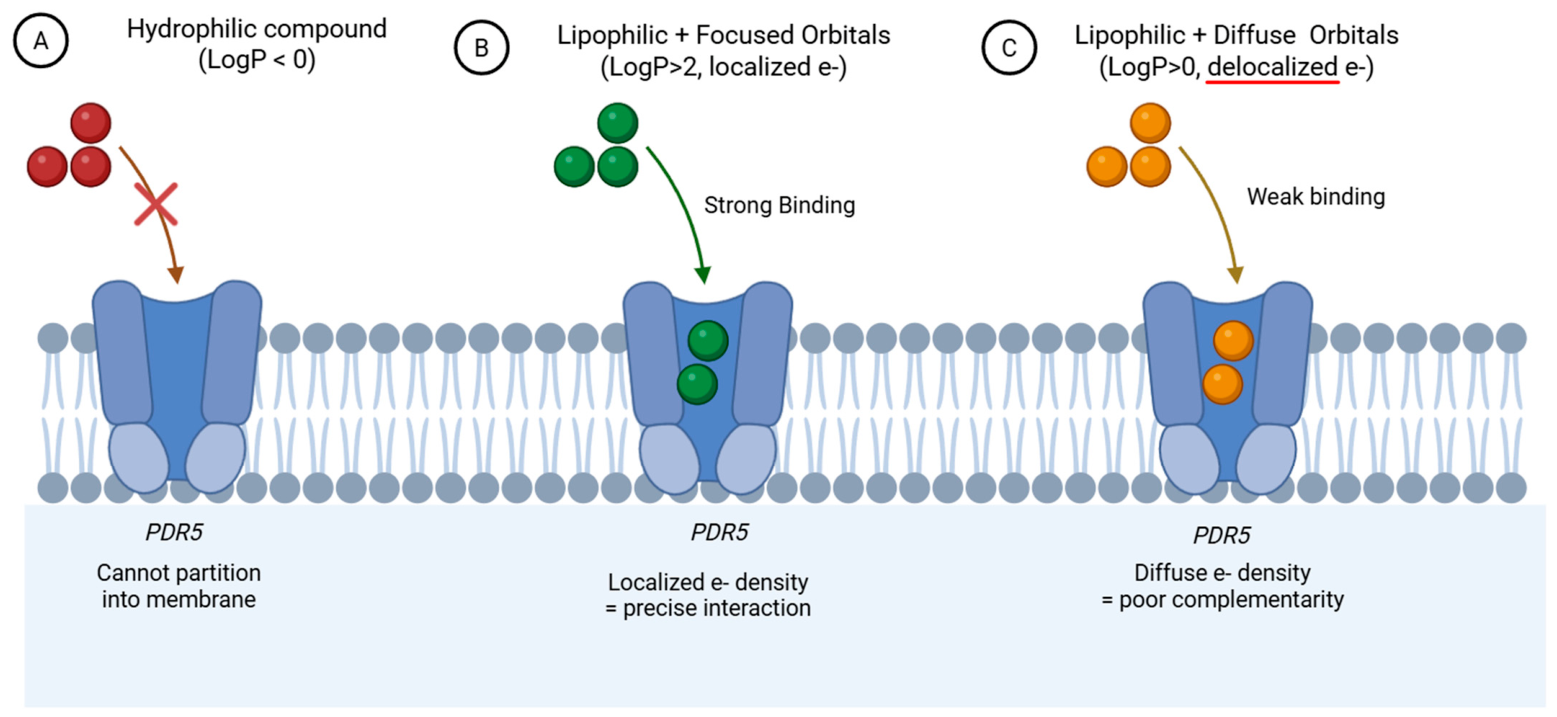
Membrane Access and Orbital Localization Govern ABC Transporter Substrate Recognition


Abstract
1. Introduction
2. Results
2.1. Quantum Chemical Landscape of Pdr5p-Associated Compounds
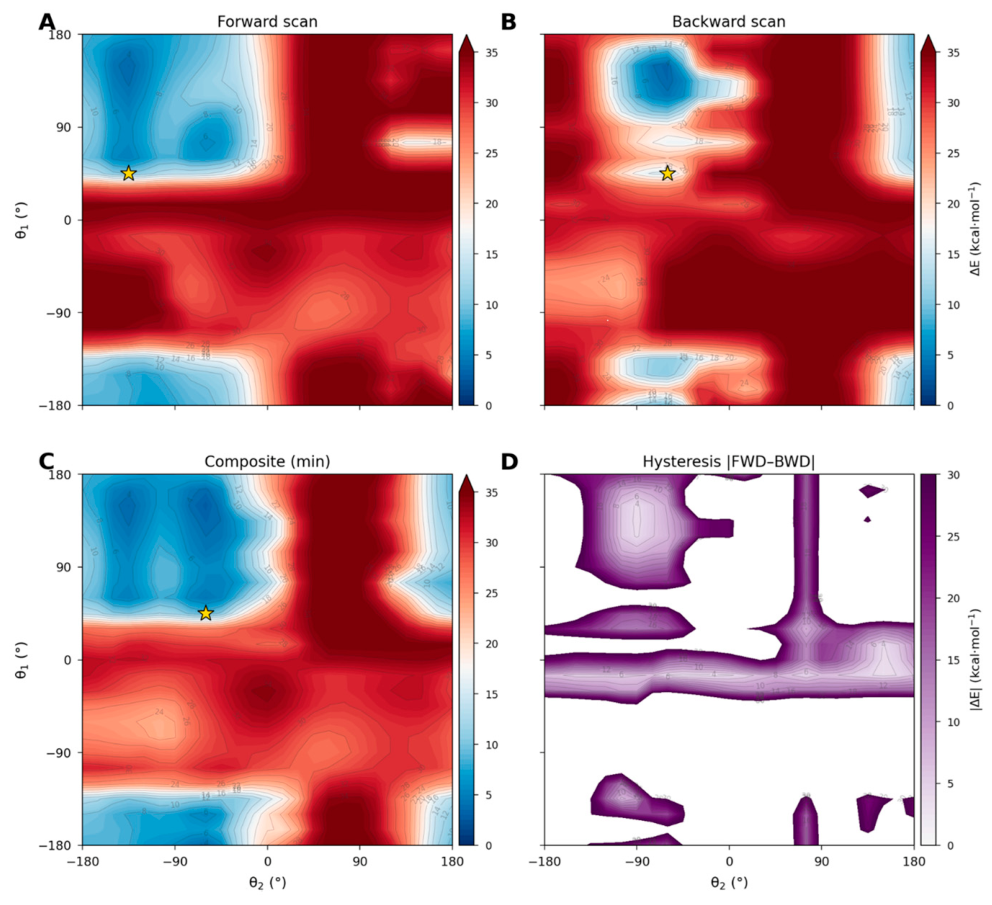
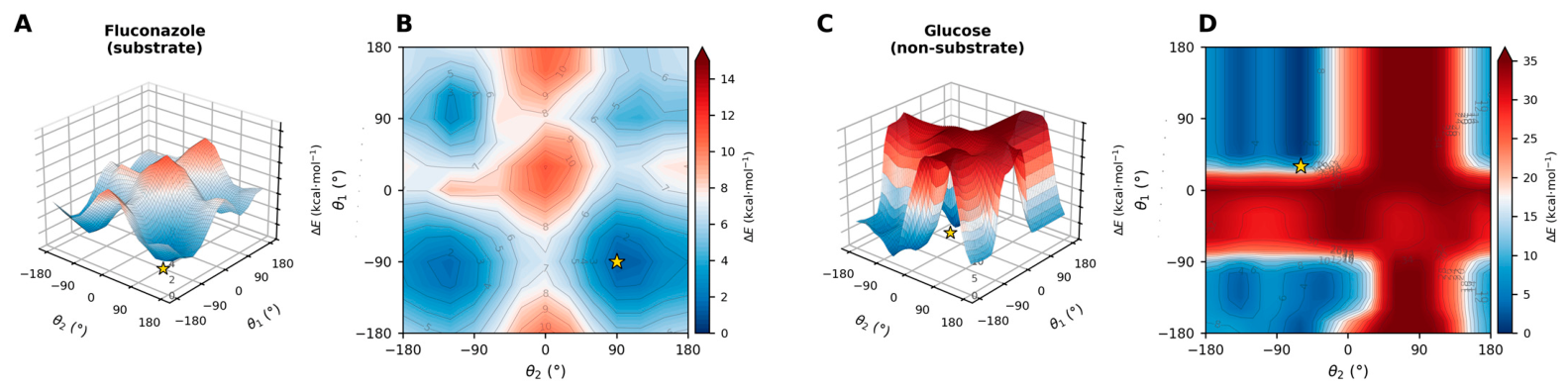
2.2. Conformational Energy Landscapes Reveal Contrasting Flexibility Profiles
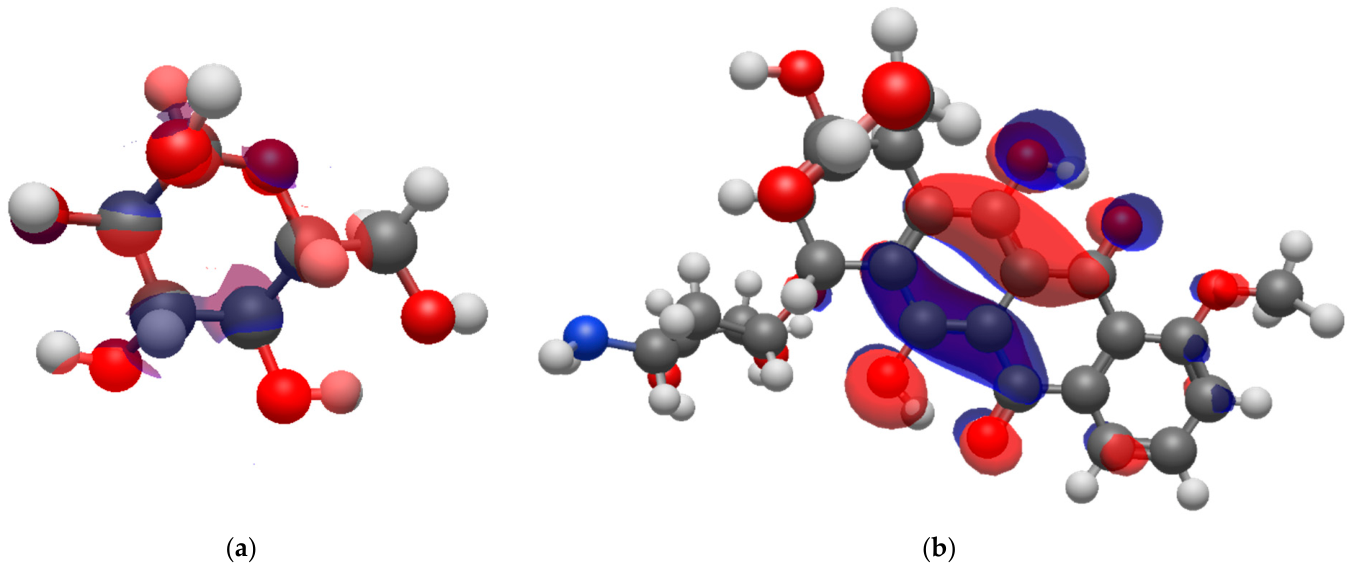
2.3. Frontier Orbital Focalization Distinguishes Substrates from Non-Substrates
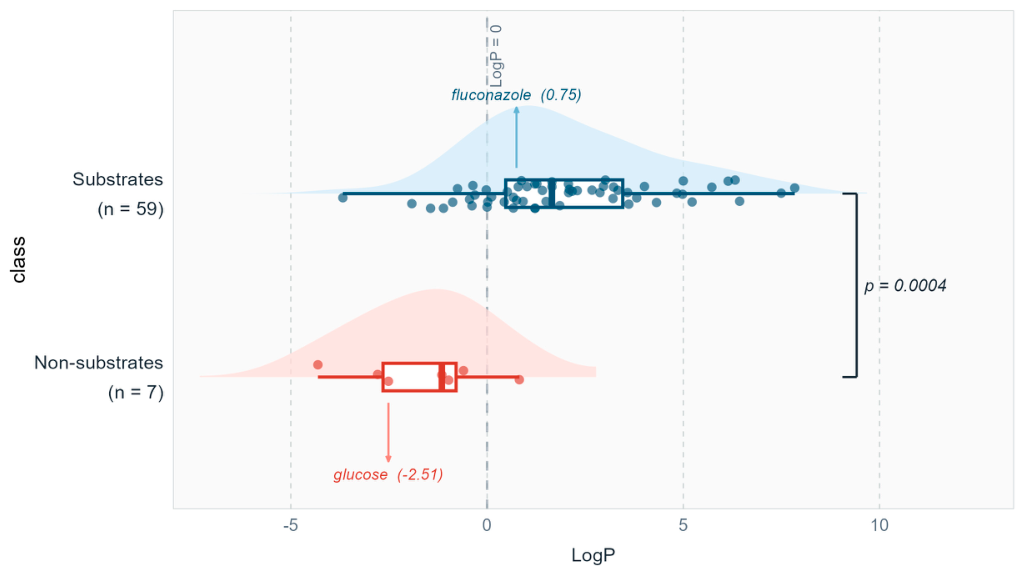
2.4. Lipophilicity Is the Dominant Predictor of Pdr5p Substrate Recognition
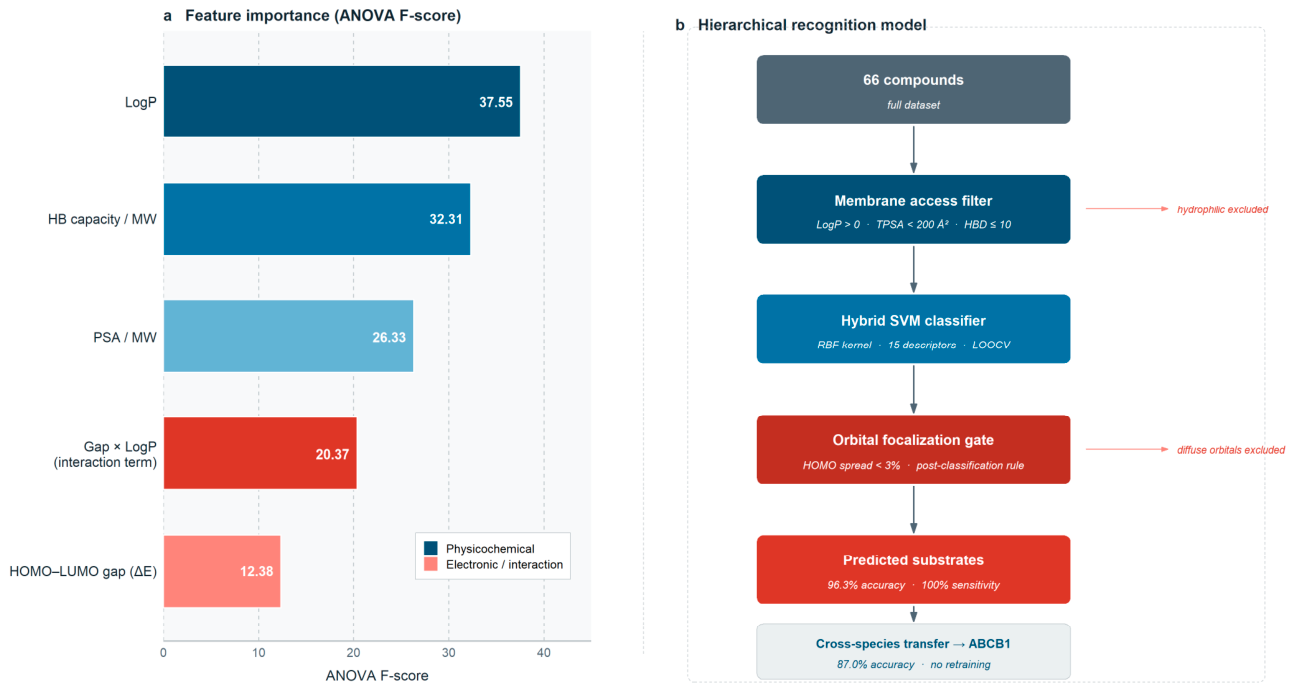
2.5. Hybrid Machine Learning Model Achieves High Accuracy with Perfect Substrate Sensitivity
2.6. Weak Correlation Between Electronic Reactivity and Resistance Magnitude
2.7. Cross-Species Validation Reveals Conserved ABC Transporter Recognition Rules
2.8. Integrated View of Substrate Recognition
3. Discussion
4. Materials and Methods
4.1. Dataset Compilation
4.2. Three-Dimensional Structure Generation
4.3. Density Functional Theory Calculations
4.4. Conformational Potential Energy Surface Calculations
4.5. Molecular Electrostatic Potential and Orbital Localization Analysis
4.6. Physicochemical Descriptor Calculations
4.7. Machine Learning Model Development and Evaluation
4.8. Post-Classification Physicochemical Filtering
4.9. Cross-Species External Validation on Human ABCB1
5. Conclusions
Supplementary Materials
Author Contributions
Funding
Institutional Review Board Statement
Informed Consent Statement
Data Availability Statement
Acknowledgments
Conflicts of Interest
Abbreviations
| ABC | ATP-binding cassette |
| MDR | multidrug resistance |
| PDR | pleiotropic drug resistance |
| DFT | density functional theory |
| FMO | frontier molecular orbital |
| HOMO | highest occupied molecular orbital |
| LUMO | lowest unoccupied molecular orbital |
| MEP | molecular electrostatic potential |
| PES | potential energy surface |
| SVM | support vector machine |
| LOOCV | leave-one-out cross-validation |
| ANOVA | analysis of variance |
| LogP | octanol–water partition coefficient |
| TPSA | topological polar surface area |
| HBD | hydrogen bond donor |
| HBA | hydrogen bond acceptor |
| AUC-ROC | area under the receiver operating characteristic curve |
| MCC | Matthews correlation coefficient |
| SAR | structure–activity relationship |
References
- Nikaido, H. Multidrug resistance in bacteria. Annu. Rev. Biochem. 2009, 78, 119–146. [Google Scholar] [CrossRef] [PubMed]
- Prasad, R.; Goffeau, A. Yeast ATP-binding cassette transporters conferring multidrug resistance. Annu. Rev. Microbiol. 2012, 66, 39–63. [Google Scholar] [CrossRef]
- Balzi, E.; Goffeau, A. Yeast multidrug resistance: The PDR network. J. Bioenerg. Biomembr. 1995, 27, 71–76. [Google Scholar] [CrossRef] [PubMed]
- Delaveau, T.; Delahodde, A.; Carvajal, E.; Subik, J.; Jacq, C. PDR3, a new yeast regulatory gene, is homologous to PDR1 and controls the multidrug resistance phenomenon. Mol. Gen. Genet. 1994, 244, 501–511. [Google Scholar] [CrossRef]
- Kolaczkowski, M.; Kolaczkowska, A.; Luczynski, J.; Witek, S.; Goffeau, A. In vivo characterization of the drug resistance profile of the major ABC transporters and other components of the yeast pleiotropic drug resistance network. Microb. Drug Resist. 1998, 4, 143–158. [Google Scholar] [CrossRef]
- Rogers, B.; Decottignies, A.; Kolaczkowski, M.; Carvajal, E.; Balzi, E.; Goffeau, A. The pleiotropic drug ABC transporters from Saccharomyces cerevisiae. J. Mol. Microbiol. Biotechnol. 2001, 3, 207–214. [Google Scholar] [PubMed]
- Gottesman, M.M.; Fojo, T.; Bates, S.E. Multidrug resistance in cancer: Role of ATP-dependent transporters. Nat. Rev. Cancer 2002, 2, 48–58. [Google Scholar] [CrossRef]
- Lamping, E.; Baret, P.V.; Holmes, A.R.; Monk, B.C.; Goffeau, A.; Cannon, R.D. Fungal PDR transporters: Phylogeny, topology, motifs and function. Fungal Genet. Biol. 2010, 47, 127–142. [Google Scholar] [CrossRef]
- Harris, A.; Wagner, M.; Du, D.; Raschka, S.; Nentwig, L.-M.; Gohlke, H.; Smits, S.H.J.; Luisi, B.F.; Schmitt, L. Structure and efflux mechanism of the yeast pleiotropic drug resistance transporter Pdr5. Nat. Commun. 2021, 12, 5254. [Google Scholar] [CrossRef]
- Kolaczkowski, M.; van der Rest, M.; Cybularz-Kolaczkowska, A.; Soumillion, J.-P.; Konings, W.N.; Goffeau, A. Anticancer drugs, ionophoric peptides, and steroids as substrates of the yeast multidrug transporter Pdr5p. J. Biol. Chem. 1996, 271, 31543–31548. [Google Scholar] [CrossRef]
- Monk, B.C.; Goffeau, A. Outwitting multidrug resistance to antifungals. Science 2008, 321, 367–369. [Google Scholar] [CrossRef]
- Parr, R.G.; Yang, W. Density-Functional Theory of Atoms and Molecules; Oxford University Press: New York, NY, USA, 1989. [Google Scholar]
- Geerlings, P.; De Proft, F.; Langenaeker, W. Conceptual density functional theory. Chem. Rev. 2003, 103, 1793–1874. [Google Scholar] [CrossRef] [PubMed]
- Fukui, K. Role of frontier orbitals in chemical reactions. Science 1982, 218, 747–754. [Google Scholar] [CrossRef] [PubMed]
- Politzer, P.; Murray, J.S. The fundamental nature and role of the electrostatic potential in atoms and molecules. Theor. Chem. Acc. 2002, 108, 134–142. [Google Scholar] [CrossRef]
- Vamathevan, J.; Clark, D.; Czodrowski, P.; Dunham, I.; Ferran, E.; Lee, G.; Li, B.; Madabhushi, A.; Shah, P.; Spitzer, M.; et al. Applications of machine learning in drug discovery and development. Nat. Rev. Drug Discov. 2019, 18, 463–477. [Google Scholar] [CrossRef]
- Montanari, F.; Ecker, G.F. Prediction of drug–ABC-transporter interaction—Recent advances and future challenges. Adv. Drug Deliv. Rev. 2015, 86, 17–26. [Google Scholar] [CrossRef]
- Ferreira, R.J.; Bonito, C.A.; Cordeiro, M.N.D.S.; Ferreira, M.-J.U.; dos Santos, D.J.V.A. Structure–function relationships in ABCG2: Insights from molecular dynamics simulations and molecular docking studies. Sci. Rep. 2017, 7, 15534. [Google Scholar] [CrossRef]
- Dudas, B.; Miteva, M.A. Computational and artificial intelligence-based approaches for drug metabolism and transport prediction. Trends Pharmacol. Sci. 2024, 45, 39–55. [Google Scholar] [CrossRef]
- Ernst, R.; Klemm, R.; Schmitt, L.; Kuchler, K. Yeast ATP-binding cassette transporters: Cellular cleaning pumps. Methods Enzymol. 2005, 400, 460–484. [Google Scholar] [CrossRef]
- Muller, M.P.; Jiang, T.; Sun, C.; Lihan, M.; Pant, S.; Mahinthichaichan, P.; Trifan, A.; Tajkhorshid, E. Characterization of lipid–protein interactions and lipid-mediated modulation of membrane protein function through molecular simulation. Chem. Rev. 2019, 119, 6086–6161. [Google Scholar] [CrossRef]
- Landrum, G. RDKit: Open-Source Cheminformatics Software. Available online: https://www.rdkit.org (accessed on 1 January 2024).
- Wildman, S.A.; Crippen, G.M. Prediction of physicochemical parameters by atomic contributions. J. Chem. Inf. Comput. Sci. 1999, 39, 868–873. [Google Scholar] [CrossRef]
- Golin, J.; Ambudkar, S.V. The multidrug transporter Pdr5 on the 25th anniversary of its discovery: An important model for the study of asymmetric ABC transporters. Biochem. J. 2015, 467, 353–363. [Google Scholar] [CrossRef]
- Lipinski, C.A.; Lombardo, F.; Dominy, B.W.; Feeney, P.J. Experimental and computational approaches to estimate solubility and permeability in drug discovery and development settings. Adv. Drug Deliv. Rev. 2001, 46, 3–26. [Google Scholar] [CrossRef] [PubMed]
- Sharom, F.J. The P-glycoprotein multidrug transporter. Essays Biochem. 2011, 50, 161–178. [Google Scholar] [CrossRef] [PubMed]
- Egner, R.; Rosenthal, F.E.; Kralli, A.; Sanglard, D.; Kuchler, K. Genetic separation of FK506 susceptibility and drug transport in the yeast Pdr5 ATP-binding cassette multidrug resistance transporter. Mol. Biol. Cell 1998, 9, 523–543. [Google Scholar] [CrossRef]
- Kim, S.; Chen, J.; Cheng, T.; Gindulyte, A.; He, J.; He, S.; Li, Q.; Shoemaker, B.A.; Thiessen, P.A.; Yu, B.; et al. PubChem 2023 update. Nucleic Acids Res. 2023, 51, D1373–D1380. [Google Scholar] [CrossRef]
- Riniker, S.; Landrum, G.A. Better informed distance geometry: Using what we know to improve conformation generation. J. Chem. Inf. Model. 2015, 55, 2562–2574. [Google Scholar] [CrossRef]
- Halgren, T.A. Merck molecular force field. I. Basis, form, scope, parameterization, and performance of MMFF94. J. Comput. Chem. 1996, 17, 490–519. [Google Scholar] [CrossRef]
- Neese, F. Software update: The ORCA program system—Version 5.0. WIREs Comput. Mol. Sci. 2022, 12, e1606. [Google Scholar] [CrossRef]
- Becke, A.D. Density-functional thermochemistry. III. The role of exact exchange. J. Chem. Phys. 1993, 98, 5648–5652. [Google Scholar] [CrossRef]
- Lee, C.; Yang, W.; Parr, R.G. Development of the Colle–Salvetti correlation-energy formula into a functional of the electron density. Phys. Rev. B 1988, 37, 785–789. [Google Scholar] [CrossRef] [PubMed]
- Grimme, S.; Ehrlich, S.; Goerigk, L. Effect of the damping function in dispersion corrected density functional theory. J. Comput. Chem. 2011, 32, 1456–1465. [Google Scholar] [CrossRef]
- Weigend, F. Accurate Coulomb-fitting basis sets for H to Rn. Phys. Chem. Chem. Phys. 2006, 8, 1057–1065. [Google Scholar] [CrossRef]
- Barone, V.; Cossi, M. Quantum calculation of molecular energies and energy gradients in solution by a conductor solvent model. J. Phys. Chem. A 1998, 102, 1995–2001. [Google Scholar] [CrossRef]
- Bannwarth, C.; Ehlert, S.; Grimme, S. GFN2-xTB—An accurate and broadly parametrized self-consistent tight-binding quantum chemical method with multipole electrostatics and density-dependent dispersion contributions. J. Chem. Theory Comput. 2019, 15, 1652–1671. [Google Scholar] [CrossRef] [PubMed]
- Grimme, S.; Bannwarth, C.; Shushkov, P. A robust and accurate tight-binding quantum chemical method for structures, vibrational frequencies, and noncovalent interactions of large molecular systems parametrized for all spd-block elements (Z = 1–86). J. Chem. Theory Comput. 2017, 13, 1989–2009. [Google Scholar] [CrossRef] [PubMed]
- Pracht, P.; Bohle, F.; Grimme, S. Automated exploration of the low-energy chemical space with fast quantum chemical methods. Phys. Chem. Chem. Phys. 2020, 22, 7169–7192. [Google Scholar] [CrossRef]
- Virtanen, P.; Gommers, R.; Oliphant, T.E.; Haberland, M.; Reddy, T.; Cournapeau, D.; Burovski, E.; Peterson, P.; Weckesser, W.; Bright, J.; et al. SciPy 1.0: Fundamental algorithms for scientific computing in Python. Nat. Methods 2020, 17, 261–272. [Google Scholar] [CrossRef]
- Hunter, J.D. Matplotlib: A 2D graphics environment. Comput. Sci. Eng. 2007, 9, 90–95. [Google Scholar] [CrossRef]
- Humphrey, W.; Dalke, A.; Schulten, K. VMD: Visual molecular dynamics. J. Mol. Graph. 1996, 14, 33–38. [Google Scholar] [CrossRef]
- Weigend, F.; Ahlrichs, R. Balanced basis sets of split valence, triple zeta valence and quadruple zeta valence quality for H to Rn: Design and assessment of accuracy. Phys. Chem. Chem. Phys. 2005, 7, 3297–3305. [Google Scholar] [CrossRef] [PubMed]
- Ertl, P.; Rohde, B.; Selzer, P. Fast calculation of molecular polar surface area as a sum of fragment-based contributions and its application to the prediction of drug transport properties. J. Med. Chem. 2000, 43, 3714–3717. [Google Scholar] [CrossRef]
- Hastie, T.; Tibshirani, R.; Friedman, J. The Elements of Statistical Learning, 2nd ed.; Springer: New York, NY, USA, 2009. [Google Scholar] [CrossRef]
- Pedregosa, F.; Varoquaux, G.; Gramfort, A.; Michel, V.; Thirion, B.; Grisel, O.; Blondel, M.; Prettenhofer, P.; Weiss, R.; Dubourg, V.; et al. Scikit-learn: Machine learning in Python. J. Mach. Learn. Res. 2011, 12, 2825–2830. [Google Scholar]
- Veber, D.F.; Johnson, S.R.; Cheng, H.-Y.; Smith, B.R.; Ward, K.W.; Kopple, K.D. Molecular properties that influence the oral bioavailability of drug candidates. J. Med. Chem. 2002, 45, 2615–2623. [Google Scholar] [CrossRef] [PubMed]
- Matthews, B.W. Comparison of the predicted and observed secondary structure of T4 phage lysozyme. Biochim. Biophys. Acta 1975, 405, 442–451. [Google Scholar] [CrossRef] [PubMed]



| Category | n | Gap (eV) | χ (eV) | η (eV) |
|---|---|---|---|---|
| Chemotherapy | 5 | 3.70 ± 1.07 | 4.21 ± 0.54 | 1.85 ± 0.53 |
| Membrane stress | 6 | 4.35 ± 0.94 | 3.89 ± 0.72 | 2.18 ± 0.47 |
| Antifungal | 14 | 4.73 ± 0.59 | 3.52 ± 0.38 | 2.37 ± 0.30 |
| Antibiotic | 5 | 4.80 ± 0.53 | 3.68 ± 0.41 | 2.40 ± 0.27 |
| Steroid | 4 | 5.01 ± 0.39 | 3.61 ± 0.22 | 2.50 ± 0.20 |
| Oxidative stress | 12 | 5.09 ± 0.70 | 3.44 ± 0.55 | 2.54 ± 0.35 |
| Control (non-substrate) | 7 | 5.99 ± 1.17 | 2.93 ± 0.48 | 3.00 ± 0.58 |
| Category | n | HOMO Spread (%) | LUMO Spread (%) | Avg. Resistance (Fold) |
|---|---|---|---|---|
| Chemotherapy | 5 | 1.83 | 2.10 | 3.7× |
| Membrane stress | 6 | 2.11 | 2.08 | 9.3× |
| Antifungal | 14 | 2.56 | 2.21 | 277× a |
| Oxidative stress | 12 | 1.79 | 1.80 | 2.3× |
| Control (non-substrate) | 7 | 4.18 | 7.22 | 1.1× |
| Model | n | Accuracy (%) | Balanced Acc. (%) | Sensitivity (%) | Specificity (%) | MCC | p-Value |
|---|---|---|---|---|---|---|---|
| M0: LogP alone | 61 | 83.6 | 90.7 | 81.5 | 100.0 | 0.579 | 0.0040 |
| M1: Classical (6 descriptors) | 61 | 82.0 | 77.4 | 83.3 | 71.4 | 0.415 | 0.0200 |
| M2: Quantum (6 descriptors) | 61 | 85.2 | 73.0 | 88.9 | 57.1 | 0.396 | 0.0319 |
| M3: Combined (12 descriptors) | 61 | 90.2 | 69.6 | 96.3 | 42.9 | 0.455 | 0.0379 |
| M4: Full set (15 descriptors) | 61 | 95.1 | 84.8 | 98.2 | 71.4 | 0.745 | 0.0020 |
| Model | Accuracy | Sensitivity | Specificity | AUC-ROC | Balanced Accuracy | MCC |
|---|---|---|---|---|---|---|
| Logistic Regression | 88.9% | 100% | 57.1% | 0.86 | 78.5% | 0.705 |
| Random Forest | 88.9% | 100% | 57.1% | 0.84 | 78.5% | 0.705 |
| SVM (RBF) | 92.6% | 100% | 71.4% | 0.88 | 85.7% | 0.806 |
| k-Nearest Neighbors (k = 3) | 92.6% | 100% | 57.1% | 0.86 | 78.5% | 0.705 |
| Hybrid (SVM + rules) | 96.3% | 100% | 85.7% | 0.93 | 92.8% | 0.904 |
| Category | n | HOMO Spread (%) | LUMO Spread (%) | ||||
|---|---|---|---|---|---|---|---|
| 0.005 | 0.01 a | 0.02 | 0.005 | 0.01 a | 0.02 | ||
| Chemotherapy | 3 | 3.28 | 1.83 | 0.89 | 3.56 | 2.10 | 1.08 |
| Membrane stress | 2 | 3.72 | 2.06 | 0.98 | 3.03 | 1.70 | 0.85 |
| Antifungal | 3 | 4.45 | 2.56 | 1.28 | 4.13 | 2.21 | 1.10 |
| Oxidative stress | 3 | 3.24 | 1.79 | 0.88 | 3.44 | 1.80 | 0.84 |
| Antibiotic | 1 | 4.01 | 2.20 | 1.07 | 6.12 | 2.82 | 1.12 |
| Control (non-substrate) | 2 | 7.13 | 4.19 | 2.15 | 12.21 | 7.22 | 3.71 |
Disclaimer/Publisher’s Note: The statements, opinions and data contained in all publications are solely those of the individual author(s) and contributor(s) and not of MDPI and/or the editor(s). MDPI and/or the editor(s) disclaim responsibility for any injury to people or property resulting from any ideas, methods, instructions or products referred to in the content. |
© 2026 by the authors. Licensee MDPI, Basel, Switzerland. This article is an open access article distributed under the terms and conditions of the Creative Commons Attribution (CC BY) license.
Share and Cite
Harrizi, S.; Nait Irahal, I.; El Birgui, K.; Kabine, M. Membrane Access and Orbital Localization Govern ABC Transporter Substrate Recognition. Molecules 2026, 31, 2084. https://doi.org/10.3390/molecules31122084
Harrizi S, Nait Irahal I, El Birgui K, Kabine M. Membrane Access and Orbital Localization Govern ABC Transporter Substrate Recognition. Molecules. 2026; 31(12):2084. https://doi.org/10.3390/molecules31122084
Chicago/Turabian StyleHarrizi, Saad, Imane Nait Irahal, Kaouthar El Birgui, and Mostafa Kabine. 2026. "Membrane Access and Orbital Localization Govern ABC Transporter Substrate Recognition" Molecules 31, no. 12: 2084. https://doi.org/10.3390/molecules31122084
APA StyleHarrizi, S., Nait Irahal, I., El Birgui, K., & Kabine, M. (2026). Membrane Access and Orbital Localization Govern ABC Transporter Substrate Recognition. Molecules, 31(12), 2084. https://doi.org/10.3390/molecules31122084