Structural Knowledge Is What Matters in Protein–Ligand Binding Affinity Prediction


Abstract
1. Introduction
2. Results
2.1. Analysis of the Importance of Variables
2.2. Analysis of the Independence of Variables
3. Discussion
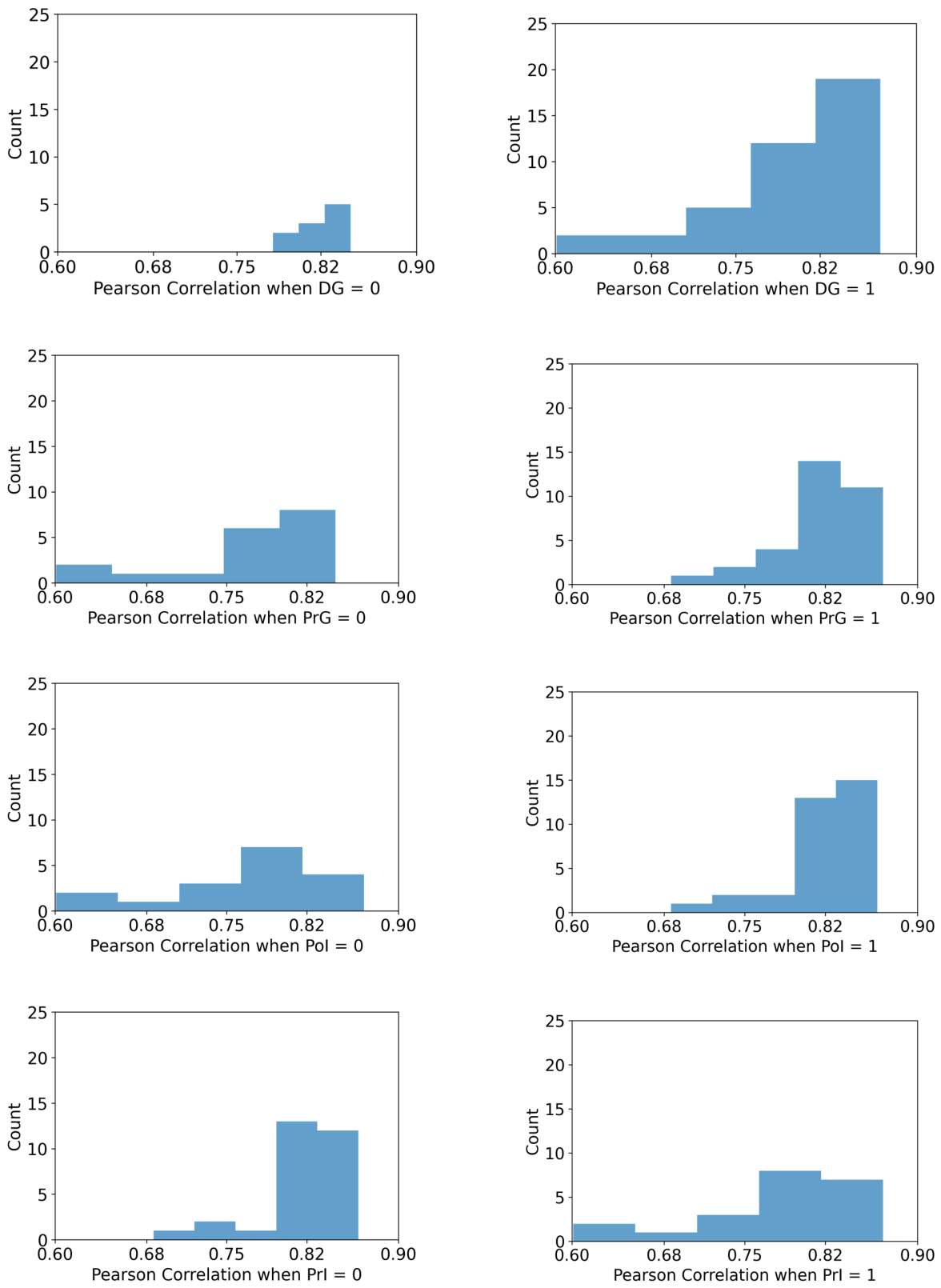
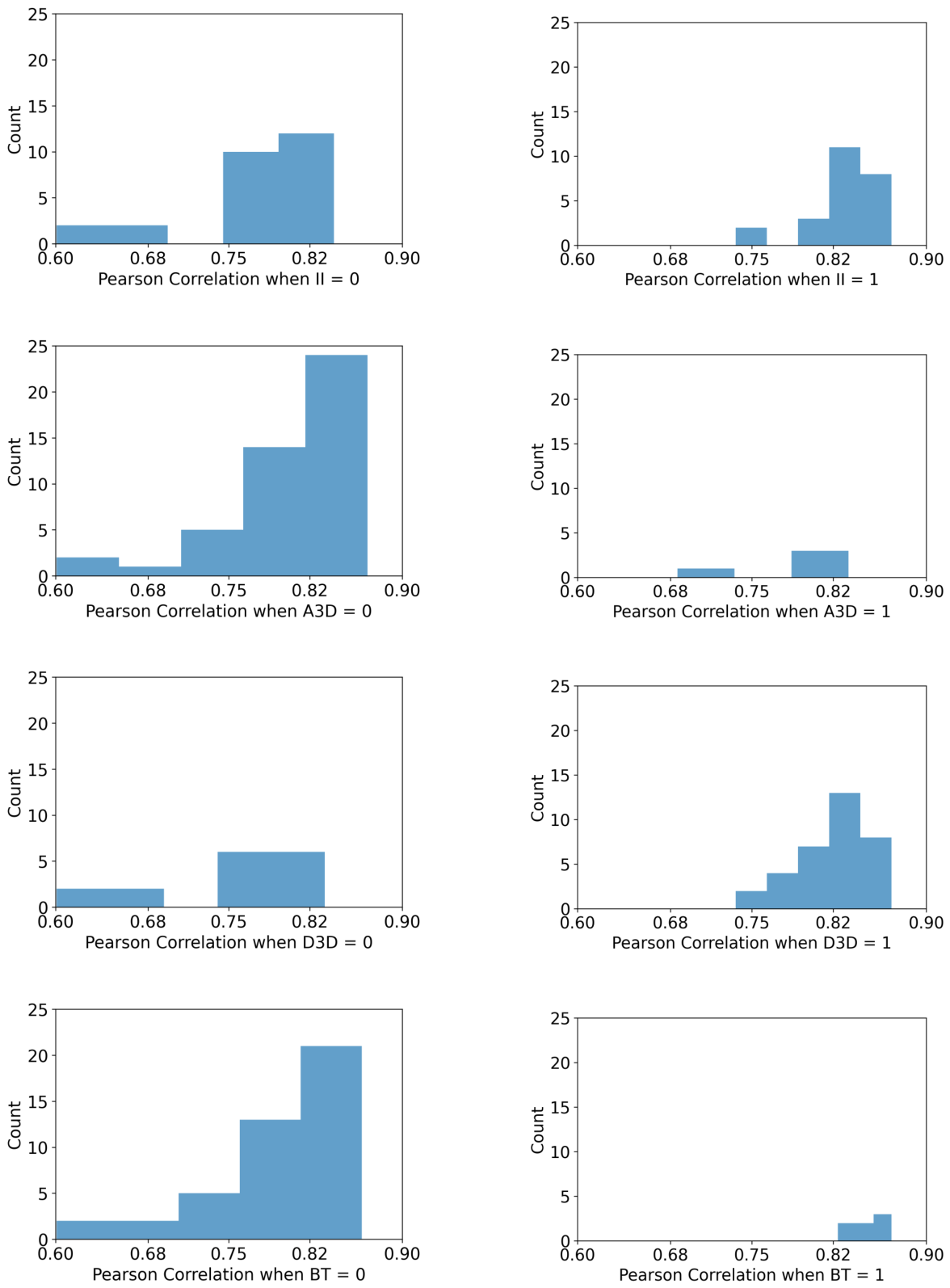
- The five most important properties that the models must have to achieve the highest Pearson coefficient are:(1) The model introduces the drug as a graph.(2) The pocket has to be selected (the atoms and the bonds of the protein that are “close to” the drug) and introduced into the model.(3) The model introduces the interactions between the protein and the drug.(4) The model uses the 3D information on the atoms. Nevertheless, the 3D information must be invariant to rotation and translation. For this reason, the distance between the atoms must be introduced into the model and not the specific 3D position.(5) The model uses the type of chemical bonds.
- Most of the models do not introduce the protein, the pocket and the interactions between pocket and protein at the same time. The authors assume this is due to the need to reduce the volume of the data and the belief in the redundancy of this data.
- The protein is not entirely introduced as a graph. It is introduced only by the pocket as a graph or the whole protein as a vector or string. The authors believe this is because the graph of a protein is too large to be processed or because of runtime restrictions.
4. Materials and Methods
4.1. Binding Affinity Prediction Based on Machine Learning
4.2. Practical Experiments on Binding Affinity Prediction

| Model | Ref. | Year | RMSE | Data Ref. | |
|---|---|---|---|---|---|
| CheapNET | [11] | 2025 | 0.870 | 1.107 | [11] |
| saCNN | [12] | 2021 | 0.865 | 1.117 | [13] |
| TopBP | [14] | 2018 | 0.861 | 1.650 | [15] |
| egGNN | [16] | 2021 | 0.860 | 1.122 | [16] |
| SS–GNN | [15] | 2023 | 0.853 | 1.181 | [15] |
| MP-GNN | [17] | 2022 | 0.851 | - | [17] |
| DAAP | [18] | 2025 | 0.845 | 1.196 | [18] |
| Mol-PSI | [19] | 2022 | 0.844 | 1.278 | [15] |
| DCML | [20] | 2022 | 0.843 | 1.255 | [15] |
| CAPLA | [21] | 2023 | 0.841 | 1.206 | [17] |
| GIGN | [22] | 2023 | 0.840 | 1.190 | [17] |
| PerSpect ML | [23] | 2021 | 0.840 | 1.724 | [15] |
| FPRC | [24] | 2021 | 0.838 | - | [17] |
| AGL-Score | [25] | 2019 | 0.833 | 1.733 | [25] |
| SableBind | [26] | 2025 | 0.832 | 1.205 | [26] |
| HPC/HWPC | [27] | 2022 | 0.831 | 1.307 | [15] |
| CurvAGN | [28] | 2023 | 0.830 | 1.217 | [28] |
| DEAttentionDTA | [29] | 2024 | 0.827 | 1.266 | [11] |
| PLEC | [30] | 2019 | 0.826 | - | [17] |
| DeepAtom | [31] | 2019 | 0.825 | 1.232 | [13] |
| DG-GL | [32] | 2019 | 0.825 | 1.767 | [32] |
| PLANET | [33] | 2024 | 0.824 | 1.247 | [33] |
| LGN-GIN | [34] | 2024 | 0.822 | 1.333 | [34] |
| IGN | [35] | 2021 | 0.821 | 1.269 | [11] |
| KDeep | [36] | 2018 | 0.820 | 1.270 | [15] |
| EGNN | [37] | 2021 | 0.816 | 1.289 | [11] |
| OnionNet | [38] | 2019 | 0.816 | 1.278 | [15] |
| Fusion-Score | [13] | 2021 | 0.815 | 1.300 | [13] |
| ELGN | [39] | 2024 | 0.810 | 1.285 | [28] |
| TNET-BP | [40] | 2017 | 0.810 | 1.340 | [40] |
| FAST | [41] | 2021 | 0.810 | 1.308 | [41] |
| GAABind | [42] | 2024 | 0.803 | 1.297 | [11] |
| SIGN | [43] | 2021 | 0.797 | 1.316 | [28] |
| LGN-GAT | [34] | 2024 | 0.794 | 1.424 | [34] |
| SchNet | [44] | 2017 | 0.787 | 1.390 | [11] |
| DeepDTAF | [45] | 2021 | 0.785 | 1.357 | [45] |
| AttentionSiteDTI | [46] | 2022 | 0.784 | 1.352 | [11] |
| Pafnucy | [47] | 2018 | 0.780 | 1.420 | [15] |
| PotentialNET | [48] | 2018 | 0.772 | 1.503 | [11] |
| CMPNN | [49] | 2020 | 0.765 | 1.408 | [28] |
| LGN-GTN | [34] | 2024 | 0.767 | 1.481 | [34] |
| GraphDTA-GAT-GCN | [50] | 2021 | 0.754 | 1.434 | [11] |
| MGraphDTA | [51] | 2022 | 0.753 | 1.439 | [11] |
| DimeNet | [52] | 2021 | 0.752 | 1.453 | [28] |
| MAT | [53] | 2020 | 0.747 | 1.457 | [28] |
| GNN-DTI | [54] | 2019 | 0.736 | 1.492 | [28] |
| SGCN | [55] | 2020 | 0.686 | 1.583 | [28] |
| GraphDTA-GIN | [50] | 2021 | 0.667 | 1.640 | [28] |
| GraphDTA-GCN | [50] | 2021 | 0.613 | 1.735 | [28] |
| GraphDTA-GAT | [50] | 2021 | 0.601 | 1.765 | [28] |
4.3. Structural Properties of the Binding Affinity Methods
- DG: The Drug is represented as an attributed Graph. Other alternatives are to represent the drug as a string (SMILES), molecular fingerprints (Morgan, ECFP, MACCS keys) or Physicochemical Descriptor Vectors (LogP, TPSA). In all the models, the whole drug, usually much smaller than the protein, is included.
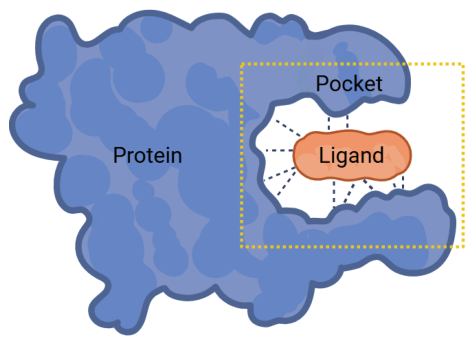
- PrG: The Protein or a part of the protein is represented as an attributed Graph. Some of the models do not include the whole protein but only the pocket. The next category is used to distinguish between both cases.
- PrI: The whole Protein is part of the Input. As in PrG, some models only include the pocket.
- PoI: The Pocket is part of the Input. Some models specifically incorporate the pocket, although they can also include the whole protein or not. The existence of this property is not contradictory to the existence of PrI. Nevertheless, if both exist, some redundant information is introduced into the model.
- II: Interaction between the protein and drug is part of the Input. Some models deduce the interactions between the protein and drug, such as an estimation of the non-covalent bonds, and then consider them in the model.
- A3D: The Atom’s 3D positions are considered. The model introduces the 3D position of the atom, usually obtained by the SDF and PDB files or some chemical computational programs. This knowledge is written in the node attributes.
- D3D: Data on 3D positions is considered, although it is not part of the node attributes. Some distances or functions are computed using the 3D position, but the 3D information itself is not stored in the node attributes. Therefore, D3D and A3D are mutually exclusive.
- BT: Bond Types are considered as attributes of the graph edges. In the same way as for the 3D position, this information is extracted from the SDF and PDB files or computed in some chemistry programs. In contrast, some models deduce the existence of a pair-of-atoms relation, and this information is structured as an edge between nodes. However, edges do not have attributes. A common option is to impose an edge if the distance between atoms is smaller than a given threshold, for example, to 5 Å.
| Representation | Model Input | Struct. Features | |||||||
|---|---|---|---|---|---|---|---|---|---|
| Model | Ref. | DG | PrG | PoI | PrI | II | A3D | D3D | BT |
| CheapNET | [11] | 1 | 1 | 0 | 1 | 1 | 0 | 1 | 1 |
| saCNN | [12] | 1 | 1 | 1 | 0 | 1 | 0 | 1 | 0 |
| TopBP | [14] | 1 | 1 | 1 | 1 | 1 | 0 | 1 | 1 |
| egGNN | [16] | 1 | 1 | 1 | 0 | 1 | 0 | 1 | 1 |
| SS-GNN | [15] | 1 | 1 | 1 | 0 | 1 | 0 | 1 | 1 |
| MP-GNN | [17] | 1 | 1 | 1 | 0 | 1 | 0 | 1 | 0 |
| DAAP | [18] | 0 | 0 | 1 | 1 | 1 | 0 | 1 | 0 |
| Mol-PSI | [19] | 1 | 1 | 1 | 0 | 1 | 0 | 1 | 0 |
| DCML | [20] | 1 | 1 | 1 | 0 | 1 | 0 | 1 | 0 |
| CAPLA | [21] | 0 | 0 | 1 | 1 | 0 | 0 | 1 | 0 |
| GIGN | [22] | 1 | 1 | 1 | 0 | 1 | 0 | 1 | 1 |
| PerSpect ML | [23] | 1 | 1 | 1 | 0 | 0 | 0 | 1 | 0 |
| FPRC | [24] | 1 | 1 | 1 | 0 | 1 | 0 | 1 | 0 |
| AGL-Score | [25] | 1 | 1 | 1 | 0 | 1 | 1 | 0 | 0 |
| SableBind | [26] | 1 | 1 | 0 | 1 | 0 | 0 | 0 | 1 |
| HPC/HWPC | [27] | 1 | 1 | 1 | 0 | 1 | 0 | 1 | 0 |
| CurvAGN | [28] | 1 | 1 | 1 | 0 | 1 | 0 | 1 | 0 |
| DEAttentionDTA | [29] | 0 | 0 | 1 | 1 | 0 | 0 | 0 | 0 |
| PLEC | [30] | 0 | 0 | 1 | 0 | 1 | 0 | 0 | 0 |
| DeepAtom | [31] | 0 | 0 | 0 | 0 | 0 | 0 | 1 | 0 |
| DG-GL | [32] | 1 | 1 | 1 | 0 | 1 | 0 | 1 | 0 |
| PLANET | [33] | 1 | 1 | 1 | 0 | 1 | 0 | 1 | 1 |
| LGN-GIN | [34] | 1 | 1 | 1 | 0 | 1 | 0 | 1 | 0 |
| IGN | [35] | 1 | 1 | 1 | 0 | 1 | 0 | 1 | 0 |
| KDeep | [36] | 0 | 0 | 0 | 1 | 0 | 0 | 1 | 0 |
| EGNN | [37] | 1 | 1 | 1 | 0 | 0 | 0 | 1 | 0 |
| OnionNet | [38] | 0 | 0 | 1 | 0 | 0 | 0 | 1 | 0 |
| Fusion-Score | [13] | 1 | 1 | 0 | 1 | 0 | 1 | 0 | 0 |
| ELGN | [39] | 1 | 1 | 1 | 0 | 1 | 0 | 1 | 0 |
| TNET-BP | [40] | 0 | 0 | 0 | 1 | 0 | 0 | 1 | 0 |
| FAST | [41] | 1 | 1 | 1 | 0 | 0 | 1 | 0 | 0 |
| GAABind | [42] | 1 | 1 | 1 | 0 | 0 | 0 | 1 | 0 |
| SIGN | [43] | 1 | 1 | 1 | 0 | 1 | 0 | 1 | 0 |
| LGN-GAT | [34] | 1 | 1 | 1 | 0 | 1 | 0 | 1 | 0 |
| SchNet | [44] | 1 | 0 | 0 | 1 | 0 | 0 | 1 | 0 |
| DeepDTAF | [45] | 0 | 0 | 1 | 1 | 0 | 0 | 0 | 0 |
| AttentionSiteDTI | [46] | 1 | 1 | 1 | 0 | 0 | 0 | 1 | 0 |
| Pafnucy | [47] | 0 | 0 | 0 | 1 | 0 | 0 | 1 | 0 |
| PotentialNET | [48] | 1 | 1 | 0 | 1 | 0 | 0 | 1 | 0 |
| CMPNN | [49] | 1 | 1 | 0 | 1 | 0 | 0 | 0 | 0 |
| GraphDTA-GAT-GCN | [50] | 1 | 0 | 0 | 1 | 0 | 0 | 0 | 0 |
| LGN-GTN | [34] | 1 | 1 | 1 | 0 | 1 | 0 | 1 | 0 |
| MGraphDTA | [51] | 1 | 0 | 0 | 1 | 0 | 0 | 0 | 0 |
| DimeNet | [52] | 1 | 0 | 0 | 1 | 0 | 0 | 0 | 0 |
| MAT | [53] | 1 | 0 | 0 | 1 | 0 | 0 | 0 | 0 |
| GNN-DTI | [54] | 1 | 1 | 1 | 0 | 1 | 0 | 1 | 0 |
| SGCN | [55] | 1 | 1 | 1 | 0 | 0 | 1 | 0 | 0 |
| GraphDTA-GIN | [50] | 1 | 0 | 0 | 1 | 0 | 0 | 0 | 0 |
| GraphDTA-GCN | [50] | 1 | 0 | 0 | 1 | 0 | 0 | 0 | 0 |
| GraphDTA-GAT | [50] | 1 | 0 | 0 | 1 | 0 | 0 | 0 | 0 |
5. Conclusions
- Structural information of the pocket and the ligand.
- The chemical relations generated between the protein and the ligand.
- 3D information independent of rotations and translations.
- The drug as an attributed graph.
Author Contributions
Funding
Data Availability Statement
Acknowledgments
Conflicts of Interest
Appendix A


References
- Zhao, T.; Hu, Y.; Valsdottir, L.R.; Zang, T.; Peng, J. Identifying drug–target interactions based on graph convolutional network and deep neural network. Brief. Bioinform. 2020, 22, 2141–2150. [Google Scholar] [CrossRef]
- Fadlallah, S.; Julià, C.; García-Vallvé, S.; Pujadas, G.; Serratosa, F. Drug Potency Prediction of SARS-CoV-2 Main Protease Inhibitors Based on a Graph Generative Model. Int. J. Mol. Sci. 2023, 24, 8779. [Google Scholar] [CrossRef]
- Serratosa, F. AE+GAE: A mixture model for structural and semantic feature detection in graph neural network regression. Pattern Recognit. Lett. 2025, 195, 80–86. [Google Scholar] [CrossRef]
- Nelson, D.L.; Cox, M.M. Lehninger Principles of Biochemistry, 8th ed.; W. H. Freeman and Company: New York, NY, USA, 2021. [Google Scholar]
- Cheng, Y.C.; Prusoff, W.H. Relationship between the inhibition constant (Ki) and the concentration of inhibitor which causes 50 per cent inhibition (IC50) of an enzymatic reaction. Biochem. Pharmacol. 1973, 22, 3099–3108. [Google Scholar] [CrossRef] [PubMed]
- Liu, Z.; Su, M.; Han, L.; Liu, J.; Yang, Q.; Li, Y.; Wang, R. Forging the Basis for Developing Protein–Ligand Interaction Scoring Functions. Acc. Chem. Res. 2017, 50, 302–309. [Google Scholar] [CrossRef] [PubMed]
- Su, M.; Yang, Q.; Du, Y.; Feng, G.; Liu, Z.; Li, Y.; Wang, R. Comparative Assessment of Scoring Functions: The CASF-2016 Update. J. Chem. Inf. Model. 2019, 59, 895–913. [Google Scholar] [CrossRef]
- Debnath, K.; Rana, P.; Ghosh, P. A survey on deep learning for drug-target binding prediction: Models, benchmarks, evaluation, and case studies. Brief. Bioinform. 2025, 26, bbaf491. [Google Scholar] [CrossRef]
- Wang, Y.; Lv, J.; Xia, Y.; Xu, J.; Meng, Y.; Cui, F.; Wei, L.; Zou, Q.; Zhang, Z. A unified survey on drug-target interaction and binding affinity prediction: Models, representations, and challenges. Biotechnol. Adv. 2026, 88, 108843. [Google Scholar] [CrossRef]
- Dietterich, T.G. Approximate Statistical Tests for Comparing Supervised Classification Learning Algorithms. Neural Comput. 1998, 10, 1895–1923. [Google Scholar] [CrossRef]
- Lim, H.; Kim, S.; Lee, S. CHEAPNET: Cross-attention on hierarchical representations for efficient protein-ligand binding affinity prediction. In Proceedings of the 13th International Conference on Learning Representations, ICLR 2025, Singapore, 24–28 April 2025; pp. 17663–17696. [Google Scholar]
- Wang, Y.; Qiu, Z.; Jiao, Q.; Chen, C.; Meng, Z.; Cui, X. Structure-Based Protein-Drug Affinity Prediction with Spatial Attention Mechanisms. In Proceedings of the 2021 IEEE International Conference on Bioinformatics and Biomedicine (BIBM), Houston, TX, USA, 9–12 December2021. [Google Scholar]
- Wang, Y.; Jiao, Q.; Wang, J.; Cai, X.; Zhao, W.; Cui, X. Prediction of protein-ligand binding affinity with deep learning. Comput. Struct. Biotechnol. J. 2023, 21, 5796–5806. [Google Scholar] [CrossRef]
- Cang, Z.; Mu, L.; Wei, G.W. Representability of algebraic topology for biomolecules in machine learning based scoring and virtual screening. PLoS Comput. Biol. 2018, 14, e1005929. [Google Scholar] [CrossRef]
- Zhang, S.; Jin, Y.; Liu, T.; Wang, Q.; Zhang, Z.; Zhao, S.; Shan, B. SS-GNN: A Simple-Structured Graph Neural Network for Affinity Prediction. ACS Omega 2023, 8, 22496–22507. [Google Scholar] [CrossRef]
- Jiao, Q.; Qiu, Z.; Wang, Y.; Chen, C.; Yang, Z.; Cui, X. Edge-Gated Graph Neural Network for Predicting Protein-Ligand Binding Affinities. In Proceedings of the 2021 IEEE International Conference on Bioinformatics and Biomedicine (BIBM), Houston, TX, USA, 9–12 December 2021; pp. 334–339. [Google Scholar] [CrossRef]
- Li, X.S.; Liu, X.; Lu, L.; Hua, X.S.; Chi, Y.; Xia, K. Multiphysical graph neural network (MP-GNN) for COVID-19 drug design. Brief. Bioinform. 2022, 23, bbac231. [Google Scholar] [CrossRef] [PubMed]
- Rahman, J.; Newton, M.; Ali, M.; Sattar, A. Distance plus attention for binding affinity prediction. J. Cheminform. 2024, 16, 52. [Google Scholar] [CrossRef] [PubMed]
- Jiang, P.; Chi, Y.; Li, X.S.; Meng, Z.; Liu, X.; Hua, X.S.; Xia, K. Molecular Persistent Spectral Image (Mol-PSI) Representation for Machine Learning Models in Drug Design. Brief. Bioinform. 2022, 23, bbab527. [Google Scholar]
- Liu, X.; Feng, H.; Wu, J.; Xia, K. Dowker complex based machine learning (DCML) models for protein-ligand binding affinity prediction. PLoS Comput. Biol. 2022, 18, e1009943. [Google Scholar]
- Jin, Z.; Wu, T.; Chen, T.; Pan, D.; Wang, X.; Xie, J.; Quan, L.; Lyu, Q. CAPLA: Improved prediction of protein–ligand binding affinity by a deep learning approach based on a cross-attention mechanism. Bioinformatics 2023, 39, btad049. [Google Scholar] [CrossRef]
- Yang, Z.; Zhong, W.; Lv, Q.; Dong, T.; Chen, C.Y.C. Geometric Interaction Graph Neural Network for Predicting Protein Ligand Binding Affinities from 3D Structures (GIGN). J. Phys. Chem. Lett. 2023, 14, 2020–2033. [Google Scholar] [CrossRef]
- Meng, Z.; Xia, K. Persistent spectral–based machine learning (PerSpect ML) for protein-ligand binding affinity prediction. Sci. Adv. 2021, 7, eabc5329. [Google Scholar] [CrossRef]
- Wee, J.; Xia, K. Forman persistent Ricci curvature (FPRC)-based machine learning models for protein-ligand binding affinity prediction. Brief. Bioinform. 2021, 22, bbab136. [Google Scholar]
- Nguyen, D.D.; Wei, G.W. AGL-Score: Algebraic Graph Learning Score for Protein-Ligand Binding Scoring, Ranking, Docking, and Screening. J. Chem. Inf. Model. 2019, 59, 3291–3304. [Google Scholar] [CrossRef]
- Li, J.; Gong, X. Harnessing Pre-trained Models for Accurate Prediction of Protein-Ligand Binding Affinity. BMC Bioinform. 2025, 26, 55. [Google Scholar] [CrossRef]
- Liu, X.; Wang, X.; Wu, J.; Xi, K. Hypergraph-based persistent cohomology (HPC) for molecular representations in drug design. Brief. Bioinform. 2022, 5, bbaa411. [Google Scholar]
- Wu, J.; Chen, H.; Cheng, M.; Xiong, H. CurvAGN: Curvature-based Adaptive Graph Neural Networks for Predicting Protein-Ligand Binding Affinity. BMC Bioinform. 2023, 24, 378. [Google Scholar] [CrossRef]
- Chen, X.; Huang, J.; Shen, T.; Zhang, H.; Xu, L.; Yang, M.; Xie, X.; Yan, Y.; Yan, J. DEAttentionDTA: Protein–ligand binding affinity prediction based on dynamic embedding and self-attention. Bioinformatics 2024, 40, btae319. [Google Scholar] [CrossRef]
- Wójcikowski, M.; Kukiełka, M.; Stepniewska-Dziubinska, M.M.; Siedlecki, P. Development of a protein–ligand extended connectivity (PLEC) fingerprint and its application for binding affinity predictions. Bioinformatics 2019, 35, 1334–1341. [Google Scholar] [CrossRef] [PubMed]
- Li, Y.; Rezaei, M.A.; Li, C.; Li, X.; Wu, D. DeepAtom: A framework for protein-ligand binding affinity prediction. In Proceedings of the 2019 IEEE International Conference on Bioinformatics and Biomedicine (BIBM), San Diego, CA, USA, 18–21 November 2019. [Google Scholar]
- Nguyen, D.D.; Wei, G.W. DG-GL: Differential geometry-based geometric learning of molecular datasets. Int. J. Numer. Method Biomed. Eng. 2019, 35, e3179. [Google Scholar] [CrossRef]
- Zhang, X.; Gao, H.; Wang, H.; Chen, Z.; Zhang, Z.; Chen, X.; Li, Y.; Qi, Y.; Wang, R. PLANET: A Multi-Objective Graph Neural Network Model for Protein–Ligand Binding Affinity Prediction. J. Chem. Inf. Model. 2024, 64, 2205–2220. [Google Scholar] [CrossRef] [PubMed]
- Guo, J. Improving structure-based protein-ligand affinity prediction by graph representation learning and ensemble learning. PLoS ONE 2024, 19, e0296676. [Google Scholar] [CrossRef] [PubMed]
- Jiang, D.; Hsieh, C.Y.; Wu, Z.; Kang, Y.; Wang, J.; Wang, E.; Liao, B.; Shen, C.; Xu, L.; Wu, J.; et al. InteractionGraphNet: A Novel and Efficient Deep Graph Representation Learning Framework for Accurate Protein-Ligand Interaction Predictions. J. Med. Chem. 2021, 64, 18209–18232. [Google Scholar]
- Jiménez, J.; Skalic, M.; Martínez-Rosell, G.; Fabritiis, G.D. KDEEP: Protein Ligand Absolute Binding Affinity Prediction via 3D Convolutional Neural Networks. J. Chem. Inf. Model. 2018, 58, 287–296. [Google Scholar] [CrossRef] [PubMed]
- Satorras, V.G.; Hoogeboom, E.; Welling, M. E(n) Equivariant Graph Neural Networks. In Proceedings of the 38th International Conference on Machine Learning, Virtual Event, 18–24 July 2021; Meila, M., Zhang, T., Eds.; PMLR: Cambridge, MA, USA, 2021; Volume 139, pp. 9323–9332. [Google Scholar]
- Zheng, L.; Fan, J.; Mu, Y. OnionNet: A Multiple-Layer Intermolecular Contact Based Convolutional Neural Network for Protein Ligand Binding Affinity Prediction. ACS Omega 2019, 4, 15956–15965. [Google Scholar]
- Yi, Y.; Wan, X.; Zhao, K.; Ou-Yang, L.; Zhao, P. Equivariant Line Graph Neural Network for Protein-Ligand Binding Affinity Prediction. IEEE J. Biomed. Health Inform. 2024, 28, 4336–4347. [Google Scholar] [PubMed]
- Cang, Z.; Wei, G.-W. TopologyNet: Topology based deep convolutional and multi-task neural networks for biomolecular property predictions. PLoS Comput. Biol. 2017, 13, e1005690. [Google Scholar] [CrossRef] [PubMed]
- Jones, D.; Kim, H.; Zhang, X.; Zemla, A.; Stevenson, G.; Bennett, W.D.; Kirshner, D.; Wong, S.E.; Lightstone, F.C.; Allen, J.E. Improved Protein-Ligand Binding Affinity Prediction with Structure-Based Deep Fusion Inference. J. Chem. Inf. Model. 2021, 61, 1583–1592. [Google Scholar] [CrossRef]
- Tan, H.; Wang, Z.; Hu, G. GAABind: A geometry-aware attention-based network for accurate protein-ligand binding pose and binding affinity prediction. Brief. Bioinform. 2025, 25, bbad462. [Google Scholar] [CrossRef]
- Li, S.; Zhou, J.; Xu, T.; Huang, L.; Wang, F.; Xiong, H.; Xiong, H. Structure-aware interactive graph neural networks for the prediction of protein-ligand binding affinity. In Proceedings of the 27th ACM SIGKDD Conference on Knowledge Discovery & Data Mining, Virtually, 14–81 August 2021; pp. 975–985. [Google Scholar]
- Schütt, K.T.; Kindermans, P.J.; Sauceda, H.E.; Chmiela, S.; Tkatchenko, A.; Müller, K.R. SchNet: A continuous-filter convolutional neural network for modeling quantum interactions. In Proceedings of the 31st Conference on Neural Information Processing Systems (NIPS 2017), Long Beach, CA, USA, 4–9 December 2017. [Google Scholar]
- Wang, K.; Zhou, R.; Li, Y.; Li, M. DeepDTAF: A deep learning method to predict protein ligand binding affinity. Brief. Bioinform. 2021, 22, bbab072. [Google Scholar] [CrossRef]
- Yazdani-Jahromi, M.; Yousefi, N.; Tayebi, A.; Kolanthai, E.; Neal, C.J.; Seal, S.; Garibay, O.O. AttentionSiteDTI: An interpretable graph-based model for drug-target interaction prediction using NLP sentence-level relation classification. Brief. Bioinform. 2022, 23, bbac272. [Google Scholar]
- Stepniewska-Dziubinska, M.M.; Zielenkiewicz, P.; Siedlecki, P. Development and evaluation of a deep learning model for protein–ligand binding affinity prediction. Bioinformatics 2018, 34, 3666–3674. [Google Scholar] [CrossRef]
- Feinberg, E.N.; Sur, D.; Wu, Z.; Husic, B.E.; Mai, H.; Li, Y.; Sun, S.; Yang, J.; Ramsundar, B.; Pande, V.S. PotentialNet for Molecular Property Prediction. ACS Cent. Sci. 2018, 4, 1520–1530. [Google Scholar] [CrossRef]
- Song, Y.; Zheng, S.; Niu, Z.; Fu, Z.H.; Lu, Y.; Yang, Y. Communicative representation learning on attributed molecular graphs. In Proceedings of the IJCAI, Yokohama, Japan, 7–15 January 2020; pp. 2831–2838. [Google Scholar]
- Nguyen, T.; Le, H.; Quinn, T.P.; Nguyen, T.; Le, T.D.; Venkatesh, S. Graphdta: Predicting drug-target binding affinity with graph neural networks. Bioinformatics 2021, 37, 1140–1147. [Google Scholar]
- Yang, Z.; Zhong, W.; Zhao, L.; Chen, C.Y.C. MGraphDTA: Deep multiscale graph neural network for explainable drug–target binding affinity prediction. Chem. Sci. 2022, 13, 816–833. [Google Scholar] [CrossRef]
- Gasteiger, J.; Yeshwanth, C.; Günnemann, S. Directional Message Passing on Molecular Graphs via Synthetic Coordinates. In Proceedings of the 35th Conference on Neural Information Processing Systems (NeurIPS 2021), Virtual, 6–14 December 2021. [Google Scholar]
- Maziarka, Ł.; Danel, T.; Mucha, S.; Rataj, K.; Tabor, J.; Jastrzębski, S. Molecule attention transformer. arXiv 2020, arXiv:2002.08264. [Google Scholar] [CrossRef]
- Lim, J.; Ryu, S.; Park, K.; Choe, Y.J.; Ham, J.; Kim, W.Y. Predicting Drug Target Interaction Using a Novel Graph Neural Network with 3D Structure-Embedded Graph Representation. J. Chem. Inf. Model. 2019, 59, 3981–3988. [Google Scholar] [CrossRef]
- Danel, T.; Spurek, P.; Tabor, J.; Śmieja, M.; Struski, Ł.; Słowik, A.; Maziarka, Ł. Spatial graph convolutional networks. In Proceedings of the Neural Information Processing: 27th International Conference, ICONIP 2020, Bangkok, Thailand, 18–22 November 2020; pp. 668–675. [Google Scholar]

| Property | 1 | 0 | Min/Max |
|---|---|---|---|
| DG | 40 | 10 | 0.25 |
| PrG | 32 | 18 | 0.56 |
| PoI | 33 | 17 | 0.51 |
| PrI | 21 | 29 | 0.72 |
| II | 24 | 26 | 0.92 |
| A3D | 4 | 46 | 0.08 |
| D3D | 34 | 16 | 0.47 |
| BT | 7 | 43 | 0.16 |
| Property | i | ||
|---|---|---|---|
| PrG | 2 | 1 | 0.0029 |
| PoI | 3 | 1 | 0.0005 |
| PrI | 4 | 0 | 0.9922 |
| II | 5 | 1 | 0.0003 |
| D3D | 7 | 1 | 0.0000 |
| DG | PrG | PoI | PrI | II | A3D | D3D | BT | |
|---|---|---|---|---|---|---|---|---|
| DG | 0 | 0.0183 | 0.9665 | 1.0000 | 1.0000 | 0.7703 | 0.9963 | 0.8672 |
| PrG | 0 | 0.0039 | 0.0002 | 0.0016 | 0.6652 | 0.0666 | 0.7258 | |
| PoI | 0 | 0.0000 | 0.0004 | 0.9126 | 0.0365 | 0.9925 | ||
| PrI | 0 | 0.0009 | 0.8471 | 0.0146 | 0.9998 | |||
| II | 0 | 0.7945 | 0.0078 | 0.7228 | ||||
| A3D | 0 | 1.0000 | 0.8455 | |||||
| D3D | 0 | 0.9211 | ||||||
| BT | 0 |
Disclaimer/Publisher’s Note: The statements, opinions and data contained in all publications are solely those of the individual author(s) and contributor(s) and not of MDPI and/or the editor(s). MDPI and/or the editor(s) disclaim responsibility for any injury to people or property resulting from any ideas, methods, instructions or products referred to in the content. |
© 2026 by the authors. Licensee MDPI, Basel, Switzerland. This article is an open access article distributed under the terms and conditions of the Creative Commons Attribution (CC BY) license.
Share and Cite
Segura-Alabart, N.; Serratosa, F. Structural Knowledge Is What Matters in Protein–Ligand Binding Affinity Prediction. Molecules 2026, 31, 2025. https://doi.org/10.3390/molecules31122025
Segura-Alabart N, Serratosa F. Structural Knowledge Is What Matters in Protein–Ligand Binding Affinity Prediction. Molecules. 2026; 31(12):2025. https://doi.org/10.3390/molecules31122025
Chicago/Turabian StyleSegura-Alabart, Natàlia, and Francesc Serratosa. 2026. "Structural Knowledge Is What Matters in Protein–Ligand Binding Affinity Prediction" Molecules 31, no. 12: 2025. https://doi.org/10.3390/molecules31122025
APA StyleSegura-Alabart, N., & Serratosa, F. (2026). Structural Knowledge Is What Matters in Protein–Ligand Binding Affinity Prediction. Molecules, 31(12), 2025. https://doi.org/10.3390/molecules31122025