Combined DFT Protocol for the Calculation of One-Bond 31P-31P Indirect Nuclear Spin–Spin Couplings


Abstract
1. Introduction
2. Result and Discussion
2.1. Practical Aspects and Recommendations
2.2. Systems with Conformational Exchange
2.3. Showcasing Examples
3. Experimental Section
Calculational Details
4. Conclusions
Supplementary Materials
Author Contributions
Funding
Data Availability Statement
Conflicts of Interest
References
- Fontana, C.; Widmalm, G. Primary structure of glycans by NMR spectroscopy. Chem. Rev. 2023, 123, 1040–1102. [Google Scholar] [CrossRef]
- Alderson, T.R.; Kay, L.E. NMR spectroscopy captures the essential role of dynamics in regulating biomolecular function. Cell 2021, 184, 577–595. [Google Scholar] [CrossRef] [PubMed]
- Contreras, R.H.; Barone, V.; Facelli, J.C.; Peralta, J.E. Advances in Theoretical and Physical Aspects of Spin-Spin Coupling Constants. Annu. Rep. NMR Spectrosc. 2003, 51, 167–260. [Google Scholar] [CrossRef]
- Raugei, S.; DuBois, D.L.; Rousseau, R.; Chen, S.; Ho, M.H.; Bullock, R.M.; Dupuis, M. Toward molecular catalysts by computer. Acc. Chem. Res. 2015, 48, 248–255. [Google Scholar] [CrossRef]
- Liu, T.; Wang, X.; Hoffmann, C.; DuBois, D.L.; Bullock, R.M. Heterolytic Cleavage of Hydrogen by an Iron Hydrogenase Model: An Fe-H···H-N Dihydrogen Bond Characterized by Neutron Diffraction. Angew. Chem. Int. Ed. 2014, 53, 5300–5304. [Google Scholar] [CrossRef]
- Zheng, A.; Liu, S.B.; Deng, F. 31P NMR chemical shifts of phosphorus probes as reliable and practical acidity scales for solid and liquid catalysts. Chem. Rev. 2017, 117, 12475–12531. [Google Scholar] [CrossRef] [PubMed]
- Rocchigiani, L.; Bochmann, M. Recent advances in gold (III) chemistry: Structure, bonding, reactivity, and role in homogeneous catalysis. Chem. Rev. 2020, 121, 8364–8451. [Google Scholar] [CrossRef]
- Derome, A.E. Modern NMR Techniques for Chemistry Research; Pergamon: Cambridge, UK, 1988. [Google Scholar]
- Kaupp, M. Calculation of NMR and EPR Parameters: Theory and Applications; Kaupp, M., Buhl, M., Malkin, V.G., Eds.; Wiley-VCH: Weinheim, Germany, 2004. [Google Scholar]
- De Dios, A.C.; Jameson, C.J. Recent advances in nuclear shielding calculations. Annu. Rep. NMR Spectrosc. 2012, 77, 1–80. [Google Scholar] [CrossRef]
- Bagno, A.; Rastrelli, F.; Saielli, G. Prediction of the 1H and 13C NMR Spectra of α-D-Glucose in Water by DFT Methods and MD Simulations. J. Org. Chem. 2007, 72, 7373–7381. [Google Scholar] [CrossRef]
- Rosselli, S.; Bruno, M.; Maggio, A.; Bellone, G.; Formisano, C.; Mattia, C.A.; Di Micco, S.; Bifulco, G. Two New Flavonoids from Bonannia Graeca: A DFT-NMR Combined Approach in Solving Structures. Eur. J. Org. Chem. 2007, 2007, 2504–2510. [Google Scholar] [CrossRef]
- Bifulco, G.; Riccio, R.; Gaeta, C.; Neri, P. Quantum Mechanical Calculations of Conformationally Relevant 1H and 13C NMR Chemical Shifts of N-, O-, and S-Substituted Calixarene Systems. Chem. Eur. J. 2007, 13, 7185–7194. [Google Scholar] [CrossRef]
- Claramunt, R.M.; López, C.; Santa María, M.D.; Sanz, D.; Elguero, J. The Use of NMR Spectroscopy to Study Tautomerism. Prog. Nucl. Magn. Reson. Spectrosc. 2006, 49, 169–206. [Google Scholar] [CrossRef]
- Lodewyk, M.W.; Siebert, M.R.; Tantillo, D.J. Computational Prediction of 1H and 13C Chemical Shifts: A Useful Tool for Natural Product, Mechanistic, and Synthetic Organic Chemistry. Chem. Rev. 2011, 112, 1839–1862. [Google Scholar] [CrossRef] [PubMed]
- Bifulco, G.; Dambruoso, P.; Gomez-Paloma, L.; Riccio, R. Determination of Relative Configuration in Organic Compounds by NMR Spectroscopy and Computational Methods. Chem. Rev. 2007, 107, 3744–3779. [Google Scholar] [CrossRef] [PubMed]
- Di Micco, S.; Chini, M.G.; Riccio, R.; Bifulco, G. Quantum Mechanical Calculation of NMR Parameters in the Stereostructural Determination of Natural Products. Eur. J. Org. Chem. 2010, 2010, 1411–1434. [Google Scholar] [CrossRef]
- Latypov, S.K.; Polyancev, F.M.; Yakhvarov, D.G.; Sinyashin, O.G. Quantum chemical calculations of 31P NMR chemical shifts: Scopes and limitations. Phys. Chem. Chem. Phys. 2015, 17, 6976–6987. [Google Scholar] [CrossRef]
- Kondrashova, S.A.; Polyancev, F.M.; Ganushevich, Y.S.; Latypov, S.K. DFT approach for predicting 13C NMR shifts of atoms directly coordinated to nickel. Organometallics 2021, 40, 1614–1625. [Google Scholar] [CrossRef]
- Latypov, S.K.; Kondrashova, S.A.; Polyancev, F.M.; Sinyashin, O.G. Quantum chemical calculations of 31P NMR chemical shifts in nickel complexes: Scope and limitations. Organometallics 2020, 39, 1413–1422. [Google Scholar] [CrossRef]
- Payard, P.A.; Perego, L.A.; Grimaud, L.; Ciofini, I. A DFT protocol for the prediction of 31P NMR chemical shifts of phosphine ligands in fi rst-row transition-metal complexes. Organometallics 2020, 39, 3121–3130. [Google Scholar] [CrossRef]
- Kondrashova, S.A.; Latypov, S.K. DFT Approach for Predicting 13C NMR Shifts of Atoms Directly Coordinated to Pd. Organometallics 2023, 42, 1951–1962. [Google Scholar] [CrossRef]
- Kondrashova, S.A.; Latypov, S.K. Combined DFT protocol for the calculation of 31P NMR shifts in platinum complexes. Dalton Trans. 2026, 55, 1781–1791. [Google Scholar] [CrossRef]
- Karplus, M. Contact electron-spin coupling of nuclear magnetic moments. J. Chem. Phys. 1959, 30, 11–15. [Google Scholar] [CrossRef]
- Contreras, R.N.H.; Peralta, J.E. Angular dependence of spin-spin coupling constants. Prog. Nucl. Magn. Reson. Spectrosc. 2000, 37, 321–425. [Google Scholar] [CrossRef]
- Marshall, J.L. Carbon-Carbon and Carbon-Proton NMR Couplings: Applications to Organic Stereochemistry and Conformational Analysis; VCH Pub: New York, NY, USA, 1983. [Google Scholar]
- Krivdin, L.B.; Contreras, R.H. Recent advances in theoretical calculations of indirect spin-spin coupling constants. Annu. Rep. NMR Spectrosc. 2007, 61, 133–245. [Google Scholar] [CrossRef]
- Helgaker, T.; Jaszuński, M.; Pecul, M. The quantum-chemical calculation of NMR indirect spin-spin coupling constants. Prog. Nucl. Magn. Reson. Spectrosc. 2008, 53, 249–268. [Google Scholar] [CrossRef]
- Rusakov, Y.Y.; Krivdin, L.B. Modern quantum chemical methods for calculating spin-spin coupling constants: Theoretical basis and structural applications in chemistry. Russ. Chem. Rev. 2013, 82, 99–130. [Google Scholar] [CrossRef]
- Bally, T.; Rablen, P.R. Quantum-chemical simulation of 1H NMR spectra. 2. Comparison of DFT-based procedures for computing proton-proton coupling constants in organic molecules. J. Org. Chem. 2011, 76, 4818–4830. [Google Scholar] [CrossRef]
- Kutateladze, A.G. Structure Revision of Decurrensides A-E Enabled by the RFF Parametric Calculations of Proton Spin-Spin Coupling Constants. J. Org. Chem. 2016, 81, 8659–8661. [Google Scholar] [CrossRef]
- Klepach, T.; Zhang, W.; Carmichael, I.; Serianni, A.S. 13C-1H and 13C-13C NMR J-couplings in 13C-labeled N-acetyl-neuraminic acid: Correlations with molecular structure. J. Org. Chem. 2008, 73, 4376–4387. [Google Scholar] [CrossRef]
- Del Bene, J.E.; Alkorta, I.; Elguero, J. Probing 1J(C-F) and nJ(F-F) Spin- Spin Coupling Constants for Fluoroazines: An Ab Initio Theoretical Investigation. J. Phys. Chem. A 2010, 114, 2637–2643. [Google Scholar] [CrossRef] [PubMed]
- San Fabián, J.; García De La Vega, J.M.; Suardíaz, R.; Fernández-Oliva, M.; Pérez, C.; Crespo-Otero, R.; Contreras, R.H. Computational NMR coupling constants: Shifting and scaling factors for evaluating 1JCH. Magn. Reson. Chem. 2013, 51, 775–787. [Google Scholar] [CrossRef]
- Deng, W.; Cheeseman, J.R.; Frisch, M.J. Calculation of nuclear spin-spin coupling constants of molecules with first and second row atoms in study of basis set dependence. J. Chem. Theory Comput. 2006, 2, 1028–1037. [Google Scholar] [CrossRef]
- Helgaker, T.; Jaszuński, M.; Świder, P. Calculation of NMR spin-spin coupling constants in strychnine. J. Org. Chem. 2016, 81, 11496–11500. [Google Scholar] [CrossRef] [PubMed]
- Del Bene, J.E.; Alkorta, I.; Sanchez-Sanz, G.; Elguero, J. 31P−31P spin-spin coupling constants for pnicogen homodimers. Chem. Phys. Lett. 2011, 512, 184–187. [Google Scholar] [CrossRef]
- Pecul, M.; Urbańczyk, M.; Wodyński, A.; Jaszuński, M. DFT calculations of 31P spin-spin coupling constants and chemical shift in dioxaphosphorinanes. Magn. Reson. Chem. 2011, 49, 399–404. [Google Scholar] [CrossRef] [PubMed]
- Forgeron, M.A.; Gee, M.; Wasylishen, R.E. A Theoretical Investigation of One-Bond Phosphorus- Phosphorus Indirect Nuclear Spin- Spin Coupling Tensors, 1J(31P, 31P), Using Density Functional Theory. J. Phys. Chem. A 2004, 108, 4895–4908. [Google Scholar] [CrossRef]
- Wrackmeyer, B. Density functional theory (DFT) calculations of indirect nuclear spin-spin coupling constants 1J(31P, 13C) in λ3-phosphaalkynes. Z. Naturforsch. B 2003, 58, 1041–1044. [Google Scholar] [CrossRef]
- Miertus, S.; Scrocco, E.; Tomasi, J. Electrostatic interaction of a solute with a continuum. A direct utilization of AB initio molecular potentials for the prevision of solvent effects. Chem. Phys. 1981, 55, 117–129. [Google Scholar] [CrossRef]
- Jensen, F. The optimum contraction of basis sets for calculating spin-spin coupling constants. Theor. Chem. Acc. 2010, 126, 371–382. [Google Scholar] [CrossRef]
- Ukhanev, S.A.; Fedorov, S.V.; Rusakov, Y.Y.; Rusakova, I.L.; Krivdin, L.B. Computational protocols for the 19F NMR parameters. Part 2: Fluorobenzenes. J. Fluor. Chem. 2023, 266, 110093. [Google Scholar] [CrossRef]
- Lutnæs, O.B.; Helgaker, T.; Jaszuński, M. Spin-spin coupling constants and triplet instabilities in Kohn-Sham theory. Mol. Phys. 2010, 108, 2579–2590. [Google Scholar] [CrossRef]
- Vaara, J. Theory and computation of nuclear magnetic resonance parameters. Phys. Chem. Chem. Phys. 2007, 9, 5399–5418. [Google Scholar] [CrossRef] [PubMed]
- Pierens, G.K. 1H and 13C NMR scaling factors for the calculation of chemical shifts in commonly used solvents using density functional theory. J. Comput. Chem. 2014, 35, 1388–1394. [Google Scholar] [CrossRef] [PubMed]
- Konstantinov, I.A.; Broadbelt, L.J. Regression formulas for density functional theory calculated 1H and 13C NMR chemical shifts in toluene-d8. J. Phys. Chem. A 2011, 115, 12364–12372. [Google Scholar] [CrossRef]
- Borucki, S.; Kelemen, Z.; Maurer, M.; Bruhn, C.; Nyulászi, L.; Pietschnig, R. Stereochemical alignment in triphospha [3]ferrocenophanes. Chem. Eur. J. 2017, 23, 10438–10450. [Google Scholar] [CrossRef]
- Komorovsky, S.; Jakubowska, K.; Świder, P.; Repisky, M.; Jaszuński, M. Nmr spin-spin coupling constants derived from relativistic four-component DFT theory—Analysis and visualization. J. Phys. Chem. A 2020, 124, 5157–5169. [Google Scholar] [CrossRef]
- Batista, P.R.; Ducati, L.C.; Autschbach, J. Dynamic and relativistic effects on Pt-Pt indirect spin-spin coupling in aqueous solution studied by ab initio molecular dynamics and two- vs four-component density functional NMR calculations. J. Chem. Phys. 2024, 160, 114307. [Google Scholar] [CrossRef]
- Kohn, W.; Sham, L.J. Self-consistent equations including exchange and correlation effects. Phys. Rev. 1965, 140, A1133. [Google Scholar] [CrossRef]
- Frisch, M.J.; Trucks, G.W.; Schlegel, H.B.; Scuseria, G.E.; Robb, M.A.; Cheeseman, J.R.; Montgomery, J.A., Jr.; Vreven, T.; Kudin, K.N.; Burant, J.C.; et al. Gaussian 03, Revision B.04; Gaussian, Inc.: Pittsburgh, PA, USA, 2003. [Google Scholar]
- Frisch, M.J.; Trucks, G.W.; Schlegel, H.B.; Scuseria, G.E.; Robb, M.A.; Cheeseman, J.R.; Scalmani, G.; Barone, V.; Petersson, G.A.; Nakatsuji, H.; et al. Gaussian 16, Revision A.03; Gaussian, Inc.: Wallingford, CT, USA, 2016. [Google Scholar]
- Adamo, C.; Barone, V. Toward reliable density functional methods without adjustable parameters: The PBE0 model. J. Chem. Phys. 1999, 110, 6158–6170. [Google Scholar] [CrossRef]
- Perdew, J.P.; Burke, K.; Ernzerhof, M. Generalized gradient approximation made simple. Phys. Rev. Lett. 1996, 77, 3865–3868, Erratum in Phys. Rev. Lett. 1997, 78, 1396. https://doi.org/10.1103/PhysRevLett.78.1396. [Google Scholar] [CrossRef]
- Bernard, Y.A.; Shao, Y.; Krylov, A.I. General formulation of spin-flip time-dependent density functional theory using non-collinear kernels: Theory, implementation, and benchmarks. J. Chem. Phys. 2012, 136, 204103. [Google Scholar] [CrossRef]
- Becke, A.D. Density-functional thermochemistry. III. The role of exact exchange. J. Chem. Phys. 1993, 98, 5648–5652. [Google Scholar] [CrossRef]
- Stephens, P.J.; Devlin, F.J.; Chabalowski, C.F.; Frisch, M.J. Ab initio calculation of vibrational absorption and circular dichroism spectra using density functional force field methods. J. Phys. Chem. A 1994, 98, 11623–11627. [Google Scholar] [CrossRef]
- Wilson, P.J.; Bradley, T.J.; Tozer, D.J. Hybrid exchange-correlation functional determined from thermochemical data and ab initio potentials. J. Chem. Phys. 2001, 115, 9233–9242. [Google Scholar] [CrossRef]
- Becke, A.D. Density-functional exchange-energy approximation with correct asymptotic behavior. Phys. Rev. A At. Mol Opt. Phys. 1988, 38, 3098–3100. [Google Scholar] [CrossRef]
- Lee, C.; Yang, W.; Parr, R.G. Development of the Colle-Salvetti correlation-energy formula into a functional of the electron density. Phys. Rev. B Condens. Matter Mater. Phys. 1988, 37, 785–789. [Google Scholar] [CrossRef]
- Miehlich, B.; Savin, A.; Stoll, H.; Preuss, H. Results obtained with the correlation energy density functional of Becke and Lee, Yang and Parr. Chem. Phys. Lett. 1989, 157, 200–206. [Google Scholar] [CrossRef]
- Perdew, J.P. Density-functional approximation for the correlation energy of the inhomogeneous electron gas. Phys. Rev. B 1986, 33, 8822–8824. [Google Scholar] [CrossRef]
- Becke, A.D. A new mixing of Hartree-Fock and local density-functional theories. J. Chem. Phys. 1993, 98, 1372–1377. [Google Scholar] [CrossRef]
- Hehre, W.J.; Ditchfield, R.; Pople, J.A. Self-Consistent Molecular Orbital Methods. XII. Further Extensions of Gaussian-Type Basis Sets for Use in Molecular Orbital Studies of Organic Molecules. J. Chem. Phys. 1972, 56, 2257–2261. [Google Scholar] [CrossRef]
- Clark, T.; Chandrasekhar, J.; Spitznagel, G.W.; Schleyer, P.V.R. Efficient diffuse function-augmented basis sets for anion calculations. III. The 3-21+G basis set for first-row elements, Li-F. J. Comput. Chem. 1983, 4, 294–301. [Google Scholar] [CrossRef]
- Francl, M.M.; Pietro, W.J.; Hehre, W.J.; Binkley, J.S.; Gordon, M.S.; DeFrees, D.J.; Pople, J.A. Self-consistent molecular orbital methods. XXIII. A polarization-type basis set for second-row elements. J. Chem. Phys. 1982, 77, 3654–3665. [Google Scholar] [CrossRef]
- Frisch, M.J.; Pople, J.A.; Binkley, J.S. Self-consistent molecular orbital methods 25. Supplementary functions for Gaussian basis sets. J. Chem. Phys. 1984, 80, 3265–3269. [Google Scholar] [CrossRef]
- Krishnan, R.; Binkley, J.S.; Seeger, R.; Pople, J.A. Self-consistent molecular orbital methods. XX. A basis set for correlated wave functions. J. Chem. Phys. 1980, 72, 650–654. [Google Scholar] [CrossRef]
- McLean, A.D.; Chandler, G.S. Contracted Gaussian basis sets for molecular calculations. I. Second row atoms, Z = 11–18. J. Chem. Phys. 1980, 72, 5639–5648. [Google Scholar] [CrossRef]
- Spitznagel, G.W.; Clark, T.; von Ragué Schleyer, P.; Hehre, W.J. An evaluation of the performance of diffuse function-augmented basis sets for second row elements, Na-Cl. J. Comput. Chem. 1987, 8, 1109–1116. [Google Scholar] [CrossRef]
- Ditchfield, R.; Hehre, W.J.; Pople, J.A. Self-Consistent Molecular-Orbital Methods. IX. An. Extended Gausian-Type Basis for Molecular-Orbital Studies of Organic Molecules. J. Chem. Phys. 1971, 54, 724–728. [Google Scholar] [CrossRef]
- Hansen, A.E.; Bouman, T.D. Localized orbital/local origin method for calculation and analysis of NMR shieldings. Applications to 13C shielding tensors. J. Chem. Phys. 1985, 82, 5035–5047. [Google Scholar] [CrossRef]
- Pritchard, B.P.; Altarawy, D.; Didier, B.; Gibson, T.D.; Windus, T.L. A New Basis Set Exchange: An Open, Up-to-date Resource for the Molecular Sciences Community. J. Chem. Inf. Model. 2019, 59, 4814–4820. [Google Scholar] [CrossRef]
- Feller, D. The Role of Databases in Support of Computational Chemistry Calculations. J. Comput. Chem. 1996, 17, 1571–1586. [Google Scholar] [CrossRef]
- Schuchardt, K.L.; Didier, B.T.; Elsethagen, T.; Sun, L.; Gurumoorthi, V.; Chase, J.; Li, J.; Windus, T.L. Basis Set Exchange: A Community Database for Computational Sciences. J. Chem. Inf. Model. 2007, 47, 1045–1052. [Google Scholar] [CrossRef]
- Niecke, E.; Rüger, R.; Lysek, M.; Pohl, S.; Schoeller, W.W. Diaminodiphosphenes—Synthesis, Crystal Structure and Bonding Properties. Angew. Chem. Int. Ed. Engl. 1983, 22, 639–654. [Google Scholar] [CrossRef]
- Jutzi, P.; Meyer, U.; Krebs, B.; Dartmann, M. Bis(Pentamethylcyclopentadienyl)Diphosphene—A Molecule with Fluxional Structure and Reactive PC Bond. Angew. Chem. Int. Ed. Engl. 1986, 25, 919–921. [Google Scholar] [CrossRef]
- Cowley, A.H.; Knueppel, P.C.; Nunn, C.M. Silyl-Substituted Diphosphenes. Synthesis, Structure, and Modes of Decomposition. Organometallics 1989, 8, 2490–2492. [Google Scholar] [CrossRef]
- Cowley, A.H.; Kilduff, J.E.; Pakulski, M.; Stewart, C.A. An Unsymmetrically Substituted Diphosphene: NMR Spectroscopic Data Pertinent to the Phosphorus-Phosphorus Double Bond. J. Am. Chem. Soc. 1983, 105, 1655–1656. [Google Scholar] [CrossRef]
- Sasamori, T.; Tsurusaki, A.; Nagahora, N.; Matsuda, K.; Kanemitsu, Y.; Watanabe, Y.; Furukawa, Y.; Tokitoh, N. Synthesis and Properties of 9-Anthryldiphosphene. Chem. Lett. 2006, 35, 1382–1383. [Google Scholar] [CrossRef]
- Smit, C.N.; van der Knaap, T.A.; Bickelhaupt, F. Stable Unsymmetrical Diphosphenes. Tetrahedron Lett. 1983, 24, 2031–2034. [Google Scholar] [CrossRef]
- Schwedtmann, K.; Hennersdorf, F.; Bauzá, A.; Frontera, A.; Fischer, R.; Weigand, J.J. Isolation of Azadiphosphiridines and Diphosphenimines by Cycloaddition of Azides and a Cationic Diphosphene. Angew. Chem. Int. Ed. 2017, 56, 6218–6222. [Google Scholar] [CrossRef]
- Smith, R.C.; Urnezius, E.; Lam, K.-C.; Rheingold, A.L.; Protasiewicz, J.D. Syntheses and Structural Characterizations of the Unsymmetrical Diphosphene DmpPPMes* (Dmp = 2,6-Mes2C6H3, Mes* = 2,4,6-tBu3C6H2) and the Cyclotetraphosphane [DmpPPPh]2. Inorg. Chem. 2002, 41, 5296–5299. [Google Scholar] [CrossRef]
- Escudie, J.; Couret, C.; Ranaivonjatovo, H.; Lazraq, M.; Satge, J. Synthesis of two stable diphosphenes with a new stabilizing substituent. Phosphorus Sulfur Silicon Relat. Elem. 1987, 31, 27–31. [Google Scholar] [CrossRef]
- Yoshifuji, M.; Shibayama, K.; Inamoto, N.; Matsushita, T.; Nishimoto, K. Isolation of Some Sterically Protected Unsymmetrical Diphosphenes: Nature of the Phosphorus-Phosphorus Double Bond. J. Am. Chem. Soc. 1983, 105, 2495–2497. [Google Scholar] [CrossRef]
- Niecke, E.; Kramer, B.; Nieger, M. Synthesis, Structure, and Reactivity of Diphosphenes Having a Cis-Configuration. Angew. Chem. Int. Ed. Engl. 1989, 28, 215–217. [Google Scholar] [CrossRef]
- Donath, M.; Hennersdorf, F.; Weigand, J.J. Recent Highlights in Mixed-Coordinate Oligophosphorus Chemistry. Chem. Soc. Rev. 2016, 45, 1145–1172. [Google Scholar] [CrossRef]
- Surgenor, B.A.; Bühl, M.; Slawin, A.M.Z.; Woollins, J.D.; Kilian, P. Isolable Phosphanylidene Phosphorane with a Sterically Accessible Two-Coordinate Phosphorus Atom. Angew. Chem. Int. Ed. 2012, 51, 10150–10153. [Google Scholar] [CrossRef]
- Ellis, B.D.; Macdonald, C.L.B. Phosphorus(I) Iodide: A Versatile Metathesis Reagent for the Synthesis of Low Oxidation State Phosphorus Compounds. Inorg. Chem. 2006, 45, 6864–6874. [Google Scholar] [CrossRef]
- Cowley, A.H.; Cushner, M.C. Exchange Reactions in (CH3)3PPCF3, Phosphinidene Analog of a Wittig Reagent. Inorg. Chem. 1980, 19, 515–518. [Google Scholar] [CrossRef]
- Lamande, L.; Munoz, A. Reactivity of Conjugated Bases of Hydridophosphoranes Synthesis of New Phosphoranes Involving P-P Bonds. Tetrahedron 1990, 46, 3527–3534. [Google Scholar] [CrossRef]
- Kovacs, I.; Matern, E.; Fritz, G. Zum Einfluß Der Substituenten R = Ph, NEt2, iPr Und tBu in Triphosphanen, (R2P)2PSiMe3, Und Phosphiden, Li(THF)2[(R2P)2P], Auf Die Bildung Und Eigenschaften von Phosphinophosphiniden-Phosphoranen. Z. Anorg. Allg. Chem. 1996, 622, 935–941. [Google Scholar] [CrossRef]
- Beil, A.; Gilliard, R.J.; Grützmacher, H. From the Parent Phosphinidene–Carbene Adduct NHCPH to Cationic P4-Rings and P2-Cycloaddition Products. Dalton Trans. 2016, 45, 2044–2052. [Google Scholar] [CrossRef]
- Burford, N.; Cameron, T.S.; Ragogna, P.J.; Ocando-Mavarez, E.; Gee, M.; McDonald, R.; Wasylishen, R.E. Phosphine Ligand Exchange at a Phosphine Lewis Acceptor: The First Structural Characterization of Homoleptic Phosphinophosphonium Salts. J. Am. Chem. Soc. 2001, 123, 7947–7948. [Google Scholar] [CrossRef]
- Karaçar, A.; Freytag, M.; Thönnessen, H.; Jones, P.G.; Bartsch, R.; Schmutzler, R. Preparation and Structures of 1-Dimethylamino-2-Bis(Dimethylamino)- and 1-Chloro-2-Bis(Diethylamino)-1-Phospha-2-Phosphonium Acenaphthene: The First Examples of the 1,2-Dihydro-1,2-Diphospha-Acenaphthene Ring System. J. Organomet. Chem. 2002, 643–644, 68–80. [Google Scholar] [CrossRef]
- Solan, D.; Timms, P.L. The Thermal Dissociation of Diphosphoros Tetrafluoride and the Formation of Tetraphosphorus Hexafluoride. Chem. Commun. 1968, 23, 1540–1541. [Google Scholar] [CrossRef]
- Bäudler, M.; Makowka, B.; Langerbeins, K. Beiträge zur Chemie des Phosphors, 156 [1, 2]. 1,2-Di-tert-butyl-cyclotriphosphan,(t-BuP)2PH, und 1,2,3-Tri-tert-butyl-cyclotetraphosphan,(t-BuP)3PH/Contributions to the Chemistry of Phosphorus, 156 [1,2]1,2-Di-tert-butyl-cyclotriphosphane,(t-BuP)2PH, and 1,2,3-Tri-tert-butyl-cyclotetraphosphane,(t-BuP)3PH. Z. Naturforschung B 1985, 40, 1274–1276. [Google Scholar]
- Burford, N.; Ragogna, P.J.; McDonald, R.; Ferguson, M.J. Phosphine Coordination Complexes of the Diphenylphosphenium Cation: A Versatile Synthetic Methodology for P−P Bond Formation. J. Am. Chem. Soc. 2003, 125, 14404–14410. [Google Scholar] [CrossRef]
- Vogt, R.; Jones, P.G.; Schmutzler, R. Darstellung, Struktur Und Eigenschaften von Harnstoffverbrückten Cyclischen Phosphoniumsalzen Mit Phosphor-Phosphor-, Phosphor-Arsen-, Phosphor-Antimon-und Phosphor-Zinn-Bindung. Chem. Ber. 1993, 126, 1271–1281. [Google Scholar] [CrossRef]
- Wolf, R.; Finger, M.; Limburg, C.; Willis, A.C.; Wild, S.B.; Hey-Hawkins, E. Reactivity of cyclooligophosphanes: Synthesis and structural characterisation of cyclo-1, 4-(BH3)2(P4Ph4CH2) and cyclo-1, 2-(BH3)2(P5Ph5). Dalton Trans. 2006, 6, 831–837. [Google Scholar] [CrossRef]
- Avens, L.R.; Wolcott, R.A.; Cribbs, L.V.; Mills, J.L. Some Perfluoroalkyl-Substituted Tripnicogens and Their Hydrolysis to Yield Chiral Dipnicogens. Inorg. Chem. 1989, 28, 200–205. [Google Scholar] [CrossRef]
- Bresien, J.; Schulz, A.; Villinger, A. A Tricyclic Hexaphosphane. Chem. Eur. J. 2015, 21, 18543–18546. [Google Scholar] [CrossRef]
- Schwedtmann, K.; Holthausen, M.H.; Sala, C.H.; Hennersdorf, F.; Fröhlich, R.; Weigand, J.J. [(ClImDipp)PP(Dipp)][GaCl4]: A Polarized, Cationic Diphosphene. Chem. Commun. 2016, 52, 1409–1412. [Google Scholar] [CrossRef]
- Miluykov, V.; Bezkishko, I.; Zagidullin, A.; Sinyashin, O.; Lönnecke, P.; Hey-Hawkins, E. Cycloaddition Reactions of 1-Alkyl-3,4,5-triphenyl-1,2-diphosphacyclopenta-2,4-dienes. Eur. J. Org. Chem. 2009, 2009, 1269–1274. [Google Scholar] [CrossRef]
- Cui, J.; Li, Y.; Ganguly, R.; Kinjo, R. Reactivity Studies on a Diazadiphosphapentalene. Chem. Eur. J. 2016, 22, 9976–9985. [Google Scholar] [CrossRef]
- Jutzi, P.; Meyer, U. Photochemie von pentamethylcyclopentadienyl-substituierten Diphosphenen und Phosphaarsenen. J. Organomet. Chem. 1987, 333, C18–C20. [Google Scholar] [CrossRef]
- Walter, M. Polyphosphine Heterocycles. J. Am. Chem. Soc. 1964, 86, 2306–2307. [Google Scholar] [CrossRef]
- Yogendra, S.; Chitnis, S.S.; Hennersdorf, F.; Bodensteiner, M.; Fischer, R.; Burford, N.; Weigand, J.J. Condensation Reactions of Chlorophosphanes with Chalcogenides. Inorg. Chem. 2016, 55, 1854–1860. [Google Scholar] [CrossRef]
- Issleib, K.; Thorausch, P.; Meyer, H. NMR-daten Substituierter 1,2-diphospholane Sowie Des 1,5-diphosphabicyclo[3.3.0]Octans Und Seiner P-derivate. Org. Magn. Reson. 1977, 10, 172–174. [Google Scholar] [CrossRef]
- Okruszek, A.; Stec, W.J.; Harris, R.K. The Axial/Equatorial Preference of the Diphenylphosphino Group Bonded to the Phosphorus of a 2-oxo-1,3,2-dioxaphosphorinanyl Ring. Org. Magn. Reson. 1977, 9, 497–498. [Google Scholar] [CrossRef]
- Fluck, E.; Binder, H. Darstellung von verbindungen MIT PP—und PPP—gerüsten. Inorg. Nucl. Chem. Lett. 1967, 3, 307–313. [Google Scholar] [CrossRef]
- Hägele, G.; Harris, R.K.; Nichols, J.M. Nuclear Magnetic Resonance Spectra of Symmetrical Phosphorus Compounds. Part V.1H Nuclear Magnetic Resonance Spectrum of P,P′-Dimethyl-P,P′-Di-t-Butyldiphosphine P,P′-Disulphide, an [ARtXn]2Spin System. J. Chem. Soc. Dalton Trans. 1973, 1, 79–82. [Google Scholar] [CrossRef]
- Harris, R.K.; Hayter, R.G. Nuclear Magnetic Resonance Studies Of Compounds Related To Tetramethyldiphosphine Disulphide. Can. J. Chem. 1964, 42, 2282–2291. [Google Scholar] [CrossRef]
- Aime, S.; Harris, R.K.; McVicker, E.M.; Fild, M. Multinuclear Magnetic Resonance Studies. Part 2. Diphosphanes and Dithioxodi-λ5-Phosphanes. J. Chem. Soc. Dalton Trans. 1976, 21, 2144–2153. [Google Scholar] [CrossRef]
- Appel, R.; Milker, R. Synthese von Tetramethyldiphosphan-oxid-sulfid. Chem. Ber. 1977, 110, 3201–3204. [Google Scholar] [CrossRef]
- Haynes, R.K.; Lam, W.W.L.; Williams, I.D.; Yeung, L.L. The First Examples of Enantiomerically Pure Diphosphane Dioxides—(RP, RP)-and (SP, SP)-1, 2-Di-ter-butyl-1, 2-diphenyldiphosphane 1, 2-Dioxides, and (RP)-and (SP)-1-tert-Butyl-1, 2, 2-triphenyldiphosphane 1, 2-Dioxides. Chem. Eur. J. 1997, 3, 2052–2057. [Google Scholar] [CrossRef]
- Finer, E.G.; Harris, R.K. Variations in Sign for the Coupling Constants between Directly-Bonded Phosphorus Nuclei. Chem. Commun. 1968, 2, 110. [Google Scholar] [CrossRef]
- Harris, R.K.; Woplin, J.R.; Stec, W. Nuclear Magnetic Resonance Coupling Constants for a Bis(Dioxaphosphorinanyl). J. Chem. Soc. D. 1970, 21, 1391–1392. [Google Scholar] [CrossRef]
- Luo, H.; McDonald, R.; Cavell, R.G. A Cationic, Macrocyclic, Six-Coordinate Phosphorus(V) Compound Containing a Mixed Valence PIII-PV-PIII Linear Chain. Angew. Chem. Int. Ed. 1998, 37, 1098–1099. [Google Scholar] [CrossRef]
- Harris, R.K.; Katritzky, A.R.; Musierowicz, S.; Ternai, B. Phosphorus and Proton Magnetic Resonance Spectra of Esters of Pyrophosphoric and Hypophosphoric Acid and Some Derivatives. J. Chem. Soc. A 1967, 37–40. [Google Scholar] [CrossRef]
- Roesky, H.W.; Djarrah, H. Preparation of a Spirocyclic Phosphorane with a PV-PV Bond. Inorg. Chem. 1982, 21, 844–845. [Google Scholar] [CrossRef]
- Rudolph, R.W.; Schultz, C.W. Phosphorus-Phosphorus Bond. I. Complexes Containing Highly Connected Phosphorus Atoms, HnMe3-nPPF5. Directly Bonded Phosphorus-Phosphorus Coupling Constant. J. Am. Chem. Soc. 1971, 93, 1898–1903. [Google Scholar] [CrossRef]
- Ruflin, C.; Fischbach, U.; Grützmacher, H.; Levalois-Grützmacher, J. Tetrakis(Trimethysilyl)Hypophosphate P2O2(OTMS)4: Synthesis, Reactivity and Application as Flame Retardant. Heteroat. Chem. 2007, 18, 721–731. [Google Scholar] [CrossRef]
- Falius, H.; Murray, M. NMR Investigations on Fluorophosphate Anions Containing a PP Bond. J. Magn. Res. (1969) 1973, 10, 127–129. [Google Scholar] [CrossRef]
- McFarlane, H.C.E.; McFarlane, W.; Nash, J.A. Phosphorus–Phosphorus Nuclear Spin Coupling in Tetraorganobiphosphines and Some of Their Derivatives. J. Chem. Soc. Dalton Trans. 1980, 2, 240–244. [Google Scholar] [CrossRef]
- Cavell, R.G.; Dobbie, R.C. Preparation and properties of some bis (trifluoromethyl)-phosphorus and-arsenic derivatives containing P–P, P–As, and As–As bonds. J. Chem. Soc. A Inorg. Phys. Theor. 1968, 1406–1410. [Google Scholar] [CrossRef]
- Baudler, M.; Heumüller, H. Beiträge Zur Chemie Des Phosphors. 74. 1,1-Diphenyldiphosphan Und Monophenyldiphosphan Durch Reaktion von Diphosphan Mit Tetraphenyldiphosphan Bzw. 1,2-Diphenyldiphosphan. Z. Anorg. Allge. Chemie. 1977, 437, 73–77. [Google Scholar] [CrossRef]
- Zagidullin, A.; Ganushevich, Y.; Miluykov, V.; Krivolapov, D.; Kataeva, O.; Sinyashin, O.; Hey-Hawkins, E. Reactions of 1-Alkyl-1,2-Diphospholes with 1,3-Dipoles: Diphenyldiazomethane and Nitrones. Org. Biomol. Chem. 2012, 10, 5298. [Google Scholar] [CrossRef]
- Baudler, M.; Warnau, M.; Koch, D. Beiträge Zur Chemie Des Phosphors, 81: 1,2,5,6-Tetraphosphabicyclo[3.3.0]Octan. Chem. Ber. 1978, 111, 3838–3842. [Google Scholar] [CrossRef]


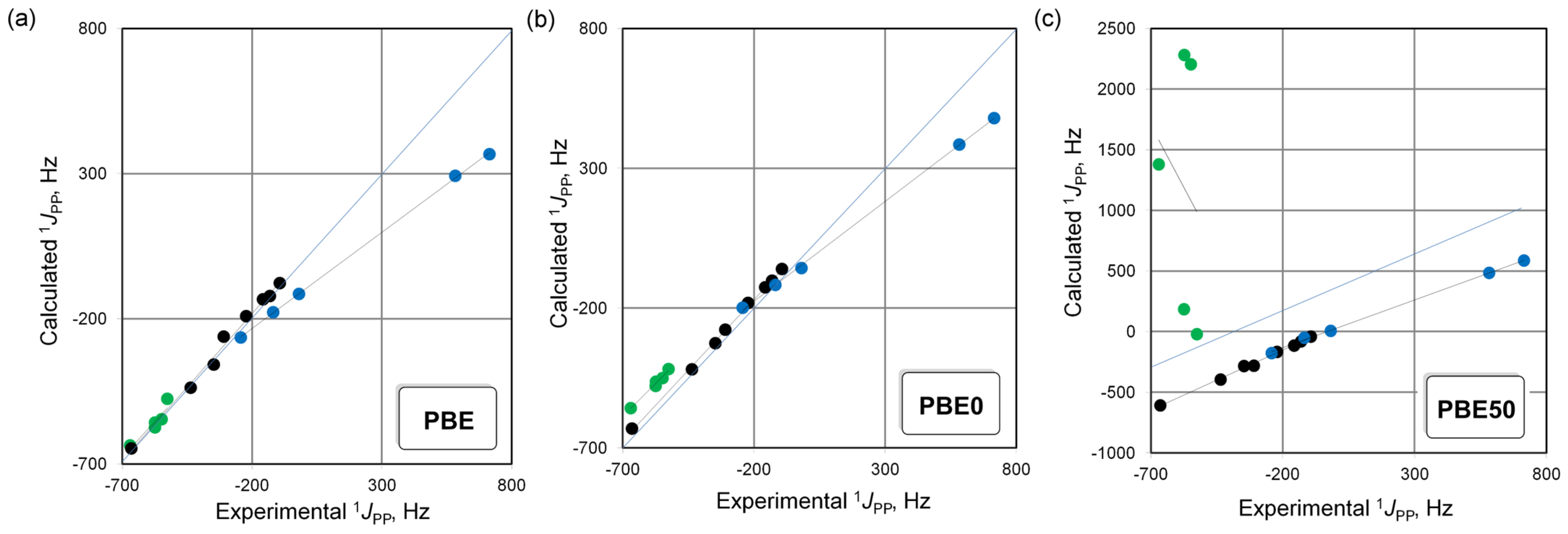



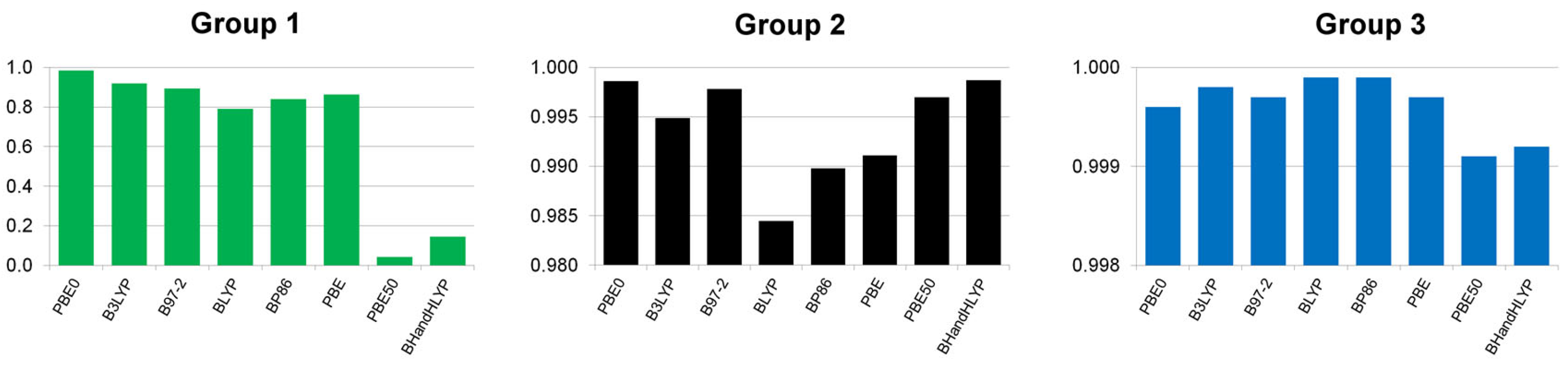
| Comp. | Exp. | Calculated 1JPP, Hz | |||
|---|---|---|---|---|---|
| PBE0 | PBE | PBE50 | BHandHLYP | ||
| 1 | −670.0 | −558.1 | −635.9 | 1377.5 | 529.9 |
| 11 | −574.3 | −478.4 | −557.9 | 185.0 | 17.8 |
| 12 | −573.7 | −462.9 | −573.6 | 2279.9 | 837.3 |
| 14 | −548.7 | −450.4 | −545.8 | 2205.2 | 734.6 |
| 15 | −526.0 | −418.1 | −475.8 | −21.6 | −416.2 |
| 16 | −665.0 | −631.4 | −646.4 | −608.8 | −643.7 |
| 20 | −436.4 | −419.1 | −437.0 | −394.6 | −418.6 |
| 26 | −347.0 | −325.2 | −357.4 | −285.4 | −305.2 |
| 30 | −309.5 | −276.9 | −261.6 | −280.9 | −277.7 |
| −222.4 | −181.6 | −190.9 | −167.5 | −175.5 | |
| −157.5 | −125.3 | −132.7 | −114.9 | −123.4 | |
| 45 | −131.1 | −102.5 | −122.0 | −81.7 | −90.8 |
| −93.0 | −60.6 | −77.6 | −42.5 | −51.9 | |
| 51 | −243.0 | −198.9 | −264.3 | −177.8 | −187.4 |
| 54 | −118.0 | −117.3 | −177.2 | −51.6 | −64.0 |
| 55 | −18.7 | −56.5 | −114.8 | 6.2 | −2.6 |
| 62 | 583.0 | 385.0 | 292.4 | 483.6 | 499.4 |
| 65 | 715.0 | 479.2 | 367.0 | 586.4 | 625.2 |
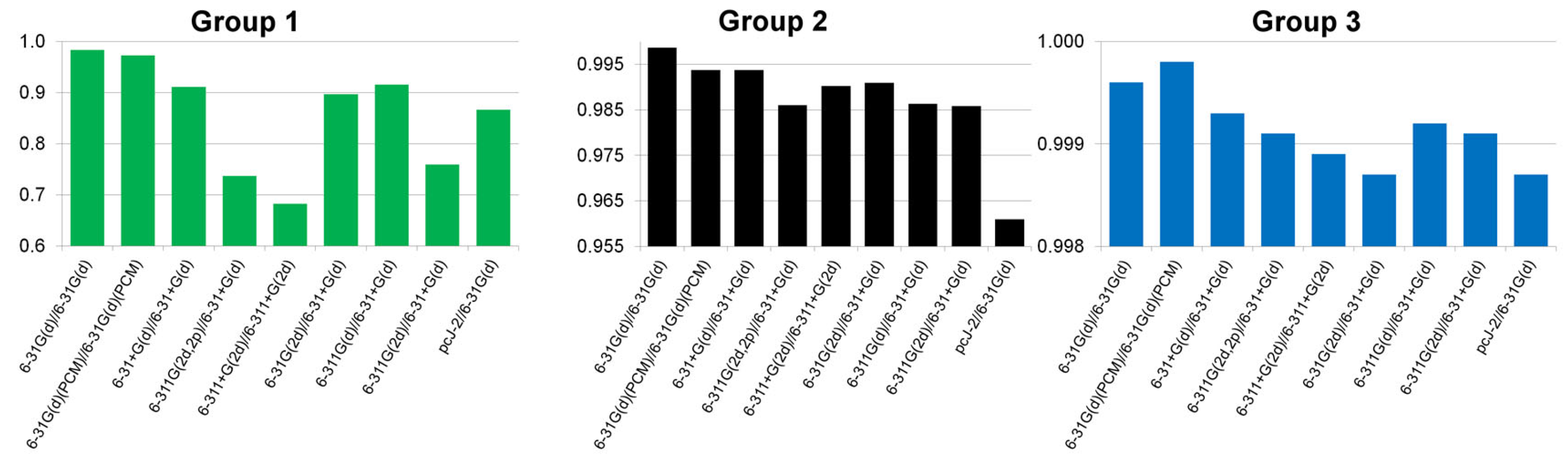
| R2 (Group 1) | 0.9837 | 0.8638 | 0.0430 | 0.1459 | |
| R2 (Group 2) | 0.9986 | 0.9911 | 0.9970 | 0.9987 | |
| R2 (Group 3) | 0.9996 | 0.9997 | 0.9991 | 0.9992 | |
| Level of Theory | Intercept | Slope | R2 | RMSE a | |
|---|---|---|---|---|---|
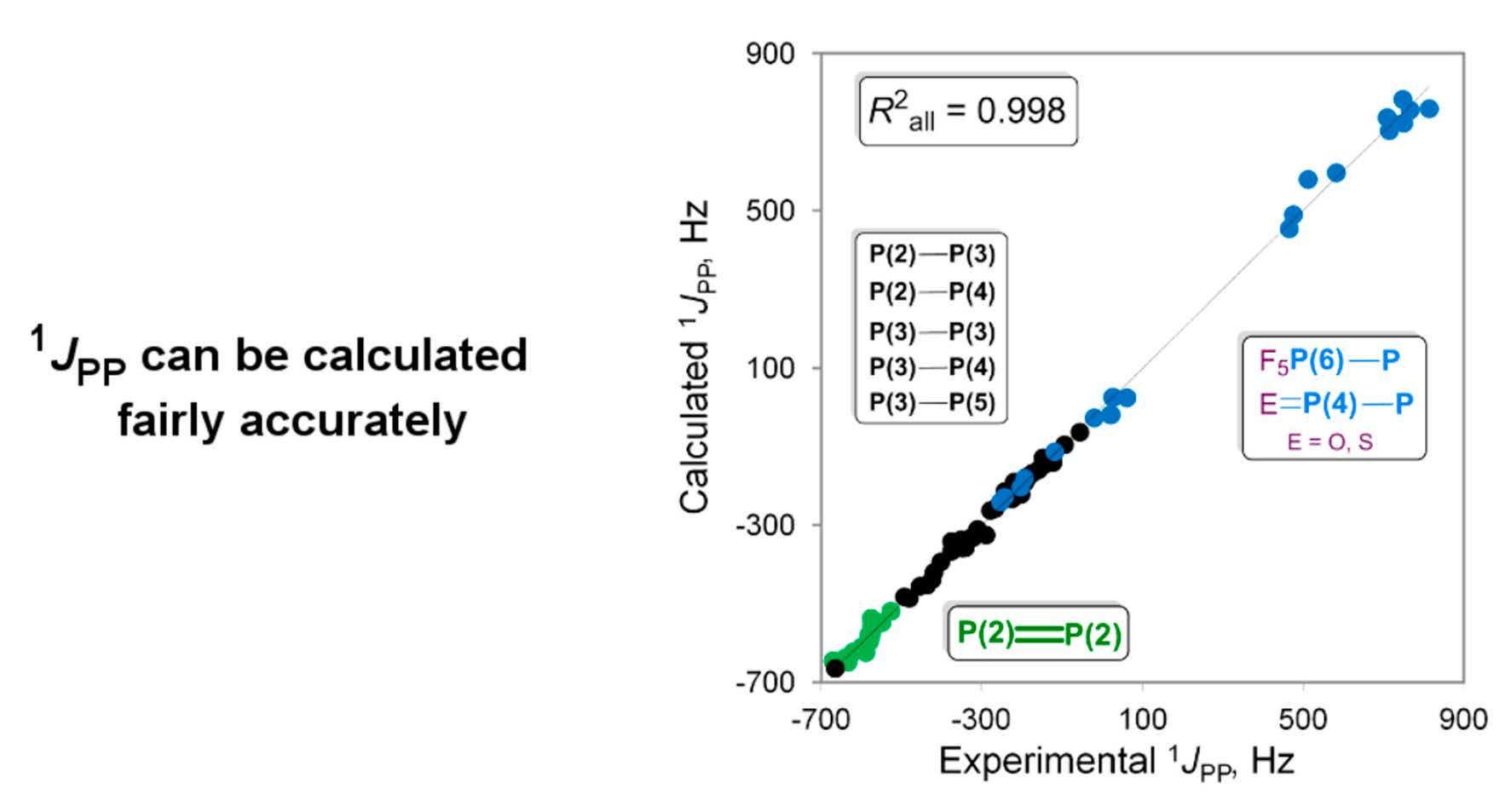
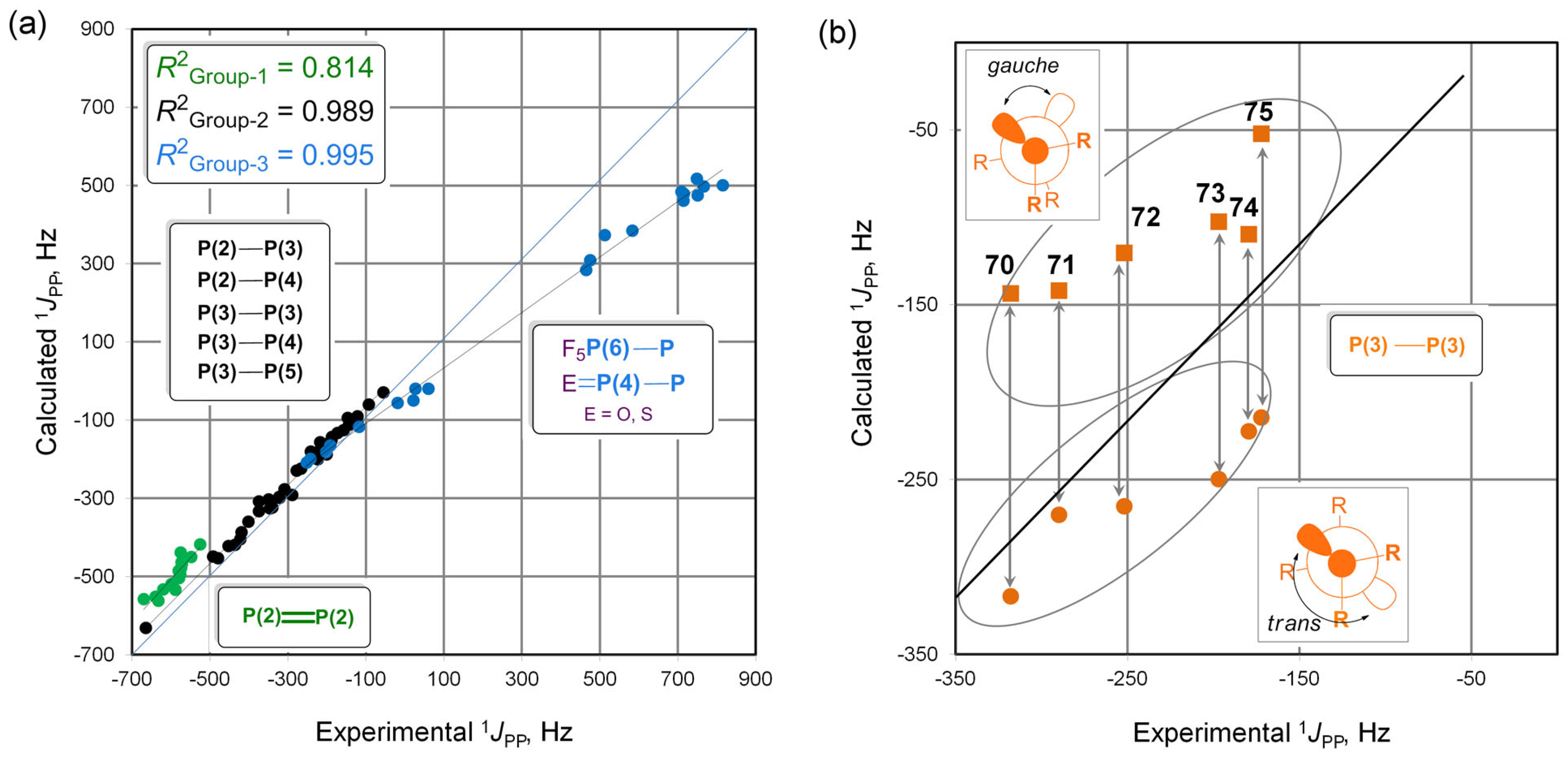
| PBE0/6-31G(d)// PBE0/6-31G(d) | Group 1 | 155.0 | 1.10 | 0.814 | 17.0 |
| Group 2 | 34.5 | 1.00 | 0.989 | 13.1 | |
| Group 3 | −37.1 | 0.71 | 0.995 | 27.1 | |
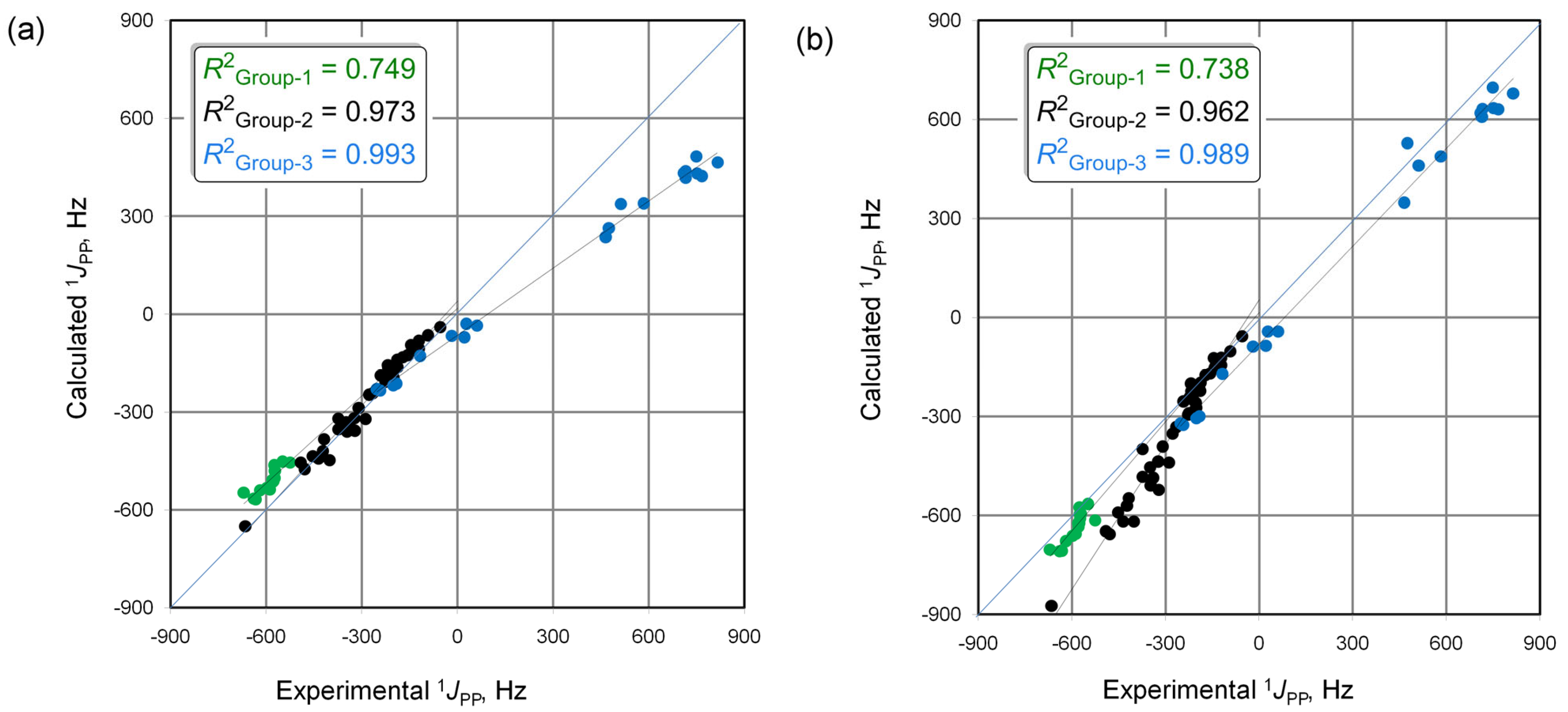
| PBE0/6-31+G(d)// PBE0/6-31+G(d) | Group 1 | 18.5 | 0.89 | 0.749 | 20.5 |
| Group 2 | 40.2 | 1.07 | 0.974 | 20.9 | |
| Group 3 | −64.3 | 0.69 | 0.994 | 31.1 | |
| PBE0/6-311G(2d,2p)// PBE0/6-31+G(d) | Group 1 | 14.7 | 1.10 | 0.739 | 21.1 |
| Group 2 | 53.6 | 1.46 | 0.962 | 25.2 | |
| Group 3 | −79.9 | 0.99 | 0.990 | 40.5 |
Disclaimer/Publisher’s Note: The statements, opinions and data contained in all publications are solely those of the individual author(s) and contributor(s) and not of MDPI and/or the editor(s). MDPI and/or the editor(s) disclaim responsibility for any injury to people or property resulting from any ideas, methods, instructions or products referred to in the content. |
© 2026 by the authors. Licensee MDPI, Basel, Switzerland. This article is an open access article distributed under the terms and conditions of the Creative Commons Attribution (CC BY) license.
Share and Cite
Kondrashova, S.A.; Latypov, S.K. Combined DFT Protocol for the Calculation of One-Bond 31P-31P Indirect Nuclear Spin–Spin Couplings. Molecules 2026, 31, 1831. https://doi.org/10.3390/molecules31111831
Kondrashova SA, Latypov SK. Combined DFT Protocol for the Calculation of One-Bond 31P-31P Indirect Nuclear Spin–Spin Couplings. Molecules. 2026; 31(11):1831. https://doi.org/10.3390/molecules31111831
Chicago/Turabian StyleKondrashova, Svetlana A., and Shamil K. Latypov. 2026. "Combined DFT Protocol for the Calculation of One-Bond 31P-31P Indirect Nuclear Spin–Spin Couplings" Molecules 31, no. 11: 1831. https://doi.org/10.3390/molecules31111831
APA StyleKondrashova, S. A., & Latypov, S. K. (2026). Combined DFT Protocol for the Calculation of One-Bond 31P-31P Indirect Nuclear Spin–Spin Couplings. Molecules, 31(11), 1831. https://doi.org/10.3390/molecules31111831