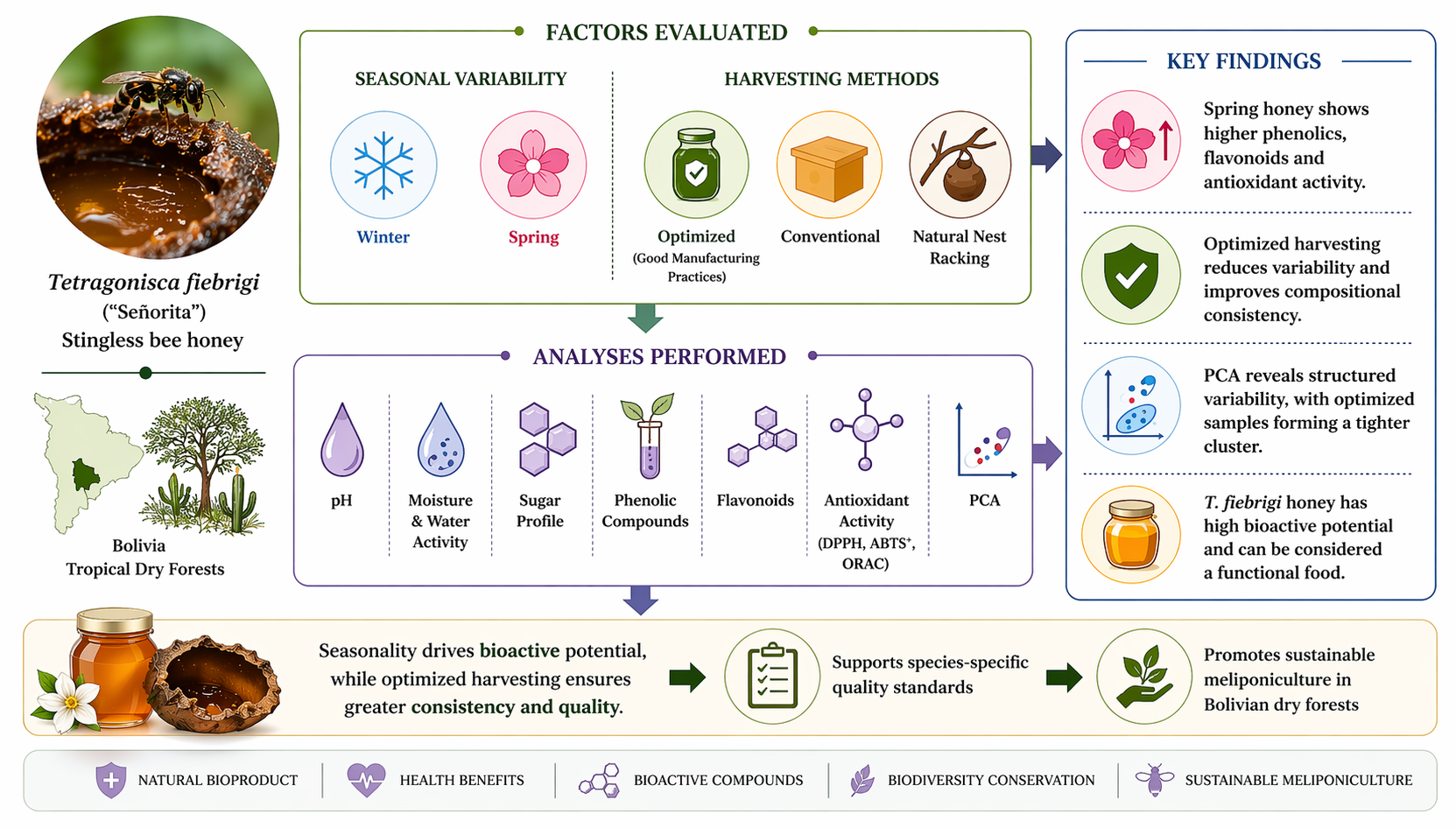
Influence of Harvesting and Seasonal Variability on the Physicochemical and Antioxidant Properties of Native Bee (Tetragonisca fiebrigi) Honey from Bolivia’s Tropical Dry Forests


 and
and 
Abstract
1. Introduction
2. Results
2.1. Physicochemical Characteristics
2.2. Sugar Composition
2.3. Antioxidant Properties
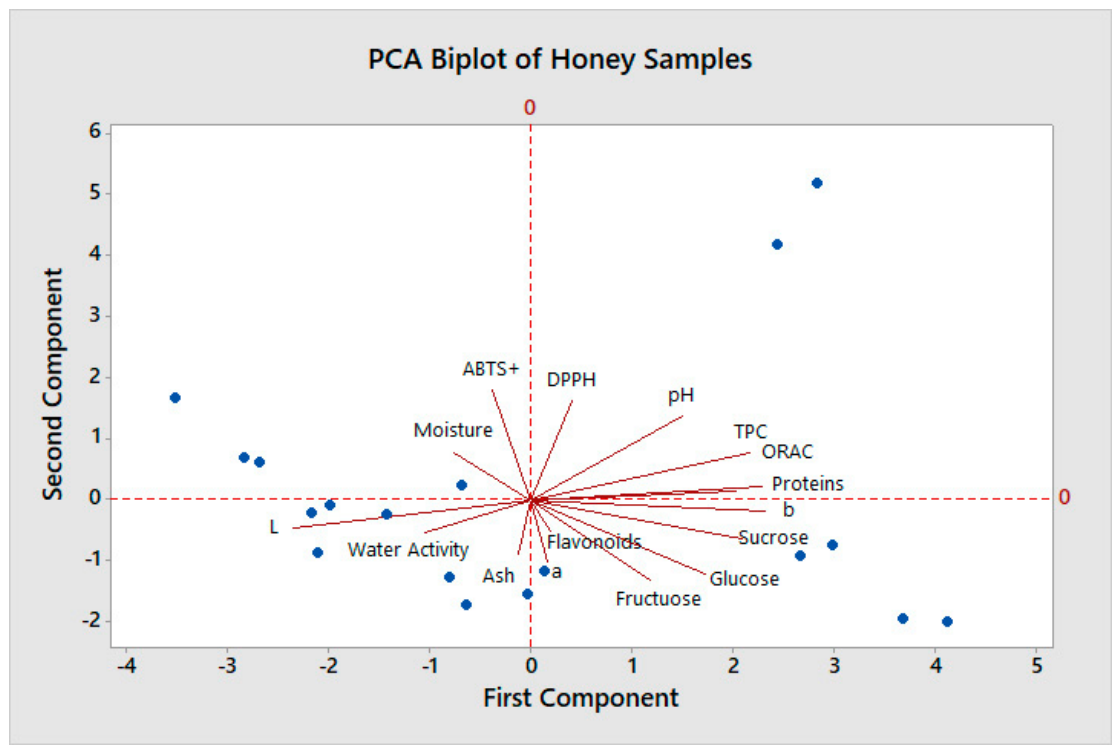
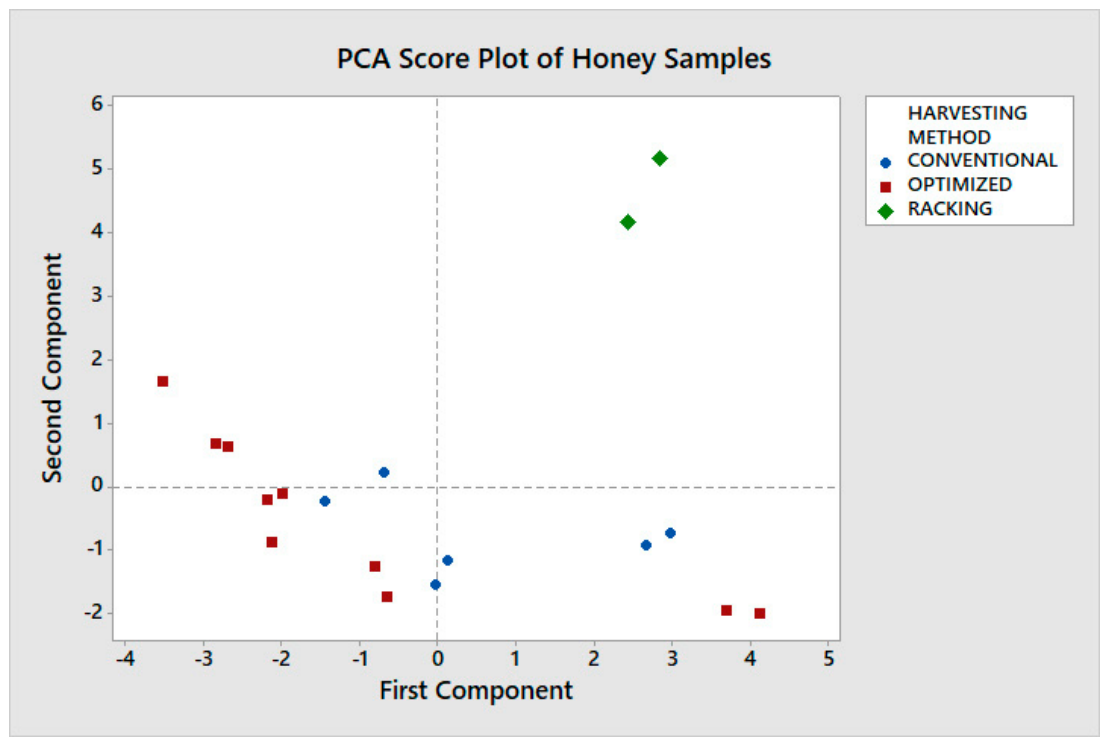
2.4. Principal Component Analysis (PCA)
3. Discussion
Future Research and Perspectives
4. Materials and Methods
4.1. Honey Samples
Harvesting Methods and Sample Coding
- Conventional method (C): Based on traditional practices used at CEBST, involving basic hygiene and the use of clean, sterilized containers.
- Optimized method (O): Developed according to Codex Alimentarius hygiene standards, with stricter sanitary measures and the use of sterile, hermetically sealed materials [47].
- Racking method (T): Direct decantation from natural nests with minimal intervention, involving filtration to remove solid particles (wood, sand, etc.).
4.2. Physicochemical Characterization
4.2.1. pH
4.2.2. Moisture Content
4.2.3. Ash Content
4.2.4. Protein Content
4.2.5. Water Activity
4.2.6. Color Analysis
4.2.7. Total and Reduced Sugars
4.3. Biological Properties
4.3.1. Total Phenolic Content (TPC)
4.3.2. Total Flavonoid Content
4.4. Antioxidant Activity Assays
4.4.1. DPPH (2,2-Diphenyl-1-Picrylhydrazyl) Free Radical-Scavenging Assay
4.4.2. ABTS+ (2,2’-Azino-Bis (3-Ethylbenzothiazoline-6-Sulfonic Acid))
4.4.3. ORAC (Oxygen Radical Absorbance Capacity)
4.5. Statistical Analysis
5. Conclusions
Supplementary Materials
Author Contributions
Funding
Institutional Review Board Statement
Informed Consent Statement
Data Availability Statement
Conflicts of Interest
Abbreviations
| ABTS | 2,2′-azino-bis (3-ethylbenzothiazoline-6-sulfonic acid) |
| AOAC | Association of Official Analytical Chemists |
| AAPH | 2,2′-azobis(2-amidinopropane) dihydrochloride |
| AUC | Area Under the Curve |
| Aw | Water activity |
| CEBST | Centro de Estudios del Bosque Seco Tropical Alta Vista |
| DPPH | 2,2-diphenyl-1-picrylhydrazyl |
| GAE | Gallic acid equivalents |
| HPLC | High-performance liquid chromatography |
| IHC | International Honey Commission |
| LC–MS | Liquid chromatography–mass spectrometry |
| ND | Not detected |
| NR | Not reported/Not performed |
| ORAC | Oxygen Radical Absorbance Capacity |
| PCA | Principal Component Analysis |
| QE | Quercetin equivalents |
| SBH | Stingless bee honey |
| TE | Trolox equivalents |
| TPC | Total phenolic content |
References
- Menezes, C.; Vollet-Neto, A.; Contrera, F.A.F.L.; Venturieri, G.C.; Imperatriz-Fonseca, V.L. The Role of Useful Microorganisms to Stingless Bees and Stingless Beekeeping. In Pot-Honey; Springer: New York, NY, USA, 2013; pp. 157–159. [Google Scholar] [CrossRef] [Scilit]
- Bradbear, N. Bees and their role in forest livelihoods. In Non-Wood Forest Products, 1st ed.; FAO: Rome, Italy, 2009; Chapter 19; pp. 51–53. Available online: https://openknowledge.fao.org/handle/20.500.14283/i0842e (accessed on 24 March 2024).
- Ávila, S.; Hornung, P.S.; Teixeira, G.L.; Malunga, L.N.; Apea-Bah, F.B.; Beux, M.R.; Beta, T.; Ribani, R.H. Bioactive compounds and biological properties of Brazilian stingless bee honey have a strong relationship with the pollen floral origin. Food Res. Int. 2019, 123, 1–10. [Google Scholar] [CrossRef] [Scilit] [PubMed]
- Pimentel, T.C.; Rosset, M.; Sousa, J.M.B.; Oliveira, L.I.G.; Mafaldo, I.M.; Pintado, M.M.E.; Souza, E.L.; Magnani, M. Stingless bee honey: An overview of health benefits and main market challenges. J. Food Biochem. 2022, 46, e13883. [Google Scholar] [CrossRef] [Scilit] [PubMed]
- Shamsudin, S.; Selamat, J.; Sanny, M.; Razak, S.-B.A.; Jambari, N.N.; Mian, Z.; Khatib, A. Influence of origins and bee species on physicochemical, antioxidant properties and botanical discrimination of stingless bee honey. Int. J. Food Prop. 2019, 22, 239–264. [Google Scholar] [CrossRef] [Scilit]
- Adler, M.; Martinez-Ugarteche, M.T.; Toledo, M. Characteristics of nests of stingless bees (Apoidea: Meliponini) in the Lomerío (Santa Cruz) and Sirionó (Beni) territories, Bolivia. Kempffiana 2022, 18, 39–52. [Google Scholar]
- Schvezov, N.; Pucciarelli, A.B.; Valdes, B.; Dallagnol, A.M. Characterization of yateí (Tetragonisca fiebrigi) honey and preservation treatments: Dehumidification, pasteurization and refrigeration. Food Control 2020, 111, 107080. [Google Scholar] [CrossRef] [Scilit]
- Campos, J.F.; dos Santos, U.P.; Rocha, P.d.S.d.; Damião, M.J.; Balestieri, J.B.P.; Cardoso, C.A.L.; Paredes-Gamero, E.J.; Estevinho, L.M.; Souza, K.d.P.; dos Santos, E.L. Antimicrobial, Antioxidant, Anti-Inflammatory, and Cytotoxic Activities of Propolis from the Stingless Bee Tetragonisca fiebrigi (Jataí). Evid.-Based Complement. Altern. Med. 2015, 2015, 296186. [Google Scholar] [CrossRef] [Scilit]
- Vit, P.; Gutiérrez, M.G.; Rodriguez-Malaver, A.J.; Aguilera, G.; Fernández-Díaz, C.; Tricio, A.E. Comparison of honeys produced by the bee yateí (Tetragonisca fiebrigi) in Argentina and Paraguay. Acta Bioquím. Clín. Latinoam. 2009, 43, 219–226. Available online: https://www.scielo.org.ar/scielo.php?script=sci_arttext&pid=S0325-29572009000200007&lng=es&nrm=iso&tlng=en (accessed on 8 April 2026).
- Saravia-Nava, A.; Niemeyer, H.M.; Pinto, C.F. Pollen Types Used by the Native Stingless Bee, Tetragonisca angustula (Latreille), in an Amazon-Chiquitano Transitional Forest of Bolivia. Neotrop. Entomol. 2018, 47, 798–807. [Google Scholar] [CrossRef] [Scilit]
- Julika, W.N.; Ajit, A.; Ismail, N.; Aqilah, N.; Naila, A.; Sulaiman, A.Z. Sugar profile and enzymatic analysis of stingless bee honey collected from local market in Malaysia. IOP Conf. Ser. Mater. Sci. Eng. 2020, 736, 062001. [Google Scholar] [CrossRef] [Scilit]
- Bijlsma, L.; de Bruijn, L.L.M.; Martens, E.P.; Sommeijer, M.J. Water content of stingless bee honeys (Apidae, Meliponini): Interspecific variation and comparison with honey of Apis mellifera. Apidologie 2006, 37, 480–486. [Google Scholar] [CrossRef] [Scilit]
- Ikhsan, L.N.; Chin, K.-Y.; Ahmad, F. Methods of the Dehydration Process and Its Effect on the Physicochemical Properties of Stingless Bee Honey: A Review. Molecules 2022, 27, 7243. [Google Scholar] [CrossRef] [Scilit] [PubMed]
- Esa, N.E.F.; Ansari, M.N.M.; Razak, S.I.A.; Ismail, N.I.; Jusoh, N.; Zawawi, N.A.; Jamaludin, M.I.; Sagadevan, S.; Nayan, N.H.M. A Review on Recent Progress of Stingless Bee Honey and Its Hydrogel-Based Compound for Wound Care Management. Molecules 2022, 27, 3080. [Google Scholar] [CrossRef] [Scilit] [PubMed]
- Santos, A.C.D.; Biluca, F.C.; Braghini, F.; Gonzaga, L.V.; Costa, A.C.O.; Fett, R. Phenolic composition and biological activities of stingless bee honey: An overview based on its aglycone and glycoside compounds. Food Res. Int. 2021, 147, 110553. [Google Scholar] [CrossRef] [Scilit]
- Chuttong, B.; Chanbang, Y.; Sringarm, K.; Burgett, M. Physicochemical profiles of stingless bee (Apidae: Meliponini) honey from South East Asia (Thailand). Food Chem. 2016, 192, 149–155. [Google Scholar] [CrossRef] [Scilit]
- Ávila, S.; Beux, M.R.; Ribani, R.H.; Zambiazi, R.C. Stingless bee honey: Quality parameters, bioactive compounds, health-promotion properties and modification detection strategies. Trends Food Sci. Technol. 2018, 81, 37–50. [Google Scholar] [CrossRef] [Scilit]
- Sujanto, I.S.R.; Ramly, N.S.; Ghani, A.A.; Huat, J.T.Y.; Alias, N.; Ngah, N. The Composition and Functional Properties of Stingless Bee Honey: A Review. Malays. J. Appl. Sci. 2021, 6, 111–127. [Google Scholar] [CrossRef] [Scilit]
- Lemos, M.S.; Venturieri, G.C.; Filho, H.A.D.; Dantas, K.G.F. Evaluation of the physicochemical parameters and inorganic constituents of honeys from the Amazon region. J. Apic. Res. 2018, 57, 135–144. [Google Scholar] [CrossRef] [Scilit]
- Bakar, M.F.A.; Sanusi, S.B.; Bakar, F.I.A.; Cong, O.J.; Mian, Z. Physicochemical and Antioxidant Potential of Raw Unprocessed Honey From Malaysian Stingless Bees. Pak. J. Nutr. 2017, 16, 888–894. [Google Scholar] [CrossRef] [Scilit]
- Braghini, F.; Gonzaga, L.V.; Costa, A.C.O.; Fett, R. Physicochemical profiles, minerals and bioactive compounds of stingless bee honey (Meliponinae). J. Food Compos. Anal. 2016, 50, 61–69. [Google Scholar] [CrossRef] [Scilit]
- Ismail, N.; Maulidiani, M.; Omar, S.; Zulkifli, M.F.; Radzi, M.N.F.M.; Ismail, N.; Jusoh, A.Z.; Roowi, S.; Yew, W.M.; Rudiyanto, R.; et al. Classification of stingless bee honey based on species, dehumidification process and geographical origins using physicochemical and ATR-FTIR chemometric approach. J. Food Compos. Anal. 2021, 104, 104126. [Google Scholar] [CrossRef] [Scilit]
- deAlmeida-Muradian, L.B.; Stramm, K.M.; Horita, A.; Barth, O.M.; daSilva de Freitas, A.; Estevinho, L.M. Comparative study of the physicochemical and palynological characteristics of honey from Melipona subnitida and Apis mellifera. Int. J. Food Sci. Technol. 2013, 48, 1698–1706. [Google Scholar] [CrossRef] [Scilit]
- Nordin, A.; Sainik, N.Q.A.V.; Chowdhury, S.R.; Saim, A.B.; Idrus, R.B.H. Physicochemical properties of stingless bee honey from around the globe: A comprehensive review. J. Food Compos. Anal. 2018, 73, 91–102. [Google Scholar] [CrossRef] [Scilit]
- de Sousa, J.M.B.; de Souza, E.L.; Marques, G.; de Toledo Benassi, M.; Gullón, B.; Pintado, M.M.; Magnani, M. Sugar profile, physicochemical and sensory aspects of monofloral honeys produced by different stingless bee species in Brazilian semi-arid region. LWT-Food Sci. Technol. 2016, 65, 645–651. [Google Scholar] [CrossRef] [Scilit]
- Chirife, J.; Zamora, M.C.; Motto, A. The correlation between water activity and % moisture in honey: Fundamental aspects and application to Argentine honeys. J. Food Eng. 2006, 72, 287–292. [Google Scholar] [CrossRef] [Scilit]
- Zamora, M.C.; Chirife, J.; Roldán, D. On the nature of the relationship between water activity and % moisture in honey. Food Control 2006, 17, 642–647. [Google Scholar] [CrossRef] [Scilit]
- Blasa, M.; Candiracci, M.; Accorsi, A.; Piacentini, M.P.; Albertini, M.C.; Piatti, E. Raw Millefiori honey is packed full of antioxidants. Food Chem. 2006, 97, 217–222. [Google Scholar] [CrossRef] [Scilit]
- Muhammad, N.I.I.; Sarbon, N.M. Physicochemical profile, antioxidant activity and mineral contents of honey from stingless bee and honey bee species. J. Apic. Res. 2023, 62, 394–401. [Google Scholar] [CrossRef] [Scilit]
- Agussalim, A.; Sabir, A.; Sahlan, M.; Agus, A. Evaluation of stingless bee honey quality (Tetragonula laeviceps) based on their physicochemical from different origins. Biodiversitas J. Biol. Divers. 2023, 24, 2134–2142. [Google Scholar] [CrossRef] [Scilit]
- Biluca, F.C.; da Silva, B.; Caon, T.; Mohr, E.T.B.; Vieira, G.N.; Gonzaga, L.V.; Vitali, L.; Micke, G.; Fett, R.; Dalmarco, E.M.; et al. Investigation of phenolic compounds, antioxidant and anti-inflammatory activities in stingless bee honey (Meliponinae). Food Res. Int. 2020, 129, 108756. [Google Scholar] [CrossRef] [Scilit]
- Ja’afar, N.L.; Ab Aziz, N.A.; Zakaria, Z.; Mustapha, M.; Mohamed, M.; Mustafa, M.Z.; Hashim, S. A narrative review on the physicochemical profiles, bioactive compounds, and therapeutic potentials of stingless bee honey. Discov. Food 2025, 5, 150. [Google Scholar] [CrossRef] [Scilit]
- Gadge, A.S.; Shirsat, D.V.; Soumia, P.S.; Pote, C.L.; Pushpalatha, M.; Pandit, T.R.; Dutta, R.; Kumar, S.; Ramesh, S.V.; Mahajan, V.; et al. Physiochemical, biological, and therapeutic uses of stingless bee honey. Front. Sustain. Food Syst. 2024, 7, 1324385. [Google Scholar] [CrossRef] [Scilit]
- da Silva, P.M.; Gauche, C.; Gonzaga, L.V.; Costa, A.C.O.; Fett, R. Honey: Chemical composition, stability and authenticity. Food Chem. 2016, 196, 309–323. [Google Scholar] [CrossRef] [Scilit] [PubMed]
- Escuredo, O.; Dobre, I.; Fernández-González, M.; Seijo, M.C. Contribution of botanical origin and sugar composition of honeys on the crystallization phenomenon. Food Chem. 2014, 149, 84–90. [Google Scholar] [CrossRef] [Scilit] [PubMed]
- Escriche, I.; Kadar, M.; Juan-Borrás, M.; Domenech, E. Suitability of antioxidant capacity, flavonoids and phenolic acids for floral authentication of honey. Impact of industrial thermal treatment. Food Chem. 2014, 142, 135–143. [Google Scholar] [CrossRef] [Scilit] [PubMed]
- Negera, T.; Degu, A.; Tigu, F. Comparative analysis of the physicochemical, proximate, and antioxidant characteristics of stingless bee (Meliponula beccarii) honey from modern and wild beehives in Ethiopia. Food Sci. Nutr. 2024, 12, 1673–1685. [Google Scholar] [CrossRef] [Scilit]
- da Silva Cruz, L.F.; Lemos, P.V.F.; Santos, T.d.S.; Tavares, P.P.L.G.; Nascimento, R.Q.; Almeida, L.M.R.; de Souza, C.O.; Druzian, J.I. Storage conditions significantly influence the stability of stingless bee (Melipona scutellaris) honey. J. Apic. Res. 2023, 62, 530–541. [Google Scholar] [CrossRef] [Scilit]
- Ranneh, Y.; Ali, F.; Zarei, M.; Akim, A.M.; Hamid, H.A.; Khazaai, H. Malaysian stingless bee and Tualang honeys: A comparative characterization of total antioxidant capacity and phenolic profile using liquid chromatography-mass spectrometry. LWT-Food Sci. Technol. 2018, 89, 1–9. [Google Scholar] [CrossRef] [Scilit]
- Vit, P.; Oddo, L.P.; Marano, M.L.; de Mejias, E.S. Venezuelan stingless bee honeys characterized by multivariate analysis of physicochemical properties. Apidologie 1998, 29, 377–389. [Google Scholar] [CrossRef] [Scilit]
- Limpias-Hurtado, J.A.; Duran, N.M.; Giménez-Turba, A.; Nina, N. Exploratory assessment of the chemical and antioxidant potential of Apis mellifera honeys from Santa Cruz, Bolivia. Food Chem. X 2026, 34, 103675. [Google Scholar] [CrossRef] [Scilit]
- Sant’ana, R.d.S.; de Carvalho, C.A.L.; Oda-Souza, M.; Souza, B.d.A.; Dias, F.d.S. Characterization of honey of stingless bees from the Brazilian semi-arid region. Food Chem. 2020, 327, 127041. [Google Scholar] [CrossRef] [Scilit]
- Anacleto, D.d.A.; Souza, B.d.A.; Marchini, L.C.; Moreti, A.C.d.C.C. Composição de amostras de mel de abelha Jataí (Tetragonisca angustula latreille, 1811). Ciência Tecnol. Aliment. 2009, 29, 535–541. [Google Scholar] [CrossRef] [Scilit]
- Mduda, C.A.; Hussein, J.M.; Muruke, M.H. The effects of bee species and vegetation on the antioxidant properties of honeys produced by Afrotropical stingless bees (Hymenoptera, Apidae, Meliponini). J. Agric. Food Res. 2023, 14, 100736. [Google Scholar] [CrossRef] [Scilit]
- Bertoncelj, J.; Doberšek, U.; Jamnik, M.; Golob, T. Evaluation of the phenolic content, antioxidant activity and colour of Slovenian honey. Food Chem. 2007, 105, 822–828. [Google Scholar] [CrossRef] [Scilit]
- Santos, M.M.D.; Khan, N.; Lim, L.Y.; Locher, C. Antioxidant Activity, Physicochemical and Sensory Properties of Stingless Bee Honey from Australia. Foods 2024, 13, 1657. [Google Scholar] [CrossRef] [Scilit] [PubMed]
- Joint FAO/WHO Codex Alimentarius Commission. Codex Alimentarius; FAO: Rome, Italy, 1992. [Google Scholar]
- AOAC. Official Methods of Analytical Chemist; Association of Official Analytical Chemist: Washington, DC, USA, 1990. [Google Scholar]
- Bogdanov, S. Harmonised Methods of the International Honey Commission. 2009. Available online: https://www.ihc-platform.net/ihcmethods2009.pdf (accessed on 23 April 2025).
- Boghossian, M.; Brassesco, M.E.; Miller, F.A.; Silva, C.L.; Brandão, T.R. Thermosonication applied to kiwi peel: Impact on nutritional and microbiological indicators. Foods 2023, 12, 622. [Google Scholar] [CrossRef] [Scilit] [PubMed]
- ISO International Organization for Standardization. Available online: https://www.iso.org/ (accessed on 31 May 2024).
- Gomes, T.; Feás, X.; Iglesias, A.; Estevinho, L.M. Study of Organic Honey from the Northeast of Portugal. Molecules 2011, 16, 5374–5386. [Google Scholar] [CrossRef] [Scilit]
- Deng, Q.; Penner, M.H.; Zhao, Y. Chemical composition of dietary fiber and polyphenols of five different varieties of wine grape pomace skins. Food Res. Int. 2011, 44, 2712–2720. [Google Scholar] [CrossRef] [Scilit]
- Coscueta, E.R.; Malpiedi, L.P.; Nerli, B.B. Micellar systems of aliphatic alcohol ethoxylates as a sustainable alternative to extract soybean isoflavones. Food Chem. 2018, 264, 135–141. [Google Scholar] [CrossRef] [Scilit]
- Meda, A.; Lamien, C.E.; Romito, M.; Millogo, J.; Nacoulma, O.G. Determination of the total phenolic, flavonoid and proline contents in Burkina Fasan honey, as well as their radical scavenging activity. Food Chem. 2005, 91, 571–577. [Google Scholar] [CrossRef] [Scilit]
- Brand-Williams, W.; Cuvelier, M.E.; Berset, C. Use of a free radical method to evaluate antioxidant activity. LWT-Food Sci. Technol. 1995, 28, 25–30. [Google Scholar] [CrossRef] [Scilit]
- Schaich, K.M.; Tian, X.; Xie, J. Reprint of “Hurdles and pitfalls in measuring antioxidant efficacy: A critical evaluation of ABTS, DPPH, and ORAC assays”. J. Funct. Foods 2015, 18, 782–796. [Google Scholar] [CrossRef] [Scilit]
- Gonçalves, B.; Falco, V.; Moutinho-Pereira, J.; Bacelar, E.; Peixoto, F.; Correia, C. Effects of Elevated CO2 on Grapevine (Vitis vinifera L.): Volatile Composition, Phenolic Content, and in Vitro Antioxidant Activity of Red Wine. J. Agric. Food Chem. 2009, 57, 265–273. [Google Scholar] [CrossRef] [Scilit]
- Sanchez-Moreno, C. Review: Methods Used to Evaluate the Free Radical Scavenging Activity in Foods and Biological Systems. Food Sci. Technol. Int. 2002, 8, 121–137. [Google Scholar] [CrossRef]
- Scripcă, L.A.; Norocel, L.; Amariei, S. Comparison of Physicochemical, Microbiological Properties and Bioactive Compounds Content of Grassland Honey and other Floral Origin Honeys. Molecules 2019, 24, 2932. [Google Scholar] [CrossRef] [Scilit]
- Mahani; Ahmed, A.O.M.; Nurhadi, B. Evaluate antioxidant activity, phenolic content and colour of Indonesian stingless bee honey and sting bee honey cultivated in Indonesia. Asian J. Pharm. Clin. Res. 2022, 15, 42–46. [Google Scholar] [CrossRef] [Scilit]


| IC1 | IC2 | IC3 | IO1 | IO2 | IO3 | IO4 | PC1 | PO1 | PT1 | PT2 | |
|---|---|---|---|---|---|---|---|---|---|---|---|
| pH | 5.13 ± 0.03 DE | 4.94 ± 0.03 F | 4.59 ± 0.04 I | 5.14 ± 0.01 D | 4.84 ± 0.02 G | 4.93 ± 0.03 F | 4.73 ± 0.03 H | 5.07 ± 0.04 E | 5.39 ± 0.01 C | 6.04 ± 0.01 B | 6.15 ± 0.01 A |
| Ash Content | 12.48 ± 1.08 A | 12.53 ± 0.23A | NR* | 11.96 ± 0.39 A | 11.73 ± 0.48 A | 12.47 ± 0.35 A | 12.38 ± 0.52 A | 12.40 ± 1.08 A | 12.04 ± 0.42 A | 12.34 ± 0.46 A | 11.71 ± 0.28 A |
| Moisture a | 30.50 ± 0.71 A | 31.00 ± 0.00 A | NR* | 30.00 ± 0.00 A | 44.00 ± 14.10 A | 32.00 ± 0.00 A | 30.00 ± 0.00 A | 31.00 ± 0.00A | 31.00 ± 0.00 A | 27.50 ± 6.36 A | 34.00 ± 0.00 A |
| Protein | 10.65 ± 0.62 ABCD | 10.12 ± 0.81 BCD | 8.93 ± 2.35 CD | 1.58 ± 3.78 E | 1.32 ± 1.55 E | 7.18 ± 0.50 DE | 13.10 ± 0.00 ABCD | 12.65 ± 0.62 ABCD | 14.50 ± 0.12 ABC | 16.35 ± 0.56 A | 16.20 ± 1.55 AB |
| Water Activity | 0.72 ± 0.03 A | 0.73 ± 0.03 A | NR* | 0.70 ± 0.03 A | 0.74 ± 0.03 A | 0.73 ± 0.03 A | 0.75 ± 0.03 A | 0.70 ± 0.03 A | 0.71 ± 0.04 A | 0.70 ± 0.03 A | 0.69 ± 0.02 A |
| Color (L*) | 65.05 ± 0.53 DE | 64.14 ± 0.19 E | 67.48 ± 0.15 BC | 69.02 ± 0.07 A | 66.98 ± 0.30 C | 68.61 ± 0.54 AB | 65.43 ± 0.42 D | 59.76 ± 0.23 F | 58.18 ± 0.17 G | 65.51 ± 1.41 D | 58.06 ± 0.59 G |
| Color (a*) | 2.93 ± 0.04 A | 2.40 ± 0.03 D | 2.30 ± 0.01 E | 2.63 ± 0.02 B | 2.45 ± 0.03 CD | 2.61 ± 0.04 B | 2.37 ± 0.02 DE | 2.68 ± 0.06 B | 2.91 ± 0.02 A | 2.50 ± 0.05 C | 2.20 ± 0.05 F |
| Color (b*) | 8.91 ± 0.14 E | 9.07 ± 0.09 E | 6.82 ± 0.04 F | 5.17 ± 0.03 H | 5.15 ± 0.12 H | 4.70 ± 0.09 I | 5.91 ± 0.11 G | 12.58 ± 0.07 B | 12.99 ± 0.11 A | 10.92 ± 0.36 C | 10.25 ± 0.23 D |
| Glucose | 12.65 ± 1.10 E | 24.97 ± 1.38 AB | 23.65 ± 0.98 BC | 18.43 ± 1.15 CD | 10.60 ± 0.98 E | 13.88 ± 0.89 DE | 22.34 ± 0.21 BC | 25.72 ± 1.41 AB | 29.03 ± 2.12 A | 22.42 ± 2.21 BC | 15.83 ± 1.01 DE |
| Sucrose | 0.70 ± 0.48 D | 1.79 ± 0.03 BCD | 1.77 ± 0.11 BCD | 1.08 ± 0.10 CD | 0.79 ± 0.07 D | 1.25 ± 0.05 BCD | 1.31 ± 0.08 BCD | 2.36 ± 0.18 AB | 3.23 ± 0.29 A | 1.96 ± 0.73 BC | 1.63 ± 0.12 BCD |
| Fructose | 11.03 ± 1.14 B | 21.97 ± 1.14 A | 21.49 ± 0.94 A | 18.43 ± 1.08 A | 9.01 ± 0.67 B | 11.68 ± 1.02 B | 21.24 ± 0.22 A | 19.58 ± 0.96 A | 21.02 ± 1.82 A | 18.71 ± 0.61 A | 12.60 ± 1.09 B |
| TPC b | 4.37 ± 0.21 CD | 3.83 ± 0.12 DE | 5.17 ± 0.25 C | 4.23 ± 0.21 CD | 4.13 ± 0.21 D | 3.17 ± 0.15 E | 3.71 ± 0.26 DE | 9.27 ± 0.47 B | 9.11 ± 0.44 B | 9.03 ± 0.59 B | 11.03 ± 0.32 A |
| Flavonoids c | 10.47 ± 0.10 B | 10.43 ± 0.33 B | 13.64 ± 1.61 AB | 11.10 ± 0.24 AB | 10.70 ± 0.13 B | 10.21 ± 0.50 B | 23.08 ± 12.23 A | 12.48 ± 0.24 AB | 13.86 ± 0.89 AB | 14.65 ± 3.04 AB | 13.68 ± 2.56 AB |
| IC1 | IC2 | IC3 | IO1 | IO2 | IO3 | IO4 | PC1 | PO1 | PT1 | PT2 | |
|---|---|---|---|---|---|---|---|---|---|---|---|
| ABTS+ (mol TE/100 g of honey) | 2.76 ± 0.10 D | 2.60 ± 0.03 D | 6.96 ± 0.11 A | 3.64 ± 0.12 C | 4.42 ± 0.12 B | 3.98 ± 0.28 C | 3.63 ± 0.16 C | 2.90 ± 0.14 D | 1.41 ± 0.05 E | ND * | 6.60 ± 0.16 A |
| DPPH (mol TE/100 g of honey) | 0.66 ± 0.22 A | 0.51 ± 0.30 A | 0.66 ± 0.24 A | 0.46 ± 0.25 A | 0.53 ± 0.19 A | 0.86 ± 0.11 A | 0.57 ± 0.11 A | 0.64 ± 0.01 A | 0.32 ± 0.18 A | 1.14 ± 0.80 A | 1.33 ± 0.27 A |
| ORAC (mol TE/100 g of honey) | 10.96 ± 0.42 CD | 10.33 ± 0.51 CDE | 13.36 ± 0.92 C | 6.63 ± 2.29 E | 10.70 ± 0.27 CD | 8.06 ± 1.61 DE | 8.87 ± 2.20 DE | 22.94 ± 1.55 AB | 25.93 ± 0.32 A | 25.11 ± 1.79 AB | 21.67 ± 0.13 B |
| Samples | Date of Collection | Relative Humidity (%) | Date of the Last Rain | Daily Temperature (°C) | Heat Index (°C) | |
|---|---|---|---|---|---|---|
| IO1 IO2 IO3 IO4 | IC1 IC2 IC3 | 23/05/2023 | 89.35 | 05/05/2023 | 24.58 | 29.36 |
| PO1 PT1 | PC1 PT2 | 11/10/2023 | 66.09 | 30/09/2023 | 30.76 | 37.46 |
Disclaimer/Publisher’s Note: The statements, opinions and data contained in all publications are solely those of the individual author(s) and contributor(s) and not of MDPI and/or the editor(s). MDPI and/or the editor(s) disclaim responsibility for any injury to people or property resulting from any ideas, methods, instructions or products referred to in the content. |
© 2026 by the authors. Licensee MDPI, Basel, Switzerland. This article is an open access article distributed under the terms and conditions of the Creative Commons Attribution (CC BY) license.
Share and Cite
Romero-Padilla, A.; Castro, L.M.G.; Pintado, M.; Brassesco, M.E. Influence of Harvesting and Seasonal Variability on the Physicochemical and Antioxidant Properties of Native Bee (Tetragonisca fiebrigi) Honey from Bolivia’s Tropical Dry Forests. Molecules 2026, 31, 1819. https://doi.org/10.3390/molecules31111819
Romero-Padilla A, Castro LMG, Pintado M, Brassesco ME. Influence of Harvesting and Seasonal Variability on the Physicochemical and Antioxidant Properties of Native Bee (Tetragonisca fiebrigi) Honey from Bolivia’s Tropical Dry Forests. Molecules. 2026; 31(11):1819. https://doi.org/10.3390/molecules31111819
Chicago/Turabian StyleRomero-Padilla, Alejandra, Luís M. G. Castro, Manuela Pintado, and María Emilia Brassesco. 2026. "Influence of Harvesting and Seasonal Variability on the Physicochemical and Antioxidant Properties of Native Bee (Tetragonisca fiebrigi) Honey from Bolivia’s Tropical Dry Forests" Molecules 31, no. 11: 1819. https://doi.org/10.3390/molecules31111819
APA StyleRomero-Padilla, A., Castro, L. M. G., Pintado, M., & Brassesco, M. E. (2026). Influence of Harvesting and Seasonal Variability on the Physicochemical and Antioxidant Properties of Native Bee (Tetragonisca fiebrigi) Honey from Bolivia’s Tropical Dry Forests. Molecules, 31(11), 1819. https://doi.org/10.3390/molecules31111819