Article

Redox Imbalance and Antioxidant Adaptation in Acute Ischemic Stroke: Temporal Changes in Enzymatic and Non-Enzymatic Markers

by
Jakub Garbarek
1,
Julia Karolina Markiel
1,
Wojciech Rzepka
1,
Kamil Glazik
1,
Magdalena Pitek
1,
Karolina Szewczyk-Golec
2,
Beata Kukulska-Pawluczuk
3,
Natalia Soja-Kukieła
4,
Alina Woźniak
2,* and
Jarosław Nuszkiewicz
2,*
1
Student Research Club of Medical Biology and Biochemistry, Department of Medical Biology and Biochemistry, Faculty of Medicine, Ludwik Rydygier Collegium Medicum in Bydgoszcz, Nicolaus Copernicus University in Toruń, 24 Karłowicza St., 85-092 Bydgoszcz, Poland
2
Department of Medical Biology and Biochemistry, Faculty of Medicine, Ludwik Rydygier Collegium Medicum in Bydgoszcz, Nicolaus Copernicus University in Toruń, 24 Karłowicza St., 85-092 Bydgoszcz, Poland
3
Department of Neurology, Faculty of Medicine, Ludwik Rydygier Collegium Medicum in Bydgoszcz, Nicolaus Copernicus University in Toruń, 9 M. Skłodowskiej—Curie St., 85-094 Bydgoszcz, Poland
4
Centre for Statistical Analysis, Nicolaus Copernicus University in Toruń, Chopina 12/18 St., 87-100 Toruń, Poland
*
Authors to whom correspondence should be addressed.
Molecules 2026, 31(10), 1767; https://doi.org/10.3390/molecules31101767

Submission received: 1 April 2026 / Revised: 17 May 2026 / Accepted: 18 May 2026 / Published: 21 May 2026

Abstract

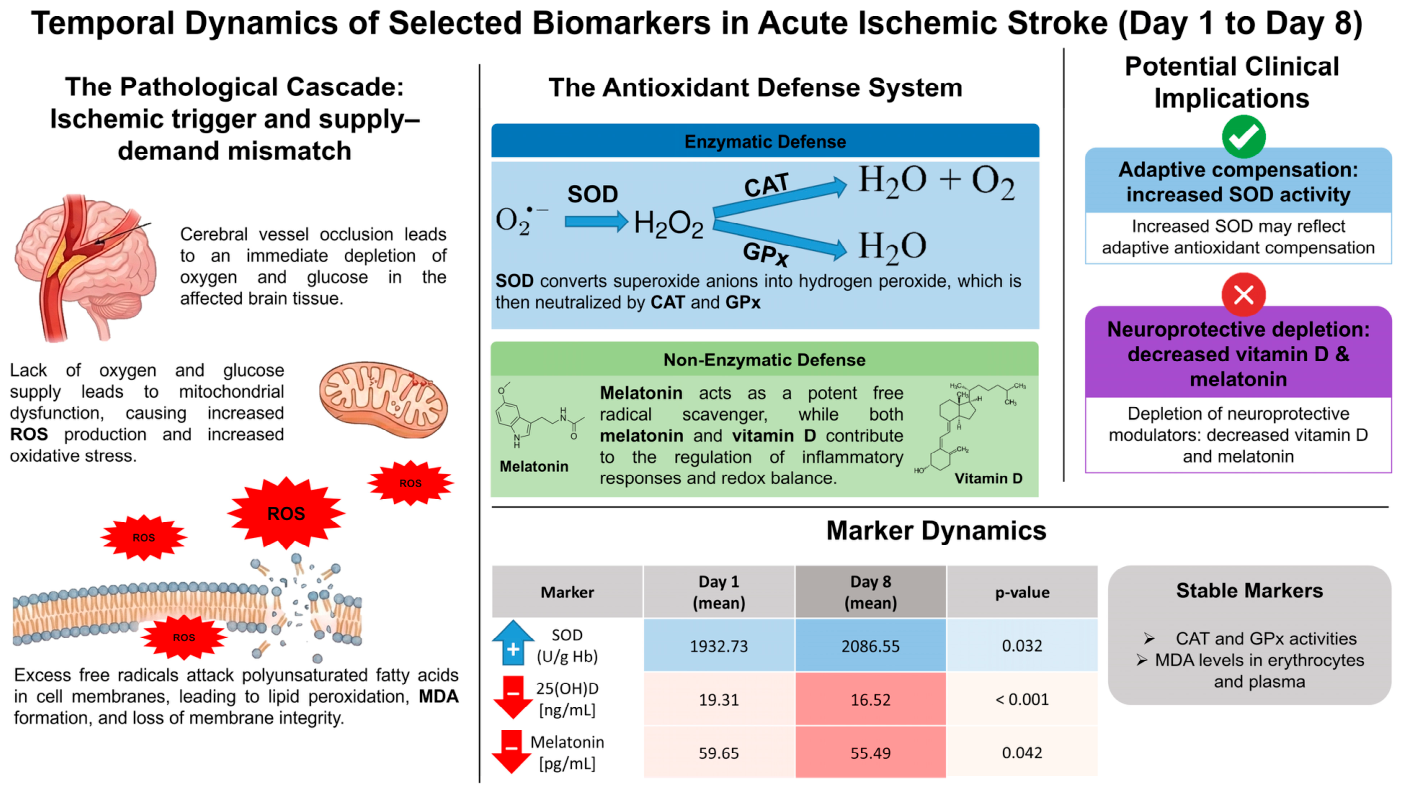
Acute ischemic stroke (AIS) is associated with redox imbalance; however, the early temporal changes in enzymatic and non-enzymatic antioxidant responses are poorly understood. The aim of this study was to evaluate changes in selected oxidative stress markers during the early phase of AIS. The study was designed as a longitudinal within-subject analysis, with each patient serving as their own reference between day 1 and day 8. A total of 48 patients (mean age 69.31 ± 1.59 years; 56.3% male; mean body mass index (BMI) 27.05 ± 0.61 kg/m2), predominantly presenting with mild to moderate stroke severity, were enrolled in a prospective observational study. The cohort was characterized by a high prevalence of hypertension (87.5%), dyslipidemia (45.8%), and diabetes or prediabetes (45.9%). Blood samples were collected on day 1 and day 8 after stroke onset. Depending on the distribution of paired differences, either the paired Student’s t-test or Wilcoxon signed-rank test was applied. A significant increase in superoxide dismutase (SOD) activity was observed (1932.73 vs. 2086.55 U/g Hb, p = 0.032), whereas catalase (CAT; 403.19 vs. 415.30 × 10³ U/g Hb, p = 0.444) and glutathione peroxidase (GPx; 24.70 vs. 24.40 U/g Hb, p = 0.477) showed no significant changes. Similarly, malondialdehyde (MDA) levels remained stable in both erythrocytes (182.96 vs. 187.15 nmol/g Hb, p = 0.838) and plasma (0.41 vs. 0.41 nmol/mL, p = 0.922). In contrast, melatonin (59.65 vs. 55.49 pg/mL, p = 0.042) and 25-hydroxyvitamin D (25(OH)D; 19.31 vs. 16.52 ng/mL, p < 0.001) concentrations significantly decreased. These findings suggest that the early phase of AIS may be associated with a selective and potentially maladaptive antioxidant response, involving increased SOD activity alongside depletion of systemic modulators, which may contribute to persistent redox imbalance.
Keywords: acute ischemic stroke; antioxidant enzymes; catalase; glutathione peroxidase; malondialdehyde; melatonin; oxidative stress; superoxide dismutase; vitamin D acute ischemic stroke; antioxidant enzymes; catalase; glutathione peroxidase; malondialdehyde; melatonin; oxidative stress; superoxide dismutase; vitamin D