Article

Multifaceted Interactions of Thermally Activated Delayed Fluorescent Emitters with Dielectric Environments: Charge Transfer vs. Structural Relaxation


by
Yiran Tian
1,
Yaxin Wang
1,†,
Yixuan Gao
1,‡,
Zilong Guo
2,§,
Shaowen Chu
1,
Yonghang Li
1,
Yandong Han
2,
Wensheng Yang
1,2,* and
Xiaonan Ma
1,*
1
Institute of Molecular Plus, Tianjin University, Tianjin 300072, China
2
Engineering Research Center for Nanomaterials, Henan University, Kaifeng 475004, China
*
Authors to whom correspondence should be addressed.
Current address: School of Science and Engineering, The Chinese University of Hong Kong, Shenzhen 518172, China.
Current address: North China Branch of SINOPEC Marketing Co., Ltd., Tianjin 300072, China.
§
Current address: School of Materials Science and Engineering, Changchun University of Science and Technology, Changchun 130022, China.
Molecules 2026, 31(10), 1581; https://doi.org/10.3390/molecules31101581
Submission received: 30 March 2026 / Revised: 27 April 2026 / Accepted: 6 May 2026 / Published: 9 May 2026
(This article belongs to the Special Issue Organic Luminescent Materials: Synthesis, Mechanism, and Applications)

Abstract

Thermally activated delayed fluorescence (TADF) emitters doped in host–guest systems are widely utilized for organic light-emitting diodes (OLEDs), where key rate constants and the fluorescence quantum yield (ΦF) are strongly influenced by the surrounding environment. However, the multifaceted interactions, i.e., dipole–dipole interaction and conformational restraint between the emitter and environment have been rarely investigated systematically, where excited state charge transfer (CT) and structural relaxation (SR) of emitters should be considered equally. In this study, four representative CT–TADF emitters were selected as model systems and studied in PS/PMMA:TADF:CA host–guest doped films with varied dielectric constants and matrix rigidity. Within D–A and D–A–D configurations, donor substitution from PXZ to DMAC varied CT characteristics, whereas TRZ-based D–A and DPS-based D–A–D emitters provided a relative difference in SR owing to their different rigidity. The total reorganization energy (λTotal) was introduced as a quantitative measure of these multifaceted interactions and correlated with the rate constants. The results indicate that the dielectric dependence of the nonradiative decay rate (knrS) for D–A–D molecules cannot be explained by the simplified energy gap law, where the vibronic effect plays the role of a game changer. This work provides a quantitative framework and highlights vibrational frequency as a key design parameter for optimizing ΦF in host–guest doped OLED devices.

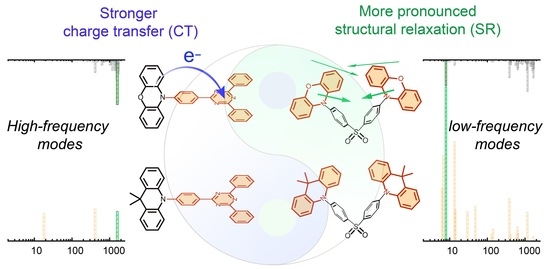
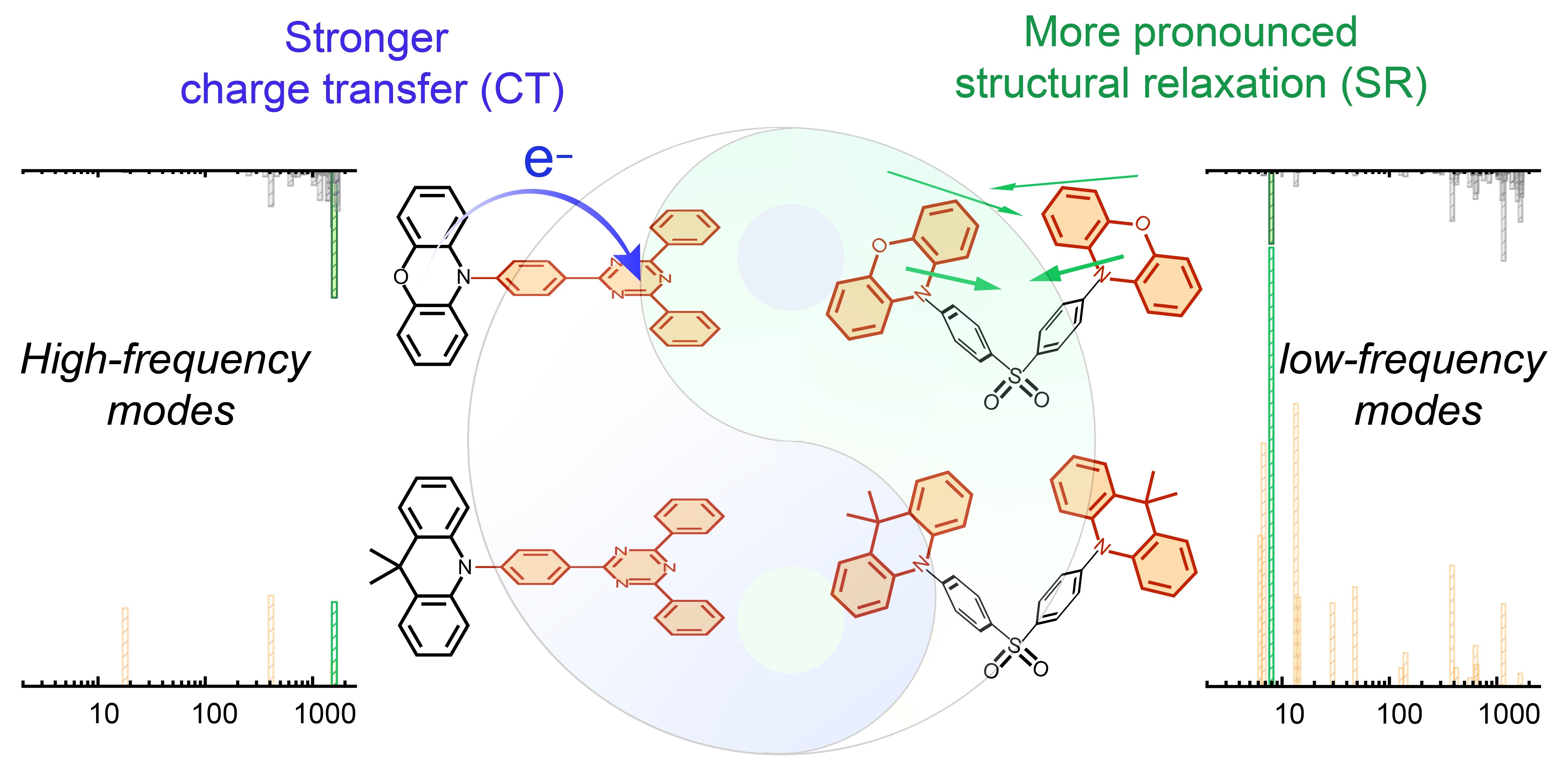
Graphical Abstract

1. Introduction

Organic light-emitting diodes (OLEDs) have emerged as a promising technology for next-generation displays, owing to their superior electroluminescence, flexibility, and tunable colors [1,2,3,4,5]. To suppress concentration-induced quenching and improve the stability of the emitting layer during fabrication and operation, host–guest doped films are widely employed in OLEDs [6,7,8,9]. In such systems, the fluorescence properties of emitters are determined not only by their intrinsic molecular characteristics but also by interactions with the surrounding environment. These interactions encompass both electrostatic effects, such as dipole–dipole interactions arising from charge transfer (CT) characteristics, and the conformational constraint associated with the structural relaxation (SR) of emitters in the excited states [10,11,12,13,14,15], which we refer to as multifaceted interactions. Early studies on fluorescent materials, such as the red laser dye DCM2, primarily attributed host–guest interactions to electrostatic effects, which were clarified by incorporating polar dopants to alter the local electric field within the films [16,17]. However, the third-generation thermally activated delayed fluorescence (TADF) emitters, with spatially separated frontier orbitals exhibiting both CT and SR characteristics, display multifaceted interactions compared to conventional fluorophores [18,19,20,21,22], i.e., co-existence of dipole–dipole interactions and conformational constraint in host–guest doped films.
In previous investigations, ternary solid films, i.e., polystyrene (PS)/poly(methyl methacrylate) (PMMA): PXZ-PYR/ACRPyr: camphoric anhydride (CA), demonstrated that the spectral shifts in prompt and delayed fluorescence over time depended dominantly on the degree of conformational constraint, independent of dielectric constants [23]. This observation indicates that SR characteristics are integral to host–guest interactions and may partly change emission behavior [12,24,25,26,27]. In analogous ternary films (e.g., PS:2PXZ-OXD:CA), the fluorescence quantum yield (ΦF) exhibited a non-monotonic dependence on CA concentration [28]. This trend implies competition between multiple processes, such as nonradiative decay (knrS, S1→S0) and reverse intersystem crossing (kRISC, T1→S1), which determine the contributions of prompt (ΦPF) and delayed fluorescence (ΦDF). A quantitative analysis of these rates is therefore essential to provide a perspective on the relationship between multifaceted interactions and emitting efficiency [29,30,31,32].
In general, both kRISC and knrS are fundamentally governed by Fermi’s golden rule, in which the transition probability is jointly determined by the energy gap and electronic coupling between the initial and final states [33]. In most previous discussions, the environment-dependent ΦF of TADF emitters has been primarily explained through changes in energy gaps, since dipole–dipole interaction can effectively stabilize the emitting CT excited states [34,35,36,37,38,39]. Nevertheless, we have recently demonstrated that the environment of doped films can also constrain molecular conformational flexibility and thereby alter the vibronic contribution to the key rate constants [40]. In rigid matrices, the structural relaxation of an ADA-type TADF emitter is significantly suppressed, leading to a marked reduction in knrS by weakening the contribution of the promoting vibrational modes. Thus, the distinctive TADF photophysics characterized by CT and SR characteristics, together with the host–guest multifaceted interactions, can affect energy gaps and vibronic contributions that govern key decay rates, thereby influencing the emission behavior.
In this work, rigid D–A and flexible D–A–D type CT–TADF emitters were employed to construct ternary PS/PMMA:TADF:CA host–guest doped films. By systematically varying dielectric constants and film rigidity and employing the total reorganization energy (λTotal) as quantitative indicator of multifaceted interactions, an integrated assessment of CT and SR characteristics was performed for the selected emitters in the doped films. On this basis, the key rate kRISC and knrS are extracted and analyzed using steady and time-resolved spectroscopy with assistance of theoretical calculations. In particular, D–A–D type emitters exhibit an abnormal dependence of knrS dielectric constants of the doped films, revealing that energy gap and vibronic effects must be simultaneously considered. These results show that considering host–guest effects only in terms of the dielectric stabilization of CT states may lead to deviations in predicting photophysics, because external structural restraint and the associated vibronic contribution, especially to knrS, must also be taken into account.

2. Results and Discussion

2.1. Emitting Properties

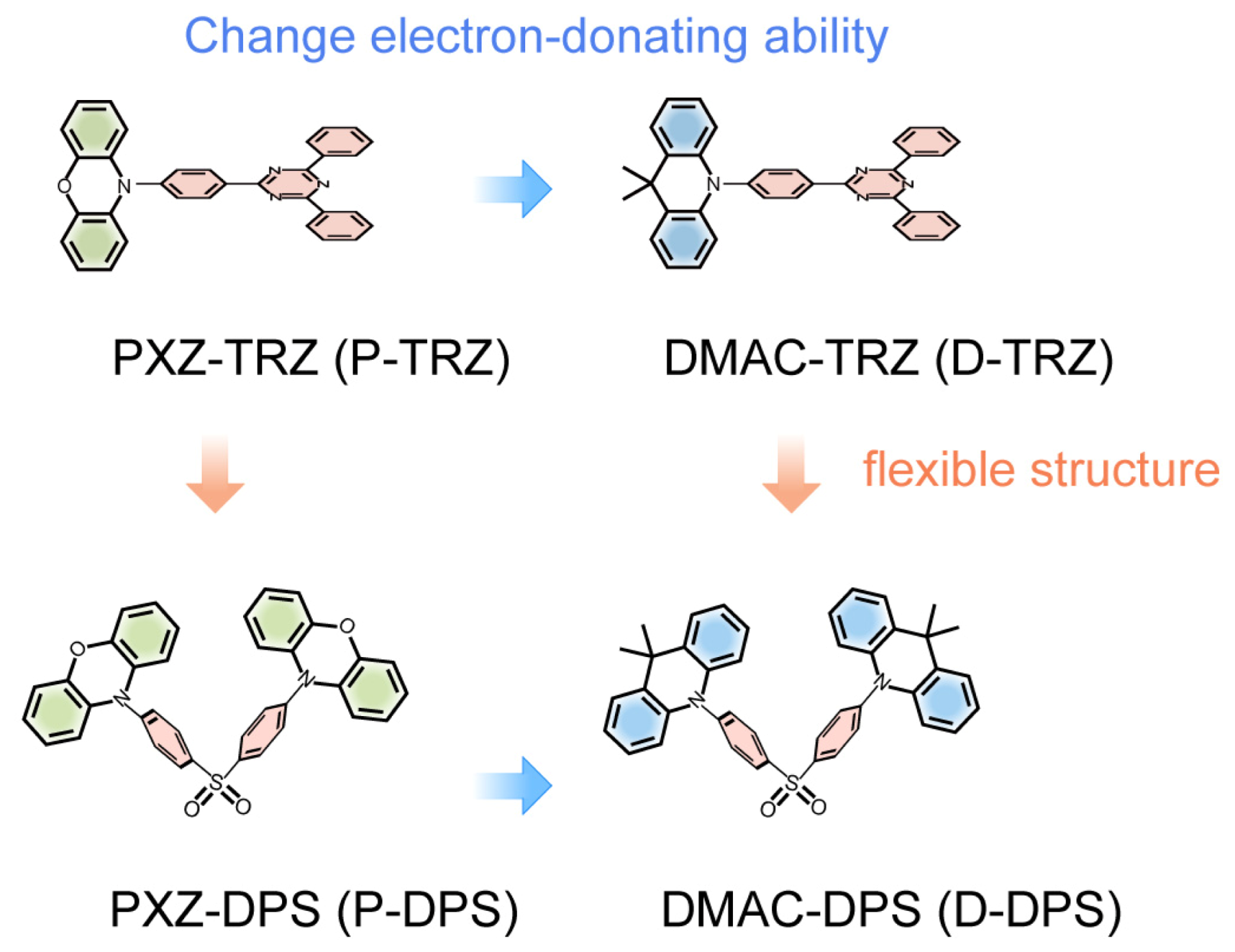
To investigate the host–guest multifaceted interactions in doped films, two variables were introduced to the molecular structure of the TADF emitters, corresponding to SR and CT characteristics, respectively. Firstly, 2,4,6-triphenyl-1,3,5-triazine (TRZ) with a relatively planar geometry and diphenyl sulfone (DPS) with a highly twisted geometry were chosen as electron acceptors, corresponding to the more rigid TRZ-based D–A and more flexible DPS-based D–A–D emitters, respectively [41,42,43]. For the D–A structure, phenoxazine (PXZ, abbreviated as P) and 9,9-dimethyl-9,10-dihydroacridine (DMAC, abbreviated as D) were introduced as donors, leading to changed CT characteristics (emitters P-TRZ and D-TRZ). The corresponding D–A–D emitters P-DPS and D-DPS were similarly included. The four emitters investigated in this work were commercially obtained and were not newly synthesized in the present study. In the investigated D–A emitters, the electron donors exhibit nearly identical orthogonal dihedral angles with the TRZ acceptor, leading to a rigid structure and minimized differences in SR characteristics. Similarly, the more flexible D–A–D type emitters were constructed with PXZ and DMAC donors incorporated with the DPS acceptor, denoted as P-DPS and D-DPS, respectively [44,45,46,47,48]. The chemical structures of the involved TADF emitters are shown in Scheme 1.
In addition to varying the CT and SR characteristics of the TADF emitters, two environmental factors were also tuned: (i) the dielectric constants within the doped films, controlled by the CA concentration. The dielectric constants of the matrices were tuned by varying the CA concentration, and estimated using published linear relationships [23], and (ii) the environment rigidity experienced by the emitters (PS and PMMA), where PS was reported to provide a stronger conformational restraint for guest emitters than PMMA [23,49]. All controlled variables are summarized in Table 1.
Quantum chemical calculations were performed to clarify the intrinsic excited-state characteristics of the involved emitters. The ground (S0) and excited-state (S1, T1) geometries were optimized at the PBE0/6-311g** level using the PCM solvation model with toluene (ε = 2.37). PBE0 was selected from six widely used hybrid and long-range corrected functionals because, with its 25% HF exchange, it provides a reasonable balance between the electronic-structure features of CT emitters and computational consistency for the subsequent geometry, charge-transfer, and vibronic analyses, while remaining consistent with the experimental fluorescence energies in toluene solution (Table S1 and Figure S1) [50]. PCM was used to account for the bulk dielectric response of the surrounding medium, as the excited-state properties of molecules in the environment are strongly affected by polarization [51]. As a continuum solvation model, PCM does not account for conformational constraint. Thus, if only the dielectric effect is considered, while neglecting the conformational restriction imposed by PS, toluene is a reasonable approximation, owing to its dielectric constant being similar to that of PS. The calculated E(S1) values are in reasonable agreement with the fluorescence energies measured in PS films and toluene solution (Table S2).
The CT characteristics of S1 states were evaluated using Multiwfn [52,53], while the relevant parameters and physical meanings are illustrated in Table S3. All involved emitters exhibited typical CT characteristics with a CT% of the S1 state up to 91% for D–A and 87% for D–A–D emitters, indicating that the local excited (LE) contribution to S1 remains limited. However, further analysis revealed clear differences between the D–A and D–A–D emitters. The D index, quantifying the spatial distance between the electron and hole centroids [54], was considerably larger for the D–A (P-TRZ: 6.17 Å; D-TRZ: 6.03 Å) than for the D–A–D emitters (P-DPS: 2.53 Å; D-DPS: 2.46 Å). Likewise, the t index of the D–A emitters (P-TRZ: 4.22; D-TRZ: 4.05), which quantifies the degree of charge separation along the CT direction [54], was observed to be significantly higher than that of the corresponding D–A–D counterparts (P-DPS: 1.00; D-DPS: 0.90). These quantitative charge transfer parameters are further supported by the vertical excitation analysis and the frontier molecular orbital distributions (Tables S4 and S5). As shown in Table S4, the S1 states of the D–A emitters are dominated almost exclusively by the HOMO→LUMO transition, whereas the D–A–D emitters exhibit slightly more mixed transition compositions involving additional contributions from adjacent frontier orbitals. Accordingly, Table S5 shows that the HOMOs of the D–A emitters are mainly localized on the donor moieties, while the LUMOs are concentrated on the acceptor units, leading to a more pronounced spatial separation between the hole and electron. By contrast, for the D–A–D emitters, the donor units are located on both sides of the acceptor, so the hole centroid is determined by the vector sum of the two donor contributions, resulting in a smaller hole–electron separation and thus a smaller effective D and t index. These results clearly indicate more evident CT characteristics in D–A than in the corresponding D–A–D emitters.
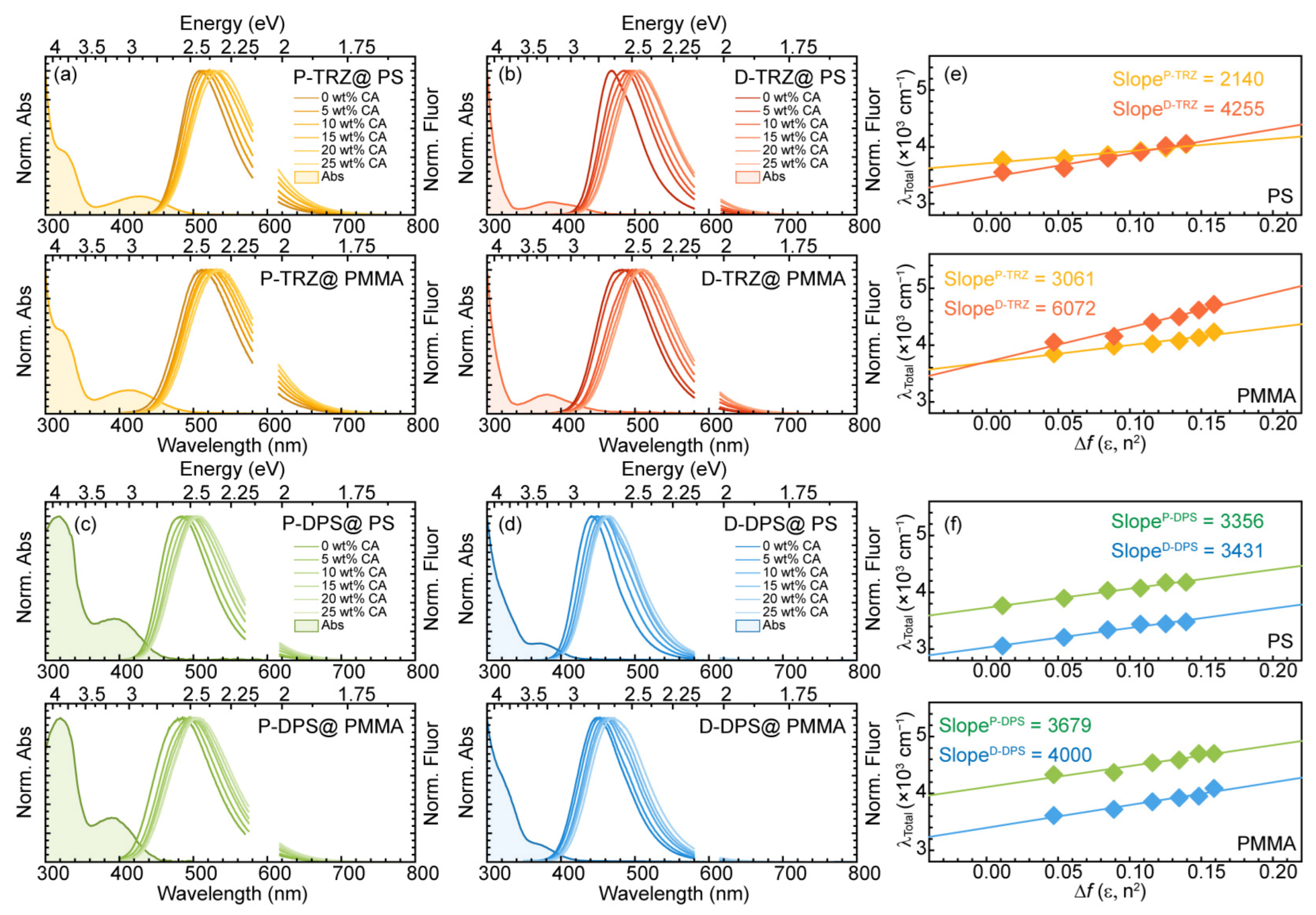
As shown in Figure 1a–d, the differed CT characteristics can be observed by Stokes shift, indicating the electrostatic stabilization through solvatochromic relationships such as the Lippert–Mataga equation [55]. In PS films without CA, P-TRZ, D-TRZ, P-DPS, and D-DPS exhibit Stokes shifts of 3738, 4395, 4524, and 4273 cm−1, respectively. Upon doping with 25 wt% CA, the corresponding values increase to 4711, 6000, 5363, and 5431 cm−1 (Table 2), resulting in Stokes shift changes (ΔS0–25PS) of 973, 1605, 839, and 1158 cm−1, respectively. For the D–A emitters, D-TRZ exhibits a larger Stokes shift than P-TRZ both in the absence and presence of CA, while the corresponding ΔS0–25PS of D-TRZ is considerably higher than P-TRZ as well. This trend is consistent with the stronger dielectric response of D-TRZ and suggests stronger electrostatic interactions with the environment. By contrast, the D–A–D type D-DPS exhibits a comparable Stokes shift to that of P-DPS under the same dielectric constants (CA = 0 and CA = 25 wt%), with the donor electron-donating ability in the dielectric response being less pronounced than for the D–A counterparts.
More importantly, P-DPS (4524 cm−1 at CA = 0 and 5363 cm−1 at CA = 25 wt%) exhibits a larger Stokes shift than the corresponding D–A emitter P-TRZ (3738 cm−1 at CA = 0 and 4711 cm−1 at CA = 25 wt%), even though the TRZ-based D–A emitters possess stronger CT characteristics. This discrepancy may be attributed to the greater conformational flexibility of P-DPS, leading to additional SR and a red-shifted emission. A similar contrast is less pronounced for D-TRZ and D-DPS, which may arise from the strong dielectric response of D-TRZ and thus makes the respective contributions of electrostatic interactions in D-TRZ and SR in D-DPS more challenging to distinguish. Consequently, the Stokes shift in the involved DPS-based D–A–D emitters can hardly be barely explained by electrostatic stabilization alone. In addition, the involved emitters exhibit a further increased Stokes shift in PMMA films, consistent with the higher dielectric constants and the greater guest flexibility in PMMA (Table 2). Therefore, the Stokes shift cannot provide a complete assessment of multifaceted interactions involving both charge transfer (CT) and structural relaxation (SR) of guest emitters.
Furthermore, the Lippert–Mataga analysis (Figure S2 and Table S6) confirms that the effect of solvent polarity on the electrostatic stabilization of the four emitters is broadly consistent with that observed in solid films. Given the similar Onsager radius (aw) of the four emitters, a larger change in dipole moment (Δμ) generally indicates a stronger electrostatic contribution to the multifaceted interactions. For the D–A emitters, D-TRZ exhibits a larger Δμ (18.47 D) than P-TRZ (10.59 D), consistent with the corresponding ΔS0–25PS in the solid films. For the D–A–D emitters, D-DPS shows only a slightly larger Δμ (15.27 D) than P-DPS (13.67 D), also matching the solid-film data; thus, donor substitution has a weaker effect on the CT character in D–A–D than in the D–A emitters. Notably, P-DPS has a much larger Δμ than P-TRZ (13.67 vs. 10.59 D), a difference more pronounced than in ΔS0–25PS (973 vs. 839 cm−1), reflecting less constrained structural relaxation in solution. Nevertheless, D-TRZ still shows a larger Δμ than D-DPS, indicating that the strong dielectric response of D-TRZ partially obscures a direct comparison between its electrostatic contribution and the structural relaxation contribution of D-DPS.
For evaluating the contribution of the excited-state SR, the internal reorganization energy of S1→S0 transition (λint) was calculated for the involved emitters by summing up the contributions of all active vibrational modes in the MOMAP 2021A package [56,57,58,59]. As expected, the DPS-based D–A–D emitters exhibit markedly larger structural reorganization in S1→S0 transition (P-DPS: 2785 cm−1; D-DPS: 2338 cm−1) than the corresponding TRZ-based D–A counterparts (P-TRZ: 2074 cm−1; D-TRZ: 1687 cm−1), indicating extensive S1/S0 SR that can respond to the rigid environment.
Based on the analysis above, the D–A and D–A–D emitters can be distinguished by stronger CT and SR characteristics, respectively, providing a molecular basis for their different host–guest multifaceted interactions in doped films. For an integrated assessment of host–guest multifaceted interactions, a quantitative indicator is required to link the excited-state characteristics with the environmental response, for which the total reorganization energy (λTotal) was extracted from the experimentally measured steady-state absorption and emission spectra. In general, λTotal includes the intramolecular contribution (λint) arising from internal vibrational degrees of freedom and external contribution (λext) associated with the polarization response of the solute–environment interaction [60,61,62], which can be extracted as
λ Total = 0 ω ~ σ a ω ~ σ f ω ~ d ω ~ 0 σ a ω ~ + σ f ω ~ d ω ~
Here, σa() and σf() are the experimentally normalized absorption and emission spectra, respectively, and = ωωeg, where ωeg is the frequency at the intersection of the absorption and emission spectra. The detailed data are listed in Tables S7 and S8.
To provide a quantitative depiction of the host–guest multifaceted interactions, the extracted values of λTotal were plotted against the orientation polarizability Δf (see Table S9) as shown in Figure 1e,f. Here, the dielectric constants were estimated from the CA doping concentration using published linear relationships between the CA content and the dielectric constant, i.e., ε = 2.45 + 0.120x for PS and ε = 3.41 + 0.219x for PMMA, where x is the CA concentration (wt%) [23]. In this picture, molecules that are highly sensitive to the dielectric environment exhibit a larger contribution from λext, thereby increasing λTotal, which is particularly pronounced for the D–A emitters with strong CT characteristics.
As shown in Figure 1e, D-TRZ (orange) exhibited a notably steeper λTotalf dependence than P-TRZ (yellow), indicating a stronger contribution of electrostatic interactions to λTotal in D-TRZ, consistent with its larger Stokes shift. In other words, the host–guest electrostatic interactions can effectively enhance λext, causing its λTotal to surpass that of P-TRZ, albeit D-TRZ possesses a smaller λint (1687 cm−1) than P-TRZ (2073 cm−1). Consequently, CT-dominant D–A emitters exhibited a cross pattern of λTotalf dependence due to their different responses to the increase of host dielectric constants.
In contrast, for SR-dominant D–A–D emitters that are less insensitive to the dielectric environment, the extracted λTotal is primarily governed by the λint associated with S1/S0 SR, leading to a nearly parallel λTotal–Δf pattern (Figure 1f). Despite D-DPS showing larger changes in Stokes shift than P-DPS (ΔS0–25PS: 1158 > 839 cm−1; ΔS0–25PMMA: 1050 > 705 cm−1), its λTotal is considerably smaller, as demonstrated by the fitted line of P-DPS (green) being consistently above that of D-DPS (blue) in Figure 1f. Moreover, the minor contribution of λext leads to a gentle increase in λTotal with Δf, without the crossing pattern.
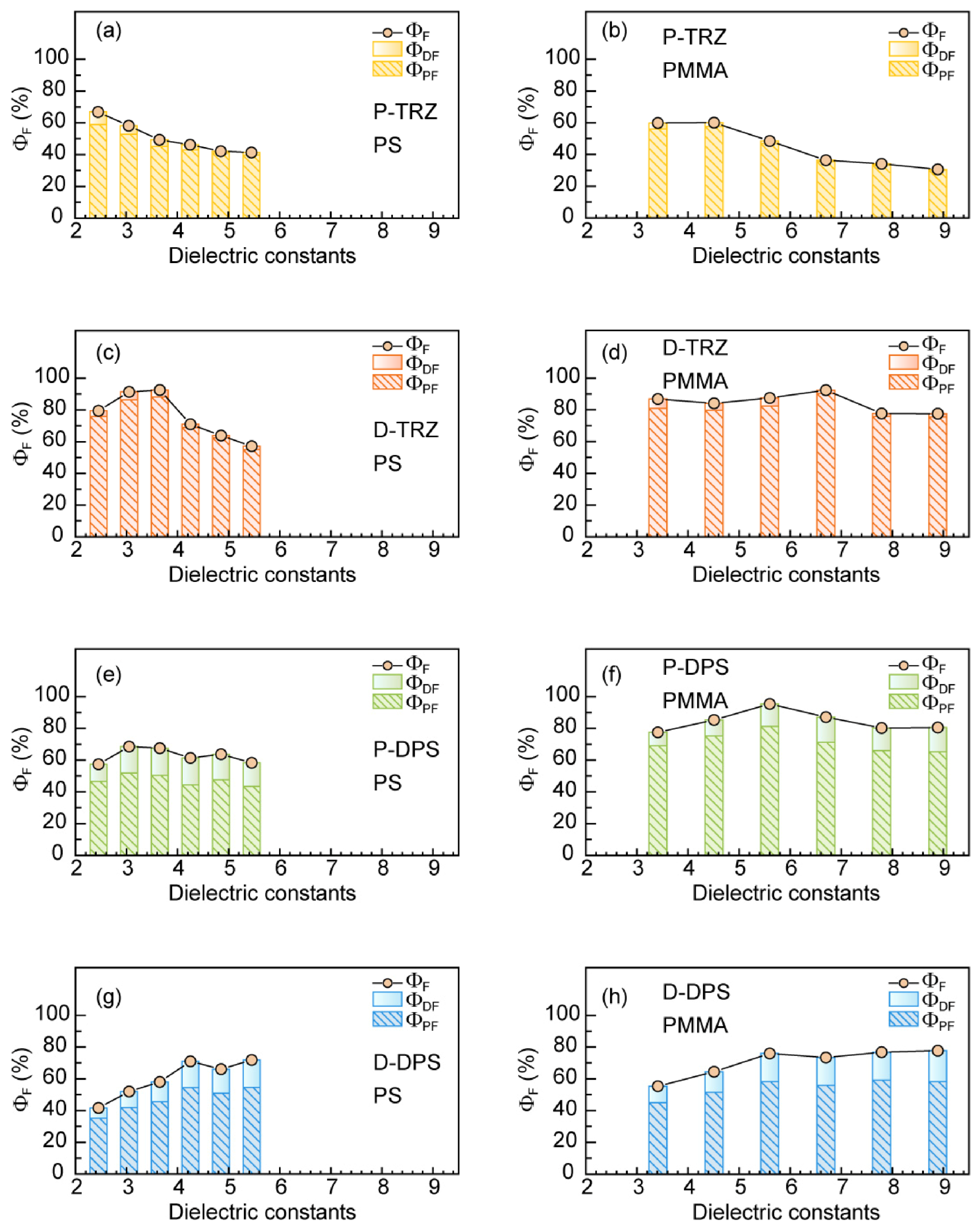
Although the analysis above indicates that D–A emitters are characterized by stronger CT characteristics, whereas D–A–D emitters exhibit more pronounced SR characteristics, the dependence of ΦF with host dielectric constants exhibited more complex pattern. As shown in Figure 2a,b, P-TRZ shows a continuously decreasing ΦF with increasing host dielectric constants, while D-DPS shows a totally reverse pattern (Figure 2g,h). Intriguingly, D-TRZ and P-DPS display similarly a non-monotonic pattern (Figure 2c–f), with ΦF initially increasing and then decreasing as the CA concentration increases. As discussed above, λTotal integrates the host–guest interactions, while ΦF is a kinetic outcome determined by the competition among multiple excited state decay channels. Therefore, the diverse ΦF trends imply that the discussion should be extended beyond a simple CT/SR ratio to the underlying rate constants, with ΦF governed by prompt and delayed emission pathways. Accordingly, for the four emitters, ΦPF and ΦDF were separated from the measured ΦF by exponential fitting of the prompt and delayed decay components [63], followed by weighting according to their integrated contributions, as exemplified by the PS-film data in Figures S3 and S4. This treatment provides the basis for the subsequent quantitative analysis of the relevant rate constants, with the corresponding rate equations summarized in Section S8 of the Supporting Information [9,64].

2.2. Delayed Fluorescence and Reverse Intersystem Crossing

The rate constants kRISC greatly affect the efficiency of triplet-to-singlet conversion, therefore plays a key role in determining the ΦDF of TADF emitters. To clarify the ΦDF dependence on dielectric constants, kRISC was analyzed within the semi-classical Marcus formalism, a well-established approximation of Fermi’s golden rule for ISC and RISC [65,66,67]:
k RISC   =   ξ ST 2 2 π λ k B T eff exp Δ E ST λ 2 4 λ k B T eff
Here ξST and ΔEST stand for the spin–orbit coupling matrix element and the singlet–triplet energy gap, respectively. Meanwhile, λ is the reorganization energy associated with RISC, while Teff corresponds to the effective temperature. Due to the local excited (LE) nature, excitation energy of the T1 state is insensitive to host dielectric constants while the S1 (CT) state can be stabilized with the increasing of the CA concentration, for which the host dielectric constants are assumed to affect the energy gap (ΔEST) rather than the relevant vibrational modes. Accordingly, ΔEST was adopted as the key parameter for describing the dielectric dependence of kRISC, by using estimated ΔEST rather than directly measured ones (Table S10). Specifically, ΔEST in PS films (ΔEST(CA0)PS) was estimated by the adiabatic ΔEST* obtained from TD-DFT calculations, whereas ΔEST at other dielectric constants was approximated by assuming a nearly unchanged T1 level and a descent with the S1 energy shift.
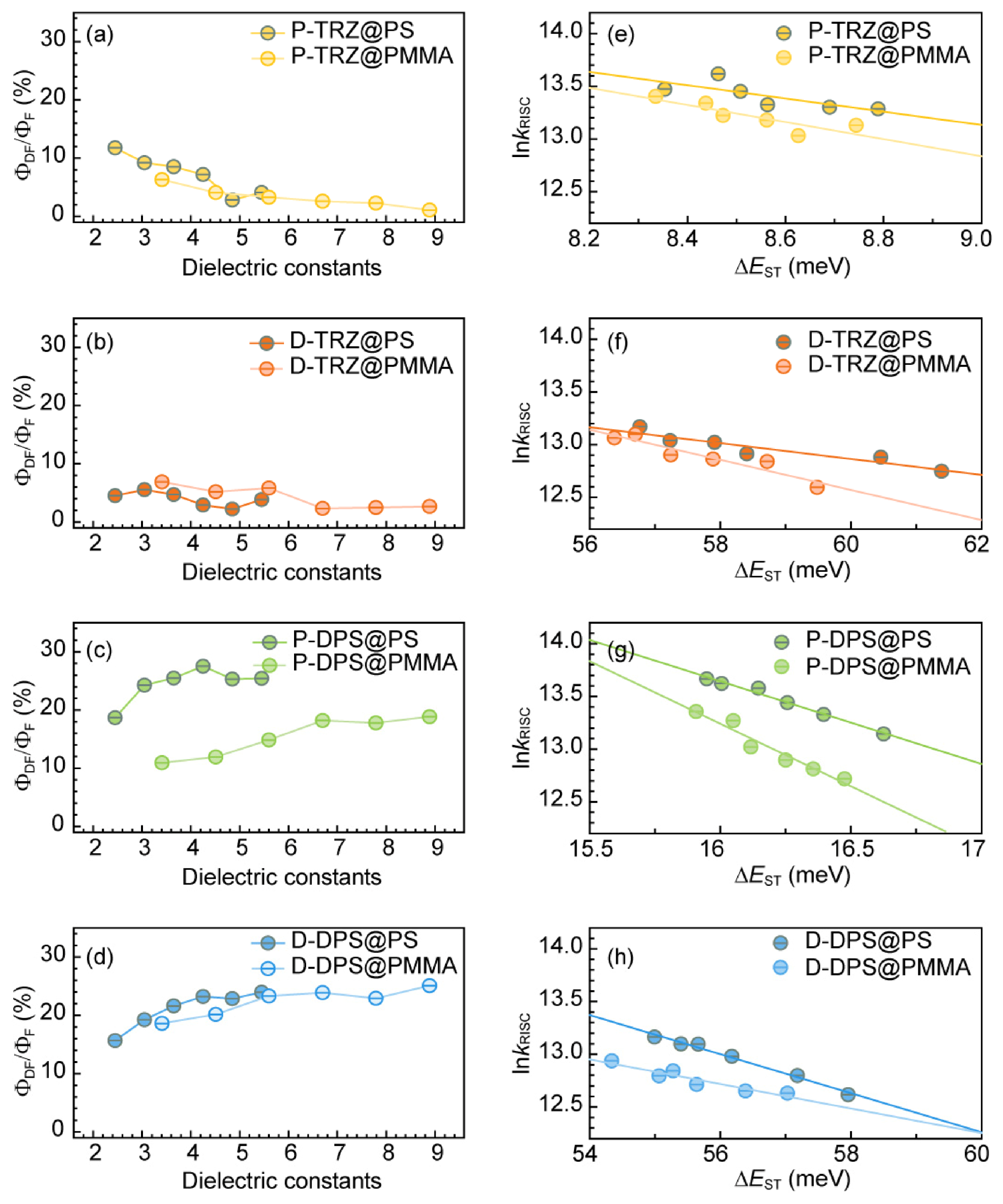
As shown in Figure 3a–d, the D–A–D emitters exhibit a gradual increase in the ΦDFF ratio with increasing dielectric constants. This trend is attributed to the reduced ΔEST that can enhance both ΦISC and ΦRISC, thereby demonstrating that ΦDF positively contributes to ΦF. In contrast, the ΦDFF ratio of the D–A emitters remains nearly unchanged or even slight decreases with the ΦDF contribution consistently below 10%, suggesting that the RISC channel is more effective in the D–A–D systems than in their D–A counterparts.
For further analysis, lnkRISC was plotted against the estimated ΔEST(CA0–25) in PS and PMMA film as shown in Figure 3e–h. In all cases, lnkRISC increased as ΔEST decreased, consistent with the expected dielectric stabilization of the CT (S1) state and the subsequent promotion of the RISC process (Table S10). This trend is further supported by the dielectric dependence of the delayed fluorescence lifetimes (τDF), which decrease with increasing dielectric constants (Figure S5). Intriguingly, the involved emitters displayed similar kRISC trend with ΔEST despite their markedly different ΦDFF patterns with host dielectric constants. Therefore, the diverse ΦF pattern observed among the four emitters (Figure 2) cannot be simply explained by variations in kRISC due to the extremely low ΦDFF ratio of the D–A emitters, i.e., the ISC/RISC cycling is insufficiently competitive against other singlet state deactivation pathways upon optical excitation (Table S10) [68,69]. Therefore, identifying the competitive decay channels of S1 state becomes essential for understanding the observed variation in ΦF with host dielectric constants. Moreover, since the radiative decay (krS) is mainly governed by S1⟶S0 transition dipole moment and is therefore much less sensitive to the dielectric environment, the key variable would be the singlet nonradiative decay rate (knrS). This consideration directly motivates the following analysis.

2.3. Prompt Fluorescence and Nonradiative Decay Rate

As a time constant that has a significant impact on fluorescence efficiency, knrS (S1⟶S0) of organic emitters and the corresponding environmental effects have been widely discussed within the framework of Fermi’s golden rule [70,71,72,73,74]. Depending on S1/S0 electronic coupling, different formulism of knrS can be employed [75,76,77,78]. In this work, the involved TADF emitters exhibit large energy gaps (ΔES1→S0) and considerable fluorescence efficiency, indicating they fall within the weak coupling limit, where knrS is given by
k nr S = C 2 2 π ω M Δ E S 1 S 0 exp Δ E S 1 S 0 ω M ln Δ E S 1 S 0 l λ M 1
in which λM and ωM represent the reorganization energy and vibrational frequency, respectively, for the specific vibrational modes coupled to the S1→S0 transition. However, since experimental results often imply a concerted vibronic coupling including multiple modes rather than an individual mode, ωM can be replaced by the average effective frequency, ωavg = ∑kSkωk/∑kSk [72,79,80], in which Sk is the Huang−Rhys factor of mode k. Accordingly, a smaller ωavg indicates that the weighted distribution of vibronic coupling is more concentrated in the low-frequency region, and Sk of modes in this region is generally higher than in the high-frequency modes [74,81]. As low-frequency modes are typically associated with collective motion, such as bond bending and dihedral twisting, enhanced contributions in the low-frequency region can lead to a larger internal reorganization energy and thus indicate a more pronounced S1/S0 SR characteristic [15,82,83,84,85].
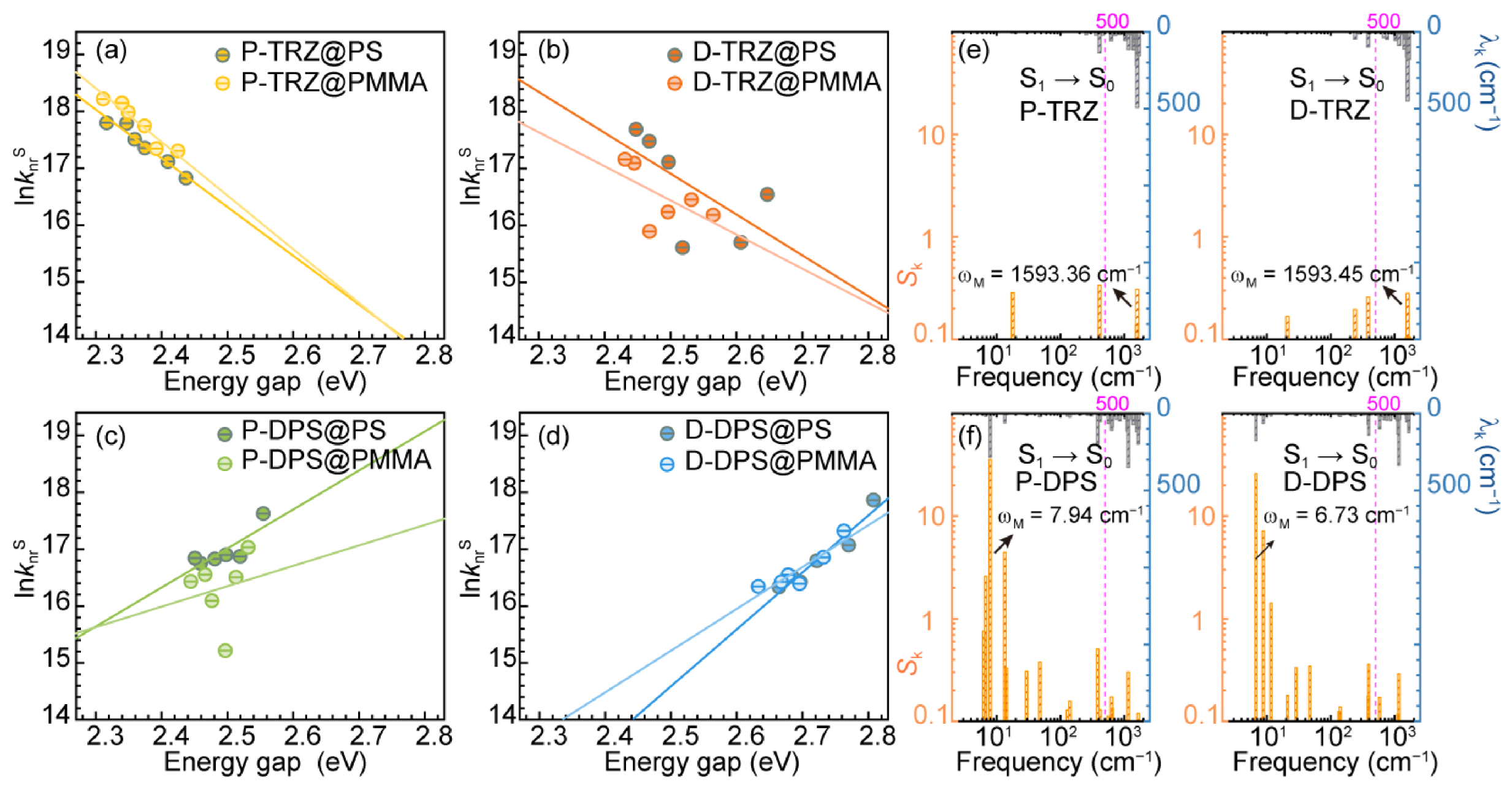
In a simplified energy gap law, knrS of organic emitters increases as ΔES1→S0 decreases dominantly, i.e., knrS∝e−αΔE, in which the contribution of the vibrational effect is ignored and might lead to mistakes in systems with strong vibronic coupling for the S1⟶S0 transition. As shown in Figure 4a,b, lnknrS of the TRZ-based D–A emitters exhibited negative slope versus ΔES1→S0, consistent with this simplified law. Intriguingly, however, for the DPS-based D–A–D emitters with enhanced conformational flexibility, a positive lnknrSES1→S0 slope was observed in both PS and PMMA matrices (Figure 4c,d), thereby deviating from the simplified energy gap law. The results are further supported by prompt fluorescence lifetime (τPF) measurements, in which opposite trends of τPF with increasing dielectric constants were revealed for the D–A and D–A–D emitters (Figure S6). The observed dramatically different lnknrSES1→S0 dependence likely originates from the contributions of vibrational modes engaged in S1⟶S0 vibronic coupling (see Equation (3)), for which a detailed vibronic analysis on the S1⟶S0 transition of the involved emitters was performed and displayed in Figure 4e,f and Table 3.
For P-TRZ and D-TRZ, the reorganization energy contributions (∑λk < 10 cm−1) associated with low-frequency modes (ωk < 500 cm−1) are negligible compared to the total reorganization energy of S1⟶S0 transition (P-TRZ: 2073 cm−1; D-TRZ: 1687 cm−1, Figure 4e). The modes with the largest λk appear at ωM ≈ 1593 cm−1, corresponding to stretching motion of the triazine acceptor (Table S11). Consequently, average effective frequency ωavg values for P-TRZ and D-TRZ are 877 cm−1 and 896 cm−1, respectively, predominantly distributed in the high-frequency region. In contrast, the D–A–D emitters exhibit greatly enhanced vibronic coupling in the low-frequency region (Figure 4f). For the ultra-low frequency modes (ωM = 7.94 cm−1 for P-DPS and 6.73 cm−1 for D-DPS), the λk values are two orders of magnitude higher (283.4 cm−1 and 115.2 cm−1, respectively) than those of the corresponding D–A emitters. These modes mainly involve out-of-plane wagging and the rotation of the donor groups, which significantly enhance the conformational flexibility of the D–A–D emitters (Table S11). Notably, low-frequency modes of D–A–D emitters exhibit more considerable Huang–Rhys factor (Sk > 1) than those of the D–A emitters, indicating stronger coupling with S1⟶S0 transition. As a result, ωavg with a major contribution from low-frequency modes is essential for describing the D–A–D emitters, with values as low as 58 cm−1 and 60 cm−1, indicating considerable conformational flexibility on S1 state.
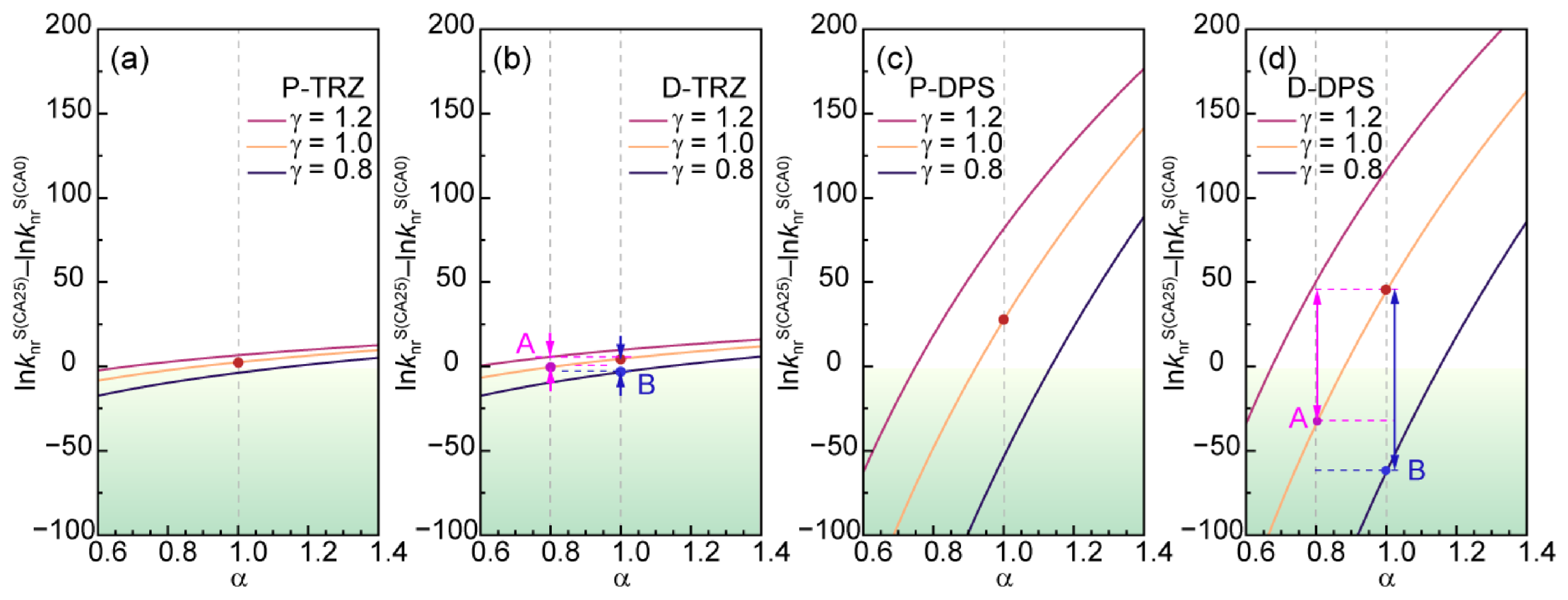
To analyze the concerted vibronic coupling on knrS within the framework of the weak coupling limit (Equation (3)), we calculated subtractive values (lnknrS(CA25) − lnknrS(CA0)) to directly compare the response of knrS to the dielectric environment, with the constant C2 eliminated. In this treatment, positive values correspond to a responsive behavior consistent with the simplified energy gap law, i.e., knrS∝e−αΔE, whereas negative values indicate a deviation from it. Please note that such an analysis is highly challenging, the key point is that we cannot directly calculate the reorganization energy (λ) and average effective frequency (ωavg) in doped films at different CA%. Therefore, to account for changes in reorganization energy and average effective vibrational frequency in the doped films, we assumed λ(CA0) and ωavg(CA0) are equal to the calculated values, while two coefficients α and γ were introduced to multiply λ and ωavg at CA% = 0, i.e., λ(CA25) = αλ(CA0) and ωavg(CA25) = γωavg(CA0). Here, an α or γ greater than 1 indicates an increase in λ or ωavg in the dielectric environment, whereas α or γ less than 1 indicates a decrease. The analyzed results are shown in Figure 5, with the relevant data summarized in Table 3.
AS can be seen in Figure 5, the reorganization energy (λ) and average effective frequency (ωavg) involved in vibronic coupling can greatly affect lnknrS(CA25) − lnknrS(CA0), even dragging it into the green shaded region, i.e., the inverted region relative to the simplified energy gap law. In general, α < 1.0 and γ < 1.0 are more favorable for producing lnknrS(CA25) − lnknrS(CA0) < 0, corresponding to λ(CA25) < λ(CA0) and ωavg(CA25) < ωavg(CA0). This implies that the suppression of vibronic coupling in doped films, i.e., λ reducing and ωavg shifting to a lower frequency, can offset the energy gap associated knrS increase and lead to reduced knrS in doped films with increased dielectric constants.
Intriguingly, the D–A and D–A–D emitters exhibit markedly different patterns of lnknrS(CA25) − lnknrS(CA0) with α and γ. For the D–A–D emitters, the steeper slopes lead to much larger variations in lnknrS(CA25) − lnknrS(CA0), indicating that knrS is highly sensitive to changes in the reorganization energy (described by the coefficient α). Furthermore, varying ωavg (described by the coefficient γ) does not substantially alter the slope or range of lnknrS(CA25) − lnknrS(CA0), but shifts the pattern upward or downward relative to the yellow line (γ = 1.0). Overall, the striking contrast between the D–A and D–A–D type emitters lies in the slope, which can be traced to the key factor ΔES1→S0/ℏωavg. Given that the ΔES1→S0 values of the involved emitters are comparable, the observed differences in slope are primarily determined by ωavg. According to the vibrational analysis (Figure 4e,f), the ωavg values of the D–A–D (~60 cm−1) and D–A (~900 cm−1) emitters differ by a factor of approximately 15, leading to a substantial difference in slope. Consequently, the larger ΔES1→S0/ℏωavg in the D–A–D emitters results in a steeper pattern of lnknrS(CA25) − lnknrS(CA0) with α, such that even minor changes in λ(CA25) can lead to substantial variations in lnknrS(CA25) − lnknrS(CA0). This reveals that the D–A–D emitters dominated by low-frequency modes exhibit steeper pattern and are more prone to deviate from the simplified energy gap law, which is consistent with the experimental observations (Figure 4c,d). Furthermore, the individual contributions of each parameter can be summarized as follows:
(1) When both λ and ωavg are assumed to be unchanged with the dielectric environment, the variation in the energy gap alone cannot reproduce the experimentally observed inverted behavior of the D–A–D emitters, as indicated by the red point in Figure 5. Under this condition, the theoretically predicted lnknrS(CA25) − lnknrS(CA0) values are 2.48, 4.54, 27.4, and 44.7 for P-TRZ, D-TRZ, P-DPS, and D-DPS, respectively, as listed in Table 3.
(2) When both ΔES1→S0 and λ are allowed to vary, entry into the negative region becomes much easier for the D–A–D emitters because their steeper slopes require only a small decrease in λ. Point A represents the values of lnknrS(CA25) − lnknrS(CA0) upon a 20% decrease in the reorganization energy. Taking D-TRZ and D-DPS as examples, the value for D-TRZ decreases from 4.54 to −0.38, whereas that for D-DPS decreases from 44.7 to −34.1. Both cases therefore move from the positive region into the negative region, which is consistent with previous studies showing that reducing the reorganization energy through the suppression of the promoting modes can lead to a rapid decrease in knrS and increased fluorescence efficiency [40,72,83]. The effect is more pronounced for the D–A–D emitters, making them more likely to deviate from the energy gap law.
(3) When ωavg is reduced by 20% (γ = 0.8, point B), all emitters can in principle exhibit inverted behavior, the corresponding values decrease to −3.39 and −62.5 for D-TRZ and D-DPS, respectively. These results indicate that a 20% reduction in ωavg can more effectively suppress knrS than a comparable reduction in λ.
Overall, the concerted vibronic coupling effect on knrS is substantially stronger for the D–A–D emitters with high conformational flexibility, owing to their low-frequency dominated vibronic coupling and larger reorganization energies. Therefore, these results demonstrate that the dielectric dependence of knrS is not governed by the energy gap alone, but by the combined influence of the vibronic coupling of the S1⟶S0 transition, i.e., λ and ωavg. It should be noted that this tendency is identified for the present DPS-based D–A–D model emitters, and its extension to other emitters still requires a case-by-case assessment.

2.4. General Discussion on Multifaceted Interactions

Quantitative analysis indicates that the variation in ΦF in doped films is primarily associated with changes in knrS upon optical excitation, where the delayed fluorescence contribution is much less considerable. Thus, the observed trends in ΦF across the four emitters are intrinsically governed by the underlying rate constants, which are in turn influenced by the excited-state characteristics (CT vs. SR) of the emitters, and their multifaceted interactions with the dielectric environments, i.e., host–guest dipole–dipole interactions and conformational restraint.
For the D–A emitters that exhibit strong CT characteristics and relatively small λint, vibronic coupling is dominated by high-frequency modes, resulting in large ωavg values, small ΔES1→S0/ℏωavg ratios, and consequently gentle slopes in the lnknrS(CA25) − lnknrS(CA0) patterns. As a result, the knrS of these emitters readily adheres to the S1⟶S0 energy gap. Their multifaceted interactions are primarily influenced by λext, which is effectively enhanced by the host dielectric constants. Among them, P-TRZ closely follows this behavior, while D-TRZ exhibits a beneficial increase in ΦF at low dielectric constants. This deviation likely stems from the stronger role of λext in D-TRZ compared to P-TRZ in varying λTotal. At low CA doping concentrations, the increase in λext is less pronounced, thereby suppressing the rise in knrS and creating a favorable outcome. Thus, for the D–A emitters, suppressing knrS requires minimizing λext and avoiding a high dielectric environment.
By contrast, the D–A–D emitters possess pronounced S1/S0 SR and weak CT characteristics, endowing them with greater conformational flexibility. Their vibronic coupling is dominated by low-frequency modes, resulting in smaller ωavg values, larger ΔES1→S0/ℏωavg ratios, and steeper slopes in lnknrS(CA25) − lnknrS(CA0) patterns. Consequently, their knrS values are equally affected by the energy gap and the vibronic effect. As reflected by the dominance of λint, their multifaceted interactions display negligible dependence on λext. Among them, D-DPS closely follows this behavior, while P-DPS displays a detrimental decrease in ΦF at high dielectric constants. This is likely because the higher λint of P-DPS amplifies the increase in reorganization energy under high dielectric constants, leading to an unacceptable rise of knrS. Therefore, for the D–A–D emitters, minimizing λint and avoiding a high dielectric environment are essential as well to suppress knrS. Overall, the combination of molecular rigidity and low dielectric environment is therefore established as a promising strategy for suppressing knrS and achieving high fluorescence efficiency of TADF emitters.
On this basis, the CT parameters, λint, λTotal, and ωavg may serve as physically meaningful descriptors for linking excited-state characteristics to the key rate constants and fluorescence efficiency. Although their applicability to other TADF emitters still requires a case-by-case assessment, the present work may offer a possible basis for future data-driven screening based on larger datasets.

3. Experimental and Calculational Methods

Materials and doped film preparation. P-TRZ [10-(4-(4,6-diphenyl-1,3,5-triazin-2-yl)phenyl)-10H-phenoxazine], P-DPS [10,10′-(4,4′-sulfonylbis(4,1-phenylene))bis(10H-phenoxazine)], D-TRZ [1-(4-(4,6-diphenyl-1,3,5-triazin-2-yl)phenyl)-9,9-dimethyl-9,10-dihydroacridine], and D-DPS [bis(4-(9,9-dimethyl-9,10-dihydroacridine)phenyl)sulfone] were obtained from Xi’an Polymer Light Technology Corp. (Xi’an, China). Polystyrene (PS, P107085, density = 1.047 g cm−3) and poly(methyl methacrylate) (PMMA, P141444, density = 1.18 g cm−3) were purchased from Sigma-Aldrich (Shanghai, China). Camphoric anhydride (CA) was purchased from Shanghai Standard Co., Ltd. (Shanghai, China). All chemicals were used without further purification. Deionized water with a resistivity of 18 MΩ·cm was used in all experiments. Polymer solutions (5 wt%) were obtained by dissolving 1 g of PS or PMMA in 12.84 mL of toluene. To prepare films with different CA contents, 8.2, 17.3, 27.5, 38.9, and 51.9 mg of CA were added to 2 mL portions of the polymer solution, corresponding to CA concentrations of 5, 10, 15, 20, and 25 wt%, respectively. The appropriate amount of each CA/polymer solution was then transferred to another vial containing the corresponding TADF emitter to afford a doping concentration of 1 wt%. The masses of the TADF emitters used were 1.574, 1.607, 1.644, 1.685, 1.731, and 1.783 mg, corresponding to CA concentrations from 0% to 25%, respectively. All solutions were prepared through a three-step dissolution process under stirring at appropriate temperatures. The resulting ternary solutions were spin-coated onto cleaned quartz substrates at 2000 rpm for 1 min, with an acceleration rate of 2000 rpm/s.
Spectroscopic Experiments. Steady-state UV/Vis absorption and fluorescence emission spectra were recorded on a HITACHI U-3900 spectrophotometer and a HITACHI F-4700 fluorescence spectrophotometer (Hitachi, Tokyo, Japan), respectively. The fluorescence emission spectra of the solid films and solutions were recorded under excitation wavelengths of 300 and 320 nm, respectively. Prompt and delayed fluorescence lifetimes were measured using a time-correlated single-photon counting (TCSPC) spectrometer (PTI QuantaMaster 800, HORIBA). The absolute photoluminescence quantum yields (ΦF) of the doped films were measured using an integrating sphere equipped with a standard excitation source at 330 nm.
Computational Methods. All electronic structure calculations of the TADF emitters were carried out using the Gaussian 16 software package [86]. The S0, S1 and T1 geometries of the TADF emitters were optimized at the PBE0/6-311g** level. All optimized structures were confirmed to be true minima by vibrational frequency analysis. Solvent effects were described using the polarizable continuum model (PCM) with toluene (ε = 2.37), employing equilibrium solvation for optimizations and nonequilibrium solvation for subsequent single-point calculations.

4. Conclusions

To summarize, this work establishes a quantitative framework for understanding host–guest multifaceted interactions in dielectric environments by employing rigid TRZ-based D–A and flexible DPS-based D–A–D TADF emitters in PS/PMMA:TADF:CA ternary films. For integrating CT and SR contributions, λTotal emerges as an effective indicator enabling the analysis of excited state characteristics and rate constants to rationalize the diverse ΦF. The DPS-based D–A–D emitters with pronounced conformational flexibility exhibit considerable vibronic coupling dominated by low-frequency modes. Consequently, their knrS values are equally affected by the energy gap and the vibronic effect, while dipole–dipole interaction and conformational restraint should be considered in the host–guest interaction in doped films. By contrast, the TRZ-based D–A emitters possess greater molecular rigidity and weak vibronic coupling dominated by high-frequency modes, for which their interaction with dielectric environments is primarily dominated by the dipole–dipole interaction. Accordingly, the suppression of low-frequency vibronic contributions and the employment of a low dielectric environment represent a promising route toward highly efficient host–guest devices.

Supplementary Materials

The following supporting information can be downloaded at: https://www.mdpi.com/article/10.3390/molecules31101581/s1, Figure S1: Steady-state UV–vis absorption (lines) and fluorescence (area) spectra of P-TRZ (a), D-TRZ (b), P-DPS (c), and D-DPS (d) in toluene solvent (10−5 mol·L−1); Table S1. The calculated vertical (E) emission energy (in eV) comparison with corresponding experimental data of the four TADF emitters; Table S2: Experimental fluorescence energies measured in PS films and toluene solutions, together with the calculated vertical (E) and adiabatic energy (E*) of the singlet state (S1) of the four TADF emitters; Table S3: Calculated CT parameters from hole–electron analysis of the four TADF emitters by TD-DFT (PBE0/6-311g**); Table S4: The DFT (PBE0/6-311g**) calculated vertical excited-states (S1) for investigated four emitters; Table S5: The DFT (PBE0/6-311g**) calculated visualized distribution of frontier molecular orbitals (HOMO to LUMO) for investigated four emitters; Figure S2: Lippert–Mataga plots of Stokes shifts for P-TRZ (a), D-TRZ (b), P-DPS (c) and D-DPS (d); Table S6: The calculated data for Lippert–Mataga relationship; Table S7: Calculated total reorganization energy (λTotal) for four TADF emitters in the PS films; Table S8: Calculated total reorganization energy (λTotal) for four TADF emitters in the PMMA films; Table S9: The dielectric constants of the PS and PMMA matrices with different CA concentrations were obtained via linear fitting; Figure S3: TCSPC decays of delayed fluorescence for P-TRZ (a–f) and D-TRZ (g–l) in PS films with different CA concentrations. Black squares are the experimental data, red lines are the fits, and blue and green lines are the individual fitted components. Insets summarize the fitting parameters and R2 values; Figure S4: TCSPC decays of delayed fluorescence for P-DPS (a–f) and D-DPS (g–l) in PS films with different CA concentrations. Black squares are the experimental data, red lines are the fits, and blue and green lines are the individual fitted components. Insets summarize the fitting parameters and R2 values; Figure S5: TCSPC measurements of delayed fluorescence and the corresponding τDF trends for P-TRZ (a,c), D-TRZ (b,d), P-DPS (e,g), and D-DPS (f,h) in PS and PMMA films with increasing CA concentration; Table S10: TD-DFT calculated adiabatic singlet–triplet energy gaps (ΔEST*) and spin–orbit coupling elements (ξST), and the corresponding ΔEST values in PS and PMMA film; Figure S6: TCSPC measurement of prompt fluorescence and a tendency of τPF for P-TRZ (a,c), D-TRZ (b,d), P-DPS (e,g), and D-DPS (f,h) in PS and PMMA films with increasing CA concentration; Table S11: The dominant modes displayed in Huang–Rhys.

Author Contributions

Conceptualization, Y.T. and X.M.; Methodology, Y.T.; Formal analysis, Y.T., Y.W., Y.G., S.C., Y.L., Y.H. (Yandong Han) and X.M.; Investigation, Y.T.; Resources, Z.G., Y.H. and W.Y.; Data curation, Y.T., S.C. and Y.L. (Yonghang Li); Writing—original draft, Y.T.; Writing—review and editing, X.M.; Visualization, Y.T., Y.W. and Y.G.; Supervision, Z.G., W.Y. and X.M.; Project administration, Z.G. and Y.H.; Funding acquisition, W.Y. and X.M. All authors have read and agreed to the published version of the manuscript.

Funding

This project was support by the National Natural Science Foundation of China (Grant No. 22573071) and the National Key R&D Program of China (Grants Nos. 2020YFA0714603 and 2020YFA0714604). We also acknowledge the experimental assistance of Prof. Tao Xue and Dr. Shuo Yang from Analysis and Testing Center of Tianjin University.

Institutional Review Board Statement

Not applicable.

Informed Consent Statement

Not applicable.

Data Availability Statement

Data is contained within the article or Supplementary Materials.

Conflicts of Interest

Author Yixuan Gao was employed by company North China Branch of SINOPEC Marketing Co., Ltd. The remaining authors declare that the research was conducted in the absence of any commercial or financial relationships that could be construed as a potential conflict of interest.

Abbreviations

The following abbreviations are used in this manuscript:
CTcharge transfer
SRstructural relaxation
CAcamphoric anhydride
PSpolystyrene
PMMApoly(methyl methacrylate)
P-TRZ10-(4-(4,6-diphenyl-1,3,5-triazin-2-yl)phenyl)-10H-phenoxazine
D-TRZ10-(4-(4,6-Diphenyl-1,3,5-triazin-2-yl)phenyl)-9,9-dimethyl-9,10-dihydroacridine
P-DPS10-(4-(4-(10H-Phenoxazin-10-yl)phenylsulfonyl)phenyl)-10H-phenoxazine
D-DPS10,10′-(4,4′-Sulfonylbis(4,1-phenylene))bis(9,9-dimethyl-9,10-dihydroacridine
LElocal excited
E(S1)energy of the first singlet excited state
Δμexcited-state dipole-moment changes
knrSnonradiative decay rate
kRISCreverse intersystem crossing
ΦFfluorescence quantum yield
ΦDFdelayed fluorescence
ΦPFprompt fluorescence
τDFdelayed fluorescence lifetimes
τPFprompt fluorescence lifetimes
λTotaltotal reorganization energy
λintinternal reorganization energy
λextexternal reorganization energy
λMspecific reorganization energy
ΔS0–25PSchange in Stokes shift of PS films from 0 wt% to 25 wt% CA
ΔS0–25PMMAchange in Stokes shift in PMMA films from 0 wt% to 25 wt% CA
ξSTspin–orbit coupling matrix
ΔESTsinglet–triplet energy gap
ΔEST*adiabatic energy gap from TD-DFT
ΔEST(CA0)PSapproximate adiabatic energy gap
ΔES1→S0energy gap between S1 and S0
ωavgaverage effective frequency
ωkvibrational frequency of mode k
Skthe Huang−Rhys factor of mode k
lnknrS(CA25) − lnknrS(CA0)change in the singlet nonradiative decay rate from 0 wt% to 25 wt% CA
αchanges in reorganization energy in doped films
γchanges in average effective vibrational frequency in doped films

References

  1. Uoyama, H.; Goushi, K.; Shizu, K.; Nomura, H.; Adachi, C. Highly Efficient Organic Light-Emitting Diodes from Delayed Fluorescence. Nature 2012, 492, 234–238. [Google Scholar] [CrossRef] [PubMed]
  2. Wu, X.; Ni, S.; Wang, C.-H.; Zhu, W.; Chou, P.-T. Comprehensive Review on the Structural Diversity and Versatility of Multi-Resonance Fluorescence Emitters: Advance, Challenges, and Prospects toward OLEDs. Chem. Rev. 2025, 125, 6685–6752. [Google Scholar] [CrossRef]
  3. Farokhi, A.; Lipinski, S.; Cavinato, L.M.; Shahroosvand, H.; Pashaei, B.; Karimi, S.; Bellani, S.; Bonaccorso, F.; Costa, R.D. Metal Complex-Based TADF: Design, Characterization, and Lighting Devices. Chem. Soc. Rev. 2025, 54, 266–340. [Google Scholar] [CrossRef]
  4. Cho, E.H.; Kim, Y.W.; Sim, J.; Yeon, H.; Baek, S.; Jeong, S.M.; Lee, J.; Jeon, Y.; Choi, K.C. Recent Advances in Flexible and Wearable OLEDs for Biomedical Applications: A Review. Mater. Horiz. 2025, 12, 8862–8894. [Google Scholar] [CrossRef]
  5. Son, Y.H.; Lee, S.-W.; Lim, M.S.; Kim, T.-S.; Kwon, J.H.; Choi, K.C. Highly Reliable Organic Light-Emitting Diodes with Optimized Fill Factor Based on Rotational Membrane Design for Stretchable Displays. Mater. Horiz. 2025, 12, 7580–7593. [Google Scholar] [CrossRef] [PubMed]
  6. Oner, S.; Bryce, M.R. A Review of Fused-Ring Carbazole Derivatives as Emitter and/or Host Materials in Organic Light Emitting Diode (OLED) Applications. Mater. Chem. Front. 2023, 7, 4304–4338. [Google Scholar] [CrossRef]
  7. Ren, Y.; Su, S.-J. Recent Advances in Highly Efficient Small-Molecule TADF Emitters for Solution-Processed OLEDs. J. Mater. Chem. C 2025, 13, 19909–19926. [Google Scholar] [CrossRef]
  8. Blazevicius, D.; Tavgeniene, D.; Sutkuviene, S.; Zaleckas, E.; Jiang, M.-R.; Swayamprabha, S.S.; Yadav, R.A.K.; Jou, J.-H.; Grigalevicius, S. Pyridinyl-Carbazole Fragments Containing Host Materials for Efficient Green and Blue Phosphorescent OLEDs. Molecules 2021, 26, 4615. [Google Scholar] [CrossRef]
  9. Kim, H.S.; Park, S.-R.; Suh, M.C. Concentration Quenching Behavior of Thermally Activated Delayed Fluorescence in a Solid Film. J. Phys. Chem. C 2017, 121, 13986–13997. [Google Scholar] [CrossRef]
  10. Wu, X.; Su, B.-K.; Chen, D.-G.; Liu, D.; Wu, C.-C.; Huang, Z.-X.; Lin, T.-C.; Wu, C.-H.; Zhu, M.; Li, E.Y.; et al. The Role of Host–Guest Interactions in Organic Emitters Employing MR-TADF. Nat. Photonics 2021, 15, 780–786. [Google Scholar] [CrossRef]
  11. Gillett, A.J.; Pershin, A.; Pandya, R.; Feldmann, S.; Sneyd, A.J.; Alvertis, A.M.; Evans, E.W.; Thomas, T.H.; Cui, L.-S.; Drummond, B.H.; et al. Dielectric Control of Reverse Intersystem Crossing in Thermally Activated Delayed Fluorescence Emitters. Nat. Mater. 2022, 21, 1150–1157. [Google Scholar] [CrossRef]
  12. Phan Huu, D.K.A.; Saseendran, S.; Dhali, R.; Franca, L.G.; Stavrou, K.; Monkman, A.; Painelli, A. Thermally Activated Delayed Fluorescence: Polarity, Rigidity, and Disorder in Condensed Phases. J. Am. Chem. Soc. 2022, 144, 15211–15222. [Google Scholar] [CrossRef] [PubMed]
  13. Dos Santos, J.M.; Hall, D.; Basumatary, B.; Bryden, M.; Chen, D.; Choudhary, P.; Comerford, T.; Crovini, E.; Danos, A.; De, J.; et al. The Golden Age of Thermally Activated Delayed Fluorescence Materials: Design and Exploitation. Chem. Rev. 2024, 124, 13736–14110. [Google Scholar] [CrossRef]
  14. Deng, C.; Zhang, L.; Wang, D.; Tsuboi, T.; Zhang, Q. Exciton- and Polaron-Induced Reversible Dipole Reorientation in Amorphous Organic Semiconductor Films. Adv. Opt. Mater. 2019, 7, 1801644. [Google Scholar] [CrossRef]
  15. Wang, Y.; Guo, Z.; Gao, Y.; Tian, Y.; Deng, Y.; Ma, X.; Yang, W. Tuning Hybridized Local and Charge-Transfer Mixing for Efficient Hot-Exciton Emission with Improved Color Purity. J. Phys. Chem. Lett. 2022, 13, 6664–6673. [Google Scholar] [CrossRef]
  16. Bulović, V.; Deshpande, R.; Thompson, M.E.; Forrest, S.R. Tuning the Color Emission of Thin Film Molecular Organic Light Emitting Devices by the Solid State Solvation Effect. Chem. Phys. Lett. 1999, 308, 317–322. [Google Scholar] [CrossRef]
  17. Madigan, C.F.; Bulović, V. Solid State Solvation in Amorphous Organic Thin Films. Phys. Rev. Lett. 2003, 91, 247403. [Google Scholar] [CrossRef]
  18. Liu, Y.; Li, C.; Ren, Z.; Yan, S.; Bryce, M.R. All-Organic Thermally Activated Delayed Fluorescence Materials for Organic Light-Emitting Diodes. Nat. Rev. Mater. 2018, 3, 18020. [Google Scholar] [CrossRef]
  19. Li, N.; Ni, F.; Lv, X.; Huang, Z.; Cao, X.; Yang, C. Host-Dopant Interaction between Organic Thermally Activated Delayed Fluorescence Emitter and Host Material: Insight into the Excited State. Adv. Opt. Mater. 2022, 10, 2101343. [Google Scholar] [CrossRef]
  20. Bardi, B.; Giavazzi, D.; Ferrari, E.; Iagatti, A.; Di Donato, M.; Phan Huu, D.K.A.; Di Maiolo, F.; Sissa, C.; Masino, M.; Lapini, A.; et al. Solid State Solvation: A Fresh View. Mater. Horiz. 2023, 10, 4172–4182. [Google Scholar] [CrossRef] [PubMed]
  21. Cucchi, M.; Matulaitis, T.; Kukhta, N.A.; Grazulevicius, J.V.; Reineke, S.; Scholz, R. Influence of the Dielectric Constant around an Emitter on Its Delayed Fluorescence. Phys. Rev. Appl. 2019, 12, 044021. [Google Scholar] [CrossRef]
  22. Pershin, A.; Hall, D.; Lemaur, V.; Sancho-Garcia, J.-C.; Muccioli, L.; Zysman-Colman, E.; Beljonne, D.; Olivier, Y. Highly Emissive Excitons with Reduced Exchange Energy in Thermally Activated Delayed Fluorescent Molecules. Nat. Commun. 2019, 10, 597. [Google Scholar] [CrossRef]
  23. Serevičius, T.; Skaisgiris, R.; Dodonova, J.; Fiodorova, I.; Genevičius, K.; Tumkevičius, S.; Kazlauskas, K.; Juršėnas, S. Temporal Dynamics of Solid-State Thermally Activated Delayed Fluorescence: Disorder or Ultraslow Solvation? J. Phys. Chem. Lett. 2022, 13, 1839–1844. [Google Scholar] [CrossRef]
  24. Chen, G.; Swartzfager, J.R.; Asbury, J.B. Matrix Dynamics and Their Crucial Role in Non-Radiative Decay during Thermally Activated Delayed Fluorescence. J. Am. Chem. Soc. 2023, 145, 25495–25504. [Google Scholar] [CrossRef]
  25. Stavrou, K.; Franca, L.G.; Monkman, A.P. Photophysics of TADF Guest–Host Systems: Introducing the Idea of Hosting Potential. ACS Appl. Electron. Mater. 2020, 2, 2868–2881. [Google Scholar] [CrossRef]
  26. Fang, H.; Li, J.; Gong, S.; Lin, J.; Xie, G. Inkjet Printing of High-Color-Purity Blue Organic Light-Emitting Diodes with Host-Free Inks. Molecules 2024, 29, 2147. [Google Scholar] [CrossRef] [PubMed]
  27. Saigo, M.; Miyata, K.; Tanaka, S.; Nakanotani, H.; Adachi, C.; Onda, K. Suppression of Structural Change upon S1–T1 Conversion Assists the Thermally Activated Delayed Fluorescence Process in Carbazole-Benzonitrile Derivatives. J. Phys. Chem. Lett. 2019, 10, 2475–2480. [Google Scholar] [CrossRef]
  28. Cotts, B.L.; McCarthy, D.G.; Noriega, R.; Penwell, S.B.; Delor, M.; Devore, D.D.; Mukhopadhyay, S.; De Vries, T.S.; Ginsberg, N.S. Tuning Thermally Activated Delayed Fluorescence Emitter Photophysics through Solvation in the Solid State. ACS Energy Lett. 2017, 2, 1526–1533. [Google Scholar] [CrossRef]
  29. Serevičius, T.; Skaisgiris, R.; Kreiza, G.; Dodonova, J.; Kazlauskas, K.; Orentas, E.; Tumkevičius, S.; Juršėnas, S. TADF Parameters in the Solid State: An Easy Way to Draw Wrong Conclusions. J. Phys. Chem. A 2021, 125, 1637–1641. [Google Scholar] [CrossRef] [PubMed]
  30. Tsuchiya, Y.; Diesing, S.; Bencheikh, F.; Wada, Y.; dos Santos, P.L.; Kaji, H.; Zysman-Colman, E.; Samuel, I.D.W.; Adachi, C. Exact Solution of Kinetic Analysis for Thermally Activated Delayed Fluorescence Materials. J. Phys. Chem. A 2021, 125, 8074–8089. [Google Scholar] [CrossRef]
  31. Haase, N.; Danos, A.; Pflumm, C.; Morherr, A.; Stachelek, P.; Mekic, A.; Brütting, W.; Monkman, A.P. Kinetic Modeling of Transient Photoluminescence from Thermally Activated Delayed Fluorescence. J. Phys. Chem. C 2018, 122, 29173–29179. [Google Scholar] [CrossRef]
  32. Qian, X.; Chu, F.; Zhou, W.; Zheng, Z.; Chen, X.; Zhao, Y. Design of Intramolecular Dihedral Angle between Electronic Donor and Acceptor in Thermally Activated Delayed Fluorescence Molecules. J. Phys. Chem. Lett. 2023, 14, 3335–3342. [Google Scholar] [CrossRef]
  33. Shizu, K.; Kaji, H. Theoretical Determination of Rate Constants from Excited States: Application to Benzophenone. J. Phys. Chem. A 2021, 125, 9000–9010. [Google Scholar] [CrossRef] [PubMed]
  34. Mandal, B.; Dunietz, B.D. Effects of Solvent Dielectric on Thermally Activated Delayed Fluorescence: A Predictive Computational Polarization Consistent Approach. J. Phys. Chem. A 2023, 127, 216–223. [Google Scholar] [CrossRef] [PubMed]
  35. Ishimatsu, R.; Matsunami, S.; Shizu, K.; Adachi, C.; Nakano, K.; Imato, T. Solvent Effect on Thermally Activated Delayed Fluorescence by 1,2,3,5-Tetrakis(Carbazol-9-Yl)-4,6-Dicyanobenzene. J. Phys. Chem. A 2013, 117, 5607–5612. [Google Scholar] [CrossRef]
  36. Fan, D.; Yi, Y.; Li, Z.; Liu, W.; Peng, Q.; Shuai, Z. Solvent Effects on the Optical Spectra and Excited-State Decay of Triphenylamine-Thiadiazole with Hybridized Local Excitation and Intramolecular Charge Transfer. J. Phys. Chem. A 2015, 119, 5233–5240. [Google Scholar] [CrossRef] [PubMed]
  37. Xie, G.; Chen, D.; Li, X.; Cai, X.; Li, Y.; Chen, D.; Liu, K.; Zhang, Q.; Cao, Y.; Su, S.-J. Polarity-Tunable Host Materials and Their Applications in Thermally Activated Delayed Fluorescence Organic Light-Emitting Diodes. ACS Appl. Mater. Interfaces 2016, 8, 27920–27930. [Google Scholar] [CrossRef]
  38. Hu, Q.; Zhang, P.; Zhang, Y.; Sun, J. Polarity- and Pressure-Induced Emission from a Benzophenone-Based Luminophore. Molecules 2022, 27, 8748. [Google Scholar] [CrossRef]
  39. Wang, Z.; Qu, C.; Liang, J.; Zhuang, X.; Liu, Y.; Wang, Y. High-Efficiency and Narrowband Green Thermally Activated Delayed Fluorescence Organic Light-Emitting Diodes Based on Two Diverse Boron Multi-Resonant Skeletons. Molecules 2024, 29, 841. [Google Scholar] [CrossRef] [PubMed]
  40. Gao, Y.; Wang, Y.; Guo, Z.; Wan, Y.; Xue, Z.; Han, Y.; Yang, W.; Ma, X. Ultrafast Photophysics of Orange–Red Thermally Activated Delayed Fluorescence Emitter: Role of External Structural Restrain. Chem. Sci. 2024, 15, 6410–6420. [Google Scholar] [CrossRef]
  41. Sun, D.; Si, C.; Wang, T.; Zysman-Colman, E. 1,3,5-Triazine-Functionalized Thermally Activated Delayed Fluorescence Emitters for Organic Light-Emitting Diodes. Adv. Photonics Res. 2022, 3, 2200203. [Google Scholar] [CrossRef]
  42. Tsai, W.-L.; Huang, M.-H.; Lee, W.-K.; Hsu, Y.-J.; Pan, K.-C.; Huang, Y.-H.; Ting, H.-C.; Sarma, M.; Ho, Y.-Y.; Hu, H.-C.; et al. A Versatile Thermally Activated Delayed Fluorescence Emitter for Both Highly Efficient Doped and Non-Doped Organic Light Emitting Devices. Chem. Commun. 2015, 51, 13662–13665. [Google Scholar] [CrossRef]
  43. Tanaka, H.; Shizu, K.; Miyazaki, H.; Adachi, C. Efficient Green Thermally Activated Delayed Fluorescence (TADF) from a Phenoxazine–Triphenyltriazine (PXZ–TRZ) Derivative. Chem. Commun. 2012, 48, 11392–11394. [Google Scholar] [CrossRef]
  44. Li, B.; Liu, M.; Sang, L.; Li, Z.; Wan, X.; Zhang, Y. Role of the Intramolecular-Locking Strategy in the Construction of Organic Thermally Activated Delayed Fluorescence Emitters with Rotation-Restricted Acceptors. Adv. Opt. Mater. 2023, 11, 2202610. [Google Scholar] [CrossRef]
  45. Zhang, Q.; Li, B.; Huang, S.; Nomura, H.; Tanaka, H.; Adachi, C. Efficient Blue Organic Light-Emitting Diodes Employing Thermally Activated Delayed Fluorescence. Nat. Photonics 2014, 8, 326–332. [Google Scholar] [CrossRef]
  46. Zhang, Q.; Li, J.; Shizu, K.; Huang, S.; Hirata, S.; Miyazaki, H.; Adachi, C. Design of Efficient Thermally Activated Delayed Fluorescence Materials for Pure Blue Organic Light Emitting Diodes. J. Am. Chem. Soc. 2012, 134, 14706–14709. [Google Scholar] [CrossRef] [PubMed]
  47. Zeng, X.; Huang, Y.-H.; Gong, S.; Li, P.; Lee, W.-K.; Xiao, X.; Zhang, Y.; Zhong, C.; Wu, C.-C.; Yang, C. An Unsymmetrical Thermally Activated Delayed Fluorescence Emitter Enables Orange-Red Electroluminescence with 31.7% External Quantum Efficiency. Mater. Horiz. 2021, 8, 2286–2292. [Google Scholar] [CrossRef]
  48. Ma, Z.; Guo, Z.; Gao, Y.; Wang, Y.; Du, M.; Han, Y.; Xue, Z.; Yang, W.; Ma, X. Boosting Excited-State Energy Transfer by Anchoring Dipole Orientation in Binary Thermally Activated Delayed Fluorescence/J-Aggregate Assemblies. Chem. Eur. J. 2024, 30, e202400046. [Google Scholar] [CrossRef]
  49. Delor, M.; McCarthy, D.G.; Cotts, B.L.; Roberts, T.D.; Noriega, R.; Devore, D.D.; Mukhopadhyay, S.; De Vries, T.S.; Ginsberg, N.S. Resolving and Controlling Photoinduced Ultrafast Solvation in the Solid State. J. Phys. Chem. Lett. 2017, 8, 4183–4190. [Google Scholar] [CrossRef] [PubMed]
  50. Jacquemin, D.; Planchat, A.; Adamo, C.; Mennucci, B. TD-DFT Assessment of Functionals for Optical 0–0 Transitions in Solvated Dyes. J. Chem. Theory Comput. 2012, 8, 2359–2372. [Google Scholar] [CrossRef]
  51. Scalmani, G.; Frisch, M.J.; Mennucci, B.; Tomasi, J.; Cammi, R.; Barone, V. Geometries and Properties of Excited States in the Gas Phase and in Solution: Theory and Application of a Time-Dependent Density Functional Theory Polarizable Continuum Model. J. Chem. Phys. 2006, 124, 094107. [Google Scholar] [CrossRef]
  52. Lu, T.; Chen, F. Multiwfn: A Multifunctional Wavefunction Analyzer. J. Comput. Chem. 2012, 33, 580–592. [Google Scholar] [CrossRef] [PubMed]
  53. Liu, Z.; Lu, T.; Chen, Q. An Sp-Hybridized All-Carboatomic Ring, Cyclo[18]Carbon: Electronic Structure, Electronic Spectrum, and Optical Nonlinearity. Carbon 2020, 165, 461–467. [Google Scholar] [CrossRef]
  54. Le Bahers, T.; Adamo, C.; Ciofini, I. A Qualitative Index of Spatial Extent in Charge-Transfer Excitations. J. Chem. Theory Comput. 2011, 7, 2498–2506. [Google Scholar] [CrossRef]
  55. Fleming, G.R.; Cho, M. Chromophore-Solvent Dynamics. Annu. Rev. Phys. Chem. 1996, 47, 109–134. [Google Scholar] [CrossRef]
  56. Niu, Y.; Li, W.; Peng, Q.; Geng, H.; Yi, Y.; Wang, L.; Nan, G.; Wang, D.; Shuai, Z. MOlecular MAterials Property Prediction Package (MOMAP) 1.0: A Software Package for Predicting the Luminescent Properties and Mobility of Organic Functional Materials. Mol. Phys. 2018, 116, 1078–1090. [Google Scholar] [CrossRef]
  57. Peng, Q.; Yi, Y.; Shuai, Z.; Shao, J. Toward Quantitative Prediction of Molecular Fluorescence Quantum Efficiency: Role of Duschinsky Rotation. J. Am. Chem. Soc. 2007, 129, 9333–9339. [Google Scholar] [CrossRef] [PubMed]
  58. Niu, Y.; Peng, Q.; Shuai, Z. Promoting-Mode Free Formalism for Excited State Radiationless Decay Process with Duschinsky Rotation Effect. Sci. China Ser. B 2008, 51, 1153–1158. [Google Scholar] [CrossRef]
  59. Pei, Z.; Ou, Q.; Mao, Y.; Yang, J.; Lande, A.D.L.; Plasser, F.; Liang, W.; Shuai, Z.; Shao, Y. Elucidating the Electronic Structure of a Delayed Fluorescence Emitter via Orbital Interactions, Excitation Energy Components, Charge-Transfer Numbers, and Vibrational Reorganization Energies. J. Phys. Chem. Lett. 2021, 12, 2712–2720. [Google Scholar] [CrossRef]
  60. Jordanides, X.J.; Lang, M.J.; Song, X.; Fleming, G.R. Solvation Dynamics in Protein Environments Studied by Photon Echo Spectroscopy. J. Phys. Chem. B 1999, 103, 7995–8005. [Google Scholar] [CrossRef]
  61. Reynolds, L.; Gardecki, J.A.; Frankland, S.J.V.; Horng, M.L.; Maroncelli, M. Dipole Solvation in Nondipolar Solvents: Experimental Studies of Reorganization Energies and Solvation Dynamics. J. Phys. Chem. 1996, 100, 10337–10354. [Google Scholar] [CrossRef]
  62. Ma, X.; Yan, L.; Wang, X.; Guo, Q.; Xia, A. Determination of the Hydrogen-Bonding Induced Local Viscosity Enhancement in Room Temperature Ionic Liquids via Femtosecond Time-Resolved Depleted Spontaneous Emission. J. Phys. Chem. A 2011, 115, 7937–7947. [Google Scholar] [CrossRef]
  63. Dias, F.B.; Penfold, T.J.; Monkman, A.P. Photophysics of Thermally Activated Delayed Fluorescence Molecules. Methods Appl. Fluoresc. 2017, 5, 012001. [Google Scholar] [CrossRef] [PubMed]
  64. Goushi, K.; Yoshida, K.; Sato, K.; Adachi, C. Organic Light-Emitting Diodes Employing Efficient Reverse Intersystem Crossing for Triplet-to-Singlet State Conversion. Nat. Photonics 2012, 6, 253–258. [Google Scholar] [CrossRef]
  65. Marian, C.M. Understanding and Controlling Intersystem Crossing in Molecules. Annu. Rev. Phys. Chem. 2021, 72, 617–640. [Google Scholar] [CrossRef]
  66. Lee, Y.; Malamakal, R.M.; Chenoweth, D.M.; Anna, J.M. Halogen Bonding Facilitates Intersystem Crossing in Iodo-BODIPY Chromophores. J. Phys. Chem. Lett. 2020, 11, 877–884. [Google Scholar] [CrossRef]
  67. Guo, Z.; Wang, Y.; Heitmüller, J.; Sieck, C.; Prüfer, A.; Ralle, P.; Steffen, A.; Henke, P.; Ogilby, P.R.; Marder, T.B.; et al. Ultrafast Photophysics of para-Substituted 2,5-Bis(Arylethynyl) Rhodacyclopentadienes: Thermally Activated Intersystem Crossing. Chem. Sci. 2024, 15, 14746–14756. [Google Scholar] [CrossRef] [PubMed]
  68. Hou, Y.; Biskup, T.; Rein, S.; Wang, Z.; Bussotti, L.; Russo, N.; Foggi, P.; Zhao, J.; Di Donato, M.; Mazzone, G.; et al. Spin–Orbit Charge Recombination Intersystem Crossing in Phenothiazine–Anthracene Compact Dyads: Effect of Molecular Conformation on Electronic Coupling, Electronic Transitions, and Electron Spin Polarizations of the Triplet States. J. Phys. Chem. C 2018, 122, 27850–27865. [Google Scholar] [CrossRef]
  69. Wang, Z.; Jiang, X.; Xiong, J.; Xiao, B.; Wang, Y.; Zhou, X.; Pan, R.; Tang, X. Understanding Spin–Orbit-Coupling-Induced Reverse Intersystem Crossing in DMAC-TRZ-Doped Organic Light-Emitting Diodes via Magnetic-Field-Effect Measurement. J. Phys. Chem. Lett. 2024, 15, 9630–9636. [Google Scholar] [CrossRef]
  70. Englman, R.; Jortner, J. The Energy Gap Law for Radiationless Transitions in Large Molecules. Mol. Phys. 1970, 18, 145–164. [Google Scholar] [CrossRef]
  71. Kim, T.; Shin, G.; Park, T.; Kim, M. Molecular Design Leveraging Non-Covalent Interactions for Efficient Light-Emitting Organic Small Molecules. Adv. Funct. Mater. 2024, 35, 2412267. [Google Scholar] [CrossRef]
  72. Wei, Y.-C.; Wang, S.F.; Hu, Y.; Liao, L.-S.; Chen, D.-G.; Chang, K.-H.; Wang, C.-W.; Liu, S.-H.; Chan, W.-H.; Liao, J.-L.; et al. Overcoming the Energy Gap Law in Near-Infrared OLEDs by Exciton–Vibration Decoupling. Nat. Photonics 2020, 14, 570–577. [Google Scholar] [CrossRef]
  73. Xue, J.; Xu, J.; Ren, J.; Liang, Q.; Ou, Q.; Wang, R.; Shuai, Z.; Qiao, J. Intermolecular Charge-Transfer Aggregates Enable High-Efficiency near-Infrared Emissions by Nonadiabatic Coupling Suppression. Sci. China Chem. 2021, 64, 1786–1795. [Google Scholar] [CrossRef]
  74. Gao, Y.; Wang, Y.; Guo, Z.; Wan, Y.; Li, C.; Yang, B.; Yang, W.; Ma, X. Ultrafast Photophysics of Multiple-Resonance Ultrapure Blue Emitters. J. Phys. Chem. B 2022, 126, 2729–2739. [Google Scholar] [CrossRef]
  75. Wang, S.; Zhou, D.; Kuo, K.; Wang, C.; Hung, C.; Yan, J.; Liao, L.; Hung, W.; Chi, Y.; Chou, P. Effects of Deuterium Isotopes on Pt(II) Complexes and Their Impact on Organic NIR Emitters. Angew. Chem. Int. Ed. 2024, 63, e202317571. [Google Scholar] [CrossRef]
  76. Guo, Z.; Liu, P.; Sha, Y.; Gao, Y.; Yu, G.; Lv, H.-H.; Wang, Y.; Han, Y.; Yang, W.; Wang, X.-Y.; et al. Resolving the Vibronic Effect on Dark Processes of Conjugation Extended Diketopyrrolopyrrole with Red/NIR Emitting. J. Phys. Chem. Lett. 2025, 16, 4615–4625. [Google Scholar] [CrossRef]
  77. Ramos, P.; Friedman, H.; Li, B.Y.; Garcia, C.; Sletten, E.; Caram, J.R.; Jang, S.J. Nonadiabatic Derivative Couplings through Multiple Franck–Condon Modes Dictate the Energy Gap Law for Near and Short-Wave Infrared Dye Molecules. J. Phys. Chem. Lett. 2024, 15, 1802–1810. [Google Scholar] [CrossRef]
  78. Yu, G.; Gao, Y.; Li, Y.; Tian, Y.; Zhang, X.; Han, Y.; Song, J.; Yang, W.; Ma, X. Tuning the Inter-Chromophore Electronic Coupling in Perylene Diimide Dimers with Rigid Covalent Linkers. Molecules 2025, 30, 2513. [Google Scholar] [CrossRef]
  79. Wei, Y.-C.; Kuo, K.-H.; Chi, Y.; Chou, P.-T. Efficient Near-Infrared Luminescence of Self-Assembled Platinum(II) Complexes: From Fundamentals to Applications. Acc. Chem. Res. 2023, 56, 689–699. [Google Scholar] [CrossRef]
  80. Caspar, J.V.; Kober, E.M.; Sullivan, B.P.; Meyer, T.J. Application of the Energy Gap Law to the Decay of Charge-Transfer Excited States. J. Am. Chem. Soc. 1982, 104, 630–632. [Google Scholar] [CrossRef]
  81. Yu, G.; Yang, L.; Gao, Y.; Guo, Z.; Tian, Y.; Wang, Y.; Wan, Y.; Han, Y.; Yang, W.; Song, J.; et al. Enabling Ultrafast Intramolecular Singlet Fission in Perylene Diimide Tetramer with Saddle-Shaped Linker. J. Phys. Chem. Lett. 2024, 15, 12561–12570. [Google Scholar] [CrossRef] [PubMed]
  82. Wu, L.; Mu, X.; Liu, D.; Li, W.; Li, D.; Zhang, J.; Liu, C.; Feng, T.; Wu, Y.; Li, J.; et al. Regional Functionalization Molecular Design Strategy: A Key to Enhancing the Efficiency of Multi-Resonance OLEDs. Angew. Chem. Int. Ed. 2024, 63, e202409580. [Google Scholar] [CrossRef] [PubMed]
  83. Jiang, S.; Yu, Y.; Li, D.; Chen, Z.; He, Y.; Li, M.; Yang, G.; Qiu, W.; Yang, Z.; Gan, Y.; et al. Sulfone-Embedded Heterocyclic Narrowband Emitters with Strengthened Molecular Rigidity and Suppressed High-Frequency Vibronic Coupling. Angew. Chem. Int. Ed. 2023, 62, e202218892. [Google Scholar] [CrossRef] [PubMed]
  84. Wang, Y.; Tian, Y.; Gao, Y.; Guo, Z.; Xue, Z.; Han, Y.; Yang, W.; Ma, X. Resolving the Photophysics of Nitrogen-Embedded Multiple Resonance Emitters: Origin of Color Purity and Emitting Efficiency. J. Phys. Chem. Lett. 2023, 14, 9665–9676. [Google Scholar] [CrossRef]
  85. Gao, Y.; Sun, Y.; Guo, Z.; Yu, G.; Wang, Y.; Wan, Y.; Han, Y.; Yang, W.; Zhao, D.; Ma, X. Facilitating Intrinsic Delayed Fluorescence of Conjugated Emitters by Inter-Chromophore Interaction. Chem. Sci. 2024, 15, 18431–18442. [Google Scholar] [CrossRef]
  86. Frisch, M.J.; Trucks, G.W.; Schlegel, H.B.; Scuseria, G.E.; Robb, M.A.; Cheeseman, J.R.; Scalmani, G.; Barone, V.; Petersson, G.A.; Nakatsuji, H.; et al. Gaussian 16 Rev. A.03; Gaussian Inc.: Wallingford, CT, USA, 2016. [Google Scholar]
Scheme 1. Molecular structures of the four TADF emitters studied in this work, illustrating the variation in donor electron-donating ability (PXZ vs. DMAC) and molecular flexibility (rigid D–A vs. flexible D–A–D structures).
Molecules 31 01581 sch001
Figure 1. Normalized steady-state absorption and fluorescence spectra recorded under 300 nm of P-TRZ (a), D-TRZ (b), P-DPS (c), and D-DPS (d) in PS and PMMA films with increasing CA concentration from 0% to 25%. Dependence of λTotal on Δf for D–A (e) and D–A–D molecules (f) and linear fitting.
Molecules 31 01581 g001
Figure 2. Measured fluorescence quantum yields (ΦF) of P-TRZ (a,b), D-TRZ (c,d), P-DPS (e,f), and D-DPS (g,h) in PS (left column) and PMMA (right column) films as a function of CA concentration. The contributions of prompt (ΦPF) and delayed (ΦDF) fluorescence are distinguished.
Molecules 31 01581 g002
Figure 3. Contributions of the delayed fluorescence component (ΦDFF, left panels) and the corresponding lnkRISC as a function of ΔEST (right panels) for P-TRZ (a,e), D-TRZ (b,f), P-DPS (c,g), and D-DPS (d,h) in PS and PMMA films with increasing CA concentration.
Molecules 31 01581 g003
Figure 4. Dependence of knrS on S1⟶S0 energy gap for P-TRZ (a), D-TRZ (b), P-DPS (c), and D-DPS (d) in PS and PMMA films with increasing CA concentration. Huang–Rhys factors and reorganization energy contributions of each vibrational mode for D–A (e) and D–A–D emitters (f).
Molecules 31 01581 g004
Figure 5. Effects of varying λ with coefficient α (λ(CA25) = αλ(CA0)) and ωavg with coefficient γ (ωavg(CA25) = γωavg(CA0)) on lnknrS(CA25) − lnknrS(CA0) for P-TRZ (a), D-TRZ (b), P-DPS (c) and D-DPS (d). The green shaded region corresponds to deviation from the simplified energy gap law, i.e., knrS∝e−αΔE.
Molecules 31 01581 g005
Table 1. Control variables of molecules and environment in multifaceted interactions.
MoleculeEnvironment
Charge transferPXZ or DMACCA doping concentration
Structural relaxationD–A or D–A–DPS or PMMA
Table 2. Stokes shift and corresponding changes in four emitters in PS and PMMA films at 0 and 25 wt% CA.
Stokes Shift (cm−1)P-TRZD-TRZP-DPSD-DPS
PS(CA0)3738439545244273
PS(CA25)4711600053635431
ΔS0–25PS97316058391158
PMMA(CA0)4747551957275894
PMMA(CA25)5662659764326944
ΔS0–25PMMA91510797051050
Table 3. Parameters for analyzing knrS, including total Huang–Rhys factor (∑kSk), average effective frequency (ωavg), internal reorganization energy (λint) and changes in lnknrS for PS and PMMA films.
P-TRZD-TRZP-DPSD-DPS
kSk2.361.8847.838.5
ωavg (cm−1)8778965860
λint (cm−1)2073168727842338
PS: lnknrS(CA25) − lnknrS(CA0)0.971.14−0.78−1.53
Cal.: lnknrS(CA25) − lnknrS(CA0)2.484.5427.444.7
PMMA: lnknrS(CA25) − lnknrS(CA0)0.920.97−0.60−0.98
Disclaimer/Publisher’s Note: The statements, opinions and data contained in all publications are solely those of the individual author(s) and contributor(s) and not of MDPI and/or the editor(s). MDPI and/or the editor(s) disclaim responsibility for any injury to people or property resulting from any ideas, methods, instructions or products referred to in the content.