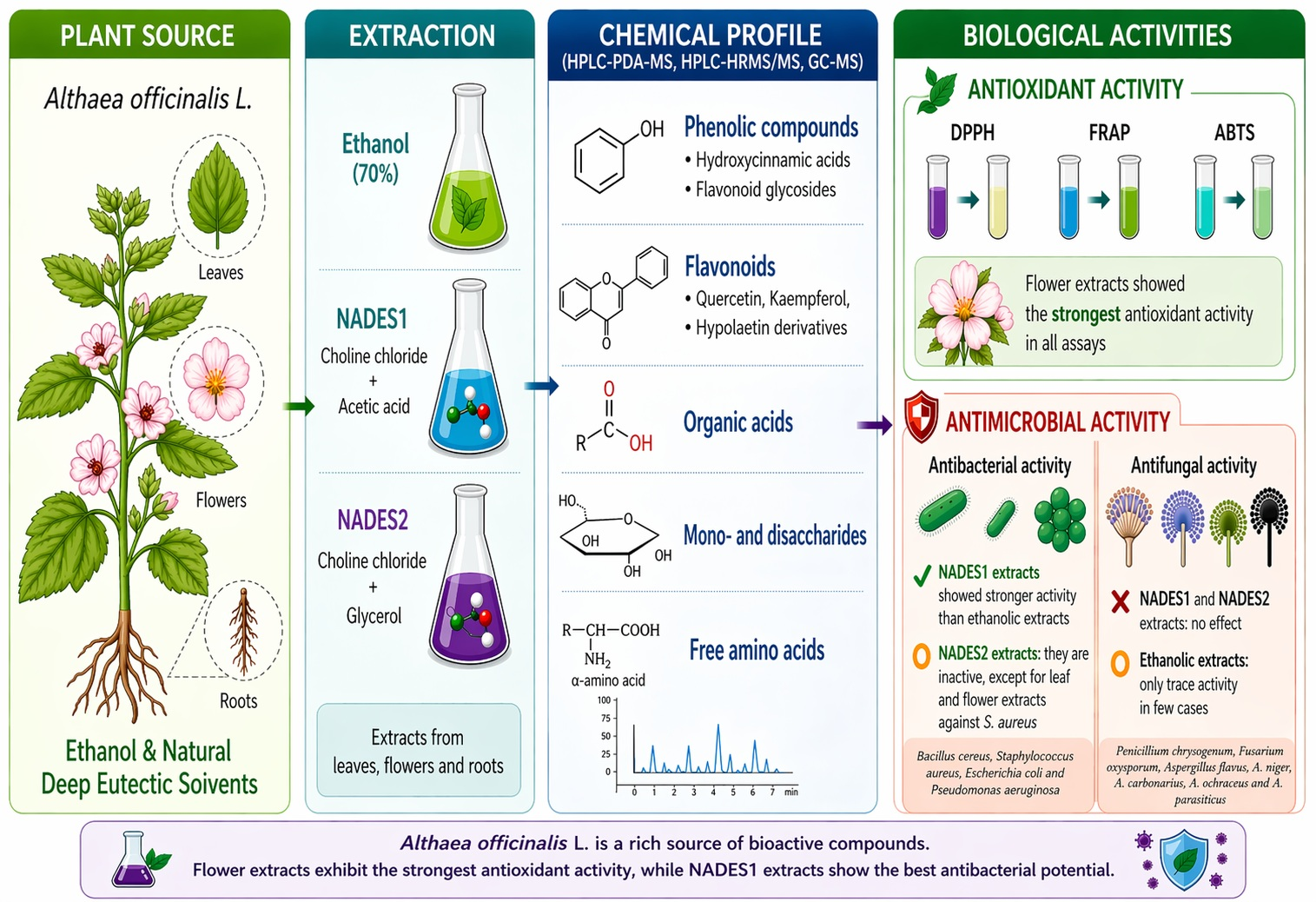
Phytochemical Content, Antioxidant and Antimicrobial Potential of Althaea officinalis L. Extracts Prepared by “Green” Classical and Natural Deep Eutectic Solvents


 , ,
, ,  , ,
, ,
Abstract
1. Introduction
2. Results and Discussion
2.1. Chemical Profiling and Antioxidant Potential of A. officinalis Extracts
2.1.1. Phytochemical Profiling by LC–MS

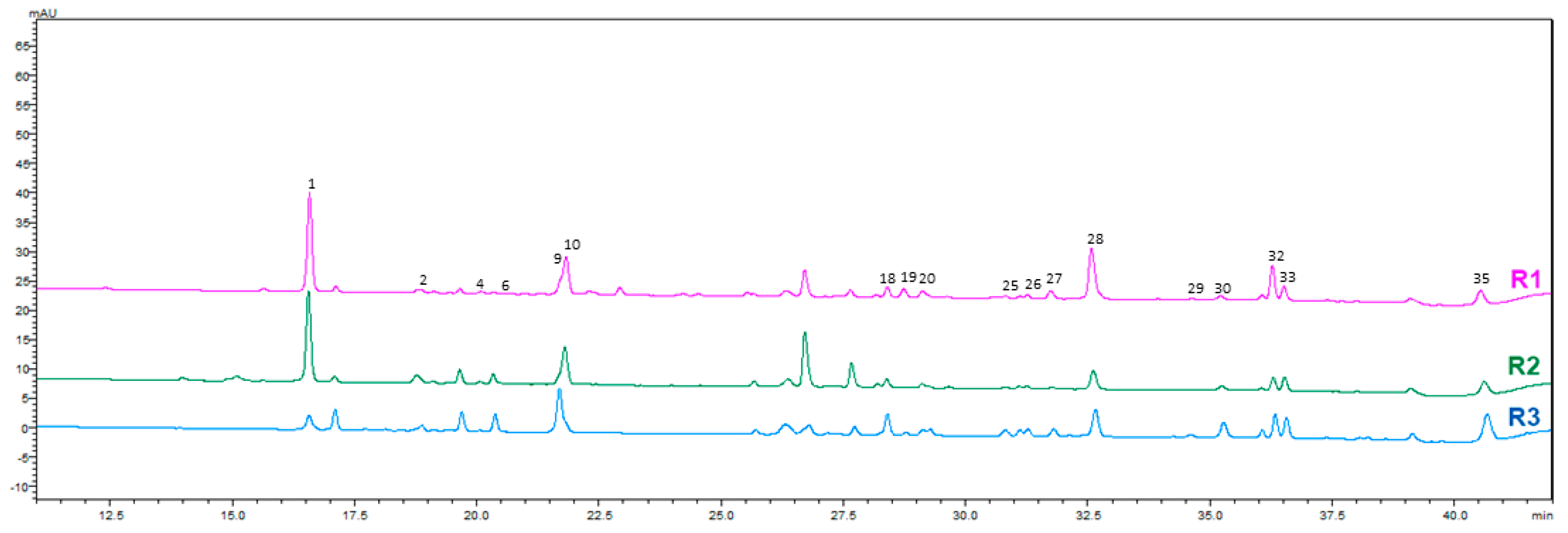
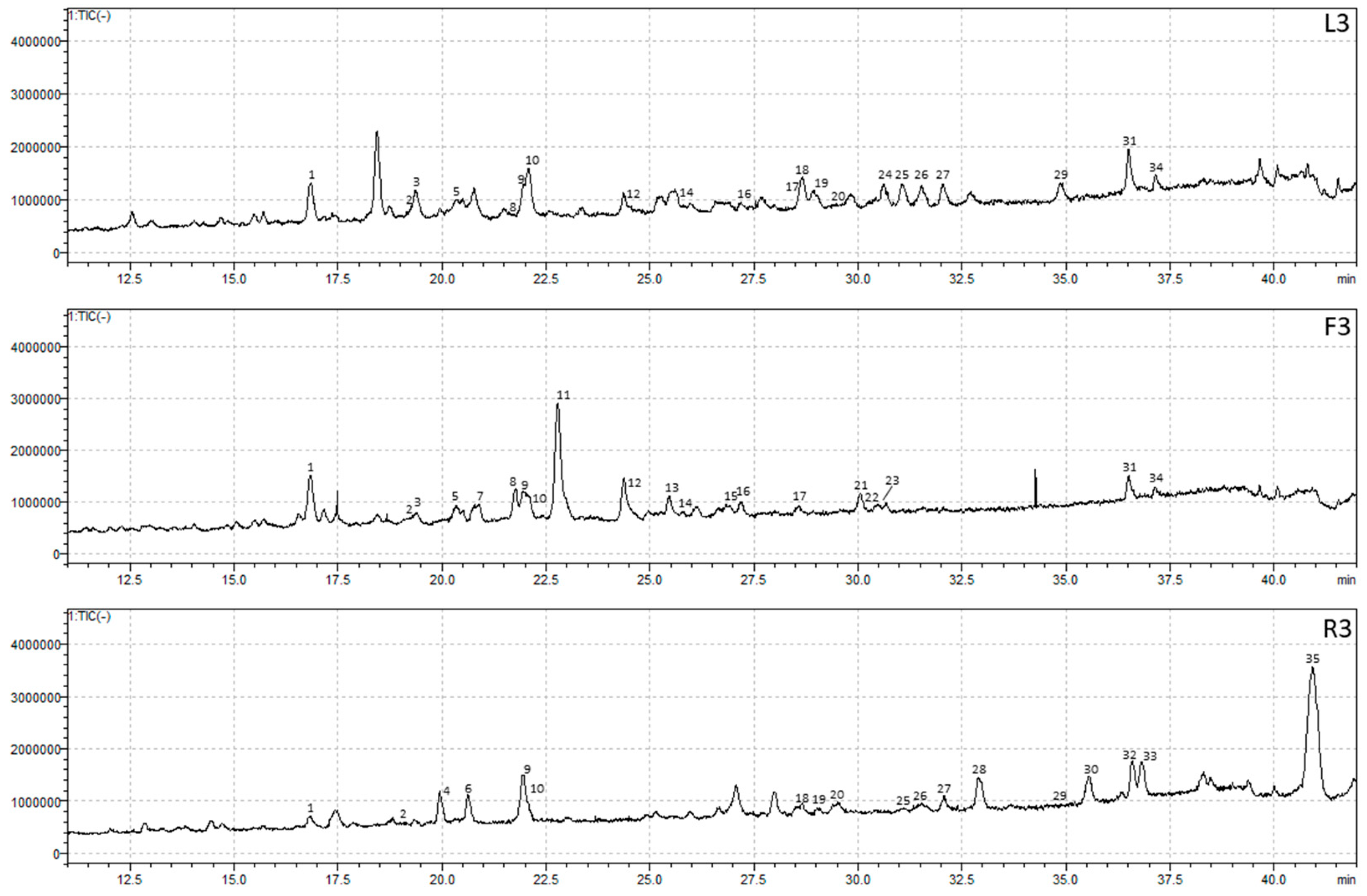
| No | RT a min | RT b min | Compound | UV a λmax, nm | [M−H]− b | Δ b, ppm | Formula | MS/MS Fragments b | L1 | L2 | L3 | F1 | F2 | F3 | R1 | R2 | R3 | Ref. |
|---|---|---|---|---|---|---|---|---|---|---|---|---|---|---|---|---|---|---|
| 1 | 16.91 | 6.07 | 2-Caffeloylhydroxycitric acid | 236, 330 | 369.0464 | 0.66 | C15H14O11 | 207, 189, 127, 83 | + | + | + | + | + | + | + | + | + | [44] |
| 2 | 19.06 | 5.90 | Caffeic acid | 239, 330 | 179.0340 | 5.28 | C9H8O4 | 179, 135 | + | + | + | + | + | + | + | + | + | Std |
| 3 | 19.41 | 7.52 | 2-Caffeloylisocitric acid or isomer | 239, 330 | 353.0518 | 1.00 | C15H14O10 | 191, 173, 111 | + | + | + | + | + | + | − | − | − | |
| 4 | 19.97 | 9.36 | Flavonoid O-sulfoglycoside I | 240, 273, 330 | 543.0456 | 1.07 | C21H20O15S | 543, 301, 241, 133 | − | − | − | − | − | − | + | + | + | |
| 5 | 20.31 | 8.18 | 2-O-Coumaroylhydroxycitric acid | 238, 315 | 353.0517 | 0.84 | C15H14O10 | 207, 189, 127, 83 | + | + | + | + | + | + | − | − | − | [51] |
| 6 | 20.56 | 10.06 | Flavonoid O-sulfoglycoside II | 241, 273, 330 | 557.0611 | 0.56 | C22H22O15S | 557, 477, 315, 300, 241, 137 | − | − | − | − | − | − | + | + | + | |
| 7 | 20.89 | 10.12 | Flavonoid diglycoside I | 269, 355 | 655.1526 | 1.60 | C28H32O18 | 655, 330, 315, 287 | − | − | − | + | + | + | − | − | − | |
| 8 | 21.75 | 9.07 | Flavonoid diglycoside II | 231, 289 | 465.1039 | 0.25 | C21H22O12 | 465, 303, 285, 125 | + | + | + | + | + | + | − | − | − | |
| 9 | 21.86 | 10.03 | N-(E)-caffeoyl-l-dopa | 238, 321 | 358.0936 | 1.07 | C18H17NO7 | 358, 222,178, 135 | + | + | + | + | + | + | + | + | + | [37] |
| 10 | 22.05 | 9.54 | 2-O-Feruloylhydroxycitric acid | 242, 330 | 383.0623 | 0.82 | C16H16O11 | 189, 127, 83 | + | + | + | + | + | + | + | + | + | [51] |
| 11 | 22.78 | 9.69 | Dihydrokaempferol-7-O-β-d-glucopyranoside | 224, 291 | 449.1094 | 0.98 | C21H22O11 | 449, 287, 259, 125 | − | − | − | + | + | + | − | − | − | [45] |
| 12 | 24.53 | 12.32 | Rutin | 254, 355 | 609.1470 | 1.45 | C27H30O16 | 609, 300, 271, 255 | + | + | + | + | + | + | − | − | − | Std |
| 13 | 25.45 | 12.77 | Flavonoid diglycoside III | 264, 347 | 579.1362 | 0.75 | C26H28O15 | 579, 284, 255, 227 | − | − | − | + | + | + | − | − | − | |
| 14 | 25.77 | 12.65 | Quercetin 3-glucoside | 246, 352 | 463.0890 | 1.64 | C21H20O12 | 463, 300, 271, 255 | + | + | + | + | + | + | − | − | − | Std |
| 15 | 26.89 | 14.49 | Flavonoid triglycoside | 244, 272 | 767.2049 | 1.28 | C34H40O10 | 665, 623, 314, 299, 271 | − | − | − | + | + | + | − | − | − | |
| 16 | 27.26 | 14.13 | Kaempferol 3-rutinoside | 245, 350 | 593.1520 | 1.28 | C27H30O15 | 593, 285, 284, 255, 227 | + | + | + | + | + | + | − | − | − | Std |
| 17 | 28.61 | 14.50 | Kaempferol 3-glucoside | 264, 346 | 447.0938 | 1.13 | C21H20O11 | 447, 285, 284, 255, 227 | + | + | + | + | + | + | − | − | − | Std |
| 18 | 28.65 | 14.96 | Hypolaetin-8-O-β-d-glucopyranosyl-(1‴ → 4″)-β-d-glucuronopyranoside | 268, 352 | 639.1284 | 1.36 | C27H28O18 | 639, 459, 371, 301, 133 | + | + | + | − | − | − | + | + | + | [37] |
| 19 | 29.01 | 14.54 | Hypolaetin-8-O-d-glucoside-3′-sulfate | 246, 350 | 543.0457 | 1.24 | C21H20O15S | 543, 301, 255, 133 | + | + | + | − | − | − | + | + | + | [46,50] |
| 20 | 29.41 | 15.22 | Hypolaetin-8-β-d-glucuronopyranoside | 246, 311 | 477.0680 | 1.20 | C21H18O13 | 477, 301, 255, 133 | + | + | + | − | − | − | + | + | + | [47,50] |
| 21 | 30.05 | 14.97 | Naringenin 7-O-β-d-glucoside (Prunin) | 241, 289 | 433.1143 | 0.53 | C21H22O10 | 433, 271, 151 | − | − | − | + | + | + | − | − | − | [45] |
| 22 | 30.41 | 15.98 | Kaempferol malonyl glycoside | 247, 355 | 533.0942 | 1.05 | C24H22O14 | 489, 285, 255, 227 | − | − | − | + | + | + | − | − | − | [51] |
| 23 | 30.51 | 15.54 | Kaempferol glucopyranoside | 265, 363 | 447.0937 | 0.98 | C22H20O11 | 447, 284, 255, 151 | − | − | − | + | + | + | − | − | − | [45] |
| 24 | 30.64 | 16.43 | Quercetin malonyl glycoside | 252, 347 | 549.0893 | 1.28 | C24H22O15 | 301, 133 | + | + | + | − | − | − | − | − | − | [51] |
| 25 | 31.06 | 16.41 | Quercitin-3-O-β-d-glucopyranoside | 269, 351 | 463.0888 | 1.27 | C21H20O12 | 301, 133 | + | + | + | − | − | − | + | + | + | [48] |
| 26 | 31.53 | 17.20 | Flavonoid diglycoside IV | 252, 349 | 653.1369 | 1.40 | C28H30O18 | 653, 473, 429, 315, 300 | + | + | + | − | − | − | + | + | + | |
| 27 | 32.08 | 16.66 | 4′-O-Methylhypolaetin-8-O-β-d-(2″-O-sulfo)glucopyranoside | 247, 349 | 557.0611 | 0.83 | C22H22O15S | 557, 477, 315, 300, 241 | + | + | + | − | − | − | + | + | + | [37] |
| 28 | 32.9 | 17.13 | Hypolaetin-8-O-β-d-(3″-O-sulfo)glucuronopyranoside | 253, 352 | 557.0251 | 1.39 | C21H18O16S | 557, 477, 301, 255 | − | − | − | − | − | − | + | + | + | [37] |
| 29 | 34.91 | 19.03 | Flavonoid diglycoside V | 251, 347 | 477.1043 | 0.96 | C22H22O12 | 477, 315, 300 | + | + | + | − | − | − | tr | tr | tr | |
| 30 | 35.44 | 18.83 | Isoscutellarein 8-O-β-glucuronopyranoside 3′′-O-sulfate or isomer | 245, 272, 330 | 541.0665 | 1.35 | C22H22O14S | 541, 461, 299, 284, 241 | tr | tr | tr | − | − | − | + | + | + | |
| 31 | 36.5 | 20.58 | trans-Tiliroside | 266, 314 | 593.1308 | 1.20 | C30H26O13 | 593, 285, 284, 255, 227 | + | + | + | + | + | + | − | − | − | Std |
| 32 | 36.6 | 19.62 | 4′-O-Methylhypolaetin-8-O-β-d-(3″-O-sulfo)glucuronopyranoside | 249, 349 | 571.0406 | 1.24 | C22H20O16S | 571, 315, 300, 255 | − | − | − | − | − | − | + | + | + | [37] |
| 33 | 36.87 | 19.76 | Isoscutellarein 8-O-β-glucuronopyranoside 3″-O-sulfate or isomer | 270, 340 | 541.0300 | 1.18 | C21H18O15S | 541, 461, 299, 285, 255 | − | − | − | − | − | − | + | + | + | [49] |
| 34 | 37.19 | 21.45 | cis-Tiliroside | 266, 312 | 593.1309 | 1.38 | C30H26O13 | 593, 285, 284, 255, 227 | + | + | + | + | + | + | − | − | − | Std |
| 35 | 40.97 | 24.04 | 4′-O-Methylisoscutellarein-8-O-β-d-(3″-O-sulfo)glucuronopyranoside | 273, 330 | 555.0457 | 1.20 | C22H20O15S | 555, 475, 299, 284, 254, 175 | − | − | − | − | − | − | + | + | + | [37] |
2.1.2. Primary Metabolite Profiling by GC–MS
2.1.3. Phenolic Content and Antioxidant Activity
2.2. Biological Activity
2.2.1. Antibacterial Activity
2.2.2. Antifungal Activity
3. Materials and Methods
3.1. Plant Material
3.2. Chemicals and Reagents
3.3. Microorganisms Studied
3.4. Extraction Procedures
3.4.1. Synthesis of Natural Deep Eutectic Solvents (NADESs)
3.4.2. Extraction by NADESs
3.4.3. Extraction by Classical Solvent
3.5. HPLC-PDA-MS Analysis
3.6. HPLC-HRMS/MS Analysis
3.7. GC-MS Analysis
3.8. pH Values
3.9. Antioxidant Activity
3.9.1. 2,2-Diphenyl-1-Picrylhydrazyl (DPPH) Method
3.9.2. 2,2′-Azino-Bis(3-Ethylbenzothiazoline-6-Sulfonic Acid) (ABTS) Method
3.9.3. Ferric-Reducing Antioxidant Power (FRAP) Method
3.10. Total Phenolic Content (TPC)
3.11. Total Flavonoid Content (TFC)
3.12. Total Condensed Tannin Content (TCT)
3.13. Determination of Total Anthocyanin Content (TAntC)
3.14. Total Alkaloid Content (TAlkC)
3.15. Antimicrobial Activity
3.16. Statistical Analysis
4. Conclusions
Author Contributions
Funding
Institutional Review Board Statement
Informed Consent Statement
Data Availability Statement
Acknowledgments
Conflicts of Interest
Abbreviations
| ABTS | 2,2′-Azino-bis(3-ethylbenzothiazoline-6-sulfonic acid |
| BSTFA | N,O-Bis(trimethylsilyl)trifluoroacetamide |
| ChCl | Choline Chloride |
| CA | Citric Acid |
| DPPH | 2,2-Diphenyl-1-picrylhydrazyl |
| FRAP | Ferric-Reducing Antioxidant Power |
| GC | Gas Chromatography |
| Gly | Glycerol |
| HBD | Hydrogen Bond Donor |
| HBA | Hydrogen Bond Acceptor |
| HPLC | High-Performance Liquid Chromatography |
| HRMS | High-Resolution Mass Spectrometry |
| IZ | Inhibition Zone |
| MS | Mass Spectrometer |
| NADES | Natural Deep Eutectic Solvents |
| PDA | Photo Diode Detector |
| TAlkC | Total Alkaloid Content |
| TAntC | Total Anthocyanin Content |
| TCT | Total Condensed Tannin Content |
| TFC | Total Flavonoid Content |
| TPC | Total Phenolic Content |
| SD | Standard Deviation |
| UV | Ultraviolet |
| UV-VIS | Ultraviolet–Visible |
References
- Geszke-Moritz, M.; Nowak, G.; Moritz, M. Pharmacological Properties and Safe Use of 12 Medicinal Plant Species and Their Bioactive Compounds Affecting the Immune System. Appl. Sci. 2023, 13, 6477. [Google Scholar] [CrossRef]
- El-Saadony, M.T.; Saad, A.M.; Mohammed, D.M.; Korma, S.A.; Alshahrani, M.Y.; Ahmed, A.E.; Ibrahim, E.H.; Salem, H.M.; Alkafaas, S.S.; Saif, A.M.; et al. Medicinal Plants: Bioactive Compounds, Biological Activities, Combating Multidrug-Resistant Microorganisms, and Human Health Benefits—A Comprehensive Review. Front. Immunol. 2025, 16, 1491777. [Google Scholar] [CrossRef]
- Latif, R.; Nawaz, T. Medicinal Plants and Human Health: A Comprehensive Review of Bioactive Compounds, Therapeutic Effects, and Applications. Phytochem. Rev. 2026, 25, 2299–2342. [Google Scholar] [CrossRef]
- Lei, Z.; Li, Z.; Zhang, W.; He, D.; Zhang, Y. From Wild to Cultivated Crops: General Shift in Morphological and Physiological Traits for Yield Enhancement Following Domestication. Crop Environ. 2024, 3, 138–146. [Google Scholar] [CrossRef]
- Gruda, N.S.; Gallegos-Cedillo, V.M.; Nájera, C.; Catalina, E.G.; Ochoa, J.; Fernández, J.A. Advancing Protected Cultivation: A Pathway for Nutrient-Rich Vegetables. Crit. Rev. Plant Sci. 2025, 44, 88–116. [Google Scholar] [CrossRef]
- Davis, C.C.; Choisy, P. Medicinal plants meet modern biodiversity science. Curr. Biol. 2024, 34, R158–R173. [Google Scholar] [CrossRef]
- Kalam, M.A.; Ahmad, R.; Avid, M.; Rahim, A.; Habib, A. Khatmī (Althea officinalis L. and Althea rosea): Medicinal Importance in the Perspective of Unani Medicine and Pharmacological Studies. J. Drug Deliv. Ther. 2023, 13, 270–277. [Google Scholar] [CrossRef]
- Farhat, C.; Younes, H.; Alyamani, O.A.; Mrad, M.; Hourani, N.; Khalifeh, H.; El-Makhour, Y.; Dbaibo, G.; Hage-Sleiman, R. Chemical Characterization and In Vitro Biological Evaluation of Aqueous Extract of Althaea officinalis L. Flower Grown in Lebanon. J. Herb. Med. 2022, 34, 100575. [Google Scholar] [CrossRef]
- Baimakhanova, B.; Sadanov, A.; Ratnikova, I.; Orasymbet, S.; Shorabaev, E.; Baimakhanova, G.; Amangeldi, A.; Kapassova, Z.; Rakhymbayev, N.; Arystanov, Z.; et al. Phytochemical Compounds and Biomedical Properties of Althaea officinalis. Pharm. Pract. 2025, 23, 3153. [Google Scholar] [CrossRef]
- Kianitalaei, A.; Feyzabadi, Z.; Hamedi, S.; Qaraaty, M. Althaea officinalis in Traditional Medicine and Modern Phytotherapy. J. Adv. Pharm. Edu. Res. 2019, 9, 154–161. [Google Scholar]
- Al-Snafi, A.E. The Pharmaceutical Importance of Althaea officinalis and Althaea rosea: A Review. Int. J. Pharm. Technol. Res. 2013, 5, 1378–1385. [Google Scholar]
- Xue, T.; Ruan, K.; Tang, Z.; Duan, J.; Xu, H. Isolation, Structural Properties, and Bioactivities of Polysaccharides from Althaea officinalis Linn.: A review. Int. J. Biol. Macromol. 2023, 242, 125098. [Google Scholar] [CrossRef] [PubMed]
- Mahboubi, M. Marsh Mallow (Althaea officinalis L.) and Its Potency in the Treatment of Cough. Complement. Med. Res. 2020, 27, 174–183. [Google Scholar] [CrossRef]
- Clarke, C.J.; Tu, W.-C.; Levers, O.; Brōhl, A.; Hallett, J.P. Green and Sustainable Solvents in Chemical Processes. Chem. Rev. 2018, 118, 747–800. [Google Scholar] [CrossRef]
- Tzanova, M.T.; Yaneva, Z.; Ivanova, D.; Toneva, M.; Grozeva, N.; Memdueva, N. Green Solvents for Extraction of Natural Food Colorants from Plants: Selectivity and Stability Issues. Foods 2024, 13, 605. [Google Scholar] [CrossRef]
- García, A.; Rodríguez-Juan, E.; Rodríguez-Gutiérrez, G.; Rios, J.J.; Fernández-Bolaños, J. Extraction of Phenolic Compounds from Virgin Oil by Deep Eutectic Solvents (DESs). Food Chem. 2016, 197A, 554–561. [Google Scholar] [CrossRef]
- Carasek, E.; Morés, L.; da Cunha, N.; Branco, G.L.; Dias, A.N. Natural Deep Eutectic Solvents and Natural Solid Biosorbents in Microextraction Techniques of Organic Compounds Based on Chromatographic Techniques: A Critical Review. Adv. Sample Prep. 2024, 12, 100139. [Google Scholar] [CrossRef]
- Negi, T.; Kumar, A.; Sharma, S.K.; Rawat, N.; Saini, D.; Sirohi, R.; Prakash, O.; Dubey, A.; Dutta, A.; Shahi, N.C. Deep Eutectic Solvents: Preparation, Properties, and Food Applications. Heliyon 2024, 10, 30. [Google Scholar] [CrossRef]
- Silva, J.M.; Reis, R.L.; Palva, A.; Duarte, A.R.C. Design of Functional Therapeutic Deep Eutectic Solvents Based on Choline Chloride and Ascorbic Acid. ASC Sustain. Chem. Eng. 2018, 6, 10355–10363. [Google Scholar] [CrossRef]
- Lanari, D.; Zadra, C.; Negro, F.; Njem, R.; Marcotullio, M.C. Influence of Choline Chloride-Based NADES on the Composition of Myristica fragrans Houtt. Essential Oil. Heliyon 2022, 8, e09531. [Google Scholar] [CrossRef]
- Monem, A.; Habibi, D.; Goudarzi, H.; Mahmoudiani-Glian, M.; Benrashid, A.; Alshablawi, Z. The Choline Chloride-Based DES as a Capable and New Catalyst for the Synthesis of Benzopyranophenazinecarbonitriles. Catal. Commun. 2024, 187, 106913. [Google Scholar] [CrossRef]
- Alam, M.A.; Muhammad, G.; Khan, M.N.; Mofijur, M.; Lv, Y.; Xiong, W.; Xu, J.; Xu, J. Choline Chloride-Based Deep Eutectic Solvents as Green Extractants for the Isolation of Phenolic Compounds from Biomass. J. Clean. Prod. 2021, 309, 127445. [Google Scholar] [CrossRef]
- Zannou, O.; Koca, I. Optimization and Stabilization of the Antioxidant Properties from Alkanet (Alkanna tinctoria) with Natural Deep Eutectic Solvents. Arab. J. Chem. 2020, 13, 6437–6450. [Google Scholar] [CrossRef]
- Shahbaz, M.; Riaz, M.; Momal, U.; Ul Rasool, I.F.; Naeem, H.; Raza, N.; Moreno, A.; Khalid, W.; Esatbeyoglu, T. Green Solvent Extraction and Eco-Friendly Novel Techniques of Bioactive Compounds from Plant Waste: Applications, Future Perspective and Circular Economy. Appl. Food Res. 2025, 5, 101434. [Google Scholar] [CrossRef]
- Khodadadi, H.; Ghasemi, R.; Karami, F.; Vaez, A.; Nouraei, H.; Sahraeian, K.; Zareshahrabadi, Z. Antimicrobial and Antioxidant Effects of Aqueous, Methanolic, and a Deep Eutectic Solvent–Based Extracts of Althaea officinalis. Scientifica 2026, 2026, 9161837. [Google Scholar] [CrossRef]
- Rezaei, M.; Alirezaei, M. Protective Effects of Althaea officinalis L. Extract in 6-Hydroxydopamine-Induced Hemi-Parkinsonism Model: Behavioral, Biochemical and Histochemical Evidence. Physiol. Sci. 2014, 64, 171–176. [Google Scholar] [CrossRef]
- Sadighara, P.; Gharibi, S.; Jafari, A.M.; Khaniki, G.J.; Salari, S. The Antioxidant and Flavonoids Contents of Althaea officinalis L. Flowers Based on Their Color. Avicenna J. Phytomed. 2012, 2, 113–117. [Google Scholar]
- Shahsavari, S.; Derikvand, Z. Extraction and Identification of Compounds of Althaea officinalis L. and Anchusa italica Retz.Native to Ilam Province by Using HS-SPME, GC-MS, and FTIR, and Study of Their Antioxidant Capacity. Prog. Chem. Biochem. Res. 2022, 5, 338–350. [Google Scholar] [CrossRef]
- Moazzezi, S.; Elhamirad, A.H.; Nateghi, L.; Khodaparast, M.H.H.; Zarei, F. Studies on Physicochemical and Structural Properties of Marshmallow (Althaea officinalis) Seed Mucilage. J. Food Biosci. Technol. 2022, 12, 29–38. [Google Scholar] [CrossRef]
- Xue, T.T.; Xu, H.B.; Tang, Z.S.; Duan, J.A.; Liu, H.B.; Shi, X.B.; Song, Z.X. Progress in Chemical Compositions and Pharmacological Activities of Althaea officinalis. Med. Res. 2021, 5, 210002. [Google Scholar] [CrossRef]
- Xue, T.T.; Yang, Y.G.; Tang, Z.S.; Duan, J.A.; Song, Z.X.; Hu, X.H.; Yang, H.D.; Xu, H.B. Evaluation of Antioxidant, Enzyme Inhibition, Nitric Oxide Production Iinhibitory Activities and Chemical Profiles of the Active Extracts from the Medicinal and Edible Plant: Althaea officinalis. Food Res. Int. 2022, 156, 111166. [Google Scholar] [CrossRef]
- Hage-Sleiman, R.; Mroueh, M.; Daher, C.F. Pharmacological Evaluation of Aqueous Extract of Althaea officinalis Flower Grown in Lebanon. Pharm. Biol. 2011, 49, 327–333. [Google Scholar] [CrossRef]
- Rani, S.; Khan, S.A.; Ali, M. Phytochemical Investigation of the Seeds of Althaea officinalis L. Nat. Prod. Res. 2010, 24, 1358–1364. [Google Scholar] [CrossRef] [PubMed]
- Zoobi, J.; Mohd, A. Three New Compounds from the Roots of Althaea officinalis L. Int. J. Res. Ayurveda Pharm. 2011, 2, 864–868. [Google Scholar]
- Didry, N.; Torck, M.; Pinkas, M. Polyphenolic Compounds from the Flowers of Althaea officinalis. Fitoterapia 1990, 61, 280. [Google Scholar]
- Deters, A.; Zippel, J.; Hellenbrand, N.; Pappai, D.; Possemeyer, C.; Hensel, A. Aqueous Extracts and Polysaccharides from Marshmallow Roots (Althaea officinalis L.): Cellular Internalization and Stimulation of Cell Physiology of Human Epithelial Cells In Vitro. J. Ethnopharmacol. 2010, 127, 62–69. [Google Scholar] [CrossRef]
- Sendker, J.; Boker, I.; Lengers, I.; Brandt, S.; Jose, J.; Hensel, A.; Stark, T.; Hofmann, T.; Fink, C.; Abdel-Aziz, H. Phytochemical Characterization of Low Molecular Weight Constituents from Marshmallow Roots (Althaea officinalis) and Inhibiting Effects of the Aqueous Extract on Human Hyaluronidase-1. J. Nat. Prod. 2017, 80, 290–297. [Google Scholar] [CrossRef]
- Gudej, J. Flavonoids, Phenolic Acids and Coumarins from the Roots of Althaea officinalis. Planta Med. 1991, 57, 284–285. [Google Scholar] [CrossRef]
- Benbassat, N.; Yoncheva, K.; Hadjimitova, V.; Hristova, N.; Konstantinov, S.; Lambov, N. Influence of the Extraction Solvent on Antioxidant Activity of Althaea officinalis L. Root Extracts. Cent. Eur. J. Biol. 2014, 9, 182–188. [Google Scholar] [CrossRef]
- Ninov, S.; Ionkova, I.; Kolev, D. Constituents of Althaea officinalis var. “Russalka” roots. Fitoterapia 1992, 63, 474. [Google Scholar]
- Khamees, A.H.; Mutlag, S.H.; Al-hilli, F.A.; Bahja, A.A. Evaluation of Antibacterial Activity of Aqueous and Methanol Extract of Iraqi Althaea officinalis L. flowers on Gastrointestinal Key Pathogens. Int. J. Pharm. Sci. Rev. Res. 2018, 48, 59–62. [Google Scholar]
- Hikmawanti, N.P.E.; Ramadon, D.; Jantan, I.; Munim, A. Natural Deep Eutectic Solvents (NADES): Phytochemical Extraction Performance Enhancer for Pharmaceutical and Nutraceutical Product Development. Plants 2021, 10, 2091. [Google Scholar] [CrossRef]
- Cannavacciuolo, C.; Pagliari, S.; Frigerio, J.; Giustra, C.M.; Labra, M.; Campone, L. Natural Deep Eutectic Solvents (NADESs) Combined with Sustainable Extraction Techniques: A Review of the Green Chemistry Approach in Food Analysis. Foods 2023, 12, 56. [Google Scholar] [CrossRef]
- Salem, M.A.; Michel, H.E.; Ezzat, M.I.; Okba, M.M.; EL-Desoky, A.M.; Mohamed, S.O.; Ezzat, S.M. Optimization of an Extraction Solvent for Angiotensin-Converting Enzyme Inhibitors from Hibiscus sabdariffa L. Based on Its UPLC-MS/MS Metabolic Profiling. Molecules 2020, 25, 2307. [Google Scholar] [CrossRef]
- Xu, X.; Du, K.; Zhang, C.; Zheng, C.; Wang, L.; Wang, Y.; Meng, D. Hibiscus syriacus L. Flower Attenuates Ethanol-Induced Gastric Ulcer via Modulation of the Nrf2/HO-1, AKT, and JNK Pathways. J. Ethnopharmacol. 2026, 357, 120920. [Google Scholar] [CrossRef] [PubMed]
- Paul, Z.A.; Malla, A.T.; Dar, M.A.; Masoodi, M.H. Phytochemistry and Pharmacological Activity of Malva sylvestris L: A Detailed Insight. Comb. Chem. High Throughput Screen. 2024, 16, 2309–2322. [Google Scholar] [CrossRef]
- Billeter, M.; Meier, B.; Sticher, O. 8-Hydroxyflavonoid Glucuronides from Malva sylvestris. Phytochemistry 1991, 30, 987–990. [Google Scholar] [CrossRef]
- Ma, F.; Cui, Q.; Bai, G. Combining UPLC/Q-TOF-MS/MS With Biological Evaluation for NF-κB Inhibitors in Uyghur Medicine Althaea rosea Flowers. Front. Plant Sci. 2019, 9, 1975. [Google Scholar] [CrossRef] [PubMed]
- Matławska, I.; Sikorska, M.; El-Sayed, N.H.; Budzianowski, J.; Hołderna-Kędzia, E.; Mabry, T.J. Bioactive Flavone Sulfates of Abutilon indicum Leaves. Nat. Prod. Commun. 2007, 2, 1003–1008. [Google Scholar] [CrossRef]
- Memdueva, N.; Dinev, T.; Staleva, P.; Kamenova-Nacheva, M.; Yaneva, Z.; Rusenova, N.; Grozeva, N.; Ginin, S.; Tzanova, M. Antioxidant and Antimicrobial potential of Malva neglecta Wallr. Extracts prepared by “Green” Solvents. Appl. Sci. 2025, 15, 12813. [Google Scholar] [CrossRef]
- The Metabolomics Innovation Centre (TMIC). FooDB. Available online: https://foodb.ca (accessed on 6 April 2026).
- Bahari, Z.; Saidi, A.; Anwar, F.; Tohidfar, M.; Shojaeiyan, A.; Ahmad, N.; Mnif, W. High-Value Phytochemicals and Nutra-Pharmaceutical Prospects of Althaea officinalis L. (Marshmallow). A review. Biocatal. Agric. Biotechnol. 2025, 7, 103601. [Google Scholar] [CrossRef]
- Kardosova, A.; Capek, P.; Rosik, J. 4-O-Methyl-D-glucurono-D-xylan from the Leaves of the Marshmallow (Althaea officinalis L. var Rhobusta). Chem. Pap. 1989, 43, 705–713. [Google Scholar]
- Tomoda, M.; Gonda, R.; Shimizu, N.; Akiyama, S.; Arai, H. Plant mucilages. XXXVII. A representative Mucilage,” Althaea-Mucilage RL,” from the leaves of Althaea rosea. Chem. Pharm. Bull. 1985, 33, 4320–4325. [Google Scholar] [CrossRef]
- Capek, P.; Rosík, J.; Kardosova, A. Polysaccharides from the Roots of the Marshmallow (Althea officinalis L., var. rhobusta): Structural Features of an Acidic Polysaccharide. Carbohydr. Res. 1987, 164, 443–452. [Google Scholar] [CrossRef]
- Abari, A.H.; Rourani, H.A.; Ghasemi, S.M.; Kim, H.; Kim, Y.G. Investigation of Antioxidant and Anticancer Activities of Unsaturated Oligo-Galacturonic Acids Produced by Pectinase of Streptomyces hydrogenans YAM1. Sci. Rep. 2021, 11, 8491. [Google Scholar] [CrossRef]
- Chou, Y.-C.; Lin, H.-W.; Wang, C.-Y.; Hsieh, C.-C.; Santoso, S.P.; Lin, S.-P.; Cheng, K.-C. Enhancing Antioxidant Benefits of Kombucha Through Optimized Glucuronic Acid by Selected Symbiotic Fermentation Culture. Antioxidants 2024, 13, 1323. [Google Scholar] [CrossRef] [PubMed]
- Sivova, V.; Bera, K.; Ray, B.; Nosa, S.; Nosaľova, G. Cough and Arabinogalactan Polysaccharide from the Bark of Terminalia arjuna. Adv. Exp. Med. Biol. 2016, 935, 43–52. [Google Scholar] [CrossRef]
- Memdueva, N.; Tzanova, M.; Yaneva, Z.; Rusenova, N.; Grozeva, N.; Dinev, T. Natural Deep Eutectic Solvent-Based Extraction of Malva sylvestris L.: Phytochemical Content, Antioxidant and Antimicrobial Potential. Separations 2025, 12, 187. [Google Scholar] [CrossRef]
- Hikmawanti, N.P.E.; Saputri, F.C.; Yanuar, A.; Jantan, I.; Ningrum, R.A.; Juanssilfero, A.B.; Munim, A. Choline Chloride-Urea-Based Natural Deep Eutectic Solvent for Highly Efficient Extraction of Polyphenolic Antioxidants from Pluchea indica (L.) Leaves. Arab. J. Chem. 2024, 17, 105537. [Google Scholar] [CrossRef]
- Gomez-Urios, C.; Puchades-Colera, P.; Frigola, A.; Esteve, M.J.; Blesa, J.; Lopez-Malo, D. Natural Deep Eutectic Solvents: A Paradigm of Stability and Permeability in the Design of New Ingredients. J. Mol. Liq. 2024, 412, 125864. [Google Scholar] [CrossRef]
- Saha, S.K.; Dey, S.; Chakraborty, R. Effect of Choline Chloride-Oxalic Acid Based Deep Eutectic Solvent on the Ultrasonic Assisted Extraction of Polyphenols from Aegle marmelos. J. Mol. Liq. 2019, 287, 110956. [Google Scholar] [CrossRef]
- Bohdanovych, T.; Belokurova, V.; Matvieieva, N. Varibility of Flavonoid Content, Reducing and Antioxidant Activity in Althaea officinalis L. Hairy Roots. Agrobiodivers. Improv. Nutr. Health Life Qual. 2023, 7, 181–188. [Google Scholar] [CrossRef]
- Irfan, A.; Imran, M.; Khalid, N.; Hussain, R.; Basra, M.A.R.; Khaliq, T.; Shahzad, M.; Hussien, M.; Shah, A.T.; Qayyum, M.A.; et al. Isolation of Phytochemicals from Malva neglecta Wallr and Their Quantum Chemical, Molecular Docking Exploration as Active Drugs against COVID-19. J. Saudi Chem. Soc. 2021, 25, 101358. [Google Scholar] [CrossRef]
- Munir, A.; Youssef, F.S.; Ishtiaq, S.; Kamran, S.H.; Sirwi, A.; Ahmed, S.A.; Ashour, M.L.; Elhady, S.S. Malva parviflora Leaves Mucilage: An Eco-Friendly and Sustainable Biopolymer with Antioxidant Properties. Polymers 2021, 13, 4251. [Google Scholar] [CrossRef]
- Żbik, K.; Onopiuk, A.; Szpicer, A.; Kurek, A. Comparison of the Effects of Extraction Method and Solvents on Biological Activities of Phytochemicals from Selected Violet and Blue Pigmented Flowers. J. Food Meas. Charact. 2023, 17, 6600–6608. [Google Scholar] [CrossRef]
- Zaghlool, S.S.; Abo-Seif, A.A.; Rabeh, M.A.; Abdelmohsen, U.R.; Messiha, B.A.S. Gastro-Protective and Anti-Oxidant Potential of Althaea officinalis and Solanum nigrum on Pyloric Ligation/Indomethacin-Induced Ulceration in Rats. Antioxidants 2019, 8, 512. [Google Scholar] [CrossRef]
- Sales, M.D.C.; Costa, H.B.; Fernandes, P.M.B.; Ventura, J.A.; Meira, D.D. Antifungal Activity of Plant Extracts with Potential to Control Plant Pathogens in Pineapple. Asian Pac. J. Trop. Biomed. 2016, 6, 26–31. [Google Scholar] [CrossRef]
- Khameneh, B.; Iranshahy, M.; Soheili, V.; Bazzaz, B.S.F. Review on Plant Antimicrobials: A Mechanistic Viewpoint. Antimicrob. Resist. Infect. Control 2019, 8, 118. [Google Scholar] [CrossRef]
- Gama, G.S.P.; Pimenta, A.S.; Feijó, F.M.C.; dos Santos, C.S.; de Oliveira Castro, R.V.; de Azevedo, T.K.B.; de Medeiros, L.C.D. Effect of pH on the Antibacterial and Antifungal Activity of Wood Vinegar (Pyroligneous Extract) from Eucalyptus. Rev. Árvore 2023, 47, 4711. [Google Scholar] [CrossRef]
- De Morais, P.; Gonçalves, F.; Coutinho, J.A.P.; Ventura, S.P.M. Ecotoxicity of Cholinium-Based Deep Eutectic Solvents. ACS Sustain. Chem. Eng. 2015, 3, 3398–3404. [Google Scholar] [CrossRef]
- Radošević, K.; Čanak, I.; Panić, M.; Markov, K.; Bubalo, M.C.; Frece, J.; Srček, V.G.; Redovniković, I.R. Antimicrobial, Cytotoxic and Antioxidative Evaluation of Natural Deep Eutectic Solvents. Environ. Sci. Pollut. Res. 2018, 25, 14188–14196. [Google Scholar] [CrossRef]
- Jenny, J.C.; Kuś, P.M.; Szweda, P. Investigation of Antifungal and Antibacterial Potential of Green Extracts of Propolis. Sci. Rep. 2024, 14, 13613. [Google Scholar] [CrossRef]
- Lim, K.; Li, W.Y.; Dinata, A.; Ho, E.T. Comparing the Antibacterial Efficacy and Functionality of Different Commercial Alcohol-Based Sanitizers. PLoS ONE 2023, 18, 0282005. [Google Scholar] [CrossRef] [PubMed]
- Jafari-Sales, A.; Jafari, B.; Sayyahi, J.; Zohoori-Bonab, T. Evaluation of Antibacterial Activity of Ethanolic Extract of Malva neglecta and Althaea officinalis L. on Antibiotic-Resistant Strains of Staphylococcus aureus. J. Biol. Today’s World 2015, 4, 58–62. [Google Scholar] [CrossRef]
- Arab, M.; Arab, N.; Kahrizi, D.; Ebadi, A.G. Evaluating Antibacterial Effects of Alcoholic Extracts and Essential Oil of Althaea officinalis Against Two Types of Gram-positive and Gram-negative Bacteria (Bacillus cereus and Klebsiella pneumoniae). J. Med. Plants By-Prod. 2023, 1, 107–115. [Google Scholar]
- Dinev, T.; Tzanova, M.; Velichkova, K.; Dermendzhieva, D.; Beev, G. Antifungal and Antioxidant Potential of Methanolic Extracts from Acorus calamus L., Chlorella vulgaris Beijerinck, Lemna minuta Kunth and Scenedesmus dimorphus (Turpin) Kützing. Appl. Sci. 2021, 11, 4745. [Google Scholar] [CrossRef]
- Jangir, A.K.; Lad, B.; Dani, U.; Shah, N.; Kuperkar, K. In Vitro Toxicity Assessment and Enhanced Drug Solubility Profile of Green Deep Eutectic Solvent Derivatives (DESDs) Combined with Theoretical Validation. RSC Adv. 2020, 10, 24063–24072. [Google Scholar] [CrossRef]
- Hassan, R.A.; Sand, M.I.; El-Kadi, S.M. Effect of Some Organic Acids on Fungal Growth and Their Toxins Production. J. Agric. Chem. Biotechnol. 2012, 3, 391–397. [Google Scholar] [CrossRef]
- Sekhon, A.S.; Padhye, A.A.; Garg, A.K. In Vitro Sensitivity of Penicillium marneffei and Pythium insidiosum to Various Antifungal Agents. Eur. J. Epidemiol. 1992, 8, 427–432. [Google Scholar] [CrossRef]
- Lalitha, P.; Shapiro, B.L.; Srinivasan, M. Antimicrobial Susceptibility of Fusarium, Aspergillus, and Other Filamentous Fungi Isolated from Keratitis. Arch. Ophthalmol. 2007, 125, 789–793. [Google Scholar] [CrossRef]
- Sequeira, S.O.; Phillips, A.J.L.; Cabrita, E.J.; Macedo, M.F. Ethanol as an Antifungal Treatment for Paper. Stud. Conserv. 2017, 62, 33–42. [Google Scholar] [CrossRef]
- Rashidi, A.; Mousavi, B.; Rahmani, M.R.; Rezaee, M.A.; Hosaini, W.; Motaharinia, Y.; Davari, B.; Zamini, G. Evaluation of Antifungal effect of Lavandula officinalis, Salvia officinalis L., Sumac, Glycyrrhiza glabra, and Althaea officinalis Extracts on Aspergillus niger, Aspergillus fumigatus, and Aspergillus flavus Species. J. Med. Plants Res. 2011, 6, 309–313. [Google Scholar]
- Dehkordi, S.H.; Sadeghi, H.; Rahimi, R.; Ebrahimi, A. The Evaluation of Antifungal Effects of Althaea officinalis and Syzygium aromaticum Aqueous Extracts against Penicillium spp. and Aspergillus spp. Isolates. Vet. Res. Biol. Prod. 2017, 30, 147–152. [Google Scholar]
- Twaij, B.M.; Alwan, A.H. Anti-Fungal activity of Althaea officinalis L. Tissue Culture Extracts. Plant Arch. 2018, 18, 2053–2057. [Google Scholar]
- Tzanova, M.; Atanasov, V.; Yaneva, Z.; Ivanova, D.; Dinev, T. Selectivity of Current Extraction Techniques for Flavonoids from Plant Materials. Processes 2020, 8, 1222. [Google Scholar] [CrossRef]
- Boyadzhieva, S.S.; Tsvetanova, F.V.; Coelho, J.A.P.; Staleva, P.; Kamenova-Nacheva, M.; Taneva, S.; Stateva, R.P. Boosting the Sustainable Transformation of Cornus mas L. Stones Using a Hybrid Strategy Involving Microwave-Assisted Extraction. Molecules 2026, 31, 525. [Google Scholar] [CrossRef] [PubMed]
- Dincheva, I.; Badjakov, I.; Georgiev, V.; Semerdjieva, I.; Vrancheva, R.; Ivanov, I.; Pavlov, A. Comprehensive GC-MS Characterization and Histochemical Assessment of Various Parts of Three Colchicum Species from Bulgarian Flora. Plants 2025, 14, 270. [Google Scholar] [CrossRef]
- IUPAC Compendium of Chemical Terminology, 5th ed. International Union of Pure and Applied Chemistry. Online Version 5.0.0. 2025. Available online: https://goldbook.iupac.org/terms/view/R05360 (accessed on 3 February 2026).
- NIST Standard Reference Database 1A: NIST/EPA/NIH Mass Spectral Library (NIST 08) and NIST Mass Spectral Search Program (Version 2.0f) Manual; US Department of Commerce, National Institute of Standards and Technology: Gaithersburg, MD, USA, 2008.
- Yaneva, Z.; Grozeva, N.; Todorova, M.; Kamenova-Nacheva, M.; Staleva, P.; Memdueva, N.; Tzanova, M.T. Comparison of the Potential of “Green” Classical and Natural Deep Eutectic Solvents in the Production of Natural Food Colorant Extracts from the Roots of Alkanna tinctoria (L.). Foods 2025, 14, 584. [Google Scholar] [CrossRef] [PubMed]
- Rebaya, A.; Belghith, S.I.; Baghdikian, B.; Leddet, V.M.; Mabrouki, F.; Olivier, E.; Cherif, J.; Ayadi, M.T. Total Phenolic, Total Flavonoid, Tannin Content, and Antioxidant Capacity of Halimium halimifolium (Cistaceae). J. Appl. Pharm. Sci. 2015, 5, 052–057. [Google Scholar] [CrossRef]
- Lee, J.; Durst, R.W.; Wrolstad, R.E. Determination of Total Monomeric Anthocyanin Pigment Content of Fruit Juices, Beverages, Natural Colorants, and Wines by the pH Differential Method: Collaborative study. J. AOAC Int. 2005, 88, 1269–1278. [Google Scholar] [CrossRef]
- John, B.; Sulaiman, C.T.; Satheesh, G.; Reddy, V.R.K. Spectrophotometric Estimation of Total Alkaloids in Selected Justicia Species. Int. J. Pharm. Pharm. Sci. 2014, 6, 647–648. [Google Scholar]
- Velichkova, K.; Sirakov, I.; Rusenova, N.; Beev, G.; Denev, S.; Valcheva, N.; Dinev, T. In Vitro Antimicrobial Activity on Lemna minuta, Chlorella vulgaris and Spirulina sp. Extracts. Fresenius Environ. Bull. 2018, 27, 5736–5741. [Google Scholar]
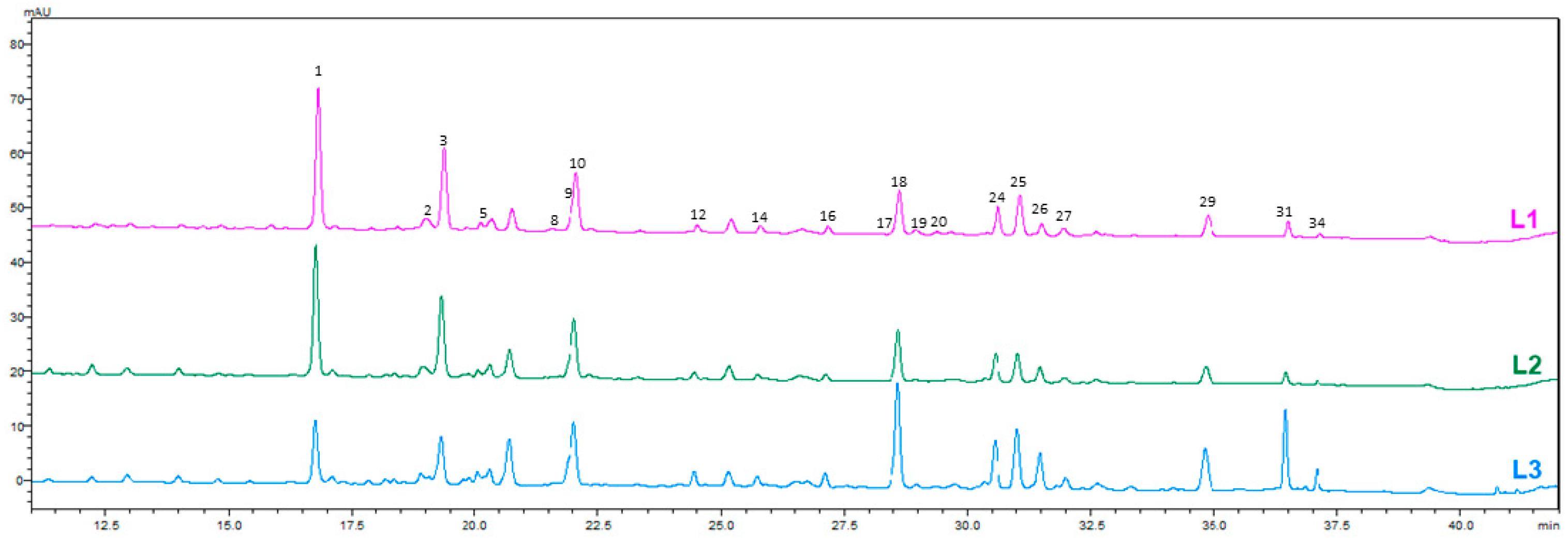
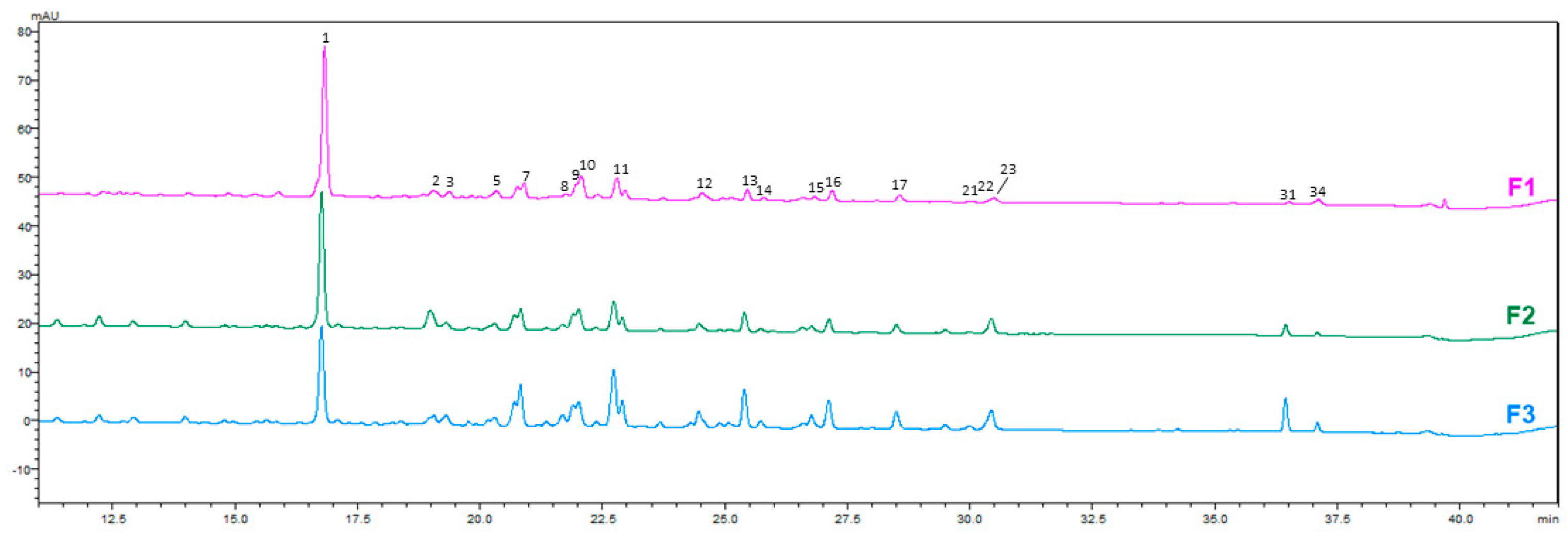

| ID | Plant Organ | Solvent |
|---|---|---|
| L1 | Leaf | NADES1 Choline chloride + Citric acid + Water (1:1 mol/mol) + 30% w/w Water |
| F1 | Flower | Choline chloride + Citric acid + Water (1:1 mol/mol) + 30% w/w Water |
| R1 | Root | Choline chloride + Citric acid + Water (1:1 mol/mol) + 30% w/w Water |
| L2 | Leaf | NADES2 Choline chloride + Glycerol (1:1 mol/mol) + 30% w/w Water |
| F2 | Flower | Choline chloride + Glycerol (1:1 mol/mol) + 30% w/w Water |
| R2 | Root | Choline chloride + Glycerol (1:1 mol/mol) + 30% w/w Water |
| L3 | Leaf | 70% v/v Ethanol in water |
| F3 | Flower | 70% v/v Ethanol in water |
| R3 | Root | 70% v/v Ethanol in water |
| Metabolite | Leaves mg/g dm | Flowers mg/g dm | Roots mg/g dm |
|---|---|---|---|
| Free amino acids | |||
| Glutamic acid | 4.1 ± 0.9 | 3.2 ± 0.8 | 1.7 ± 0.5 |
| Aspartic acid | 3.6 ± 0.8 | 2.9 ± 0.7 | 1.4 ± 0.4 |
| Alanine | 2.2 ± 0.6 | 2.0 ± 0.5 | 0.9 ± 0.3 |
| Serine | 1.8 ± 0.5 | 1.7 ± 0.4 | 0.7 ± 0.2 |
| Glycine | 1.6 ± 0.4 | 1.5 ± 0.4 | 0.6 ± 0.2 |
| Proline | 2.4 ± 0.7 | 4.5 ± 1.1 | 0.8 ± 0.3 |
| Asparagine | 1.9 ± 0.5 | 2.3 ± 0.6 | 5.6 ± 1.4 |
| Valine | 1.2 ± 0.3 | 1.1 ± 0.3 | 0.5 ± 0.2 |
| Leucine | 1.0 ± 0.3 | 0.9 ± 0.2 | 0.4 ± 0.1 |
| Phenylalanine | 0.7 ± 0.2 | 0.6 ± 0.2 | 0.3 ± 0.1 |
| Total | 20.5 | 28.7 | 12.9 |
| Organic acids | |||
| Malic acid | 10.8 ± 2.1 | 9.7 ± 2.0 | 5.6 ± 1.4 |
| Citric acid | 8.3 ± 1.9 | 7.4 ± 1.7 | 4.3 ± 1.1 |
| Oxalic acid | 6.1 ± 1.5 | 3.2 ± 0.9 | 2.0 ± 0.6 |
| Succinic acid | 2.6 ± 0.7 | 2.4 ± 0.6 | 1.6 ± 0.5 |
| Fumaric acid | 1.2 ± 0.4 | 1.1 ± 0.3 | 0.6 ± 0.2 |
| Galacturonic acid | 0.5 ± 0.1 | nd * | 10.7 ± 2.8 |
| Glucuronic acid | nd | nd | 6.4 ± 1.7 |
| Total | 29.5 | 23.8 | 17.5 |
| Mono-, di-, and oligosaccharides | |||
| Sucrose | 45.2 ± 8.7 | 72.6 ± 12.5 | 31.8 ± 7.4 |
| Glucose | 32.4 ± 6.5 | 58.3 ± 10.9 | 21.6 ± 5.2 |
| Fructose | 28.9 ± 5.9 | 55.1 ± 10.4 | 19.7 ± 4.6 |
| Maltose | 9.6 ± 2.3 | 6.8 ± 1.9 | nd |
| Raffinose | 5.1 ± 1.4 | 9.2 ± 2.5 | 6.3 ± 1.8 |
| Arabinose | nd | nd | 12.4 ± 3.1 |
| Galactose | nd | nd | 11.1 ± 2.9 |
| Rhamnose | nd | nd | 5.0 ± 1.3 |
| Total | 121.2 | 201.9 | 108.0 |
| ID | pH | TPC | TFC | TCT | TAntC | TAlkC |
|---|---|---|---|---|---|---|
| mgGAE/L | mgCE/L | mgCE/L | mgCGE/L | µgAE/L | ||
| L1 | 0.92 ± 0.02 | 61 ± 5 | 31 ± 2 | 18 ± 2 | nd * | 4.7 ± 0.2 |
| F1 | 0.96 ± 0.02 | 175 ± 7 | 109 ± 9 | 46 ± 6 | 0.29 ± 0.03 | 11.2 ± 0.5 |
| R1 | 0.68 ± 0.02 | 19 ± 2 | 4.4 ± 0.5 | 17 ± 2 | nd * | 2.5 ± 0.1 |
| NADES 1 | −0.17 ± 0.02 | - | - | - | - | - |
| L2 | 4.83 ± 0.02 | 30 ± 2 | 17 ± 2 | 13 ± 1 | nd * | nd * |
| F2 | 4.85 ± 0.02 | 143 ± 5 | 58 ± 3 | 49 ± 5 | nd * | nd * |
| R2 | 4.51 ± 0.02 | 11 ± 1 | 4.5 ± 0.6 | nd * | nd * | nd * |
| NADES 2 | 2.63 ± 0.02 | - | - | - | - | - |
| L3 | 6.17 ± 0.01 | 119 ± 3 | 76 ± 4 | 69 ± 6 | 1.04 ± 0.06 | nd * |
| F3 | 5.82 ± 0.01 | 176 ± 4 | 79 ± 4 | 73 ± 6 | 7.34 ± 0.12 | 9.7 ± 0.4 |
| R3 | 6.33 ± 0.01 | 32 ± 1 | 3.4 ± 0.5 | 16 ± 4 | nd * | nd * |
| 70% EtOH | 7.91 ± 0.01 | - | - | - | - | - |
| ID | DPPH | ABTS | FRAP |
|---|---|---|---|
| µmol TE/L | % | mg Fe(II)/L | |
| L1 | 71 ± 2 | 40 ± 2 | 0.34 ± 0.03 |
| F1 | 85 ± 2 | 89 ± 3 | 0.83 ± 0.05 |
| R1 | 39 ± 1 | 14 ± 1 | 0.57 ± 0.03 |
| L2 | 69 ± 2 | 31 ± 2 | 5.44 ± 0.15 |
| F2 | 72 ± 2 | 73 ± 3 | 8.09 ± 0.16 |
| R2 | 45 ± 1 | 12 ± 2 | 2.52 ± 0.09 |
| L3 | 76 ± 2 | 51 ± 3 | 3.95 ± 0.16 |
| F3 | 89 ± 2 | 81 ± 3 | 2.37 ± 0.05 |
| R3 | 42 ± 1 | 78 ± 2 | 1.82 ± 0.05 |
| TPC | TFC | TCT | TAntC | TAlkC | DPPH | ABTS | FRAP | |
|---|---|---|---|---|---|---|---|---|
| TPC | 1.0000 | 0.9545 * | 0.8907 | 0.5532 | 0.2749 | 0.8640 | 0.7914 | 0.1887 |
| TFC | 1.0000 | 0.8430 | 0.4248 | 0.4187 | 0.8784 | 0.6987 | 0.0856 | |
| TCT | 1.0000 | 0.6485 | −0.0157 | 0.7648 | 0.6521 | −0.0654 | ||
| TAntC | 1.0000 | −0.2213 | 0.5267 | 0.3890 | −0.0654 | |||
| TAlkC | 1.0000 | 0.2296 | 0.1940 | −0.5771 | ||||
| DPPH | 1.0000 | 0.5926 | 0.2132 | |||||
| ABTS | 1.0000 | 0.1162 | ||||||
| FRAP | 1.0000 |
| ID | Diameter of Inhibition Zones (mm) | |||
|---|---|---|---|---|
| S. aureus | E. coli | P. aeruginosa | B. cereus | |
| L1 | 34.3 ± 1.5 ac | 32.7 ± 3.1 bc | 31.3 ± 1.2 ac | 30.7 ±1.2 ac |
| F1 | 32.0 ± 0.0 ac | 31.3 ± 2.3 bb | 29.3 ± 1.2 ab | 32.0 ± 0.0 ab |
| R1 | 33.3 ± 2.3 bc | 31.7 ± 3.9 bc | 29.3 ± 0.6 ab | 31.3 ±1.2 ab |
| NADES1 | 30.0 ± 0.0 a | 27.0 ± 0.0 a | 28.3 ± 0.6 a | 30.0 ± 0.0 a |
| L2 | 11.3 ± 1.2 ac | - ** | - ** | - ** |
| F2 | 12.0 ± 0.0 ac | - ** | - ** | - ** |
| R2 | - ** | - ** | - ** | - ** |
| NADES2 | 6.0 ± 0 a | 6 ± 0 a | 6.0 ± 0 a | 6.0 ± 0 a |
| L3 | 10.3 ± 1.2 ac | - ** | 9.0 ± 1.7 ac | 10.7 ± 1.2 ac |
| F3 | 8.7 ± 0.6 ab | - ** | 9.0 ± 1.7 ac | 8.3 ± 1.5 ab |
| R3 | 9.7 ± 0.6 ac | 11.3 ± 1.2 bc | 9.7 ± 0.6 ac | 9.3 ± 0.6 ac |
| 70% EtOH | 7.0 ± 0 a | 7.0 ± 0.0 a | 7.0 ± 0 a | 6.7 ± 0.6 a |
| Gentamicin | 15.0 ± 0.0 ac | 11.0 ± 0.0 ac | 11.0 ± 0.0 ac | 15.0 ± 0.0 ac |
| ID | Diameter of Inhibition Zones (mm) | ||||||
|---|---|---|---|---|---|---|---|
| P. chrysogenum | F. oxysporum | A. parasiticus | A. niger | A. flavus | A. carbonarius | A. ochraceus | |
| L1 | 13.0 ± 1.7 bc | 9.7 ± 0.6 ac | - ** | - ** | 11.0 ± 1.0 bc | - ** | 10.0 ± 0.0 aa |
| F1 | 14.0 ± 1.7 bc | 8.7 ± 0.6 ac | - ** | - ** | 11.7 ± 0.6 ab | - ** | 10.0 ± 0.0 aa |
| R1 | 15.7 ± 1.2 bb | - ** | 8.0 ± 0.0 ac | 16.7 ± 0.6 bb | 11.7 ± 0.6 ab | - ** | 9.7 ± 0.6 ab |
| NADES1 | 15.3 ± 0.6 a | 10.0 ± 0.0 a | 9.0 ± 0.0 a | 17.7 ± 0.6 a | 12.0 ± 0.0 a | 6.0 ± 0.0 a | 10.0 ± 0.0 a |
| L2 | - ** | - ** | - ** | - ** | - ** | - ** | - ** |
| F2 | - ** | - ** | - ** | - ** | - ** | - ** | - ** |
| R2 | - ** | - ** | - ** | - ** | - ** | - ** | - ** |
| NADES2 | 6.0 ± 0.0 a | 6.0 ± 0.0 a | 6.0 ± 0.0 a | 6.0 ± 0.0 a | 6.0 ± 0.0 a | 6.0 ± 0.0 a | 6.0 ± 0.0 a |
| L3 | 8.3 ± 0.6 ab | 8.7 ± 0.6 ab | 7.3 ± 0.6 ab | - ** | 7.7 ± 0.06 ac | - ** | 8.3 ± 1.2 bc |
| F3 | 8.0 ± 0.0 aa | 7.7 ± 0.6 ab | 7.3 ± 0.6 ab | - ** | 7.0 ± 0.0 ab | - ** | 7.7 ± 0.6 aa |
| R3 | 8.7 ± 1.2 bb | 8.0 ± 0.0 ab | 7.7 ± 0.6 ab | - ** | 7.7 ± 0.6 ac | 8.0 ± 0.0 aa | 7.7 ± 0.6 aa |
| 70% EtOH | 8.0 ± 0.0 a | 7.7 ± 0.6 a | 7.0 ± 0.0 a | 6.0 ± 0.0 a | 6.0 ± 0.0 a | 6.0 ± 0.0 a | 7.7 ± 0.6 a |
| Amphotericin B | 6.0 ± 0.0 ab | 6.0 ± 0.0 ab | 11.0 ± 0.0 ac | 9.0 ± 0.0 ac | 11.5 ± 0.3 ac | 13.8 ± 0.3 ac | 6.0 ± 0.0 ab |
Disclaimer/Publisher’s Note: The statements, opinions and data contained in all publications are solely those of the individual author(s) and contributor(s) and not of MDPI and/or the editor(s). MDPI and/or the editor(s) disclaim responsibility for any injury to people or property resulting from any ideas, methods, instructions or products referred to in the content. |
© 2026 by the authors. Licensee MDPI, Basel, Switzerland. This article is an open access article distributed under the terms and conditions of the Creative Commons Attribution (CC BY) license.
Share and Cite
Memdueva, N.; Tzanova, M.; Staleva, P.; Kamenova-Nacheva, M.; Krastilova, K.; Yaneva, Z.; Rusenova, N.; Grozeva, N.; Ginin, S.; Dinev, T. Phytochemical Content, Antioxidant and Antimicrobial Potential of Althaea officinalis L. Extracts Prepared by “Green” Classical and Natural Deep Eutectic Solvents. Molecules 2026, 31, 1575. https://doi.org/10.3390/molecules31101575
Memdueva N, Tzanova M, Staleva P, Kamenova-Nacheva M, Krastilova K, Yaneva Z, Rusenova N, Grozeva N, Ginin S, Dinev T. Phytochemical Content, Antioxidant and Antimicrobial Potential of Althaea officinalis L. Extracts Prepared by “Green” Classical and Natural Deep Eutectic Solvents. Molecules. 2026; 31(10):1575. https://doi.org/10.3390/molecules31101575
Chicago/Turabian StyleMemdueva, Neli, Milena Tzanova, Plamena Staleva, Mariana Kamenova-Nacheva, Kalina Krastilova, Zvezdelina Yaneva, Nikolina Rusenova, Neli Grozeva, Stela Ginin, and Toncho Dinev. 2026. "Phytochemical Content, Antioxidant and Antimicrobial Potential of Althaea officinalis L. Extracts Prepared by “Green” Classical and Natural Deep Eutectic Solvents" Molecules 31, no. 10: 1575. https://doi.org/10.3390/molecules31101575
APA StyleMemdueva, N., Tzanova, M., Staleva, P., Kamenova-Nacheva, M., Krastilova, K., Yaneva, Z., Rusenova, N., Grozeva, N., Ginin, S., & Dinev, T. (2026). Phytochemical Content, Antioxidant and Antimicrobial Potential of Althaea officinalis L. Extracts Prepared by “Green” Classical and Natural Deep Eutectic Solvents. Molecules, 31(10), 1575. https://doi.org/10.3390/molecules31101575