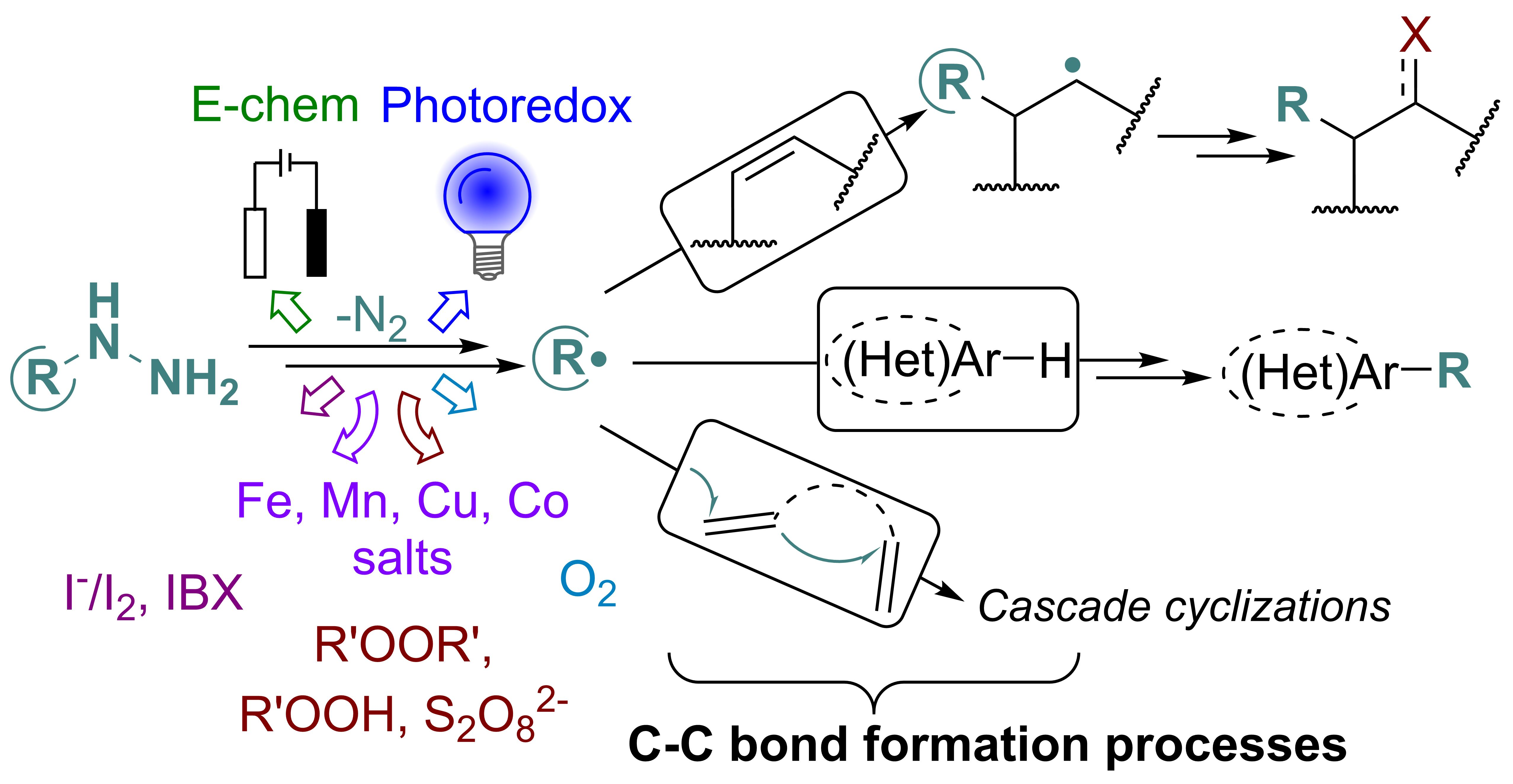
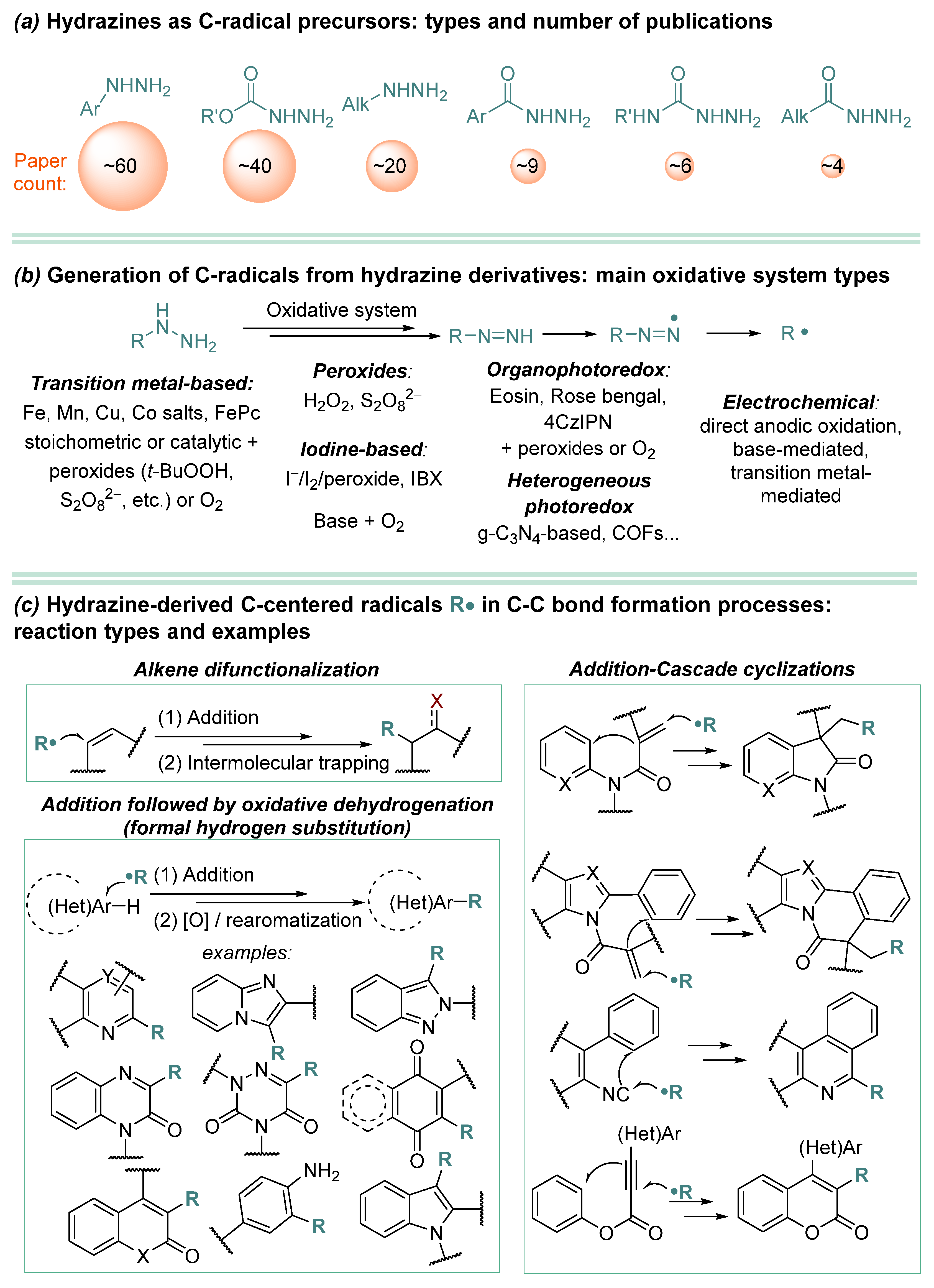
Hydrazine Derivatives as C-Centered Radical Precursors for C-C Bond Formation Reactions




Abstract
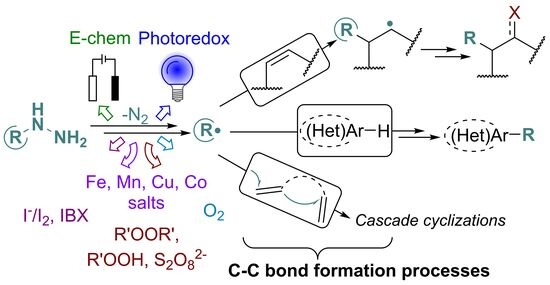
1. Introduction
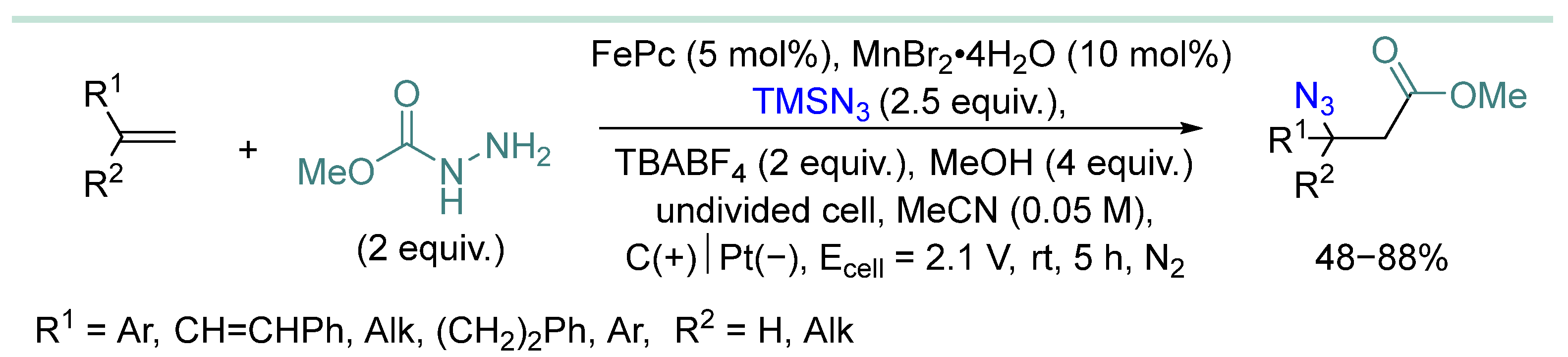
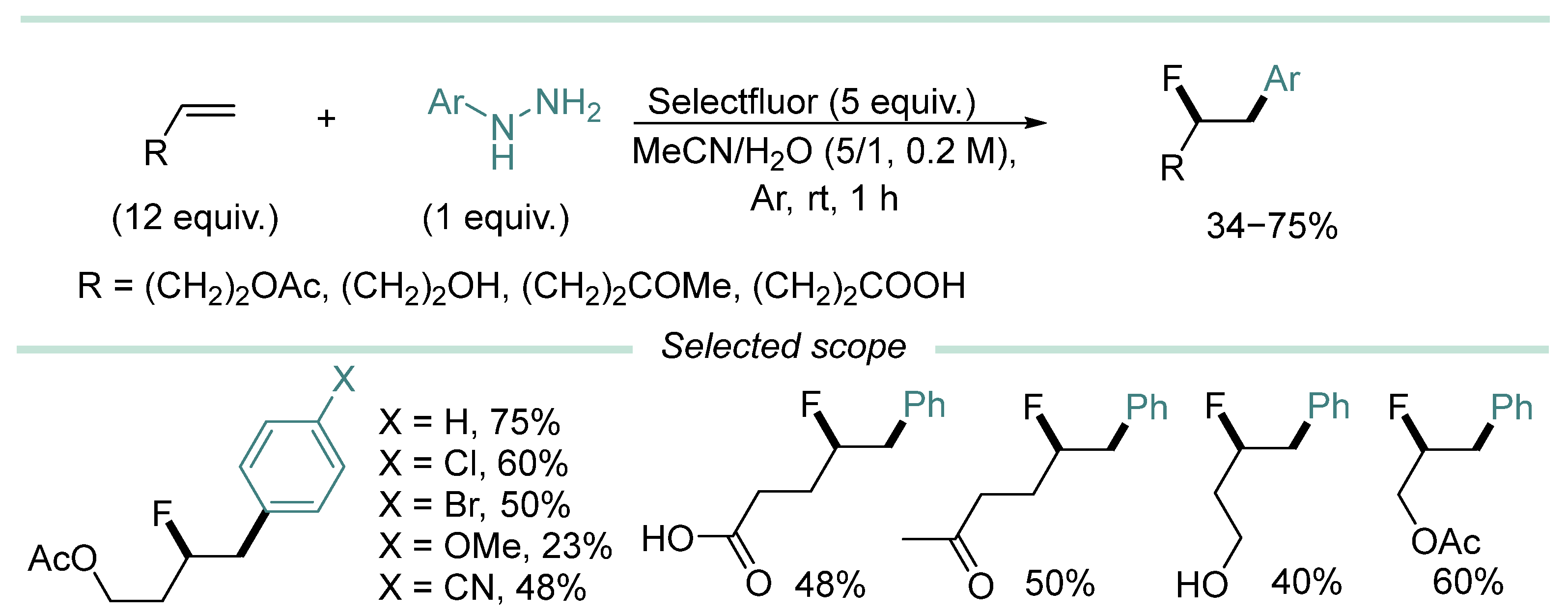
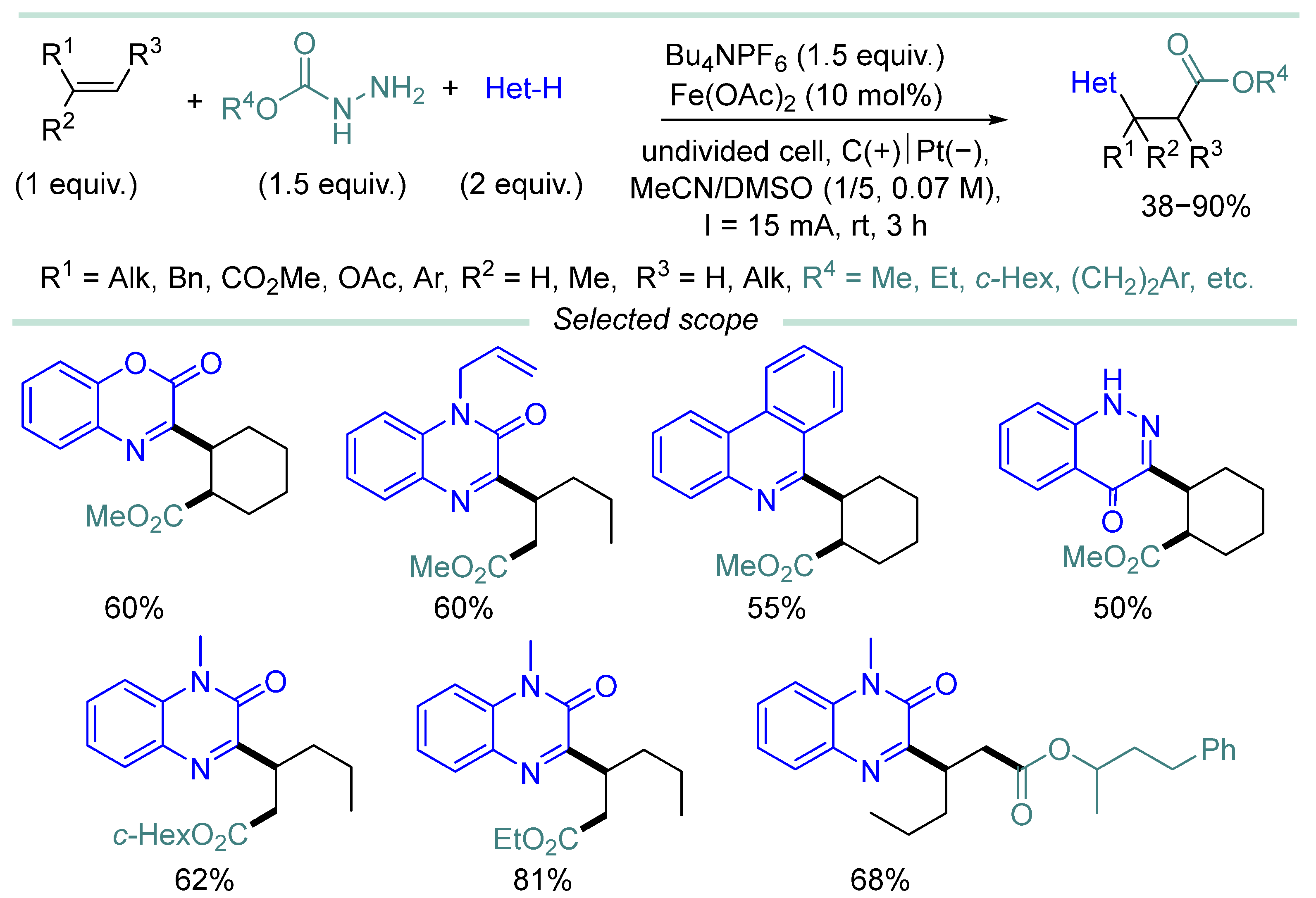
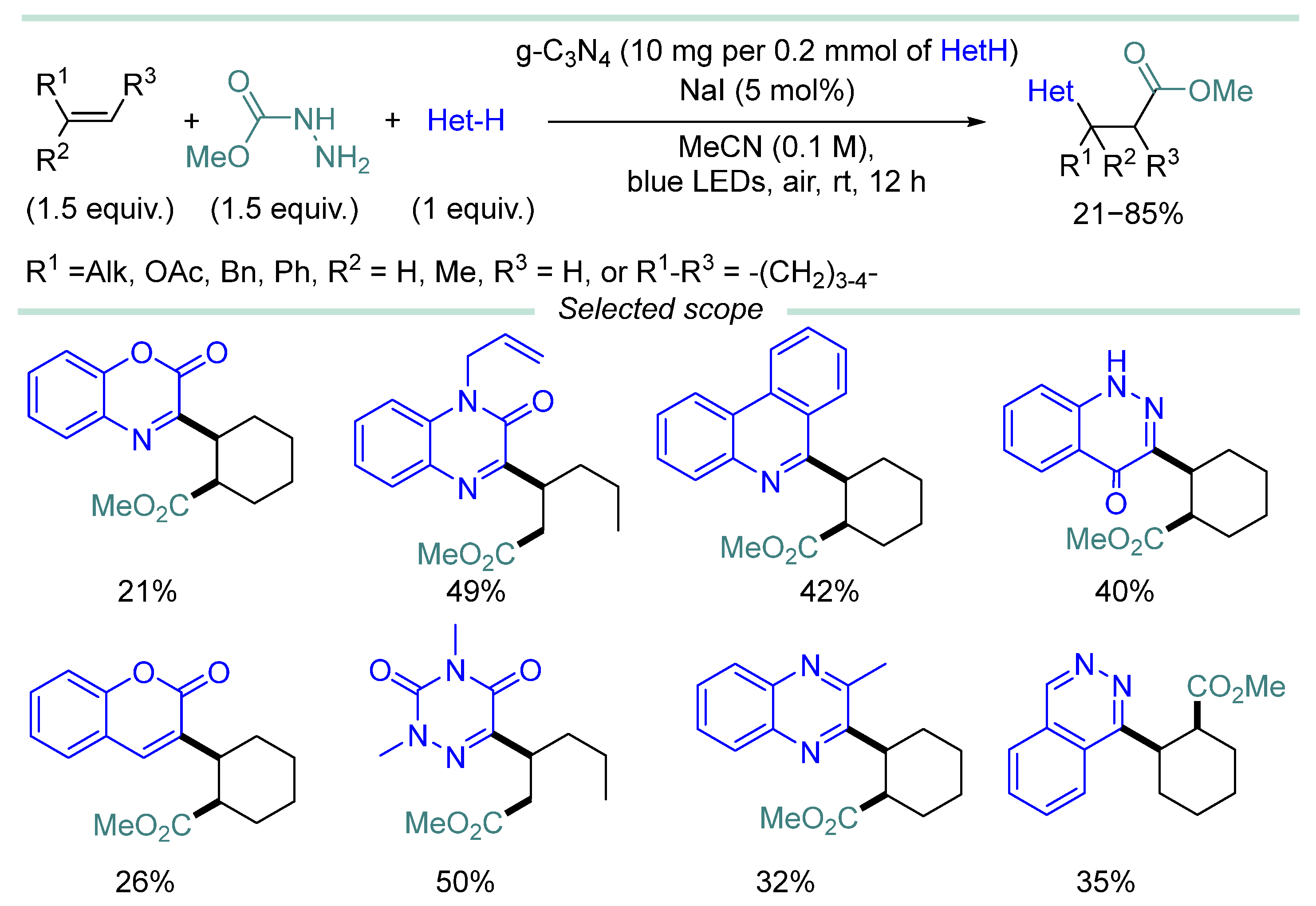
2. Additions to the C=C Double Bonds
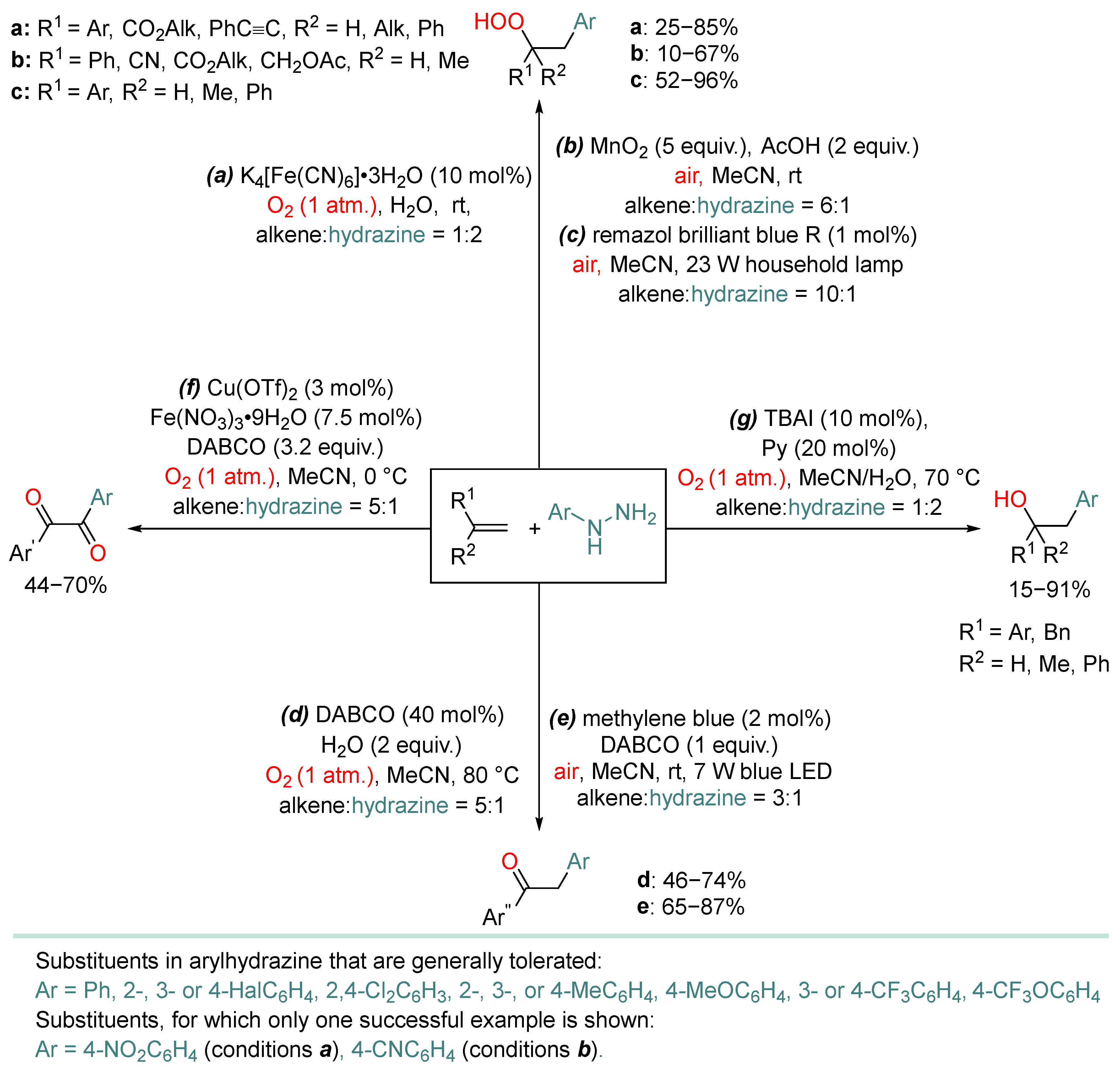
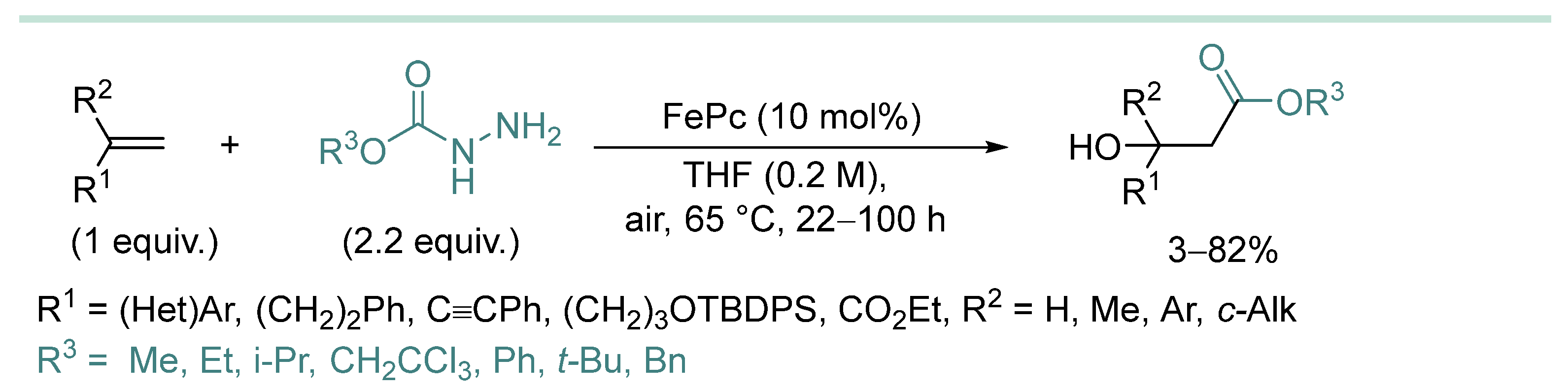
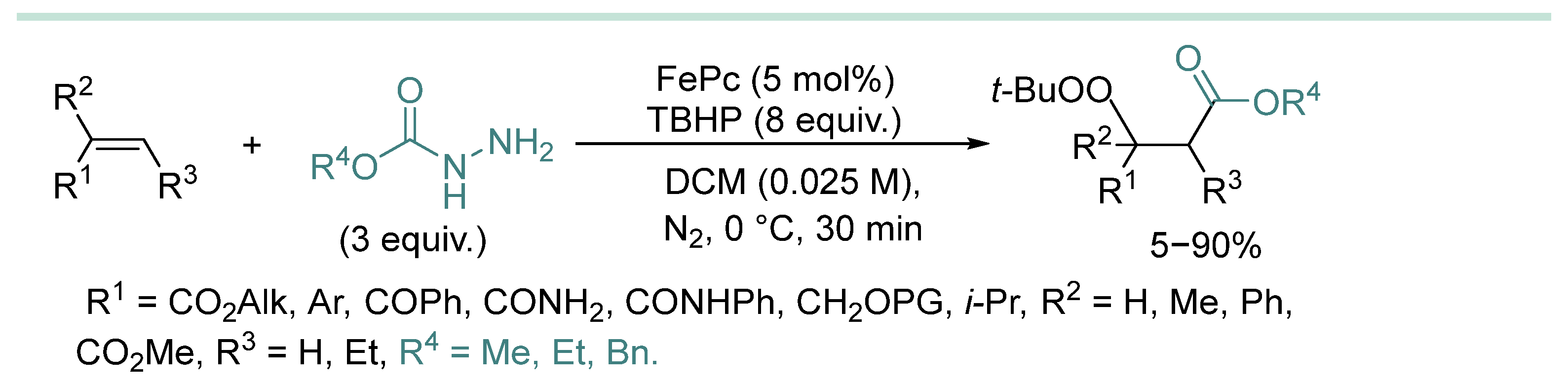
2.1. Additions to C=C Double Bonds Followed by Intermolecular Reactions of the Resultant Carbon-Centered Radicals
2.2. Additions to Acrylamides Followed by Intramolecular Cyclizations
2.2.1. Type 1—Cyclization to Oxindoles
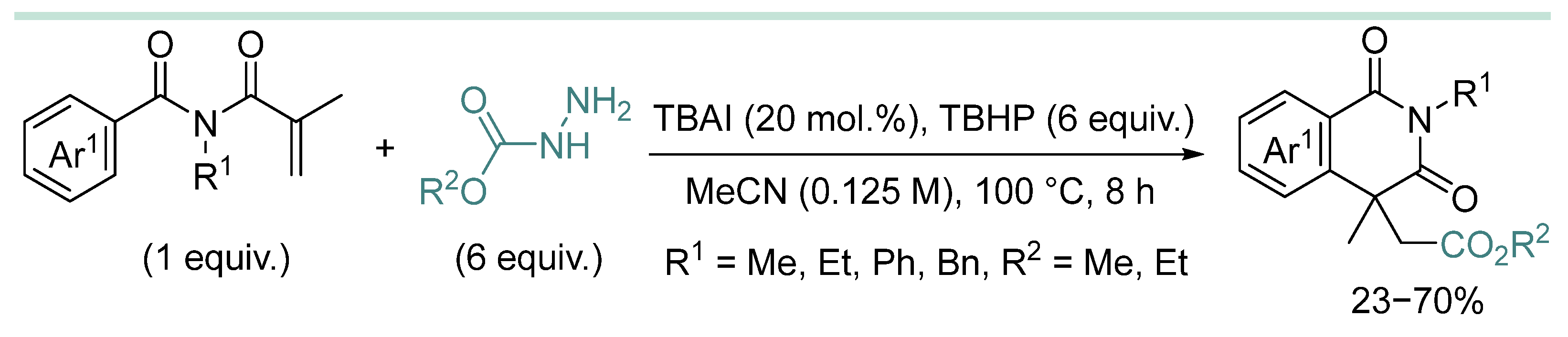
2.2.2. Type 2—Cyclization to Isoqunolinones
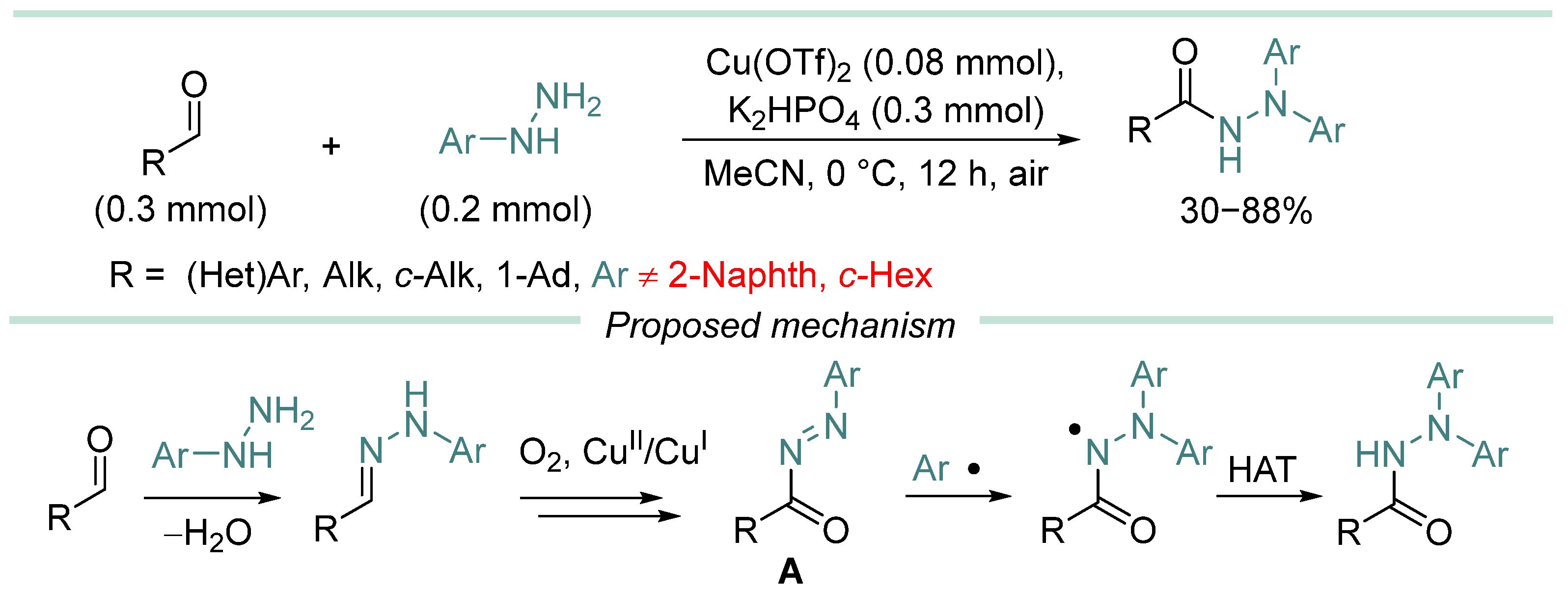
3. Addition to Hydrazones
4. Addition to Alkynes
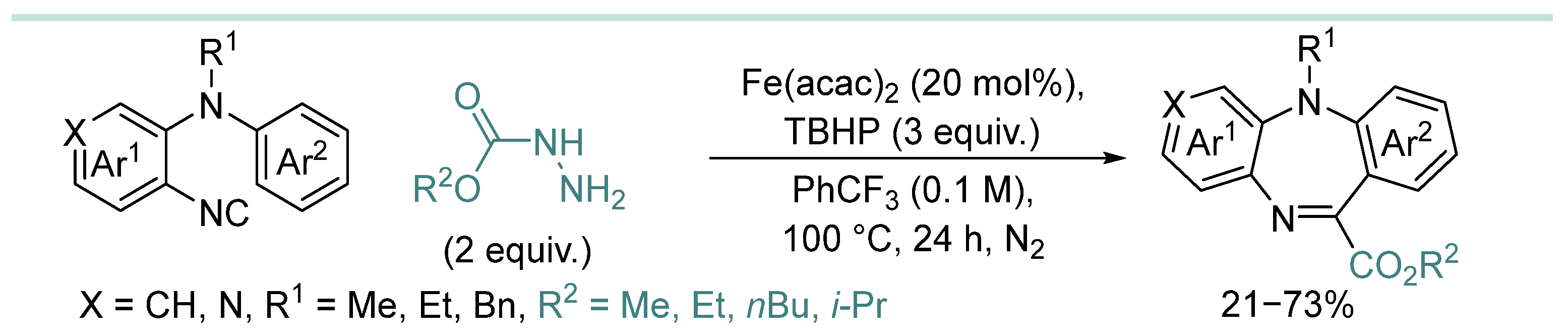
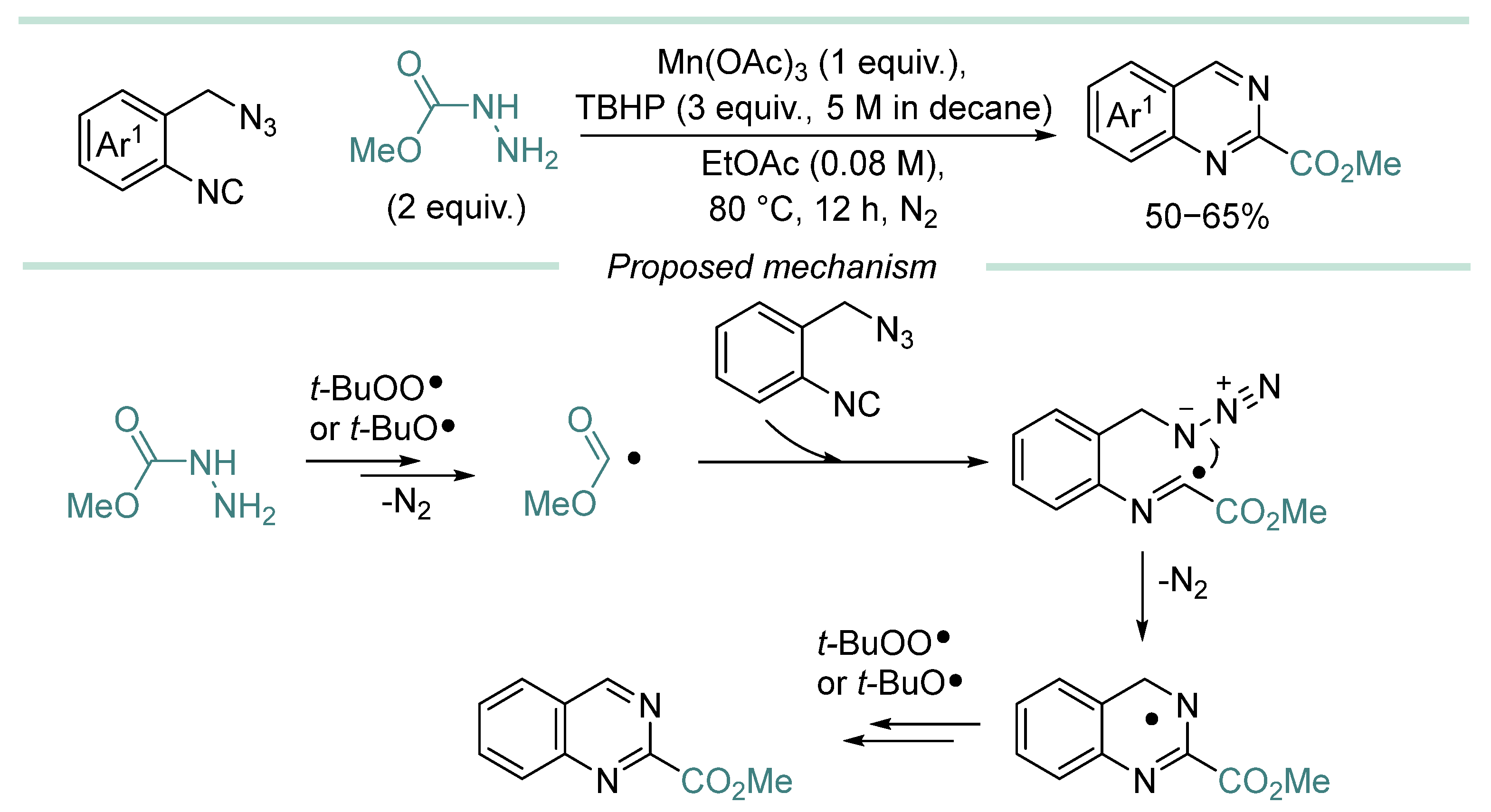
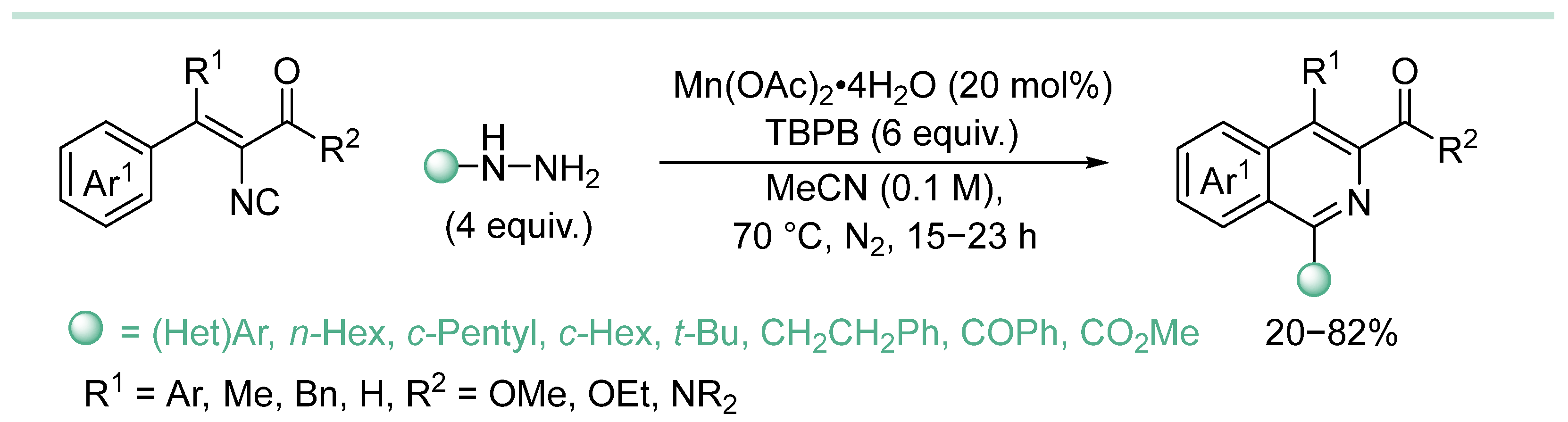
5. Addition to Isonitriles
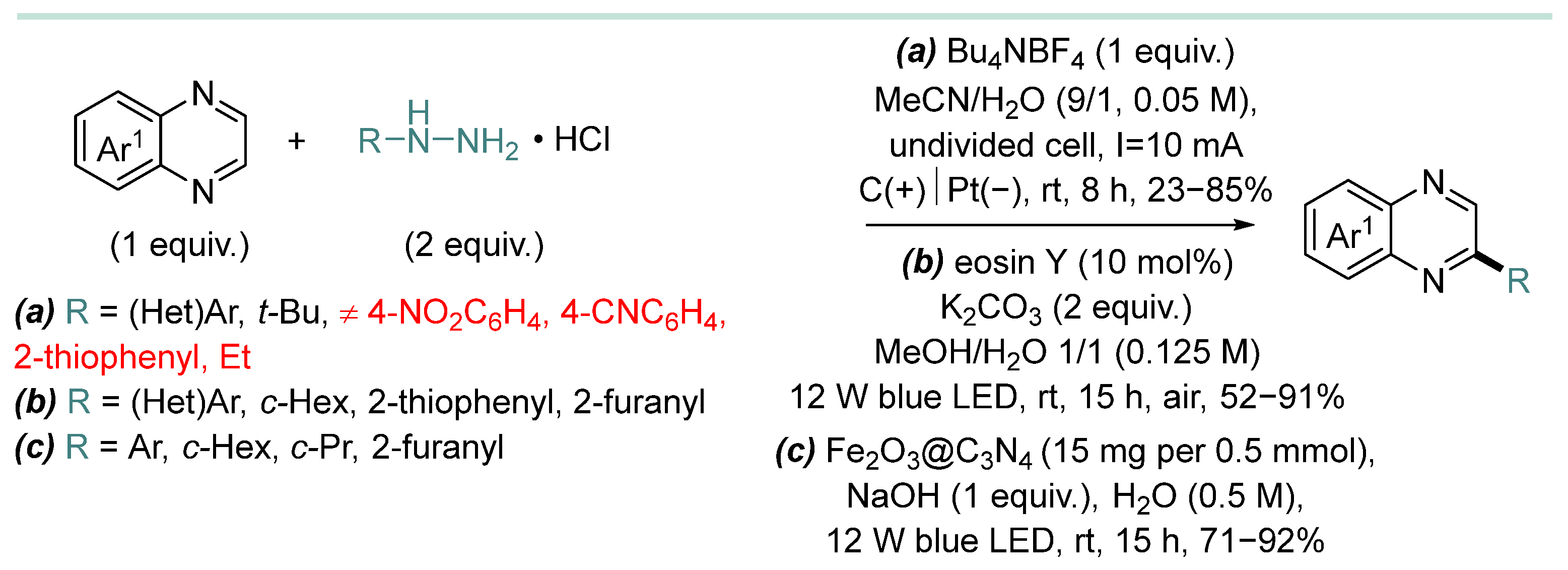
6. Additions to (Hetero)Arenes with Formal Hydrogen Substitution
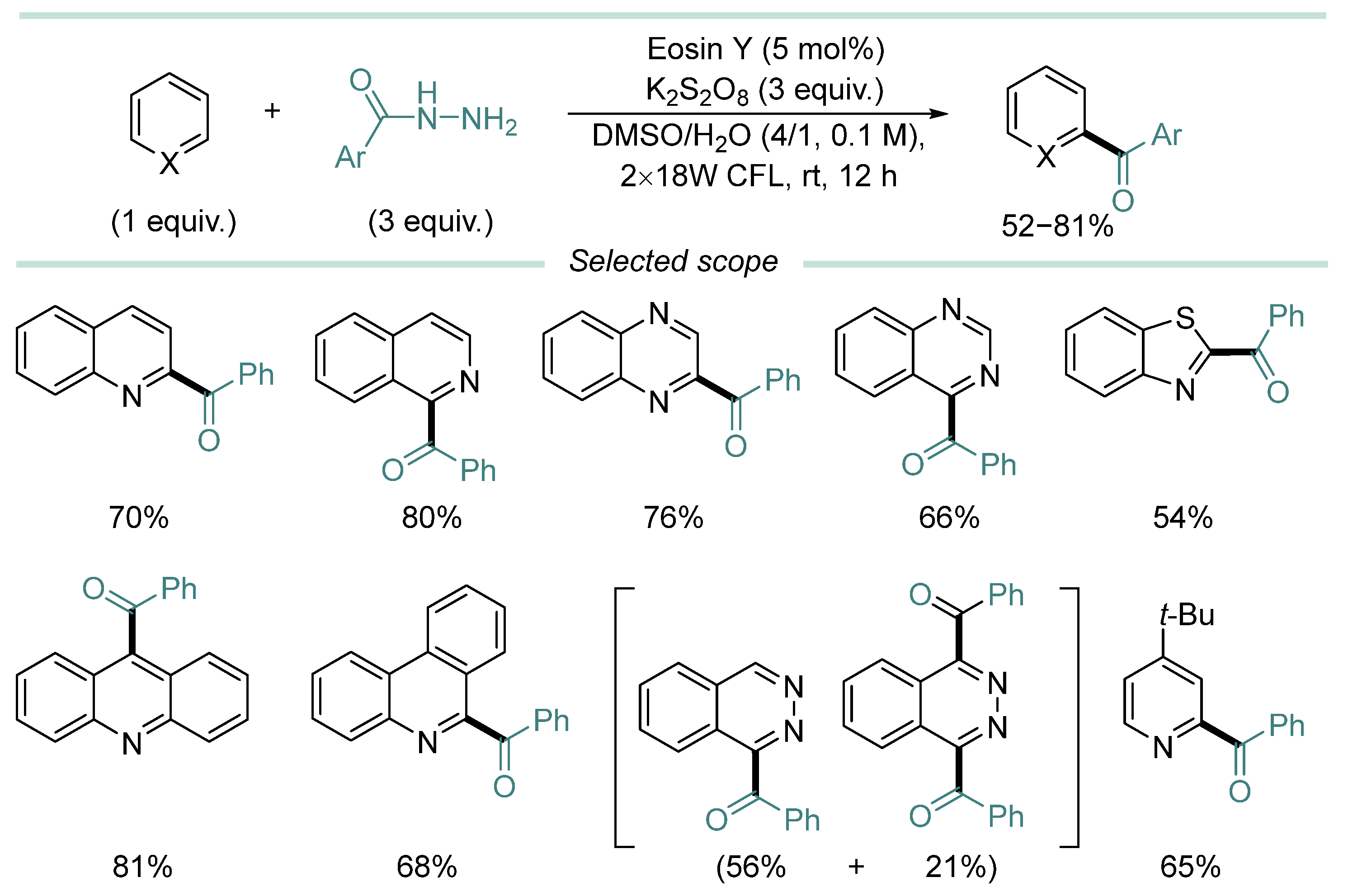
6.1. Pyridine-Type N-Heterocycles: Pyridines, Quinolines, Quinoxaline, Isoquinoline, etc.
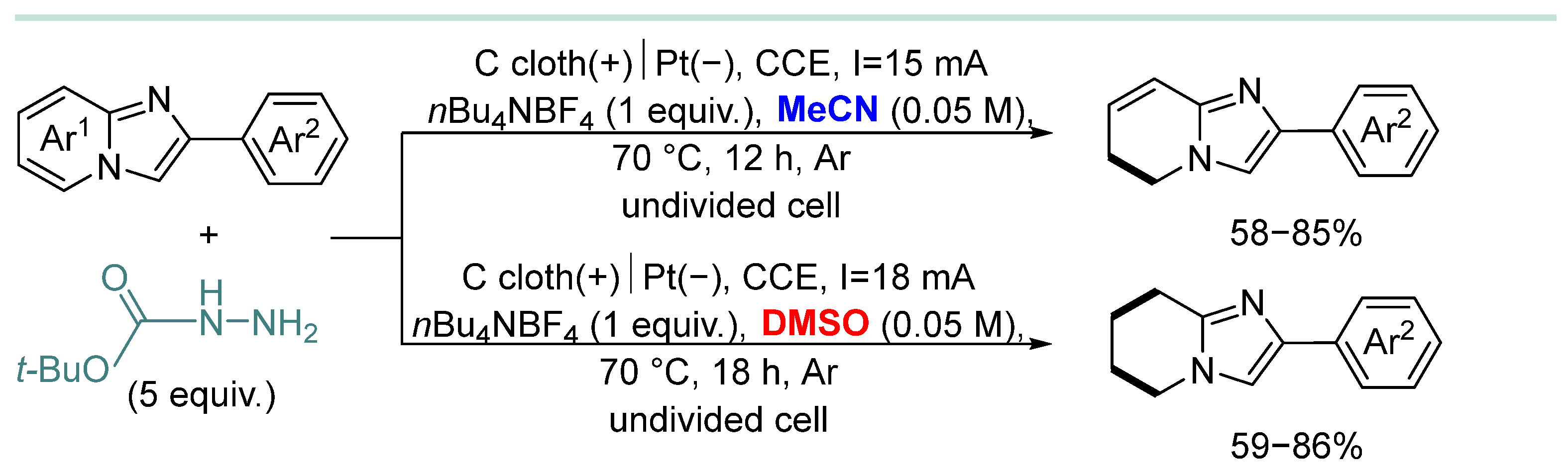
6.2. Imidazo[1,2-a]pyridines
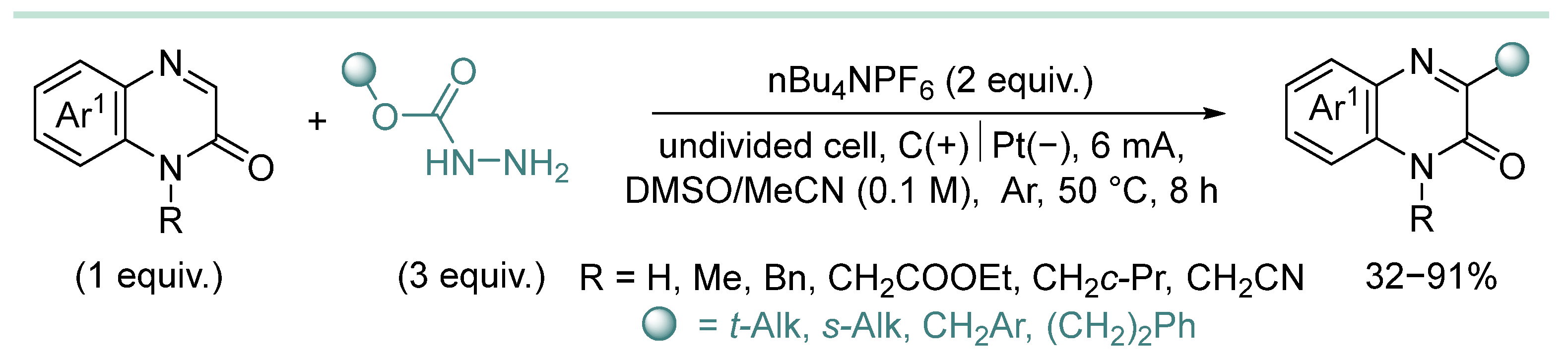
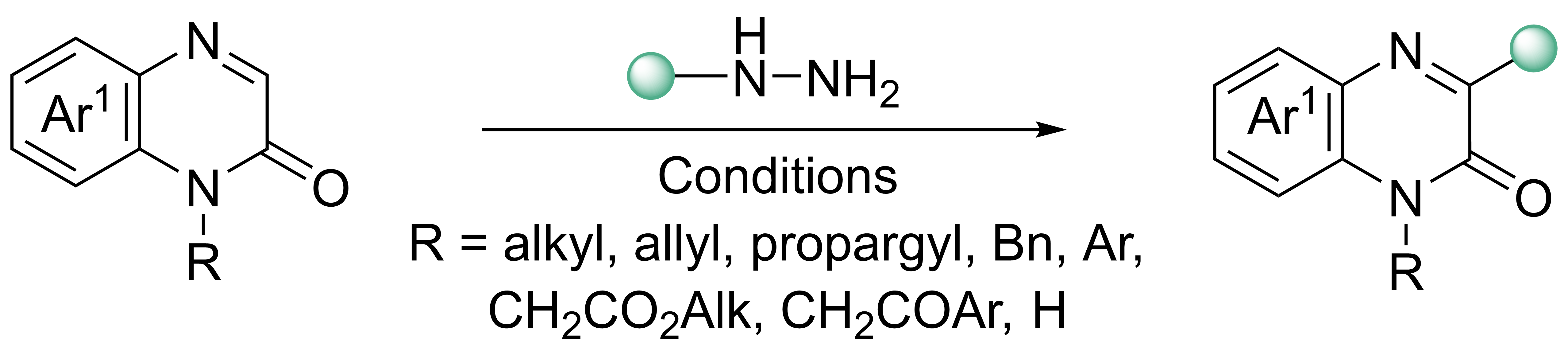
6.3. Quinoxalin-2(1H)-Ones
6.4. 2H-Indazoles
6.5. Quinoline-N-Oxides
6.6. Intermolecular Functionalization of Biaryls
6.7. Functionalization of 1,4-Benzoquinones and 1,4-Naphthoquinones
6.8. Functionalization of Anilines
6.9. Functionalization of Other Heterocycles
7. Miscellaneous Reactions
8. Conclusions
- In most cases, hydrazine derivative is used in excess amounts, in some cases, C-radical acceptor is used in excess, but there are almost no effective examples of C-C coupling with 1:1 substrate/hydrazine ratio, which is a serious limitation when two complex and valuable reagents are to be coupled.
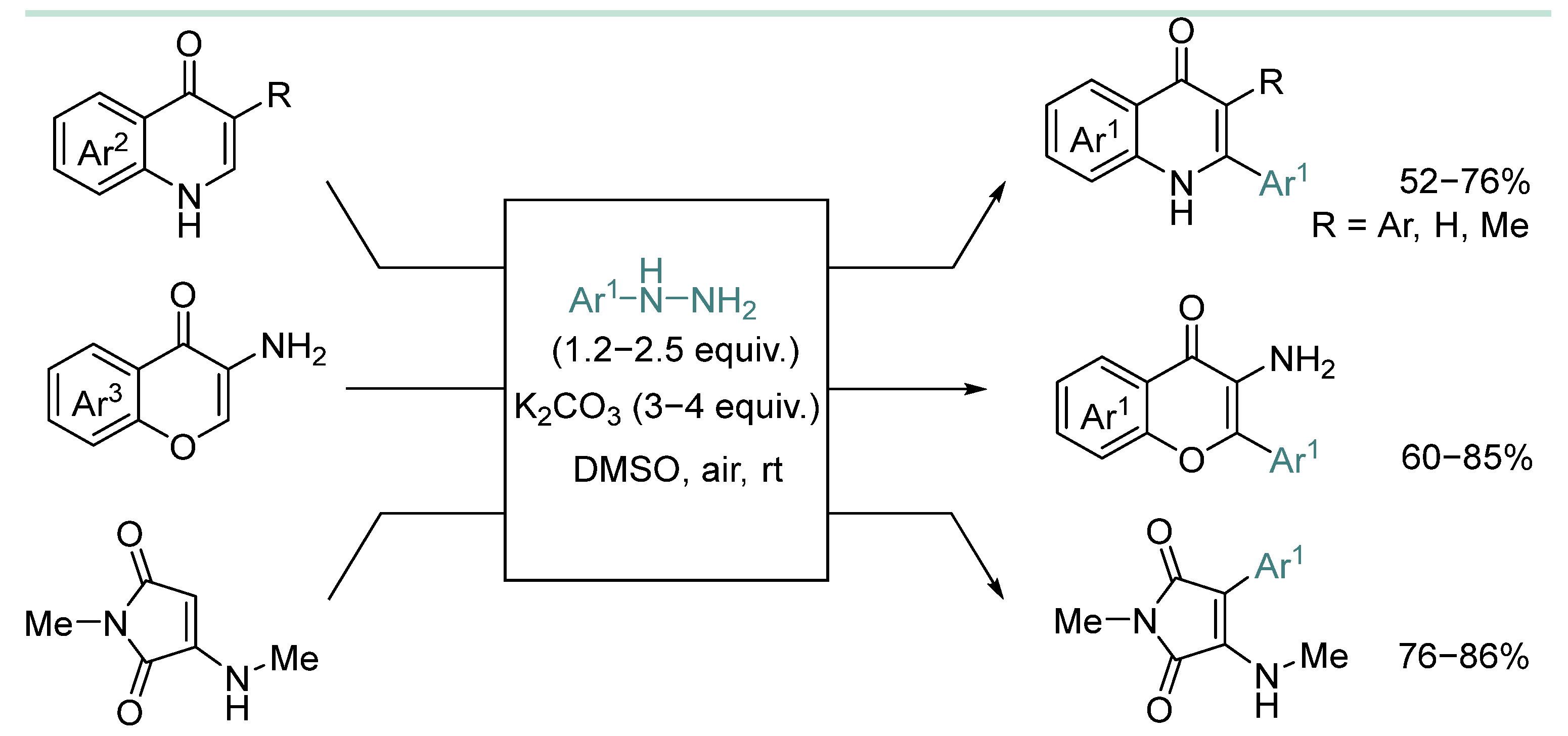
- Despite extensive development of the field, there is no established fundamental understanding of the rational oxidative system choice and prediction of reactivity for various hydrazine types. Apparently, arylhydrazines and alkylhydrazines without electron-withdrawing group are oxidized more easily compared to carbazates and acylhydrazines and, thus, oxidation by air/base systems (see Scheme 1d, Scheme 29, Scheme 32, Scheme 33 and Scheme 39; Table 4, entry 4; Table 5, entry 5; Table 7, entry 1; Table 8, entries 2, 5 and 6) becomes possible without the usage photoredox catalysts, peroxides or transition metal catalysts.
- The application of acylhydrazines and alkylhydrazines remains less explored compared to arylhydrazines and carbazates, despite the synthetic importance of methods for the introduction of alkyl and acyl substituents.
- There is a limited number of examples for radical hydrogen substitution in aliphatic functional groups (compared to heterocycle CH-functionalization) and alkyne functionalization (compared to alkene functionalization).
Author Contributions
Funding
Data Availability Statement
Conflicts of Interest
Abbreviations
| 4CzIPN | 1,2,3,5-Tetrakis(carbazol-9-yl)-4,6-dicyanobenzene |
| BPO | benzoyl peroxide |
| CCE | constant current electrolysis |
| DCE | 1,2-dichloroethane |
| DCM | dichloromethane |
| DTBP | di-tert-butylperoxide |
| DTBP | di-tert-butyl peroxide |
| FePc | iron phthalocyanine |
| HD | Hydrazine derivative |
| IBX | 2-iodoxybenzoic acid |
| TBAI | tetra-n-butylammonium iodide |
| TBHP | tert-butylhydroperoxide |
| TBPB | tert-butylperoxybenzoate |
| TEMPO | (2,2,6,6-Tetramethylpiperidin-1-yl)oxyl |
References
- Varea, T.; González-Núñez, M.E.; Rodrigo-Chiner, J.; Asensio, G. Aryl Radicals by Copper(II) Oxidation of Hydrazines: A New Method for the Oxidative and Reductive Arylation of Alkenes. Tetrahedron Lett. 1989, 30, 4709–4712. [Google Scholar] [CrossRef]
- Braslau, R.; Anderson, M.O.; Rivera, F.; Jimenez, A.; Haddad, T.; Axon, J.R. Acyl Hydrazines as Precursors to Acyl Radicals. Tetrahedron 2002, 58, 5513–5523. [Google Scholar] [CrossRef]
- Amos, R.I.J.; Gourlay, B.S.; Yates, B.F.; Schiesser, C.H.; Lewis, T.W.; Smith, J.A. Mechanistic Investigation of the Oxidation of Hydrazides: Implications for the Activation of the TB Drug Isoniazid. Org. Biomol. Chem. 2013, 11, 170–176. [Google Scholar] [CrossRef] [PubMed]
- Nguyen, M.; Claparols, C.; Bernadou, J.; Meunier, B. A Fast and Efficient Metal-Mediated Oxidation of Isoniazid and Identification of Isoniazid-NAD(H) Adducts. ChemBioChem 2001, 2, 877–883. [Google Scholar] [CrossRef]
- Nguyen, M.; Claparols, C.; Bernadou, J.; Meunier, B. Is the Isonicotinoyl Radical Generated during Activation of Isoniazid by MnIII-Pyrophosphate? Comptes Rendus Chim. 2002, 5, 325–330. [Google Scholar] [CrossRef]
- Qin, L.; Huang, C.-H.; Mao, L.; Shao, B.; Zhu, B.-Z. First Unequivocal Identification of the Critical Acyl Radicals from the Anti-Tuberculosis Drug Isoniazid and Its Hydrazide Analogs by Complementary Applications of ESR Spin-Trapping and HPLC/MS Methods. Free Radic. Biol. Med. 2020, 154, 1–8. [Google Scholar] [CrossRef]
- Li, R.; Shi, T.; Chen, X.-L.; Lv, Q.-Y.; Zhang, Y.-L.; Peng, Y.-Y.; Qu, L.-B.; Yu, B. Visible-Light-Promoted Organic Dye-Catalyzed Sulfidation and Phosphorylation of Arylhydrazines toward Aromatic Sulfides and Diarylphosphoryl Hydrazides. New J. Chem. 2019, 43, 13642–13646. [Google Scholar] [CrossRef]
- Balgotra, S.; Verma, P.K.; Vishwakarma, R.A.; Sawant, S.D. Catalytic Advances in Direct Functionalizations Using Arylated Hydrazines as the Building Blocks. Catal. Rev. 2020, 62, 406–479. [Google Scholar] [CrossRef]
- Huang, P.-K.C.; Kosower, E.M. Diazenes. II. Preparation of Phenyldiazene. J. Am. Chem. Soc. 1968, 90, 2362–2367. [Google Scholar] [CrossRef]
- Huang, P.-K.C.; Kosower, E.M. Diazenes. III. Properties of Phenyldiazene. J. Am. Chem. Soc. 1968, 90, 2367–2376. [Google Scholar] [CrossRef]
- Fehler, S.K.; Pratsch, G.; Heinrich, M.R. The Trapping of Phenyldiazenes in Cycloaddition Reactions. Angew. Chem. Int. Ed. 2014, 53, 11361–11365. [Google Scholar] [CrossRef] [PubMed]
- Gradl, S.; Köckenberger, J.; Oppl, J.; Schiller, M.; Heinrich, M.R. Synthetic Route to Phenyl Diazenes and Pyridazinium Salts from Phenylazosulfonates. J. Org. Chem. 2021, 86, 6228–6238. [Google Scholar] [CrossRef] [PubMed]
- Amos, R.I.J.; Schiesser, C.H.; Smith, J.A.; Yates, B.F. Nucleophilic Acyl Substitution of Acyl Diimides. J. Org. Chem. 2009, 74, 5707–5710. [Google Scholar] [CrossRef] [PubMed]
- Chen, L.; Thompson, J.D.F.; Jamieson, C. eAmidation: An Electrochemical Amidation of Aldehydes via the Oxidation of N-Aryl Hydrazones. Adv. Synth. Catal. 2025, 367, e9587. [Google Scholar] [CrossRef]
- Bath, S.; Laso, N.M.; Lopez-Ruiz, H.; Quiclet-Sire, B.; Zard, S.Z. A Practical Access to Acyl Radicals from Acyl Hydrazides. Chem. Commun. 2003, 204–205. [Google Scholar] [CrossRef]
- Cheng, C.; Chen, D.; Li, Y.; Xiang, J.-N.; Li, J.-H. Fluoroamide-Driven Intermolecular Hydrogen-Atom-Transfer-Enabled Intermolecular 1,2-Alkylarylation of Alkenes. Org. Chem. Front. 2023, 10, 943–950. [Google Scholar] [CrossRef]
- Xu, J.; Liu, Y.; Wang, Q.; Tao, X.; Ni, S.; Zhang, W.; Yu, L.; Pan, Y.; Wang, Y. Electrochemical Deoxygenative Amination of Stabilized Alkyl Radicals from Activated Alcohols. Nat. Commun. 2024, 15, 6116. [Google Scholar] [CrossRef]
- Dong, D.; Han, Q.; Yang, S.; Song, J.; Li, N.; Wang, Z.; Xu, X. Recent Progress in Sulfonylation via Radical Reaction with Sodium Sulfinates, Sulfinic Acids, Sulfonyl Chlorides or Sulfonyl Hydrazides. ChemistrySelect 2020, 5, 13103–13134. [Google Scholar] [CrossRef]
- Shao, J.; Liu, J.; Mei, H.; Han, J. Recent Advances on Electrochemical Generation of Sulfonyl Radical Triggered Cyclization of Alkene/Alkynes. Tetrahedron 2025, 173, 134467. [Google Scholar] [CrossRef]
- Qian, B.-C.; Zhu, C.-Z.; Shen, G.-B. The Application of Sulfonyl Hydrazides in Electrosynthesis: A Review of Recent Studies. ACS Omega 2022, 7, 39531–39561. [Google Scholar] [CrossRef]
- Mulina, O.M.; Ilovaisky, A.I.; Parshin, V.D.; Terent’ev, A.O. Oxidative Sulfonylation of Multiple Carbon-Carbon Bonds with Sulfonyl Hydrazides, Sulfinic Acids and Their Salts. Adv. Synth. Catal. 2020, 362, 4579–4654. [Google Scholar] [CrossRef]
- Zhao, S.; Chen, K.; Zhang, L.; Yang, W.; Huang, D. Sulfonyl Hydrazides in Organic Synthesis: A Review of Recent Studies. Adv. Synth. Catal. 2020, 362, 3516–3541. [Google Scholar] [CrossRef]
- Yang, F.-L.; Tian, S.-K. Sulfonyl Hydrazides as Sulfonyl Sources in Organic Synthesis. Tetrahedron Lett. 2017, 58, 487–504. [Google Scholar] [CrossRef]
- Gupta, T.; Raj, M.; Kumari, P.; Premlata; Kumari, P.; Chanchal, C.K.; Kant, C.; Singh, N.; Kumar, R. Synthetic Relevance and Mechanistic Insights of Sulfonylation Reactions Using Sulfonylhydrazides. J. Sulfur Chem. 2025, 46, 975–1054. [Google Scholar] [CrossRef]
- Yi, R.; Wang, L.-T.; Chen, J.; Wei, W.-T.; Lei, K.-W. Applications of Sulfonyl Hydrazides in Radical Cyclization of Alkenes. Org. Biomol. Chem. 2023, 21, 5906–5918. [Google Scholar] [CrossRef]
- Kong, Y.; Wei, K.; Yan, G. Radical Coupling Reactions of Hydrazines via Photochemical and Electrochemical Strategies. Org. Chem. Front. 2022, 9, 6114–6128. [Google Scholar] [CrossRef]
- Bugaenko, D.I.; Volkov, A.A.; Karchava, A.V.; Yurovskaya, M.A. Generation of Aryl Radicals by Redox Processes. Recent Progress in the Arylation Methodology. Russ. Chem. Rev. 2021, 90, 116–170. [Google Scholar] [CrossRef]
- Bellina, F. Real Metal-Free C–H Arylation of (Hetero)Arenes: The Radical Way. Synthesis 2021, 53, 2517–2544. [Google Scholar] [CrossRef]
- Hofmann, J.; Heinrich, M.R. Recent Developments in Intermolecular Radical Arylations of Arenes and Heteroarenes. Tetrahedron Lett. 2016, 57, 4334–4340. [Google Scholar] [CrossRef]
- Bonin, H.; Sauthier, M.; Felpin, F. Transition Metal-Mediated Direct C-H Arylation of Heteroarenes Involving Aryl Radicals. Adv. Synth. Catal. 2014, 356, 645–671. [Google Scholar] [CrossRef]
- Grudzień, K.; Zlobin, A.; Zadworny, J.; Rybicka-Jasińska, K.; Sadowski, B. Modern Photo- and Electrochemical Approaches to Aryl Radical Generation. Org. Chem. Front. 2024, 11, 5232–5277. [Google Scholar] [CrossRef]
- Zeng, X. The Strategies Towards Electrochemical Generation of Aryl Radicals. Chem.-Eur. J. 2024, 30, e202402220. [Google Scholar] [CrossRef] [PubMed]
- Yadav, S.; Kumar, R.; Srivastava, V.; Singh, P.P.; Singh, P.K. Recent Applications of Phenyl Hydrazine in Photoinduced Chemical Transformations. Synth. Commun. 2025, 55, 93–115. [Google Scholar] [CrossRef]
- Kvasovs, N.; Gevorgyan, V. Contemporary Methods for Generation of Aryl Radicals. Chem. Soc. Rev. 2021, 50, 2244–2259. [Google Scholar] [CrossRef] [PubMed]
- Liang, H.; Julaiti, Y.; Zhao, C.-G.; Xie, J. Electrochemical Gold-Catalysed Biocompatible C(Sp2)–C(Sp) Coupling. Nat. Synth. 2023, 2, 338–347. [Google Scholar] [CrossRef]
- Charpe, V.P.; Hande, A.A.; Sagadevan, A.; Hwang, K.C. Visible-Light Induced Copper(I)-Catalysed Denitrogenative Oxidative Coupling of Hydrazinylpyridines with Terminal Alkynes. Green Chem. 2018, 20, 4859–4864. [Google Scholar] [CrossRef]
- Ogundipe, O.O.; Shoberu, A.; Xiao, M.; Zou, J.-P. Copper-Catalyzed Radical Hydrazono-Phosphorylation of Alkenes. J. Org. Chem. 2022, 87, 15820–15829. [Google Scholar] [CrossRef]
- Xue, P.; Li, L.; Fu, N. Pairing Iron and Nickel Catalysis for Electrochemical Esterification of Aryl Halides with Carbazates. Org. Lett. 2022, 24, 7595–7599. [Google Scholar] [CrossRef]
- Hosseinian, A.; Mohammadi, R.; Ahmadi, S.; Monfared, A.; Rahmani, Z. Arylhydrazines: Novel and Versatile Electrophilic Partners in Cross-Coupling Reactions. RSC Adv. 2018, 8, 33828–33844. [Google Scholar] [CrossRef]
- Li, M.; Ye, Y. Palladium-Catalyzed Sp2 C−H Arylation of Azoarenes with Arylhydrazines. ChemCatChem 2015, 7, 4137–4142. [Google Scholar] [CrossRef]
- Xie, J.; Huang, H.; Xu, T.; Li, R.; Chen, J.; Ye, X. The Synthesis of Quinolines via Denitrogenative Palladium-Catalyzed Cascade Reaction of o-Aminocinnamonitriles with Arylhydrazines. RSC Adv. 2020, 10, 8586–8593. [Google Scholar] [CrossRef] [PubMed]
- Kolekar, Y.A.; Bhanage, B.M. Palladium-Catalyzed Denitrogenative Self-carbonylation of Arylhydrazine Using CO and O2 as an Ideal Oxidant. Chin. J. Chem. 2023, 41, 3216–3222. [Google Scholar] [CrossRef]
- Wang, X.; Wang, X.; Pan, H.; Ming, X.; Zhang, Z.; Wang, T. Palladium-Catalyzed Oxidative Nonclassical Heck Reaction of Arylhydrazines with Allylic Alcohols via C–N Bond Cleavage: Access to β-Arylated Carbonyl Compounds. J. Org. Chem. 2022, 87, 10173–10184. [Google Scholar] [CrossRef] [PubMed]
- Yogesh Kumar, G.R.; Begum, N.S. Palladium-Catalyzed Oxidative C–H Alkoxycarbonylation of Arenes with Alkylcarbazates Directed by N-Heterocyclic Substituents. Eur. J. Org. Chem. 2020, 2020, 4698–4704. [Google Scholar] [CrossRef]
- Taniguchi, T.; Zaimoku, H.; Ishibashi, H. A Mild Oxidative Aryl Radical Addition into Alkenes by Aerobic Oxidation of Arylhydrazines. Chem.-Eur. J. 2011, 17, 4307–4312. [Google Scholar] [CrossRef]
- Kindt, S.; Jasch, H.; Heinrich, M.R. Manganese(IV)-Mediated Hydroperoxyarylation of Alkenes with Aryl Hydrazines and Dioxygen from Air. Chem.-Eur. J. 2014, 20, 6251–6255. [Google Scholar] [CrossRef]
- Chen, Y.; Lee, M.; Lin, Y.; Leow, D. Remazol-Catalyzed Hydroperoxyarylation of Styrenes. Chem.-Asian J. 2015, 10, 1618–1621. [Google Scholar] [CrossRef]
- Su, Y.; Sun, X.; Wu, G.; Jiao, N. Catalyst-Controlled Highly Selective Coupling and Oxygenation of Olefins: A Direct Approach to Alcohols, Ketones, and Diketones. Angew. Chem. Int. Engl. 2013, 52, 9808–9812. [Google Scholar] [CrossRef]
- Ding, Y.; Zhang, W.; Li, H.; Meng, Y.; Zhang, T.; Chen, Q.-Y.; Zhu, C. Metal-Free Synthesis of Ketones by Visible-Light Induced Aerobic Oxidative Radical Addition of Aryl Hydrazines to Alkenes. Green Chem. 2017, 19, 2941–2944. [Google Scholar] [CrossRef]
- Taniguchi, T.; Sugiura, Y.; Zaimoku, H.; Ishibashi, H. Iron-Catalyzed Oxidative Addition of Alkoxycarbonyl Radicals to Alkenes with Carbazates and Air. Angew. Chem. Int. Engl. 2010, 49, 10154–10157. [Google Scholar] [CrossRef]
- Zong, Z.; Lu, S.; Wang, W.; Li, Z. Iron-Catalyzed Alkoxycarbonylation–Peroxidation of Alkenes with Carbazates and T-Hydro. Tetrahedron Lett. 2015, 56, 6719–6721. [Google Scholar] [CrossRef]
- Zhou, K.; Lv, C.; Fu, N. Electrochemical Metal-Catalyzed Azidoesterification of Alkenes. Eur. J. Org. Chem. 2023, 26, e202200977. [Google Scholar] [CrossRef]
- Fu, N.; Sauer, G.S.; Saha, A.; Loo, A.; Lin, S. Metal-Catalyzed Electrochemical Diazidation of Alkenes. Science 2017, 357, 575–579. [Google Scholar] [CrossRef] [PubMed]
- Kindt, S.; Heinrich, M.R. Intermolecular Radical Carbofluorination of Non-activated Alkenes. Chem.-Eur. J. 2014, 20, 15344–15348. [Google Scholar] [CrossRef]
- Pirzer, A.S.; Alvarez, E.; Friedrich, H.; Heinrich, M.R. Radical Carbofluorination of Alkenes with Arylhydrazines and Selectfluor: Additives, Mechanistic Pathways, and Polar Effects. Chem.-Eur. J. 2019, 25, 2786–2792. [Google Scholar] [CrossRef]
- Chen, B.; Xu, J.; Wang, Z.; Yang, L.; Liu, Q.; Zhang, P. Electrochemical Iron-Catalyzed Difunctionalization of Olefins: Efficient and Sustainable Access to β-Heteroarylated Esters. Green Chem. 2025, 27, 10656–10663. [Google Scholar] [CrossRef]
- Zheng, K.; Chen, C.; Wang, Y.; Xu, H.; Ge, K.; Shen, C. Heterogeneous G-C3N4/NaI Dual Catalytic Difunctionalization of Alkenes with Heteroarenes and Methyl Carbazate under Visible Light. Org. Lett. 2025, 27, 4747–4752. [Google Scholar] [CrossRef]
- Jiang, P.; Wang, M.; Sohail, A.; Firdous, F.; Ablajan, K. Visible-Light-Induced Difunctionalization of Styrenes with Aryl Hydrazines and Tert-Butyl Nitrite: One-Pot Access to α-Arylethanone Oximes. Org. Lett. 2025, 27, 11077–11082. [Google Scholar] [CrossRef]
- Gholami, F.; Yousefnejad, F.; Larijani, B.; Mahdavi, M. Vinyl Azides in Organic Synthesis: An Overview. RSC Adv. 2023, 13, 990–1018. [Google Scholar] [CrossRef]
- Wang, Y.; Wang, Y.-J.; Liang, X.-C.; Shen, M.-H.; Xu, H.-D.; Xu, D. An Aryl Thiol–Vinyl Azide Coupling Reaction and a Thiol–Vinyl Azide Coupling/Cyclization Cascade: Efficient Synthesis of β-Ketosulfides and Arene-Fused 5-Methylene-2-Pyrrolidinone Derivatives. Org. Biomol. Chem. 2021, 19, 5169–5176. [Google Scholar] [CrossRef]
- Doronin, M.M.; Klikushin, A.S.; Mulina, O.M.; Medvedev, M.G.; Vil’, V.A.; He, L.-N.; Terent’ev, A.O. α-Sulfonylated Ketazine Synthesis from Vinyl Azides and Sodium Sulfinates Using CAN: Radical C–S/N–N Coupling Cascade as a Key Reaction Pathway. Org. Chem. Front. 2025, 12, 5271–5278. [Google Scholar] [CrossRef]
- Paveliev, S.A.; Segida, O.O.; Mulina, O.M.; Krylov, I.B.; Terent’ev, A.O. Decatungstate-Catalyzed Photochemical Synthesis of Enaminones from Vinyl Azides and Aldehydes. Org. Lett. 2022, 24, 8942–8947. [Google Scholar] [CrossRef] [PubMed]
- Luo, M.; Zhang, Y.; Fang, P.; Li, Y.; Qi, C.; Li, Y.; Shen, R.; Cheng, K.; Wang, H. H2 O2 -Mediated Room Temperature Synthesis of 2-Arylacetophenones from Arylhydrazines and Vinyl Azides in Water. Org. Biomol. Chem. 2022, 20, 630–635. [Google Scholar] [CrossRef] [PubMed]
- Ding, R.; Zhang, Q.-C.; Xu, Y.-H.; Loh, T.-P. Preparation of Highly Substituted (β-Acylamino)Acrylates via Iron-Catalyzed Alkoxycarbonylation of N-Vinylacetamides with Carbazates. Chem. Commun. 2014, 50, 11661–11664. [Google Scholar] [CrossRef] [PubMed]
- Mandal, S.; Bera, T.; Dubey, G.; Saha, J.; Laha, J.K. Uses of K2S2O8 in Metal-Catalyzed and Metal-Free Oxidative Transformations. ACS Catal. 2018, 8, 5085–5144. [Google Scholar] [CrossRef]
- Xie, D.; Tian, R.-G.; Liao, J.-J.; Tian, S.-K. Aliphatic Acylhydrazides as Effective Alkylating Agents for the Copper-Catalyzed Oxidative Cyclization of N-Arylacrylamides. Synthesis 2023, 55, 2219–2227. [Google Scholar] [CrossRef]
- He, Z.; Guo, J.; Tian, S. Copper-Catalyzed Oxidative Carbamoylation of N-Arylacrylamides with Hydrazinecarboxamides Leading to 2-(Oxindol-3-yl)Acetamide s. Adv. Synth. Catal. 2018, 360, 1544–1548. [Google Scholar] [CrossRef]
- Xu, X.; Tang, Y.; Li, X.; Hong, G.; Fang, M.; Du, X. Iron-Catalyzed Arylalkoxycarbonylation of N-Aryl Acrylamides with Carbazates. J. Org. Chem. 2014, 79, 446–451. [Google Scholar] [CrossRef]
- Wang, G.; Wang, S.; Wang, J.; Chen, S.-Y.; Yu, X.-Q. Synthesis of Oxindole-3-Acetates through Iron-Catalyzed Oxidative Arylalkoxycarbonylation of Activated Alkenes. Tetrahedron 2014, 70, 3466–3470. [Google Scholar] [CrossRef]
- Liu, Y.; Xu, J.; Fu, X.; Xu, M.; Li, X.; Cheng, D.; Xu, X. Synthesis of 2-(Oxindol-3-yl)Acetamides via Visible-light-mediated Oxidative Carbamoylation of N-arylacrylamides. Asian J. Org. Chem. 2023, 12, e202200618. [Google Scholar] [CrossRef]
- Yu, Y.; Zheng, P.; Wu, Y.; Ye, X. Electrochemical Cobalt-Catalyzed C–H or N–H Oxidation: A Facile Route to Synthesis of Substituted Oxindoles. Org. Biomol. Chem. 2018, 16, 8917–8921. [Google Scholar] [CrossRef] [PubMed]
- Ren, T.; Qu, R.; Song, L. Electrochemical Fe-Catalysed Radical Cyclization for the Synthesis of Oxindoles. Org. Biomol. Chem. 2023, 21, 8089–8093. [Google Scholar] [CrossRef] [PubMed]
- Li, Q.; Han, L.; Zhou, H.; Hou, J.; Shi, X. Advances in Synthetic Strategies for Indolo[2,1-a]Isoquinoline Derivatives. Adv. Synth. Catal. 2025, 367, e202500035. [Google Scholar] [CrossRef]
- Yang, M.; Tang, Y.; Jiang, J.; Li, J.; Pan, R.; Chen, Y.; Duan, J.; Zhang, S. Copper(I)-Catalyzed Acylation/Cyclization of 2-Aryl-N-Acryloyl Indole toward Indolo[2,1-α]Isoquinoline Derivatives. Chin. J. Org. Chem. 2025, 45, 307. [Google Scholar] [CrossRef]
- Tang, Y.; Li, M.; Huang, H.; Wang, F.; Hu, X.; Zhang, X. Iron-Catalyzed Oxidative Radical Alkoxycarbonylation of Activated Alkenes with Carbazates toward Alkoxycarbonylated Benzimidazo[2,1-a]Isoquinolin-6(5H)-Ones. Synlett 2021, 32, 1219–1222. [Google Scholar] [CrossRef]
- Tang, Y.; Dai, K.; Xiang, X.; Yang, Y.; Li, M. Synthesis of Ester-Functionalized Indolo[2,1-a]Isoquinolines via Iron-Catalyzed Radical Cascade Cyclization of 2-Aryl-N-Acryloyl Indoles with Carbazates. Org. Biomol. Chem. 2022, 20, 5704–5711. [Google Scholar] [CrossRef]
- Du, C.; Tang, Y.; Duan, J.; Yang, B.; He, Y.; Zhou, Q.; Liu, X. Organic-Dye-Catalyzed Visible-Light-Mediated Alkoxycarbon-Ylation of 2-Aryl-N-Acryloyl Indoles with Carbazates. Chin. J. Org. Chem. 2023, 43, 4268. [Google Scholar] [CrossRef]
- Tang, Y.; Zhang, M.; Li, X.; Xu, X.; Du, X. Tetrabutylammonium Iodide-Catalyzed Radical Alkoxycarbonylation of Activated Alkenes: Synthesis of Isoquinolinedione Derivatives. Chin. J. Org. Chem. 2015, 35, 875. [Google Scholar] [CrossRef]
- Li, X.; Fang, X.; Zhuang, S.; Liu, P.; Sun, P. Photoredox Catalysis: Construction of Polyheterocycles via Alkoxycarbonylation/Addition/Cyclization Sequence. Org. Lett. 2017, 19, 3580–3583. [Google Scholar] [CrossRef]
- Guo, S.; Wang, X.; Zhao, D.; Zhang, Z.; Zhang, G.; Tang, S.; Sun, K. Convenient Access to Ester-Containing Quinolinones through a Sequential Radical Alkoxycarbonylation/Cyclization/Hydrolysis Process. Asian J. Org. Chem. 2022, 11, e202100812. [Google Scholar] [CrossRef]
- Qiao, S.; Qian, P.-C.; Chen, F.; Cheng, J. Iron-Catalyzed Radical Cascade 6-Endo Cyclization of Dienes towards Fused Nitrogen Heterocycles Initiated by an Alkoxycarbonyl Radical. Org. Biomol. Chem. 2020, 18, 7086–7089. [Google Scholar] [CrossRef]
- Niu, T.; Zhang, C.; Gao, C.; Wang, Y.; Wei, H.; Zhang, X.; Zhang, R.; Jiang, L.; Yang, T. FeCl2/K2S2O8-Mediated Oxidative Radical Alkoxycarbonylation of Trifluoromethylated N-Acylhydrazones Using Carbazates. Tetrahedron Lett. 2025, 170, 155767. [Google Scholar] [CrossRef]
- Deng, L.; Guo, W.; Yang, X.; Zheng, L.; Wu, Y.; Yang, B.; Wang, Y.; Chen, D. An Aerobic Copper-Catalyzed Multi-Component Reaction Strategy for N′,N′-Diaryl Acylhydrazine Synthesis: Reactions and Mechanism. Org. Chem. Front. 2024, 11, 1132–1139. [Google Scholar] [CrossRef]
- Harsha; Kumar, R.; Jain, N. Photocatalyzed Synthesis of Coumarin-3-Derivatives from Aryl Alkynoates and Hydrazines. J. Org. Chem. 2025, 90, 13047–13055. [Google Scholar] [CrossRef] [PubMed]
- Bharate, J.B.; Abbat, S.; Sharma, R.; Bharatam, P.V.; Vishwakarma, R.A.; Bharate, S.B. Cobalt(II) Catalyzed C(Sp)–H Bond Functionalization of Alkynes with Phenyl Hydrazines: Facile Access to Diaryl 1,2-Diketones. Org. Biomol. Chem. 2015, 13, 5235–5242. [Google Scholar] [CrossRef]
- Zhang, B.; Studer, A. Recent Advances in the Synthesis of Nitrogen Heterocycles via Radical Cascade Reactions Using Isonitriles as Radical Acceptors. Chem. Soc. Rev. 2015, 44, 3505–3521. [Google Scholar] [CrossRef]
- Wang, G.; Chen, S.-Y.; Yu, X.-Q. Synthesis of 6-Carboxylated Phenanthridines by Oxidative Alkoxycarbonylation–Cyclization of 2-Isocyanobiphenyls with Carbazates. Tetrahedron Lett. 2014, 55, 5338–5341. [Google Scholar] [CrossRef]
- Pan, C.; Han, J.; Zhang, H.; Zhu, C. Radical Arylalkoxycarbonylation of 2-Isocyanobiphenyl with Carbazates: Dual C–C Bond Formation toward Phenanthridine-6-Carboxylates. J. Org. Chem. 2014, 79, 5374–5378. [Google Scholar] [CrossRef]
- Li, X.; Fang, M.; Hu, P.; Hong, G.; Tang, Y.; Xu, X. Tetrabutylammonium Iodide-Catalyzed Radical Alkoxycarbonylation of 2-Isocyanobiphenyls with Carbazates: Synthesis of Phenanthridine-6-carboxylates. Adv. Synth. Catal. 2014, 356, 2103–2106. [Google Scholar] [CrossRef]
- Xiao, T.; Li, L.; Lin, G.; Wang, Q.; Zhang, P.; Mao, Z.; Zhou, L. Synthesis of 6-Substituted Phenanthridines by Metal-Free, Visible-Light Induced Aerobic Oxidative Cyclization of 2-Isocyanobiphenyls with Hydrazines. Green Chem. 2014, 16, 2418–2421. [Google Scholar] [CrossRef]
- Liu, S.; Pan, W.; Wu, S.; Bu, X.; Xin, S.; Yu, J.; Xu, H.; Yang, X. Visible-Light-Induced Tandem Radical Addition–Cyclization of 2-Aryl Phenyl Isocyanides Catalysed by Recyclable Covalent Organic Frameworks. Green Chem. 2019, 21, 2905–2910. [Google Scholar] [CrossRef]
- Yuan, S.; Liu, Y.; Ni, M.; Hao, T.; Peng, Y.; Ding, Q. Fe(Acac)2/TBHP-Promoted Synthesis of 11-Functionalized Dibenzodiazepines via Alkoxycarbonylation and Carboxamidation of o-Isocyanodiaryl Amines. Chem. Commun. 2022, 58, 10985–10988. [Google Scholar] [CrossRef] [PubMed]
- Yogesh Kumar, G.R.; Begum, N.S.; Mohammed Imran, K. Mn-Mediated Oxidative Radical Cyclization of 2-(Azidomethyl)Phenyl Isocyanides with Carbazate: Access to Quinazoline-2-Carboxylates. New J. Chem. 2020, 44, 7001–7006. [Google Scholar] [CrossRef]
- Paveliev, S.A.; Dvoretskiy, A.; Segida, O.O.; Krylov, I.B.; Terent’ev, A.O. Azides as an Unconventional Source of Iminyl Radicals: Electrochemically Induced Synthesis of O-Imido Oximes from Benzyl Azides and N-Hydroxyimides via N–O Coupling. Chem. Commun. 2025, 61, 14426–14429. [Google Scholar] [CrossRef]
- Bencivenni, G.; Lanza, T.; Leardini, R.; Minozzi, M.; Nanni, D.; Spagnolo, P.; Zanardi, G. Iminyl Radicals from α-Azido o-Iodoanilides via 1,5-H Transfer Reactions of Aryl Radicals: New Transformation of α-Azido Acids to Decarboxylated Nitriles. J. Org. Chem. 2008, 73, 4721–4724. [Google Scholar] [CrossRef]
- Muthukrishnan, S.; Sankaranarayanan, J.; Klima, R.F.; Pace, T.C.S.; Bohne, C.; Gudmundsdottir, A.D. Intramolecular H-Atom Abstraction in γ-Azido-Butyrophenones: Formation of 1,5 Ketyl Iminyl Radicals. Org. Lett. 2009, 11, 2345–2348. [Google Scholar] [CrossRef]
- Zhang, J.; Zhu, L.; Zhao, Z.; Wang, J. Visible-Light-Induced Construction of 2-Aryl or 2-Alkyl Benzothiazoles via Radical Addition Cascade Cyclization of 2-Isocyanoaryl Thioethers. Tetrahedron Lett. 2023, 129, 154757. [Google Scholar] [CrossRef]
- Mao, H.; Gao, M.; Liu, B.; Xu, B. Manganese(II)-Catalyzed Modular Synthesis of Isoquinolines from Vinyl Isocyanides and Hydrazines. Org. Chem. Front. 2016, 3, 516–521. [Google Scholar] [CrossRef]
- Demir, A.S.; Reis, Ö.; Özgül-Karaaslan, E. Manganese(III) Acetate-Mediated Oxidative Coupling of Phenylhydrazines with Benzene: A Novel Method for Biaryl Coupling. J. Chem. Soc. Perkin 2001, 1, 3042–3045. [Google Scholar] [CrossRef]
- Demir, A.S.; Reis, Ö.; Emrullahoğlu, M. Manganese(III) Acetate-Mediated Oxidative Coupling of Phenylhydrazines with Furan and Thiophene: A Novel Method for Hetero Biaryl Coupling. Tetrahedron 2002, 58, 8055–8058. [Google Scholar] [CrossRef]
- Demir, A.S.; Findik, H. Potassium Permanganate/Carboxylic Acid/Organic Solvent: A Powerful Reagent for Enone Oxidation and Aryl Coupling Reactions. Tetrahedron 2008, 64, 6196–6201. [Google Scholar] [CrossRef]
- Hafeez, S.; Saeed, A. Photo-Redox Catalyzed Dehydrazinative Acylation of N-Heterocycles via Minisci Reaction. RSC Adv. 2021, 11, 38683–38689. [Google Scholar] [CrossRef] [PubMed]
- Song, S.; Shi, X.; Zhu, Y.; Ren, Q.; Zhou, P.; Zhou, J.; Li, J. Electrochemical Oxidative C–H Arylation of Quinoxalin(on)Es with Arylhydrazine Hydrochlorides under Mild Conditions. J. Org. Chem. 2022, 87, 4764–4776. [Google Scholar] [CrossRef] [PubMed]
- Wu, M.; Lian, N.; Wu, C.; Wu, X.; Chen, H.; Lin, C.; Zhou, S.; Ke, F. Metal-Free Visible-Induced C(Sp2)–C(Sp2) Coupling of Quinoxalin-2(H)-Ones via Oxidative Cleavage of the C–N Bond. RSC Adv. 2023, 13, 18328–18331. [Google Scholar] [CrossRef] [PubMed]
- Chen, H.; Liu, S.; Wang, J.; Zhou, S.; Chen, Y.; Ke, F.; Xu, X. Unlocking the Potential of Minisci: Aromatisation of Nitrogenous Heterocycles Using Recyclable Photocatalysts. Mol. Catal. 2025, 572, 114783. [Google Scholar] [CrossRef]
- He, Z.-Y.; Huang, C.-F.; Tian, S.-K. Highly Regioselective Carbamoylation of Electron-Deficient Nitrogen Heteroarenes with Hydrazinecarboxamides. Org. Lett. 2017, 19, 4850–4853. [Google Scholar] [CrossRef]
- Ma, C.-H.; Chen, M.; Feng, Z.-W.; Zhang, Y.; Wang, J.; Jiang, Y.-Q.; Yu, B. Functionalization of Imidazo[1,2-a]Pyridines via Radical Reactions. New J. Chem. 2021, 45, 9302–9314. [Google Scholar] [CrossRef]
- Gao, Y.; Lu, W.; Liu, P.; Sun, P. Iron-Catalyzed Regioselective Alkoxycarbonylation of Imidazoheterocycles with Carbazates. J. Org. Chem. 2016, 81, 2482–2487. [Google Scholar] [CrossRef]
- Sarothiya, D.; Bhawale, R.T.; Kshirsagar, U.A. Organic-Dye-Catalyzed Visible-Light-Mediated Regioselective C-3 Alkoxycarbonylation of Imidazopyridines by Carbazates. J. Org. Chem. 2022, 87, 14915–14922. [Google Scholar] [CrossRef]
- Zhang, J.-Q.; Huang, H.; Fu, Y. Electrochemical Fe-Catalyzed Deoxygenative Alkoxycarbonylation of Imidazoheterocycles with Carbazates. Synth. Commun. 2025, 55, 422–432. [Google Scholar] [CrossRef]
- Jana, S.; Samanta, S.; Bagdi, A.K.; Shirinian, V.Z.; Hajra, A. Metal-Free C–H Arylation of Imidazoheterocycles with Aryl Hydrazines. RSC Adv. 2018, 8, 12360–12367. [Google Scholar] [CrossRef] [PubMed]
- Kishor, K.; Prabhakar, N.S.; Singh, K.N. Iodine-Mediated Regioselective C-3 Sulfenylation Using Elemental Sulfur and Arylhydrazine Hydrochloride to Access 3-Sulfenylated Imidazo[1,2-a]Pyridines. Org. Biomol. Chem. 2025, 23, 2418–2423. [Google Scholar] [CrossRef] [PubMed]
- Tang, Z.; Hong, G.; Chen, J.; Huang, T.; Zhou, Z.; Wang, L. Electrochemical-Induced Solvent-Tuned Selective Transfer Hydrogenation of Imidazopyridines with Carbazates as Hydrogen Donors. Green Chem. 2023, 25, 9705–9710. [Google Scholar] [CrossRef]
- Monika, M.; Selvakumar, S. Recent Developments in Direct C–H Functionalization of Quinoxalin-2(1H)-Ones via Radical Addition Processes. Synthesis 2019, 51, 4113–4136. [Google Scholar] [CrossRef]
- Xie, L.-Y.; Peng, S.; Fan, T.-G.; Liu, Y.-F.; Sun, M.; Jiang, L.-L.; Wang, X.-X.; Cao, Z.; He, W.-M. Metal-Free C3-Alkoxycarbonylation of Quinoxalin-2(1H)-Ones with Carbazates as Ecofriendly Ester Sources. Sci. China Chem. 2019, 62, 460–464. [Google Scholar] [CrossRef]
- Dutta, N.B.; Bhuyan, M.; Baishya, G. K2S2O8 Mediated C-3 Arylation of Quinoxalin-2(1H)-Ones under Metal-, Photocatalyst- and Light-Free Conditions. RSC Adv. 2020, 10, 3615–3624. [Google Scholar] [CrossRef]
- Chu, X.; Wu, Y.; Lu, H.; Yang, B.; Ma, C. Copper-Catalyzed Direct Carbamoylation of Quinoxalin-2(1H)-ones with Hydrazinecarboxamides Under Mild Conditions. Eur. J. Org. Chem. 2020, 2020, 1141–1144. [Google Scholar] [CrossRef]
- Hou, H.; Wang, C.; Cheng, X.; Chen, H.; Sun, W.; Zheng, Z.; Ke, F. Visible Light-Induced Direct and Highly Selective C–H Functionalization of Quinoxalin-2(1H)-One without Orientating Group. Catal. Sci. Technol. 2023, 13, 305–309. [Google Scholar] [CrossRef]
- Song, H.-Y.; Jiang, J.; Wu, C.; Hou, J.-C.; Lu, Y.-H.; Wang, K.-L.; Yang, T.-B.; He, W.-M. Semi-Heterogeneous g-C3N4/NaI Dual Catalytic C–C Bond Formation under Visible Light. Green Chem. 2023, 25, 3292–3296. [Google Scholar] [CrossRef]
- Tian, M.; Liu, S.; Bu, X.; Yu, J.; Yang, X. Covalent Organic Frameworks: A Sustainable Photocatalyst toward Visible-Light-Accelerated C3 Arylation and Alkylation of Quinoxalin-2(1H)-ones. Chem.-Eur. J. 2020, 26, 369–373. [Google Scholar] [CrossRef]
- Liu, C.; Cai, L.; Liu, H.-X.; Wang, H.-Y.; Yin, Q.; Fang, Z.-B.; Lei, D.; Liu, T.-F. A Metal-Free Bifunctional Porphyrin-Based Hydrogen-Bonded Organic Framework Enables Solar-Driven Radical-Mediated C-H Functionalization. Sci. China Chem. 2025, 68, 5740–5747. [Google Scholar] [CrossRef]
- Liang, Y.; He, Y.; Jiang, Z.; Yang, L.; Xie, L. Direct C−H Arylation of Quinoxalin-2(H)-ones with Arylhydrazine Hydrochlorides. ChemistrySelect 2023, 8, e202204611. [Google Scholar] [CrossRef]
- Wang, K.; Xu, W.; Qi, H.; Zhang, P.; Cao, X.-T.; Wang, G. A HCl-Mediated, Metal- and Oxidant-Free Photocatalytic Strategy for C3 Arylation of Quinoxalin(on)Es with Arylhydrazine. Catalysts 2022, 12, 633. [Google Scholar] [CrossRef]
- Xu, Y.-D.; Xing, Y.-M.; Ji, H.-T.; Ou, L.-J.; He, W.-B.; Peng, J.; Wang, J.-S.; Jiang, J.; He, W.-M. Self-Catalyzed Sono-Photoinduced Arylation of Quinoxalin-2(1H)-Ones with Arylhydrazines. J. Org. Chem. 2024, 89, 17701–17707. [Google Scholar] [CrossRef]
- Tan, R.; Yang, H.; Jiang, M.; Song, P. Visible-Light-Induced Singlet Oxygen-Promoted Arylation and Alkylation of Quinoxalin-2(1H)-Ones and Quinolines. Molecules 2024, 29, 5113. [Google Scholar] [CrossRef]
- Zhang, H.; Wang, D.; Xu, K.; Zeng, C. Quinuclidine-Catalyzed Electrochemical Minisci Acylation of N-Heteroarenes with Acylhydrazines. ChemCatChem 2025, 17, e202401642. [Google Scholar] [CrossRef]
- Gao, Y.; Wu, Z.; Yu, L.; Wang, Y.; Pan, Y. Alkyl Carbazates for Electrochemical Deoxygenative Functionalization of Heteroarenes. Angew. Chem. Int. Engl. 2020, 59, 10859–10863. [Google Scholar] [CrossRef]
- Pan, Y.; Zhu, Y.; Li, S.; Li, G.; Ma, Z.; Qian, Y.; Huang, W. Photoinduced Arylation or Alkylation of 1,2,4-Triazine-3,5(2H,4H)-Diones with Hydrazines. Chem. Commun. 2024, 60, 3665–3668. [Google Scholar] [CrossRef]
- Yang, Z.; Yu, J.-T.; Pan, C. Recent Advances in C–H Functionalization of 2H-Indazoles. Org. Biomol. Chem. 2022, 20, 7746–7764. [Google Scholar] [CrossRef]
- Lai, D.; Bhattacharjee, S.; Ghosh, S.; Sinha, S.; Hajra, A. Metal-Free Synthesis of C-3-Alkoxycarbonylated 2H-Indazoles Using Alkyl Carbazates. Synlett 2024, 35, 2477–2481. [Google Scholar] [CrossRef]
- Thondur, J.R.; Gowda, P.S.; Sharada, D.S.; Satyanarayana, G. Electrochemical Regioselective C-3 Alkoxycarbonylation of 2H-Indazoles. J. Org. Chem. 2025, 90, 7435–7448. [Google Scholar] [CrossRef] [PubMed]
- Saritha, R.; Annes, S.B.; Perumal, K.; Veerappan, A.; Ramesh, S. Oxidative Coupling of Phenylhydrazine Hydrochloride With 2H-Indazole Derivatives Using Visible Light Activation of Carbazole Based Organophotocatalyst. ChemistrySelect 2021, 6, 12440–12445. [Google Scholar] [CrossRef]
- Li, G.; Dong, D.; Yang, Y.; Yu, X.; Wang, Z. Direct Carbamoylation of Quinoline N-oxides with Hydrazinecarboxamides via C−H Bond Activation Catalyzed by Copper Catalyst. Adv. Synth. Catal. 2019, 361, 832–835. [Google Scholar] [CrossRef]
- Yuan, J.-W.; Li, W.-J.; Xiao, Y.-M. KMnO4-Mediated Direct C2-Selective C−H Arylation of Quinoline N-Oxides with Aromatic Hydrazines. Tetrahedron 2017, 73, 179–186. [Google Scholar] [CrossRef]
- Zhang, H.; Wang, T.; Xu, K.; Zeng, C. N-Hydroxyphthalimide-Mediated Electrochemical Denitrogenation of Aroylhydrazides to Generate Acyl Radicals and Their Applications in the Syntheses of Fluorenones. J. Org. Chem. 2021, 86, 16171–16176. [Google Scholar] [CrossRef]
- Sar, S.; Chauhan, J.; Sen, S. Generation of Aryl Radicals from Aryl Hydrazines via Catalytic Iodine in Air: Arylation of Substituted 1,4-Naphthoquinones. ACS Omega 2020, 5, 4213–4222. [Google Scholar] [CrossRef]
- Sayahi, M.H.; Ansari, S.; Saghanezhad, S.J.; Mahdavi, M. Metal-Free, Air-Promoted, Radical-Mediated Arylation of Benzoquinone with Phenylhydrazines. Z. Für Naturforschung B 2018, 73, 703–706. [Google Scholar] [CrossRef]
- Xue, Y.; Wang, S. C–H Arylation of Aminoquinones through Electrochemical Denitrogenative Coupling. J. Org. Chem. 2025, 90, 2553–2557. [Google Scholar] [CrossRef]
- Patil, P.; Nimonkar, A.; Akamanchi, K.G. Aryl-Free Radical-Mediated Oxidative Arylation of Naphthoquinones Using o-Iodoxybenzoic Acid and Phenylhydrazines and Its Application toward the Synthesis of Benzocarbazoledione. J. Org. Chem. 2014, 79, 2331–2336. [Google Scholar] [CrossRef]
- Patil, D.V.; Bathe, G.A.; Patil, V. O-Iodoxybenzoic Acid (IBX) Mediated Synthesis of Arylated Naphthoquinone Using Phenylhydrazine as Arylating Precursor. J. Indian Chem. Soc. 2025, 102, 101942. [Google Scholar] [CrossRef]
- Jasch, H.; Scheumann, J.; Heinrich, M.R. Regioselective Radical Arylation of Anilines with Arylhydrazines. J. Org. Chem. 2012, 77, 10699–10706. [Google Scholar] [CrossRef] [PubMed]
- Hofmann, J.; Jasch, H.; Heinrich, M.R. Oxidative Radical Arylation of Anilines with Arylhydrazines and Dioxygen from Air. J. Org. Chem. 2014, 79, 2314–2320. [Google Scholar] [CrossRef] [PubMed]
- Taniguchi, T.; Imoto, M.; Takeda, M.; Nakai, T.; Mihara, M.; Mizuno, T.; Nomoto, A.; Ogawa, A. Regioselective Radical Arylation of Aromatic Diamines with Arylhydrazines. Synthesis 2016, 49, 1623–1631. [Google Scholar] [CrossRef][Green Version]
- Taniguchi, T.; Imoto, M.; Takeda, M.; Matsumoto, F.; Nakai, T.; Mihara, M.; Mizuno, T.; Nomoto, A.; Ogawa, A. Metal-Free C–H Arylation of Aminoheterocycles with Arylhydrazines. Tetrahedron 2016, 72, 4132–4140. [Google Scholar] [CrossRef]
- Jiang, T.; Chen, S.-Y.; Zhang, G.-Y.; Zeng, R.-S.; Zou, J.-P. CoPc-Catalyzed Selective Radical Arylation of Anilines with Arylhydrazines for Synthesis of 2-Aminobiaryls. Org. Biomol. Chem. 2014, 12, 6922. [Google Scholar] [CrossRef]
- Jiang, T.; Chen, S.-Y.; Zhuang, H.; Zeng, R.-S.; Zou, J.-P. Air-Promoted Direct Radical Arylation of Anilines with Arylhydrazines. Tetrahedron Lett. 2014, 55, 4549–4552. [Google Scholar] [CrossRef]
- Yuan, J.-W.; Li, W.-J.; Yang, L.-R.; Mao, P.; Xiao, Y.-M. Regioselective C-3 Arylation of Coumarins with Arylhydrazines via Radical Oxidation by Potassium Permanganate. Z. Für Naturforschung B 2016, 71, 1115–1123. [Google Scholar] [CrossRef]
- Chauhan, P.; Ravi, M.; Singh, S.; Prajapati, P.; Yadav, P.P. Regioselective α-Arylation of Coumarins and 2-Pyridones with Phenylhydrazines under Transition-Metal-Free Conditions. RSC Adv. 2016, 6, 109–118. [Google Scholar] [CrossRef]
- Ravi, M.; Chauhan, P.; Kant, R.; Shukla, S.K.; Yadav, P.P. Transition-Metal-Free C-3 Arylation of Quinoline-4-Ones with Arylhydrazines. J. Org. Chem. 2015, 80, 5369–5376. [Google Scholar] [CrossRef]
- Murugesh, N.; Karvembu, R.; Vedachalam, S. The Base-Induced Regioselective Radical Arylation of 3-Aminochromone with Aryl Hydrazine. Org. Biomol. Chem. 2020, 18, 7884–7891. [Google Scholar] [CrossRef]
- Saroha, M.; Bartwal, G.; Khurana, J.M. Transition Metal Free K2CO3 Mediated Thioarylation, Selenoarylation and Arylation of 2-Aminomaleimides at Ambient Temperature. Tetrahedron 2019, 75, 130486. [Google Scholar] [CrossRef]
- Tokura, Y.; Xu, S.; Kamiyoshi, I.; Hirano, K. Organophotoredox-Catalyzed C–H Functionalizations of Benzophospholes. Org. Lett. 2024, 26, 5269–5273. [Google Scholar] [CrossRef] [PubMed]
- Li, C.-K.; Zhang, D.-L.; Olamiji, O.; Zhang, P.-Z.; Shoberu, A.; Zou, J.-P.; Zhang, W. Mn(OAc)3-Mediated Regioselective Radical Alkoxycarbonylation of Indoles, Pyrimidinones, and Pyridinones. Synthesis 2018, 50, 2968–2973. [Google Scholar] [CrossRef]
- Yuan, Z.; Chen, S.; Weng, Z. Copper-Catalyzed Synthesis of Trifluoromethylated Bis(Indolyl)Arylmethanes from 2-Arylindoles and 2,2,2-Trifluoroacetohydrazide. Org. Chem. Front. 2020, 7, 482–486. [Google Scholar] [CrossRef]
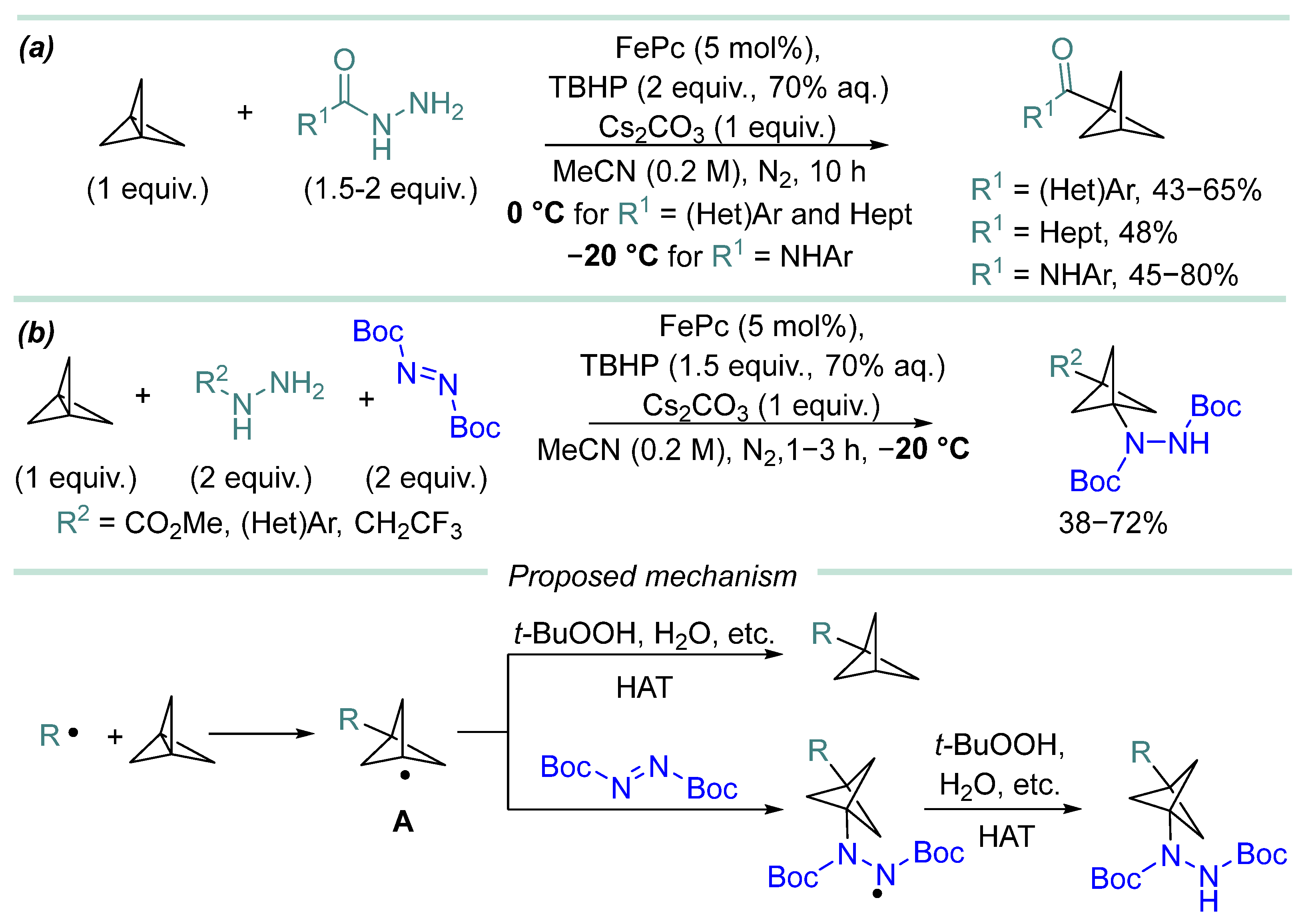
- Ling, M.; Chen, M.; Jiang, Q.; Cheng, D.; Li, J. Synthesis of Bicyclo[1.1.1]Pentane Carboxamides and Ketones from [1.1.1]Propellane. Eur. J. Org. Chem. 2024, 27, e202301297. [Google Scholar] [CrossRef]
- Kanazawa, J.; Maeda, K.; Uchiyama, M. Radical Multicomponent Carboamination of [1.1.1]Propellane. J. Am. Chem. Soc. 2017, 139, 17791–17794. [Google Scholar] [CrossRef]
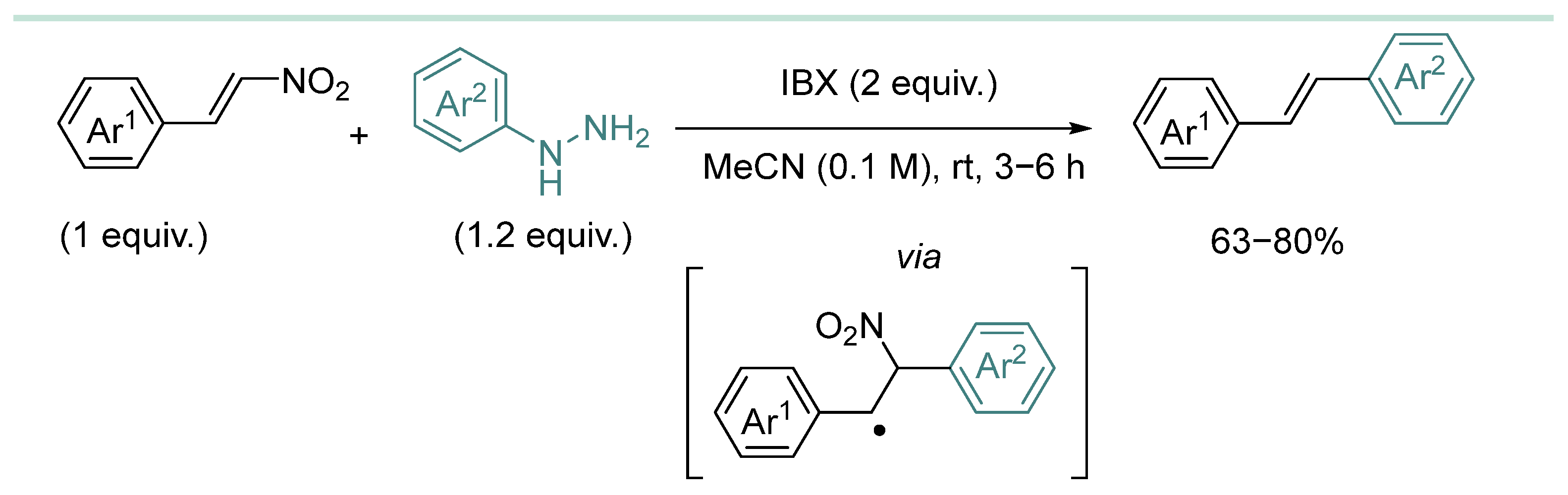
- Wagh, G.; Autade, S.; Patil, P.C.; Akamanchi, K.G. o-Iodoxybenzoic Acid Mediated Generation of Aryl Free Radicals: Synthesis of Stilbenes through C–C Cross-Coupling with β-Nitrostyrenes. New J. Chem. 2018, 42, 3301–3309. [Google Scholar] [CrossRef]
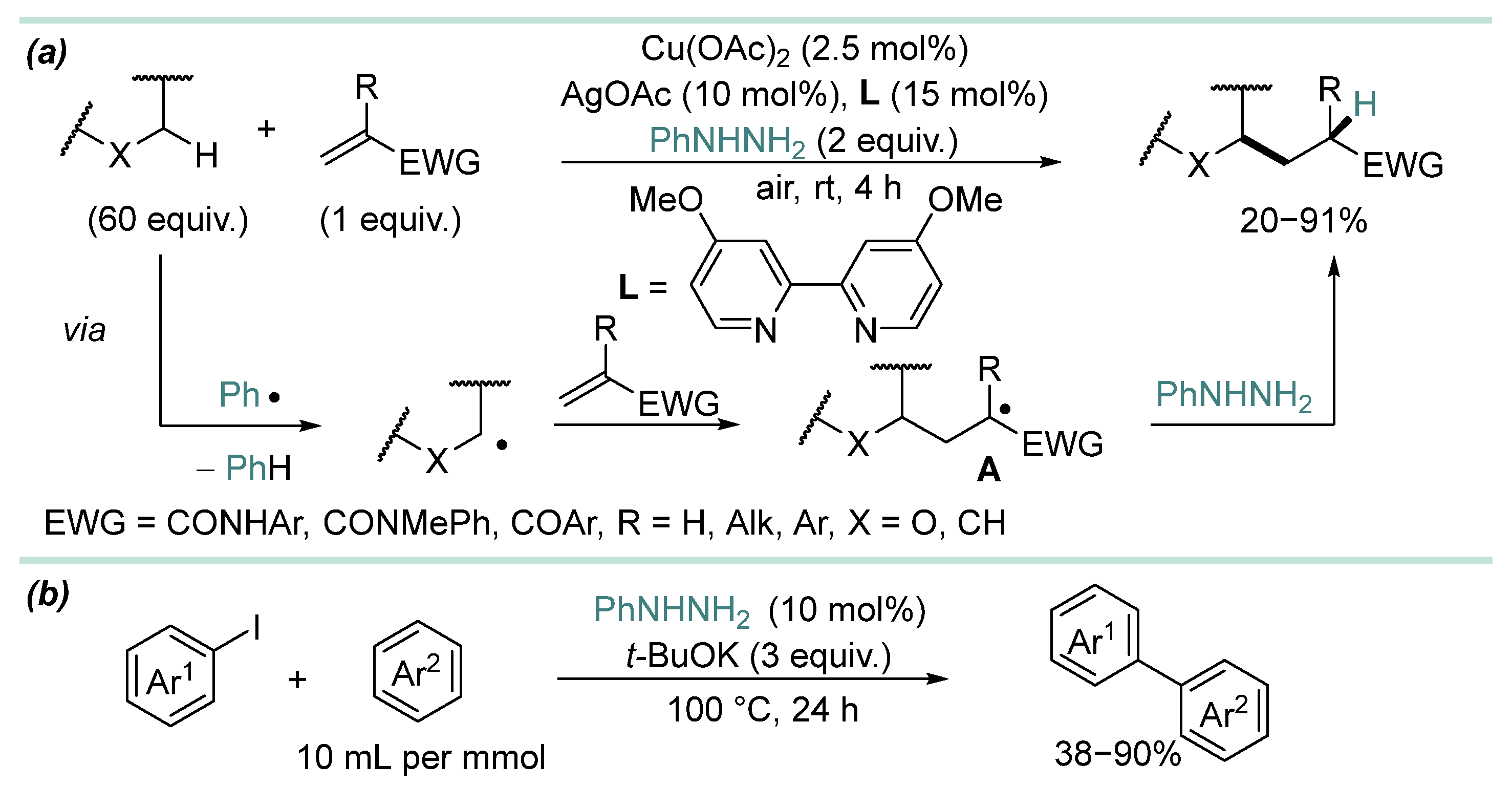
- Tu, J.-L.; Huang, B. Direct C(Sp3)–H Functionalization with Aryl and Alkyl Radicals as Intermolecular Hydrogen Atom Transfer (HAT) Agents. Chem. Commun. 2024, 60, 11450–11465. [Google Scholar] [CrossRef]
- Sarkar, S.; Cheung, K.P.S.; Gevorgyan, V. C–H Functionalization Reactions Enabled by Hydrogen Atom Transfer to Carbon-Centered Radicals. Chem. Sci. 2020, 11, 12974–12993. [Google Scholar] [CrossRef]
- Dewanji, A.; Murarka, S.; Curran, D.P.; Studer, A. Phenyl Hydrazine as Initiator for Direct Arene C–H Arylation via Base Promoted Homolytic Aromatic Substitution. Org. Lett. 2013, 15, 6102–6105. [Google Scholar] [CrossRef]
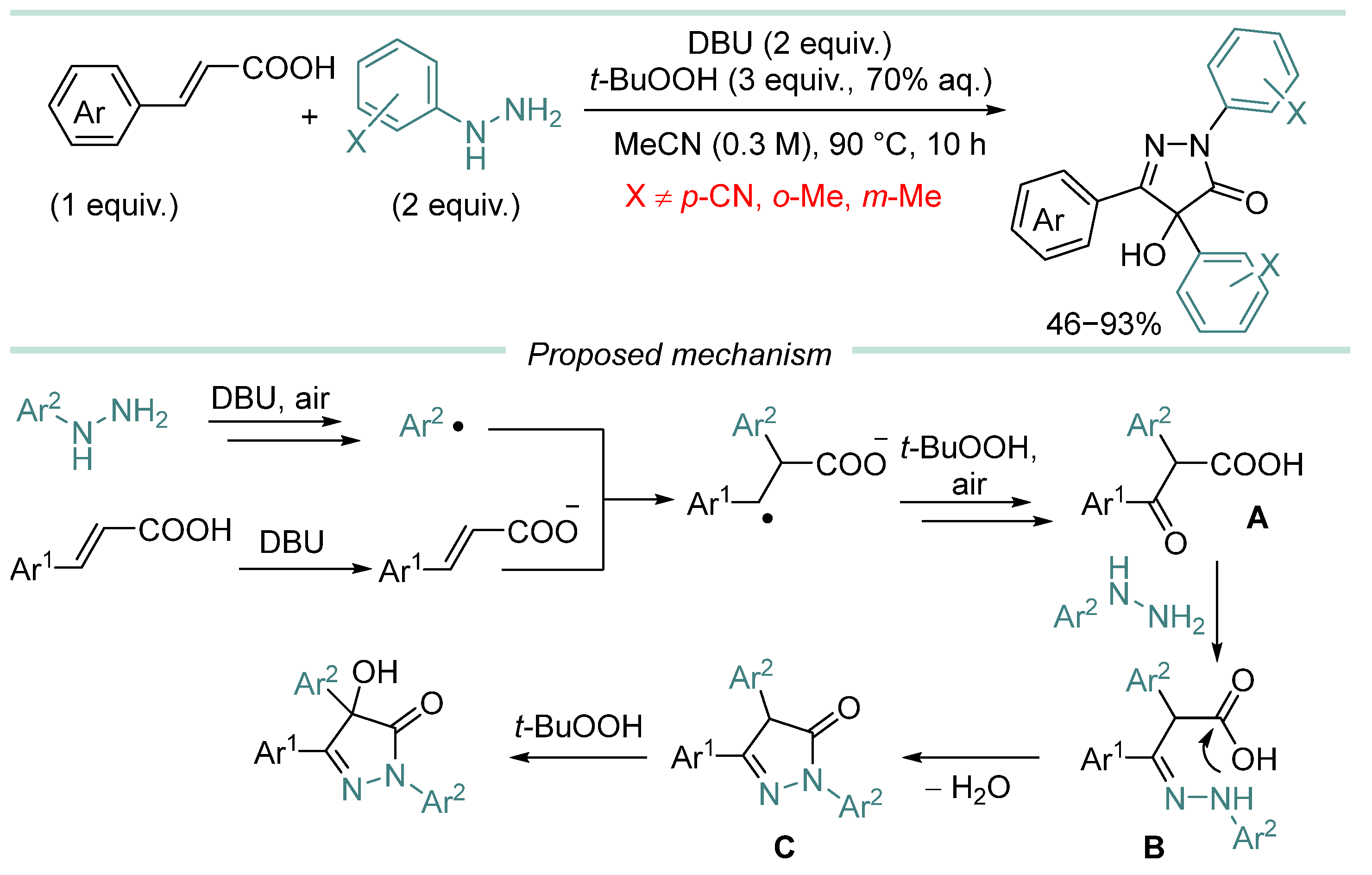
- Chand, S.; Kumar, S.; Murthy, M.; Singh, K.N. Easy and Straightforward Access to Tertiary Pyrazolone Alcohols via Oxidative Cyclization of Cinnamic Acids with Arylhydrazines. J. Org. Chem. 2025, 90, 17412–17421. [Google Scholar] [CrossRef]













 | |||
|---|---|---|---|
| № |  | Conditions | Ref. |
| 1 | COt-Alkyl, COi-alkyl, COBn | HD (2 equiv.), CuCO3 (10 mol%), DTBP (3 equiv.), DCE (0.1 M), 90 °C | [66] |
| 2 | CONHAr, CONH2, CONHAlk, CONHBn, CONHpropargyl. | HD (2 equiv.), CuCO3 (1 mol%), TBHP (4 equiv), DCE/MeCN (1:1, 0.3 M), 70 °C, N2, 4 h. | [67] |
| 3 | CO2Me, CO2Et | HD (4 equiv.), FeCl2·4H2O (20 mol%), TBHP (6 equiv, 70% aq.), MeCN (0.125 M), 80 °C, 6 h | [68] |
| 4 | CO2n-Alk, CO2Ph | HD (4 equiv.), FeCl2·4H2O (10 mol %), 4-cyanopyridine (20 mol%), TBHP (5 equiv.), EtOAc (0.1 M), 80 °C, 4 h, air | [69] |
| 5 | CONHAr, CONHAlk. CONHBn, CO2Me, COPh, Ph | HD (2.5 equiv.), Rose Bengal (5.0 mol%), (NH4)2S2O8 (5 equiv.), DMSO/H2O (5/1, 0.06 M), 5 W blue LED (λmax = 480 nm), N2, rt, 48 h. | [70] |
| 6 | Ar | HD (1.5 equiv.), Co(OAc)2 (10 mol%), NaOPiv (2 equiv.), EtOH (0.03 M), undivided cell, RVC(+)|Pt(−), CCE 8 mA, N2, rt, 12 h | [71] |
| 7 | CO2Alk | HD (2 equiv.), FePc (5 mol%), TBABF4 (1 equiv.), MeCN/DMSO/MeOH (2:1:1, 0.05 M), undivided cell, CF(+)|Pt(−), 2.4 V, 60 °C, N2, 15 h | [72] |
 | |||
|---|---|---|---|
| № |  | Conditions | Ref. |
| 1 | COAr | HD (8.0 equiv.), CuI (20 mol%), TBHP (8.0 equiv., 70% aq.), MeCN (0.1 M), 80 °C, 8 h. | [74] |
| 2 | CO2Me, CO2Bn, t-Bu | HD (5.0 equiv.), FeCl2·4H2O (20 mol%), TBHP (4.0 equiv., 70% aq.), MeNO2 (0.125 M), 80 °C, 6 h. | [75] |
| 3 | CO2Me, CO2Et, CO2t-Bu, CO2Bn | HD (6 equiv.), FeCl2·4H2O (20 mol%), TBHP (5 equiv.), DCE (0.1 M), 80 °C, 8 h. | [76] |
| 4 | CO2Me, CO2Et, t-Bu | HD (5.0 equiv.), rose bengal (5 mol%), (NH4)2S2O8 (3.0 equiv.), DMSO (0.1 M), rt, 10 W blue LED, 15 h | [77] |
 | |||
|---|---|---|---|
| № |  | Conditions | Ref. |
| 1 | CO2Me, CO2Et, CO2n-Pr, CO2Ph, Ph, COMe | HD (4 equiv.), FeCl2·4H2O (0.02 mmol), phen·H2O (40 mol%), TBHP (5 equiv.), EtOAc (2 mL), 80 °C, air, 4 h | [87] |
| 2 | CO2Me, CO2Et | HD (2 equiv.), Fe(acac)2 (5 mol%), TBHP (3 equiv., 70% aq.), PhF (0.1 M), 80 °C, N2, 12 h | [88] |
| 3 | CO2Me, CO2Et, ≠CO2Bn | HD (6 equiv.), Bu4NI (20 mol%), TBHP (5 equiv., 70% aq.), MeCN (0.15 M), 80 °C, 6 h. | [89] |
| 4 | Ar, Me, t-Bu, c-Hex, COPh, CO2Et | HD (3 equiv.), eosin B (5 mol%), K2CO3 (3 equiv.), DMSO (0.2 M), 5 W blue LED, rt, air, 18 h | [90] |
| 5 | Ar, t-Bu, | HD (3 equiv.), 2D-COF-1 (1 mol%), K2CO3 (3 equiv.), DMSO (0.1 M), 5 W Blue LED, rt, air, 20 h | [91] |
 | |||
|---|---|---|---|
| № |  | Conditions | Ref. |
| 1 | CO2Me, CO2Et | HD (2 equiv.), FeCl2·4H2O (20 mol%), (NH4)2S2O8 (3 equiv.), DMSO (0.1 M), 55 °C, 6 h | [108] |
| 2 | CO2Me, CO2Et | HD (4 equiv.), rose bengal (5 mol%), Na2S2O8 (3 equiv.), DMSO (0.08 M), blue LED, rt, 6−12 h. | [109] |
| 3 | CO2Me, CO2Et | HD (3 equiv.), FePc (5 mol%), NaHCO3 (3.0 equiv.), nBu4NHSO4 (1 equiv.) and MECN/HFIP (4.9/0.1, 0.04 M), Ar, CF(+)|Ni(−), CCE 10 mA, 6 h | [110] |
| 4 | Ar | HD (1.3 equiv.), DBU (4 equiv.), MeCN (0.6 M), rt, 4–12 h | [111] |
 | |||
|---|---|---|---|
| № |  | Conditions | Ref. |
| 1 | CO2Me, CO2Et, t-Bu, COAr | HD (1.5 equiv.), K2S2O8 (3 equiv.), MeCN (0.2 M), 90 °C, 8–12 h | [115] |
| 2 | Ar | HD (1.5 equiv.), K2S2O8 (3 equiv.), MeCN (0.1 M), 50 °C, 6–9 h | [116] |
| 3 | CONHAr | HD (2.5 equiv.), CuI (10 mol%), BPO (3 equiv.), DMSO (0.1 M), 100 °C, 18 h. | [117] |
| 4 | CO2Me, CO2Et, t-Bu | HD (4 equiv.), rose bengal (5 mol%), Na2S2O8 (3 equiv.), DMSO (0.08 M), blue LED, rt, 6–12 h. | [109] |
| 5 | (Het)Ar, c-Hex, i-Pr, | HD (2 equiv.), Eosin Y (5 mol%), KI (1.5 equiv.), K2CO3 (3 equiv.), EtOH/H2O (2/1, 0.07 M), 12W blue LED, rt, 10 h | [118] |
| 6 | Ar | HD (2 equiv), g-C3N4 (15 mg per 0.2 mmol), NaI (5 mol%), EtOH (0.07 M), air, rt, 8 W blue LED | [119] |
| 7 | Ar, alkyl | HD (3 equiv.), 2D-COF-1 (4 mg per 0.1 mmol), K2CO3 (3 equiv.), DMSO (0.06 M), 34 W blue LED, 24 h | [120] |
| 8 | Ph | HD (2.5 equiv), PFC-943 (5 mg per 0.1 mmol), EtOH (0.1 M), O2 (1 atm.), 4 h, rt, 10 W white LED | [121] |
| 9 | Ar | HD (1.5 equiv.), DBU (3 equiv.), MeCN (0.2 M), air, rt, 8–12 h | [122] |
| 10 | Ar | HD (1.5 equiv), HCl (4.0 equiv, 37.5% aq.), MeCN (0.1 M), 25 W blue LED, air, rt, 10 h | [123] |
| 11 | Ar | HD (1 equiv.), MeCN (0.1 M), 4 W purple LED (390 nm), Ultrasound (44 kHz/30 W), rt, air, 4 h | [124] |
| 12 | Ar, c-Hex c-Pent, (CH2)2OH | HD (1 equiv.), MeCN (0.1 M), 400 nm LED, rt, 12 h | [125] |
| 13 | Ar, c-Hex | HD (2 equiv), Bu4NBF4 (1 equiv.), MeCN/H2O (9/1, 0.05 M), undivided cell, CCE I = 10 mA, C(+)|Pt(−), rt, 8 h | [103] |
| 14 | Ar, 2-quinolinyl | HD (3 equiv), Quinuclidine (20 mol%), LiClO4 (1 equiv.), NaHCO3 (1 equiv.), MeCN (0.06 M), undivided cell, CCE I = 7 mA, 50 °C, Pt(+)|Ni(−), 7 h, 6.09 F/mol | [126] |
 | |||
|---|---|---|---|
| № |  | Conditions | Ref. |
| 1 | CO2Me, CO2Et | HD (2 equiv.), TBHP (4 equiv.), DCE (0.1 M), N2, rt, 8 h, | [130] |
| 2 | CO2Alk | HD (2 equiv.), Li2CO3 (1 equiv.), nBu4NOAc (0.1 M), MeCN/H2O (5/1, 0.6 M), undivided cell, C(+)|Ni(−), CCE I = 6 mA, rt, 10 h | [131] |
| 3 | Ar | HD (3 equiv.), 4CzIPN (10 mol%), DIPEA (3 equiv.), MeCN, 7 W blue LED, air, rt, 24 h | [132] |
 | |||
|---|---|---|---|
| № | R = | Conditions | Ref. |
| 1 | H | HD (1.2 equiv.), K2CO3 (3 equiv.), DMSO (0.07 M), rt, air, 12 h | [137] |
| 2 | NHR, NR2 | HD (3 equiv.), Et4NOH (2 mol%), nBu4NBF4 (2 equiv.), MeCN (0.02 M), undivided cell, C(+)|C(−), CCE 5 mA, rt, 4 h | [138] |
| 3 | H, Br, Me, Ar, SAr, NR2 | HD (1.2 equiv.), I2 (0.3 equiv.), TFE (0.05 M), 40 °C, air, 16–20 h | [136] |
| 4 | H, Cl, Br, OH, NH2, NHAlk, Ph | HD (1.2 equiv.), IBX (2 equiv.), MeCN (0.05 M), 2.2–5 h | [139] |
| 5 | H | HD (1.2 equiv.), IBX (2 equiv.), MeCN (0.05 M), 3–5 h | [140] |
 | ||
|---|---|---|
| № | Conditions | Ref. |
| 1 | aminoarene (20 equiv.), MnO2 (5 equiv.), MeCN (0.2 M), rt, 2 h, air | [141] |
| 2 | aminoarene (20 equiv.), NaOH (1 M, 1 mL), 60–90 °C, 24 h, air | [142] |
| 3 | aminoarene (10 equiv.), NaOH (6 equiv.), MeCN/H2O (3/2, 0.2 M), 80 °C, 3 h, air | [146] |
| 4 | aminoarene (10 equiv.), CoPc (10 mol%), MeCN (0.1 M), 80 °C, 24 h, air | [145] |
| 5 | aminoarene (20 equiv.), K2CO3 (2 equiv.), DMSO (0.1 M), rt, air, 24 h | [143] |
| 6 | aminopyridine (20 equiv.), K2CO3 (3 equiv.), DMSO (0.1 M), rt, air, 24 h | [144] |
Disclaimer/Publisher’s Note: The statements, opinions and data contained in all publications are solely those of the individual author(s) and contributor(s) and not of MDPI and/or the editor(s). MDPI and/or the editor(s) disclaim responsibility for any injury to people or property resulting from any ideas, methods, instructions or products referred to in the content. |
© 2025 by the authors. Licensee MDPI, Basel, Switzerland. This article is an open access article distributed under the terms and conditions of the Creative Commons Attribution (CC BY) license.
Share and Cite
Lopat’eva, E.R.; Krylov, I.B.; Terent’ev, A.O. Hydrazine Derivatives as C-Centered Radical Precursors for C-C Bond Formation Reactions. Molecules 2026, 31, 67. https://doi.org/10.3390/molecules31010067
Lopat’eva ER, Krylov IB, Terent’ev AO. Hydrazine Derivatives as C-Centered Radical Precursors for C-C Bond Formation Reactions. Molecules. 2026; 31(1):67. https://doi.org/10.3390/molecules31010067
Chicago/Turabian StyleLopat’eva, Elena R., Igor B. Krylov, and Alexander O. Terent’ev. 2026. "Hydrazine Derivatives as C-Centered Radical Precursors for C-C Bond Formation Reactions" Molecules 31, no. 1: 67. https://doi.org/10.3390/molecules31010067
APA StyleLopat’eva, E. R., Krylov, I. B., & Terent’ev, A. O. (2026). Hydrazine Derivatives as C-Centered Radical Precursors for C-C Bond Formation Reactions. Molecules, 31(1), 67. https://doi.org/10.3390/molecules31010067