Article

Construction of S-Scheme BiVO4/Bi2O2S Heterojunction for Highly Effective Photocatalysis of Antibiotic Pollutants

Guangdong Provincial Key Laboratory of Environmental Health and Land Resource, School of Environmental and Chemical Engineering, Zhaoqing University, Zhaoqing 526061, China
*
Authors to whom correspondence should be addressed.
Molecules 2026, 31(1), 136; https://doi.org/10.3390/molecules31010136 (registering DOI)
Submission received: 1 December 2025 / Revised: 28 December 2025 / Accepted: 29 December 2025 / Published: 30 December 2025

Abstract

Photocatalytic processes have emerged as an efficacious strategy for the removal of organic pollutants from wastewater. In the present investigation, a BiVO4 nanorod supported on Bi2O2S nanosheet catalyst (referred to as BiVO4/Bi2O2S) was meticulously synthesized via a straightforward synthetic approach, aimed explicitly at the photodegradation of tetracycline (TC). The optimized BiVO4/Bi2O2S composite, with a theoretical weight ratio of BiVO4 to Bi2O2S at 2:1 (designated as 2BVO/BOS), demonstrated a significant improvement in tetracycline degradation efficiency, achieving up to 82.9% under visible light irradiation for 90 min. This result stands in stark contrast to the relatively low degradation rates of 42.9% and 50.7% observed for pure BiVO4 and Bi2O2S, respectively. Furthermore, the apparent reaction rate of 2BVO/BOS (approximately 0.01894 min−1) was 3.19-fold and 2.66-fold higher than those of BiVO4 (0.00594 min−1) and Bi2O2S (0.00713 min−1), respectively. This significant improvement in photocatalytic efficacy can be ascribed to the composite’s superior capacity for visible light absorption, as well as its remarkable proficiency in charge carrier separation and transfer. Comprehensive experimental analyses, corroborated by extensive characterization techniques, revealed the formation of a distinctive S-scheme charge transfer mechanism at the interface between BiVO4 and Bi2O2S. This mechanism effectively suppresses charge recombination and optimizes the redox potentials of the photogenerated carriers, thereby enhancing the overall photocatalytic performance. The current study underscores the remarkable potential and promising application of BiVO4/Bi2O2S composite in the realm of wastewater treatment.

1. Introduction

The advent of antibiotics has significantly reduced mortality rates over the past few decades, positioning them as some of the most crucial medications for combating bacterial infections. Tetracyclines (TCs), including TC and its derivatives (such as oxytetracycline, tigecycline, and so on), are broad-spectrum antibiotics extensively used to combat Gram-negative and Gram-positive bacteria in both human and animal healthcare [1,2,3,4,5]. Over the past several decades, the overuse and uncontrolled discharge of TCs have not only posed a threat to human health but have also contributed to severe environmental contamination. As such, the development of green, sustainable, and efficient methods for TC removal has become an urgent priority. In response, various advanced treatment technologies, including photocatalysis [6,7,8], electrocatalysis [9], and ozonolysis [10], have been explored for the effective elimination of such organic contaminants from aqueous environments. Among these, photocatalysis stands out as a potent method for mineralization and photodegradation.
Bismuth-based semiconductors, including BiVO4, Bi2WO6, Bi2O2CO3, Bi2O3, BiOCl, and their analogs, have attracted substantial scholarly interest due to their exceptional photocatalytic capabilities, particularly in the context of TC degradation. This impressive performance is attributed to their expansive energy bandgaps (Eg), which range from 1.8 to 3.3 eV [11,12]. Furthermore, these materials demonstrate superior visible light absorption, a feature stemming from the hybridized valence band composed of O 2p and Bi 6s orbitals, which effectively narrows the Eg values [12]. Among them, monoclinic bismuth vanadate (BiVO4), with an Eg of about 2.40 eV, is heralded as one of the most promising photocatalysts, owing to its robust physicochemical stability, tunable morphology, and its environmentally friendly, cost-effective nature [13,14,15,16]. Despite these advantageous properties, BiVO4’s actual photoelectric conversion efficiency—hovering around 10%—remains far from adequate to fulfill the stringent demands of industrial applications [17]. The primary impediments to the widespread application of BiVO4 in photocatalytic processes include insufficient solar energy utilization and the rapid recombination of photogenerated electron–hole (e-h+) pairs, which undermine its overall efficacy [17,18]. To address these challenges, a range of strategies have been proposed to enhance the photocatalytic performance of BiVO4, such as morphological engineering [7], heteroatom doping [19], metal deposition [20], crystal plane optimization [21], and the construction of heterojunctions [11,12,22]. Among these, the formation of semiconductor heterojunctions is the most efficacious approach, as it mitigates the inherent limitations of individual materials, significantly augmenting photocatalytic activity by fostering enhanced charge separation [13,14,22]. Over the past few decades, various BiVO4-based heterostructures have been developed, including BiVO4/BiOI [23], m-BiVO4/t-BiVO4 [24], BiVO4/Bi6O6(OH)3(NO3)3 [25], and BiVO4/Bi2S3 [26], among others.
The recently identified ultrathin two-dimensional (2D) bismuth oxychalcogenides, specifically the Bi2O2X (X = S, Se, Te) family, have emerged as a highly promising class of materials owing to their superior carrier mobility, tunable bandgap structures, and exceptional physicochemical stability [27]. Notably, Bi2O2S, with an energy bandgap ranging from 1.2 to 1.5 eV, exhibits a unique crystal architecture characterized by alternating stacking of [BiO]2n2n+ and Sn2n− layers, with weak interlayer interactions [28,29]. The intercalation of S2− anions between these cationic layers induces synergistic effects, such as band structure modulation, enhanced interlayer charge transport pathways, and improved structural stability [28,29]. The narrow bandgap of Bi2O2S facilitates efficient absorption of both visible and near-infrared light, substantially broadening its spectral responsiveness to solar energy [28,29]. Moreover, Bi2O2S is abundant in raw materials, environmentally benign, simple to synthesize, and non-toxic, making it an ideal candidate for sustainable applications [30]. Consequently, Bi2O2S has been extensively utilized in the construction of heterojunctions with other semiconductors over the past decades, significantly enhancing the photocatalytic performance of these composite structures. Examples include Ni2P/Bi2O2S [31], Bi2O2S/Bi12TiO20 [32], Bi2O2S/Bi5O7I/ZA [6], and Bi2O2S/In2O3 [33].
In this study, Bi2O2S nanosheets were synthesized through a straightforward solution-based method, and visible light-driven BiVO4/Bi2O2S composites were fabricated via a hydrothermal strategy. Compared to the pristine BiVO4 and individual Bi2O2S, the BiVO4/Bi2O2S heterostructures exhibited significantly enhanced visible light absorption, reduced charge recombination rates, and superior charge transport capabilities for photoexcited carriers. TC was selected as the typical target pollutant to evaluate the photocatalytic degradation performance of the composites. The BiVO4/Bi2O2S composites demonstrated remarkable efficiency in degrading organic contaminants within 90 min. Furthermore, the underlying degradation mechanism was investigated in detail, with free radical trapping experiments and electron spin resonance (ESR) analysis employed to probe the possible pathways. This research offers valuable insights into the development of highly efficient, cost-effective, and non-precious metal-based photocatalysts for environmental applications.

2. Results and Discussion

2.1. Characterization of the Photocatalysts

Figure 1 presents XRD patterns and FT-IR spectra of BiVO4, Bi2O2S, and their corresponding BiVO4/Bi2O2S composite heterostructures (i.e., 2BVO/BOS and BVO/BOS). In Figure 1a, distinct diffraction peaks are observed at 2θ values of 18.67°, 18.99°, 28.83°, 28.95°, 30.55°, and 53.31°, which can be attributed to the (110), (011), (−121), (121), (040), and (161) crystal planes of the monoclinic BiVO4 phase (JCPDS No. 14-0688), respectively [12,34]. In contrast, the XRD pattern of the pristine Bi2O2S sample reveals peaks at 14.88°, 24.23°, 27.42°, 29.96°, 32.29°, 32.78°, 45.04°, and 55.26°, which are indexed to the (020), (110), (120), (040), (130), (101), (141), and (221) planes of the orthorhombic Bi2O2S phase (JCPDS No. 34-1493) [30,35,36]. The XRD spectra of the composite materials clearly exhibit characteristic peaks corresponding to both BiVO4 and Bi2O2S, confirming the successful incorporation of both phases within the composite structure. Additionally, as the BiVO4 content in the composites decreases, the intensity of the characteristic peaks of Bi2O2S increases, further substantiating the successful synthesis of the BiVO4/Bi2O2S heterostructures. To elucidate the functional groups inherent in the synthesized catalysts, FT-IR spectroscopy was employed. As depicted in Figure 1b, the spectra of all synthesized composites exhibit absorption bands spanning the wavenumber range of 400–4000 cm−1. The pristine BiVO4 sample reveals a subtle Bi–O absorption band at 478 cm−1, indicative of the bismuth oxide phase [37]. Furthermore, a prominent and expansive absorption peak near 830 cm−1 is observed, which corresponds to the bending vibration of the VO43− tetrahedral units, thereby confirming the presence of BiVO4 [38]. Additionally, a broad FT-IR band between 3200–3400 cm−1 is detected, attributed to the O–H stretching vibration of adsorbed water molecules on the surface of the sample [38]. In the case of pure Bi2O2S, distinct peaks at approximately 770 and 850 cm−1 are observed, which are characteristic of Bi–S bond vibrations [39,40]. The FT-IR spectra of the composite materials unequivocally demonstrate the retention of all functional groups present in the individual BiVO4 and Bi2O2S phases within the synthesized composites. Significantly, an increase in the intensity of the 770 cm−1 peak with rising Bi2O2S content further corroborates the successful incorporation of BiVO4 and Bi2O2S into the composite structure, confirming the formation of a well-integrated heterostructure.
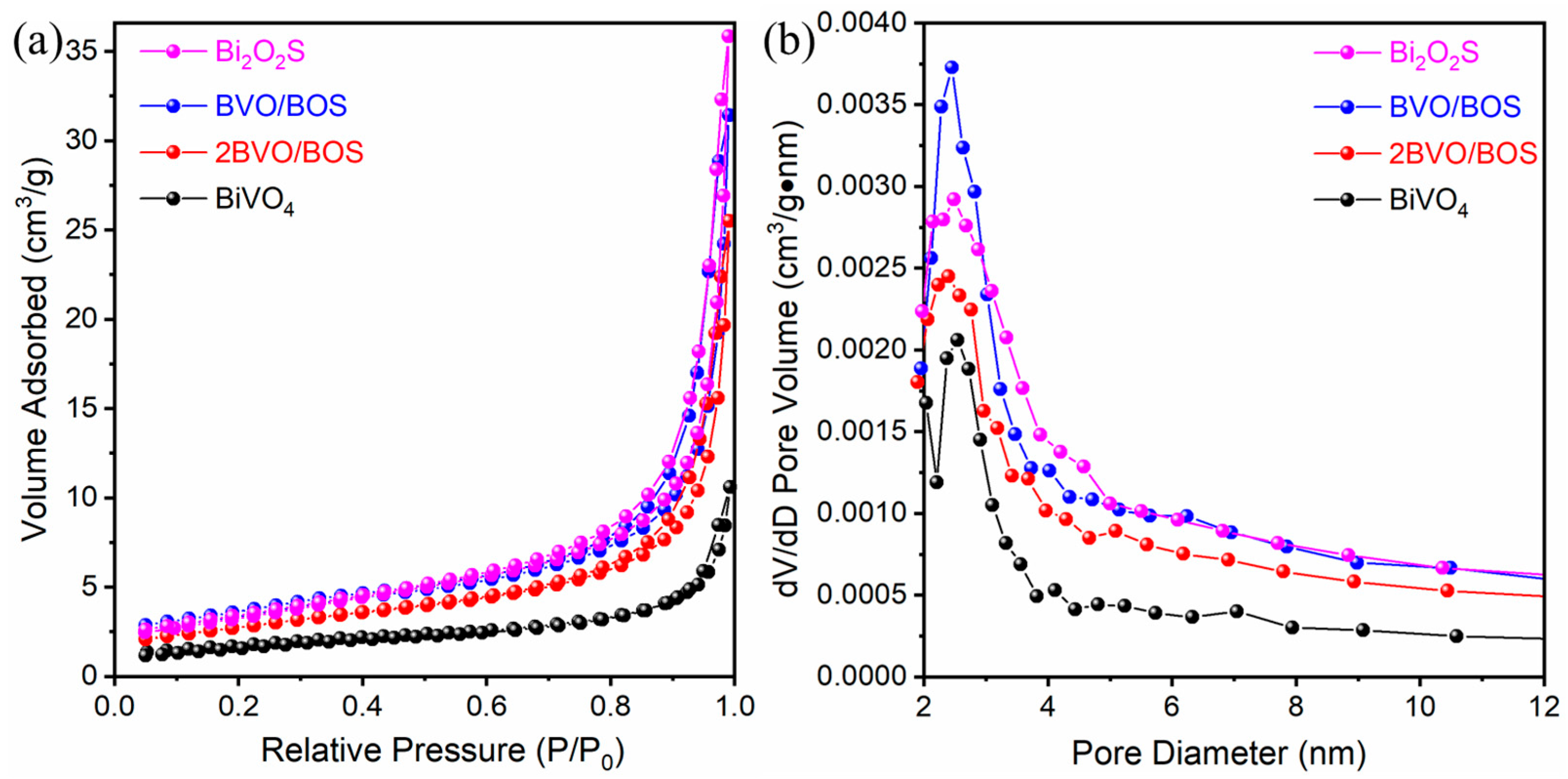
To assess the BET-specific surface areas and pore distributions of the catalysts, nitrogen adsorption–desorption isotherms for BiVO4, Bi2O2S, and their BiVO4/Bi2O2S composite counterparts were conducted, with the results presented in Figure 2. The N2 adsorption–desorption isotherms, as depicted in Figure 2a, exhibit a characteristic type IV curve with an H3-type hysteresis loop, indicative of a mesoporous structure [37]. The BET surface areas for BiVO4, 2BVO/BOS, BVO/BOS, and Bi2O2S are 6.1, 9.9, 12.1, and 11.9 m2/g, respectively. Compared to BiVO4, the elevated surface areas of 2BVO/BOS and BVO/BOS can be attributed to the incorporation of Bi2O2S nanosheets, which significantly enhance the material’s surface properties. As illustrated in Figure 2b, the pore size distribution curves derived from the BJH method, utilizing the adsorption branch of the isotherms, reveal pore sizes predominantly in the range of 2–10 nm for all samples. The incorporation of Bi2O2S (with a pore volume of 0.0554 cm3/g) resulted in a notable increase in pore volume, with values escalating from 0.0164 cm3/g for BiVO4 to 0.0395 cm3/g for 2BVO/BOS and 0.0486 cm3/g for BVO/BOS, respectively. The enhanced BET surface area and pore volume of the composites are expected to facilitate photocatalytic reactions by providing an increased number of adsorption and reaction sites, thereby improving overall catalytic efficiency.
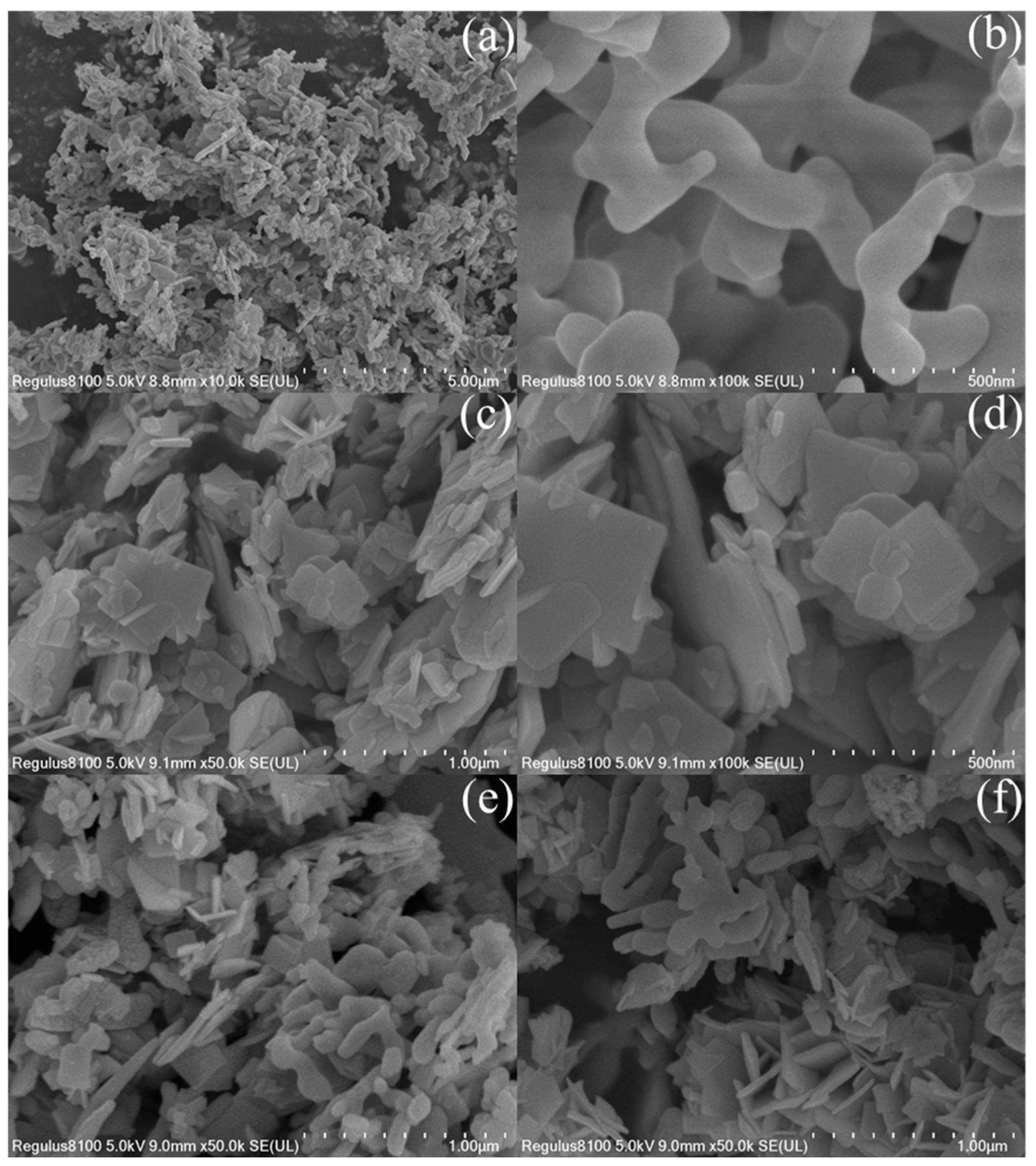
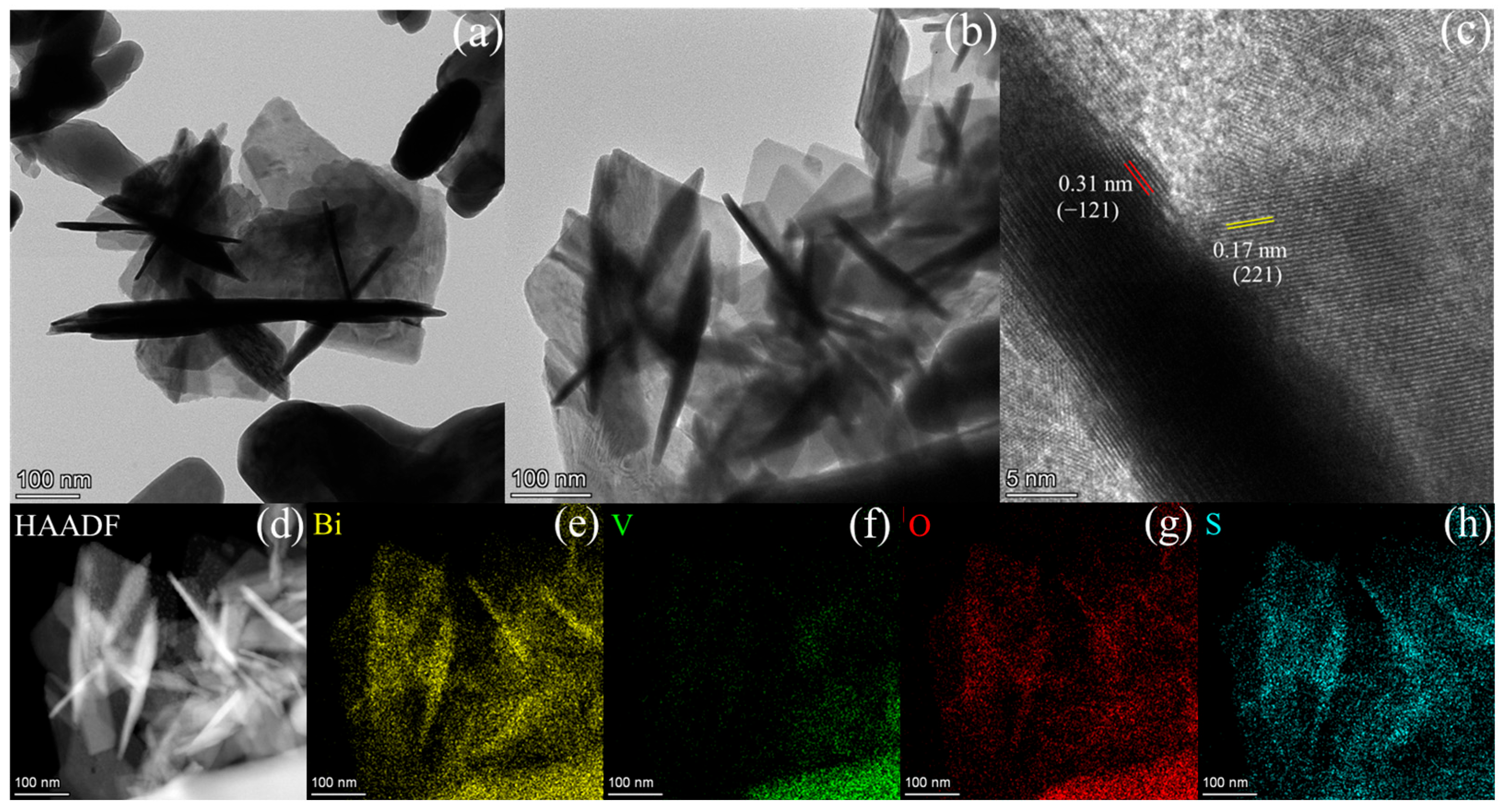
To thoroughly investigate the microstructural attributes of the synthesized catalysts, the individual BiVO4, Bi2O2S, and 2BVO/BOS composites were subjected to an array of advanced characterizations using SEM, TEM, and high-resolution TEM (HRTEM), with the corresponding results presented in Figure 3 and Figure 4. As illustrated in Figure 3a,b, the BiVO4 sample exhibits a worm-like, nanostructured morphology comprising irregular nanorods. Figure 3c,d reveal that Bi2O2S adopts a highly uniform nanosheet morphology, with an average lateral size of approximately 200 nm. In the case of the 2BVO/BOS composite (Figure 3e,f), both the irregular nanorods and nanosheets are clearly discernible, further corroborating the presence of both BiVO4 and Bi2O2S phases within the composite. To gain deeper structural insights, TEM and HRTEM analyses were conducted, as shown in Figure 4. Figure 4a,b distinctly reveal the highly homogeneous dispersion of rod-like BiVO4 structures, which are meticulously aligned on the surface of Bi2O2S nanosheets within the 2BVO/BOS composite. The HRTEM image presented in Figure 4c exhibits clear lattice fringes at 0.17 nm, attributed to the (221) plane of Bi2O2S, and at 0.31 nm, corresponding to the (−121) plane of BiVO4, thereby offering definitive proof of the successful formation of the BiVO4/Bi2O2S heterostructure [36,41,42]. Moreover, the high-resolution image in Figure 4c further demonstrates the intimate interface between BiVO4 and Bi2O2S, suggesting a robust interfacial contact that is conducive to enhanced carrier transfer processes. Additionally, the elemental composition and spatial distribution of the constituent elements within the composite were meticulously analyzed through energy dispersive X-ray spectroscopy (EDS) elemental mapping, providing further insight into the uniform distribution and structural integrity of the 2BVO/BOS composite. Figure 4d–h showcase the distribution maps for Bi, V, O, and S, each distinctly color-coded, which confirm the homogeneous dispersion of these elements throughout the 2BVO/BOS composite. Taken together, these findings provide compelling and robust evidence for the successful synthesis, structural coherence, and uniformity of the 2BVO/BOS photocatalyst.
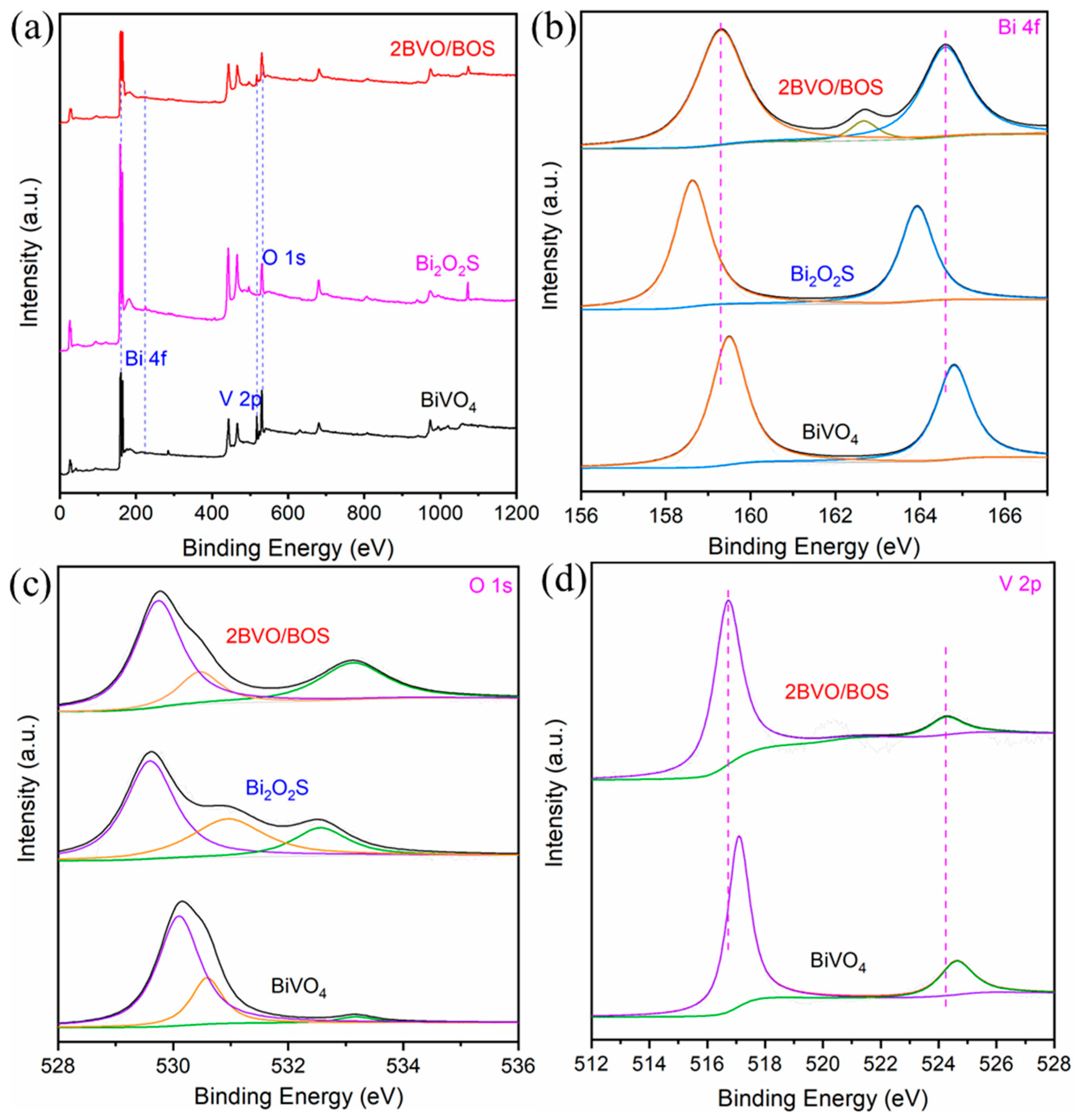
To investigate the surface chemical composition and electronic states, XPS analysis was employed to examine both BiVO4, Bi2O2S, and 2BVO/BOS samples. As illustrated in Figure 5a, the survey spectrum indicates that the composite material contains all the elements from the two individual components. The Bi 4f peak illustrated in Figure 5b is characterized by a distinct splitting into the Bi 4f5/2 and Bi 4f7/2 orbitals, with the respective energy positions at 164.8 eV and 159.5 eV for monomeric BiVO4, and 163.9 eV and 158.6 eV for Bi2O2S. The observed spin-orbit splitting energy difference of 5.3 eV signifies the presence of bismuth in the +3 valence state within both BiVO4 and Bi2O2S [29]. In the case of the 2BVO/BOS composite, the Bi 4f5/2 and Bi 4f7/2 orbitals are found at 164.6 eV and 159.3 eV, respectively, indicating positions that lie between those of BiVO4 and Bi2O2S. This intermediate positioning suggests the occurrence of charge transfer between the two materials, highlighting their interaction within the composite structure [13]. In the 2BVO/BOS composite, these binding energies exhibit a minor shift (approximately 0.2 eV) to values of 164.6 eV and 159.3 eV, suggesting a charging effect attributed to the conductive properties of Bi2O2S [32,43]. The small bump located at 162.7 eV corresponds to the characteristic peak of S [29]. The O 1s XPS spectra (Figure 5c) reveal three distinct peaks located at approximately 530.1 eV, 530.6 eV, and 533.2 eV. The first peak is attributed to the oxygen species present in metal-oxygen bonds, while the latter two peaks correspond to various hydroxyl (OH) groups on the surface; specifically, they represent the dissociative adsorption of water and the irreversibly adsorbed molecular water [44,45,46]. Notably, the binding energy of the O 1s peak is slightly shifted in the 2BVO/BOS composite, further indicating the formation of binding interactions between BiVO4 and Bi2O2S. The significantly weaker intensity of the O 1s peak in the 2BVO/BOS system, relative to pure BiVO4, further corroborates the loss of oxygen through the cleavage of Bi–O bonds during the synthesis process [29]. Furthermore, as shown in Figure 5d, the V 2p spectrum of pure BiVO4 reveals two characteristic peaks at binding energies of 517.1 eV and 524.6 eV, corresponding to V 2p3/2 and V 2p1/2, respectively, with a peak separation of 7.5 eV, confirming the presence of vanadium in the +5 oxidation state (V5+) [13]. In the 2BVO/BOS composite, these V 2p peaks shift to lower binding energies relative to the pure BiVO4, a phenomenon attributed to the strong interaction between BiVO4 and Bi2O2S [13,47].
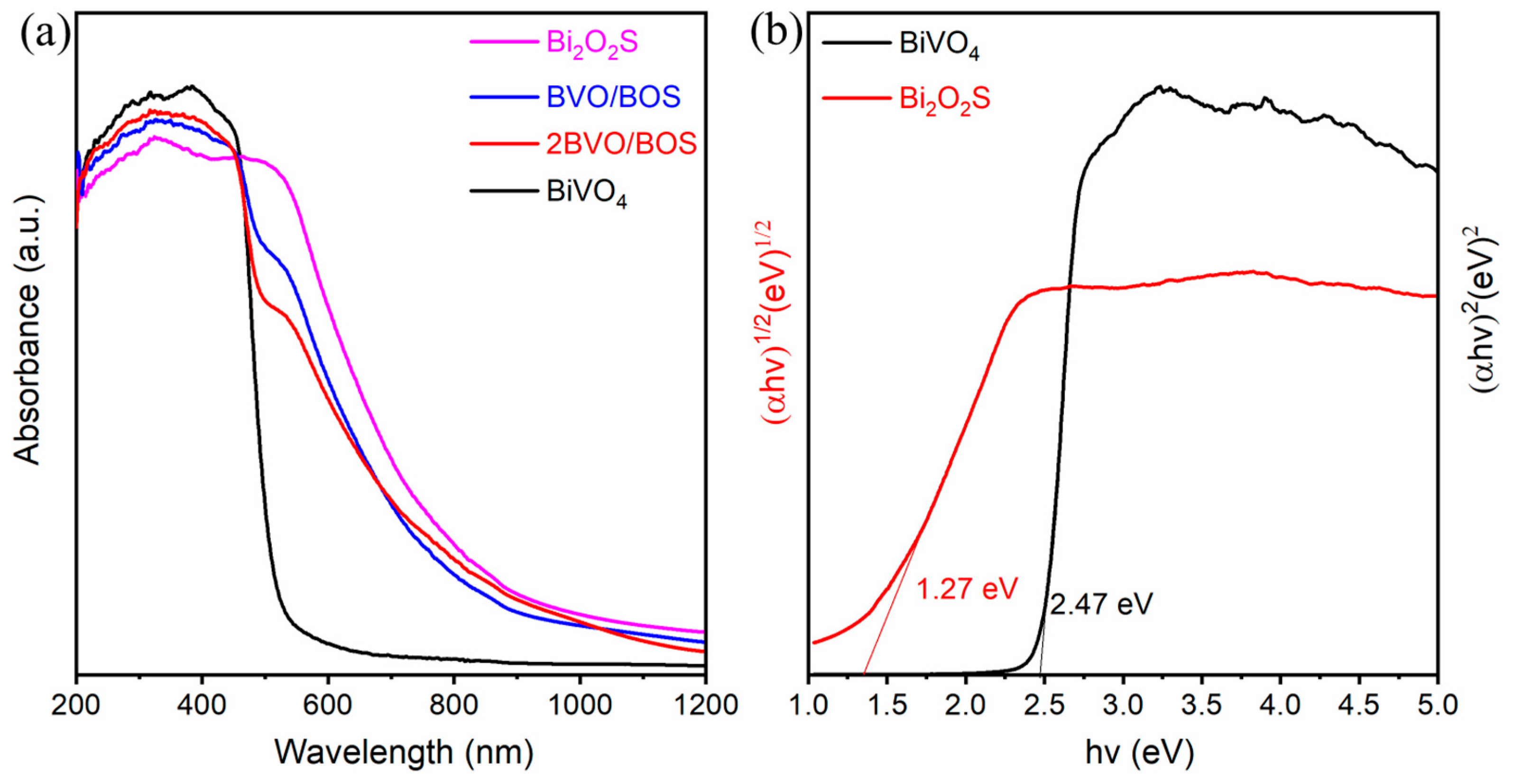
The light absorption properties of the as-prepared samples are investigated using the UV-Vis DRS method. As shown in Figure 6a, the UV-Vis diffuse reflectance spectra of BiVO4, Bi2O2S, and BiVO4/Bi2O2S composites are obtained. As can be seen, the characteristic absorption edge of pure BiVO4 is observed at about 500 nm, while Bi2O2S exhibits a prominent absorption capability across the entire wavelength range because of its narrow bandgap, showing its remarkable light-trapping structure and photosensitivity. Compared with pure BiVO4, the 2BVO/BOS sample exhibited a red-shift spectral response in the visible light region due to a photosensitizing effect of the incorporated Bi2O2S, with further increasing the Bi2O2S nanosheet, BVO/BOS shows a stronger ability for adsorbing visible light. The enhanced visible light adsorption ability of the composites means that more electron–hole pairs can be produced under the same visible light irradiation with the assistance of Bi2O2S. The bandgap of a semiconductor can be calculated by the following formula: αhν = A(hν − Eg)n, where α is the absorption coefficient, h is Planck’s constant, ν is the light frequency, A is a constant, Eg is the bandgap energy of the semiconductor, and n depends on the type of transition. The parameter n is determined by the semiconductor’s electronic transition characteristics, with n = 1/2 for direct transitions and n = 2 for indirect transitions [32,48]. Since BiVO4 and Bi2O2S are indirect and direct semiconductors, the Eg values of BiVO4 and Bi2O2S can be calculated to be 2.47 eV and 1.27 eV, respectively, by using the Tauc plot analysis method, as depicted in Figure 6b.
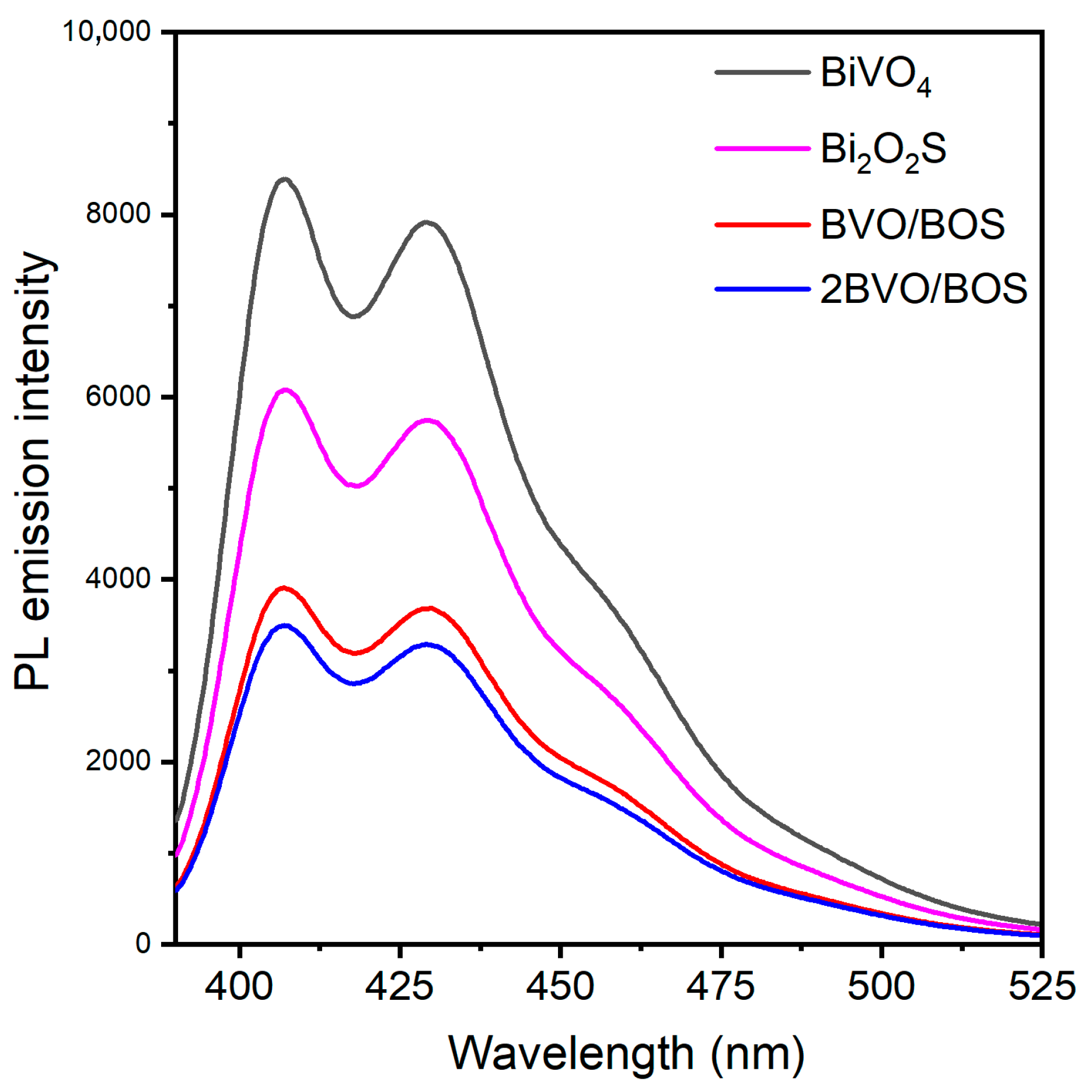
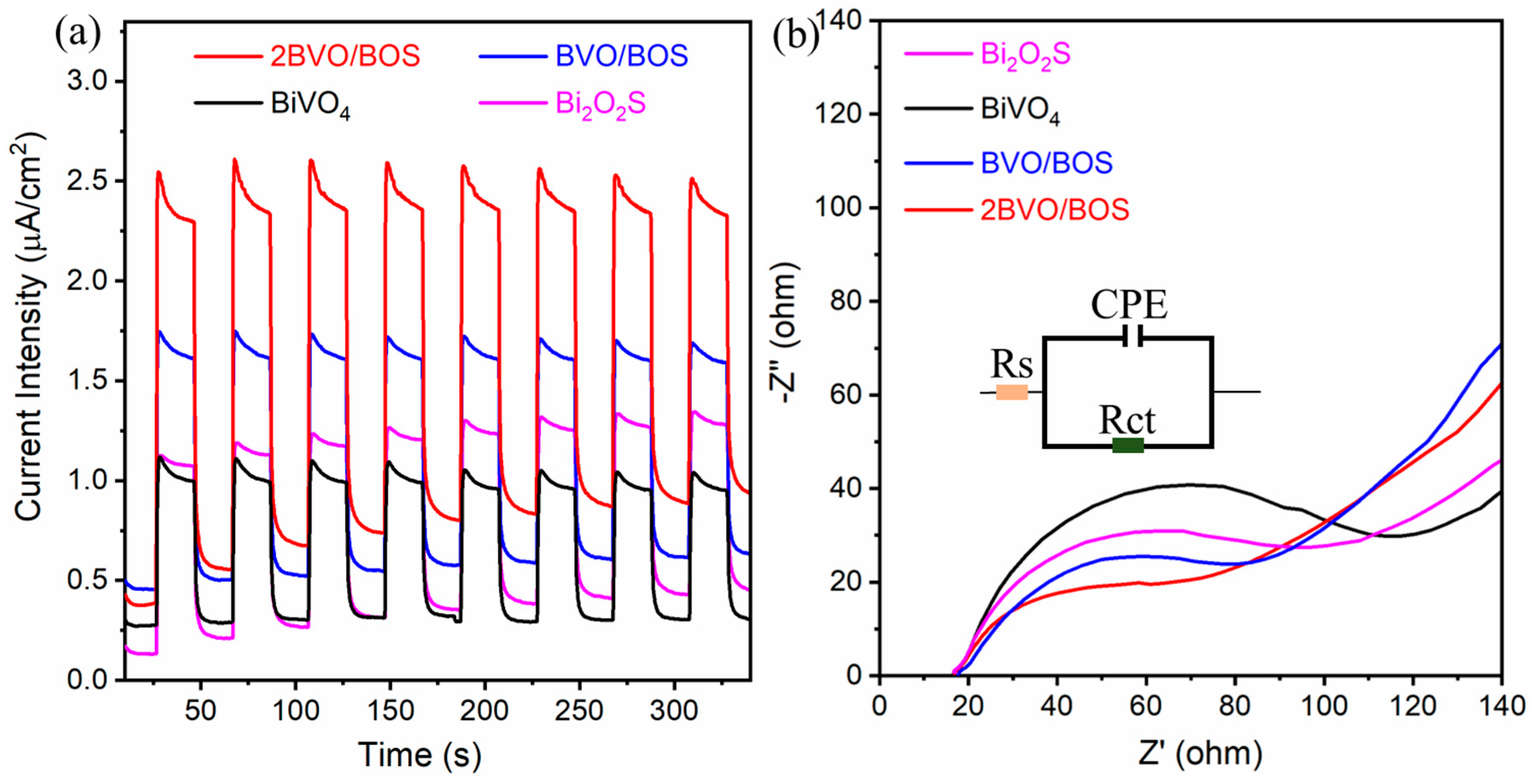
PL spectroscopy stands as an indispensable technique for probing the recombination dynamics of photoinduced electron–hole pairs, a pivotal determinant in the modulation of photocatalytic efficacy. The analysis was executed at an excitation wavelength of 380 nm. The resultant PL spectra of BiVO4, Bi2O2S, BVO/BOS, and 2BVO/BOS are illustrated in Figure 7. Upon the integration of BiVO4 with Bi2O2S, a pronounced diminution in PL intensity was detected, with 2BVO/BOS manifesting the most attenuated emission. The intensity hierarchy of the PL spectra for the synthesized samples follows the sequence: BiVO4 > Bi2O2S > BVO/BOS > 2BVO/BOS, signifying that the 2BVO/BOS composite excels in facilitating the most efficient segregation of photo-excited electron–hole pairs, thus underpinning its enhanced photocatalytic performance [8,32]. These PL observations corroborate the photocatalytic degradation activity for TC, as corroborated by subsequent photocatalytic assays. To further elucidate the separation and transport characteristics of the photogenerated charge carriers, transient photocurrent response (i-t) measurements and electrochemical impedance spectroscopy (EIS) analyses were conducted on the as-prepared BiVO4, Bi2O2S, BVO/BOS, and 2BVO/BOS samples, as shown in Figure 8. The i-t plots depicted in Figure 8a demonstrate that the photocurrent densities of BVO/BOS and 2BVO/BOS surpass those of BiVO4 and Bi2O2S under visible light irradiation. Notably, 2BVO/BOS exhibits the highest current intensity, indicating that the incorporation of Bi2O2S substantially enhances the migration and separation of photogenerated electron-hole pairs, thereby inducing a more pronounced photocurrent response. EIS is employed to evaluate the electrochemical resistance of the electrode material and the interfacial interactions between the electrode and the electrolyte. The impedance spectra typically exhibit three distinct components across the frequency spectrum: ohmic resistance (Rs), charge transfer resistance (Rct), and a constant phase element (CPE) that accounts for non-ideal capacitive behavior [6,49,50]. Figure 8b showcases the EIS data for the four samples. In the low-frequency region, the diffusion impedance manifests as a well-defined semicircular arc, indicative of the diffusion of species through the electrode films and the presence of direct current flow within the films. It is well-established that a lower Rct value correlates with more rapid charge transfer across the electrolyte/electrode interface [51]. Consequently, a reduced Nyquist semicircle radius in the EIS spectra signals a lower interfacial charge transfer resistance, suggesting superior charge transfer capabilities. The smallest arc radius observed for the 2BVO/BOS composite correlates with the lowest resistance to carrier diffusion, which aligns seamlessly with the trend observed in photocurrent density.

2.2. Photocatalytic Degradation of TC

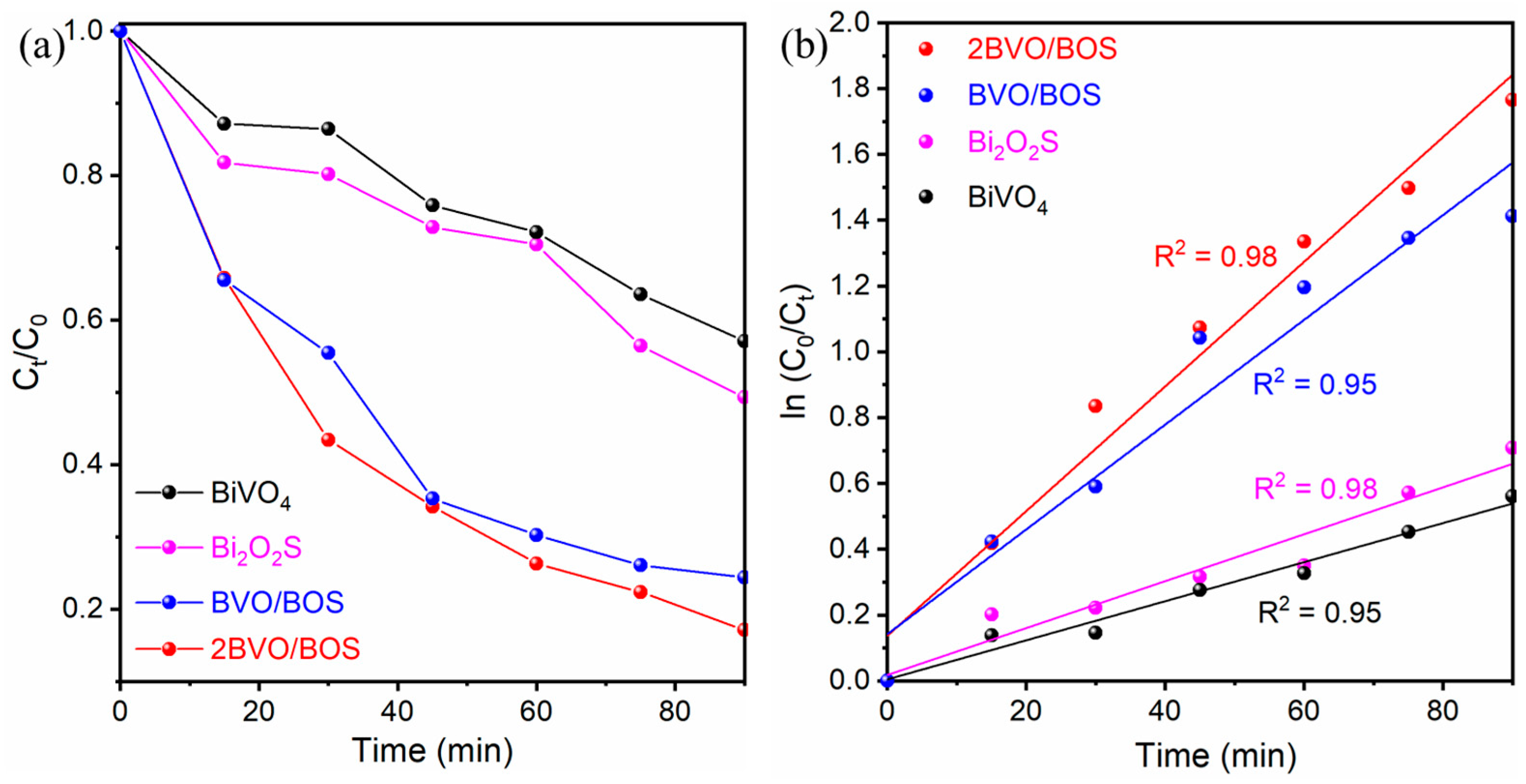
TC is employed as a benchmark probe to assess the photocatalytic performance of the four as-prepared catalysts under visible light exposure. Prior to illumination, a 90 min dark adsorption step is performed to achieve adsorption–desorption equilibrium within the reaction system. The photocatalytic degradation of TC under visible light for the synthesized samples is presented in Figure 9, with the self-degradation of pure TC being negligible and insignificant. As illustrated in Figure 9a, the bare BiVO4 and Bi2O2S catalysts demonstrated relatively modest degradation rates of 42.9% and 50.7%, respectively, after 90 min of visible light irradiation. This can be attributed to the rapid recombination of photoexcited charge carriers. In stark contrast, the 2BVO/BOS heterostructure exhibited notably superior photocatalytic efficiency, achieving degradation rates of approximately 82.9%, surpassing the individual BiVO4 and Bi2O2S catalysts. The enhanced photocatalytic efficacy of the BiVO4/Bi2O2S composite is ascribed to its superior charge carrier separation and its augmented light absorption in the visible spectrum. To gain further insights into the degradation kinetics of TC, the photocatalytic performance of the materials was analyzed through a first-order kinetic model. As shown in Figure 9b, the rate constants for BiVO4, Bi2O2S, BVO/BOS, and 2BVO/BOS heterostructures were determined from the linear plot of ln(C0/Ct) versus reaction time. The linearity of this plot unequivocally confirms that TC degradation follows a pseudo-first-order kinetic model [51]. The degradation process for all samples adheres to the pseudo-first-order kinetic equation: ln(C0/Ct) = kt, where k represents the rate constant, t denotes the irradiation time (in minutes), and C0 and Ct are the initial and subsequent concentrations of TC, respectively [50,51]. From this model, the apparent rate constants for the photocatalysts were extracted. As depicted in Figure 9b, the 2BVO/BOS composite exhibits the highest apparent rate constant of 0.01894 min−1, significantly surpassing the rate constants of BiVO4 (0.00594 min−1), Bi2O2S (0.00713 min−1), and BVO/BOS (0.01592 min−1). Remarkably, the 2BVO/BOS composite exhibits an apparent rate constant that is approximately 3.19, 2.66, and 1.19 times greater than those of BiVO4, Bi2O2S, and BVO/BOS, respectively. This substantial enhancement in photocatalytic activity provides compelling evidence of the synergistic effects arising from the integration of BiVO4 and Bi2O2S within the heterostructure, underscoring the exceptional charge transfer dynamics and enhanced photocatalytic efficiency of the BiVO4/Bi2O2S composite.
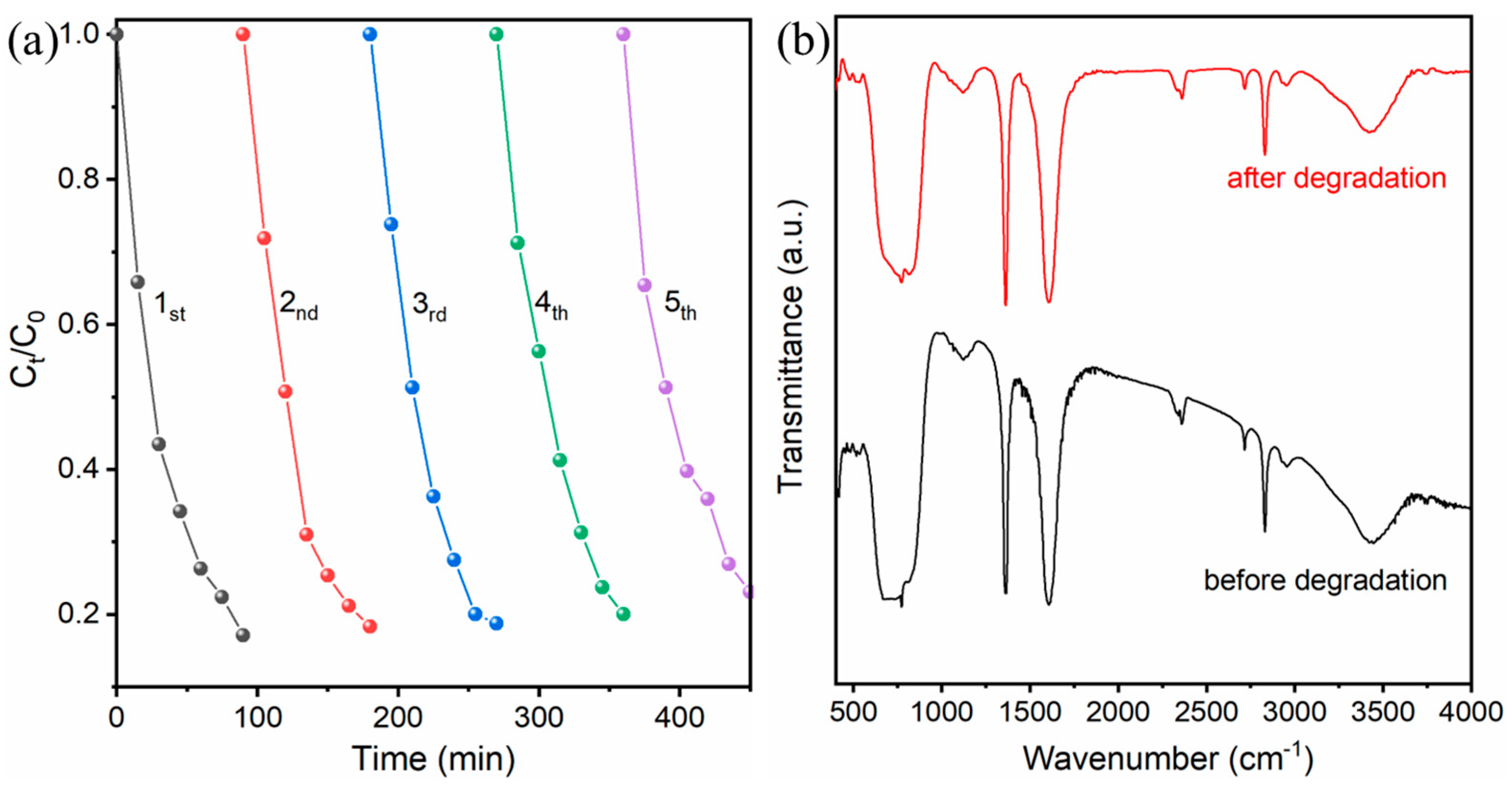
Stability constitutes a pivotal criterion in defining the practicality and applicability of an efficient photocatalyst, particularly within the demanding context of wastewater purification [50,52]. Therefore, a rigorous evaluation of the recyclability and long-term structural robustness of the 2BVO/BOS heterostructure is indispensable. To systematically assess its durability, five successive photocatalytic degradation cycles of TC under visible light irradiation were conducted, with the corresponding results depicted in Figure 10a. Remarkably, relative to the initial cycle, the photocatalyst exhibited only a marginal decline—approximately 5%—in degradation efficiency by the fifth run. This minimal attenuation in performance is plausibly attributed to slight material attrition or partial detachment of active sites induced by repeated irradiation and recovery processes. Additionally, FT-IR spectroscopy was employed to analyze the surface chemical composition of the samples (Figure 10b). The results revealed that the photocatalyst retains a consistent chemical composition throughout the photocatalytic cycles, showing no evidence of impurity surface groups before or after the photocatalytic reaction. Collectively, these findings conclusively demonstrate that the 2BVO/BOS heterostructure possesses exceptional physicochemical stability and commendable recyclability, retaining robust photocatalytic performance over multiple operational cycles. Such steadfast durability underscores its formidable potential for sustainable, long-term deployment in environmental remediation systems, affirming its reliability and resilience under prolonged functional conditions.
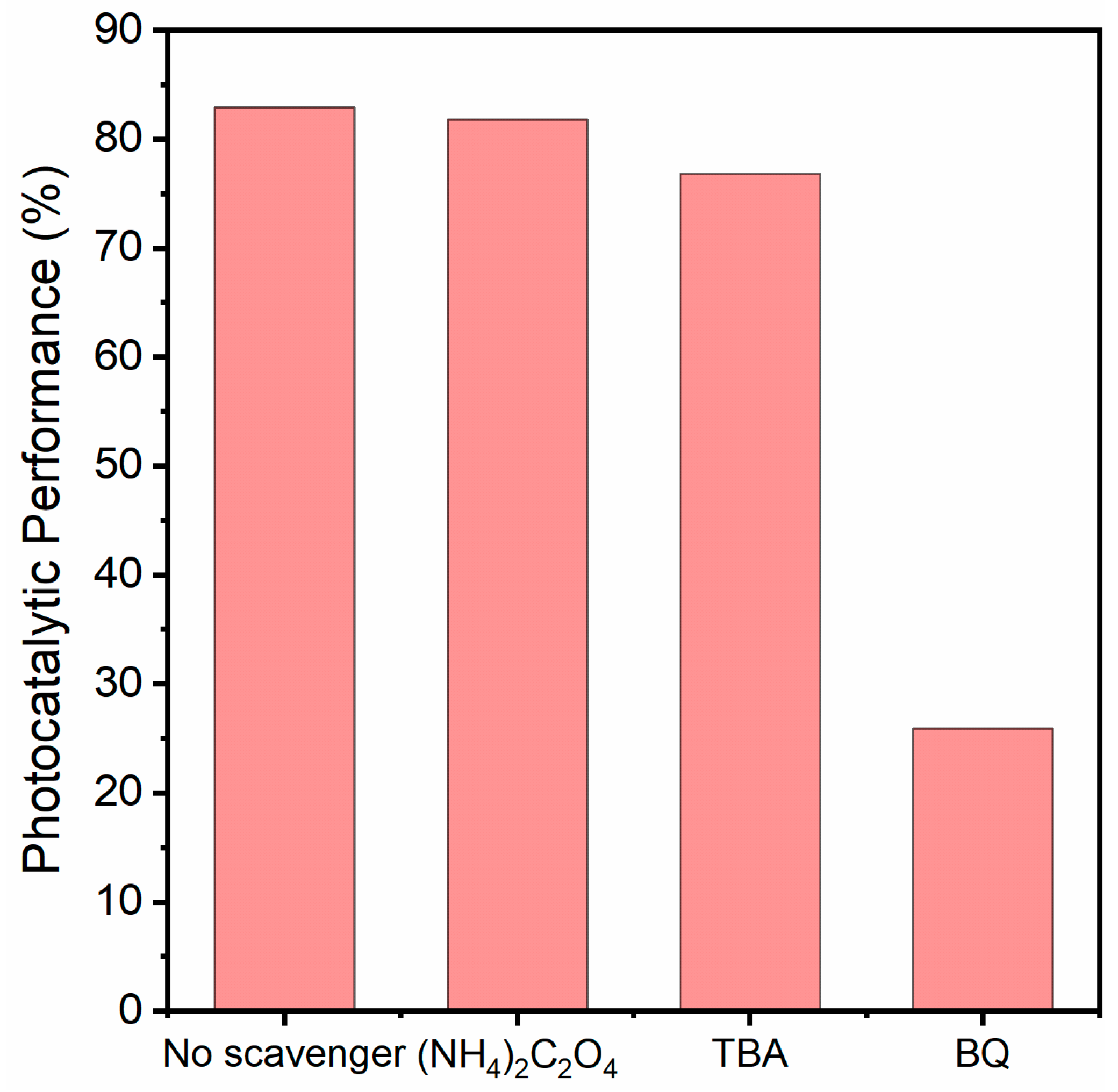
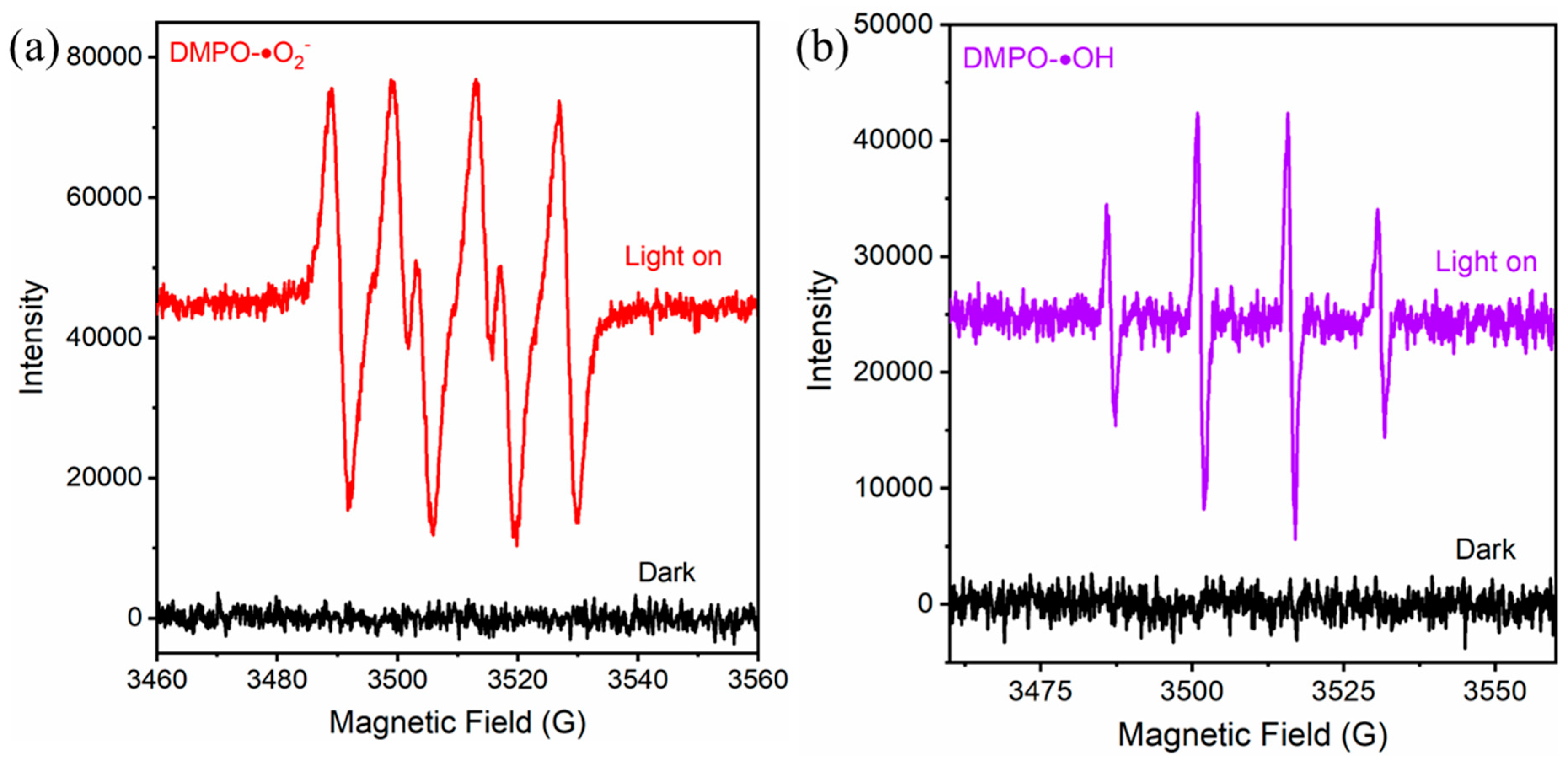
To gain deeper insight into the primary reactive species responsible for the photodegradation of TC by the 2BVO/BOS nanocomposite, an exhaustive series of active species scavenging experiments was meticulously carried out. Ammonium oxalate ((NH4)2C2O4), benzoquinone (BQ), and tert-butyl alcohol (TBA) were strategically employed as scavengers to selectively capture h+, •O2, and •OH species, respectively [27,53]. As illustrated in Figure 11, the degradation efficiency of TC was observed to be 82.9% in the absence of any scavenger, establishing the baseline photocatalytic activity. Notably, the introduction of (NH4)2C2O4 exerted no discernible effect on the TC degradation efficiency, thereby indicating that h+ does not play a predominant role in the degradation process. In contrast, the addition of BQ and TBA led to a noticeable decline in degradation efficiency, thereby providing compelling evidence of the involvement of both •O2 and •OH in the photocatalytic process. Specifically, BQ and TBA reduced the photocatalytic performance to 25.9% and 76.8%, respectively, signifying that •O2 contributes substantially to the degradation of TC, while •OH plays a secondary, yet significant, role. To further corroborate the participation of •O2 and •OH, ESR spectroscopy was employed. As shown in Figure 12a,b, no signals were detected under dark conditions, confirming the absence of reactive species in the absence of visible light illumination. However, upon visible light irradiation of the 2BVO/BOS nanocomposite, distinct ESR signals with characteristic intensity ratios of 1:1:1:1 and 1:2:2:1, corresponding to DMPO-•O2 and DMPO-•OH adducts, were clearly observed [6,54]. These results unambiguously confirm the presence of •O2 and •OH under light irradiation. The ESR data are in excellent agreement with the scavenging experiment outcomes, further reinforcing the notion that •O2 and •OH are pivotal contributors to the enhanced photocatalytic performance of the 2BVO/BOS nanocomposites.

2.3. Photocatalytic Mechanism

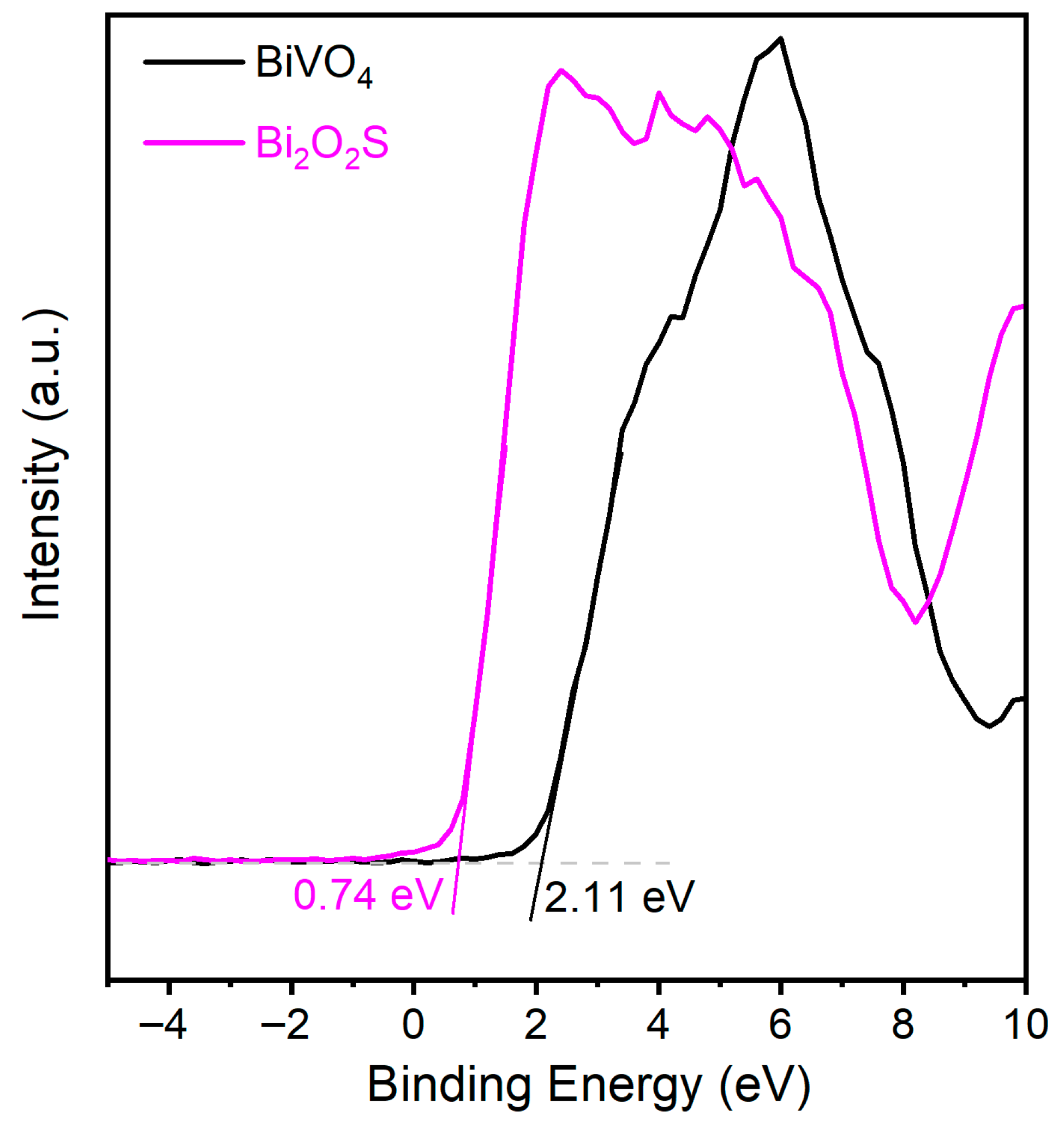
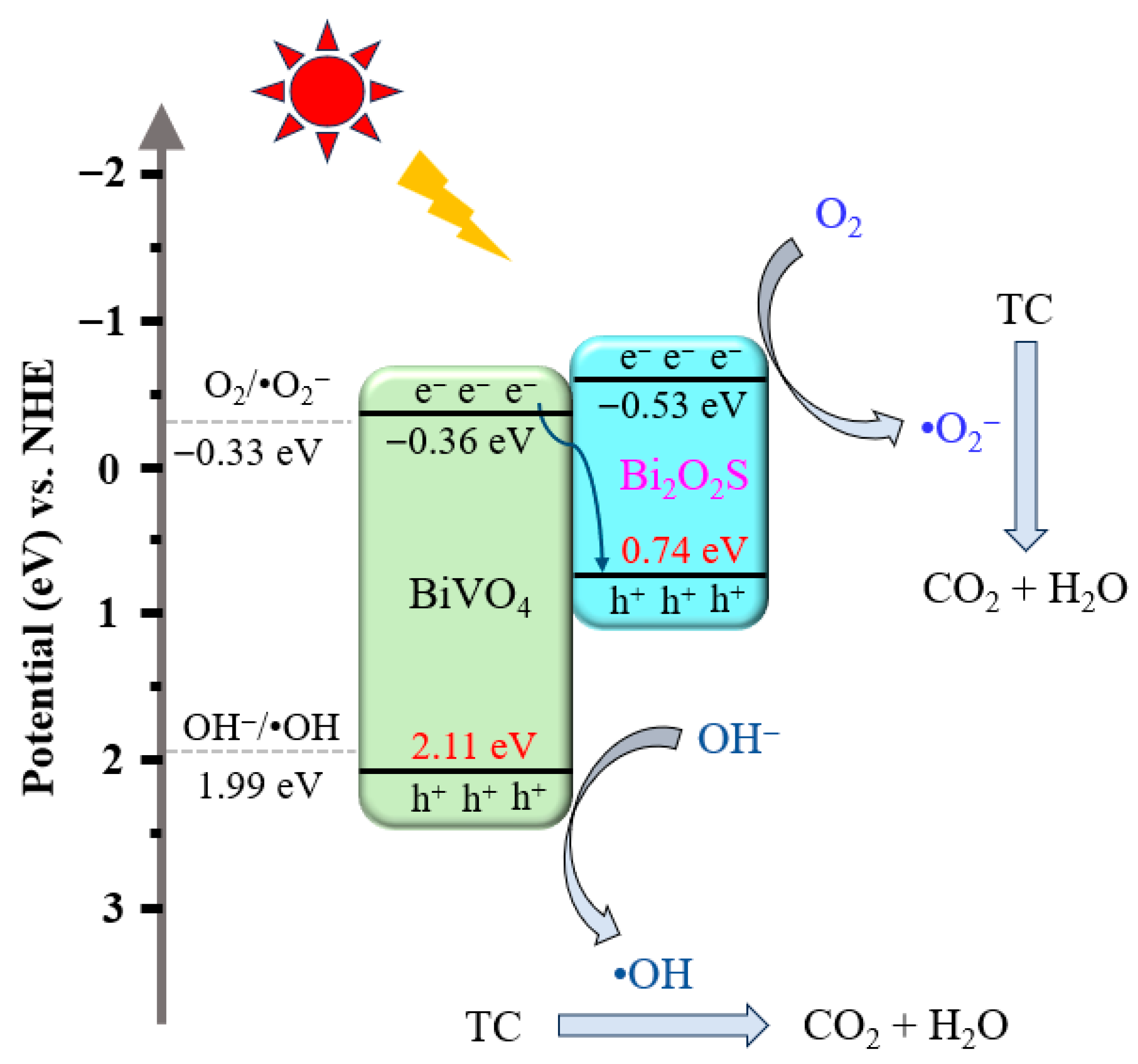
To further elucidate the mechanism underlying the substantial enhancement in the TC degradation performance of the 2BVO/BOS photocatalyst, the positions of the conduction band (CB) and valence band (VB) of the BiVO4 and Bi2O2S samples were determined via valence band X-ray photoelectron spectroscopy (VB-XPS), thereby facilitating an in-depth analysis of the charge transfer dynamics. Specifically, as shown in Figure 13, the valence band positions of BiVO4 and Bi2O2S were ascertained to be 2.11 and 0.74 eV, respectively. Additionally, the optical bandgaps of BiVO4 and Bi2O2S, calculated from the UV-Vis diffuse reflectance spectra (Figure 6b), were found to be 2.47 eV and 1.27 eV, respectively. Consequently, the conduction band positions of BiVO4 and Bi2O2S were calculated to be −0.36 eV and −0.53 eV, respectively. Incorporating the results from the trapping experiments, ESR spectra, redox potential assessments, and charge transfer analysis, a plausible S-scheme type photocatalytic mechanism can be proposed, as illustrated in Figure 14. Under visible light irradiation, the composite absorbs photon energy, leading to the generation of electron-hole pairs that migrate from the VB to the CB. Owing to the energy disparity between the CB and VB positions, the photogenerated electrons and holes undergo interband transfer. Specifically, the excited electrons are transferred from the CB of Bi2O2S to the CB of BiVO4, while the photoexcited holes migrate from the VB of BiVO4 to the VB of Bi2O2S. Considering that the VB position of Bi2O2S (+0.74 eV) is more negative than the oxidation potential of OH/•OH (+1.99 eV vs. NHE) [13,55], the thermodynamic conditions preclude the formation of •OH radicals. Nevertheless, both •O2 and •OH radicals were observed in ESR spectra and radical trapping experiments, confirming their crucial roles in the photocatalytic degradation of TC. Therefore, a more plausible S-scheme type photocatalytic mechanism is proposed, as illustrated in Figure 14. In this mechanism, the excited electrons in the CB of BiVO4 are transferred to the interface and recombine with the holes in the VB of Bi2O2S. Consequently, the electrons remain in the CB of Bi2O2S, while the holes are retained in the VB of BiVO4. The electrons in the CB of Bi2O2S possess sufficient reducing power to convert O2 into •O2, owing to the CB potential of Bi2O2S (−0.53 eV vs. NHE), which is more negative than the standard potential for O2/•O2 (−0.33 eV vs. NHE) [42,56]. Simultaneously, the holes in the VB of BiVO4 (+2.11 eV vs. NHE) exhibit a strong oxidative potential capable of generating •OH radicals. This mechanism significantly suppresses the recombination of electron-hole pairs, leading to the enhanced generation of •O2 and •OH radicals, which, in turn, play dominant roles in the photodegradation of TC.

3. Experimental Section

3.1. Catalyst Preparation

3.1.1. Preparation of Bi2O2S Nanosheets

The Bi2O2S nanosheets were synthesized via a refined, modified procedure, building upon established methodologies [35]. In this process, 100 mg (0.206 mmol) of Bi(NO3)3·5H2O was sonicated in 20 mL of deionized water, resulting in a transparent solution. In a separate vial, 12.7 mg of CH4N2S was introduced to 1 mg of hydrazine hydrate solution, and subsequently, 120 mg of KOH and 320 mg of NaOH were carefully added to the mixture. The reaction was allowed to proceed overnight, yielding a brown precipitate. The solid product was thoroughly washed with distilled water to remove impurities and then dried overnight in a forced-air oven. The resulting material was characterized as deep brown, exhibiting the distinctive morphology of Bi2O2S nanosheets.

3.1.2. Preparation of BiVO4/Bi2O2S and BiVO4 Catalysts

Following the synthesis of Bi2O2S nanosheets through a straightforward solution-phase approach at ambient temperature, BiVO4/Bi2O2S composite photocatalysts were fabricated via a hydrothermal method, incorporating varying amounts of Bi2O2S. The theoretical weight ratios of BiVO4 to Bi2O2S were maintained at 2:1 and 1:1, labeled as 2BVO/BOS and BVO/BOS, respectively. In a typical synthesis procedure, equimolar quantities of Bi(NO3)3·5H2O and NH4VO3 were dissolved in a 2 mol/L nitric acid solution. Ammonia solution was then introduced to adjust the pH of the resulting mixture to 4. The Bi2O2S nanosheets were subsequently incorporated into the precursor solution and subjected to ultrasonic treatment to ensure uniform dispersion. This homogeneous solution was transferred to a 100 mL stainless-steel autoclave, lined with PTFE, and subjected to hydrothermal treatment at 150 °C for 6 h. The resulting composite materials were repeatedly washed with deionized water and ethanol, followed by drying at 70 °C for 10 h to yield the BiVO4/Bi2O2S composite photocatalysts. For comparison, BiVO4 was synthesized using the same procedure, but without the incorporation of Bi2O2S.

3.2. Catalyst Characterization

The crystallographic framework of the catalysts was meticulously investigated through X-ray diffraction (XRD) analysis, utilizing a Bruker D8-Advance diffractometer (Bruker, Karlsruhe, Germany), powered by a Cu Kα radiation source. The specific surface area (SBET) and pore size distribution were precisely determined at 77 K using a Micromeritics ASAP 2020 adsorption–desorption analyzer (Micromeritics, Norcross, GA, USA). To probe the molecular structures and surface chemical compositions, Fourier-transform infrared (FT-IR) spectroscopy (FTIR-8400S, Shimadzu, Kyoto, Japan) and X-ray photoelectron spectroscopy (XPS, ESCALAB 250, Thermo Fisher Scientific, Waltham, MA, USA) were employed, respectively. The optical absorption properties were evaluated through diffuse reflectance spectroscopy (UV-Vis DRS) within the 200–1200 nm range, with BaSO4 serving as an inert reference (UV3600IPLUS, Shimadzu, Kyoto, Japan). The morphological and microstructural characteristics of the samples were analyzed using field-emission scanning electron microscopy (FE-SEM, Regulus 8100, Hitachi, Hitachi, Japan) in conjunction with transmission electron microscopy (TEM, FEI Tecnai G2 F20, Hillsboro, OR, USA). Additionally, ESR spectroscopy (JES-FA300, Bruker, Karlsruhe, Germany) was utilized to detect and quantify reactive radical species, with 5, 5-dimethyl-1-pyrroline N-oxide (DMPO) employed as the spin-trapping agent to capture •OH (hydroxyl) and •O2− (superoxide) radicals.

3.3. Photoelectrochemical Measurements

Electrochemical evaluations were conducted using a CHI 660D electrochemical workstation (Chenhua, Shanghai, China). A three-electrode setup was employed, wherein a platinum (Pt) wire functioned as the counter electrode, a saturated calomel electrode (SCE) was utilized as the reference electrode, and the catalysts were employed as the working electrode. Photocurrent response measurements were performed in a 0.5 M Na2SO4 aqueous electrolyte under irradiation from a 300 W xenon (Xe) lamp. To assess the charge transfer dynamics and resistance characteristics of the system, electrochemical impedance spectroscopy (EIS) was conducted in the Na2SO4 solution. An alternating current (AC) signal with a 10 mV amplitude was applied across a frequency range of 105 Hz to 10−1 Hz, facilitating a comprehensive analysis of the electrochemical behavior of the material.

3.4. Photocatalytic Tests

The photocatalytic performance of the composite materials was evaluated in a photoreactor equipped with a 420 nm cutoff filter and a 300 W xenon lamp (PLS-SXE 300BF, Merry Change, Beijing, China), simulating visible light irradiation. A 50 mL solution of 10 mg/L TC was prepared, to which 50 mg of the synthesized composite materials was added. After a 90 min dark reaction, the lamp was turned on to initiate the photocatalytic reaction. During the reaction, 3 mL of the solution was sampled at 15 min intervals, filtered through a 0.22 μm microporous membrane to remove catalyst particles, and the absorbance at the characteristic absorption wavelength of TC (357 nm) was measured using a UV-Vis spectrophotometer. To comprehensively assess the catalytic performance, the entire photocatalytic degradation experiment was conducted for 90 min, with samples collected at six different time points for analysis. The degradation efficiency of tetracycline is calculated based on the concentration of the tetracycline solution after 1.5 h of dark reaction as the initial benchmark. During the cyclic experiments, after each reaction, the catalyst in the solution is recovered by centrifugation and dried. In each cycle of the reaction, the lost catalyst is supplemented with fresh catalyst. Additionally, each time a new tetracycline solution at a concentration of 10 mg/L is freshly prepared for the cyclic reactions.

4. Conclusions

In summary, we delineated a sophisticated and highly effective strategy for constructing a BiVO4/Bi2O2S heterostructure that exhibits outstanding photocatalytic prowess toward TC degradation. The strategic incorporation of Bi2O2S not only substantially augments the visible light harvesting capability but also markedly accelerates the spatial separation and interfacial migration of photogenerated charge carriers within the composite. In addition, Bi2O2S modification significantly amplifies the SBET of the composite, thereby providing a considerably greater density of adsorption sites and catalytically active centers. Consequently, the 2BVO/BOS heterostructure delivers an extraordinary photocatalytic performance, achieving an impressive TC removal efficiency of approximately 82.9% under visible light illumination for 90 min—far surpassing those of pristine BiVO4 (42.9%) and Bi2O2S (50.7%). Complementary radical quenching assays and ESR analyses reveal that •O2 serves as the dominant oxidative species during the degradation process, while •OH plays an auxiliary yet non-negligible role. On the basis of these mechanistic insights, an S-scheme heterojunction charge-transfer pathway is proposed to rationalize the superior photocatalytic behavior of the 2BVO/BOS system. Collectively, this work establishes an elegant and practical paradigm for engineering next-generation BiVO4-based photocatalysts with elevated activity, offering substantial promise for advanced environmental purification technologies.

Author Contributions

Conceptualization, D.C. and Z.J.; methodology, D.C.; resources, X.L.; data curation, D.C. and S.H.; writing—original draft preparation, S.H. and Y.Z.; writing—review and editing, D.C. and B.Z.; supervision, D.C. and S.L.; project administration, D.C.; funding acquisition, D.C. and S.L. All authors have read and agreed to the published version of the manuscript.

Funding

This work was financially supported by the Zhaoqing University Natural Science Project (Grant No. ZD202408 and qn202526), Funded Project for Innovative Scientific Research Teams of Zhaoqing University (Grant No. TD202418), the Zhaoqing City Science and Technology Innovation Guidance Project (Grant No. 241220170090183) and Innovative Entrepreneurship Project of Chinese College Students (Grant No. X202510580134, 202410580016, 202410580017 and 202410580018).

Institutional Review Board Statement

Not applicable.

Informed Consent Statement

Not applicable.

Data Availability Statement

The data presented in this study are available upon request from the corresponding author.

Acknowledgments

We express our sincere gratitude for the invaluable experimental resources and characterization platform generously provided by the School of Environmental and Chemical Engineering at Zhaoqing University.

Conflicts of Interest

The authors declare no competing financial interests or personal relationships that could have appeared to influence the work reported in this paper.

References

  1. Breczko, J.; Basa, A.; Niemirowicz-Laskowska, K.; Skonieczna, B.; López-Martín, R.; De Toro, J.A.; Car, H.; Regulska, E. Magnetic AuNPs@TiO2@NF heterojunction for solar-light degradation of antibiotics and mitigation of bacterial resistance risk. RSC Adv. 2025, 15, 41862–41873. [Google Scholar] [CrossRef] [PubMed]
  2. Regulska, E.; Breczko, J.; Basa, A.; Niemirowicz-Laskowska, K.; Kiszkiel-Taudul, I. Photocatalytic degradation of oxytetracycline with the REMs (Er, Tm, Yb)-doped nickel and copper aluminates. Mat. Sci. Eng. B-Adv. 2022, 285, 115959. [Google Scholar] [CrossRef]
  3. Niemirowicz-Laskowska, K.; Basa, A.; Breczko, J.; Kiszkiel-Taudul, I.; Wielgat, P.; Skonieczna, B.; Car, H.; Regulska, E. Sunlight-activated nanocomposites for antibiotic degradation: How NiFe2O4@TiO2@Au tackles tigecycline and its biotoxicity. Surf. Interfaces 2025, 58, 105889. [Google Scholar] [CrossRef]
  4. Jia, Z.; Wang, T.; Wu, Z.; Razzaque, S.; Zhao, Z.; Cai, J.; Xie, W.; Wang, J.; Zhao, Q.; Wang, K. In Situ construction of thiazole-linked covalent organic frameworks on Cu2O for high-efficiency photocatalytic tetracycline degradation. Molecules 2025, 30, 3233. [Google Scholar] [CrossRef]
  5. Zhu, X.; Luo, M.; Sun, C.; Jiang, J.; Guo, Y. Highly efficient photocatalytic degradation of tetracycline antibiotics by BiPO4/g-C3N4: A novel heterojunction nanocomposite with nanorod/stacked-like nanosheets structure. Molecules 2025, 30, 2905. [Google Scholar] [CrossRef]
  6. Du, H.; Zhang, A.; Zhang, Q.; Sun, Y.; Zhu, H.; Wang, H.; Tan, Z.; Zhang, X.; Chen, G. Fabrication of recoverable Bi2O2S/Bi5O7I/ZA hydrogel beads for enhanced photocatalytic Hg0 removal in the presence of H2O2. Sep. Purif. Technol. 2025, 359, 130597. [Google Scholar] [CrossRef]
  7. Esmaili, Z.; Sadeghian, Z.; Ashrafizadeh, S.N. Tailoring of BiVO4 morphology for efficient antifouling of visible-light-driven photocatalytic ceramic membranes for oily wastewater treatment. J. Water Process Eng. 2024, 67, 106145. [Google Scholar] [CrossRef]
  8. Guan, H.; Wang, Q.; Feng, Y.; Sun, H.; Zhang, W.; Hu, Y.; Zhong, Q. Preparation of binary type II α-Bi2O3/Bi12TiO20 cross-shaped heterojunction with enhanced visible light photocatalytic performance. ACS Appl. Electron. Mater. 2022, 4, 1132–1142. [Google Scholar] [CrossRef]
  9. Yang, S.; Feng, Y.; Gao, D.; Wang, X.; Suo, N.; Yu, Y.; Zhang, S. Electrocatalysis degradation of tetracycline in a three-dimensional aeration electrocatalysis reactor (3D-AER) with a flotation-tailings particle electrode (FPE): Physicochemical properties, influencing factors and the degradation mechanism. J. Hazard. Mater. 2021, 407, 124361. [Google Scholar] [CrossRef] [PubMed]
  10. Koundle, P.; Nirmalkar, N.; Momotko, M.; Makowiec, S.; Boczkaj, G. Tetracycline degradation for wastewater treatment based on ozone nanobubbles advanced oxidation processes (AOPs)—Focus on nanobubbles formation, degradation kinetics, mechanism and effects of water composition. Chem. Eng. J. 2024, 501, 156236. [Google Scholar] [CrossRef]
  11. Moral-Rodríguez, A.I.; Quintana, M.; Leyva-Ramos, R.; Ojeda-Galván, H.J.; Oros-Ruiz, S.; Peralta-Rodríguez, R.D.; Mendoza-Mendoza, E. Novel and green synthesis of BiVO4 and GO/BiVO4 photocatalysts for efficient dyes degradation under blue LED illumination. Ceram. Int. 2022, 48, 1264–1276. [Google Scholar] [CrossRef]
  12. Hemmatpour, P.; Nezamzadeh-Ejhieh, A. A Z-scheme CdS/BiVO4 photocatalysis towards Eriochrome black T: An experimental design and mechanism study. Chemosphere 2022, 307, 135925. [Google Scholar] [CrossRef]
  13. Yang, Q.; Tan, G.; Yin, L.; Liu, W.; Zhang, B.; Feng, S.; Bi, Y.; Liu, Y.; Liu, T.; Wang, Z.; et al. Full-spectrum broad-spectrum degradation of antibiotics by BiVO4@BiOCl crystal plane S-type and Z-type heterojunctions. Chem. Eng. J. 2023, 467, 143450. [Google Scholar] [CrossRef]
  14. Boualam, O.; El Alami, S.; Miyah, Y.; Belaabed, R.; El Knidri, H.; Kherbeche, A.; Addaou, A.; Laajeb, A. Multifunctional BiVO4@Illite-Chitosan hybrid for visible-light photocatalytic degradation of phenol and diluted olive mill wastewater via synergistic photocatalysis-coagulation. J. Environ. Chem. Eng. 2025, 13, 120389. [Google Scholar] [CrossRef]
  15. Zhao, J.; Yang, H.; Chen, C.; You, T.; Yu, X.; Zhang, Y.; Liu, H.; Zhu, Y. Fabrication of CuO/BiVO4 composites for enhanced visible-light-driven photocatalytic antibacterial activity. RSC Adv. 2025, 15, 45038–45047. [Google Scholar] [CrossRef] [PubMed]
  16. Popović, M.; Pandey, S.K.; Zjačić, J.P.; Dananić, V.; Roković, M.K.; Kovačić, M.; Kušić, H.; Šuligoj, A.; Štangar, U.L.; Božić, A.L. Elucidating semiconducting properties and photocatalytic performance of surface-decorated BiVO4 for the removal of contaminants of emerging concern. Molecules 2025, 30, 2454. [Google Scholar] [CrossRef] [PubMed]
  17. Zhong, X.; Li, Y.; Wu, H.; Xie, R. Recent progress in BiVO4-based heterojunction nanomaterials for photocatalytic applications. Mat. Sci. Eng. B-Adv. 2023, 289, 116278. [Google Scholar] [CrossRef]
  18. Bai, Y.; Fang, Z.; Fang, Y.; Lin, C.; Bai, H.; Fan, W. Recent advances in BiVO4-based heterojunction photocatalysts for energy and environmental applications. Chem. Commun. 2025, 61, 5264–5280. [Google Scholar] [CrossRef] [PubMed]
  19. Nalini, P.; Raja, A.; Sweekaran, S.; Thulasika, R.; Poonguzhali, K.; Yuvarani, K.; Sridhar, S.; Saravanakumar, M.; Kang, M.; El-marghany, A. Preparation of Zn-doped BiVO4 nanoparticles by hydrothermal process for solar photocatalytic activity. J. Mater. Sci. Mater. Electron. 2025, 36, 516. [Google Scholar] [CrossRef]
  20. Qin, C.; Tang, X.; Chen, J.; Liao, H.; Zhong, J.; Li, J. In-situ fabrication of Bi/BiVO4 heterojunctions with N-doping for efficient elimination of contaminants. Colloids Surf. A 2021, 617, 126224. [Google Scholar] [CrossRef]
  21. Li, X.; Fang, G.; Tian, Q.; Wu, T. Crystal regulation of BiVO4 for efficient photocatalytic degradation in g-C3N4/BiVO4 heterojunction. Appl. Surf. Sci. 2022, 584, 152642. [Google Scholar] [CrossRef]
  22. Peng, Y.; Kong, F.; Ren, J.; Cai, J.; Xu, L.; Jia, M. Oxygen vacancy-rich CuOx/BiVO4 heterojunction engineering with optimized charge separation for high-efficiency solar-driven photocatalysis. J. Phys. Chem. C 2025, 129, 18993–19001. [Google Scholar] [CrossRef]
  23. Li, C.; Feng, F.; Jian, J.; Xu, Y.; Li, F.; Wang, H.; Jia, L. Boosting carrier dynamics of BiVO4 photoanode via heterostructuring with ultrathin BiOI nanosheets for enhanced solar water splitting. J. Mater. Sci. Technol. 2021, 79, 21–28. [Google Scholar] [CrossRef]
  24. Tian, H.; Wu, H.; Fang, Y.; Li, R.; Huang, Y. Hydrothermal synthesis of m-BiVO4/t-BiVO4 heterostructure for organic pollutants degradation: Insight into the photocatalytic mechanism of exposed facets from crystalline phase controlling. J. Hazard. Mater. 2020, 399, 123159. [Google Scholar] [CrossRef]
  25. Wang, W.; Wang, X.; Gan, L.; Ji, X.; Wu, Z.; Zhang, R. All-solid-state Z-scheme BiVO4−Bi6O6(OH)3(NO3)3 heterostructure with prolonging electron-hole lifetime for enhanced photocatalytic hydrogen and oxygen evolution. J. Mater. Sci. Technol. 2021, 77, 117–125. [Google Scholar] [CrossRef]
  26. Zhang, Y.; Liu, Y.; Xie, W.; Gong, X.; Wang, Z.; Liu, Y.; Wang, P.; Cheng, H.; Dai, Y.; Huang, B.; et al. In-situ topotactic synthesis of decahedron BiVO4/2D networks Bi2S3 heterojunctions for efficient Cr(VI) reduction: Improved charge separation and imaged at the single-particle level. Chem. Eng. J. 2024, 485, 149794. [Google Scholar] [CrossRef]
  27. Jiamprasertboon, A.; Waehayee, A.; Eknapakul, T.; Li, S.; Carmalt, C.J.; Phonsuksawang, P.; Siritanon, T. Efficient synthesis of Bi2O2S nanoparticles for photocatalytic tetracycline degradation. Mater. Lett. 2024, 369, 136776. [Google Scholar] [CrossRef]
  28. Jiang, L.; Li, J.; Li, Y.; Wu, X.; Zhang, G. Promoted charge separation from nickel intervening in [Bi2O2]2+ layers of Bi2O2S crystals for enhanced photocatalytic CO2 conversion. Appl. Catal. B-Environ. 2021, 294, 120249. [Google Scholar] [CrossRef]
  29. Zhang, W.; Liu, D.; Jin, W.; Zhang, D.; Sun, T.; Liu, E.; Hu, X.; Miao, H. In-situ construction of 2D/1D Bi2O2S/Bi2S3 heterojunction from the topological transformation of Bi2O2S with significantly enhanced photoelectrochemical performance. Int. J. Hydrog. Energy 2024, 51, 1545–1557. [Google Scholar] [CrossRef]
  30. Rong, P.; Gao, S.; Zhang, M.; Ren, S.; Lu, H.; Jia, J.; Jiao, S.; Zhang, Y.; Wang, J. Large-area hierarchical Bi2O2S flowers composed of 2D ultrathin nanosheets for high performance self-powered IR photodetector. J. Alloys Compd. 2022, 928, 167128. [Google Scholar] [CrossRef]
  31. Tan, Y.; Liu, X.; Madhusudan, P.; Zhang, J. Half reaction over a Ni2P/Bi2O2S composite for photocatalytic overall nitrogen fixation. New J. Chem. 2025, 49, 1262–1267. [Google Scholar] [CrossRef]
  32. Liu, X.; Zhang, Z.; Wu, Y.; Wang, T.; Wang, W.; Su, X.; Shi, D.; Zhan, H.; Wang, Y. Interfacial engineering of [Bi2O2]2+-layer structures at Bi2O2S/Bi12TiO20 heterojunctions for enhanced photocatalytic degradation of 2,4-dichlorophenol. J. Environ. Chem. Eng. 2024, 12, 111778. [Google Scholar] [CrossRef]
  33. Pacquette, A.L.; Hagiwara, H.; Ishihara, T.; Gewirth, A.A. Fabrication of an oxysulfide of bismuth Bi2O2S and its photocatalytic activity in a Bi2O2S/In2O3 composite. J. Photochem. 2014, 277, 27–36. [Google Scholar] [CrossRef]
  34. Liaqat, M.; Younas, A.; Iqbal, T.; Afsheen, S.; Zubair, M.; Kamran, S.K.S.; Syed, A.; Bahkali, A.H.; Wong, L.S. Synthesis and characterization of ZnO/BiVO4 nanocomposites as heterogeneous photocatalysts for antimicrobial activities and waste water treatment. Mater. Chem. Phys. 2024, 315, 128923. [Google Scholar] [CrossRef]
  35. Seling, T.R.; Kumar Shringi, A.; Wang, K.; Riaz, U.; Yan, F. Bi2O2S nanosheets for effective visible light photocatalysis of anionic dye degradation. Mater. Lett. 2024, 361, 136136. [Google Scholar] [CrossRef]
  36. Zheng, J.; Xu, K.; Zhang, C.; Han, S.; Shi, D. One-step construction of Bi2O2S-Bi2O3 S-scheme heterojunction for enhanced photocatalytic degradation of ciprofloxacin. J. Alloys Compd. 2025, 1032, 181042. [Google Scholar] [CrossRef]
  37. Alomayri, T. Enhanced interfacial charge transfer in BiVO4/rGO/FeVO4 heterojunction composite for improved photocatalysis water purification. Ceram. Int. 2025, 51, 10193–10199. [Google Scholar] [CrossRef]
  38. Phuruangrat, A.; Wannapop, S.; Sakhon, T.; Kuntalue, B.; Thongtem, T.; Thongtem, S. Characterization and photocatalytic properties of BiVO4 synthesized by combustion method. J. Mol. Struct. 2023, 1274, 134420. [Google Scholar] [CrossRef]
  39. Vattikuti, S.V.P.; Shim, J.; Byon, C. Synthesis, characterization, and optical properties of visible light-driven Bi2S3 nanorod photocatalysts. J. Mater. Sci. Mater. Electron. 2017, 28, 14282–14292. [Google Scholar] [CrossRef]
  40. Sasikala, S.; Balakrishnan, M.; Kumar, M.; Chang, J.-H.; Manivannan, M.; Thangabalu, S. Effect of sulfur source and temperature on the morphological characteristics and photocatalytic activity of Bi2S3 nanostructure synthesized by microwave irradiation technique. J. Mater. Sci. Mater. Electron. 2023, 34, 997. [Google Scholar] [CrossRef]
  41. Liu, Y.; Wygant, B.R.; Kawashima, K.; Mabayoje, O.; Hong, T.E.; Lee, S.-G.; Lin, J.; Kim, J.-H.; Yubuta, K.; Li, W.; et al. Facet effect on the photoelectrochemical performance of a WO3/BiVO4 heterojunction photoanode. Appl. Catal. B-Environ. 2019, 245, 227–239. [Google Scholar] [CrossRef]
  42. Lai, C.; Zhang, T.; Chen, Y.; Chen, J.; Zhong, J.; Li, J.; Huang, S.; Dou, L.; Li, M.; Jiang, Z. In-situ preparation of N-doped Bi0/OVs-BiVO4 photocatalysts with enhanced photocatalytic properties. J. Alloys Compd. 2024, 972, 172852. [Google Scholar] [CrossRef]
  43. Lamonier, C.; Bennani, A.; D’Huysser, A.; Aboukaïs, A.; Wrobel, G. Evidence for different copper species in precursors of copper–cerium oxide catalysts for hydrogenation reactions. An X-ray diffraction, EPR and X-ray photoelectron spectroscopy study. J. Chem. Soc. Faraday Trans. 1996, 92, 131–136. [Google Scholar] [CrossRef]
  44. Posada-Borbón, A.; Bosio, N.; Grönbeck, H. On the signatures of oxygen vacancies in O1s core level shifts. Surf. Sci. 2021, 705, 121761. [Google Scholar] [CrossRef]
  45. Frankcombe, T.J.; Liu, Y. Interpretation of oxygen 1s X-ray photoelectron spectroscopy of ZnO. Chem. Mater. 2023, 35, 5468–5474. [Google Scholar] [CrossRef]
  46. Idriss, H. On the wrong assignment of the XPS O1s signal at 531–532 eV attributed to oxygen vacancies in photo- and electro-catalysts for water splitting and other materials applications. Surf. Sci. 2021, 712, 121894. [Google Scholar] [CrossRef]
  47. Su, Q.; Zhu, L.; Zhang, M.; Li, Y.; Liu, S.; Lin, J.; Song, F.; Zhang, W.; Zhu, S.; Pan, J. Construction of a bioinspired hierarchical BiVO4/BiOCl heterojunction and its enhanced photocatalytic activity for phenol degradation. ACS Appl. Mater. Interfaces 2021, 13, 32906–32915. [Google Scholar] [CrossRef]
  48. Cooper, J.K.; Gul, S.; Toma, F.M.; Chen, L.; Liu, Y.-S.; Guo, J.; Ager, J.W.; Yano, J.; Sharp, I.D. Indirect bandgap and optical properties of monoclinic bismuth vanadate. J. Phys. Chem. C 2015, 119, 2969–2974. [Google Scholar] [CrossRef]
  49. Song, Q.; Zhou, Y.; Hu, J.; Zhou, C.; Shi, X.; Li, D.; Jiang, D. Synergistic effects of surface Lewis Base/Acid and nitrogen defect in MgAl layered double Oxides/Carbon nitride heterojunction for efficient photoreduction of carbon dioxide. Appl. Surf. Sci. 2021, 563, 150369. [Google Scholar] [CrossRef]
  50. Li, B.; Cao, Z.; Wang, S.; Wei, Q.; Shen, Z. BiVO4 quantum dot-decorated BiPO4 nanorods 0D/1D heterojunction for enhanced visible-light-driven photocatalysis. Dalton Trans. 2018, 47, 10288–10298. [Google Scholar] [CrossRef]
  51. Pandey, A.; Shrestha, S.; Kandel, R.; Gyawali, N.; Acharya, S.; Nepal, P.; Gaire, B.; Fualo, V.; Hahn, J.R. Visible-light-driven Co3O4/Nb2O5 heterojunction nanocomposites for efficient photocatalytic and antimicrobial performance in wastewater treatment. Molecules 2025, 30, 2561. [Google Scholar] [CrossRef] [PubMed]
  52. Li, M.; Sun, J.; Chen, G.; Yao, S.; Cong, B.; Liu, P. Construction photothermal/pyroelectric property of hollow FeS2/Bi2S3 nanostructure with enhanced full spectrum photocatalytic activity. Appl. Catal. B-Environ. 2021, 298, 120573. [Google Scholar] [CrossRef]
  53. Li, Z.; Jin, C.; Wang, M.; Kang, J.; Wu, Z.; Yang, D.; Zhu, T. Novel rugby-like g-C3N4/BiVO4 core/shell Z-scheme composites prepared via low-temperature hydrothermal method for enhanced photocatalytic performance. Sep. Purif. Technol. 2020, 232, 115937. [Google Scholar] [CrossRef]
  54. Luo, X.-L.; Yang, S.-Y.; Wang, Z.-L.; Xu, Y.-H. Synthesis of Z–scheme Bi2S3/RGO/BiVO4 photocatalysts with superior visible light photocatalytic effectiveness for pollutant degradation. Sep. Purif. Technol. 2023, 318, 123966. [Google Scholar] [CrossRef]
  55. Yang, S.; Li, K.; Huang, P.; Liu, K.; Li, W.; Zhuo, Y.; Yang, Z.; Han, D. Dual-functional Cu2O/g-C3N4 heterojunctions: A high-performance SERS sensor and photocatalytic self-cleaning system for water pollution detection and remediation. Microsyst. Nanoeng. 2024, 10, 198. [Google Scholar] [CrossRef]
  56. Yu, W.; Hu, C.; Bai, L.; Tian, N.; Zhang, Y.; Huang, H. Photocatalytic hydrogen peroxide evolution: What is the most effective strategy? Nano Energy 2022, 104, 107906. [Google Scholar] [CrossRef]
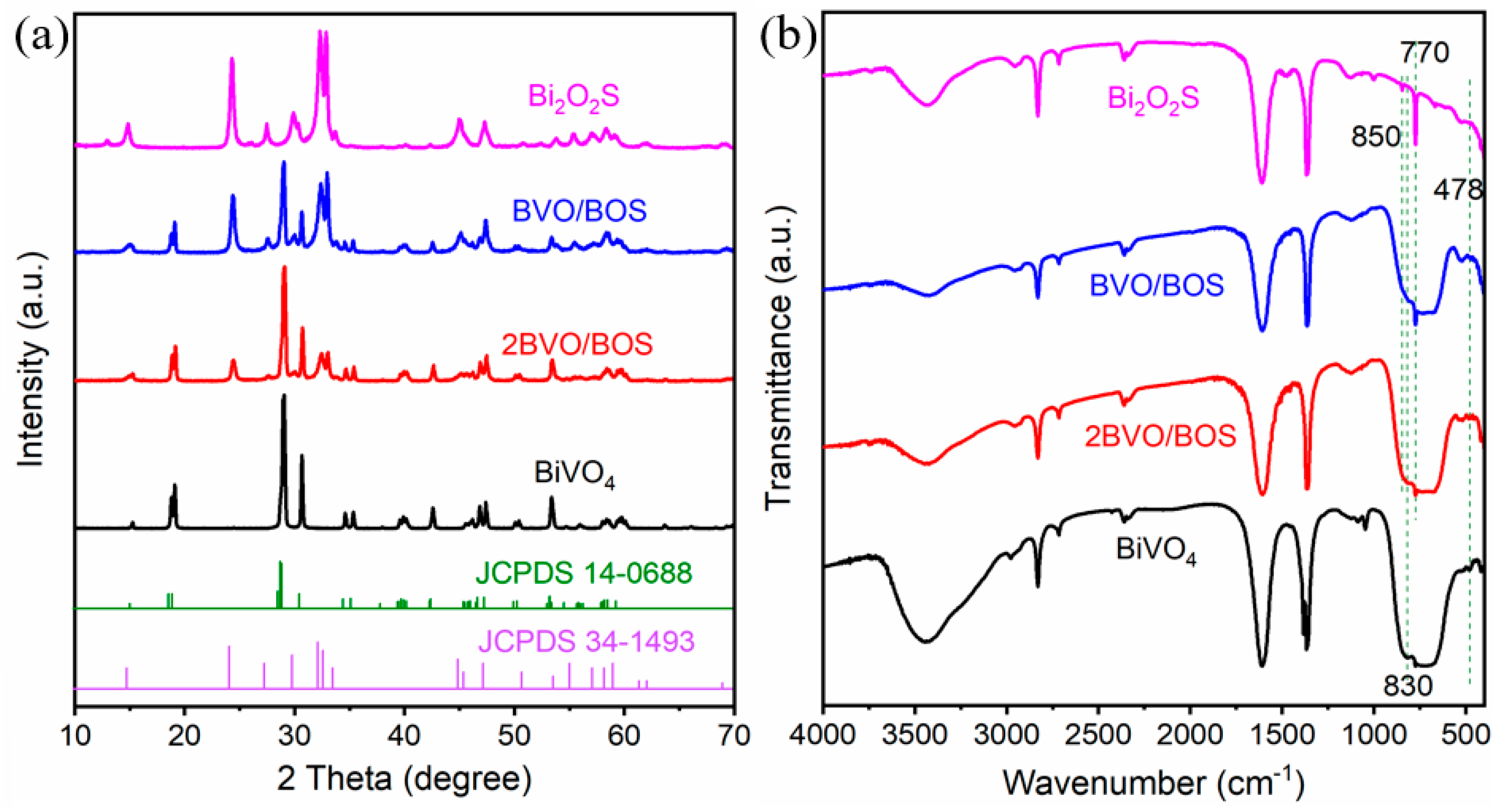
Figure 1. (a) XRD and (b) FT-IR spectra of the pure BiVO4, Bi2O2S, BVO/BOS, and 2BVO/BOS composites.
Molecules 31 00136 g001
Figure 2. (a) N2 adsorption–desorption curves; (b) the related pore size distribution of the BiVO4, Bi2O2S, BVO/BOS, and 2BVO/BOS composite heterostructures.
Molecules 31 00136 g002
Figure 3. FE-SEM images of BiVO4 (a,b), Bi2O2S (c,d), and 2BVO/BOS composite (e,f) at different magnifications.
Molecules 31 00136 g003
Figure 4. TEM (a,b), HRTEM images (c), and the EDX elemental mapping images (dh) of 2BVO/BOS composite (Bi, V, O, and S elements).
Molecules 31 00136 g004
Figure 5. XPS spectra: (a) survey spectra, (b) Bi 4f, and (c) O 1s for the Bi2O2S, BiVO4, and 2BVO/BOS samples; (d) V 2p for BiVO4 and 2BVO/BOS samples.
Molecules 31 00136 g005
Figure 6. (a) UV-Vis spectra of BiVO4, Bi2O2S, BVO/BOS, and 2BVO/BOS composite and (b) corresponding Tauc plot for BiVO4 and Bi2O2S.
Molecules 31 00136 g006
Figure 7. PL spectra of BiVO4, Bi2O2S, BVO/BOS, and 2BVO/BOS composite.
Molecules 31 00136 g007
Figure 8. (a) Transient photocurrent response and (b) EIS spectroscopy of BiVO4, Bi2O2S, BVO/BOS, and 2BVO/BOS composite.
Molecules 31 00136 g008
Figure 9. (a) The photocatalytic performances for TC degradation under the visible irradiation and (b) The pseudo-first-order reaction kinetics of the BiVO4, Bi2O2S, BVO/BOS, and 2BVO/BOS heterostructures.
Molecules 31 00136 g009
Figure 10. (a) Five cycling experiments of 2BVO/BOS heterostructure for photocatalytic TC degradation; (b) FT-IR spectra of 2BVO/BOS heterostructure before and after TC degradation.
Molecules 31 00136 g010
Figure 11. The photocatalytic performance of 2BVO/BOS composite for TC degradation in the presence of various trapping agents.
Molecules 31 00136 g011
Figure 12. ESR spectra of (a) DMPO-•O2 and (b) DMPO-•OH adducts for 2BVO/BOS in methanol dispersions, recorded both in the dark and under visible light (λ > 420 nm).
Molecules 31 00136 g012
Figure 13. The valence band positions of BiVO4 and Bi2O2S photocatalysts determined by the VB-XPS method.
Molecules 31 00136 g013
Figure 14. Possible S-scheme heterojunction photocatalytic reaction mechanism for the BiVO4/Bi2O2S composite.
Molecules 31 00136 g014
Disclaimer/Publisher’s Note: The statements, opinions and data contained in all publications are solely those of the individual author(s) and contributor(s) and not of MDPI and/or the editor(s). MDPI and/or the editor(s) disclaim responsibility for any injury to people or property resulting from any ideas, methods, instructions or products referred to in the content.