


Abstract
The efficient generation of structurally diverse rare ginsenosides from abundant precursors remains a significant challenge. In this study, a heterogeneous catalyst, 12-tungstosilicic acid supported on mesoporous silica (HSiW@mSiO2), was developed for the transformation of ginsenoside Re in aqueous ethanol solution. The reaction was conducted under mild conditions, and the products were systematically analyzed using high-performance liquid chromatography coupled with multistage tandem mass spectrometry and high-resolution mass spectrometry. A total of 24 transformation products were identified, arising from deglycosylation, epimerization, dehydration, cyclization, and nucleophilic addition reactions. Structural elucidation revealed the formation of deglycosylated, hydrated and dehydrated derivatives, C-20 epimers, and novel ethoxylated protopanaxatriol-type ginsenosides resulting from solvent incorporation at the C-24(25) or C-20 position. Product distribution varied with reaction parameters, including solvent composition, reaction time, temperature, and catalyst dosage. The synthesized HSiW@mSiO2 catalyst could be readily recovered by centrifugation and reused for five consecutive cycles, with complete conversion of ginsenoside Re maintained in the first two runs and a gradual decline in conversion to approximately 50% by the fifth cycle. This work demonstrates the efficacy of solid acid catalysts in enabling the structural diversification of ginsenosides through solvent-involved pathways.
1. Introduction
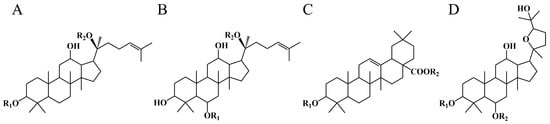
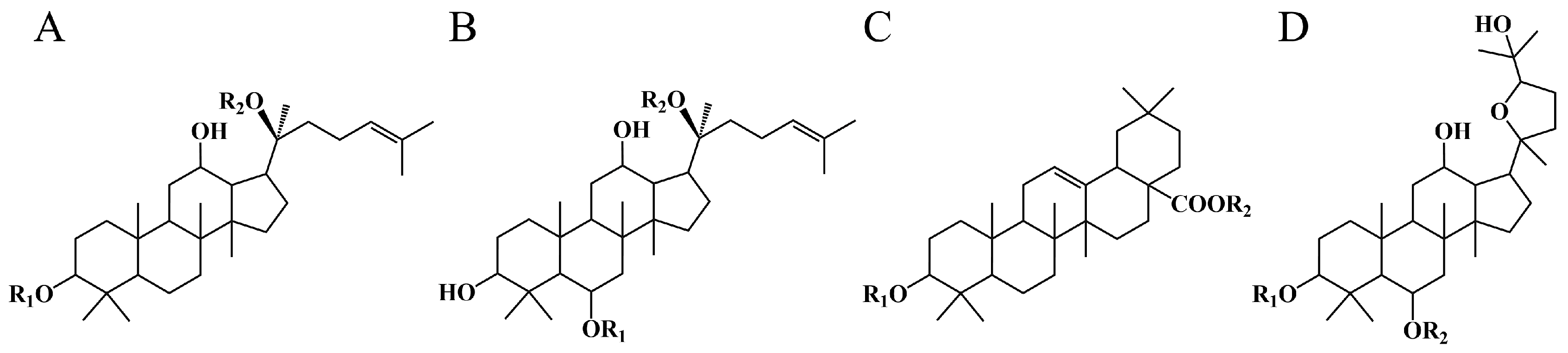
Ginseng (Panax ginseng C. A. Meyer), with its prolonged growth cycle and remarkable medicinal properties, is regarded as a unique and highly valued herb in traditional Chinese medicine [1,2]. The chemical constituents of ginseng comprise ginsenosides, volatile components, polysaccharides, amino acids and peptides, trace elements, and other minor constituents [3]. Among these, ginsenosides have been identified as the primary bioactive components mediating its pharmacological effects [4]. As shown in Figure 1, ginsenosides are categorized into four structural types based on their aglycone skeletons: protopanaxadiol (PPD)-type, protopanaxatriol (PPT)-type, ocotillol-type, and oleanolic acid-type [5]. Additionally, they are classified into major ginsenosides and rare ginsenosides according to their natural abundance. Rare ginsenosides typically exhibit superior bioavailability and more targeted bioactivities compared to their major counterparts. For instance, the anticancer efficacy of ginsenoside Rg3 and the anti-inflammatory activity of ginsenoside Rh2 have been extensively validated through preclinical and clinical investigations [6,7,8]. However, the naturally low abundance of rare ginsenosides, coupled with the prohibitively high costs of their extraction and purification processes, severely limits their large-scale application. Structural characterization of rare ginsenosides has revealed that their main structural differences from major ginsenosides involve a reduced number of glycosyl substituents and modified skeletons. Consequently, the hydrolysis and modification of major ginsenosides, which reduce glycosylation and alter skeletal structures, represent a viable strategy for the production of diverse rare ginsenosides.
Figure 1.
Chemical structures of PPD-type (A), PPT-type (B), ocotillol-type (C), and oleanolic acid-type (D) ginsenosides.
The C-24(25) double bond in PPT and PPD-type ginsenosides serves as a key site for structural diversification. This alkene chain can undergo acid-catalyzed electrophilic addition, forming a C-25 carbocation intermediate that is susceptible to nucleophilic attack [9]. In aqueous alcoholic systems, both water and the alcohol (e.g., methanol, ethanol) can act as nucleophiles, leading to competitive hydration or alkoxy addition at C-25, thereby generating 25-hydroxylated and 25-alkoxyl derivatives, respectively. These 25-functionalized rare ginsenosides are scarcely found in nature and represent valuable structural analogs [10,11,12]. Notably, biotransformation studies demonstrate that microorganisms can similarly target this site via enzymatic hydroxylation, producing novel rare ginsenosides from Rb1 [13]. This convergence of chemical and biological pathways underscores the C-24(25) double bond as a critical “hotspot” for generating structural diversity. The resulting hydroxylation and alkoxylation at C-25 is associated with enhanced pharmacological activities in these derivatives compared to their parent compounds. Therefore, an ideal catalytic system should enable not only glycosidic bond cleavage but also versatile functionalization of the aglycone skeleton.
The preparation of rare ginsenosides currently relies on either biotransformation or chemical transformation of major ginsenosides [9,14]. Chemical transformation, which typically requires strong acids and heavy metal catalysts, poses environmental risks and complicates subsequent product purification. In contrast, enzymatic catalysis, while benefiting from mild reaction conditions, also faces challenges such as high production costs and insufficient catalyst stability. In response to these issues, heteropoly acids (HPAs) offer a promising approach for the efficient transformation of ginsenosides owing to their unique acidic and redox properties [15]. HPAs represent a class of nanoscale cluster compounds comprising transition metals (e.g., tungsten and molybdenum) and oxygen atoms. These compounds feature strong Brønsted and Lewis acid sites that enable precise catalysis of glycosidic bond hydrolysis reactions. Furthermore, their stable cage structures (e.g., Keggin-type and Dawson-type) confer excellent reusability [16].
However, the primary limitations of HPAs in catalytic applications include their small specific surface area and poor solubility in polar solvents, factors that not only limit catalytic activity but also complicate separation from the reaction mixture. Mesoporous silica (mSiO2) is an excellent support for HPAs due to its highly ordered pore structure with a tunable pore size ranging from 2 nm to 50 nm, high specific surface area, and abundant surface silanol groups [17]. The large specific surface area and uniform pore size distribution of mSiO2 facilitate the highly dispersed immobilization and spatial confinement of HPA nanoclusters, thereby significantly increasing the density of catalytic active sites. Furthermore, the surface silanol groups can anchor HPAs through hydrogen bonding or covalent linkages, thereby effectively mitigating the leaching of active species. Recent studies have demonstrated distinct strategies to immobilize Keggin-type HPAs on silica supports. Falcão et al. used an in situ sol–gel co-condensation approach to embed tungstophosphoric acid directly into a silica matrix, preserving the Keggin structure and enhancing acidity for dehydration reactions [18]. In contrast, Zhang et al. immobilized tungstophosphoric acid onto a pre-formed Fe3O4@SiO2@TiO2 support via post-synthetic impregnation, yielding a magnetically recoverable catalyst that exhibited exceptional performance in the synthesis of 5-hydroxymethylfurfural from fructose and inulin, along with excellent recyclability over at least five consecutive cycles [19]. These examples demonstrate that effective immobilization on mSiO2 can improve the catalyst stability and reusability of HPAs. Therefore, mSiO2-supported HPA catalysts are expected to serve as an efficient platform for the comprehensive transformation of major ginsenosides, enabling not only deglycosylation but also diverse functionalization.
High-performance liquid chromatography–mass spectrometry (HPLC-MS) offers significant advantages in the analysis of ginsenosides [20,21,22]. This technique facilitates the efficient separation and highly specific identification of complex transformation products by combining high-resolution mass spectrometry (HRMS) and multistage tandem mass spectrometry (MSn). HRMS enables precise compound identification by providing high-accuracy mass measurement [23]. MSn enables the accurate elucidation of molecular structures and the differentiation of isomers via the sequential selection and fragmentation of precursor ions, thereby generating comprehensive multistage fragmentation data [24].
In the present study, 12-tungstosilicic acid (H4SiW12O40, HSiW) was immobilized on a mSiO2 framework to synthesize the heterogeneous catalyst HSiW@mSiO2, which was subsequently used for the catalytic transformation of ginsenoside Re in an aqueous ethanol solution. The transformation products were effectively separated and structurally characterized using HPLC-MSn and HRMS analyses. A total of 24 rare ginsenosides were successfully obtained from ginsenoside Re through a series of reactions, including deglycosylation, addition, elimination, cyclization, and epimerization. In addition, the reusability of the heterogeneous catalyst HSiW@mSiO2 was evaluated over multiple catalytic cycles in ginsenoside transformation reactions.
2. Results and Discussion
2.1. Characterization of HSiW@mSiO2
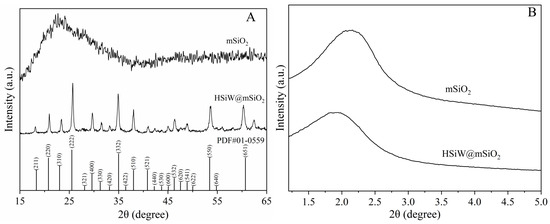
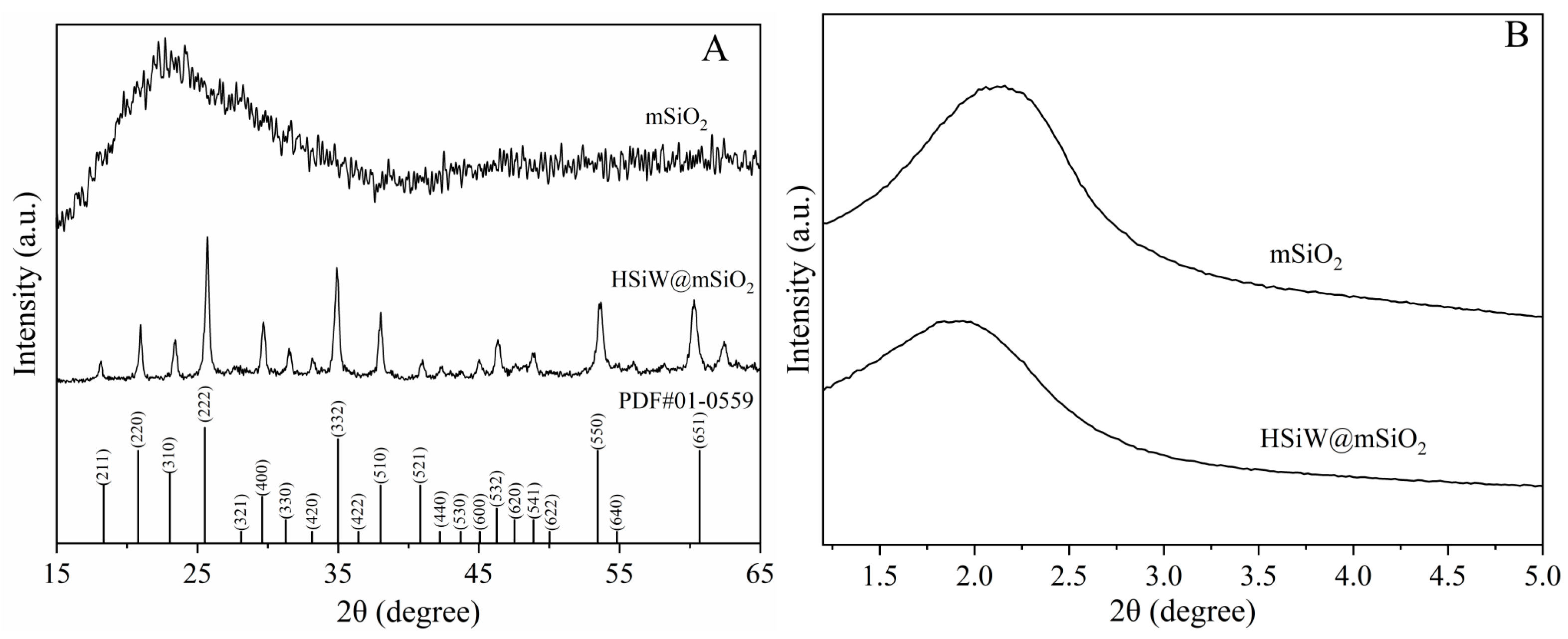
The immobilization of HSiW on the mSiO2 framework was first confirmed through combined wide-angle and small-angle powder X-ray diffraction (XRD). In the wide-angle XRD pattern (Figure 2A), the as-prepared mSiO2 framework exhibits a broad peak centered at 23.8°, indicating its amorphous structure. After HSiW immobilization, characteristic diffraction peaks at 25.2°, 34.7°, 53.2°, and 61.4° appear in the HSiW@mSiO2 composite, corresponding to the (222), (332), (550), and (651) crystallographic planes of the Keggin-type HSiW (PDF#01-0559). The appearance of characteristic diffraction peaks of HSiW in the XRD pattern of HSiW@mSiO2 suggests that the Keggin-type structure of HSiW is retained after immobilization. The presence of sharp reflections further indicates that HSiW is present as nanocrystalline domains rather than being molecularly dispersed within the mSiO2 matrix [25]. As shown in Figure 2B, the pristine mSiO2 exhibits a distinct low-angle diffraction peak at 2.1°, corresponding to the (100) reflection of a hexagonally ordered mesoporous structure, indicating the presence of uniform and periodic pore channels. After HSiW loading, the peak shifts slightly to 1.9°, indicating a minor increase in the interplanar spacing of the framework [26]. This suggests that the long-range order is maintained, while HSiW incorporation induces a subtle lattice expansion, likely due to interactions between the heteropoly acid and the pore walls. Therefore, XRD analysis confirms the successful preparation of HSiW@mSiO2, with retention of both the Keggin structure of HSiW and the ordered mesoporous framework of mSiO2.
Figure 2.
XRD patterns of mSiO2 and HSiW@mSiO2 over the 2θ range of 15–65° (A) and 1.2–5° (B).
As shown in Figure S1, the Fourier-transform infrared (FTIR) spectrum of the HSiW@mSiO2 composite clearly displays the characteristic vibrational modes associated with both the mSiO2 framework and the immobilized HSiW, indicating that neither component undergoes structural alteration during immobilization. In the composite, the vibrational characteristics of Keggin-type HSiW are distinctly observed: the band at 980 cm−1 is assigned to the terminal W=O stretching vibration, and the peak at 930 cm−1 to the central Si-O stretching vibration. Additionally, the adsorption bands at 883 cm−1 and 800 cm−1 arise from W-O-W bridges formed by corner- and edge-sharing oxygen atoms between W3O13 units, respectively [27,28,29], confirming the integrity of the Keggin structure. The broad band between 1300 cm−1 and 1000 cm−1 is attributed to the asymmetric stretching vibration of Si-O-Si linkages, while the bands at 803 cm−1 and 465 cm−1 correspond to the symmetric stretching and bending vibrations of the same bonds, respectively [30,31,32]. These features confirm the retention of the silica-based mesoporous framework. Notably, no significant peak broadening, shifting, or disappearance is observed, suggesting that the chemical interactions are extremely weak, insufficient to distort the HSiW structure, while still enabling stable immobilization on the mSiO2 framework.
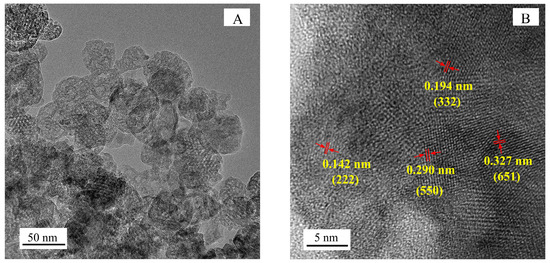
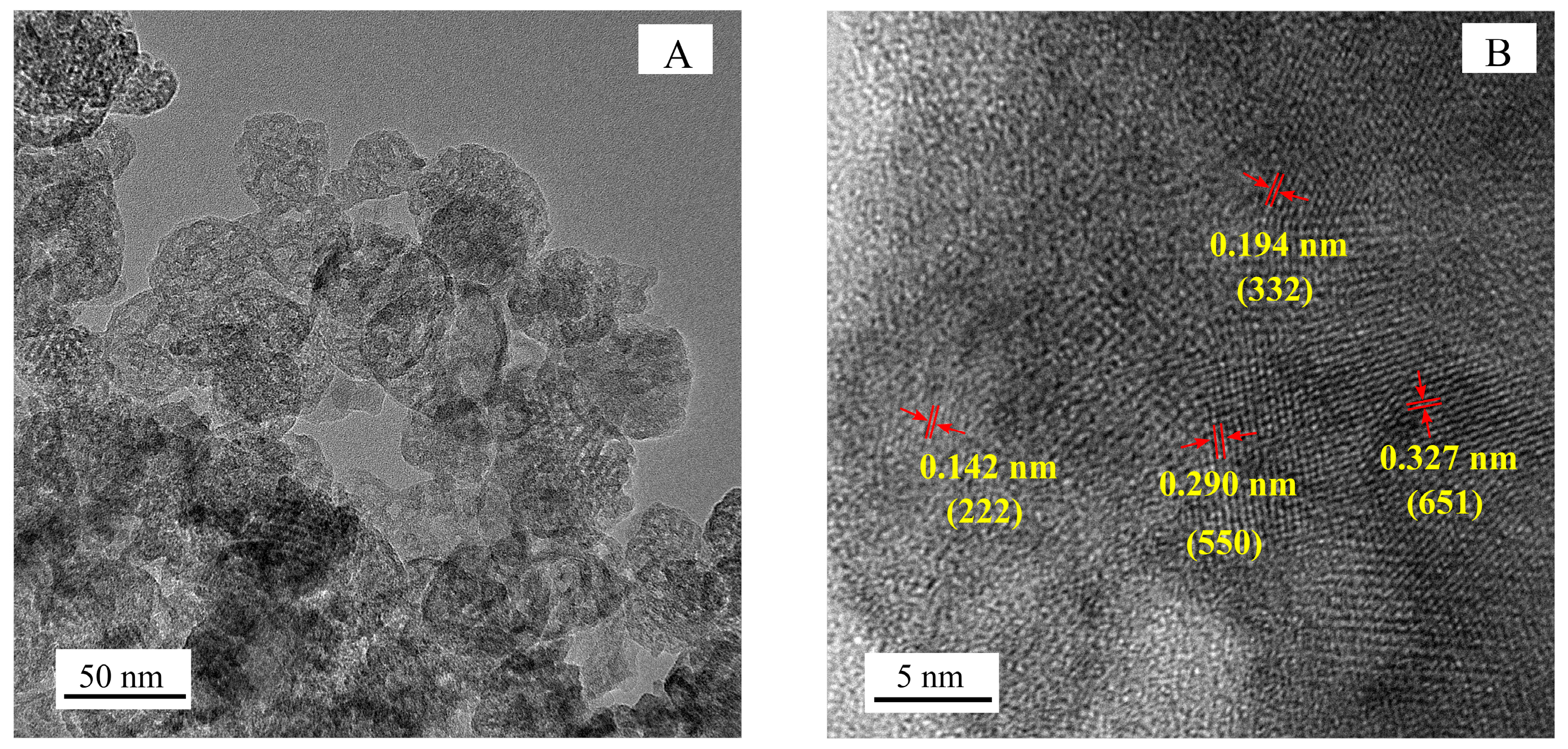
Transmission electron microscopy (TEM) images further provide direct evidence of HSiW incorporation on the mSiO2 framework. Figure 3A reveals that the spherical mSiO2 particles, with an average diameter of approximately 50 nm, retain their ordered mesoporous structure following HSiW immobilization. As shown in Figure 3B, well-defined lattice fringes are observed from the HSiW@mSiO2 composite, with measured interplanar spacings of 0.142 nm, 0.194 nm, 0.290 nm, and 0.327 nm, corresponding to the (222), (332), (550), and (651) crystallographic planes of the Keggin-type HSiW, respectively. This confirms the preservation of its crystalline structure upon immobilization. The coexistence of distinct lattice fringes and intact spherical morphology indicates that HSiW is structurally integrated with the mSiO2 framework, forming a well-structured hybrid composite. Furthermore, the synthesized HSiW@mSiO2 composite exhibits excellent insolubility in aqueous ethanol solution, a crucial requirement for heterogeneous catalysis. The combination of structural integrity and phase stability reveals the potential of HSiW@mSiO2 as a catalyst for the heterogeneous transformation of ginsenosides [33,34]. Notably, although silica-supported HSiW catalysts prepared by impregnation or hybrid sol–gel strategies have been used in acid-catalyzed reactions such as alcohol dehydration and alkylation [18,19], their use in the transformation of PPT-type ginsenosides in an aqueous ethanol environment has not been investigated.
Figure 3.
TEM (A) and HRTEM (B) images of HSiW@mSiO2.
2.2. Structural Characterization and Identification of Ginsenoside Re Transformation Products in Aqueous Ethanol by HPLC-MS
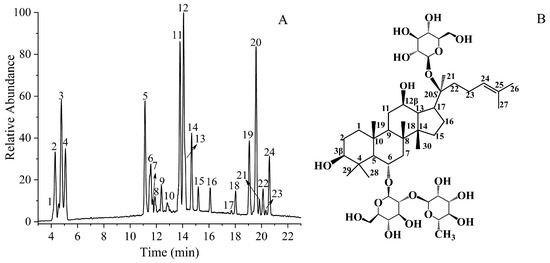
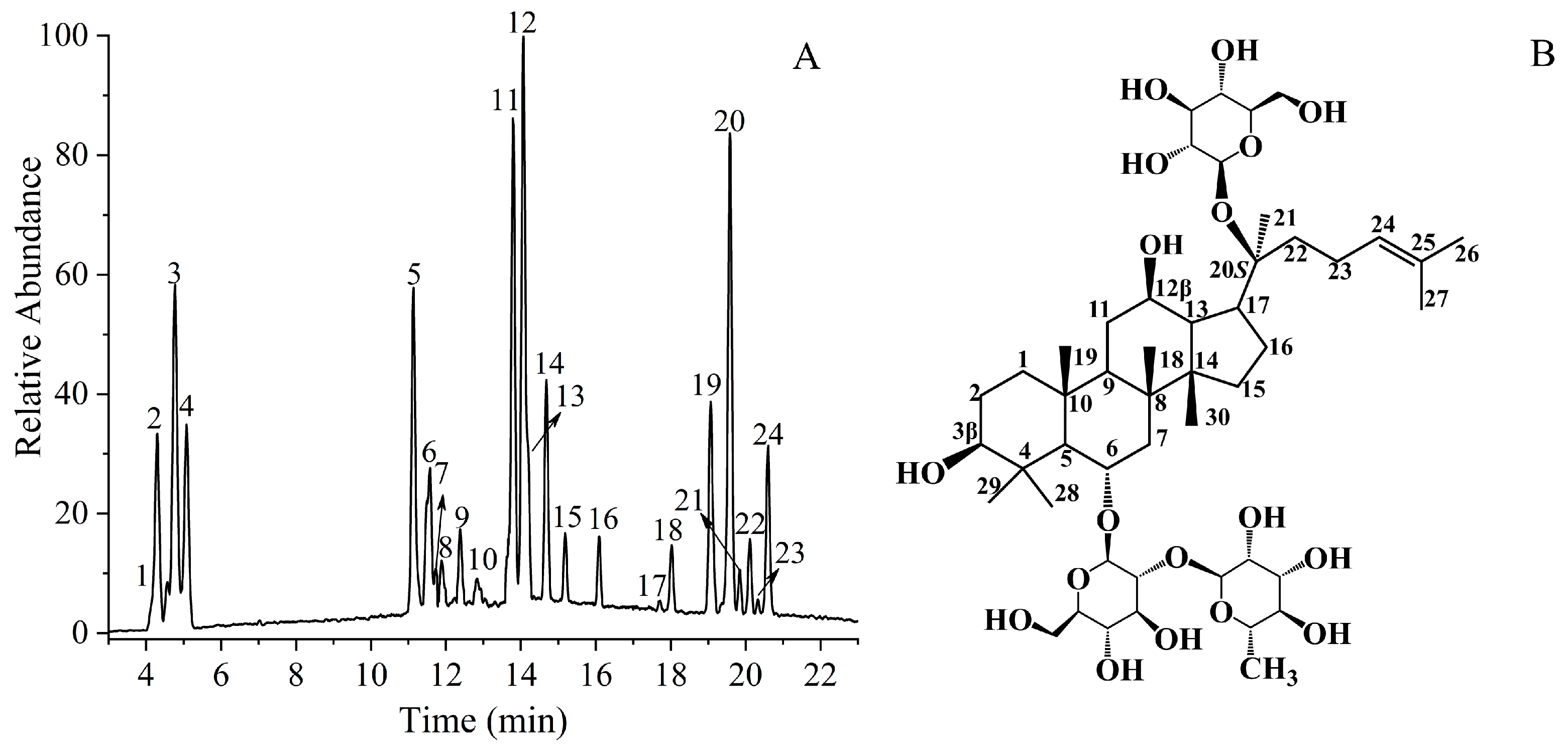
The chemical transformation of ginsenoside Re was carried out using synthesized HSiW@mSiO2 as a catalyst in 70% aqueous ethanol at 80 °C for 4 h, and the resulting products were analyzed by HPLC-MS. The total ion chromatogram (Figure 4A) revealed 24 distinct compounds, designated as 1 to 24, all of which were subjected to comprehensive structural elucidation using MSn and HRMS. For comparison, the TIC of untreated ginsenoside Re under identical HPLC-MS conditions is provided in Figure S2. The structure of the reactant ginsenoside Re is shown in Figure 4B, illustrating its glycosylation pattern: a disaccharide Glc(2-1)-Rha at C-6 and a glucosyl substituent at C-20, which serves as the reference framework for structural derivation of the transformation products. The structural identification for all 24 compounds was primarily based on accurate molecular masses from HRMS, characteristic fragmentation patterns in MSn spectra, and retention time matching with authentic ginsenoside standards, collectively ensuring the reliability and consistency of each identification.
Figure 4.
TIC of the transformation products of ginsenoside Re with ethanol (A) and the structural formula of ginsenoside Re (B).
2.2.1. Identification of Ethanol Adducts
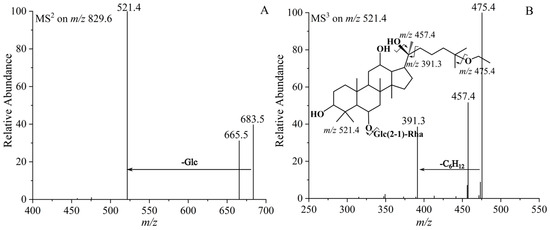
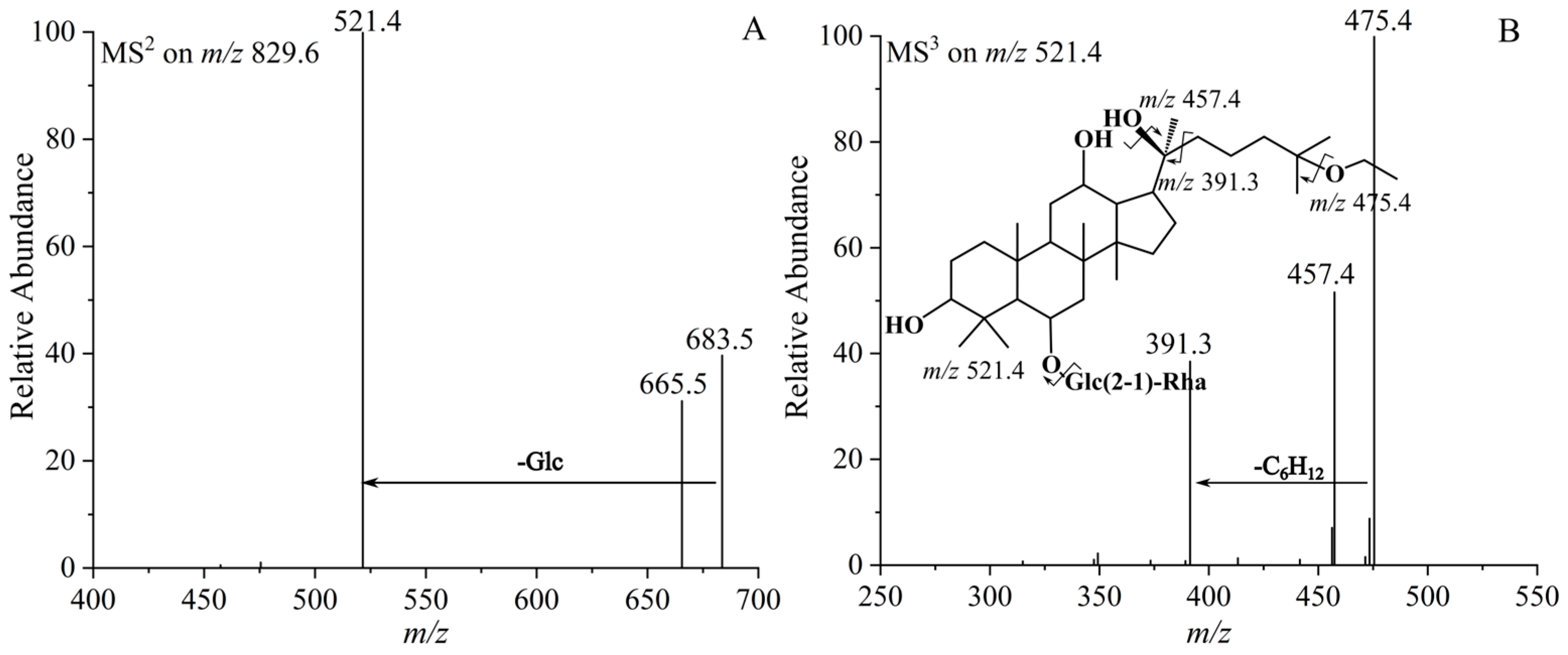
Compounds 8 and 9 were identified as a pair of isomers with the identical molecular formula of C44H78O14 and a relative molecular mass of 830.6. The MS2 spectrum of compound 8 on its [M−H]− ion at m/z 829.6 (Figure 5A) exhibited product ions at m/z 683.5 and m/z 521.4, corresponding to sequential losses of rhamnosyl (146.1 Da) and glucosyl (162.1 Da) substituents. These fragments indicate that compound 8 retained the Glc(2-1)-Rha disaccharide substituent at the C-6 position, but lost the glucosyl substituent at the C-20 position.
Figure 5.
MS2 spectrum of the [M−H]− ion at m/z 829.6 (A), fragmentation pathways, and MS3 spectrum of the product ion at m/z 521.4 (B) from ginsenoside (20S)-25-OCH2CH3-Rg2.
Further MS3 analysis was performed on the product ion at m/z 521.4 (Figure 5B), which revealed a neutral loss of 46.0 Da, corresponding to the elimination of an ethanol molecule, yielding the ion at m/z 475.4. This suggests the presence of an ethoxyl group in the aglycone structure. The ion at m/z 475.4 is assigned to the characteristic deprotonated aglycone of PPT-type ginsenosides. Additionally, the presence of the product ion at m/z 391.3, along with an 84.1 Da neutral loss corresponding to the C6H12 molecule from the ion at m/z 475.4, indicates cleavage of the C-20(22) single bond in the olefin chain and preservation of the tetracyclic skeleton. This rules out the possibility of ethanol addition to the double bond formed at C-20 upon dehydration, as such dehydration would disrupt the olefin chain and prevent the observed fragmentation. Instead, it confirms that the ethoxyl group was preferentially attached to the C-24(25) double bond [11]. Therefore, compound 8 is derived from hydrolytic deglycosylation at the C-20 position, accompanied by ethanol addition to the C-24(25) double bond. Based on the chromatographic behavior of ginsenoside epimers on a C18 column, where (20S)-epimers exhibit higher polarity and elute earlier than their (20R)-counterparts [9,10,11,12,13,35,36], compounds 8 and 9 are assigned as (20S)-25-OCH2CH3-Rg2 and (20R)-25-OCH2CH3-Rg2, respectively. Their structures are illustrated in Figure 5B and Figure S3.
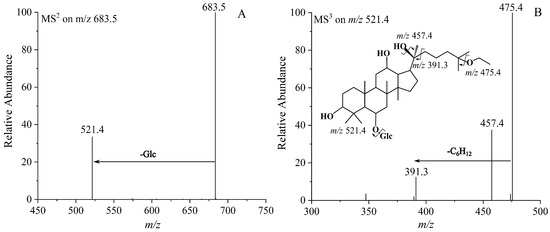
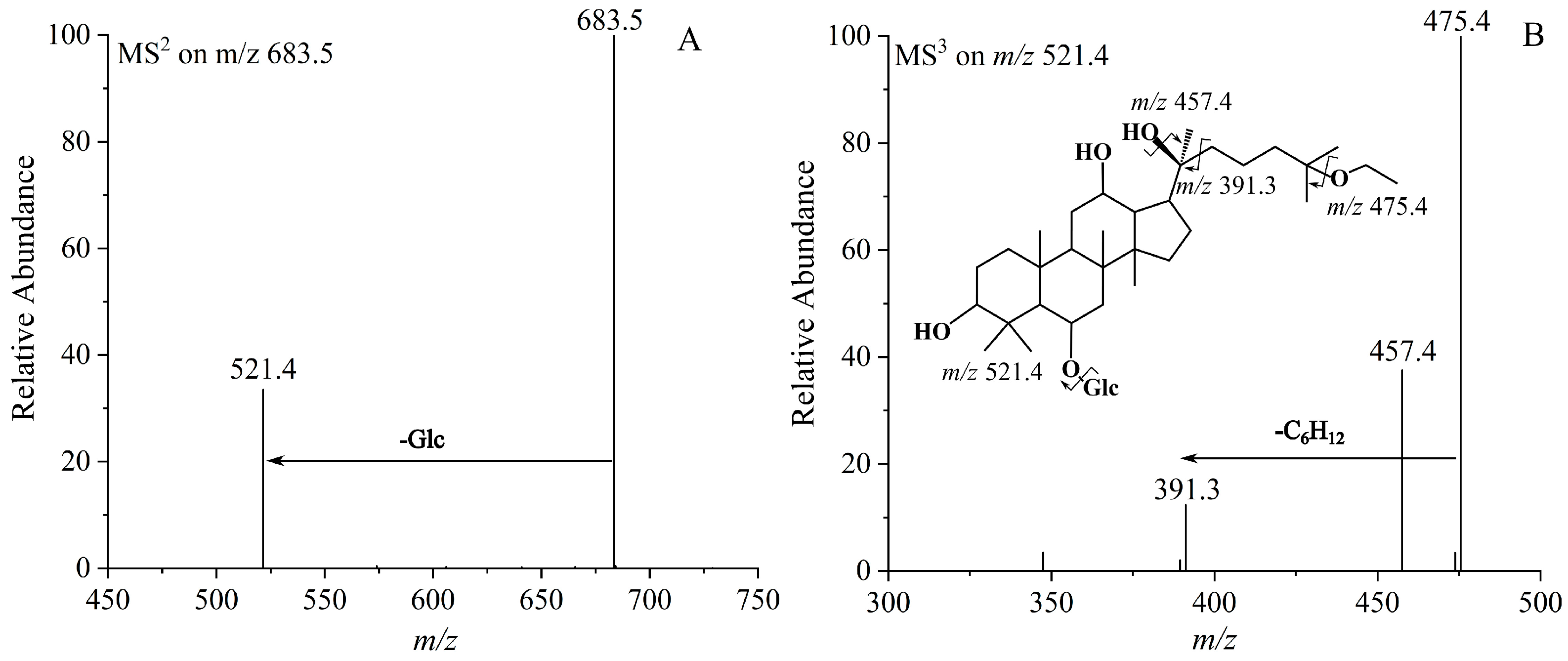
Compounds 7 and 10 were similarly identified as a pair of epimers, sharing an [M−H]− ion at m/z 683.5, corresponding to a molecular formula of C38H68O10 and a relative molecular mass of 684.5. The MS2 spectra of their [M−H]− ions in Figure 6A and Figure S4A exhibited a single neutral loss of 162.1 Da, derived from glucosyl elimination and generating the main product ion at m/z 521.4. This indicates that compounds 7 and 10 retained only a glucosyl substituent at the C-6 position. As shown in Figure 6B and Figure S4B, MS3 analysis of the ions at m/z 521.4 revealed product ions at m/z 475.4, m/z 457.4, and m/z 391.3, which are consistent with those of compounds 8 and 9, suggesting the presence of the same ethoxylated PPT-type aglycone. Therefore, compounds 7 and 10 are derived from the further loss of the rhamnosyl substituent from compounds 8 and 9. They are identified as (20S)-25-OCH2CH3-Rh1 and (20R)-25-OCH2CH3-Rh1, respectively.
Figure 6.
MS2 spectrum of the [M−H]− ion at m/z 683.5 (A), fragmentation pathways, and MS3 spectrum of the product ion at m/z 521.4 (B) from ginsenoside (20S)-25-OCH2CH3-Rh1.
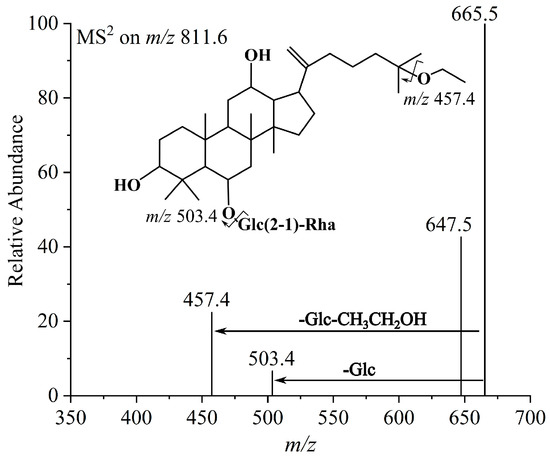
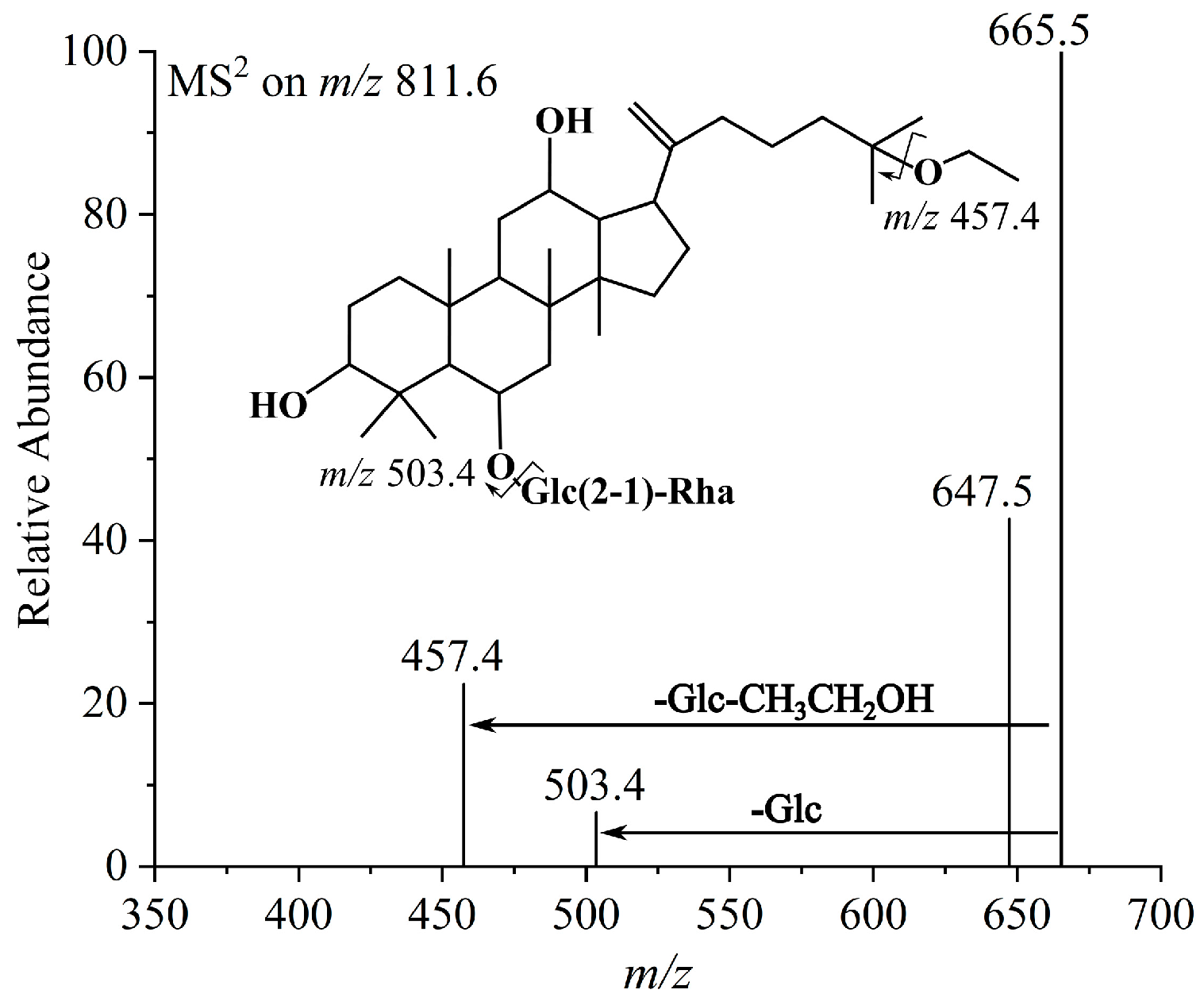
Compounds 17, 18, 21, and 23 constitute a set of four isomeric ginsenosides with an identical molecular formula of C44H76O13 and a relative molecular mass of 812.6. They exhibit nearly identical MS2 spectra of their [M−H]− ion at m/z 811.6, as shown in Figure 7, Figures S5 and S6. The product ions at m/z 665.5 and m/z 503.4, corresponding to sequential neutral loss of 146.1 Da and 162.1 Da, suggest the retention of the rutinose disaccharide substituent at the C-6 position. Given their relatively close retention times of compounds 17 and 18, and compounds 21 and 23, they are inferred to represent two pairs of structurally related isomers. Furthermore, the absence of the characteristic fragment at m/z 391.3 in all four compounds suggests a structural modification at the C-20 position.
Figure 7.
MS2 spectrum of the [M−H]− ion at m/z 811.6 from ginsenoside 25-OCH2CH3-Rg6.
A neutral loss of 46.0 Da between the aglycone ion at m/z 503.4 and the ion at m/z 457.4 indicates the presence of an ethoxyl group in the aglycone. The mass difference of 18.0 Da between the de-ethoxylated ion at m/z 457.4 and the absent characteristic aglycone ion of PPT-type ginsenosides at m/z 475.4 implies the formation of an additional double bond beyond the C-24(25) position. This extra unsaturation can only arise from dehydration of the hydroxyl group at C-20 following deglycosylation at this site. Subsequent addition of ethanol to these two double bonds at C-24(25) and C-20(21/22) would generate two pairs of ethoxylated isomers, consistent with the chromatographic pairing observed. According to Markovnikov’s rule under acidic conditions, when ethanol adds to the C-24(25) double bond, the ethoxyl group attaches to C-25, while the other double bond remains at C-20(21/22), forming Δ20(21) and Δ20(22) isomeric products. In contrast, when the addition occurs to the C-20(21/22) double bond, the ethoxyl group attaches to C-20, resulting in a pair of C-20 epimers and leaving the other double bond at C-24(25). Based on previous reports that 25-alkoxyl ginsenosides elute earlier than their 20-alkoxyl counterparts on C18 columns [12], compounds 17, 18, 21, and 23 are therefore assigned as 25-OCH2CH3-Rg6, 25-OCH2CH3-F4, (20S)-OCH2CH3-Rg2, and (20R)-OCH2CH3-Rg2, respectively.
2.2.2. Identification of Hydration Adducts
Compounds 2 and 3 exhibit a relative molecular mass of 802.6 and an aglycone ion at m/z 493.4, both 18.0 Da higher than those of (20S/R)-Rg2, indicating that they are hydration products of the Rg2 epimers. As shown in the MS3 spectra of the ion at m/z 493.4 (Figures S7B and S8B), product ions at m/z 475.4, m/z 417.4, and m/z 391.3 are observed. The 58.0 Da neutral loss between the ions at m/z 475.4 and m/z 417.4 corresponds to the fragment C3H6O, which is generated by dissociation of a tertiary alcohol with two methyl groups at C-25, formed upon hydration on the C-24(25) double bond. This characteristic neutral loss provides evidence that the hydroxyl group is attached to C-25 in accordance with Markovnikov’s rule. Therefore, compounds 2 and 3 are assigned as (20S)-Rf2 and (20R)-Rf2, respectively.
The aglycone ion of compounds 1 and 4 exhibits identical spectral features to that of (20S/R)-Rf2 (Figures S9 and S10), confirming that they possess the same 25-hydroxyl-PPT aglycone. With a relative molecular mass of 656.5, corresponding to the loss of a rhamnosyl substituent from (20S/R)-Rf2 at the C-6 position, compounds 1 and 4 are identified as (20S)-25-OH-Rh1 and (20R)-25-OH-Rh1, respectively. Notably, their spectra also exhibit the characteristic 58.0 Da neutral loss associated with C-25 hydroxylation.
Similarly, compounds 5 and 6 exhibit a 58.0 Da neutral loss from the aglycone ion at m/z 475.4 (Figure S11), which indicates C-25 hydroxylation. However, unlike compounds 2 and 3, compounds 5 and 6 have the same relative molecular mass of 784.6 and degree of unsaturation as (20S/R)-Rg2. This suggests that the 18.0 Da mass increase from hydration is counterbalanced by dehydration at C-20, resulting in the formation of Δ20(21) and Δ20(22) derivatives. Therefore, compounds 5 and 6 are assigned as 25-OH-Rg6 and 25-OH-F4, respectively.
2.2.3. Identification of Cyclic Ether Derivatives
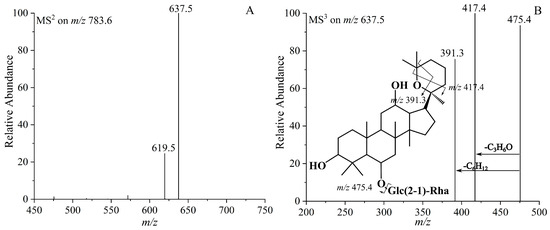
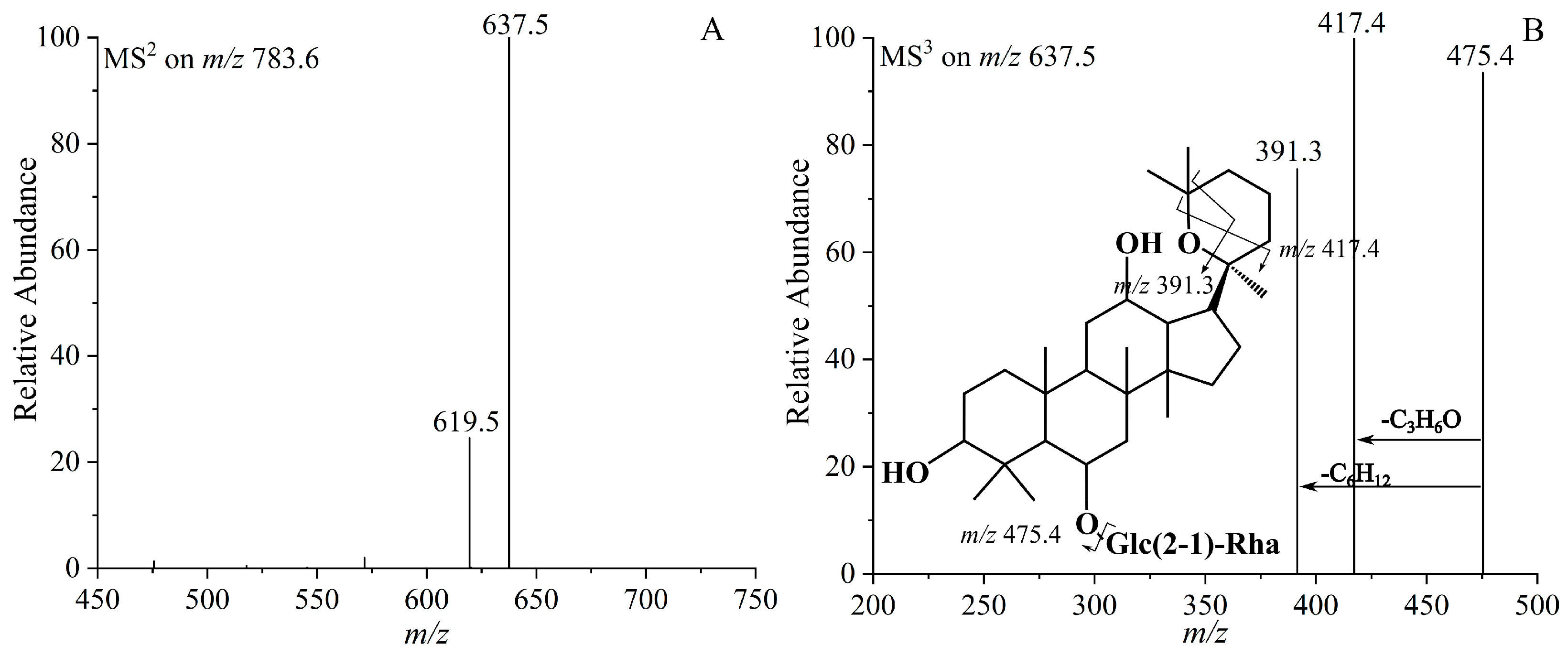
Compounds 15 and 16 represent another pair of isomers of (20S/R)-Rg2, both exhibiting a relative molecular mass of 784.6. As shown in Figure 8 and Figure S12, their MSn spectra are largely consistent with those of (20S/R)-Rg2, except for the presence of a distinctive product ion at m/z 417.4. Notably, two characteristic neutral losses of 58.0 Da and 84.1 Da are observed from the aglycon ion at m/z 475.4, corresponding to the fragmentation of the hydroxylated C-25 and the intact olefin chain, respectively. Their coexistence appears contradictory under conventional hydration or dehydration mechanisms. The most plausible explanation is intramolecular cyclization between the C-20 hydroxyl group and the C-24(25) double bond, forming an ether bridge between C-20 and C-25. As illustrated in Figure 8B and Figure S12B, the 58.0 Da loss arises from concurrent cleavage of the C-C and C-O bonds adjacent to C-25, whereas the 84.1 Da loss results from cleavage of the C-20(21) and C-25(O) within the constrained cyclic structure. Therefore, compounds 15 and 16 are assigned as cyclic ether derivatives of (20S/R)-Rg2, specifically (20S, 25)-epoxy-Rg2 and (20R, 25)-epoxy-Rg2, respectively. This cyclization preserves the molecular mass but alters the olefin chain connectivity, enabling unique fragmentation patterns.
Figure 8.
MS2 spectrum of the [M−H]− ion at m/z 783.6 (A), fragmentation pathways, and MS3 spectrum of the product ion at m/z 637.5 (B) from ginsenoside (20S, 25)-epoxy-Rg2.
2.2.4. Identification by Comparison with Authentic Standards
In contrast to the isomeric transformation products discussed above, a distinct set of transformation products was identified by comparison of retention times and MSn spectra with those of authentic standards, revealing alternative reaction pathways under acidic aqueous conditions. Compounds 11, 12, 13, 14, 19, 20, 22, and 24 are identified as (20S)-Rg2, (20R)-Rg2, (20S)-Rh1, (20R)-Rh1, Rg6, F4, Rk3, and Rh4, respectively (Figures S13–S16). These compounds represent sequential deglycosylation and dehydration products derived from ginsenoside Re. Specifically, (20S/R)-Rg2 arise from cleavage of the C-20 glucosyl substituent of Re, followed by removal of the rhamnose unit at C-6 to yield (20S/R)-Rh1, both retaining the typical dammarane-type Δ24(25) olefin. Dehydration at the C-20 hydroxyl group of the Rg2 epimers generates Rg6 and F4, featuring C-20(21) and C-20(22) double bonds, respectively. Further deglycosylation at C-6 of these dehydrated intermediates gives rise to Rk3 and Rh4, which possess the minimal number of glycosyl substituents and exhibit a highly rigid triterpenoid core due to the formation of the conjugated diene system.
To validate the structural assignments of the transformation products derived from MSn analysis, HRMS was performed in both all-ion fragmentation and data-dependent MS2 modes using normalized collision energy. As summarized in Table 1, the product ion profiles of all 24 compounds showed excellent consistency between HRMS and MSn data. Accurate mass measurements of the key fragment ions confirmed the elemental compositions proposed in the structural identification. This correlation highlights the reliability and precision of the HPLC-MSn approach for structural characterization in this study.
Table 1.
HRMS-derived molecular and ion data for ginsenoside Re transformation products in aqueous ethanol.
2.3. Transformation Pathways and Mechanisms of Ginsenoside Re in Aqueous Ethanol
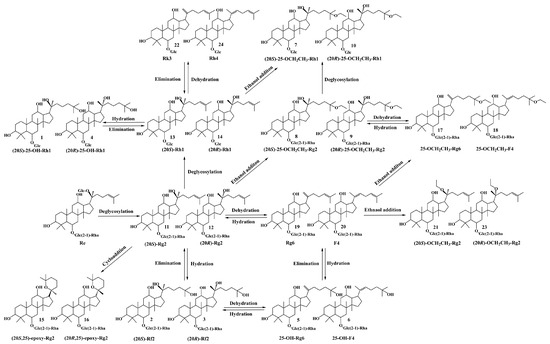
The catalytic transformation of ginsenoside Re over HSiW@mSiO2 in aqueous ethanol yielded 24 rare ginsenosides, including seven pairs of isomers, one set of four isomers, and one set of six isomers. As illustrated in Scheme 1, the transformation cascade centers on the formation and subsequent transformation of the key intermediates, (20S/R)-Rg2, where deglycosylation, elimination, epimerization, nucleophilic addition, and intramolecular cyclization proceed concurrently to generate structural diversity.
Scheme 1.
Transformation pathways of ginsenoside Re in aqueous ethanol.
2.3.1. Regioselective Deglycosylation
The transformation initiates with the selective hydrolysis of the outer glucosyl substituent at the C-20 position of ginsenoside Re, preferentially over the disaccharide substituent at the C-6 position, yielding (20S/R)-Rg2 as the primary intermediate. This regioselectivity is rationalized by the carbenium ion mechanism: cleavage of the C-20 glycosidic bond generates a tertiary carbocation, which is thermodynamically more stable than the secondary carbocation formed by C-6 glycosidic bond cleavage due to steric constraints in the aglycone framework [9]. This is further supported by the observation that most transformation products retain the C-6 disaccharide substituent, indicating lower reactivity of the C-6 glycosidic bond under the reaction conditions. Consequently, under HSiW@mSiO2-catalyzed acidic conditions, the C-20 glycosidic bond is hydrolyzed more readily, establishing (20S/R)-Rg2 as the key intermediate for subsequent transformations.
2.3.2. E1 Dehydration
Following the formation of (20S/R)-Rg2, the hydroxyl group at the C-20 position undergoes E1 elimination under acidic conditions. In this unimolecular process, the rate-determining step is the formation of a carbocation intermediate, whose stability determines the activation barrier and overall reaction rate [9,37]. The kinetics are first-order with respect to the concentration of (20S/R)-Rg2. In the early reaction stage, the high concentration of (20S/R)-Rg2 promotes efficient dehydration, leading to the formation of positional isomers Rg6 and F4, which are characterized by C-20(21) and C-20(22) double bonds, respectively. These newly formed double bonds, along with the inherent C-24(25) double bond of the aglycone, serve as critical reactive sites for subsequent nucleophilic addition reactions.
2.3.3. Nucleophilic Addition and Cyclization
Under acidic conditions, the double bonds are protonated to form tertiary carbocation intermediates, which can be trapped by nucleophiles such as water or ethanol. The stability of these intermediates is primarily influenced by hyperconjugation and the inductive effects from the adjacent alkyl groups. These effects determine the regioselectivity of the addition, whereby the functional groups preferentially attach to the C-20 or C-25 positions in accordance with Markovnikov’s rule [38,39,40]. This pathway yields six hydroxylated products and eight ethoxylated products. Notably, while tertiary alcohols can undergo acid-catalyzed dehydration to regenerate the olefins, ethoxyl groups are poor leaving groups under these conditions, rendering ethanol addition effectively irreversible. This kinetic trapping effect leads to the progressive accumulation of ethoxylated products despite the lower nucleophilicity of ethanol. Therefore, the differential reversibility of hydration versus ethanol addition plays a decisive role in product distribution.
In addition to intermolecular addition, the C-20 hydroxyl group in Rg2 can act as an intramolecular nucleophile. Upon protonation, it attacks the electrophilic C-25 of the C-24(25) double bond, yielding the 20,25-epoxy-Rg2 epimers. This intramolecular cyclization competes with intermolecular nucleophilic addition and is influenced by solvent polarity, substrate concentration, and molecular conformation.
In summary, the structural diversity of the 24 rare ginsenosides arises from a combination of acid-catalyzed transformations initiated by selective deglycosylation, with the inherent C-24(25) double bond serving as a key reactive center for both intermolecular nucleophilic addition and intramolecular cyclization. Concurrently, dehydration at C-20 generates transient olefins that further expand the product profile through solvent-dependent trapping. The aqueous ethanol medium thus acts not only as a solvent but also as a co-reactant, enabling the efficient generation of structurally diverse and potentially bioactive ginsenoside derivatives.
2.4. Effects of Reaction Conditions on Ginsenoside Re Transformation in Aqueous Ethanol
2.4.1. Time Course Analysis of Reaction Pathway
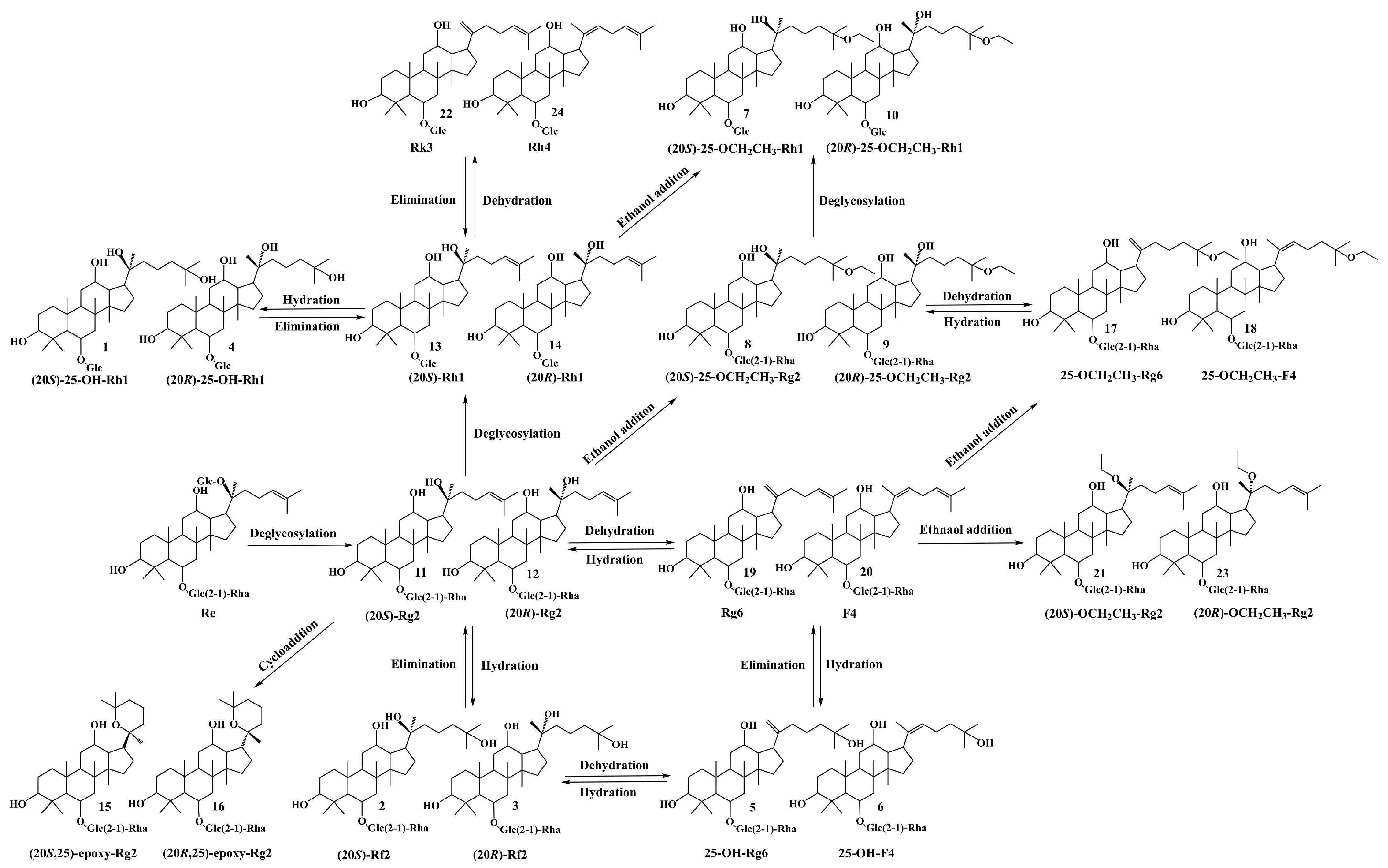
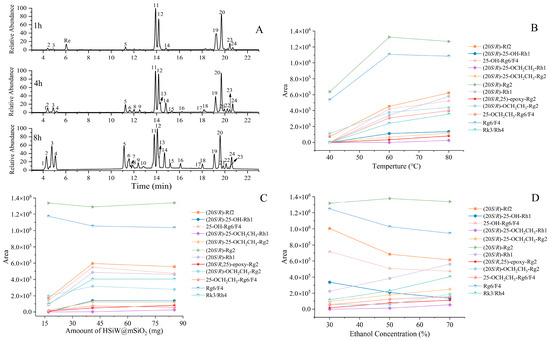
Time-course analysis (Figure 9A) elucidated the sequential nature of the transformation pathways. Within the 1 h of reaction in 70% ethanol, the primary products of (20S/R)-Rg2, Rg6, and F4 emerged. The high abundance of the (20S/R)-Rg2 is indicative of their role as predominant products. The concurrent formation of Rg6 and F4 indicates that E1 elimination at C-20 proceeds efficiently under mild acidic conditions, thus surpassing competing addition pathways. By 4 h, complete consumption of Re is observed, and the full spectrum of 24 transformation products has emerged. The extension of the reaction time to 8 h resulted in a substantial decrease in the peak areas of early-stage intermediates, accompanied by a notable increase in the abundance of subsequent products. This shift reflects the consumption of primary intermediates in subsequent reactions, including nucleophilic additions and further deglycosylation at the C-6 position, highlighting the dynamic and multi-stage character of the overall transformation.
Figure 9.
TIC of ginsenoside Re transformation products in aqueous ethanol after 1 h, 4 h, and 8 h (A). Peak areas of the transformation products at varied temperature (B), catalyst amount (C), and ethanol concentration (D).
2.4.2. Temperature-Dependent Reaction Kinetics
The reaction temperature was found to have a significant effect on both the rate and selectivity of product formation. At 40 °C, the reaction proceeded selectively, yielding predominantly Rg2 epimers, their ethoxylated products (20S/R)-OCH2CH3-Rg2, and the dehydration products Rg6 and F4 after 8 h (Figure 9B). This demonstrates that the primary transformations of deglycosylation, elimination, and initial addition are accessible even under mild thermal conditions, thereby indicating the high catalytic efficiency of HSiW@mSiO2. Elevating the temperature to 80 °C dramatically accelerated the reaction kinetics, enabling the rapid generation of the additional 18 products. Notably, the relative abundance of early intermediates decreased, while advanced transformation products, particularly those derived from nucleophilic addition and C-6 deglycosylation, increased substantially. This temperature-driven shift confirms that higher thermal energy promotes the progression of secondary and tertiary reactions, thereby expanding the structural diversity of the resulting rare ginsenosides.
2.4.3. Catalyst Dosage and Product Distribution
The concentration of accessible Brønsted acid sites, controlled by HSiW@mSiO2 dosage, directly modulates reaction efficiency. Increasing the catalyst amount from 17.1 mg to 40.9 mg significantly enhanced the rate of nucleophilic addition of water and ethanol to olefin intermediates (Figure 9C). This observation indicates that an elevated proton availability accelerates key transformation steps such as double bond protonation and carbocation formation. However, further increasing the loading to 85.3 mg resulted in only minimal additional improvements in product yield or distribution. This plateau effect suggests that the system reaches a state of acid site saturation, where the rate of proton transfer is no longer limited by catalyst concentration but likely by diffusion or intrinsic kinetic barriers, indicating optimal catalytic efficiency at moderate dosages.
2.4.4. Solvent-Dependent Nucleophilic Addition Selectivity
The ethanol/water ratio emerged as a critical parameter for modulating reaction selectivity. At 30% ethanol, hydration products, such as Rf2 epimers, 25-OH-Rg6, and 25-OH-F4, predominated, indicating that water acts as the dominant nucleophile under aqueous-rich conditions (Figure 9D). In contrast, an increase in the ethanol concentration to 70% led to a substantial reversal in selectivity, with hydration products decreasing considerably and ethoxylated products becoming significantly more abundant. This clear trend demonstrates a competitive nucleophilic addition mechanism between water and ethanol at electrophilic carbons generated upon protonation of C-20(21), C-20(22), and C-24(25) double bonds. Thus, solvent composition acts as an effective tool to modulate product distribution, with elevated ethanol concentrations enabling access to novel ethoxylated rare ginsenosides.
2.5. Reusability and Structural Stability of HSiW@mSiO2 in Sequential Cycles
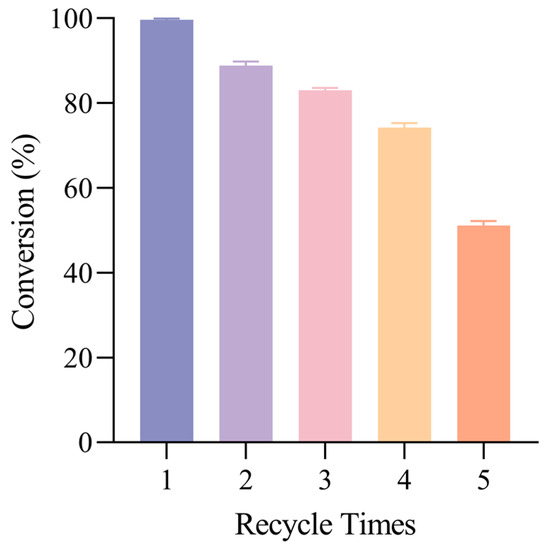
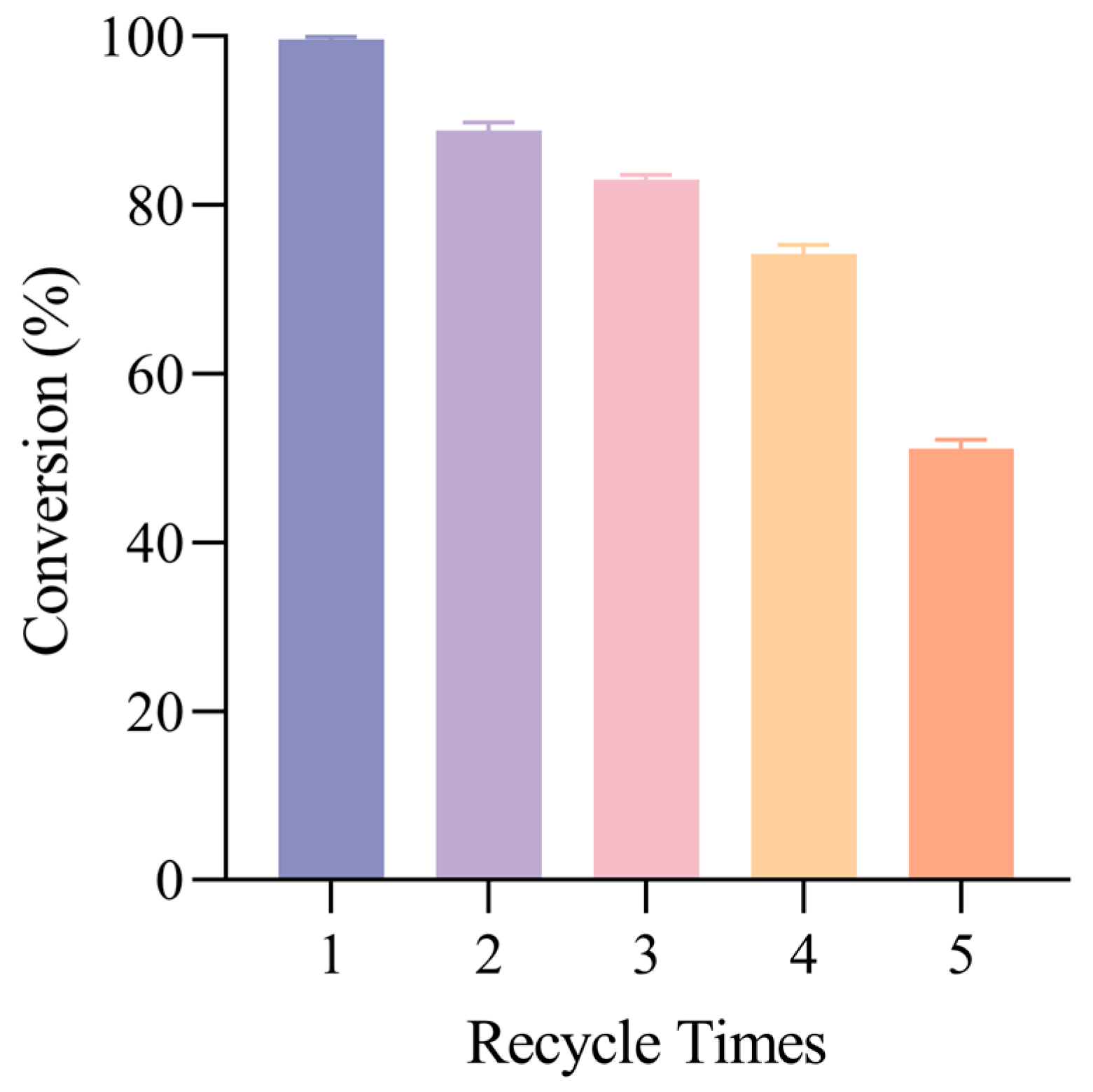
The heterogeneous catalyst HSiW@mSiO2 can be readily separated from the reaction mixture by centrifugation after promoting the transformation of ginsenoside Re in 70% aqueous ethanol solution at 80 °C for 4 h, enabling its reuse across consecutive runs. After isolation, the catalyst was washed, dried under vacuum at 50 °C, and directly used in the next cycle. As shown in Figure 10, full substrate transformation was maintained during the first two cycles, but a gradual decrease in activity became evident thereafter, reaching about 50% conversion by the fifth cycle. This deactivation is primarily attributed to partial leaching of the active HSiW species from the mesoporous silica framework, as supported by the ICP-MS analysis showing a decrease in tungsten content from 105.6 mg/g in the fresh catalyst to 72.3 mg/g after five cycles, alongside subtle degradation of the framework under prolonged acidic conditions. Together, these factors reduce the density of accessible Brønsted acid sites. These results underscore the critical role of immobilization stability in determining long-term catalyst performance.
Figure 10.
Transformation rate of ginsenoside Re catalyzed by HSiW@mSiO2 at different cycle times.
3. Materials and Methods
3.1. Chemicals and Materials
12-tungstosilicic acid (H4SiW12O40) of analytical grade and authentic ginsenoside standards (purity ≥ 98%) of Re, (20S)-Rg2, (20R)-Rg2, (20S)-Rh1, (20R)-Rh1, Rh4, Rk3, Rg6, and F4, were purchased from Shanghai Yuanye Biological Technology Co., Ltd. (Shanghai, China). Tetraethyl orthosilicate (TEOS), hexadecyl trimethyl ammonium bromide (CTAB), and ammonium hydroxide (NH3·H2O) of analytical grade were purchased from Shanghai Macklin Biochemical Co., Ltd. (Shanghai, China). HPLC-grade acetonitrile, ethanol, and formic acid were purchased from Tedia (Fairfield, OH, USA) and Thermo Fisher Scientific (Waltham, MA, USA), respectively. Ultrapure water was prepared using a Milli-Q water purification system (Merck Millipore, Burlington, MA, USA).
3.2. Instruments and Conditions
XRD patterns were recorded using a TDM-10 diffractometer (Dandong Tongda Technology Co., Ltd., Dandong, China), which was equipped with Cu Kα radiation (λ = 1.5418 Å). Low-angle XRD data (1–5° 2θ) were collected to investigate the mesoporous structure, and wide-angle XRD data (10–70° 2θ) were acquired to assess crystallinity. Measurements were performed at a tube voltage of 40 kV and a current of 30 mA. FTIR spectra were recorded on a Thermo Scientific Nicolet iS10 spectrometer (Waltham, MA, USA) in the wavenumber range of 4000–400 cm−1 with a resolution of 4 cm−1. Samples were prepared as KBr pellets prior to analysis. TEM images were acquired using a JEOL JEM-2100F electron microscope (JEOL Ltd., Tokyo, Japan) operated at an accelerating voltage of 200 kV. Samples were dispersed in ethanol, sonicated, and drop-cast onto carbon-coated copper grids prior to analysis. Inductively coupled plasma mass spectrometry (ICP-MS) was performed on an Agilent 7800 instrument (Agilent Technologies, Santa Clara, CA, USA) to determine the elemental content.
HPLC analysis was carried out on a Thermo Scientific Ultimate 3000 system (San Jose, CA, USA) equipped with a Syncronis C18 column (100 × 2.1 mm, 1.7 μm). The column temperature was maintained at 35 °C. The mobile phase consisted of phase A (water containing 0.1% v/v formic acid) and phase B (acetonitrile). The flow rate was set to 0.2 mL/min. The gradient elution program was set as follows: 0–5 min (25% B), 5–8 min (30–36% B), 8–15 min (36–48% B), 15–20 min (48–70% B), 20–25 min (70–90% B), 25–28 min (90% B), and 28–34 min (90–25% B). The injection volume was 2.0 μL.
HRMS analysis was performed on a Q-Exactive hybrid quadrupole-Orbitrap mass spectrometer (Thermo Fisher Scientific, San Jose, CA, USA), while MSn experiments were conducted on an LTQ XL ion trap mass spectrometer (Thermo Fisher Scientific, San Jose, CA, USA). Both instruments were coupled online with the HPLC system via electrospray ionization (ESI) sources operated in negative-ion mode, which provided enhanced ionization efficiency for ginsenosides. The ion source parameters were optimized as follows: sheath gas flow rate, 35 (arbitrary units); auxiliary gas flow rate, 10 (arbitrary units); sweep gas flow rate, 1 (arbitrary unit); capillary temperature, 320 °C; and capillary voltage, −3.2 kV. The full-scan mass range was set to m/z 100–2000 with a resolution of 70,000 (at m/z 200), while the product ion scan range was set to m/z 200–1000.
3.3. Sample Preparation
3.3.1. Preparation of mSiO2
1.76 g of CTAB was dissolved in 561 mL of ultrapure water. 3.20 mL of NH3·H2O was then added, and the mixture was stirred for 30 min at room temperature. Subsequently, 9.33 mL of TEOS was added dropwise under vigorous stirring, and the reaction mixture was further stirred for 2 h. The mixture was aged at room temperature for 20 h. Following aging, the resulting gel products were collected by vacuum filtration using a Büchner funnel and filter paper, and washed repeatedly with a 50% ethanol-water solution (v/v) to remove CTAB and residual reactants. The collected solid was dried overnight at 80 °C, followed by calcination in air at 550 °C for 4 h. The final product was stored under vacuum.
3.3.2. Preparation of HSiW@mSiO2
0.6 g of HSiW was dissolved in 60 mL of ultrapure water, followed by the addition of 2 g of the as-prepared mSiO2. The resulting mixture was stirred at room temperature for 22 h, and the mixture was then transferred to a water bath at 50 °C to allow slow evaporation of the solvent. The resulting solid was dried at 100 °C for 12 h, followed by calcination in air at 300 °C for 2 h [10].
3.3.3. Transformation of Ginsenoside Re
2.0 mg of ginsenoside Re authentic standard was dissolved in 2 mL of 70% (v/v) ethanol aqueous solution. Then, 37.8 mg of the HSiW@mSiO2 catalyst was added to the solution. The reaction mixture was immediately transferred to a temperature-controlled shaking water bath set at 80 °C and reacted for 8 h with continuous shaking. After the reaction, the mixture was cooled to room temperature and then centrifuged at 3000 rpm for 2 min to pellet the catalyst. A 200 μL aliquot of the supernatant was diluted to 1 mL with ethanol, then passed through a 0.22 μm syringe filter prior to HPLC-MS analysis. The catalyst precipitate was collected, washed with 50% (v/v) ethanol aqueous solution, and dried under vacuum at 50 °C. The recovered catalyst was reused in consecutive transformation cycles of ginsenoside Re.
4. Conclusions
In this study, a mesoporous silica-supported heteropolyacid catalyst HSiW@mSiO2 was developed for the transformation of ginsenoside Re in aqueous ethanol solution. The catalyst promoted a cascade of acid-mediated reactions, including deglycosylation, epimerization, dehydration, nucleophilic addition, and intramolecular cyclization yielding 24 structurally diverse rare ginsenosides, as characterized by HPLC-MSn/HRMS. These products include seven pairs of isomers, one set of four isomers and one set of six isomers mainly arising from C-20 epimerization or differences in double bond location. Notably, eight ethoxylated PPT-type ginsenosides were formed via ethanol trapping of reactive carbocation intermediates, including (20S/R)-OCH2CH3-Rg2, (20S/R)-25-OCH2CH3-Rg2, their derhamnosylated derivatives (20S/R)-25-OCH2CH3-Rh1, and dehydrated derivatives 25-OCH2CH3-Rg6/F4. These ethoxylated products represent novel ginsenoside scaffolds featuring either C-20 or C-25 ethoxyl substitution and highlight the potential of solvent as a nucleophile in generating structurally unique and naturally rare ginsenoside analogs. The reaction efficiency was influenced by solvent composition, temperature, and catalyst loading. Furthermore, HSiW@mSiO2 could be readily recovered and reused for multiple cycles, although gradual activity loss was observed. This work demonstrates the utility of solid acid catalysts in enabling selective, tunable, and solvent-directed structural modification of complex natural products, offering a sustainable strategy for expanding the chemical diversity of bioactive ginsenosides.
Supplementary Materials
The following supporting information can be downloaded at: https://www.mdpi.com/article/10.3390/molecules30244753/s1, Figure S1: FTIR spectra of HSiW, mSiO2, and HSiW@mSiO2; Figure S2: The total ion chromatogram of untreated ginsenoside Re. Figure S3: MS2 spectrum of the [M−H]− ion at m/z 829.6 (A), fragmentation pathways, and MS3 spectrum of the product ion at m/z 521.4 (B) from ginsenoside (20R)-25-OCH2CH3-Rg2; Figure S4: MS2 spectrum of the [M−H]− ion at m/z 683.5 (A), fragmentation pathways, and MS3 spectrum of the product ion at m/z 521.4 (B) from ginsenoside (20R)-25-OCH2CH3-Rh1; Figure S5: MS2 spectrum of the [M−H]− ion at m/z 811.6 from ginsenoside 25-OCH2CH3-F4; Figure S6: MS2 spectra of the [M−H]− ion at m/z 811.6 from ginsenosides (20S)-OCH2CH3-Rg2 (A) and (20R)-OCH2CH3-Rg2 (B); Figure S7: MS2 spectrum of the [M−H]− ion at m/z 801.6 (A), fragmentation pathways, and MS3 spectrum of the product ion at m/z 493.4 (B) from ginsenoside (20S)-Rf2; Figure S8: MS2 spectrum of the [M−H]− ion at m/z 801.6 (A), fragmentation pathways, and MS3 spectrum of the product ion at m/z 493.4 (B) from ginsenoside(20R)-Rf2; Figure S9: MS2 spectrum of the [M−H]− ion at m/z 655.5 (A), fragmentation pathways, and MS3 spectrum of the product ion at m/z 493.4 (B) from ginsenoside (20S)-25-OH-Rh1; Figure S10: MS2 spectrum of the [M−H]− ion at m/z 655.5 (A), fragmentation pathways, and MS3 spectrum of the product ion at m/z 493.4 (B) from ginsenoside (20R)-25-OH-Rh1; Figure S11: MS2 spectra of the [M−H]− ion at m/z 783.6 from ginsenosides 25-OH-Rg6 (A) and 25-OH-F4 (B); Figure S12: MS2 spectrum of the [M−H]− ion at m/z 783.6 (A), fragmentation pathways, and MS3 spectrum of the product ion at m/z 637.5 (B) from ginsenoside (20R,25)-epoxy-Rg2; Figure S13: MS2 spectra of the [M−H]− ion at m/z 783.6 from ginsenosides (20S)-Rg2 (A) and (20R)-Rg2 (B); Figure S14: MS2 spectra of the [M−H]− ion at m/z 637.5 from ginsenosides (20S)-Rh1 (A) and (20R)-Rh1 (B); Figure S15: MS2 spectra of the [M−H]− ion at m/z 765.6 from ginsenosides Rg6 (A) and F4 (B); Figure S16: MS2 spectra of the [M−H]− ion at m/z 619.5 from ginsenosides Rk3 (A) and Rh4 (B).
Author Contributions
Conceptualization, Y.C. and Y.X.; methodology, Q.W. and B.L.; software, M.Z. and Z.Z.; validation, Q.W., Y.C. and M.Z.; formal analysis, Q.W. and Y.C.; investigation, Q.W. and Y.C.; resources, Q.W.; data curation, Q.W. and B.L.; writing—original draft preparation, Q.W. and Y.C.; writing—review and editing, Q.W., Y.C. and Y.X.; visualization, Z.Z.; supervision, H.Z. and Y.X.; project administration, H.Z. and Y.X.; funding acquisition, Y.X. All authors have read and agreed to the published version of the manuscript.
Funding
This work was funded by the Science and Technology Development Plan of Jilin Province of China (YDZJ202401089ZYTS) and the “Golden Seed” Key Supported Areas Innovation and Entrepreneurship Project Funding Program of Changchun University of Chinese Medicine.
Institutional Review Board Statement
Not applicable.
Informed Consent Statement
Not applicable.
Data Availability Statement
The data supporting this article have been included as part of the Supplementary Materials.
Conflicts of Interest
The authors declare no conflicts of interest.
References
- He, J.; Wang, J.; Qi, G.; Yao, L.; Li, X.; Paek, K.-Y.; Park, S.-Y.; Gao, W. Comparison of polysaccharides in ginseng root cultures and cultivated ginseng and establishment of high-content uronic acid plant synthesis system. Ind. Crops Prod. 2022, 186, 115155. [Google Scholar] [CrossRef] [Scilit]
- Ito, H.; Ito, M. Recent trends in ginseng research. J. Nat. Med. 2024, 78, 455–466. [Google Scholar] [CrossRef] [Scilit]
- Huang, L.; Ren, C.; Li, H.-J.; Wu, Y.-C. Recent Progress on Processing Technologies, Chemical Components, and Bioactivities of Chinese Red Ginseng, American Red Ginseng, and Korean Red Ginseng. Food Bioprocess Technol. 2021, 15, 47–71. [Google Scholar] [CrossRef] [Scilit]
- Ge, S.; Liu, J.; Liu, Y.; Song, J.; Wu, H.; Li, L.; Zhu, H.; Feng, B. Chemical Profiling, Quantitation, and Bioactivities of Ginseng Residue. Molecules 2023, 28, 7854. [Google Scholar] [CrossRef] [Scilit]
- Geng, X.; Wang, J.; Liu, Y.; Liu, L.; Liu, X.; Zhao, Y.; Wang, C.; Liu, J. Research progress on chemical diversity of saponins in Panax ginseng. Chin. Herb. Med. 2024, 16, 529–547. [Google Scholar] [CrossRef] [Scilit]
- Huang, W.C.; Huang, T.H.; Yeh, K.W.; Chen, Y.L.; Shen, S.C.; Liou, C.J. Ginsenoside Rg3 ameliorates allergic airway inflammation and oxidative stress in mice. J. Ginseng Res. 2021, 45, 654–664. [Google Scholar] [CrossRef] [Scilit]
- Wu, L.; Bai, L.; Dai, W.; Wu, Y.; Xi, P.; Zhang, J.; Zheng, L. Ginsenoside Rg3: A Review of its Anticancer Mechanisms and Potential Therapeutic Applications. Curr. Top. Med. Chem. 2024, 24, 869–884. [Google Scholar] [CrossRef] [Scilit]
- Ding, R.; Kan, Q.; Wang, T.; Xiao, R.; Song, Y.; Li, D. Ginsenoside Rh2 regulates triple-negative breast cancer proliferation and apoptosis via the IL-6/JAK2/STAT3 pathway. Front. Pharmacol. 2025, 15, 1483896. [Google Scholar] [CrossRef] [Scilit] [PubMed]
- Xiu, Y.; Zhao, H.; Gao, Y.; Liu, W.; Liu, S. Chemical transformation of ginsenoside Re by a heteropoly acid investigated using HPLC-MSn/HRMS. New J. Chem. 2016, 40, 9073–9080. [Google Scholar] [CrossRef] [Scilit]
- Zhao, M.; Xiao, Y.; Chang, Y.; Tian, L.; Zhou, Y.; Liu, S.; Zhao, H.; Xiu, Y. Methanol-involved heterogeneous transformation of ginsenoside Rb1 to rare ginsenosides using heteropolyacids embedded in mesoporous silica with HPLC-MS investigation. J. Ginseng Res. 2024, 48, 366–372. [Google Scholar] [CrossRef] [Scilit]
- Zhao, M.; Tian, L.; Xiao, Y.; Chang, Y.; Zhou, Y.; Liu, S.; Zhao, H.; Xiu, Y. Heterogeneous Transformation of Ginsenoside Rb1 with Ethanol Using Heteropolyacid-Loaded Mesoporous Silica and Identification by HPLC-MS. ACS Omega 2023, 8, 43285–43294. [Google Scholar] [CrossRef] [Scilit] [PubMed]
- Chang, Y.; Li, B.; Xiao, Y.; Zhao, M.; Zhou, Y.; Zhao, H.; Xiu, Y. Diverse rare ginsenosides derived from ginsenoside Re in aqueous methanol solution via heterogeneous catalysis and identified by HPLC-MS. RSC Adv. 2025, 15, 16455–16467. [Google Scholar] [CrossRef] [Scilit]
- Gao, Y.; Feng, Y.; Chang, Y.; Zhu, Z.; Zhao, H.; Xu, W.; Zhao, M.; Xiao, Y.; Tian, L.; Xiu, Y. Biotransformation of Ginsenoside Rb1 to Ginsenoside Rd and 7 Rare Ginsenosides Using Irpex lacteus with HPLC-HRMS/MS Identification. ACS Omega 2024, 9, 22744–22753. [Google Scholar] [CrossRef] [Scilit]
- Kim, S.Y.; Lee, H.N.; Hong, S.J.; Kang, H.J.; Cho, J.Y.; Kim, D.; Ameer, K.; Kim, Y.M. Enhanced biotransformation of the minor ginsenosides in red ginseng extract by Penicillium decumbens β-glucosidase. Enzym. Microb. Technol. 2022, 153, 109941. [Google Scholar] [CrossRef] [Scilit]
- da Silva, M.J.; Rodrigues, A.A.; Lopes, N.P.G. Keggin Heteropolyacid Salt Catalysts in Oxidation Reactions: A Review. Inorganics 2023, 11, 162. [Google Scholar] [CrossRef] [Scilit]
- Dias, C.N.; Santos-Vieira, I.C.M.S.; Gomes, C.R.; Mirante, F.; Balula, S.S. Heteropolyacids@Silica Heterogeneous Catalysts to Produce Solketal from Glycerol Acetalization. Nanomaterials 2024, 14, 733. [Google Scholar] [CrossRef] [Scilit]
- Escriche-Navarro, B.; Escudero, A.; Lucena-Sánchez, E.; Sancenón, F.; García-Fernández, A.; Martínez-Máñez, R. Mesoporous Silica Materials as an Emerging Tool for Cancer Immunotherapy. Adv. Sci. 2022, 9, 2200756. [Google Scholar] [CrossRef] [Scilit]
- Falcão, E.S.M.; Valadares, D.D.; dos Santos, G.M.; de Mendonça, E.S.D.; Santos, M.M.; Dias, S.C.L.; Dias, J.A. Preparation of 12-Tungstophosphoric Acid Embedded in a Silica Matrix and Its Effect on the Activity of 1-Propanol Dehydration. ACS Omega 2025, 10, 16277–16290. [Google Scholar] [CrossRef] [Scilit] [PubMed]
- Zhang, L.; Shah, A.; Michel, F.C. Synthesis of 5-hydroxymethylfurfural from fructose and inulin catalyzed by magnetically-recoverable Fe3O4@SiO2@TiO2–HPW nanoparticles. J. Chem. Technol. Biotechnol. 2019, 94, 3393–3402. [Google Scholar] [CrossRef] [Scilit]
- Hsu, B.Y.; Jen, C.T.; Inbaraj, B.S.; Chen, B.H. A Comparative Study on Analysis of Ginsenosides in American Ginseng Root Residue by HPLC-DAD-ESI-MS and UPLC-HRMS-MS/MS. Molecules 2022, 27, 3071. [Google Scholar] [CrossRef] [Scilit]
- Wang, H.P.; Zhang, Y.B.; Yang, X.W.; Zhao, D.Q.; Wang, Y.P. Rapid characterization of ginsenosides in the roots and rhizomes of Panax ginseng by UPLC-DAD-QTOF-MS/MS and simultaneous determination of 19 ginsenosides by HPLC-ESI-MS. J. Ginseng Res. 2016, 40, 382–394. [Google Scholar] [CrossRef] [Scilit]
- Xie, Y.Y.; Luo, D.; Cheng, Y.J.; Ma, J.F.; Wang, Y.M.; Liang, Q.L.; Luo, G.A. Steaming-Induced Chemical Transformations and Holistic Quality Assessment of Red Ginseng Derived from Panax ginseng by Means of HPLC-ESI-MS/MSn-Based Multicomponent Quantification Fingerprint. J. Agric. Food Chem. 2012, 60, 8213–8224. [Google Scholar] [CrossRef] [Scilit]
- Abashev, M.; Stekolshchikova, E.; Stavrianidi, A. Quantitative aspects of the hydrolysis of ginseng saponins: Application in HPLC-MS analysis of herbal products. J. Ginseng Res. 2021, 45, 246–253. [Google Scholar] [CrossRef] [Scilit]
- Wang, C.Q.; Yi, L.W.; Zhao, L.; Zhou, Y.Z.; Guo, F.; Huo, Y.S.; Zhao, D.Q.; Xu, F.; Wang, X.; Cai, S.Q. 177 Saponins, Including 11 New Compounds in Wild Ginseng Tentatively Identified via HPLC-IT-TOF-MSn, and Differences among Wild Ginseng, Ginseng under Forest, and Cultivated Ginseng. Molecules 2021, 26, 3371. [Google Scholar] [CrossRef] [Scilit]
- Ausavasukhi, A.; Noenkrathok, K.; Kongnok, N.; Wattanakul, T. Pivotal role of support architecture in encapsulating heteropolyacids: Enhancing water tolerance and suppressing leaching for aqueous ethanol dehydration. Sustain. Chem. Pharm. 2025, 48, 102212. [Google Scholar] [CrossRef] [Scilit]
- Chen, Y.; Zhang, X.; Dong, M.; Wu, Y.; Zheng, G.; Huang, J.; Guan, X.; Zheng, X. MCM-41 immobilized 12-silicotungstic acid mesoporous materials: Structural and catalytic properties for esterification of levulinic acid and oleic acid. J. Taiwan Inst. Chem. Eng. 2016, 61, 147–155. [Google Scholar] [CrossRef] [Scilit]
- Ashtekar, S.; Hastings, J.J.; Barrie, P.J.; Gladden, L.F. Quantification of the Number of Silanol Groups in Silicalite and Mesoporous MCM-41: Use of Ft-Raman Spectroscopy. Spectrosc. Lett. 2000, 33, 569–584. [Google Scholar] [CrossRef] [Scilit]
- Bhatt, N.; Patel, A. Esterification of 1° and 2° alcohol using an ecofriendly solid acid catalyst comprising 12-tungstosilicic acid and hydrous zirconia. J. Mol. Catal. A Chem. 2005, 238, 223–228. [Google Scholar] [CrossRef] [Scilit]
- Hu, W.; Xu, H.; Zhang, Z.; Duan, Y.; Lu, X.; Lu, L.; Si, C.; Peng, Y.; Li, X. Optimizing acidic site control for selective conversion of biomass-based sugar to furfural and levulinic acid through HSiW/MCM-41 catalyst. Biomass Bioenergy 2024, 186, 107275. [Google Scholar] [CrossRef] [Scilit]
- Hu, X.; Xiong, W.; Liu, X.; Wang, J.; Wang, S.; Chen, Q.; Gao, K.; Li, C.; Li, Y. Biomimetic, folic acid-modified mesoporous silica nanoparticles with “stealth” and “homing” capabilities for tumor therapy. Mater. Des. 2024, 241, 112899. [Google Scholar] [CrossRef] [Scilit]
- Ansari, A.A.; Khan, A.; Labis, J.P.; Alam, M.; Aslam Manthrammel, M.; Ahamed, M.; Akhtar, M.J.; Aldalbahi, A.; Ghaithan, H. Mesoporous multi-silica layer-coated Y2O3: Eu core-shell nanoparticles: Synthesis, luminescent properties and cytotoxicity evaluation. Mater. Sci. Eng. C Mater. Biol. Appl. 2019, 96, 365–373. [Google Scholar] [CrossRef] [Scilit]
- Kong, X.; Garg, S.; Mortazavi, M.; Ma, J.; Waite, T.D. Heterogenous Iron Oxide Assemblages for Use in Catalytic Ozonation: Reactivity, Kinetics, and Reaction Mechanism. Environ. Sci. Technol. 2023, 57, 18636–18646. [Google Scholar] [CrossRef] [Scilit]
- Beck, J.S.; Vartuli, J.C.; Roth, W.J.; Leonowicz, M.E.; Kresge, C.T.; Schmitt, K.D.; Chu, C.T.W.; Olson, D.H.; Sheppard, E.W.; McCullen, S.B.; et al. A new family of mesoporous molecular sieves prepared with liquid crystal templates. J. Am. Chem. Soc. 1992, 114, 10834–10843. [Google Scholar] [CrossRef] [Scilit]
- Luo, G.; Kang, L.; Zhu, M.; Dai, B. Highly active phosphotungstic acid immobilized on amino functionalized MCM-41 for the oxidesulfurization of dibenzothiophene. Fuel Process. Technol. 2014, 118, 20–27. [Google Scholar] [CrossRef] [Scilit]
- Yang, H.; Lee, D.Y.; Kang, K.B.; Kim, J.Y.; Kim, S.O.; Yoo, Y.H.; Sung, S.H. Identification of ginsenoside markers from dry purified extract of Panax ginseng by a dereplication approach and UPLC–QTOF/MS analysis. J. Pharm. Biomed. Anal. 2015, 109, 91–104. [Google Scholar] [CrossRef] [Scilit] [PubMed]
- Liang, Y.Z.; Guo, M.; Li, Y.F.; Shao, L.J.; Cui, X.M.; Yang, X.Y. Highly Regioselective Biotransformation of Protopanaxadiol-type and Protopanaxatriol-type Ginsenosides in the Underground Parts of Panax notoginseng to 18 Minor Ginsenosides by Talaromyces flavus. ACS Omega 2022, 7, 14910–14919. [Google Scholar] [CrossRef] [Scilit] [PubMed]
- Bockisch, C.; Lorance, E.D.; Hartnett, H.E.; Shock, E.L.; Gould, I.R. Kinetics and Mechanisms of Hydrothermal Dehydration of Cyclic 1,2- and 1,4-Diols. J. Org. Chem. 2022, 87, 14299–14307. [Google Scholar] [CrossRef] [Scilit]
- Mollar-Cuni, A.; Martín, S.; Guisado-Barrios, G.; Mata, J.A. Dual role of graphene as support of ligand-stabilized palladium nanoparticles and carbocatalyst for (de)hydrogenation of N-heterocycles. Carbon 2023, 206, 314–324. [Google Scholar] [CrossRef] [Scilit]
- Rahimi, L.; Mansoori, Y.; Nuri, A.; Koohi-Zargar, B.; Esquivel, D. A new Pd (II)-supported catalyst on magnetic SBA-15 for C-C bond formation via the Heck and Hiyama cross-coupling reactions. Appl. Organomet. Chem. 2020, 35, e6078. [Google Scholar] [CrossRef] [Scilit]
- Yamamoto, Y.; Itonaga, K. Versatile Friedel–Crafts-Type Alkylation of Benzene Derivatives Using a Molybdenum Complex/ortho-Chloranil Catalytic System. Chem. Eur. J. 2008, 14, 10705–10715. [Google Scholar] [CrossRef] [Scilit]

Disclaimer/Publisher’s Note: The statements, opinions and data contained in all publications are solely those of the individual author(s) and contributor(s) and not of MDPI and/or the editor(s). MDPI and/or the editor(s) disclaim responsibility for any injury to people or property resulting from any ideas, methods, instructions or products referred to in the content. |
© 2025 by the authors. Licensee MDPI, Basel, Switzerland. This article is an open access article distributed under the terms and conditions of the Creative Commons Attribution (CC BY) license (https://creativecommons.org/licenses/by/4.0/).