
This is an early access version, the complete PDF, HTML, and XML versions will be available soon.
Review

Pea Protein Isolates: From Extraction to Functionality

1
Adaptive Food Systems Accelerator-Science Centre, Wroclaw University of Economics and Business, Komandorska 118/120, 53-345 Wroclaw, Poland
2
Department of Biotechnology and Food Analysis, Wroclaw University of Economics and Business, Komadorska 118/120, 53-345 Wroclaw, Poland
*
Author to whom correspondence should be addressed.
Molecules 2025, 30(23), 4650; https://doi.org/10.3390/molecules30234650

Submission received: 5 November 2025 / Revised: 29 November 2025 / Accepted: 2 December 2025 / Published: 3 December 2025
(This article belongs to the Special Issue Featured Review Papers in Food Chemistry—2nd Edition)

Abstract

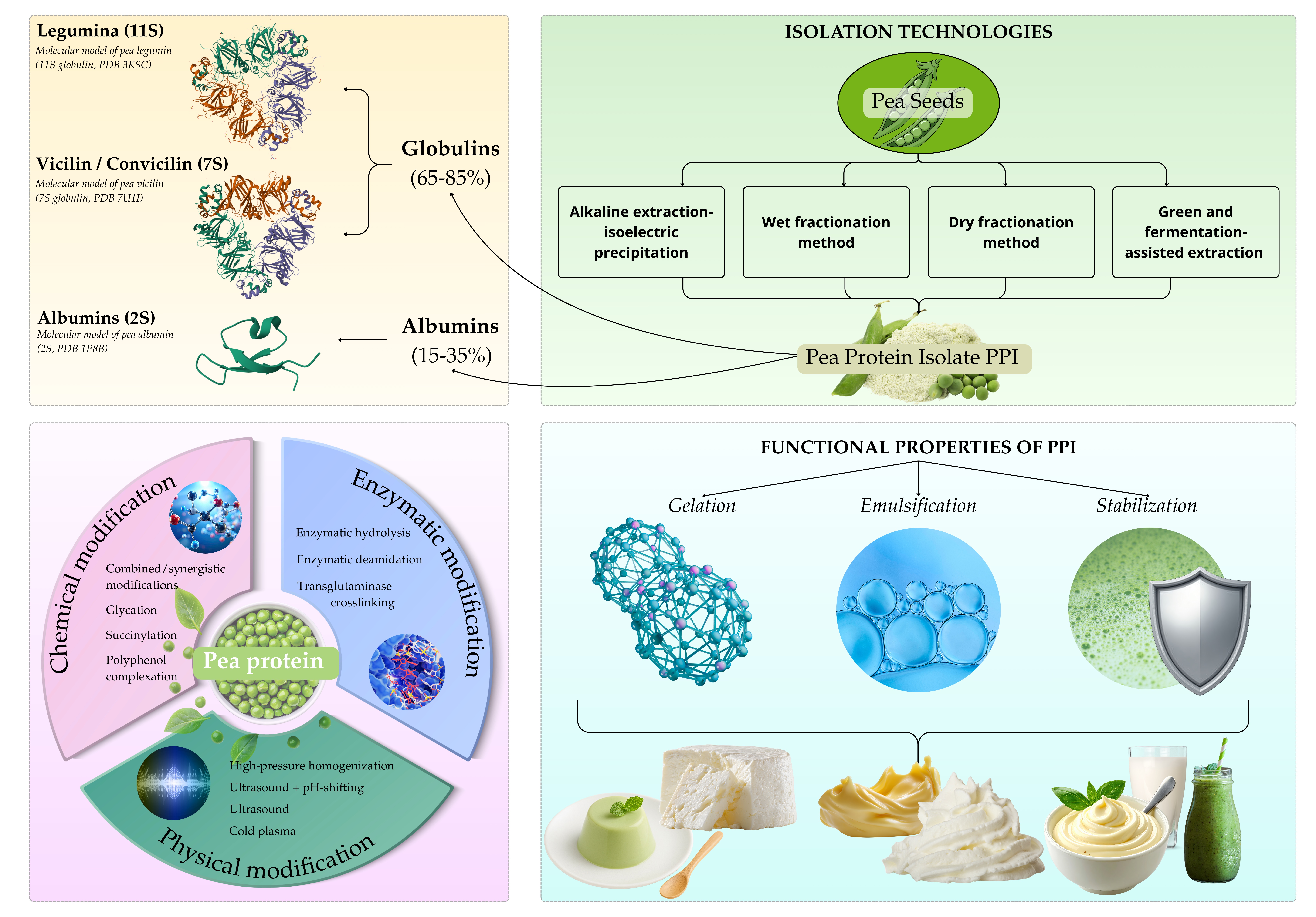
Pea protein isolates (PPIs) from Pisum sativum have emerged as strategic ingredients at the interface of nutrition, sustainability, and functional food design. This review synthesizes advances linking isolation procedures with molecular structure and techno-functional performance. We compare alkaline extraction–isoelectric precipitation with wet and dry fractionation, as well as green/fermentation-assisted methods, highlighting the purity–functionality trade-offs driven by denaturation, aggregation, and the removal of anti-nutritional factors. We relate globulin composition (vicilin/legumin ratio), secondary/tertiary structure, and disulfide chemistry to interfacial activity, solubility, gelation thresholds, and long-term emulsion stability. Structure-guided engineering strategies are critically evaluated, including enzymatic hydrolysis, deamidation, transglutaminase cross-linking, ultrasound, high-pressure homogenization, pH shifting, cold plasma, and selected chemical/glycation approaches. Application case studies cover high-moisture texturization for meat analogues, emulsion and Pickering systems, fermented dairy alternatives, edible films, and bioactive peptide-oriented nutraceuticals. We identify bottlenecks—weak native gel networks, off-flavors, acidic pH performance, and batch variability—and outline process controls and synergistic modifications that close functionality gaps relative to animal proteins. Finally, we discuss sustainability and biorefinery opportunities that valorize soluble peptide streams alongside globulin-rich isolates. By integrating extraction, structure, and function, the review provides a roadmap for designing PPI with predictable, application-specific performance.
Keywords: pea protein isolate; Pisum sativum; extraction; fractionation; emulsification; gelation; modifications pea protein isolate; Pisum sativum; extraction; fractionation; emulsification; gelation; modifications
Graphical Abstract