


Abstract
Density functional theory (DFT) calculations at the M06-2X-D3/6-311++G(2df,2pd) level elucidate the mechanism and selectivity origins in the NHC-catalyzed divergent synthesis of spirocyclopentane oxindoles from isatin-derived enals and N-sulfonyl ketimines. The Michael addition constitutes the regio- and stereoselectivity-determining step, where Parr function analysis demonstrates that nucleophile/electrophile electrophilicity governs regioselectivity, while distortion/interaction and non-covalent interaction analyses reveal stereoselectivity is controlled by distortion and weak interactions. K3PO4 facilitates Breslow intermediate formation and proton transfer toward the β-lactam-fused spirocyclopentane oxindole, whereas N,N-diisopropylethylamine (DIPEA) promotes these processes for the spirocyclopentane oxindole bearing an enaminone moiety. Catalyst roles are also further delineated.
1. Introduction
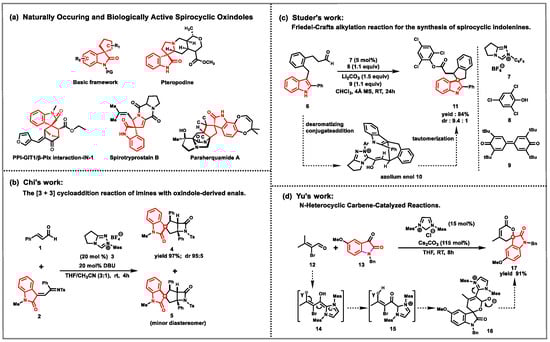
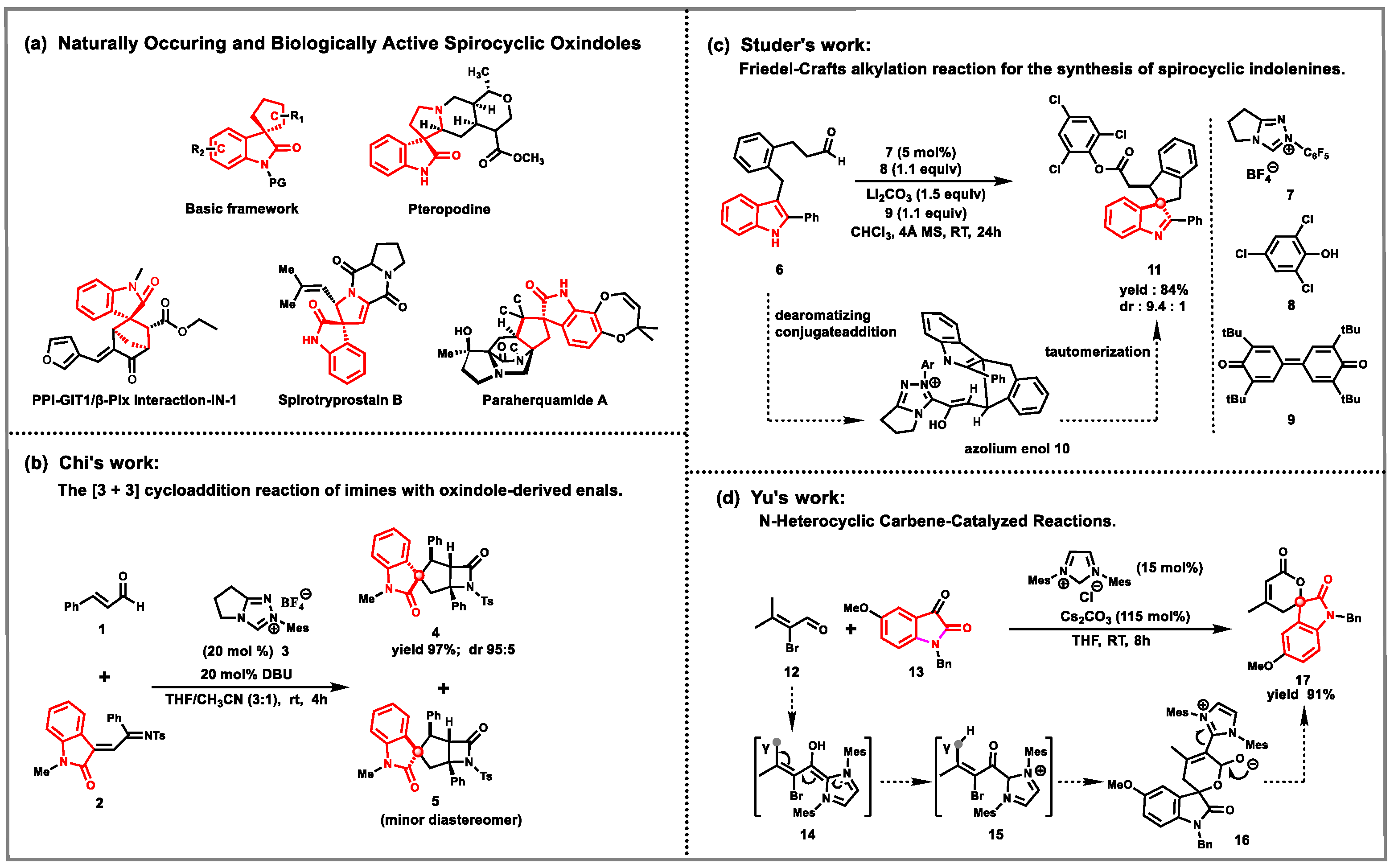
Spirocyclopentane oxindoles have attracted considerable interest in the fields of medicinal chemistry and organic synthesis, owing to their intricate structural features and potential applications in the domain of drug discovery [1,2,3]. Molecules endowed with spirocyclopentane oxindole not only augment the molecular rigidity and stereoconfiguration but also affords avenues for the nuanced modulation of the resultant molecules’ pharmacokinetic and pharmacodynamic attributes [4,5,6,7]. These compounds have been identified to possess diverse biological activities, including anti-inflammatory [8,9], anticancer [10], and antimicrobial properties [11,12] (Figure 1a). Stereochemical control for the synthesis of spirocyclopentane oxindole is crucial for ensuring the biological activity of the compounds.
Figure 1.
Representative examples of natural products containing the spirocyclopentane oxindole scaffold and related research.
Since the successful isolation and characterization of N-heterocyclic carbenes (NHCs) in 1991, NHCs have been widely recognized as powerful tools for enantioselective C-C bond formation, particularly in the synthesis of spirocyclic cyclopentane-fused oxindole molecules, Chi [13,14,15,16], Studer [17], Yu [18,19,20] and others have done a lot of excellent work [21,22,23,24] (Figure 1b–d). By modulating the electronic and steric properties of NHCs and substrates, they enable asymmetric syntheses of reactive intermediates with highly enantioenriched structures, such as acyl anion [25,26], acyl azoles [27,28,29,30,31,32], enolates [33,34,35,36,37,38] and homoenolates [39,40,41,42,43], to achieve selective transformations. Despite significant advances in switchable syntheses via catalytic regiodivergent processes [44,45,46], the development of switchable synthetic platforms that exploit a single substrate mode through distinct NHC catalysts remains a formidable challenge.
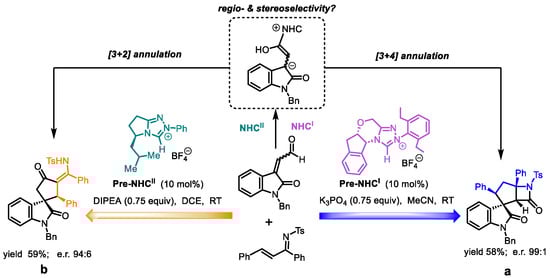
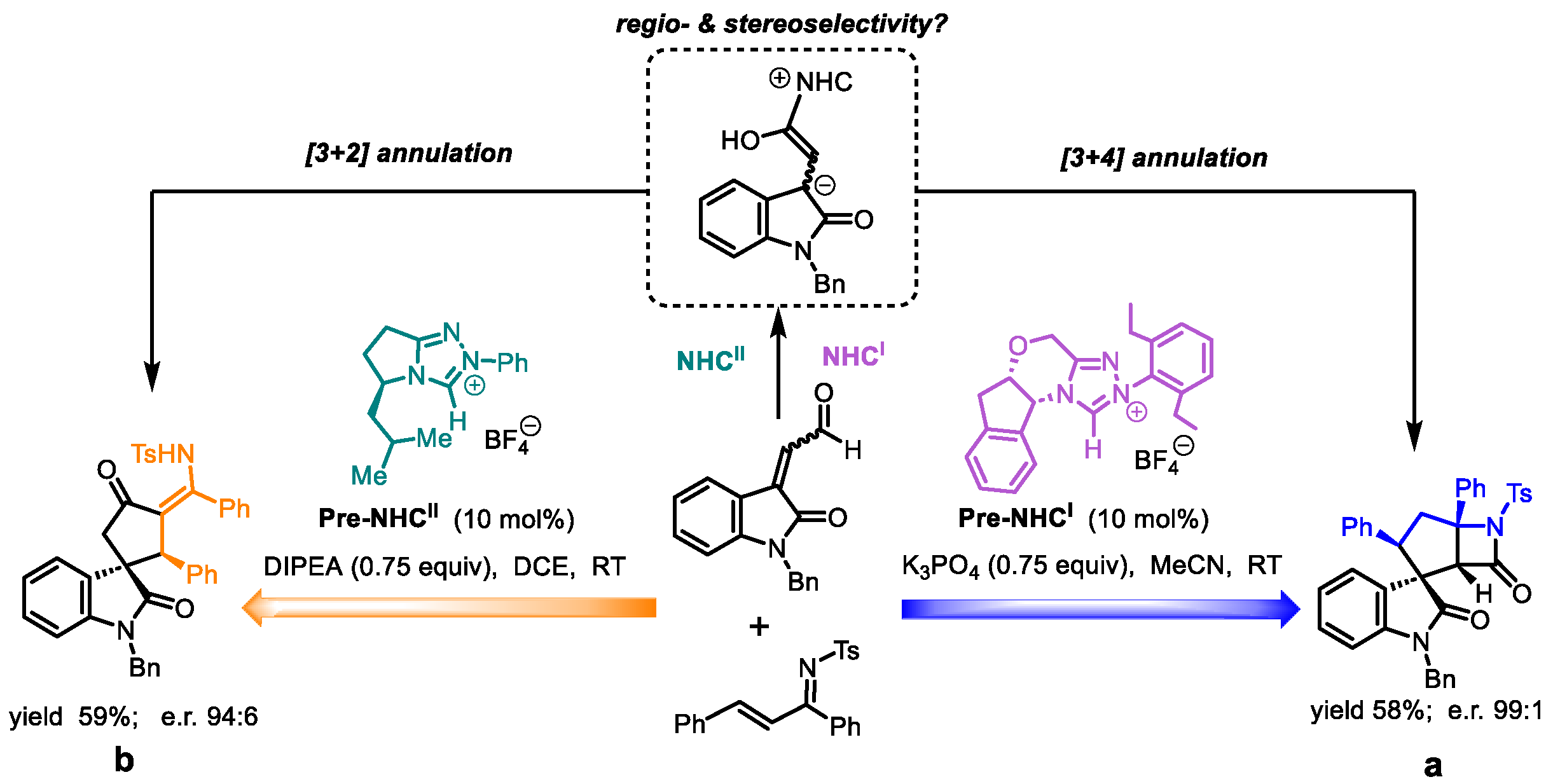
A variety of theoretical studied on NHC-catalyzed reactions have an important progress [47,48,49,50]. Notably, NHCs are commonly used in the synthesis of spirocyclization reactions. In this context, the switchable spirocyclization reaction developed by Enders and co-workers was the first to employ an NHC catalyst, which can catalyze indigo-derived enals and N-sulfonyl ketimines to yield different spirocyclic pentane oxindoles (Figure 2) [51]. Under Pre-NHCI catalysis, the reaction employing K3PO4 as the base in acetonitrile (MeCN) solvent affords spirocyclopentane oxindole scaffolds bearing a β-lactam moiety. Conversely, when mediated by Pre-NHCII with N,N-diisopropylethylamine (DIPEA) as the base in dichloroethane (DCE), the protocol selectively generates analogous spirocyclic architectures functionalized with an enaminone group, demonstrating precise catalyst-controlled divergent synthesis. Nevertheless, the detailed mechanism of NHC-controlled asymmetric reaction has remained unclear.
Figure 2.
NHC-Catalyzed Switchable [3+4] and [3+2] Annulations of Isatin-Derived Enals and N-Sulfonyl Ketimines (a: β-Lactam fused spirocyclopentane oxindole; b: spirocyclopentane oxindoles bearing an enaminone moiety).
Herein, we employed the mechanistically unexplored NHC-catalyzed switchable formation of spirocyclopentane oxindoles from isatin-derived enals and N-sulfonyl ketimines as a computational model (Figure 2). Density functional theory (DFT) studies were conducted to elucidate the reaction mechanism, regio- and stereoselectivity, as well as the role of the NHC catalyst.
2. Results and Discussion
2.1. Reaction Mechanism
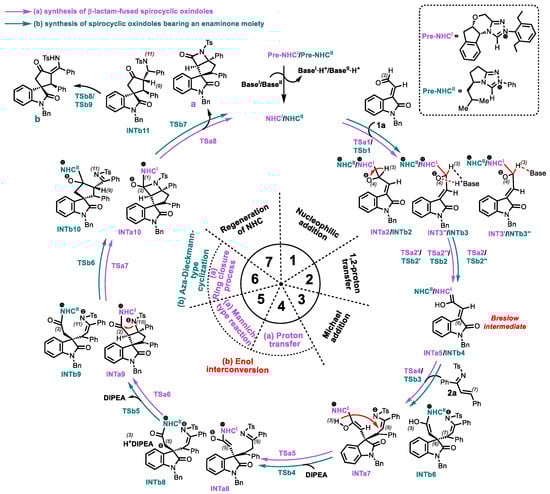
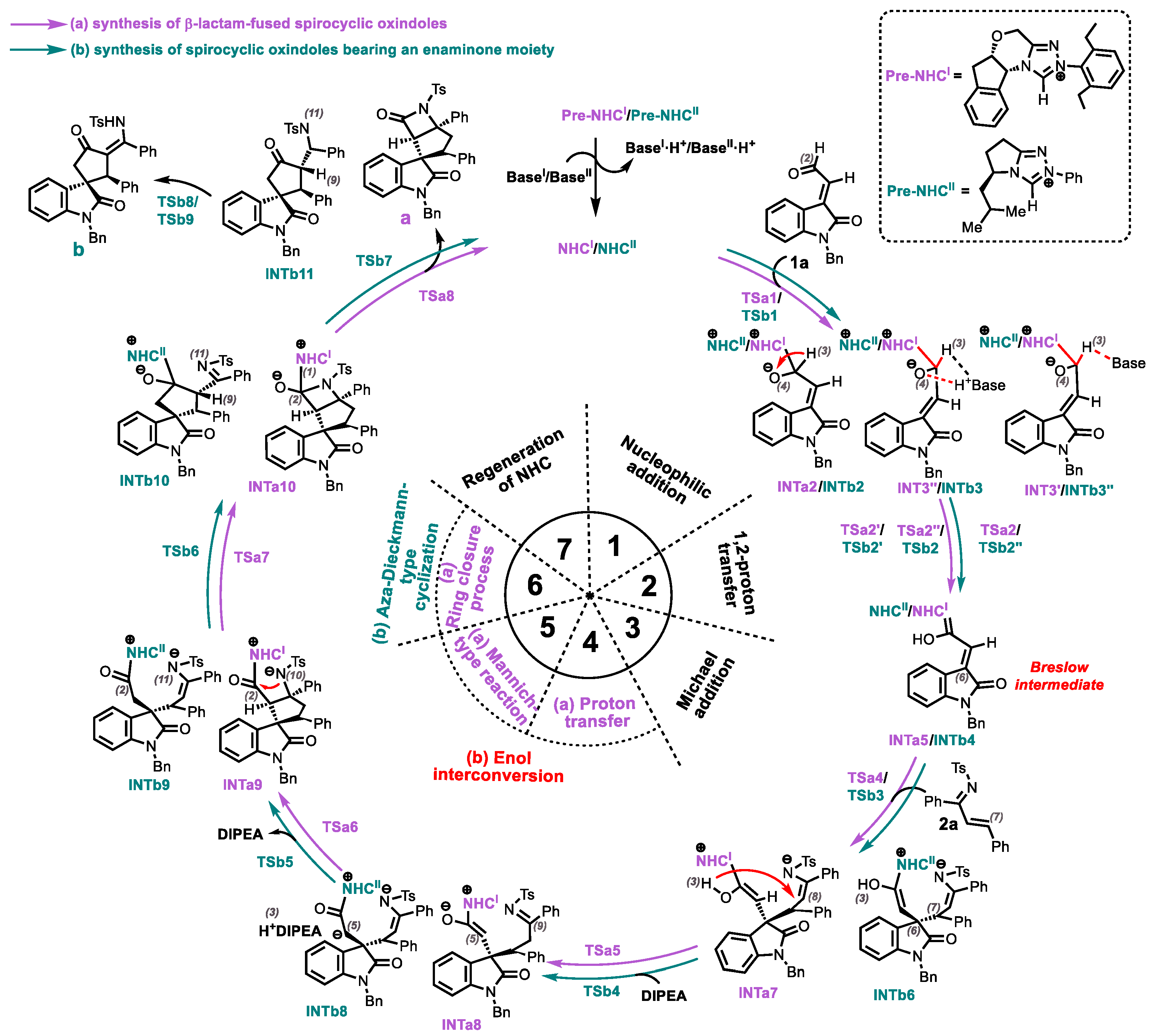
Based on the mechanistic hypothesis of Enders’ group [51] and the computational reports by Tang [52], Chen [53], and Zhang [54] et al., a plausible catalytic mechanism has been postulated for the NHC-catalyzed [3+4] and [3+2] annulation reactions of isatin-derived enals with N-sulfonylketimines, respectively, as depicted in Figure 3. In the catalytic pathway affording product a (purple cycle), the precatalyst Pre-NHCI undergoes base-mediated (K3PO4) deprotonation to generate the active catalyst NHCI. The ensuing seven-step catalytic manifold comprises: (1) Nucleophilic addition, (2) Breslow intermediate generation through 1,2-proton transfer, (3) Michael addition, (4) 1,3-proton transfer, (5) Mannich-type reaction, (6) Cyclization, and (7) Catalyst elimination. Conversely, the product b formation pathway (green cycle) initiates with DIPEA-promoted deprotonation of Pre-NHCII to access catalytically active catalyst NHCII species. This divergent mechanism features: (1) Nucleophilic addition, (2) Breslow intermediate generation through 1,2-proton transfer, (3) Michael addition, (4) Enol-tautomerism, (5) Aza-Dieckmann-type cyclization, (6) Catalyst elimination, and (7) Tautomerization. The detailed mechanisms of the reactions will be discussed step by step below.
Figure 3.
A plausible catalytic cycle of the reaction.
Product Generation Process for Compound a:
Step 1: NHCI Generation & Nucleophilic Addition
Following the above proposal, calculations were performed to reveal the mechanism of the NHCI-catalyzed [3+4] annulation reactions of isatin-derived enals 1a with N-sulfonylketimines 2a. The transformation begins with the barrierless K3PO4-mediated deprotonation of Pre-NHCI to provide the NHCI. This process is highly exergonic by 28.0 kcal/mol (Figure S1, Please see Supplementary Information for details).
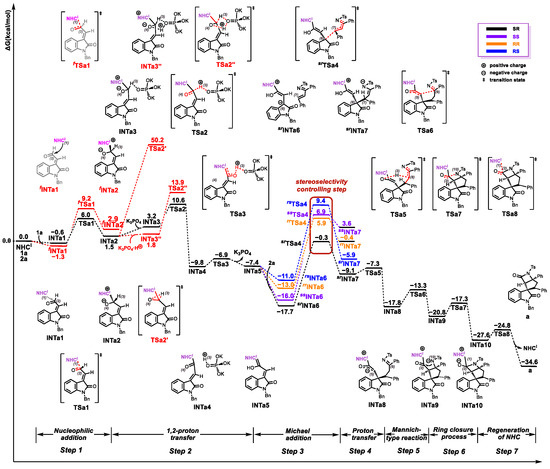
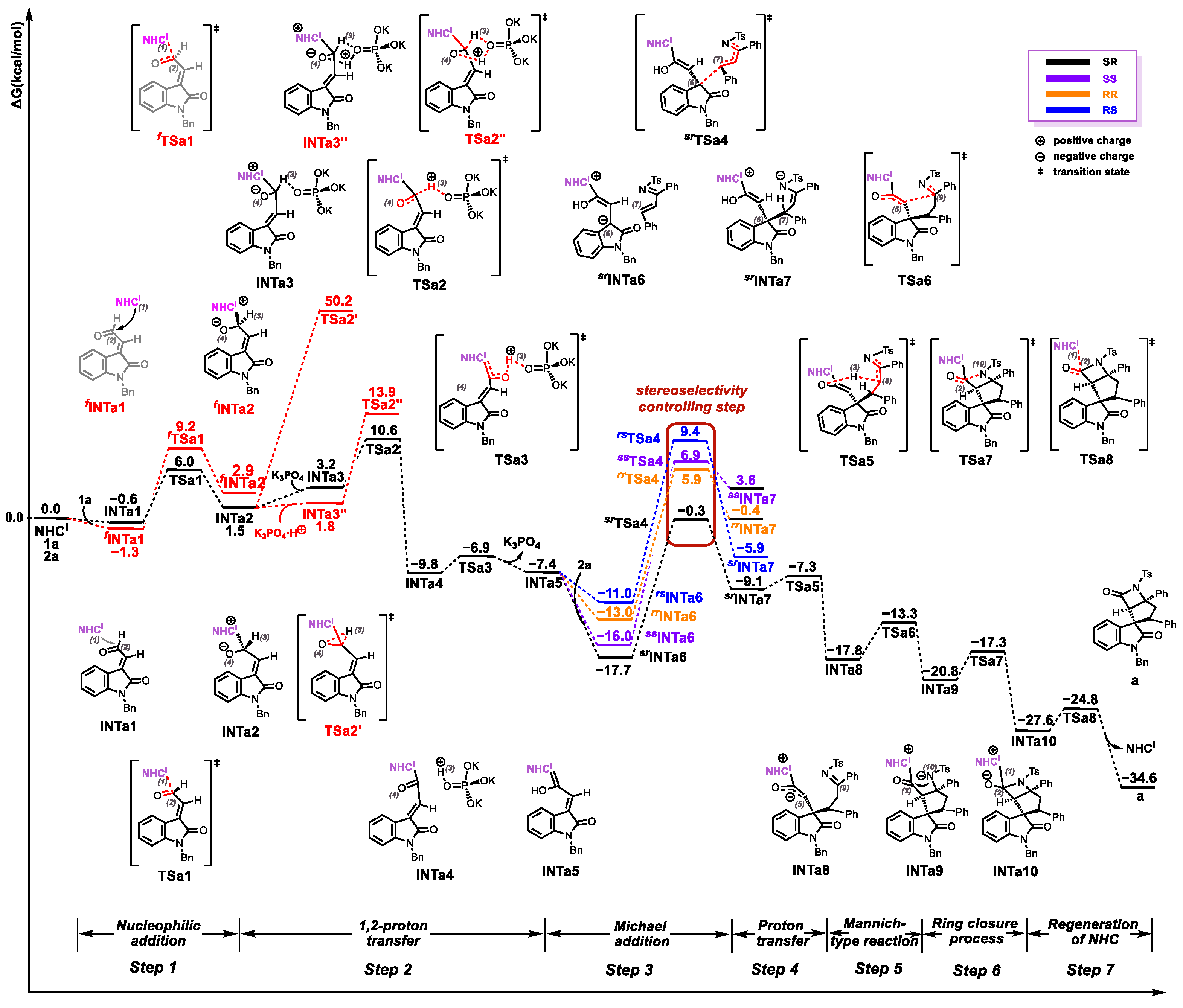
Next, coordination of NHCI to 1a through an n→π* interaction between the carbene carbon and the carbonyl group delivers the complex INTa1 with an energy release of 0.6 kcal/mol (see Figure 4). Nucleophilic addition of NHCI to 1a via the reverse-side transition state TSa1 (6.0 kcal/mol) affords intermediate INTa2 (1.5 kcal/mol). The stereochemical alternative involving front-side nucleophilic attack of NHCI on 1a was also evaluated. Calculations revealed that the energy barrier for the front-side transition state fTSa1 (∆G‡ = 10.5 kcal/mol) is 3.9 kcal/mol higher than that of the reverse-side transition state TSa1 (∆G‡ = 6.6 kcal/mol), indicating that the reverse-side pathway is energetically favored.
Figure 4.
The Gibbs free energy profile of the process of generating product a.
Step 2: Formation of the Breslow Intermediate
We initially explored the direct proton transfer pathway from INTa2. However, the calculated energy barrier for the corresponding transition state TSa2′ was prohibitively high (∆G‡ = 48.7 kcal/mol relative to INTa2). We then evaluated an alternative pathway involving proton (H3) migration assisted by K3PO4·H+ via transition state TSa2″. This pathway exhibited a significantly reduced barrier (∆G‡ = 12.4 kcal/mol relative to INTa2). Additionally, we investigated the K3PO4-assisted mechanism. In this pathway, INTa2 forms a hydrogen-bonded complex INTa3 with K3PO4, which is endergonic by 3.2 kcal/mol. Subsequently, proton migration within INTa3 via transition state TSa2 affords complex INTa4. This step requires an energy barrier of 9.1 kcal/mol relative to INTa2 and is exergonic (∆G = −11.3 kcal/mol relative to INTa2). Crucially, the barrier for this step (∆G‡ = 9.1 kcal/mol) is lower than both the direct proton transfer barrier (∆G‡ = 48.7 kcal/mol) and the K3PO4·H+-assisted barrier (∆G‡ = 12.4 kcal/mol). Finally, the proton from the K3PO4·H+ moiety in INTa4 migrates to O4 via transition state TSa3 (∆G‡ = 2.9 kcal/mol relative to INTa4), generating the Breslow intermediate INTa5 and releasing K3PO4. Therefore, the K3PO4-assisted pathway is energetically favored for the formation of the Breslow intermediate.
Step 3: Michael Addition
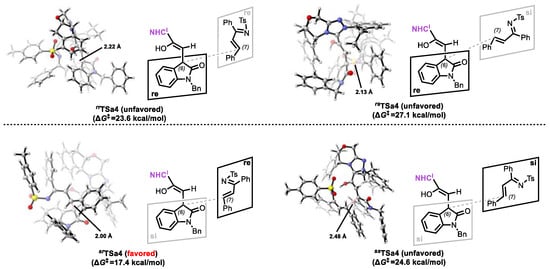
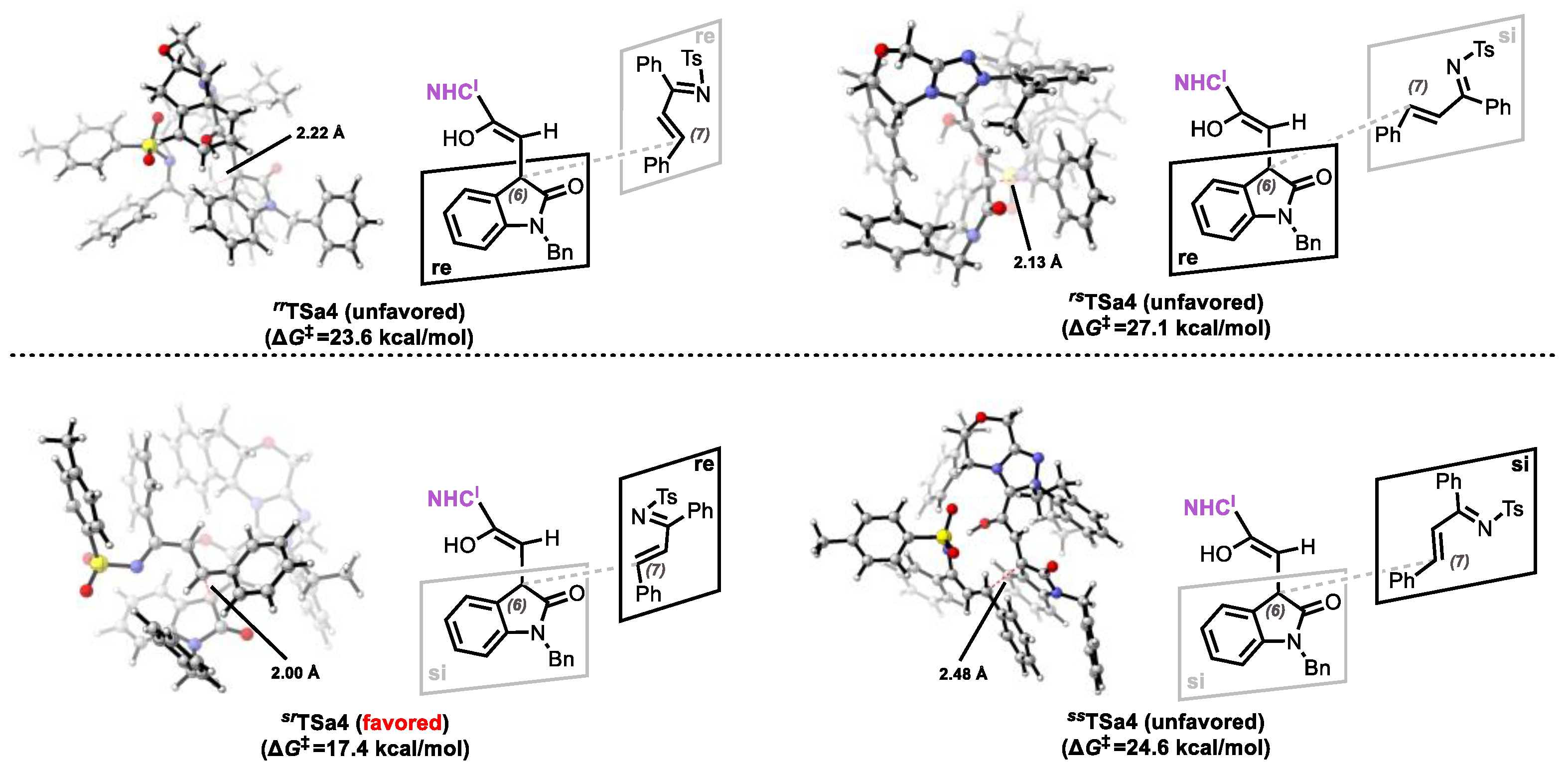
Following the generation of intermediate INTa5, a stereoselective Michael addition with 2a proceeds to form intermediate INTa7. Considering the prochiral of both reacting partners (INTa5 and 2a), we systematically evaluated four distinct facial addition patterns: re-re, re-si, si-re, and si-si, corresponding to the formation of 6R,7R-, 6R,7S-, 6S,7R-, and 6S,7S-configured adducts, respectively. Transition state analysis revealed activation barriers of 17.4 kcal/mol (srTSa4), 24.6 kcal/mol (ssTSa4), 23.6 kcal/mol (rrTSa4), and 27.1 kcal/mol (rsTSa4) (see Figure 5). The observed preference for 6R,7R-configuration formation, consistent with experimental results, can be rationalized by the lowest energy transition state (srTSa4, ∆G‡ = 17.4 kcal/mol).
Figure 5.
Four stereochemical configurations are possible for the Michael addition.
Step 4: Proton Transfer
Proton transfer from the hydroxyl group (H3) of intermediate srINTa7 to the adjacent C8 atom occurs via TSa5 (∆G‡ = 1.8 kcal/mol), exergonically forming INTa8 (∆G = −8.7 kcal/mol). This thermodynamically driven process is facilitated by optimal spatial proximity between H3 and C8.
Step 5: Mannich-type Reaction
The enol-structured intermediate INTa8, bearing strong nucleophilicity at the C5 position, undergoes a Mannich reaction with the electrophilic C9 position via a five-membered ring transition state TSa6. This process surmounts an activation barrier of 4.5 kcal/mol, yielding the more stable five-membered ring intermediate INTa9 with an exergonicity of 3.0 kcal/mol relative to INTa8.
Step 6: Formation of the Four-membered Ring
Intermediate INTa9, featuring an electrophilic carbonyl carbon atom at the C2 position, undergoes nucleophilic addition with the N-tosylamide anion. This reaction proceeds via four-membered ring transition state TSa7, yielding a β-lactam intermediate INTa10. This process has an energy barrier of 3.5 kcal/mol and liberates 6.8 kcal/mol of free energy relative to intermediate INTa9.
Step 7: Catalyst Regeneration
Finally, intermediate INTa10 undergoes catalyst NHCI regeneration via transition state TSa8, affording product a. This step requires overcoming an energy barrier of only 2.8 kcal/mol and liberates 7.0 kcal/mol of free energy relative to intermediate INTa10.
Product Generation Process for Compound b:
Step 1: Nucleophilic Addition
The NHCII-catalyzed [3+4] annulation commences with DIPEA-mediated deprotonation of Pre-NHCII, generating the active catalyst NHCII. This step proceeds via transition state TS-NHCII with a calculated barrier of ∆G‡ = 9.7 kcal/mol and is endergonic (∆G = +6.3 kcal/mol), both relative to the ZPE-corrected ground state of Pre-NHCII and DIPEA (Figure S2). This contrasts sharply with the barrierless formation of the alternative active catalyst NHCI.
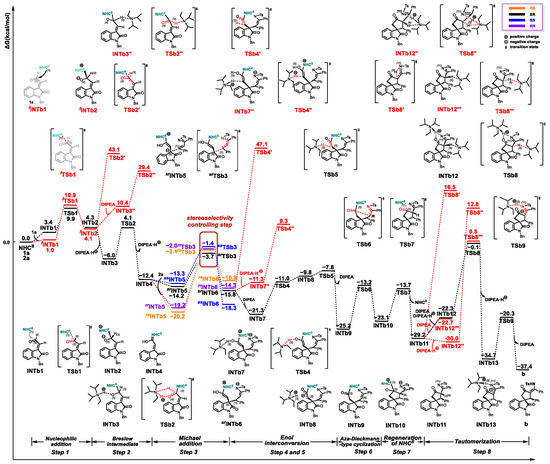
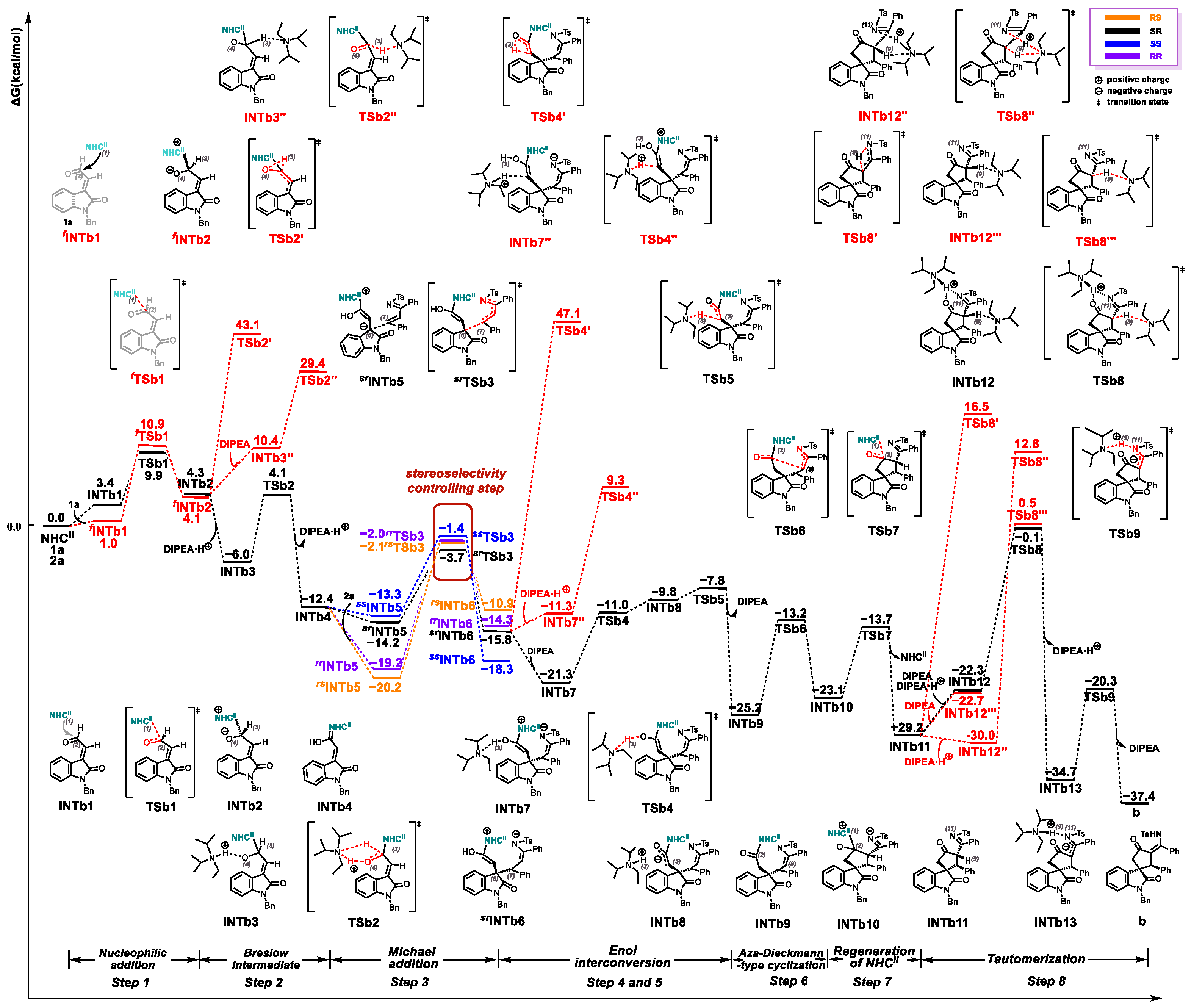
As depicted in Figure 6, coordination of NHCII to 1a via an n→π* interaction between the carbene carbon and the carbonyl group forms complex INTb1, which is endergonic by 3.4 kcal/mol. Nucleophilic addition of NHCII to 1a then proceeds via the reverse-side transition state TSb1 (∆G‡ = 9.9 kcal/mol), affording intermediate INTb2 (∆G = +4.3 kcal/mol). For comparison, the stereochemical alternative involving frontside attack was evaluated. Calculations reveal that the barrier for the front-side transition state fTSb1 (∆G‡ = 10.9 kcal/mol) is 1.0 kcal/mol higher than that for TSb1 (∆G‡ = 9.9 kcal/mol), indicating that the reverse-side pathway is energetically favored.
Figure 6.
The Gibbs free energy profile of the process of generating product b.
Step 2: Formation of the Breslow Intermediate
Three distinct pathways for Breslow intermediate formation were evaluated. First, the direct proton transfer from INTb2 via transition state TSb2′ was excluded due to its prohibitively high barrier (∆G‡ = 38.8 kcal/mol relative to INTb2). Second, the DIPEA-assisted proton (H3) migration via transition state TSb2″ exhibited a similarly high barrier (∆G‡ = 25.3 kcal/mol relative to INTb2). Third, the DIPEA·H+-assisted mechanism was investigated. In this pathway: (i) INTb2 forms a hydrogen-bonded complex INTb3 with DIPEA·H+, which is exergonic (∆G = −10.3 kcal/mol relative to INTb2). (ii) Proton migration within INTb3 through a hydrogen-bonded transition state TSb2 affords the Breslow intermediate INTb4. This step requires a barrier of ∆G‡ = 10.1 kcal/mol and is exergonic (∆G = −6.4 kcal/mol), both relative to INTb3. Consequently, the DIPEA·H+-assisted pathway is energetically favored for Breslow intermediate formation.
Step 3: Michael Addition
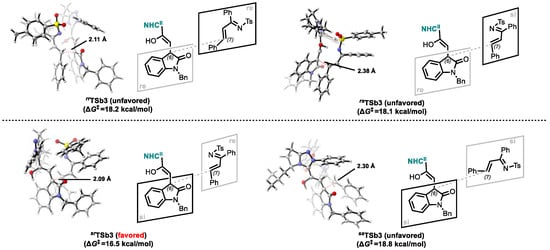
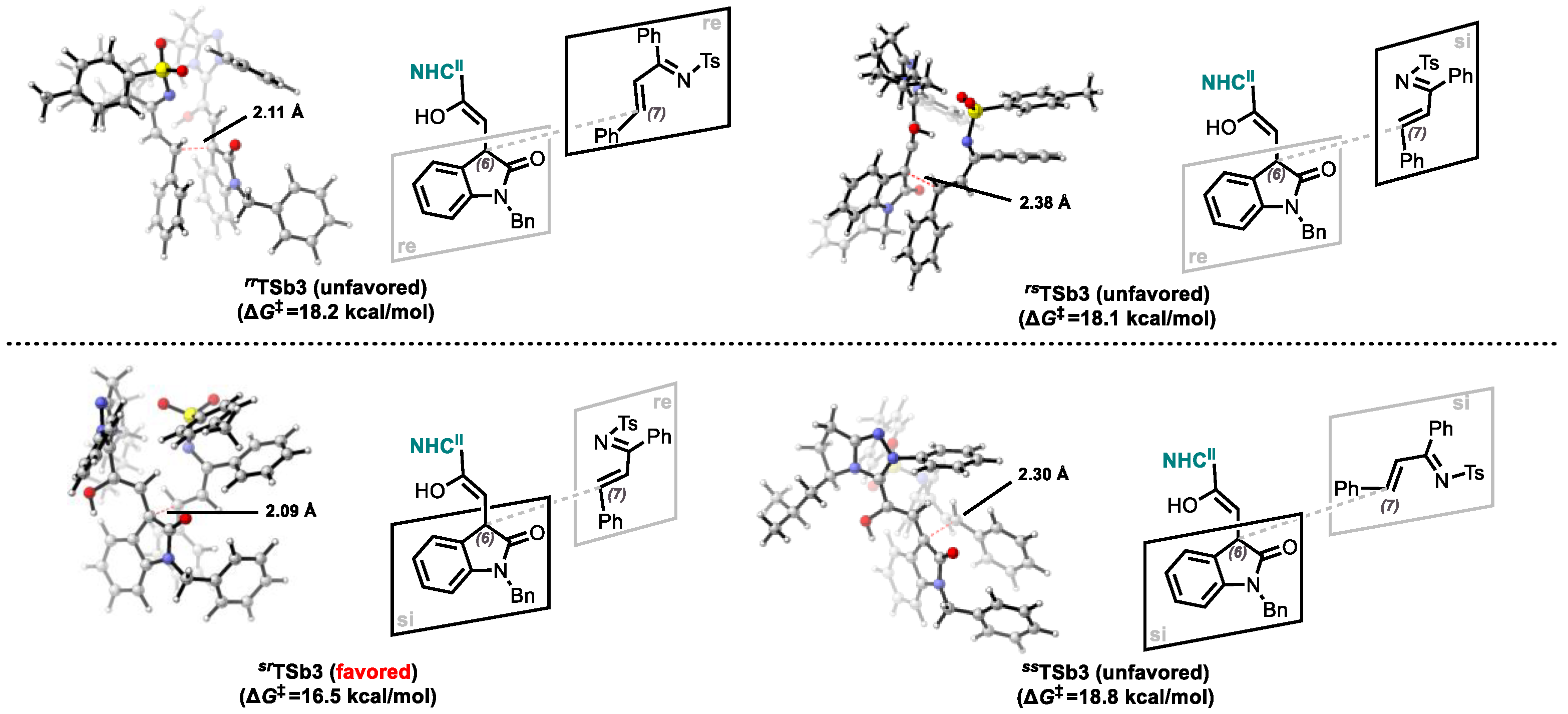
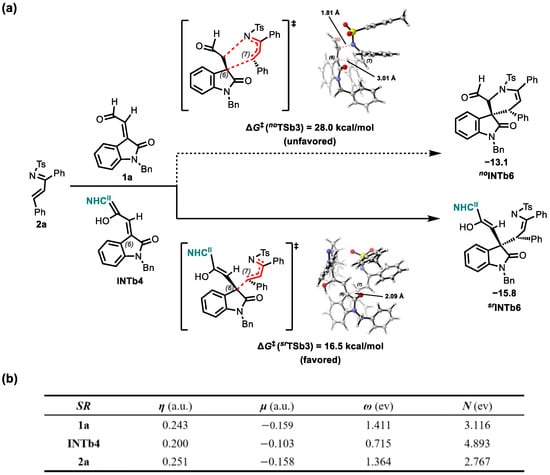
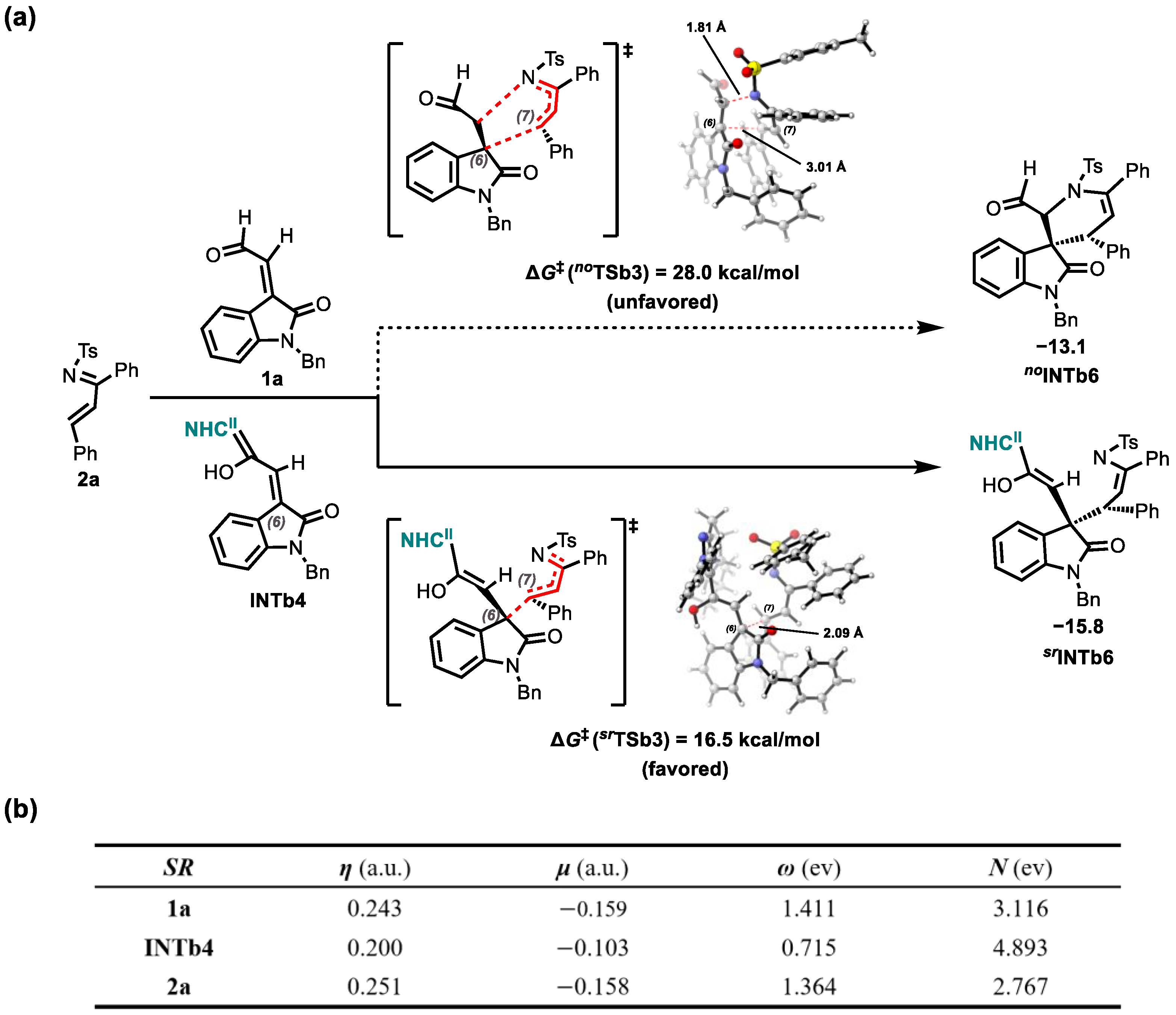
Given the prochiral of both reaction partners (INTb4 and 2a), four stereochemically distinct pathways exist for the Michael addition of INTb4 to 2a to form INTb6 via transition state TSb3. These correspond to the re-facial/re-facial (re/re), re-facial/si-facial (re/si), si-facial/re-facial (si/re), and si-facial/si-facial (si/si) addition modes, yielding the (6R,7R)-, (6R,7S)-, (6S,7R)-, and (6S,7S)-configured adducts, respectively. Transition state analysis revealed the following activation barriers: ∆G‡ = 18.2 kcal/mol for rrTSb3 (re/re), ∆G‡ = 18.1 kcal/mol for rsTSb3 (re/si), ∆G‡ = 16.5 kcal/mol for srTSb3 (si/re), ∆G‡ = 18.8 kcal/mol for ssTSb3 (si/si) (Figure 6 and Figure 7). The observed diastereoselectivity toward the (6R,7S)-adduct aligns with experimental results and is attributed to the lowest-energy transition state (srTSb3, ∆G‡ = 16.5 kcal/mol).
Figure 7.
Four stereochemical configurations are possible for the Michael addition.
Step 4 and Step 5: Enol Tautomerism
Three distinct mechanistic pathways for enol tautomerization were evaluated computationally. First, direct proton transfer from srINTb6 via transition state TSb4′ was excluded due to its prohibitively high barrier (∆G‡ = 62.9 kcal/mol relative to srINTb6). Second, DIPEA·H+-assisted proton migration via TSb4″ also exhibited a high barrier (∆G‡ = 25.1 kcal/mol relative to srINTb6). Third, the DIPEA-assisted mechanism proceeds as follows: (i) rsINTb6 forms a hydrogen-bonded complex INTb7 with DIPEA, which is exergonic (∆G = −5.5 kcal/mol relative to srINTb6). (ii) Proton transfer through the hydrogen-bonded transition state TSb4 affords INTb8. This step has a barrier of ∆G‡ = 10.3 kcal/mol and is endergonic (∆G‡ = +11.5 kcal/mol), both relative to INTb7. (iii) The DIPEA·H+ proton in INTb8 migrates to C5 via TSb5 (∆G‡ = 2.0 kcal/mol) to form INTb9, with strong exergonicity (∆G = −25.2 kcal/mol), both relative to INTb8. Consequently, the DIPEA-assisted pathway is energetically favored for enol tautomerization.
Step 6: Aza-Dieckmann-type Cyclization
The intermediate INTb9 undergoes an aza-Dieckmann-type cyclization via the five-membered-ring transition state TSb6 to afford INTb10. This step has a low activation barrier (∆G‡ = 12.0 kcal/mol) and is slightly endergonic (∆G = +2.1 kcal/mol), both relative to INTb9.
Step 7: Regeneration of NHCII
INTb10 releases the catalyst NHCII and forms INTb11 via transition state TSb7. This dissociation step exhibits a low activation barrier (∆G‡ = 9.4 kcal/mol) and is exergonic (∆G = −6.1 kcal/mol), both relative to INTb10. These results demonstrate that the regeneration of catalyst NHCII is both kinetically and thermodynamically favorable.
Step 8: Isomerization via Proton Transfer
Four distinct mechanistic pathways were evaluated for the isomerization of the imine moiety. First, the direct proton migration pathway from INTb11 via transition state TSb8′ was excluded due to its prohibitively high activation barrier (∆G‡ = 45.7 kcal/mol relative to INTb11). Second, DIPEA·H+-assisted proton migration via TSb8″ also exhibited a similarly high barrier (∆G‡ = 42.8 kcal/mol relative to INTb12″). Consequently, both the direct and DIPEA·H+-assisted proton migration mechanisms are energetically unfavorable. Third, the DIPEA-assisted pathway via transition state TSb8‴ (∆G‡ = 29.7 kcal/mol relative to INTb11) showed a lower barrier compared to the first two pathways. In contrast, considering that DIPEA·H+ is already generated in the second step, the positively charged DIPEA·H+ can form an intermolecular hydrogen bond with the ketone carbonyl oxygen in INTb11, which facilitates the proton migration at H9. Calculation results revealed that TSb8 exhibits the lowest barrier among the four pathways (∆G‡ = 29.1 kcal/mol relative to INTb11). Therefore, the pathway co-assisted by DIPEA·H+ and DIPEA was considered viable: (i) INTb11 forms a hydrogen-bonded complex INTb12 with DIPEA·H+ and DIPEA, which is endergonic (∆G = +6.9 kcal/mol relative to INTb11). (ii) Proton transfer through the hydrogen-bonded transition state TSb8 affords complex INTb13. This step exhibits an activation barrier of ∆G‡ = 29.1 kcal/mol relative to INTb11. (iii) The DIPEA·H+ proton in INTb13 migrates to nitrogen via TSb9 (∆G = 14.4 kcal/mol relative to INTb13) to form product b, a mildly exergonic process (∆G = −2.7 kcal/mol relative to INTb13). Therefore, the pathway co-assisted by DIPEA·H+ and DIPEA is energetically favored for this isomerization process.
2.2. Origins of Regioselectivity
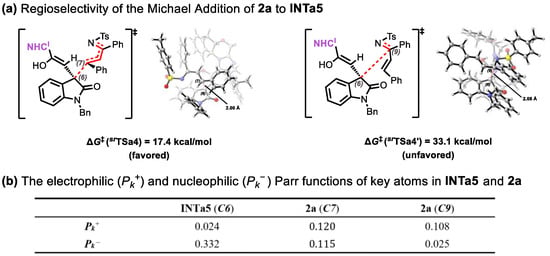
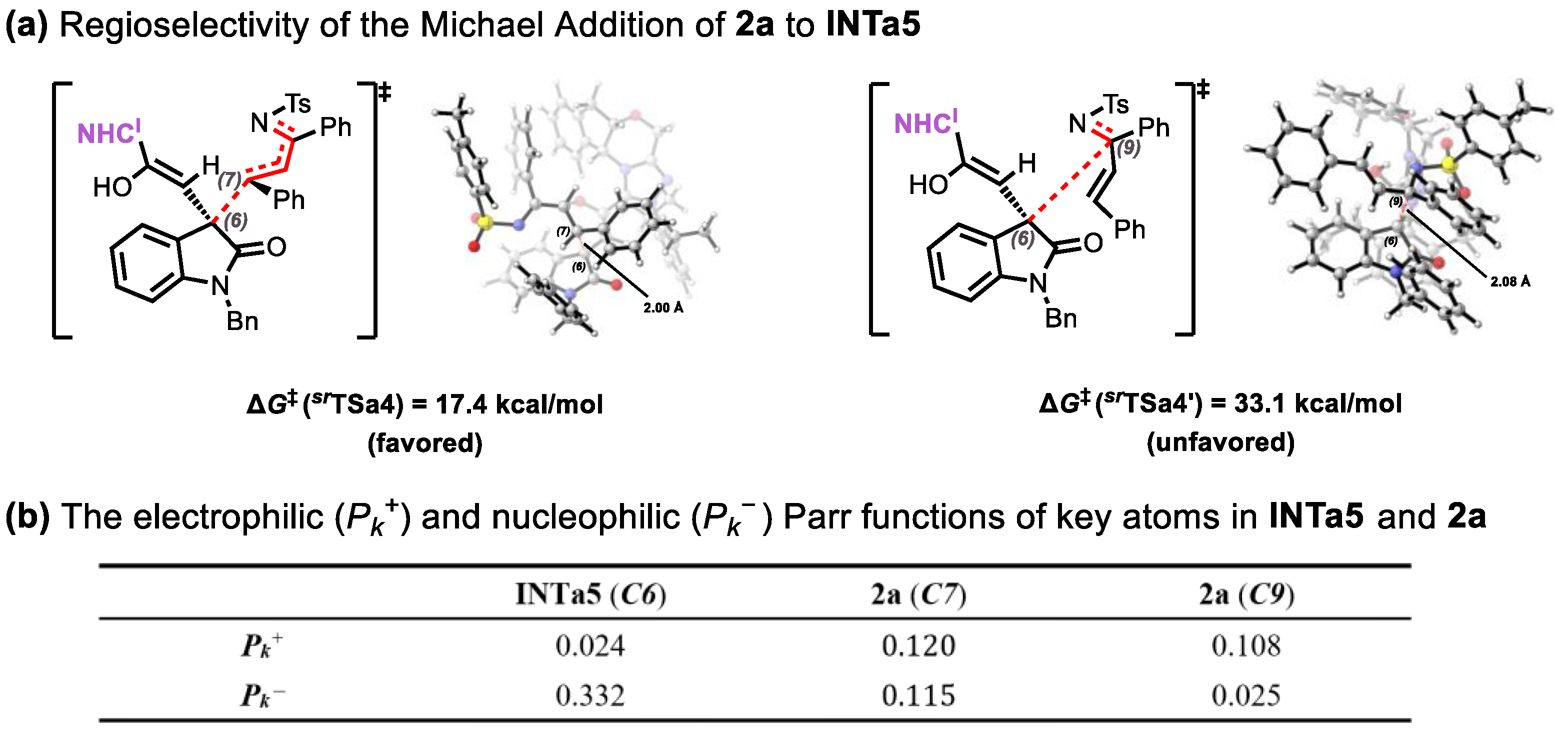
For the Michael addition of INTa5 with 2a, besides the pathway generating the intermediate srINTa7 via srTSa4 described in the previous section, we also identified an alternative pathway that involves C6-C9 bond formation through transition state srTSa4′ (Figure 8a). However, the corresponding activation barrier is 15.7 kcal/mol higher than that of srTSa4 indicating that formation of srINTa7 is energetically favored. This regioselectivity is consistent with Parr function analysis [55], as summarized in (Figure 8b). Specifically, the calculated electrophilic Parr function (Pk+) value for the C7 atom (0.120) is higher than that for the C9 atom (0.108). Consequently, nucleophilic attack occurs preferentially at the C7 atom during the addition of 2a to INTa5, in agreement with our DFT calculations.
Figure 8.
(a) Regioselectivity of the Michael Addition of 2a to INTa5; (b) The electrophilic (Pk+) and nucleophilic (Pk−) Parr functions of key atoms in INTa5 and 2a.
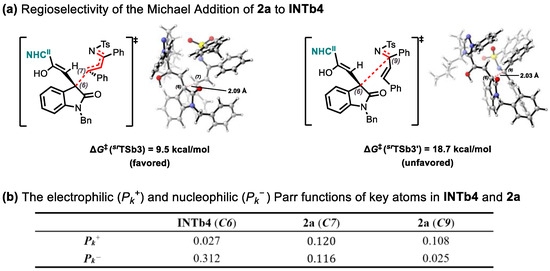
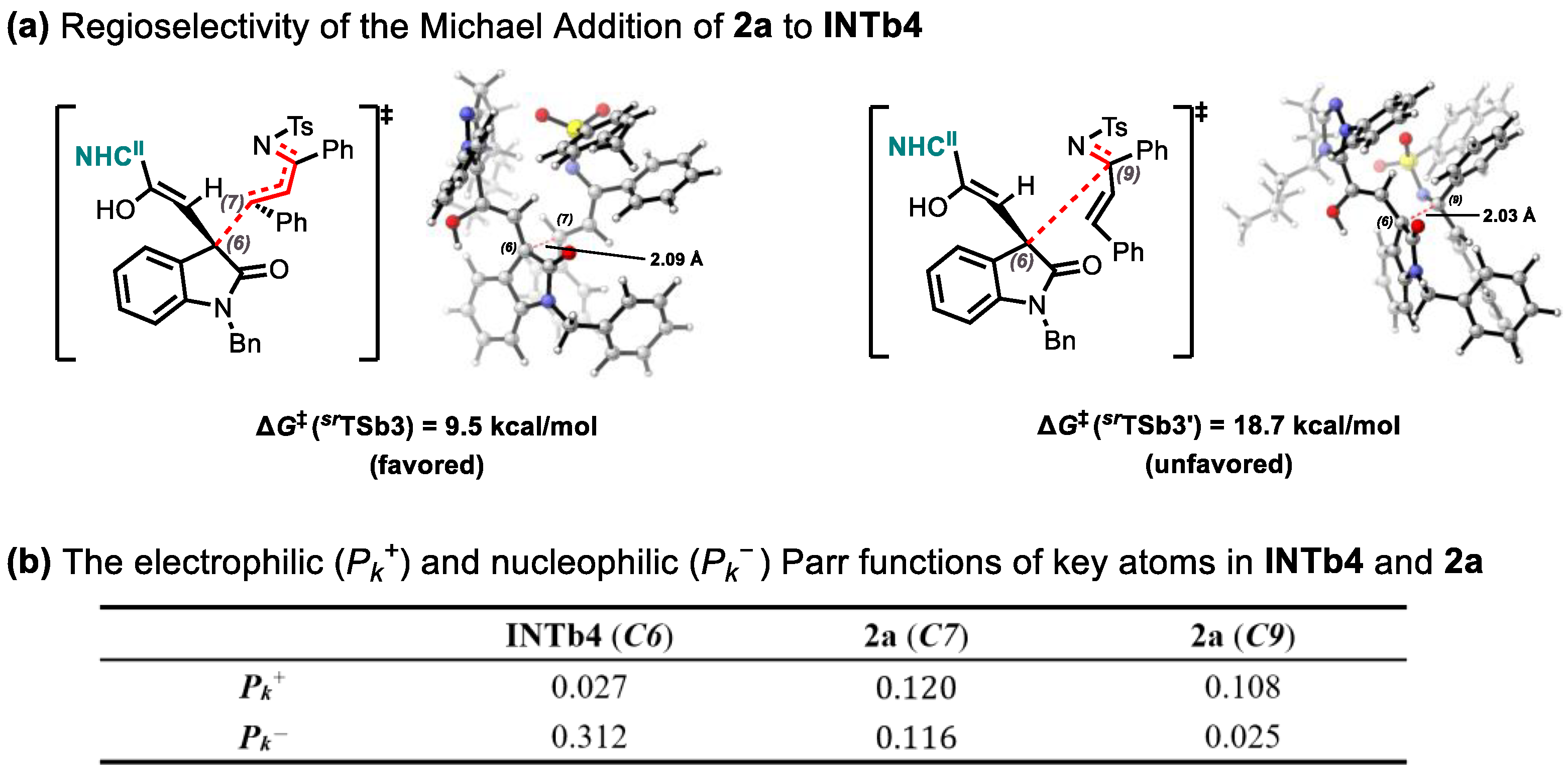
Regarding the Michael addition between INTb4 and 2b, in addition to the previously described pathway forming intermediate srINTb6 via srTSb3, computational exploration revealed an alternative route. This pathway proceeds through transition state srTSb3′ with concomitant C6-C9 bond formation (Figure 9a). Notably, the activation barrier for this alternative route surpasses that of srTSb3 by 9.2 kcal/mol, establishing srINTb6 formation as the energetically preferred process. The observed regioselectivity is rationalized through Parr function analysis [55] (Figure 9b). For electrophile 2a, computed electrophilic Parr function (Pk+) values at C7 (0.120) and C9 (0.108) reveal enhanced electrophilicity at C7. This electronic preference facilitates nucleophilic attack by INTb4’s C6 atom at the C7 position of 2a, in full accord with DFT computational outcomes.
Figure 9.
(a) Regioselectivity of the Michael Addition of 2a to INTb4; (b) The electrophilic (Pk+) and nucleophilic (Pk−) Parr functions of key atoms in INTb4 and 2a.
2.3. Origins of Stereoselectivity
The observed stereoselectivity in the formation of product a originates from the Michael addition step, which establishes the stereogenic centers at C6 and C7. As detailed in Step 3, the computed energy barriers for the diastereomeric addition pathways are: 17.4 kcal/mol (srTSa4(6S,7R)), 24.6 kcal/mol (ssTSa4(6S,7S)), 23.6 kcal/mol (rrTSa4(6R,7R)), and 27.1 kcal/mol (rsTSa4(6R,7S)), with the si/re pathway being energetically most favorable. The energy difference between srTSa4 and rsTSa4 (Δ∆G‡ = 9.7 kcal/mol) corresponds to a predicted enantiomeric excess of 99.9%, in excellent agreement with the experimental value (98% ee).
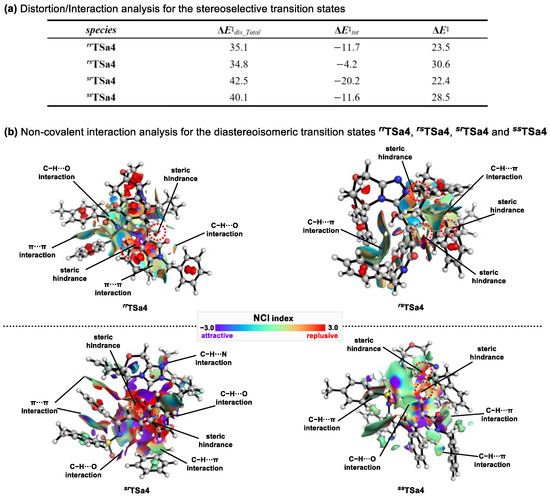
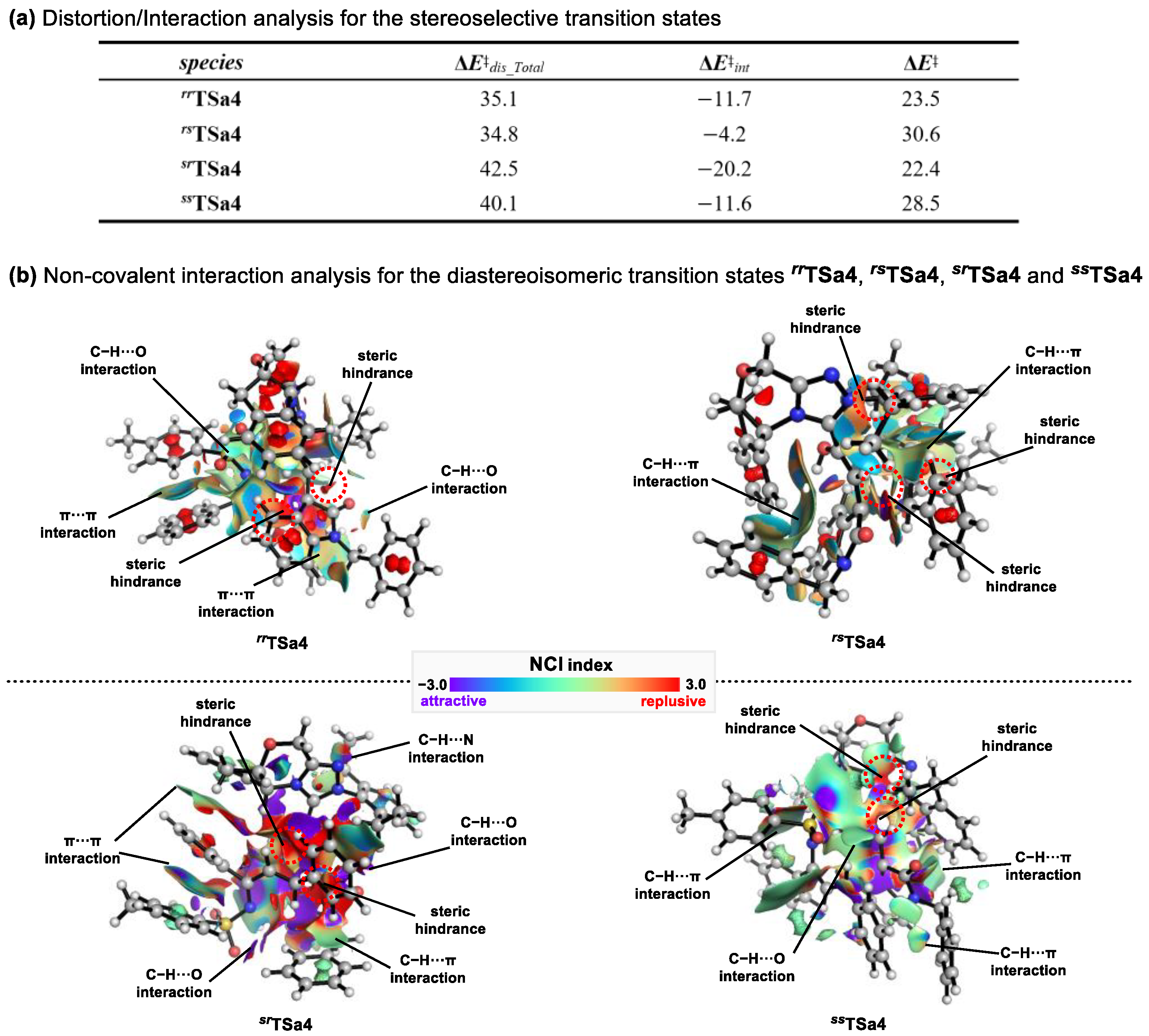
To further elucidate the origin of the stereoselectivity, a distortion-interaction analysis [56] was carried out (Figure 10a). The computational results reveal that the activation energies (ΔE‡) are consistent with the Gibbs free energy barriers (ΔG‡) derived from the reaction mechanism. Although the total distortion energies (ΔE‡dis_Total) of srTSa4 (42.5 kcal/mol) and ssTSa4 (40.1 kcal/mol) are higher than those of rrTSa4 (35.1 kcal/mol) and rsTSa4 (34.8 kcal/mol), srTSa4, which exhibits the lowest activation energy, features the most favorable interaction energy (−20.2 kcal/mol). This plays a decisive role in lowering the reaction barrier. Overall, the interaction energy governs the energy variations in this reaction.
Figure 10.
(a) Distortion/interaction analysis for the stereoselective transition states; (b) Interaction analysis for the diastereoisomeric transition states rrTSa4, rsTSa4, srTSa4 and ssTSa4.
Further non-covalent interaction (NCI) analysis (Figure 10b) revealed that srTSa4 exhibits the most extensive attractive regions (shown in purple), including two π⋯π interactions (3.021 and 3.14 Å), two C-H⋯O interactions (2.863 and 2.857 Å), one C-H⋯π interaction (2.681 Å), and one C-H⋯N interaction (2.636 Å). This was followed by ssTSa4, which contains three C-H⋯π interactions (3.023, 2.852, and 2.764 Å) and one C-H⋯O interaction (2.320 Å), and rrTSa4, which exhibits two π⋯π interactions (2.476 and 2.566 Å) together with two C-H⋯O interactions (3.031 and 2.944 Å). In contrast, rsTSa4 only shows two C-H⋯π interactions (2.835 and 2.981 Å). Additionally, repulsive non-covalent interactions in all four transition states are mainly localized in the region between the Breslow intermediate INTa5 and substrate 2a (red areas). These results clearly demonstrate that, among the four transition states, srTSa4 (6S,7R) features the strongest attractive interactions, which likely accounts for the stereoselectivity observed experimentally.
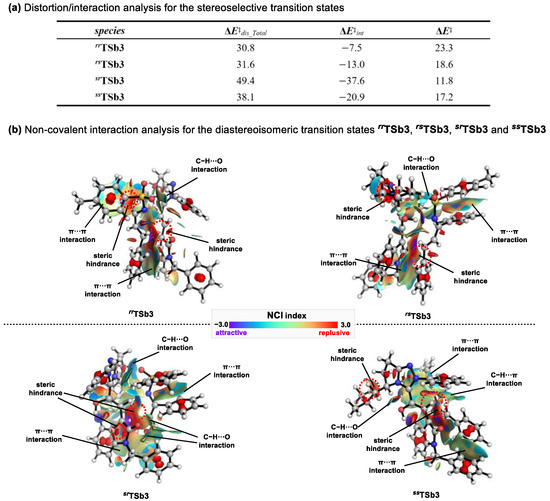
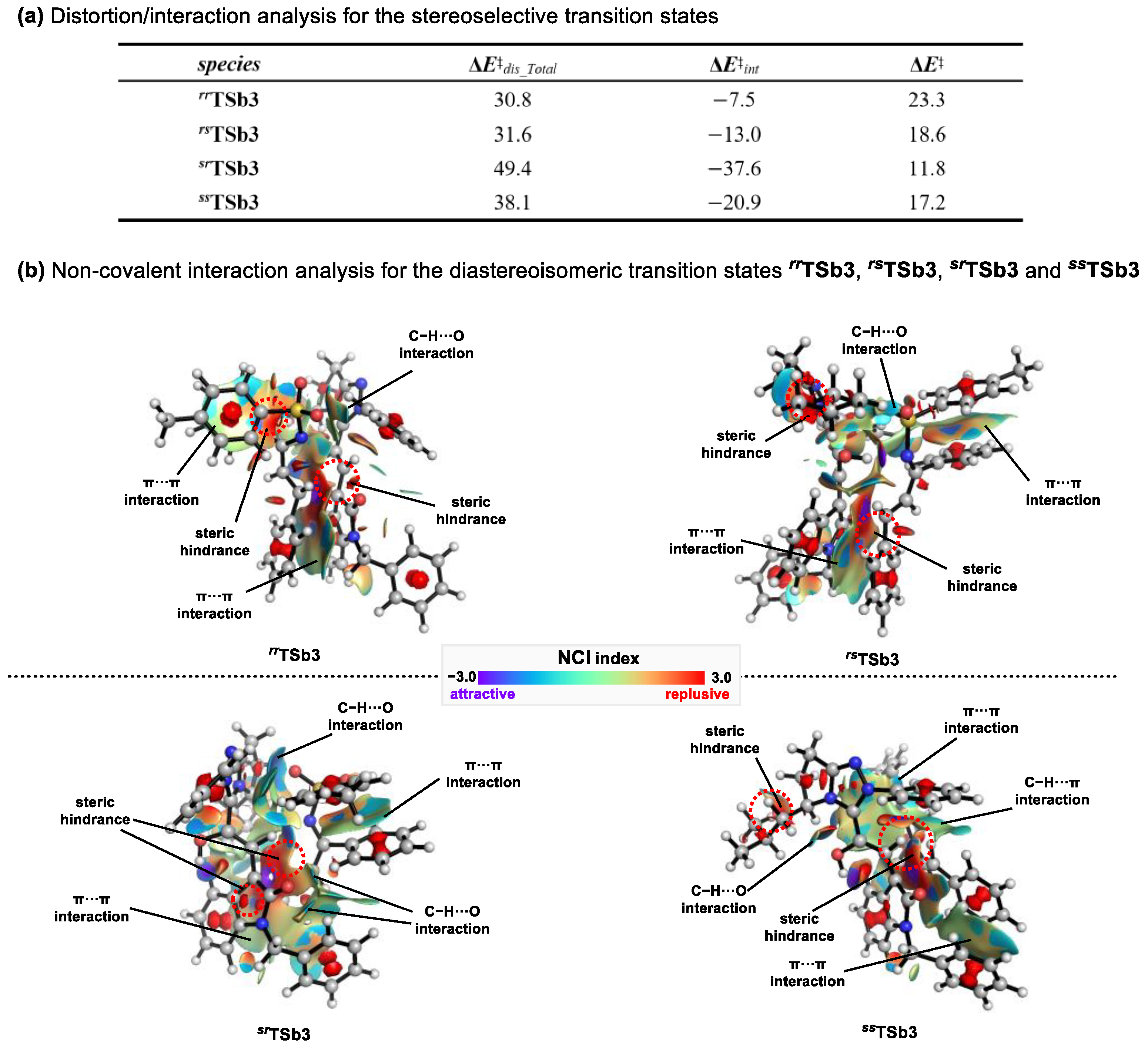
Stereocontrol in product b formation is dictated by the Michael addition step, which generates the C6/C7 stereogenic centers. Computational analysis (Step 3) identifies the si/re pathway as kinetically preferred, exhibiting the lowest energy barrier among diastereomeric transition states: 18.2 kcal/mol (rrTSb3(6R,7R)), 18.1 kcal/mol (rsTSb3(6R,7S)), 16.5 kcal/mol (srTSb3(6S,7R)), 18.8 kcal/mol (ssTSb3(6S,7S)). The Δ∆G‡ = 1.6 kcal/mol between the dominant (srTSb3) and major competing (rsTSb3) transition states corresponds to 87.4% predicted ee, closely matching the experimental 88% ee.
Concerning the origin of stereoselectivity for product b, we also performed a distortion-interaction analysis [56] (Figure 11a). The computational findings demonstrate that the activation energies (ΔE‡) are consistent with the Gibbs free energy barriers (ΔG‡) derived from the reaction mechanism. Even though the total distortion energy (ΔE‡dis_Total) of srTSb3 (49.4 kcal/mol) exceeds those of ssTSb3 (38.1 kcal/mol), rrTSb3 (30.8 kcal/mol), and rsTSb3 (31.6 kcal/mol), srTSb3—possessing the lowest activation energy—displays the most favorable interaction energy (−37.6 kcal/mol), which exerts a decisive effect on lowering the reaction barrier. Overall, the interaction energy controls the energy variations in this reaction.
Figure 11.
(a) Distortion/interaction analysis for the stereoselective transition states; (b) Interaction analysis for the diastereoisomeric transition states rrTSb3, rsTSb3, srTSb3 and ssTSb3.
A further non-covalent interaction (NCI) analysis (Figure 11b) revealed that srTSb3 exhibits the most extensive attractive regions (shown in purple), including two π⋯π interactions (2.946 and 3.046 Å) and three C-H⋯O interactions (2.334, 2.307, and 2.843 Å). This was followed by ssTSb3 and rrTSb3: among them, ssTSb3 contains two π⋯π interactions (3.159 and 3.254 Å), one C-H⋯π interaction (2.669 Å), and one C-H⋯O interaction (2.600 Å); in contrast, rrTSb3 exhibits two π⋯π interactions (3.008 and 2.943 Å) and one C-H⋯O interaction (2.597 Å). Meanwhile, rsTSb3—with the weakest attractive interactions—shows two π⋯π interactions (3.109 and 3.004 Å) and one C-H⋯O interaction (2.301 Å). Additionally, the repulsive non-covalent interactions in all four transition states are mainly localized in the region between the Breslow intermediate INTb4 and substrate 2a (red areas). These results clearly demonstrate that among the four transition states, srTSb3 (6S,7R) possesses the strongest attractive interactions, a feature that likely accounts for the stereoselectivity observed experimentally.
2.4. The Role of Catalysts
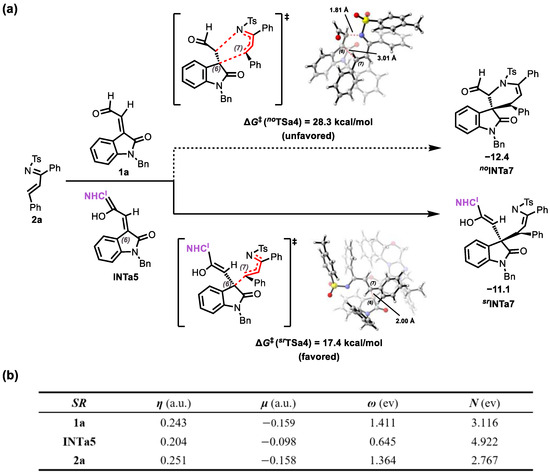
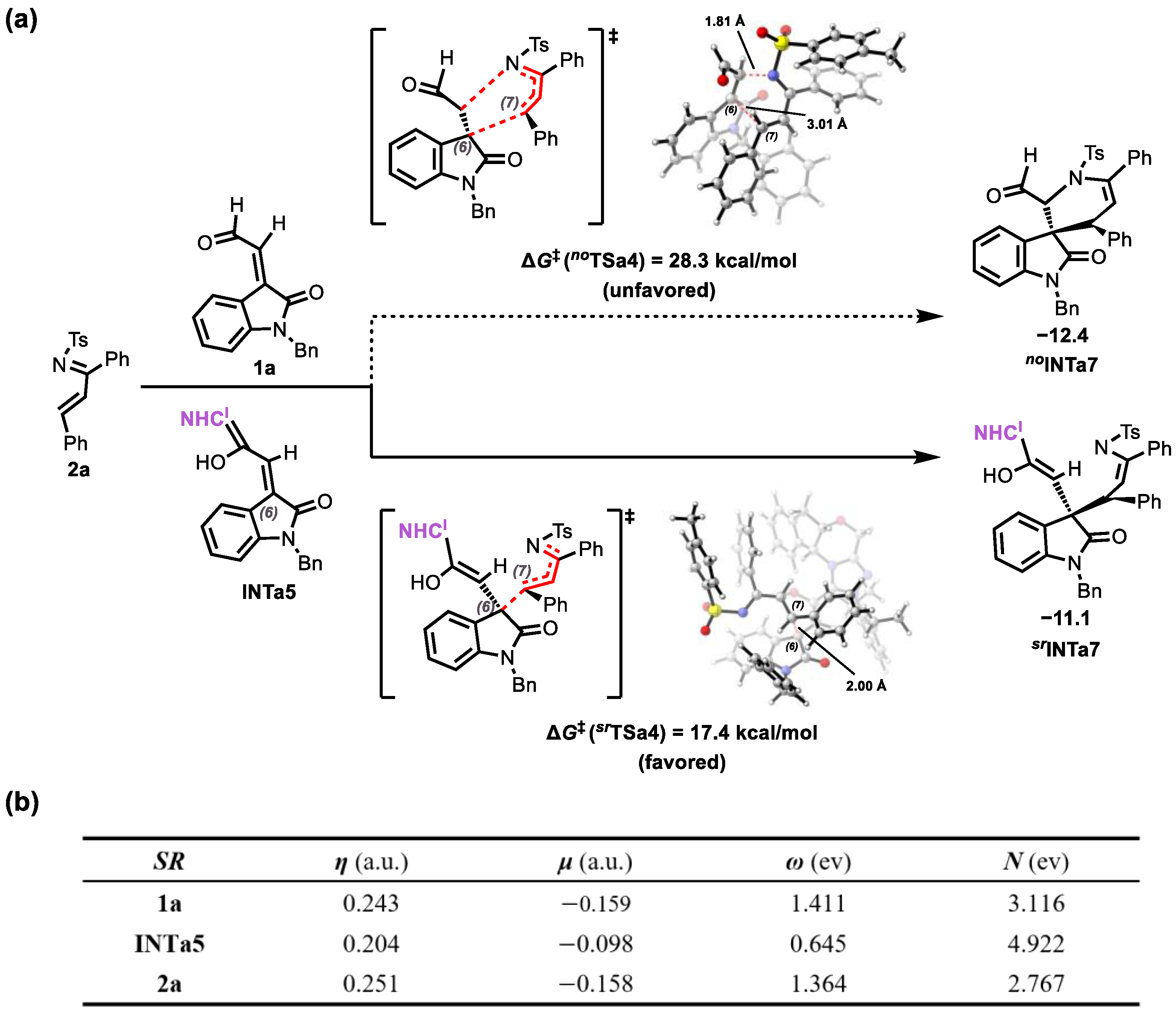
Figure 12a reveals that the uncatalyzed Michael addition between 2a and 1a exhibits an activation barrier of 28.3 kcal/mol, significantly higher than the NHCI-catalyzed barrier (17.4 kcal/mol). This 10.9 kcal/mol reduction demonstrates the critical catalytic role of NHCI.
Figure 12.
(a) Catalytic Effect of NHCI on Michael Addition; (b) Electronic chemical potential (μ, in a.u.), chemical hardness (η, in a.u.), global electrophilicity (ω, in eV) and global nucleophilicity (N, in eV) of some reactants (6S,7R) involved in the key steps.
To elucidate the catalytic role of NHCI in the reaction of isatin-derived enals with N-sulfonyl ketoimines, global reactivity indices (GRIs) [57,58,59,60,61] analysis was employed. Figure 12b demonstrates that NHCI activation enhances the nucleophilicity of 1a from 3.116 eV to 4.922 eV in INTa5, consequently reducing the Michael addition activation barrier with electrophile 2a.
As shown in Figure 13a, the activation barrier for the uncatalyzed Michael addition between 2a and 1a (28.0 kcal/mol) is significantly higher (by 9.1 kcal/mol) than that for the NHCII-catalyzed reaction (18.1 kcal/mol), highlighting the critical catalytic function of NHCII. Analysis of global reactivity indices (GRIs) [57,58,59,60,61] revealed that NHCII activation enhanced the nucleophilicity of 1a to 4.893 eV for INTb4, a significant increase from 3.116 eV. This enhancement substantially lowered the activation barrier for the Michael addition reaction with electrophile 2a.
Figure 13.
(a) Catalytic Effect of NHCII on Michael Addition; (b) Electronic chemical potential (μ, in a.u.), chemical hardness (η, in a.u.), global electrophilicity (ω, in eV) and global nucleophilicity (N, in eV) of some reactants (6S,7R) involved in the key steps.
3. Computational Methods
All DFT calculations were performed with the Gaussian 09 (Revision E.01) software package [62]. The M06-2X [63]-D3 [64] functional was used for the geometry optimization in the gas phase at 298.15 K and 1 atm with the 6-31G(d,p) basis set [65,66,67] for all elements. Harmonic vibrational frequency calculations were performed for all of the stationary points to determine whether they are local minima or transition structures and to derive the thermochemical corrections for the enthalpies and free energies. The same functional and more accurate 6-311++G(2df,2pd) basis set [68] was used to calculate the single-point energies for the [3+4] annulation in acetonitrile (MeCN, ε = 35.688) and the [3+2] annulation in dichloroethane (DCE, ε = 10.125) from the gas-phase stationary points with the IEFPCM model [69]. The discussed energies are Gibbs free energies (∆G298, kcal/mol). The connectivity of all transition states has been verified by the intrinsic reaction coordinate (IRC) analysis [70,71,72]. NPA [73] charges were computed with the NBO program implemented in Gaussian. Non-covalent interaction analysis [74] was performed using NCIPLOT (version 3.0) [75] and Pymol (version 3.0.0) [76]. All 3D structures were generated using CYLview (version 2.0) [77].
4. Conclusions
In our study, DFT calculations were performed to elucidate the reaction pathways and the origins of regio- and stereoselectivity in the switchable formation of spirocyclopentane oxindoles from isatin-derived enals and N-sulfonyl ketimines, catalyzed by NHCs. DFT calculations elucidate the catalytic cycle for product a formation, comprising nucleophilic addition, 1,2-proton transfer to afford the Breslow intermediate, Michael addition, (1,3)-proton shift, Mannich-type reaction, cyclization, and catalyst regeneration. The formation of product b involves a catalytic cycle comprising nucleophilic addition, Breslow intermediate formation, Michael addition, enol-keto tautomerism, proton transfer, aza-Dieckmann-cyclization, catalyst regeneration, and tautomerization. In pathway a, the K3PO4, and in pathway b, the DIPEA, effectively facilitate the formation of the Breslow intermediate and proton transfer. The Michael addition step is the decisive step governing the regio- and stereoselectivity. The activation energies for the Michael addition of INTa5 or INTb4 to 2a reveal that C6-C7 bond formation is consistently favored. Parr function analysis rationalizes that the regioselectivity arises from the greater electrophilicity of C7 than C9 in 2a. Distortion/interaction analysis demonstrates that the stereoselectivity of the Michael addition is governed by both the distortion energy and non-covalent interaction energy. Global reactivity indices show that the catalyst facilitates enhanced electrophilicity of electrophile 2a and reduced activation barriers for the Michael addition reaction.
Supplementary Materials
The following supporting information can be downloaded at: https://www.mdpi.com/article/10.3390/molecules30214218/s1, Figure S1: (a) Precatalyst Pre-NHCI forms active catalyst NHCI; (b) IRC diagram for the formation of the active catalyst NHCI; Figure S2: Precatalyst Pre-NHCII forms active catalyst NHCII. Cartesian coordinates and total energies for all optimized geometries are tabulated in the Supporting Information (PDF).
Author Contributions
S.Y. (Saisai Yu), W.Z.: Writing—original draft, Software, Investigation, Data curation. X.Z.: Writing—review and editing, Supervision, Project administration, Conceptualization. Y.J.: Visualization, Software, Data curation. H.W.: Visualization, Software, Data curation. S.Y. (Shengwen Yang): Writing—review and editing, Supervision, Funding acquisition, Conceptualization. All authors have read and agreed to the published version of the manuscript.
Funding
We thank the Shihezi University Interdisciplinary Research Program (JCYJ202310) and the Yunnan Key Laboratory of Chiral Functional Substance Research and Application (202402AN360010) for funding of this work.
Institutional Review Board Statement
Not applicable.
Informed Consent Statement
Not applicable.
Data Availability Statement
The data are contained within the Supporting Information (SI).
Conflicts of Interest
The authors declare that they have no known competing financial interests or personal relationships that could have appeared to influence the work reported in this paper.
References
- Chaudhari, P.D.; Hong, B.C.; Wen, C.L.; Lee, G.H. Asymmetric Synthesis of Spirocyclopentane Oxindoles Containing Four Consecutive Stereocenters and Quaternary α-Nitro Esters via Organocatalytic Enantioselective Michael–Michael Cascade Reactions. ACS Omega 2019, 4, 655–667. [Google Scholar] [CrossRef] [Scilit]
- Zeng, W.; Han, C.; Mohammed, S.; Li, S.S.; Song, Y.X.; Sun, F.X.; Du, Y.F. Indole-containing pharmaceuticals: Targets, pharmacological activities, and SAR studies. RSC Med. Chem. 2024, 15, 788–808. [Google Scholar] [CrossRef] [Scilit]
- Luo, Q.L.; Mao, T.; Luo, Y.; Zhang, T.X.; Wang, F.; Dong, S.X.; Feng, X.M. Enantioselective Synthesis of Spiro [cyclopentane-1,3’-oxindole] Scaffolds with Five Consecutive Stereocenters. Org. Lett. 2024, 26, 6402–6406. [Google Scholar] [CrossRef] [Scilit] [PubMed]
- Boddy, A.J.; Bull, J.A. Stereoselective synthesis and applications of spirocyclic oxindoles. Org. Chem. Front. 2021, 8, 1026–1084. [Google Scholar] [CrossRef] [Scilit]
- Zhang, J.Q.; Li, N.K.; Yin, S.J.; Sun, B.B.; Fan, W.T.; Wang, X.W. Chiral N-Heterocyclic Carbene-Catalyzed Asymmetric Michael-Intramolecular Aldol-Lactonization Cascade for Enantioselective Construction of β-Propiolactone-Fused Spiro [cyclopentane-oxindoles]. Adv. Synth. Catal. 2017, 359, 1541–1551. [Google Scholar] [CrossRef] [Scilit]
- Dočekal, V.; Vopálenská, A.; Měrka, P.; Konečná, K.; Jand’ourek, O.; Pour, M.; Císařová, I.; Veselý, J. Enantioselective Construction of Spirooxindole-Fused Cyclopentanes. J. Org. Chem. 2021, 86, 12623–12643. [Google Scholar] [CrossRef] [Scilit]
- Ren, J.; Ding, S.H.; Li, X.N.; Zhao, Q.S. Unified strategy enables the collective syntheses of structurally diverse indole alkaloids. J. Am. Chem. Soc. 2024, 146, 7616–7627. [Google Scholar] [CrossRef] [Scilit]
- Chowdhury, S.; Chafeev, M.; Liu, S.F.; Sun, J.Y.; Raina, V.; Chui, R.; Young, W.; Kwan, R.; Fu, J.M.; Cadieux, J.A. Discovery of XEN907, a spirooxindole blocker of NaV1.7 for the treatment of pain. Bioorg. Med. Chem. Lett. 2011, 21, 3676–3681. [Google Scholar] [CrossRef] [Scilit] [PubMed]
- Chowdhury, S.; Liu, S.F.; Cadieux, J.A.; Hsieh, T.; Chafeev, M.; Sun, S.Y.; Jia, Q.; Sun, J.Y.; Wood, M.; Langille, J.; et al. Tetracyclic spirooxindole blockers of hNa V 1.7: Activity in vitro and in CFA-induced inflammatory pain model. Med. Chem. Res. 2013, 22, 1825–1836. [Google Scholar] [CrossRef] [Scilit]
- Gu, J.; Peng, R.K.; Guo, C.L.; Zhang, M.; Yang, J.; Yan, X.; Zhou, Q.; Li, H.W.; Wang, N.; Zhu, J.W.; et al. Construction of a synthetic methodology-based library and its application in identifying a GIT/PIX protein–protein interaction inhibitor. Nat. Commun. 2022, 13, 7176. [Google Scholar] [CrossRef] [Scilit]
- Sakhuja, R.; Panda, S.S.; Khanna, L.; Khurana, S.; Jain, S.C. Design and synthesis of spiro [indole-thiazolidine] spiro [indole-pyrans] as antimicrobial agents. Bioorg. Med. Chem. Lett. 2011, 21, 5465–5469. [Google Scholar] [CrossRef] [Scilit]
- Bhaskar, G.; Arun, Y.; Balachandran, C.; Saikumar, C.; Perumal, P.T. Synthesis of novel spirooxindole derivatives by one pot multicomponent reaction and their antimicrobial activity. Eur. J. Med. Chem. 2012, 51, 79–91. [Google Scholar] [CrossRef] [Scilit] [PubMed]
- Jiang, K.; Tiwari, B.; Chi, Y.R. Access to spirocyclic oxindoles via N-heterocyclic carbene-catalyzed reactions of enals and oxindole-derived α,β-unsaturated imines. Org. Lett. 2012, 14, 2382–2385. [Google Scholar] [CrossRef] [Scilit] [PubMed]
- Jin, J.M.; Lv, Y.; Tang, W.L.; Teng, K.P.; Huang, Y.X.; Ding, J.X.; Li, T.T.; Wang, G.J.; Chi, Y.R. Enantioselective Transformation of Hydrazones via Remote NHC Catalysis: Activation Across C=N and N–N Bonds. ACS Catal. 2024, 14, 18378–18384. [Google Scholar] [CrossRef] [Scilit]
- Lv, H.; Tiwari, B.; Mo, J.M.; Xing, C.; Chi, Y.R. Highly Enantioselective Addition of Enals to Isatin-Derived Ketimines Catalyzed by N-Heterocyclic Carbenes: Synthesis of Spirocyclic γ-Lactams. Org. Lett. 2012, 14, 5412–5415. [Google Scholar] [CrossRef] [Scilit]
- Xu, J.F.; Mou, C.L.; Zhu, T.S.; Song, B.A.; Chi, Y.R. N-Heterocyclic Carbene-Catalyzed Chemoselective Cross-Aza-Benzoin Reaction of Enals with Isatin-Derived Ketimines: Access to Chiral Quaternary Aminooxindoles. Org. Lett. 2014, 16, 3272–3275. [Google Scholar] [CrossRef] [Scilit]
- Bera, S.; Daniliuc, C.G.; Studer, A. Oxidative N-heterocyclic carbene catalyzed dearomatization of indoles to spirocyclic indolenines with a quaternary carbon stereocenter. Angew. Chem. Int. Ed. 2017, 56, 7402–7406. [Google Scholar] [CrossRef] [Scilit]
- Yao, C.S.; Xiao, Z.X.; Liu, R.; Li, T.J.; Jiao, W.H.; Yu, C.X. N-Heterocyclic-Carbene-Catalyzed Reaction of α-Bromo-α,β-Unsaturated Aldehyde or α,β-Dibromoaldehyde with Isatins: An Efficient Synthesis of Spirocyclic Oxindole-Dihydropyranones. Chem. Eur. J. 2013, 19, 456–459. [Google Scholar] [CrossRef] [Scilit]
- Liu, R.; Yu, C.X.; Xiao, Z.X.; Li, T.J.; Wang, X.S.; Xie, Y.W.; Yao, C.S. NHC-catalyzed oxidative γ-addition of α,β-unsaturated aldehydes to isatins: A high-efficiency synthesis of spirocyclic oxindole-dihydropyranones. Org. Biomol. Chem. 2014, 12, 1885–1891. [Google Scholar] [CrossRef] [Scilit]
- Zhu, L.; Yu, C.X.; Li, T.J.; Wang, Y.H.; Lu, Y.N.; Wang, W.J.; Yao, C.S. N-Heterocyclic carbene-catalyzed [4+2] cyclization of α,β-unsaturated carboxylic acids bearing γ-H with isatins: An enantioselective synthesis of spirocyclic oxindole–dihydropyranones. Org. Biomol. Chem. 2016, 14, 1485–1491. [Google Scholar] [CrossRef] [Scilit] [PubMed]
- Liu, B.H.; Duan, X.Y.; Li, J.H.; Wu, Y.T.; Li, Y.T.; Qi, J. N-heterocyclic carbene-catalyzed [3+2] annulation of 3,3′-bisoxindoles with α-bromoenals: Enantioselective construction of contiguous quaternary stereocenters. Org. Lett. 2022, 24, 5929–5934. [Google Scholar] [CrossRef] [Scilit]
- Breuers, C.B.J.; Daniliuc, C.G.; Studer, A. Dearomatizing Cyclization of 2-Iodoindoles by Oxidative NHC Catalysis to Access Spirocyclic Indolenines and Oxindoles Bearing an All Carbon Quaternary Stereocenter. Org. Lett. 2022, 24, 4960–4964. [Google Scholar] [CrossRef] [Scilit] [PubMed]
- Liang, Z.; Li, J.B.; Liu, C.L.; Zhu, Y.W.; Du, D. N-heterocyclic carbene-catalyzed enantioselective synthesis of spirocyclic ketones bearing gem-difluoromethylenes. Org. Chem. Front. 2023, 10, 3027–3032. [Google Scholar] [CrossRef] [Scilit]
- Maji, U.; Das, S.; Baidya, A.; Roy, I.; Guin, J. Asymmetric Synthesis of Benzofuranones with a C3 Quaternary Center via an Addition/Cyclization Cascade Using Noncovalent N-Heterocyclic Carbene Catalysis. Org. Lett. 2024, 26, 8719–8724. [Google Scholar] [CrossRef] [Scilit]
- Tang, C.H.; Wang, W.; Luo, G.Y.; Song, C.Y.; Bao, Z.W.; Li, P.; Hao, G.F.; Chi, Y.G.R.; Jin, Z.C. Carbene-Catalyzed Activation of C−Si Bonds for Chemo- and Enantioselective Cross Brook–Benzoin Reaction. Angew. Chem. 2022, 134, e202206961. [Google Scholar] [CrossRef] [Scilit]
- Reimler, J.; Yu, X.Y.; Spreckelmeyer, N.; Daniliuc, C.G.; Studer, A. Regiodivergent C-H Acylation of Arenes by Switching from Ionic-to Radical-Type Chemistry Using NHC Catalysis. Angew. Chem. Int. Ed. 2023, 62, e202303222. [Google Scholar] [CrossRef] [Scilit]
- Ryan, S.J.; Candish, L.; Lupton, D.W. N-heterocyclic carbene-catalyzed generation of α,β-unsaturated acyl imidazoliums: Synthesis of dihydropyranones by their reaction with enolates. J. Am. Chem. Soc. 2009, 131, 14176–14177. [Google Scholar] [CrossRef] [Scilit] [PubMed]
- Kravina, A.G.; Mahatthananchai, J.; Bode, J.W. Enantioselective NHC-Catalyzed Annulations of Trisubstituted Enals and Cyclic N-Sulfonylimines via α,β-Unsaturated Acyl Azoliums. Angew. Chem. Int. Ed. 2012, 51, 9433–9436. [Google Scholar] [CrossRef] [Scilit] [PubMed]
- Yetra, S.R.; Kaicharla, T.; Kunte, S.S.; Gonnade, R.G.; Biju, A.T. Asymmetric N-heterocyclic carbene (NHC)-catalyzed annulation of modified enals with enolizable aldehydes. Org. Lett. 2013, 15, 5202–5205. [Google Scholar] [CrossRef] [Scilit]
- Gao, Z.H.; Chen, X.Y.; Zhang, H.M.; Ye, S. N-Heterocyclic carbene-catalyzed [3+3] cyclocondensation of bromoenals with aldimines: Highly enantioselective synthesis of dihydropyridinones. Chem. Commun. 2015, 51, 12040–12043. [Google Scholar] [CrossRef] [Scilit]
- Yi, L.; Chen, K.Q.; Liang, Z.Q.; Sun, D.Q.; Ye, S. N-Heterocyclic carbene-catalyzed [3+3] annulation of indoline-2-thiones with bromoenals: Synthesis of indolo [2,3-b] dihydrothiopyranones. Adv. Synth. Catal. 2017, 359, 44–48. [Google Scholar] [CrossRef] [Scilit]
- Zhao, C.G.; Blaszczyk, S.A.; Wang, J.M. Asymmetric reactions of N-heterocyclic carbene (NHC)-based chiral acyl azoliums and azolium enolates. Green. Synth. Catal. 2021, 2, 198–215. [Google Scholar] [CrossRef] [Scilit]
- He, M.; Struble, J.R.; Bode, J.W. Highly enantioselective azadiene Diels-Alder reactions catalyzed by chiral N-heterocyclic carbenes. J. Am. Chem. Soc. 2006, 128, 8418–8420. [Google Scholar] [CrossRef] [Scilit]
- He, L.; Lv, H.; Zhang, Y.R.; Ye, S. Formal cycloaddition of disubstituted ketenes with 2-oxoaldehydes catalyzed by chiral N-heterocyclic carbenes. J. Org. Chem. 2008, 73, 8101–8103. [Google Scholar] [CrossRef] [Scilit] [PubMed]
- Wang, X.N.; Shao, P.L.; Lv, H.; Ye, S. Enantioselective Synthesis of β-Trifluoromethyl-β-lactones via NHC-Catalyzed Ketene-Ketone Cycloaddition Reactions. Org. Lett. 2009, 11, 4029–4031. [Google Scholar] [CrossRef] [Scilit]
- Wang, X.N.; Zhang, Y.Y.; Ye, S. Enantioselective Synthesis of Spirocyclic Oxindole-β-lactones via N-Heterocyclic Carbene-Catalyzed Cycloaddition of Ketenes and Isatins. Adv. Synth. Catal. 2010, 352, 1892–1895. [Google Scholar] [CrossRef] [Scilit]
- Wang, X.N.; Shen, L.T.; Ye, S. NHC-catalyzed enantioselective [2+2] and [2+2+2] cycloadditions of ketenes with isothiocyanates. Org. Lett. 2011, 13, 6382–6385. [Google Scholar] [CrossRef] [Scilit] [PubMed]
- Wang, L.; Ni, Q.J.; Blümel, M.; Shu, T.; Raabe, G.; Enders, D. NHC-Catalyzed Asymmetric Synthesis of Functionalized Succinimides from Enals and α-Ketoamides. Chem. Eur. J. 2015, 21, 8033–8037. [Google Scholar] [CrossRef] [Scilit] [PubMed]
- Burstein, C.; Glorius, F. Organocatalyzed conjugate umpolung of α,β-unsaturated aldehydes for the synthesis of γ-butyrolactones. Angew. Chem. Int. Ed. 2004, 43, 6205–6208. [Google Scholar] [CrossRef] [Scilit]
- Matsuoka, Y.; Ishida, Y.; Sasaki, D.; Saigo, K. Cyclophane-type imidazolium salts with planar chirality as a new class of N-heterocyclic carbene precursors. Chem. Eur. J. 2008, 14, 9215–9222. [Google Scholar] [CrossRef] [Scilit]
- Li, Y.; Wang, X.Q.; Zheng, C.; You, S.L. Highly enantioselective intramolecular Michael reactions by D-camphor-derived triazolium salts. Chem. Commun. 2009, 39, 5823–5825. [Google Scholar] [CrossRef] [Scilit]
- Cohen, D.T.; Eichman, C.C.; Phillips, E.M.; Zarefsky, E.R.; Scheidt, K.A. Catalytic dynamic kinetic resolutions with N-heterocyclic carbenes: Asymmetric synthesis of highly substituted β-lactones. Angew. Chem. Int. Ed. 2012, 51, 7309–7313. [Google Scholar] [CrossRef] [Scilit]
- Guo, C.; Schedler, M.; Daniliuc, C.G.; Glorius, F. N-Heterocyclic Carbene Catalyzed Formal [3+2] Annulation Reaction of Enals: An Efficient Enantioselective Access to Spiro-Heterocycles. Angew. Chem. Int. Ed. 2014, 53, 10232–10236. [Google Scholar] [CrossRef] [Scilit]
- Guo, C.; Sahoo, B.; Daniliuc, C.G.; Glorius, F. N-heterocyclic carbene catalyzed switchable reactions of enals with azoalkenes: Formal [4+3] and [4+1] annulations for the synthesis of 1,2-diazepines and pyrazoles. J. Am. Chem. Soc. 2014, 136, 17402–17405. [Google Scholar] [CrossRef] [Scilit] [PubMed]
- Chen, X.Y.; Xong, J.W.; Liu, Q.; Li, S.; Sheng, H.; von Essen, C.; Rissanen, K.; Enders, D. Control of N-Heterocyclic Carbene Catalyzed Reactions of Enals: Asymmetric Synthesis of Oxindole-γ-Amino Acid Derivatives. Angew. Chem. Int. Ed. 2018, 57, 300–304. [Google Scholar] [CrossRef] [Scilit] [PubMed]
- Liu, L.X.; Zhou, C.Y.; Wang, C.M. Construction of highly congested quaternary carbon centers by NHC catalysis through dearomatization. Green. Synth. Catal. 2023, 4, 263–267. [Google Scholar] [CrossRef] [Scilit]
- Liu, C.H.; Han, P.L.; Zhang, X.S.; Qiao, Y.; Xu, Z.H.; Zhang, Y.G.; Li, D.P.; Wei, D.H.; Lan, Y. NHC-Catalyzed transformation reactions of imines: Electrophilic versus nucleophilic attack. J. Org. Chem. 2022, 87, 7989–7994. [Google Scholar] [CrossRef] [Scilit]
- Nong, Y.L.; Pang, C.; Teng, K.P.; Zhang, S.; Liu, Q. NHC-Catalyzed Chemoselective Reactions of Enals and Cyclopropylcarbaldehydes for Access to Chiral Dihydropyranone Derivatives. J. Org. Chem. 2023, 88, 13535–13543. [Google Scholar] [CrossRef] [Scilit]
- Hou, X.X.; Wei, D.H. Mechanism and origin of stereoselectivity for the NHC-catalyzed desymmetrization reaction for the synthesis of axially chiral biaryl aldehydes. J. Org. Chem. 2024, 89, 3133–3142. [Google Scholar] [CrossRef] [Scilit]
- Ding, Y.M.; Long, X.W.; Zhang, J.W.; Qu, C.L.; Wang, P.; Yang, X.D.; Puno, P.T.; Deng, J. Asymmetric total synthesis of penicilfuranone A through an NHC-catalyzed umpolung strategy. Chem. Sci. 2025, 16, 8302–8308. [Google Scholar] [CrossRef] [Scilit] [PubMed]
- Wang, L.; Li, S.; Blümel, M.; Puttreddy, R.; Peuronen, A.; Rissanen, K.; Enders, D. Switchable Access to Different Spirocyclopentane Oxindoles by N-Heterocyclic Carbene Catalyzed Reactions of Isatin-Derived Enals and N-Sulfonyl Ketimines. Angew. Chem. Int. Ed. 2017, 129, 8636–8641. [Google Scholar] [CrossRef] [Scilit]
- Wang, Y.Y.; Wei, D.H.; Wang, Y.; Zhang, W.J.; Tang, M.S. N-heterocyclic carbene (NHC)-catalyzed sp3 β-C-H activation of saturated carbonyl compounds: Mechanism, role of NHC, and origin of stereoselectivity. ACS Catal. 2016, 6, 279–289. [Google Scholar] [CrossRef] [Scilit]
- He, N.; Zhu, Y.Y.; Zhu, Z.H.; Yang, Y.K.; Zhang, W.J.; Wei, D.H.; Qu, L.B.; Tang, M.S.; Chen, H.S. A density functional theory study on mechanisms of [4+2] annulation of enal with α-methylene cycloalkanone catalyzed by N-heterocyclic carbene. Int. J. Quantum Chem. 2019, 119, e26039. [Google Scholar] [CrossRef] [Scilit]
- Cao, S.S.; Yuan, H.Y.; Zhang, J.P. A mechanistic investigation into N-heterocyclic carbene (NHC) catalyzed umpolung of ketones and benzonitriles: Is the cyano group better than the classical carbonyl group for the addition of NHC? Org. Chem. Front. 2019, 6, 523–531. [Google Scholar] [CrossRef] [Scilit]
- Domingo, L.R.; Pérez, P.; Sáez, J.A. Understanding the local reactivity in polar organic reactions through electrophilic and nucleophilic Parr functions. RSC Adv. 2013, 3, 1486–1494. [Google Scholar] [CrossRef] [Scilit]
- Bickelhaupt, F.M.; Houk, K.N. Analyzing Reaction Rates with the Distortion/Interaction-Activation Strain Model. Angew. Chem. Int. Ed. 2017, 56, 10070–10086. [Google Scholar] [CrossRef] [Scilit]
- Parr, R.G.; Pearson, R.G. Absolute hardness: Companion parameter to absolute electronegativity. J. Am. Chem. Soc. 1983, 105, 7512–7516. [Google Scholar] [CrossRef] [Scilit]
- Yepes, D.; Murray, J.S.; Pérez, P.; Domingo, L.R.; Politzer, P.; Jaque, P. Complementarity of reaction force and electron localization function analyses of asynchronicity in bond formation in Diels-Alder reactions. Phys. Chem. Chem. Phys. 2014, 16, 6726–6734. [Google Scholar] [CrossRef] [Scilit] [PubMed]
- Sham, L.J.; Kohn, W. One-particle properties of an inhomogeneous interacting electron gas. Phys. Rev. 1966, 145, 561–567. [Google Scholar] [CrossRef] [Scilit]
- Domingo, L.R.; Picher, M.T.; Sáez, J.A. Toward an understanding of the unexpected regioselective hetero-diels-alder reactions of asymmetric tetrazines with electron-rich ethylenes: A DFT study. J. Org. Chem. 2009, 74, 2726–2735. [Google Scholar] [CrossRef] [Scilit]
- Domingo, L.R.; Saézm, J.A.; Zaragozá, R.J.; Arnó, M. Understanding the participation of quadricyclane as nucleophile in polar [2σ+2σ+2π] cycloadditions toward electrophilic π molecules. J. Org. Chem. 2008, 73, 8791–8799. [Google Scholar] [CrossRef] [Scilit]
- Frisch, M.J.; Trucks, G.W.; Schlegel, H.B.; Scuseria, G.E.; Robb, M.A.; Cheeseman, J.R.; Scalmani, G.; Barone, V.; Mennucci, B.; Petersson, G.A.; et al. Gaussian 09, Revision E.01; Gaussian, Inc.: Wallingford, CT, USA, 2013. [Google Scholar]
- Zhao, Y.; Truhlar, D.G. The M06 suite of density functionals for main group thermochemistry, thermochemical kinetics, noncovalent interactions, excited states, and transition elements: Two new functionals and systematic testing of four M06-class functionals and 12 other functionals. Theor. Chem. Acc. 2008, 120, 215–241. [Google Scholar]
- Schröder, H.; Hühnert, J.; Schwabe, T. Evaluation of DFT-D3 dispersion corrections for various structural benchmark sets. J. Chem. Phys. 2017, 146, 044115. [Google Scholar] [CrossRef] [Scilit]
- Hariharan, P.C.; Pople, J.A. The influence of polarization functions on molecular orbital hydrogenation energies. Theoret. Chim. Acta 1973, 28, 213–222. [Google Scholar] [CrossRef] [Scilit]
- Francl, M.M.; Pietro, W.J.; Hehre, W.J.; Binkley, J.S.; Gordon, M.S.; DeFrees, D.J.; Pople, J.A. Self-consistent molecular orbital methods. XXIII. A polarization-type basis set for second-row elements. J. Chem. Phys. 1982, 77, 3654–3665. [Google Scholar] [CrossRef] [Scilit]
- Rassolov, V.A.; Pople, J.A.; Ratner, M.A.; Windus, T.L. 6-31G* basis set for atoms K through Zn. J. Chem. Phys. 1998, 109, 1223–1229. [Google Scholar] [CrossRef] [Scilit]
- Zhao, Y.; Truhlar, D.G. Density functionals with broad applicability in chemistry. Acc. Chem. Res. 2008, 41, 157–167. [Google Scholar] [CrossRef] [Scilit]
- Bonaccorsi, R.; Cimiraglia, R.; Tomasi, J. Ab initio evaluation of absorption and emission transitions for molecular solutes, including separate consideration of orientational and inductive solvent effects. J. Comput. Chem. 1983, 4, 567–577. [Google Scholar] [CrossRef] [Scilit]
- Fukui, K. The path of chemical reactions-the IRC approach. Acc. Chem. Res. 1981, 14, 363–368. [Google Scholar] [CrossRef] [Scilit]
- Hratchian, H.P.; Schlegel, H.B. Accurate reaction paths using a Hessian based predictor–corrector integrator. J. Chem. Phys. 2004, 120, 9918–9924. [Google Scholar] [CrossRef] [Scilit]
- Hratchian, H.P.; Schlegel, H.B. Using Hessian updating to increase the efficiency of a Hessian based predictor-corrector reaction path following method. J. Chem. Theory Comput. 2005, 1, 61–69. [Google Scholar] [CrossRef] [Scilit] [PubMed]
- Reed, A.E.; Curtiss, L.A.; Weinhold, F. Intermolecular interactions from a natural bond orbital, donor-acceptor viewpoint. Chem. Rev. 1988, 88, 899–926. [Google Scholar] [CrossRef] [Scilit]
- Johnson, E.R.; Keinan, S.; Mori-Sánchez, P.; Contreras-García, J.; Cohen, A.J.; Yang, W. Revealing Noncovalent Interactions. J. Am. Chem. Soc. 2010, 132, 6498–6506. [Google Scholar] [CrossRef] [Scilit] [PubMed]
- Contreras-García, J.; Johnson, E.R.; Keinan, S.; Chaudret, R.; Piquemal, J.P.; Beratan, D.N.; Yang, W.T. NCIPLOT: A program for plotting noncovalent interaction regions. J. Chem. Theory Comput. 2011, 7, 625–632. [Google Scholar] [CrossRef] [Scilit] [PubMed]
- Schrödinger, LLC.; DeLano, W. The PyMOLmolecular Graphics System, version 3.0.0; Schrödinger, LLC.: New York, NY, USA, 2020.
- Legault, C.Y. CYLview20; Université de Sherbrooke: Quebec City, QC, Canada, 2020. [Google Scholar]
Disclaimer/Publisher’s Note: The statements, opinions and data contained in all publications are solely those of the individual author(s) and contributor(s) and not of MDPI and/or the editor(s). MDPI and/or the editor(s) disclaim responsibility for any injury to people or property resulting from any ideas, methods, instructions or products referred to in the content. |
© 2025 by the authors. Licensee MDPI, Basel, Switzerland. This article is an open access article distributed under the terms and conditions of the Creative Commons Attribution (CC BY) license (https://creativecommons.org/licenses/by/4.0/).