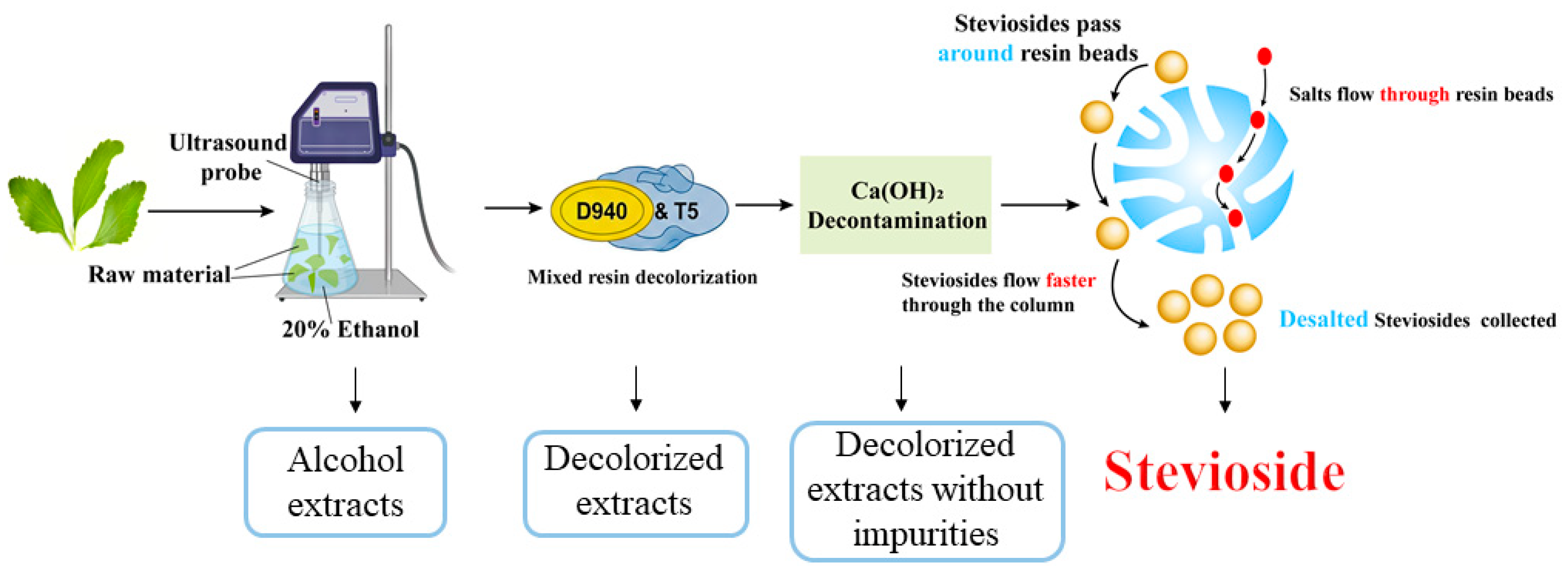
Ultrasound-Assisted Coupled with Resin-Based Purification for Sustainable Extraction of Steviosides from Stevia rebaudiana Leaves

Abstract
Share and Cite
Liu, Z.; Luo, L.; Ding, Z.; Long, W.; Osire, T.; Li, Q.; Chen, Q.; Long, M. Ultrasound-Assisted Coupled with Resin-Based Purification for Sustainable Extraction of Steviosides from Stevia rebaudiana Leaves. Molecules 2025, 30, 3416. https://doi.org/10.3390/molecules30163416
Liu Z, Luo L, Ding Z, Long W, Osire T, Li Q, Chen Q, Long M. Ultrasound-Assisted Coupled with Resin-Based Purification for Sustainable Extraction of Steviosides from Stevia rebaudiana Leaves. Molecules. 2025; 30(16):3416. https://doi.org/10.3390/molecules30163416
Chicago/Turabian StyleLiu, Zidan, Linyu Luo, Zhiqiang Ding, Weihao Long, Tolbert Osire, Qiong Li, Qianfeng Chen, and Mengfei Long. 2025. "Ultrasound-Assisted Coupled with Resin-Based Purification for Sustainable Extraction of Steviosides from Stevia rebaudiana Leaves" Molecules 30, no. 16: 3416. https://doi.org/10.3390/molecules30163416
APA StyleLiu, Z., Luo, L., Ding, Z., Long, W., Osire, T., Li, Q., Chen, Q., & Long, M. (2025). Ultrasound-Assisted Coupled with Resin-Based Purification for Sustainable Extraction of Steviosides from Stevia rebaudiana Leaves. Molecules, 30(16), 3416. https://doi.org/10.3390/molecules30163416