A Facile and General Oxidative Hydroxylation of Organoboron Compounds: Citric Acid as an Efficient Catalyst in Water to Access Phenolic and Alcoholic Motifs


Abstract
1. Introduction
2. Results
3. Materials and Methods
3.1. General Information
3.2. Synthetic Procedures
3.2.1. The Typical Procedure for the Oxidative Hydroxylation of Arylboronic Acids
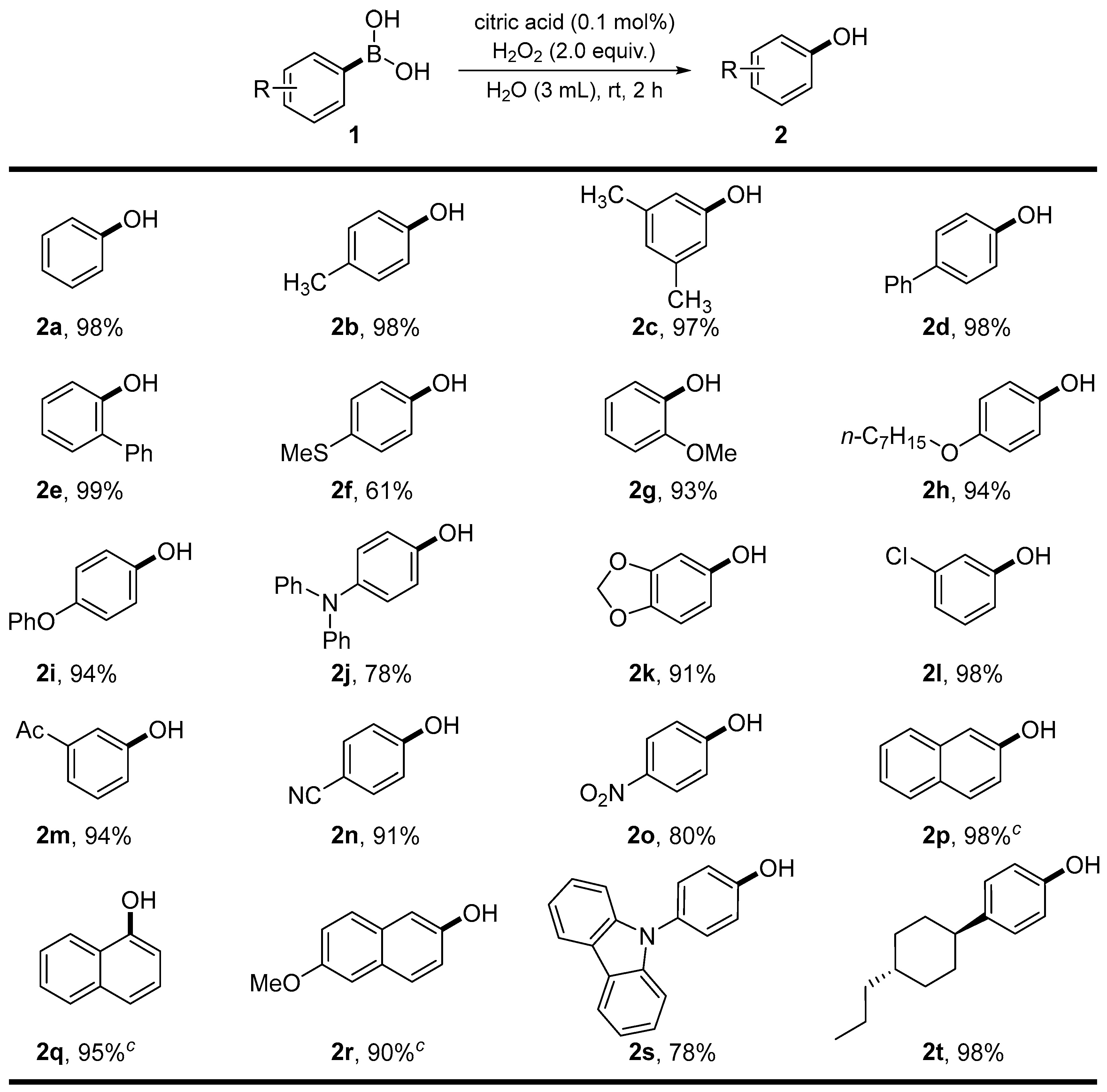
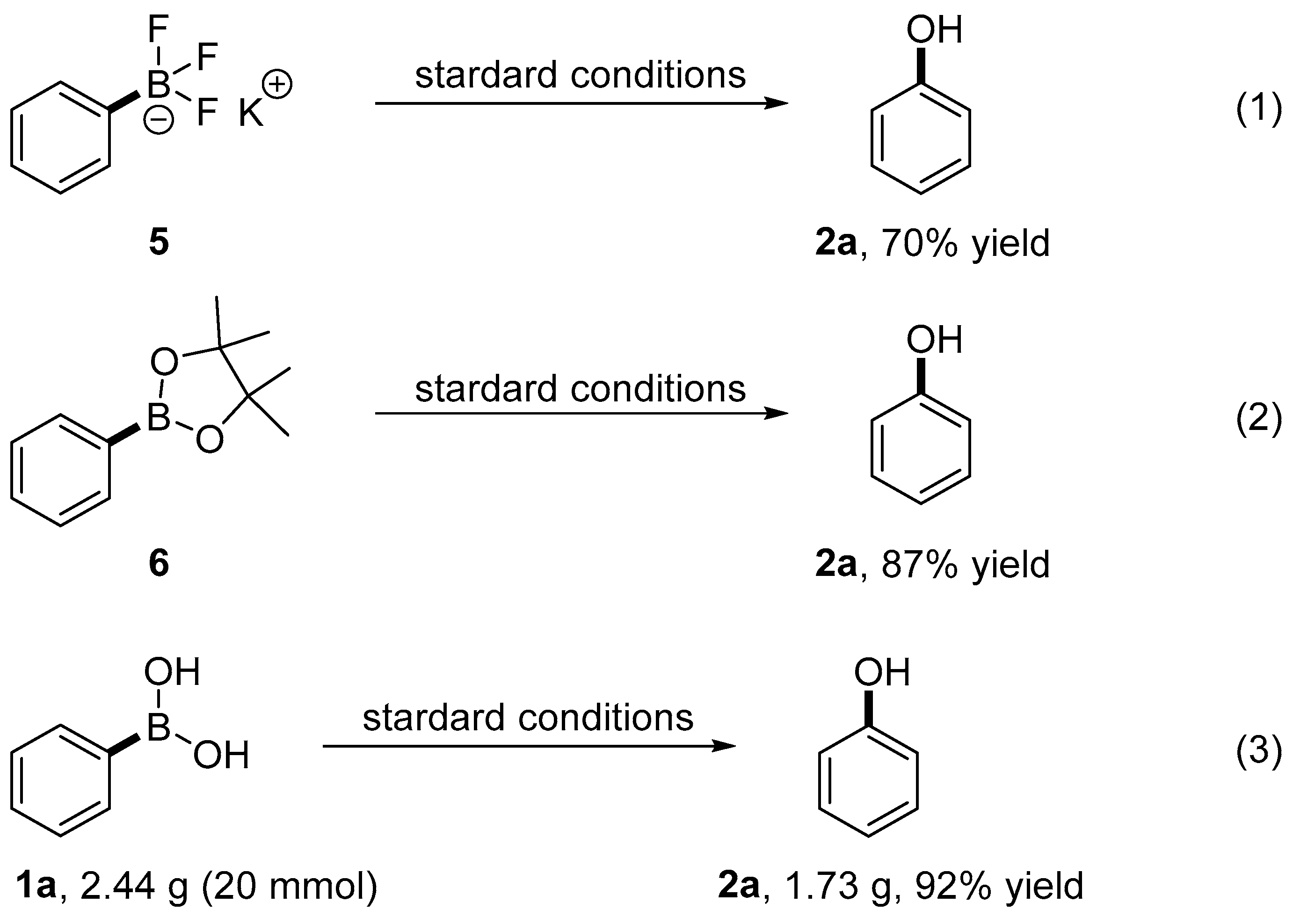
- phenol (2a): Yield: 98%, 92.2 mg, light pink solid, mp 38–40 °C, Rf = 0.50 (H/E = 5:1). 1H NMR (500 MHz, CDCl3) δ 7.29 (d, J = 6.2 Hz, 2H), 6.97 (t, J = 7.4 Hz, 1H), 6.87 (d, J = 7.7 Hz, 2H), and 4.64 (brs, 1H). 13C NMR (126 MHz, CDCl3) δ 155.5, 129.7 (2C), 120.8, and 115.3 (2C). [M + H]+ calcd for C6H7O, 95.0497; found 95.0493.
- p-cresol (2b): Yield: 98%, 105.7 mg, light brown solid, mp 30–32 °C, Rf = 0.52 (H/E = 5:1). 1H NMR (500 MHz, CDCl3) δ 7.06 (d, J = 8.0 Hz, 2H), 6.76 (d, J = 8.2 Hz, 2H), and 4.72 (brs, 1H), 2.30 (s, 3H). 13C NMR (126 MHz, CDCl3) δ 153.2, 131.0, 130.1 (2C), and 115.1 (2C), 20.5. [M + H]+ calcd for C7H9O, 109.0653; found 109.0659.
- 3,5-dimethylphenol (2c): Yield: 97%, 119.6 mg, yellow solid, mp 59–61 °C, Rf = 0.62 (H/E = 5:1). 1H NMR (500 MHz, CDCl3) δ 6.64 (s, 1H), 6.52 (s, 2H), 5.12 (brs, 1H), and 2.31 (s, 6H). 13C NMR (126 MHz, CDCl3) δ 155.3, 139.6 (2C), 122.6, 113.1 (2C), and 21.3 (2C). [M + H]+ calcd for C8H11O, 123.0810; found 123.0808.
- [1,1′-biphenyl]-4-ol (2d): Yield: 98%, 166.6 mg, light yellow solid, mp 162–164 °C, Rf = 0.44 (H/E = 5:1).1H NMR (500 MHz, CDCl3) δ 7.66–7.33 (m, 7H), 6.94 (d, J = 6.7 Hz, 2H), and 4.87 (s, 1H). 13C NMR (126 MHz, CDCl3) δ 155.1, 140.8, 134.0, 131.0, 128.8 (2C), 128.4 (2C), 126.7 (2C), and 115.7(2C). [M + H]+ calcd for C12H11O, 171.0810; found 171.0815.
- [1,1′-biphenyl]-2-ol (2e): Yield: 99%, 168.8 mg, light yellow solid, mp 29–31 °C, Rf = 0.43 (H/E = 5:1).1H NMR (500 MHz, CDCl3) δ 7.56 (d, J = 4.4 Hz, 4H), 7.48–7.45 (m, 1H), 7.34 (d, J = 7.4 Hz, 2H), 7.08 (dd, J = 12.2, 7.4 Hz, 2H), and 5.40 (s, 1H). 13C NMR (126 MHz, CDCl3) δ 152.5, 137.2, 130.4, 129.32 (2C), 129.25, 129.2, 128.3, 127.9 (2C), 121.0, and 116.0. [M + H]+ calcd for C12H11O, 171.0810; found 171.0818.
- 4-(methylthio)phenol (2f): Yield: 61%, 85.6 mg, white solid, mp 82–84 °C, Rf = 0.36 (H/E = 5:1). 1H NMR (500 MHz, CDCl3) δ 7.24 (d, J = 8.6 Hz, 2H), 6.81 (d, J = 8.6 Hz, 2H), 5.34 (brs, 1H), and 2.46 (s, 3H). 13C NMR (126 MHz, CDCl3) δ 154.1, 130.4 (2C), 128.8, 116.1 (2C), and 18.1. [M + H]+ calcd for C7H9OS, 141.0374; found 141.0369.
- 2-methoxyphenol (2g): Yield: 93%, 115.2 mg, colorless oil, Rf = 0.62 (H/E = 5:1). 1H NMR (500 MHz, CDCl3) δ 6.97–6.95 (m, 1H), 6.92–6.88 (m, 3H), 5.67 (brs, 1H), and 3.92 (s, 3H). 13C NMR (126 MHz, CDCl3) δ 146.6, 145.7, 121.5, 120.2, 114.6, 110.7, and 55.9. [M + H]+ calcd for C7H9O2, 125.0603; found 125.0605.
- 4-(heptyloxy)phenol (2h): Yield: 94%, 195.6 mg, white solid, mp 56–58 °C, Rf = 0.58 (H/E = 5:1). 1H NMR (500 MHz, CDCl3) δ 6.80 (q, J = 9.2 Hz, 4H), 5.34 (brs, 1H), 3.93 (t, J = 6.7 Hz, 2H), 1.79 (p, J = 6.9 Hz, 2H), 1.53–1.42 (m, 2H), 1.43–1.28 (m, 6H), and 0.93 (t, J = 6.7 Hz, 3H). 13C NMR (126 MHz, CDCl3) δ 153.2, 149.4, 116.1 (2C), 115.8 (2C), 69.0, 31.8, 29.4, 29.1, 26.0, 22.6, and 14.1. [M + H]+ calcd for C13H21O2, 209.1542; found 209.1540.
- 4-phenoxyphenol (2i): Yield: 94%, 175.0 mg, light brown solid, mp 74–76 °C, Rf = 0.48 (H/E = 5:1). 1H NMR (500 MHz, CDCl3) δ 7.34 (t, J = 7.9 Hz, 2H), 7.09 (t, J = 7.3 Hz, 1H), 7.00–6.97 (m, 4H), 6.86 (d, J = 8.8 Hz, 2H), and 5.28 (brs, 1H). 13C NMR (126 MHz, CDCl3) δ 158.4, 151.7, 150.3, 129.7 (2C), 122.7, 121.1 (2C), 117.7 (2C), and 116.5 (2C). [M + H]+ calcd for C12H11O2, 187.0759; found 187.0759.
- 4-(diphenylamino)phenol (2j): Yield: 78%, 204.2 mg, white solid, mp 118–120 °C, Rf = 0.48 (H/E = 5:1). 1H NMR (500 MHz, CDCl3) δ 7.26 (t, J = 8.6 Hz, 4H), 7.13–6.97 (m, 8H), 6.81 (d, J = 8.1 Hz, 2H), and 4.98 (brs, 1H). 13C NMR (126 MHz, CDCl3) δ 152.1, 148.2(2C), 141.0, 129.1 (4C), 127.6 (2C), 123.0 (4C), 122.0 (2C), and 116.3 (2C). [M + H]+ calcd for C18H16NO, 262.1232; found 262.1237.
- benzo[d][1,3]dioxol-5-ol (2k): Yield: 91%, 125.6 mg, white solid, mp 58–60 °C, Rf = 0.38 (H/E = 5:1). 1H NMR (500 MHz, CDCl3) δ 6.68 (d, J = 8.3 Hz, 1H), 6.45 (d, J = 2.4 Hz, 1H), 6.28 (dd, J = 8.3, 2.4 Hz, 1H), 5.93 (s, 2H), and 4.87 (brs, 1H). 13C NMR (126 MHz, CDCl3) δ 150.5, 148.3, 141.6, 108.2, 106.8, 101.2, and 98.4. [M + H]+ calcd for C7H7O3, 139.0395; found 139.0393.
- 3-chlorophenol (2l): Yield: 98%, 125.8 mg, colorless oil, Rf = 0.51 (H/E = 5:1). 1H NMR (500 MHz, CDCl3) δ 7.18 (t, J = 8.1 Hz, 1H), 6.94 (d, J = 7.9 Hz, 1H), 6.88 (s, 1H), 6.76–6.74 (m, 1H), and 5.11 (brs, 1H). 13C NMR (126 MHz, CDCl3) δ 156.3, 134.9, 130.5, 121.1, 115.9, and 113.8. [M + H]+ calcd for C6H6ClO, 129.0107; found 129.0111.
- 1-(3-hydroxyphenyl)ethan-1-one (2m): Yield: 94%, 127.8 mg, yellow solid, mp 92–94 °C, Rf = 0.54 = (H/E 5:1). 1H NMR (500 MHz, CDCl3) δ 7.58 (s, 1H), 7.53 (d, J = 7.7 Hz, 1H), 7.36 (t, J = 7.9 Hz, 1H), 7.15 (dd, J = 8.1, 2.5 Hz, 1H), 6.98 (brs, 1H), and 2.63 (s, 3H). 13C NMR (126 MHz, CDCl3) δ 199.7, 156.5, 138.3, 130.0, 121.1, 121.0, 114.8, and 26.8. [M + H]+ calcd for C8H9O2, 137.0603; found 137.0599.
- 4-hydroxybenzonitrile (2n): Yield: 91%, 108.3 mg, gray solid, mp 110–112 °C, Rf = 0.20 (H/E = 5:1). 1H NMR (500 MHz, CDCl3) δ 7.58 (d, J = 8.7 Hz, 2H), 7.22 (brs, 1H), and 6.98 (d, J = 8.8 Hz, 2H). 13C NMR (126 MHz, CDCl3) δ 160.5, 134.4 (2C), 119.3, 116.6 (2C), and 102.8. [M + H]+ calcd for C7H6NO, 120.0449; found 120.0457.
- 4-nitrophenol (2o): Yield: 80%, 111.3 mg, yellow solid, mp 108–110 °C, Rf = 0.18 (H/E = 5:1). 1H NMR (500 MHz, CDCl3) δ 8.20 (d, J = 8.8 Hz, 2H), 6.96 (d, J = 8.8 Hz, 2H), and 6.14 (s, 1H). 13C NMR (126 MHz, CDCl3) δ 161.5, 141.6, 126.3 (2C), and 115.8 (2C). [M + H]+ calcd for C6H6NO3, 140.0348; found 140.0349.
- naphthalen-2-ol (2p): Yield: 98%, 141.2 mg, white solid, mp 118–120 °C, Rf = 0.48 (H/E = 5:1). 1H NMR (500 MHz, CDCl3) δ 7.83–7.79 (m, 2H), 7.71 (d, J = 7.9 Hz, 1H), 7.48 (t, J = 7.1 Hz, 1H), 7.38 (t, J = 7.0 Hz, 1H), 7.18–7.14 (m, 2H), and 5.20 (brs, 1H). 13C NMR (126 MHz, CDCl3) δ 153.3, 134.6, 123.0, 129.0, 127.8, 126.6, 126.5, 123.7, 117.8, and 109.6. [M + H]+ calcd for C10H9O, 145.0653; found 145.0658.
- naphthalen-1-ol (2q): Yield: 95%, 136.8 mg, white solid, mp 92–94 °C, Rf = 0.52 (H/E = 5:1). 1H NMR (500 MHz, CDCl3) δ 8.24–8.22 (m, 1H), 7.88–7.86 (m, 1H), 7.56–7.49 (m, 3H), 7.35 (t, J = 7.8 Hz, 1H), 6.85 (d, J = 7.4 Hz, 1H), and 5.35 (brs, 1H). 13C NMR (126 MHz, CDCl3) δ 151.4, 134.8, 127.7, 126.5, 125.9, 125.3, 124.4, 121.6, 120.8, and 108.7. [M + H]+ calcd for C10H9O, 145.0653; found 145.0655.
- 6-methoxynaphthalen-2-ol (2r): Yield: 90%, 156.8 mg, white solid, mp 146–148 °C, Rf = 0.56 (H/E = 5:1). 1H NMR (500 MHz, CDCl3) δ 7.67 (d, J = 8.7 Hz, 1H), 7.61 (d, J = 8.8 Hz, 1H), 7.16–7.09 (m, 4H), 4.90 (s, 1H), and 3.93 (s, 3H). 13C NMR (126 MHz, CDCl3) δ 156.1, 151.8, 129.8, 129.7, 128.5, 127.8, 119.3, 118.1, 109.8, 106.0, and 55.3. [M + H]+ calcd for C11H11O2, 175.0759; found 175.0766.
- 4-(9H-carbazol-9-yl)phenol (2s): Yield: 78%, 202.3 mg, white solid, mp 94–96 °C, Rf = 0.40 (H/E = 5:1). 1H NMR (500 MHz, CDCl3) δ 8.25 (t, J = 7.2 Hz, 2H), 7.52–7.36 (m, 8H), 7.06 (d, J = 8.4 Hz, 2H), and 5.26 (brs, 1H). 13C NMR (126 MHz, CDCl3) δ 154.8, 141.4 (2C), 130.6, 128.9 (2C), 126.0 (2C), 123.2 (2C), 120.4 (2C), 119.9 (2C), 116.7 (2C), and 109.8 (2C). [M + H]+ calcd for C18H14NO, 260.1075; found 260.1071.
- 4-((1s,4r)-4-propylcyclohexyl)phenol (2t): Yield: 98%, 214.1 mg, white solid, mp 44–46 °C, Rf = 0.42 (H/E = 5:1). 1H NMR (500 MHz, CDCl3) δ 7.10 (d, J = 8.5 Hz, 2H), 6.78 (d, J = 8.5 Hz, 2H), 4.69 (brs, 1H), 2.45–2.40 (m, 1H), 1.89–1.86 (m, 4H), 1.47–1.21 (m, 7H), 1.10–1.02 (m, 2H), and 0.93 (t, J = 7.3 Hz, 3H). 13C NMR (126 MHz, CDCl3) δ 153.5, 140.4, 127.9 (2C), 115.0 (2C), 43.8, 39.8, 37.0, 34.6 (2C), 33.6 (2C), 20.1, and 14.4. [M + H]+ calcd for C15H23O, 219.1749; found 219.1754.
3.2.2. The Typical Procedure for the Oxidative Hydroxylation of Alkylboronic Acids
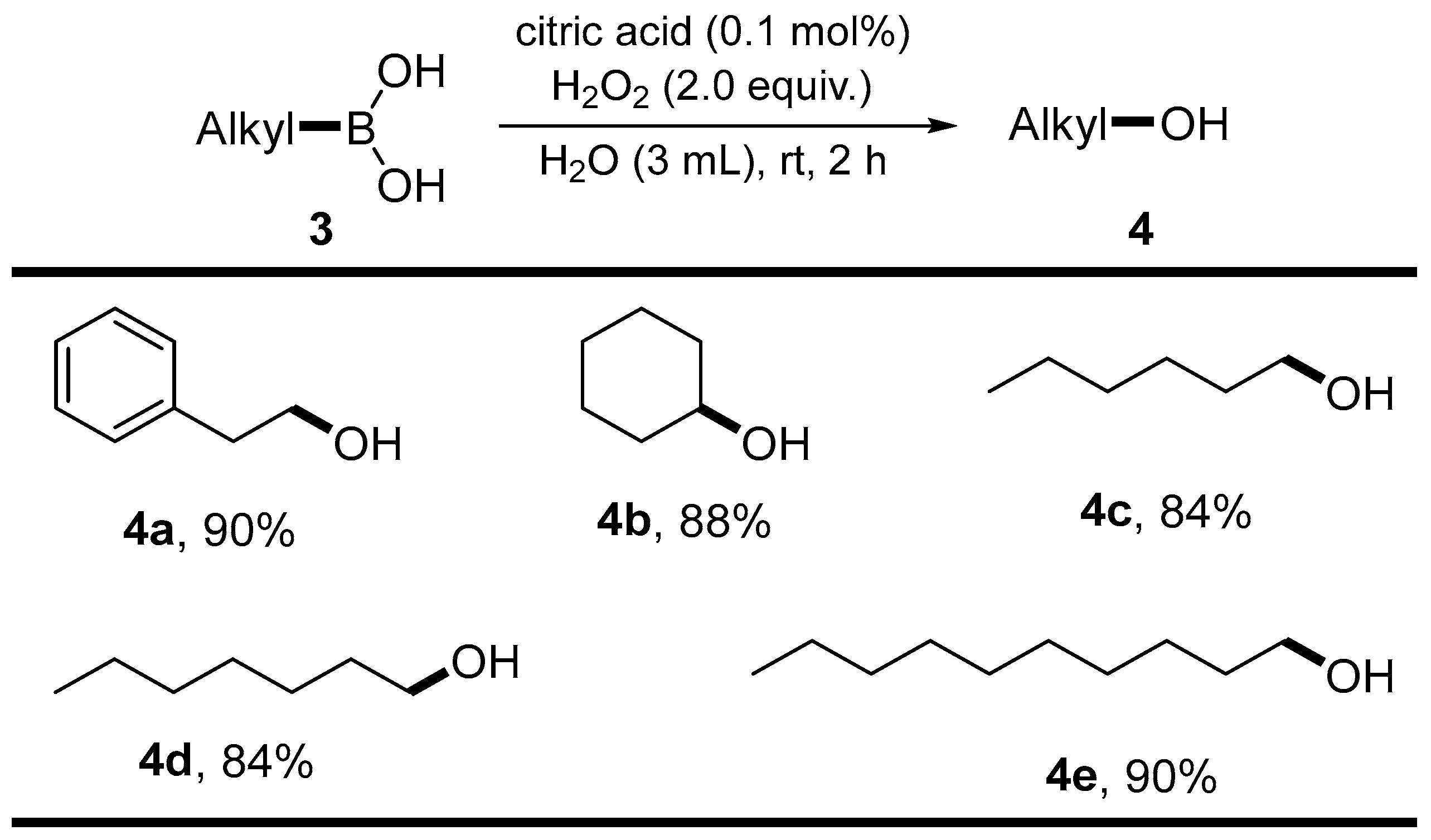
- 2-phenylethan-1-ol (4a): Yield: 90%, 110.0 mg, colorless oil, Rf = 0.40 (H/E = 5:1). 1H NMR (500 MHz, CDCl3) δ 7.35 (t, J = 7.7 Hz, 2H), 7.28–7.25 (m, 3H), 3.89 (t, J = 6.6 Hz, 2H), 2.90 (t, J = 6.5 Hz, 2H), and 1.54 (brs, 1H). 13C NMR (126 MHz, CDCl3) δ 138.5, 129.1 (2C), 128.6 (2C), 126.5, 63.7, and 39.2. [M + H]+ calcd for C8H11O, 123.0810; found 123.0807.
- cyclohexanol (4b): Yield: 88%, 88.2 mg, colorless oil, Rf = 0.34 (H/E = 4:1). 1H NMR (600 MHz, CDCl3) δ 3.53–3.50 (m, 1H), 2.94 (s, 1H), 1.82 (dd, J = 9.6, 4.8 Hz, 2H), 1.67 (dd, J = 9.1, 4.7 Hz, 2H), 1.50–1.46 (m, 1H), 1.22–1.16 (m, 4H), and 1.12–1.07 (m, 1H). 13C NMR (151 MHz, CDCl3) δ 70.1, 35.4 (2C), 25.4, and 24.2 (2C). [M + H]+ calcd for C6H13O, 101.0966; found 101.0967.
- hexan-1-ol (4c): Yield: 84%, 85.8 mg, colorless oil, Rf = 0.38 (H/E = 4:1). 1H NMR (600 MHz, CDCl3) δ 4.41 (brs, 1H), 3.30 (t, J = 6.9 Hz, 2H), 1.29 (p, J = 6.9 Hz, 2H), 1.22–0.95 (m, 6H), and 0.65 (t, J = 7.0 Hz, 3H). 13C NMR (151 MHz, CDCl3) δ 61.8, 32.3, 31.5, 25.3, 22.4, and 13.6. [M + H]+ calcd for C6H15O, 103.1123; found 103.1128.
- heptan-1-ol (4d): Yield: 84%, 97.6 mg, colorless oil, Rf = 0.40 (H/E = 4:1). 1H NMR (600 MHz, CDCl3) δ 3.64 (t, J = 6.7 Hz, 2H), 1.68 (s, 1H), 1.62–1.53 (m, 2H), 1.38–1.26 (m, 8H), and 0.90 (t, J = 7.0 Hz, 3H).13C NMR (151 MHz, CDCl3) δ 63.0, 32.8, 31.8, 29.1, 25.7, 22.6, and 14.1. [M + H]+ calcd for C7H17O, 117.1279; found 117.1277.
- decan-1-ol (4e): Yield: 90%, 142.4 mg, colorless oil, Rf = 0.48 (H/E = 4:1). 1H NMR (600 MHz, CDCl3) δ 3.64 (t, J = 6.7 Hz, 2H), 1.68 (s, 1H), 1.61–1.53 (m, 2H), 1.38–1.25 (m, 14H), and 0.89 (t, J = 7.0 Hz, 3H). 13C NMR (151 MHz, CDCl3) δ 63.0, 32.8, 31.9, 29.64, 29.57, 29.5, 29.3, 25.8, 22.7, and 14.1. [M + H]+ calcd for C10H23O, 159.1749; found 159.1752.
3.2.3. Substrate Extension Studies
3.3. Large-Scale Synthesis
4. Conclusions
Supplementary Materials
Author Contributions
Funding
Institutional Review Board Statement
Informed Consent Statement
Data Availability Statement
Conflicts of Interest
References
- Rappoport, Z. The Chemistry of Phenols; Wiley-VCH: Weinheim, Germany, 2003. [Google Scholar]
- Quideau, S.; Deffieux, D.; Douat-Casassus, C.; Pouységu, L. Plant Polyphenols: Chemical Properties, Biological Activities, and Synthesis. Angew. Chem. Int. Ed. 2011, 50, 586–621. [Google Scholar] [CrossRef] [Scilit] [PubMed]
- Scott, K.A.; Cox, P.B.; Njardarson, J.T. Phenols in Pharmaceuticals: Analysis of a Recurring Motif. J. Med. Chem. 2022, 65, 7044–7072. [Google Scholar] [CrossRef] [Scilit] [PubMed]
- Gualandi, A.; Savoini, A.; Saporetti, R.; Franchi, P.; Lucarini, M.; Cozzi, P.G. A facile hydroxylation of arylboronic acids mediated by sodium ascorbate. Org. Chem. Front. 2018, 5, 1573–1578. [Google Scholar] [CrossRef] [Scilit]
- Yin, W.; Pan, X.; Leng, W.; Chen, J.; He, H. The highly efficient air oxidation of aryl and alkyl boronic acids by a microwave-assisted protocol under transition metal-free conditions. Green Chem. 2019, 21, 4614–4618. [Google Scholar] [CrossRef] [Scilit]
- Zhang, H.; Zhou, C.; Zheng, Y.; Zhang, X. Isotruxene-based porous polymers as efficient and recyclable photocatalysts for visible-light induced metal-free oxidative organic transformations. Green Chem. 2021, 23, 8878–8885. [Google Scholar] [CrossRef] [Scilit]
- Cammidge, A.N.; Goddard, V.H.M.; Schubert, C.P.J.; Gopee, H.; Hughes, D.L.; Gonzalez-Lucas, D. Unexpected Phenol Production from Arylboronic Acids under Palladium-Free Conditions; Organocatalyzed Air Oxidation. Org. Lett. 2011, 13, 6034. [Google Scholar] [CrossRef] [Scilit]
- Kaewmati, P.; Somsook, E.; Dhital, R.N.; Sakurai, H. Aerobic oxygenation of phenylboronic acid promoted by thiol derivatives under gold-free conditions: A warning against gold nanoparticle catalysis. Tetrahedron Lett. 2012, 53, 6104–6106. [Google Scholar] [CrossRef] [Scilit]
- Hosoi, K.; Kuriyama, Y.; Inagi, S.; Fuchigami, T. Electrochemical hydroxylation of organoboron compounds. Chem. Commun. 2010, 46, 1284–1286. [Google Scholar] [CrossRef] [Scilit]
- Jiang, H.; Lykke, L.; Pedersen, S.U.; Xiao, W.-J.; Jørgensen, K.A. A practical electromediated ipso-hydroxylation of aryl and alkyl boronic acids under an air atmosphere. Chem. Commun. 2012, 48, 7203–7205. [Google Scholar] [CrossRef] [Scilit]
- Simon, J.; Salzbrunn, S.; Prakash, G.K.S.; Petasis, N.A.; Olah, G.A. Regioselective Conversion of Arylboronic Acids to Phenols and Subsequent Coupling to Symmetrical Diaryl Ethers. J. Org. Chem. 2001, 66, 633–634. [Google Scholar] [CrossRef] [Scilit]
- Kwon, G.-T.; Kim, S.-H. Tylenol® and Aspirin® as Green Promoters for Ipso-Hydroxylation of Arylboronic Acids. Lett. Org. Chem. 2022, 19, 902–907. [Google Scholar] [CrossRef] [Scilit]
- Mahanta, A.; Adhikari, P.; Bora, U.; Thakur, A.J. Biosilica as an efficient heterogeneous catalyst for ipso-hydroxylation of arylboronic acids. Tetrahedron Lett. 2015, 56, 1780–1783. [Google Scholar] [CrossRef] [Scilit]
- Das, S.K.; Bhattacharjee, P.; Bora, U. Ascorbic Acid as a Highly Efficient Organocatalyst for ipso-Hydroxylation of Arylboronic Acid. ChemistrySelect 2018, 3, 2131–2134. [Google Scholar] [CrossRef] [Scilit]
- Phukan, S.; Mahanta, A.; Rashid, M.H. Size-tunable ZnO nanotapes as an efficient catalyst for oxidative chemoselective C-B bond cleavage of arylboronic acids. Appl. Catal. A-Gen. 2018, 562, 58–66. [Google Scholar] [CrossRef] [Scilit]
- Agarwal, S.; Deori, K. Copper Sulfide Nanosheets for Photocatalytic Oxidation of Benzyl Alcohols and Hydroxylation of Arylboronic Acids. ACS Appl. Nano Mater. 2022, 5, 4413–4422. [Google Scholar] [CrossRef] [Scilit]
- Begum, T.; Gogoi, A.; Gogoi, P.K.; Bora, U. Catalysis by mont K-10 supported silver nanoparticles: A rapid and green protocol for the efficient ipso-hydroxylation of arylboronic acids. Tetrahedron Lett. 2015, 56, 95–97. [Google Scholar] [CrossRef] [Scilit]
- Shin, E.-J.; Kim, H.-S.; Joo, S.-R.; Shin, U.S.; Kim, S.-H. Heterogeneous Palladium–Chitosan–CNT Core–Shell Nanohybrid Composite for Ipso-hydroxylation of Arylboronic Acids. Catal. Lett. 2019, 149, 1560–1564. [Google Scholar] [CrossRef] [Scilit]
- Guo, S.; Lu, L.; Cai, H. Base-Promoted, Mild and Highly Efficient Conversion of Arylboronic Acids into Phenols with tert-Butyl Hydroperoxide. Synlett 2013, 24, 1712–1714. [Google Scholar] [CrossRef] [Scilit]
- Chen, D.-S.; Huang, J.-M. A Mild and Highly Efficient Conversion of Arylboronic Acids into Phenols by Oxidation with MCPBA. Synlett 2013, 24, 499–501. [Google Scholar] [CrossRef] [Scilit]
- Kianmehr, E.; Yahyaee, M.; Tabatabai, K. A mild conversion of arylboronic acids and their pinacolyl boronate esters into phenols using hydroxylamine. Tetrahedron Lett. 2007, 48, 2713–2715. [Google Scholar] [CrossRef] [Scilit]
- Zhu, C.; Wang, R.; Falck, J.R. Mild and Rapid Hydroxylation of Aryl/Heteroaryl Boronic Acids and Boronate Esters with N-Oxides. Org. Lett. 2012, 14, 3494–3497. [Google Scholar] [CrossRef] [Scilit] [PubMed]
- Chatterjee, N.; Chowdhury, H.; Sneh, K.; Goswami, A. Hydroxylation of aryl- and alkylboronic acids/esters mediated by iodobenzene diacetate—An avenue for using organoboronic acids/esters as nucleophiles for hydroxylation reactions. Tetrahedron Lett. 2015, 56, 172–174. [Google Scholar] [CrossRef] [Scilit]
- Gogoi, P.; Bezboruah, P.; Gogoi, J.; Boruah, R.C. ipso-Hydroxylation of Arylboronic Acids and Boronate Esters by Using Sodium Chlorite as an Oxidant in Water. Eur. J. Org. Chem. 2013, 2013, 7291–7294. [Google Scholar] [CrossRef] [Scilit]
- Gogoi, A.; Bora, U. An Iodine-Promoted, Mild and Efficient Method for the Synthesis of Phenols from Arylboronic Acids. Synlett 2012, 23, 1079–1081. [Google Scholar]
- Prakash, G.K.S.; Chacko, S.; Panja, C.; Thomas, T.E.; Gurung, L.; Rasul, G.; Mathew, T.; Olah, G.A. Regioselective Synthesis of Phenols and Halophenols from Arylboronic Acids Using Solid Poly(N-vinylpyrrolidone)/ Hydrogen Peroxide and Poly(4-vinylpyridine)/Hydrogen Peroxide Complexes. Adv. Synth. Catal. 2009, 351, 1567–1574. [Google Scholar] [CrossRef] [Scilit]
- Mulakayala, N.; Kumar, K.M.; Rapolu, R.K.; Kandagatla, B.; Rao, P.; Oruganti, S.; Pal, M. Catalysis by Amberlite IR-120 resin: A rapid and green method for the synthesis of phenols from arylboronic acids under metal, ligand, and base-free conditions. Tetrahedron Lett. 2012, 53, 6004–6007. [Google Scholar] [CrossRef] [Scilit]
- Gohain, M.; Plessis, M.; van Tonder, J.H.; Bezuidenhoudt, B.C.B. Preparation of phenolic compounds through catalyst-free ipso-hydroxylation of arylboronic acids. Tetrahedron Lett. 2014, 55, 2082–2084. [Google Scholar] [CrossRef] [Scilit]
- Wagh, R.B.; Nagarkar, J.M. Silica chloride: An efficient promoter for oxidation of arylboronic acids to phenols. Tetrahedron Lett. 2017, 58, 3323–3326. [Google Scholar] [CrossRef] [Scilit]
- Karthik, M.; Suresh, P. Graphene Oxide as a Carbocatalyst for Sustainable ipso-Hydroxylation of Arylboronic Acids: A Simple and Straightforward Strategy To Access Phenols. ACS Sustain. Chem. Eng. 2019, 7, 9028–9034. [Google Scholar] [CrossRef] [Scilit]
- Choudhary, P.; Kumari, K.; Sharma, D.; Kumar, S.; Krishnan, V. Surface Nanoarchitectonics of Boron Nitride Nanosheets for Highly Efficient and Sustainable ipso-Hydroxylation of Arylboronic Acids. ACS Appl. Mater. Interfaces 2023, 15, 9412–9420. [Google Scholar] [CrossRef] [Scilit]
- Huang, W.-C.; Li, B.; Qi, X.; Mao, X. New type of green extractant for oil production: Citric acid/citric acid sodium extraction system. Food Chem. 2020, 310, 125815. [Google Scholar] [CrossRef] [Scilit] [PubMed]
- Zolfigol, M.A.; Mokhlesi, M.; Farahmand, S. Application of citric acid as highly efficient and green organocatalyst for multi-component synthesis of indazolo[2,1-b]phthalazine-triones. J. Iran. Chem. Soc. 2013, 10, 577–581. [Google Scholar] [CrossRef] [Scilit]
- Ding, Q.-S.; Zhang, J.-L.; Chen, J.-X.; Liu, M.-C.; Ding, J.-C.; Wu, H.-Y. Tandem synthesis of 2,3-dihydroquinazolin-4(1H)-ones on grinding under solvent-free conditions. J. Heterocycl. Chem. 2012, 49, 375–380. [Google Scholar] [CrossRef] [Scilit]
- Gundala, T.R.; Godugu, K.; Nallagondu, C.G.R. Citric Acid-catalyzed Synthesis of 2,4-Disubstituted Thiazoles from Ketones via C–Br, C–S, and C–N Bond Formations in One Pot: A Green Approach. J. Chin. Chem. Soc. 2017, 64, 1408–1416. [Google Scholar] [CrossRef] [Scilit]
- Gawande, M.B.; Brancoa, P.S.; Varma, R.S. Nano-magnetite (Fe3O4) as a support for recyclable catalysts in the development of sustainable methodologies. Chem. Soc. Rev. 2013, 42, 3371–3393. [Google Scholar] [CrossRef] [Scilit]

 | ||||
|---|---|---|---|---|
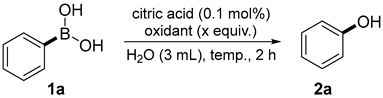
| Entry | Cat. (x mol) | Oxidant (x equiv.) | Temp. (°C) | Yield (%) b |
| 1 | citric acid (0.1) | H2O2 (2.0) | 40 | 93 |
| 2 | citric acid (0.1) | H2O2 (2.0) | 30 | 96 |
| 3 | citric acid (0.1) | H2O2 (2.0) | rt | 98 |
| 4 | citric acid (0.1) | air | rt | n. d. c |
| 5 | citric acid (0.1) | TBHP (2.0) | rt | 30 |
| 6 | citric acid (0.1) | DTBP (2.0) | rt | 40 |
| 7 | citric acid (0.1) | O2 (balloon) | rt | n. d. |
| 8 | citric acid (0.1) | NaClO2 (2.0) | rt | 64 |
| 9 | citric acid (0.1) | H2O2 (1.0) | rt | 68 |
| 10 | citric acid (0.1) | H2O2 (3.0) | rt | 95 |
| 11 | citric acid (0.05) | H2O2 (2.0) | rt | 90 |
| 12 | citric acid (0.2) | H2O2 (2.0) | rt | 97 |
| 13 d | citric acid (0.1) | H2O2 (2.0) | rt | 91 |
| 14 | - | H2O2 (2.0) | rt | 66 |
| 15 | acetic acid (0.1) | H2O2 (2.0) | rt | 69 |
| 16 | benzoic acid (0.1) | H2O2 (2.0) | rt | 74 |
| 17 | tartaric acid (0.1) | H2O2 (2.0) | rt | 83 |
| 18 | formic acid (0.1) | H2O2 (2.0) | rt | 81 |
Disclaimer/Publisher’s Note: The statements, opinions and data contained in all publications are solely those of the individual author(s) and contributor(s) and not of MDPI and/or the editor(s). MDPI and/or the editor(s) disclaim responsibility for any injury to people or property resulting from any ideas, methods, instructions or products referred to in the content. |
© 2023 by the authors. Licensee MDPI, Basel, Switzerland. This article is an open access article distributed under the terms and conditions of the Creative Commons Attribution (CC BY) license (https://creativecommons.org/licenses/by/4.0/).
Share and Cite
Zhou, J.-H.; Chen, X.; Yang, D.; Liu, C.-Y.; Zhou, X.-Y. A Facile and General Oxidative Hydroxylation of Organoboron Compounds: Citric Acid as an Efficient Catalyst in Water to Access Phenolic and Alcoholic Motifs. Molecules 2023, 28, 7915. https://doi.org/10.3390/molecules28237915
Zhou J-H, Chen X, Yang D, Liu C-Y, Zhou X-Y. A Facile and General Oxidative Hydroxylation of Organoboron Compounds: Citric Acid as an Efficient Catalyst in Water to Access Phenolic and Alcoholic Motifs. Molecules. 2023; 28(23):7915. https://doi.org/10.3390/molecules28237915
Chicago/Turabian StyleZhou, Jia-Hui, Xia Chen, Dan Yang, Chun-Yan Liu, and Xiao-Yu Zhou. 2023. "A Facile and General Oxidative Hydroxylation of Organoboron Compounds: Citric Acid as an Efficient Catalyst in Water to Access Phenolic and Alcoholic Motifs" Molecules 28, no. 23: 7915. https://doi.org/10.3390/molecules28237915
APA StyleZhou, J.-H., Chen, X., Yang, D., Liu, C.-Y., & Zhou, X.-Y. (2023). A Facile and General Oxidative Hydroxylation of Organoboron Compounds: Citric Acid as an Efficient Catalyst in Water to Access Phenolic and Alcoholic Motifs. Molecules, 28(23), 7915. https://doi.org/10.3390/molecules28237915