Photoactive Thin-Film Structures of Curcumin, TiO2 and ZnO



Abstract
1. Introduction
2. Results
2.1. Curcumin Films via Spin-Coating
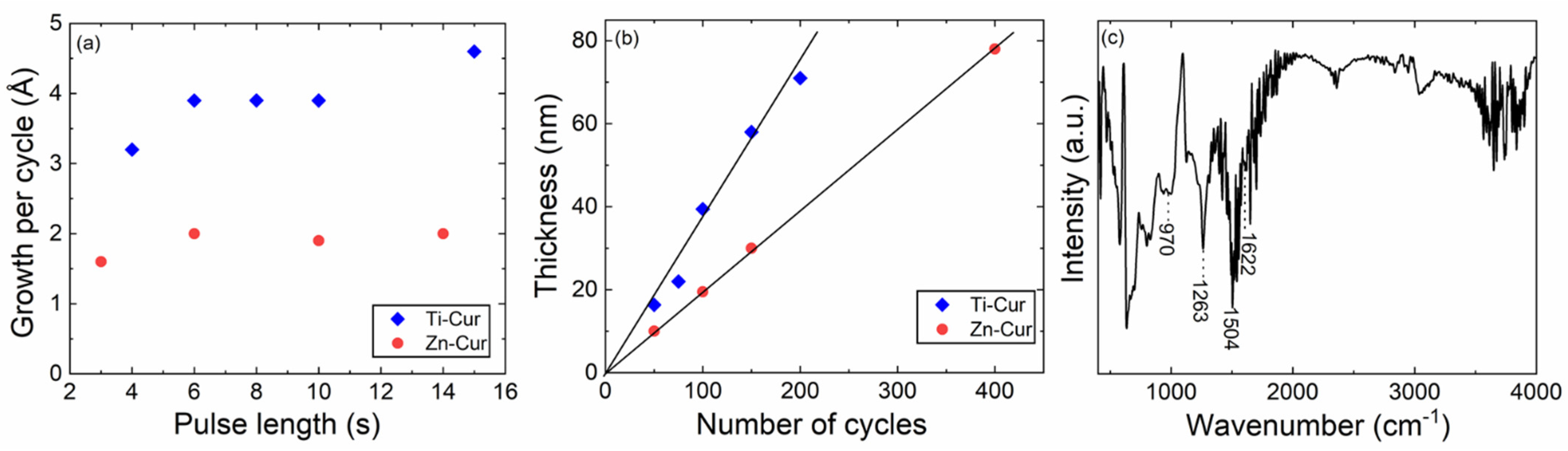
2.2. Zn/Ti-Cur Films by ALD/MLD
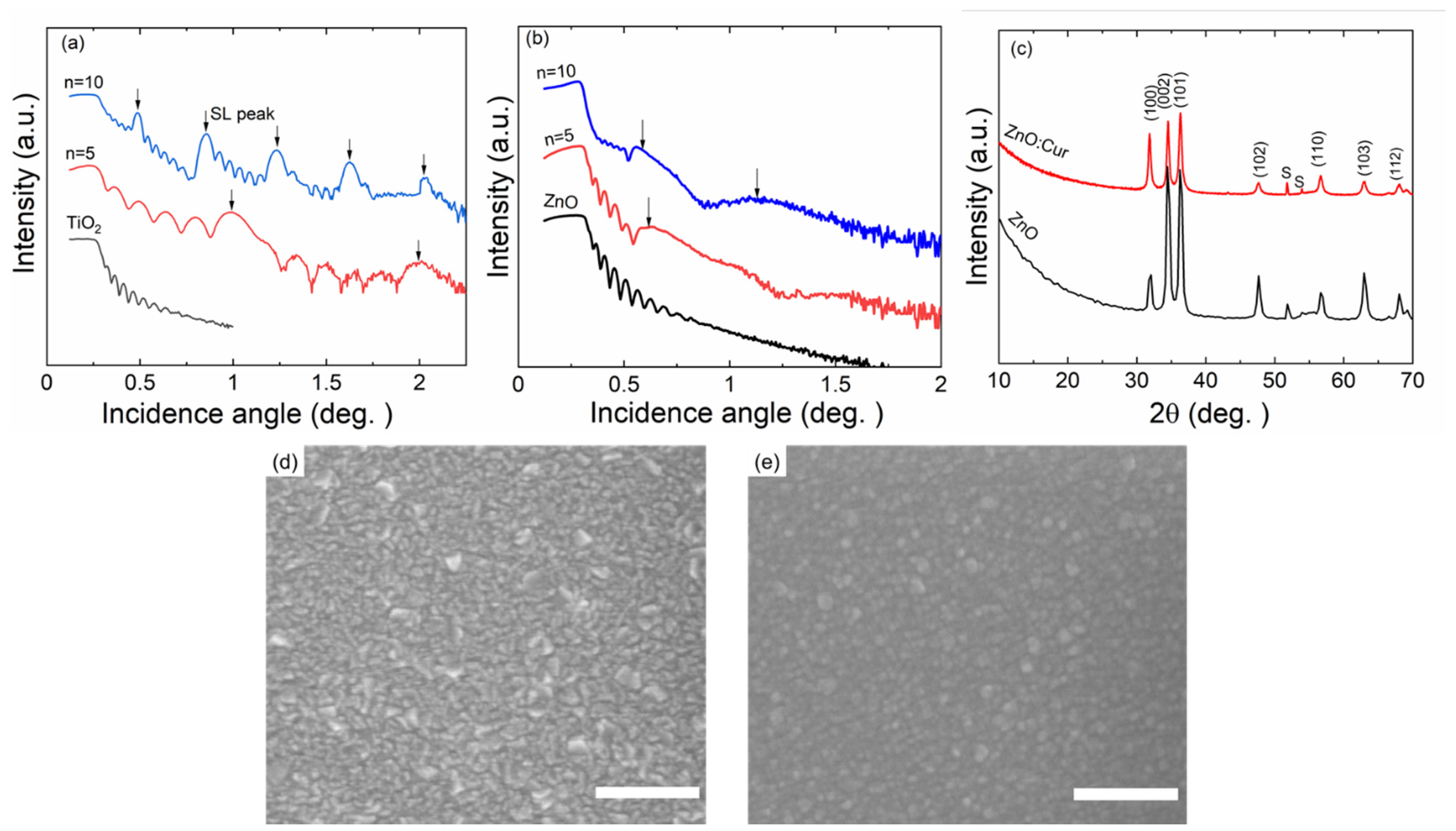
2.3. Superlattice and Double-Layer Structures with Curcumin and ZnO/TiO2
2.4. UV-Vis Absorption Characteristics
3. Materials and Methods
4. Conclusions
Author Contributions
Funding
Institutional Review Board Statement
Informed Consent Statement
Data Availability Statement
Acknowledgments
Conflicts of Interest
Sample Availability
References
- Mathew, D.; Hsu, W.L. Antiviral potential of curcumin. J. Funct. Foods 2018, 40, 692–699. [Google Scholar] [CrossRef] [Scilit]
- Pröhl, M.; Schubert, U.S.; Weigand, W.; Gottschaldt, M. Metal complexes of curcumin and curcumin derivatives for molecular imaging and anticancer therapy. Coord. Chem. Rev. 2016, 307, 32–41. [Google Scholar] [CrossRef] [Scilit]
- Zorofchian Moghadamtousi, S.; Abdul Kadir, H.; Hassandarvish, P.; Tajik, H.; Abubakar, S.; Zandi, K. A review on antibacterial, antiviral, and antifungal activity of curcumin. BioMed Res. Int. 2014, 2014. [Google Scholar] [CrossRef] [Scilit]
- Zandi, K.; Ramedani, E.; Khosro, M.; Tajbakhsh, S.; Deilami, I.; Rastian, Z.; Fouladvand, M.; Yousefi, F.; Farshadpour, F. Evaluation of Antiviral Activities of Curcumin Derivatives. Nat. Prod. Commun. 2010, 5, 1935–1938. [Google Scholar]
- Mazumder, A.; Raghavan, K.; Weinstein, J.; Kohn, K.W.; Pommier, Y. Inhibition of human immunodeficiency virus type-1 integrase by curcumin. Biochem. Pharmacol. 1995, 49, 1165–1170. [Google Scholar] [CrossRef] [Scilit]
- Wanninger, S.; Lorenz, V.; Subhan, A.; Edelmann, F.T. Metal complexes of curcumin—synthetic strategies, structures and medicinal applications. Chem. Soc. Rev. 2015, 44, 4986–5002. [Google Scholar] [CrossRef] [Scilit]
- Chen, T.Y.; Chen, D.Y.; Wen, H.W.; Ou, J.L.; Chiou, S.S.; Chen, J.M.; Wong, M.L.; Hsu, W.L. Inhibition of Enveloped Viruses Infectivity by Curcumin. PLoS ONE 2013, 8. [Google Scholar] [CrossRef] [Scilit]
- Zahedipour, F.; Hosseini, S.A.; Sathyapalan, T.; Majeed, M.; Jamialahmadi, T.; Al-Rasadi, K.; Banach, M.; Sahebkar, A. Potential effects of curcumin in the treatment of COVID-19 infection. Phytother. Res. 2020, 34, 2911–2920. [Google Scholar] [CrossRef] [Scilit]
- Wen, C.C.; Kuo, Y.H.; Jan, J.T.; Liang, P.H.; Wang, S.Y.; Liu, H.G.; Lee, C.K.; Chang, S.T.; Kuo, C.J.; Lee, S.S.; et al. Specific plant terpenoids and lignoids possess potent antiviral activities against severe acute respiratory syndrome coronavirus. J. Med. Chem. 2007, 50, 4087–4095. [Google Scholar] [CrossRef] [Scilit]
- Liu, Z.; Ying, Y. The Inhibitory Effect of Curcumin on Virus-Induced Cytokine Storm and Its Potential Use in the Associated Severe Pneumonia. Front. Cell Dev. Biol. 2020, 8, 1–10. [Google Scholar] [CrossRef] [Scilit]
- Zhang, B.; Swamy, S.; Balijepalli, S.; Panicker, S.; Mooliyil, J.; Sherman, M.A.; Parkkinen, J.; Raghavendran, K.; Suresh, M.V. Direct pulmonary delivery of solubilized curcumin reduces severity of lethal pneumonia. FASEB J. 2019, 33, 13294–13309. [Google Scholar] [CrossRef] [Scilit]
- Chai, Y.S.; Chen, Y.Q.; Lin, S.H.; Xie, K.; Wang, C.J.; Yang, Y.Z.; Xu, F. Curcumin regulates the differentiation of naïve CD4+T cells and activates IL-10 immune modulation against acute lung injury in mice. Biomed. Pharmacother. 2020, 125, 109946. [Google Scholar] [CrossRef] [Scilit] [PubMed]
- Heger, M.; van Golen, R.F.; Broekgaarden, M.; Michel, M.C. The molecular basis for the pharmacokinetics and pharmacodynamics of curcumin and its metabolites in relation to cancers. Pharmacol. Rev. 2014, 66, 222–307. [Google Scholar] [CrossRef] [Scilit] [PubMed]
- Anand, P.; Kunnumakkara, A.B.; Newman, R.A.; Aggarwal, B.B. Bioavailability of curcumin: Problems and promises. Mol. Pharm. 2007, 4, 807–818. [Google Scholar] [CrossRef] [Scilit] [PubMed]
- Yeon, D.K.; Ki, S.H.; Choi, J.; Kang, S.M.; Cho, W.K. Formation of Turmeric-Based Thin Films: Universal, Transparent Coatings. Langmuir 2017, 33, 3639–3646. [Google Scholar] [CrossRef] [Scilit]
- Falsetti, P.H.E.; Soares, F.C.; Rodrigues, G.N.; Del Duque, D.M.S.; de Oliveira, W.R.; Gianelli, B.F.; de Mendonça, V.R. Synthesis and photocatalytic performance of Bi2O3 thin films obtained in a homemade spin coater. Mater. Today Commun. 2021, 27, 102214. [Google Scholar] [CrossRef] [Scilit]
- Zhan, Y.; Grottenmüller, R.; Li, W.; Javaid, F.; Riedel, R. Evaluation of mechanical properties and hydrophobicity of room-temperature, moisture-curable polysilazane coatings. J. Appl. Polym. Sci. 2021, 138, 1–10. [Google Scholar] [CrossRef] [Scilit]
- Im, J.H.; Jang, I.H.; Pellet, N.; Grätzel, M.; Park, N.G. Growth of CH3NH3PbI3 cuboids with controlled size for high-efficiency perovskite solar cells. Nat. Nanotechnol. 2014, 9, 927–932. [Google Scholar] [CrossRef] [Scilit]
- Kulikouskaya, V.; Chyshankou, I.; Pinchuk, S.; Vasilevich, I.; Volotovski, I.; Agabekov, V. Fabrication and characterization of ultrathin spin-coated poly(L-lactic acid) films suitable for cell attachment and curcumin loading. Biomed. Mater. 2020, 15. [Google Scholar] [CrossRef] [Scilit]
- Tone, C.M.; Pirillo, S.; Pucci, D.; De Santo, M.P.; Barberi, R.C.; Ciuchi, F. AFM studies on curcumin based Zn(II) complex molecules for applications as anticancer agents. Mol. Cryst. Liq. Cryst. 2012, 558, 194–203. [Google Scholar] [CrossRef] [Scilit]
- Yoshimura, T.; Tatsuura, S.; Sotoyama, W. Polymer films formed with monolayer growth steps by molecular layer deposition. Appl. Phys. Lett. 1991, 59, 482–484. [Google Scholar] [CrossRef] [Scilit]
- Sundberg, P.; Karppinen, M. Organic and inorganic-organic thin film structures by molecular layer deposition: A review. Beilstein J. Nanotechnol. 2014, 5, 1104–1136. [Google Scholar] [CrossRef] [Scilit]
- Knez, M.; Nielsch, K.; Niinistö, L. Synthesis and surface engineering of complex nanostructures by atomic layer deposition. Adv. Mater. 2007, 19, 3425–3438. [Google Scholar] [CrossRef] [Scilit]
- Johnson, R.W.; Hultqvist, A.; Bent, S.F. A brief review of atomic layer deposition: From fundamentals to applications. Mater. Today 2014, 17, 236–246. [Google Scholar] [CrossRef] [Scilit]
- George, S.M. Atomic layer deposition: An overview. Chem. Rev. 2010, 110, 111–131. [Google Scholar] [CrossRef] [Scilit]
- Karttunen, A.J.; Sarnes, L.; Townsend, R.; Mikkonen, J.; Karppinen, M. Flexible Thermoelectric ZnO–Organic Superlattices on Cotton Textile Substrates by ALD/MLD. Adv. Electron. Mater. 2017, 3, 1600459. [Google Scholar] [CrossRef] [Scilit]
- Malm, J.; Sahramo, E.; Karppinen, M.; Ras, R.H.A. Photo-controlled wettability switching by conformal coating of nanoscale topographies with ultrathin oxide films. Chem. Mater. 2010, 22, 3349–3352. [Google Scholar] [CrossRef] [Scilit]
- Marin, G.; Funahashi, R.; Karppinen, M. Textile-Integrated ZnO-Based Thermoelectric Device Using Atomic Layer Deposition. Adv. Eng. Mater. 2020, 22, 2000535. [Google Scholar] [CrossRef] [Scilit]
- Brozena, A.H.; Oldham, C.J.; Parsons, G.N. Atomic layer deposition on polymer fibers and fabrics for multifunctional and electronic textiles. J. Vac. Sci. Technol. A Vac. Surf. Film. 2016, 34, 010801. [Google Scholar] [CrossRef] [Scilit]
- Philip, A.; Ghiyasi, R.; Karppinen, M. Visible-Light Absorbing TiO2:Curcumin Thin Films with ALD/MLD. ChemNanoMat 2021, 7, 253–256. [Google Scholar] [CrossRef] [Scilit]
- Meng, X. An overview of molecular layer deposition for organic and organic-inorganic hybrid materials: Mechanisms, growth characteristics, and promising applications. J. Mater. Chem. A 2017, 5, 18326–18378. [Google Scholar] [CrossRef] [Scilit]
- Nilsen, O.; Klepper, K.B.; Nielsen, H.Ø.; Fjellvåg, H. Deposition of Organic- Inorganic Hybrid Materials by Atomic Layer Deposition. ECS Trans. 2008, 16, 3–14. [Google Scholar] [CrossRef] [Scilit]
- Krahl, F.; Giri, A.; Tomko, J.A.; Tynell, T.; Hopkins, P.E.; Karppinen, M. Thermal Conductivity Reduction at Inorganic–Organic Interfaces: From Regular Superlattices to Irregular Gradient Layer Sequences. Adv. Mater. Interfaces 2018, 5, 1701692. [Google Scholar] [CrossRef] [Scilit]
- Philip, A.; Niemelä, J.P.; Tewari, G.C.; Putz, B.; Edwards, T.E.J.; Itoh, M.; Utke, I.; Karppinen, M. Flexible ϵ-Fe2O3-Terephthalate Thin-Film Magnets through ALD/MLD. ACS Appl. Mater. Interfaces 2020, 12, 21912–21921. [Google Scholar] [CrossRef] [Scilit]
- Ghaffari, H.; Tavakoli, A.; Moradi, A.; Tabarraei, A.; Bokharaei-Salim, F.; Zahmatkeshan, M.; Farahmand, M.; Javanmard, D.; Kiani, S.J.; Esghaei, M.; et al. Inhibition of H1N1 influenza virus infection by zinc oxide nanoparticles: Another emerging application of nanomedicine. J. Biomed. Sci. 2019, 26, 1–10. [Google Scholar] [CrossRef] [Scilit] [PubMed]
- Zan, L.; Fa, W.; Peng, T.; Gong, Z. kui Photocatalysis effect of nanometer TiO2 and TiO2-coated ceramic plate on Hepatitis B virus. J. Photochem. Photobiol. B Biol. 2007, 86, 165–169. [Google Scholar] [CrossRef] [Scilit] [PubMed]
- Mazurkova, N.A.; Spitsyna, Y.E.; Shikina, N.V.; Ismagilov, Z.R.; Zagrebel’nyi, S.N.; Ryabchikova, E.I. Interaction of titanium dioxide nanoparticles with influenza virus. Nanotechnol. Russ. 2010, 5, 417–420. [Google Scholar] [CrossRef] [Scilit]
- Tynell, T.; Karppinen, M. Atomic layer deposition of ZnO: A review. Semicond. Sci. Technol. 2014, 29, 043001. [Google Scholar] [CrossRef] [Scilit]
- Niemelä, J.P.; Marin, G.; Karppinen, M. Titanium dioxide thin films by atomic layer deposition: A review. Semicond. Sci. Technol. 2017, 32, 093005. [Google Scholar] [CrossRef] [Scilit]
- Sirelkhatim, A.; Mahmud, S.; Seeni, A.; Kaus, N.H.M.; Ann, L.C.; Bakhori, S.K.M.; Hasan, H.; Mohamad, D. Review on zinc oxide nanoparticles: Antibacterial activity and toxicity mechanism. Nano-Micro Lett. 2015, 7, 219–242. [Google Scholar] [CrossRef] [Scilit]
- Etacheri, V.; Di Valentin, C.; Schneider, J.; Bahnemann, D.; Pillai, S.C. Visible-light activation of TiO2 photocatalysts: Advances in theory and experiments. J. Photochem. Photobiol. C Photochem. Rev. 2015, 25, 1–29. [Google Scholar] [CrossRef] [Scilit]
- Buddee, S.; Wongnawa, S.; Sriprang, P.; Sriwong, C. Curcumin-sensitized TiO2 for enhanced photodegradation of dyes under visible light. J. Nanopart. Res. 2014, 16. [Google Scholar] [CrossRef] [Scilit]
- Buddee, S.; Wongnawa, S. Removal of dyes by photocatalytically active curcumin-sensitized amorphous TiO2 under visible light irradiation. J. Sol-Gel Sci. Technol. 2015, 75, 152–163. [Google Scholar] [CrossRef] [Scilit]
- Perera, W.P.T.D.; Dissanayake, R.K.; Ranatunga, U.I.; Hettiarachchi, N.M.; Perera, K.D.C.; Unagolla, J.M.; De Silva, R.T.; Pahalagedara, L.R. Curcumin loaded zinc oxide nanoparticles for activity-enhanced antibacterial and anticancer applications. RSC Adv. 2020, 10, 30785–30795. [Google Scholar] [CrossRef] [Scilit]
- Niemelä, J.P.; Karppinen, M. Tunable optical properties of hybrid inorganic-organic [(TiO2)m(Ti-O-C6H4-O-)k]n superlattice thin films. Dalton Trans. 2015, 44, 591–597. [Google Scholar] [CrossRef] [Scilit] [PubMed]
- Kim, H.J.; Kim, D.J.; Karthick, S.N.; Hemalatha, K.V.; Justin Raj, C.; Ok, S.; Choe, Y. Curcumin dye extracted from Curcuma longa L. used as sensitizers for efficient dye-sensitized solar cells. Int. J. Electrochem. Sci. 2013, 8, 8320–8328. [Google Scholar]
- Manimaran, S.; SambathKumar, K.; Gayathri, R.; Raja, K.; Rajkamal, N.; Venkatachalapathy, M.; Ravichandran, G.; Lourdu EdisonRaj, C. Medicinal Plant Using Ground State Stabilization of Natural Antioxidant Curcumin by Keto-Enol Tautomerisation. Nat. Prod. Bioprospect. 2018, 8, 369–390. [Google Scholar] [CrossRef] [Scilit] [PubMed]
- Mohan, P.R.K.; Sreelakshmi, G.; Muraleedharan, C.V.; Joseph, R. Water soluble complexes of curcumin with cyclodextrins: Characterization by FT-Raman spectroscopy. Vib. Spectrosc. 2012, 62, 77–84. [Google Scholar] [CrossRef] [Scilit]
- Khayyami, A.; Karppinen, M. Reversible Photoswitching Function in Atomic/Molecular-Layer-Deposited ZnO:Azobenzene Superlattice Thin Films. Chem. Mater. 2018, 30, 5904–5911. [Google Scholar] [CrossRef] [Scilit] [PubMed]
- Sundberg, P.; Karppinen, M. Organic-inorganic thin films from TiCl4 and 4-aminophenol precursors: A model case of ALD/MLD hybrid-material growth? Eur. J. Inorg. Chem. 2014, 2014, 968–974. [Google Scholar] [CrossRef] [Scilit]
- Kolev, T.M.; Velcheva, E.A.; Stamboliyska, B.A.; Spiteller, M. DFT and experimental studies of the structure and vibrational spectra of curcumin. Int. J. Quantum Chem. 2005, 102, 1069–1079. [Google Scholar] [CrossRef] [Scilit]
- Krahl, F.; Ge, Y.; Karppinen, M. Characterization of ZnO/AlOx/benzene thin-film heterostructures grown through atomic layer deposition/molecular layer deposition. Semicond. Sci. Technol. 2020, 36, 025012. [Google Scholar] [CrossRef] [Scilit]
- Niemelä, J.-P.; Aghaee, M.; Kessels, W.M.M.; Creatore, M.; Verheijen, M.A. Transition in layer structure of atomic/molecular layer deposited ZnO-zincone multilayers. J. Vac. Sci. Technol. A 2019, 37, 040602. [Google Scholar] [CrossRef] [Scilit]
- Hausmann, D.M.; Gordon, R.G. Surface morphology and crystallinity control in the atomic layer deposition (ALD) of hafnium and zirconium oxide thin films. J. Cryst. Growth 2003, 249, 251–261. [Google Scholar] [CrossRef] [Scilit]
- Azpitarte, I.; Botta, G.A.; Tollan, C.; Knez, M. SCIP: A new simultaneous vapor phase coating and infiltration process for tougher and UV-resistant polymer fibers. RSC Adv. 2020, 10, 15976–15982. [Google Scholar] [CrossRef] [Scilit]
- Goh, E.G.; Xu, X.; McCormick, P.G. Effect of particle size on the UV absorbance of zinc oxide nanoparticles. Scr. Mater. 2014, 78–79, 49–52. [Google Scholar] [CrossRef] [Scilit]
- Puglisi, A.; Giovannini, T.; Antonov, L.; Cappelli, C. Interplay between conformational and solvent effects in UV-visible absorption spectra: Curcumin tautomers as a case study. Phys. Chem. Chem. Phys. 2019, 21, 15504–15514. [Google Scholar] [CrossRef] [Scilit]



Publisher’s Note: MDPI stays neutral with regard to jurisdictional claims in published maps and institutional affiliations. |
© 2021 by the authors. Licensee MDPI, Basel, Switzerland. This article is an open access article distributed under the terms and conditions of the Creative Commons Attribution (CC BY) license (https://creativecommons.org/licenses/by/4.0/).
Share and Cite
Philip, A.; Ghiyasi, R.; Karppinen, M. Photoactive Thin-Film Structures of Curcumin, TiO2 and ZnO. Molecules 2021, 26, 3214. https://doi.org/10.3390/molecules26113214
Philip A, Ghiyasi R, Karppinen M. Photoactive Thin-Film Structures of Curcumin, TiO2 and ZnO. Molecules. 2021; 26(11):3214. https://doi.org/10.3390/molecules26113214
Chicago/Turabian StylePhilip, Anish, Ramin Ghiyasi, and Maarit Karppinen. 2021. "Photoactive Thin-Film Structures of Curcumin, TiO2 and ZnO" Molecules 26, no. 11: 3214. https://doi.org/10.3390/molecules26113214
APA StylePhilip, A., Ghiyasi, R., & Karppinen, M. (2021). Photoactive Thin-Film Structures of Curcumin, TiO2 and ZnO. Molecules, 26(11), 3214. https://doi.org/10.3390/molecules26113214