Review

Role of Inositols and Inositol Phosphates in Energy Metabolism
by
Saimai Chatree
1,
Nanthaphop Thongmaen
2,
Kwanchanit Tantivejkul
3,
Chantacha Sitticharoon
2 and
Ivana Vucenik
4,5,*
1
Faculty of Medicine and Public Health, HRH Princess Chulabhorn College of Medical Science, Chulabhorn Royal Academy, Bangkok 10210, Thailand
2
Department of Physiology, Faculty of Medicine Siriraj Hospital, Mahidol University, Bangkok 10700, Thailand
3
Sugavia Co., Ltd., Nakhonratchasima 30130, Thailand
4
Department of Medical and Research Technology, School of Medicine, University of Maryland, Baltimore, MD 21201, USA
5
Department of Pathology, School of Medicine, University of Maryland, Baltimore, MD 21201, USA
*
Author to whom correspondence should be addressed.
Molecules 2020, 25(21), 5079; https://doi.org/10.3390/molecules25215079

Submission received: 3 October 2020 / Revised: 27 October 2020 / Accepted: 27 October 2020 / Published: 1 November 2020
(This article belongs to the Special Issue Bioactivity of Inositol Phosphates)

Abstract

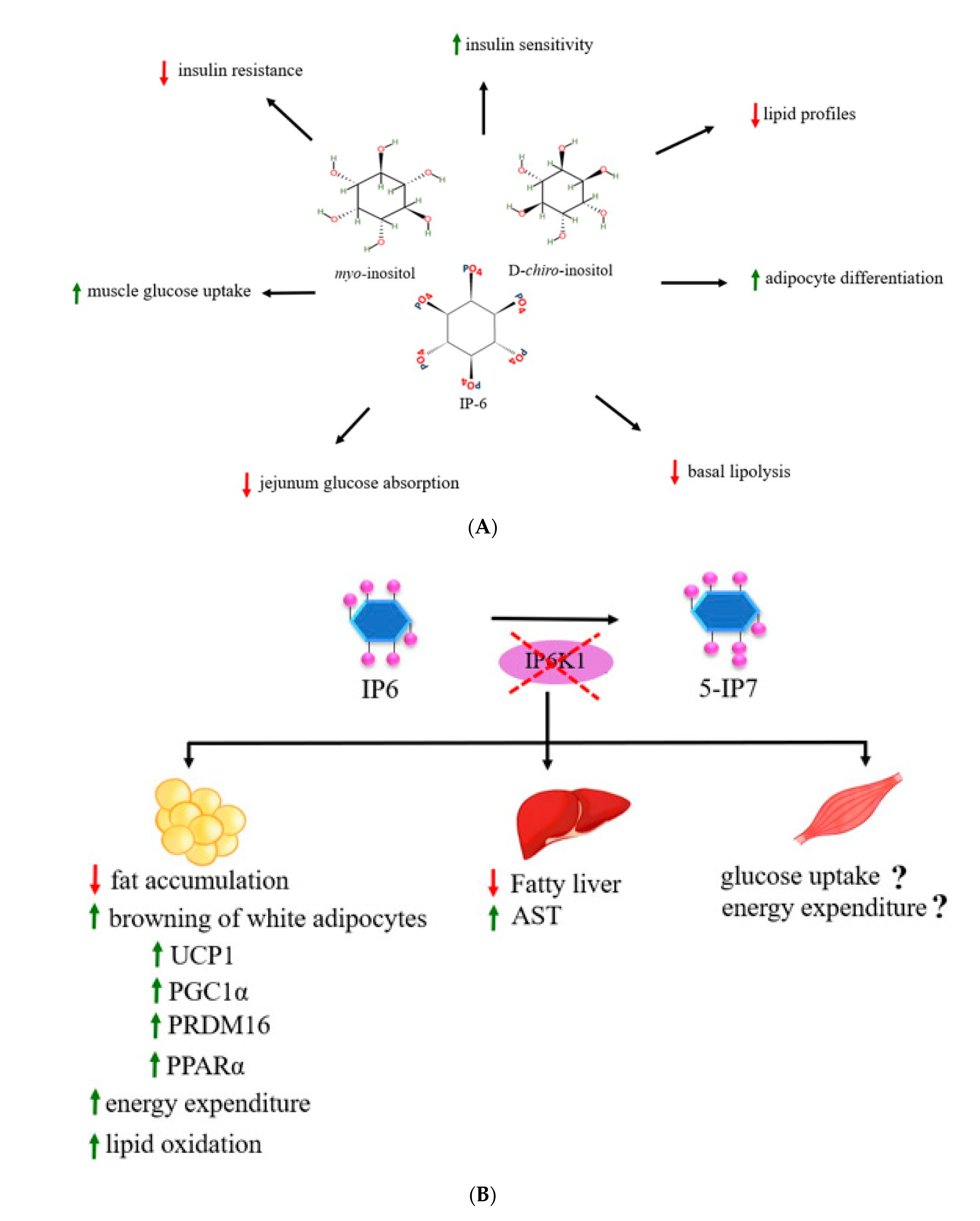
Recently, inositols, especially myo-inositol and inositol hexakisphosphate, also known as phytic acid or IP6, with their biological activities received much attention for their role in multiple health beneficial effects. Although their roles in cancer treatment and prevention have been extensively reported, interestingly, they may also have distinctive properties in energy metabolism and metabolic disorders. We review inositols and inositol phosphate metabolism in mammalian cells to establish their biological activities and highlight their potential roles in energy metabolism. These molecules are known to decrease insulin resistance, increase insulin sensitivity, and have diverse properties with importance from cell signaling to metabolism. Evidence showed that inositol phosphates might enhance the browning of white adipocytes and directly improve insulin sensitivity through adipocytes. In addition, inositol pyrophosphates containing high-energy phosphate bonds are considered in increasing cellular energetics. Despite all recent advances, many aspects of the bioactivity of inositol phosphates are still not clear, especially their effects on insulin resistance and alteration of metabolism, so more research is needed.
Keywords: inositol phosphates; myo-inositol; IP6; energy metabolism; insulin resistance inositol phosphates; myo-inositol; IP6; energy metabolism; insulin resistance