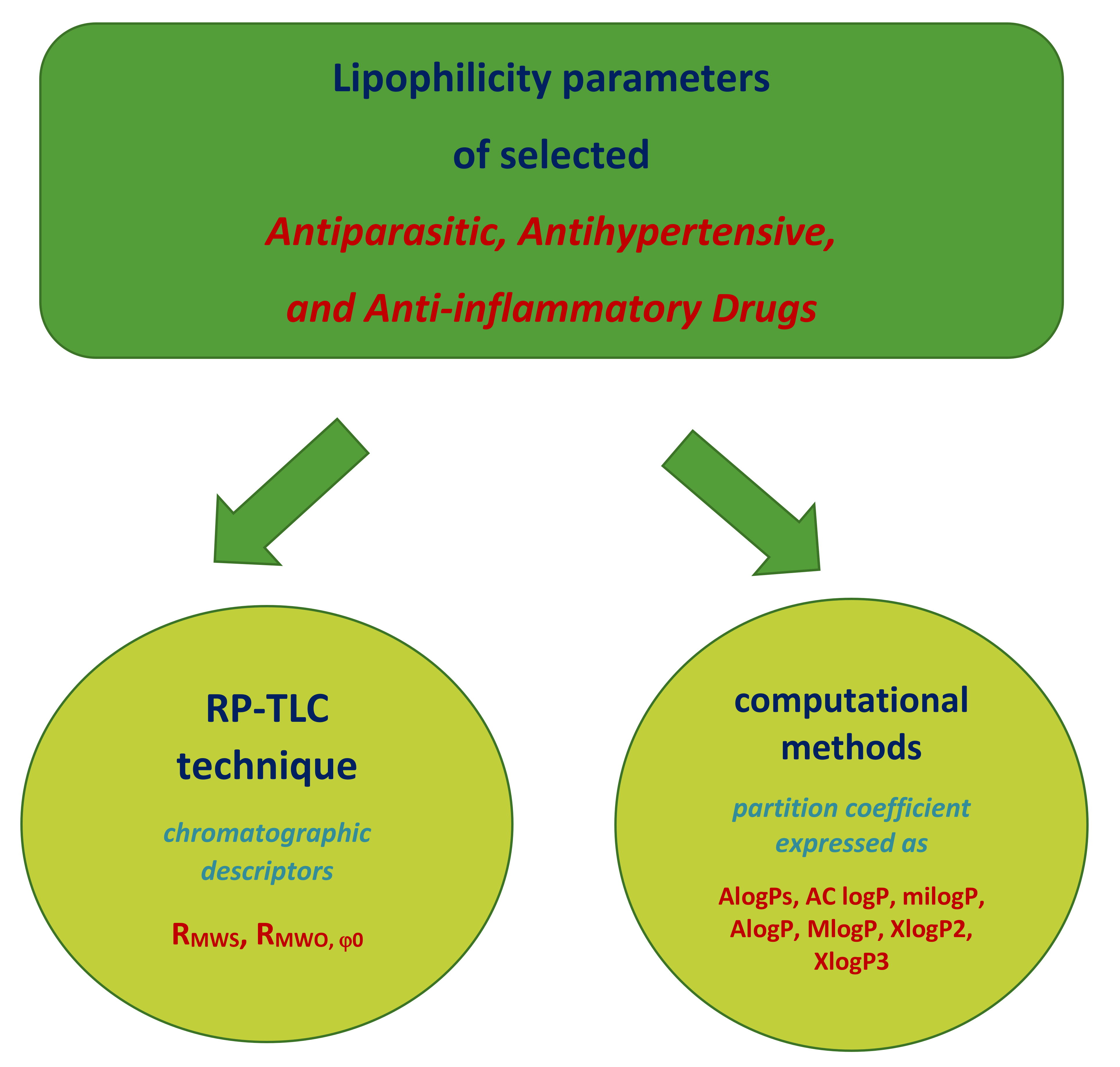
Comparison of the Utility of RP-TLC Technique and Different Computational Methods to Assess the Lipophilicity of Selected Antiparasitic, Antihypertensive, and Anti-inflammatory Drugs




Abstract
Share and Cite
Pyka-Pająk, A.; Parys, W.; Dołowy, M. Comparison of the Utility of RP-TLC Technique and Different Computational Methods to Assess the Lipophilicity of Selected Antiparasitic, Antihypertensive, and Anti-inflammatory Drugs. Molecules 2019, 24, 3187. https://doi.org/10.3390/molecules24173187
Pyka-Pająk A, Parys W, Dołowy M. Comparison of the Utility of RP-TLC Technique and Different Computational Methods to Assess the Lipophilicity of Selected Antiparasitic, Antihypertensive, and Anti-inflammatory Drugs. Molecules. 2019; 24(17):3187. https://doi.org/10.3390/molecules24173187
Chicago/Turabian StylePyka-Pająk, Alina, Wioletta Parys, and Małgorzata Dołowy. 2019. "Comparison of the Utility of RP-TLC Technique and Different Computational Methods to Assess the Lipophilicity of Selected Antiparasitic, Antihypertensive, and Anti-inflammatory Drugs" Molecules 24, no. 17: 3187. https://doi.org/10.3390/molecules24173187
APA StylePyka-Pająk, A., Parys, W., & Dołowy, M. (2019). Comparison of the Utility of RP-TLC Technique and Different Computational Methods to Assess the Lipophilicity of Selected Antiparasitic, Antihypertensive, and Anti-inflammatory Drugs. Molecules, 24(17), 3187. https://doi.org/10.3390/molecules24173187