


The Biosynthetic Pathways of Tanshinones and Phenolic Acids in Salvia miltiorrhiza
Abstract
1. Introduction
2. Comparative Transcriptome Provides Informative Data in Biosynthetic Pathway Analysis
3. Biosynthesis of Tanshinones in S. miltiorrhiza
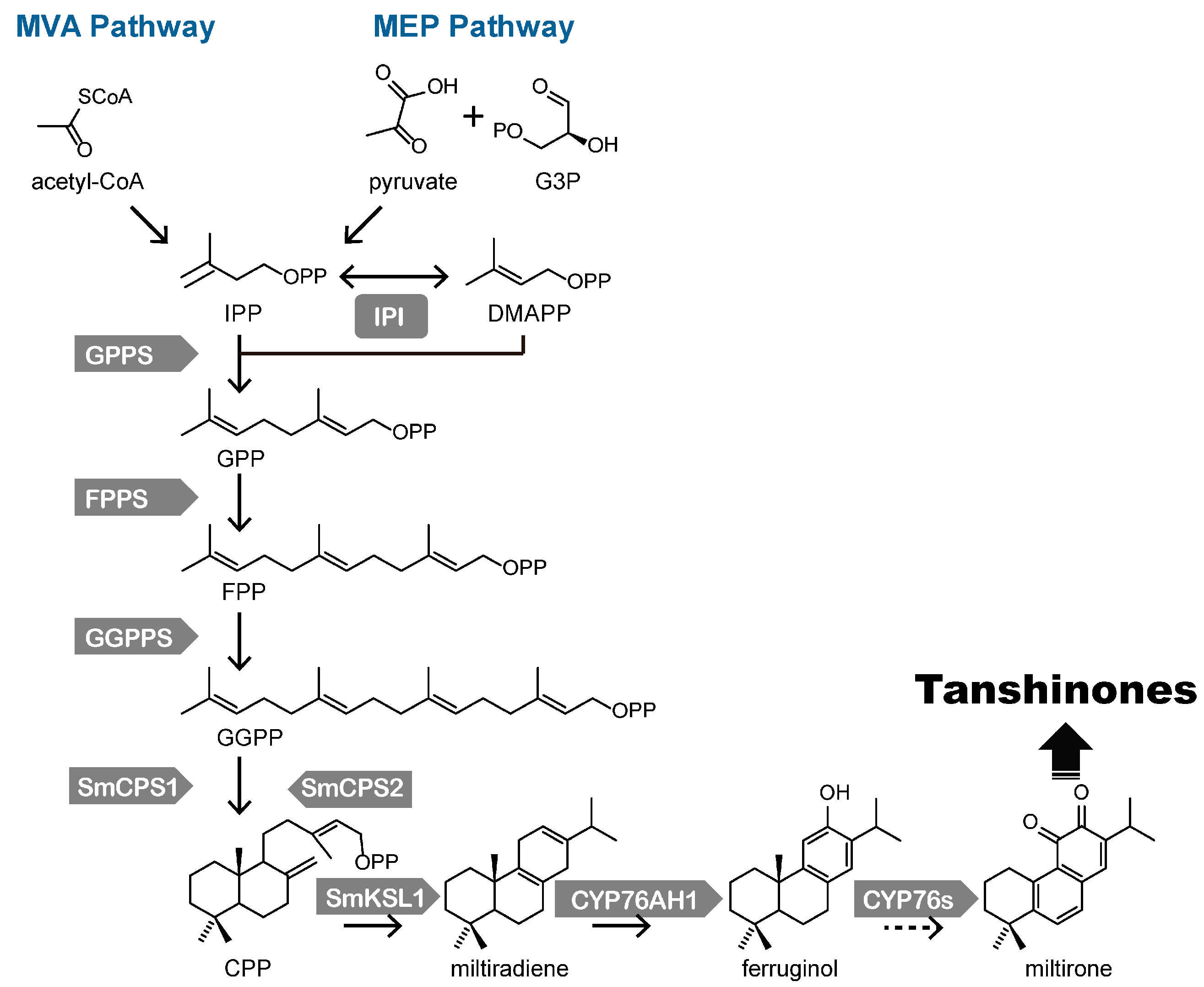

| Gene (Genbank No.) | Highest Expression Sites | Elicitor | Reference | |
|---|---|---|---|---|
| SmAACT1 (EF635969) | root | YE, Ag+ | [30] | |
| SmAACT2 (AEZ55671) | stem | [31] | ||
| SmHMGS (FJ785326) | leaf | SA, MJ, YE | [32] | |
| SmHMGR1 (EU680958 GU367911) | flower and root | SA, JA, MJ, PEG, ABA | [31,33,34] | |
| SmHMGR2 (FJ747636) | leaf, stem, root | MJ, Ag+ | [22,31,35,36] | |
| SmHMGR3 (JN831102) | leaf | MJ | [31,37] | |
| SmHMGR4 (JN831103) | flower | [31] | ||
| SmMK (JN831104) | stem | MJ | [31] | |
| SmPMK (JN831095) | stem and root | MJ | [31] | |
| SmMDC (JN831105) | stem and root | MJ | [31] | |
| SmDXS1 (EU670744) | leaf | Ag+ | [31,35] | |
| SmDXS2 (FJ643618) | root and leaf | MJ, PEG, ABA, MJ Act12, Ag+ | [17,31,34,35,38] | |
| SmDXS3 (JN831116) | leaf, stem, root cortex, and root stele | MJ | [31] | |
| SmDXS4 (JN831117) | ubiquitous | [31] | ||
| SmDXS5 (JN831118) | leaf and stem | [31] | ||
| SmDXR (FJ768959, FJ476255, DQ991431) | leaf | SA,YE, Hypertonic stress, Act12 PEG, ABA and MJ, Ag+ | [34,35,38,39,40] | |
| SmCMT (JN831096) | leaf | [31] | ||
| SmCMK (EF534309) | leaf | MJ | [31,41] | |
| SmMCS (JX233816) | leaf and stem | Ag+ | [31,42] | |
| SmHDS1 (JN831098) | leaf | [31,43] | ||
| SmHDS2 (KJ746807) | [44] | |||
| SmHDR1 (JX233817 JN831099) | leaf | MJ, Ag+ | [31] | |
| SmHDR2 (JN831100) | leaf | [31] | ||
| SmHDR (JX516088) | leaf | MJ, SA | [45] | |
| SmIPI1 (JN831106) | root | MJ, fungal elicitor | [22,46] | |
| SmIPI2 (JN831106) | stem | MJ | [31] | |
| SmGPPS (JN831107) | [31] | |||
| SmGPPS.LSU (JN831111) | stem and flower | MJ | [31] | |
| SmGPPS.SSUI (JN831108) | leaf | MJ | [31] | |
| SmGPPS.SSUII.1 (JN831109) | leaf and root cortex | [31] | ||
| SmGPPS.SSUII.2 (JN831110) | stem | [31] | ||
| SmFPPS (EF635968 HQ687768) | stem | MJ | [22,31,47] | |
| SmGGPPS1 (FJ643617 FJ178784) | leaf | NaCl, wounding, high temperature, darkness, pathogen, MJ, ABA, SA and GA, Act12, Ag+ | [17,35,38,48,49,50] | |
| SmGGPPS2 (JN831112) | root stele | [31] | ||
| SmGGPPS3 (JN831113) | ubiquitous | [31] | ||
| SmCPS1 (EU003997) | root cortex | Ag+, MJ, YE | [35,51,52] | |
| SmCPS2 (JN831114) | leaf | [31,53] | ||
| SmCPS3 (JN831115) | stem | [31,53] | ||
| SmCPS4 (JN831120) | sepal | [31,53] | ||
| SmCPS5 (JN831121) | stem | MJ | [31,53] | |
| SmKSL1 (EF635966) | root | Ag+, MJ | [35,51,53] | |
| SmKSL2 (JN831119) | root xylem | [31,53] | ||
| CYP76AH1 (JX422213) | root | Ag+ | [27,35] | |
| CYP76s (KR140168) (KR140169) | root | Ag+ | [54] | |
| SmCPR1(FR693803) | [27,55] | |||
| SmCPR2(JX848592) | [27] |
4. Biosynthesis of Phenolic Acids in S. miltiorrhiza
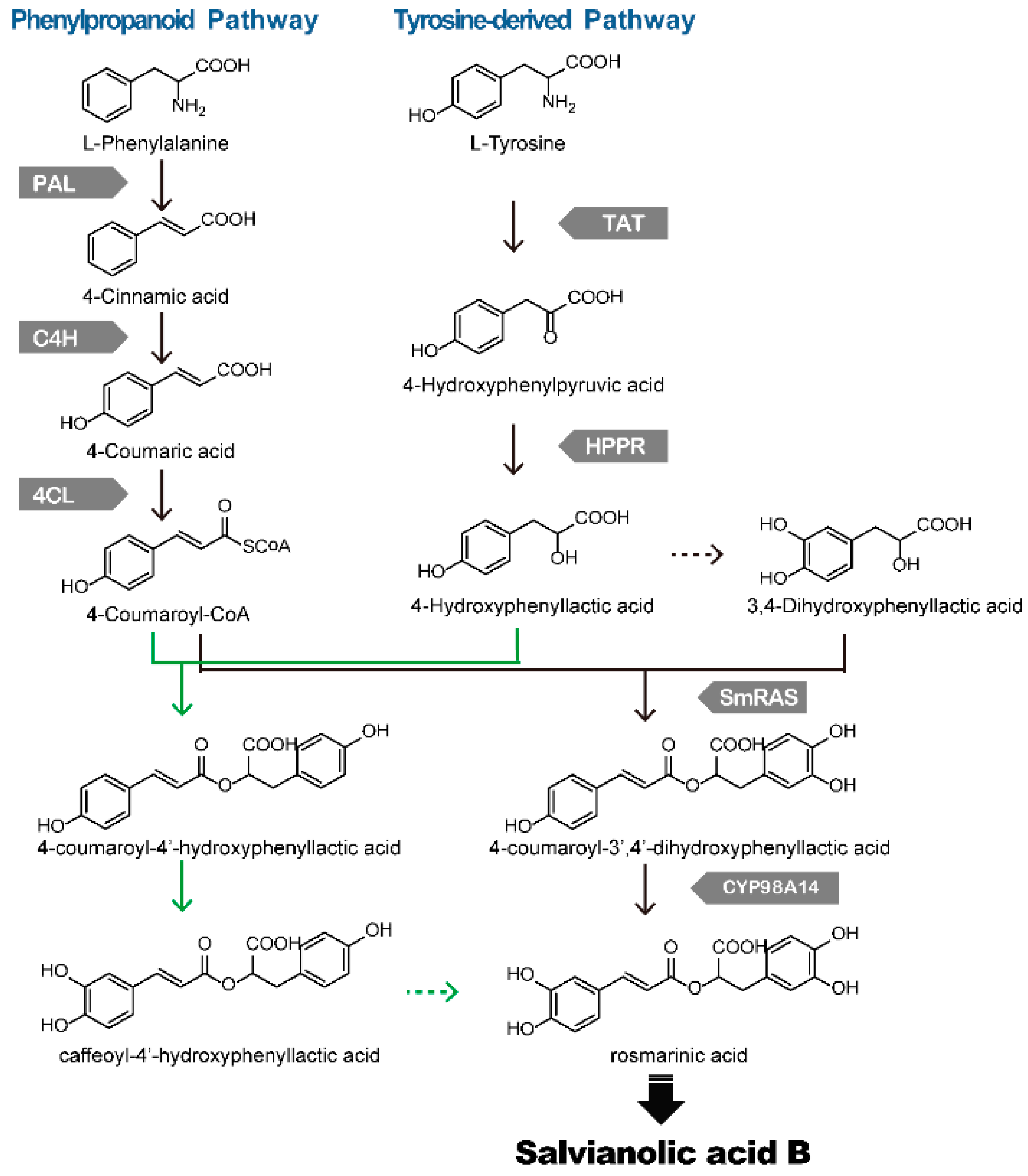
| Gene (Genbank No.) | Highest Expression Sites | Elicitor | Reference |
|---|---|---|---|
| SmPAL1 (EF462460) | root, leaf | ABA, wounding and dehydration, PEG, MJ, SA, Ca2+, GA, ethylene | [66,67,68,71,72,73,74,75] |
| SmPAL2 (GQ249111) | stem, flower | PEG and MJ | [66,68,71] |
| SmPAL3 (KF220569) | rootleaf | PEG and MJ | [66,71] |
| SmC4H1 (EF377337 DQ355979) | root, stem | MJ, ABA, UV-B, Ag+ | [35,71,76,77] |
| SmC4H2 (KF220564) | stem, root | [71] | |
| Sm4CL1 (AY237163) | leaf | MJ, YE | [69,70] |
| Sm4CL2 (AY237164) | root | MJ, YE, Ag+ | [35,69,70,71] |
| Sm4CL3 (KF220556) | root | MJ | [71] |
| Sm4CL-like1 (KF220557) | root | MJ | [71] |
| Sm4CL-like2 (KF220558) | MJ | [71] | |
| Sm4CL-like3 (KF220559) | [71] | ||
| Sm4CL-like4 (KF220560) | root | [71] | |
| Sm4CL-like5 (KF220561) | [71] | ||
| Sm4CL-like6 (KF220562) | MJ | [71] | |
| Sm4CL-like7 (KF220563) | [71] | ||
| SmTAT1 (DQ334606 EF192320) | stem | MJ, ABA, SA, UV-B, GA, ethylene, Ag+, YE | [35,65,72,74,78] |
| SmTAT2 (KF220575) | flower | MJ | [71] |
| SmTAT3 (KF220555) | Stem, root | [71] | |
| SmHPPR1 (DQ099741 DQ266514 EF458148) | stemflower | MJ, SA, GA3, ABA, UV-B, Ag+ | [35,71,79] |
| SmHPPR2 (KF220565) | Stem,leaf | [71] | |
| SmHPPR3 (KF220566) | stem | [71] | |
| SmHPPR4 (KF220567) | [80] | ||
| SmRAS-Like (GU647199) | stem | Pseudomonas lachrymans, MJ, light, and SA | [81] |
| SmRAS1 (FJ906696) | root | MJ, Ag+ | [15,35] |
| SmHCT1 (KF220570) | root | [71] | |
| SmHCT2 (KF220571) | stem | [71] | |
| SmHCT3 (KF220572) | stem | MJ | [71] |
| SmHCT4 (KF220573) | stem | MJ | [71] |
| SmHCT5 (KF220574) | stem | MJ | [71] |
| CYP98A14 (HQ316179) | root | MJ, Ag+ | [15,35] |
5. Biotechnological Applications
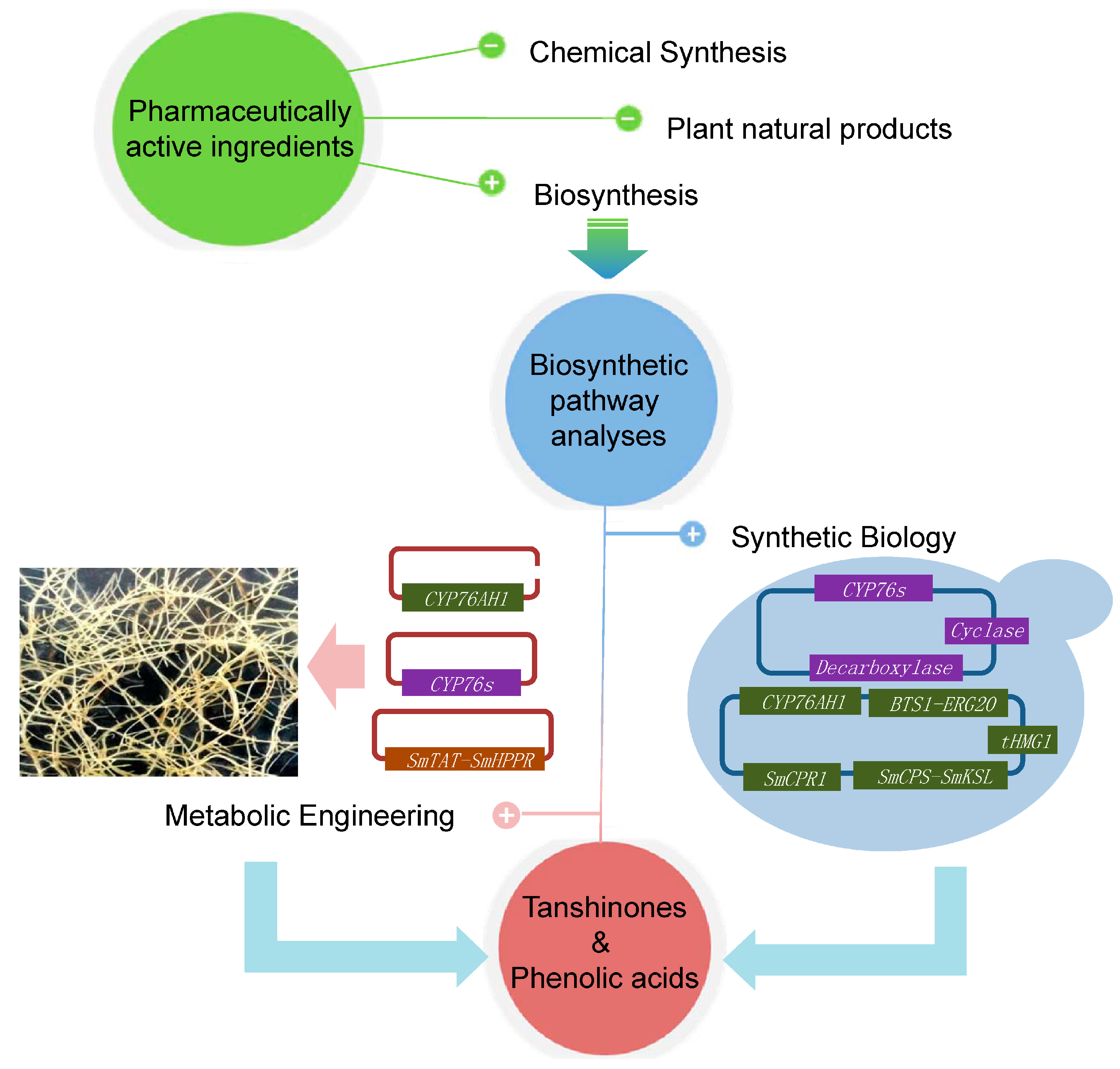
6. Perspectives
Acknowledgments
Author Contributions
Conflicts of Interest
References
- Croteau, R.; Ketchum, R.B.; Long, R.; Kaspera, R.; Wildung, M. Taxol biosynthesis and molecular genetics. Phytochem. Rev. 2006, 5, 75–97. [Google Scholar] [CrossRef] [PubMed]
- Zhao, Q.; Gao, C.; Cui, Z. Ginkgolide a reduces inflammatory response in high-glucose-stimulated human umbilical vein endothelial cells through STAT3-mediated pathway. Int. Immunopharmacol. 2015, 25, 242–248. [Google Scholar] [CrossRef] [PubMed]
- Zhang, L.; Ding, R.; Chai, Y.; Bonfill, M.; Moyano, E.; Oksman-Caldentey, K.M.; Xu, T.; Pi, Y.; Wang, Z.; Zhang, H.; et al. Engineering tropane biosynthetic pathway in Hyoscyamus niger hairy root cultures. Proc. Natl. Acad. Sci. USA 2004, 101, 6786–6791. [Google Scholar] [CrossRef] [PubMed]
- Han, J.Y.; Kim, M.J.; Ban, Y.W.; Hwang, H.S.; Choi, Y.E. The involvement of β-Amyrin 28-oxidase (CYP716A52v2) in oleanane-type ginsenoside biosynthesis in Panax ginseng. Plant Cell Physiol. 2013, 54, 2034–2046. [Google Scholar] [CrossRef] [PubMed]
- Paddon, C.J.; Westfall, P.J.; Pitera, D.J.; Benjamin, K.; Fisher, K.; McPhee, D.; Leavell, M.D.; Tai, A.; Main, A.; Eng, D.; et al. High-level semi-synthetic production of the potent antimalarial artemisinin. Nature 2013, 496, 528–532. [Google Scholar] [CrossRef] [PubMed]
- Dong, Y.; Morris-Natschke, S.L.; Lee, K.-H. Biosynthesis, total syntheses, and antitumor activity of tanshinones and their analogs as potential therapeutic agents. Nat. Prod. Rep. 2011, 28, 529–542. [Google Scholar] [CrossRef] [PubMed]
- Li, M.H.; Peng, Y.; Xiao, P.G. Distribution of tanshinones in the genus Salvia (family Lamiaceae) from China and its systematic significance. J. Syst. Evol. 2010, 48, 118–122. [Google Scholar] [CrossRef]
- Zhang, Y.; Jiang, P.; Ye, M.; Kim, S.H.; Jiang, C.; Lu, J. Tanshinones: Sources, pharmacokinetics and anti-cancer activities. Int. J. Mol. Sci. 2012, 13, 13621–13666. [Google Scholar] [CrossRef] [PubMed]
- Chen, X.; Guo, J.; Bao, J.; Lu, J.; Wang, Y. The anticancer properties of Salvia miltiorrhiza Bunge (Danshen): A systematic review. Med. Res. Rev. 2014, 34, 768–794. [Google Scholar] [CrossRef] [PubMed]
- Robertson, A.L.; Holmes, G.R.; Bojarczuk, A.N.; Burgon, J.; Loynes, C.A.; Chimen, M.; Sawtell, A.K.; Hamza, B.; Willson, J.; Walmsley, S.R.; et al. A zebrafish compound screen reveals modulation of neutrophil reverse migration as an anti-inflammatory mechanism. Sci. Transl. Med. 2014, 6. [Google Scholar] [CrossRef] [PubMed]
- Wu, T.W.; Zeng, L.H.; Fung, K.P.; Wu, J.; Pang, H.; Grey, A.A.; Weisel, R.D.; Wang, J.Y. Effect of sodium tanshinone IIA sulfonate in the rabbit myocardium and on human cardiomyocytes and vascular endothelial cells. Biochem. Pharmacol. 1993, 46, 2327–2332. [Google Scholar] [CrossRef]
- Wu, Z.; Song, L.; Liu, S.; Huang, D. Tanshinones extend chronological lifespan in budding yeast Sacchraromyces cerevisiae. Appl. Microbiol. Biotechnol. 2014, 98, 8617–8628. [Google Scholar] [CrossRef] [PubMed]
- Petersen, M. Rosmarinic acid: New aspects. Phytochem. Rev. 2013, 12, 207–227. [Google Scholar] [CrossRef]
- Wang, X.; Morris-Natschke, S.L.; Lee, K.-H. New developments in the chemistry and biology of the bioactive constituents of tanshen. Med. Res. Rev. 2007, 27, 133–148. [Google Scholar] [CrossRef] [PubMed]
- Di, P.; Zhang, L.; Chen, J.; Tan, H.; Xiao, Y.; Dong, X.; Zhou, X.; Chen, W. 13C Tracer reveals phenolic acids biosynthesis in hairy root cultures of Salvia miltiorrhiza. ACS Chem. Biol. 2013, 8, 1537–1548. [Google Scholar] [CrossRef] [PubMed]
- Cheng, Q.; Su, P.; Hu, Y.; He, Y.; Gao, W.; Huang, L. RNA interference-mediated repression of SmCPS (copalyldiphosphate synthase) expression in hairy roots of Salvia miltiorrhiza causes a decrease of tanshinones and sheds light on the functional role of SmCPS. Biotechnol. Lett. 2014, 36, 363–369. [Google Scholar] [CrossRef] [PubMed]
- Kai, G.; Xu, H.; Zhou, C.; Liao, P.; Xiao, J.; Luo, X.; You, L.; Zhang, L. Metabolic engineering tanshinone biosynthetic pathway in Salvia miltiorrhiza hairy root cultures. Metab. Eng. 2011, 13, 319–327. [Google Scholar] [CrossRef] [PubMed]
- Xiao, Y.; Zhang, L.; Gao, S.; Saechao, S.; Di, P.; Chen, J.; Chen, W. The c4h, tat, hppr and hppd genes prompted engineering of rosmarinic acid biosynthetic pathway in salvia miltiorrhiza hairy root cultures. PLoS ONE 2011, 6, e29713. [Google Scholar] [CrossRef] [PubMed]
- Chen, H.; Chen, F.; Zhang, Y.L.; Song, J.Y. Production of lithospermic acid B and rosmarinic acid in hairy root cultures of Salvia miltiorrhiza. J. Ind. Microbiol. Biotechnol. 1999, 22, 133–138. [Google Scholar] [CrossRef]
- Hu, Z.; Alfermann, A.W. Diterpenoid production in hairy root cultures of Salvia miltiorrhiza. Phytochemistry 1993, 32, 699–703. [Google Scholar]
- Yuan, Y.; liu, Y.; Lu, D.; Huang, L.; Liang, R.; Yang, Z.; Chen, S. Genetic stability, active constituent, and pharmacoactivity of Salvia miltiorrhiza hairy roots and wild plant. Z. Naturforsch. C. 2009, 64, 557–563. [Google Scholar] [CrossRef] [PubMed]
- Cui, G.; Huang, L.; Tang, X.; Zhao, J. Candidate genes involved in tanshinone biosynthesis in hairy roots of Salvia miltiorrhiza revealed by cDNA microarray. Mol. Biol. Rep. 2011, 38, 2471–2478. [Google Scholar] [CrossRef] [PubMed]
- Hua, W.; Zhang, Y.; Song, J.; Zhao, L.; Wang, Z. De novo transcriptome sequencing in Salvia miltiorrhiza to identify genes involved in the biosynthesis of active ingredients. Genomics 2011, 98, 272–279. [Google Scholar]
- Yang, L.; Ding, G.; Lin, H.; Cheng, H.; Kong, Y.; Wei, Y.; Fang, X.; Liu, R.; Wang, L.; Chen, X.; et al. Transcriptome analysis of medicinal plant Salvia miltiorrhiza and identification of genes related to tanshinone biosynthesis. PLoS ONE 2013, 8, e80464. [Google Scholar] [CrossRef] [PubMed]
- Luo, H.; Zhu, Y.; Song, J.; Xu, L.; Sun, C.; Zhang, X.; Xu, Y.; He, L.; Sun, W.; Xu, H.; et al. Transcriptional data mining of Salvia miltiorrhiza in response to methyl jasmonate to examine the mechanism of bioactive compound biosynthesis and regulation. Physiol. Plant. 2014, 152, 241–255. [Google Scholar] [CrossRef] [PubMed]
- Gao, W.; Sun, H.-X.; Xiao, H.; Cui, G.; Hillwig, M.; Jackson, A.; Wang, X.; Shen, Y.; Zhao, N.; Zhang, L.; et al. Combining metabolomics and transcriptomics to characterize tanshinone biosynthesis in Salvia miltiorrhiza. BMC Genomics 2014, 15. [Google Scholar] [CrossRef] [PubMed]
- Guo, J.; Zhou, Y.J.; Hillwig, M.L.; Shen, Y.; Yang, L.; Wang, Y.; Zhang, X.; Liu, W.; Peters, R.J.; Chen, X.; et al. CYP76AH1 catalyzes turnover of miltiradiene in tanshinones biosynthesis and enables heterologous production of ferruginol in yeasts. Proc. Natl. Acad. Sci. USA 2013, 110, 12108–12113. [Google Scholar] [CrossRef] [PubMed]
- Chen, H.; Wu, B.; Nelson, D.R.; Wu, K.; Liu, C. Computational identification and systematic classification of novel cytochrome P450 genes in Salvia miltiorrhiza. PLoS ONE 2015, 10, e0120063. [Google Scholar] [CrossRef] [PubMed]
- Xu, Z.; Peters, R.J.; Weirather, J.; Luo, H.; Liao, B.; Zhang, X.; Zhu, Y.; Ji, A.; Zhang, B.; Hu, S.; et al. Full-length transcriptome sequences and splice variants obtained by a combination of sequencing platforms applied to different root tissues of Salvia miltiorrhiza and tanshinone biosynthesis. Plant. J. 2015, 82, 951–961. [Google Scholar] [CrossRef] [PubMed]
- Cui, G.H.; Wang, X.Y.; Feng, H.; Zhao, J.X.; Huang, L.Q. Molecular cloning and SNP analysis of a acetyl-CoA C-acetyltransferase gene (SmAACT) from Salvia miltiorrhiza. Acta Pharm. Sin. 2010, 45, 785–790. [Google Scholar]
- Ma, Y.; Yuan, L.; Wu, B.; Li, X.; Chen, S.; Lu, S. Genome-wide identification and characterization of novel genes involved in terpenoid biosynthesis in Salvia miltiorrhiza. J. Exp. Bot. 2012, 63, 2809–2823. [Google Scholar] [CrossRef] [PubMed]
- Zhang, L.; Yan, X.; Wang, J.; Li, S.; Liao, P.; Kai, G. Molecular cloning and expression analysis of a new putative gene encoding 3-hydroxy-3-methylglutaryl-CoA synthase from Salvia miltiorrhiza. Acta Physiol. Plant. 2011, 33, 953–961. [Google Scholar] [CrossRef]
- Liao, P.; Zhou, W.; Zhang, L.; Wang, J.; Yan, X.; Zhang, Y.; Zhang, R.; Li, L.; Zhou, G.; Kai, G. Molecular cloning, characterization and expression analysis of a new gene encoding 3-hydroxy-3-methylglutaryl coenzyme A reductase from Salvia miltiorrhiza. Acta Physiol. Plant. 2009, 31, 565–572. [Google Scholar] [CrossRef]
- Yang, D.; Ma, P.; Liang, X.; Wei, Z.; Liang, Z.; Liu, Y.; Liu, F. PEG and ABA trigger methyl jasmonate accumulation to induce the MEP pathway and increase tanshinone production in Salvia miltiorrhiza hairy roots. Physiol. Plant. 2012, 146, 173–183. [Google Scholar] [CrossRef] [PubMed]
- Xing, B.; Yang, D.; Guo, W.; Liang, Z.; Yan, X.; Zhu, Y.; Liu, Y. Ag+ as a more effective elicitor for production of tanshinones than phenolic acids in Salvia miltiorrhiza hairy roots. Molecules 2014, 20, 309–324. [Google Scholar] [CrossRef] [PubMed]
- Dai, Z.; Cui, G.; Zhou, S.-F.; Zhang, X.; Huang, L. Cloning and characterization of a novel 3-hydroxy-3-methylglutaryl coenzyme A reductase gene from Salvia miltiorrhiza involved in diterpenoid tanshinone accumulation. J. Plant Physiol. 2011, 168, 148–157. [Google Scholar] [CrossRef] [PubMed]
- Zhang, X.; Guo, J.; Shen, Y.; Huang, L. Cloning and expression analysis of a new 3-hydroxy-3-methylglutaryl coenzyme A reductase gene from Salvia miltiorrhiza (SmHMGR3). China J. Chin. Mater. Med. 2012, 37, 2378–2382. [Google Scholar]
- Yan, Y.; Zhang, S.; Yang, D.; Zhang, J.; Liang, Z. Effects of Streptomyces pactum Act12 on Salvia miltiorrhiza hairy root growth and tanshinone synthesis and its mechanisms. Appl. Biochem. Biotechnol. 2014, 173, 883–893. [Google Scholar] [CrossRef] [PubMed]
- Wu, S.J.; Shi, M.; Wu, J.Y. Cloning and characterization of the 1-deoxy-d-xylulose 5-phosphate reductoisomerase gene for diterpenoid tanshinone biosynthesis in Salvia miltiorrhiza (Chinese sage) hairy roots. Biotechnol. Appl. Biochem. 2009, 52, 89. [Google Scholar] [CrossRef] [PubMed]
- Yan, X.; Zhang, L.; Wang, J.; Liao, P.; Zhang, Y.; Zhang, R.; Kai, G. Molecular characterization and expression of 1-deoxy-d-xylulose 5-phosphate reductoisomerase (DXR) gene from Salvia miltiorrhiza. Acta Physiol. Plant. 2009, 31, 1015–1022. [Google Scholar] [CrossRef]
- Wang, X.Y.; Cui, G.H.; Huang, L.Q.; Gao, W.; Yuan, Y. A full length cDNA of 4-(cytidine 5′-diphospho)-2-C-methyl-d-erythritol kinase cloning and analysis of introduced gene expression in Salvia miltiorrhiza. Acta Pharm. Sin. 2008, 43, 1251–1257. [Google Scholar]
- Gao, W.; Cheng, Q.; Ma, X.; He, Y.; Jiang, C.; Yuan, Y.; Huang, L. Cloning and bioinformatics analysis of 2-C-methyl-d-erythritol 2,4-cyclodiphosphate synthase gene in Salvia miltiorrhiza. China J. Chin. Mater. Med. 2012, 37, 3365–3370. [Google Scholar]
- Cheng, Q.Q.; He, Y.F.; Li, G.; Jiang, C.; Yuan, Y.; Gao, W.; Huang, L.Q. Cloning and induced expression analysis of 4-hydroxy-3-methyl-but-2-enyl diphosphate reductase gene (SmHDR) of Salvia miltiorrhiza. Acta Pharm. Sin. 2013, 48, 236–242. [Google Scholar]
- Jiang, D.; Rong, Q.; Yuan, Q.; Zhang, W.; Zhang, Y.; Huang, L. Cloning and prokaryotic expression analysis of HDS from Salvia miltiorrhiza bge.f.alba. Acta Pharm. Sin. 2014, 49, 1614–1620. [Google Scholar]
- Hao, G.; Shi, R.; Tao, R.; Fang, Q.; Jiang, X.; Ji, H.; Feng, L.; Huang, L. Cloning, molecular characterization and functional analysis of 1-hydroxy-2-methyl-2-(E)-butenyl-4-diphosphate reductase (HDR) gene for diterpenoid tanshinone biosynthesis in Salvia miltiorrhiza Bge. f. alba. Plant Physiol. Biochem. 2013, 70, 21–32. [Google Scholar] [CrossRef] [PubMed]
- Yang, Y.; Zhou, L.; Hua, W.; Wang, Z.; Li, C. Bioinformatics and expression analysis of isopentenyl diphosphate isomerase (SmIPI) from Salvia militiorrhiza Bunge. Plant Phisiol. J. 2011, 47, 1086–1090. [Google Scholar]
- Zhou, L.; Hua, W.; Yang, Y.; Wang, Z.; Li, C. Expression pattern of farnesyl diphosphate synthese (SmFPPS1) from Salvia Miltiorrhiza Bunge. J. Shaanxi Norm. Univ. (Nat. Sci. Ed.) 2013, 41, 70–75. [Google Scholar]
- Hua, W.; Song, J.; Li, C.; Wang, Z. Molecular cloning and characterization of the promoter of SmGGPPs and its expression pattern in Salvia miltiorrhiza. Mol. Biol. Rep. 2012, 39, 5775–5783. [Google Scholar] [CrossRef] [PubMed]
- Kai, G.; Liao, P.; Zhang, T.; Zhou, W.; Wang, J.; Xu, H.; Liu, Y.; Zhang, L. Characterization, expression profiling, and functional identification of a gene encoding geranylgeranyl diphosphate synthase from Salvia miltiorrhiza. Biotechnol. Bioprocess Eng. 2010, 15, 236–245. [Google Scholar] [CrossRef]
- Zhang, L.; Dai, Z.; Cui, G.; Cheng, Y.; Qi, X.; Gao, Z. Cloning and characterization of geranylgeranyl diphosphate synthase gene of Salvia miltiorrhia. China J. Chin. Mater. Med. 2009, 34, 2704–2708. [Google Scholar]
- Gao, W.; Hillwig, M.L.; Huang, L.; Cui, G.; Wang, X.; Kong, J.; Yang, B.; Peters, R.J. A functional genomics approach to tanshinone biosynthesis provides stereochemical insights. Org. Lett. 2009, 11, 5170–5173. [Google Scholar] [CrossRef] [PubMed]
- Cheng, Q.; He, Y.; Li, G.; Liu, Y.; Gao, W.; Huang, L. Effects of combined elicitors on tanshinone metabolic profiling and SmCPS expression in Salvia miltiorrhiza hairy root cultures. Molecules 2013, 18, 7473–7485. [Google Scholar] [CrossRef] [PubMed]
- Cui, G.; Duan, L.; Jin, B.; Qian, J.; Xue, Z.; Shen, G.; Snyder, J.H.; Song, J.; Chen, S.; Huang, L.; et al. Functional divergence of diterpene syntheses in the medicinal plant Salvia miltiorrhiza Bunge. Plant. Physiol. 2015. [Google Scholar] [CrossRef] [PubMed]
- Guo, J.; Ma, X.H.; Cai, Y.; Ma, Y.; Zhan, Z.L.; Zhou, Y.J.; Liu, W.J.; Guan, M.X.; Cui, G.H.; Kang, L.P.; et al. Cytochrome P450 Promiscuity Leads to a Bifurcating Pathway in Tanshinone Biosynthesis; National Resource Center for Chinese Materia Medica, China Academy of Chinese Medical Sciences: Beijing, China, 2015; Unpublished work. [Google Scholar]
- Cai, Y.; Guo, J.; Zhou, Y.; Zhu, Z.; Wu, W.; Huang, L.; Chen, M.; Zhao, Z. Construction of Saccharomyces cerevisiae whole-cell biocatalyst system for conversion miltiradiene. Acta Pharm. Sin. 2013, 48, 1618–1623. [Google Scholar]
- Rohmer, M.; Knani, M.; Simonin, P.; Sutter, B.; Sahm, H. Isoprenoid biosynthesis in bacteria: A novel pathway for the early steps leading to isopentenyl diphosphate. Biochem. J. 1993, 295, 517–524. [Google Scholar] [CrossRef] [PubMed]
- Schwarz, M.K. Terpen-Biosynthese in Ginkgo biloba: Eine Überraschende Geschichte. Ph.D. Thesis, ETH Zurich, Zurich, Switzerland, 1994. [Google Scholar]
- Rodrı́guez-Concepción, M.; Boronat, A. Elucidation of the methylerythritol phosphate pathway for isoprenoid biosynthesis in bacteria and plastids. A metabolic milestone achieved through genomics. Plant Physiol. 2002, 130, 1079–1089. [Google Scholar] [CrossRef] [PubMed]
- Miziorko, H.M. Enzymes of the mevalonate pathway of isoprenoid biosynthesis. Arch. Biochem. Biophys. 2011, 505, 131–143. [Google Scholar] [CrossRef] [PubMed]
- Ge, X.; Wu, J. Tanshinone production and isoprenoid pathways in Salvia miltiorrhiza hairy roots induced by Ag+ and yeast elicitor. Plant Sci. 2005, 168, 487–491. [Google Scholar] [CrossRef]
- Yang, D.; Du, X.; Liang, X.; Han, R.; Liang, Z.; Liu, Y.; Liu, F.; Zhao, J. Different roles of the mevalonate and methylerythritol phosphate pathways in cell growth and tanshinone production of Salvia miltiorrhiza hairy roots. PLoS ONE 2012, 7, e46797. [Google Scholar] [CrossRef] [PubMed]
- Shi, M.; Luo, X.; Ju, G.; Yu, X.; Hao, X.; Huang, Q.; Xiao, J.; Cui, L.; Kai, G. Increased accumulation of the cardio-cerebrovascular disease treatment drug tanshinone in Salvia miltiorrhiza hairy roots by the enzymes 3-hydroxy-3-methylglutaryl CoA reductase and 1-deoxy-d-xylulose 5-phosphate reductoisomerase. Funct. Integr. Genomics 2014, 14, 603–615. [Google Scholar] [CrossRef] [PubMed]
- Kirby, J.; Keasling, J.D. Biosynthesis of plant isoprenoids: Perspectives for microbial engineering. Annu. Rev. Plant Biol. 2009, 60, 335–355. [Google Scholar] [CrossRef] [PubMed]
- Zhang, S.; Yan, Y.; Wang, B.; Liang, Z.; Liu, Y.; Liu, F.; Qi, Z. Selective responses of enzymes in the two parallel pathways of rosmarinic acid biosynthetic pathway to elicitors in Salvia miltiorrhiza hairy root cultures. J. Biosci. Bioeng. 2014, 117, 645–651. [Google Scholar] [CrossRef] [PubMed]
- Yan, Q.; Shi, M.; Ng, J.; Wu, J.Y. Elicitor-induced rosmarinic acid accumulation and secondary metabolism enzyme activities in Salvia miltiorrhiza hairy roots. Plant Sci. 2006, 170, 853–858. [Google Scholar] [CrossRef]
- Hou, X.; Shao, F.; Ma, Y.; Lu, S. The phenylalanine ammonia-lyase gene family in Salvia miltiorrhiza: Genome-wide characterization, molecular cloning and expression analysis. Mol. Biol. Rep. 2013, 40, 4301–4310. [Google Scholar] [CrossRef] [PubMed]
- Song, J.; Wang, Z. Molecular cloning, expression and characterization of a phenylalanine ammonia-lyase gene (SmPAL1) from Salvia miltiorrhiza. Mol. Biol. Rep. 2009, 36, 939–952. [Google Scholar] [CrossRef] [PubMed]
- Song, J.; Wang, Z. RNAi-mediated suppression of the phenylalanine ammonia-lyase gene in Salvia miltiorrhiza causes abnormal phenotypes and a reduction in rosmarinic acid biosynthesis. J. Plant Res. 2011, 124, 183–192. [Google Scholar] [CrossRef] [PubMed]
- Jin, X.Q.; Chen, Z.W.; Tan, R.H.; Zhao, S.J.; Hu, Z.B. Isolation and functional analysis of 4-coumarate: Coenzyme A ligase gene promoters from Salvia miltiorrhiza. Biol. Plant 2012, 56, 261–268. [Google Scholar] [CrossRef]
- Zhao, S.-J.; Hu, Z.-B.; Liu, D.; Leung, F.C.C. Two divergent members of 4-coumarate: Coenzyme A ligase from Salvia miltiorrhiza Bunge: cDNA cloning and functional study. J. Integr. Plant Biol. 2006, 48, 1355–1364. [Google Scholar] [CrossRef]
- Wang, B.; Sun, W.; Li, Q.; Li, Y.; Luo, H.; Song, J.; Sun, C.; Qian, J.; Zhu, Y.; Hayward, A.; et al. Genome-wide identification of phenolic acid biosynthetic genes in Salvia miltiorrhiza. Planta 2015, 241, 711–725. [Google Scholar] [CrossRef] [PubMed]
- Dong, J.; Wan, G.; Liang, Z. Accumulation of salicylic acid-induced phenolic compounds and raised activities of secondary metabolic and antioxidative enzymes in Salvia miltiorrhiza cell culture. J. Biotechnol. 2010, 148, 99–104. [Google Scholar] [CrossRef] [PubMed]
- Liu, L.; Dong, J.; Zhang, J.; Dang, X.; Xing, B.; Yang, X. Effects of calcium on synthesis of rosmarinic acid and related enzymes in suspension cultures of Salvia miltiorrhiza. Sheng Wu Gong Cheng Xue Bao 2012, 28, 1359–1369. [Google Scholar] [PubMed]
- Liang, Z.; Ma, Y.; Xu, T.; Cui, B.; Liu, Y.; Guo, Z.; Yang, D. Effects of abscisic acid, gibberellin, ethylene and their interactions on production of phenolic acids in Salvia miltiorrhiza Bunge hairy roots. PLoS ONE 2013, 8, e72806. [Google Scholar] [CrossRef] [PubMed]
- Hao, W.F.; Guo, H.B.; Zhang, J.Y.; Hu, G.G.; Yao, Y.Q.; Dong, J.E. Hydrogen peroxide is involved in salicylic acid-elicited rosmarinic acid production in Salvia miltiorrhiza cell cultures. Sci. World J. 2014, 2014. [Google Scholar] [CrossRef] [PubMed]
- Huang, B.; Duan, Y.; Yi, B.; Sun, L.; Lu, B.; Yu, X.; Sun, H.; Zhang, H.; Chen, W. Characterization and expression profiling of cinnamate 4-hydroxylase gene from Salvia miltiorrhiza in rosmarinic acid biosynthesis pathway. Russ. J. Plant Physiol. 2008, 55, 390–399. [Google Scholar] [CrossRef]
- Xiao, Y.; Gao, S.; Di, P.; Chen, J.; Chen, W.; Zhang, L. Methyl jasmonate dramatically enhances the accumulation of phenolic acids in Salvia miltiorrhiza hairy root cultures. Physiol. Plant. 2009, 137, 1–9. [Google Scholar] [CrossRef] [PubMed]
- Huang, B.; Yi, B.; Duan, Y.; Sun, L.; Yu, X.; Guo, J.; Chen, W. Characterization and expression profiling of tyrosine aminotransferase gene from Salvia miltiorrhiza (Dan-shen) in rosmarinic acid biosynthesis pathway. Mol. Biol. Rep. 2008, 35, 601–612. [Google Scholar] [CrossRef] [PubMed]
- Yi, B. Molecular Cloning and Regulation Analysis of Important Genes Involved in Tyrosine-branch Pathway of Rosmarinic Acid Metabolism from Salvia miltiorrhza Bunge. Master’s Thesis, Second Military Medical University, Shanghai, China, 2007. [Google Scholar]
- Chen, S.L.; Wang, B.; Sun, W.; Xu, H.B. Genome-Wide Identification and Profiling of Novel Genes Involved in Phenolic Acids Biosynthesis Pathway in Salvia miltiorrhiza, Chinese Academy of Medical Sciences, Institute of Medicinal Plant Development (IMPLAD): Beijing, China, 2013; Unpublished Work.
- Song, J. Function Analysis of the Genes Involved in Rosmarinic Acid Biosynthesis Pathway in Salvia miltiorrhiza Bunge. Ph.D. Thesis, Shaanxi Normal University, Xi’an, China, 2010. [Google Scholar]
- Zhou, Y.J.; Gao, W.; Rong, Q.; Jin, G.; Chu, H.; Liu, W.; Yang, W.; Zhu, Z.; Li, G.; Zhu, G.; et al. Modular pathway engineering of diterpenoid synthases and the mevalonic acid pathway for miltiradiene production. J. Am. Chem. Soc. 2012, 134, 3234–3241. [Google Scholar] [CrossRef] [PubMed]
- Dai, Z.; Liu, Y.; Huang, L.; Zhang, X. Production of miltiradiene by metabolically engineered Saccharomyces cerevisiae. Biotechnol. Bioeng. 2012, 109, 2845–2853. [Google Scholar] [CrossRef] [PubMed]
- Bloch, S.E.; Schmidt-Dannert, C. Construction of a chimeric biosynthetic pathway for the de novo biosynthesis of rosmarinic acid in Escherichia coli. Chembiochem 2014, 15, 2393–2401. [Google Scholar] [CrossRef] [PubMed]
- Zhang, Y.; Yan, Y.-P.; Wu, Y.-C.; Hua, W.-P.; Chen, C.; Ge, Q.; Wang, Z.-Z. Pathway engineering for phenolic acid accumulations in Salvia miltiorrhiza by combinational genetic manipulation. Metab. Eng. 2014, 21, 71–80. [Google Scholar] [CrossRef] [PubMed]
- Sample Availability: Samples of the compounds are not available from the authors.
© 2015 by the authors. Licensee MDPI, Basel, Switzerland. This article is an open access article distributed under the terms and conditions of the Creative Commons Attribution license ( http://creativecommons.org/licenses/by/4.0/).
Share and Cite
Ma, X.-H.; Ma, Y.; Tang, J.-F.; He, Y.-L.; Liu, Y.-C.; Ma, X.-J.; Shen, Y.; Cui, G.-H.; Lin, H.-X.; Rong, Q.-X.; et al. The Biosynthetic Pathways of Tanshinones and Phenolic Acids in Salvia miltiorrhiza. Molecules 2015, 20, 16235-16254. https://doi.org/10.3390/molecules200916235
Ma X-H, Ma Y, Tang J-F, He Y-L, Liu Y-C, Ma X-J, Shen Y, Cui G-H, Lin H-X, Rong Q-X, et al. The Biosynthetic Pathways of Tanshinones and Phenolic Acids in Salvia miltiorrhiza. Molecules. 2015; 20(9):16235-16254. https://doi.org/10.3390/molecules200916235
Chicago/Turabian StyleMa, Xiao-Hui, Ying Ma, Jin-Fu Tang, Ya-Li He, Yu-Chen Liu, Xiao-Jing Ma, Ye Shen, Guang-Hong Cui, Hui-Xin Lin, Qi-Xian Rong, and et al. 2015. "The Biosynthetic Pathways of Tanshinones and Phenolic Acids in Salvia miltiorrhiza" Molecules 20, no. 9: 16235-16254. https://doi.org/10.3390/molecules200916235
APA StyleMa, X.-H., Ma, Y., Tang, J.-F., He, Y.-L., Liu, Y.-C., Ma, X.-J., Shen, Y., Cui, G.-H., Lin, H.-X., Rong, Q.-X., Guo, J., & Huang, L.-Q. (2015). The Biosynthetic Pathways of Tanshinones and Phenolic Acids in Salvia miltiorrhiza. Molecules, 20(9), 16235-16254. https://doi.org/10.3390/molecules200916235

