

An Improved Method for Removal of Azo Dye Orange II from Textile Effluent Using Albumin as Sorbent

Abstract
1. Introduction
2. Results and Discussion
2.1. Influence of the Time Interaction, pH and Adsorption

| Assay | Azo dye/albumin concentration (g/L) | Time of incubation (min.) | pH | Orange II removal (%) |
|---|---|---|---|---|
| 01 | 0.10 | 20 | 3.0 | 10.72 |
| 02 | 0.10 | 30 | 3.0 | 21.49 |
| 03 | 0.10 | 60. | 3.0 | 54.06 |
| 04 | 0.10 | 90. | 3.0 | 87.28 |
| 05 | 0.10 | 60 | 3.2 | 78.95 |
| 06 | 0.10 | 60 | 3.5 | 84.20 |
| 07 | 0.10 | 60 | 3.8 | 63.40 |
| 08 | 0.10 | 60 | 4.0 | 55.71 |
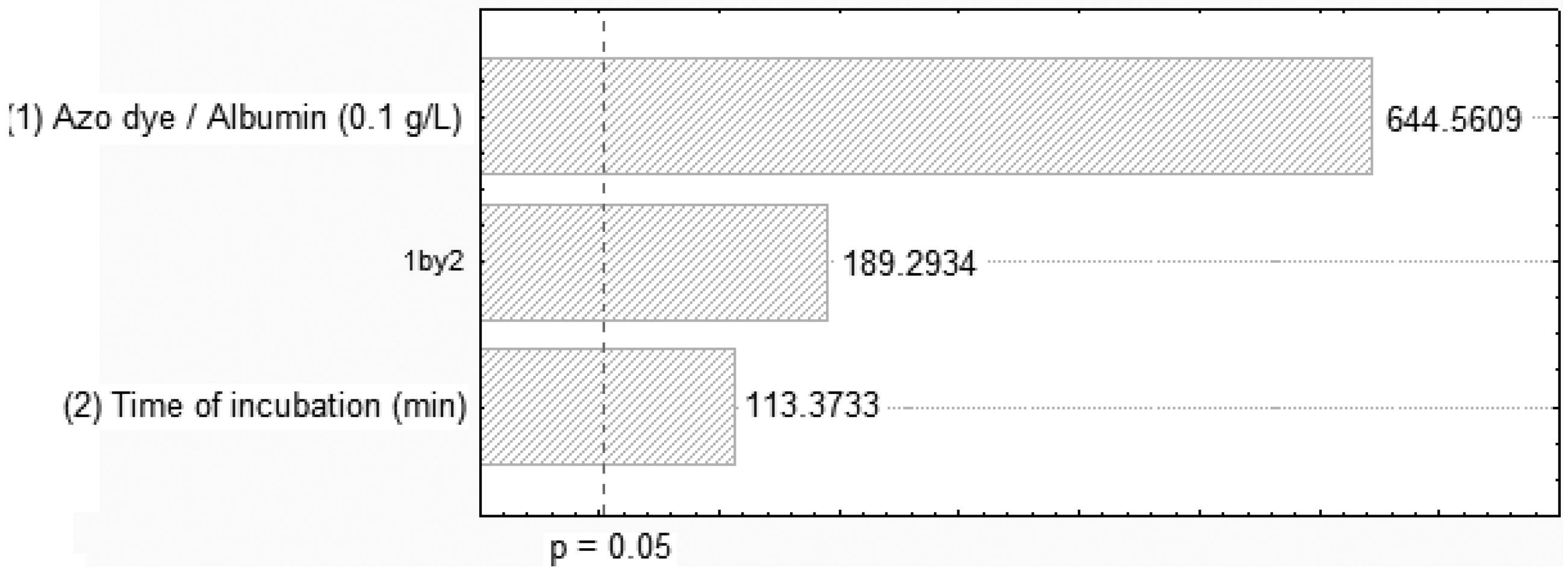
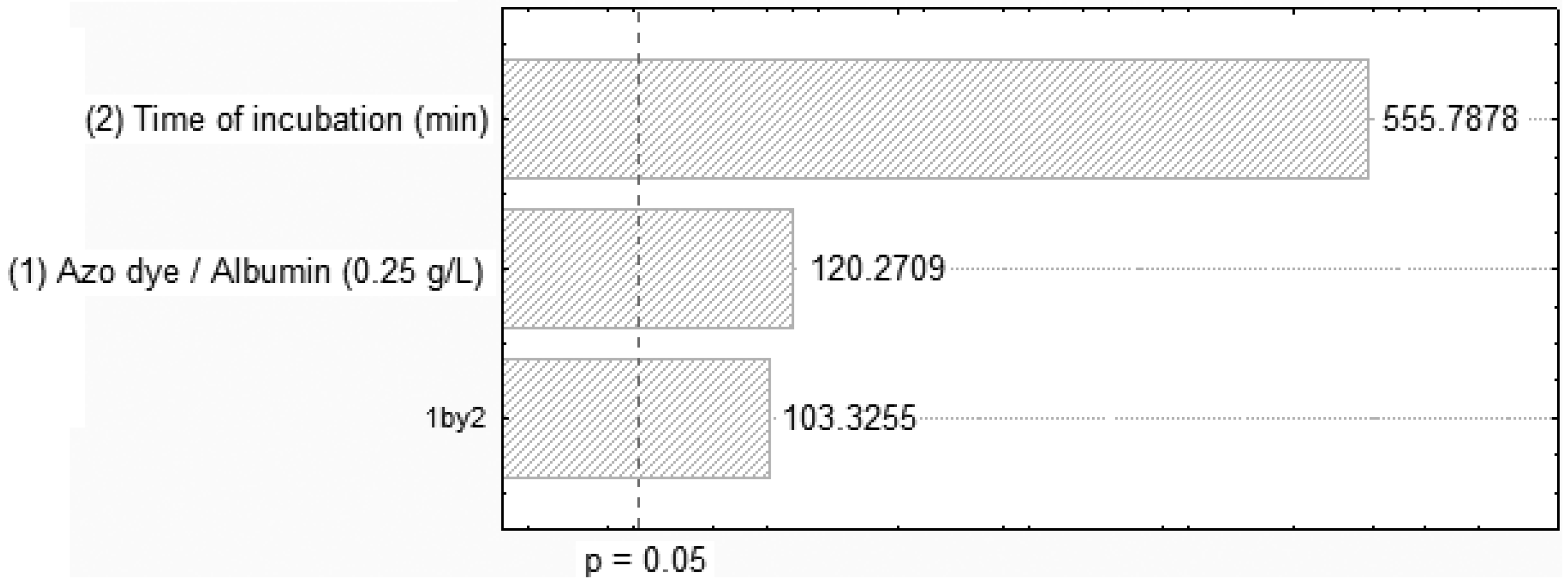
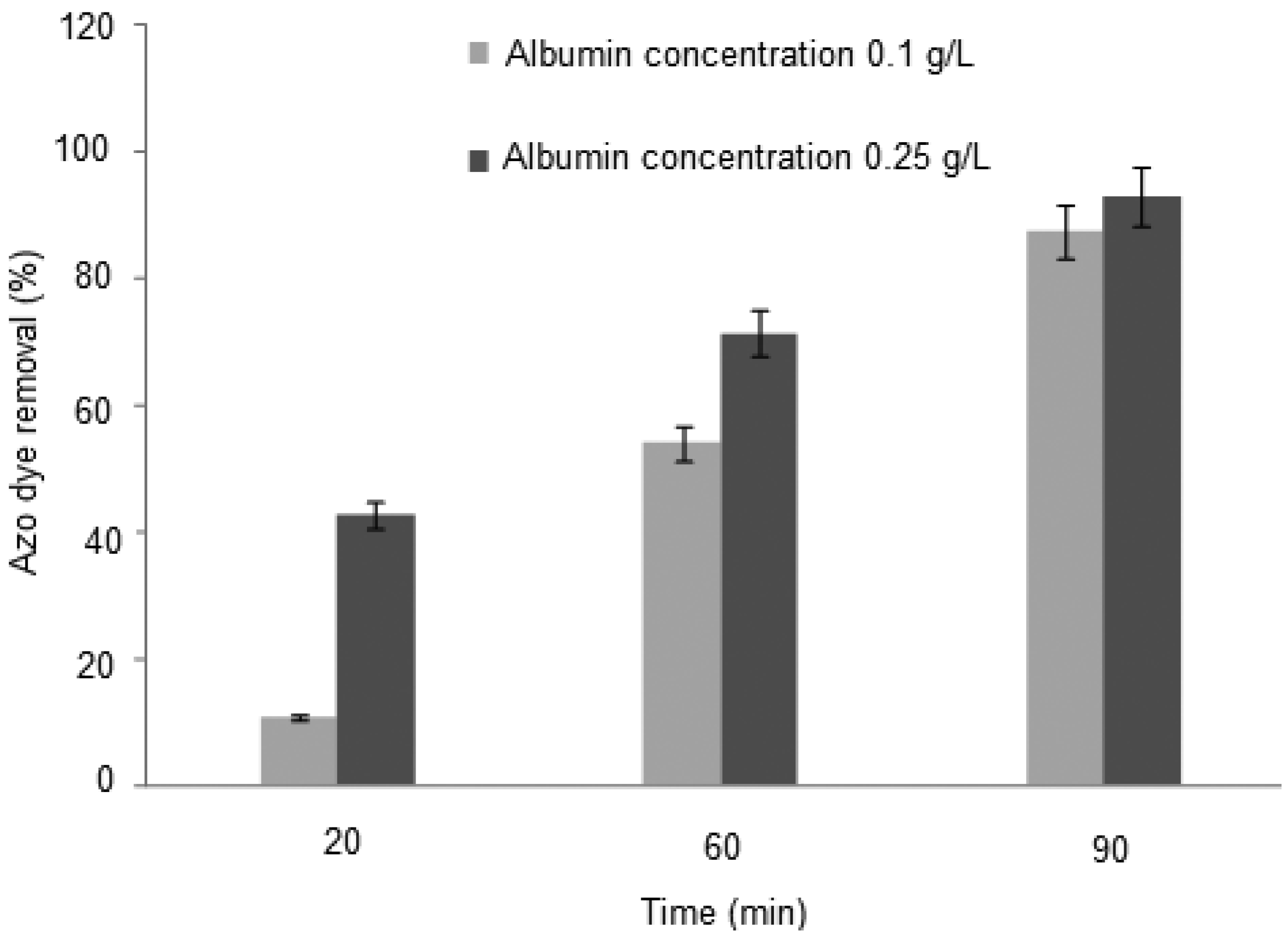
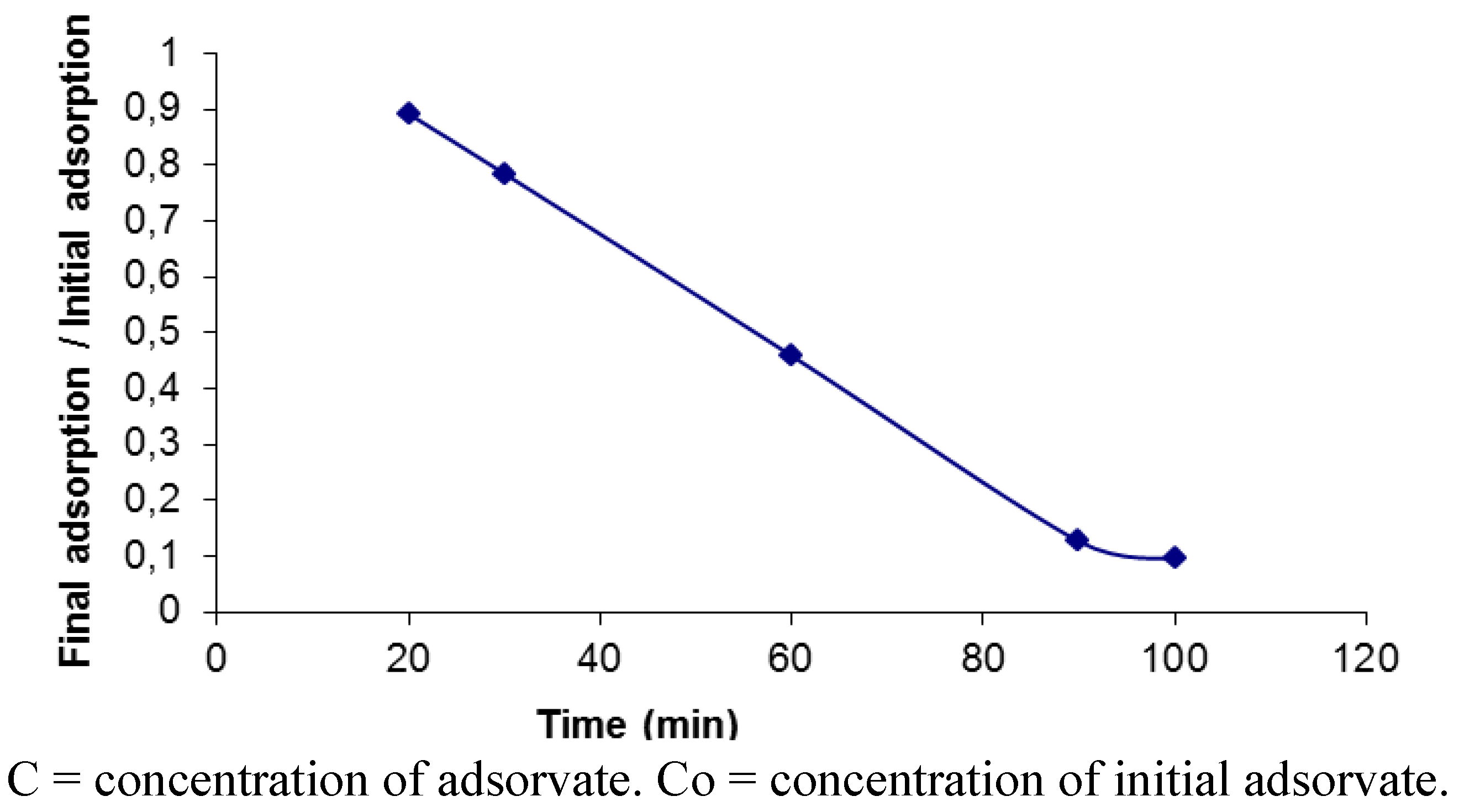
2.2. Removal of Orange II in the Azo Dye/Albumin (v/v) System, and Time of Interaction
| Assay | Azo dye/albumin proportions (mL) | Orange II removal (%) |
|---|---|---|
| 01 | 1:1 (25 + 25) | 27.48 |
| 02 | 1:2 (25 + 50) | 56.21 |
| 03 | 1:3 (25 + 75) | 84.20 |
| 04 | 1:4 (25 + 100) | 33.33 |
| 05 | 1:5 (25 + 125) | 27.85 |
| Assay | Relation dye/albumin v/v (mL) | Contact time (min) | pH before filtration | pH after filtration | Retention time % |
|---|---|---|---|---|---|
| 1 | 50/50 | 60 | 3.5 | 3.2 | 27.84 |
| 2 | 50/100 | 60 | 3.5 | 3.2 | 33.83 |
| 3 | 50/150 | 60 | 3.5 | 3.2 | 85.00 |
| 4 | 50/200 | 60 | 3.5 | 3.2 | 69.57 |
| 5 | 50/250 | 60 | 3.5 | 3.2 | 77.28 |
| 6 | 25/75 | 20 | 3.5 | 3.9 | 46.81 |
| 7 | 25/100 | 20 | 3.5 | 3.6 | 66.67 |
| 8 | 25/125 | 20 | 3.5 | 3.7 | 13.34 |
| 9 | 25/75 | 20 | 3.0 | 3.0 | 46.16 |
| 10 | 25/75 | 20 | 3.1 | 3.1 | 21.96 |
| 11 | 25/75 | 20 | 3.2 | 3.2 | 21.43 |
| 12 | 25/75 | 20 | 3.3 | 3.3 | 24.45 |
| 13 | 25/75 | 80 | 3.6 | 3.6 | 54.77 |
| 14 | 8.5/34 | 80 | 3.5 | 3.5 | 90.33 |
| 15 | 12/48 | 60 | 3.5 | 3.5 | 97.15 |
| 16 | 25/75 | 60 | 3.5 | 3.5 | 99.50 |
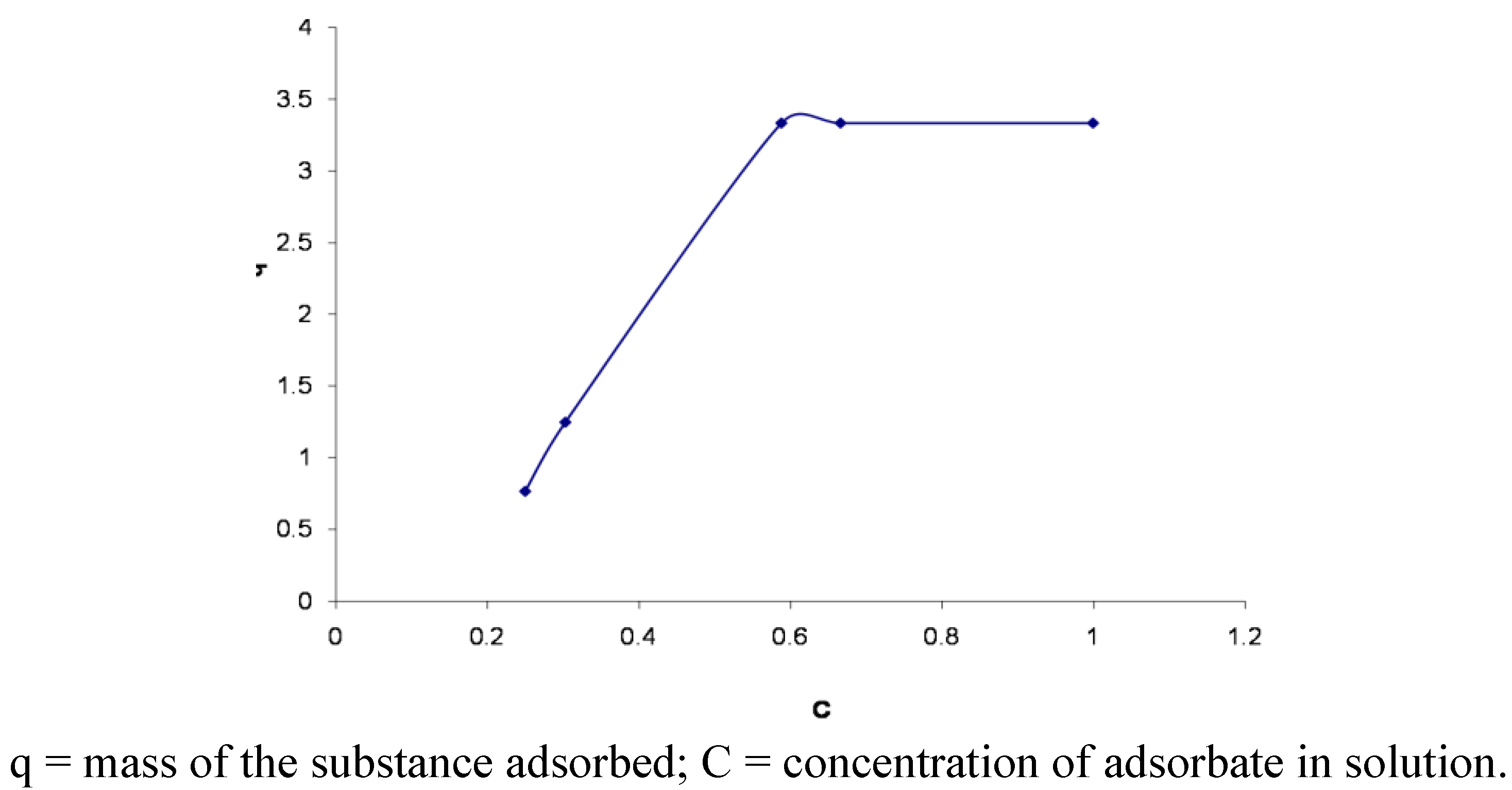
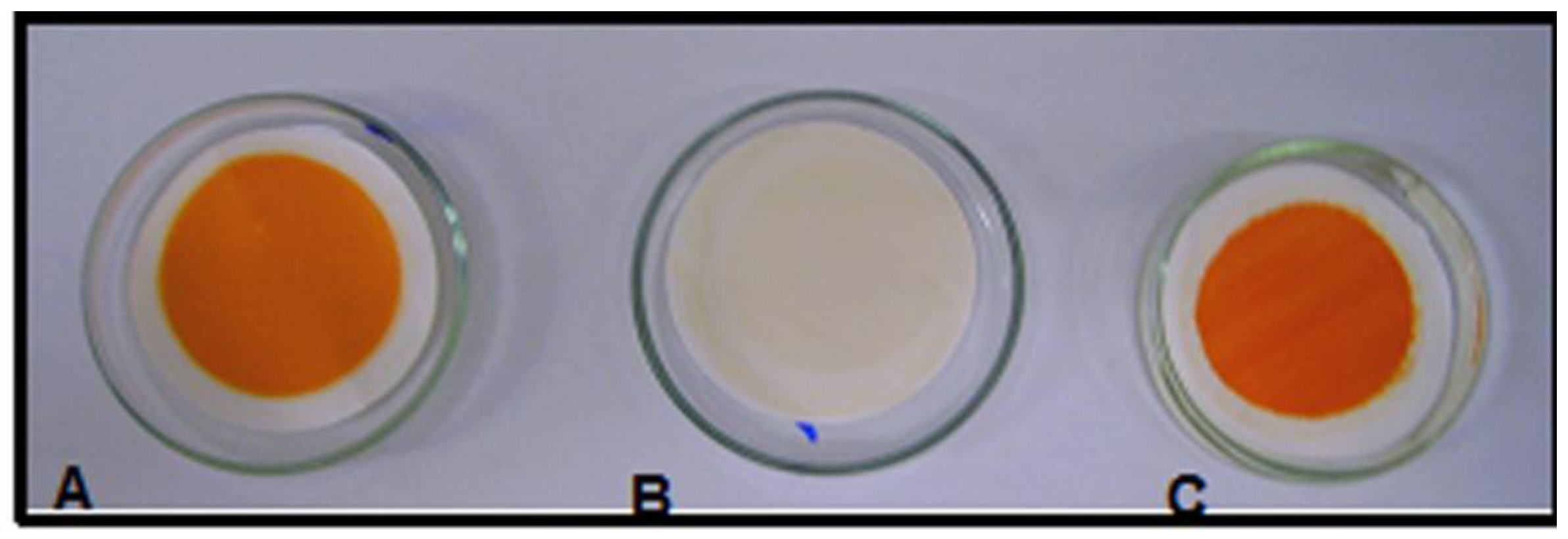
3. Experimental
3.1. Dye, Effluent, Albumin and Membrane
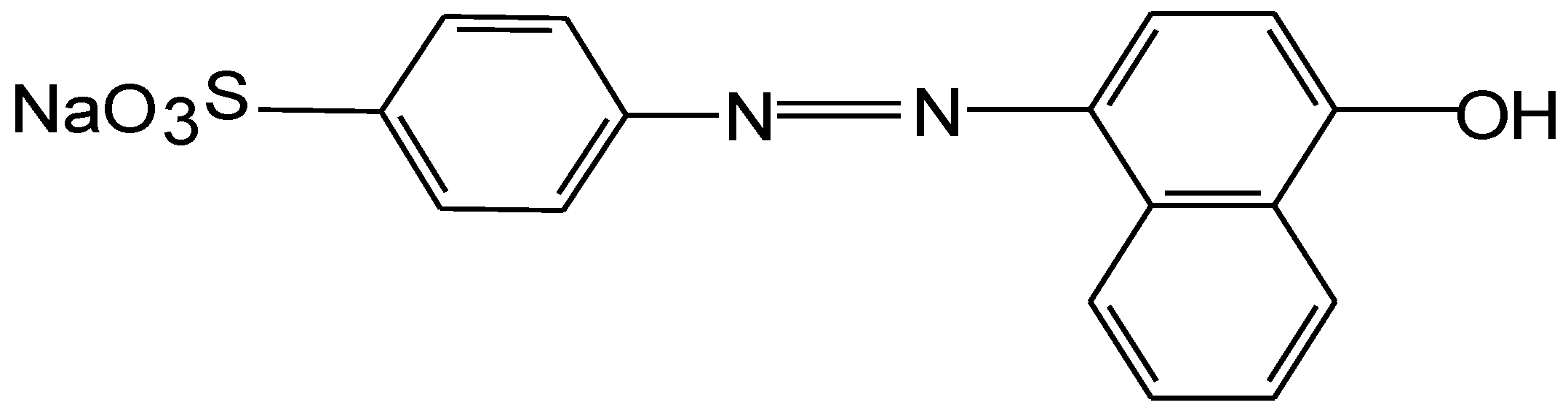
3.2. Vacuum Filtration Procedure
3.3. Colour Reduction Measurement
3.4. Albumin Determination
3.5. Experimental Factorial Design
3.6. Adsorption Isotherms
| First full factorial design | |||
| Factor | Level | ||
| −1 | 0 | +1 | |
| Azo dye/Albumin0.10 g/L (v/v) | 1:3 | 1:2 | 1:1 |
| Time of incubation (min) | 30 | 60 | 90 |
| Second full factorial design | |||
| Factor | Level | ||
| −1 | 0 | +1 | |
| Azo dye/Albumin0.25 g/L (v/v) | 1:3 | 1:2 | 1:1 |
| Time of incubation (min) | 30 | 60 | 90 |
4. Conclusions
Acknowledgments
References
- Ambrosio, S.T.; Campos-Takaki, G.M. Decolorization of reactive azo dyes by Cunninghamella elegans UCP 542 under co-metabolism conditions. Bioresour. Technol. 2004, 91, 69–75. [Google Scholar] [CrossRef]
- Zollinger, H. Color Chemistry, 2nd ed; VCH Publishers: New York, NY, USA, 1991. [Google Scholar]
- Guaratini, C.I.; Zanoni, M.V. Textile Dyes. Quím. Nova 2000, 23, 71–78. [Google Scholar] [CrossRef]
- Zamora, P.; Kunz, A.P.; Moraes, S.G.; Duran, N. New tendencies on textile effluent treatment. Quím. Nova 2002, 25, 78–82. [Google Scholar] [CrossRef]
- Zanoni, M.V.B.; Sousa, W.R.; Lima, J.P.; Carneiro, P.A.; Fogg, A.G. Application of voltammetric technique to the analysis of indanthrene dye in alckaline solution. Dyes Pigm. 2006, 68, 19–25. [Google Scholar] [CrossRef]
- Allinger, N.L.; Cava, M.P.; de Jongh, D.C.; Johnson, C.R.; Lebel, N.A.; Stevens, C.L. Organic Chemistry; Worth Publishers: New York, NY, USA, 1976. [Google Scholar]
- Araújo, M.; Castro, E.M.M. Manual de Engenharia Têxtil; Fundação Calouste Gulbenkian: Lisbon, Portugal, 1984. [Google Scholar]
- Daltin, D.; Alcantra, M.R. Textile Chemistry. Quim. Nova 1996, 19, 320–330. [Google Scholar]
- Gogate, P.R.; Pandit, A.B. A review of imperative technologies for wastewater treatment I: Oxidation technologies at ambient conditions. Adv. Environ. Res. 2004, 8, 501–551. [Google Scholar] [CrossRef]
- Erdal, S.; Taskin, M. Uptake of textile dye Reactive Black-5 by PenicilliumchrysogenumMT-6 isolated from cement-contaminated soil. Afr. J. Microbiol. Res. 2010, 4, 618–625. [Google Scholar]
- Anliker, R. Organic Colorants—Interpretation of Mammalian, Genus and Ecotoxicity Data in Terms of Potential Risks; The Royal Society of Chemistry: London, UK, 1986. [Google Scholar]
- Correia, V.M.; Stephenson, T.; Judd, S.J. Characterization of textile wastewaters. Environ. Technol. 1994, 15, 917–929. [Google Scholar] [CrossRef]
- Bielska, M.; Prochasca, K.J. Dyes separation by means of cross-flow ultrafiltration of micellar solution. Dyes Pigm. 2007, 74, 410–415. [Google Scholar] [CrossRef]
- Anjaneyulu, Y.; Chary, N.; Raj, D.; Samuel, S. Decolorization of industrial effluents—Available methods and emerging Technologies—A review. Rev. Environ. Sci. Biotechnol. 2005, 4, 245–273. [Google Scholar]
- Beck, J.V. Nonlinear estimation applied to the nonlinear heat conduction. J. Heat Transfer 1988, 13, 1046–1058. [Google Scholar] [CrossRef]
- Al-Malack, M.H.; Anderson, G.K. Coagulation—Cross flow micro filtration of domestic waste water. J. Memb. Sci. 1996, 121, 59–65. [Google Scholar]
- Dogan, M.; Alkan, M. Adsorption kinetics of methyl violet onto perlite. Chemosphere 2003, 50, 517–528. [Google Scholar] [CrossRef]
- Haan, J. The renal function as judged by the excretion of vital dye-stuffs. J. Physiol. 1922, 56, 444–450. [Google Scholar]
- Pond, S.M. Extracorporeal techniques in the treatment of poisoned patients. Med. J. Aust. 1991, 154, 617–622. [Google Scholar]
- Holm, N. Aggregation and fibrillation of bovine serum albumin. Biochim. Biophys. Acta 2007, 1774, 1128–1138. [Google Scholar]
- Vetri, V.; Librizzi, L.; Leone, L.; Militello, V. Thermal aggregation of bovine serum albumin at different pH: Comparison with human serum albumin. Eur. Biophys. J. 2007, 36, 717–725. [Google Scholar] [CrossRef]
- Gao, D.; Tian, Y.; Liang, F.; Jim, D.; Chen, Y.; Zhang, H.; Yu, A. Investigation on the pH-dependent binding of EosinY and bovine serum albumin by spectral methods. J. Lumin. 2007, 127, 515–522. [Google Scholar] [CrossRef]
- Jayabharathi, J.; Thamikachalam, M.P. Mechanistic investigation on binding of bioactive imidazole with protein bovine serum albumin—A biophysical study. Spectrochim. Acta A 2011, 79, 502–507. [Google Scholar] [CrossRef]
- Doyen, W. Latest developments in ultrafiltration for large-scale drinking water applications. Desalination 1997, 113, 165–177. [Google Scholar]
- Hamza, A.; Pham, V.A.; Matsuura, T.; Santerre, J.P. Development of membranes with low surface energy to reduce the fouling in filtration application. J. Memb. Sci 1997, 131, 217–227. [Google Scholar] [CrossRef]
- Bhattacharyya, K.G.; Sharma, A. Adsorption characteristics of the dye, Brilliant Green, on Neem leaf powder. Dyes Pigm. 2003, 57, 211–222. [Google Scholar] [CrossRef]
- Bader, M.S.H.; Veenstra, J.N. Analysis of concentration polarization phenomenon in ultrafiltration under turbulent flux conditions. J. Memb. Sci. 1996, 114, 139–148. [Google Scholar] [CrossRef]
- Darup, J.; Bleese, N.; Kalmar, P.; Lutz, G.; Pokar, H. Hemofiltration during extracorporeal circulation (ECC). J. Thorac. Cardiovasc. Surg. 1979, 27, 227–330. [Google Scholar] [CrossRef]
- Laurence, J.D.R. A study of the adsorption of dyes on bovine serum albumin by the method of polarization of fluorescence. Biochem. J. 1952, 51, 168–180. [Google Scholar]
- Nicolaisen, B. Developments in membrane technology for water treatment. Desalination 2002, 153, 355–360. [Google Scholar] [CrossRef]
- Shu, H.Y.; Shang, M. Pilot scale annular plug flow photoreactor by UV/H2O2 for the decolorization of azo dye wastewater. J. Hazard. Mater. 2005, 125, 244–251. [Google Scholar] [CrossRef]
- Shu, H.Y.; Shang, M.C. Decolorization and mineralization of a phthalocyanine dye C.I. Direct Blue 199 using UV/H2O2 process. J. Hazard. Mater. 2005, 125, 96–101. [Google Scholar] [CrossRef]
- Mu, Y.; Rabaey, K.; Rozendal, R.A.; Yuan, Z.; Keller, J. Decolorization of azo dyes in bioelectrochemical systems. Environ. Sci. Technol. 2009, 43, 5137–5143. [Google Scholar] [CrossRef]
- Sereikaite, J.; Bumelis, V. Interaction of serum albumin with vinyl sulfonate azo dye. Cent. Eur. J. Chem. 2008, 6, 509–512. [Google Scholar] [CrossRef]
- Woei-Jye, L.; Ismail, A.F. Polymeric nanofiltration membranes for textile dye wastewater treatment: Preparation, performance evaluation, transport modelling, and fouling control—A review. Desalination 2009, 245, 321–348. [Google Scholar] [CrossRef]
- Namasivayan, C.; Kavitha, D. Removal of Congo Red from water by adsorption onto activated carbon prepared from coir pith, an agricultural solid waste. Dyes Pigm. 2002, 54, 47–58. [Google Scholar] [CrossRef]
- Robinson, T.; Chandran, B.; Nigam, P. Removal of dyes from an artificial textile dye effluent by two agricultural waste residues. Environ. Int. 2002, 28, 29–33. [Google Scholar] [CrossRef]
- Zhang, M.M.; Chang, C.T.; Ding, Y.; Lin, K.L.; Chiou, C.S.; Hsueh, C.C.; Xu, H. Assessment upon azo dye decolorization and bioelectricity generation by Proteus hauseri. Bioresour. Technol. 2010, 101, 4737–4741. [Google Scholar]
- Zhao, J.; Chen, J.; Gao, J. Decolorization of Azo Dyes C.I. Acid Yellow 17 and C.I.Direct Red 31 by Dielectric-Barrier Discharge Air Plasma. Plasma Sci. 2010, 8, 488–495. [Google Scholar]
- Mclaughlin, J.L.; Saizarbitori, T.-C.; Anderson, J.E. Trés bioensayos simples para quimicos de productos naturales. Rev. Soc. Venez. Quim. 1995, 18, 13–18. [Google Scholar]
- Crini, G. Non-conventional low-cost adsorbents for dye removal: A review. Bioresour. Technol. 2005, 97, 1061–1085. [Google Scholar] [CrossRef]
- Kumar, K.V.; Sivanesan, S. Equilibrium data, isotherm parameters and process design for partial and complete isotherm of methylene blue onto activated carbon. J. Hazard. Mater. 2006, 134, 237–244. [Google Scholar] [CrossRef]
- StatSoft, Inc. Statistica, version 7.1; Data analysis software system. Tulsa, OK, USA, 2005.
- Sample Availability: Not available.
© 2012 by the authors; licensee MDPI, Basel, Switzerland. This article is an open-access article distributed under the terms and conditions of the Creative Commons Attribution license (http://creativecommons.org/licenses/by/3.0/).
Share and Cite
Ohashi, T.; Jara, A.M.T.; Batista, A.C.L.; Franco, L.O.; Lima, M.A.B.; Benachour, M.; Da Silva, C.A.A.; Campos-Takaki, G.M. An Improved Method for Removal of Azo Dye Orange II from Textile Effluent Using Albumin as Sorbent. Molecules 2012, 17, 14219-14229. https://doi.org/10.3390/molecules171214219
Ohashi T, Jara AMT, Batista ACL, Franco LO, Lima MAB, Benachour M, Da Silva CAA, Campos-Takaki GM. An Improved Method for Removal of Azo Dye Orange II from Textile Effluent Using Albumin as Sorbent. Molecules. 2012; 17(12):14219-14229. https://doi.org/10.3390/molecules171214219
Chicago/Turabian StyleOhashi, Tadashi, Alícia M. T. Jara, Anabelle C. L. Batista, Luciana O. Franco, Marcos A. Barbosa Lima, Mohand Benachour, Carlos A. Alves Da Silva, and Galba M. Campos-Takaki. 2012. "An Improved Method for Removal of Azo Dye Orange II from Textile Effluent Using Albumin as Sorbent" Molecules 17, no. 12: 14219-14229. https://doi.org/10.3390/molecules171214219
APA StyleOhashi, T., Jara, A. M. T., Batista, A. C. L., Franco, L. O., Lima, M. A. B., Benachour, M., Da Silva, C. A. A., & Campos-Takaki, G. M. (2012). An Improved Method for Removal of Azo Dye Orange II from Textile Effluent Using Albumin as Sorbent. Molecules, 17(12), 14219-14229. https://doi.org/10.3390/molecules171214219

