Phenolic Compounds from Merremia umbellata subsp. orientalis and Their Allelopathic Effects on Arabidopsis Seed Germination

Abstract
1. Introduction
2. Results and Discussion
3. Experimental
3.1. General
3.2. Plant Material
3.3. Extraction and Isolation
3.4. Hydrolysis, Sugar Permethylation and GC-MS Analysis
3.5. Seed Germination Bioassay
4. Conclusions
Acknowledgements
References and Notes
- Wu, D.L. Flora of Guangdong; Guangdong Science and Technology Press: Guangzhou, China, 2000; Volume 4, p. 345. [Google Scholar]
- Chen, B.H.; Wang, R.J.; Huang, X.L.; Zhou, L.X. Merremia boisiana - a newly recorded species from Guangdong, China. J. Trop. Subtrop. Bot. 2005, 13, 76–77. [Google Scholar]
- Fitter, A. Making Allelopathy Respectable. Science 2003, 301, 1377–1380. [Google Scholar] [CrossRef] [Scilit] [PubMed]
- Zhao, X.; Zheng, G.W.; Niu, X.M.; Li, W.Q.; Wang, F.S.; Li, S.H. Terpenes from Eupatorium adenophorum and their allelopathic effects on Arabidopsis seeds germination. J. Agr. Food Chem. 2009, 57, 478–482. [Google Scholar] [CrossRef] [Scilit] [PubMed]
- Kitagawa, I.; Shibuya, H.; Yokokawa, Y.; Baek, N.I.; Ohashi, K.; Yoshikawa, M.; Nitta, A.; Wariadinata, H. Structures of merremosides B and D, new antiserotonic resin-glycosides from the tube of Merremia mammosa, an Indonesian folk medicine. Chem. Pharm. Bull. 1988, 36, 1618–1622. [Google Scholar] [CrossRef] [Scilit] [PubMed]
- Kitagawa, I.; Baek, N.I.; Ohashi, K.; Sakagami, M.; Yokokawa, Y.; Shibuya, H. Mammosides B and H1, new ionophoric resin-glycosides from the tube of Merremia mammosa, an Indonesian folk medicine. Chem. Pharm. Bull. 1989, 37, 1131–1133. [Google Scholar] [CrossRef] [Scilit]
- Kitagawa, I.; Baek, N.I.; Kawashima, K.; Yokokawa, Y.; Yoshikawa, M.; Ohashi, K.; Shibuya, H. Indonesian medicinal plants. XV. chemical structures of five new resin-glycosides, merremosides a, b, c, d, and e, from the tuber of Merremia mammosa (Convolvulaceae). Chem. Pharm. Bull. 1996, 44, 1680–1692. [Google Scholar] [CrossRef] [Scilit] [PubMed]
- Kitagawa, I.; Baek, N.I.; Yokokawa, Y.; Yoshikawa, M.; Ohashi, K.; Shibuya, H. Indonesian medicinal plants. XVI. chemical structures of four new resin-glycosides, merremosides f, g, h1, and h2, from the tuber of Merremia mammosa (Convolvulaceae). Chem. Pharm. Bull. 1996, 44, 1693–1699. [Google Scholar] [CrossRef] [Scilit] [PubMed]
- Noda, N.; Tsuji, K.; Miyahara, K.; Yang, C.R. Resin glycosides. XXI. tuguajalapins I-X, the resin glycosides having long-chain fatty acid groups from the root of Merremia hungaiensis. Chem. Pharm. Bull. 1994, 42, 2011–2016. [Google Scholar] [CrossRef] [Scilit] [PubMed]
- Noda, N.; Tsuji, K.; Kawasaki, T.; Miyahara, K.; Hanazono, H.; Yang, C.R. A novel resin glycoside, merremin (tuguajalapin X dimer), from Merremia hungaiensis. Chem. Pharm. Bull. 1995, 43, 1061–1062. [Google Scholar] [CrossRef] [Scilit] [PubMed]
- Krishnappan, A.L.; Seetharaman, T.R. Flavonoids of Merremia tridentate. Fitoterapia 1992, 63, 190. [Google Scholar]
- Garcia-Argaez, A.N.; Perez-Amador, M.C.; Aguirre-Hernandez, E.; Martinez-Vazquez, M. Two new caffeate esters from roots of Merremia tuberosa and M. dissecta. Planta Med. 1999, 65, 678–679. [Google Scholar] [CrossRef] [Scilit] [PubMed]
- Khan, A.M.; Rathor, O.S. Phenolic acids of Merremia emarginata Hallier F. Himalayan Chem. Pharm. Bull. 1985, 2, 12. [Google Scholar]
- Gao, G.C.; Wu, P.; Cao, H.L.; Lin, L.D.; Wei, X.Y. Phenolic compounds from Merremia boisiana (Convolvulaceae). J. Trop. Subtrop. Bot. 2006, 14, 233–237. [Google Scholar]
- Jenett-Siems, K.; Siems, K.; Witte, L.; Eich, E. Merrekentrones A−D, ipomeamarone-like furanosesquiterpenes from Merremia kentrocaulos. J. Nat. Prod. 2001, 64, 1471–1473. [Google Scholar] [CrossRef] [Scilit] [PubMed]
- Jenett-Siems, K.; Weigl, R.; Böhm, A.; Mann, P.; Tofern-Reblin, B.; Ott, S.C.; Ghomian, A.; Kaloga, M.; Siems, K.; Witte, L.; Hilker, M.; Müller, F.; Eich, E. Chemotaxonomy of the pantropical genus Merremia (Convolvulaceae) based on the distribution of tropane alkaloids. Phytochemistry 2005, 66, 1448–1464. [Google Scholar] [CrossRef] [Scilit] [PubMed]
- Kelley, C.J.; Harruff, R.C.; Carmack, M. Polyphenolic acids of Lithospermum ruderale. II. Carbon-13 nuclear magnetic resonance of lithospermic and rosmarinic acids. J. Org. Chem. 1976, 41, 449–454. [Google Scholar] [CrossRef] [Scilit]
- Kelley, C.J.; Mahajan, J.R.; Brooks, L.C.; Neubert, L.A.; Breneman, W.R.; Carmack, M. Polyphenolic acids of Lithospermum ruderale (Boraginaceae). I. Isolation and structure determination of lithospermic acid. J. Org. Chem. 1975, 40, 1804–1805. [Google Scholar] [CrossRef] [Scilit]
- Rahman, A.U.; Bhatti, M.K.; Akhtar, F.; Choudhary, M.I. Alkaloids of Fumaria indica. Phytochemistry 1992, 31, 2869–2872. [Google Scholar] [CrossRef] [Scilit]
- Wu, T.S.; Ou, L.F.; Teng, C.M. Aristolochic acids, aristolactam alkaloids and amides from Aristolochia kankauensis. Phytochemistry 1994, 36, 1063–1068. [Google Scholar] [PubMed]
- Schnarr, G.W.; Vyas, D.M.; Szarek, W.A. Carbon-13 nuclear magnetic resonance spectra of acyclic carbohydrate derivatives: alditols, 1,2-bis(phenylhydrazones), and dithioacetals. J. Chem. Soc. Perkin Trans. 1979, 1, 496–503. [Google Scholar] [CrossRef] [Scilit]
- Zhang, W.X.; Bao, W.F. Studies on the chemical constituents of Xanthoceras sorbifolia Bunge. Acta Pharm. Sinica 2000, 35, 124–127. [Google Scholar]
- Shen, C.C.; Changa, Y.S.; Hott, L.K. Nuclear magnetic resonance studies of 5,7-dihydroxyflavonoids. Phytochemistry 1993, 34, 843–845. [Google Scholar] [CrossRef] [Scilit]
- Youssef, D.; Frahm, A.W. Constituents of the Egyptian Centaurea scoparia; III. Phenolic constituents of the aerial parts. Planta Med. 1995, 61, 570–573. [Google Scholar] [CrossRef] [Scilit] [PubMed]
- Kalinova, J.; Vrchotova, N.; Triska, J. Exudation of allelopathic substances in buckwheat (Fagopyrum esculentum Moench). J. Agr. Food Chem. 2007, 55, 6453–6459. [Google Scholar] [CrossRef] [Scilit] [PubMed]
- Reigosa, M.J.; Malvido-Pazos, E. Phytotoxic effects of 21 plant secondary metabolites on Arabidopsis thaliana germination and root growth. J. Chem. Ecol. 2007, 33, 1456–1466. [Google Scholar] [CrossRef] [Scilit] [PubMed]
- Cipollini, D.; Stevenson, R.; Enright, S.; Eyles, A.; Bonello, P. Phenolic metabolites in leaves of the invasive shrub, Lonicera maackii, and their potential phytotoxicand anti-herbivore effects. J. Chem. Ecol. 2008, 34, 144–152. [Google Scholar] [CrossRef] [Scilit] [PubMed]
- Durrant, W.E.; Dong, X. Systemic acquired resistance. Annu. Rev. Phytopathol. 2004, 42, 185–209. [Google Scholar] [CrossRef] [Scilit] [PubMed]
- Loake, G.; Grant, M. Salicylic acid in plant defence-the players and protagonists. Curr. Opin. Plant Biol. 2007, 10, 466–472. [Google Scholar] [CrossRef] [Scilit] [PubMed]
- Lee, H.I.; Raskin, I. Glucosylation of salicylic acid in Nicotiana tabacum Cv. Xanthi-nc. Phytopathol. 1998, 88, 692–697. [Google Scholar] [CrossRef] [Scilit] [PubMed]
- Bertin, C.; Weston, L.A.; Huang, T.; Jander, G.; Owens, T.; Meinwald, J.; Schroeder, F.C. Grass roots chemistry: metatyrosine, an herbicidal nonprotein amino acid. Proc. Natl. Acad. Sci. USA 2007, 104, 16964–16969. [Google Scholar] [CrossRef] [Scilit] [PubMed]
- Diana, H.; Dudy, B.Z. An improved, simple, hydroponic method for growing Arabidopsis thaliana. Plant Mol. Biol. Rep. 2003, 21, 59–63. [Google Scholar]
Sample Availability: Samples of the compounds are available from the authors. |
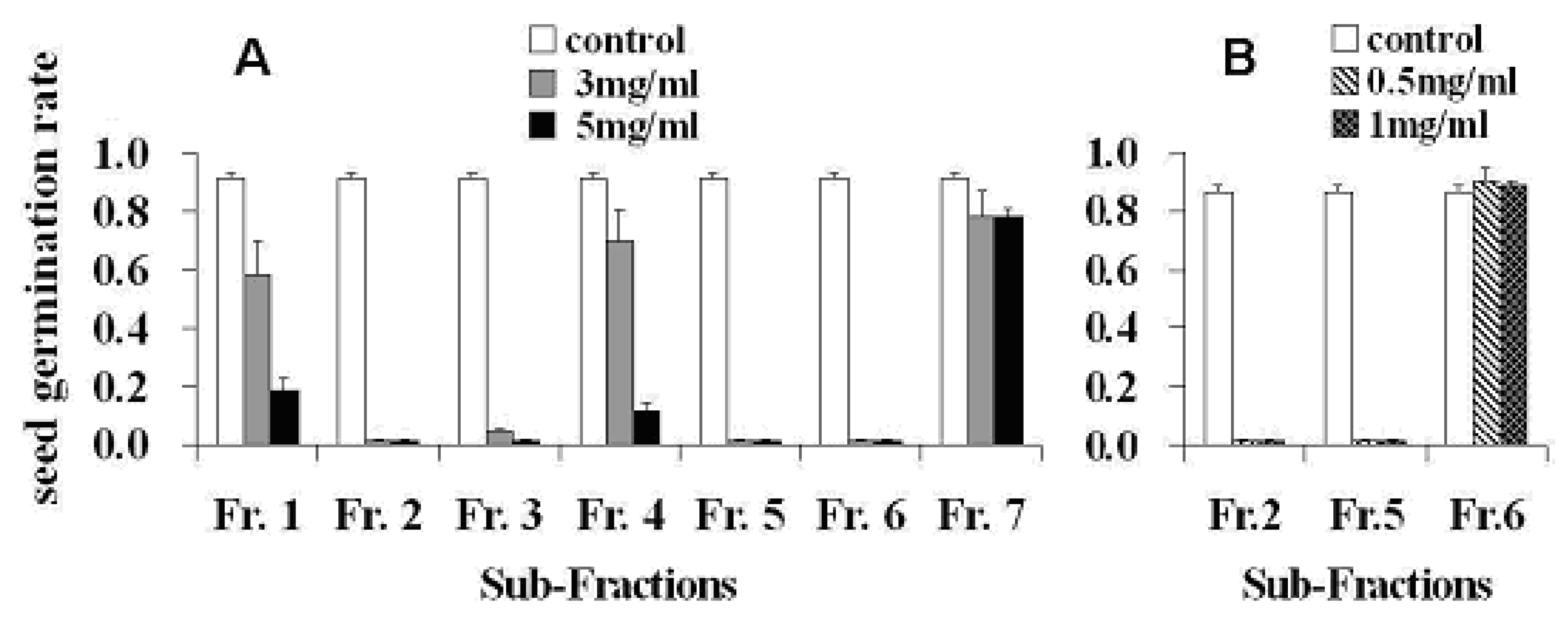
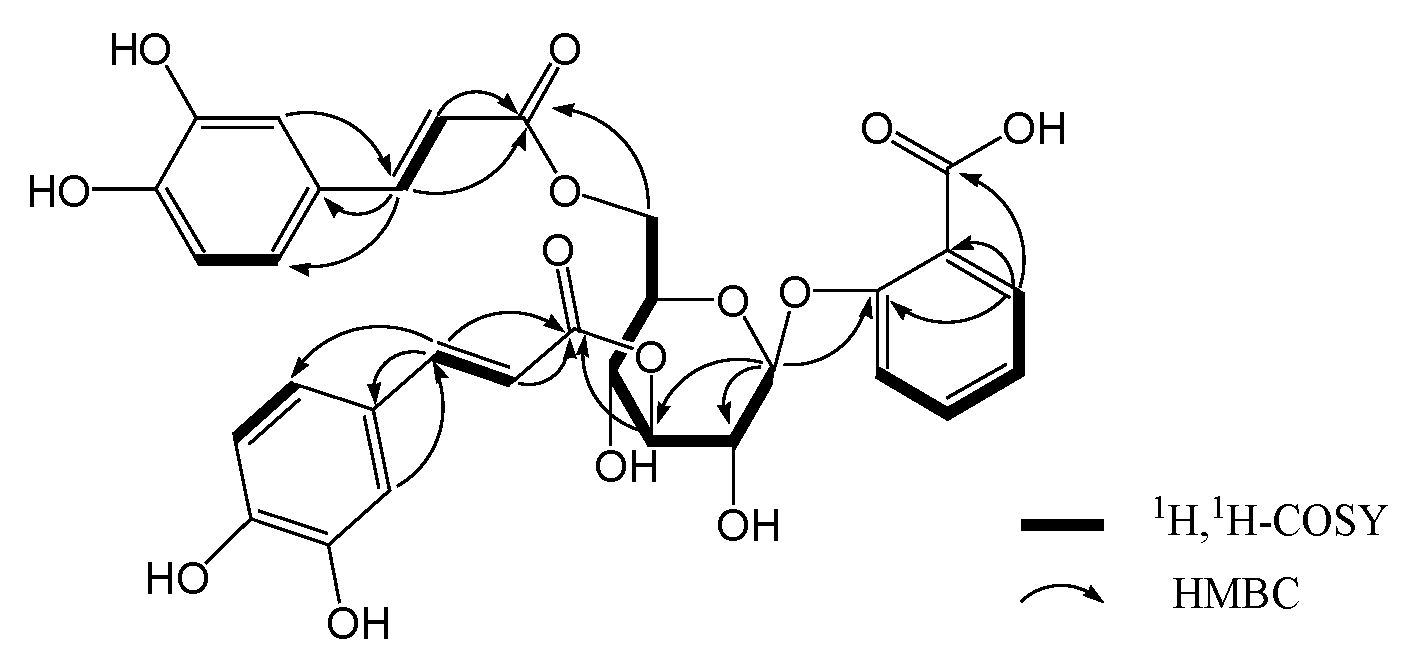


| No. | δ (C) | δ (H) | No. | δ (C) | δ (H) |
|---|---|---|---|---|---|
| 1 | 123.0 | 1″ | 127.9 | ||
| 2 | 158.4 | 2″ | 115.3 | 7.07 (1H, d, 2.4) | |
| 3 | 119.2 | 7.81 (1H, dd, 7.8, 1.2) | 3″ | 146.9 | |
| 4 | 134.9 | 7.42 (1H, dt, 7.8, 1.2) | 4″ | 149.7 | |
| 5 | 124.0 | 7.10 (1H, dt, 7.8, 1.2) | 5″ | 116.6 | 6.80 (1H, d, 8.4) |
| 6 | 132.5 | 7.34 (1H, dd, 7.8, 1.2) | 6″ | 123.0 | 6.79 (1H, dd, 8.4, 2.4) |
| 7 | 169.7 | 7″ | 147.3 | 7.62 (1H, d, 16.2) | |
| 1′ | 103.9 | 5.04 (1H, d, 7.8) | 8″ | 115.2 | 6.36 (1H, d, 16.2) |
| 2′ | 73.3 | 3.78 (1H, dd, 9.6, 7.8) | 9″ | 168.9 | |
| 3′ | 78.1 | 5.19 (1H, dd, 9.6, 9.0) | 1‴ | 127.7 | |
| 4′ | 70.0 | 3.68 (1H, dd, 9.6, 9.0) | 2‴ | 115.2 | 7.06 (1H, d, 1.8) |
| 5′ | 75.8 | 3.87 (1H, m) | 3‴ | 146.8 | |
| 6′a | 64.3 | 4.56 (1H, dd, 12.0, 1.8) | 4‴ | 149.6 | |
| 6′b | 4.44 (1H, dd, 12.0, 6.6) | 5‴ | 116.5 | 6.78 (1H, d, 8.4) | |
| 6‴ | 122.9 | 6.69 (1H, dd, 8.4, 1.8) | |||
| 7‴ | 147.2 | 7.59 (1H, d, 15.6) | |||
| 8‴ | 114.9 | 6.31 (1H, d, 15.6) | |||
| 9‴ | 168.9 |
© 2010 by the authors; licensee MDPI, Basel, Switzerland. This article is an open access article distributed under the terms and conditions of the Creative Commons Attribution license (http://creativecommons.org/licenses/by/3.0/).
Share and Cite
Yan, J.; Bi, H.-H.; Liu, Y.-Z.; Zhang, M.; Zhou, Z.-Y.; Tan, J.-W. Phenolic Compounds from Merremia umbellata subsp. orientalis and Their Allelopathic Effects on Arabidopsis Seed Germination. Molecules 2010, 15, 8241-8250. https://doi.org/10.3390/molecules15118241
Yan J, Bi H-H, Liu Y-Z, Zhang M, Zhou Z-Y, Tan J-W. Phenolic Compounds from Merremia umbellata subsp. orientalis and Their Allelopathic Effects on Arabidopsis Seed Germination. Molecules. 2010; 15(11):8241-8250. https://doi.org/10.3390/molecules15118241
Chicago/Turabian StyleYan, Jian, Hai-Hong Bi, Yong-Zhu Liu, Mei Zhang, Zhong-Yu Zhou, and Jian-Wen Tan. 2010. "Phenolic Compounds from Merremia umbellata subsp. orientalis and Their Allelopathic Effects on Arabidopsis Seed Germination" Molecules 15, no. 11: 8241-8250. https://doi.org/10.3390/molecules15118241
APA StyleYan, J., Bi, H.-H., Liu, Y.-Z., Zhang, M., Zhou, Z.-Y., & Tan, J.-W. (2010). Phenolic Compounds from Merremia umbellata subsp. orientalis and Their Allelopathic Effects on Arabidopsis Seed Germination. Molecules, 15(11), 8241-8250. https://doi.org/10.3390/molecules15118241