Abstract
A series of novel bis(substituted pyrazol-4-ylcarbonyl)-substituted thioureas have been synthesized by the reactions of substituted pyrazol-4-ylcarbonyl isothiocyanates with different diamines under ultrasound irradiation and classical heating method at 20-25 °C. In general, substantial improvement in rates and modest yields increases were observed when reactions were carried out under sonication, compared with the classical heating method. The structures of these compounds have been elucidated by elemental and spectral (IR, 1H-NMR) analysis.
Introduction
Heterocycles bearing a pyrazole moiety represent an interesting class of compounds possessing a wide spectrum of biological and pharmacological activities, such as herbicidal [1], antitumor [2], antibacterial [3], antileukemic [4], anti-inflammatory [5] properties. On the other hand, thiourea compounds have received much attention because of their wide range of biological properties such as antituberculosis [6], anticancer [7], anti-HIV [8], antimicrobial [9] activity.
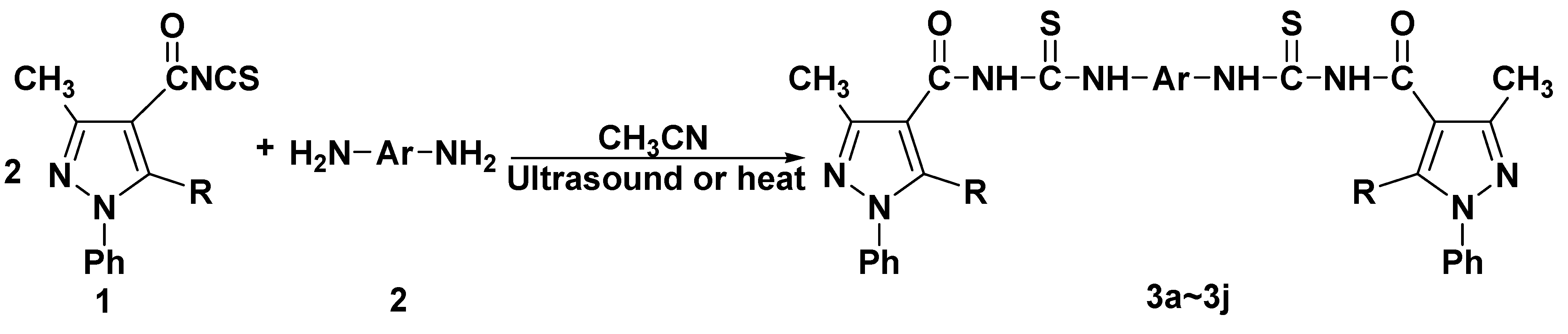
The use of ultrasound in chemistry, usually known as sonochemistry, has grown spectacularly in recent years [10,11]. The success and advantages of sonochemical reactions include higher yields, shorter reaction times and milder reaction conditions when compared with traditional methods. Recently, we have reported mild and efficient procedures for the synthesis of 4-substituted pyrazolyl-3,4-dihydropyrimidin-2(1H)-(thi)ones under ultrasonic irradiation [12]. As a part of our interest in the synthesis of a wide range of heterocyclic systems, and in continuation of our research interest in the use of ultrasonic irradiation [12], we wish to report herein the synthesis of some novel bis(substituted pyrazol-4-ylcarbonyl)-substituted thioureas by the reaction of substituted pyrazol-4-ylcarbonyl isothiocyanates with different diamines under ultrasound irradiation (US) and classical heating conditions (CH) (Scheme 1).
Scheme 1.
Synthesis of bis(substituted pyrazol-4-ylcarbonyl)-substituted thioureas.
Results and Discussion
Data in Table 1 clearly show that the reactions of substituted pyrazol-4-ylcarbonyl isothiocyanates with diamines leading to bis(substituted pyrazol-4-ylcarbonyl)-substituted thioureas was carried out smoothly under both conventional and ultrasound irradiation conditions. Compared to the conventional method, the achieved yields under ultrasound irradiation increased two or three percent and the reaction times under ultrasound irradiation were dramatically shortened to 0.75 h from 7.5 h. Therefore, ultrasound irradiation exhibited some advantages over the classical condition by improving the reaction yields and reducing the reaction time. The difference in yields and reaction time (US > CH) may be a consequence of the specific effects of ultrasound.
We also examined the effect of different ultrasound irradiation frequencies on the reactions. Thus, in the case of compound 3a, for example, when the frequency was 28 kHz, the reaction required 45 min and resulted in the formation of the desired product in 74% yield, whereas when the frequencies were 45 kHz or 100 kHz, the reaction was also complete in 45 min affording the product in 75% and 76% yield, respectively. This showed that the irradiation frequency did not significantly influence the reactions, so all the other reactions were carried out in acetonitrile under 100 kHz ultrasound irradiation.
The structures of the compounds 3a-j were established on the basis of elemental analysis and spectral (IR, 1H-NMR) data. In the IR spectra of compounds 3a-j, one sharp absorption band was seen at 1,650-1,678 cm-1, which belongs to the carbonyl function. The υ(NH) and υ(C=S) stretching frequencies were observed at 3,402-3,044 cm-1 and 1,200-1,127 cm-1, respectively. In the 1H-NMR spectra, the proton signals for compounds 3a-j were recorded at 12.60-12.25 ppm (carbonyl band NH) and 9.84-9.40 ppm (benzene ring NH). At the same time, a singlet appearing at 2.26-2.48 ppm could be assigned to the protons of the methyl group of the pyrazole ring.
Table 1.
Comparison between ultrasound irradiation and conventional method.
| Entry | R | Ar | Yields (%)a | Time (h)b | Mp (°C) | ||
|---|---|---|---|---|---|---|---|
| Ac | Bc | Ac | Bc | ||||
| 3a | Cl- | ![]() | 73 | 76 | 7.5 | 0.75 | 189-190 |
| 3b | Cl- | ![]() | 66 | 69 | 7.5 | 0.75 | 205-206 |
| 3c | Cl- | ![]() | 91 | 92 | 7.5 | 0.75 | 220-222 |
| 3d | Cl- | ![]() | 95 | 96 | 7.5 | 0.75 | 223-224 |
| 3e | Cl- | ![]() | 83 | 85 | 7.5 | 0.75 | 204-206 |
| 3f | PhO- | ![]() | 80 | 81 | 7.5 | 0.75 | 210-211 |
| 3g | PhO- | ![]() | 71 | 73 | 7.5 | 0.75 | 203-205 |
| 3h | PhO- | ![]() | 79 | 83 | 7.5 | 0.75 | 235-237 |
| 3i | PhO- | ![]() | 84 | 86 | 7.5 | 0.75 | 218-220 |
| 3j | PhO- | ![]() | 76 | 78 | 7.5 | 0.75 | 226-228 |
a Isolated yields; b Reactions were stopped on disappearance of starting materials by TLC;
c Method A: without ultrasound irradiation at 20-25 °C. Method B: under ultrasound irradiation at 20-25 °C.
Conclusions
In summary, we have developed an efficient procedure for the synthesis of bis(substituted pyrazol-4-ylcarbonyl)-substituted thioureas under ultrasonic irradiation. We anticipate that these compounds will be subjected to biomedical screening. This work is currently in progress and the results will be reported in due course.
Experimental
General
Melting points were determined using a Büchi B-540 instrument and are uncorrected. The IR spectra were obtained as potassium bromide pellets with a FTS-40 spectrometer (BIO-RAD, U.S.A). The 1H-NMR spectra were measured in CDCl3 on a Varian Inova-400 spectrometer using TMS as an internal standard. Elemental (C, H, N) analysis was performed on a Perkin-Elmer Analyzer 2400. Sonication was performed in a Kunshan KQ-100VDB ultrasonic cleaner with three frequencies (28 kHz, 45 kHz, 100 kHz) and a nominal power 100 W. The reaction flask was located in the maximum energy area in the cleaner, where the surface of reactants is slightly lower than the level of the water. The reaction temperature was controlled between 20-25 °C by addition or removal of water from ultrasonic bath. Compounds 1 were synthesized according to literature methods [13].
Synthesis of bis(substituted pyrazol-4-ylcarbonyl) substituted thioureas 3a-3j
Method A (conventional heating): Substituted pyrazol-4-ylcarbonyl isothiocyanates (1 mmol), diamine (0.5 mmol) and acetonitrile (25 mL) were placed in a Pyrex round bottom flask (50 mL). The mixture was stirred for a specified period at 20-25 °C. After the reaction was completed (monitored by TLC), the solids were filtered and dried at 20-25 °C. The crude mixture was recrystallized from a mixture of DMF/H2O.
Method B (ultrasonic irradiation): Substituted pyrazol-4-ylcarbonyl isothiocyanates (1 mmol), diamine (0.5 mmol) and acetonitrile (25 mL) were placed in a Pyrex round bottom flask (50 mL). The mixture was sonicated (100 W) in a ultrasonic cleaning bath at 20-25 °C for a specified period. After the reaction was complete (as monitored by TLC), the solids were filtered and dried at 20-25 °C. The crude mixture was recrystallized from a mixture of DMF/H2O. Data of the compounds are shown below.
1,2-Di[(5-chloro-3-methyl-1-phenylpyrazol-4-yl) acylthiourea]benzene (3a): white powder. IR (νmax., cm–1): 3,402, 3,068, 1,672, 1,161; 1H-NMR (δ ppm): 12.36 (s, 2H, NH), 9.43 (s, 2H, NH), 8.05-7.26 (m, 14H, ArH), 2.51 (s, 6H, 2xCH3); Anal. calcd. for C30H24Cl2N8O2S2: C, 54.30; H, 3.65; N, 16.89. Found: C, 54.21; H, 3.59; N, 16.98%.
1,3-Di[(5-chloro-3-methyl-1-phenylpyrazol-4-yl)acylthiourea]benzene (3b): flesh powder. IR (νmax., cm–1): 3,395, 3,044, 1,666, 1,189; 1H-NMR (4δ ppm): 12.60 (s, 2H, NH), 9.33 (s, 2H, NH), 8.26-7.26 (m, 14H, ArH), 2.61 (s, 6H, 2xCH3); Anal. calcd. for C30H24Cl2N8O2S2: C, 54.30; H, 3.65; N, 16.89. Found: C, 54.41; H, 3.72; N, 16.80%.
1,4-Di[(5-chloro-3-methyl-1-phenylpyrazol-4-yl acylthiourea]benzene (3c): grey powder. IR (νmax., cm–1): 3,401, 3,065, 1,664, 1,164; 1H-NMR (δ ppm): 12.58 (s, 2H, NH), 9.42 (s, 2H, NH), 8.11-7.25 (m, 14H, ArH), 2.54 (s, 6H, 2xCH3); Anal. calcd. for C30H24Cl2N8O2S2: C, 54.30; H, 3.65; N, 16.89. Found: C, 54.46; H, 3.72; N, 16.77%.
4,4'-Di[(5-chloro-3-methyl-1-phenylpyrazol-4-yl)acylthiourea]biphenyl (3d): light yellow powder. IR (νmax., cm–1): 3,393, 3,054, 1,672, 1,157; 1H-NMR (δ ppm): 12.62 (s, 2H, NH), 9.35 (s, 2H, NH), 7.86-7.26 (m, 18H, ArH), 2.62 (s, 6H, 2xCH3); Anal. calcd. for C36H28Cl2N8O2S2: C, 58.46; H, 3.82; N, 15.15. Found: C, 58.29; H ,3.76; N, 15.25%.
2,2'-Dimethyl-4,4'-di[(5-chloro-3-methyl-1-phenylpyrazol-4-yl)acylthiourea]biphenyl (3e): light yellow powder. IR (νmax., cm–1): 3,415, 3,084, 1,672, 1,171; 1H-NMR (δ ppm): 12.62 (s, 2H, NH), 9.35 (s, 2H, NH), 7.86-7.26 (m, 16H, ArH), 2.62 (s, 6H, 2xCH3), 2.42 (s, 6H, 2xCH3); Anal. calcd. for C38H32Cl2N8O2S2: C, 59.45; H, 4.20; N, 14.60. Found: C, 59.61; H, 4.24; N, 14.71%.
1,2-Di[(3-methyl-5-phenoxyl-1-phenylpyrazol-4-yl)acylthiourea]benzene (3f): light yellow powder. IR (νmax., cm–1): 3,413, 3,075, 1,678, 1,145; 1H-NMR (δ ppm): 12.49 (s, 2H, NH), 9.36 (s, 2H, NH), 7.88-7.32 (m, 24H, ArH), 2.55 (s, 6H, 2xCH3); Anal. calcd. for C42H34N8O4S2: C, 64.77; H, 4.40; N, 14.39. Found: C, 64.65; H, 4.45; N, 14.35%.
1,3-Di[(3-methyl-5-phenoxyl-1-phenylpyrazol-4-yl)acylthiourea]benzene (3g): grey powder. IR (νmax., cm–1): 3,392, 3,052, 1,671, 1,176; 1H-NMR ( δ ppm): 12.48 (s, 2H, NH), 9.33 (s, 2H, NH), 8.07-6.92 (m, 24H, ArH), 2.62 (s, 6H, 2xCH3); Anal. calcd. for C42H34N8O4S2: C, 64.77; H, 4.40; N, 14.39. Found: C, 64.68; H, 4.43; N, 14.29%.
1,4-Di[(3-methyl-5-phenoxyl-1-phenylpyrazol-4-yl)acylthiourea]benzene (3h): brown powder. IR (νmax., cm–1): 3,412, 3,064, 1,668, 1,127; 1H-NMR (δ ppm): 12.58 (s, 2H, NH), 9.29 (s, 2H, NH), 7.89-7.56 (m, 24H, ArH), 2.58 (s, 6H, 2xCH3); Anal. calcd. for C42H34N8O4S2: C, 64.77; H, 4.40; N, 14.39. Found: C, 64.64; H, 4.36; N, 14.30%.
4,4'-Di[(3-methyl-5-phenoxyl-1-phenylpyrazol-4-yl)acylthiourea]biphenyl (3i): yellow powder. IR (νmax., cm–1): 3,338, 3,065, 1,650, 1,182; 1H-NMR (δ ppm): 12.53 (s, 2H, NH), 9.37 (s, 2H, NH), 7.77-6.94 (m, 28H, ArH), 2.64 (s, 6H, 2xCH3); Anal. calcd. for C48H38N8O4S2: C, 67.43; H, 4.48; N, 13.11. Found: C, 67.32; H, 4.52; N, 13.26%.
2,2'-Dimethyl-4,4'-di[(3-methyl-5-phenoxyl-1-phenylpyrazol-4-yl)acylthiourea]biphenyl (3j): yellow powder. IR (νmax., cm–1): 3,403, 3,072, 1,678, 1,153; 1H-NMR (δ ppm): 12.48 (s, 2H, NH), 9.45 (s, 2H, NH), 7.93-7.02 (m, 26H, ArH), 2.60 (s, 6H, 2xCH3), 2.43 (s, 6H, 2xCH3); Anal. calcd. for C50H42N8O4S2: C, 68.01; H, 4.79; N, 12.69. Found: C, 68.19; H, 4.85; N, 12.59%.
Acknowledgements
We gratefully ackonwledge support from the National Natural Science Foundation of China (No. 20662009).
References
- Liu, H.; Wang, H.Q.; Liu, Z.J. Synthesis and herbicidal activity of novel pyrazolo[3,4-d]pyrimidin-4-one derivatives containing aryloxyphenoxypropionate moieties. Bioorg. Med. Chem. Lett. 2007, 17, 2203–2209. [Google Scholar] [CrossRef]
- Park, H.J; Lee, K.; Park, S.J; Ahn, B.; Lee, J.C; Cho, H.Y.; Lee, K.I. Identification of antitumor activity of pyrazole oxime ethers. Bioorg. Med. Chem. Lett. 2005, 15, 3307–3312. [Google Scholar] [CrossRef]
- Akbas, E.; Berber, I.; Sener, A.; Hasanov, B. Synthesis and antibacterial activity of 4-benzoyl-1-methyl-5-phenyl-1H-pyrazole-3-carboxylic acid and derivatives. Il Farmaco. 2005, 60, 23–26. [Google Scholar] [CrossRef]
- Daidone, G.; Maggio, B.; Raffa, D.; Plescia, S.; Schillaci, D.; Raimondi, M.V. Synthesis and in vitro antileukemic activity of new 4-triazenopyrazole derivatives. Il Farmaco. 2004, 59, 413–417. [Google Scholar] [CrossRef]
- Bekhit, A.A.; Ashour, H.M.A.; Ghany, Y.S.A.; Bekhit, A.E.A.; Baraka, A. Synthesis and biological evaluation of some thiazolyl and thiadiazolyl derivatives of 1H-pyrazole as anti-inflammatory antimicrobial agents. Eur. J. Med. Chem. 2008, 43, 456–463. [Google Scholar] [CrossRef]
- Dixit, P.P.; Patil, V.J.; Nair, P.S.; Jain, S.; Sinha, N.; Arora, S.K. Synthesis of 1-[3-(4-benzotriazol-1/2-yl-3-fluorophenyl)-2-oxo-oxazolidin-5-ylmethyl]-3-substituted-thiourea derivatives as antituberculosis agents. Eur. J. Med. Chem. 2006, 41, 423–428. [Google Scholar] [CrossRef]
- Mahajan, A.; Yeh, S.; Nell, M.; Rensburg, C.E.J.V.; Chibale, K. Synthesis of new 7-chloroquinolinyl thioureas and their biological investigation as potential antimalarial and anticancer agents. Bioorg. Med. Chem. Lett. 2007, 17, 5683–5685. [Google Scholar] [CrossRef]
- Küçükgüzel, I.; Tatar, E.; Küçükgüzel, S.G.; Rollas, S.; Clercq, E.D. Synthesis of some novel thiourea derivatives obtained from 5-[(4-aminophenoxy)methyl]-4-alkyl/aryl-2,4-dihydro-3H-1,2,4-triazole-3-thiones and evaluation as antiviral/anti-HIV and anti-tuberculosis agents. Eur. J. Med. Chem. 2008, 43, 381–392. [Google Scholar] [CrossRef]
- Arslan, H.; Duran, N.; Borekci, G.; Ozer, C.K.; Akbay, C. Antimicrobial activity of some thiourea derivatives and their nickel and copper complexes. Molecules 2009, 14, 519–527. [Google Scholar] [CrossRef]
- Ding, L.Q.; Wang, W.; Zhang, A.Q. Synthesis of 1,5-dinitroaryl-1,4-pentadien-3-ones under ultrasound irradiation. Ultrason. Sonochem. 2007, 14, 563–567. [Google Scholar] [CrossRef]
- Lin, H.X.; Yang, M.F.; Huang, P.G.; Cao, W.G. A facile procedure for the generation of dichlorocarbene from the reaction of carbon tetrachloride and magnesium using ultrasonic Irradiation. Molecules 2003, 8, 608–613. [Google Scholar] [CrossRef]
- Zhang, X.L.; Li, Y.P.; Liu, C.J.; Wang, J.D. An efficient synthesis of 4-substituted pyrazolyl-3,4-dihydropyrimidin-2(1H)-(thio)ones catalyzed by Mg(ClO4)2 under ultrasound irradiation. J. Mol. Catal. A: Chem. 2006, 253, 207–211. [Google Scholar] [CrossRef]
- Jia, Z.X.; Li, Y.P.; Liu, C.J. Synthesis of N-Substituted Benzothiazol-2-yl-amino-N'-substituted pyrazol-4-yl-carbonylthiourea under ultrasound. Chin. J. Org. Chem. 2005, 25, 1450–1453. [Google Scholar]
- Sample Availability: Available from the authors
© 2009 by the authors; licensee Molecular Diversity Preservation International, Basel, Switzerland. This article is an open-access article distributed under the terms and conditions of the Creative Commons Attribution license ( http://creativecommons.org/licenses/by/3.0/).