Time Modulation-Based Multi-User Covert Communication

Abstract
1. Introduction
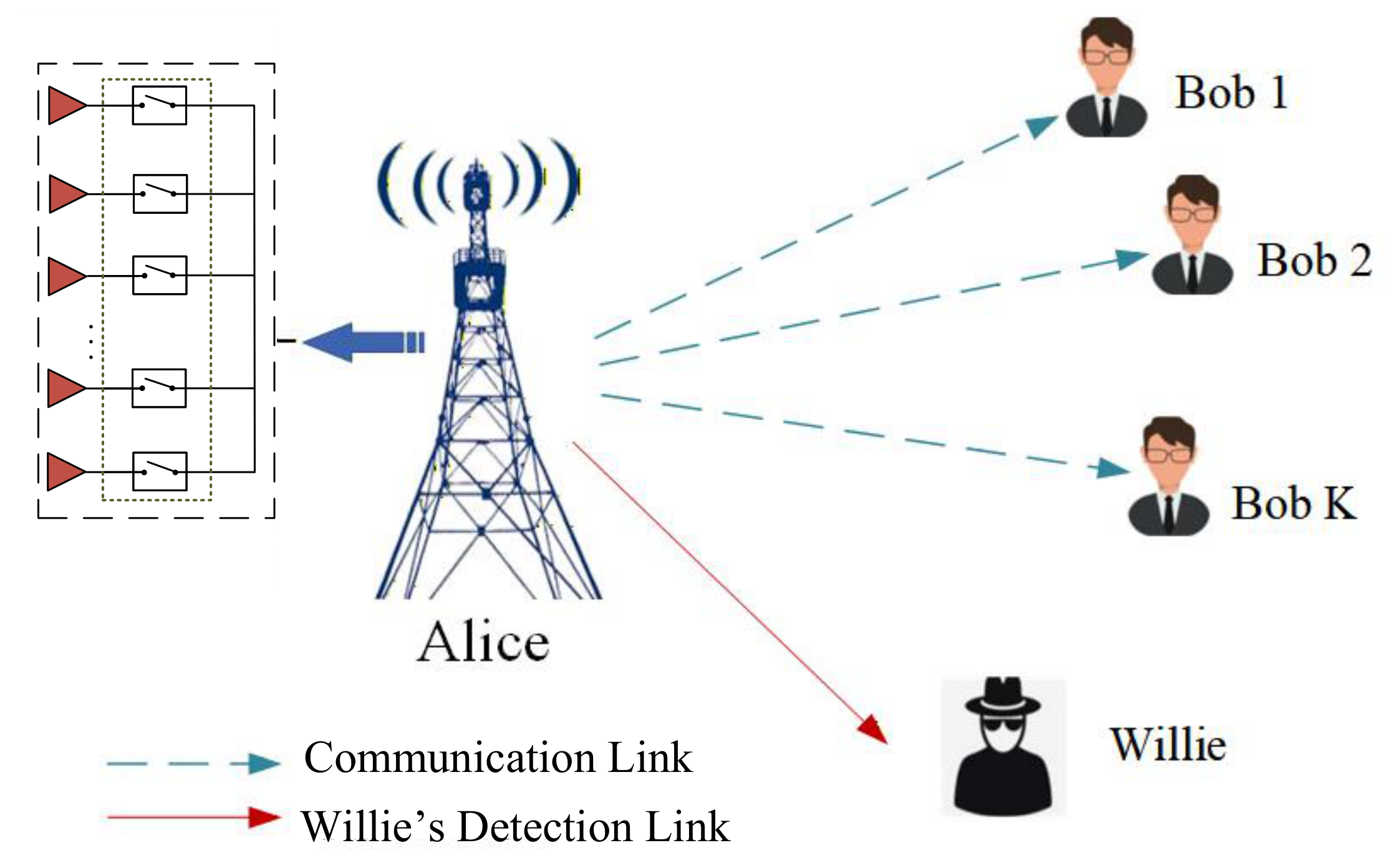
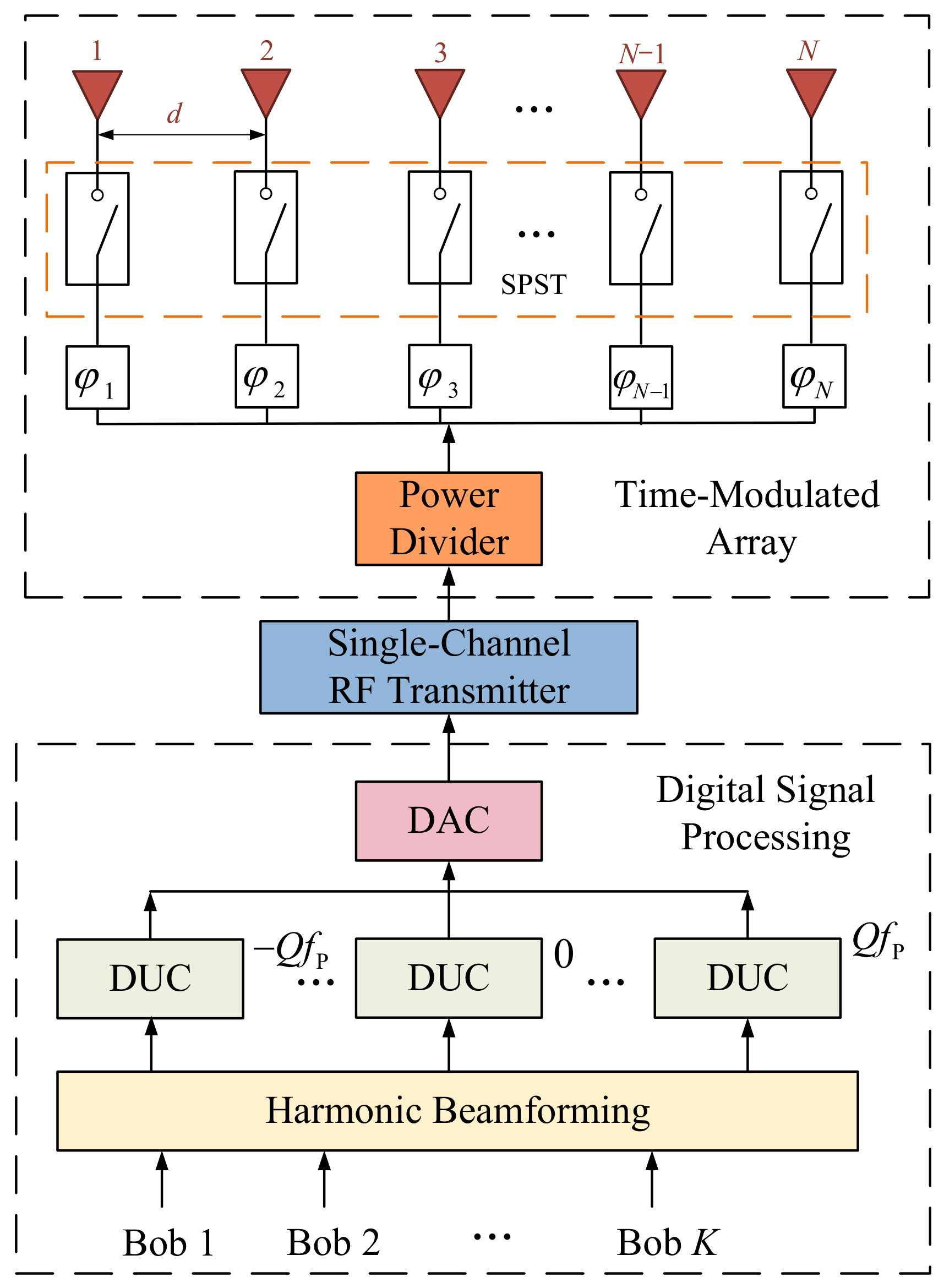
- TMA-Based Multi-User Covert Communication: We propose a TMA-based multi-user covert communication scheme under a single-RF-chain architecture, where time modulation is exploited to support SDMA transmission while reducing hardware complexity. Different from conventional approaches based on fundamental-component or finite-harmonic assumptions, the proposed analysis models Willie’s received signal using infinite-order harmonic components, and thus reveals the statistical characteristics and power distribution of high-order harmonic-induced leakage.
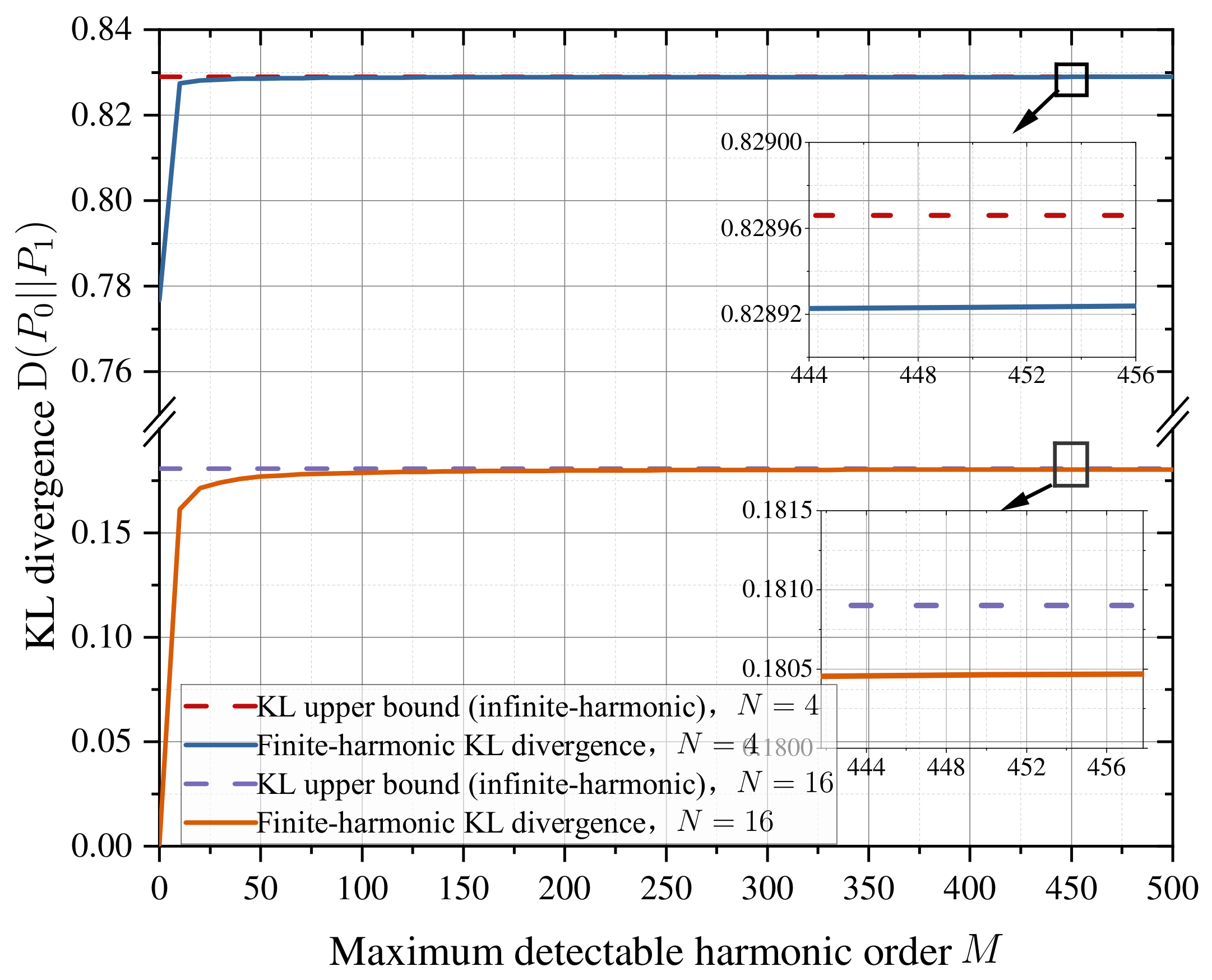
- Closed-Form KL-Divergence Bound Under Infinite Harmonics: The exact Kullback–Leibler (KL) divergence under infinite-order harmonics is analytically intractable due to the accumulated contributions of all harmonic components. To address the challenge, an equivalent closed-form upper bound on the KL divergence is derived. The bound provides a tractable covert constraint for performance evaluation and optimization, enabling more comprehensive assessment of covert performance than models relying only on finite or fundamental harmonic components.
- KL-Divergence Bound-Based Joint Optimization Design: Based on the derived KL-divergence upper bound, a max-min optimization problem is formulated to maximize the minimum covert transmission rate among multiple users under the covertness constraint. A genetic algorithm (GA)-based joint design is developed to optimize the time-modulation sequence, power allocation, and spatial phase parameters. The optimization framework directly accounts for infinite-harmonic leakage, thereby offering design guidance for practical TMA-SDMA covert communication systems.
- Numerical Validation: Numerical simulations validate the effectiveness of the derived KL-divergence upper bound and the proposed joint optimization scheme. Comparisons between the fundamental-component model and the infinite-order harmonic model reveal the performance deviation caused by neglecting high-order harmonics. The results show that the proposed design improves covert transmission performance while suppressing signal leakage toward the warden, confirming the importance of infinite-harmonic-aware modeling for accurate covert performance assessment.
2. System Model
2.1. Transmit Signal Model at Alice
2.2. Received Signal Model at Bobs
2.3. Binary Detection Model at Willie
3. Covert Performance Analysis of TMA-SDMA
3.1. Covertness Constraint Analysis Based on KL Divergence
3.2. KL Divergence Upper Bound Under Infinite-Harmonic Detection
4. Max–Min Rate Design Under Strict Covert Constraints
4.1. Optimization Problem Formulation
4.2. Genetic Algorithm-Based Maximization of the Minimum Transmission Rate
5. Numerical Results
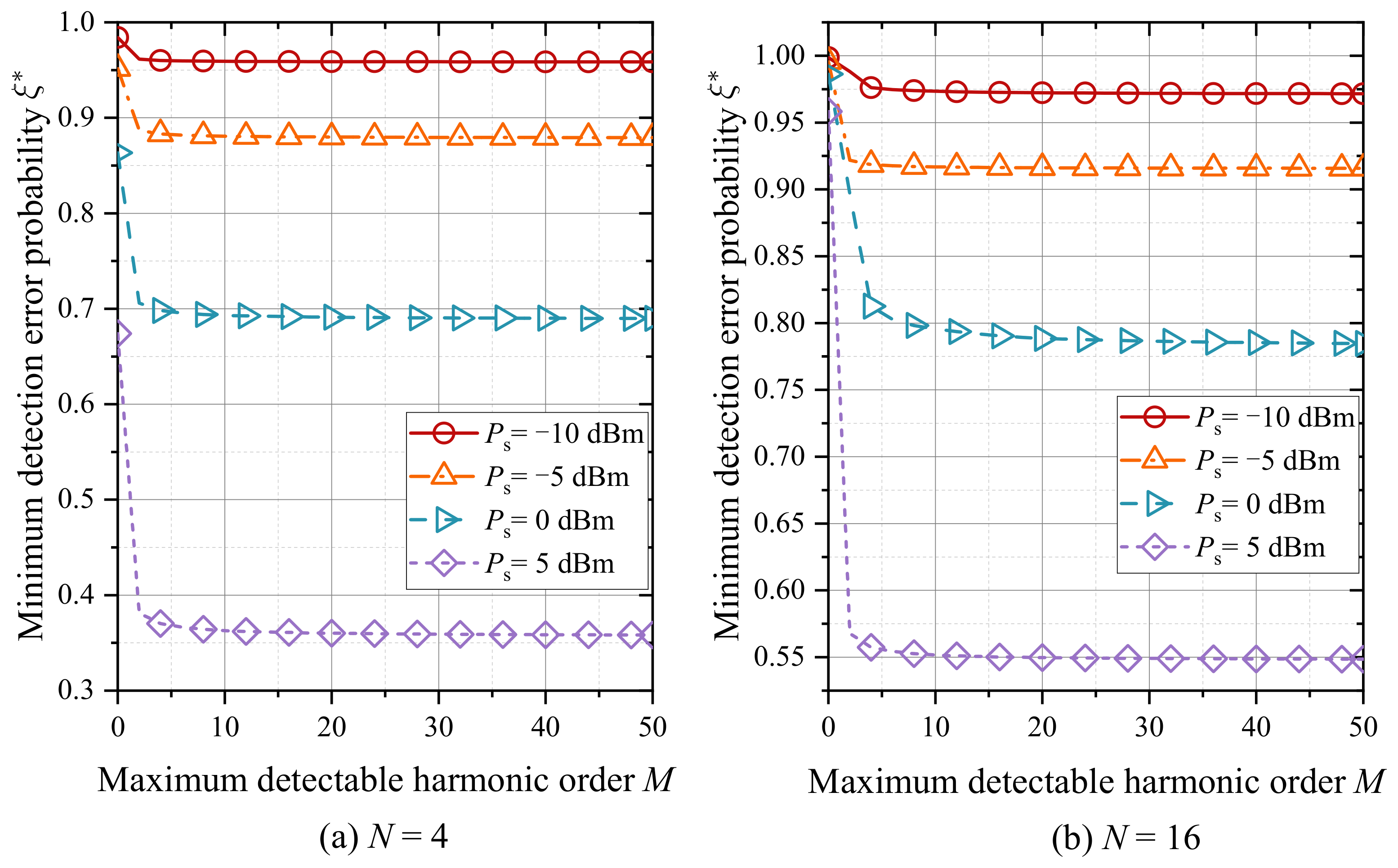
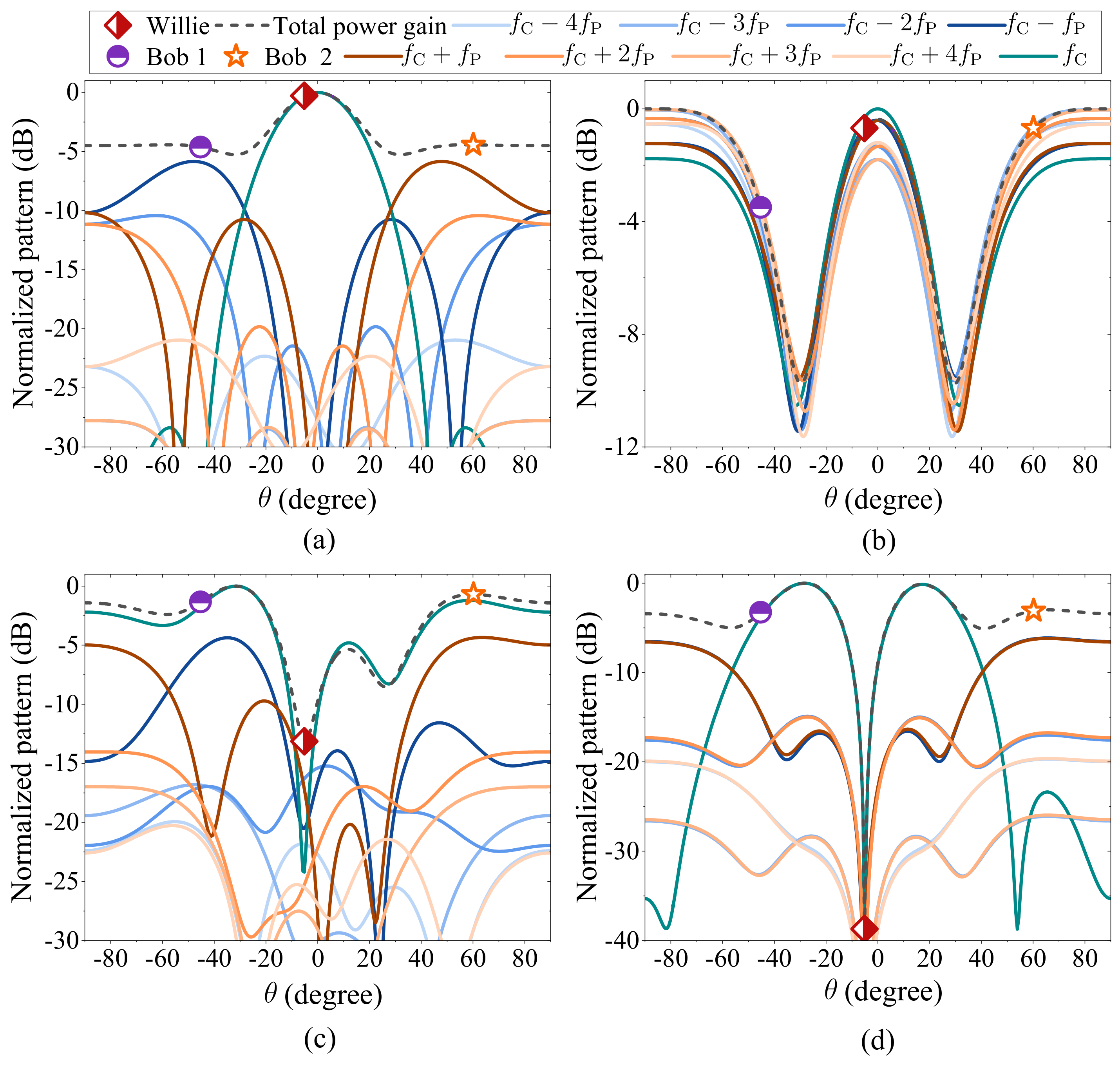
5.1. Impact of Detectable Harmonic Order at Willie on Covertness
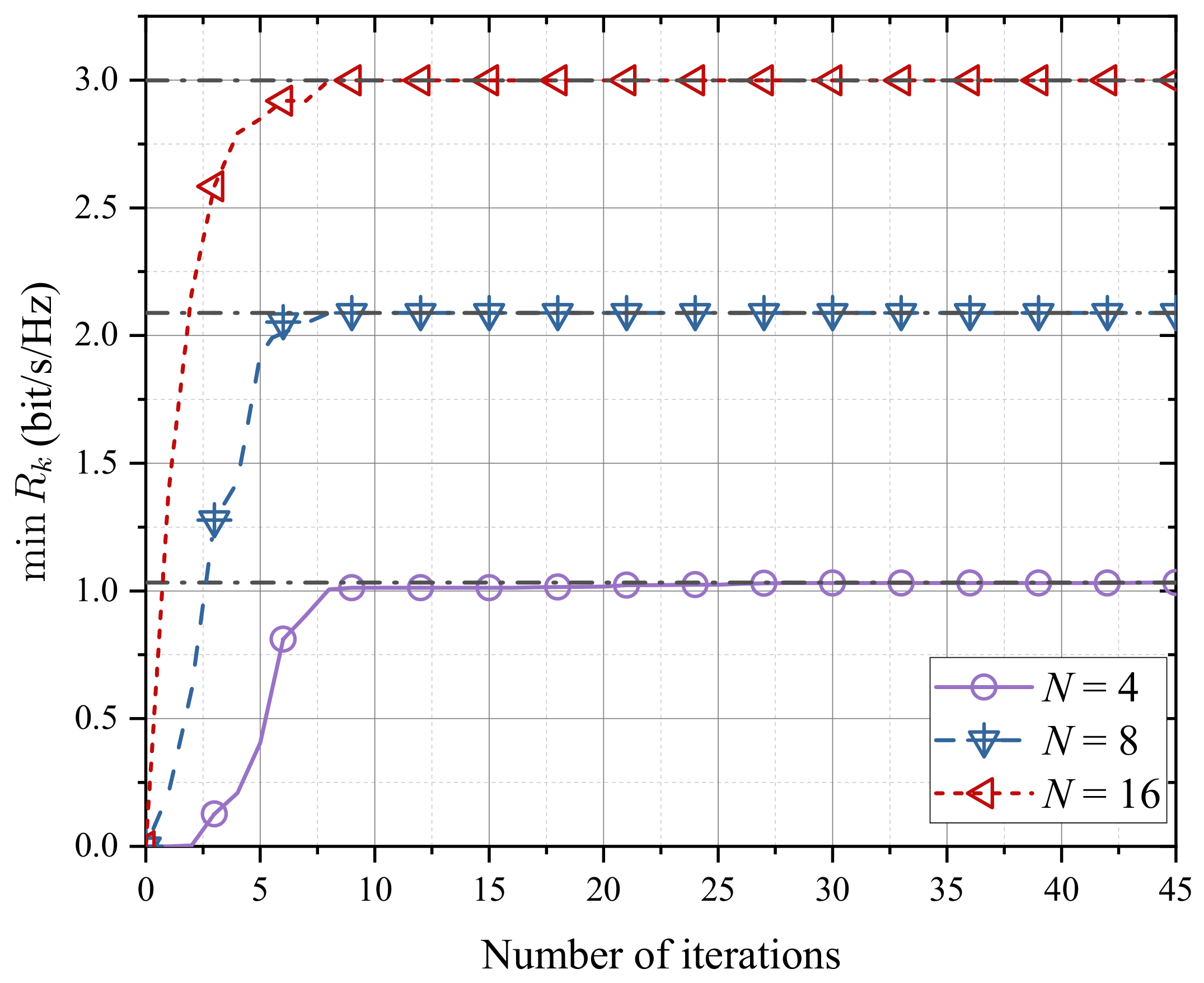
5.2. The Convergence Behavior of the Algorithms Proposed
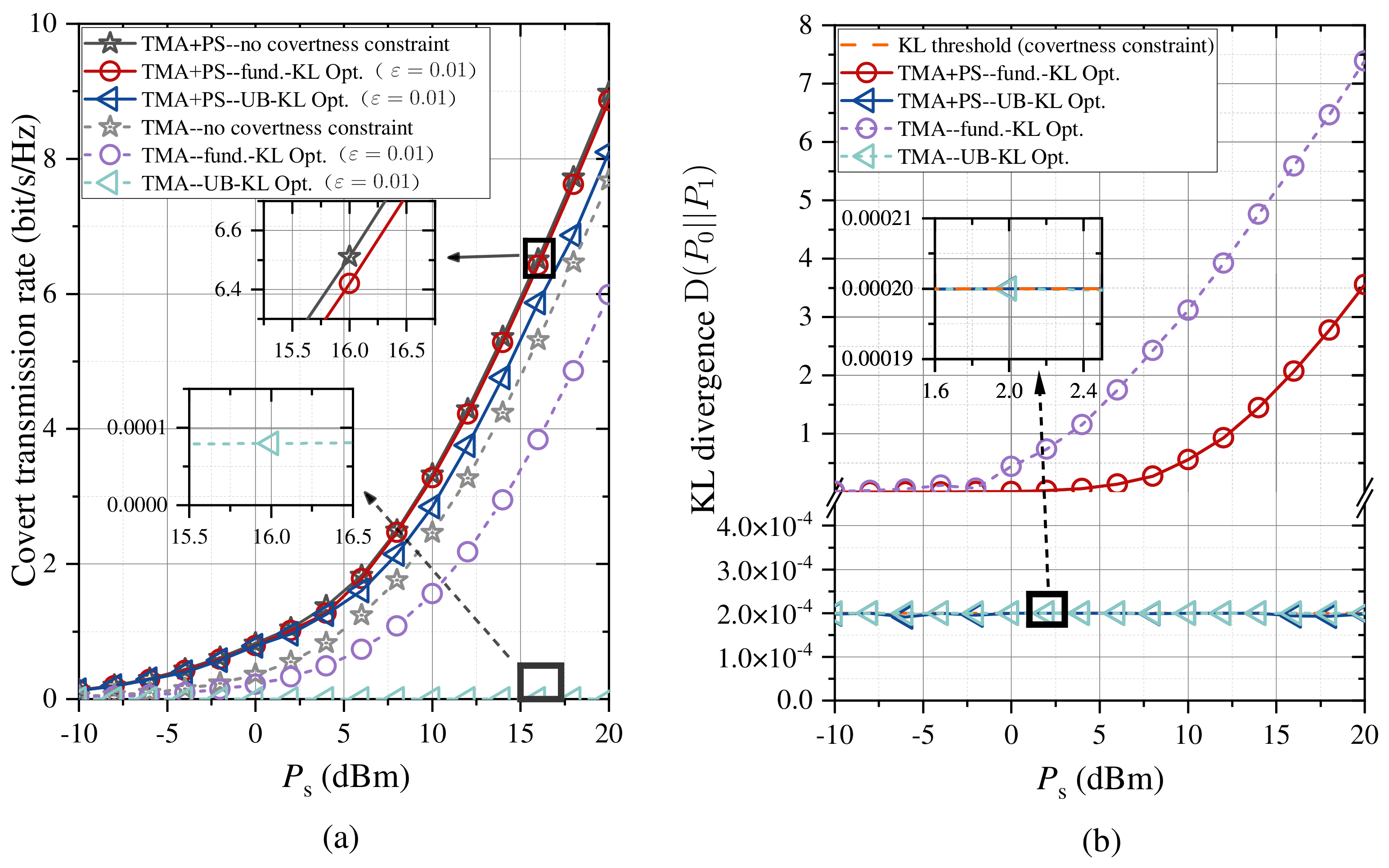
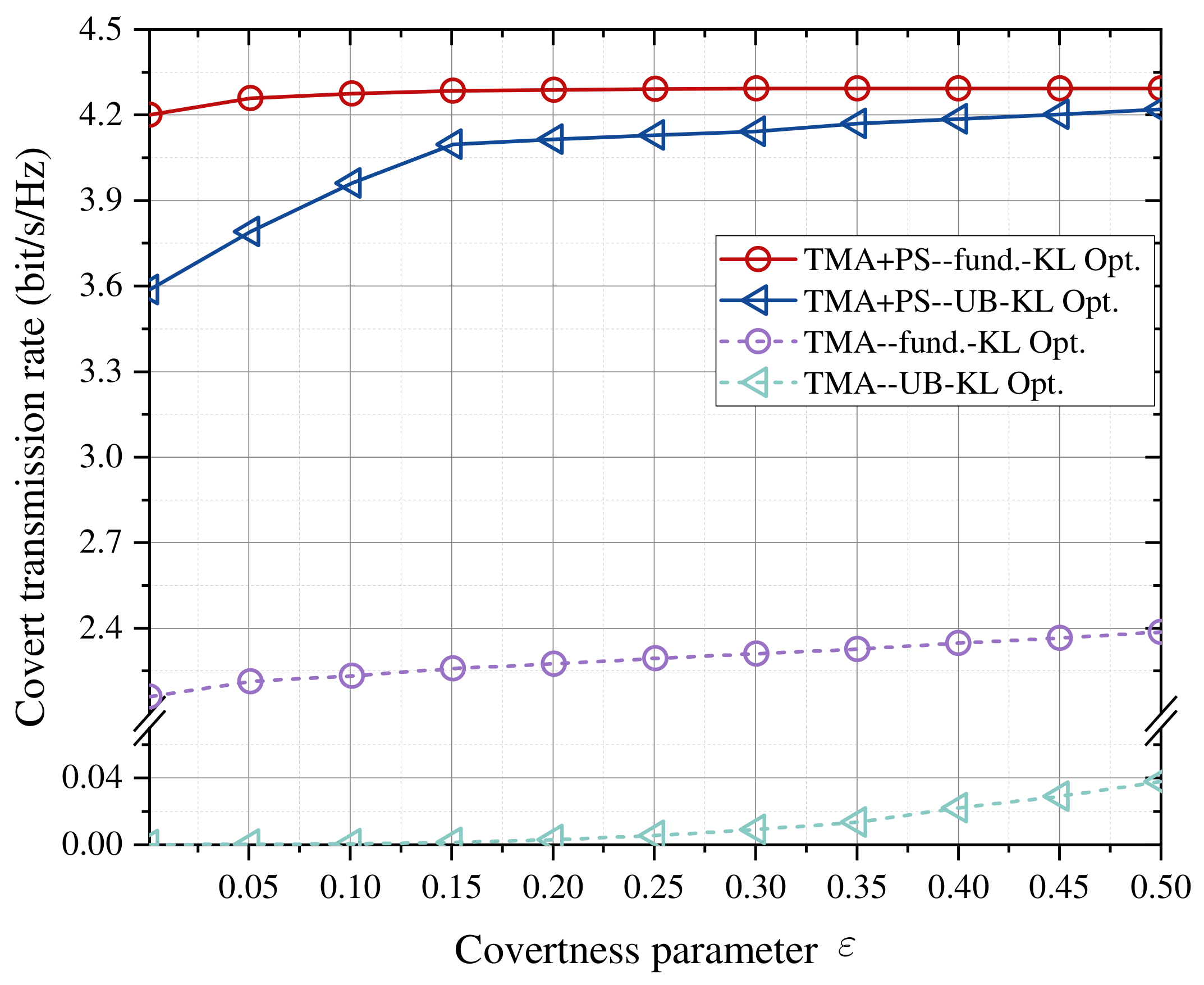
5.3. Covertness Performance Comparison Under Different Constraints
- no covertness constraint: Without covertness constraint;
- fund.-KL Opt.: KL divergence constraint based on fundamental-harmonic detection;
- UB-KL Opt.: KL divergence upper-bound constraint based on infinite-harmonic joint detection.
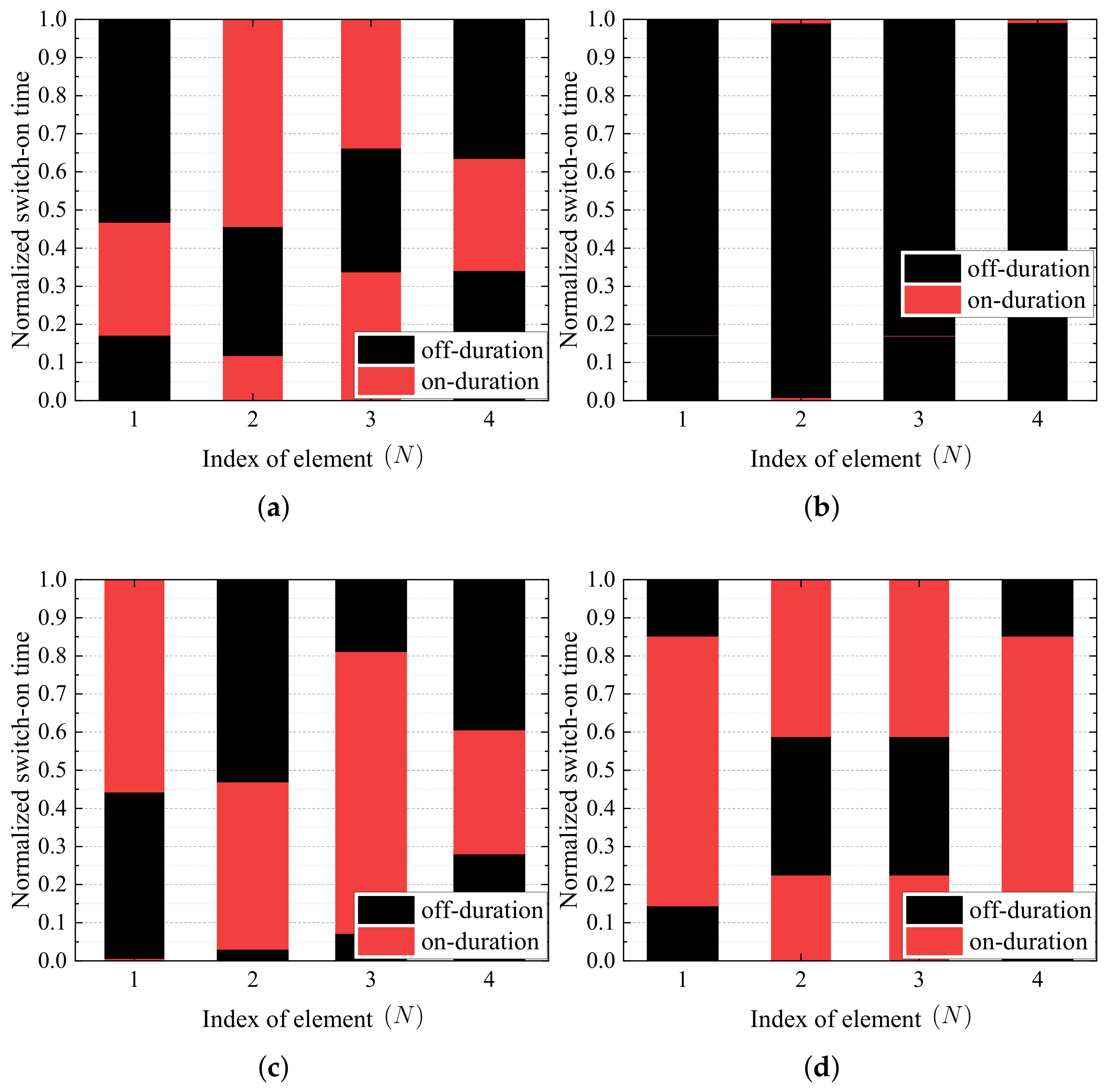
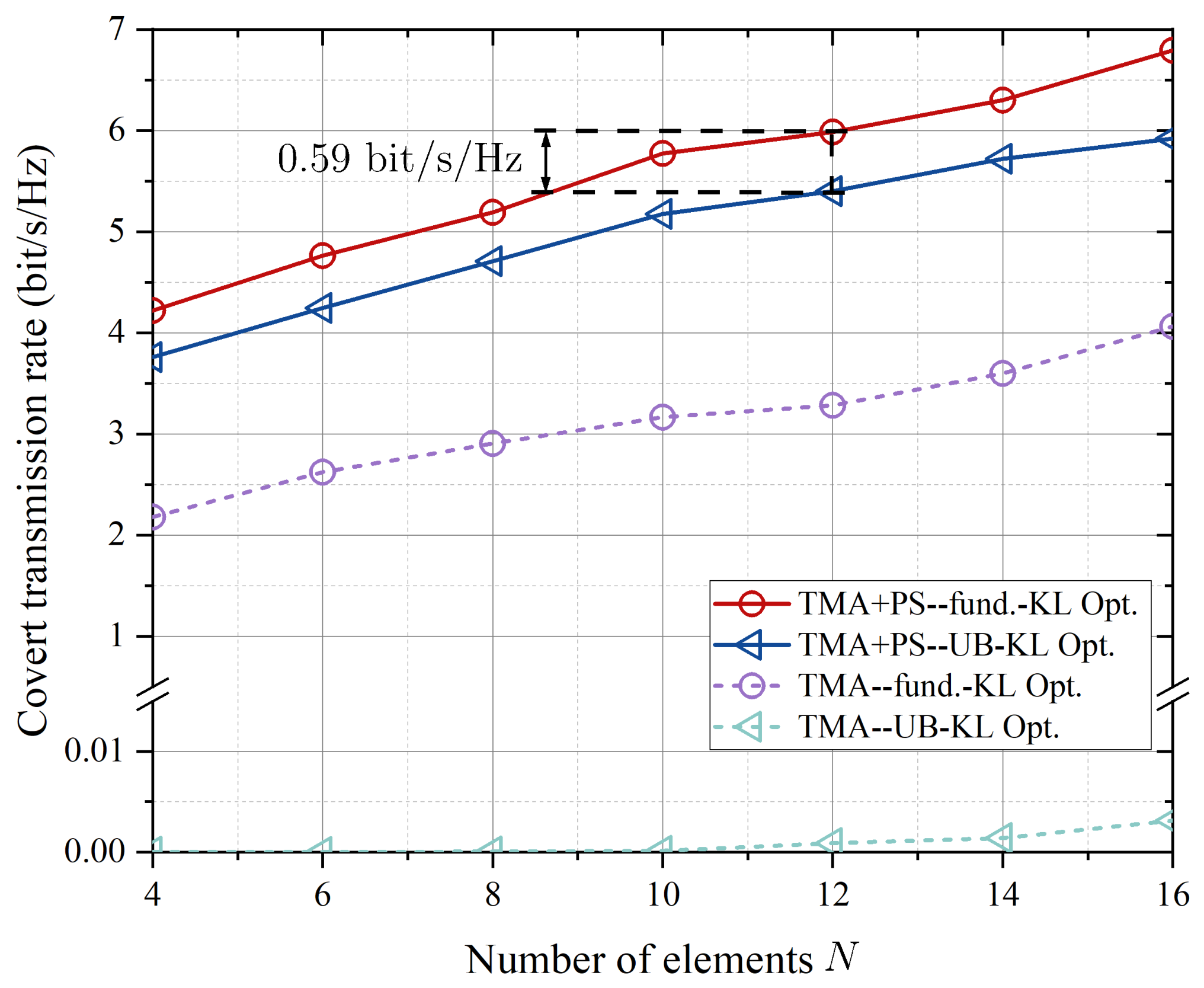
5.4. Impact of System Parameters on Covert Communication Performance
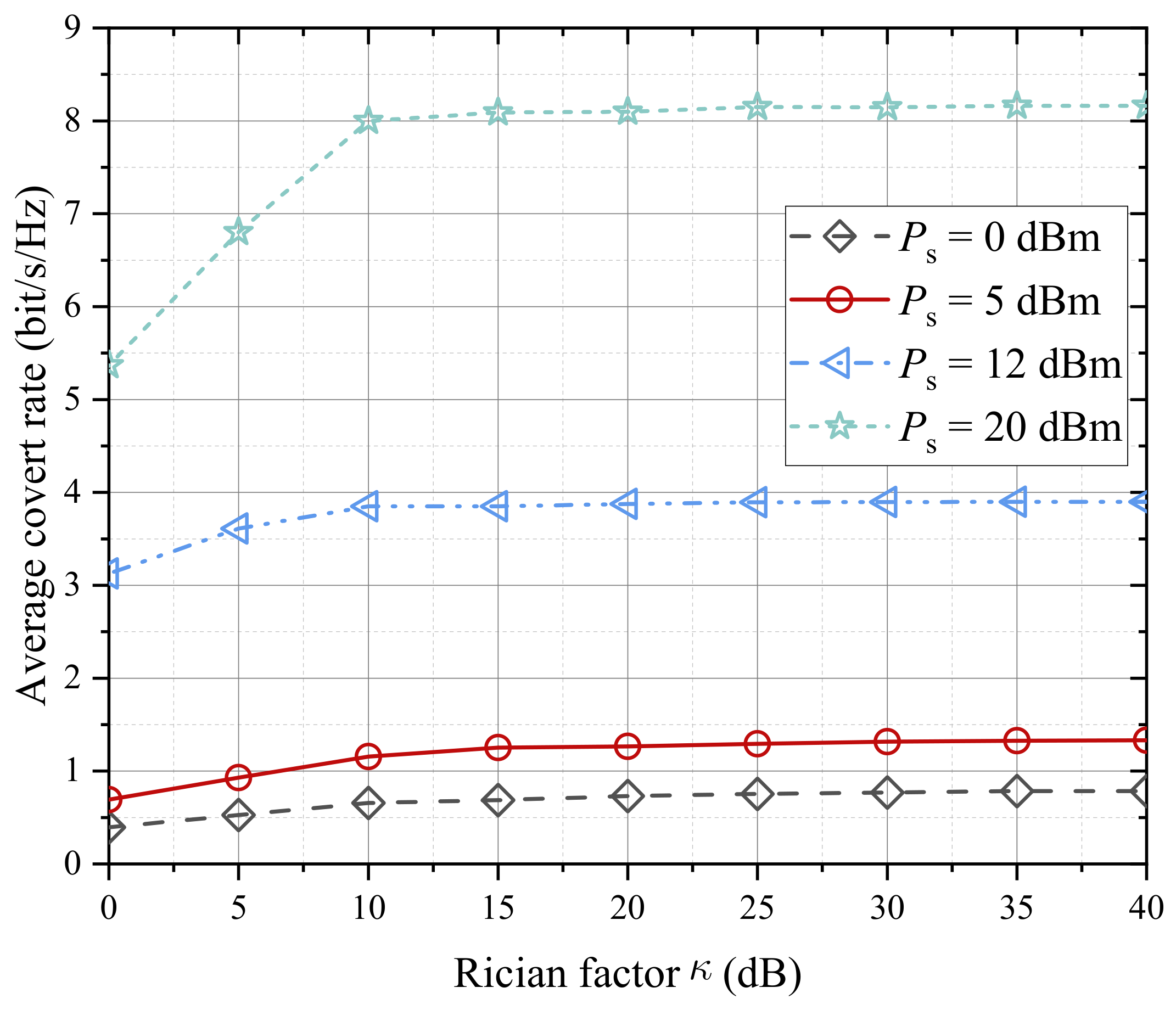
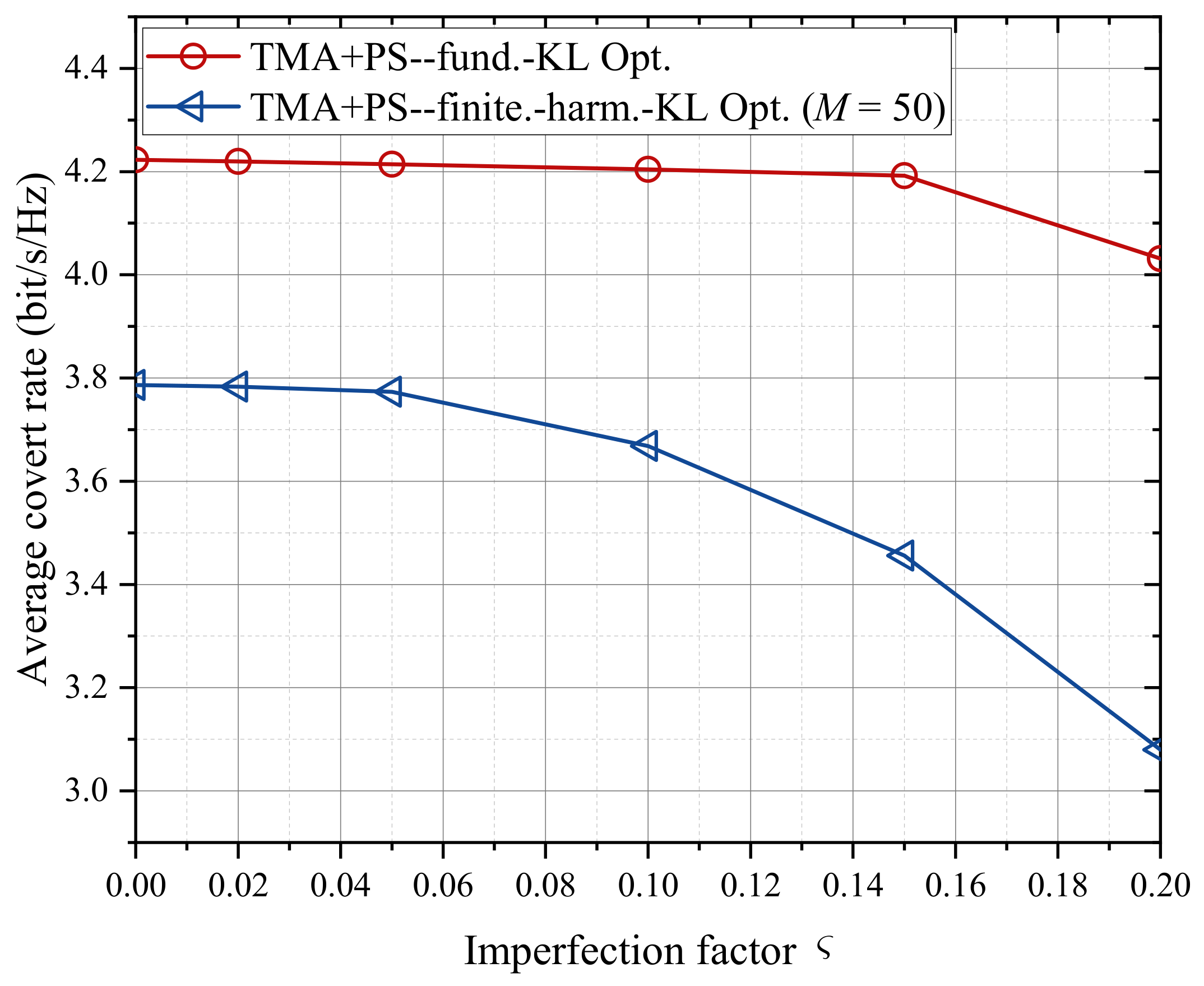
5.5. Impact of Practical Channel Effects on Covert Transmission
6. Conclusions
Author Contributions
Funding
Data Availability Statement
Conflicts of Interest
Abbreviations
| TMA | Time-Modulated Arrays |
| RF | Radio Frequency |
| GA | Genetic Algorithm |
| SDMA | Space-Division Multiple Access |
| AWGN | Additive White Gaussian Noise |
| DUC | Digital Up-Converter |
| DAC | Digital-to-Analog Converter |
| AoD | Aangle of Departure |
| SINR | Signal-to-Interference-plus-Noise Ratio |
Appendix A. Closed-Form Expressions of
References
- Liu, R.; Zheng, B.; Lee, J.; Lee, S.H.; Kaddoum, G.; Günlü, O.; Gündüz, D. Secure Communications, Sensing, and Computing Toward Next-Generation Networks. IEEE J. Sel. Areas Commun. 2026, 44, 4444–4470. [Google Scholar] [CrossRef]
- Gao, C.; Tian, L.; Zhao, Q.; Zheng, D.; Jiang, X. Covert and Secure Communication in Untrusted UAV-Assisted Wireless Systems. IEEE Internet Things J. 2025, 12, 35329–35339. [Google Scholar] [CrossRef]
- Zhang, J.; Duong, T.Q.; Woods, R.; Marshall, A. Securing Wireless Communications of the Internet of Things from the Physical Layer, An Overview. Entropy 2017, 19, 420. [Google Scholar] [CrossRef]
- Peng, J.; Tang, S. Covert Communication Over VoIP Streaming Media With Dynamic Key Distribution and Authentication. IEEE Trans. Ind. Electron. 2021, 68, 3619–3628. [Google Scholar] [CrossRef]
- Sanenga, A.; Mapunda, G.A.; Jacob, T.M.L.; Marata, L.; Basutli, B.; Chuma, J.M. An Overview of Key Technologies in Physical Layer Security. Entropy 2020, 22, 1261. [Google Scholar] [CrossRef] [PubMed]
- Ge, S.; Zhou, S.; Zhao, X.; Geng, J.; Chen, J.; Jin, R. A Scannable Directional Modulation Secure Communication Method With Time-Modulated Array. IEEE Antennas Wirel. Propag. Lett. 2026, 25, 716–720. [Google Scholar] [CrossRef]
- Tao, Z.; Petropulu, A.P. On the Security of Directional Modulation via Time Modulated Arrays Using OFDM Waveforms. IEEE Trans. Wirel. Commun. 2025, 24, 9749–9762. [Google Scholar] [CrossRef]
- Zhai, Y.; Wang, T.; Zhou, Y.; Zhu, F.; Yang, B. Towards Secure Internet of Things: A Coercion-Resistant Attribute-Based Encryption Scheme with Policy Revocation. Entropy 2025, 27, 32. [Google Scholar] [CrossRef] [PubMed]
- Xu, J.; Zhou, L.; Zhang, S.; Xie, X.; Yuan, W.; Wang, J. Intelligent Foundation Model-Enabled Low-Altitude FANETs: Integrating Communication, Control, Sensing, and Security. IEEE Internet Things Mag. 2026, 9, 84–92. [Google Scholar] [CrossRef]
- Tang, M.; Lau, V.K.N. Online Identification and Temperature Tracking Control for Furnace System With a Single Slab and a Single Heater Over the Wirelessly Connected IoT Controller. IEEE Internet Things J. 2024, 11, 6730–6747. [Google Scholar] [CrossRef]
- Jiang, Y.; Wu, S.; Ma, R.; Liu, M.; Luo, H.; Kaynak, O. Monitoring and Defense of Industrial Cyber-Physical Systems Under Typical Attacks: From a Systems and Control Perspective. IEEE Trans. Ind. Cyber-Phys. Syst. 2023, 1, 192–207. [Google Scholar] [CrossRef]
- Shangguan, X.C.; Yu, M.H.; Zhang, C.K.; He, Y. Detection and Defense Against Multi-Point False Data Injection Attacks of Load Frequency Control in Smart Grid. IEEE Trans. Smart Grid 2025, 16, 4143–4154. [Google Scholar] [CrossRef]
- He, Y.; Xu, J.; Zhou, L.; Wang, J.; Jiang, C. Channel Inversion Power Control-Aided Multi-User Secret and Covert UAV Communications. IEEE Trans. Wirel. Commun. 2026, 25, 11002–11018. [Google Scholar] [CrossRef]
- Chen, X.; An, J.; Xiong, Z.; Xing, C.; Zhao, N.; Yu, F.R.; Nallanathan, A. Covert Communications: A Comprehensive Survey. IEEE Commun. Surv. Tutor. 2023, 25, 1173–1198. [Google Scholar] [CrossRef]
- Yan, S.; Cong, Y.; Hanly, S.V.; Zhou, X. Gaussian Signalling for Covert Communications. IEEE Trans. Wirel. Commun. 2019, 18, 3542–3553. [Google Scholar] [CrossRef]
- Bash, B.A.; Goeckel, D.; Towsley, D.; Guha, S. Hiding information in noise: Fundamental limits of covert wireless communication. IEEE Commun. Mag. 2015, 53, 26–31. [Google Scholar] [CrossRef]
- Bash, B.A.; Goeckel, D.; Towsley, D. Limits of Reliable Communication with Low Probability of Detection on AWGN Channels. IEEE J. Sel. Areas Commun. 2013, 31, 1921–1930. [Google Scholar] [CrossRef]
- Yang, Z.; Yue, P.; Wang, S.; Pan, G.; An, J. Energy-Efficient Optimization for RIS-Aided MIMO Covert Communications. IEEE Internet Things J. 2023, 10, 18993–19003. [Google Scholar] [CrossRef]
- Shmuel, O.; Cohen, A.; Gurewitz, O. Multi-Antenna Jamming in Covert Communication. IEEE Trans. Commun. 2021, 69, 4644–4658. [Google Scholar] [CrossRef]
- Bai, L.; Xu, J.; Zhou, L. Covert Communication for Spatially Sparse mmWave Massive MIMO Channels. IEEE Trans. Commun. 2023, 71, 1615–1630. [Google Scholar] [CrossRef]
- Xu, J.; Bai, L.; Xie, X.; Zhou, L. Collaborative Secret and Covert Communications for Multi-User Multi-Antenna Uplink UAV Systems: Design and Optimization. IEEE Trans. Wirel. Commun. 2025, 24, 6020–6035. [Google Scholar] [CrossRef]
- Chen, C.; Wang, M.; Xu, Z.; Lv, X.; Xia, B. Performance Analysis and Optimization of MIMO Covert Communications With Finite-Alphabet Inputs. IEEE Trans. Wirel. Commun. 2026, 25, 5922–5934. [Google Scholar] [CrossRef]
- Liu, P.; Si, J.; Cheng, Z.; Li, Z.; Hu, H. Movable-Antenna Enabled Covert Communication. IEEE Wirel. Commun. Lett. 2025, 14, 280–284. [Google Scholar] [CrossRef]
- Mao, H.; Pi, X.; Zhu, L.; Xiao, Z.; Xia, X.G.; Zhang, R. Sum Rate Maximization for Movable Antenna Enhanced Multiuser Covert Communications. IEEE Wirel. Commun. Lett. 2025, 14, 611–615. [Google Scholar] [CrossRef]
- Yang, R.; Wei, N.; Dong, Z.; Zhang, L.; Lyu, W.; Xiu, Y.; Bazzi, A.; Assi, C. Movable Antenna Empowered Covert Dual-Functional Radar-Communication. arXiv 2026, arXiv:2601.14868. [Google Scholar] [CrossRef]
- Ma, R.; Ma, Y.; Lin, Z.; Ma, Y.; Yang, W.; Niyato, D. Covert Communication Assisted by Movable Time-Modulated Arrays. IEEE Commun. Lett. 2026, 30, 382–386. [Google Scholar] [CrossRef]
- Chen, Q.; Bai, L.; He, C.; Jin, R. On the Harmonic Selection and Performance Verification in Time-Modulated Array-Based Space Division Multiple Access. IEEE Trans. Antennas Propag. 2021, 69, 3244–3256. [Google Scholar] [CrossRef]
- Ni, G.; He, C.; Jin, R. Harmonic-Based MIMO Transceiver With Time-Modulated Arrays. IEEE Trans. Antennas Propag. 2023, 71, 7553–7565. [Google Scholar] [CrossRef]
- Shan, C.; Zhang, J.; Ma, Y.; Sha, X.; Zhao, H.; Zhang, J.; Hanzo, L. Energy-Efficient Time-Modulated Beam-Forming for Joint Communication-Radar Systems. IEEE Trans. Green Commun. Netw. 2023, 7, 1849–1862. [Google Scholar] [CrossRef]
- Ma, Y.; Ma, R.; Yang, W.; Miao, C.; Cai, Y.; Wu, W. Covert Communication Using Time Modulated Retrodirective Array. IEEE Wirel. Commun. Lett. 2024, 13, 510–514. [Google Scholar] [CrossRef]
- Yue, M.; Ruiqian, M.; Zhi, L.; Weiwei, Y.; Yueming, C.; Chen, M.; Wen, W. Age of information for short-packet covert communication with time modulated retrodirective array. China Commun. 2024, 21, 23–37. [Google Scholar] [CrossRef]
- Ma, Y.; Ma, R.; Lin, Z.; Zhang, R.; Cai, Y.; Wu, W.; Wang, J. Improving Age of Information for Covert Communication With Time-Modulated Arrays. IEEE Internet Things J. 2025, 12, 1718–1731. [Google Scholar] [CrossRef]
- Miao, C.; Qin, Y.; Ma, R.; Lin, Z.; Ma, Y.; Zhang, W.; Wu, W. Covert Communication of UAV Aided by Time Modulated Array Perception. J. Electron. Inf. Technol. 2025, 47, 1004–1013. [Google Scholar] [CrossRef]
- He, C.; Wang, L.; Chen, J.; Jin, R. Time-Modulated Arrays: A Four-Dimensional Antenna Array Controlled by Switches. J. Commun. Inf. Netw. 2018, 3, 1–14. [Google Scholar] [CrossRef]
- Zeng, Q.; Yang, P.; Yin, L.; Lin, H.; Wu, C.; Yang, F.; Yang, S. Calculation of the Total Radiated Power for 4-D Antenna Arrays With Arbitrary Time Modulated Waveform. IEEE Trans. Antennas Propag. 2021, 69, 9015–9020. [Google Scholar] [CrossRef]
- Ding, Y.; Fusco, V.; Zhang, J.; Wang, W.Q. Time-Modulated OFDM Directional Modulation Transmitters. IEEE Trans. Veh. Technol. 2019, 68, 8249–8253. [Google Scholar] [CrossRef]
- Marzetta, T.L. Noncooperative Cellular Wireless with Unlimited Numbers of Base Station Antennas. IEEE Trans. Wirel. Commun. 2010, 9, 3590–3600. [Google Scholar] [CrossRef]
- Bash, B.A.; Goeckel, D.; Towsley, D. Square root law for communication with low probability of detection on AWGN channels. In Proceedings of the 2012 IEEE International Symposium on Information Theory Proceedings, Cambridge, MA, USA, 1–6 July 2012; pp. 448–452. [Google Scholar] [CrossRef]
- Chen, Z.; Yan, S.; Zhou, X.; Shu, F.; Ng, D.W.K. Intelligent Reflecting Surface-Assisted Passive Covert Wireless Detection. IEEE Trans. Veh. Technol. 2024, 73, 2954–2959. [Google Scholar] [CrossRef]
- Lin, S.; Xu, Y.; Wang, H.; Ding, G. Multi-Antenna Covert Communication Assisted by UAV-RIS With Imperfect CSI. IEEE Trans. Wirel. Commun. 2024, 23, 13841–13855. [Google Scholar] [CrossRef]



| Parameter | Notation | Value |
|---|---|---|
| Number of Bobs | K | 2 |
| Distance of Bobs | m | |
| Direction of Bobs | ||
| Distance of Willie | 800 m | |
| Direction of Willie | ||
| Covertness parameter | ||
| Center frequency | GHz | |
| Number of TMA elements | N | 4 |
| Harmonic order of precoding | Q | 2 |
| Signal bandwidth | B | 8 MHz |
| Noise power | dBm | |
| Path loss exponent | 2 | |
| Reference path loss | dB |
Disclaimer/Publisher’s Note: The statements, opinions and data contained in all publications are solely those of the individual author(s) and contributor(s) and not of MDPI and/or the editor(s). MDPI and/or the editor(s) disclaim responsibility for any injury to people or property resulting from any ideas, methods, instructions or products referred to in the content. |
© 2026 by the authors. Licensee MDPI, Basel, Switzerland. This article is an open access article distributed under the terms and conditions of the Creative Commons Attribution (CC BY) license.
Share and Cite
Jiang, L.; Zhang, X.; Chen, Q.; Wan, X.; Yang, F.; Yang, G. Time Modulation-Based Multi-User Covert Communication. Entropy 2026, 28, 773. https://doi.org/10.3390/e28070773
Jiang L, Zhang X, Chen Q, Wan X, Yang F, Yang G. Time Modulation-Based Multi-User Covert Communication. Entropy. 2026; 28(7):773. https://doi.org/10.3390/e28070773
Chicago/Turabian StyleJiang, Lanxiang, Xuanya Zhang, Qun Chen, Xin Wan, Fei Yang, and Gang Yang. 2026. "Time Modulation-Based Multi-User Covert Communication" Entropy 28, no. 7: 773. https://doi.org/10.3390/e28070773
APA StyleJiang, L., Zhang, X., Chen, Q., Wan, X., Yang, F., & Yang, G. (2026). Time Modulation-Based Multi-User Covert Communication. Entropy, 28(7), 773. https://doi.org/10.3390/e28070773