1. Introduction
As core information carriers, images are widely used in security-sensitive fields such as medicine, military, and cloud computing. The need for privacy protection during their transmission and storage is increasingly urgent, requiring image encryption technology to meet the core demands of high security, strong resistance to attacks, and practicality [
1].
Chaotic systems have been the mainstream technical cornerstone in the field of image encryption. Low-dimensional chaotic systems exhibit inherent security limitations, such as a narrow key space and vulnerability to cryptographic attacks. By comparison, high-dimensional chaotic systems (4D and above) can enhance resistance against adversarial attacks through increased system complexity, emerging as a prominent research focus in recent years [
2,
3,
4,
5,
6,
7,
8,
9]. To enhance the complexity of chaotic behavior for applications in chaotic encryption and secure communication, Teng et al. proposed a dual-dynamic-coupling-coefficient coupled map lattice with delayed feedback (DDCMLDF), which introduces two dynamic coupling coefficients and a random delay mechanism based on the traditional coupled map lattice (CML) to achieve a higher degree of chaotic complexity [
3]. In 2024, Li et al. constructed a class of chaotic systems that can achieve direct offset boosting for two dimensions via a single constant, featuring multiple typical control modes including system variable single control, synchronous common control, reverse control, and differential control as well as the combination of two-dimensional offset boosting and amplitude control [
4]. A novel fractional-order five-dimensional hyper-chaotic system (F5DHS) is proposed by Meng et al. to generate more complicated chaotic sequences for the permutation and diffusion processes in color image encryption [
9].
In existing mainstream schemes that combine neural networks with chaotic encryption, the core idea often relies on memristors to simulate the synaptic characteristics of neural networks and the excitation/inhibition behavior between neurons, thereby leveraging the rich dynamic behavior of such memristor neural networks to construct encryption mechanisms [
10,
11,
12,
13,
14,
15,
16]. In 2024, Lai et al. proposed an image encryption algorithm with excellent performance by leveraging the multiscroll attractors and coexisting homogeneous/heterogeneous attractors of a novel memristive Hopfield neural network (HNN) [
10]. This network is constructed by introducing Sigmoid functions into memristors and has a simple topology with unidirectional neuron connections. To leverage the diverse firing modes and grid multiscroll attractors of the memristive tri-neuron Hopfield neural network (MTN-HNN) constructed by replacing the synapse of the second neuron with a proposed memristor, an encryption scheme was proposed by Yu et al. and successfully implemented on a field-programmable gate array (FPGA) together with custom digital circuits [
12]. By leveraging the periodic initial offset boosting behavior and unique multi-scroll attractor extension characteristics of the memristive Hopfield neural network (MHNN)—constructed by coupling a new locally active non-volatile trigonometric memristor into the Hopfield neural network—Leng et al. designed a real-time image encryption scheme for protecting medical image privacy [
14].
In parallel, a number of recent works have explored complementary directions for chaos-based image encryption. Nardo et al. exploited the finite-precision error of digital chaotic implementations to construct an encryption scheme with enhanced sensitivity [
17]. Nepomuceno et al. proposed a scheme that drives the permutation–diffusion process using the pseudo-orbits of 1D chaotic maps, leveraging the difference between two close pseudo-orbits as the keystream source [
18]. Moysis et al. designed a bit-level cubic-shuffling cipher in which image bits are arranged in a three-dimensional matrix and shuffled along its three axes according to chaotic indices [
19], while Hua et al. constructed a cosine-transform-based chaotic system that combines two seed chaotic maps via a cosine transform to overcome the chaotic degradation of classical low-dimensional maps [
20]. Zhang et al. further developed an image-adaptive encryption algorithm built on a novel 2D enhanced-cosine coupled chaotic system, in which the encryption parameters are adapted to the plaintext to enhance plaintext sensitivity [
21].
Nevertheless, existing high-dimensional chaotic systems still suffer from complex and degenerate structures—memristor-based schemes [
10,
12] rely on intricate circuit design and dedicated hardware, while structure-extended systems [
9] involve complex matrix reconstruction or fractional-order calculation that easily causes chaotic degradation in partial parameter ranges. Mainstream neural network-integrated chaotic encryption schemes have the core limitation of deep binding between algorithm design and hardware implementation [
10,
12,
14], requiring deployment on FPGA, DSP platforms or dedicated analog circuits, and their neural network structures are customized for specific chaotic systems with poor scalability and portability. Even the few hardware-independent fusion schemes [
11] trade off the structural simplicity of the underlying chaotic system for encryption reversibility, failing to balance system simplicity, encryption security and engineering practicality. This paper aims to construct a high-dimensional chaotic system with low complexity, no degeneracy, and high pseudo-randomness that abandons complex components and hardware dependence, and design a general, hardware-decoupled image encryption algorithm based on this system that achieves an optimal balance of security, computational efficiency and practicality.
The main contributions of this paper are as follows:
A novel 4D discrete chaotic system (4D-DCS) with a minimalist structure is proposed, which avoids dependencies on complex components. Through mathematical proofs and numerical simulations, the system exhibits hyperchaotic characteristics and excellent pseudo-randomness, without chaotic degradation.
An encryption framework based on 4D-DCS is designed. An initial key bound to the plaintext is generated using the SHA-256 hash function to ensure key uniqueness, row and column scrambling is combined to disrupt pixel spatial correlation, and a reversible neural network is introduced to achieve efficient diffusion, enhance confusion capabilities and support decryption.
This encryption algorithm achieves ideal levels in several core security metrics and effectively resists various attacks such as differential attacks, cropping, noise attacks, and chosen-plaintext attacks, making it suitable for security-sensitive scenarios.
The rest of this paper are arranged as follows:
Section 2 will elaborate on the design principles, mathematical model, and chaotic characteristic verification process of 4D-DCS.
Section 3 will specifically introduce the image encryption algorithm based on this chaotic system, including the three core aspects of key generation, row and column scrambling, and reversible neural network diffusion.
Section 4 will verify the comprehensive performance of the algorithm through simulation experiments and multi-dimensional security analysis;
Section 5 will summarize the research results of the entire paper and provide an outlook on future optimization directions.
2. The Proposed Chaotic System
2.1. System Design and Mathematical Model
Current design approaches for chaotic systems typically involve combining existing chaotic systems, tuning their parameters, or splicing their structures. While this strategy enables the rapid development of new systems, it is often confined to the dynamical frameworks of existing chaotic systems, thereby hindering efforts to enhance the system’s complexity and originality at a fundamental level. To address this problem, this paper integrates a feedback controller to transform a linear system into a discrete chaotic system.
For a linear discrete-time system, its state evolution is described as:
where
represents the state transition matrix of the linear system. A matrix
is randomly selected such that it satisfies the condition
.
It is evident that the infinity norm of matrix
is 0.9. A feedback controller
is designed to induce chaotic behavior in this linear discrete-time system, which is shown in Equation (
3).
Here,
r is the control parameter of the system. By integrating the feedback controller
and
operation into the linear system, the final mathematical model of the novel four-dimensional discrete chaotic system (4D-DCS) is derived as follows:
where
and
denote the 4-dimensional state vectors of the system at discrete time steps
k and
, respectively. The linear expression of the system in terms of state components is further expanded as:
2.2. Mathematical Discussion of the 4D-DCS
The original matrix
is already diagonally dominant. Define matrix
as:
It is obvious that the matrix
satisfies the diagonally dominant condition:
According to the non-singularity of diagonally dominant matrices, the inverse matrix
of
must exist, and satisfies:
Rewrite the equality
:
Rearranging terms yields:
Take the infinity norm (
) on both sides, and apply the triangle inequality of norms
:
Rearranging the inequality gives:
Given that
, the term
is strictly positive. Rearranging the inequality gives:
Let
, and it is obvious that
. Construct the initial state as:
By the submultiplicativity of norms
, rearranging the equality:
For the mapping
, iterate from the initial state
to get
and
:
It is obvious that
. Let
r denote the radius of the closed ball
. Since
,
lies inside
, while
is located outside this closed ball.
Let
. According to Equation (
6),
is a strongly diagonally dominant matrix. By the Gershgorin Disk Theorem, all eigenvalues of
satisfy
. Thus,
and
is a repelling domain. In addition,
satisfied:
So
is non-degenerate. From the above analysis:
There exists a real number such that for every point , the modulus of all eigenvalues of the Jacobian matrix is greater than 1.
There exists a point (with ) and a natural number such that .
is non-degenerate.
Therefore, is a recurrent repeller of the 4D-DCS. According to Marotto’s Theorem, the system exhibits chaos in the sense of Li–Yorke.
2.3. Bifurcation Diagram and Trajectory
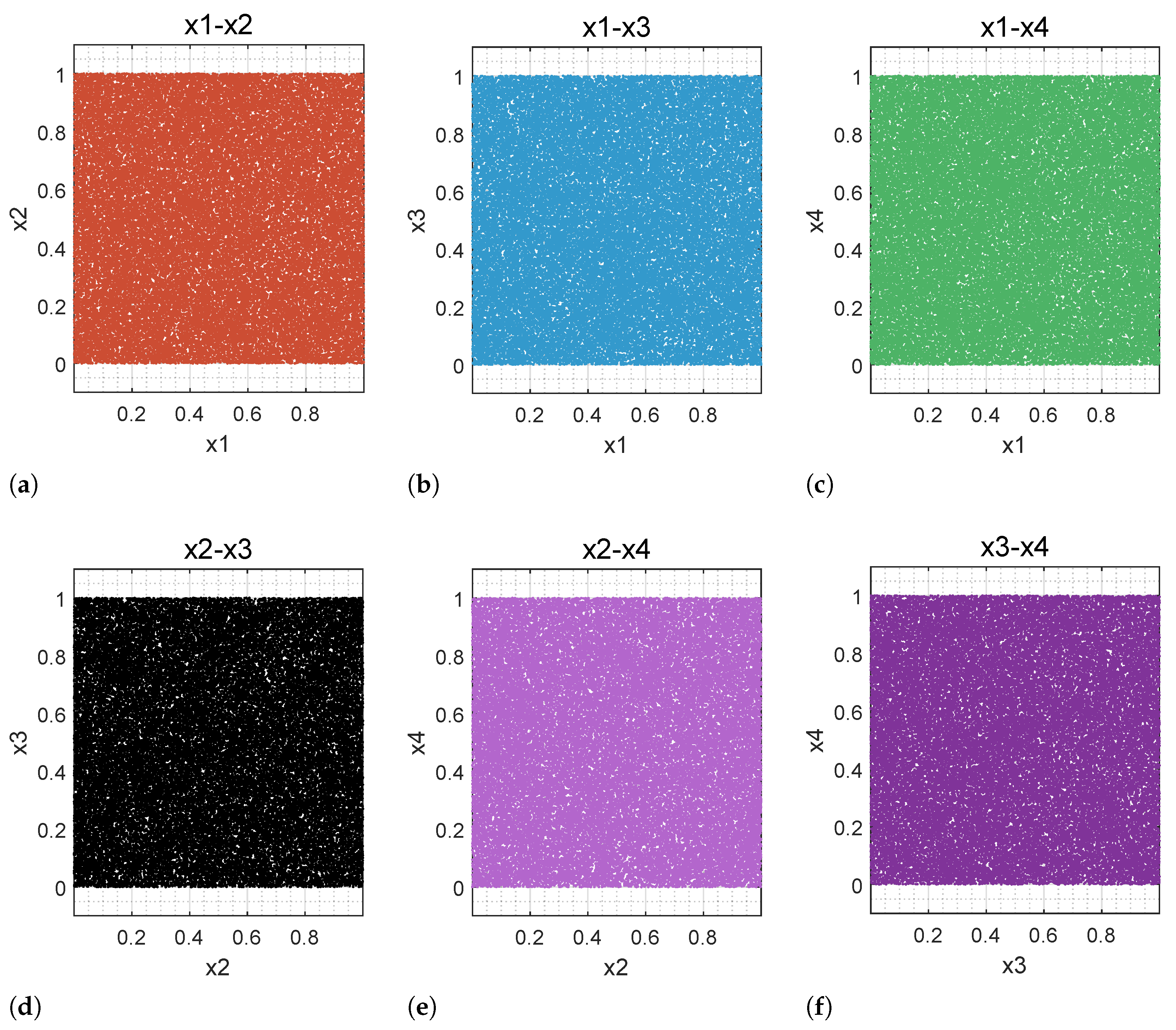
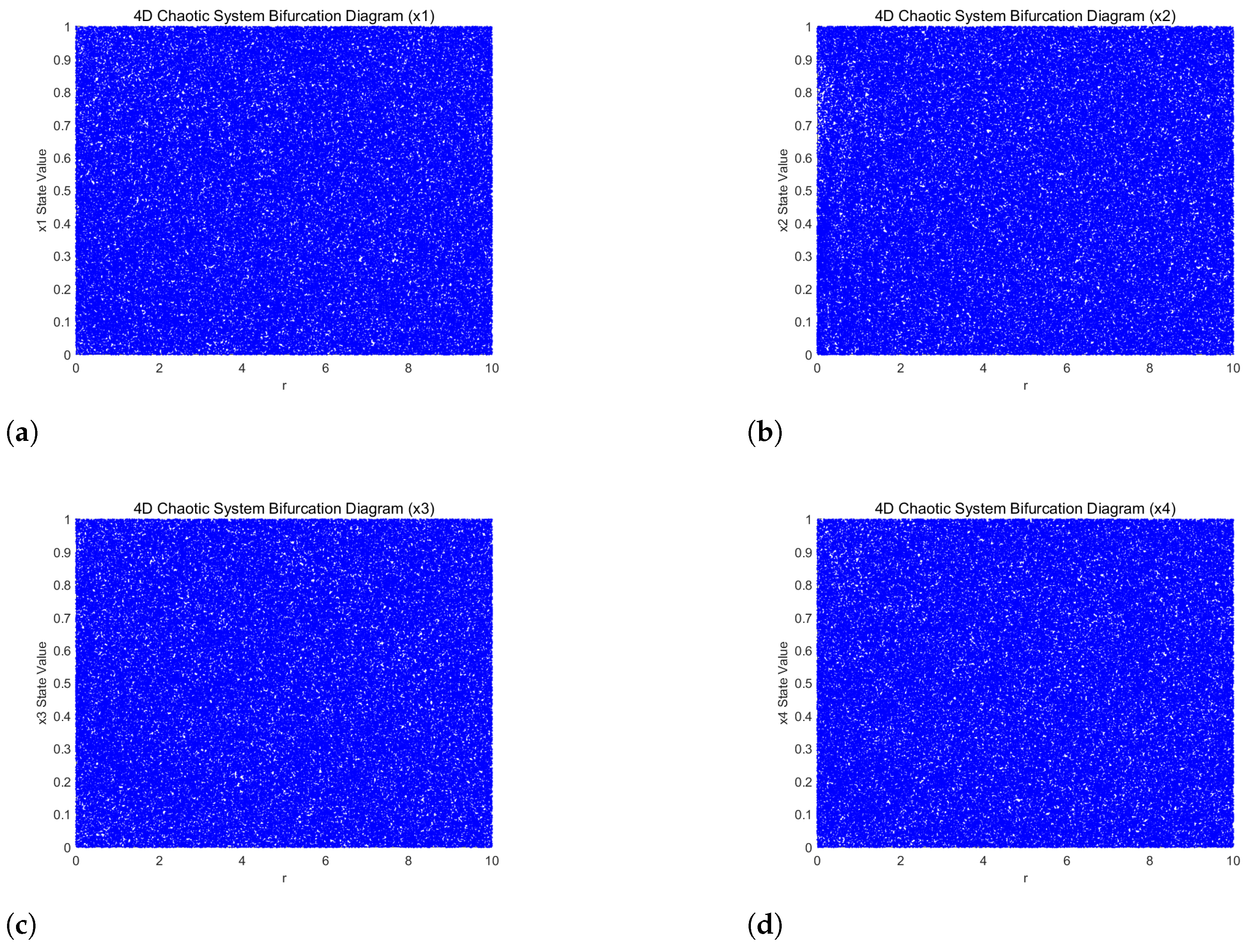
A bifurcation diagram of a chaotic system is a core visualization tool that portrays the long-term dynamical behaviors, enabling intuitive observation of regime transitions. The phase space scatter plot and bifurcation diagram of 4D-DCS is shown in
Figure 1 and
Figure 2. The phase space scatter plots demonstrate a well-distributed, complex attractor structure across pairwise state variable projections. To avoid relying on purely visual inspection of the bifurcation diagrams, quantitative chaos indicators are computed throughout the same parameter range
. In
Figure 1, the trajectory is generated by iterating Equation (
5) for
samples with control parameter
and initial state
; the first
transient iterations are discarded before plotting. In
Figure 2, for each value of the control parameter
r, the system is iterated for
steps and the last
samples are recorded. The control parameter
r is swept over the range
with a step size of
, yielding 1001 parameter values.
2.4. Lyapunov Exponent
The Lyapunov exponent (LE) of a high-dimensional discrete chaotic system can be stably calculated using the QR decomposition method. The core of this method is to separate the perturbation growth factor at each step through the evolution and orthogonal decomposition of the tangent space perturbation, and finally obtain the long-term average exponential separation rate.
For a high-dimensional discrete chaotic system:
where n is the system dimension.
is the non-linear mapping of the system, and
is the state vector at step k.
Construct the initial perturbation matrix
(n-order identity matrix).
For each step
: 1. Find the Jacobian matrix
of the mapping f corresponding to the current state
. 2. Applying the Jacobian matrix to the perturbation matrix
from the previous step yields a new perturbation matrix:
3. Perform QR decomposition on
to decompose it into an orthogonal matrix
and an upper triangular matrix
. 4. Update the perturbation matrix for the next iteration to an orthogonal matrix
.
5. Record the diagonal elements
of the upper triangular matrix
(
). After N iterations, for each perturbation direction i, its Lyapunov exponent is the logarithmic mean of the growth factors of all steps:
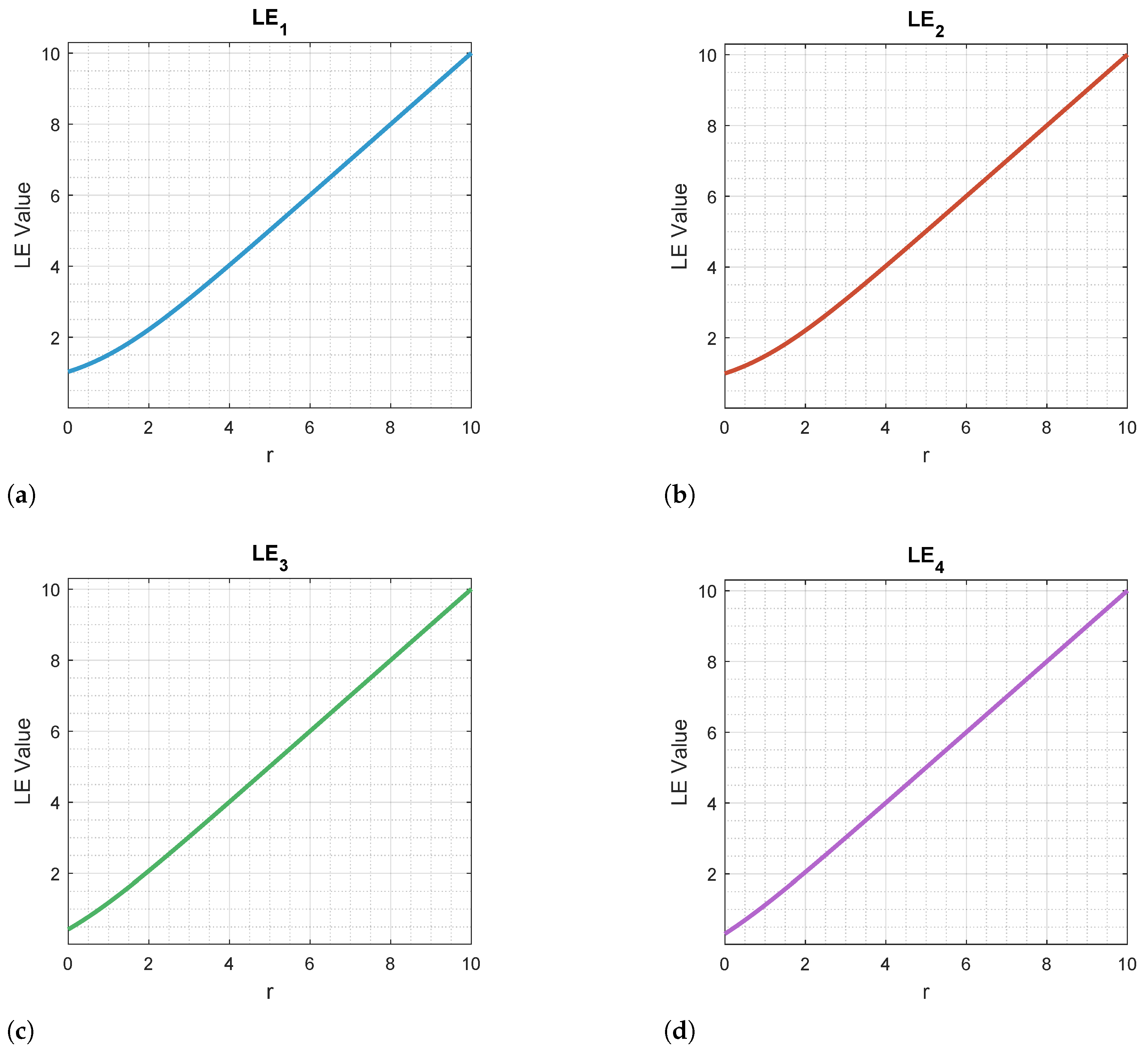
The LE value of 4D-DCS is shown in
Figure 3. One can see that all the LE values are positive, so 4D-DCS is a hyperchaotic system.
2.5. Sample Entropy
Sample entropy is a non-linear metric that measures the complexity of a time series data set. The calculation steps are as follows.
Step 1: Given a raw time series
, extract all consecutive subsequences of length
m from the raw series to form
m-dimensional reconstructed vectors.
Step 2: For each vector
, compute the Chebyshev distance between
and
(
,
).
Step 3: Count the number of vectors
satisfying
. For each
i, calculate the ratio of the matching count to the total number of comparisons (
), denoted as
. The average of all
values is defined as the
m-dimensional matching probability
.
Step 4: Increase the embedding dimension to
and construct
-dimensional reconstructed vectors.
Repeat Step 3 to obtain the average matching probability
for
-dimensional vectors.
SampEn is defined as the negative logarithm of the ratio of
to
:
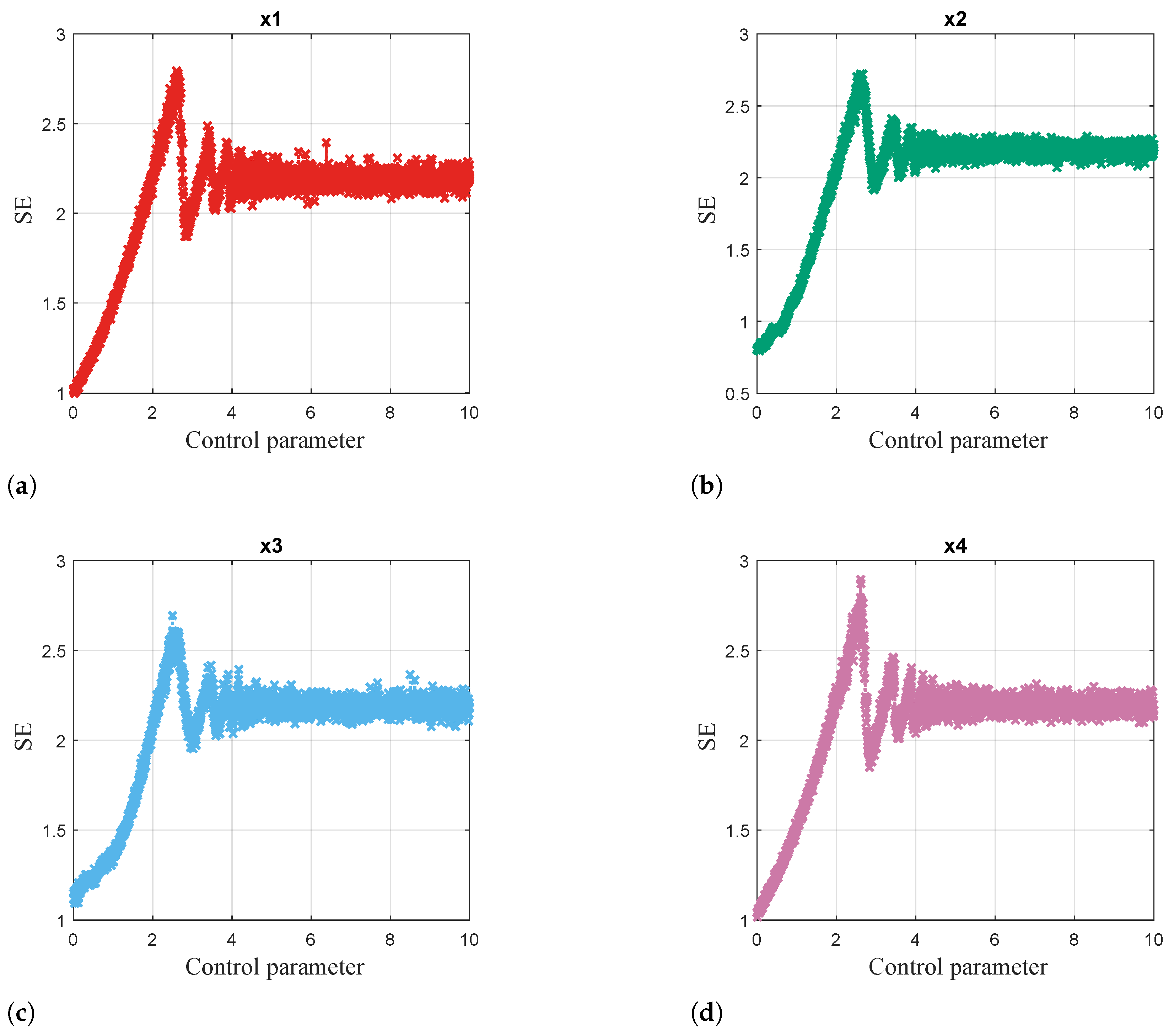
In the simulation, the embedding dimension
m was set to 2, and the similarity tolerance
r was set to
. As shown in
Figure 4, the SE values of all variables rise rapidly with the increase of the control parameter and then stabilize at a high level, indicating the excellent pseudo-randomness of the system.
2.6. 0–1 Test
The 0–1 test is a widely used method for detecting chaos in deterministic time series. It quantifies chaotic behavior through a binary decision index K, where suggests regular dynamics, and indicates chaotic dynamics. The computation of K proceeds as follows:
Given the discrete time series to be analyzed
(
), construct two cumulative sum sequences
and
to characterize the cumulative distribution of the original sequence in the trigonometric domain.
and
correspond to the cumulative cosine and sine components of the sequence, respectively. The translation invariant
describes the statistical characteristics of the distance between the sequence and its translated version.
K is obtained by the logarithmic ratio of the translation invariant
to the number of rounds
n.
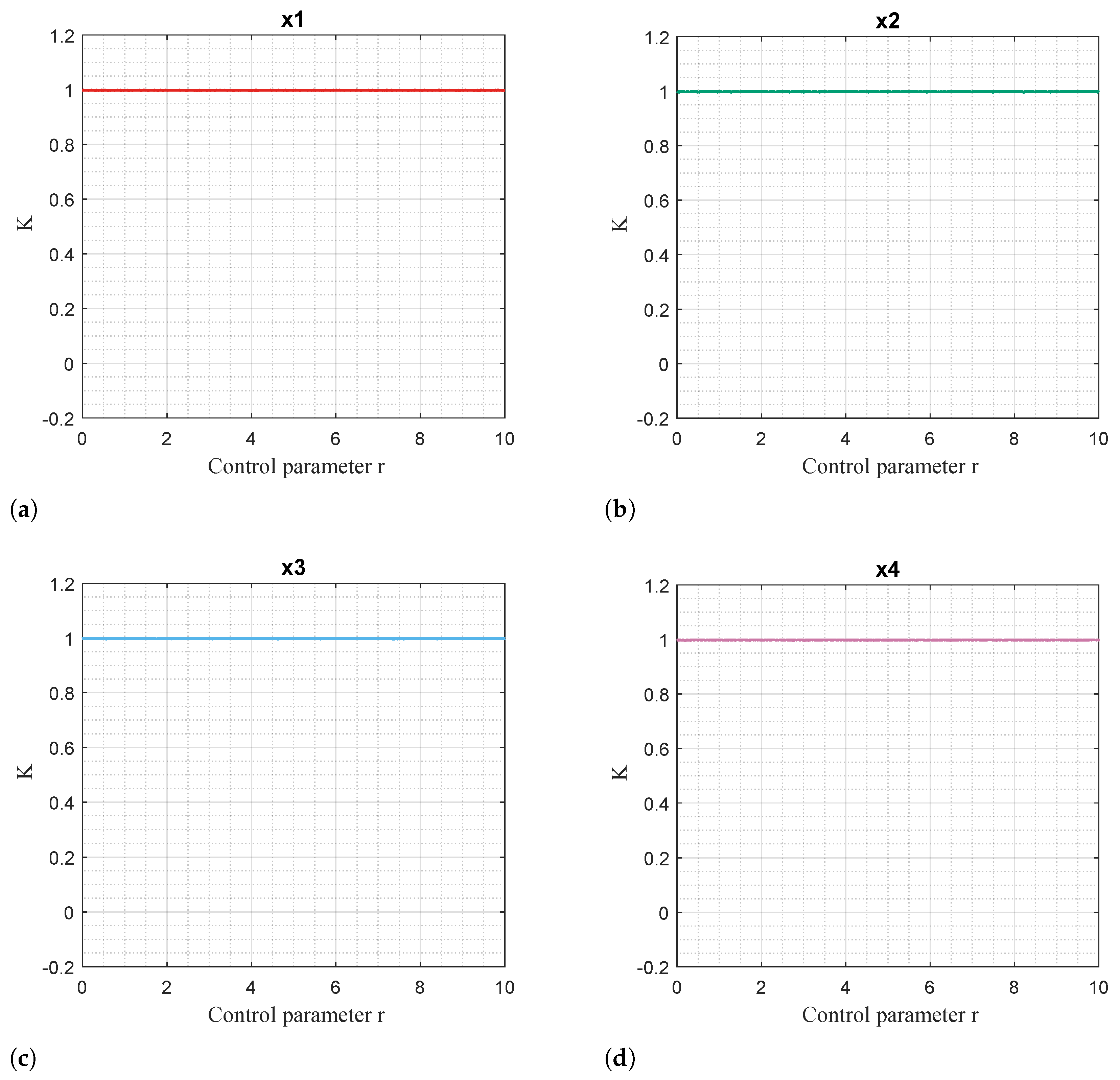
The results is shown in
Figure 5, all the K values are closed to 1, proving that 4D-DCS achieves high randomness performance.
2.7. NIST Test
NIST SP 800-22 is a standard statistical test suite for evaluating the pseudorandomness of bit sequences, commonly applied to verify the quality of chaotic system-generated sequences in cryptographic scenarios. A sequence passes the test if its
p-value for each sub-test exceeds 0.01, signifying adequate pseudorandomness suitable for secure encryption applications. Each 4D-DCS sequence is iterated 125,000 times. The resulting values are multiplied to
and then taken modulo 256, generating 1,000,000 bits for the NIST SP 800-22 pseudorandomness test. The NIST test results of 4D-DCS is shown in
Table 1. All the
p-value of 4D-DCS fall in
, proving that 4D-DCS is suitable for encryption.
2.8. Comparative
Analysis
To verify the superiority of the proposed 4D-DCS, a comparative analysis is conducted by benchmarking it against other state-of-the-art 4D chaotic systems. As summarized in
Table 2, the proposed 4D-DCS achieves an ultra-high maximal Lyapunov exponent of greater than 10—far exceeding the 2.3020 of Ref. [
22] and the sub-1 values of other comparative systems—while maintaining the simplest structural complexity, which make it achieve a superior balance of simplicity, robustness, and practicality.
3. The Proposed Encryption Algorithm
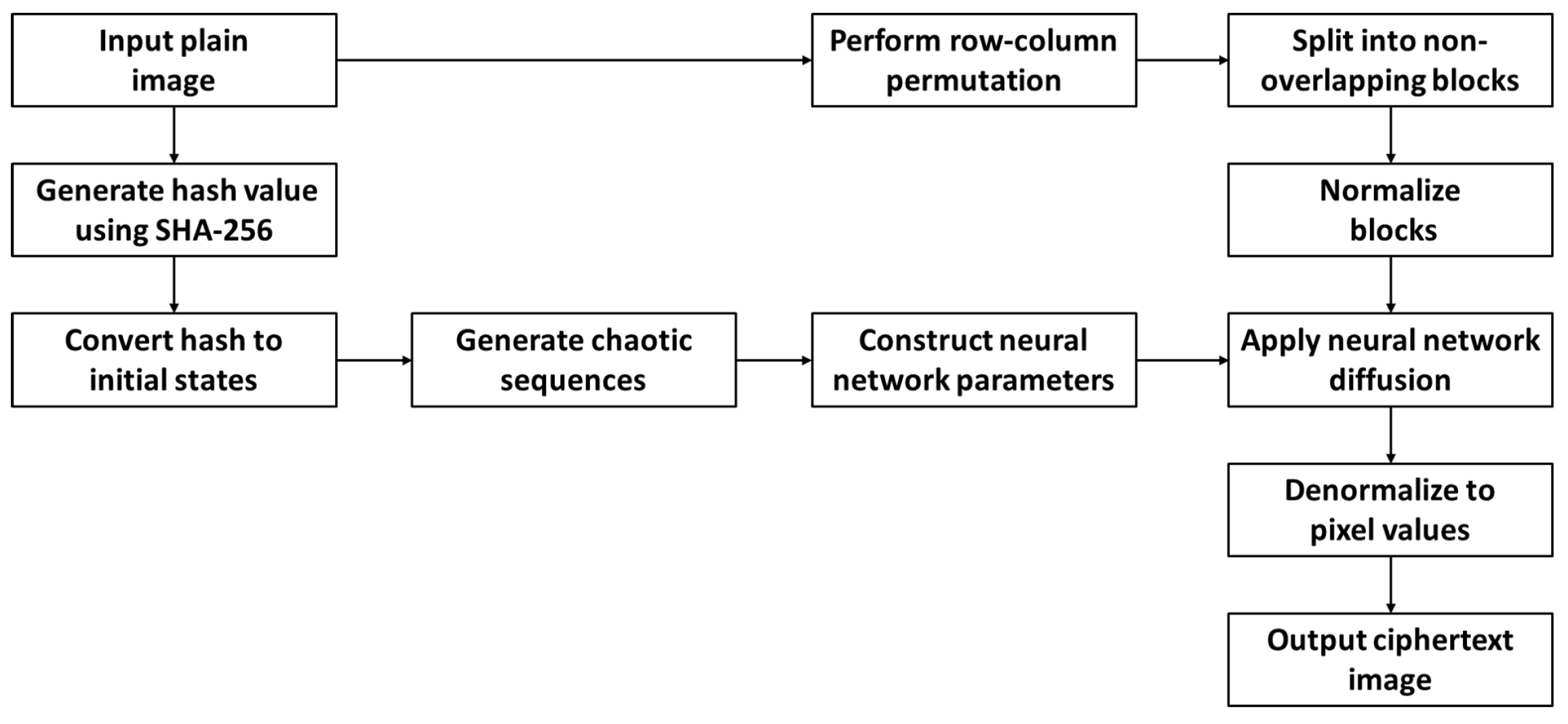
In this section, all the procedure of the proposed encryption algorithm will be introduced, including key generation, permutation and diffusion operation. The flowchart of the proposed algorithm is shown in
Figure 6.
3.1. Key Generation
Initially, for the plain image , the hash value h of the image P is generated through SHA-256 hash function. The initial values of 4D-DCS will be generated through h.
The 64-character hash string is evenly split into four disjoint segments, each containing 16 hexadecimal characters, to ensure balanced randomness across all key elements:
Each segment
(
) corresponds to a 64-bit binary value, and then is converted to a 64-bit decimal integer:
where
is the hexadecimal-to-numeric mapping function, defined as:
To align with the stable initial state range
of the chaotic system, each decimal integer
is linearly mapped to the target interval via the affine transformation:
This transformation guarantees
, which is critical for avoiding chaotic system divergence. Finally, using the mapped initial values
as the initial states, four independent chaotic sequences
are generated via iterative evolution of Equation (
5).
3.2. Permutation Operation
To generate row and column permutation indices,
is split into two disjoint subsequences:
Each element of
and
is then transformed to an integer within the valid index range via modular arithmetic:
Permutation indices are derived by sorting the transformed chaotic subsequences and extracting the sorted indices.
Let
denote the sorting operator. The row and column permutation indices are defined as:
where
and
.
The permuted image
is constructed by reordering the rows and columns of
using
and
.
Here,
denotes the pixel value of
P at row
i and column
j. The permutation is invertible, as
and
can be used to reverse the row/column reordering during decryption.
3.3. Diffusion Operation with a Reversible Neural Network
Compared with conventional element-wise XOR or modular-addition diffusion, employing a reversible neural network (RNN) in the diffusion stage offers three concrete advantages. (i) Strictinvertibility without lookup tables. The linear layer is parameterized by an orthogonal matrix W () generated from the chaotic sequence , so its inverse equals its transpose and decryption is bit-exact, avoiding the rounding errors that often plague non-orthogonal neural ciphers. (ii) Stronger confusion through non-linear coupling. The hyperbolic-tangent activation, combined with the chaotic bias b derived from , induces a highly non-linear input–output mapping at the block level, which propagates a single-bit plaintext change across the entire block in one round and thereby boosts plaintext sensitivity (NPCR/UACI). (iii) Block-parallel computational efficiency. The diffusion is performed in independent blocks via dense matrix multiplications, which can be evaluated in parallel and exhibit a per-pixel cost of (with ) that is asymptotically comparable to a single XOR sweep but with substantially higher diffusion capability per round.
The image
P is split into
non-overlapping
blocks. This yields a block matrix:
where
is the flattened
k-th block.
Each block is normalized to
with block-wise minima/maxima stored for decryption:
where
(block minima) and
(block maxima) are saved for inversion.
An orthogonal matrix is constructed from the chaotic sequence .
The is derived from the chaotic sequence to introduce non-linear offset:
Extract a subsequence from
:
Min–max normalization to
:
Scale with
and reshape to a column vector:
The normalized blocks are transformed via the chaotic neural layer:
A hyperbolic tangent activation (tanh) is applied to introduce non-linearity:
The activated blocks are denormalized back to 8-bit pixel values:
where
(scales
to
). The encrypted block matrix
is reshaped back to the original image dimensions:
where
reverses the block flattening operation. Finally, performed XOR operation between the
and the chaotic sequence
.
Decryption is the reverse process of encryption. First, perform an inverse XOR operation between the ciphertext image and the chaotic sequence , then use the stored block extrema for denormalization reversal, apply the inverse activation and the transpose of the orthogonal matrix W for reverse linear transformation, and recover and reorganize the permuted image blocks. Finally, execute inverse permutation using the row and column permutation indices stored during encryption.
5. Conclusions
This paper proposes a novel four-dimensional discrete chaotic system 4D-DCS constructed by integrating a feedback controller and modulo operation into a linear system, which features simple structure, no chaotic degradation, and excellent pseudorandomness verified by Lyapunov exponent, 0–1 test, and NIST SP 800-22 test. Based on this system, an image encryption algorithm is designed with SHA-256-based key generation, row–column permutation, and reversible neural network-based diffusion. Comprehensive security analysis shows the algorithm achieves ideal NPCR/UACI values, large key space, high information entropy, and strong resistance to differential, statistical, cropping, and noise attacks, outperforming many state-of-the-art methods in terms of balance between security and practicality. Despite the favorable security and complexity properties demonstrated above, the present study has several limitations that should be acknowledged. First, the experimental validation is restricted to 8-bit grayscale natural images; extensions to color images, medical volumetric data, and video streams remain to be empirically verified. Second, the proposed scheme is evaluated purely at the algorithm level on a general-purpose CPU; a dedicated hardware realization that would quantify on-chip throughput, energy efficiency, and side-channel resistance has not yet been carried out. Future work will focus on optimizing the neural network structure and algorithm workflow to improve encryption speed, extending the scheme to video encryption, realizing the proposed system on FPGA/ASIC and memristive crossbar platforms to evaluate its hardware throughput and energy efficiency, and exploring the integration of quantum computing or lightweight cryptographic technologies to enhance its adaptability in more security-critical application scenarios.




 and
and