Traffic-Weighted Detour Ratio Identifies Inefficient Cycling Routes

 , , , , and
Abstract
1. Introduction
2. Data and Methodology
3. Road Network Topology and Detour Ratio of Cycling
4. Interplay Between Travel Modes and Road Networks
5. Identification of Inefficient Cycling Routes
6. Conclusions and Discussion
Author Contributions
Funding
Data Availability Statement
Acknowledgments
Conflicts of Interest
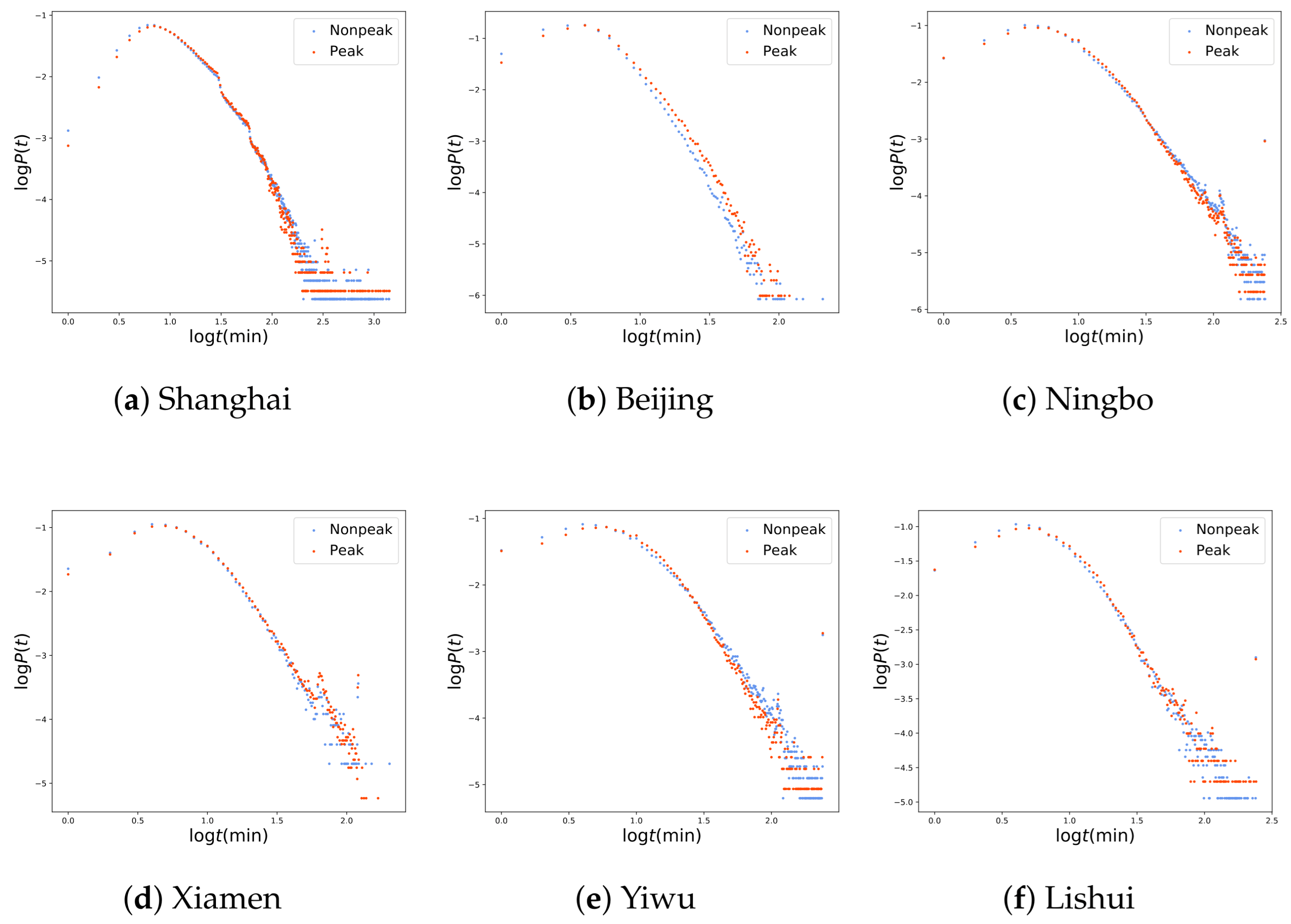
Appendix A. Cycling Duration Distribution

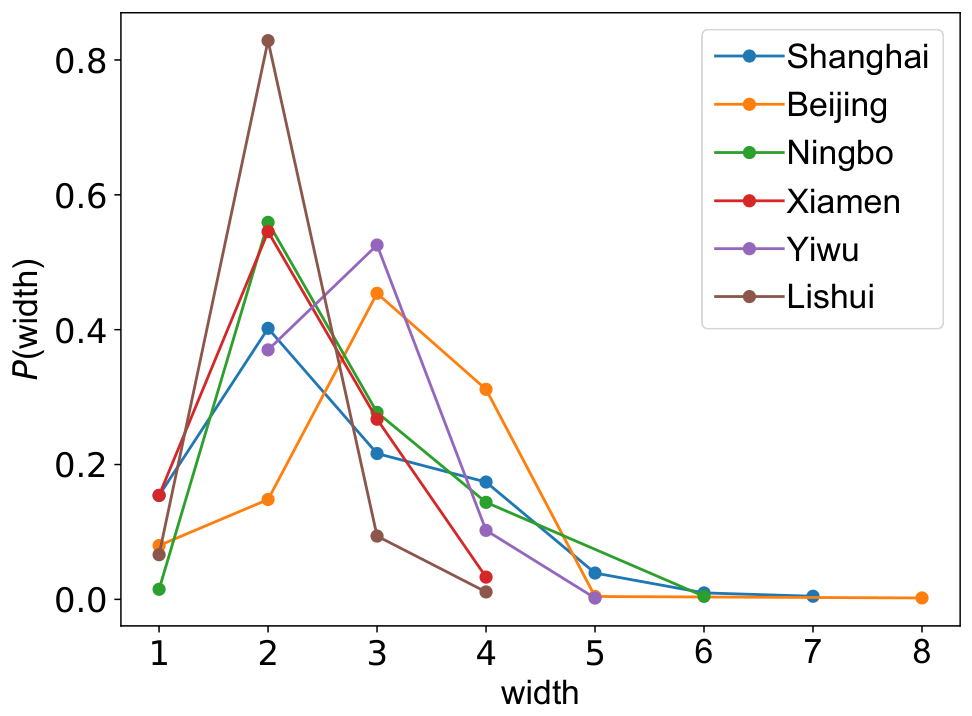
Appendix B. Road Width Distribution

References
- Jacobs, J. The Death and Life of Great American Cities; Random House LLC: New York, NY, USA, 1961. [Google Scholar]
- WHO. A Physically Active Life Through Everyday Transport with a Special Focus on Children and Older People and Examples and Approaches from Europe; Technical Report; WHO Regional Office for Europe: Copenhagen, Demark, 2002. [Google Scholar]
- DeMaio, P. Bike-sharing: History, impacts, models of provision, and future. J. Public Transp. 2009, 12, 3. [Google Scholar] [CrossRef]
- Jäppinen, S.; Toivonen, T.; Salonen, M. Modelling the potential effect of shared bicycles on public transport travel times in Greater Helsinki: An open data approach. Appl. Geogr. 2013, 43, 13–24. [Google Scholar] [CrossRef]
- Diao, M.; Kong, H.; Zhao, J. Impacts of transportation network companies on urban mobility. Nat. Sustain. 2021, 4, 494–500. [Google Scholar] [CrossRef]
- Li, R.; Dong, L.; Zhang, J.; Wang, X.; Wang, W.X.; Di, Z.; Stanley, H.E. Simple spatial scaling rules behind complex cities. Nat. Commun. 2017, 8, 1841. [Google Scholar] [CrossRef]
- Dill, J.; Carr, T. Bicycle commuting and facilities in major US cities: If you build them, commuters will use them. Transp. Res. Rec. 2003, 1828, 116–123. [Google Scholar] [CrossRef]
- Hull, A.; O’Holleran, C. Bicycle infrastructure: Can good design encourage cycling? Urban Plan. Transp. Res. 2014, 2, 369–406. [Google Scholar]
- Life, B. Transforming Cities: The Potential of Everyday Cycling; Technical Report; Sustrans: Bristol, UK, 2019. [Google Scholar]
- Cheng, L.; Mi, Z.; Coffman, D.; Meng, J.; Liu, D.; Chang, D. The Role of Bike Sharing in Promoting Transport Resilience. Netw. Spat. Econ. 2021, 22, 567–585. [Google Scholar] [CrossRef]
- Teixeira, J.F.; Lopes, M. The link between bike sharing and subway use during the COVID-19 pandemic: The case-study of New York’s Citi Bike. Transp. Res. Interdiscip. Perspect. 2020, 6, 100166. [Google Scholar] [CrossRef] [PubMed]
- Jiang, H.; Song, S.; Zou, X.; Lu, L. How Dockless Bike Sharing Changes Lives: An Analysis of Chinese Cities; Technical Report; World Resources Institute: Washington, DC, USA, 2020. [Google Scholar]
- Li, R.; Richmond, P.; Roehner, B.M. Effect of population density on epidemics. Phys. A Stat. Mech. Its Appl. 2018, 510, 713–724. [Google Scholar] [CrossRef]
- Glick, D.M.; Einstein, K.L.; Palmer, M.; Fox, S. 2020 Menino Survey: COVID-19 Recovery and the Future of Cities; Technical Report; Boston University Initiative on Cities: Boston, MA, USA, 2020. [Google Scholar]
- Yang, Y.; Gao, T.; Xu, Z.; Liu, C.; Yang, Y.; Shang, F.; Li, R. Quantifying relation between mobility patterns and socioeconomic status of dockless sharing-bike users. Int. J. Mod. Phys. C 2024, 35, 2450108. [Google Scholar] [CrossRef]
- Li, R.; Gao, S.; Luo, A.; Yao, Q.; Chen, B.; Shang, F.; Jiang, R.; Stanley, H.E. Gravity model in dockless bike-sharing systems within cities. Phys. Rev. E 2021, 103, 012312. [Google Scholar] [CrossRef] [PubMed]
- Sun, Y. Sharing and riding: How the dockless bike sharing scheme in China shapes the city. Urban Sci. 2018, 2, 68. [Google Scholar] [CrossRef]
- Li, R.; Bai, T.; Luo, A.; Yang, Y.; Lü, L.; Fan, J.; Zhang, Y.; Lu, G.; Stanley, H.E. Emergence of scaling in dockless bike-sharing systems for bike choice behavior. J. Phys. Complex. 2025, 6, 025007. [Google Scholar] [CrossRef]
- Martin, E.W.; Shaheen, S.A. Evaluating public transit modal shift dynamics in response to bikesharing: A tale of two US cities. J. Transp. Geogr. 2014, 41, 315–324. [Google Scholar] [CrossRef]
- Shaheen, S.A.; Cohen, A.P.; Martin, E.W. Public bikesharing in North America: Early operator understanding and emerging trends. Transp. Res. Rec. 2013, 2387, 83–92. [Google Scholar] [CrossRef]
- Cavill, N.; Kahlmeier, S.; Racioppi, F. Physical Activity and Health in Europe: Evidence for Action; WHO Regional Office Europe: Copenhagen, Demark, 2006. [Google Scholar]
- Rojas-Rueda, D.; De Nazelle, A.; Tainio, M.; Nieuwenhuijsen, M.J. The health risks and benefits of cycling in urban environments compared with car use: Health impact assessment study. BMJ 2011, 343, d4521. [Google Scholar] [CrossRef] [PubMed]
- Shaheen, S.A.; Guzman, S.; Zhang, H. Bikesharing in Europe, the Americas, and Asia: Past, present, and future. Transp. Res. Rec. 2010, 2143, 159–167. [Google Scholar] [CrossRef]
- Gössling, S.; Schröder, M.; Späth, P.; Freytag, T. Urban space distribution and sustainable transport. Transp. Rev. 2016, 36, 659–679. [Google Scholar] [CrossRef]
- Szell, M. Crowdsourced quantification and visualization of urban mobility space inequality. Urban Plan. 2018, 3, 1–20. [Google Scholar] [CrossRef]
- Hamilton, T.L.; Wichman, C.J. Bicycle infrastructure and traffic congestion: Evidence from DC’s Capital Bikeshare. J. Environ. Econ. Manag. 2018, 87, 72–93. [Google Scholar] [CrossRef]
- Fishman, E.; Washington, S.; Haworth, N. Bike share: A synthesis of the literature. Transp. Rev. 2013, 33, 148–165. [Google Scholar] [CrossRef]
- Noland, R.B.; Ishaque, M.M. Smart bicycles in an urban area: Evaluation of a pilot scheme in London. J. Public Transp. 2006, 9, 5. [Google Scholar] [CrossRef]
- Yang, H.; Ke, J.; Ye, J. A universal distribution law of network detour ratios. Transp. Res. Part C Emerg. Technol. 2018, 96, 22–37. [Google Scholar] [CrossRef]
- Dong, L.; Li, R.; Zhang, J.; Di, Z. Population-weighted efficiency in transportation networks. Sci. Rep. 2016, 6, 26377. [Google Scholar] [CrossRef] [PubMed]
- Cardillo, A.; Scellato, S.; Latora, V.; Porta, S. Structural properties of planar graphs of urban street patterns. Phys. Rev. E 2006, 73, 066107. [Google Scholar] [CrossRef] [PubMed]
- Gastner, M.T.; Newman, M.E. Shape and efficiency in spatial distribution networks. J. Stat. Mech. Theory Exp. 2006, 2006, P01015. [Google Scholar] [CrossRef]
- Coutrot, A.; Manley, E.; Goodroe, S.; Gahnstrom, C.; Filomena, G.; Yesiltepe, D.; Dalton, R.; Wiener, J.; Hölscher, C.; Hornberger, M.; et al. Entropy of city street networks linked to future spatial navigation ability. Nature 2022, 604, 104–110. [Google Scholar] [CrossRef]
- De Fabiis, F.; Baldini, M.; Coppola, P. The impact of geographical context on Bikeability perception: A gender-difference analysis. J. Transp. Geogr. 2026, 131, 104528. [Google Scholar] [CrossRef]
- Arellana, J.; Saltarín, M.; Larrañaga, A.M.; Alvarez, V.; Henao, C.A. Urban walkability considering pedestrians’ perceptions of the built environment: A 10-year review and a case study in a medium-sized city in Latin America. Transp. Rev. 2020, 40, 183–203. [Google Scholar] [CrossRef]
- Feng, X.; Sun, H.; Gross, B.; Wu, J.; Li, D.; Yang, X.; Lv, Y.; Zhou, D.; Gao, Z.; Havlin, S. Scaling of spatio-temporal variations of taxi travel routes. New J. Phys. 2022, 24, 043020. [Google Scholar] [CrossRef]
- Liu, Q.; Chen, C.L.; Cao, M. Exploring the relationship between the commuting experience and hedonic and eudaimonic well-being. Transp. Res. Part D Transp. Environ. 2021, 99, 103026. [Google Scholar] [CrossRef]
- Chen, J.; Zhang, Y.; Zhang, R.; Cheng, X.; Yan, F. Analyzing users’ attitudes and behavior of free-floating bike sharing: An investigating of Nanjing. Transp. Res. Procedia 2019, 39, 634–645. [Google Scholar] [CrossRef]
- Bettencourt, L.M.; Lobo, J.; Helbing, D.; Kühnert, C.; West, G.B. Growth, innovation, scaling, and the pace of life in cities. Proc. Natl. Acad. Sci. USA 2007, 104, 7301–7306. [Google Scholar] [CrossRef]
- Liu, C.; Yang, Y.; Chen, B.; Cui, T.; Shang, F.; Fan, J.; Li, R. Revealing spatio-temporal interacting patterns behind complex cities. Chaos 2022, 32, 081105. [Google Scholar] [CrossRef]
- Black, W.R. Transportation: A Geographical Analysis; Guilford Press: New York, NY, USA, 2003. [Google Scholar]
- Barthélemy, M. Spatial networks. Phys. Rep. 2011, 499, 1–101. [Google Scholar] [CrossRef]
- Louf, R.; Barthelemy, M. A typology of street patterns. J. R. Soc. Interface 2014, 11, 20140924. [Google Scholar] [CrossRef]
- Li, L.; Wan, W.X.; He, S. The Heightened ‘Security Zone’Function of Gated Communities during the COVID-19 Pandemic and the Changing Housing Market Dynamic: Evidence from Beijing, China. Land 2021, 10, 983. [Google Scholar]
- Çolak, S.; Lima, A.; González, M.C. Understanding congested travel in urban areas. Nat. Commun. 2016, 7, 10793. [Google Scholar] [CrossRef]
- Xu, Y.; Li, R.; Jiang, S.; Zhang, J.; González, M.C. Clearer skies in Beijing–revealing the impacts of traffic on the modeling of air quality. In Proceedings of the 96th Annual Meeting Transportation Research Board, Washington, DC, USA, 8–12 January 2017; p. 17-05211. [Google Scholar]
- OpenStreetMap. 2022. Available online: https://www.openstreetmap.org (accessed on 4 January 2023).
- Boeing, G. OSMnx: New methods for acquiring, constructing, analyzing, and visualizing complex street networks. Comput. Environ. Urban Syst. 2017, 65, 126–139. [Google Scholar] [CrossRef]
- Simini, F.; González, M.C.; Maritan, A.; Barabási, A.L. A universal model for mobility and migration patterns. Nature 2012, 484, 96–100. [Google Scholar] [CrossRef]
- Yan, X.Y.; Zhao, C.; Fan, Y.; Di, Z.; Wang, W.X. Universal predictability of mobility patterns in cities. J. R. Soc. Interface 2014, 11, 20140834. [Google Scholar] [CrossRef]
- Yan, X.Y.; Wang, W.X.; Gao, Z.Y.; Lai, Y.C. Universal model of individual and population mobility on diverse spatial scales. Nat. Commun. 2017, 8, 1639. [Google Scholar] [CrossRef]
- Kahn, M.E. Gentrification trends in new transit-oriented communities: Evidence from 14 cities that expanded and built rail transit systems. Real Estate Econ. 2007, 35, 155–182. [Google Scholar] [CrossRef]
- Olmos, L.E.; Tadeo, M.S.; Vlachogiannis, D.; Alhasoun, F.; Alegre, X.E.; Ochoa, C.; Targa, F.; González, M.C. A data science framework for planning the growth of bicycle infrastructures. Transp. Res. Part C Emerg. Technol. 2020, 115, 102640. [Google Scholar] [CrossRef]
- Szell, M.; Mimar, S.; Perlman, T.; Ghoshal, G.; Sinatra, R. Growing urban bicycle networks. Sci. Rep. 2022, 12, 6765. [Google Scholar] [CrossRef] [PubMed]
- Brockmann, D.; Hufnagel, L.; Geisel, T. The scaling laws of human travel. Nature 2006, 439, 462–465. [Google Scholar] [CrossRef] [PubMed]



| City | Platform | #Orders | Period (MM/DD,YY) | #Users | #Bikes | Population | Area | GDP |
|---|---|---|---|---|---|---|---|---|
| Shanghai | Mobike | 1.02 | 08/01–08/31, 2016 | 0.017 | 0.300 | 24.89 | 6340.00 | 4470 |
| Beijing | Mobike | 3.20 | 05/10–05/24, 2017 | 0.350 | 0.485 | 21.89 | 16,455.13 | 4160 |
| Ningbo | Hellobike | 1.62 | 09/14–09/27, 2020 | 0.256 | 0.049 | 4.47 | 1147.76 | 1570 |
| Xiamen | Aggregated | 0.22 | 12/21–12/25, 2020 | NA | 0.053 | 2.11 | 192.74 | 780 |
| Yiwu | Hellobike | 0.39 | 09/14-09/27, 2020 | 0.089 | 0.021 | 1.89 | 575.66 | 184 |
| Lishui | Hellobike | 0.18 | 09/14–09/27, 2020 | 0.031 | 0.014 | 0.57 | 225.50 | 183 |
| Time | Shanghai | Beijing | Ningbo | Xiamen | Yiwu | Lishu |
|---|---|---|---|---|---|---|
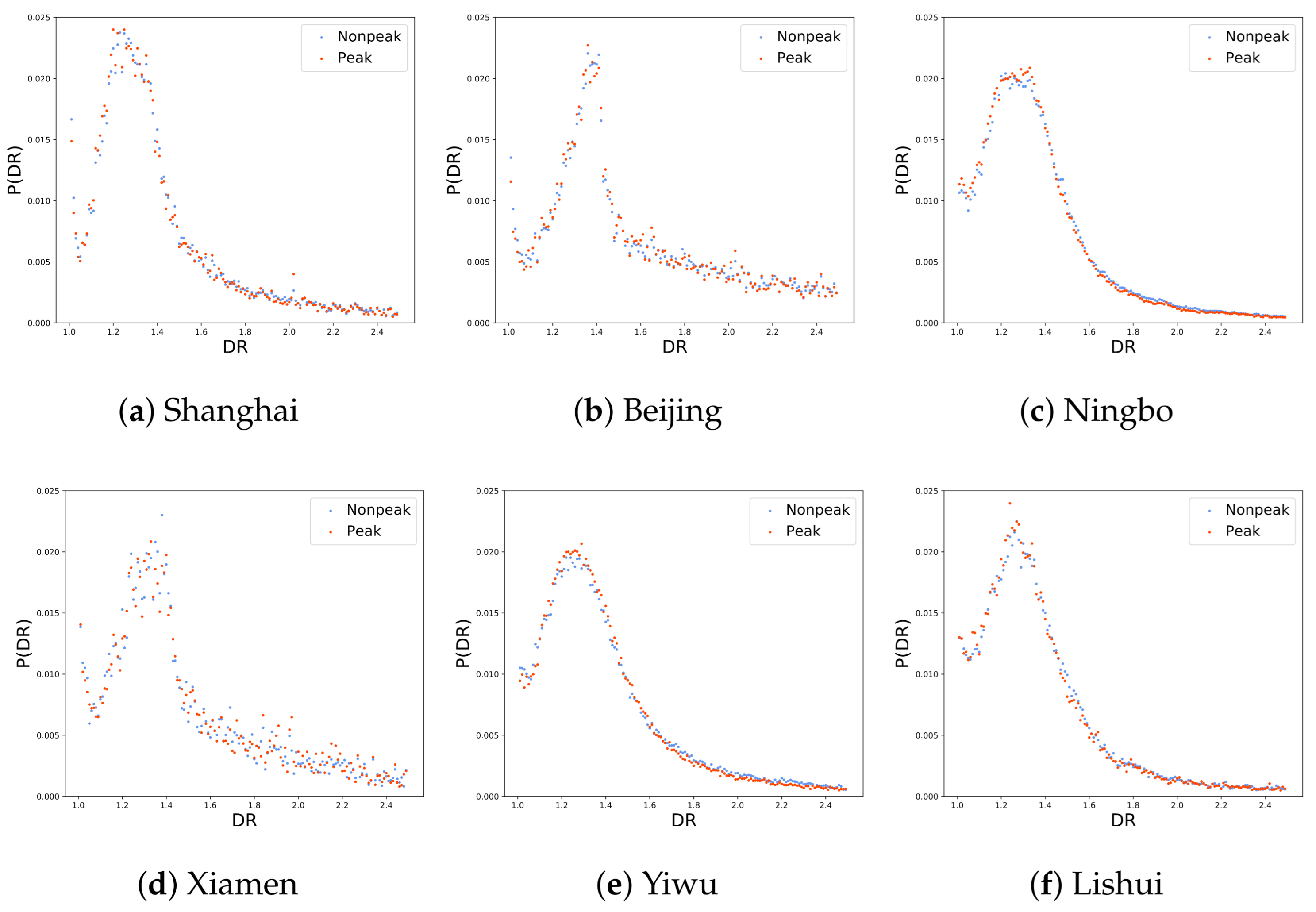
| Peak | 1.33 | 1.56 | 1.29 | 1.42 | 1.30 | 1.28 |
| Nonpeak | 1.33 | 1.59 | 1.29 | 1.40 | 1.30 | 1.29 |
Disclaimer/Publisher’s Note: The statements, opinions and data contained in all publications are solely those of the individual author(s) and contributor(s) and not of MDPI and/or the editor(s). MDPI and/or the editor(s) disclaim responsibility for any injury to people or property resulting from any ideas, methods, instructions or products referred to in the content. |
© 2026 by the authors. Licensee MDPI, Basel, Switzerland. This article is an open access article distributed under the terms and conditions of the Creative Commons Attribution (CC BY) license.
Share and Cite
Qiu, X.; Gao, T.; Yu, J.; Wang, J.; Zhang, Y.; Li, R. Traffic-Weighted Detour Ratio Identifies Inefficient Cycling Routes. Entropy 2026, 28, 670. https://doi.org/10.3390/e28060670
Qiu X, Gao T, Yu J, Wang J, Zhang Y, Li R. Traffic-Weighted Detour Ratio Identifies Inefficient Cycling Routes. Entropy. 2026; 28(6):670. https://doi.org/10.3390/e28060670
Chicago/Turabian StyleQiu, Xinze, Tianli Gao, Jingru Yu, Jianying Wang, Yongping Zhang, and Ruiqi Li. 2026. "Traffic-Weighted Detour Ratio Identifies Inefficient Cycling Routes" Entropy 28, no. 6: 670. https://doi.org/10.3390/e28060670
APA StyleQiu, X., Gao, T., Yu, J., Wang, J., Zhang, Y., & Li, R. (2026). Traffic-Weighted Detour Ratio Identifies Inefficient Cycling Routes. Entropy, 28(6), 670. https://doi.org/10.3390/e28060670